Tag Archives: spiritual

DOCTRINE OF KARMA AND REINCARNATION

Copyright@shravancharitymission


    Why do Hindus believe in these two doctrines? One being karma and the other being reincarnation. Because these doctrines not only explain the unusual occurrences logically. They also shed light on day-to-day events of life. Hindus do not consider life and death to be mutually exclusive. But intertwined and inseparable. Like the two sides of the same coin. If there are disparities between two individuals at the time of birth, and if these disparities can be seen. Then the cause for these disparities must have preceded their births.

  • Karma: The word karma means “action.” In accordance with the cosmic laws of karma. Each individual reaps the fruits of his actions, performed in this lifetime or in former lives. This logically explains the disparities in creation, between various individuals, environments and situations. No deed, small or great, good or bad, can be without an effect—this essentially is the law of karma, the law of casualty. In fact one begins to feel as if it is Newton’s 3rd law of motion—‘to every action there is an equal and opposite reaction’ was drawn out of the doctrine of karma.
  • Karma is no fate. Fate implies helplessness in a human being, to determine his own destiny. The law of karma states that the individual is the creator of his own destiny, because his conscious choices in life determines his actions and the fruits thereof.
  • Reincarnation: Hindus believe that the jiva, or the individual being, travels from life to life. Acquiring bodies and environments best suited to exhaust his vasanas (vices) or innate tendencies that are expressed as desires, emotions, and actions. The exhaustion of vasanas allows the jiva to reach his ultimate goal: complete freedom from the cycle of birth and death through the realization of his true nature as the Self, or Brahman.

—synopsis from a book on Hinduism—by Chinmaya Mission Trust—

*

By Kamlesh Tripathi

*

https://kamleshsujata.wordpress.com

*

Share if you like it

*

Shravan Charity Mission is an NGO that works for poor children suffering from life threatening diseases. Should you wish to donate for the cause the bank details are given below:

NAME OF ACCOUNT: SHRAVAN CHARITY MISSION

Account no: 680510110004635 (BANK OF INDIA)

IFSC code: BKID0006805

*

Our publications

GLOOM BEHIND THE SMILE

(Archived in 7 prestigious libraries of the US, including, Harvard University and Library of Congress. It can also be accessed in MIT through Worldcat.org. Besides, it is also available for reading in Libraries and archives of Canada and Cancer Aid and Research Foundation Mumbai)  

ONE TO TANGO … RIA’S ODYSSEY

(Archived in Connemara Library, Chennai and Delhi Public Library, GOI, Ministry of Culture)

AADAB LUCKNOW … FOND MEMORIES

(Launched in Lucknow International Literary Festival 2014)

REFRACTIONS … FROM THE PRISM OF GOD

(Co-published by Cankids–Kidscan, a pan India NGO and Shravan Charity Mission, that works for Child cancer in India. The book is endorsed by Ms Preetha Reddy, MD Apollo Hospitals Group. Book was launched in Lucknow International Literary Festival 2016)

(CAN BE BOUGHT FROM ON LINE BOOK STORES OR WRITE TO US FOR COPIES)

*****


THE SPIRITUAL SIGNIFICANCE OF JOINING PALMS OR ‘NAMASTE’

Copyright@shravancharitymission


    The ancient and traditional greeting of ‘namaskar’ or ‘namaste’ is for one and all. It is done reverently by joining the palms at the chest and humbly bowing the head. Namaskar or Namaste is a form of prostration and salutation and has profound spiritual and ego bearing significance.

    In Sanskrit, namah + te = Namaste. It means, ‘I bow to you along with my prostrations and salutations.’ Namah can also be interpreted as na mama, which in the literal sense would mean, “not mine.” The purpose of saying Namaste is thus to negate one’s ego. Rather separate yourself from your ego and recognize the Divine in every person we greet. And, as we feel the Lord God resides in us. In the same manner we feel, it resides in others too. The joining of the palms depicts this sense of oneness. When we know this significance. Our greeting paves the way for a deeper and divine communion, complete with love and respect.

    Translated from a religious text.

*

Posted by Kamlesh Tripathi

*

                                                    https://kamleshsujata.wordpress.com

*

Share if you like it

*

Shravan Charity Mission is an NGO that works for poor children suffering from life threatening diseases. Should you wish to donate for the cause the bank details are given below:

NAME OF ACCOUNT: SHRAVAN CHARITY MISSION

Account no: 680510110004635 (BANK OF INDIA)

IFSC code: BKID0006805

*

Our publications

GLOOM BEHIND THE SMILE

ONE TO TANGO … RIA’S ODYSSEY

AADAB LUCKNOW … FOND MEMORIES

REFRACTIONS … FROM THE PRISM OF GOD

(CAN BE BOUGHT FROM ON LINE BOOK STORES OR WRITE TO US FOR COPIES)

*****


SUPPORT CHILDREN WITH SPECIAL NEEDS

Copyright@shravancharitymission

By Kamlesh Tripathi

1
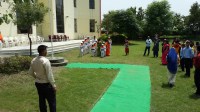
Participants waiting for the flag to unfurl
2
flag hoisting area


SUPPORT CHILDREN WITH SPECIAL NEEDS


RAMANUJAN DIVYANG REHABILITATION & SKILL DEVELOPMENT CENTER- A NOBLE EFFORT


My mother’s birthday falls on the 15th of August—that happens to be our Independence Day. She is now no more, but I continue to remember and celebrate her birthday each year in a virtuous manner. And, pursuing the cause as ever, I wanted to do something different again this time, when I came to know that Ramanujan Divyang Rehabilitation & Skill Development Centerlocated in Palwal is celebrating the Independence Day in a noble manner, so I decided to visit them on that day. The center works for children with special needs. And on the occasion of the Independence Day they had planned for a musical extravaganza where all the protagonists were children who were hearing impaired.

The programme commenced with the chief guest Shri Vipul Goyal, a cabinet minister in Government of Haryana, in charge for Industries, performing the flag hoisting in the presence of these noble yet daring children, followed by a spell of bright and colourful cultural programmes of dance and music performed by the same children.

Needless to say it was a tough task for these children to have stepped, toed, and danced to the soothing rhythms of the gentle music that was being played, that provided no hearing stimulus to them, yet the show went off as immaculate.

7
Minister handing over awards


Apart from the chief guest the programme was also well attended by Shri Tek Chand Sharma M.L.A.; Shri Deepak Mangla—political secretary to the chief minister; Shri Ashok Kumar Sharma—deputy commissioner Palwal; Shri Rahul Sharma—superintendent of police Palwal; Shri Bijender Saroth—President, District Red Cross Society and Shri Jawahar Singh—district president, BJP. As a kind gesture an amount of Rs 50,000 was announced as donation by the honourable minister who was too moved by the spirits of these children.

At this august moment Dr Rajeev Mohan Kukreja—founder Chairman, and Dr Sujata Tripathi—Director of the center were also present.

There isn’t much need for me to describe the function anymore as the pictures will say it all. But what should not go unnoticed is the glimmer of hope in the eyes of both the children and their parents. We all do enough for ourselves and our children but it requires something extra in you to step out and do something for others and especially children with special needs.

Below is a synopsis of what the center does and you could join the cause by donating liberally.

Ramanujan Divyang Rehabilitation & Skill Development Center


About Us


    We are a self sustained educational society of great repute located in one of the backward districts of Southern Haryana, where we are running a ‘facility center’ for children with special needs since 2013. Through this facility center we are imparting specific therapies along with training and education for their overall betterment, as we want all such children to be cognitively and financially self-reliant. And as a first step towards this goal we are providing them with vocational and computer training. Our center, vow’s for good benchmarks and keeping in line with that we have evolved the values of three “S” that we are currently pursuing: a. Self Confidence b. Skill Enhancement c. Self dependent.


  1. FACILITY FOR CHILDREN WITH SPECIAL NEEDS


The center has identified more than 100 children with special needs from nearby villages & Palwal town, and has started a facility center in order to provide them with therapies, together with training & education. It has two sections namely MR (Mentally Retarded) & HI (Hearing Impaired). And we are happy to inform you that today over 30 such students are training under this noble and demanding mission on a regular basis. The center has also appointed two special educators & a speech therapist registered with RCI having required qualification, along with other support staff.


  • VOCATIONAL TRAINING AND SKILL DEVELOPMENT


We intend to cover as many Divyang children and adults to bring them under the central umbrella of ‘mainstream earning members’ in the family and society, by imparting vocational & computer training that they are capable of learning. We also intend training rural women who are unable to travel to towns or cities away from their homes. And for the purpose, the center runs the following programs and has simultaneously applied to (NIOS) National Institute of Open Schooling, for affiliation and accreditation of the following courses:


  • Cutting & Tailoring
  • Indian Embroidery
  • Basics & Advance Computer Training


  • Project ‘SWAVALAMBAN’ — FOR WOMEN & DIVYANGS


Rural women and Divyang persons are often exploited since they are financially not independent. Project Swavalamban is a brain child of Ramanujan Foundation to provide employment exclusively to rural women & Divyang

persons. Swavalamban means ‘Self Dependent’ or “Having Freedom of Action or Initiative/Decisions.” Under project ‘Swavalamban’ our center inculcates and develops skills as per capabilities of the learner & subsequently provides them with raw material to work with. Produced artifacts thereafter are retailed in the market under the brand name “Swavalamban”. This makes it convenient for them to work out of their homes and simultaneously facilitates them to even look after their families. Thus: people involved in project Swavalamban will no longer be a liability for their family and society and will earn their livelihood with self respect.


Currently on a pilot basis following products are being produced by these people:


  1. Hand Knitted Sweaters for ladies, gents, kids and infants.
  2. Embroidered home furnishing such as bed-sheets, pillow covers, table cloths etc.
  3. Handmade dari (rug) from waste wool.


BUT WE NEED HELP


Most children enrolled in the facility-center are from a very poor background. They are unable to pay any fee for such facilities. Till date Ramanujan Foundation and its team were bearing all the expenses. But due to down turn in education sector leading to severe downturn in our own revenues the foundation for now is finding it difficult to bear the cost of center. Hence the humble request, to all our well wishers, patrons and like-minded people to kindly donate as generously as possible for the noble cause.


Our website: www.ramanujan.edu.in

E-mail: info@ramanujan.edu.in


Special significance of number 18 in Hindu scriptures

Copyright@shravancharitymission


    Number 18 unquestionably has a great significance in Hindu scriptures. Apart from the fact that there are 18 Purans, 18 major Up-purans, and 18 Dharm-Shastras. The importance of number 18 is best explained in the great epic of Mahabharat, which is divided into 18 parvas or sections. The great war of Mahabharat was fought with 18 divisions of army. And out of this 11 were on the side of Kauravas and 7 on the side of Pandavas. The war lasted for 18 days. Finally, it is said that only 18 persons survived the war. The treatise Shrimad Bhagwad Gita is a part of Mahabharat and has 18 chapters. In Gita, Lord Krishna describes the ideal man in 18 verses at the end of Chapter 2, in which he lists the 18 traits that constitute the man with a steady wisdom.

    The central theme of all scriptures of all religions in the world are the same: Prime being the victory of the higher being over the lower one, or righteousness over unrighteousness, or of good over the evil, of dharma over adharma. Ved Vyas had originally titled Mahabharat as Jaya (victory). The word Jaya is in the opening stanzas of both Mahabharat and Gita.

    In the KatapayadiSystem (numerical notation system) of Sanskrit numerology, each letter has a formula-based numerical value, where the numerical value of the word Jaya is 18. To stress on the importance of the word Jaya, number 18 is given a prominent place not only in Mahabharat, but also in various other Hindu scriptures. Thus, number 18 is repeatedly used as an auspicious reminder, to be alert in our constant battle, for inner spiritual victory.

(taken from Hindu scriptures)

By Kamlesh Tripathi

*****

POEM: RIGHT OR WRONG

Copyright@shravancharitymission

Share it if you like.


I was right and he was wrong,

And that brought about the storm,

No! she was wrong and I was right,

And that brought about the enduring strife.

*

In the race of life,

I always made my wrong look like right,

And, his right look wrong.

But all that required,

 A lot of treacherous brainstorm.

*

For no one could realize,

 In the rhythm of life,

Right and wrong,

Were only the two sides of the golden coin.

*

And what mattered in the cruise of life,

Was, the proud possession of the coin,

And, not the two deadly sides,

In the spiral of right and wrong.

*

And as my life meandered along,

There came a day when I turned blind,

Is when I lost the coin,

And what was left with me,

Were only the two sides without the coin,

My right and his wrong.

*

I then realized,

In the speed and greed of life,

When my wrongs outweighed my rights,

God took away whatever I liked.

*

And when I began entering my twilight,

I painstakingly realised,

Neither was right and neither was wrong,

As it was only a lethal battle of ego, rage and the storm.

*

Then sadly one day,

The ego eclipsed,

Storm vanished,

Rage retired,

As my partner expired.

*

And that made me realise,

He too was right,

And I too was wrong,

And that had brought about the blazing storm,

But by then it was too late for a new dawn.

***

Man is born with zero balance of ego but during the journey of life he accumulates ego like no one’s business. That happens to be the main reason for most clashes that doesn’t even spare loving couples.

by Kamlesh Tripathi

Our NGO works for poor children suffering from life threatening diseases. If you wish to contribute for the cause. The bank details are below:

NAME OF ACCOUNT: SHRAVAN CHARITY MISSION

                                  Account no: 680510110004635 (BANK OF INDIA)

                                  IFSC code: BKID0006805

*****

‘MANVANTARA’—THE METHOD OF TIME CALCULATION

Copyright@shravancharitymission


    Hindu calculation of time is based on ‘manvantara.’ Antara means “space” or “duration between.” Manvantara is therefore a period of time or duration, during which a Manu (the archetypal human being) rules the entire creation. Hindus developed the skill of calculating time based on manvantaras. Western scientists and archaeologists later discovered. That these manvantaras are based on accurate astronomical calculations.

    One manvantara is calculated as follows:

  • 360 human years make one divya varshs (celestial year)
  • 4,800 divya varshas make one Satya Yuga, or Krita Yuga.
  • 3,600 divya varshas make one Treta Yuga.
  • 2,400 divya varshas make one Dvapara Yuga.
  • 1,200 divya varsha make one Kali Yuga.

    All the yugas together total to 12,000 divya varshas. This one cycle of all the yugas makes one Maha-Yuga or Chatur-Yuga. One Manvantara=71 Maha-yugas, or 306,720,000 human years. One Kalpa, or cycle of creation, preservation, and destruction=14 manvantaras. and thus the cycle of time continues.

    At the beginning of each manvantara, a Manu appears and codifies all ethical and social regulations to be followed during the manvantara. The Manu whose code is currently being followed is Vaivasvata Manu, who is the seventh in the line of the cycle of 14 Manus. The six Manus who preceded Vaivasvata Manu were: Svayambhuva, Svarochisha, Uttama, Tamasa, Raivata and Chakshusha. The seven who will follow Vaivasvata Manu are: Savarni, Daksha-savarni, Brahma-savarni, Dharma-savarni, Rudra-savarni, Deva-savarni and Indra-savarni.

Extracted from a Hindu holy granth.

*

By Kamlesh Tripathi

*

https://kamleshsujata.wordpress.com

*

Share if you like it

*

Shravan Charity Mission is an NGO that works for poor children suffering from life threatening diseases. Should you wish to donate for the cause the bank details are given below:

NAME OF ACCOUNT: SHRAVAN CHARITY MISSION

Account no: 680510110004635 (BANK OF INDIA)

IFSC code: BKID0006805

*

Our publications

GLOOM BEHIND THE SMILE

(Archived in 7 prestigious libraries of the US, including, Harvard University and Library of Congress. It can also be accessed in MIT through Worldcat.org. Besides, it is also available for reading in Libraries and archives of Canada and Cancer Aid and Research Foundation Mumbai)  

ONE TO TANGO … RIA’S ODYSSEY

(Archived in Connemara Library, Chennai and Delhi Public Library, GOI, Ministry of Culture)

AADAB LUCKNOW … FOND MEMORIES

(Launched in Lucknow International Literary Festival 2014)

REFRACTIONS … FROM THE PRISM OF GOD

(Co-published by Cankids–Kidscan, a pan India NGO and Shravan Charity Mission, that works for Child cancer in India. The book is endorsed by Ms Preetha Reddy, MD Apollo Hospitals Group. Book was launched in Lucknow International Literary Festival 2016)

(CAN BE BOUGHT FROM ON LINE BOOK STORES OR WRITE TO US FOR COPIES)

*****


THE TWO MAJOR HISTORICAL EPICS IN HINDUISM-VALMIKI, TULSIDAS AND VED VYAS

Copyright@shravancharitymission


    Had it not been for the ultimate epic writers and sages such as Valmiki and Tulsidas who wrote Ramayan, and Ved Vyas who wrote Mahabharat. Hinduism would have remained incomplete and perhaps in the confines of God alone. It is only because of these great all time writers. The history of Hinduism has spread so comprehensively all across the world since inception.

    Ramayan and Mahabharat are the two historical sagas referred as Itihas (history) in Hinduism. That serves as the eternal inspiration for humanity and is considered as the putative and exemplary realization of the four … purusharthas (efforts): Dharma (righteous and dutiful) Artha (wealth) Kama (desire and fulfillment) and Moksha (liberation).

    Ramayan in the real sense is the ‘abode of Lord Ram’ and is smaller of the two great works. The tireless epic mirrors the highest ideals of Hindu tradition, culture and civilization. The story relates to Treta Yug (one of the four ages of the world) and centers on Ram. The prince of Ayodhya and the incarnation of Lord Vishnu, and his wife Sita as the incarnation of Mother Lakshmi. Ramayan sings the glory of Lord Ram and advises humanity on how to lead a fulfilling life and attain the four purusharthas. The epic is profound and timeless in its popularity. It teaches with the analogy of symbolism. As to how an individual can evolve into greatness and perfection.

    Sage Valmiki’s Ramayana has been translated into most Indian languages, as well as several foreign languages, including Russian. It consists of 24,000 stanzas in seven cantos, and depicts Rama as the ideal king, son, brother, friend, and husband. In Bharat, Lakshman, and Shatrughan, we see exemplified ideal brothers. In Sita, we have the purest flower of Indian womanhood. Who is devoted to her Lord in thought, word, and deed.

    Ramayana is an ideal textbook of morals and values. That inspires nobler dimensions of character and conduct. Other noteworthy and famous versions of Ramayana include Sage Veda Vyasa’s Adhyatma Ramayana, Goswami Tulsidasa’s Shri Ramcharitamanas (Tulsi Ramayana), and Kambar’s Kamba Ramayana.

    Mahabharat on the other hand is an epic. That is more than eight times the size of Homer’s Iliad and Odyssey combined. In philosophical content it is unparalleled to any other literary work in the world. This grand book of knowledge contains more than 100,000 stanzas in 18 chapters and is the work of the renowned Sage Veda Vyasa.

    The underlying theme of Mahabharata is yato dharma tato jayah, “where there is dharma, there is victory.” Indicating the ultimate triumph of good over evil and the establishment of righteousness.

    The story unfolds toward the end of Dvapara Yuga and describes the genealogy and events leading up to, and after, the familial war between the royal cousins.

    The story is used as a vehicle. To convey eternal philosophical truths of the highest order. It is said, “that which is in Mahabharata can be seen elsewhere, but that which is not there cannot be seen anywhere else.” This gives an idea of the comprehensiveness of subjects in the epic. Which is full of lofty instructions on all aspects of human life and endeavour—an inspiring saga of India’s past glory, portraying all that is great and noble in humanity.

    The guiding spirit throughout the epic is the divine figure of Lord Krishna. Who brings the pure and the righteous to Himself, and destroys the evil and the evildoers. Shrimad Bhagwad Gita or the “Lord’s Song” is part of Mahabharata.


*

Posted by Kamlesh Tripathi

*

                                                   https://kamleshsujata.wordpress.com

     *

Share if you like it

*

Shravan Charity Mission is an NGO that works for poor children suffering from life threatening diseases. Should you wish to donate for the cause the bank details are given below:

NAME OF ACCOUNT: SHRAVAN CHARITY MISSION

Account no: 680510110004635 (BANK OF INDIA)

IFSC code: BKID0006805

*

Our publications

GLOOM BEHIND THE SMILE

ONE TO TANGO … RIA’S ODYSSEY

AADAB LUCKNOW … FOND MEMORIES

REFRACTIONS … FROM THE PRISM OF GOD

(CAN BE BOUGHT FROM ON LINE BOOK STORES OR WRITE TO US FOR COPIES)

*****


STORY: MAHABHARAT-DRONACHARYA AND EKLAVYA

Copyright@shravancharitymission


     Once while Dronacharya was imparting astra-shastra (Astra– is a fierce form of mantra that comprises of destructive frequency. Shastra– is essentially a physical weapon) training to Kurukul children (Kauravas and Pandavas) in Hastinapur, a black and tough appearing Bheel (tribal) child came up to him. He first bowed and said ‘pranam!’ (greetings) and then said—‘Acharya! (teacher) my name is Eklavya. I have come with the hope that you will be kind enough to teach me astra management, as you are teaching these children.’

    Acharya, though, he appreciated the humbleness of the child. He couldn’t have given permission to a Bheel to stay with the Rajkumars (princes). He therefore said—‘Son! For mere knowledge of weapons to hunt animals you can ask your Guru to teach you. But as far as learning of astra is concerned it is not a must for you, as the same is required only when you have to rule a kingdom or fight a war.’

    Upon hearing this Eklavya was disheartened. But his enthusiasm did not die down. He was determined to learn astra-shiksha. So, somewhere there only. Not far from Dronacharya’s gurukul (residential school) he built a cottage. Along with that he also made a bust of Dronacharya and established it in front of his cottage. And thereafter with his bow and arrow he started vigorous practice.

    One day Dronacharya along with his shishyas was roaming around the jungles. When a dog of Pandavas by mistake dawdled away to where Eklavya was practicing his targets in full flow.     The dog at the frightful sight of a dark and tough Bheel with a bow and arrow started barking. That spoiled Eklavya’s concentration and to stop the dog from barking he filled it’s mouth with arrows but without piercing it.   This frightened the dog so much that he immediately retracted and ran towards Pandavas.

Upon seeing the dog both Pandavas and Kauravas laughed at its condition. But Arjun was immensely surprised. He realized someone had immaculately aimed the arrows in such a manner that none of the arrows had pierced his mouth. Even when, his mouth was completely packed with those arrows. And it was more than evident that the arrows were shot by some proficient archer. Acharya Dronacharya was also stunned and immediately decided to discover this ace archer.

    Meanwhile, when Eklavya saw Dronacharya, he rushed towards him to pay his respects. On seeing his bust in front of the cottage Dronacharya was stunned. But just then Arjun who was right behind him slowly whispered in his ears—‘Gurudev! You had given a word to me that among all your shishyas I will be the topmost archer. But in front of him I look petty. Now how will you protect your own word?’ Upon hearing Arjun’s comment Achraya tried to reassure him. He then decided to demanded guru-dakshina (tradition of repaying one’s teacher or guru after the period of study) from Eklavya. And when Eklavya asked—‘Acharya what can I do for you that will make me blessed?’ Acharya hesitatingly replied—‘You need to give me the thumb of your right hand as guru-dakshina.’

    Eklavya, who was otherwise matchless in strength and was a stalwart, suddenly turned patient. He heard his guru and then took out his sword and cut his right thumb and placed it near his feet. After losing his thumb he had ceased to be an ace archer. Because by performing the skill with his left hand he wouldn’t have been in the list of top archers of his times. But because of the sacrifice and unquestioned loyalty towards his guru Dronacharya. He became immortal in the annals of mythology.

    There is no mention about how Dronacharya must have felt receiving Eklavya’s thumb as guru-dakshina. And at that moment did he feel small? But yes, ultimately he did bless Eklavya to immortality.

    In life there are always gaps in what we plan to do and what actually happens. And at times even a small person can make a tall personality look small in front of his proficiency and attitude.

*

Posted by Kamlesh Tripathi

*

https://kamleshsujata.wordpress.com

*

Share if you like it

*

Shravan Charity Mission is an NGO that works for poor children suffering from life threatening diseases. Should you wish to donate for the cause the bank details are given below:

NAME OF ACCOUNT: SHRAVAN CHARITY MISSION

Account no: 680510110004635 (BANK OF INDIA)

IFSC code: BKID0006805

*

Our publications

GLOOM BEHIND THE SMILE

(Archived in 7 prestigious libraries of the US, including, Harvard University and Library of Congress. It can also be accessed in MIT through Worldcat.org. Besides, it is also available for reading in Libraries and archives of Canada and Cancer Aid and Research Foundation Mumbai)  

ONE TO TANGO … RIA’S ODYSSEY

(Archived in Connemara Library, Chennai and Delhi Public Library, GOI, Ministry of Culture)

AADAB LUCKNOW … FOND MEMORIES

(Launched in Lucknow International Literary Festival 2014)

REFRACTIONS … FROM THE PRISM OF GOD

(Co-published by Cankids–Kidscan, a pan India NGO and Shravan Charity Mission, that works for Child cancer in India. The book is endorsed by Ms Preetha Reddy, MD Apollo Hospitals Group. Book was launched in Lucknow International Literary Festival 2016)

(CAN BE BOUGHT FROM ON LINE BOOK STORES OR WRITE TO US FOR COPIES)

*****


STORY: PARMESHWAR VS THE PRIDE OF DEVTAS

Copyright@shravancharitymission

By Kamlesh Tripathi


Once there was a war between Devtas (Demigods) and Asurs (Demons). And in that war by the grace of Supreme God Almighty Devtas achieved victory. Asurs who perpetuated in destroying the decorum of God Almighty and the religious scriptures lost in this war. Albeit, this great victory was because of the blessings of God Almighty, Devatas could somehow not comprehend the real reason for their victory. They thought it was purely because of their own power and might, and that no one else had anything to do with it. But Supreme God Almighty did not lose time in understanding the arrogance of Devtas. And, to put down their false pride he soon appeared in the form of a supercalifragilisticexpialidocious Yaksha (broad class of nature-spirits, usually benevolent, who are caretakers of the natural treasures hidden in the earth and tree roots.)

Devtas could not understand this quaint form of God, looking like a Yaksha and were awe struck. They sent Agni-Devta (Fire-demigod) to find out about Yaksha. When Agni reached there, Yaksharoop (God in form of Yaksha) asked him, ‘who are you?’ Agni said—‘you don’t know me. I’m famously known in the world as ‘Agni-Devta.’ Yaksharoop then asked—‘You call yourself famous and powerful—but what kind of power do you yield?’ Agni replied, ‘I have the power to burn the entire universe into ashes.’ Upon hearing such arrogant words from Agni Yaksharoop kept a small straw in front of him and said—‘kindly burn this.’ Agni tried but couldn’t. He tried again and again but failed each time. And finally in anger he burst into flames from his toe to his head, yet he couldn’t burn the straw. In the end he got extremely frustrated and embarrassed and returned where he came from and told the Devtas, ‘I couldn’t find anything God like in that Yaksha.’ It was a blatant lie.

Thereafter, Devtas decided to send Vayu-Devta immediately to check on Yakshaswaroop. But he again asked, ‘who are you and what kind of power do you possess? Vayu-Devta replied, ‘In this entire universe I’m known as Vayu-Devta. I’m almighty and with my power I can make anything in this universe fly.’ At this Yakshaawaroop pointed towards the same straw lying on the ground and asked him to fly it. Vayu-Devta utilized all his strength but could not even move it by an inch and in the end filled with shame he too returned to the Devtas. When devtas enquired, ‘what happened, could you find out who this Yaksha is?’ he sadly replied, ‘I couldn’t?’

Finally Devtas politely requested Devraj Indra, ‘God! You alone can delve deep in this matter regarding Yaksha?’ Indra-Devta acceded to their request and said, ‘very well’ and left to meet Yakshaswaroop but before he could even reach him he had disappeared from there. But noticing the devotion and inquisition with which Devraj Indra had come, Bhagwati Goddess Uma suddenly appeared in front of him. Indra asked, ‘Mother! Who is this Yaksha?’ Bhagwati Uma replied, ‘This Yakshaswaroop is the Supreme God Almighty. You may not know, but only with his blessings and lilashakti (divine mesmerization) Asurs were defeated in that great war that you fought, and let me tell you, Devtas only had a minimal contribution in that great victory, but you all were not aware of this and dwelled in false pride and arrogance. And, therefore, only to smash the destructive pride in you Devatas, Supreme God Almighty has emerged in the form of Yaksharoop. You all need to understand that in this universe the might of the warriors, the strength of the mighty, the enlightenment of the litterateurs, the meditation of tapasawis (Sages in deep meditation) and the energy of the energetic; all of this comes only from only one source and that is the Supreme God. And through his divine plays emerges the righteous powers of which you get only few droplets. He is the nerve centre of all the happenings in the universe and he alone is the ruler of the universe in the real sense. And therefore priding about oneself is only misleading.’

Bhagwati Uma’s words were an eye-opener for Indra-Devta. He was embarrassed on his mistake and the mistake of other Devtas. And after returning he narrated the actual reason of their victory and that made all the Devtas realize their false pride and that in turn made them happy.

*****

Story: God likes simple ways

Copyright with shravancharitymission


    Once, Kannap, who happened to be the head of the Bheel (tribal) community. Landed up in a temple, located in a remote jungle, after a hunt.

    Temple housed an old idol of Lord Shiva. And upon noticing, the idol to be in a degraded state. Kannap got a little emotional. He was simple person at heart and felt—‘Shiva is alone in this jungle with countless wild and notorious animals. Hope no animal comes in the night and attacks him.’ By now it was evening and getting dark. Concerned, Kannap loaded his bow with an arrow and decided to guard the temple by standing across the door, where he spent the entire night.

    At dawn, Kannap thought of doing puja in the temple. But truly speaking he didn’t know how to perform one. So, he went to the jungle and killed an animal and roasted its flesh on fire for prasad. He then climbed a tree and broke open a honeycomb and collected honey. Thereafter he collected everything in a leaf-bowl and then plucked some flowers and stuck them on his unruly hair and plaits. He then filled his mouth with water from the nearby river and reached the temple to perform his puja. The idol had some dry leaves and flowers rotting on it. Kannap, removed it, with his feet, as his hands were tied up. With one hand he was holding his bow and with the other he was holding the leaf-bowl filled with roasted flesh and honey. He washed the idol with the water in his mouth. And then he pulled out the flowers from his hair and started respectfully placing them in front of Shiva. Thereafter, he placed the leaf bowl in front of the idol. After which, in his simplicity he thought the puja is over, and then with his bow and arrow he started guarding the temple.

    In all of this Kannap forgot about his home, his family, and so much so that he even forgot his hunger and his sleep. In his endeavour to safeguard his beloved God and performing the puja. He as if forgot his world and his own self and even his body.

    But, surprisingly, in that very temple. Every morning a Brahmin also used to come from a distant village to perform puja and after the ritual he used to go back. He normally came when Kannap was away in the forest, hunting. And on finding morsels of flesh in the temple the Brahmin was saddened. He walked up to the river and got some fresh water and cleaned the temple. He bathed again to perform the puja. But this was not a matter pertaining to a particular day. When the Brahmin found, the temple in this condition every morning he decided, ‘today I’ll hide and see as to who is this person who is polluting and soiling the temple every day.’

    Brahmin hid himself in the temple and started gazing to and fro from the camouflage. After a little while he was astounded to see a scary appearing bheel (tribal) carrying a bow and arrow on his shoulders. After seeing him. He did not have the guts to say anything. But when Kannap entered the temple. He was shocked to see that one eye of the idol was bleeding. He slowly kept the leaf-bowl on the ground and started weeping himself—‘Who is this devil who has hurt my God in the eyes?’

    Immediately, Kannap loaded his bow and ran out of the temple. He wanted to kill the person who had inflicted injury upon the idol. But he could find no one. Soon he kept his bow and arrow on the side and started collecting some grass and leaves. And in a little while he had collected a heap. He then returned to the temple and started crushing what he had collected, and started applying it on the eyes of the idol. But even by doing so Kannap was not successful in stopping the bleeding. This made Bheelkumar Kannap extremely uneasy. But just then he remembered what another bheel (tribesman) had once told him—‘In the wound of a person if the same body part of a different person is placed then the wound heals immediately.’ Kannap was happy to remember it. He decided to act immediately. From his quiver he quickly pulled out an arrow and with that he scooped out his own eye. Even, when, it pained to the hilt and placed it on the eye of the idol and pressed it hard. But from his own wound, from where he had pulled out his eye, blood had started oozing out profusely, but he was unaware of the pain. On the contrary he was feeling happy that it had stopped the bleeding from the eye of the idol.

    But the agony was not over yet. As just then the other eye of the idol also started bleeding. But Kannap by now had the therapeutic solution for it. He kept the toe of his foot on that eye of the idol, so that after he scoops his second eye and goes blind it will not be difficult for him to find the second bleeding eye in the idol. And with his arrow he scooped out his second eye. But before that suddenly there was divine illumination in the temple. From the idol, Lord Shiva emanated and embraced Kannap; and said,

    ‘Dear Brahmin! Puja and its complex methods don’t make me happy. What really, makes me happy is the earnest and respectful feelings of a devotee towards me.’ Lord Shiva addressed the Brahmin hiding there. And by now Kannap’s eyes had healed as that became Ashutosh’s (Shiva’s) prasad, and along with him he went to his divine abode. The Brahmin too, because of Bheelkumar Kannap’s simple ways that God liked, got darshan of Lord Shiva.

    And that is why it is said, ‘it is so simple to be happy, but so difficult to be simple.’

*

Posted by Kamlesh Tripathi

*

https://kamleshsujata.wordpress.com

*

Share if you like it

*

Shravan Charity Mission is an NGO that works for poor children suffering from life threatening diseases. Should you wish to donate for the cause the bank details are given below:

NAME OF ACCOUNT: SHRAVAN CHARITY MISSION

Account no: 680510110004635 (BANK OF INDIA)

IFSC code: BKID0006805

*

Our publications

GLOOM BEHIND THE SMILE

(Archived in 7 prestigious libraries of the US, including, Harvard University and Library of Congress. It can also be accessed in MIT through Worldcat.org. Besides, it is also available for reading in Libraries and archives of Canada and Cancer Aid and Research Foundation Mumbai)  

ONE TO TANGO … RIA’S ODYSSEY

(Archived in Connemara Library, Chennai and Delhi Public Library, GOI, Ministry of Culture)

AADAB LUCKNOW … FOND MEMORIES

(Launched in Lucknow International Literary Festival 2014)

REFRACTIONS … FROM THE PRISM OF GOD

(Co-published by Cankids–Kidscan, a pan India NGO and Shravan Charity Mission, that works for Child cancer in India. The book is endorsed by Ms Preetha Reddy, MD Apollo Hospitals Group. Book was launched in Lucknow International Literary Festival 2016)

(CAN BE BOUGHT FROM ON LINE BOOK STORES OR WRITE TO US FOR COPIES)

*****