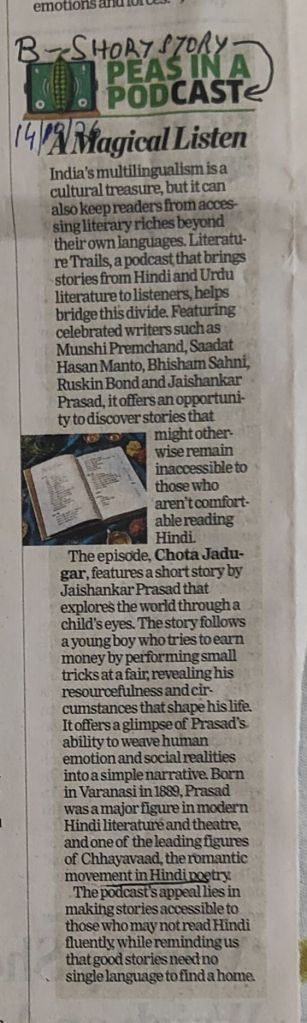
14/10/26 Short story

Copyright@shravancharitymission
CORPORATE ATTIRE: WHEN DID THE SUIT BECOME MORE INDIAN THAN THE KURTA?
Kamlesh Tripathi
Walk into an Indian corporate office and look around. The dress code may appear modern, global and professional: shirts, trousers, jackets, suits and, occasionally, ties. Yet there is something curious about what Indian corporate culture has traditionally accepted as “formal Indian wear.”
The sari has long been accepted as respectable office attire for women. The salwar kameez too has gradually become part of the corporate wardrobe. But for men, the kurta-pyjama and dhoti have often been treated as too casual, too traditional or simply “not professional enough.” Why?
Was the kurta-pyjama considered unsmart? Was the dhoti regarded as unsuitable for the workplace? Were these clothes too closely associated with politicians, rural India or traditional society? Or did we inherit a colonial idea that Western clothing represented modernity, efficiency and professional competence? Even after independence, the Indian corporate world has been sleeping over this aspect of dressing up.
The question is not entirely imaginary. Emma Tarlo’s Clothing Matters: Dress and Identity in India examines precisely how clothing in India became entangled with caste, education, urbanisation, status and ideas of Indian identity. Her research shows that clothes have historically been used not merely to cover the body but to assert power, challenge authority and negotiate social identity.
Literature provides an intriguing illustration. Rabindranath Tagore’s family itself experimented with the question of what an Indian should wear. His brother Jyotirindranath Tagore attempted to create a national costume combining Indian and European elements. The problem was that the dhoti was considered insufficiently “business-like”, while trousers appeared too foreign. The resulting compromise tried to combine both worlds.
We may laugh at the awkwardness of this nineteenth-century sartorial experiment, but the dilemma survives in the twenty-first-century corporate office. We have become comfortable with the idea that Western trousers and a shirt constitute “professional attire”, while a kurta-pyjama requires some explanation.
Gandhi turned this hierarchy upside down. In 1921, Mahatma Gandhi deliberately abandoned much of his conventional clothing and adopted the simple dhoti and shawl as a political and social statement. His decision was rooted in his desire to identify himself with India’s poor. The dhoti was no longer merely clothing; it became a statement of solidarity, self-respect and resistance to foreign clothes.
Indeed, Gandhi’s clothing became so powerful a political symbol that his apparently simple attire could carry greater political meaning than the most elaborate suit. Clothing, in his case, became a language. So then why did the Indian corporate world not inherit this confidence in Indian attire?
Perhaps the answer lies partly in history. During the colonial rule, Western dress became associated with education, employment and social advancement. A striking example cited in discussions of Indian clothing history is that a young man wearing European dress could gain access to government employment, while a candidate appearing in a dhoti could be treated as inadequately dressed.
The irony is that independent India subsequently produced leaders who deliberately rejected European dress. Jawaharlal Nehru made the kurta-pyjama, sherwani and Nehru jacket part of his public identity. Indian national dress was no longer necessarily a rejection of modernity; it could represent modern India itself.
There is also a gender question here. If a woman can walk into a boardroom wearing an elegant sari and be considered perfectly professional, why should a man in an equally well-tailored kurta-pyjama automatically appear less professional? Is the difference really about the garment—or about the assumptions attached to it?
And then comes an amusing contemporary twist. When temperatures rise dramatically in Britain, office dress codes can suddenly become flexible. During recent heatwaves, British workplaces have debated whether shorts should be acceptable office wear, with some employers relaxing traditional dress expectations. Indian corporate offices, meanwhile, have traditionally regarded shorts as almost unthinkable in formal workplaces.
So perhaps the next corporate revolution will not be about artificial intelligence, hybrid working or the four-day week. It might simply be about what we wear. If a temperature of 40 degrees can make shorts respectable in a London office, could an Indian summer make the kurta-pyjama respectable in a Mumbai or Delhi boardroom?
Perhaps it is time to stop asking whether Indian clothes look “corporate” and start asking whether our definition of corporate clothing is unnecessarily Western. After all, professionalism is ultimately a quality of the person—not a property of the trousers.
A well-cut kurta does not make an employee less efficient. A dhoti does not make a manager less capable. And a tie does not automatically make an executive more intelligent.
Perhaps the real dress code should be simple when you think of global warming. If you want to reduce contributors to global warming, if not fully eliminate them, Indian dresses can come in handy with reduced air-conditioning. Indian HR needs to wake up.
Dress appropriately. Work professionally. And let competence—not clothing—make the impression.
Written and posted by Kamlesh Tripathi
Author, Poet, & Columnist
*
https://kamleshsujata.wordpress.com
*
Like it and Share it
*
Shravan Charity Mission is an NGO that works for poor children suffering from life-threatening diseases, especially cancer. Our posts are meant for our readers, including children and adults, and have a wide variety of content. We also accept donations for our mission. Should you wish to donate to the cause of cancer, please do so. The bank details are given below:
NAME OF ACCOUNT: SHRAVAN CHARITY MISSION
Account no: 680510110004635 (BANK OF INDIA)
IFSC code: BKID0006805
***
Copyright@shravancharitymission
PARALLELS BETWEEN RAINER MARIA RILKE’S GEOGRAPHY OF SOLITUDE AND ANCIENT INDIAN TEXTS
Kamlesh Tripathi
There are thematic parallels between Austrian poet Rainer Maria Rilke and ancient Indian philosophical texts, especially the Upanishads, Bhagavad Gita, Vedas, and some later spiritual traditions. However, it is better to call them resonances rather than direct influence.
Rilke repeatedly encourages the individual to turn inward rather than seek answers entirely in the external world. In his book Letters to a Young Poet, he advises the young military officer Kappus to “go into yourself” to examine the questions in your life. This strongly resonates with the Upanishadic movement from the outer world to the inner Self. The Chandogya Upanishad declares: “Tat tvam asi” — “That thou art.” The basic spiritual movement is similar: what we are seeking outside may ultimately have to be discovered within. Let’s not forget Rumi’s quote here ‘What you seek is seeking you” Reciprocal attraction.
For Rilke, solitude is not simply loneliness. It is a necessary condition for becoming oneself. The Katha Upanishad describes the wise person as one who turns inward and discovers the Self rather than remaining absorbed in external objects. Rilke calls it solitude; the Indian sage calls it inwardness.
Rilke’s central concern is discovering one’s authentic inner being. He asks the individual not to live according to society’s expectations but to discover what is genuinely alive within. The Upanishadic tradition goes further: the deepest Self (Atman) is not merely one’s personality, ego or psychological identity. It is connected with ultimate reality, Brahman. Thus there is an important distinction: Rilke’s inward journey is psychological, artistic and spiritual; the Upanishadic journey ultimately becomes metaphysical.
One of the most appropriate similarities is Rilke’s attitude toward uncertainty. Rather than demanding immediate answers, he encourages Kappus to “live the questions.” A question needs to mature before its answer becomes possible, akin to the Shakespearean phrase ‘the why and the wherefore,’ used in The Comedy of Errors. This has an Indian parallel in the Upanishadic method of inquiry. The seeker repeatedly asks: Who am I? What is reality? What is the Self? What happens after death? (as Nachiketa asked). The Kena Upanishad, for example, investigates the mysterious power behind the mind, speech, sight and hearing. In both traditions, wonder precedes wisdom.
Rilke’s spirituality is deeply connected with silence. When external noise disappears, the individual can hear something deeper. The Indian spiritual tradition places enormous importance on mauna—silence—and meditation. The famous Upanishadic formulation is particularly striking: “Yato vāco nivartante aprāpya manasā saha” —“From where words return, together with the mind, not having reached it.” The idea is that ultimate reality cannot simply be captured by ordinary language. That is very close to Rilke’s poetic intuition: some truths must be experienced rather than explained.
Rilke does not advise us simply to escape suffering. He asks us to allow suffering to transform us. The Bhagavad Gita does not promise Arjun a life free of pain, conflict or uncertainty. Instead, it teaches him how to act without being psychologically destroyed by the results of action. Rilke’s idea could therefore be expressed as: Do not merely endure suffering; allow it to deepen you.
Rilke warns against being controlled by external pressures and encourages an inwardly grounded life. The Bhagavad Gita repeatedly emphasises mastery and steadiness of mind. Rilke does not advocate simply abandoning the world. He wants the individual to experience life deeply while maintaining an inner independence. This resembles the Gita’s concept of detached action—nishkama karma. One participates fully in life without becoming completely enslaved to its rewards and disappointments.
Rilke’s conception of love is unusually modern. He believes two people should preserve their individuality. Love should allow each person to grow rather than become an attempt to possess another. This can be compared with the broader Indian distinction between love (prema) and attachment (moha). The Gita particularly warns against attachment because attachment can generate desire, frustration and confusion.
Rilke was not a conventional religious thinker. He travelled a lot. His spirituality was personal, mystical and sometimes deliberately uncertain. He was fascinated by God, angels, death, beauty and transcendence, but did not always approach them through orthodox religious doctrine. Death is not merely an interruption in Rilke’s thought. It is intimately connected with existence. This also resonates strongly with Indian scriptures. The Bhagavad Gita presents death as part of the transformation of embodied existence: “Jātasya hi dhruvo mṛtyur”
“For one who is born, death is certain.”
Written and posted by Kamlesh Tripathi
Author, Poet, & Columnist
*
https://kamleshsujata.wordpress.com
*
Like it and Share it
*
Shravan Charity Mission is an NGO that works for poor children suffering from life-threatening diseases, especially cancer. Our posts are meant for our readers, including children and adults, and have a huge variety of content. We also accept donations for our mission. Should you wish to donate to the cause of cancer? The bank details are given below:
NAME OF ACCOUNT: SHRAVAN CHARITY MISSION
Account no: 680510110004635 (BANK OF INDIA)
IFSC code: BKID0006805
***
Copyright@shravancharitymission

Author: E. M. Forster
Published: 1924
Genre: Social, political and psychological novel
Setting: Chandrapore, British India, during British colonial rule
Major themes: Colonialism, racial prejudice, friendship, cultural misunderstanding and the difficulty of human relationships.
A Passage to India is a famous novel by E. M. Forster that explores the strained relationship between the British rulers and the Indian people during the colonial period. Through the experiences of its principal characters, the novel reveals the racial discrimination, cultural misunderstandings and political tensions that divide the two communities.
The story takes place in Chandrapore, a fictional town in British India. Dr Aziz, an Indian Muslim physician, lives there and works at a local hospital. He is intelligent, emotional, friendly and eager to establish genuine relationships with the British people, despite the prevailing atmosphere of racial prejudice.
Two Englishwomen, Mrs Moore and Adela Quested, arrive in India. Mrs Moore is the mother of Ronny Heaslop, the British city magistrate, while Adela is engaged to Ronny. Both women wish to see the real India rather than merely experience the restricted social life of the British community.
Mrs Moore meets Dr Aziz by chance in a mosque. Their conversation develops into a warm and respectful friendship. Unlike many British officials, Mrs Moore treats Aziz with sympathy and humanity. Adela, too, wishes to understand Indian society, although she remains uncertain about her feelings towards India and her future marriage.
Dr Aziz arranges an excursion to the Marabar Caves for Mrs Moore and Adela, accompanied by other members of the party. The caves become the central turning point of the novel.
Inside the caves, Mrs Moore experiences a disturbing echo that seems to reduce every sound and human feeling to the same meaningless noise. She becomes spiritually disillusioned and loses her earlier confidence in the possibility of understanding the world.
Adela enters one of the caves alone and later emerges in a state of confusion and distress. She accuses Dr Aziz of attempting to assault her. Aziz is arrested, and the incident creates a major controversy in Chandrapore.
The British community immediately rallies behind Adela and assumes Aziz’s guilt, revealing its deep-seated racial prejudice. In contrast, many Indians support Aziz and regard the accusation as another example of British injustice. The incident intensifies the conflict between the Indian and British communities.
During the trial, tensions between the two communities reach their peak. Fielding, a British educator and one of Aziz’s few genuine friends, stands by him and challenges the assumptions of the British authorities.
At the trial, Adela is questioned about what actually happened in the caves. She becomes uncertain about her accusation and finally withdraws it. Dr Aziz is acquitted and released.
Although Aziz is legally vindicated, the incident leaves him deeply embittered. He loses much of his faith in the possibility of friendship with the British while India remains under colonial rule. Adela faces social isolation from the British community because of her decision to withdraw the accusation.
Following the trial, the relationship between Aziz and Fielding becomes strained. Aziz suspects that Fielding has developed a romantic attachment to Adela, although this suspicion is mistaken. Fielding returns to England, and Aziz eventually moves to a princely state where he can live and work away from direct British control.
Later, Aziz and Fielding meet again in India. Although they still care for one another, their friendship remains troubled by political circumstances. Aziz believes that genuine friendship between an Indian and an Englishman cannot fully exist while the British continue to rule India.
The novel ends with Aziz and Fielding riding together, but the surrounding landscape seems to push them apart. Their personal affection cannot overcome the larger forces of colonialism and political inequality. Forster thus leaves the possibility of their friendship unresolved until India becomes free.
A Passage to India is not merely a story about a false accusation; it is a profound examination of colonialism, human relationships and the difficulty of achieving mutual understanding across cultural and political divisions. Through the experiences of Aziz, Fielding, Adela and Mrs Moore, Forster shows that personal goodwill alone cannot overcome the inequalities created by imperial rule.
The novel’s central message is that true friendship and mutual understanding require equality, respect and freedom from racial prejudice. It remains one of the most important literary critiques of British colonialism in India.
Copyright@shravancharitymission
**
When Benjamin Franklin was asked, ‘What is the greatest discovery of our generation?’ he answered, ‘The greatest discovery of our generation is that by changing one’s thought pattern, one can change one’s life.’
*
People blame their stars, their destiny. ‘Men heap together mistakes of their lives,’ said John Oliver Hobbes, ‘and create a monster they call destiny.’
*
The best place to find a helping hand is at the end of your own arm…SWEDISH PROVERB
*
Nothing happens, nobody comes, nobody goes, it’s awful! … SAMUEL BECKETT, Waiting for Godot
*
Thus photons which constitute a ray of light behave like intelligent human beings; out of all possible curves they always select the one which will take them most quickly to their goal…MAX PLANCK
*
If you don’t like people, put up with them as well as you can. Don’t try to love them: you can’t, you’ll only strain yourself.’ Ansell’s advice to Rickie in the The Longest Journey was.
*
The universe is not required to be in perfect harmony with human ambition…CARL SAGAN
*
Grief can be the garden of compassion. If you keep your heart open through everything your pain can become your greatest ally in your life’s search for love and wisdom…RUMI
*
I am no longer accepting the things I cannot change. I am changing the things I cannot accept… ANGELA DAVIS
*
Surrender once and for all be done with the desire. So long as the sense of doership is retained there is the desire. There is also personality. If this goes the Self is found to shine forth pure…RAMANA MAHARISHI
*
The body is said to be the root of the tree of Sansar. Through this body, the Self comes into contact with sons and other relations. If the body is non-existent, how can there be relations for the Self, which is asang, unattached, with sons and relations…THUS SPAKE SRI RAMA
Copyright@shravancharitymission
Kamlesh Tripathi
Adventure, calamity and song are the pillars of life. Don Quixote, the master adventurer created by Spanish novelist Miguel de Cervantes, never faced a calamity as sudden and devastating as the recent Himalayan disaster in Nepal. Life surprises us with adventure, devastates us with calamity and lifts our spirits with a song. A song is born out of joy and sorrow. Its melody echoes across great rivers such as the Brahmaputra, the Ganges, the Trishuli or the Bhotekoshi River in Nepal, all eventually meeting the unshakable oceans. Despite calamities, they say, the song of life must go on.
On 26 August 2026, Nepal witnessed a catastrophic chain of natural events after a massive collapse of rock and glacial ice in the Himalayas that triggered a destructive debris flow and flash flood. The disaster swept through the Nepal-China border and downstream areas. The tragedy reminds us how suddenly the familiar world can disappear.
Let us juxtapose two iconic songs: Kishore Kumar’s mystifying “Zindagi ka safar hai yeh kaisa safar, koi samjha nahi, koi jana nahi”, and the 1955 classic “Que Sera, Sera (Whatever Will Be, Will Be),” written by Jay Livingston and Ray Evans. The latter was popularised by Doris Day in Alfred Hitchcock’s 1956 film The Man Who Knew Too Much. The lyrics follow a narrator’s journey through childhood, youth, love and parenthood, repeatedly asking what the future will bring. The answer is simple: whatever will be, will be.
The recent Nepal disaster gives those words a haunting resonance. People went about their daily lives, travelling, working and living beside the rivers, unaware that a gigantic mass of rock and ice was about to descend from the Himalayas.
Did The Man Who Knew Too Much really know too much? Could anyone truly know when nature would unleash its fury? Humanity has accumulated extraordinary scientific knowledge, yet nature continues to remind us of the limits of prediction.
This recalls Mary Shelley’s Frankenstein, where Victor Frankenstein’s scientific ambition creates consequences he cannot control. The comparison is not between Frankenstein’s creature and a natural disaster, but between the human desire to understand and control the world and the humbling realisation that some forces remain beyond our command.
Before calamity, life often appears permanent. The Nepal disaster has also shown the vulnerability of Himalayan communities and the importance of early warning systems. Reports indicate that the enormous speed of the flood left communities with very little time to react. The catastrophe has consequently renewed discussion about monitoring and warning systems for hazards that can originate in remote mountain regions and cross national boundaries. Yet even amid destruction, the song of life continues.
The Sound of Music, with its book by Howard Lindsay and Russel Crouse, similarly continues to remind generations that music can provide courage in difficult times. And then there is ABBA’s memorable line: “The winner takes it all,
The loser has to fall.”
But disasters do not necessarily create winners and losers. They create survivors, rescuers, mourners and rebuilders. They reveal the fragility of human existence, but they also reveal extraordinary courage. Rescue workers, security personnel, volunteers and ordinary citizens become part of a collective struggle to save lives and restore communities. And then, slowly, nature begins to heal.
The rivers continue to flow. The Ganges does not stop. The Brahmaputra continues its journey. The Trishuli or the Bhotekoshi River will flow as they have for centuries. The mountains remain majestic, even after their slopes have collapsed. The sun rises each morning. Birds return. Children play again. Markets reopen. Homes are rebuilt.
Life finds its rhythm once more. Perhaps that is the deepest lesson of Que Sera, Sera. The phrase “Whatever will be, will be” suggests acceptance of an uncertain future. But acceptance does not mean surrender. It means recognising the limits of human control while still doing everything within our power to prepare, protect and rebuild.
The Nepal disaster reminds us of this truth with painful clarity. A landscape that appeared eternal can change within minutes. A river that sustained communities can suddenly become an agent of destruction. A familiar road can disappear beneath mud and debris. A home can vanish, while a simple house key may become the last surviving symbol of a life that once existed there. The calamity may interrupt the song of life, but it cannot silence it forever.
Written and posted by Kamlesh Tripathi
Author, Poet, & Columnist
*
https://kamleshsujata.wordpress.com
*
Like it and Share it
*
Shravan Charity Mission is an NGO that works for poor children suffering from life-threatening diseases, especially cancer. Our posts are meant for our readers, including children and adults, and have a huge variety of content. We also accept donations for our mission. Should you wish to donate to the cause of cancer? The bank details are given below:
NAME OF ACCOUNT: SHRAVAN CHARITY MISSION
Account no: 680510110004635 (BANK OF INDIA)
IFSC code: BKID0006805
***
Copyright@shravancharitymission
Written and posted by Kamlesh Tripathi
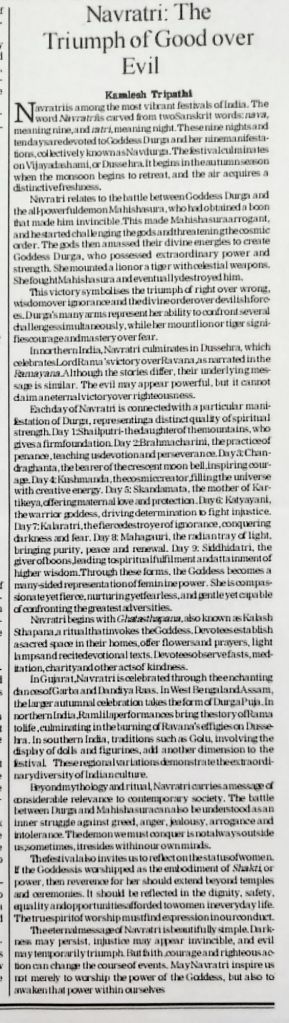
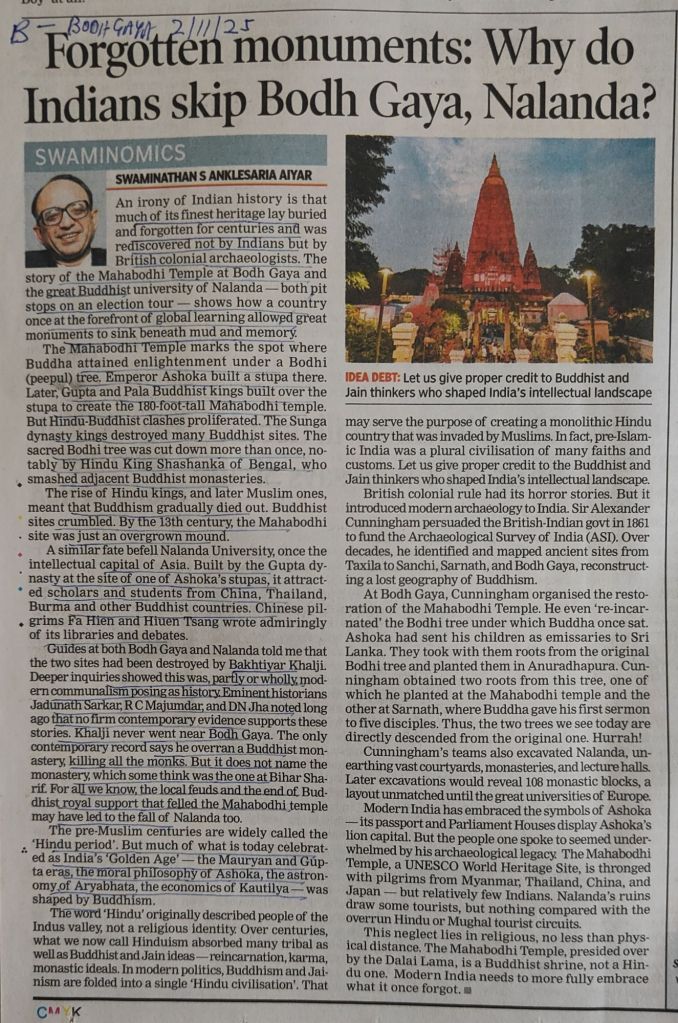
India is a land where festivals are not merely occasions for celebration. Rather, they are expressions of mythology, spirituality, culture and collective memory. Among its most vibrant festivals is Navratri, the sacred celebration of the Divine Feminine. The word Navratri is carved from two Sanskrit words: nava, meaning nine, and ratri, meaning night. These nine nights and ten days are devoted to Goddess Durga and her nine manifestations, collectively known as Navdurga.
Sharad (Ritu) Navratri culminates on Vijayadashami, or Dussehra. The festival arrives with the autumn season. This is when the monsoon begins to retreat, and the air acquires a distinctive freshness. Ardent devotees prepare for worship, and devotional bhajans fill the atmosphere.
Navratri concerns the battle between Goddess Durga and Mahishasura, a powerful demon who had obtained a boon that made him invincible. This made Mahishasura arrogant, and he started challenging the gods and threatening the cosmic order. The gods amassed their divine energies to create Goddess Durga. She possessed extraordinary strength, courage and determination. Riding a lion or tiger and wielding celestial weapons, she fought Mahishasura and eventually destroyed him.
This victory conveys much more than the defeat of a demon. It symbolises the triumph of righteousness over arrogance, wisdom over ignorance and divine order over destructive forces. Durga’s many arms represent her ability to confront several challenges simultaneously, while her lion signifies courage and mastery over fear.
In northern India, the period culminates in Dussehra, which celebrates Lord Rama’s victory over Ravana, as narrated in the Ramayana. Although the stories differ, their underlying message is similar. The evil may appear powerful, but it cannot claim an eternal victory over righteousness.
Each day of Navratri is associated with a particular manifestation of Durga, representing a distinct quality of spiritual strength—Day 1: Shailputri- the daughter of the mountains, who gives a firm foundation. Day 2: Brahmacharini, the practice of penance, teaching us devotion and perseverance. Day 3: Chandraghanta, the bearer of the crescent moon bell, inspiring courage. Day 4: Kushmanda, the cosmic creator, filling the universe with creative energy. Day 5: Skandamata, the mother of Kartikeya, offering maternal love and protection. Day 6: Katyayani, the warrior goddess, driving determination to fight injustice. Day 7: Kalaratri, the fierce destroyer of ignorance, conquering darkness and fear. Day 8: Mahagauri, the radiant ray of light, bringing purity, peace and renewal. Day 9: Siddhidatri, the giver of boons, leading to spiritual fulfilment and attainment of higher wisdom.
Through these forms, the Goddess becomes a many-sided representation of feminine power. She is compassionate yet fierce, nurturing yet fearless, and gentle yet capable of confronting the greatest adversities.
Navratri begins with Ghatasthapana, also known as Kalash Sthapana, a ritual that invokes the Goddess. Devotees establish a sacred space in their homes, offer flowers and prayers, light lamps and recite devotional texts. Many observe fasts, while others devote the nine days to meditation, charity and acts of service.
In Gujarat, Navratri is celebrated through the enchanting dances of Garba and Dandiya Raas. In West Bengal, the larger autumnal celebration takes the form of Durga Puja, with magnificent pandals, artistic idols and community festivities. In northern India, Ramlila performances bring the story of Rama to life, culminating in the burning of Ravana’s effigies on Dussehra. In southern India, traditions such as Golu, involving the display of dolls and figurines, add another dimension to the festival.
These regional variations demonstrate the extraordinary diversity of Indian culture. The rituals may differ, but devotion to the Divine Feminine and the celebration of good overcoming evil remain powerful connecting threads.
Beyond mythology and ritual, Navratri carries a message of considerable relevance to contemporary society. The battle between Durga and Mahishasura can also be understood as an inner struggle against greed, anger, jealousy, arrogance and intolerance. The demon we must conquer is not always outside us; sometimes, it resides within our own minds.
The festival also invites us to reflect on the status of women. If the Goddess is worshipped as the embodiment of Shakti, or power, then reverence for her should extend beyond temples and ceremonies. It should be reflected in the dignity, safety, equality and opportunities afforded to women in everyday life. The true spirit of worship must find expression in our conduct.
The eternal message of Navratri is beautifully simple. Darkness may persist, injustice may appear invincible, and evil may temporarily triumph. But faith, courage and righteous action can change the course of events. May Navratri inspire us not merely to worship the power of the Goddess, but also to awaken that power within ourselves.
The author is a novelist, poet, short story writer and a columnist
Written and posted by Kamlesh Tripathi
Author, Poet, & Columnist
*
https://kamleshsujata.wordpress.com
*
Like it and Share it
*
Shravan Charity Mission is an NGO that works for poor children suffering from life-threatening diseases, especially cancer. Our posts are meant for our readers, including children and adults, and have a huge variety of content. We also accept donations for our mission. Should you wish to donate to the cause of cancer? The bank details are given below:
NAME OF ACCOUNT: SHRAVAN CHARITY MISSION
Account no: 680510110004635 (BANK OF INDIA)
IFSC code: BKID0006805
***

