At a party in an upscale housing society, a Page 3 socialite cornered me with the confidence of a customs officer examining a suspicious passport.
“What do you do?” he asked, looking me up and down.
“I did many things in the past,” I replied cheerfully, “but now I do nothing. So, mostly, I dwell on my past.”
He looked puzzled. Perhaps doing nothing was not listed among the respectable professions in his social directory.
“And where are you from?” came his next question.
“I am very much from this place,” I said, “though I have been around the world.”
“Really? And where do you stay?”
“Currently, I stay in a house of my own, just behind that pond you can see.” I pointed towards it. “But during my career, I have stayed in more than three dozen houses.”
“Good heavens! Why so many?”
“Because I always lived in rented accommodation in different cities. My career demanded mobility, while my salary discouraged property ownership.”
For the first time, he smiled. I suspected he had mistaken my explanation for an investment strategy.
“But what is your introduction?” he asked, looking increasingly uncomfortable.
“Well, I have a retired face, a retired figure, and a retired walk, as you can see. I also possess an Aadhaar card, a PAN card, a voter ID card, and a house number. What more does a citizen need to establish his identity?”
He stared at me as though I had just applied for membership of the United Nations.
“Nice to meet youuu…?”
“Samarth,” I replied. “And what about you?”
He straightened his designer jacket. “I am in the corporate world.”
“Wonderful! Which planet?”
He ignored the question. “Which department were you in, Samarth?”
“Several, at different times. I moved from one department to another, met hundreds of people, attended countless meetings, and filled in enough forms to qualify for a post in bureaucracy.”
“And what was your designation?”
“That depended on whom I was talking to. To my boss, I was a subordinate. To my colleagues, I was a colleague. To my juniors, I was a senior. At home, I was simply the man who had forgotten to bring vegetables.”
He laughed politely, although I could tell he was wondering whether I had ever occupied a respectable position.
“And now?” he persisted.
“Now I occupy a sofa, occasionally an armchair, and sometimes a chair at the dining table. I am enjoying the most senior position of my life: nobody can transfer me.”
By then, a few guests had gathered around us. The socialite, however, was not ready to surrender.
“So, how do you spend your time?”
“I read, write, observe people, and attend parties like this. They provide excellent material for my next article.”
He suddenly became alert. “You write?”
“Occasionally.”
“Anything published?”
“Yes. Some of my articles have appeared in newspapers and magazines.”
His expression changed instantly. The retired gentleman had acquired professional relevance.
“Splendid! We must keep in touch. Here is my card. Do call me sometime.”
I accepted it graciously.
As he moved away, another guest approached me with the inevitable question.
“What do you do?”
I smiled.
“Before I answer, may I ask you something?”
“Certainly.”
“How do you do?”
He looked startled. “I beg your pardon?”
“Exactly!” I said. “That is what I have been trying to discover all evening. Everyone wants to know what everybody does, but hardly anyone asks how anybody does.”
The man blinked, then burst out laughing.
Perhaps that was the first honest introduction of the evening.
After all, ‘What do you do?’ asks about your occupation; ‘How do you do?’ ought to ask about your well-being. Unfortunately, at modern parties, your occupation often matters more than your condition.
And if you happen to be retired, be prepared: you may have to introduce your entire past before anyone permits you to enjoy your present.
It is always safer to over-communicate than to under-communicate. History, mythology and literature repeatedly show how a single misunderstanding can change destinies. One striking example comes from the Mahabharata — the life of Bhishma Pitamah. Bhishma had vowed lifelong celibacy. When he went to Kashi for the swayamvara of the three princesses — Amba, Ambika and Ambalika, on behalf of his half-brother King Vichitravirya, he decided to bring all three back as brides for him. As Bhishma entered the swayamvara hall, a hush fell. None of the princes dared to oppose him.
He announced, “I am taking these three Rajkumaris to Hastinapur so that they may marry my brother Vichitravirya. I am ready to fight anyone who objects to it.” The frightened King of Kashi offered no resistance. But on the way back to Hastinapur, the eldest princess, Amba, confessed, “I cannot marry your brother. I love Prince Salwa of the Saubala kingdom and had intended to garland him. You brought me without taking my consent.” Bhishma, stunned, admitted his mistake. He stopped the chariot and told her, “Had you told me at the swayamvara itself, I would have left you with your beloved and taken only your sisters.”
He sent Amba to Prince Salwa while continuing on with Ambika and Ambalika. But tragedy unfolded. Salwa refused to accept Amba. She returned to Bhishma, begging him to marry her, but he was bound by his vow. Even a duel with his guru Parashurama could not resolve the matter. Amba finally undertook a fierce penance and was reborn as Shikhandi, who became the cause of Bhishma’s death on the battlefield of Kurukshetra. Had Bhishma clarified Amba’s wishes at the outset—or had Amba voiced them earlier—the course of his life and perhaps the Mahabharata itself might have been very different.
Two of Shakespeare’s greatest tragedies, Romeo and Juliet and Othello, also pivot on fatal miscommunication. In Romeo and Juliet, Juliet fakes her death with a potion. Friar Lawrence sends a letter to Romeo explaining the plan, but because of a plague quarantine, the messenger never reaches him. Romeo instead listens to second-hand information from his servant Balthasar, who truly believes Juliet is dead. Acting on this false news, Romeo buys poison and dies beside her. She wakes up to find him dead and takes her own life. A single undelivered letter seals their fate.
In Othello, the miscommunication is a chain of manipulation. Iago, angry at being passed over for promotion, insinuates to Othello that his wife Desdemona is unfaithful to Cassio. He plants “evidence” — especially the handkerchief that Othello had given Desdemona. Othello never verifies the facts with Desdemona directly, and by the time he confronts her, he is already convinced of her guilt. Desdemona’s innocent references to Cassio deepen his suspicion. Emilia (Iago’s wife), who could expose the plot, stays silent until it’s too late. Othello murders Desdemona in a jealous rage and then kills himself when the truth emerges.
Whether in mythology or literature, these stories teach the same lesson: miscommunication can destroy lives. In Bhishma’s case, a single assumption led to his greatest karmic debt. In Romeo and Juliet, a missed letter caused a double suicide. In Othello, unchecked insinuations ended in murder and self-destruction. Clear, timely and honest communication could have changed every one of these outcomes.
Shravan Charity Mission is an NGO that works for poor children suffering from life-threatening diseases, especially cancer. Our posts are meant for our readers, including children and adults, and have a huge variety of content. We also accept donations for our mission. Should you wish to donate to the cause of cancer? The bank details are given below:
Every morning, I walk up to the IT College metro station from my house, which is about ten minutes, cutting across the sprawling Police Lines. Today was a similar drill. I took the metro from there to Hazratganj Station, which is just three stations away. And today, being a holiday, the metro was absolutely empty. In fact, I was the only chap, I think, who got down at the Hazratganj station. Even as I was returning, I was the only person who boarded from there.
In Hazratganj, I usually walk for about half an hour every day. But the air was heavy today, even when the roads and the footpath were empty. There was a heavy security deployment near the Khadi Gram showroom where Yogi ji, the Chief Minister of U.P., was to arrive to pay homage to Mahatma Gandhi, today being his birth anniversary. I continued walking till I arrived at my usual joint, The Shukla tea stall, on Church Road, Hazratganj, that serves tea and street food.
The place is heavily crowded. Today was no different. I normally have a Kulhad chai there, which reminds me of the cutting Chai in Mumbai. While I was having Chai, two police motorcycles, blaring their sirens, landed at the tea stall. They started coaxing the drivers to remove their cars and scooters from there. It appeared as a special security drill on the 2nd of October. I was happy to note that I had landed in Hazratganj by metro and was on foot, so I didn’t have to bother about my car. I felt liberated. As a result, the tea tasted even sweeter, the weather even more pleasant, and the walk even more energising, and the mind relaxed. See what blaring sirens can do to you when you don’t have a car.
Shravan Charity Mission is an NGO that works for poor children suffering from life-threatening diseases, especially cancer. Our posts are meant for our readers, including children and adults, and have a huge variety of content. We also accept donations for our mission. Should you wish to donate to the cause of cancer? The bank details are given below:
Shravan Charity Mission is an NGO that works for poor children suffering from life-threatening diseases, especially cancer. Our posts are meant for our readers, including children and adults, and have a huge variety of content. We also accept donations for our mission. Should you wish to donate to the cause of cancer? The bank details are given below:
One day, a camel and her baby were chatting. The baby asked, “Mother, why do we have humps?” The mother replied, “Our humps are for storing water so that we can survive in the desert”.
“Oh”, said the child, “and why do we have rounded feet, mother?” “Because they are meant to help us walk comfortably in the desert. These legs help us move around in the sand.”
“Alright. But then why are our eyelashes so long?”
Mother replied, “To protect our eyes
from the severe dust and sand of the desert. They are the protective covers for
the eyes”, replied the mother camel.
The baby camel thought for a while
and said, “So we have humps to store water for desert journeys, rounded hooves
to keep us comfortable when we walk in the desert sand, and long eyelashes to
protect us from the sand and dust during a desert storm. So, then what are we
doing in a zoo?”
The mother was dumbfounded.
Moral: Your strengths, skills, and knowledge are useless if you are not in the right place.
Shravan Charity Mission is an NGO that works for poor children suffering from life-threatening diseases, especially cancer. Our posts are meant for our readers, including children and adults, and have a huge variety of content. We also accept donations for our mission. Should you wish to donate to the cause of cancer? The bank details are given below:
Vijay and Raju were friends. Once, while on a holiday, they went into a forest. There, they were enjoying the beauty of nature. Suddenly, they saw a bear charging at them. They were frightened. Raju, who knew how to climb a tree, ran towards one and climbed it in no time. He did not think of Vijay, who did not know how to climb a tree.
Vijay got nervous and thought for a second. He had heard, animals don’t prefer dead bodies. So, he fell on the ground and held his breath. The bear sniffed him for a few moments and thought he was dead, and decided to carry on. Upon witnessing this scene, Raju asked Vijay. ‘What did the bear whisper in your ears?’
Vijay replied, ‘The bear asked me to keep away from friends like you.’
The moral of the story is: A friend in need is a friend indeed.
Shravan Charity Mission is an NGO that works for poor children suffering from life-threatening diseases, especially cancer. Our posts are meant for our readers, which include both children and adults, and have a huge variety in terms of content. We also accept donations for our mission. Should you wish to donate to the cause. The bank details are given below:
Everyone fears death, but birth and death are laws of creation. It is essential for the balance of the universe. Without it, humans would dominate one another.
How? Read this story:
*Once, a king visited a sage who was sitting under a tree outside his kingdom. He asked, “O Swami! If there is any herb or medicine that can grant immortality, please let me know.”*
The sage replied,
“O King! Please cross the two mountains in front of you. There, you will find a lake. Drink its water, and you will become immortal.”
*After crossing the two mountains, the king found a lake. As he was about to drink the water, he heard painful groans. Following the sound, he found a very weak man lying in pain.*
When the king asked the reason, the man said, “I drank the water from the lake and became immortal. After I turned a hundred years old, my son threw me out of the house. I have been lying here for the last fifty years with no one to care for me. My son has passed away, and my grandchildren are now grown. I have stopped eating and drinking, yet I am still alive.”
*The king pondered, “What is the use of immortality with old age? What if I gain youth along with immortality?” He went back to the sage to find a solution and asked, “Please tell me how I can gain both immortality and youth.”*
The sage replied, “After crossing the lake, you will find another mountain. Cross it, and you will find a tree filled with yellow fruits. Eat one of them, and you will gain both immortality and youth.”
*The king crossed another mountain and found a tree filled with yellow fruits. As he was about to pluck and eat one, he heard loud arguments and fighting. He wondered who could be quarrelling in such a remote place.*
He saw four young men arguing loudly. The king asked why they were fighting. One of them said, “I am 250 years old, and the man on my right is 300 years old. He is not giving me my share of the property.”
*When the king asked the man on the right, he said, “My father, who is 350 years old, is still alive and hasn’t given me my share. How can I give mine to my son?”*
The man pointed to his father, who was 400 years old, and shared the same complaint. All of them told the king that their endless fight for property had forced the villagers to expel them from the village.
*Shocked, the king returned to the sage and said, “Thank you for teaching me the importance of death.”*
The sage then said, *”Because death exists, there is love in the world.”*
*”Instead of trying to avoid death, live each day and every moment happily.* Change yourself, and the world will change.”
1. *When you chant the name of God while bathing, it becomes a holy bath.*
2. When you chant while eating, the food becomes sacred.
3. *When you chant while walking, it becomes a pilgrimage.*
4. When you chant while cooking, the food becomes divine.
5. *When you chant before sleeping, it becomes meditative sleep.*
6. When you chant while working, it becomes devotion.
7. *When you chant at home, it turns into a sacred space.*
Shravan Charity Mission is an NGO that works for poor children suffering from life-threatening diseases, especially cancer. Our posts are meant for our readers, including children and adults, and have a huge variety of content. We also accept donations for our mission. Should you wish to donate to the cause of cancer? The bank details are given below:
The tiger’s tail takes me back to Shillong of the 60s. Once, I was returning from Guwahati to Shillong in my father’s sky-blue Chevrolet Bel-Air car. Father had returned to Gauhati from Delhi via Kolkata, and the car had gone from Shillong to pick him up from Guwahati airport. (Shillong airport was not operational till mid 70s). I was very young and had tagged along with our friendly chauffeur, Bahadur, to receive Father. Father was a member of the Assam Cabinet. This was before Meghalaya was carved out of the state of Assam; until then, Shillong happened to be the capital of Assam. The sky-blue Chevrolet was cruising along quietly on the winding, hilly road. In those days, the drive from Guwahati to Shillong took about three hours, on account of the single road with a half-hour stop at the picturesque Nongpoh circuit house (midway) surrounded by tall pine trees and lush green hills. Nongpoh was famous for delicious mutton chops.
We were close to Barapani, on the Shillong-Guwahati Road, aka the GS Road. Father was taking a well-deserved rest on the back seat after a hectic tour, and I was in the front seat with Bahadur. I was talking in undertones with him, and he too was replying in the same manner, as we didn’t want to disturb Father. Since Bahadur was well versed with Shillong and the vicinity, I was trying to find out if there was any wildlife around, even when I had seen plenty of wolves and foxes frequenting the iconic Brightwell Bungalow, our home in Barik Point, Shillong.
Suddenly, Bahadur pointed at something unusual as well as bizarre on the roadside, a little before the Umiam Dam Project coming up in Barapani near Shillong. A group of about eight tribals were carrying a tiger with its legs bound on a sturdy pole, and the body lashed with strong and thick creepers. They were resting there while the tiger was lying by their side. Bahadur and I promptly got out of the car and approached the party. I started circling the tiger, not knowing how to approach it. Bahadur offered that I wanted to feel the tiger, especially its ears, whiskers, paws, body or the tail. I realised that even a fallen tiger looked so ferocious. I gradually gathered some guts and touched its tail. The tail wasn’t soft and silky as generally made out. I was anxious that the tiger might get up and pounce on me. But sadly, it was lying dead. I ran my fingers on the tail from one end to the other and finally lifted it with both my hands. It was an amazing experience. Bahadur explained, the tiger uses its tail for balancing, counterbalancing and signalling while chasing targets. Soon we were back in the car. The car was filled with the scent of tiger.
Father enquired if the tiger was dead. We felt the question was strange, as a tiger alive would have threatened and jeopardised our lives, as no one possessed a gun. We then came to know about the extent of the father’s knowledge about the local flora and fauna. He informed us that different tribes used dissimilar poisons to traumatise and kill the prey. The availability of poisons varied with locales, and in the present case, the poison appeared strong enough to kill the tiger immediately and not just make him unconscious. The Khasi Hills had several little-known Asiatic poisons but very powerful ones. Some strong poisons were extracted from flowers that bloomed once in two years or maybe three. This, however, cannot be authenticated now, but the local wisdom still believes in it. The tiger had probably been killed by a poisonous arrow (Teer) and chased after being hit. Tiger meat is still a delicacy and is used as an aphrodisiac in many parts of Asia. The hapless tiger with its upturned body was a grotesque sight. They lifted the pole along with the tiger and vanished into thin air, taking a shortcut through some glade, shouting ‘Khublei.’ (‘Thank you’ or ‘God bless you’ in Khasi language). This method of hunting was primitive, though much followed by the old veterans of the village. It was economical as guns and bullets were unnecessary, and was mostly manpower oriented.
This one-off episode, just twenty minutes of screen time, wrapped around my soul like the tail of a tiger. It struck me not with a roar, but with a whisper so powerful that it echoed through the quiet chambers of my heart. It was a scene that stuck in my mind for life. A mix of danger and beauty.
Since then, whenever I visit Shillong, I stop at the location near the dam to remember the animal that had found space in my heart, and I don’t know why. How could an animal carcass find space in my heart, I could never figure out? I have seen umpteen tigers since then, some in zoos and some in sanctuaries, but that sleeping beauty of my childhood days was different, and the feel of the tiger’s tail was indelible. It lives in me even now as I watch the world in silence. The memory doesn’t fade. It has only grown sharper with time and refuses to forget me. That is why I scripted this story with freshness, as if it had happened only yesterday. Childhood memories always stay alive.
Shravan Charity Mission is an NGO that works for poor children suffering from life-threatening diseases, especially cancer. Our posts are meant for our readers, including children and adults, and have a huge variety of content. We also accept donations for our mission. Should you wish to donate to the cause of cancer? The bank details are given below:
–“If there is a paradise on earth, it is here, it is here, it is here,” said Amir Khusrau, a renowned Indian Sufi poet, about Kashmir. But the Pahalgam perpetrators have made it bloody—
*
In the Baisaran valley in Pahalgam,
On the 22nd of April 2025,
While the tourists were freaking out in the meadows,
Helping themselves to a picnic lunch,
Under the bright sun.
*
The terrorist struck,
With all their brutality,
Killing 26 able-bodied Indians,
In the worst of atrocities.
*
It all happened in the beating heart of the Anantnag district,
Where the Lidder River whispers through the valley,
And the tall mountains stand in majestic grace,
In the Vale of Kashmir.
*
The gruesome carnage was committed,
By AK-47-toting terrorists,
On a day that was meant to be peaceful and joyful,
Which humanity will never forget.
*
They say,
Terrorism doesn’t have a religion,
But the terrorists proved it otherwise,
When unable to recite the Kalma,
They shot those hapless Indians,
In an inhuman style.
*
But the Indians,
Never thought like that,
For they were always united in great style,
1.4 billion to be precise.
*
The terrorists asked the victims to undress,
To prove their religion,
And that proved the point,
That terror has a religion.
*
The victims were mostly young,
They were all bright,
They all had ambitions,
To come up in life.
*
The worst came when they were shot dead,
In front of their wives,
Who wailed for their safety,
But the lethal Pakistani terrorists,
Failed to sigh.
*
Being born a Hindu is no crime,
Being born in any religion is divine,
But perpetrating terrorism,
Is a terrible crime.
*
It’s like Alexander Fleming versus Mikhail Kalashnikov,
One invented penicillin,
And the other AK-47,
One saved a life, the other killed the hapless,
Kalashnikov must be turning in his grave,
Seeing the legacy of his invention.
*
Five Lashkar terrorists,
Brought India to an emotional halt,
But let there be no doubt,
In the minds of the killers and their handlers,
The young India is 65% of 1.4 billion,
That will not forget its revenge.
*
–Terrorism is the worst crime against humanity. Life is only a sojourn on Planet Earth. Live with that in mind—
***
Posted by Kamlesh Tripathi
Author, Poet, & Columnist
***
Like it and Share itShravan Charity Mission is an NGO that works for poor children suffering from life-threatening diseases, especially cancer. Our posts are meant for our readers, including children and adults, and have a huge variety of content. We also accept donations for our mission. Should you wish to donate to the cause of cancer? The bank details are given below:680510110004635 (BANK OF INDIA)
Shravan Charity Mission is an NGO that works for poor children suffering from life-threatening diseases, especially cancer. Our posts are meant for our readers, including children and adults, and have a huge variety of content. We also accept donations for our mission. Should you wish to donate to the cause of cancer? The bank details are given below:
NAME OF ACCOUNT: SHRAVAN CHARITY MISSION
Account no: 680510110004635 (BANK OF INDIA)
IFSC code: BKID0006805
*
Publications of Kamlesh Tripathi
BOOK TITLE: GLOOM BEHIND THE SMILE
(The book is about a young cancer patient. Now archived in eight prestigious libraries of the US which include Harvard College Library; Harvard University Library; Library of Congress; University of Washington, Seattle; University of Minnesota, Minneapolis; Yale University, New Haven; University of Chicago; University of North Carolina, at Chapel Hill University Libraries. It can also be accessed at MIT through Worldcat.org. Besides, it is also available for reading in the libraries and archives of Canada; the Open Library; Cancer Aid and Research Foundation Mumbai; Jaipuria Institute of Management, Noida, India; Shoolini University, Yogananda Knowledge Center, Himachal Pradesh and Azim Premzi University, Bangalore and the Library of Cancer Aid and Research Foundation, Mumbai. The title also finds a mention in a book titled ‘Enduring Cancer: Life, Death and Diagnosis in Delhi’ by Dwaipayan Banerjee published by the Duke University Press).
BOOK TITLE: ONE TO TANGO … RIA’S ODYSSEY
(It is a book on ‘singlehood’ about a Delhi girl now archived in Connemara Library, Chennai and Delhi Public Library, GOI, Ministry of Culture, Delhi; It is also available for reading in the Indian National Bibliography, March 2016, in the literature section, in Central Reference Library, Ministry of Culture, India, Belvedere, Kolkata-700022)
BOOK TITLE: AADAB LUCKNOW … FOND MEMORIES
(This is a fiction written around the great city of Nawabs—Lucknow. It describes Lucknow in great detail and also talks about its Hindu-Muslim amity, which is the undying characteristic of Lucknow. The book was launched at the Lucknow International Literary Festival in 2014. It is catalogued and included for reading in Askews and Holts Library Services, Lancashire, U.K; Herrick District Library, Holland; Charlotte-Mecklenburg Library, Mecklenburg County, North Carolina, USA; Black Gold Cooperative Library Administration, Arroyo Grande, California; Berkeley Library, University of California; The Peshastin Public Library and The George Public Library near Washington, a Northern Central Washington Libraries branch; the Flagstaff City-Coconino County Public Library in Arizona in the US and the Salina Public Library, Kansas, USA.
BOOK TITLE: REFRACTIONS … FROM THE PRISM OF GOD
(Co-published by Cankids–Kidscan, a pan India NGO and Shravan Charity Mission, that works for child cancer in India. The book is endorsed by Ms Preetha Reddy, MD Apollo Hospitals Group. It was launched at the Lucknow International Literary Festival in 2016).
BOOK TITLE: TYPICAL TALE OF AN INDIAN SALESMAN
(Is a story of an Indian salesman who is, humbly qualified. Yet he fights his way through unceasing uncertainties to reach the top. A good read not only for salesmen but for any reader. The book was launched on 10th February 2018 at Gorakhpur Lit-Fest. Now available on Amazon, Flipkart and Onlinegatha)
BOOK TITLE: RHYTHM … IN POEMS
(Published in January 2019. The book contains 50 poems. The poems are about our day-to-day life. Poems from this book have been published in Shillong Times, Bandra Times, Bhavan’s Journal and Arunachal Times. The book is available on Amazon, Flipkart and Onlinegatha)
BOOK TITLE: MIRAGE
(Published in February 2020. The book is a collection of eight short stories available on Amazon, Flipkart and Notion Press)
BOOK TITLE: AWADH ASSAM AND DALAI LAMA … The Kalachakra
(It is the story of the man who received His Holiness The Dalai Lama and his retinue in 1959 as a GOI representative when he fled Tibet in 1959. The book was launched on 21st November 2022 by His Holiness The Dalai Lama at Dharmshala. The title is archived in the library of the Department of Information and International Relations (DIIR) Government of Tibet, Tibet Policy Institute (TPI) and the personal library of His Holiness The Dalai Lama. The title is also archived in The Ohio Digital Library, USA. It was recently included in the digital library of the world-renowned company APPLE). Included in the library of Friends of Tibet.
(POEMS, SHORT STORIES AND ARTICLES OF KAMLESH TRIPATHI PUBLISHED IN JOURNALS AND MAGAZINES)
BHAVANS JOURNAL
Short stories, Book reviews and Articles published in Bhavan’s Journal: 1. Reality and Perception, 15.10.19; 2. Sending the Wrong Message, 31.5.20; 3. Eagle versus Scholars, June, 15 & 20, 2020; 4. Indica, 15.8.20; 5. The Story of King Chitraketu, August 31 2020; 6. Breaking Through the Chakravyuh, September 30 2020. 7. The Questioning Spouse, October 31, 2020; 8. Happy Days, November 15, 2020; 9. The Karma Cycle of Paddy and Wheat, December 15, 2020; 10. Power Vs Influence, January 31, 2021; 11. Three Refugees, March 15, 2021; 12. Rise and Fall of Ajatashatru, March 31, 2021; 13. Reformed Ruler, May 15, 2021; 14. A Lasting Name, May 31, 2021; 15. Are Animals Better Teachers? June 16, 2021; 16. Book Review: The Gram Swaraj, 1.7.21; 17. Right Age for Achievements, 15.7.21; 18. Big Things Have Small Beginnings, 15.8.21; 19. Where is Gangaridai?, 15.9.21; 20. Confront the Donkey Within You 30.9.21; 21. Know Your Strengths 15.10.21; 22. Poverty 15.11.21; 23. Top View 30.11.21; 24. The Bansuriwala 15.1.22; 25. Sale of Alaska 15.2.22; 26. The Dimasa Kingdom 28.2.22;27. Buried Treasure 15.4.22; 28. The Kingdom of Pragjyotisha 30.4.22; 29. Who is more useful? 15.5.22; 30. The White Swan from Lake Mansarovar 30.6.22; 31. Bhool Bhulayya 15.9.22; 32. Good Karma 30.9.22; 33. Good Name vs Bad Name 15.10.22; 34. Uttarapath—The Grand Trunk Road 1.12.22; 35. When Gods Get Angry 1.1.23; 36. Holinshed’s Chronicles 15.1.23; 37. Theogony 15.2.23; 38. Poem: Mother 14.5.23; 39. The Nag Mandir 30.6.23; 40. The Story of Garuda 30.7.23; 41. Janmabhoomi vs Karmabhoomi 31.8.23; 42. The Ghost Town of Kuldhara 15.9.23; 43. The Tale of Genji 15.10.23; 44. The Soul Connection 1.12.23; 45.Book review: Jungle Nama … a story of the Sundarban 16.3.24; 46. Book review: A Forgotten Chapter 16.5.24; 47. Exploring Ancient Egypt, 1.8.24; 48. The Story of Dhruva, 16.8.24; 49. Two Hundred Years of Tea in Assam 16.9.24; 50. The Cosmic Messenger 16.10.24;
THE SHILLONG TIMES
Articles & Poems: 1. Poem: Happy New Year 8.1.23; 2.Poem: Spring 12.3.23; 3.Poem: Right and Wrong 20.3.23; 4.The Gush of Emotion—Writing, 26.3.23; 5. The Nag Mandir, 7.5.23; 6. Poem: Mother 7.5.23; 7. Poem: Rain Rain 9.7.23; 8. Poem:You Come Alone You Go Alone 6.8.23; 9. Poem: Rain Rain (Second Time) 10.8.23; 10. Poem: Guru Teacher 1.10.23; 11. Poem: Autumn … The Interim Heaven 15.10.23; 12. Poem: Happy Diwali 12.11.23; 13. Overcoming Blindness: Learn it the John Milton Way 10.12.23; 14. The Happy Prince and The Happy Man’s Shirt 31.12.23; 15. Annus Mirabilis -2024 7.1.24; 16. Gandhi to Mahatma Gandhi- Incidents that Shaped Gandhi in South Africa 28.1.24; 17. Poem: Together But Not Made For Each Other, 11.2.24; 18. The Birds Bees and The Spiders of Nicholas Guildford and Jonathan Swift 25.2.24; 19. The Overcoats of Nikolai Gogol and Ruskin Bond 10.3.24; 20. The Ethnic Colours of Holi 24.3.24; 21. A Lesson from Dalai Lama, 21.4.24; 22. Poem: Morning Walk 28.4.24; 23. Trip to Rhine Falls, Switzerland, 19.5.24; 24. Poem: Hurt 2.6.24; 25. Poem: Your Conscience Was My Sign On 16.6.24; 26.Poem: The Eerie Ways of Time 7.7.24; 27.Poem: Celebrating the T20 World Champions 14.7.24;28. Read to Rise above mediocrity, 4.8.24; 29. Poem: Desire vs Reality 11.8.24; 30. Jack Ma’s Pristine Advice to Employers, Employees and the Youth 22.9.24;
THE ASSAM TRIBUNE
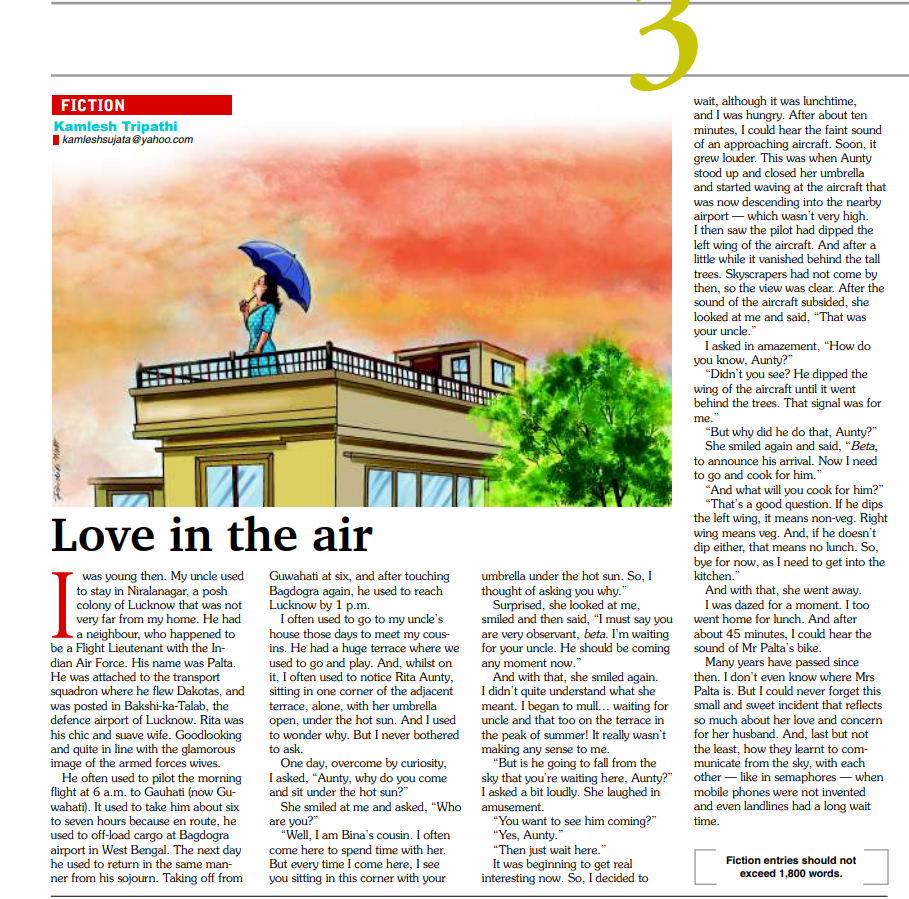
Article: 1. The Magic of Reading 11.12.23; 2. Gandhi to Mahatma 29.1.24; 3. Geography of Solitude 8.4.24; 4. A Lesson From Dalai Lama, 22.4.24; 5. A Source of Inspiration, 29.4.24; 6. The Four-LeggedLibrary, 12.5.24; 7. Age and Achievement, 10.6.24; 8. Read … To Rise Above Mediocrity, 1.7.24; 9. Crusade for a College, 25.8.24; 10. Hemingway’s Iceberg Theory (Panorama) 27.9.24; 11. Short story: Love in the Air, 20.10.24;
THE ARUNACHAL TIMES
Poem: 1. Hope—In The Arc of Twilight, 13.8.23; 2.Poem: Spring 3.3.24; 3.Poem: The Morning Walk 10.3.24;
BANDRA TIMES, MUMBAI
Articles & Poems: 1. Poem: SPRING, 1.4.23; 2. Poem: Mother, 1.6.23; 3. Poem: Rain Rain, 1.8.23; 4. A Lesson From Dalai Lama, 1.6.24; 5. Read to rise above Mediocrity 1.8.24
THE GOAN
Poem: Autumn – The Interim Heaven, 6.10.24
ARTICLES IN THE DIGITAL MAGAZINE ESAMSKRITI
29.12.2020: Indica by Megasthenes; 14.3.22: About The Dimasa Kingdom Assam; 10.12.22: Grand Trunk Road–Uttarapath; 5.10.23: The Ghost Town of Kuldhara Near Jaisalmer;
(ALL THE ABOVE BOOK TITLES ARE AVAILABLE FOR SALE ON AMAZON, FLIPKART AND OTHER ONLINE STORES OR YOU COULD EVEN WRITE TO US FOR A COPY)