During our trip to Europe we visited the ‘Zuiderzee Museum’ in Provincie Noord-Holland. It was celebrating its 75th anniversary and becasue of that there were celebrations taking place in the museum every day. The streets and bridges in the outdoor area of the museum were decorated artistically and there were plenty of exciting activities happening in and around. Three popular traditional festivals were going on there. They were celebrated every year in a spectacular manner. And all around, on the former Zuiderzee King’s Day, a Flower Parade was also held during the Fair.
THE OUTDOOR MUSEUM
The museum took us hundred years back in time. It gave me a feel as if we had walked hundred years back, along the cobbled streets of the Outdoor Museum. More than 140 authentic historic buildings were seen in Zuiderzee, located on the bay in the North Sea. They form a complete village. There we met the inhabitants of Urk. We had a chat with the rag-and-bone man there and watched the craftsmen at work. Do you know how to make a net or a rope someone asked? I said no. I was feeling peckish after all those new impressions that I had seen? Then we treated ourselves to a freshly smoked fish at the fish smokehouse.
AN OUTING FOR THE WHOLE FAMILY!
A visit to the Zuiderzee Museum is fun. One can call it and educational outing for the whole family. Discover the power and importance of water at the Waterworks Expedition. Play ‘Old Dutch’ games or let your imagination run wild trying to build a miniature float.
INDOOR MUSEUM
We met some former and current inhabitants of the Zuiderzee region at the exhibition … Sea of Stories. They can tell you all about their daily lives, their clothing, homes and leisure activities. And about their customs, feasts, and their eternal battle against the water and about the Afsluitdijk, (the dam) that changed their lives and everything. Be sure to visit the Ships Hall that has a unique collection of boats. Don’t miss the anniversary exhibition about the history of the development of the unique Outdoor Museum.
Shravan Charity Mission is an NGO that works for poor children suffering from life-threatening diseases, especially cancer. Our posts are meant for our readers, including children and adults, and have a huge variety in content. We also accept donations for our mission. Should you wish to donate to the cause? The bank details are given below:
NAME OF ACCOUNT: SHRAVAN CHARITY MISSION
Account no: 680510110004635 (BANK OF INDIA)
IFSC code: BKID0006805
*
Kamlesh Tripathi’s Publications
GLOOM BEHIND THE SMILE
(The book is about a young cancer patient. Now archived in 8 prestigious libraries of the US which include Harvard College Library; Harvard University Library; Library of Congress; University of Washington, Seattle; University of Minnesota, Minneapolis; Yale University, New Haven; University of Chicago; University of North Carolina, at Chapel Hill University Libraries. It can also be accessed at MIT through Worldcat.org. Besides, it is also available for reading in libraries and archives of Canada; Cancer Aid and Research Foundation Mumbai; Jaipuria Institute of Management, Noida, India; Shoolini University, Yogananda Knowledge Center, Himachal Pradesh and Azim Premzi University, Bangalore).
ONE TO TANGO … RIA’S ODYSSEY
(Is a book on ‘singlehood’ about a Delhi girl now archived in Connemara Library, Chennai and Delhi Public Library, GOI, Ministry of Culture, Delhi; It is also available for reading in the Indian National Bibliography, March 2016, in the literature section, in Central Reference Library, Ministry of Culture, India, Belvedere, Kolkata-700022)
AADAB LUCKNOW … FOND MEMORIES
(Is a fiction written around the great city of Nawabs—Lucknow. It describes Lucknow in great detail and also talks about its Hindu-Muslim amity, which is the undying characteristic of Lucknow. The book was launched at the Lucknow International Literary Festival in 2014. It is included for reading in Askews and Holts Library Services, Lancashire, U.K; Herrick District Library, Holland and Charlotte-Mecklenburg Library, Mecklenburg County in North Carolina, USA; Black Gold Cooperative Library Administration, Arroyo Grande, California; Berkeley Library, University of California).
REFRACTIONS … FROM THE PRISM OF GOD
(Co-published by Cankids–Kidscan, a pan India NGO and Shravan Charity Mission, that works for child cancer in India. The book is endorsed by Ms Preetha Reddy, MD Apollo Hospitals Group. It was launched at the Lucknow International Literary Festival in 2016).
TYPICAL TALE OF AN INDIAN SALESMAN
(Is a story of an Indian salesman who is, humbly qualified. Yet he fights his way through unceasing uncertainties to reach the top. A good read not only for salesmen. The book was launched on 10th February 2018 at Gorakhpur Lit-Fest. Now available on Amazon, Flipkart and Onlinegatha)
RHYTHM … in poems
(Published in January 2019. The book contains 50 poems. The poems describe our day-to-day life. A few poems from the book have been published in Shillong Times, Bandra Times and Bhavan’s Journal. The book is available on Amazon, Flipkart and Onlinegatha)
MIRAGE
(Published in February 2020. The book is a collection of eight short stories available on Amazon, Flipkart and Notion Press)
AWADH ASSAM AND DALAI LAMA … The Kalachakra
(The story of the man who received His Holiness The Dalai Lama and his retinue in 1959 as a GOI representative when he fled Tibet in 1959. The book was launched on 21st November 2022 by His Holiness The Dalai Lama at Dharmshala. The title is archived in the library of the Department of Information and International Relations (DIIR) Government of Tibet, Tibet Policy Institute (TPI) and the personal library of His Holiness The Dalai Lama. The title is also archived in The Ohio Digital Library, USA. It was recently included in the digital library of the world-renowned company APPLE).
BHAVANS JOURNAL
Short stories, Book reviews and Articles published in Bhavan’s Journal: 1. Reality and Perception, 15.10.19; 2. Sending the Wrong Message, 31.5.20; 3.Eagle versus Scholars June, 15 & 20, 2020; 4.Indica, 15.8.20; 5.The Story of King Chitraketu, August 31 2020; 6.Breaking Through the Chakravyuh, September 30 2020. 7. The Questioning Spouse, October 31, 2020; 8. Happy Days, November 15, 2020; 9.The Karma Cycle of Paddy and Wheat, December 15, 2020; 10.Power Vs Influence, January 31, 2021; 11.Three Refugees, March 15, 2021; 12.Rise and Fall of Ajatashatru, March 31, 2021; 13.Reformed Ruler, May 15, 2021; 14.A Lasting Name, May 31, 2021; 15.Are Animals Better Teachers? June 16, 2021; 16.Book Review: The Gram Swaraj, 1.7.21; 17.Right Age for Achievements, 15.7.21; 18.Big Things Have Small Beginnings, 15.8.21; 19.Where is Gangaridai?, 15.9.21; 20.Confront the Donkey Within You 30.9.21; 21. Know Your Strengths 15.10.21; 22. Poverty 15.11.21; 23. Top View 30.11.21; 24. The Bansuriwala 15.1.22; 25.Sale of Alaska 15.2.22; 26.The Dimasa Kingdom 28.2.22; 27. Buried Treasure 15.4.22; 28. The Kingdom of Pragjyotisha 30.4.22; 29.Who is more useful? 15.5.22; 30. The White Swan from Lake Mansarovar 30.6.22; 31. Bhool Bhulayya 15.9.22; 32. Good Karma 30.9.22; 33. Good Name vs Bad Name 15.10.22; 34.Uttarapath—The Grand Trunk Road 1.12.22; 35.When Gods Get Angry 1.1.23; 36. Holinshed’s Chronicles 15.1.23; 37. Theogony 15.2.23; 38. Poem: Mother 14.5.23; 39. THE NAG MANDIR 30.6.23; 40. The Story of Garuda 30.7.23; 41. Janmabhoomi vs Karmabhoomi 31.8.23; 42. The Ghost Town of Kuldhara 15.9.23; 43. The Tale of Genji 15.10.23; 44. The Soul Connection 1.12.23;
SHILLONG TIMES—SUNDAY EDITION
ARTICLES & POEMS: 1. POEM: HAPPY NEW YEAR 8.1.23; 2. POEM: SPRING 12.3.23; 3. POEM: RIGHT AND WRONG 20.3.23; 4. THE GUSH OF EMOTION—WRITING, 26.3.23; 5. THE NAG MANDIR, 7.5.23; 6. POEM:MOTHER 7.5.23; 7. POEM: RAIN RAIN 9.7.23; 8. POEM:YOU COME ALONE YOUGO ALONE 6.8.23; 9. RAIN RAIN (SECOND TIME) 10.8.23; 10. POEM: GURU TEACHER 10.8.23; 11. POEM: AUTUMN … THE INTERIM HEAVEN 15.10.23; 12. POEM: HAPPY DIWALI 12.11.23; 13. OVERCOMING BLINDNESS: LEARN IT THE JOHN MILTON WAY 10.12.23; 14. THE HAPPY PRINCE AND THE HAPPY MAN’S SHIRT 31.12.23; 15. ANNUS MIRABILIS 2024 7.1.24; 16. GANDHI TO MAHATMA GANDHI- Incidents that Shaped Gandhi in South Africa 28.1.24;
THE ASSAM TRIBUNE
ARTICLE: 1. THE MAGIC OF READING 11.12.23; 2. GANDHI TO MAHATMA 29.1.24
29.12.2020: INDICA BY MEGASTHENES; 14.3.22: ABOUT THE DIMASA KINGDOM ASSAM; 10.12.22: GRAND TRUNK ROAD-UTTARAPATH; 5.10.23: THE GHOST TOWN OF KULDHARA NEAR JAISALMER;
(ALL THE ABOVE BOOK TITLES ARE AVAILABLE FOR SALE ON AMAZON, FLIPKART AND OTHER ONLINE STORES OR YOU COULD EVEN WRITE TO US FOR A COPY)
After over a century of the publishing of ‘Gulliver’s Travels’ came ‘The Voyage of Captain Popanilla’, considered, a modern Gulliver’s Travels. The former was penned by Jonathan Swift in the year 1726 and the latter by author Benjamin Disraeli in 1828. Disraeli, later went on to become the Prime Minister of the United Kingdom.
But what inspired Benjamin Disraeli to write this satiric sea adventure is worth pondering. Because the two real-life master adventurers and explorers of the world were born centuries ago. Italian sailor Christopher Columbus was born in 1451. He completed four Spanish-based voyages across the Atlantic Ocean sponsored by Catholic Monarchs, opening the way for the widespread European exploration and European colonization of America in the 15th century. Vasco Da Gama the Portuguese sailor and explorer was born in 1460. His initial voyage to India by way of the Cape of Good Hope was the first link between Europe and Asia. So did Disraeli get the idea of writing this novel from these two master explorers?
But that apart. The Voyage of Popanilla is an allegorical adventure story describing the surreal voyage of Captain Popanilla and his crew to distant lands and is a satire on contemporary society. It belongs to the genre of Menippean Satire and was influenced by Jonathan Swift’s “Gulliver’s Travels.” The wit is very incisive, and the satire, though it lacks the teeth of Swift’s, is surely rubbing. It contains shades of utopia, in which the author creates a confrontation between an innocent and happy life on a blissful Arcadian island in the South Pacific and the principles of Benthamite Utilitarianism, which Disraeli despised. Obliquely, the narration is a satire on utilitarianism, where the author through appropriations of sea-voyages tries to give a message to England where he later goes on to become the Prime Minister.
The Voyage of Captain Popanilla can also be read as a concomitant sequel to Jonathan Swift’s Gulliver’s Travels. Using the platform of travelogue, Disraeli describes an imaginary land on which he plants contemporary English vices and follies, particularly the mercantilist mentality of the new commercial middle class. In his narrative, Disraeli incorporates a series of dialogues between representatives of two opposing viewpoints: The utilitarian and the non-utilitarian. The novel also deals with issues such as the protectionist Corn Laws of the late 1820s, the acceptance of silver-fork novels, the economic crisis of 1825-26, as well as the founding of the University College London and the Society for the Diffusion of Useful Knowledge. The author has very aptly tried to expose the downside of utilitarianism through the escapades of the sea voyages of Captain Popanilla. He uncovers the conflict between utilitarian and non-utilitarian in the narration. In the following passage, Disraeli ridicules utilitarianism when he exposes its inherent paradoxes and pitfalls.
‘He also showed that man was not born for himself, but for society; that the interests of the body are alone to be considered, and not those of the individual; and that a nation might be extremely happy, extremely powerful, and extremely rich, although every individual member of it might at the same time be miserable, dependent, and in debt. […] Man is created for a purpose; the object of his existence is to perfect himself. Man is imperfect by nature, because if nature had made him perfect he would have had no wants; and it is only by supplying his wants that utility can be developed. The development of utility is therefore the object of our being, and the attainment of this great end the cause of our existence. This principle clears all doubts, and rationally accounts for a state of existence which has puzzled many pseudo-philosophers.
Popanilla then went on to show that the hitherto received definitions of man were all erroneous; that man is neither a walking animal, nor a talking animal, nor a cooking animal, nor a lounging animal, nor a debt-incurring animal, nor a tax-paying animal, nor a printing animal, nor a puffing animal, but a developing animal. Development is the discovery of utility.’
According to Disraeli, utilitarianism dimwits people by destroying their individuality by reducing them to mere automatons and statistical numbers. The reader may infer that the mechanisation of people and converting them into machines will prevent the natural progression and development of their imagination and emotions.
‘Man’, said he, ‘is called the masterpiece of nature; and man is also, as we all know, the most curious of machines: now, a machine is a work of art, consequently, the masterpiece of nature is the masterpiece of art. The object of all mechanisms is the attainment of utility; the object of man, who is the most perfect machine, is utility in the highest degree.
In Disraeli’s interpretation, utilitarianism allows individual rights and liberties to be sacrificed to maximise the vaguely defined collective welfare.
There is a good comparison one can make between the king of Brobdingnag who laughs at Gulliver, in Gulliver’s Travels and the King who doesn’t understand Popanilla’s lucubrations and laughs at him.
Disraeli, who as Prime Minister led the movement to make Queen Victoria the Empress of the British Empire, here early in his career ridicules British colonial expansion as a commercial enterprise created by sea merchants and adventurers — a clear attack on the East India Company.
In The Voyage of Captain Popanilla Disraeli also ridicules the nouveau riche, principally the rising world of capitalism and industry and by extension the silver-fork novels, like his own book Vivian Grey, which enjoyed great popularity among both servants and middle-class readers. Disraeli laughs at the newly rich called Millionaires (however desperately he wished to become one himself), who do not know how to behave in polite society and need to read books about fashionable life for education.
Shravan Charity Mission is an NGO that works for poor children suffering from life-threatening diseases, especially cancer. Our posts are meant for our readers, including children and adults, and have a huge variety in content. We also accept donations for our mission. Should you wish to donate to the cause? The bank details are given below:
NAME OF ACCOUNT: SHRAVAN CHARITY MISSION
Account no: 680510110004635 (BANK OF INDIA)
IFSC code: BKID0006805
*
Kamlesh Tripathi’s Publications
GLOOM BEHIND THE SMILE
(The book is about a young cancer patient. Now archived in 8 prestigious libraries of the US which include Harvard College Library; Harvard University Library; Library of Congress; University of Washington, Seattle; University of Minnesota, Minneapolis; Yale University, New Haven; University of Chicago; University of North Carolina, at Chapel Hill University Libraries. It can also be accessed at MIT through Worldcat.org. Besides, it is also available for reading in libraries and archives of Canada; Cancer Aid and Research Foundation Mumbai; Jaipuria Institute of Management, Noida, India; Shoolini University, Yogananda Knowledge Center, Himachal Pradesh and Azim Premzi University, Bangalore).
ONE TO TANGO … RIA’S ODYSSEY
(Is a book on ‘singlehood’ about a Delhi girl now archived in Connemara Library, Chennai and Delhi Public Library, GOI, Ministry of Culture, Delhi; It is also available for reading in the Indian National Bibliography, March 2016, in the literature section, in Central Reference Library, Ministry of Culture, India, Belvedere, Kolkata-700022)
AADAB LUCKNOW … FOND MEMORIES
(Is a fiction written around the great city of Nawabs—Lucknow. It describes Lucknow in great detail and also talks about its Hindu-Muslim amity, which is the undying characteristic of Lucknow. The book was launched at the Lucknow International Literary Festival in 2014. It is included for reading in Askews and Holts Library Services, Lancashire, U.K; Herrick District Library, Holland and Charlotte-Mecklenburg Library, Mecklenburg County in North Carolina, USA; Black Gold Cooperative Library Administration, Arroyo Grande, California; Berkeley Library, University of California).
REFRACTIONS … FROM THE PRISM OF GOD
(Co-published by Cankids–Kidscan, a pan India NGO and Shravan Charity Mission, that works for child cancer in India. The book is endorsed by Ms Preetha Reddy, MD Apollo Hospitals Group. It was launched at the Lucknow International Literary Festival in 2016).
TYPICAL TALE OF AN INDIAN SALESMAN
(Is a story of an Indian salesman who is, humbly qualified. Yet he fights his way through unceasing uncertainties to reach the top. A good read not only for salesmen. The book was launched on 10th February 2018 at Gorakhpur Lit-Fest. Now available on Amazon, Flipkart and Onlinegatha)
RHYTHM … in poems
(Published in January 2019. The book contains 50 poems. The poems describe our day-to-day life. A few poems from the book have been published in Shillong Times, Bandra Times and Bhavan’s Journal. The book is available on Amazon, Flipkart and Onlinegatha)
MIRAGE
(Published in February 2020. The book is a collection of eight short stories available on Amazon, Flipkart and Notion Press)
AWADH ASSAM AND DALAI LAMA … The Kalachakra
(The story of the man who received His Holiness The Dalai Lama and his retinue in 1959 as a GOI representative when he fled Tibet in 1959. The book was launched on 21st November 2022 by His Holiness The Dalai Lama at Dharmshala. The title is archived in the library of the Department of Information and International Relations (DIIR) Government of Tibet, Tibet Policy Institute (TPI) and the personal library of His Holiness The Dalai Lama. The title is also archived in The Ohio Digital Library, USA. It was recently included in the digital library of the world-renowned company APPLE).
BHAVANS JOURNAL
Short stories, Book reviews and Articles published in Bhavan’s Journal: 1. Reality and Perception, 15.10.19; 2. Sending the Wrong Message, 31.5.20; 3.Eagle versus Scholars June, 15 & 20, 2020; 4.Indica, 15.8.20; 5.The Story of King Chitraketu, August 31 2020; 6.Breaking Through the Chakravyuh, September 30 2020. 7. The Questioning Spouse, October 31, 2020; 8. Happy Days, November 15, 2020; 9.The Karma Cycle of Paddy and Wheat, December 15, 2020; 10.Power Vs Influence, January 31, 2021; 11.Three Refugees, March 15, 2021; 12.Rise and Fall of Ajatashatru, March 31, 2021; 13.Reformed Ruler, May 15, 2021; 14.A Lasting Name, May 31, 2021; 15.Are Animals Better Teachers? June 16, 2021; 16.Book Review: The Gram Swaraj, 1.7.21; 17.Right Age for Achievements, 15.7.21; 18.Big Things Have Small Beginnings, 15.8.21; 19.Where is Gangaridai?, 15.9.21; 20.Confront the Donkey Within You 30.9.21; 21. Know Your Strengths 15.10.21; 22. Poverty 15.11.21; 23. Top View 30.11.21; 24. The Bansuriwala 15.1.22; 25.Sale of Alaska 15.2.22; 26.The Dimasa Kingdom 28.2.22; 27. Buried Treasure 15.4.22; 28. The Kingdom of Pragjyotisha 30.4.22; 29.Who is more useful? 15.5.22; 30. The White Swan from Lake Mansarovar 30.6.22; 31. Bhool Bhulayya 15.9.22; 32. Good Karma 30.9.22; 33. Good Name vs Bad Name 15.10.22; 34.Uttarapath—The Grand Trunk Road 1.12.22; 35.When Gods Get Angry 1.1.23; 36. Holinshed’s Chronicles 15.1.23; 37. Theogony 15.2.23; 38. Poem: Mother 14.5.23; 39. THE NAG MANDIR 30.6.23; 40. The Story of Garuda 30.7.23; 41. Janmabhoomi vs Karmabhoomi 31.8.23; 42. The Ghost Town of Kuldhara 15.9.23; 43. The Tale of Genji 15.10.23; 44. The Soul Connection 1.12.23;
SHILLONG TIMES—SUNDAY EDITION
ARTICLES & POEMS: 1. POEM: HAPPY NEW YEAR 8.1.23; 2. POEM: SPRING 12.3.23; 3. POEM: RIGHT AND WRONG 20.3.23; 4. THE GUSH OF EMOTION—WRITING, 26.3.23; 5. THE NAG MANDIR, 7.5.23; 6. POEM:MOTHER 7.5.23; 7. POEM: RAIN RAIN 9.7.23; 8. POEM:YOU COME ALONE YOUGO ALONE 6.8.23; 9. RAIN RAIN (SECOND TIME) 10.8.23; 10. POEM: GURU TEACHER 10.8.23; 11. POEM: AUTUMN … THE INTERIM HEAVEN 15.10.23; 12. POEM: HAPPY DIWALI 12.11.23; 13. OVERCOMING BLINDNESS: LEARN IT THE JOHN MILTON WAY 10.12.23; 14. THE HAPPY PRINCE AND THE HAPPY MAN’S SHIRT 31.12.23; 15. ANNUS MIRABILIS 2024 7.1.24; 16. GANDHI TO MAHATMA GANDHI- Incidents that Shaped Gandhi in South Africa 28.1.24;
THE ASSAM TRIBUNE
ARTICLE: 1. THE MAGIC OF READING 11.12.23; 2. GANDHI TO MAHATMA 29.1.24
29.12.2020: INDICA BY MEGASTHENES; 14.3.22: ABOUT THE DIMASA KINGDOM ASSAM; 10.12.22: GRAND TRUNK ROAD-UTTARAPATH; 5.10.23: THE GHOST TOWN OF KULDHARA NEAR JAISALMER;
(ALL THE ABOVE BOOK TITLES ARE AVAILABLE FOR SALE ON AMAZON, FLIPKART AND OTHER ONLINE STORES OR YOU COULD EVEN WRITE TO US FOR A COPY)
There are two things that a man cannot do even if he devotes all his life to it. The first is he cannot read all the literature available in the world during his lifetime. The second is he cannot behold all the wonders on earth created by God Almighty. But yes he can visit many of them if he sincerely endeavours to. We attempted to do that.
On 13th August 2023, we left on a group tour of Europe. Our tour operator was Kesari Tours, Mumbai. Our first take-off was an early morning three-hour Indigo Flight from Mumbai to Doha. It landed in Doha the capital of Qatar, where we had a two-hour halt. Thereafter, we were on a Qatar Airways 7-hour flight to London.
We landed at Heathrow London, Terminal 4 at around 2.30 PM London time. It took three hours for the group to clear immigration. By the time we were out of the airport, it was 6 PM. We reached our Hotel, Holiday Inn Express Terminal 5, at seven. The check-in was followed by dinner. The day in London appeared longer than Mumbai, say till nine in the evening in August, as a result, one felt as if one had just finished lunch instead of dinner.
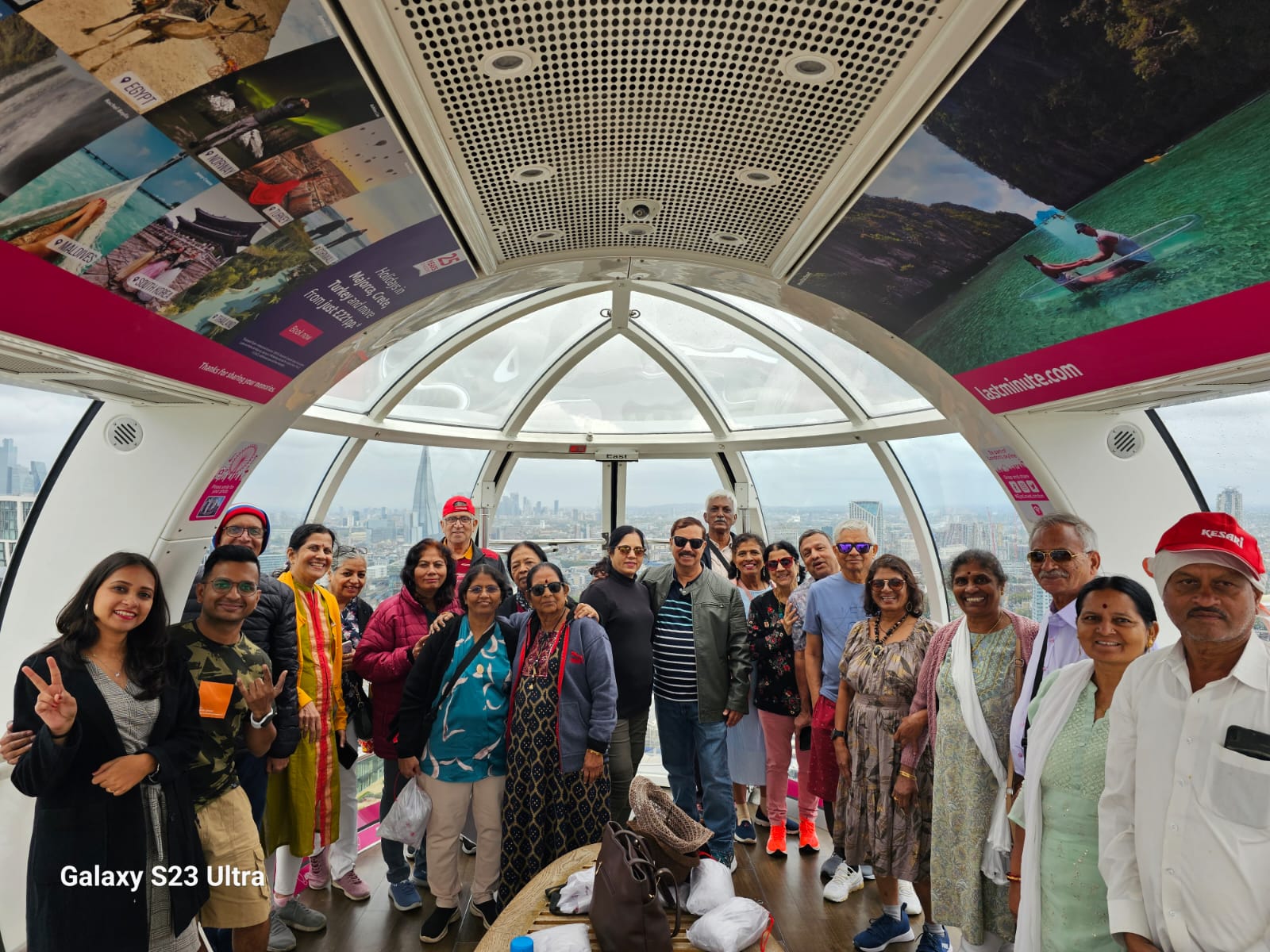
14.8.23: We left for local London sightseeing after an English breakfast at nine in the morning. We travelled to London City Centre crossing zone 3, 2 and 1. Our local travel guide was Sari and coach driver was Sam. We visited the Natural History Museum followed by Victoria and Albert Museum. There were several unique and brick-laden houses on the way that gave a grand look to the city. We passed through the Piccadilly Circle, Hyde Park, Hyde Corner, the statue of the Duke of Wellington straddled on his horse, the Fountain of Opera, Trafalgar Square—Nelson’s Column and its four lions considered zero miles in UK where plenty of Bollywood movies have been shot. Soon after we saw the ‘change of guard ceremony’ at 11.30 in Buckingham Palace which is held every alternate day. We were lucky to be there on the right day which was Monday. It’s an old royal tradition and we were able to video shoot the ceremony. The royal family guards change their shifts under a proper ceremony along with the marching band. The next on the sightseeing list were the Big Ben, Westminster Abbey, Parliament Square and 10 Downing Street. When I crossed the Thames River it reminded me of the old classic song, ‘Scarborough Fair’. The ‘London Eye’ was fascinating. We then saw the symbol of the two dragons indicating you’re entering London. The actual London city is colloquially called the Square Mile. It is 2.90 km square, in area.
LONDON EYE
The London Eye gives a panoramic view of the city of London. It has 32 capsules. It takes 32 minutes for a circle with 32 people, reminding you of the 32 boroughs of London. One capsule represents one borough. The next to see was the Phantom of the Opera, the tower bridge on the left of London Bridge. We drove past the London Bridge and the fire monument of the 16th century. Our lunch was at the Bangalore Express Restaurant. This was followed by a long stroll and shopping in Oxford Street, followed by dinner at the Hot Plate Restaurant and then we returned to our hotel.
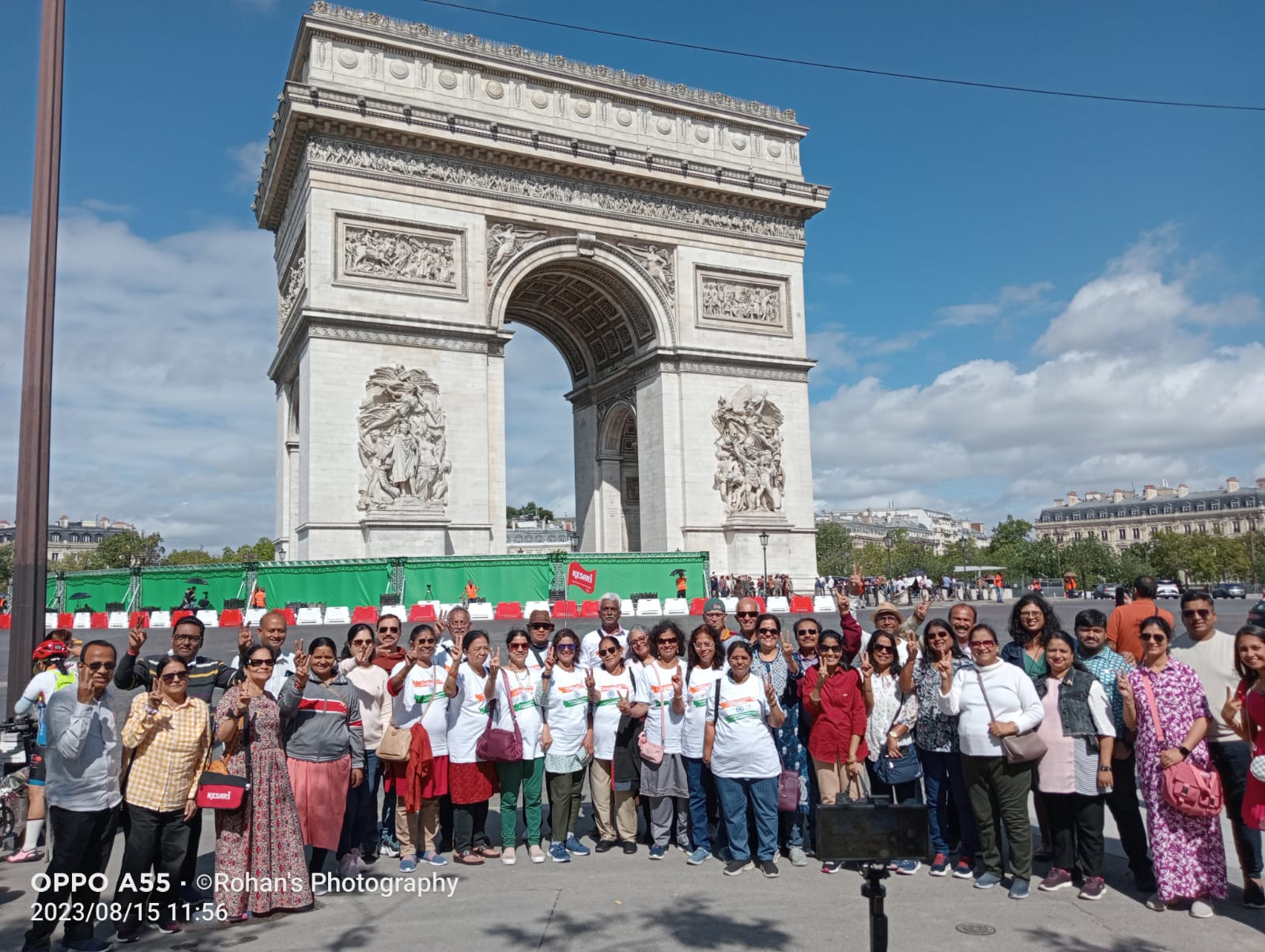
15.8.23: On Independence Day we were up at three in the morning. The need was to catch the famous Eurostar train to Paris and Brussels from St. Pancras International Station, London. The train was at 7.01 AM. We left the hotel at 4.30 in a coach to be at the station by five. The security check at the railway station was quite tedious because of the heavy luggage that we were carrying. After the security, one technically leaves the territory of the U.K. and enters Europe on a Schengen visa. Twenty minutes before departure we were informed about our gate number. We sat in bogies 12 and 13 after walking past gate number 10. Soon, the Eurostar train number 9004 to Paris, left platform 10 from St Pancras Railway Station. After a point, it entered Europe leaving behind the U.K. It took 2 hours and 20 minutes to reach Paris. We were there at 10.20 AM which was exactly two hours and twenty minutes of travel time, but going by the clock it was three hours and twenty minutes because the continent of Europe is one hour ahead of the U.K. time. Our immigration process was held in London station itself. There are tunnels under the English Channel. The train crosses them in about 15-16 minutes on its way to Paris-Gare-du-Nord railway station in Paris. On the way, we ate breakfast along with hot coffee. The local tour guide in Paris was one Mr Senthil, an expat Indian from Tamilnadu. He started the city tour with a Vannakam—Tamil Namaste. Soon Paris started unfolding in front of our eyes. The tour began with the Opera House and The Greek Church—rich in Greek architecture. Then we saw the Golden Flame and the bridge where Lady Diana died in a car mishap. Then followed the Place De La Concorde Square, Macaline, Shawn Elizey, and the famous Eiffel Tower.
15TH AUGUST 2023, WITH TIRANGA FLAGS NEAR EIFFEL TOWER IN PARIS
We celebrated Independence Day with the Tiranga singing our national anthem in front of the Eiffel Tower. Later we visited Napoleon Bonaparte’s tomb in Les Invalides. Lunch was at ‘Welcome India,’ an Indian restaurant, after which at 2 PM we left for the Eiffel Tower. There was a huge crowd there with several souvenir shops. The names of Jules Verne (the author of Twenty Thousand Leagues Under the Sea) and Victor Hugo (the author of Les Miserables), both French authors, find their names mentioned in many of these shops and even in some public areas in Paris. Just as Sir Arthur Conan Doyle’s bust is seen in Baker Street, London. Do you recall the mention of Baker Street in the Sherlock Homes novels?
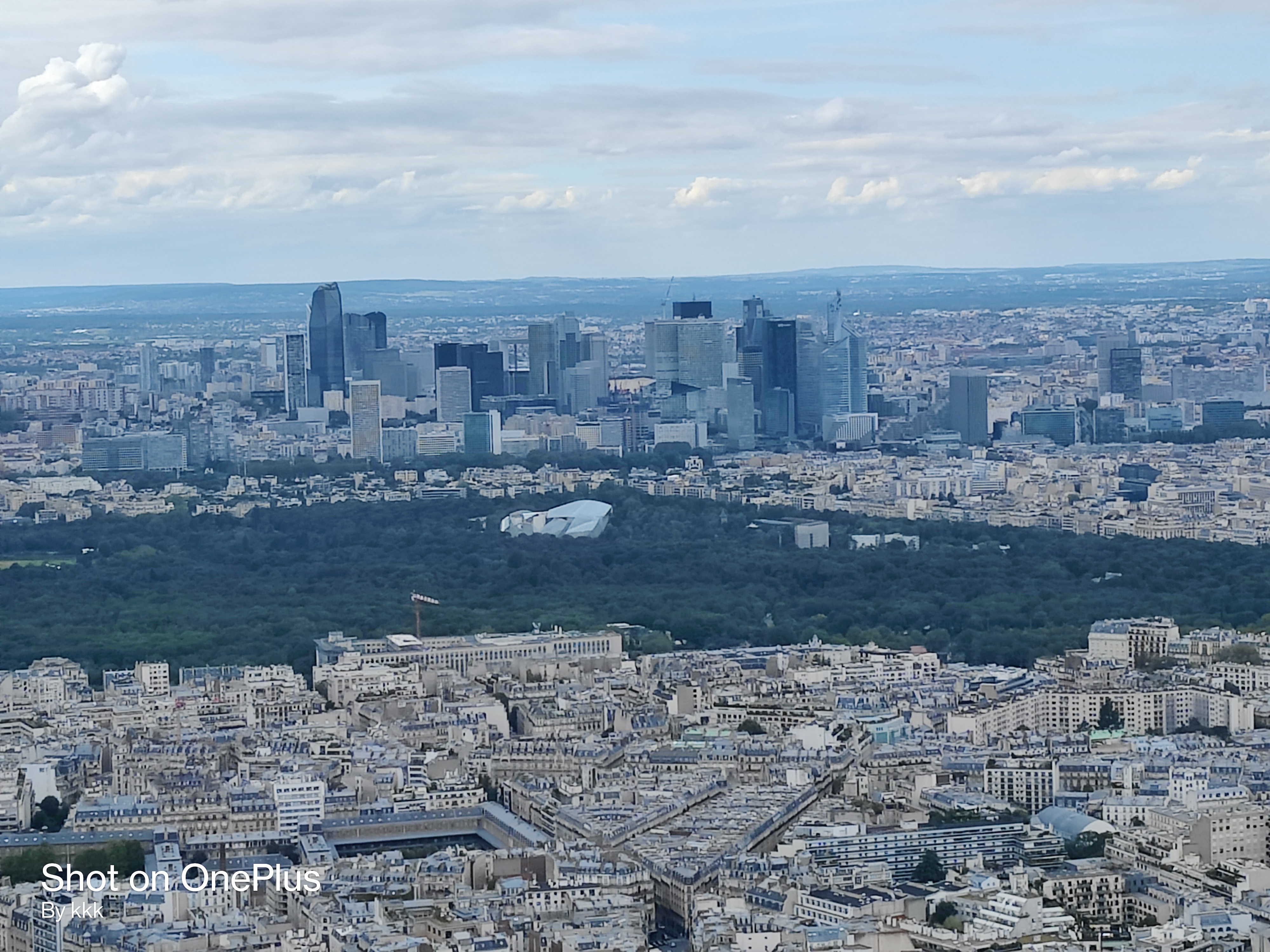
It took us two hours to get across the security gate alone and reach the summit level of the Eiffel Tower. The aerial view of Paris city from there was gorgeous. The summit level was earlier closed. Later they opened it. We were lucky to get the tickets for it. There is a Champagne bar there where we had a drink. The Eiffel Tower has three floors. The first level, the second level, and the summit level. The pillar elevators and the stairs take you to the first and second levels. To reach the top of the Tower from the second-floor platform, one needed to locate the separate elevator meant for it. In the same sequence, one can come down. After beholding the Eiffel Tower to our fill, we undertook a river cruise in the Seine River which was breathtaking.
THE CITY OF PARIS FROM EIFFEL TOWER SUMMIT
Our dinner was at Mewar Restaurant at 7 PM and by eight, we were back in our hotel, Novotel. The roads in Europe were quite open without traffic jams so one could accurately calculate the travel time. After an hour of free time in the hotel, we drove down to the main Paris city which included ‘The Champs-Elysees’, the main street of Paris that in some ways resembled the ‘Kartavya Path’ in New Delhi where we had a photo session in the glittering lights. After that, we went to the Eiffel Tower again. And wow!! It was an amazing sight to see the entire Tower lit up at eleven in the night. We returned to our hotel at midnight. The 15th of August was the longest day of our tour—from 3 a.m to midnight and from London to Paris.
16.8.23
The next day our coach rolled out of the hotel at 8 AM after a sumptuous continental breakfast. Soon it started negotiating the wide roads. Today, we were to travel from Paris to Brussels the capital of Belgium. Belgium is also the capital of the European Union. From Belgium we were to travel to the Netherlands. We realized the uniqueness of Europe: It was breakfast in France, lunch in Belgium and dinner in the Netherlands. It took three and a half hours from Paris to Brussels. The drive was picturesque with the ongoing green landscape and flowing rivers off and on. There was no honking. The drivers in Europe were disciplined and didn’t drive outside their lane, something that needs to be appreciated. Our coach driver was Michelle who hailed from Italy. All along there were small and big villages, all neatly manicured, and all with a church tower. The landscape was verily verdant with a river or two flowing near Belgium where we had a filling meal at the Wonders Restaurant. Thereafter we visited the city centre called the La Grand Place in Brussels, a beautiful square that houses the Town Hall, the Gilded Age houses and the circular monument. There is an old folktale behind the ‘Mannekin Pis Statue’ … ‘The Peeing Boy Statue’ at the nub of the Square. There was hectic shopping in that inviting market. There were photo-ops too followed by a session of delicious ice cream. At four in the evening, we left for Atomium, and it took us an hour to get there. It was again a photo-op point with a long history. The place houses a huge atom structure with 9 spheres and 21 cubes. It is part of the gate built in 1957 considered an icon of Belgium. After the Atomium, we left for Amsterdam, the Netherlands. We crossed Valenciennes—the France – Belgium – border. Then we crossed Breda which is the Belgium- Netherlands border. But before that, we crossed a small town called Antwerp which is famous for its diamond market. In and around Antwerp we could see many windmills, canals, lakes and village houses. My spouse and I were thrilled to see this exquisite face of nature. In the evening we entered the Netherlands through Hazeldonk. Our dinner was in an Indian Restaurant called ‘Bollywood’ in Amsterdam. By 9 PM we had checked into Amedia Hotel, Amsterdam.
17.8.23
After local sightseeing in Amsterdam, we were to travel to Germany. At 9 AM, we left for Madurodam a miniature park in Amsterdam.
MADURODAM, MINI AMSTERDAM
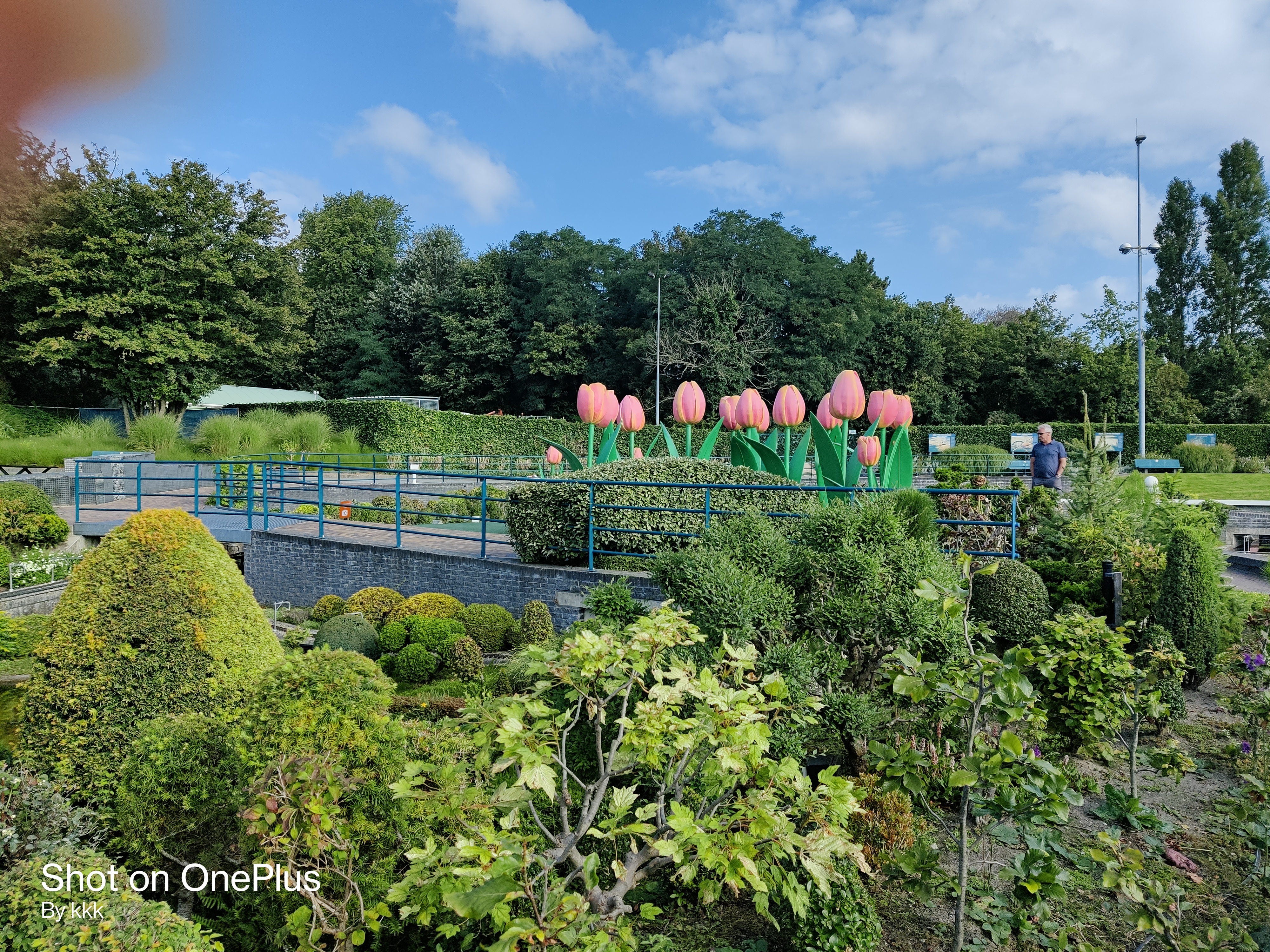
Madurodam Park is also called mini-Amsterdam. Amsterdam gets its water from the North Sea. It is known as the city of cycles, canals and rivers. It remotely reminds you of Venice. We entered Madurodam Park at 9.45 AM. We were supposed to be there till noon. There were many things to be seen there along with the mind-blowing landscape. Whoever built that park must have been a genius. There was a 3D flight ride in a stationery Dakota Plane with high sound effects. There was so much to photograph there, like the verdant garden with miniature canals, boats, luxury liners and the draw-bridges that lifted when the toy ships passed—a real entertainment for children and even adults. The landscaping was just awesome with miniature hills and forests and the modelling of canals, windmills and rural houses were amazing. The souvenir shops were so well laid and with so much merchandise that it could have tempted anyone to buy in droves. We were to leave the park for lunch but on that day our appointed Guru Restaurant caught fire and we were accommodated in Rangoli Restaurant. It’s so nice to see Indian cuisine reaching the nooks and corners of Europe, but you need to book it in advance because the capacities are still low. The blessing in disguise was that the Rangoli Restaurant was just a 5-minute walk from the Lovers Canal Cruise Station so we were able to meet our schedule. We reached the Restaurant at 1 PM. After a quick bite, we were at the Lovers Canal Cruise for a boat ride at 1.45 PM. The canals reminded me of the last scene (a motorboat chase) of Alistair Maclean’s famous movie ‘The Puppet on a Chain.’ Luckily we had the best of both worlds—the lunch and the canal cruise.
The Cologne Cathedral
In the afternoon we left for Germany. Our destination was Cologne. We were to visit the famous Cologne Cathedral after dinner at the Rangoli Restaurant there, (sunset in Europe is rather late during this time of the year so we could do sightseeing even after dinner). Since it was vacation time in Europe, there wasn’t much traffic either. We reached the restaurant by seven, in 4 hours. After dinner, we took a long walk to reach the Cologne Cathedral. It was still daylight. Cologne Cathedral is a unique landmark of Germany. It has a height of 157 metres and it took 650 years to build this cathedral. We clicked many pictures. Visitors who reached there early were able to enter the Cathedral to have an inside view. After visiting the Cathedral we undertook a 45-minute drive to arrive at the Mercure Hotel, in Bonn, where we checked in for the night. Most European countries are small in land area and one never comes to know when one has crossed over to another country. And while crossing over to another country your passport and visa are not checked.
18.8.23
On 18 August we were to travel across Germany through the Black Forest and reach the Rhine Fall (waterfall) in Switzerland and then to our hotel Seadamm Plaza in Pfaeffikon, Zurich. The drive was through the mystique Bavarian Alps with misty mountains and fast lane observing traffic. The weather was cold and overcast.
We started at eight in the morning, first towards the Black Forest. The Black Forest in the German language is called ‘Schwarzwald’ which is known for the Cuckoo Clock Industry, Cloud Fisheries Industry and the Black Forest Cake. The extended word is ‘Schwarzwalder Kirschtorte’, which translates into ‘Black Forest Cherry Cake’ which is the most famous sweet delicacy of that place. Cuckoo Clocks, Watchmaking, Skiing and Hiking are prime activities of the region. The Black Forest Clock Association includes producers, traders and experts. It provides certification to clock-makers who meet these requirements. All clocks are mechanical and are made by hand in Germany with wood from the Black Forest. During the World War, the area of the Black Forest in Bavaria was destroyed. People had become poor. But by starting these industries people regained their affluence. It became a major tourist centre and with that, the income of local people went up. The first stop of our journey was after 450 km which took us around five-and-a-half hours.
We reached the car park of the Cuckoo Clock factory at about 1.45 PM. The place is known as Titisee Brietnau, where clocks are manufactured. It also manufactures glass toys. We were given a live demonstration of how clocks are made. We also saw a live show of a Cuckoo Clock that squeaks and chimes at two in the afternoon and the dancing dolls come out to dance with their partners. In the deep recesses of Germany, we had a rather sumptuous lunch in great style and variety. We were served dahi vadas, veg pulao, grilled chicken, French fries, cutlets and pastries. The group shopped to its delight and was all for the traditional Cuckoo Clock.
RHINEFALL, SWITZERLAND
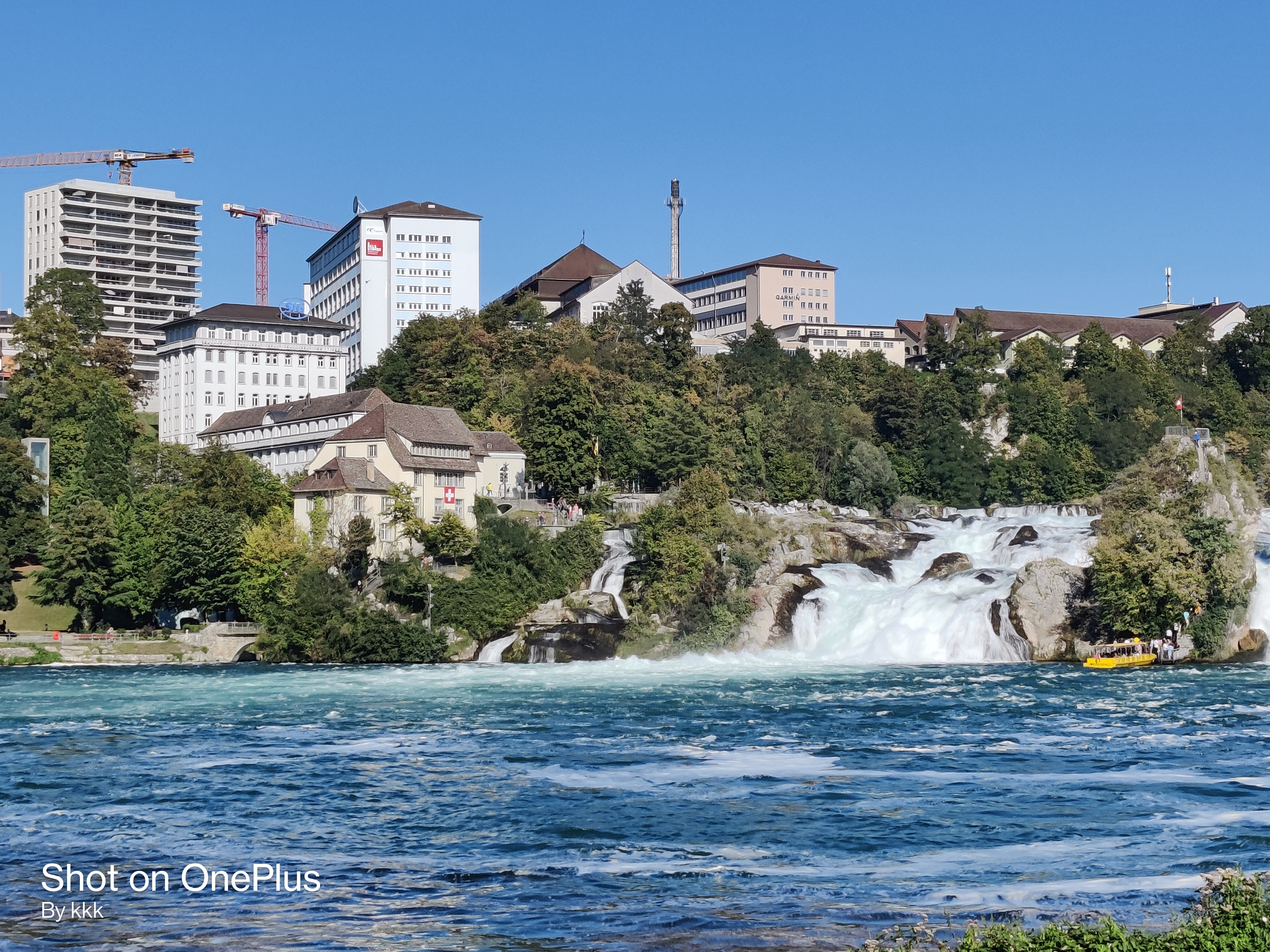
At 3 in the afternoon, we left for the Rhine Fall in Switzerland located in the municipality of Neuhausen Am Rhinefall. Earlier there were only rocks and stones there but when the water arrived it turned into a horizontal waterfall. At 5.40 PM we boarded a forty-seater yellow boat. It took us to the rock island at the centre of the fall. We climbed the rock island to have a three-sixty-degree view. And it was amazing. We then returned to the boarding station where we were in for a pleasant surprise as we were served Indian Masala Tea and Mumbai’s famous Vada-Pav right at the heart of the Rhine Fall in Switzerland. After the Rhine Fall, we travelled for two hours to reach our hotel Seddam Plaza in Seddam Centre in Pfäffikon, Switzerland. With that, the long journey across the Black Forest in Germany and the Rhine Fall in Switzerland came to an end.
19.8.23
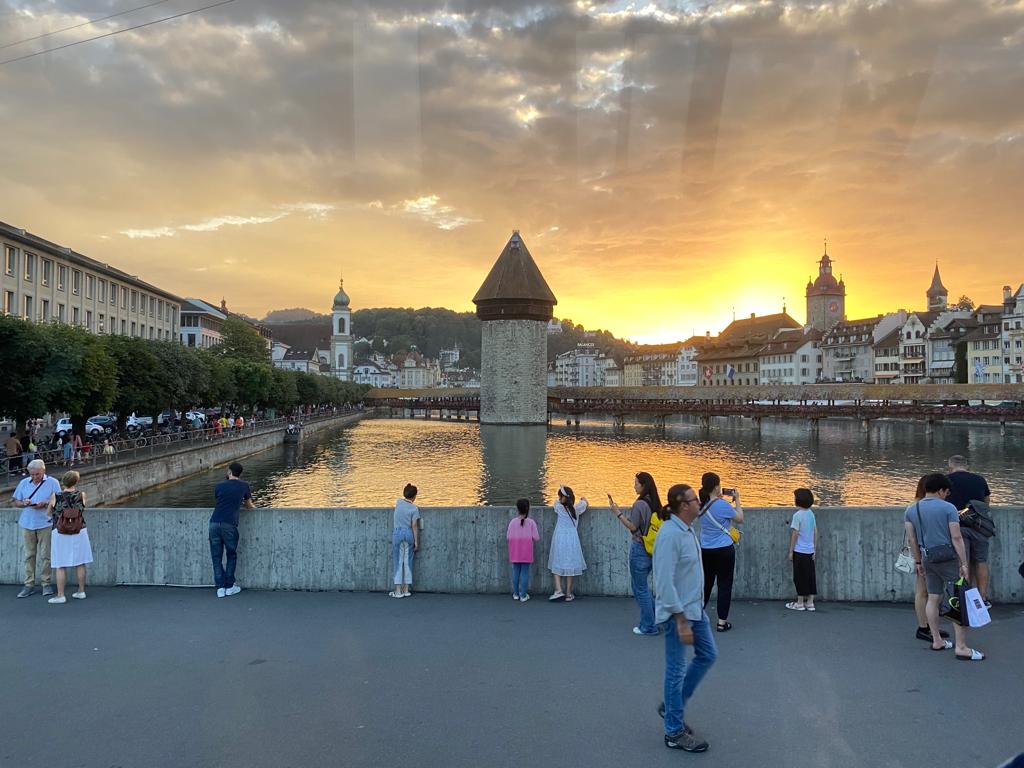
19 August was the highlight day of our tour. We traveled to Mount Titlus in Switzerland. We left our hotel at 8.30 in the morning and arrived in Engelberg, which is the base camp at 10 AM. Engelberg is also called the ‘City of Angels’. From Engelberg, there are cable cars that go right up to Mount Titlis. The journey to the top can be completed in two cable car rides. Engelberg to Stands and Stands to Mount Titlis at an altitude of 10,500 feet. There is a 5-storey building on Mount Titlus. The level 1 of the building has both entry and exit gates. It also has retail shops where we went shopping and had Movenpick ice cream. The weather was unusually warm (signs of global warming). We were roaming in T-shirts without any woollens. The view from the cable car Gondola was just spectacular. We could see some people paragliding from a spot in Mount Titlis. The Titlis Cliff Walk and the Ice Cave were on the first level. We were there till 1.15 PM. Later we came down to Trusbee where we had an Indian meal of Pav-Bhaji, Dhokla, Gajar Halwa, Roti, and Rice. After lunch, we went down to Engelberg and travelled to Lucerne City. In Lucerne, we first went to the Lion Monument dedicated to the Swiss Mercenaries who were killed during the French Revolution by stealth. The sad face of the lion there is dedicated to them. Since the artist who sculpted the Lion monument was not paid his due, he was annoyed, and he cursed them by keeping the lion within the outline of the swine which is considered an abuse.Then we came to Schwanenplatz the busy market area of Lucerne. It is next to the Lucerne Lake which has a sizeable population of ducks on the shore. There was so much to shop starting from Swiss watches, knives, chocolates etc. At 6.30 we were off to a boat cruise with dinner. There we had the pleasure of listening to Swiss folklore and some special instruments. We also chorused Bollywood songs and danced on the upper deck of the boat. After enjoying the sail and dinner we left at eight for our hotel Seedamm Plaza. We were there by nine. It was the climax of our tour: Engelberg, Mount Titlis, Lion Monument, Lucerne Lake and the dinner cruise. We learnt that the government of Switzerland has installed a bust of Indian film producer Yash Chopra in the city of Interlaken for promoting Switzerland in his films.
20.8.23
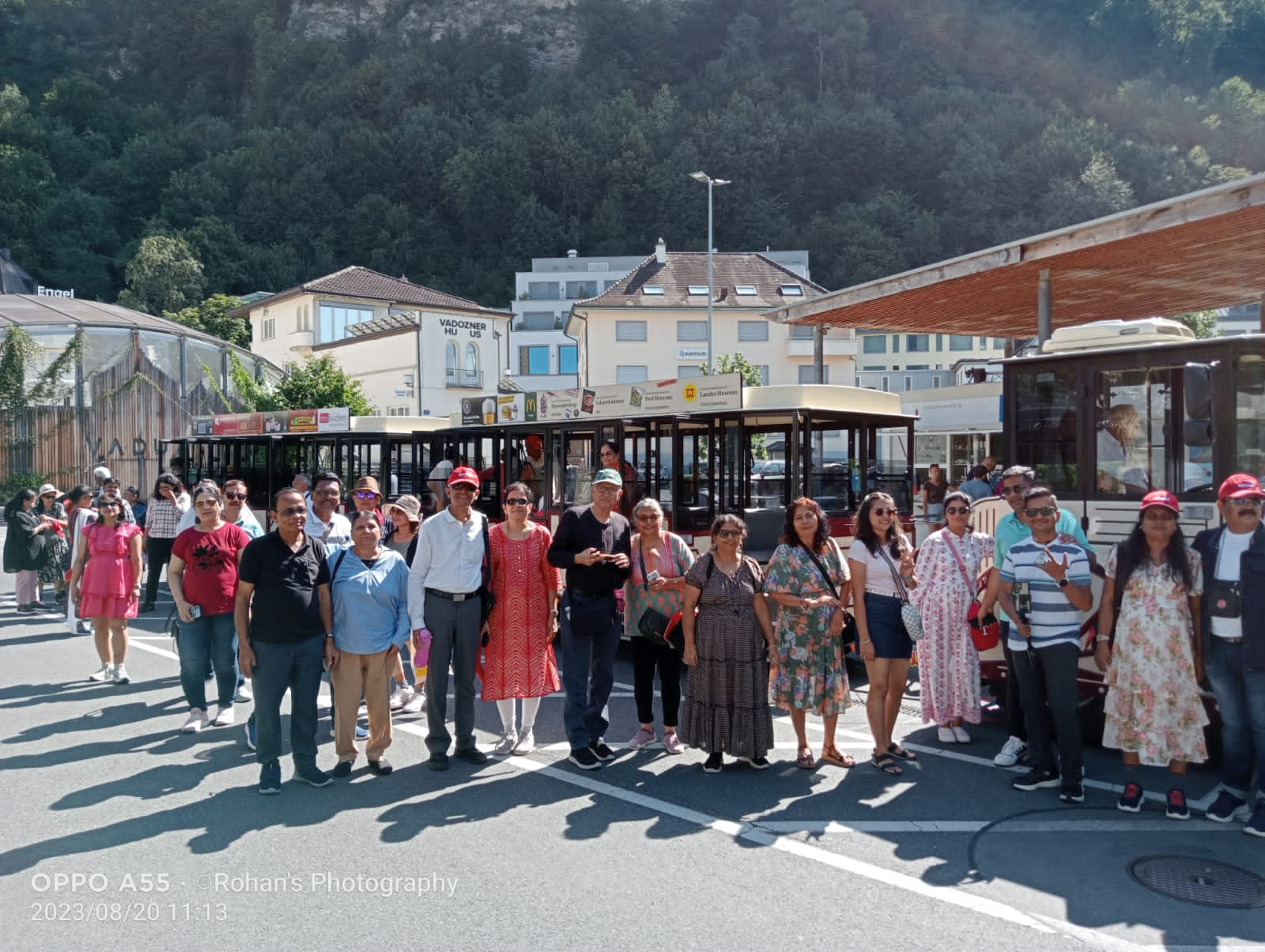
On 20 August we left Switzerland at 9.30 AM for Wattens, Austria via Vaduz, the capital of Liechtenstein. Liechtenstein is a small country with a tiny population of 35000 people.
THE GROUP IN LIECHTENSTEIN
They too have their national day on 15 August. We took a guided Mini-Train tour around the city, and can you beat it, the pre-recorded running commentary in that describing the city was in Hindi of all the languages. As Indians, we felt proud. There was lots to buy in Vaaduz like liquor chocolates, garments, coins and souvenirs. There was also a big collection of stamps there for the stamp collectors. We lunched at Schlossle Mahal which is run by a chef from Assam, India. I was thrilled to meet him as I too have my roots in Assam. Moreover, he had studied at Darrang College in Tezpur, Assam. My father was the founder principal of that college in 1945. Indeed the world is small. After the splendid lunch, we departed for Austria which is landlocked with Liechtenstein. The first village that we crossed in Austria was Feldkirch which borders with Liechtenstein. We drove past the Inn River and arrived in Wattens, Austria at 4 PM. Here, we visited the Swarovski Crystal Museum, a wonderful complex. We couldn’t resist the temptation so we bought some crystal glass. Swarovski is a world-renowned brand that manufactures crystal glass. They also have showrooms in India. At 6 in the evening, we left for Innsbruck where we had a walking tour that took us to the Golden Roof, St. Jacob Dome, Inn River and Maria-Theresien Street. We clicked some pictures there. At 7.15 PM we drove to the mountain area—the top of the hill called Axams where we stayed at the Olympia Hotel which is a ski resort and where we had a filling continental dinner. In the evening there was a casual discussion on Mozart who hails from Austria. Recapping … on the 20th, we had breakfast in Switzerland, lunch in Liechtenstein and dinner in Austria.
WATTENS, AUSTRIA
21.8.23
We travelled from Austria to Italy (from Innsbruck in Austria to Venice in Italy). It was a long drive. We left at 7.30 AM to arrive at the designated restaurant for lunch by 1.15 in the afternoon. Punctuality is very important in Europe. We reached the restaurant exactly at 1 PM. The restaurant’s name was Bombay Spice. On the way, we crossed Brenner-Pass over the Alps which is the border between Austria and Italy. We drove through the Alps and finally arrived in Trento. There was a 45-minute halt there after which the Alps were left behind. The landscape re-styled after that. We crossed the city of Verona which is the village of Romeo and Juliet in William Shakespeare’s play. Post Verona, we reached Padua which is an industrial zone. We were to return here for our night halt. After Padua, there is the town of Mestre. We had lunch there in the restaurant called Bombay Spice after obtaining a permit from the checkpoint. Soon after, we left for Tronchetto in Venice where a Vaporetto boat was waiting to take us to St. Marks Island. The temperature was 39 degrees, hot and humid but the group negotiated the weather quite well. After arriving at St. Mark Island we started our walking tour. We went past the Bridge of Sighs, the Canal Grande, the Rialto Bridge, Piazzo San Marco, Santa Maria, Murano, Dodge’s Palace, St Mark’s Square, St. Mark’s Basilica, St. Mark’s Cathedral and a few more spots, all tourist attractions. In our free time there we did hectic photography and souvenir shopping. We then proceeded to Danieli from where we took the Gondola ride for about half an hour. Five people sat in one Gondola. Following that we had Gelato Icecream, and returned to Tronchetto in the same boat by six and then drove down to our hotel – 4 Points by Sheraton in Padua. The dinner was at eight. It came from the Rangoli restaurant in Padua. After dinner, we retired for the day.
22.8.23
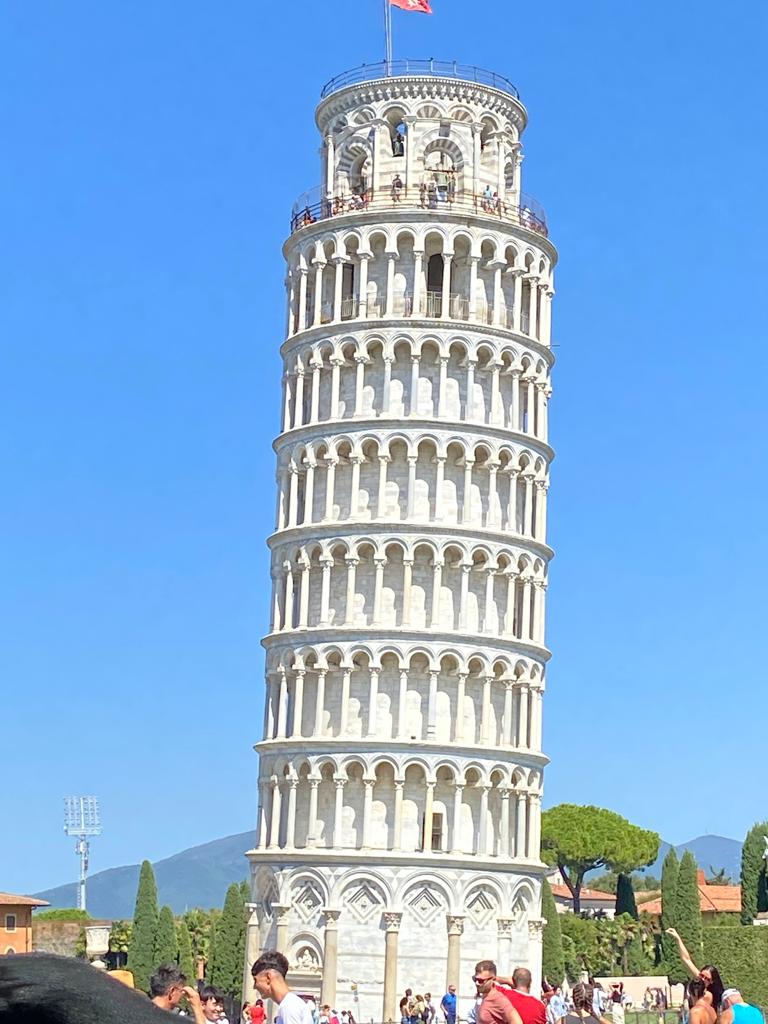
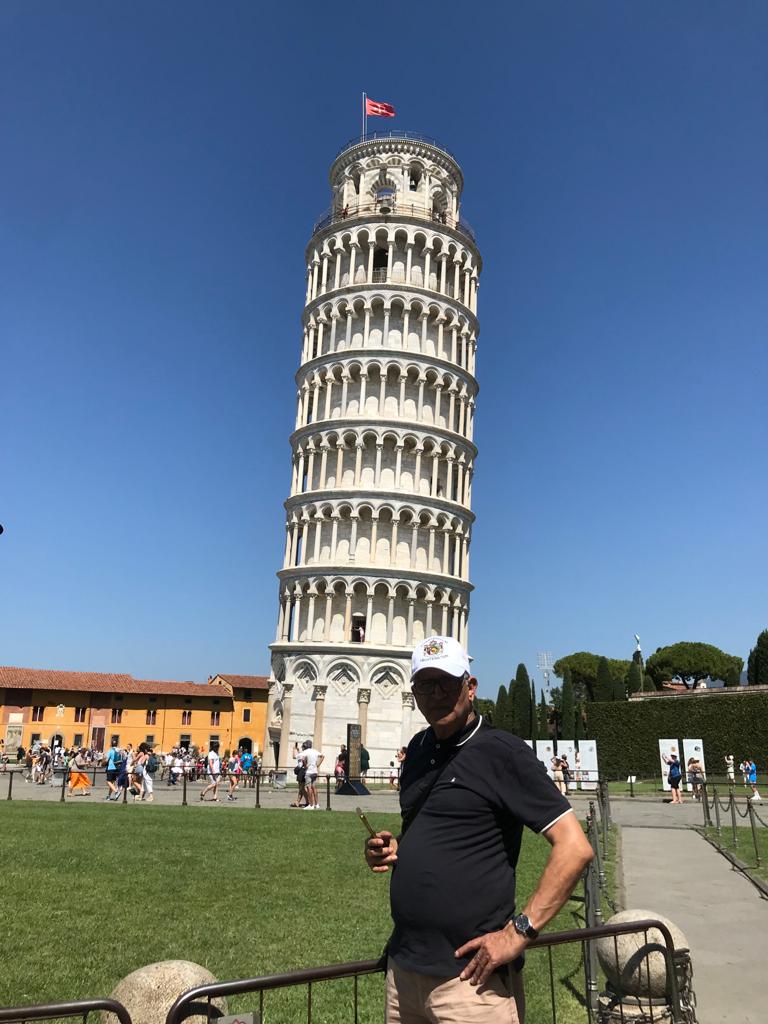
THE LEANING TOWER OF PISA
Today, we were to travel from Padua to Pisa and then to Aritzo, the central part of Italy. It was a relaxed day. We left Padua at nine in the morning and reached Pisa at 1 PM. Pisa is famously known as the city of the Italian astronomer, Galileo Galilei. He was born there. We had lunch at Rajasthan Restaurant in the vicinity. Thereafter we explored the sight: The Square of Miracles which comprises the Leaning Tower of Pisa, the Baptistery, the Cathedral, the Campanile and the Camposanto or Cemetery. We clicked pictures galore of The Leaning Tower in a particular manner as told by Rohan our tour guide. We shopped for souvenirs, had tea, coffee and snacks and then took the Mini-Train back to the parking area where our vehicle awaited us.
THE LEANNG TOWER OF PISA–KAMLESH TRIPATHI
Soon we left for our onward destination, Aritzo. In two hours we were there. We checked into Hotel Aritzo A-Point and called it a day.
23.8.23
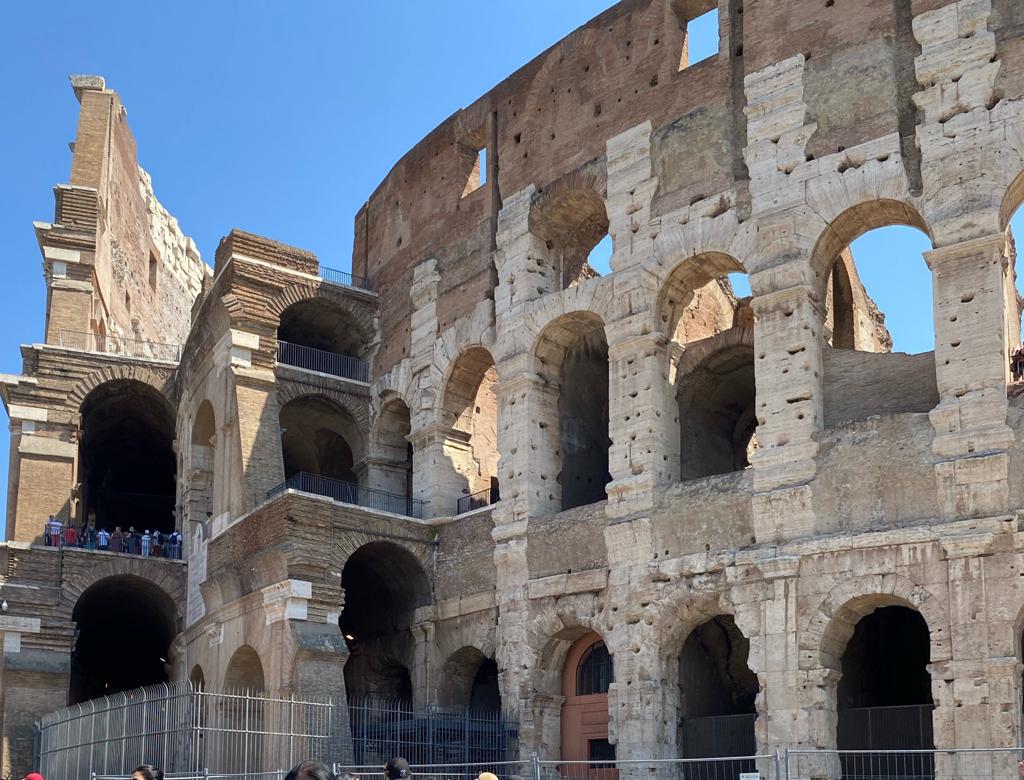
COLOSSEUM, ROME
We were heading to Rome from Aritzo. It was the second last day of our tour and the last night in Italy. All roads lead to Rome as they say. After reaching Rome we had a photo-stop at the Colosseum. The Colosseum is an elliptical Flavian amphitheatre in the centre of the city of Rome, just east of the Roman Forum. It is the largest ancient amphitheatre ever built in the world, despite its age. The construction of this amphitheatre was completed in 80 AD. It was constructed 2000 years ago and has a seating capacity of 50,000 to 80,000 spectators. Romans were considered cruel. They enjoyed bloodshed where male gladiators were made to fight animals, and slaves were made to fight Gladiators and in the end, whoever lost was subject to the spectator’s decision of being let off or being killed based on their thumbs up or a thumbs down. In case of thumbs down the loser used to be killed. After seeing the Colosseum we went for lunch at the Annapurna Restaurant. The good thing about Europe is that in every city you’ll find an Indian Restaurant.
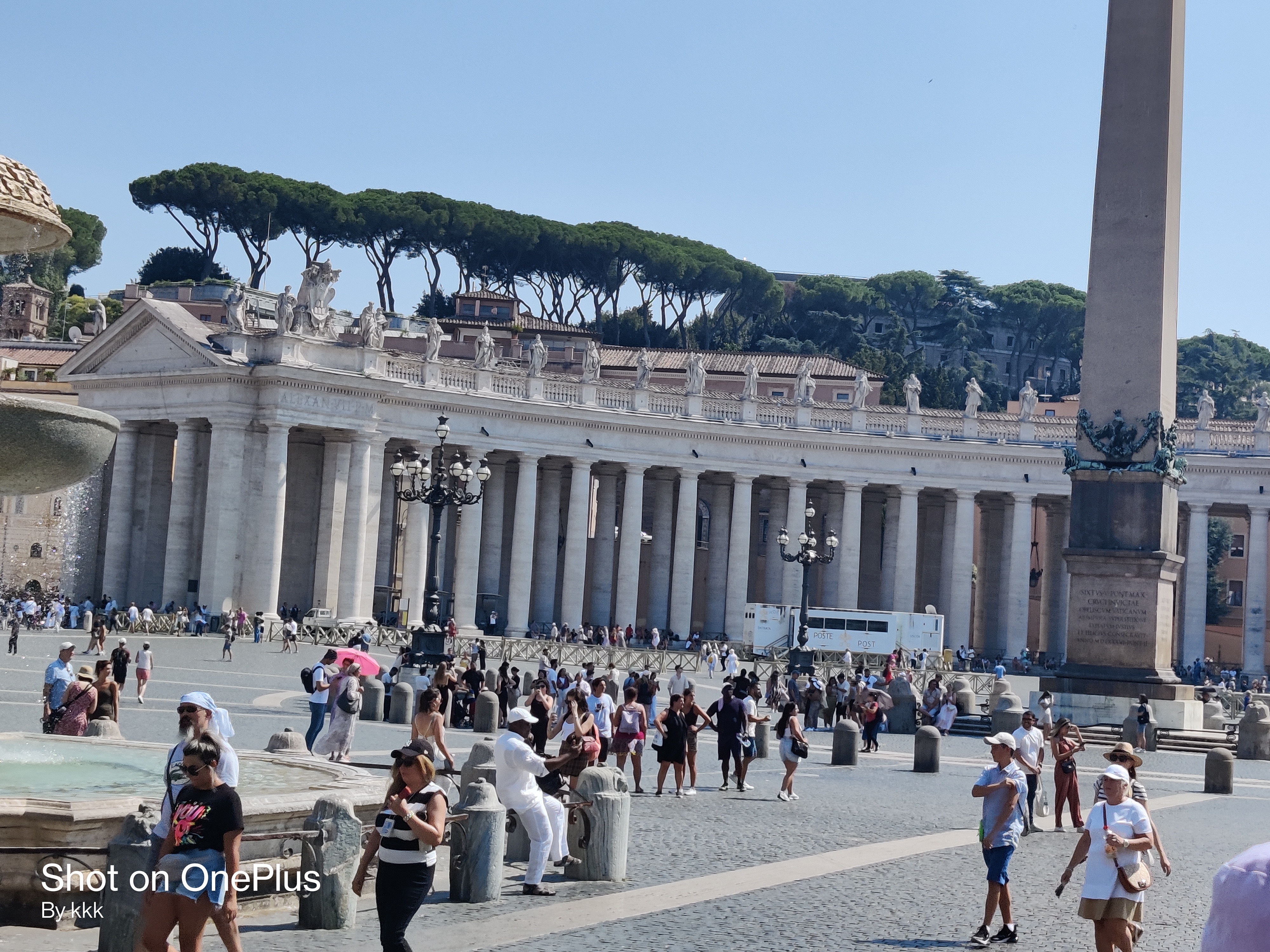
St Peter’s Square, Vatican.
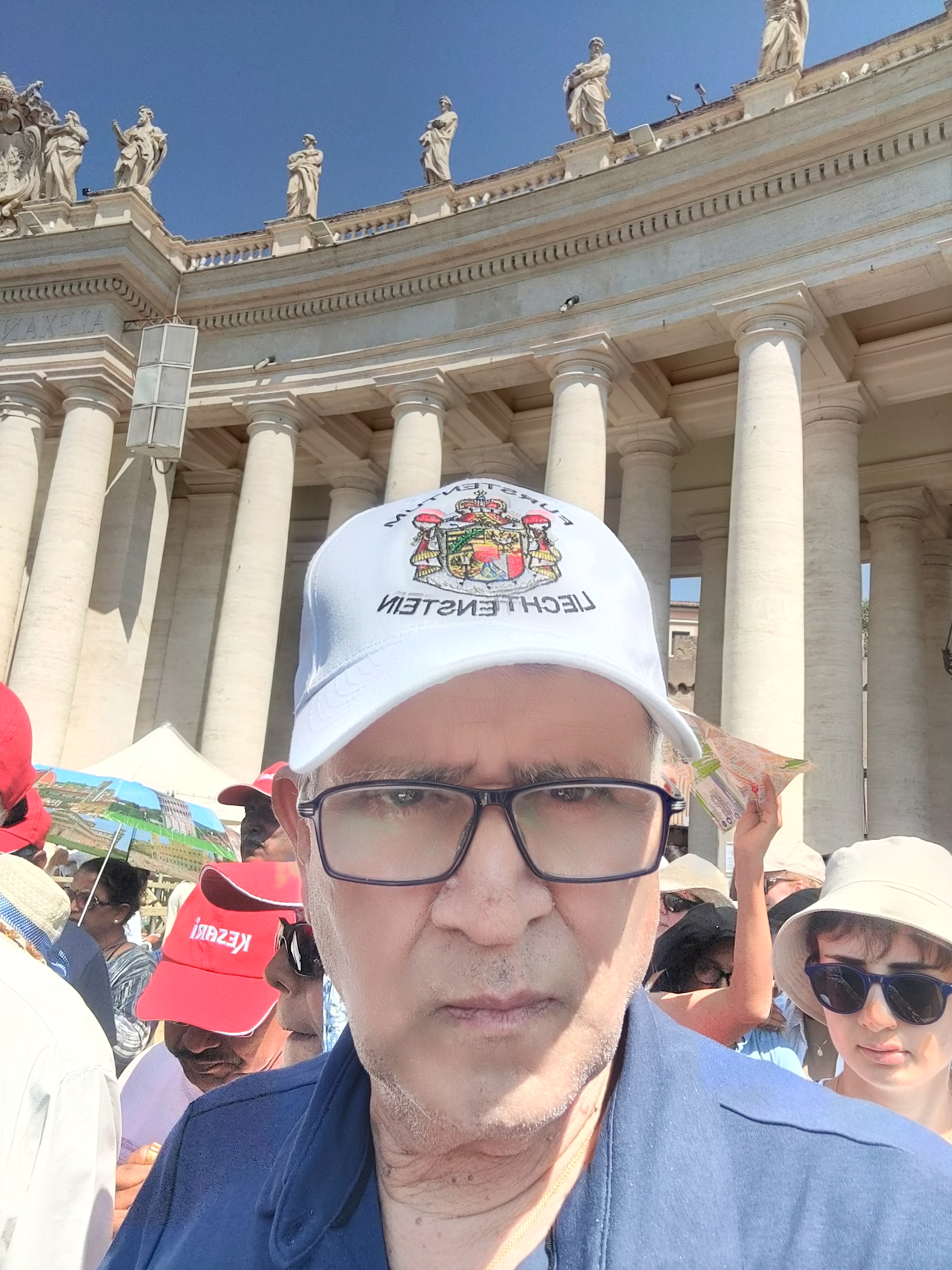
After lunch, we went on a guided tour to St Peter’s Basilica in the Vatican City. We were given earphones so that we could listen to our tour guide properly. We saw The Madonna della Pieta, informally known as La Pieta (Jesus in the lap of Mother Mary) a marble sculpture of Jesus and Mary at Mount Golgotha representing the “Sixth Sorrow” of the Blessed Virgin Mary by Michelangelo Buonarroti, now in Saint Peter’s Basilica, Vatican City. It is a key work of the Italian Renaissance sculpture and is often taken as the start of the High Renaissance. Down the line, we also got to see the Papal Tombs of the Popes who were buried there. Then there was the statue of the first Pope St. Peters. There was the bronze and gilded baldachin, the first work of Bernini (Bernini columns) to combine sculpture and architecture. We went past Michelangelo’s dome, columns, the Holy Water and the doors where you can wash your sins which open once in 25 years. Thereafter we had a photo session in St Peter Square and saw the two fountains created by Carlo Maderno and Gian Lorenzo Bernini. What was to follow was the residence of the earlier Pope and the gallery from where the current Pope Francis, addresses the public. After that, we left for our hotel Mercure Roma West.
AUTHOR KAMLESH TRIPATHI IN THE VATICAN
24.8.23
On the final day, we left our hotel at 11.15 AM. Lunch was in the Rome City Centre at noon. At 1.00 PM, we left for Trevi Fountain. It was a long walk to the monument as vehicles were not allowed there. We had a photo-op followed by last-minute shopping and a walking tour at 3 PM., of Rome Piazza Venezia (the square of Venice) a white-coloured monument building called the Typewriter Building or Wedding Cake Building, Mussolini’s Office, Town Hall and the Roman Forum Museum. At around 4.30 PM, we departed for Rome airport and reached there at 6 PM. We were to fly to Qatar by flight number QR 114 of Qatar Airways in the night. And from there to Mumbai on an Indigo international flight, and that was the end of this very exciting tour.
In a matter of 12 days, we drove through 10 countries and over 3000 km. This was possible only because of Kesari Tours, excellent roads, disciplined lane driving and the seamless borders of Europe.
Shravan Charity Mission is an NGO that works for poor children suffering from life-threatening diseases, especially cancer. Our posts are meant for our readers, including children and adults, and have a huge variety in content. We also accept donations for our mission. Should you wish to donate to the cause? The bank details are given below:
NAME OF ACCOUNT: SHRAVAN CHARITY MISSION
Account no: 680510110004635 (BANK OF INDIA)
IFSC code: BKID0006805
*
Kamlesh Tripathi’s Publications
GLOOM BEHIND THE SMILE
(The book is about a young cancer patient. Now archived in 8 prestigious libraries of the US which include Harvard College Library; Harvard University Library; Library of Congress; University of Washington, Seattle; University of Minnesota, Minneapolis; Yale University, New Haven; University of Chicago; University of North Carolina, at Chapel Hill University Libraries. It can also be accessed at MIT through Worldcat.org. Besides, it is also available for reading in libraries and archives of Canada; Cancer Aid and Research Foundation Mumbai; Jaipuria Institute of Management, Noida, India; Shoolini University, Yogananda Knowledge Center, Himachal Pradesh and Azim Premzi University, Bangalore).
ONE TO TANGO … RIA’S ODYSSEY
(Is a book on ‘singlehood’ about a Delhi girl now archived in Connemara Library, Chennai and Delhi Public Library, GOI, Ministry of Culture, Delhi; It is also available for reading in the Indian National Bibliography, March 2016, in the literature section, in Central Reference Library, Ministry of Culture, India, Belvedere, Kolkata-700022)
AADAB LUCKNOW … FOND MEMORIES
(Is a fiction written around the great city of Nawabs—Lucknow. It describes Lucknow in great detail and also talks about its Hindu-Muslim amity, which is the undying characteristic of Lucknow. The book was launched at the Lucknow International Literary Festival in 2014. It is included for reading in Askews and Holts Library Services, Lancashire, U.K; Herrick District Library, Holland and Charlotte-Mecklenburg Library, Mecklenburg County in North Carolina, USA; Black Gold Cooperative Library Administration, Arroyo Grande, California; Berkeley Library, University of California).
REFRACTIONS … FROM THE PRISM OF GOD
(Co-published by Cankids–Kidscan, a pan India NGO and Shravan Charity Mission, that works for child cancer in India. The book is endorsed by Ms Preetha Reddy, MD Apollo Hospitals Group. It was launched at the Lucknow International Literary Festival in 2016).
TYPICAL TALE OF AN INDIAN SALESMAN
(Is a story of an Indian salesman who is, humbly qualified. Yet he fights his way through unceasing uncertainties to reach the top. A good read not only for salesmen. The book was launched on 10th February 2018 at Gorakhpur Lit-Fest. Now available on Amazon, Flipkart and Onlinegatha)
RHYTHM … in poems
(Published in January 2019. The book contains 50 poems. The poems describe our day-to-day life. A few poems from the book have been published in Shillong Times, Bandra Times and Bhavan’s Journal. The book is available on Amazon, Flipkart and Onlinegatha)
MIRAGE
(Published in February 2020. The book is a collection of eight short stories available on Amazon, Flipkart and Notion Press)
AWADH ASSAM AND DALAI LAMA … The Kalachakra
(The story of the man who received His Holiness The Dalai Lama and his retinue in 1959 as a GOI representative when he fled Tibet in 1959. The book was launched on 21st November 2022 by His Holiness The Dalai Lama at Dharmshala. The title is archived in the library of the Department of Information and International Relations (DIIR) Government of Tibet, Tibet Policy Institute (TPI) and the personal library of His Holiness The Dalai Lama. The title is also archived in The Ohio Digital Library, USA. It was recently included in the digital library of the world-renowned company APPLE).
BHAVANS JOURNAL
Short stories, Book reviews and Articles published in Bhavan’s Journal: 1. Reality and Perception, 15.10.19; 2. Sending the Wrong Message, 31.5.20; 3.Eagle versus Scholars June, 15 & 20, 2020; 4.Indica, 15.8.20; 5.The Story of King Chitraketu, August 31 2020; 6.Breaking Through the Chakravyuh, September 30 2020. 7. The Questioning Spouse, October 31, 2020; 8. Happy Days, November 15, 2020; 9.The Karma Cycle of Paddy and Wheat, December 15, 2020; 10.Power Vs Influence, January 31, 2021; 11.Three Refugees, March 15, 2021; 12.Rise and Fall of Ajatashatru, March 31, 2021; 13.Reformed Ruler, May 15, 2021; 14.A Lasting Name, May 31, 2021; 15.Are Animals Better Teachers? June 16, 2021; 16.Book Review: The Gram Swaraj, 1.7.21; 17.Right Age for Achievements, 15.7.21; 18.Big Things Have Small Beginnings, 15.8.21; 19.Where is Gangaridai?, 15.9.21; 20.Confront the Donkey Within You 30.9.21; 21. Know Your Strengths 15.10.21; 22. Poverty 15.11.21; 23. Top View 30.11.21; 24. The Bansuriwala 15.1.22; 25.Sale of Alaska 15.2.22; 26.The Dimasa Kingdom 28.2.22; 27. Buried Treasure 15.4.22; 28. The Kingdom of Pragjyotisha 30.4.22; 29.Who is more useful? 15.5.22; 30. The White Swan from Lake Mansarovar 30.6.22; 31. Bhool Bhulayya 15.9.22; 32. Good Karma 30.9.22; 33. Good Name vs Bad Name 15.10.22; 34.Uttarapath—The Grand Trunk Road 1.12.22; 35.When Gods Get Angry 1.1.23; 36. Holinshed’s Chronicles 15.1.23; 37. Theogony 15.2.23; 38. Poem: Mother 14.5.23; 39. THE NAG MANDIR 30.6.23; 40. The Story of Garuda 30.7.23; 41. Janmabhoomi vs Karmabhoomi 31.8.23; 42. The Ghost Town of Kuldhara 15.9.23; 43. The Tale of Genji 15.10.23; 44. The Soul Connection 1.12.23;
SHILLONG TIMES—SUNDAY EDITION
ARTICLES & POEMS: 1. POEM: HAPPY NEW YEAR 8.1.23; 2. POEM: SPRING 12.3.23; 3. POEM: RIGHT AND WRONG 20.3.23; 4. THE GUSH OF EMOTION—WRITING, 26.3.23; 5. THE NAG MANDIR, 7.5.23; 6. POEM:MOTHER 7.5.23; 7. POEM: RAIN RAIN 9.7.23; 8. POEM:YOU COME ALONE YOUGO ALONE 6.8.23; 9. RAIN RAIN (SECOND TIME) 10.8.23; 10. POEM: GURU TEACHER 10.8.23; 11. POEM: AUTUMN … THE INTERIM HEAVEN 15.10.23; 12. POEM: HAPPY DIWALI 12.11.23; 13. OVERCOMING BLINDNESS: LEARN IT THE JOHN MILTON WAY 10.12.23; 14. THE HAPPY PRINCE AND THE HAPPY MAN’S SHIRT 31.12.23; 15. ANNUS MIRABILIS 2024 7.1.24; 16. GANDHI TO MAHATMA GANDHI- Incidents that Shaped Gandhi in South Africa 28.1.24;
THE ASSAM TRIBUNE
ARTICLE: 1. THE MAGIC OF READING 11.12.23; 2. GANDHI TO MAHATMA 29.1.24
29.12.2020: INDICA BY MEGASTHENES; 14.3.22: ABOUT THE DIMASA KINGDOM ASSAM; 10.12.22: GRAND TRUNK ROAD-UTTARAPATH; 5.10.23: THE GHOST TOWN OF KULDHARA NEAR JAISALMER;
(ALL THE ABOVE BOOK TITLES ARE AVAILABLE FOR SALE ON AMAZON, FLIPKART AND OTHER ONLINE STORES OR YOU COULD EVEN WRITE TO US FOR A COPY)
Pietermaritzburg railway station, South Africa, winter, 1893. In the waiting room, which is dark and bitterly cold, a well-dressed young Indian is seated. He has a first-class ticket from Durban to Pretoria in his pocket, but he has only completed part of the journey. A few hours earlier, the guard had asked the police to take him off the train because a white passenger wanted to ride in the first class compartment but not while an Indian man was sitting there. For the railway company and the police, this was a normal affair.
But not for Mohandas Gandhi. As the night grows, he wonders what to do. Should he remain quiet? Should he go back to India? Or should he fight against this injustice? By morning, Gandhi had decided to fight. He had taken the first step on the path that would one day make him a leader loved and followed by millions even years after his death. Gandhi was mentally tough but malleable in appearance.
Gandhi sat alone all night, thinking about what had happened and about his future. He was just twenty-three years old. Should he return to India, or should he stay and fight against injustice, he pondered? He realised that the injustice he was experiencing was caused by deep racism. That night, in the station at Pietermaritzburg, Gandhi decided that he was prepared to fight against racism.
When he finally reached Pretoria the next evening it was dark and Gandhi did not know where to stay. An African American, offered to take him to a small hotel. The owner gave Gandhi a room. ‘But you must eat in your room,’ he said. ‘The other people here are white and they could be angry if you eat in the restaurant.’ Gandhi told the owner that he was beginning to understand the conditions in South Africa. But later, the owner came back. ‘Please come and eat in the restaurant,’ he said. ‘The others do not mind.’
One day in Pretoria, Gandhi was pushed off the path by a white guard. Only white people were allowed to walk on the paths: Africans and Indians had to walk on the roads.
And so, Gandhi, through painful experiences like these, discovered that he wanted to fight injustice. He quickly changed from a shy young man to a confident one.
Abdullah Sheth Gandhi’s employer in South Africa took Gandhi to Durban court, with his white lawyer. The judge stared at Gandhi and finally told him to take off his turban. Mohandas refused and left the court. The next day a newspaper reported this story, and called Gandhi an ‘unwelcome visitor’. Gandhi wrote to the newspaper and explained that the turban was an important part of his Indian life. Gandhi continued to wear his turban while he lived in South Africa.
In 1893, South Africa was not one nation, but several separate provinces. Durban was in the province of Natal, which was part of the British Empire. The British had large sugar and coffee farms in Natal and from 1860 the British had been bringing farm workers from India to work on these farms. The Indian farm workers were very poor and they were not allowed to leave the farms until they had worked there for five years.
Durban was the biggest city in Natal. About 30,000 people lived in the city. Half of them were white people, one quarter were Indian, and one quarter were African.
Gandhi worked with the Indians and Africans with great vigour. He taught them English so that they could stand up to the British. He taught them the lesson of ‘satyagraha’ and non-violence, he started a newspaper called the ‘Indian Opinion’, and he also started a political party along the lines of the Indian National Congress. He fought against the decree that farm-labours were required to give their names to British authorities for verification. He fought against the British tax of three pounds levied on every farm worker. He also stood up to the leader of the government, Jan Christiaan Smuts when he reneged on his words. He fought against the order that derecognized Indian and Muslim marriages and their voting rights. An outcome of all this was that they first called Gandhi, bhai for several years, but now they began calling him ‘Mahatma’.
Shravan Charity Mission is an NGO that works for poor children suffering from life-threatening diseases, especially cancer. Our posts are meant for our readers, including children and adults, and have a huge variety in content. We also accept donations for our mission. Should you wish to donate to the cause? The bank details are given below:
NAME OF ACCOUNT: SHRAVAN CHARITY MISSION
Account no: 680510110004635 (BANK OF INDIA)
IFSC code: BKID0006805
*
Kamlesh Tripathi’s Publications
GLOOM BEHIND THE SMILE
(The book is about a young cancer patient. Now archived in 8 prestigious libraries of the US which include Harvard College Library; Harvard University Library; Library of Congress; University of Washington, Seattle; University of Minnesota, Minneapolis; Yale University, New Haven; University of Chicago; University of North Carolina, at Chapel Hill University Libraries. It can also be accessed at MIT through Worldcat.org. Besides, it is also available for reading in libraries and archives of Canada; Cancer Aid and Research Foundation Mumbai; Jaipuria Institute of Management, Noida, India; Shoolini University, Yogananda Knowledge Center, Himachal Pradesh and Azim Premzi University, Bangalore).
ONE TO TANGO … RIA’S ODYSSEY
(Is a book on ‘singlehood’ about a Delhi girl now archived in Connemara Library, Chennai and Delhi Public Library, GOI, Ministry of Culture, Delhi; It is also available for reading in the Indian National Bibliography, March 2016, in the literature section, in Central Reference Library, Ministry of Culture, India, Belvedere, Kolkata-700022)
AADAB LUCKNOW … FOND MEMORIES
(Is a fiction written around the great city of Nawabs—Lucknow. It describes Lucknow in great detail and also talks about its Hindu-Muslim amity, which is the undying characteristic of Lucknow. The book was launched at the Lucknow International Literary Festival in 2014. It is included for reading in Askews and Holts Library Services, Lancashire, U.K; Herrick District Library, Holland and Charlotte-Mecklenburg Library, Mecklenburg County in North Carolina, USA; Black Gold Cooperative Library Administration, Arroyo Grande, California; Berkeley Library, University of California).
REFRACTIONS … FROM THE PRISM OF GOD
(Co-published by Cankids–Kidscan, a pan India NGO and Shravan Charity Mission, that works for child cancer in India. The book is endorsed by Ms Preetha Reddy, MD Apollo Hospitals Group. It was launched at the Lucknow International Literary Festival in 2016).
TYPICAL TALE OF AN INDIAN SALESMAN
(Is a story of an Indian salesman who is, humbly qualified. Yet he fights his way through unceasing uncertainties to reach the top. A good read not only for salesmen. The book was launched on 10th February 2018 at Gorakhpur Lit-Fest. Now available on Amazon, Flipkart and Onlinegatha)
RHYTHM … in poems
(Published in January 2019. The book contains 50 poems. The poems describe our day-to-day life. A few poems from the book have been published in Shillong Times, Bandra Times and Bhavan’s Journal. The book is available on Amazon, Flipkart and Onlinegatha)
MIRAGE
(Published in February 2020. The book is a collection of eight short stories available on Amazon, Flipkart and Notion Press)
AWADH ASSAM AND DALAI LAMA … The Kalachakra
(The story of the man who received His Holiness The Dalai Lama and his retinue in 1959 as a GOI representative when he fled Tibet in 1959. The book was launched on 21st November 2022 by His Holiness The Dalai Lama at Dharmshala. The title is archived in the library of the Department of Information and International Relations (DIIR) Government of Tibet, Tibet Policy Institute (TPI) and the personal library of His Holiness The Dalai Lama. The title is also archived in The Ohio Digital Library, USA. It was recently included in the digital library of the world-renowned company APPLE).
BHAVANS JOURNAL
Short stories, Book reviews and Articles published in Bhavan’s Journal: 1. Reality and Perception, 15.10.19; 2. Sending the Wrong Message, 31.5.20; 3.Eagle versus Scholars June, 15 & 20, 2020; 4.Indica, 15.8.20; 5.The Story of King Chitraketu, August 31 2020; 6.Breaking Through the Chakravyuh, September 30 2020. 7. The Questioning Spouse, October 31, 2020; 8. Happy Days, November 15, 2020; 9.The Karma Cycle of Paddy and Wheat, December 15, 2020; 10.Power Vs Influence, January 31, 2021; 11.Three Refugees, March 15, 2021; 12.Rise and Fall of Ajatashatru, March 31, 2021; 13.Reformed Ruler, May 15, 2021; 14.A Lasting Name, May 31, 2021; 15.Are Animals Better Teachers? June 16, 2021; 16.Book Review: The Gram Swaraj, 1.7.21; 17.Right Age for Achievements, 15.7.21; 18.Big Things Have Small Beginnings, 15.8.21; 19.Where is Gangaridai?, 15.9.21; 20.Confront the Donkey Within You 30.9.21; 21. Know Your Strengths 15.10.21; 22. Poverty 15.11.21; 23. Top View 30.11.21; 24. The Bansuriwala 15.1.22; 25.Sale of Alaska 15.2.22; 26.The Dimasa Kingdom 28.2.22; 27. Buried Treasure 15.4.22; 28. The Kingdom of Pragjyotisha 30.4.22; 29.Who is more useful? 15.5.22; 30. The White Swan from Lake Mansarovar 30.6.22; 31. Bhool Bhulayya 15.9.22; 32. Good Karma 30.9.22; 33. Good Name vs Bad Name 15.10.22; 34.Uttarapath—The Grand Trunk Road 1.12.22; 35.When Gods Get Angry 1.1.23; 36. Holinshed’s Chronicles 15.1.23; 37. Theogony 15.2.23; 38. Poem: Mother 14.5.23; 39. THE NAG MANDIR 30.6.23; 40. The Story of Garuda 30.7.23; 41. Janmabhoomi vs Karmabhoomi 31.8.23; 42. The Ghost Town of Kuldhara 15.9.23; 43. The Tale of Genji 15.10.23; 44. The Soul Connection 1.12.23;
SHILLONG TIMES—SUNDAY EDITION
ARTICLES & POEMS: 1. POEM: HAPPY NEW YEAR 8.1.23; 2. POEM: SPRING 12.3.23; 3. POEM: RIGHT AND WRONG 20.3.23; 4. THE GUSH OF EMOTION—WRITING, 26.3.23; 5. THE NAG MANDIR, 7.5.23; 6. POEM:MOTHER 7.5.23; 7. POEM: RAIN RAIN 9.7.23; 8. POEM:YOU COME ALONE YOUGO ALONE 6.8.23; 9. RAIN RAIN (SECOND TIME) 10.8.23; 10. POEM: GURU TEACHER 10.8.23; 11. POEM: AUTUMN … THE INTERIM HEAVEN 15.10.23; 12. POEM: HAPPY DIWALI 12.11.23; 13. OVERCOMING BLINDNESS: LEARN IT THE JOHN MILTON WAY 10.12.23; 14. THE HAPPY PRINCE AND THE HAPPY MAN’S SHIRT 31.12.23; 15. ANNUS MIRABILIS 2024 7.1.24;
29.12.2020: INDICA BY MEGASTHENES; 14.3.22: ABOUT THE DIMASA KINGDOM ASSAM; 10.12.22: GRAND TRUNK ROAD-UTTARAPATH; 5.10.23: THE GHOST TOWN OF KULDHARA NEAR JAISALMER;
(ALL THE ABOVE BOOK TITLES ARE AVAILABLE FOR SALE ON AMAZON, FLIPKART AND OTHER ONLINE STORES OR YOU COULD EVEN WRITE TO US FOR A COPY)
The very idiom “chink in one’s armour’ refers to an area of vulnerability. There is no denying the fact that each one of us has a ‘chink in our armour’. Even the most powerful person on earth has a chink in his armour. Destiny bestows a chink in everyone’s armour that subjugates a Vardan (boon) if the person becomes immoral. This is when the armour reveals the chink. Traditionally the idiom is used to refer to a weak spot in a figurative suit of armour. The usual meaning is similar to that of the ‘Achilles heel’.
There was once an asura who with his marathon tapasya and devotion was able to please Lord Shiva. In return, he obtained from him the powerful ‘Vardan’ to burn anyone to ashes the moment he placed his hand on his head. The asura came to be known as Bhasmasur because he could reduce anyone to ashes by his mere touch.
Bhasmasur was indeed delighted by this vardan of Lord Shiva. So he decided to try out, his newly acquired power, on Shiva himself. When Shiva learnt of his intention he fled in horror and sought the help of Lord Vishnu, who transformed himself into Mohini the renowned apsara to distract Bhasmasur. Overwhelmed by lust, Bhasmasur begged Mohini to marry him. Mohini agreed but laid down a condition that only if, Bhasmasur could dance like her. Bhasmasur agreed to her condition. During the dance, Mohini touched her head. The deluded Bhasmasur, blinded by desire, copied her, and he put his hand on his head too and was burnt to ashes, much to the delight of Lord Shiva.
Achilles, in Greek mythology, is the hero of the Trojan War, a central character in Homer’s Iliad. He is the son of Peleus, the king of the Myrmidons, and the Nereid, or the sea nymph, Thetis. Achilles was brave, handsome, and the greatest warrior of the army of Agamemnon in the Trojan War. According to Homer, Achilles was brought up by his mother Thetis at Phthia a city in Greece with his inseparable companion Patroclus. Thetis the mother of Achilles dipped Achilles as a child in the waters of the River Styx, which made him invulnerable, except for the part of his heel by which she held him—which is called the proverbial “Achilles’ heel.” Achilles was invulnerable all over except for one heel that remained untouched by the water of the River Styx.
According to the legend, after the Trojan War, the Trojan prince Paris at the request of his sister Polyxena ambushed Achilles. Paris shot a fatal arrow into Achilles’ vulnerable spot … the heel. Paris was avenging his brother, Hector, whom Achilles had killed.
In the Mahabharat, Gandhari made a single purposeful exception to her blindfold when she removed it to shield her eldest son Duryodhana. She poured all her power into her son’s body in one gaze, rendering Duryodhana’s entire body, except his loins, as strong as a rock. But Krishna foiled Gandhari’s plan by asking Duryodhana to cover up his private parts before meeting his mother. Later on their decisive encounter on the eighteenth day of the Kurukshetra battle, Bhima smashed Duryodhana’s thighs, a move both literally and figuratively below the belt, breaking the rules to kill him.
In the Lanka War in Ramayan, Vibhishan’s knowledge about the secrets of Lanka proves invaluable to Ram. Vibhishan freely divulges many secrets that become key to the success of Ram’s attack. In the climactic battle between Ram and Ravan, when Ram is unable to kill Ravan, he reveals the secret of Ravan’s invulnerability to Ram. He tells Ram that Ravan has stored the nectar of immortality (amrit) in his belly and it is necessary to dry it first and then kill him. With this knowledge, Ram is finally able to kill Ravan.
A boon is not an easy object to handle. It comes with a lot of responsibility. Use your brains if you need to copy someone. And if your karmas are immoral no amount of boon, Raksha or Suraksha Kavach or armour will be able to save you.
Shravan Charity Mission is an NGO that works for poor children suffering from life-threatening diseases, especially cancer. Our posts are meant for our readers, including children and adults, and have a huge variety in content. We also accept donations for our mission. Should you wish to donate to the cause? The bank details are given below:
NAME OF ACCOUNT: SHRAVAN CHARITY MISSION
Account no: 680510110004635 (BANK OF INDIA)
IFSC code: BKID0006805
*
Kamlesh Tripathi’s Publications
GLOOM BEHIND THE SMILE
(The book is about a young cancer patient. Now archived in 8 prestigious libraries of the US which include Harvard College Library; Harvard University Library; Library of Congress; University of Washington, Seattle; University of Minnesota, Minneapolis; Yale University, New Haven; University of Chicago; University of North Carolina, at Chapel Hill University Libraries. It can also be accessed at MIT through Worldcat.org. Besides, it is also available for reading in libraries and archives of Canada; Cancer Aid and Research Foundation Mumbai; Jaipuria Institute of Management, Noida, India; Shoolini University, Yogananda Knowledge Center, Himachal Pradesh and Azim Premzi University, Bangalore).
ONE TO TANGO … RIA’S ODYSSEY
(Is a book on ‘singlehood’ about a Delhi girl now archived in Connemara Library, Chennai and Delhi Public Library, GOI, Ministry of Culture, Delhi; It is also available for reading in the Indian National Bibliography, March 2016, in the literature section, in Central Reference Library, Ministry of Culture, India, Belvedere, Kolkata-700022)
AADAB LUCKNOW … FOND MEMORIES
(Is a fiction written around the great city of Nawabs—Lucknow. It describes Lucknow in great detail and also talks about its Hindu-Muslim amity, which is the undying characteristic of Lucknow. The book was launched at the Lucknow International Literary Festival in 2014. It is included for reading in Askews and Holts Library Services, Lancashire, U.K; Herrick District Library, Holland and Charlotte-Mecklenburg Library, Mecklenburg County in North Carolina, USA; Black Gold Cooperative Library Administration, Arroyo Grande, California; Berkeley Library, University of California).
REFRACTIONS … FROM THE PRISM OF GOD
(Co-published by Cankids–Kidscan, a pan India NGO and Shravan Charity Mission, that works for child cancer in India. The book is endorsed by Ms Preetha Reddy, MD Apollo Hospitals Group. It was launched at the Lucknow International Literary Festival in 2016).
TYPICAL TALE OF AN INDIAN SALESMAN
(Is a story of an Indian salesman who is, humbly qualified. Yet he fights his way through unceasing uncertainties to reach the top. A good read not only for salesmen. The book was launched on 10th February 2018 at Gorakhpur Lit-Fest. Now available on Amazon, Flipkart and Onlinegatha)
RHYTHM … in poems
(Published in January 2019. The book contains 50 poems. The poems describe our day-to-day life. A few poems from the book have been published in Shillong Times, Bandra Times and Bhavan’s Journal. The book is available on Amazon, Flipkart and Onlinegatha)
MIRAGE
(Published in February 2020. The book is a collection of eight short stories available on Amazon, Flipkart and Notion Press)
AWADH ASSAM AND DALAI LAMA … The Kalachakra
(The story of the man who received His Holiness The Dalai Lama and his retinue in 1959 as a GOI representative when he fled Tibet in 1959. The book was launched on 21st November 2022 by His Holiness The Dalai Lama at Dharmshala. The title is archived in the library of the Department of Information and International Relations (DIIR) Government of Tibet, Tibet Policy Institute (TPI) and the personal library of His Holiness The Dalai Lama. The title is also archived in The Ohio Digital Library, USA. It was recently included in the digital library of the world-renowned company APPLE).
BHAVANS JOURNAL
Short stories, Book reviews and Articles published in Bhavan’s Journal: 1. Reality and Perception, 15.10.19; 2. Sending the Wrong Message, 31.5.20; 3. Eagle versus Scholars June, 15 & 20, 2020; 4. Indica, 15.8.20; 5. The Story of King Chitraketu, August 31 2020; 6. Breaking Through the Chakravyuh, September 30 2020. 7. The Questioning Spouse, October 31, 2020; 8. Happy Days, November 15, 2020; 9. The Karma Cycle of Paddy and Wheat, December 15, 2020; 10. Power Vs Influence, January 31, 2021; 11. Three Refugees, March 15, 2021; 12. Rise and Fall of Ajatashatru, March 31, 2021; 13. Reformed Ruler, May 15, 2021; 14. A Lasting Name, May 31, 2021; 15. Are Animals Better Teachers? June 16, 2021; 16. Book Review: The Gram Swaraj, 1.7.21; 17. Right Age for Achievements, 15.7.21; 18. Big Things Have Small Beginnings, 15.8.21; 19. Where is Gangaridai?, 15.9.21; 20. Confront the Donkey Within You 30.9.21; 21. Know Your Strengths 15.10.21; 22. Poverty 15.11.21; 23. Top View 30.11.21; 24. The Bansuriwala 15.1.22; 25. Sale of Alaska 15.2.22; 26. The Dimasa Kingdom 28.2.22;27. Buried Treasure 15.4.22; 28. The Kingdom of Pragjyotisha 30.4.22; 29. Who is more useful? 15.5.22; 30. The White Swan from Lake Mansarovar 30.6.22; 31. Bhool Bhulayya 15.9.22; 32. Good Karma 30.9.22; 33. Good Name vs Bad Name 15.10.22; 34. Uttarapath—The Grand Trunk Road 1.12.22; 35. When Gods Get Angry 1.1.23; 36. Holinshed’s Chronicles 15.1.23; 37. Theogony 15.2.23; 38. Poem: Mother 14.5.23; 39. THE NAG MANDIR 30.6.23; 40. The Story of Garuda 30.7.23; 41. Janmabhoomi vs Karmabhoomi 31.8.23; 42. The Ghost Town of Kuldhara 15.9.23; 43. The Tale of Genji 15.10.23; 44. The Soul Connection 1.12.23; 45.Book review: Jungle Nama … a story of the Sundarban 16.3.24;
THE SHILLONG TIMES
ARTICLES & POEMS: 1. POEM: HAPPY NEW YEAR 8.1.23; 2. POEM: SPRING 12.3.23; 3. POEM: RIGHT AND WRONG 20.3.23; 4.THE GUSH OF EMOTION—WRITING, 26.3.23; 5. THE NAG MANDIR, 7.5.23; 6. POEM:MOTHER 7.5.23; 7. POEM: RAIN RAIN 9.7.23; 8. POEM:YOU COME ALONE YOUGO ALONE 6.8.23; 9. RAIN RAIN (SECOND TIME) 10.8.23; 10. POEM: GURU TEACHER 10.8.23; 11. POEM: AUTUMN … THE INTERIM HEAVEN 15.10.23; 12. POEM: HAPPY DIWALI 12.11.23; 13. OVERCOMING BLINDNESS: LEARN IT THE JOHN MILTON WAY 10.12.23; 14. THE HAPPY PRINCE AND THE HAPPY MAN’S SHIRT 31.12.23; 15. ANNUS MIRABILIS 2024 7.1.24; 16. GANDHI TO MAHATMA GANDHI- Incidents that Shaped Gandhi in South Africa 28.1.24; 17. POEM: TOGETHER BUT NOT MADE FOR EACH OTHER, 11.2.24; 18. THE BIRDS BEES AND THE SPIDERS OF NICHOLAS GUILDFORD AND JONATHAN SWIFT 25.2.24; 19. THE OVERCOATS OF NIKOLAI GOGOL AND RUSKIN BOND 10.3.24; 20. THE ETHNIC COLOURS OF HOLI 24.3.24
THE ASSAM TRIBUNE
ARTICLE: 1. THE MAGIC OF READING 11.12.23; 2. GANDHI TO MAHATMA 29.1.24;
29.12.2020: INDICA BY MEGASTHENES; 14.3.22: ABOUT THE DIMASA KINGDOM ASSAM; 10.12.22: GRAND TRUNK ROAD-UTTARAPATH; 5.10.23: THE GHOST TOWN OF KULDHARA NEAR JAISALMER;
(ALL THE ABOVE BOOK TITLES ARE AVAILABLE FOR SALE ON AMAZON, FLIPKART AND OTHER ONLINE STORES OR YOU COULD EVEN WRITE TO US FOR A COPY)
The tale of Garuda starts with the story of Rishi Kashyapa. The ancient Puranas mention Rishi Kashyapa and his genealogy, numerous times. In the Vishnu Purana, Rishi Kashyapa marries thirteen daughters of Daksha Prajapati. Scholar Vettam Mani concludes in his research that Kashyapa may have married more women, thirteen of whom were daughters of Daksha. The story of Garuda originates from the two wives of Rishi Kashyap named Kadru and Vinata, who were daughters of Daksha Prajapati.
Both the sisters were very fond of Rishi Kashyapa. One day they expressed their desire to marry him and the devout rishi agreed. Thereafter, they both served the rishi with piety and devotion.
After years of blissful matrimony, one day the Rishi called his wives and expressed his desire to offer them a boon each. Kadru immediately entreated Rishi Kashyap to bless her with a thousand children, each strong and potent. She desired that they should be fearsome, lustrous, and powerful creatures, and as her children, they should be capable of, vanquishing their foes and striking terror in the hearts of their enemies.
‘So be it!’ Replied Rishi Kashyapa and granted her the wish immediately. Soon a thousand eggs appeared from Kadru’s womb. She cared for them along with her maids and incubated them in a warm and cosy place. And she eagerly awaited the birth of her many children.
On the other hand, a meek Vinata bade her time with equanimity. She carried on with her daily duties, prayers, and rituals and continued to seek the blessings of Rishi Kashyapa but did not ask for anything special. The only thing she wished was that her children, balance the effects, brought about, by Kadru’s children. They should give strength, remove fear, and brighten the world.
Rishi Kashyapa thought long and hard about Vinata’s unborn children. He was reminded of the blessings of the thumb-sized Valakhilya sages. He told Vinata that she would bear two children, who are destined to be the lords of the winged creatures. The Rishi also said they would achieve greatness and be worshipped in all three Lokas. Soon, two eggs sprang forth from the womb of Vinata. She cared for her eggs and showered all her affection and attention on them. Time flew and soon five hundred years passed in no time.
In the meantime, the eggs of Kadru began to hatch. Snakes and serpents of all sizes, forms, and colours began to emerge from these eggs. They hissed and spewed venom around. The attendants of Kadru got terrified and started running helter-skelter.
Meanwhile, Vinata kept eagerly thinking about her eggs. She too was anxiously waiting for her children to be born soon. She was overwhelmed with the feeling of fear, impatience and jealousy. One day when she couldn’t hold herself, she picked up an egg and cracked it open. And from the egg, emerged, a bird-like child. It was not fully developed. But it had a brilliant radiance and shined like God Surya himself. The newborn was not pleased with his mother’s behaviour. So he foretold that an unfortunate circumstance awaited her. He said, ‘Dear Mother! As a result of your impatience, you will suffer as a slave.’ In his later days, the newborn Aruna was appointed as the charioteer of Surya, the Sun God.
One day, Ucchaisravas, the seven-headed celestial stallion, while galloping across the planets reached where Kadru and Vinata lived. Playfully, Kadru asked Vinata if the horse’s tail was black or white. And they argued with each other and finally placed a bet.
‘I say the tail is black. If what I say is true, you have to be my slave forever.’ Said Kadru. ‘No, the tail is white. And if I win the bet, you shall remain my slave forever.’ Added Vinata.
The two sisters then agreed to check the horse’s tail the following day. Meanwhile, Kadru summoned her children and ordered them to do something deceitful. She directed that the snakes coil themselves around the tail of Ucchaisravas, the celestial steed, to make it appear black in colour. The snakes hesitated, making Kadru angry. She cursed them for disobeying their mother’s command and conveyed that they all shall be consumed by fire in a yagna.
Fearing the wrath of their mother, the snakes agreed to accede to her command and the following day, they coiled themselves around the tail of Ucchaisravas, making the tail appear black.
‘Look the tail is black. I’ve won the bet.’ Shrilled Kadru. Having lost the bet Vinata agreed to become the slave of Kadru.
One fine day, the second egg of Vinata began to hatch. A mighty bird emerged from it. His lustre was bright, and he engulfed everything around him in flames. His eyes were like lightning. He grew in size very quickly and covered everything, even the skies. All those around him cowered in fear and ran for help. Agni and the Devas, and the learned Rishis assembled around the divine bird and praised him. They asked him to contain his divine form to which Pakshiraja, the king of birds agreed.
He then took the form of a Kinnara—half-bird and half-man and took to the skies in search of his mother Vinata and flew right into her arms where he found her living with Kadru and his serpentine cousins. Vinata was both happy and sad to see her son. Happy to see him alive and well. Sorry that they were bound by an old bet because of which they had to serve the snakes.
One day, Kadru ordered that she and her children be carried to the island of Ramaniyaka. Vinata lifted Kadru on her shoulders, while the snakes climbed onto Pakshiraja’s back. They were then flown across the seas to the enchanting island. The Pakshiraja flew too close to the sun so the snakes got scorched. They fainted and began to fall down. Kadru prayed to Indra, who provided showers that gave the snakes some respite. Soon they all reached the island of Ramaniyaka safely.
On the island, the snakes kept ordering the mighty bird to do many tasks. This confused Vinata’s son. He asked his mother why these snakes were ordering him around. Vinata narrated to her son, the story of how she was enslaved by the bet she made in haste. Vinata’s son then requested the snakes to liberate his mother and him. The snakes in return demanded that he bring the pot of nectar held by the Devas in exchange for their freedom. A determined Vainatheya (Vinata’s son Garuda) then took his mother’s blessings and set out for the tough task.
As he flew past many lands, his eyes fell on Rishi Kashyapa, his father. The majestic bird landed in front of the Rishi to pay his respects. He informed him of his quest to bring back the pot of Amrita (nectar). Rishi Kashyapa blessed him and wished him success in the onerous mission. Pakshiraj then asked his father.
‘Where can I find some food to eat? Rishi Kashyapa replied, ‘Near the lake, you’ll find an elephant and a tortoise perpetually quarrelling with each other. Go eat them up. They were sages Vibhavasu and Supratika in their previous birth. By eating them up you will liberate them from their respective curse. The mighty bird took flight and promised to do his father’s bidding. He soared towards the lake and spotted his prey. In one fell swoop, he grabbed the elephant and tortoise – one in each claw. The mighty bird then went in search of a solitary spot to devour his catch. He chanced upon a big banyan tree on which he landed.
The weight of Pakshiraj along with the elephant and the tortoise broke the branch. Pakshiraj realised that the branch had thousands of little sages on it. They were known as Valakhilyas. They were engaged in deep penance while hanging upside down. To avoid injury to them, the emperor of birds caught the branch with his beak and flew further. The sages opened their eyes and saw this feat of strength.
They named the mighty son of Vinata, “Garuda”, one who is able to bear heavy weights. Garuda brought the sages down safely and they blessed him with success in his mission to obtain the pot of nectar. Garuda then proceeded to the peaks of the Gandhamadana hills. There he disposed of the remains of the elephant and tortoise and freed them from their curse. Thereafter, he began his journey towards heaven in pursuit of the pot of nectar.
As Garuda approached the kingdom of Indra, many ill omens began to appear in front of the Devas. Meteors began to fall. Thunderstorms appeared out of nowhere. The weapons held by the Devas began to throb. Filled with anxiety about the well-being of the world, Indra asked his guru Brihaspati, what is happening. And upon hearing the response from his guru, Indra was grief-stricken. He asked his learned guru.
‘What do these ill omens foretell? The guru replied.
‘That it’s time for you to pay for those ignoble acts that you committed many years ago.’ And he reminded. ‘A long time ago, you … mighty Indra, while you were once assisting Rishi Kashyapa in a yagna where, apart from you, many other learned rishis such as Gandharvas, Devas and others were also present to assist him. Among them, there were the Valakhilyas also. They were large in number but were only as big as a thumb. With all your might, you carried a massive pile of Samith (wood for the fire in the yagna) from the forest, but the Valakhilyas collapsed from the burden of only a single Palasha Danda (peepal tree twig) that they were carrying for the yagna. You laughed at the poor plight of those little sages … “Ha-Ha-Ha. Look at you, struggling with a twig!”
This offended the Valakhilyas very much. So they vowed to perform a separate yagna to create another Indra. And they cursed you, wishing that your slayer would be born as Rishi Kashyapa’s son. When you heard about their vows you were terrified. So you ran to Rishi Kashyapa to explain what had happened. Kashyapa lent a patient ear but warned that he would not be able to stop the powerful Valakhilyas from doing so. But he gave an assurance to you that he would work out a compromise. When Rishi Kashyap met Valakhilyas he requested them to drop the yagna for creating a new Indra. But he assured them that whomsoever they create will be the Indra of the birds. Valakhilyas agreed to the new plan. After the yagna, Valakhilyas prasad (offering) was offered to Vinata, one of the two wives of Kashyapa. After eating the same she gave birth to two children. They are Aruna and the most powerful golden-hued eagle, Garuda. The same son of Vinata, the Lord of birds, the mighty Garuda is now approaching our realm to take away the pot of nectar.’
Upon hearing the story, Indra was terrified. He feared losing his position as the sovereign king of the Devas. Indra ordered his entire army to be in a state of readiness and to guard the Amrita at all costs.
Several armies responded to the clarion call of Indra. Soon, the path to the ‘Amrita Kalasa’ was guarded by armies of Celestial beings such as Devas, Yakshas, Maruts, Rudras, Vasus, Adityas, Gandharvas, Sadhyas, and the Aswini twins. But the determined Garuda fought with each army and routed them in no time.
Garuda’s form instilled terror in those who opposed him. He blinded them with the dust raised by his wings, tore them with his talons, broke them with his beak, and cleaved them with his claws. Finally, when Garuda reached the place where the pot of nectar was kept, he found, it was guarded by a giant wheel containing many sharp spikes. Garuda transformed himself into a tiny form and slipped between the spokes, unnoticed.
Beneath the contraption were two snakes each guarding the pot from the opposite direction. Garuda fought them bravely and finally annihilated them. He shattered the wheel above the pot and took off from the heavens along with the pot of nectar. The victorious Garuda then began his journey back to where his mother was enslaved.
Impressed by his selflessness, determination and strength, Lord Vishnu appeared before the mighty bird. He looked at Garuda fondly. The king of birds paid his respect to the king of all beings. Lord Vishnu asked Garuda to be of service as a Vaishnava.
Garuda agreed but placed a request that he shall serve Lord Vishnu from both beneath and above. Happily, Lord Vishnu agreed. Thereafter, as one can see that all flags belonging to Lord Vishnu bear the insignia of Garuda. Garuda was also appointed as the sacred mount of the Lord. So, Garuda got his boons, and Lord Vishnu a devoted attendant.
Indra, who was watching all this, could not believe his eyes. He gathered all his energy and hurled his Vajrayudha (Thunderbolt) at Garuda. But Indra’s weapon did no harm to Garuda.
The mighty bird stopped in his tracks to address Indra, respectfully. He then shed a feather out of courtesy at the weapon and resumed his journey. Indra implored him to return the pot of nectar. Garuda explained his mother’s predicament. The two then decided to fulfil each other’s wishes.
Garuda carried the pot of nectar to the lair of his snake brothers. Eager to drink the nectar and attain a limitless life, the snakes came rushing to Garuda. But he stopped them and requested that first his mother be liberated.
The snakes and Kadru agreed. Vinata was free once again. Garuda then placed the pot on a bed of Kusha Grass. He then told the snakes that the proper way was to first cleanse themselves and then drink the nectar. The snakes acceded to the wisdom and went to the nearby water bodies to bathe. In the meantime, Indra’s son Jayanta descended from heaven and stealthily made away with the pot of nectar and placed it back safely in the realms of heaven. Upon the return of the snakes after their cleansing, they were devoured by Garuda. In this manner, both Indra and Garuda were happy. Since then, Garuda and snakes have been sworn enemies of each other. Garuda, who is eternal, spends his life in the service of Lord Maha Vishnu.
Garuda wears various nagas (serpent-Gods) as ornaments. They are:
Ananta on the crown, Vasuki as sacred thread, Takshaka around the waist, Karkota as a necklace, Padma and Mahapadma as earrings and Shankapala and Gulika on his thighs. Other nagas serve him as his servant.
Garuda is known by many names. They are: Vainateya, Kashyapanandana, Pakshiraja, Tarkshya, Garuthman, Vedatma, Vihageshwara, Vedaswarupi, Suparna and Khagaraja.
The Ramayana and the Mahabharata have a lot of references to the Valakhilya Rishis. They may be considered the forerunners of English folklore ‘Tom Thumb’ and the Lilliputians of the famous satirical novel ‘Gulliver’s Travels’ by Jonathan Swift.
Shravan Charity Mission is an NGO that works for poor children suffering from life threatening diseases especially cancer. Our posts are meant for our readers that includes both children and adults and it has a huge variety in terms of content. We also accept donations for our mission. Should you wish to donate for the cause. The bank details are given below:
NAME OF ACCOUNT: SHRAVAN CHARITY MISSION
Account no: 680510110004635 (BANK OF INDIA)
IFSC code: BKID0006805
*
Our Publications
GLOOM BEHIND THE SMILE
(The book is about a young cancer patient. Now archived in 8 prestigious libraries of the US that includes Harvard College Library; Harvard University Library; Library of Congress; University of Washington, Seattle; University of Minnesota, Minneapolis; Yale University, New Haven; University of Chicago; University of North Carolina, at Chapel Hill University Libraries. It can also be accessed in MIT through Worldcat.org. Besides, it is also available for reading in libraries and archives of Canada, Cancer Aid and Research Foundation Mumbai; Jaipuria Institute of Management, Noida; India. Shoolini University, Yogananda Knowledge Center, Himachal Pradesh and Azim Premzi University, Bangalore).
ONE TO TANGO … RIA’S ODYSSEY
(Is a book on ‘singlehood’ about a Delhi girl now archived in Connemara Library, Chennai and Delhi Public Library, GOI, Ministry of Culture, Delhi; Available for reading in Indian National Bibliography, March 2016, in the literature section, in Central Reference Library, Ministry of Culture, India, Belvedere, Kolkata-700022)
AADAB LUCKNOW … FOND MEMORIES
(Is a fiction written around the great city of Nawabs—Lucknow. It describes Lucknow in great detail and also talks about its Hindu-Muslim amity. That happens to be the undying characteristics of Lucknow. The book was launched in Lucknow International Literary Festival of 2014. It is included for reading in Askews and Holts Library Services, Lancashire, U.K; Herrick District Library, Holland and Charlotte-Mecklenburg Library, Mecklenburg County in North Carolina, USA; Black Gold Cooperative Library Administration, Arroyo Grande, California).
REFRACTIONS … FROM THE PRISM OF GOD
(Co-published by Cankids–Kidscan, a pan India NGO and Shravan Charity Mission, that works for Child cancer in India. The book is endorsed by Ms Preetha Reddy, MD Apollo Hospitals Group. It was launched in Lucknow International Literary Festival 2016)
TYPICAL TALE OF AN INDIAN SALESMAN
(Is a story of an Indian salesman who is, humbly qualified. Yet he fights his way through unceasing uncertainties to reach the top. A good read not only for salesmen. The book was launched on 10th February 2018 in Gorakhpur Lit-Fest. Now available on Amazon, Flipkart and Onlinegatha)
RHYTHM … in poems
(Published in January 2019. The book contains 50 poems. The poems describe our day-to-day life. The book is available on Amazon, Flipkart and Onlinegatha)
MIRAGE
(Published in February 2020. The book is a collection of eight short stories available in Amazon, Flipkart and Notion Press)
AWADH ASSAM AND DALAI LAMA … The Kalachakra
(The story of the man who received His Holiness The Dalai Lama and his retinue in 1959 as a GOI representative when he fled Tibet in 1959. The book was launched on 21st November 2022 by His Holiness The Dalai Lama).
BHAVANS JOURNAL
Short stories, Book reviews and Articles published in Bhavan’s Journal: 1. Reality and Perception, 15.10.19; 2. Sending the Wrong Message, 31.5.20; 3.Eagle versus Scholars June, 15 & 20 2020; 4.Indica, 15.8.20; 5.The Story of King Chitraketu, August 31 2020; 6.Breaking Through the Chakravyuh, September 30 2020. 7. The Questioning Spouse, October 31, 2020; 8. Happy Days, November 15, 2020; 9.The Karma Cycle of Paddy and Wheat, December 15, 2020; 10.Power Vs Influence, January 31, 2021; 11.Three Refugees, March 15, 2021; 12.Rise and Fall of Ajatashatru, March 31, 2021; 13.Reformed Ruler, May 15, 2021; 14.A Lasting Name, May 31, 2021; 15.Are Animals Better Teachers?, June 16, 2021; 16.Book Review: The Gram Swaraj, 1.7.21; 17.Right Age for Achievements, 15.7.21; 18.Big Things Have Small Beginnings, 15.8.21; 19.Where is Gangaridai?, 15.9.21; 20.Confront the Donkey Within You 30.9.21; 21. Know Your Strengths 15.10.21; 22. Poverty 15.11.21; 23. Top View 30.11.21; 24. The Bansuriwala 15.1.22; 25.Sale of Alaska 15.2.22; 26.The Dimasa Kingdom 28.2.22; 27. Buried Treasure 15.4.22; 28. The Kingdom of Pragjyotisha 30.4.22; 29.Who is more useful? 15.5.22; 30. The White Swan from Lake Mansarovar 30.6.22; 31. Bhool Bhulayya 15.9.22; 32. Good Karma 30.9.22; 33. Good name vs Bad Name 15.10.22; 34.Uttarapath—The Grand Trunk Road 1.12.22; 35.When Gods Get Angry 1.1.23; 36. Holinshed’s Chronicles 15.1.23; 37. Theogony 15.2.23
SUNDAY SHILLONG TIMES
POEM HAPPY NEW YEAR 8.1.23;
(ALL THE ABOVE BOOK TITLES ARE AVAILABLE FOR SALE ON AMAZON, FLIPKART AND OTHER ONLINE STORES OR YOU COULD EVEN WRITE TO US FOR A COPY)
Shravan Charity Mission is an NGO that works for poor children suffering from life threatening diseases especially cancer. Our posts are meant for our readers that includes both children and adults and it has a huge variety in terms of content. We also accept donations for our mission. Should you wish to donate for the cause. The bank details are given below:
NAME OF ACCOUNT: SHRAVAN CHARITY MISSION
Account no: 680510110004635 (BANK OF INDIA)
IFSC code: BKID0006805
*
Our Publications
GLOOM BEHIND THE SMILE
(The book is about a young cancer patient. Now archived in 8 prestigious libraries of the US that includes Harvard College Library; Harvard University Library; Library of Congress; University of Washington, Seattle; University of Minnesota, Minneapolis; Yale University, New Haven; University of Chicago; University of North Carolina, at Chapel Hill University Libraries. It can also be accessed in MIT through Worldcat.org. Besides, it is also available for reading in libraries and archives of Canada, Cancer Aid and Research Foundation Mumbai; Jaipuria Institute of Management, Noida; India. Shoolini University, Yogananda Knowledge Center, Himachal Pradesh and Azim Premzi University, Bangalore).
ONE TO TANGO … RIA’S ODYSSEY
(Is a book on ‘singlehood’ about a Delhi girl now archived in Connemara Library, Chennai and Delhi Public Library, GOI, Ministry of Culture, Delhi; Available for reading in Indian National Bibliography, March 2016, in the literature section, in Central Reference Library, Ministry of Culture, India, Belvedere, Kolkata-700022)
AADAB LUCKNOW … FOND MEMORIES
(Is a fiction written around the great city of Nawabs—Lucknow. It describes Lucknow in great detail and also talks about its Hindu-Muslim amity. That happens to be the undying characteristics of Lucknow. The book was launched in Lucknow International Literary Festival of 2014. It is included for reading in Askews and Holts Library Services, Lancashire, U.K; Herrick District Library, Holland and Charlotte-Mecklenburg Library, Mecklenburg County in North Carolina, USA; Black Gold Cooperative Library Administration, Arroyo Grande, California).
REFRACTIONS … FROM THE PRISM OF GOD
(Co-published by Cankids–Kidscan, a pan India NGO and Shravan Charity Mission, that works for Child cancer in India. The book is endorsed by Ms Preetha Reddy, MD Apollo Hospitals Group. It was launched in Lucknow International Literary Festival 2016)
TYPICAL TALE OF AN INDIAN SALESMAN
(Is a story of an Indian salesman who is, humbly qualified. Yet he fights his ways through unceasing uncertainties to reach the top. A good read not only for salesmen. The book was launched on 10th February, 2018 in Gorakhpur Lit-Fest. Now available in Amazon, Flipkart and Onlinegatha)
RHYTHM … in poems
(Published in January 2019. The book contains 50 poems. The poems describe our day to day life. The book is available in Amazon, Flipkart and Onlinegatha)
MIRAGE
(Published in February 2020. The book is a collection of eight short stories available in Amazon, Flipkart and Notion Press)
Short stories, Book reviews and Articles published in Bhavan’s Journal: 1.Reality and Perception, 15.10.19; 2.Sending the Wrong Message, 31.5.20; 3.Eagle versus Scholars June, 15 & 20 2020; 4.Indica, 15.8.20; 5.The Story of King Chitraketu, August 31 2020; 6.Breaking Through the Chakravyuh, September 30 2020. 7. The Questioning Spouse, October 31, 2020; 8. Happy Days, November 15, 2020; 9.The Karma Cycle of Paddy and Wheat, December 15, 2020; 10.Power Vs Influence, January 31, 2021; 11.Three Refugees, March 15, 2021; 12.Rise and Fall of Ajatashatru, March 31, 2021; 13.Reformed Ruler, May 15, 2021; 14.A Lasting Name, May 31, 2021; 15.Are Animals Better Teachers?, June 16, 2021; 16.Book Review: The Gram Swaraj, 1.7.21; 17.Right Age for Achievements, 15.7.21; 18.Big Things Have Small Beginnings, 15.8.21; 19.Where is Gangaridai?, 15.9.21; 20.Confront the Donkey Within You 30.9.21; 21. Know Your Strengths 15.10.21; 22. Poverty 15.11.21; 23. Top View 30.11.21; 24. The Bansuriwala 15.1.22; 25.Sale of Alaska 15.2.22; 26.The Dimasa Kingdom 28.2.22; 27. Buried Treasure 15.4.22; 28. The Kingdom of Pragjyotisha 30.4.22; 29.Who is more useful? 15.5.22; 30. The White Swan from Lake Mansarovar 30.6.22;
(ALL THE ABOVE BOOK TITLES ARE AVAILABLE FOR SALE IN AMAZON, FLIPKART AND OTHER ONLINE STORES OR YOU COULD EVEN WRITE TO US FOR A COPY)
Each morning as I go and sit along the free flowing river under the old Banyan tree I get this tranquil feel of how little it takes for a man to smile. It’s just like that proverbial ‘stone soup’ that fills your stomach even without too any ingredients. But the situation reverses when I reach my workplace, where, even a smirk becomes a task.
The water is cold, just as cold as the human beings of today even when the globe is warming up. One can now see the redness in the sky announcing the arrival of the sun that is duty bound to give me light and energy. He is my old friend who comes to meet me daily in the morning, barring those cloudy days. A Few patches of dark clouds, semaphore from the sky about the arriving rain, realizing water on earth is only getting scarce. The birds around, up-tempo their melodious chorus, before the blasting car horns, beat their retreat.
The river has a long journey to undertake. It has to meet the sea. Post which it’ll lose its identity. Yet it is calm, barring its routine splashes that hit the shores too often, that too, as a semblance of prothalamiun. The embankment is still, unmoved, even when, some stray dogs are yawning, stretching and occasionally yelping. Early risers, for a longer and healthier life, are out, for their morning walks and jogs. There is harmonious silence all around when one can hear the nature talking to you. It is my time to drench in her and her time to drench in me. Some birds, in formation, appearing like arrows in the sky, about twenty in number are crossing the river. No one knows where they are coming from and where they are heading to. They appear to be in a great hurry. Nevertheless, they are giving an excellent fly-past, reminding you of the Republic-day-Parade. One can distinctly hear their calls but can’t make out what they are saying. Perhaps, discussing about, human atrocities.
Many things in my life have become routine. But not this daily setting. Where, I come and perch everyday, as it unshackles me from the enduring shackles of life for some measurable and memorable moments. Otherwise, there is always so much to worry, so little time to rejoice, so much to plan and all the more to execute. But for the present everything is set aside as it is my divine time that refreshes me to take on the grueling day, and mind you I haven’t spent a penny for it. But as the axiom of life tinkles, all good things, have to come to an end, and so does the morning.
Slowly, I start walking back, as the sun begins to tower up. Morning, and the remaining day are two different worlds. And, only the ones who have experienced it, know about it.
Shravan Charity Mission is an NGO that works for poor children suffering from life threatening diseases especially cancer. Our posts are meant for our readers that includes both children and adults and it has a huge variety in terms of content. We also accept donations for our mission. Should you wish to donate for the cause. The bank details are given below:
NAME OF ACCOUNT: SHRAVAN CHARITY MISSION
Account no: 680510110004635 (BANK OF INDIA)
IFSC code: BKID0006805
*
Our Publications
GLOOM BEHIND THE SMILE
(The book is about a young cancer patient. Now archived in 8 prestigious libraries of the US that includes Harvard College Library; Harvard University Library; Library of Congress; University of Washington, Seattle; University of Minnesota, Minneapolis; Yale University, New Haven; University of Chicago; University of North Carolina, at Chapel Hill University Libraries. It can also be accessed in MIT through Worldcat.org. Besides, it is also available for reading in libraries and archives of Canada, Cancer Aid and Research Foundation Mumbai and Jaipuria Institute of Management, Noida, India)
ONE TO TANGO … RIA’S ODYSSEY
(Is a book on ‘singlehood’ about a Delhi girl now archived in Connemara Library, Chennai and Delhi Public Library, GOI, Ministry of Culture, Delhi; Available for reading in Indian National Bibliography, March 2016, in the literature section, in Central Reference Library, Ministry of Culture, India, Belvedere, Kolkata-700022)
AADAB LUCKNOW … FOND MEMORIES
(Is a fiction written around the great city of Nawabs—Lucknow. It describes Lucknow in great detail and also talks about its Hindu-Muslim amity. That happens to be the undying characteristics of Lucknow. The book was launched in Lucknow International Literary Festival of 2014. It is included for reading in Askews and Holts Library Services, Lancashire, U.K.)
REFRACTIONS … FROM THE PRISM OF GOD
(Co-published by Cankids–Kidscan, a pan India NGO and Shravan Charity Mission, that works for Child cancer in India. The book is endorsed by Ms Preetha Reddy, MD Apollo Hospitals Group. It was launched in Lucknow International Literary Festival 2016)
TYPICAL TALE OF AN INDIAN SALESMAN
(Is a story of an Indian salesman who is, humbly qualified. Yet he fights his ways through unceasing uncertainties to reach the top. A good read not only for salesmen. The book was launched on 10th February, 2018 in Gorakhpur Lit-Fest. Now available in Amazon, Flipkart and Onlinegatha)
RHYTHM … in poems
(Published in January 2019. The book contains 50 poems. The poems describe our day to day life. The book is available in Amazon, Flipkart and Onlinegatha)
MIRAGE
(Published in February 2020. The book is a collection of eight short stories available in Amazon, Flipkart and Notion Press)
Short stories and Articles published in Bhavan’s Journal: Reality and Perception, 15.10.19; Sending the Wrong Message, 31.5.20; Eagle versus Scholars June, 15 & 20 2020; Indica, 15.8.20; The Story of King Chitraketu, August 31 2020; Breaking Through the Chakravyuh, September 30 2020. The Questioning Spouse, October 31, 2020; Happy Days, November 15, 2020; The Karma Cycle of Paddy and Wheat, December 15,2020; Power Vs Influence, January 31, 2021;
(ALL THE ABOVE TITLES ARE AVAILABLE FOR SALE IN AMAZON, FLIPKART AND OTHER ONLINE STORES OR YOU COULD EVEN WRITE TO US FOR A COPY)
Once a tiger sneaked into a town during the day. The town was quiet with not a soul around. The doors of all the houses were closed and so were the shops and the market. There were no children playing outside. The tiger felt quite elated at the scenario thinking how much people were scared of him, that upon his arrival, the whole town has shut down.
While he was observing the sombre ambience very keenly, he came across a wandering cow. He asked, ‘Hey you what’s going on here. Kya chal raha hai? Where is everyone, and why is this city under a lockdown?’
The cow replied, ‘There is a new beast in town so everyone has gone into a hiding.’
‘Hiding … beast!! O yes—yes. I’m the deadliest of all the beasts, so they have all gone into a hiding because of me.’ Cheered the tiger.
‘No I’m sorry tiger bhai. Your days are over. Now no one is scared of you, because there is a new beast in town.’
‘My days are over … New beast in town? But where is this new beast? What is his name and where has he come from?’ Asked the tiger.
‘Well he has come all the way from China. His name is Corona and he comes from a killer family called Virus.’ Replied the cow.
‘And what does he look like?’ Asked the tiger.
‘Well … He is as big as the tip of your whisker or may be even smaller. You actually can’t see him with naked eyes. There are some posters of his that human beings have erected in the town so that one can at least imagine how he looks like. He resembles a tiny ball with thorns on it. If I understand correctly he has already killed about half a million people across the world. And tiger ji, you now, pale in front of him.’ Replied the cow.
‘But yaar, who produced this little deadly beast?’ Asked the tiger.
‘The other day Tommy my neighbourhood dog was telling me, that he had heard from someone, that this micro beast called Corona-Virus, was actually, produced by the Chinese in their own lab without the permission of God, and it has gone on to kill so many human beings already.’
‘But yaar cow, can something, as tragic as this, happen without the aegis of God.’ Asked the tiger.
‘Well if you believe in God the answer is no, as nothing can happen without God’s permission. And if you don’t believe in God the answer is yes, as things can happen without the permission of God. So where do you stand in all of this?’ Asked the cow.
‘Well … well.’ The tiger took his own time thinking and then he said.
‘I would like to be an atheist and not believe in God just as the dragon.’
By becoming an atheist and not believing in God almighty, the tiger had actually absolved God from the responsibility of the pandemic of Corona, for he couldn’t have imagined God perpetrating such a calamity on mankind.
Where do you stand on this pandemic? Do you think God is responsible for the pandemic, or you too, are an atheist like the tiger. I am holding God responsible for this pandemic.
Shravan Charity Mission is an NGO that works for poor children suffering from life threatening diseases especially cancer. Our posts are meant for our readers that includes both children and adults and it has a huge variety in terms of content. We also accept donations for our mission. Should you wish to donate for the cause. The bank details are given below:
NAME OF ACCOUNT: SHRAVAN CHARITY MISSION
Account no: 680510110004635 (BANK OF INDIA)
IFSC code: BKID0006805
*
Our publications
GLOOM BEHIND THE SMILE
(The book is about a young cancer patient. Now archived in 7 prestigious libraries of the US, including, Harvard University and Library of Congress. It can also be accessed in MIT through Worldcat.org. Besides, it is also available for reading in Libraries and archives of Canada and Cancer Aid and Research Foundation Mumbai)
ONE TO TANGO … RIA’S ODYSSEY
(Is a book on ‘singlehood’ about a Delhi girl now archived in Connemara Library, Chennai and Delhi Public Library, GOI, Ministry of Culture, Delhi)
AADAB LUCKNOW … FOND MEMORIES
(Is a fiction written around the great city of Nawabs—Lucknow. It describes Lucknow in great detail and also talks about its Hindu-Muslim amity. That happens to be its undying characteristic. The book was launched in Lucknow International Literary Festival of 2014)
REFRACTIONS … FROM THE PRISM OF GOD
(Co-published by Cankids–Kidscan, a pan India NGO and Shravan Charity Mission, that works for Child cancer in India. The book is endorsed by Ms Preetha Reddy, MD Apollo Hospitals Group. It was launched in Lucknow International Literary Festival 2016)
TYPICAL TALE OF AN INDIAN SALESMAN
(Is a story of an Indian salesman who is, humbly qualified. Yet he fights his ways through unceasing uncertainties to reach the top. A good read not only for salesmen. The book was launched on 10th February, 2018 in Gorakhpur Lit-Fest. Now available in Amazon, Flipkart and Onlinegatha)
RHYTHM … in poems
(Published in January 2019. The book contains 50 poems. The poems describe our day to day life. The book is available in Amazon, Flipkart and Onlinegatha)
MIRAGE
(Published in February 2020. The book is a collection of eight short stories. It is available in Amazon, Flipkart and Notion Press)
(ALL THE ABOVE TITLES ARE AVAILABLE FOR SALE IN AMAZON, FLIPKART AND OTHER ONLINE STORES OR YOU COULD EVEN WRITE TO US FOR A COPY)
Eric Arthur Blair, lifespan (25 June 1903 – 21 January 1950) was better known by his pen name George Orwell. He was an English novelist, essayist, journalist and a critic. His work is prominent by his lucid prose, his fancy for social injustice, opposition to totalitarianism, and outspoken support for democratic socialism. Very few would know that George Orwell was born in Motihari, Bihar, under British India.
As a writer, George produced literary criticism, poetry, fiction and polemical journalism. He is best known for his allegorical novella Animal Farm (written in 1945) and the dystopian novel Nineteen Eighty-Four (written in 1949). His non-fiction works include, The Road to Wigan Pier (written in 1937), documenting his experience of the working-class life, in the north of England, and his homage to Catalonia (1938), an account of his experiences, soldiering for the Republican faction, of the Spanish Civil War (1936–1939), are as critically respected, as his essay on politics, literature, language and culture. In 2008, The Times ranked George Orwell second among “The 50 greatest British writers since 1945”. The book I liked the most out of George’s stable was the Burmese Days written in the backdrop of Burma during the British Raj. Since the book centrally is, anti-British, and publicises his opposition to totalitarianism it didn’t get the prominence it deserved.
Orwell’s work continues to remain influential and popular in various political and social cultures. The adjective “Orwellian” –describing totalitarian, and authoritarian, social practices – is part of the English language, like many of his, other neologisms, such as “Big Brother”, “Thought Police”, and “Hate week”, “Room 101”, the “memory hole”, “Newspeak”, “doublethink”, “proles”, “unperson” and “thoughtcrime”.
George Orwell described his family as ‘lower-upper-middle class.’ His father, Richard Walmesley Blair, worked in the Opium Department of the Indian Civil Service. His mother, Ida Mabel Blair, grew up in Moulmein, Burma, where her French father was involved in speculative ventures. George had two sisters: Marjorie, five years older; and Avril, five years younger. When George was one year old, his mother took him and Marjorie to England. His birthplace and ancestral house in Motihari have been declared a protected monument of historical importance.
In 1904 Ida Blair settled with her children at Henley-on-Thames in Oxfordshire. George was brought up in the company of his mother and sisters, and apart from a brief visit in mid-1907, the family did not see their husband or father, Richard Blair, until 1912. His mother’s diary from 1905 describes a lively round of social activity and artistic interests.
Before the First World War, the family moved to Shiplake, Oxfordshire where Orwell became friendly with the Buddicom family, especially their daughter Jacintha. When they first met, he was standing on his head in a field. On being asked why, he replied, “You are noticed more if you stand on your head than if you are right way up.” Jacintha and Orwell read and wrote poetry, and dreamed of becoming famous writers.
At the age of five, George was sent as a day-boy to a convent school in Henley-on-Thames, which Marjorie also attended. It was a Roman Catholic convent run by French Ursuline nuns, who had been exiled from France after religious education was banned in 1903. His mother wanted him to have a public school education, but his family could not afford the fee, and he needed to earn a scholarship. Ida Blair’s brother Charles Limouzin recommended St Cyprian’s school, Eastbourne, East Sussex.
He later took up a place at Wellington, where he spent the Spring Term. In May 1917 a place became available at King’s Scholar at Eton. George remained at Eton until December 1921, when he left midway between his 18th and 19th birthday. Wellington was “beastly”, George told his childhood friend Jacintha Buddicom, and he was “interested and happy” at Eton. George was briefly taught French even by Aldous Huxley.
George’s academic reports suggest that he neglected his academic studies, but during his time at Eton he worked with Roger Mynors to produce a college magazine. His parents could not afford to send him to a university without another scholarship, and they concluded from his poor results that he would not be able to win one. Steven Runciman a friend noted that he had a romantic idea about the East and the family decided that George should join the Imperial Police, the precursor of the Indian Police Service. For this he had to pass an entrance examination. In December 1921 he left Eton and travelled to join his retired father, mother, and younger sister Avril, who that month had moved to 40 Stradbroke Road, Southwold, Suffolk, the first of their four homes in the town. George was enrolled at a crammer there called Craighurst, and brushed up on his Classics, English, and History. He passed the entrance exam, coming seventh out of the 26 candidates who exceeded the pass mark.
George’s maternal grandmother lived at Moulmein, Burma, so he chose a posting in Burma, which was then a province of British India. In October 1922 he sailed on board SS Hereforshire via the Suez Canal and Ceylon to join the Indian Imperial Police in Burma. A month later, he arrived at Rangoon and travelled to the police training school in Mandalay. He was appointed as Assistant District Superintendent (on probation) on 29 November 1922 with effect from 27 November and at a base salary of Rs 325 per month, with an overseas supplement of Rs 125/month and a Burma Allowance of Rs 75/month (a total of Rs 525). After a short posting at Maymyo, Burma’s principal hill station, he was posted to the frontier outpost of Myaungmya in the Irrawaddy Delta at the beginning of 1924.
In April 1926 he moved to Moulmein, where his maternal grandmother lived. At the end of that year, he was assigned to Katha in Upper Burma, where he contracted dengue fever in 1927. Entitled to a leave in England that year, he was allowed to return in July due to his illness. While on leave in England and on holiday with his family in Cornwall in September 1927, he reappraised his life. Deciding against returning to Burma, he resigned from the Indian Imperial Police to become a writer, with effect from 12 March 1928 after five-and-a-half years of service. He drew on his experiences in the Burma police for the novel Burmese Days (which he wrote in the year 1934) and the essays “A hanging” (in 1931) and “Shooting an Elephant” (in 1936). In England, he settled back in the family home at Southwold, renewing acquaintance with local friends and attending an Old Etonian dinner. He visited his old tutor Gow at Cambridge for advice on becoming a writer. In 1927 he moved to London. In early 1928 he moved to Paris. In December 1929, after nearly two years in Paris, George returned to England and went directly to his parents’ house in Southwold, a coastal town in Suffolk, which remained his base for the next five years.
In April 1932 George Orwell became a teacher at The Hawthorns High School, a school for boys, in Hayes, West London. This was a small school offering private schooling for children of local tradesmen and shopkeepers, and had only 14 or 16 boys aged between ten and sixteen, and one other school master. While at the school he became friendly with the curate of a local parish church and became involved with activities there. There he joins hands in the publishing of ‘A Scullion’s Diary for forty pounds advance.
At the end of the summer term in 1932, Blair returns to Southwold, where his parents had used a legacy to buy their own home. Blair and his sister Avril spend the holidays making the house habitable while he also works on his novel ‘Burmese Days.’ He was also spending time with Eleanor Jacques, but her attachment with Dennis Collings remained an obstacle to his hopes of a more serious relationship. He later takes up a job in Hampstead to sell second hand books.
George Orwell sets out for Spain on about 23 December 1936, dining with Henry Miller in Paris on the way. He returns to England in June 1937, and stays at the O’Shaughnessy home at Greenwich. He finds his views on the Spanish Civil War out of favour. Publishers reject two of his works.
He later publishes Animal Farm in 1945 and 1984 in the year 1949. Orwell was an atheist who identified himself with the humanist outlook on life.
It is sad when you discover many of these iconic writers of the past have seen very bad times financially, yet they still shine like bright stars.
Shravan Charity Mission is an NGO that works for poor children suffering from life threatening diseases especially cancer. Our posts are meant for our readers that includes both children and adults and it has a huge variety in terms of content. We also accept donations for our mission. Should you wish to donate for the cause. The bank details are given below:
NAME OF ACCOUNT: SHRAVAN CHARITY MISSION
Account no: 680510110004635 (BANK OF INDIA)
IFSC code: BKID0006805
*
Our publications
GLOOM BEHIND THE SMILE
(The book is about a young cancer patient. Now archived in 7 prestigious libraries of the US, including, Harvard University and Library of Congress. It can also be accessed in MIT through Worldcat.org. Besides, it is also available for reading in Libraries and archives of Canada and Cancer Aid and Research Foundation Mumbai)
ONE TO TANGO … RIA’S ODYSSEY
(Is a book on ‘singlehood’ about a Delhi girl now archived in Connemara Library, Chennai and Delhi Public Library, GOI, Ministry of Culture, Delhi)
AADAB LUCKNOW … FOND MEMORIES
(Is a fiction written around the great city of Nawabs—Lucknow. It describes Lucknow in great detail and also talks about its Hindu-Muslim amity. That happens to be its undying characteristic. The book was launched in Lucknow International Literary Festival of 2014)
REFRACTIONS … FROM THE PRISM OF GOD
(Co-published by Cankids–Kidscan, a pan India NGO and Shravan Charity Mission, that works for Child cancer in India. The book is endorsed by Ms Preetha Reddy, MD Apollo Hospitals Group. It was launched in Lucknow International Literary Festival 2016)
TYPICAL TALE OF AN INDIAN SALESMAN
(Is a story of an Indian salesman who is, humbly qualified. Yet he fights his ways through unceasing uncertainties to reach the top. A good read not only for salesmen. The book was launched on 10th February, 2018 in Gorakhpur Lit-Fest. Now available in Amazon, Flipkart and Onlinegatha)
RHYTHM … in poems
(Published in January 2019. The book contains 50 poems. The poems describe our day to day life. The book is available in Amazon, Flipkart and Onlinegatha)
(ALL THE ABOVE TITLES ARE AVAILABLE FOR SALE IN AMAZON, FLIPKART AND OTHER ONLINE STORES OR YOU COULD EVEN WRITE TO US FOR A COPY)