Tag Archives: king

BOOK CORNER: SHORT STORY–THE THREE QUESTIONS by Leo Tolstoy

Copyright@shravancharitymission

Khidki (Window)

–Read India Initiative—

This is only an attempt to create interest in reading. We may not get the time to read all the books in our lifetime. But such reviews, talk and synopsis will at least convey what the book is all about.

THE THREE QUESTIONS

By Leo Tolstoy

    It once occurred to a certain king that if he only knew the right time to begin any task. If he knew, who were the right people to listen to and whom to avoid. And above all, if he always knew, what was the most important thing to do, he would never fail in anything he might undertake.

    With this thought in mind. He decided to announce in his kingdom. That he would give a handsome reward to anyone who could teach him. The right time for every action, and who are the most essential people and how he might know what was the most important thing to do.

    Many learned men came to the king but they all answered his questions differently.

    In reply to the first question some said that to know the right time for every action, one must draw up in advance a table of days, months and years and must strictly adhere to it. Only thus said they, could everything be done at a proper time. Others declared that it was impossible to decide beforehand the right time for every action. And, one should always attend to all that is going on, and then do what is most needful. Others said. However attentive the king might be to what is going on. It is impossible for one man to decide correctly the right time for every action. And that he should have a council of wise men who would help him fix the proper time for everything.

    But then again others said there were some things which could not wait to be laid before a council, and about which one needed to decide at once to undertake them or not. But in order to decide that one must know beforehand what was going to happen. It is only magicians who know that and therefore in order to know the right time for every action one must consult magicians.

    Equally, there were various other answers to the second question. Some said. The people, king needed the most were his councilors, priests and the doctors. While some said warriors were the most essential.

    Regarding the third question, as to what was the most important occupation. Some replied that the most important thing in the world was science. Others said it was skill in warfare and others said it was religious worship.

    Since all the answers were different. The king agreed with none of them and gave reward to none. But still determined to find the right answers to his question he decided to consult a hermit widely renowned for his wisdom.

    The hermit lived in a forest. Where, he received only common people and no VIPs. So, to match the hermit’s discipline. The king too, put on simple clothes and before reaching the hermit’s cell he even dismounted from his horse. Leaving his bodyguard behind. He was now alone.

    When the king approached the hermit. He was digging the ground in front of his hut. Seeing the king he greeted him but kept digging. The hermit appeared frail and weak. Each time he struck his spade on the ground and turned little earth, he breathed heavily.

    The king went up to him and said. ‘I have come to you wise man, to ask you to answer, three of my questions. One, how can I learn to do the right thing at the right time? Two, who are the people I need the most, and to whom, should I pay more attention than the rest? Three, what affairs are most important and need my attention on priority?’

    The hermit listened to the king, but answered nothing. In fact he just spat on his hand and recommenced digging.

    “You are tired,” said the king, “so let me take the spade and work awhile for you.”

    “Thanks!” said the hermit, and, giving the spade to the king, he sat down, on the ground.

    When the king had finished digging two beds, he stopped and repeated his questions. The hermit again gave no answer, but rose, stretched out his hand for the spade, and said:

    “Now you rest awhile – and let me work a bit.”

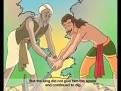
    But the king did not give him the spade, and continued to dig. One hour passed, and then another. The sun began to sink behind the trees, and the king at last stuck the spade into the ground, and said:

    “I came to you, wise man, for an answer to my questions. If you can give me none, tell me so. I will return home.”

    “Here comes someone running,” said the hermit. “Let us see who it is.”

    The king turned round and saw a bearded man come running out of the forest. The man had pressed his stomach with his hands and was bleeding profusely. And as he approached the king he fainted and fell on the ground and began moaning feebly. The king and the hermit unfastened the man’s clothing.

    There was a large wound in his stomach. The king washed it, as best as he could and even bandaged it, with his handkerchief and a towel of the hermit. But the blood didn’t stop oozing. So, the king removed, the warm blood soaked bandage several times. And he washed and re-bandaged the wound.

    Finally the bleeding stopped. With that the man revived and asked for something to drink. The king brought fresh water and gave it to him. Meanwhile the sun had set, and it had become cool. So, the king, with the hermit’s help, carried the wounded man into the hut and laid him on the bed. While lying on the bed, the man closed his eyes and was quiet. But the king was extremely tired on account of the tedious day. So, he crouched down on the threshold, and fell asleep–and so soundly that he slept all throughout the short summer night.

    When he woke up in the morning. It was long before he could remember where he was, or who was the strange bearded man lying on the bed and gazing intently at him with glistening eyes.

    “Forgive me!” said the bearded man in a weak voice, when he saw, that the king was awake and was looking at him.

    “I do not know you, and have nothing to forgive you for,” said the king.

    “You do not know me, but I know you. I am an enemy of yours who had sworn to take revenge of you, because you had executed my brother and seized my property. I knew you had gone alone to meet the hermit, and I had resolved to kill you on your way back.

     But the day passed, and you did not return. So, I came out of my ambush to look for you. But ill luck struck me. When, I bumped into your bodyguard, and they recognized me, and wounded me. I escaped from them and would have bled to death had you not dressed my wound so meticulously. I wished to kill you, but you saved my life. Now, if I live, and if you wish it, I will serve you as your most faithful slave, and will bid my sons also to do the same. Forgive me!”

    The king was very glad to have made peace with his enemy so easily, and to have gained him for a friend. He not only forgave him. But promised that he would send his servants and his own physician to attend to him, and even promised to restore his property.

    Having taken leave of the wounded man, the king went out into the porch and looked around for the hermit. Before leaving he wished to beg once more for an answer to his questions. The hermit was outside, on his knees, sowing seeds in the beds that had been dug the day before.

    King approached him and said, “For the last time, I pray to you to answer my questions, wise man.”

    “You have already been answered!” said the hermit, still crouching on his thin legs, and looking up at the king, who stood before him.

    “Answered but how? What do you mean?” asked the king.

    “Don’t you see?” replied the hermit. “If you had not pitied on my weakness yesterday, and had not dug these beds for me. And had gone your way, that man would have attacked you, and you would have repented not having stayed with me. So, the most important time was when you were digging the beds and I was the most important man and to do me good was your most important business.

    Afterwards, when that man ran to us, the most important time was when you were attending to him. For if you had not nursed his wounds he would have died without having made peace with you. So, he was the most important man, and what you did for him was your most important business.

    Remember then. There is only one time that is important – and that is now! It is the most important time because it is the only time when we have any kind of power. The most necessary person is the one with whom you are, for no man knows whether he will ever have dealings with anyone else, and the most important business is to do that person good, because for that purpose alone was man sent into this life.”

Synopsis by Kamlesh Tripathi

***

https://kamleshsujata.wordpress.com

*

Share it if you like it

*

Shravan Charity Mission is an NGO that works for poor children suffering from life threatening diseases especially cancer. Should you wish to donate for the cause. The bank details are given below:

NAME OF ACCOUNT: SHRAVAN CHARITY MISSION

Account no: 680510110004635 (BANK OF INDIA)

IFSC code: BKID0006805

*

Our publications

GLOOM BEHIND THE SMILE

(The book is about a young cancer patient. Now archived in 7 prestigious libraries of the US, including, Harvard University and Library of Congress. It can also be accessed in MIT through Worldcat.org. Besides, it is also available for reading in Libraries and archives of Canada and Cancer Aid and Research Foundation Mumbai)  

ONE TO TANGO … RIA’S ODYSSEY

(Is a book on ‘singlehood’ about a Delhi girl now archived in Connemara Library, Chennai and Delhi Public Library, GOI, Ministry of Culture, Delhi)

AADAB LUCKNOW … FOND MEMORIES

(Is a fiction written around the great city of Nawabs—Lucknow. It describes Lucknow in great detail and also talks about its Hindu-Muslim amity. That happens to be its undying characteristic. The book was launched in Lucknow International Literary Festival of 2014)

REFRACTIONS … FROM THE PRISM OF GOD

(Co-published by Cankids–Kidscan, a pan India NGO and Shravan Charity Mission, that works for Child cancer in India. The book is endorsed by Ms Preetha Reddy, MD Apollo Hospitals Group. It was launched in Lucknow International Literary Festival 2016)

TYPICAL TALE OF AN INDIAN SALESMAN

(Is a story of an Indian salesman who is, humbly qualified. Yet he fights his ways through unceasing uncertainties to reach the top. A good read not only for salesmen. The book was launched on 10th February, 2018 in Gorakhpur Lit-Fest. Now available in Amazon, Flipkart and Onlinegatha

(ALL THE ABOVE TITLES ARE AVAILABLE FOR SALE IN AMAZON, FLIPKART AND OTHER ONLINE STORES OR YOU COULD EVEN WRITE TO US FOR A COPY)

*****



BOOK TALK: PANCHANTRA by Vishnu Sharma

Copyright@shravancharitymission

Khidki (Window)

–Read India Initiative—

This is only an attempt to create interest in reading. We may not get the time to read all the books in our lifetime. But such reviews, talk and synopsis will at least convey what the book is all about

PANCHTANTRA

By Vishnu Sharma

    Panchatantra moral stories are one of the most popular collections of animal-based fables. Originally written in Sanskrit, where, each of these fables have a concomitant moral. These stories are simple to understand. They are colourful and appropriate even for tiny tots and provide valuable lessons that stay in the mind … forever.

    The legend about the origin of Panchatantra goes back to times of King Amarashakti. Who had appointed a scholar by the name of Vishnu Sharma to educate his three sons. Vishnu Sharma soon realized that conventional tools and techniques of teaching will not work well with these princes, so he decided to teach them through stories instead. He, therefore, wrote a collection of stories under the following five volumes, and so it was named as Panchatantra (‘pancha’ – five and ‘tantra’ – systems).

  • Mitra labha (gaining friends)– Collection of stories relating to winning of friends.
  • Mitra bheda (losing friends)– Collection of stories relating to losing friends.
  • Aparïksitakárakam (acting without thinking) – Collection of stories relating to how imprudence leads to losing what is important.
  • Labdhapranásam (Loss of gains)– Collection of stories that mention how to come out of difficult situations without losing things.
  • Kákolùkïyam (Crows and owls)– Collection of stories about rules and strategies of war and peace.

The Panchatantra was translated into many languages, including English, Indian vernacular languages, Persian and Arabic.

By Kamlesh Tripathi

*

https://kamleshsujata.wordpress.com

*

Share it if you like it

*

Shravan Charity Mission is an NGO that works for poor children suffering from life threatening diseases especially cancer. Should you wish to donate for the cause. The bank details are given below:

NAME OF ACCOUNT: SHRAVAN CHARITY MISSION

Account no: 680510110004635 (BANK OF INDIA)

IFSC code: BKID0006805

*

Our publications

GLOOM BEHIND THE SMILE

(The book is about a young cancer patient. Now archived in 7 prestigious libraries of the US, including, Harvard University and Library of Congress. It can also be accessed in MIT through Worldcat.org. Besides, it is also available for reading in Libraries and archives of Canada and Cancer Aid and Research Foundation Mumbai)  

ONE TO TANGO … RIA’S ODYSSEY

(Is a book on ‘singlehood’ about a Delhi girl now archived in Connemara Library, Chennai and Delhi Public Library, GOI, Ministry of Culture, Delhi)

AADAB LUCKNOW … FOND MEMORIES

(Is a fiction written around the great city of Nawabs—Lucknow. It describes Lucknow in great detail and also talks about its Hindu-Muslim amity. That happens to be its undying characteristic. The book was launched in Lucknow International Literary Festival of 2014)

REFRACTIONS … FROM THE PRISM OF GOD

(Co-published by Cankids–Kidscan, a pan India NGO and Shravan Charity Mission, that works for Child cancer in India. The book is endorsed by Ms Preetha Reddy, MD Apollo Hospitals Group. It was launched in Lucknow International Literary Festival 2016)

TYPICAL TALE OF AN INDIAN SALESMAN

(Is a story of an Indian salesman who is, humbly qualified. Yet he fights his ways through unceasing uncertainties to reach the top. A good read not only for salesmen. The book was launched on 10th February, 2018 in Gorakhpur Lit-Fest. Now available in Amazon, Flipkart and Onlinegatha

(ALL THE ABOVE TITLES ARE AVAILABLE FOR SALE IN AMAZON, FLIPKART AND OTHER ONLINE STORES OR YOU COULD EVEN WRITE TO US FOR A COPY)

*****


BOOK TALK: A SCANDAL IN BOHEMIA–by Sir Arthur Conan Doyle

Copyright@shravancharitymission

Khidki (Window)

–Read India Initiative—

This is only an attempt to create interest in reading. We may not get the time to read all the books in our lifetime. But such reviews, talk and synopsis will at least convey what the book is all about

A SCANDAL IN BOHEMIA

By Sir Arthur Conan Doyle

    This is the first short story. And the third overall work, featuring Arthur Conan Doyle’s fictional detective ‘Sherlock Holmes.’ It happens to be the first of the 56 Holmes short stories written by Doyle and the first of 38 Sherlock Holmes works illustrated by Sidney Paget (illustrator an artist who specialised on Conan Doyle’s work). The story is notable for introducing the character of Irene Adler, often referred as a romantic interest for Holmes in later derivative works. Conan Doyle ranked “A Scandal in Bohemia” fifth in the list of his twelve favourite Holmes stories.

    “A Scandal in Bohemia” was first published on 25 June 1891 in the July issue of The Strand Magazine, and was the first of the stories collected in The Adventures of Sherlock Holmes in 1892.

PLOT

    Dr Watson recounts an adventure that started on 20th March 1888. When, the newly married Watson is paying Holmes a visit. This is when a masked visitor arrives. He introduces himself as Count Kramm, an agent for a wealthy client. Holmes quickly deduces that the visitor is in fact Wilhelm Gottsreich Sigismond von Ormstein, Grand Duke of Cassel-Felstein and the hereditary King of Bohemia. Realising Holmes has seen through his guise. The King admits this and tears off his mask.

    It transpires that the King is to get engaged to one Clotilde Lothman von Saxe-Meiningen, a young Scandinavian princess. However, five years before the current scenario, he had enjoyed a liaison with a “well-known adventuress,” an American opera singer Irene Adler, whilst, she was prima donna of the Imperial Opera of Warsaw. She had since retired, and now lived in London. Fearful … that should the strictly principled family of his fiancée learn of this impropriety, the marriage would be called off. So, he had sought to regain the letters and the photograph of Adler and himself together. Which, he had sent to her during their relationship as a token. The King’s agents had tried to recover the photograph through, forceful means, burglary, stealing her luggage, and even waylaying her. Also, an offer was made to pay her for the photograph and the letters. But she had refused. With Adler threatening to send them to his future in-laws, which the King presumed is intended to prevent him from marrying any other woman. So, he made the incognito visit to Holmes to request for his help in locating and obtaining the photograph.

    The photograph is described to Holmes as a cabinet (5½ by 4 inches) and therefore too bulky for a lady to carry upon her person. As regards expenses, the King said Holmes had a carte blanche and gave him £1,000 (£102,200 today), exclaiming. “I would give one of the provinces of my kingdom to have that photograph!” Holmes asks Dr. Watson to join him at 221B Baker Street at 3 o’clock the following afternoon.

    Next morning, Holmes goes to Adler’s house, disguised as a drunken out-of-work groom. He discovers from the local stable workers that Adler has a gentleman friend, the barrister Godfrey Norton of the Inner Temple, who calls on her at least once a day. On this particular day too, Norton comes to visit Adler, and soon afterwards, takes a cab to the Church of St. Monica in Edgware Road. Minutes later, the lady herself gets into her landau, bound for the same place. Holmes follows them in a cab and enters the church, where he is unexpectedly asked to be a witness to Norton and Adler’s wedding. Curiously, they go their separate ways after the ceremony.

    Meanwhile, Watson is waiting for Sherlock to arrive, and when Sherlock Holmes, finally does deliver himself back at Baker Street, he starts laughing. Watson is confused and asks what is so funny? Sherlock then recounts his tale and comments. He thought the situation and position he was in at the wedding was amusing. He also asks whether or not Watson is willing to participate in a scheme to figure out where the picture is hidden in Adler’s house. Watson agrees, and Holmes changes into another disguise as a clergyman. The duo, depart Baker Street for Adler’s house.

    When Holmes and Watson arrive, a group of jobless men meander throughout the street. When Adler’s coach pulls up, Sherlock Holmes enacts his plan. A fight breaks out between the men on the street over who gets to help Adler. Holmes rushes into the fight to protect Adler, and is seemingly struck and injured. Adler takes him into her sitting room, where Holmes motions for her to have the window opened. As Holmes lifts his hand, Watson recognizes a pre-arranged signal and tosses in a plumber’s smoke rocket. While smoke billows out of the building, Watson shouts “FIRE!” and the cry is echoed up and down the street.

    Holmes slips out of Adler’s house and tells Watson what he saw. As Holmes expected, Adler rushes to get her most precious possession at the cry of “fire”—the photograph of herself and the King. Holmes was able to see that the picture was kept in a recess behind a sliding panel just above the right bell pull. He was unable to steal it at that moment, however because the coachman was watching him. He explains all of this to Watson before being bid ‘good-night’ by a familiar-sounding youth. Who, promptly manages to get lost in the crowd.

    The following morning, Holmes, explains his findings to the King. When, Holmes, Watson, and the King arrive at Adler’s house at 8 am. When, her elderly maidservant sardonically informs them that she has left the country by the 5.15 train from Charing Cross railway station. Holmes quickly goes to the photograph’s hiding spot, finding a photo of Irene Adler in an evening dress and a letter dated midnight addressed to him. In the letter, Adler tells Holmes. He did very well in finding the photograph and taking her in with his disguises. She also reveals that she posed as the youth who bid Holmes ‘good-night.’ Adler has left England with Norton, “a better man” than the King, adding she will not compromise the King, despite being “cruelly wronged” by him. She had kept the photo only to protect herself from any further action he might take.

    The King exclaims how amazing Adler is (“Would she not have made an admirable queen? Is it not a pity she was not on my level?”) Holmes replies Miss Adler is indeed on a much different level from the King (by which he means higher – an implication lost on the King). Thanking Holmes effusively, the King offers a valuable emerald ring from his finger as further reward. Holmes says there is something he values even more highly – the photograph of Adler. Ignoring the handshake proffered by the King, Holmes leaves. He keeps the photograph as a reminder of her cleverness, and of being beaten by a woman’s wit.

    Watson has already called her “the late Irene Adler,” confirming her death sometime in the intervening three years (between the story’s setting and the publication of “A Scandal in Bohemia”). Watson also tells that, since their meeting, Holmes always refers to her by the honorable title of “the woman”.

    The story is high on humour and even wit, but low on plot intensity. So, before I close, let me take you through this interesting and humorous conversation that happens between Holmes and Dr Watson on page 9 and 10 of the story:  

    “Quite so,” he answered, lighting a cigarette, and throwing himself down into the armchair. “You see, but you do not observe. The distinction is clear. For example, you have frequently seen the steps which lead up from the hall to this room.” *(States Holmes)

    “Frequently” *(Replies Watson)

    “How often?” *(asks Holmes)

    “Well some hundreds of times.” *(Replies Watson)

    “Then how many are there?” *(Questions Holmes)

    “How many! I don’t know.” *(says Dr Watson)

    “Quite so! You have not observed. And yet you have seen. That is just my point. Now I know that there are seventeen steps, because I have both seen and observed …….” *(says Holmes)

    *Not part of the text in the book.

*****

By Kamlesh Tripathi

*

https://kamleshsujata.wordpress.com

*

Share it if you like it

*

Shravan Charity Mission is an NGO that works for poor children suffering from life threatening diseases especially cancer. Should you wish to donate for the cause. The bank details are given below:

NAME OF ACCOUNT: SHRAVAN CHARITY MISSION

Account no: 680510110004635 (BANK OF INDIA)

IFSC code: BKID0006805

*

Our publications

GLOOM BEHIND THE SMILE

(The book is about a young cancer patient. Now archived in 7 prestigious libraries of the US, including, Harvard University and Library of Congress. It can also be accessed in MIT through Worldcat.org. Besides, it is also available for reading in Libraries and archives of Canada and Cancer Aid and Research Foundation Mumbai)  

ONE TO TANGO … RIA’S ODYSSEY

(Is a book on ‘singlehood’ about a Delhi girl now archived in Connemara Library, Chennai and Delhi Public Library, GOI, Ministry of Culture, Delhi)

AADAB LUCKNOW … FOND MEMORIES

(Is a fiction written around the great city of Nawabs—Lucknow. It describes Lucknow in great detail and also talks about its Hindu-Muslim amity. That happens to be its undying characteristic. The book was launched in Lucknow International Literary Festival of 2014)

REFRACTIONS … FROM THE PRISM OF GOD

(Co-published by Cankids–Kidscan, a pan India NGO and Shravan Charity Mission, that works for Child cancer in India. The book is endorsed by Ms Preetha Reddy, MD Apollo Hospitals Group. It was launched in Lucknow International Literary Festival 2016)

TYPICAL TALE OF AN INDIAN SALESMAN

(Is a story of an Indian salesman who is, humbly qualified. Yet he fights his ways through unceasing uncertainties to reach the top. A good read not only for salesmen. The book was launched on 10th February, 2018 in Gorakhpur Lit-Fest. Now available in Amazon, Flipkart and Onlinegatha

(ALL THE ABOVE TITLES ARE AVAILABLE FOR SALE IN AMAZON, FLIPKART AND OTHER ONLINE STORES OR YOU COULD EVEN WRITE TO US FOR A COPY)

*****


DON’T VISIT ANYONE UNINVITED—SAYS, LORD SHIVA TO HIS WIFE SATI

Copyright@shravancharitymission


    King Prajapati Daksha, father of Sati aka Dakshayani, and father-in-law of Lord Shiva had once organized for a huge ‘yagya’ (divine sacrifice) in Kankhal, a well known pilgrimage centre. His prime motive to organize the function was, to avoid Shiva and Sati, and show them down. Daksha had a big ego. He hated Shiva for some reason, but had married his daughter to him, only on the insistence of Lord Brahma who also happened to be his father. Besides Shiva he had not even invited his daughter Sati for the event. And to demean Shiva further he had cordially invited Lord Vishnu and all the Devtas, in addition to the famous rishis, maharishis, musicians and even scholars.

    Sati learnt about this yagya through a close friend of hers. When, she too, desired to visit her father on the occasion even if it was uninvited. She therefore, asked Lord Shiva if she could visit him on the occasion. But Lord Shiva was unhappy with the sequence of events when he said,

    ‘Sati! People who visit others without being invited face severe humiliations that are even greater than the pain of death. And it is true, that even arrows don’t hurt you, as much as words of your near and dear ones.’

    Upon hearing this Sati got very angry. She said, ‘God what is your enmity with my father and why hasn’t he invited you?’ On this Shiva narrated the episode of the earlier yagya, but Sati was not prepared to listen to him. She said,

    ‘Shambhu without your visiting, the yagya cannot be completed. My stupid father has not invited you for the function. I want to know why, and for that I need to go there. So, please grant me permission. It is only after going there I’ll be able to ascertain how he completes the yagya.’ On hearing this, Shiva gave her the permission, to visit her father, reluctantly.

    All along the yagya Sati was restless about the fact that her husband was not participating in it. King Daksha had kept an eye on her, and when he was not able to bear her restlessness. He reprimanded her in front of all the guests by saying, ‘be in the yagya only if you can be calm and quiet otherwise leave. Your husband is the king of bhoot and prêt. He applies chita ka bhasm and he is also a hasher. He discards veda, akulit and is inauspicious. Because of these reasons I have not invited him for my yagya. I am even shameful of having married you to him.’

    On hearing her husband’s insult Sati got every angry. She said, ‘no one has the right to show his anger at my Lord and master Shiva.’ And it was only then she realized she should have listened to him. Unable to bear the tirade of her father that converted into spiking humiliations she finally entered the yagya and immolated herself.

    Upon learning about the terrible incident, in his extreme wrath Shiva invoked Virbhadra and Bhadrakali by plucking a lock and thrashing it on the ground. Virbhadra and Bhoot ganas marched south and destroyed all the premises. Daksha was decapitated and the yagya shaala was destroyed in the rampage. The Bhootganas celebrated victory, by plucking the beard of ‘Presiding Master’ of the Yagya, sage Bhrigu, as a war souvenir. Daksha was later forgiven and given life by fixing a ram’s (Male Goat’s) head and the yagya was allowed to complete, in the presence of all divinities.

    The story continues with the act of Vishnu pacifying Shiva, who was in deep grief in seeing the half burned corpse of his beloved wife. Vishnu embraced Shiva to pacify him. Shiva unable to part with Sati took her corpse and wandered. The body parts of the corpse of Sati Devi fell in the places Shiva travelled. The places where the body parts of Sati’s corpse fell came to be known as Shakti Peethas

Moral of the story: Had Sati, listened to Lord Shiva and not gone to her father, she wouldn’t have been insulted and as a consequence wouldn’t have immolated herself. And above all, the wide devastation could have been averted.

*

Posted by Kamlesh Tripathi

*

                                                       https://kamleshsujata.wordpress.com

*

Share if you like it

*

Shravan Charity Mission is an NGO that works for poor children suffering from life threatening diseases. Should you wish to donate for the cause the bank details are given below:

NAME OF ACCOUNT: SHRAVAN CHARITY MISSION

Account no: 680510110004635 (BANK OF INDIA)

IFSC code: BKID0006805

*

Our publications

GLOOM BEHIND THE SMILE

ONE TO TANGO … RIA’S ODYSSEY

AADAB LUCKNOW … FOND MEMORIES

REFRACTIONS … FROM THE PRISM OF GOD

(CAN BE BOUGHT FROM ON LINE BOOK STORES OR WRITE TO US FOR COPIES)

*****


CHANAKYA NEETI

Copyright@shravancharitymission

SAYS CHANAKYA …

AAPADRTHE DHANAM RAKSHECHACHRIMATAN KUT AAPADAH,

KADACHICHCHALIKA LAXMI: SANCHITOPTI VINASHAYATI.

A man must protect his wealth tooth and nail because, it is only the one who has money can overcome hurdles easily. Money, if not protected slips away fast.

DHANIKAH SROTRIYO RAJA NADI VEDASTU PANCHAM,

PANCH YATRA NA VIDYANTE NA TATRA DIVASAM VASET.

A man should not make that place his home. Where there are no prosperous people, no soldiers, scholarly Brahmins, a competent king, a river and physicians.

YASMAN DESHE SAMMANO NA VARTIRNA CHA BANDHAVA,

NA CHA VIDYASAGAMAH KASHICHAT TAM DESHAM PARIVARJAYATE.

Do not live in a country that does not allow you: self respect, honour, means of living, a family, kith and kin, friends, well wishers, ways of education and self-development. Quit such country. It is not fit for living.

LOKYATRA LAJJA DAKSHNYAM TYAGSHEELTA,

PANCH YATRA NA VIDAYANTE TATRA SANSSTHITITAM.

A place that does not offer means of living, fear of law, feeling of shame for shameless acts, clever people to inspire artful creations, and the spirit of charity is not fit for living.

JANIYAT PRESHNE BHRITYAN BANDHAVAN VYASNAJGAME,

MITRAM CHASPATIKALESHU BHARYA CHA VIBHAVAKSHAYA.

The testing times of the following are: Wife when the money is gone, a friend in the time of need, relatives in times of crisis and the servants when they are assigned a mission. In such times they show their true colours.

AATURE VYASNE PRAPTE DURBHIKSHE SHATRU SANKATE,

RAJDWARE SHAMSHANE CHA YASTISHATHATI SA BANDADHAVA.

A real brother is the one who stands with you in the period of grave illness, in times of misfortune, during famines or invasions by enemy, in the royal court and in death. He will stick through thick and thin.

YO DHRUVANI PARITAYAJAYA ADHRUVAM PARIHEVETE,

DHRUVANI TASYA NASHYANTI ADHRUVAM NASHTAMEV CHA.

The one who runs after an uncertain object leaving the certain one behind, does not get any. He loses both. It is Chanakya’s way of saying that a bird in hand is better than two in the bush.

VARYETA KULJAM PRAGYO VIROOPAMAPI KANYAKAM,

ROOPWARTI NA NICHASYA VIVAH: SADRISHYA KULE.

A wise man must marry a girl of high breed even if she is ugly to look at. He should not fall for a girl of low upbringing no matter how beautiful she is. The best course is to marry in the family of equal status.

NAKHINAM CHA NADINAM CHA SRINGADIRAM SHASTRAPANINAAM,

VISHVASO NEV KARTAVYA: STRISHU RAJKULESHU CHA.

Don’t ever trust: the beasts with claws or sharp horns, rivers, armed persons, women who are famous for their fickle mind and the members of the royal families.

*

Posted by Shravan Charity Mission

*

https://kamleshsujata.wordpress.com

*

Share if you like it

*

Shravan Charity Mission is an NGO that works for poor children suffering from life threatening diseases. Should you wish to donate for the cause the bank details are given below:

NAME OF ACCOUNT: SHRAVAN CHARITY MISSION

Account no: 680510110004635 (BANK OF INDIA)

IFSC code: BKID0006805

*

Our publications

GLOOM BEHIND THE SMILE

ONE TO TANGO … RIA’S ODYSSEY

AADAB LUCKNOW … FOND MEMORIES

REFRACTIONS … FROM THE PRISM OF GOD

(CAN BE BOUGHT FROM ON LINE BOOK STORES OR WRITE TO US FOR COPIES)

*****

SHORT STORY: THE LION AND THE SHEPHERD

Copyright@shravancharitymission


    Once, a lion in the forest was wounded by a sharp and poisonous thorn. Soon it become sore. The lion tried to pull it out with its teeth, but was unable to do so. He was now in deep pain and could not even walk properly. So, in hope of some help. He started limping slowly, when he reached a shepherd near the jungle. When the shepherd saw the hefty lion approaching him he got scared. He thought. If he tries to escape now. The lion in a couple of leaps will pounce on him and tear him to shreds. And even in the vicinity there weren’t any trees that he could have suddenly climbed to save himself. So having no other option he just stayed put there.

    But the lion neither roared nor growled. He just came and sat in front of the shepherd and raised his foreleg. The shepherd saw the wound and could immediately understand that the lion was in deep pain and wanted help. He immediately pulled out the thorn from the lion’s foreleg. The lion was relieved of the pain and soon he took an about turn and went back to the jungle.

    After some days there was a theft in the King’s Palace. Some people out of enmity informed the king that the shepherd was the thief and he alone had burgled the king’s palace. Shepherd was caught. But in his house the stolen stuff was not found. The king thought that the shepherd had hid it somewhere. And therefore he issued orders the shepherd be thrown alive in front of a lion.

    But by stroke of luck the same lion was brought to kill the shepherd, whose thorn, the shepherd had pulled out. When the shepherd was thrown in front of the lion, the lion recognized him. He immediately came close to the shepherd and sat beside him and started wagging his tail like a dog.

    The king was surprised at this gesture of the lion. Upon, enquiring, he came to know about the helpful nature of the shepherd. And also how he had helped the lion. When he was in deep agony, because of which the lion was grateful towards the shepherd. The king then decided to set free the shepherd, realizing he may not be the culprit.

    Moral of the story: Even the mighty predator lion did not forget the help that he had received from a shepherd. Human beings who forget the kindness that is showered on them by others are worse than animals.

*

Posted by Kamlesh Tripathi

*

https://kamleshsujata.wordpress.com

*

Share if you like it

*

Shravan Charity Mission is an NGO that works for poor children suffering from life threatening diseases. Should you wish to donate for the cause the bank details are given below:

NAME OF ACCOUNT: SHRAVAN CHARITY MISSION

Account no: 680510110004635 (BANK OF INDIA)

IFSC code: BKID0006805

*

Our publications

GLOOM BEHIND THE SMILE

(Archived in 7 prestigious libraries of the US, including, Harvard University and Library of Congress. It can also be accessed in MIT through Worldcat.org. Besides, it is also available for reading in Libraries and archives of Canada and Cancer Aid and Research Foundation Mumbai)  

ONE TO TANGO … RIA’S ODYSSEY

(Archived in Connemara Library, Chennai and Delhi Public Library, GOI, Ministry of Culture)

AADAB LUCKNOW … FOND MEMORIES

(Launched in Lucknow International Literary Festival 2014)

REFRACTIONS … FROM THE PRISM OF GOD

(Co-published by Cankids–Kidscan, a pan India NGO and Shravan Charity Mission, that works for Child cancer in India. The book is endorsed by Ms Preetha Reddy, MD Apollo Hospitals Group. Book was launched in Lucknow International Literary Festival 2016)

(CAN BE BOUGHT FROM ON LINE BOOK STORES OR WRITE TO US FOR COPIES)

*****


Short story: THE KING AND THE GARDENER

Copyright@shravancharitymission

By Kamlesh Tripathi


Nausherwan the king of Faras was famous for his judicial acumen. He was a big philanthropist too. One day he set out with his ministers to go around the city to ascertain what all was happening. While going around he saw an old gardener in an orchard busy planting walnut saplings. The king entered the orchard and went up to him. He asked—‘are you a servant here or this is your own orchard?’

The gardener replied—‘My Lord I don’t serve anymore. This orchard was planted by my forefathers, so it belongs to me.’

The king said—‘you are planting these walnut saplings. But do you even know it takes twenty years for it to flower and bear fruits. Do you think you’ll live for twenty years to eat the fruits?’

The gardener heard the king dutifully and then politely said–‘My Lord, till now I had so many fruits from trees planted by others. Now it is my duty to plant trees for others. It will be extremely selfish on my part if I plant trees that only bear fruits for me.’

The king was extremely happy with the reply the old gardener had given and as a reward he gave him two asharfees (gold coins).

Moral of the story: One must continuously think of others as others have thought about us.

*****


Short story: RESULT OF KINDNESS

Copyright@shravancharitymission

    Subuktigin was a poor man before he became a king. Just an ordinary soldier. One day he took his gun and sat on his horse and went out for a shikar (hunt) in the jungle. That day he was quite unlucky. Although, he traveled a long distance. But as ill luck would have it. He did not come across a single animal. He was quite disappointed and was about to return when he spotted a deer with her small baby. Subuktigin was suddenly animated and started following the two.

    Scared, the deer ran and hid herself behind the bushes. But in the process her baby was left behind. Subuktigin caught hold of the baby. Tied the legs, and loaded it, on the horse, and then started searching for the deer. But when he could not find her he returned with the baby.

    When the deer saw, her baby being taken away by the cruel shikari. She couldn’t resist and came out of the bushes and started following Subuktigin. After travelling a distance, when Subuktigin turned around he was surprised to see the mother deer following him. In fact he was shocked at the sight, and felt merciful towards her. So, he decided to untie the legs of the baby and let it go. Mother deer was extremely happy to meet her baby once again and in a flash of a moment she disappeared along with her offspring.

    That day after returning home when Subuktigin slept he got a dream. Where, one angel told him—‘Subuktigin! The way you showed mercy on the poor deer was amazing. This has made God happy and therefore he has included your name in the list of would be kings. One day you too will surely become a king.’

    Subuktigin’s dream came true. He later in life became a king. Showing mercy on a deer earned him this reward. People who show mercy on animals are appreciated by God.

*

Posted by Kamlesh Tripathi

*

https://kamleshsujata.wordpress.com

*

Share if you like it

*

Shravan Charity Mission is an NGO that works for poor children suffering from life threatening diseases. Should you wish to donate for the cause the bank details are given below:

NAME OF ACCOUNT: SHRAVAN CHARITY MISSION

Account no: 680510110004635 (BANK OF INDIA)

IFSC code: BKID0006805

*

Our publications

GLOOM BEHIND THE SMILE

(Archived in 7 prestigious libraries of the US, including, Harvard University and Library of Congress. It can also be accessed in MIT through Worldcat.org. Besides, it is also available for reading in Libraries and archives of Canada and Cancer Aid and Research Foundation Mumbai)  

ONE TO TANGO … RIA’S ODYSSEY

(Archived in Connemara Library, Chennai and Delhi Public Library, GOI, Ministry of Culture)

AADAB LUCKNOW … FOND MEMORIES

(Launched in Lucknow International Literary Festival 2014)

REFRACTIONS … FROM THE PRISM OF GOD

(Co-published by Cankids–Kidscan, a pan India NGO and Shravan Charity Mission, that works for Child cancer in India. The book is endorsed by Ms Preetha Reddy, MD Apollo Hospitals Group. Book was launched in Lucknow International Literary Festival 2016)

(CAN BE BOUGHT FROM ON LINE BOOK STORES OR WRITE TO US FOR COPIES)

*****


THE GREEDY KING-MIDAS

Copyright@shravancharitymission

By Kamlesh Tripathi

THE GREEDY KING—MIDAS

    Once upon a time Greece was being ruled by a king called Midas. He was extremely greedy. Besides, his daughter the only thing he loved in the world was Gold. And he was so greedy about gold that even while sleeping he used to make plans of amassing gold in large quantities.

One day while the king was sitting in his treasury and counting his possessions in terms of gold bricks and coins, he saw a ring of smoke rising from the ground and behind that a golden silhouette emerged with a halo on the top that almost resembled an angel. He was transfixed for a moment till the angel said—‘Midas! You are so rich.’

Midas turned melancholic at once and replied—‘Where am I rich. I have so little gold.’

Angel said—‘You are not content even with so much of gold? How much gold do you want?’

King Midas replied—‘I desire; whatever I touch with my hands should turn into gold.’

Angel laughed at the wish of the king and said—‘Very well! From tomorrow morning whatever you touch will turn into gold.’

That night the king could not sleep. He got up quite early in the morning. After getting up he decided to keep his hand on the chair lying close to him just to test the words of the angel. To his surprise the chair turned into gold. He then touched a table and that too turned into gold. Midas in delight started merry making by jumping and dancing. Like a mad man he then ran towards his garden and started touching the plants there. Then he touched the flowers and the leaves, he even touched the branches and the flower pots and everything turned into gold. Everything around was now glittering like gold. Midas now had unlimited gold.

Merry making and excitement had made king Midas tired by now. He hadn’t even realised that his clothes had become heavy as it had turned into gold. He was now thirsty and hungry. After returning from the garden he came and sat on a golden chair. One of his servants kept some delicious food and water in front of him realising his master was hungry. But the moment he touched the food it turned into gold and the moment he lifted the glass of water that too also turned into gold and this made him somewhat nervous. All the delicious food lying in front of Midas had now turned into gold when he was very hungry. He couldn’t have satisfied his hunger and quenched his thirst by food and water made out of gold.

He started weeping. Just then his daughter who was playing in the vicinity came there, when she heard her father crying. And, seeing him crying she climbed on to his lap to wipe his tears. Emotional Midas hugged his daughter but soon realised that his daughter was no more there and in her place Midas had his daughter’s golden statue that was very heavy for him to hold on to. Poor Midas started banging his head on the calamity. Angel who was watching king Midas from heaven witnessed the calamity that befell on him and felt sympathetic towards him and appeared again. On seeing her Midas fell on her feet and started pleading—‘please take back your blessing.’

Angel asked—‘Midas! Now you don’t want gold? Tell me whether a glass of water is more precious or gold? A morsel of bread is beneficial or gold?’

Midas folded his hands and said—‘I don’t want gold. I have come to know that a man doesn’t require gold to survive. Without gold a man can exist but without a glass of water or a loaf of bread he cannot. Now on I will not be greedy for gold.’

Angel then gave him a bowl full of water and said—‘sprinkle this all over.’

Midas sprinkled the water on his daughter, on the chair and the table, on the food and water, in the garden and on the plants and flowers, and everything thereafter from gold came back to its original form.

***

SHORT STORY: MANY FACES OF GOD

Copyright@shravancharitymission


many faces of god 2 many faces of god many faces of god1

    Once upon a time there lived a king whose daughter was very beautiful and intelligent. She often used to be present in the king’s court for fierce discussions and debates with the king’s pundits and scholars on various issues, where she often used to defeat them. The pundits and scholars were quite embarrassed and upset because of this fact. Therefore, they all were silently scheming and waiting for an opportunity when they could take revenge of the insults in the court.

     One day the king summoned all his scholars and pundits in the court and requested them to look for a suitable match for his daughter. At this request of the king all of them were extremely happy for they all wanted to teach the king’s daughter Rajkumari a lesson.

    Soon they all set out on the mission and after searching a lot they found a murkh (simpleton) whom they assured good food, drinks and clothes provided he kept his mouth shut under any situation. Murkh initially got scared but then for the sake of good food, drinks and clothes and that too without working he decided to do whatever the Pundits and the scholars wanted him to do.

    They decked the murkh with clean and holy appearing attire and presented him before the king as a Maha Pundit. King was happy to meet him. But Rajkumari wanted to test his knowledge and wisdom and so was keen to debate with him. The pundit and scholars therefore decided to call for a question and answer session in the king’s court. The topic of the Q&A session was ‘The reality of God.’ But since the Murkh had vowed to keep a maun-vrat (a vow to remain quiet) he could have spoken only in sign language.

    When the session commenced Rajkumari was in a dilemma. But after pondering for a few moments she lifted her finger. Soon a scholar who was sitting behind the murkh pressed two of his fingers on the back of the Murkh and the Murkh catching the simple hint lifted two of his fingers. Rajkumari in response lifted three fingers when the Murkh raised four fingers when he was hinted to do so.

    With some hesitation Rajkumari then lifted five fingers and responding to that the Murkh raised six fingers. Rajkumari in response raised seven and in response the Murkh raised eight. Again after some hesitation Rajkumari raised nine fingers in response to which the Murkh raised both his hands. The entire court sitting there was watching with great interest the question and answer session.

    Finally Rajkumari raised both her hands, when the Murkh too raised both his hands but in a cross position. By now Rajkumari had lost her patience and was stunned at the mysterious ways in which the Murkh was raising his fingers and now his hands. She said if this Maha Pundit is on maun-vrat, someone else, and at least one out of you can kindly stand and tell us what he is trying to convey in his sign language. Finally one scholar got up and said, ‘fine but first you kindly tell us, what you meant by those fingers that you raised.’

    ‘Fine’ said the Rajkumari, ‘when I raised one finger I meant God. God is one and he is omnipresent, but what did his two fingers mean.’ One scholar said, ‘divyata (divinity) is always present in two ways. Female and male, right and wrong, high and low, true and false, work and worship, clear and unclear etc. etc. ‘Fine’ said the Rajkumari, ‘my three fingers meant three subtle components of life (three gunas or habits)—sat, rajas and tamas. Three periods of time—past, present and the future. There are three kinds of lokas (worlds) in mythology—swarglok, (heaven) prithvi (Earth) and yamlok (Hell). There are three jobs to be done by anyone and everyone in this world—create, execute and destroy.

    One scholar stood up and said, ‘in response to three, four fingers were raised.  It means there are four Vedas (religious texts of Hindus)—Samved, Rigved, Yajurved and Atharveda.     There are four directions—North, West, South and East. There are four stages of life—bachpan, (childhood) jawani (youth) prodavastha (middle age) and vradavastha (old age). There are four ashrams- bramcharya-ashram, grahastha-ashram, vanprastha-ashram and sanyas-ashram.

    Rajkumari was happy and impressed is when she accepted the logics and said, ‘my five fingers meant five basic substances required for life—sky, air, fire, water and earth. There are also five gyanendrias (sense points) – eyes, nose, ears, tongue and relieving points (anus and urination).

    The reply to that was with six fingers. Which meant, there are six hurdles on way to acquiring Brahmagyan (complete knowledge)-desire, grief, greed, hate, anger and arrogance. There are six threads to happiness- courage, kindness, humility, perseverance, love and happiness.

    ‘O my God! This Maha Pundit is really great.’ Rajkumari whispered to herself. Meanwhile the entire king’s court had started praising the Maha Pundit. Rajkumari sermonized, ‘my seven fingers signify the presence of divinity that is present in the saptarishis (seven-rishis), the seven rivers, the seven seas, the seven colours and are also present in the seven threads required to run this life.

    Maha pundit replied to seven fingers by raising eight because in Yog (meditation) there are eight branches, there are eight kinds of assets and eight types of tribulations and it depicts all these. Nine fingers meant- nine faces of God, nine faces of mother, nine types of ratnas (precious substances) and nine vents of the human body.

    Pundit further said, ‘ten fingers of his meant that god is complete. God is one. No matter how many names, how many faces, how many divisions, but the divinity is firm, supreme, it is one and supreme.

    Rajkumari said, ‘one last question, when I raised my one hand why did he cross both his hands and lift it?

    Pundit said, ‘this is quite simple because he wanted to continue with his puja and meditation and therefore he wanted to stop the question and answer session.

    Rajkumari was now ready to marry him and the scholars and pundits were happy seeing their revenge coming through. Soon they were married.

    But when they met in isolation after marriage, the intelligent Rajkumari quickly understood, just to take revenge the scholars and the pundits had planned all this, and got her married to a murkh.    But Rajkumari without getting annoyed, and in a peaceful manner asked her husband to go to the close by temple of Goddess Durga and pray, and when Goddess is happy to ask for a vardan (blessing) of knowledge and wisdom.

    Without saying a word the murkh husband went to the close by temple with a heavy heart but open mind and started praying sincerely and in due course he got a vardan from Goddess Durga.

    This person was no one else but famous poet Kalidas of ancient times.

***

Posted by Kamlesh Tripathi

*

https://kamleshsujata.wordpress.com

*

Share it if you like it

*

Shravan Charity Mission is an NGO that works for poor children suffering from life threatening diseases especially cancer. Should you wish to donate for the cause. The bank details are given below:

NAME OF ACCOUNT: SHRAVAN CHARITY MISSION

Account no: 680510110004635 (BANK OF INDIA)

IFSC code: BKID0006805

*

Our publications

GLOOM BEHIND THE SMILE

(The book is about a young cancer patient. Now archived in 7 prestigious libraries of the US, including, Harvard University and Library of Congress. It can also be accessed in MIT through Worldcat.org. Besides, it is also available for reading in Libraries and archives of Canada and Cancer Aid and Research Foundation Mumbai)  

ONE TO TANGO … RIA’S ODYSSEY

(Is a book on ‘singlehood’ about a Delhi girl now archived in Connemara Library, Chennai and Delhi Public Library, GOI, Ministry of Culture, Delhi)

AADAB LUCKNOW … FOND MEMORIES

(Is a fiction written around the great city of Nawabs—Lucknow. It describes Lucknow in great detail and also talks about its Hindu-Muslim amity. That happens to be its undying characteristic. The book was launched in Lucknow International Literary Festival of 2014)

REFRACTIONS … FROM THE PRISM OF GOD

(Co-published by Cankids–Kidscan, a pan India NGO and Shravan Charity Mission, that works for Child cancer in India. The book is endorsed by Ms Preetha Reddy, MD Apollo Hospitals Group. It was launched in Lucknow International Literary Festival 2016)

TYPICAL TALE OF AN INDIAN SALESMAN

(Is a story of an Indian salesman who is, humbly qualified. Yet he fights his ways through unceasing uncertainties to reach the top. A good read not only for salesmen. The book was launched on 10th February, 2018 in Gorakhpur Lit-Fest. Now available in Amazon, Flipkart and Onlinegatha

(ALL THE ABOVE TITLES ARE AVAILABLE FOR SALE IN AMAZON, FLIPKART AND OTHER ONLINE STORES OR YOU COULD EVEN WRITE TO US FOR A COPY)

*****