Tag Archives: farmer

SHORT STORY: LESSON FROM A CRANE

Copyright@shravancharitymission
    Once upon a time, a pair of cranes lived in a farmer’s field located near a village, along with their newly hatched babies. And it so happened, before the babies could even grow up and fly. The field of the farmer was ready for harvest. This got the pair worried, fearing, their nests would now be destroyed. In panic they thought of leaving the place and moving to a safer area, before the farmer could cut the crop. But unfortunately the babies were unable to fly. Worried, the mother crane told the babies—‘in our absence if any one comes to the field, learn to remember what all he says.’

    One evening when the pair returned home with food for the babies, they said—‘mother-mother today the farmer had come. He inspected the fields by walking around it. At one or two places he also halted and kept staring at the crop. He was telling himself that the crop is now fit for harvest. So, today, I’ll request the villagers to cut it.’

    The father crane upon hearing this told the babies—‘don’t you worry. The crop will not be cut so soon. It will be long before it is harvested.’

    After sometime, one day, when the pair returned in the evening the babies were nervous. They started saying—‘we should now leave this field immediately. Today, the farmer had come again. He was murmuring to himself that the villagers are very selfish. They are not making any arrangements for harvesting my crop. So, tomorrow I’ll send my brothers and have the crop harvested.’

    But the father crane was still not worried. He told his babies—‘the crop will not be harvested soon. In a couple of days you will also start flying. So there is no cause for any panic.’

    By now a few more days had passed. The babies had started flying and were now fearless. One day in the evening they told their parents—‘this farmer is only scaring us. He again came today and started saying. My brothers don’t listen to me and all of them only know how to make excuses. The grains of my crop are beginning to dry up and have also started falling. So, tomorrow morning I will come myself to cut the crop.’

Upon hearing this the father crane panicked and said—‘come on! Hurry up! It hasn’t got dark as yet. Let’s fly off to another place which is safer. Tomorrow, the crop will definitely be cut.’

    The kids asked—‘why will the crop be cut this time. What makes you say that?’

    The crane replied—‘till now the farmer was depending on the villagers and his brothers. Therefore, the hope of crop being cut was minimal. Because, people who leave their tasks for someone else to perform. Their tasks never get done. But for those, who get ready to do it themselves, their jobs, no one can stop from getting it done. If the farmer has decided to cut his crop tomorrow, sure enough he will do it.’

The pair along with their kids left for another place forthwith.

*

Posted by Kamlesh Tripathi

*

                                                     https://kamleshsujata.wordpress.com

*

Share if you like it

*

Shravan Charity Mission is an NGO that works for poor children suffering from life threatening diseases. Should you wish to donate for the cause the bank details are given below:

NAME OF ACCOUNT: SHRAVAN CHARITY MISSION

Account no: 680510110004635 (BANK OF INDIA)

IFSC code: BKID0006805

*

Our publications

GLOOM BEHIND THE SMILE

(The book is about a young cancer patient. Now archived in 7 prestigious libraries of the US, including, Harvard University and Library of Congress. It can also be accessed in MIT through Worldcat.org. Besides, it is also available for reading in Libraries and archives of Canada and Cancer Aid and Research Foundation Mumbai)  

ONE TO TANGO … RIA’S ODYSSEY

(Is a book on ‘singlehood’ about a Delhi girl now archived in Connemara Library, Chennai and Delhi Public Library, GOI, Ministry of Culture, Delhi)

AADAB LUCKNOW … FOND MEMORIES

(Is a fiction written around the great city of Nawabs—Lucknow. It describes Lucknow in great detail and also talks about its Hindu-Muslim amity. That happens to be its undying characteristic. The book was launched in Lucknow International Literary Festival of 2014)

REFRACTIONS … FROM THE PRISM OF GOD

(Co-published by Cankids–Kidscan, a pan India NGO and Shravan Charity Mission, that works for Child cancer in India. The book is endorsed by Ms Preetha Reddy, MD Apollo Hospitals Group. It was launched in Lucknow International Literary Festival 2016)

TYPICAL TALE OF AN INDIAN SALESMAN

(Is a story of an Indian salesman who is, humbly qualified. Yet he fights his ways through unceasing uncertainties to reach the top. A good read not only for salesmen. The book was launched on 10th February, 2018 in Gorakhpur Lit-Fest. Now available in Amazon, Flipkart and Onlinegatha

(ALL THE ABOVE TITLES ARE AVAILABLE FOR SALE IN AMAZON, FLIPKART AND OTHER ONLINE STORES OR YOU COULD EVEN WRITE TO US FOR A COPY)

*****


Short story: Mongoose and the lady

Copyright@shravancharitymission
 

MONGOOSE AND THE LADY

    Once upon a time there lived a farmer who had a mongoose as a pet in his house. He was very clever and loyal to his master. One day the farmer went out on business and his wife too after feeding the baby and putting him off to sleep left for the nearby well, to fill water in her pitcher. She was relaxed as the mongoose was there to guard the baby.

    But after she left for the well a black snake came out from the nearby hole, close to where the baby was sleeping on the floor. And it started inching towards the infant. On seeing the threat, the mongoose pounced on the snake and attacked him. In the fight that ensued, the mongoose tore the snake into pieces and killed it. He then went to the main door of the house to wait for the farmer’s wife.

    The farmer’s wife soon returned after filling her pitcher when she saw the mongoose resting near the doorstep. But on seeing blood in his mouth she thought he had bitten her baby. She felt saddened and even angry for a moment. And then in a fit of rage she threw the heavy pitcher full of water on the mongoose. Poor mongoose could not withstand the impact of the heavy pitcher and died on the spot.

    Farmer’s wife then ran inside in panic, but only to find that her baby was peacefully sleeping, but close by, a dead snake was lying that was killed by the mongoose. The lady realised her mistake. She ran towards the dead mongoose and held it in her arms and started weeping. But by then it was too late. And that is why it is said:

    One should not act and react without ascertaining facts, and if you do so you’ll only mess up things and be laughed at by the world.

Translated by Kamlesh Tripathi

*****

SHORT STORY- THE GREEDY FARMER

Copyright@shravancharitymission


fff

    Long time ago there lived a lazy farmer in the countryside who wanted to become rich without any efforts. One day he learnt of a Mahatma (noble and learned person) who lived in the jungles and about whom it was famous that by visiting and praying to him one could fulfill his desires. So, he decided to visit him.

    The Mahatma after peacefully listening to the farmer agreed to fulfill his wishes. He assured, ‘I will give you a mantra that will make you rich.’ And soon he passed it on to the farmer.

    Who was now exuberant about the comforting thought, that without any efforts he will now become rich. But as he was about to leave, the Mahatma called him back and said, ‘Arrey, I forgot to tell you something important. The moment you start getting weary of monkeys this mantra will become ineffective, and then you will not get the fruits of it.’

    Upon hearing this, the farmer started laughing and said, ‘Mahatma ji, you just don’t worry, monkeys have never troubled me, neither in the fields nor in my thoughts. And, for a long time I have not even dreamt of a monkey.’ And, after replying to the Mahatma, the farmer quickly rushed to his house and started preparing for a ritualistic recital of the sacred mantra.

    But the moment he uttered the mantra he got terrified, because he thought of ‘monkey.’ Thereon, whenever, he uttered the mantra, he thought of monkey. And soon, every moment, the thought of monkey started troubling him. So much so that monkey even started coming in his dreams. And sadly by now, the thought of monkey had truly disturbed him, both while he was awake and also while he was asleep.

    After some days the farmer was quite terrified and saddened as the thought of monkey had almost plagued his mind. And, when he was unable to bear this he went running to the Mahatma and fell on his feet and started sobbing, ‘Mahatma ji, I am extremely distressed as I have lost my peace of mind. I have no desire of becoming rich and you please take your mantra back and save me from the thought of monkey.’

    This story is from an Indian Upanishad and reveals our mindset which like a monkey is never in our control. This story also conveys, goals are important but equally important is the means to get to your goal.

*

By Kamlesh Tripathi

*

Share if you like it

*

Shravan Charity Mission is an NGO that works for poor children suffering from life threatening diseases. Should you wish to donate for the cause the bank details are given below:

NAME OF ACCOUNT: SHRAVAN CHARITY MISSION

Account no: 680510110004635 (BANK OF INDIA)

IFSC code: BKID0006805

*

Our publications

GLOOM BEHIND THE SMILE

ONE TO TANGO … RIA’S ODYSSEY

AADAB LUCKNOW … FOND MEMORIES

REFRACTIONS … FROM THE PRISM OF GOD

(CAN BE BOUGHT FROM ON LINE BOOK STORES OR WRITE TO US FOR COPIES)

*****


THE EXCELLENCE OF #INDIAN #AGRICULTURE

Copyright@shravancharitymission

New Doc 19_1 

    India has never been the cat’s whiskers in the world forum. Today, if one was asked to speak high about India on a world platform. Many would talk about its cultural diversity, growing economy, burgeoning and young talented population, IT, cricket team etc. etc.

    But no one would talk about Indian Agriculture. As its contribution to Indian GDP has dipped to a mere 14%. Even when 60% of the Indian population still depends on it.

    But there is another way of looking at Indian Agriculture, where it is the cat’s whisker in the world stage:

    “Indian farmers without the latest of agri technology, are able to feed over a billion people in the Indian sub-continent. And, if you get them the latest of agri technology they could even feed the world.”

    So let’s not fool the farmers. In fact we should give them the right place in the society. For, we can live without political parties and even survive with poor infrastructure. But we can’t survive without food.

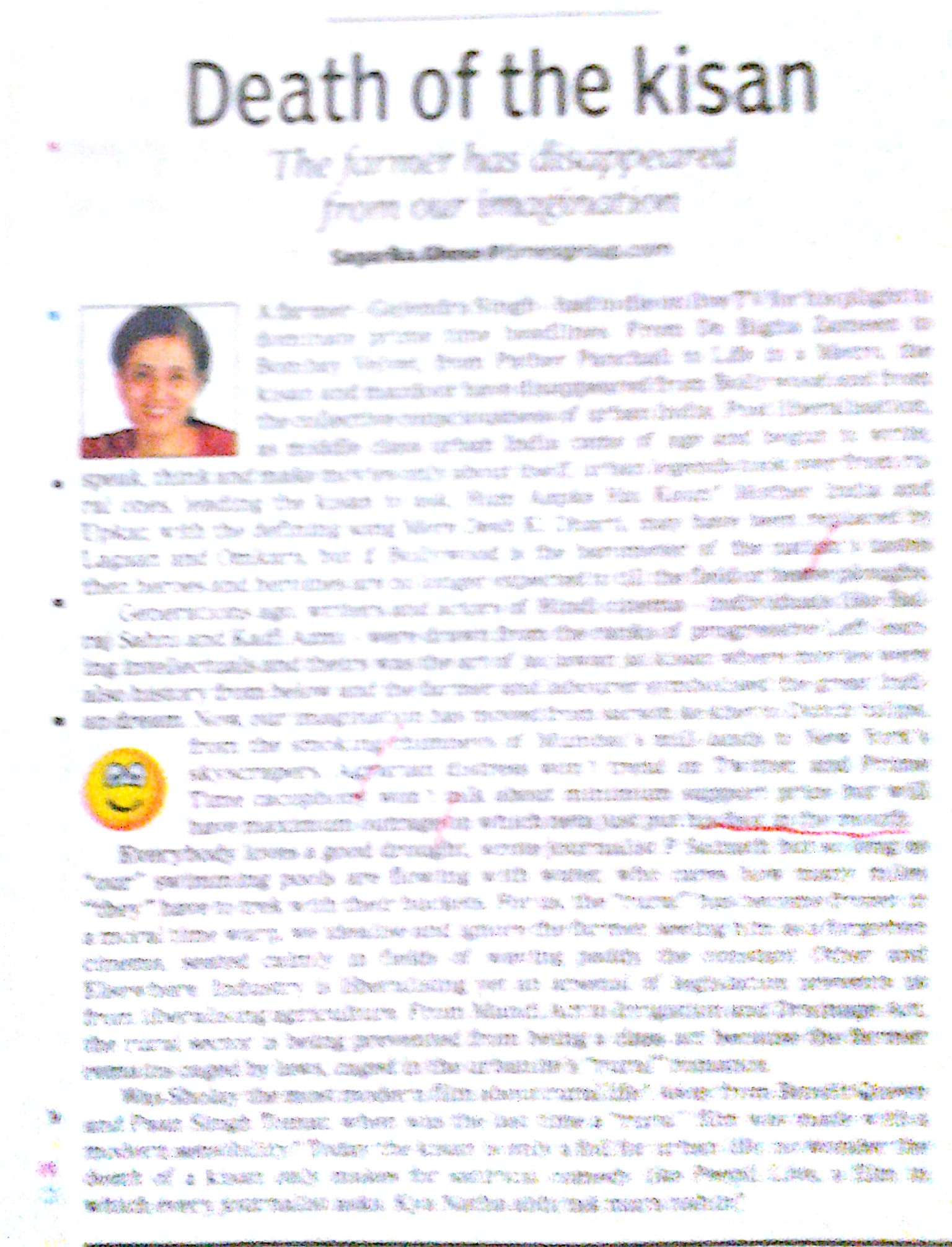
    The enclosed article ‘Death of the Kisan’ by Saraika Ghose is well meant in this direction.

*

By Kamlesh Tripathi

*

https://kamleshsujata.wordpress.com

*

Share if you like it

*

Shravan Charity Mission is an NGO that works for poor children suffering from life threatening diseases. Should you wish to donate for the cause the bank details are given below:

NAME OF ACCOUNT: SHRAVAN CHARITY MISSION

Account no: 680510110004635 (BANK OF INDIA)

IFSC code: BKID0006805

*

Our publications

GLOOM BEHIND THE SMILE

(Archived in 7 prestigious libraries of the US, including, Harvard University and Library of Congress. It can also be accessed in MIT through Worldcat.org. Besides, it is also available for reading in Libraries and archives of Canada and Cancer Aid and Research Foundation Mumbai)  

ONE TO TANGO … RIA’S ODYSSEY

(Archived in Connemara Library, Chennai and Delhi Public Library, GOI, Ministry of Culture)

AADAB LUCKNOW … FOND MEMORIES

(Launched in Lucknow International Literary Festival 2014)

REFRACTIONS … FROM THE PRISM OF GOD

(Co-published by Cankids–Kidscan, a pan India NGO and Shravan Charity Mission, that works for Child cancer in India. The book is endorsed by Ms Preetha Reddy, MD Apollo Hospitals Group. Book was launched in Lucknow International Literary Festival 2016)

(CAN BE BOUGHT FROM ON LINE BOOK STORES OR WRITE TO US FOR COPIES)

*****


SNIPPET: EVEN SIMPLE GARDEN TOOLS FOR WOMEN ARE NOT THAT SIMPLE TO DESIGN: REQUIRES INTENSIVE RESEARCH

I never thought simple garden tools require intricate research for gender specificity, till one day I went through the website of Green Heron Tools in the US wherein Adams and Brensinger promoters of this company feel. Systematic research to design garden tools for women is a must. ‘And, it’s about time farm and garden tools broke out of ‘one size fits all’ model where these two women farmers of the US are bridging the gender gap by designing tools specifically for women.

For, even if we all are equal, we are not equally sized or proportioned, because of the striking differences between women and men’s bodies. The tools that work efficiently in a man’s hands may not be that efficient in a women’s hand and so it could even be a health hazard. For example,

According to Green Heron Tools. A women’s body tends to have a lot less upper body strength, less of lower body strength, a lower center of gravity, proportionally shorter limbs, smaller hands and less grip strength than men’s bodies, which means that a ‘one size fits all’ shovel isn’t nearly as efficient or easy to use for a woman.

DESIGN AND MANUFACTURE OF HERSHOVEL

But thanks to the work of these two women farmers behind Green Heron Tools. Women now have another choice when it comes to farm and garden tools, in the form of the HERShovel, which was scientifically and specifically designed for women’s bodies. The company’s tools and other equipment are not just ergonomic, but are hergonomic, and designed to be “easiest, safest, most comfortable and most effective for women.”

After years of farming and talking with other women farmers, and sharing their frustrations about the tools they used. Ann Adams and Liz Brensinger saw an opportunity to bridge the gender tool gap by developing a line of tools and equipment that would work better for women, because they were designed with women’s bodies in mind. The two applied for, and received, a series of grants (Small Business Innovation Research grants) through the U.S. Department of Agriculture to develop their ideas, and as part of the process, they arranged to videotape women farmers as they shoveled, which revealed that women tended to use tools very differently than men did. Everything, from the angle that women put the shovel into the ground to the amount of energy expended while shoveling was analyzed, and the result of the research was the development of the HERShovel, which weighed less, was angled differently, had a large D-shaped handle, and required less energy to use. According to an interview at Modern Farmer, this new tool was the first ever shovel to be ergonomically designed for women.

For two years, the partners and their researchers pulled shovels off the shelf at places like Lowe’s and an online survey and a female focus group told Adams and Brensinger what they didn’t like about the tools they used as it was too heavy, too long and awkward. Thereafter working with Agricultural Engineers and a specialist in ergonomics at Pennsylvania State University, they designed and tested various prototypes. The HERS shovel/spade hybrid that resulted features an angled blade because “women don’t use a shovel the way men do,” says Adams. “Men power down straight. Most women can’t so that. Women put the shovel blade into the soil at an angle and take small bites.”

Once they had a prototype, it was time to test the theory that a properly designed shovel is less tiring to use. Subjects donned oxygen sensors to measure the energy expended using the HERS shovel prototype versus others, and started digging. The proof was in: HERS required less effort.

HERS weighs less than 4 ½ pounds and comes in three shaft lengths. Its foot is larger than the normal. The hollow, D shaped handle is tilted for leverage and textured to reduce slippage. Every part of the shovel is sourced and made in the US. If HERS is a success, the pair will develop more long-handled tools.

Adams and Brensinger didn’t start Green Heron Tools to get rich, but to fulfill a vocation: to make women’s lives easier and better, and to bring more women back to the land. “It’s a public health issue.’ Adam says. “If women can garden without pain or risk of injury, they can garden longer. I want to be able to garden for the rest of my life,’ she says. Millions of women hope they will be able to, as well.

One hopes in India we too will develop such implements for better women’s productivity.

*****


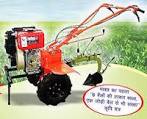
Article: SMALL TRACTORS-POWER TILLERS- THE LIKELY TOTEMPOLE OF NEXT GREEN REVOLUTION OF INDIA

Copyright@shravancharitymission

341

SULKING INDIAN AGRICULTURE

Agriculture remains the mainstay of India, even when it doesn’t contribute sufficiently to the Indian GDP. Around 65% of Indian population depends directly on agriculture when it only accounts for 22% of the GDP. But Indian agriculture now needs to undergo a paradigm shift to feed double the mouths since the last green revolution. Further, farm mechanization, agri-inputs, cropping patterns and seed varieties need to be refurbished to suit new agri challenges such as continuous soil erosion, depleting ground water levels, alarming farm labour situation and sparse market linkages. And this calls for a major overhaul on the production side of agriculture. To tackle issues such as, increase in farm produce and better farm economics, which brings us to the moot point of need based farm mechanization.

ISSUES AT HAND

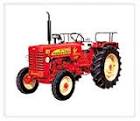
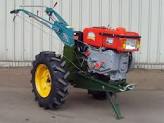
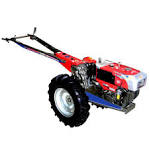
India which is 17% of the world population. But it still cultivates with either the draught animals, which are inefficient and expensive to maintain or by high horsepower tractors owned by large farmers, which are few in numbers. So the daunting question is, when more than 80 percent of the Indian farmers are small and marginal why they are not in a position to purchase tractors below hp (horsepower) 22. Is it because of the government policies that are blocking the smooth transition from draught animals to small tractors and power tillers? and what is more baffling is:

  • Small farmers don’t have a requirement of large tractors. With the amount of land they hold a tractor of 25 hp engine or more is not needed in small and medium farm size. Especially, when statistics for power availability for various agricultural operations, which is an indicator of mechanization has increased from 0.3 kilowatt per hectare in 1971-72 to 1.4 kilowatt per hectare in 2003-04.
  • Even though government puts in subsidies on tractors, farmers don’t get their free will to choose, as large manufacturers step-in to sell their own brands at the behest of Government. So if we are talking of free markets why this nudging?
578

HISTORICAL PERSPECTIVE

Tractors in India were imported initially in 1960s mainly from the US and European countries, prime being the erstwhile Soviet Union. Since these countries historically had large holdings, these machines too were manufactured in the range of medium and high horsepower to suit their own land holding sizes.

Thus, started the of lasting culture of medium and high horsepower tractors in India. Even when our land holding size way back in 1960s was far less than the European and American standards and in the range of around 3 hectares.

This as a beginning was understandable but somewhere down the line a course correction was required, which didn’t happen. Presumably, because the entire technology was new, and we were devoid of the basic sense of change or even the skill to adapt. Small was not beautiful then. A similar trend we had in the auto sector where in you had those bulky fuel guzzlers. But then the auto industry caught the imagination of their customers which farm mechanization industry didn’t.

IMPORT AND MANUFACTURING HISTORY

In the year 1961-62, first time around 880 tractors were assembled from kits purchased from British and German firms. Imports stopped in 1977 but industry’s extended honeymoon with these manufacturers continued as hand holding was required to build sufficient production bandwidth. Although, India got independence in 1947 and the socialist leaning government’s five-year plans of 1950s and 1960s aggressively promoted farm mechanizations, our production of tractors was sluggish. But by late 1980s tractor production moved upwards to 140,000 units per year, yet the prevalence rate was just 2 tractors per 1,000 farmers.

ECONOMIC REFORMS AND FAO PERSPECTIVE

Post economic reforms in 1991, with the steady pace of change, the production of tractors increased to 270,000 units per annum. And in early 2000, India overtook the US as the world’s largest producer of four-wheel tractors. FAO estimated in 1999. Of the total agricultural area in India, less than 50% was under mechanized land preparation. Thereby, indicating large opportunities still existed, and projected this in favour of small machines. Steadily growing, India in 2013 produced 619,000 tractors accounting for 29% of world’s production. And, India currently has 16 domestic and 4 multinational corporations manufacturing tractors.

SOLITARY EFFORT OF 20 HP– Swaraj story:

India had approached the erstwhile Soviet Union in the mid 1960s for R&D and manufacturing support to develop a 20 hp tractor, but they refused. This project was later taken up by Central Mechanical Engineering Research Institute (CMERI) under the council of Scientific and Industrial Research.

CMERI put together a team. They started by studying tractors of other makes that were in the market. Their first prototype was ready in May 1967 but when it was taken for trial it collapsed. Learning from the failure, they developed a second prototype, testing of which was done in October 1968, which proved satisfactory. Independent field trials later at other institutes were also successful. The tractor was called Swaraj. This Company was later promoted by Punjab State Industrial Corporation and turned out to be a blue chip company.

Besides Swaraj no other company tried to delve into 20 hp category for a long time. Until the solo effort was followed by a Delhi based company SAS Motors Ltd that has launched tractor in 15-24 hp category.

LAND HOLDING VS TRACTOR HORSEPOWER MISMATCH?

In 1960s the average land holding size was around 3 hectares (7.4 acres) and in 2010-11 it declined to 1.15ha (at an average level), which is below 3 acres on a more prevalent terminology. And, with these vital statistics, both growth and technological up gradation should have been in the low horse-power segment or in the power tiller segment. But that is clearly not the case. On the contrary both growth and technological up-gradation has been in the medium and high horsepower tractors, apparently because of foreign influence. Where, more likely the low horsepower range of tractors were discouraged because of low margins and high overheads of large manufacturing corporations and also the fatigue and capital cost of introducing a new genre.

For small and marginal farmers, low priced, small tractors of 15-24 hp was required. This generic need was highlighted as early as 1970 when (NCA )National Commission on Agriculture was set up.

At the turn of the century, India had around 2.67 million tractors, which was more than NCA projections. But category wise the number were skewed. As around 1.47 million tractors were in the 31-40 hp category, 0.65 million were in > 40 hp category and 0.68 million were in < 30 hp category. And only a part of 0.68 million tractors below 30 hp comprised of small tractors for which NCA had projected a figure of over 2 million. This large gap is surprising and reveals the callous approach of the government towards small farmers. One can perhaps safely derive that non availability made them go for higher hp tractors thereby spoiling their farm economics. And the quantity of power tillers sold was merely seventy thousand.

But then who was responsible for throwing NCA’s calculation, off balance? Well, no one can pin pointedly say who. But yes, to a certain extent the agricultural community as a whole, together with the Indian tractor industry, can be questioned on this. Instead of small tractors they came up with medium and heavy tractors, which benefited only the large farmers, and as a result tractors got concentrated only in a few states which benefitted from the green revolution such as Punjab, Haryana and parts of Uttar Pradesh (See table: some benefit)

Some benefit
Tractor sales over the last five years
States Tractors sales during last five years Area under cultivation
(‘000 hectares)
UP 290,513 17,986
MP 144,049 22,111
Punjab 121,903 4,033
Rajasthan 95,450 20,971
Haryana 89,346 3,711
Gujarat 76,439 10,293
Bihar 72,467 10,743
AP 68,994 14,461
Maharashtra 66,876 20,925
Karnataka 43,163 12,322
Tamil Nadu 38,852 7,474
Orissa 14,473 5,296
Other states 65,210 15,181
Total 1,188,735 165,507
Sources: Economic Survey 2003-04 & Indian At A Glance 2004

We all agree mechanization is an unavoidable farming tool. For, productivity has to increase along with cost and economics, and that alone is sustainable in the long run. But looking at the perfunctory approach of the government, the big question would be whether farmers should go in for small tractors or still rely of animal power. It may therefore not be out of place to mention relevant statistics of animal power.

STATISTICS ON ANIMAL POWER

– India’s 83 million draught animals carry more than 5 times the freight and four times the passenger traffic carried by railways, in terms of originating traffic.

– Draught animal power contributes 30000 megawatt of power.

– It saves 24 million tonnes of diesel per year, worth more than Rs 33,000 crore.

– Draught animals cultivate about 65% of India’s total cultivable land area

– The present value of draught animals (Rs 50,000-1,00,000/pair) is Rs 2,07,500 crore even on a very conservative estimate.

– It would take 8.3 million tractors to replace draught animal power. This would cost Rs 32,490 crore; so then why is this segment not growing?

– Draught animals provide dung worth Rs 5,000 crore annually. Five million tonnes of firewood will be needed to substitute this.

The crisis around the farmer’s traditional tiller- the draught animal is continuously growing. Even though farmers still rely on draught animals their importance is being undermined by tractors.

According to an NCA report, man can provide a power equivalent to 0.07 hp, a woman 0.05 hp, a bullock/buffalo 0.40 hp, a camel 1 hp and a tractor at least 14 hp. In 1951, the farm power available was just 0.25 kilowatt per ha (KW/ha) of which 97 percent came from draught animals. This has now gone up by almost 6 times to 1.40 KW/ha and the corresponding increase in food grain by four times, and so an optimum, farm mechanization, is the need of the hour.

Farm mechanization is also important from the aspect that 65% of our cultivable area consists of dry farming or rain fed farming where the window of soil bed preparation is very small and if we are unable to do seedbed preparation and sowing in a timely manner, given the receding soil moisture, yields will drastically reduce.

However, 70% percent farmers still use draught animals where they can easily be upgraded to small farm mechanization tools. Such as small hp tractors or power tillers, but for this to happen; government policies should start focusing on the needs of the small farmer.

COMPARISON BETWEEN DRAUGHT ANIMALS AND TRACTOR

Draught animals and tractors are complementary sources of power on Indian farms, and will continue like that for many more years, to meet the ever burgeoning demand of power and of increased production and productivity. A report of 1987 says that a 35 hp tractor can prepare a seed-bed and sow 0.2 (ha) in one hour at Rs 270-300 per ha. Bullocks for the same operation require the entire day at Rs 300 per ha. The problem is draught animals have to be fed throughout the year but their optimal use is restricted to around three months in a year.

INDIAN AGRI DISCONNECT

  • Tractors in India are out of reach for the majority of the farmers. The cheapest being Rs 1.8 lakh almost as much as a new car.
  • Barely 2% of the 115 million farmers own a tractor according to the 1995-96 agriculture, census. Yet they cultivate almost 1/3rd of the countries arable land. This itself highlights the efficient toughness of farm mechanization.
  • Most farmers possessing tractors are rich and own large land holdings. Rate of ploughing is Rs 200-250/hr or Rs 2-2500/hectare
  • But small farmers are unable to reap such benefits. For them a low priced, small tractor of 15-24 HP would be ideal. This need was recognized as early as 1970 when the National Commission on Agriculture (NCA) was set up. After a 5 year study, NCA submitted a long report in 1976, which also recommended the type and quantity of tractors India should have by 2000: 2.08 million tractors and power tillers (a farm machine, with two wheels, to till the soil) below 15HP, 0.12 million medium tractors of 35 HP & 80,000 65 HP tractors, which taken together would total 2.28 million
  • This policy argued that 2.08 million tractors and power tillers below 15 hp were needed for small and medium farmers. Besides, they are also considered more suitable for paddy cultivation — the country’s dominant food grain crop — than medium (25-40 hp) and heavy (above 40 hp) tractors.

ALL TIME PANACEA FOR SULKING INDIAN AGRICULTURE IS FARM MECHANIZATION OF THE RIGHT KIND:

  • To graduate from animal tilling to mechanized tilling and that to by small tractors, power tillers and other economical high precision equipments commensurate with land holding size of small and medium farmers, keeping in mind their farm economics.
  • An option less farmer has to buy a 35 hp category tractor that costs around 5 lacs with bank loan at a high rate of interest, even if he doesn’t require this product. This should be substituted by small tractors or even power tillers.
  • GOI provides a subsidy of 25% limited up to 30,000 tractors. Wherein also, the farmer is cajoled to buy certain brands and this needs to stop forthwith, as user of the product should alone be the decider by any diktat of consumerism.
  • Tractors available in the range of 25-40 hp use advance western technologies, which may not be required for small holdings and this makes the product expensive. In fact what is needed is a below 25 hp tractor or a power tiller that is gender friendly and useful for ‘nuclear farming’ just as a nuclear family. The cost of such tractors will bring down the farmers cost by 50%. As against his investments and maintenance in a pair of bullocks, which requires to be fed and taken care of even when it is not generating any revenue, and also serves best only for a time span of 5-6 years.
  • Farmers need to come out of the clutches of debt to make agriculture more exploring, exciting, remunerative, and even status oriented. This can happen only if simple and cheap technologies are used in conjunction and proportion to their earnings. According to 59th survey by NSSO (January-December 2003) out of 89.35 million farmer households, 43.42 million (48.6%) were reported to be in debt. But in a similar survey in 1991 only showed 26% were in debt.

*****


ARTICLE: #FARM TO #FORK methodology- IN BIG TICKET #RETAIL

Copyright@shravancharitymission

bigrel


BY KAMLESH TRIPATHI- FORMER GENERAL MANAGER MAHINDRA & MAHINDRA LTD., HEAD OPERATIONS MAHINDRA SHUBH LABH SERVICES LTD., HEAD AGRI BUSINESS AND ENGINES. ESCORTS LTD., VICE PRESIDENT RELIANCE RETAIL (FREELANCE JOURNALIST AND AUTHOR)

STATE OF PLAY

How would you like if it was written behind the packet of wheat flour that you just bought, ‘The contents were grown in the farm of Nanak Ram near Saras town, district Sehore, Madhya Pradesh.’ This is ‘traceability’ in agri terms. Sounds like a distant dream. But then the ‘big dream’ of the big ticket ‘Indian Retail.’ Connect the farm-gate to the fork. But before we get into this let us have a flavor of how the current system operates. Indian farming traditionally has been hooked to the mechanics of Artheyas (Grain merchants) Artheyas were created to help farmers with their documents while selling their crops in the mandis. These documents included entry of grain receipts in mandi registers, raising sales invoices and also tax challans. As most of them were illiterates and did not know how to read or write. This created a lifelong bond between the Artheyas and the farmers. The Artheyas initially started as the humble ombudsman assisting the farmers but gradually transformed into strong ‘gaddis’ at the influential grain market. But at the same time the profile of farmers continued to be the same or even declined comparatively, as the number of small and marginal farm holdings only increased and profits dwindled.

Today, a farmer depends on the artheyas for crop finance and finance in case of crop failure. He also treats the artheya as an assured market for his crop. And also depends on him for certain exigency finance which he may require in terms of marriage, illness, festivals thus forging a strong bond. And as compared to banks, their documentation is simple and not cumbersome and so a big convenience. But artheyas don’t forget their pound of flesh; and finance at high rate of interest and in some cases even beyond 24% per annum, and this hits farmer profitability. Even for the grain that the farmer sells through the artheyas, he charges commissions which is the major reason for grain, vegetable and even fruit prices becoming more than double from the farm level. Government in recent times has started warehouse receipt system; a type of finance that is available by mortgaging crop but then it entails a series of documentation.

hhkk

FARM TO FORK GENESIS

When the big ticket retail entered India the whole value chain from farm-gate to fork was examined by them in detail. What they found was, if the artheyas were removed from the system, and if they could buy grains, vegetables and even fruits directly from the farmers, a substantial value could be unlocked, saved and this could be shared amongst the three stakeholders; the farmer, retailer and the consumer. And, a lot of ground research has been done in this spectrum since then.

WAY FORWARD AND HOW DOES IT WORK ON THE GROUND:

Most big retailers have aggregation or stock points that store merchandise, from where it is brought to the retail floor, basis guidelines of minimum and daily stocking level. Some even have cold chains and reefer trucks for fruit and vegetable movement. Farmers who grow vegetables in the surrounding areas come with their seasonal vegetables and off load their stocks in these stock points basis number of plucking. These stocks are then sorted and graded for pricing by the company on a mutually agreed basis, after which it is taken in stock and payments are made once a week or in a fortnight to these regular suppliers. In case of onions and potatoes which have specific areas of production and limited season, such purchases may be made through one big farmer or a consortium of farmers or at times an agent who deals in these veggies. Fruits are more seasonal and the companies buy directly from orchard owners. Like apples are supplied by orchard owners from Kashmir and Himachal Pradesh, mangoes could be from Malihabad near Lucknow . Farm gate purchase for grains is more tedious and cumbersome and still continues in a big way through the mandis, because of the government policies. Even the cropping regions are quite diverse; like Basmati paddy is grown in Punjab and Haryana, as an example. Some states have also tried contract farming where farmers are first registered before the cropping season. A particular variety of seed is given to them and package of practice is explained, and when the crop is harvested the Company lifts the entire crop. Fritolay the potato chips company has done contract farming for potatoes in Ranjangaon area near Pune and Punjab Agro has taken up a huge contract farming initiative of Basmati paddy in Punjab.

ADVANTAGES VS DISADVANTAGES

Farm to fork- is model of agriculture that has come to stay and has the following advantages and disadvantages:

• Increased Profitability: It gives greater profitability and earnings to small and marginal farmers which are growing in number.

• Expert advice on crops are available such as drip irrigation, optimum use of pesticides, new cropping patterns, crop diversification and fertilizer usage, to name a few; from international crop experts associated through big retailers.

• Ready market, even before the crop is ready.

• Traceability of crop

• There is a possible danger of the buyer reneging in which case the farmer will have to look for a new buyer within a short span of time to sell his crop.

• It may not have any government support price.

*****

ARTICLE- INDIAN AGRI’S CHINK IN THE ARMOUR

Copyright@shravancharitymission

915


    If the 2011 agri census had its way. It would huff, puff and jostle the policy makers to have a hard look at the stressed agri scenario of India. That is entering from the back doors of gradual reduction in operating land holding size. It may sound primordial. Yet the tremors are only getting closer to the feet, slowly and steadily.

    Let’s take a close look at some of the key statistics thrown up by agriculture census of 2011. Which are rather alarming. More for those who thrive on agriculture and considering the fact that the census takes place every five years. What will emerge in the next one, could only be a heart broken anticipation coming true.

LAND HOLDING PATTERN UNDER STRESS

    The total no of operational holding has increased from 129.22 million hectares (ha) in 2005-06 to 138.35 million ha in 2010-11, showing an increase of 7.06%. This may sound good.

    The operated area has also increased to 159.59 million ha in 2010-11 from 158.32 million ha in 2005-06. A marginal increase of only 0.80%.

    But the average operational size of land holding which was 1.23 ha in 2005-06 has declined to 1.15 ha in 2010-11, at an all India level. Which is below 3 acres on a more prevalent terminology. What it might be in the census of 2015-16 could be anyone’s wild guess. All in all, this shift will only bring about economic stress. That will perforce change the farming paraphernalia of an Indian farmer. But are we ready for it is the moot question?

    From the veritable census report in the table below one finds. The small and marginal <2 ha operational area has gone up from 41.14% to 44.58%. While both semi medium, medium and large holding have come down. And the average operational size of holding in <2 ha class has gone up from 83.29% to 85.01%. Now this should at least ring bells if not alarm bells. Further the table also conveys:

REDUCTION SWING IN SIZE OF LAND HOLDINGS
CENSUS-2005-06 CENSUS- 2010-11
SMALL AND MARGINAL < 2HA
AVEARAGE OPERATED SIZE OF HOLDING 83.29% 85.01%
OPERATED AREA 41.14% 44.58%
SEMI MEDIUM AND MEDIUM 2.00 HA-10HA
AVERAGE OPERATED SIZE OF HOLDING 15.85% 14.29%
OPERATED AREA 47.05% 44.88%
LARGE HOLDING > 10.00HA    
AVERAGE OPERATED SIZE OF HOLDING 0.85% 0.70%
OPERATED AREA 11.82% 10.59%

1012

    Major farm productivity is going to come from <2 ha holdings. Therefore, the methodology of agriculture production changes from heavy and medium to mini and micro farm equipment. Which is a capital cost change for the industry. Distribution and marketing too will have to retract and align to the scattered farm production. That is helter-skelter logistics and smaller heaps to carry and deliver.

THE NEW PAGE IN FARM MECHANIZATION

    Reduction in the size of average operational land holding by 6.50% over the last five years ending 2011. Together with the trending future and historical past, has not gone on deaf years with major Farm mechanization companies. As they too, over the years, have added, scaled down variants of lower horse power (HP) tractors in their stable. That is from 60 to 45 to 35 to 25 and now to even 16 (HP). Yet the break-even points of these machines are spilling on to the kuccha village roads or the tarmac roads where they carry passengers, work in brick-kiln and get into seasonal transport jobs to make two ends meet.

    Also mere reduction of HP will not be sufficient in bringing about farmer profitability. The present average land holding size denotes–Like a nuclear family have nuclear farming. But this nuclear farming will be viable only with tilling machines in the range of 3 to 7 HP along with allied paraphernalia. Machines that even a lady can operate and that are self-sustainable, in terms of cost by the income of the farm alone. And do not escrow with other seasonal side operations to break even. Therefore, it is not far when the early birds of the industry will arrive in this segment.

    As a concerned friend of the farmers. I feel the Government of India needs to take a pragmatic view of the ensuing scenario, and work out a complete package for the new trendsetting ‘nuclear farming.’ Which I feel is a new skill set. And I say this for the following reason.

    For etching a full time farming career from a farm of less than 3 acres would mean performing most farm activities yourself. Or in the company of your spouse, and this would require small farm machines for all activities to match that. Especially, when the net farming profitability per acre stands around twenty five to thirty thousand rupees per annum per acre. That too on irrigated land.

    Indian agriculture has been slow but steady in catching signals of change. Perhaps, it is waiting for a point when push comes to shove. But this time it needs to be proactive. And it has the capability to imbibe change. Where, the GOI must facilitate with appropriate policies.

By Kamlesh Tripathi- Ex: General Manager, Mahindra & Mahindra Ltd.; Head Operations, Mahindra Shubh Labh Services Ltd.; Head-Agri-Business & Head Engines for Gensets, Escorts Ltd.; Vice President, Reliance Retail; Head of Marketing & Sales, SAS Motors; (WRITER AND AUTHOR).

*

By Kamlesh Tripathi

*

https://kamleshsujata.wordpress.com

 *

Share if you like it

*

Shravan Charity Mission is an NGO that works for poor children suffering from life threatening diseases. Should you wish to donate for the cause the bank details are given below:

NAME OF ACCOUNT: SHRAVAN CHARITY MISSION

Account no: 680510110004635 (BANK OF INDIA)

IFSC code: BKID0006805

*

Our publications

GLOOM BEHIND THE SMILE

(Archived in 7 prestigious libraries of the US, including, Harvard University and Library of Congress. It can also be accessed in MIT through Worldcat.org. Besides, it is also available for reading in Libraries and archives of Canada and Cancer Aid and Research Foundation Mumbai)  

ONE TO TANGO … RIA’S ODYSSEY

(Archived in Connemara Library, Chennai and Delhi Public Library, GOI, Ministry of Culture)

AADAB LUCKNOW … FOND MEMORIES

(Launched in Lucknow International Literary Festival 2014)

REFRACTIONS … FROM THE PRISM OF GOD

(Co-published by Cankids–Kidscan, a pan India NGO and Shravan Charity Mission, that works for Child cancer in India. The book is endorsed by Ms Preetha Reddy, MD Apollo Hospitals Group. Book was launched in Lucknow International Literary Festival 2016)

(CAN BE BOUGHT FROM ON LINE BOOK STORES OR WRITE TO US FOR COPIES)

*****