Category Archives: parable

STORY: The Peacock and the Crane

Copyright@shravancharity mission

There was once a peacock who often boasted about his beauty. Every day he would walk up to the banks of a large lake and look at his own reflections and say “Oh! What a beautiful bird I am! Look at my exquisite colourful tail.”

    Once the peacock saw a crane on the banks of the lake. He said with sarcasm to the crane, “What a colourless bird you are! You don’t have beautiful and colourful feathers like me—see I’m the most beautiful”. 
    The crane replied, “O yes of course! I don’t have beautiful feathers. But, my feathers can make me fly across the lake. Can your feathers make you fly?” There was no reply from the peacock. 
MORAL OF THE STORY: It is better to be useful than to be beautiful.

Posted by Kamlesh Tripathi

*

https://kamleshsujata.wordpress.com

*

Share it if you like it

*

Shravan Charity Mission is an NGO that works for poor children suffering from life threatening diseases especially cancer. Our posts are meant for our readers that includes both children and adults and it has a huge variety in terms of content. We also accept donations for our mission. Should you wish to donate for the cause. The bank details are given below:

NAME OF ACCOUNT: SHRAVAN CHARITY MISSION

Account no: 680510110004635 (BANK OF INDIA)

IFSC code: BKID0006805

*

Our publications

GLOOM BEHIND THE SMILE

(The book is about a young cancer patient. Now archived in 7 prestigious libraries of the US, including, Harvard University and Library of Congress. It can also be accessed in MIT through Worldcat.org. Besides, it is also available for reading in Libraries and archives of Canada and Cancer Aid and Research Foundation Mumbai)  

ONE TO TANGO … RIA’S ODYSSEY

(Is a book on ‘singlehood’ about a Delhi girl now archived in Connemara Library, Chennai and Delhi Public Library, GOI, Ministry of Culture, Delhi)

AADAB LUCKNOW … FOND MEMORIES

(Is a fiction written around the great city of Nawabs—Lucknow. It describes Lucknow in great detail and also talks about its Hindu-Muslim amity. That happens to be its undying characteristic. The book was launched in Lucknow International Literary Festival of 2014)

REFRACTIONS … FROM THE PRISM OF GOD

(Co-published by Cankids–Kidscan, a pan India NGO and Shravan Charity Mission, that works for Child cancer in India. The book is endorsed by Ms Preetha Reddy, MD Apollo Hospitals Group. It was launched in Lucknow International Literary Festival 2016)

TYPICAL TALE OF AN INDIAN SALESMAN

(Is a story of an Indian salesman who is, humbly qualified. Yet he fights his ways through unceasing uncertainties to reach the top. A good read not only for salesmen. The book was launched on 10th February, 2018 in Gorakhpur Lit-Fest. Now available in Amazon, Flipkart and Onlinegatha)

RHYTHM … in poems

(Published in January 2019. The book contains 50 poems. The poems describe our day to day life. The book is available in Amazon, Flipkart and Onlinegatha)

(ALL THE ABOVE TITLES ARE AVAILABLE FOR SALE IN AMAZON, FLIPKART AND OTHER ONLINE STORES OR YOU COULD EVEN WRITE TO US FOR A COPY)

*****


Speech of Narayana Murthy

Copyright@shravancharitymission

Exuberant speech of Narayana Murthy at New York University (Stern School of Business)
Dean Cooley, faculty, staff, distinguished guests, and, most importantly, the graduating class of 2007, it is a great privilege to speak at your commencement ceremonies.
I thank Dean Cooley and Prof Marti Subrahmanyam for their kind invitation. I am exhilarated to be part of such a joyous occasion. Congratulations to you, the class of 2007, on completing an important milestone in your life journey.
After some thought, I have decided to share with you some of my life lessons. I learned these lessons in the context of my early career struggles, a life lived under the influence of sometimes unplanned events which were the crucibles that tempered my character and reshaped my future.
I would like first to share some of these key life events with you, in the hope that these may help you understand my struggles and how chance events and unplanned encounters with influential persons shaped my life and career.
Later, I will share the deeper life lessons that I have learned. My sincere hope is that this sharing will help you see your own trials and tribulations for the hidden blessings they can be.
The first event occurred when I was a graduate student in Control Theory at IIT, Kanpur, in India. At breakfast on a bright Sunday morning in 1968, I had a chance encounter with a famous computer scientist on sabbatical from a well-known US university.
He was discussing exciting new developments in the field of computer science with a large group of students and how such developments would alter our future. He was articulate, passionate and quite convincing. I was hooked. I went straight from breakfast to the library, read four or five papers he had suggested, and left the library determined to study computer science.
Friends, when I look back today at that pivotal meeting, I marvel at how one role model can alter for the better the future of a young student. This experience taught me that valuable advice can sometimes come from an unexpected source, and chance events can sometimes open new doors.
The next event that left an indelible mark on me occurred in 1974. The location: Nis, a border town between former Yugoslavia, now Serbia, and Bulgaria. I was hitchhiking from Paris back to Mysore, India, my home town.
By the time a kind driver dropped me at Nis railway station at 9 p.m. on a Saturday night, the restaurant was closed. So was the bank the next morning, and I could not eat because I had no local money. I slept on the railway platform until 8.30 pm in the night when the Sofia Express pulled in.
The only passengers in my compartment were a girl and a boy. I struck a conversation in French with the young girl. She talked about the travails of living in an iron curtain country, until we were roughly interrupted by some policemen who, I later gathered, were summoned by the young man who thought we were criticising the communist government of Bulgaria.
The girl was led away; my backpack and sleeping bag were confiscated. I was dragged along the platform into a small 8×8 foot room with a cold stone floor and a hole in one corner by way of toilet facilities. I was held in that bitterly cold room without food or water for over 72 hours.
I had lost all hope of ever seeing the outside world again, when the door opened. I was again dragged out unceremoniously, locked up in the guard’s compartment on a departing freight train and told that I would be released 20 hours later upon reaching Istanbul. The guard’s final words still ring in my ears — “You are from a friendly country called India and that is why we are letting you go!”
The journey to Istanbul was lonely, and I was starving. This long, lonely, cold journey forced me to deeply rethink my convictions about Communism. Early on a dark Thursday morning, after being hungry for 108 hours, I was purged of any last vestiges of affinity for the Left.
I concluded that entrepreneurship, resulting in large-scale job creation, was the only viable mechanism for eradicating poverty in societies.
Deep in my heart, I always thank the Bulgarian guards for transforming me from a confused Leftist into a determined, compassionate capitalist! Inevitably, this sequence of events led to the eventual founding of Infosys in 1981.
While these first two events were rather fortuitous, the next two, both concerning the Infosys journey, were more planned and profoundly influenced my career trajectory.
On a chilly Saturday morning in winter 1990, five of the seven founders of Infosys met in our small office in a leafy Bangalore suburb. The decision at hand was the possible sale of Infosys for the enticing sum of $1 million. After nine years of toil in the then business-unfriendly India, we were quite happy at the prospect of seeing at least some money.
I let my younger colleagues talk about their future plans. Discussions about the travails of our journey thus far and our future challenges went on for about four hours. I had not yet spoken a word.
Finally, it was my turn. I spoke about our journey from a small Mumbai apartment in 1981 that had been beset with many challenges, but also of how I believed we were at the darkest hour before the dawn. I then took an audacious step. If they were all bent upon selling the company, I said, I would buy out all my colleagues, though I did not have a cent in my pocket.
There was a stunned silence in the room. My colleagues wondered aloud about my foolhardiness. But I remained silent. However, after an hour of my arguments, my colleagues changed their minds to my way of thinking. I urged them that if we wanted to create a great company, we should be optimistic and confident. They have more than lived up to their promise of that day.
In the seventeen years since that day, Infosys has grown to revenues in excess of $3.0 billion, a net income of more than $800 million and a market capitalisation of more than $28 billion, 28,000 times richer than the offer of $1 million on that day.
In the process, Infosys has created more than 70,000 well-paying jobs, 2,000-plus dollar-millionaires and 20,000-plus rupee millionaires.
A final story: On a hot summer morning in 1995, a Fortune-10 corporation had sequestered all their Indian software vendors, including Infosys, in different rooms at the Taj Residency hotel in Bangalore so that the vendors could not communicate with one another. This customer’s propensity for tough negotiations was well-known. Our team was very nervous.
First of all, with revenues of only around $5 million, we were minnows compared to the customer.
Second, this customer contributed fully 25% of our revenues. The loss of this business would potentially devastate our recently-listed company.
Third, the customer’s negotiation style was very aggressive. The customer team would go from room to room, get the best terms out of each vendor and then pit one vendor against the other. This went on for several rounds. Our various arguments why a fair price — one that allowed us to invest in good people, R&D, infrastructure, technology and training — was actually in their interest failed to cut any ice with the customer.
By 5 p.m. on the last day, we had to make a decision right on the spot whether to accept the customer’s terms or to walk out.
All eyes were on me as I mulled over the decision. I closed my eyes, and reflected upon our journey until then. Through many a tough call, we had always thought about the long-term interests of Infosys. I communicated clearly to the customer team that we could not accept their terms, since it could well lead us to letting them down later. But I promised a smooth, professional transition to a vendor of customer’s choice.
This was a turning point for Infosys.
Subsequently, we created a Risk Mitigation Council which ensured that we would never again depend too much on any one client, technology, country, application area or key employee. The crisis was a blessing in disguise. Today, Infosys has a sound de-risking strategy that has stabilised its revenues and profits.
I want to share with you, next, the life lessons these events have taught me.
1. I will begin with the importance of learning from experience. It is less important, I believe, where you start. It is more important how and what you learn. If the quality of the learning is high, the development gradient is steep, and, given time, you can find yourself in a previously unattainable place. I believe the Infosys story is living proof of this.
Learning from experience, however, can be complicated. It can be much more difficult to learn from success than from failure. If we fail, we think carefully about the precise cause. Success can indiscriminately reinforce all our prior actions.
2. A second theme concerns the power of chance events. As I think across a wide variety of settings in my life, I am struck by the incredible role played by the interplay of chance events with intentional choices. While the turning points themselves are indeed often fortuitous, how we respond to them is anything but so. It is this very quality of how we respond systematically to chance events that is crucial.
3. Of course, the mindset one works with is also quite critical. As recent work by the psychologist, Carol Dweck, has shown, it matters greatly whether one believes in ability as inherent or that it can be developed. Put simply, the former view, a fixed mindset, creates a tendency to avoid challenges, to ignore useful negative feedback and leads such people to plateau early and not achieve their full potential.
The latter view, a growth mindset, leads to a tendency to embrace challenges, to learn from criticism and such people reach ever higher levels of achievement.
4. The fourth theme is a cornerstone of the Indian spiritual tradition: self-knowledge. Indeed, the highest form of knowledge, it is said, is self-knowledge. I believe this greater awareness and knowledge of oneself is what ultimately helps develop a more grounded belief in oneself, courage, determination, and, above all, humility, all qualities which enable one to wear one’s success with dignity and grace.
Based on my life experiences, I can assert that it is this belief in learning from experience, a growth mindset, the power of chance events, and self-reflection that have helped me grow to the present.
Back in the 1960s, the odds of my being in front of you today would have been zero. Yet here I stand before you! With every successive step, the odds kept changing in my favour, and it is these life lessons that made all the difference.
My young friends, I would like to end with some words of advice. Do you believe that your future is pre-ordained, and is already set? Or, do you believe that your future is yet to be written and that it will depend upon the sometimes fortuitous events?
Do you believe that these events can provide turning points to which you will respond with your energy and enthusiasm? Do you believe that you will learn from these events and that you will reflect on your setbacks? Do you believe that you will examine your successes with even greater care?
I hope you believe that the future will be shaped by several turning points with great learning opportunities. In fact, this is the path I have walked to much advantage.
A final word: When, one day, you have made your mark on the world, remember that, in the ultimate analysis, we are all mere temporary custodians of the wealth we generate, whether it be financial, intellectual, or emotional. The best use of all your wealth is to share it with those less fortunate.
I believe that we have all at some time eaten the fruit from trees that we did not plant. In the fullness of time, when it is our turn to give, it behooves us in turn to plant gardens that we may never eat the fruit of, which will largely benefit generations to come. I believe this is our sacred responsibility, one that I hope you will shoulder in time.
Thank you for your patience. Go forth and embrace your future with open arms, and pursue enthusiastically your own life journey of discovery!

By Kamlesh Tripathi

*

https://kamleshsujata.wordpress.com

*

Share it if you like it

*

Shravan Charity Mission is an NGO that works for poor children suffering from life threatening diseases especially cancer. Our posts are meant for our readers that includes both children and adults and it has a huge variety in terms of content. We also accept donations for our mission. Should you wish to donate for the cause. The bank details are given below:

NAME OF ACCOUNT: SHRAVAN CHARITY MISSION

Account no: 680510110004635 (BANK OF INDIA)

IFSC code: BKID0006805

*

Our publications

GLOOM BEHIND THE SMILE

(The book is about a young cancer patient. Now archived in 7 prestigious libraries of the US, including, Harvard University and Library of Congress. It can also be accessed in MIT through Worldcat.org. Besides, it is also available for reading in Libraries and archives of Canada and Cancer Aid and Research Foundation Mumbai)  

ONE TO TANGO … RIA’S ODYSSEY

(Is a book on ‘singlehood’ about a Delhi girl now archived in Connemara Library, Chennai and Delhi Public Library, GOI, Ministry of Culture, Delhi)

AADAB LUCKNOW … FOND MEMORIES

(Is a fiction written around the great city of Nawabs—Lucknow. It describes Lucknow in great detail and also talks about its Hindu-Muslim amity. That happens to be its undying characteristic. The book was launched in Lucknow International Literary Festival of 2014)

REFRACTIONS … FROM THE PRISM OF GOD

(Co-published by Cankids–Kidscan, a pan India NGO and Shravan Charity Mission, that works for Child cancer in India. The book is endorsed by Ms Preetha Reddy, MD Apollo Hospitals Group. It was launched in Lucknow International Literary Festival 2016)

TYPICAL TALE OF AN INDIAN SALESMAN

(Is a story of an Indian salesman who is, humbly qualified. Yet he fights his ways through unceasing uncertainties to reach the top. A good read not only for salesmen. The book was launched on 10th February, 2018 in Gorakhpur Lit-Fest. Now available in Amazon, Flipkart and Onlinegatha)

RHYTHM … in poems

(Published in January 2019. The book contains 50 poems. The poems describe our day to day life. The book is available in Amazon, Flipkart and Onlinegatha)

(ALL THE ABOVE TITLES ARE AVAILABLE FOR SALE IN AMAZON, FLIPKART AND OTHER ONLINE STORES OR YOU COULD EVEN WRITE TO US FOR A COPY)

*****


STORY: TWO FRIENDS AND THE BEAR

Copyright@shravancharitymission

    Vijay and Raju were friends. Once while they were on a holiday they went into a forest. Where, they were enjoying the beauty of nature. When suddenly they saw a bear charging at them. They were frightened. Raju who knew how to climb a tree, ran towards it and climbed it up in no time. He did not think of Vijay who did not know how to climb a tree.

    Vijay got nervous and thought for a second. He had heard, animals do not prefer dead bodies. So, he fell on the ground and held his breath. The bear sniffed him for a few moments and thought he was dead and decided to carry on. Upon witnessing the scene Raju asked Vijay. ‘What did the bear whisper in your ears?’ 

Vijay replied, The bear asked me to keep away from friends like you.’ 

Moral of the story is: A friend in need is a friend indeed.

Posted by Kamlesh Tripathi

*

https://kamleshsujata.wordpress.com

*

Share it if you like it

*

Shravan Charity Mission is an NGO that works for poor children suffering from life threatening diseases especially cancer. Our posts are meant for our readers that includes both children and adults and it has a huge variety in terms of content. We also accept donations for our mission. Should you wish to donate for the cause. The bank details are given below:

NAME OF ACCOUNT: SHRAVAN CHARITY MISSION

Account no: 680510110004635 (BANK OF INDIA)

IFSC code: BKID0006805

*

Our publications

GLOOM BEHIND THE SMILE

(The book is about a young cancer patient. Now archived in 7 prestigious libraries of the US, including, Harvard University and Library of Congress. It can also be accessed in MIT through Worldcat.org. Besides, it is also available for reading in Libraries and archives of Canada and Cancer Aid and Research Foundation Mumbai)  

ONE TO TANGO … RIA’S ODYSSEY

(Is a book on ‘singlehood’ about a Delhi girl now archived in Connemara Library, Chennai and Delhi Public Library, GOI, Ministry of Culture, Delhi)

AADAB LUCKNOW … FOND MEMORIES

(Is a fiction written around the great city of Nawabs—Lucknow. It describes Lucknow in great detail and also talks about its Hindu-Muslim amity. That happens to be its undying characteristic. The book was launched in Lucknow International Literary Festival of 2014)

REFRACTIONS … FROM THE PRISM OF GOD

(Co-published by Cankids–Kidscan, a pan India NGO and Shravan Charity Mission, that works for Child cancer in India. The book is endorsed by Ms Preetha Reddy, MD Apollo Hospitals Group. It was launched in Lucknow International Literary Festival 2016)

TYPICAL TALE OF AN INDIAN SALESMAN

(Is a story of an Indian salesman who is, humbly qualified. Yet he fights his ways through unceasing uncertainties to reach the top. A good read not only for salesmen. The book was launched on 10th February, 2018 in Gorakhpur Lit-Fest. Now available in Amazon, Flipkart and Onlinegatha)

RHYTHM … in poems

(Published in January 2019. The book contains 50 poems. The poems describe our day to day life. The book is available in Amazon, Flipkart and Onlinegatha)

(ALL THE ABOVE TITLES ARE AVAILABLE FOR SALE IN AMAZON, FLIPKART AND OTHER ONLINE STORES OR YOU COULD EVEN WRITE TO US FOR A COPY)

*****


STORY: LESSON FROM THE BEST FRIEND

Copyright@shravancharitymission

    Once, two friends were walking through the desert. At some point of the journey they had an argument, and in the heat of the moment one friend slapped the other on the face.

   The one who got slapped was hurt, but without saying a word he wrote on the sand.  

“Today my best friend slapped me on the face.”

    Thereafter, they kept on walking until they found an oasis, where they decided to take a bath and rest. But by accident the one who had been slapped got stuck in the wetland and started drowning, but the friend saved him. After he recovered from the near drowning, he wrote on a stone;

“Today my best friend saved my life.”

    The friend who had slapped and saved his best friend asked him;

 “After I hurt you, you wrote in the sand and now, you write on a stone, why?”

    The friend replied;

 “When someone hurts us we should write it down in sand where winds of forgiveness can erase it away. But, when someone does something good for us, we must engrave it in stone where no wind can ever erase it.”

By Kamlesh Tripathi

*

https://kamleshsujata.wordpress.com

*

Share it if you like it

*

Shravan Charity Mission is an NGO that works for poor children suffering from life threatening diseases especially cancer. Our posts are meant for our readers that includes both children and adults and it has a huge variety in terms of content. We also accept donations for our mission. Should you wish to donate for the cause. The bank details are given below:

NAME OF ACCOUNT: SHRAVAN CHARITY MISSION

Account no: 680510110004635 (BANK OF INDIA)

IFSC code: BKID0006805

*

Our publications

GLOOM BEHIND THE SMILE

(The book is about a young cancer patient. Now archived in 7 prestigious libraries of the US, including, Harvard University and Library of Congress. It can also be accessed in MIT through Worldcat.org. Besides, it is also available for reading in Libraries and archives of Canada and Cancer Aid and Research Foundation Mumbai)  

ONE TO TANGO … RIA’S ODYSSEY

(Is a book on ‘singlehood’ about a Delhi girl now archived in Connemara Library, Chennai and Delhi Public Library, GOI, Ministry of Culture, Delhi)

AADAB LUCKNOW … FOND MEMORIES

(Is a fiction written around the great city of Nawabs—Lucknow. It describes Lucknow in great detail and also talks about its Hindu-Muslim amity. That happens to be its undying characteristic. The book was launched in Lucknow International Literary Festival of 2014)

REFRACTIONS … FROM THE PRISM OF GOD

(Co-published by Cankids–Kidscan, a pan India NGO and Shravan Charity Mission, that works for Child cancer in India. The book is endorsed by Ms Preetha Reddy, MD Apollo Hospitals Group. It was launched in Lucknow International Literary Festival 2016)

TYPICAL TALE OF AN INDIAN SALESMAN

(Is a story of an Indian salesman who is, humbly qualified. Yet he fights his ways through unceasing uncertainties to reach the top. A good read not only for salesmen. The book was launched on 10th February, 2018 in Gorakhpur Lit-Fest. Now available in Amazon, Flipkart and Onlinegatha)

RHYTHM … in poems

(Published in January 2019. The book contains 50 poems. The poems describe our day to day life. The book is available in Amazon, Flipkart and Onlinegatha)

(ALL THE ABOVE TITLES ARE AVAILABLE FOR SALE IN AMAZON, FLIPKART AND OTHER ONLINE STORES OR YOU COULD EVEN WRITE TO US FOR A COPY)

*****


THE BLIND MEN AND THE ELEPHANT

Copyright@shravancharitymission

    Once a group of blind men heard that a strange animal, called elephant, had been brought to town, but none of them were aware of its shape and form. Out of curiosity, they said: “We must inspect and know it by touch, of which we are capable”. Soon, they decided to experience it out, and when they found the elephant they started groping it. In the case of the first person, whose hand landed on the trunk of the elephant said, “This animal is like a thick snake.” For another one whose hand reached its ear, it seemed like a fan. As for another person, whose hand was upon its leg, said, the elephant is a pillar like a tree-trunk. The blind man who placed his hand upon its side said the elephant, “is a wall”. Another who felt its tail, described it as a rope. The last felt its tusk and said, ‘the elephant is hard, smooth and like a spear.

    The moral of the parable is that human beings have a tendency to claim about the absolute truth based on their limited, subjective experience as they ignore other people’s limited, subjective experiences which may be equally true.

    In some versions, of the blind men, they discover their disagreements. They suspect the others to be not telling the truth and come to blows. The stories also differ primarily in how the elephant’s body parts are described, and how violent the conflict becomes and how the conflict among the men and their perspectives is resolved. In some versions, they stop talking, and start listening and collaborate to “see” the full elephant. In another, a sighted man enters the parable and describes the entire elephant from various perspectives, the blind men then learn that they were all partially correct and partially wrong. While one’s subjective experience is true, it may not be the totality of truth.

    The parable has been used to illustrate a range of truths and fallacies; broadly, the parable implies that one’s subjective experience can be true, but that experience is inherently limited by its failure to account for other truths or a totality of truth.

By Kamlesh Tripathi

*

https://kamleshsujata.wordpress.com

*

Share it if you like it

*

Shravan Charity Mission is an NGO that works for poor children suffering from life threatening diseases especially cancer. Our posts are meant for our readers that includes both children and adults and it has a huge variety in terms of content. We also accept donations for our mission. Should you wish to donate for the cause. The bank details are given below:

NAME OF ACCOUNT: SHRAVAN CHARITY MISSION

Account no: 680510110004635 (BANK OF INDIA)

IFSC code: BKID0006805

*

Our publications

GLOOM BEHIND THE SMILE

(The book is about a young cancer patient. Now archived in 7 prestigious libraries of the US, including, Harvard University and Library of Congress. It can also be accessed in MIT through Worldcat.org. Besides, it is also available for reading in Libraries and archives of Canada and Cancer Aid and Research Foundation Mumbai)  

ONE TO TANGO … RIA’S ODYSSEY

(Is a book on ‘singlehood’ about a Delhi girl now archived in Connemara Library, Chennai and Delhi Public Library, GOI, Ministry of Culture, Delhi)

AADAB LUCKNOW … FOND MEMORIES

(Is a fiction written around the great city of Nawabs—Lucknow. It describes Lucknow in great detail and also talks about its Hindu-Muslim amity. That happens to be its undying characteristic. The book was launched in Lucknow International Literary Festival of 2014)

REFRACTIONS … FROM THE PRISM OF GOD

(Co-published by Cankids–Kidscan, a pan India NGO and Shravan Charity Mission, that works for Child cancer in India. The book is endorsed by Ms Preetha Reddy, MD Apollo Hospitals Group. It was launched in Lucknow International Literary Festival 2016)

TYPICAL TALE OF AN INDIAN SALESMAN

(Is a story of an Indian salesman who is, humbly qualified. Yet he fights his ways through unceasing uncertainties to reach the top. A good read not only for salesmen. The book was launched on 10th February, 2018 in Gorakhpur Lit-Fest. Now available in Amazon, Flipkart and Onlinegatha)

RHYTHM … in poems

(Published in January 2019. The book contains 50 poems. The poems describe our day to day life. The book is available in Amazon, Flipkart and Onlinegatha)

(ALL THE ABOVE TITLES ARE AVAILABLE FOR SALE IN AMAZON, FLIPKART AND OTHER ONLINE STORES OR YOU COULD EVEN WRITE TO US FOR A COPY)

*****


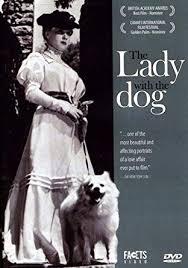
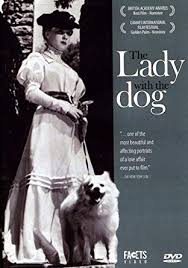
THE LADY WITH THE DOG by Anton Chekov

Copyright@shravancharitymission

Khidki (Window)

–Read India Initiative—

This is only an attempt to create interest in reading. We may not get the time to read all the books in our lifetime. But such reviews, talk and synopsis will at least convey what the book is all about.
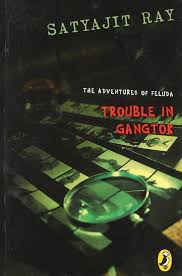
    “The Lady with the Dog” is a short story by Anton Chekhov. First published in 1899. It describes an adulterous affair between Dmitri Dmitritch Gurov, an unhappily married, Moscow banker, and Anna Sergeyevna Von Diderits, a young married woman. The affair begins while both are vacationing alone in the Crimean sea resort of Yalta. The story comprises of four parts: Part I describes the initial meeting in Yalta, Part II the consummation of the affair and the remaining time in Yalta, Part III Gurov’s return to Moscow and his visit to Anna’s town, and Part IV Anna’s visits to Moscow. This is one of Chekhov’s most famous pieces of short fiction. Vladimir Nabokov, (Russian-born American novelist) for instance, considers it as one of the greatest short stories ever written. It has an average plot to my mind but then it is an interesting read.

    Dmitri Gurov works for a Moscow bank. He is under 40, married and has a daughter and two sons. But he is unhappy in his marriage, resulting in monotony and meaninglessness of his life. He is frequently unfaithful to his wife, and considers women to be of “a lower race”. While vacationing in Yalta, he sees a young woman walking along the seafront with her little Pomeranian, and endeavours to know her. The lady, Anna Sergeyevna, is also unhappily married and vacationing without her spouse. Anna and Dmitri soon commence an affair, and spend most of their time together, often walking and taking drives to the nearby village of Oreanda. Though, she is expecting her husband to come to Yalta, he eventually sends for her to come home, saying that something is wrong with his eyes. Gurov sees her off at the station. As they part, both feel that they would never see each other again, and that their brief affair is over.

    Returning to Moscow, to his loveless marriage, and to his daily routine, working by the day and clubbing by the night, Gurov expects to soon forget young Anna. But to his surprise, her memory keeps haunting him. Unexpectedly, he feels, he is deeply in love for the first time in his life, after many affairs and just as he is approaching middle age. He strongly feels that he must see Anna, despite the obvious complications. On the ruse of going to St. Petersburg to take care of some business, he sets off to her town to find her. Learning the location of the family’s residence from a hotel porter, he finds the house, only to realize that it would be futile to intrude. In despair, he rationalizes that Anna has probably forgotten him and found someone else, and heads back to his hotel.

    In the evening, he remembers having seen a sign earlier in the day announcing the opening performance of ‘The Geisha.’ When he reasons that Anna and her husband might come to see the play. So, he goes to the theatre. And, as expected the couple enters the theatre and he watches them intently. When the husband goes out for a smoke during the first interval, Gurov greets Anna, who is bewildered and runs from him. After following her through the theatre, he confronts her and she confides that she has been thinking of him constantly. Frightened, she begs him to leave and promises to come see him in Moscow.

She makes excuses to occasionally come to Moscow, telling her husband that she is going there to see a doctor, which he “believes and does not believe”. They are both now fully aware that for the first time in their lives they have actually fallen in love, and they both wonder how they might overcome the many challenges that face them and achieve their fervent wish to permanently live together. They desperately try to come up with a plan, but the story ends without offering a resolution:

    “They . . . talked of how to avoid the necessity for secrecy, for deception, for living in different towns and not seeing each other for long stretches of time. . . . and it was clear to both of them that . . . the most complicated and difficult part of their journey was just beginning.”

   Nabokov wrote about that unconventional ending:

“All the traditional rules … have been broken in this wonderful short story…. no problem, no regular climax, no point at the end. And it is one of the greatest stories ever written.”

    Interpretations and philosophical reflections

    The story beautifully captures the quiet desperation of the two protagonists, their dissatisfaction with their meaningless lives and loveless marriages, and their craving for something better. Their deep love for each other fills that void and radically transforms their outlook on life. But that love also breaks their hearts, for, in 19th century Russia, they find it almost impossible to break away and start a new life together.

    The story can be seen as “Gurov’s spiritual journey—his transformation from a connoisseur of women to a man tenderly devoted to a single ordinary woman.” The story can also be seen as “playing with the paradox that a lie—a husband deceiving a wife or a wife deceiving a husband—can be the fulcrum of truth of feeling, a vehicle of authenticity.”

    Maxim Gorky, another great Russian writer from a working-class background, saw the importance of the story as a wake-up call to people “to let go of sleepy, half-dead existence.”

    Robert Fulford offers yet another interpretation of the story:

    “What Chekhov says in this sophisticated parable is that love radically alters the landscape of existence. When touched by love, we know the world in a different way. Love changes the inner landscape, too. Under the pressure of love, Gurov looks inside himself and sees someone he has not known before, someone capable of feelings that he barely knew existed.”

    Gurov often looks behind his immediate surroundings and reflects on the meaning of our existence. Here for instance is one poetic passage:

    ‘Yalta was hardly visible through the morning mist; white clouds stood motionless on the mountaintops. The leaves did not stir on the trees, crickets chirped, and the monotonous hollow sound of the sea, rising up from below, spoke of the peace, of the eternal sleep awaiting us. So it must have sounded when there was no Yalta, no Oreanda here; so it sounds now; and it will sound as indifferently and monotonously when we are all no more. And in this constancy, in this complete indifference to the life and death of each of us, there lies hidden, perhaps, a pledge of our eternal salvation, of the unceasing movement of life upon earth, of unceasing progress towards perfection. Sitting beside a young woman who in the dawn seemed so lovely, soothed and spellbound in these magical surroundings—the sea, mountains, clouds, the wide open sky—Gurov thought how in reality everything is beautiful in this world when one reflects: everything except what we think or do ourselves when we forget our human dignity and the higher aims of our existence.”

    Chekhov poetically describes his vision of what real love could be like:

    “Anna Sergeyevna and he loved each other like people very close and akin, like husband and wife, like tender friends; it seemed to them that fate itself had meant them for one another, and they could not understand why he had a wife and she a husband; and it was as though they were a pair of birds of passage, caught and forced to live in different cages. They forgave each other for what they were ashamed of in their past, they forgave everything in the present, and felt that this love of theirs had changed them both.”

    In the story we see Dmitri Gurov who is bored with his wife and views women as the lower race and uses women to bring an excitement to his other-wise dull life. Dmitri falls in love with the lady, Anna, when on vacation in Yalta. They are forced to go back to their normal life. Gurov cant stop thinking about her and realizes he loves her. He travels through the country to try and find her and tell her how he doesn’t want to live without her. The story brings a strong ironic ending because Gurov who thought of women to be inferior and using them only for excitement, is now chasing one across the country wanting nothing more than to be with her.

By Kamlesh Tripathi

*

https://kamleshsujata.wordpress.com

*

Share it if you like it

*

Shravan Charity Mission is an NGO that works for poor children suffering from life threatening diseases especially cancer. Our posts are meant for our readers that includes both children and adults and it has a huge variety in terms of content. We also accept donations for our mission. Should you wish to donate for the cause. The bank details are given below:

NAME OF ACCOUNT: SHRAVAN CHARITY MISSION

Account no: 680510110004635 (BANK OF INDIA)

IFSC code: BKID0006805

*

Our publications

GLOOM BEHIND THE SMILE

(The book is about a young cancer patient. Now archived in 7 prestigious libraries of the US, including, Harvard University and Library of Congress. It can also be accessed in MIT through Worldcat.org. Besides, it is also available for reading in Libraries and archives of Canada and Cancer Aid and Research Foundation Mumbai)  

ONE TO TANGO … RIA’S ODYSSEY

(Is a book on ‘singlehood’ about a Delhi girl now archived in Connemara Library, Chennai and Delhi Public Library, GOI, Ministry of Culture, Delhi)

AADAB LUCKNOW … FOND MEMORIES

(Is a fiction written around the great city of Nawabs—Lucknow. It describes Lucknow in great detail and also talks about its Hindu-Muslim amity. That happens to be its undying characteristic. The book was launched in Lucknow International Literary Festival of 2014)

REFRACTIONS … FROM THE PRISM OF GOD

(Co-published by Cankids–Kidscan, a pan India NGO and Shravan Charity Mission, that works for Child cancer in India. The book is endorsed by Ms Preetha Reddy, MD Apollo Hospitals Group. It was launched in Lucknow International Literary Festival 2016)

TYPICAL TALE OF AN INDIAN SALESMAN

(Is a story of an Indian salesman who is, humbly qualified. Yet he fights his ways through unceasing uncertainties to reach the top. A good read not only for salesmen. The book was launched on 10th February, 2018 in Gorakhpur Lit-Fest. Now available in Amazon, Flipkart and Onlinegatha)

RHYTHM … in poems

(Published in January 2019. The book contains 50 poems. The poems describe our day to day life. The book is available in Amazon, Flipkart and Onlinegatha)

(ALL THE ABOVE TITLES ARE AVAILABLE FOR SALE IN AMAZON, FLIPKART AND OTHER ONLINE STORES OR YOU COULD EVEN WRITE TO US FOR A COPY)

*****



THE STORY OF UTANGA & LORD KRISHNA … from Mahabharat

Copyright@sgravancharitymission

    Once when the great battle of Kurukshetra was over, Lord Krishna bade farewell to the Pandavas and left for Dwarka. On his way he met his old Brahmin friend Utanga. Krishna stopped and alighted from his stupendous chariot and wished the Brahmin. Utanga, delighted at the sight of mighty Krishna, returned his greetings and proceeded to make the usual enquiries about the health and welfare of his relatives.

       He enquired if Krishna’s cousins Pandavas and Kauravas loved one another as brothers, and whether they all were flourishing well enough. The innocent Brahmin had not heard about the great battle of Mahabharat that had already been fought.     Lord Krishna was astounded by this question of his and for a moment he stood silent not knowing what to say in reply.

    He then softly narrated what all had happened. How a great battle had been fought where almost all the Kauravas had been exterminated. Upon hearing the story Utanga got very angry. He retorted at Krishna telling him forcefully that He had failed in His duties and warned Him to be prepared to receive his curse. In reply the Lord just smiled and asked him not to use up the fruits of his hard earned penances.

    He then proceeded to show Utanga his Visvarupa primarily to explain to him the message of Bhagavad Gita just as He had done for Arjuna. After this explanation of Krishna, Utanga recovered his calm and with that the Lord was at ease. He told the Brahmin to ask for any boon that he desired. Utanga said, that after having witnessed You—Lord Krishna in your Universal form there isn’t anything left in this world to be desired.

    But when Krishna insisted, Utanga relented by saying that he should be able to find water whenever he felt thirsty in his long journeys. The Lord thus blessed him and went on His way.

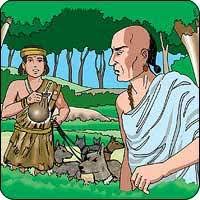
    Later when Utanga was passing through a desert he felt very thirsty and remembered the boon he had received from Lord Krishna. He decided to make use of it. The very moment, a nishad (Shudra) appeared before him attired in rags. He had five hunting hounds (dogs) in leash and an animal skin water bag strapped to his shoulder. He offered the bamboo spout of his water bag to the Brahmin to drink from.

    Utanga stared at the man in disgust and told him he was not thirsty and asked him to go. Having said this, he re-approached the Lord in his mind for the boon that He had granted him. The outcaste, meanwhile pressed upon the fastidious Brahmin Utanga, over and over again, to quench his thirst, but it only made Utanga more and more angry, and he refused to drink the water. Finally, the outcaste disappeared.

    Observing the strange disappearance of the Nishad the brahmin reflected, who was he? He could not have been a real Nishad. It was certainly my test where I blundered miserably. I rejected the holy water offered by the outcaste and proved myself to be an arrogant fool. Utanga was now in great anguish when a moment later Krishna Himself appeared before him with his conch shell and discus—Sudershan chakra.

    O Purushottama! Exclaimed Utanga, was it right of You to have sent an outcaste, to offer unclean water to a Brahmin like me? Was this a kind gesture on your part? Asked Utanga in a bitter tone.

    Lord replied smiling, Hey Utanga! It was only for your sake I had asked Indra to take ‘Amrita’ and give it to you as water. He said he would on no account give nectar to a mortal. But I prevailed upon him and he agreed to do so only if I allowed him to test you in the form of a chandal. I accepted the challenge believing you had attained that stage of understanding and wisdom. But you have made me suffer defeat at the hands of Indra. This story is from Mahabharat.

    Moral of the story: Although, the Brahmin asked the Lord only for water, Lord gave him nectar, out of His causeless mercy. The Lord always cares for us more than we do for ourselves. And we just need to have the vision to understand His mercy.

By Kamlesh Tripathi

*

https://kamleshsujata.wordpress.com

*

Share it if you like it

*

Shravan Charity Mission is an NGO that works for poor children suffering from life threatening diseases especially cancer. Our posts are meant for our readers that includes both children and adults and it has a huge variety in terms of content. We also accept donations for our mission. Should you wish to donate for the cause. The bank details are given below:

NAME OF ACCOUNT: SHRAVAN CHARITY MISSION

Account no: 680510110004635 (BANK OF INDIA)

IFSC code: BKID0006805

*

Our publications

GLOOM BEHIND THE SMILE

(The book is about a young cancer patient. Now archived in 7 prestigious libraries of the US, including, Harvard University and Library of Congress. It can also be accessed in MIT through Worldcat.org. Besides, it is also available for reading in Libraries and archives of Canada and Cancer Aid and Research Foundation Mumbai)  

ONE TO TANGO … RIA’S ODYSSEY

(Is a book on ‘singlehood’ about a Delhi girl now archived in Connemara Library, Chennai and Delhi Public Library, GOI, Ministry of Culture, Delhi)

AADAB LUCKNOW … FOND MEMORIES

(Is a fiction written around the great city of Nawabs—Lucknow. It describes Lucknow in great detail and also talks about its Hindu-Muslim amity. That happens to be its undying characteristic. The book was launched in Lucknow International Literary Festival of 2014)

REFRACTIONS … FROM THE PRISM OF GOD

(Co-published by Cankids–Kidscan, a pan India NGO and Shravan Charity Mission, that works for Child cancer in India. The book is endorsed by Ms Preetha Reddy, MD Apollo Hospitals Group. It was launched in Lucknow International Literary Festival 2016)

TYPICAL TALE OF AN INDIAN SALESMAN

(Is a story of an Indian salesman who is, humbly qualified. Yet he fights his ways through unceasing uncertainties to reach the top. A good read not only for salesmen. The book was launched on 10th February, 2018 in Gorakhpur Lit-Fest. Now available in Amazon, Flipkart and Onlinegatha)

RHYTHM … in poems

(Published in January 2019. The book contains 50 poems. The poems describe our day to day life. The book is available in Amazon, Flipkart and Onlinegatha)

(ALL THE ABOVE TITLES ARE AVAILABLE FOR SALE IN AMAZON, FLIPKART AND OTHER ONLINE STORES OR YOU COULD EVEN WRITE TO US FOR A COPY)

*****



INTERESTING FACTS & QUOTES EPISODE 21

Copyright@shravancharitymission

Floccinaucinihilipilification: is the longest non-technical word in the English language. It means an estimation of something as worthless. It has 29 letters which is more than the entire 26 letters of English Language.

Antidisestablishmentarianism: The word has 28 letters which again is more than the entire 26 letters of English language. It means opposite of disestablishment often used in the context of the Church of England.

                    Let’s not forget Christopher Columbus was looking for India when he lost his way to America. Funnily in his ‘letter of the first voyage’ explaining why he was looking for India, he mentioned the word ‘gold’ 17 times, while he mentioned the word ‘Lord’ and ‘God’ only once.

                ‘Lucky 7′ is the world’s favourite number. There are seven days in a week, seven colours in a rainbow, seven notes in a musical scale, seven seas and above all seven continents.

                Anytime you ask people about happy moments in their lives, they have to really think hard. But ask them about unpleasant or sad moments they will come up easily with many.

                Fake news: There are some 560 million or say (56 crore) internet users and 354 million or say (35 crore) smartphone devices that are either willing recipients, distributors or even victims of this growing phenomenon in India. In many cases all three.

                    Law of ‘diminishing returns’ means: Every incremental acquisition (maybe a costlier car) gives less incremental happiness than the earlier acquisition did.

Around 56% to 58% of GDP is generated by private consumption.

Meteorological department’s first 2019, southwest, monsoon forecast, puts it at, “near normal”, or 96% of the long period average (LPA) of 89 cm. Private forecaster Skymet Weather said, the monsoon would be below normal at 93% of LPA.

From a long term perspective, India is currently in the midst of a dry epoch. Government says that between 1951 and 2007, southwest monsoon has shown a decreasing trend. This monsoon provides about 75% of India’s annual rainfall, significantly influencing food production.

                    ‘Break water to storm’ is a type of phrase which means that we take a measure or make a structure with concrete or with rock at a sea shore to protect coastline from dangerous wave and storm which often take place in sea. Some are naturally created and some barriers made manually are known as breakwater.

            Ashvatta trees are those whose roots are in the air and branches touch the ground, symbolizing the subtle truth that the world we observe is the inversion of the real.

              Orwellian is an adjective describing the situation, idea, or societal condition that George Orwell identified as being destructive to the welfare of a free and open society.

        MAM Ramaswamy- Chennai industrialist holds the record for the most wins in Indian Turf (horse-racing) history.

                  Barely 4% of all households in India are headed by women. Over 70% of currently married men are household heads compared to 3% of married women.

                 The average protein intake of a person in India through normal diet has dipped 6-10% in the past two decades with almost 86% of rural and 70% of urban population not getting the government designated 2400 kilo calories per day. While the richest get over 2518 kilo calories each day the poorest get less than 1679 kilo calories—a difference of almost 50%.

                US and India are able to export only about a quarter of what they import from China.

              In the 1950s private health costs were, just between, 5% to 10%, of the total health bill of the country. Today, the position is reversed and the change has not been in slow motion. There has been an eight fold increase in the number of private hospitals between 1980 and now. This is why, the NSS records, as many as 24% of rural households and as many as 18% of urban households fall into the debt trap on account of medical expenses.

               According to the most recent national survey, around 5 crore people in India are pushed below poverty line due to high out-of-pocket health expenditures.

                  As of the last count there were 20 lakh major temples, three lakh major mosques and thousands of churches in India.

               In the recent past UNESCO estimated that India had lost 50,000 artifacts till 1989. I would say the number is much bigger. India has been able to recover only about 40 pieces of stolen heritage since independence. Fascinatingly 27 of these have come back only in the last 4 years.

                  With half of India’s farm less than half hectare in size many of its farmers need decent jobs to escape poverty.

                In past centuries people suffered from a severe lack of information which made it difficult to verify what’s true. Today we suffer from too much information, so people are too distracted to investigate the truth.

Mountstuart Elphinstone was a Scottish statesman and historian, associated with the government of British India. He later became the Governor of Bombay where he is credited with the opening of several educational institutions accessible to the Indian population.

                 In a single day there are a 50 million exchanges on snapchat. 1.15 billion opinions on facebook, 500 million twitter feeds and a multitude of reactions on newspaper and TV.

And now some interesting lines:

               These days, to find fools is not difficult, and to find people who fool others, is even easier.

                 Tradition is a guide and not a jailor—said SOMERSET MAUGHAM

            George Mikes (Hungarian born-British journalist) said this of Englishmen and queues: ‘An Englishman even if he is alone, forms an orderly queue of one.’

              India has always been a difficult country for Indians.

                   If you are not born with a silver spoon, you better become a spoon.

By Kamlesh Tripathi

*

https://kamleshsujata.wordpress.com

*

Share it if you like it

*

Shravan Charity Mission is an NGO that works for poor children suffering from life threatening diseases especially cancer. Our posts are meant for our readers that includes both children and adults and it has a huge variety in terms of content. We also accept donations for our mission. Should you wish to donate for the cause. The bank details are given below:

NAME OF ACCOUNT: SHRAVAN CHARITY MISSION

Account no: 680510110004635 (BANK OF INDIA)

IFSC code: BKID0006805

*

Our publications

GLOOM BEHIND THE SMILE

(The book is about a young cancer patient. Now archived in 7 prestigious libraries of the US, including, Harvard University and Library of Congress. It can also be accessed in MIT through Worldcat.org. Besides, it is also available for reading in Libraries and archives of Canada and Cancer Aid and Research Foundation Mumbai)  

ONE TO TANGO … RIA’S ODYSSEY

(Is a book on ‘singlehood’ about a Delhi girl now archived in Connemara Library, Chennai and Delhi Public Library, GOI, Ministry of Culture, Delhi)

AADAB LUCKNOW … FOND MEMORIES

(Is a fiction written around the great city of Nawabs—Lucknow. It describes Lucknow in great detail and also talks about its Hindu-Muslim amity. That happens to be its undying characteristic. The book was launched in Lucknow International Literary Festival of 2014)

REFRACTIONS … FROM THE PRISM OF GOD

(Co-published by Cankids–Kidscan, a pan India NGO and Shravan Charity Mission, that works for Child cancer in India. The book is endorsed by Ms Preetha Reddy, MD Apollo Hospitals Group. It was launched in Lucknow International Literary Festival 2016)

TYPICAL TALE OF AN INDIAN SALESMAN

(Is a story of an Indian salesman who is, humbly qualified. Yet he fights his ways through unceasing uncertainties to reach the top. A good read not only for salesmen. The book was launched on 10th February, 2018 in Gorakhpur Lit-Fest. Now available in Amazon, Flipkart and Onlinegatha)

RHYTHM … in poems

(Published in January 2019. The book contains 50 poems. The poems describe our day to day life. The book is available in Amazon, Flipkart and Onlinegatha)

(ALL THE ABOVE TITLES ARE AVAILABLE FOR SALE IN AMAZON, FLIPKART AND OTHER ONLINE STORES OR YOU COULD EVEN WRITE TO US FOR A COPY)

*****

SHORT STORY: LESSON FROM THE DONKEY

Copyright@shravancharitymission


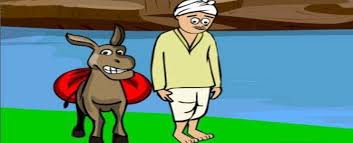
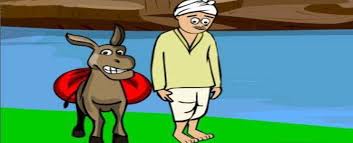
    Once a washer man was going along with his donkey and a bucket filled with clothes. It was pitch dark. They were walking around a small hillock when the donkey fell into a ditch. After falling in the ditch the donkey went into a shock and could not stand properly and so it started braying (hee-haw-hee-haw).

    The washer man who was very attached to his donkey. Could not stand the braying of the donkey. So, he decided to bury it thinking its half dead. He soon started throwing bucket full of mud in the ditch to bury the donkey. But after sometime the washer man was shocked to see the donkey limping out of the ditch slowly and soon he started striding as usual.

    What had happened was, whenever, the mud was thrown in by the washerman, the donkey used to shake it off, and the mud became steps for him, and stepping on those steps the donkey came out.

Moral of the story: Don’t get disheartened when people throw muck at you. Just shake it off as that will further strengthen you to go up in life.

By Kamlesh Tripathi

*

https://kamleshsujata.wordpress.com

*

Share it if you like it

*

Shravan Charity Mission is an NGO that works for poor children suffering from life threatening diseases especially cancer. Our posts are meant for our readers that includes both children and adults and it has a huge variety in terms of content. We also accept donations for our mission. Should you wish to donate for the cause. The bank details are given below:

NAME OF ACCOUNT: SHRAVAN CHARITY MISSION

Account no: 680510110004635 (BANK OF INDIA)

IFSC code: BKID0006805

*

Our publications

GLOOM BEHIND THE SMILE

(The book is about a young cancer patient. Now archived in 7 prestigious libraries of the US, including, Harvard University and Library of Congress. It can also be accessed in MIT through Worldcat.org. Besides, it is also available for reading in Libraries and archives of Canada and Cancer Aid and Research Foundation Mumbai)  

ONE TO TANGO … RIA’S ODYSSEY

(Is a book on ‘singlehood’ about a Delhi girl now archived in Connemara Library, Chennai and Delhi Public Library, GOI, Ministry of Culture, Delhi)

AADAB LUCKNOW … FOND MEMORIES

(Is a fiction written around the great city of Nawabs—Lucknow. It describes Lucknow in great detail and also talks about its Hindu-Muslim amity. That happens to be its undying characteristic. The book was launched in Lucknow International Literary Festival of 2014)

REFRACTIONS … FROM THE PRISM OF GOD

(Co-published by Cankids–Kidscan, a pan India NGO and Shravan Charity Mission, that works for Child cancer in India. The book is endorsed by Ms Preetha Reddy, MD Apollo Hospitals Group. It was launched in Lucknow International Literary Festival 2016)

TYPICAL TALE OF AN INDIAN SALESMAN

(Is a story of an Indian salesman who is, humbly qualified. Yet he fights his ways through unceasing uncertainties to reach the top. A good read not only for salesmen. The book was launched on 10th February, 2018 in Gorakhpur Lit-Fest. Now available in Amazon, Flipkart and Onlinegatha)

RHYTHM … in poems

(Published in January 2019. The book contains 50 poems. The poems describe our day to day life. The book is available in Amazon, Flipkart and Onlinegatha)

(ALL THE ABOVE TITLES ARE AVAILABLE FOR SALE IN AMAZON, FLIPKART AND OTHER ONLINE STORES OR YOU COULD EVEN WRITE TO US FOR A COPY)

*****

VAND CHAKNA … IN SIKHISM

Copyright@shravancharitymission

    Vand Chakna in Sikhism, is best explained as “sharing and caring.” On one occasion, when Guru Nanak was with his two sons and Lehna (Guru Angad Dev) there was a corpse covered with a cloth lying there. He asked who will eat this. No one responded, but Lehna, having full faith in his master, accepted it and when he removed the cloth, he saw there was a tray full of sacred food, which he served to his master and ate the leftovers. On this Guru Nanak said, “Lehna, you are blessed with sacred food because you shared it. Similarly, people should use wealth, not only for themselves, but share it with others. If one consumes it only for himself then it is like a corpse. But when we share it with others it becomes sacred.”

    This constitutes the basis for “Langar” the community kitchen, and Dasvandh, that is sharing one-tenth of one’s earnings with the community.

By Kamlesh Tripathi

*

https://kamleshsujata.wordpress.com

*

Share it if you like it

*

Shravan Charity Mission is an NGO that works for poor children suffering from life threatening diseases especially cancer. Our posts are meant for our readers that includes both children and adults and it has a huge variety in terms of content. We also accept donations for our mission. Should you wish to donate for the cause. The bank details are given below:

NAME OF ACCOUNT: SHRAVAN CHARITY MISSION

Account no: 680510110004635 (BANK OF INDIA)

IFSC code: BKID0006805

*

Our publications

GLOOM BEHIND THE SMILE

(The book is about a young cancer patient. Now archived in 7 prestigious libraries of the US, including, Harvard University and Library of Congress. It can also be accessed in MIT through Worldcat.org. Besides, it is also available for reading in Libraries and archives of Canada and Cancer Aid and Research Foundation Mumbai)  

ONE TO TANGO … RIA’S ODYSSEY

(Is a book on ‘singlehood’ about a Delhi girl now archived in Connemara Library, Chennai and Delhi Public Library, GOI, Ministry of Culture, Delhi)

AADAB LUCKNOW … FOND MEMORIES

(Is a fiction written around the great city of Nawabs—Lucknow. It describes Lucknow in great detail and also talks about its Hindu-Muslim amity. That happens to be its undying characteristic. The book was launched in Lucknow International Literary Festival of 2014)

REFRACTIONS … FROM THE PRISM OF GOD

(Co-published by Cankids–Kidscan, a pan India NGO and Shravan Charity Mission, that works for Child cancer in India. The book is endorsed by Ms Preetha Reddy, MD Apollo Hospitals Group. It was launched in Lucknow International Literary Festival 2016)

TYPICAL TALE OF AN INDIAN SALESMAN

(Is a story of an Indian salesman who is, humbly qualified. Yet he fights his ways through unceasing uncertainties to reach the top. A good read not only for salesmen. The book was launched on 10th February, 2018 in Gorakhpur Lit-Fest. Now available in Amazon, Flipkart and Onlinegatha)

RHYTHM … in poems

(Published in January 2019. The book contains 50 poems. The poems describe our day to day life. The book is available in Amazon, Flipkart and Onlinegatha)

(ALL THE ABOVE TITLES ARE AVAILABLE FOR SALE IN AMAZON, FLIPKART AND OTHER ONLINE STORES OR YOU COULD EVEN WRITE TO US FOR A COPY)

*****