At the conference in New Delhi where Lord Mountbatten disclosed Britain’s partition plan for India (left to right) Indian nationalist leader Jawaharlal Nehru (1869 – 1964), adviser to Mountbatten Lord Ismay, Viceroy of India Lord Louis Mountbatten, and President of the All-India Muslim League Muhammad Ali Jinnah. (Photo by Keystone/Getty Images)
When India got freedom, but didn’t know what its boundaries were TIMES NEWS NETWORK, 22.8.21
On the midnight of August 15, 1947, we knew that India had kept its tryst with destiny, we knew that the subcontinent had been divided, that we were now two countries, India and Pakistan, but what we didn’t know was where India ended and Pakistan began. The boundary lines were still unknown.
That had been Viceroy Lord Mountbatten’s idea. He didn’t want the celebrations to be marred by recriminations on both sides. As if that was possible.
The British had long lost the opportunity for a peaceful and orderly handover of power. With the failure of the 1942 Cripps’ mission and then the three-member 1946 Cabinet delegation (with Sir Stafford Cripps playing the key role again), partition was inevitable. But how do you divide a subcontinent? Drawing the line was never going to be easy.
The man chosen for the task was Sir Cyril Radcliffe, a man who hadn’t travelled further east than the Gibraltar. But it fell on this 48-year-old Inner Temple barrister to do this impossible task– and that, too, in just five weeks.
While Radcliffe may have known little or nothing of India, he was, after all, the ultimate establishment man, which is probably why he was picked for the job. He had studied at Haileybury (Clement Attlee, the British Prime Minister then, also went to the same school) and then Oxford. After that, he had a brilliant career as a barrister. During the war, he had been director-general in the Ministry of Information, responsible for censorship and propaganda. It was Radcliffe who had run a campaign against Nehru’s sister Vijaya Lakshmi Pandit when she visited the United States. Radcliffe had also harassed P.G. Wodehouse ‘when he made ill-judged broadcasts while in German captivity’, wrote Patrick French.
So, the Establishment Man reached India and began work as a ‘neutral umpire’ in New Delhi on July 8. He would live separately, guarded by a massive Punjabi armed with two pistols. He would take his own decisions; no one would be around to influence him. But it wasn’t such a secluded existence for Radcliffe, after all. He dined with British military commander Claude Auchinleck (maybe the Auk needed consoling; his wife had run away with his friend), Lord Mountbatten, Punjab Governor Sir Evan Jenkins and many other members of the British high society.
It’s hard to believe that Radcliffe did not discuss the boundary issue with the others, who all knew much more about India than he did. But more than anything else, Radcliffe had a cheat sheet. In February 1946, the ever-underrated Archibald Wavell, the Viceroy of India, was unceremoniously sacked by the British Prime Minister, Clement Attlee, while sending in Mountbatten, as he had drawn up a contingency plan. Wavell knew what was coming. And he understood the need for a well-thought-out boundary line. Helping him were Reforms Commissioner V.P. Menon and Benegal Rau.
So, what did Radcliffe have to go with? Maybe some advice from veterans, Wavell’s map, and outdated census data. And with this, he had to divide a subcontinent in 36 days. Its people, villages, rivers, canals, roads. And to compound matters, the weather was frightfully hot, and Radcliffe came down with a bout of dysentery.
Seventy-four years later, it might be easy to say, ‘Poor fellow, he was only a lawyer with a brief; what more could he possibly have done? But in 1947, everything hinged on this lawyer and his brief. Would he award Gurdaspur to India or Pakistan? Would he really award a part of Ferozepur to Pakistan, so that it had better control over its water supply?
In fact, he almost gave away a part of Ferozepur to Pakistan. In the first week of August, during a lunch with his commissioners at a club in Simla, he said he would give Pakistan a part of Ferozepur because India was getting Gurdaspur. But that was not to be. When word got out, there was frenzied behind-the-scenes activity that made the ‘neutral umpire’ change his mind– and the boundary line — within days.
He handed over all the Awards to Mountbatten on August 13, but Mountbatten ruled that the Awards would not be made public till August 16. So, on August 15, a free India still did not know its exact boundaries.
When at 5 pm, on August 16, Liaquat Ali Khan, Jawaharlal Nehru, Sardar Patel and Baldev Singh gathered in the Council Chamber of Government House, three hours after the Awards had been sent to them, no one looked happy. It would be months before things settled down. For the moment, freedom had arrived, and with it the horrors of Partition.
For Radcliffe, it was time to go home. He boarded a flight out on August 17. He never came back. Later, when a reporter asked him if he would ever like to visit India, he said: ‘God forbid. Not even if they asked me. I suspect they would shoot me out of hand– both sides.’
The piece also includes the following pictures and press clippings
** PICTURE SEPT 1947 REFUGEES CROWD ONTO TRAINS FOR PAKISTAN AS THEY LEAVE NEW DELHI ** PRESS CLIPPING AUG 18, 1947 PUNJAB & BENGAL BOUNDARY AWARD ANNOUNCED NO AGREED SOLUTION: WIDE DIVERGENCE OF OPINION
ASSENT TO CHAIRMAN’S OWN DECISION
DEMARCATION OF BORDERS OF DIVIDED PROVINCES
AUG 18 MOVES TO RESTORE PEACE IN PUNJAB… PINDI CUT OFF FROM REST OF INDIA ** AUG 19 PUNJAB PROMISED AID IN SUPPRESSING DISORDERS… PLANS FOR IMMEDIATE CONCERTED ACTION FORMULATED ** AUG 23 ENDING PUNJAB AND QUETTA LAWLESSNESS … PAKISTAN CABINET’S DECISION
Shravan Charity Mission is an NGO that works for poor children suffering from life-threatening diseases, especially cancer. Our posts are meant for our readers, including children and adults, and have a huge variety of content. We also accept donations for our mission. Should you wish to donate to the cause of cancer? The bank details are given below:
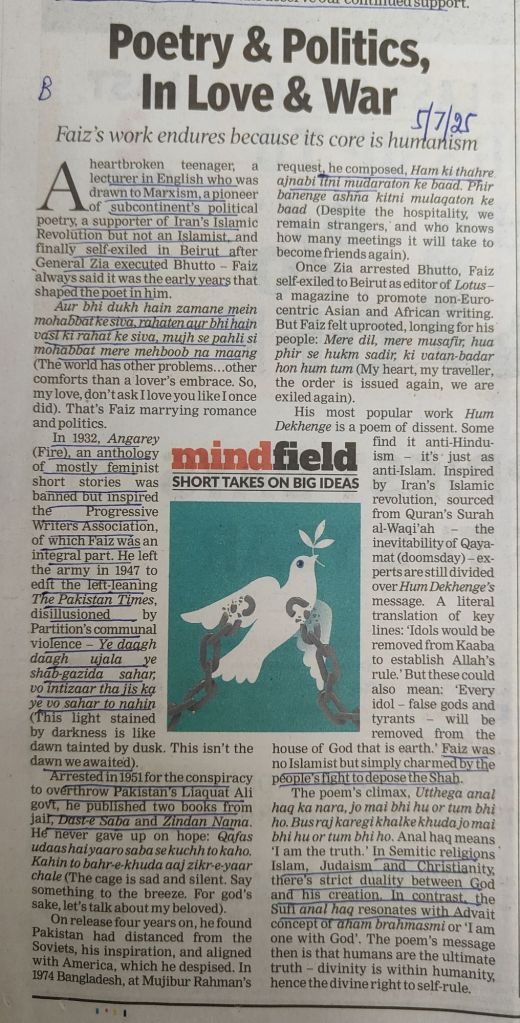
A heartbroken teenager, a lecturer in English who was drawn to Marxism, a pioneer of the subcontinent’s political poetry, a supporter of Iran’s Islamic Revolution but not an Islamist, and finally self-exiled in Beirut after General Zia executed Bhutto – Faiz always said it was the early years that shaped the poet in him.
Aur bhi dukh hain zamane mein mohabbat ke siva, rahaten aur bhi hain vasi ki rahat ke siva, mujh se pahli si mohabbat mere mehboob na maang (The world has other problems… other comforts than a lover’s embrace. So, my love, don’t ask I love you like I once did). That’s Faiz marrying romance and politics.
In 1932, Angarey (Fire), an anthology of mostly feminist short stories, was banned but inspired the Progressive Writers Association, of which Faiz was an integral part. He left the army in 1947 to edit the left-leaning The Pakistan Times, disillusioned by Partition’s communal violence — Ye daagh daagh ujala ye shab-gazida sahar, vo intezaar tha jis ka ye vo sahar to nahin (This light stained by darkness is like dawn tainted by dusk. This isn’t the dawn we awaited).
Arrested in 1951for the conspiracy to overthrow Pakistan’s Liaquat Ali govt, he published two books from jail. Dast-e Saba and Zindan Nama. He never gave up on hope: Qafas udaas hai yaaro saba se kuchh to kaho. Kahin to bahr-e-khuda aaj zikr-e-yaar chale (The cage is sad and silent. Say something to the breeze. For god’s sake, let’s talk about my beloved).
On release four years on, he found Pakistan had distanced itself from the Soviets, his inspiration, and aligned with America, which he despised. In 1974, Bangladesh, at Mujibur Rahman’s request, he composed, Ham ki thahre ajnabi itni mudaraton ke baad. Phir banege ashna kitni mulaqaton ke baad (Despite the hospitality, we remain strangers, and who knows how many meetings it will take to become friends again).
Once Zia arrested Bhutto, Faiz self-exiled to Beirut as editor of Lotus- a magazine to promote non-Euro-centric Asian and African writing. But Faiz felt uprooted, longing for his people: Mere dil, mere musafir, hua phir se hukum sadir, ki vatan-badar hon hum tum (My heart, my traveller, the order is issued again, we are exiled again).
His most popular work, Hum Dekhenge, is a poem of dissent. Some find it anti-Hinduism — it’s just as anti-Islam. Inspired by Iran’s Islamic revolution, sourced from the Quran’s Surah al-Waqi’ah – the inevitability of Qayamat (doomsday)- experts are still divided over Hum Dekhenge’s message. A literal translation of key lines: ‘Idols would be removed from Kaaba to establish Allah’s rule.’ But these could also mean: Every idol – false gods and tyrants – will be removed from the house of God that is earth.’ Faiz was no Islamist but simply charmed by the people’s fight to depose the Shah.
The poem’s climax, Utthega anal haq ka nara, jo mai bhi hu or tum bhi ho. Bus raj karegi khalke khuda jo mai bhi hu or tum bhi ho. Anal haq means ‘I am the truth.’ In Semitic religions, Islam, Judaism and Christianity, there’s strict duality between God and his creation. In contrast, the Sufi anal haq resonates with the Advait concept of aham brahmasmi or ‘I am one with God.’ The poem’s message then is that humans are the ultimate truth — divinity is within humanity, hence the divine right to self-rule.
Shravan Charity Mission is an NGO that works for poor children suffering from life-threatening diseases, especially cancer. Our posts are meant for our readers, including children and adults, and have a huge variety of content. We also accept donations for our mission. Should you wish to donate to the cause of cancer? The bank details are given below:
WE TREAT INDIA-PAK HOSTILITY AS INEVITABLE, BUT THESE DIVIDES FORMED WITHIN LIVING MEMORY (FOR THE RECORD)
Sam Dalrymple was set for a career in particle physics until a family trip to Afghanistan to visit the remains of the Bamiyan Buddha rerouted him into history. He started a virtual reality project connecting Partition survivors, which, in turn, inspired his debut book 'Shattered Lands', tracing the unravelling of the Indian Empire. In an interview with Neelam Raaj, he talks about why our complex pasts shouldn't be ignored.
Q. Several years ago, you co-founded Project Dastaan, connecting those displaced by the 1947 Partition through virtual reality. Was it Dastaan that sparked off this deep dive into the five partitions or something else? A. Dastaan was very much the origin of the book. In 2018, my college friends and I began reconnecting individuals displaced in the 1947 Partition of India, the largest forced migration in history, to their ancestral villages through VR. It was while researching the impact of Partition on Tripura and North East India for Dastaan that the book idea first came together: I was chatting with an academic in the region, and when I asked about Partition, he said, "Which one? Burma in 1937, Pakistan in 1947 or Bangladesh in 1971." That conversation made me think about the multiple ruptures and borders that have carved their way through the subcontinent.
Q. The five partitions you write about are the separation of Burma, Arabia and Pakistan from India, the division of 500 princely states, and finally, the creation of Bangladesh. Why did you want to tell this story? A. We live with the consequences of these partitions every day. Just look at the recent war between India and Pakistan. Today, South Asia is one of the most bordered regions in the world, and you can actually see its borders from space. However, 100 years ago, none of these borders were foreseen. Demands for 'independence' were widespread, but no one could have suspected that the nations India, Pakistan, Bangladesh, Yemen and Burma would soon emerge from the wreckage of British India. Nor would anyone have imagined that tiny princely states like Bhutan and Dubai would last until the end of the century, while massive states like Hyderabad would not.
Q. Your book challenges some widely held beliefs, like the idea that India's borders were drawn solely by Cyril Radcliffe. Could you tell us more about that? A. Cyril Radcliffe was famously charged with drawing the Partition border that would slice through British India. Jinnah had suggested his name because he had never been east of Paris, and supposedly his obliviousness would make him impartial. This, of course, had deadly consequences. But what we often forget is that he only drew the lines dividing Punjab and Bengal. Both the LoC and the entire stretch of the India-Pakistan Border from the Arabian Sea to Sri Ganganagar - collectively 81% of the present India-Pakistan Border fence-result from the decisions of seven local princes and have nothing to do with Radcliffe. Thirty-six per cent of the border with East Pakistan (modern Bangladesh) was made by another ten. Had states like Jodhpur joined Pakistan, or had states like Bahawalpur joined India, the border would look very, very different.
Q. The chapter on the Arabian Peninsula ties a global moment -- the British withdrawal from Aden (now in Yemen)-- to a personal story about Dhirubhai Ambani. How did that shape the trajectory of Reliance?, A. We often forget today that Aden was the Dubai of the 1960s. It was the great business hub of its time, and this remained the case right until 1967 when the British pulled out and the revolutionary NLF took over. Dhirubhai Ambani had worked in Aden until the late 1950s, and after the British evacuation from Aden, he found himself perfectly placed to hire his dispossessed colleagues and found use of 'a ready-made source of educated managers, accountants and salesmen, drilled to European standards'. He had just ended a business partnership with his cousin and gone solo, forming a new company called Reliance Commercial Corporation. Reliance ballooned in the years after the fall of Aden, underpinned by a generation of Indian-origin Adenis versed in free market capitalism rather than Nehruvian socialism.
Q. Given that your book comes out against the backdrop of India-Pakistan tensions, what is the perspective you hope readers will take away? A.So often, we treat the hostility between India and Pakistan as inevitable. Even President Trump chimed in, telling reporters aboard Air Force One that India and Pakistan had been fighting "for a thousand years, probably longer than that." But this really isn't the case. These divisions were formed within living memory --as were the divisions between India and Bangladesh, Burma and Yemen, etc. Today, the region's borders have become so embedded in our subconscious that it is easy to forget there were other possibilities for a post-colonial South Asia. Several prominent national figures, including PM Nehru and Burma's founding father Aung San, had once spoken of an 'Asiatic federation' in the 'not very, very distant future', a 'United Nations of South Asia' encompassing India, Pakistan, Ceylon and Burma. Long after the British departed, many still hoped the new borders might prove temporary. Yet in every single one of these countries, governments have made sure to paper over the shared cross-border heritage of their peoples. The last decade has witnessed the decline of globalisation, the strengthening of borders and the resurgence of nationalism across the world. India's partitions are a direct warning of what such a future might hold.
Q. Your Dad, historian William Dalrymple, sparked a lot of debate recently, saying that academics don't make their work as accessible as popular historians. Where do you stand on this? A. I don't think they have to stand in opposition at all. We obviously need both. ***
Shravan Charity Mission is an NGO that works for poor children suffering from life-threatening diseases, especially cancer. Our posts are meant for our readers, including children and adults, and have a huge variety of content. We also accept donations for our mission. Should you wish to donate to the cause of cancer? The bank details are given below:
Once upon a time, during India’s partition, three refugees landed in a city. They had walked for many miles over the past few days and were tired and hungry. They were looking for alms as they had no money to buy food.
As tired souls, they went around the streets, markets and even the nearby colonies, but no one provided them with either money or food. Tired, they filled their stomach with some tap water, after which they crossed the road and entered a park to rest under a tree.
They hadn’t adequately befriended themselves, even when they were together for the last couple of days because their focus was purely on food and shelter as they were tired, hungry and even sick. For them, fleeing persecution, organizing food, water, shelter, and survival was of immediate consequence during the days that they had been together, and not so much befriending themselves.
Their hunger was now reaching a burst point. Luckily a group of people from a charitable organisation came to their rescue, having realised they were refugees. They gave them a dozen bananas each. Upon receiving the bananas, they were thrilled. They started jumping in joy as if they had recovered their lost fortune.
Soon, the first refugee, who appeared to be the most hungry, ate all his twelve bananas in a go and burped loudly, and then decided to rest.
The second refugee, ate six and kept the balance six close to his chest and decided to take some rest.
The third refugee, after eating six got up with the remaining six in his hand. He told his comrades that he was going to the nearby market and would return soon.
The first refugee who had eaten all his bananas was rather puzzled at this banana-behaviour of the balance two refugees. As hitherto, they were cribbing, they were ravenous, but when they got bananas to eat, they wouldn’t finish it. And by now, about half-an-hour had passed when he saw the third refugee at a distance, walking towards him, without bananas in his hand. Upon seeing the third refugee without bananas, the number one refugee got a little suspicious. He couldn’t resist, and without waiting for the third refugee to arrive, he suddenly asked the second one.
‘Hello, comrade! You were so hungry, but you didn’t finish all the bananas. Why are you keeping these six bananas with you?’
The second refugee replied, ‘I have kept it for the evening. For who knows in this unknown city you might not get any charity again, so as a precaution I have kept it for my dinner.’
‘And what about you? You had gone to the market with six bananas, but now you have none with you.’ The first refugee asked the third refugee who had arrived by then.
‘Well … well, I ate six and sold six, and now I have money to buy two meals.’ Replied the third refugee.
The parable conveys a smart worldly message. The first refugee ate all the bananas in one go, thinking some Good Samaritan or God would not let him go hungry. The second refugee showed a streak of saving and cautiousness for the rainy day, so he ate six and kept six for dinner, but the third refugee had that entrepreneurial drive in him, so he ate six and sold six.
Introspect, who made the wise decision under the circumstances, and what would you have done under such trying conditions?
Shravan Charity Mission is an NGO that works for poor children suffering from life-threatening diseases, especially cancer. Our posts are meant for our readers, including children and adults, and have a huge variety of content. We also accept donations for our mission. Should you wish to donate to the cause of cancer? The bank details are given below:
Why were so many dharnas, agitations and public movements required to build Assam and the North East? Find it out for yourself by reading the book. The voluminous text under the guise of Assam covers the political history of undivided Assam, more precisely the northeast. It covers the period between 1947 and 1971. I would fancy calling this treatise the Political History of the North East as it was only after the independence that Assam was divided into various smaller states in the decades to follow.
But let’s stop here for a moment to ponder if such narrations (Political History) are conducive and should be written. Well, they are useful, provided, they capture the untold story of the state from reliable sources. Dr. Himanta Biswa Sarma, Chief Minister of Assam, deserves praise for approving this.
The uniqueness of the title is that it stems from the archives of the state and the central government, the public sector, libraries, newspapers, columns, books by citizens, and recorded statements of political and social heads who squarely construct the narrative. It is not a politically driven narrative but a neutral one based on facts. The archive records put the ruling dispensation of those times, especially the government of India, in poor light.
The title enumerates the linguistic and ethnic fissures of the North East after independence. It tells the gory story of the partition of India on the eastern border and the scheming role of the Muslim League in dividing her. The leaders of the Muslim League allowed Muslims from East Pakistan to enter India and live here only to build a sizeable Muslim population and dwarf the local population of Hindus, the effects of which are still visible. It also reveals the names of certain Indian Muslim leaders of that era who were close to Mohammed Ali Jinnah.
The editor appears dispassionate in his job because of which the narration enjoys that flush of impartiality. Eminent people from all walks of life have contributed munificently in bringing this spine to light. The book is divided into eight chapters, which are further divided into sub-chapters. This does not include the customary chapters. The catchy foreword is by the honourable Chief Minister of Assam.
A striking point that repeatedly comes up chapter after chapter is how the Congress government of Assam had to entreat the government of India for projects and issues relevant to the North East. To succinctly put it, Assam and the North East required many agitations, protests, and strikes to progress. No state, region or country is complete without the panorama of its history and mythology. The book does well to cover that. As a border region, the northeast had to face many invasions and wars described well in the pages one after another. The Tea industry has been the mainstay of Assam. The chapter is a real eye-opener when it comes to tea. The book is a comprehensive assortment of institutions, movements, local heroes and the all-time great personalities of India. It has some explosive chapters too. For example, did Nehru for the sake of the vote bank tamper with the ethnic and demographic tapestry of Assam and the northeast? The answer lies embedded in the pages of the title.
Why were things not as easy for the North East as they were for the western borders of India? So many dharnas and agitation were required to build Assam. Assam unlike Punjab (both border states) which was close to the capital had tough logistics and credibility issues while tackling the government of India. The central leadership was perhaps not aware of the complexities of the region. For every small project, Assam had to confront the government of India.
The book does well in capturing the ancient history of the land. The sources of data collection are extensive. Northeast is a complete potpourri of cultures. There was bitterness and mistrust between the plains (Assam), the hills and the government. Language was always a sensitive issue. The people of the northeast had to continuously fight for their identity. This spoke of the complexity of the land where they belonged to. The curse of partition and its shady manoeuvres haunts Assam and the northeast even today. Northeast was subject to linguistic dissensions. Assam is a politically sensitive border state. There was a time when people called it a Cinderella State.
The narrative is a brilliant effort by the Government of Assam. Congratulations to the education minister and the editor too. The idea should be embraced by all Indian states to understand their current position and trace their origins.
Shravan Charity Mission is an NGO that works for poor children suffering from life-threatening diseases, especially cancer. Our posts are meant for our readers, including children and adults, and have a huge variety in content. We also accept donations for our mission. Should you wish to donate to the cause? The bank details are given below:
NAME OF ACCOUNT: SHRAVAN CHARITY MISSION
Account no: 680510110004635 (BANK OF INDIA)
IFSC code: BKID0006805
*
Kamlesh Tripathi’s Publications
GLOOM BEHIND THE SMILE
(The book is about a young cancer patient. Now archived in 8 prestigious libraries of the US which include Harvard College Library; Harvard University Library; Library of Congress; University of Washington, Seattle; University of Minnesota, Minneapolis; Yale University, New Haven; University of Chicago; University of North Carolina, at Chapel Hill University Libraries. It can also be accessed at MIT through Worldcat.org. Besides, it is also available for reading in libraries and archives of Canada; Cancer Aid and Research Foundation Mumbai; Jaipuria Institute of Management, Noida, India; Shoolini University, Yogananda Knowledge Center, Himachal Pradesh and Azim Premzi University, Bangalore).
ONE TO TANGO … RIA’S ODYSSEY
(Is a book on ‘singlehood’ about a Delhi girl now archived in Connemara Library, Chennai and Delhi Public Library, GOI, Ministry of Culture, Delhi; It is also available for reading in the Indian National Bibliography, March 2016, in the literature section, in Central Reference Library, Ministry of Culture, India, Belvedere, Kolkata-700022)
AADAB LUCKNOW … FOND MEMORIES
(Is a fiction written around the great city of Nawabs—Lucknow. It describes Lucknow in great detail and also talks about its Hindu-Muslim amity, which is the undying characteristic of Lucknow. The book was launched at the Lucknow International Literary Festival in 2014. It is included for reading in Askews and Holts Library Services, Lancashire, U.K; Herrick District Library, Holland and Charlotte-Mecklenburg Library, Mecklenburg County in North Carolina, USA; Black Gold Cooperative Library Administration, Arroyo Grande, California; Berkeley Library, University of California).
REFRACTIONS … FROM THE PRISM OF GOD
(Co-published by Cankids–Kidscan, a pan India NGO and Shravan Charity Mission, that works for child cancer in India. The book is endorsed by Ms Preetha Reddy, MD Apollo Hospitals Group. It was launched at the Lucknow International Literary Festival in 2016).
TYPICAL TALE OF AN INDIAN SALESMAN
(Is a story of an Indian salesman who is, humbly qualified. Yet he fights his way through unceasing uncertainties to reach the top. A good read not only for salesmen. The book was launched on 10th February 2018 at Gorakhpur Lit-Fest. Now available on Amazon, Flipkart and Onlinegatha)
RHYTHM … in poems
(Published in January 2019. The book contains 50 poems. The poems describe our day-to-day life. A few poems from the book have been published in Shillong Times, Bandra Times and Bhavan’s Journal. The book is available on Amazon, Flipkart and Onlinegatha)
MIRAGE
(Published in February 2020. The book is a collection of eight short stories available on Amazon, Flipkart and Notion Press)
AWADH ASSAM AND DALAI LAMA … The Kalachakra
(The story of the man who received His Holiness The Dalai Lama and his retinue in 1959 as a GOI representative when he fled Tibet in 1959. The book was launched on 21st November 2022 by His Holiness The Dalai Lama at Dharmshala. The title is archived in the library of the Department of Information and International Relations (DIIR) Government of Tibet, Tibet Policy Institute (TPI) and the personal library of His Holiness The Dalai Lama. The title is also archived in The Ohio Digital Library, USA. It was recently included in the digital library of the world-renowned company APPLE).
BHAVANS JOURNAL
Short stories, Book reviews and Articles published in Bhavan’s Journal: 1. Reality and Perception, 15.10.19; 2. Sending the Wrong Message, 31.5.20; 3. Eagle versus Scholars June, 15 & 20, 2020; 4. Indica, 15.8.20; 5. The Story of King Chitraketu, August 31 2020; 6. Breaking Through the Chakravyuh, September 30 2020. 7. The Questioning Spouse, October 31, 2020; 8. Happy Days, November 15, 2020; 9. The Karma Cycle of Paddy and Wheat, December 15, 2020; 10. Power Vs Influence, January 31, 2021; 11. Three Refugees, March 15, 2021; 12. Rise and Fall of Ajatashatru, March 31, 2021; 13. Reformed Ruler, May 15, 2021; 14. A Lasting Name, May 31, 2021; 15. Are Animals Better Teachers? June 16, 2021; 16. Book Review: The Gram Swaraj, 1.7.21; 17. Right Age for Achievements, 15.7.21; 18. Big Things Have Small Beginnings, 15.8.21; 19. Where is Gangaridai?, 15.9.21; 20. Confront the Donkey Within You 30.9.21; 21. Know Your Strengths 15.10.21; 22. Poverty 15.11.21; 23. Top View 30.11.21; 24. The Bansuriwala 15.1.22; 25. Sale of Alaska 15.2.22; 26. The Dimasa Kingdom 28.2.22;27. Buried Treasure 15.4.22; 28. The Kingdom of Pragjyotisha 30.4.22; 29. Who is more useful? 15.5.22; 30. The White Swan from Lake Mansarovar 30.6.22; 31. Bhool Bhulayya 15.9.22; 32. Good Karma 30.9.22; 33. Good Name vs Bad Name 15.10.22; 34. Uttarapath—The Grand Trunk Road 1.12.22; 35. When Gods Get Angry 1.1.23; 36. Holinshed’s Chronicles 15.1.23; 37. Theogony 15.2.23; 38. Poem: Mother 14.5.23; 39. The Nag Mandir 30.6.23; 40. The Story of Garuda 30.7.23; 41. Janmabhoomi vs Karmabhoomi 31.8.23; 42. The Ghost Town of Kuldhara 15.9.23; 43. The Tale of Genji 15.10.23; 44. The Soul Connection 1.12.23; 45.Book review: Jungle Nama … a story of the Sundarban 16.3.24; 46. Book review: A Forgotten Chapter 16.5.24;
THE SHILLONG TIMES
ARTICLES & POEMS: 1. POEM: HAPPY NEW YEAR 8.1.23; 2. POEM: SPRING 12.3.23; 3. POEM: RIGHT AND WRONG 20.3.23; 4.THE GUSH OF EMOTION—WRITING, 26.3.23; 5. THE NAG MANDIR, 7.5.23; 6. POEM:MOTHER 7.5.23; 7. POEM: RAIN RAIN 9.7.23; 8. POEM:YOU COME ALONE YOUGO ALONE 6.8.23; 9. RAIN RAIN (SECOND TIME) 10.8.23; 10. POEM: GURU TEACHER 1.10.23; 11. POEM: AUTUMN … THE INTERIM HEAVEN 15.10.23; 12. POEM: HAPPY DIWALI 12.11.23; 13. OVERCOMING BLINDNESS: LEARN IT THE JOHN MILTON WAY 10.12.23; 14. THE HAPPY PRINCE AND THE HAPPY MAN’S SHIRT 31.12.23; 15. ANNUS MIRABILIS 2024 7.1.24; 16. GANDHI TO MAHATMA GANDHI- Incidents that Shaped Gandhi in South Africa 28.1.24; 17. POEM: TOGETHER BUT NOT MADE FOR EACH OTHER, 11.2.24; 18. THE BIRDS BEES AND THE SPIDERS OF NICHOLAS GUILDFORD AND JONATHAN SWIFT 25.2.24; 19. THE OVERCOATS OF NIKOLAI GOGOL AND RUSKIN BOND 10.3.24; 20. THE ETHNIC COLOURS OF HOLI 24.3.24; 21. A LESSON FROM DALAI LAMA, 21.4.24; 22. POEM: MORNING WALK 28.4.24; 23. TRIP TO RHINE FALLS, SWITZERLAND, 19.5.24; 24. POEM: HURT 2.6.24; 25. POEM: YOUR CONSCIENCE WAS MY SIGN ON 16.6.24; 26. THE EERIE WAYS OF TIME 7.7.24;
THE ASSAM TRIBUNE
ARTICLE: 1. THE MAGIC OF READING 11.12.23; 2. GANDHI TO MAHATMA 29.1.24; 3. GEOGRAPHY OF SOLITUDE 8.4.24; 4. A LESSON FROM DALAI LAMA, 22.4.24; 5. A SOURCE OF INSPIRATION, 29.4.24; 6. THE FOUR-LEGGED LIBRARY, 12.5.24; 7. AGE AND ACHIEVEMENT, 10.6.24; 8. READ … TO RISE ABOVE MEDIOCRITY, 1.7.24;
THE ARUNACHAL TIMES
POEM: 1. HOPE—IN THE ARC OF TWIGHT 2. SPRING 3.3.24; 3. POEM: THE MORNING WALK 10.3.24;
BANDRA TIMES, MUMBAI
ARTICLES & POEMS: 1. POEM: SPRING, 1.4.23; 2. POEM: MOTHER, 1.6.23; 3. POEM: RAIN RAIN, 1.8.23; 4. A LESSON FROM DALAI LAMA 1.6.24;
ARTICLES IN THE DIGITAL MAGAZINE ESAMSKRITI
29.12.2020: INDICA BY MEGASTHENES; 14.3.22: ABOUT THE DIMASA KINGDOM ASSAM; 10.12.22: GRAND TRUNK ROAD-UTTARAPATH; 5.10.23: THE GHOST TOWN OF KULDHARA NEAR JAISALMER;
(ALL THE ABOVE BOOK TITLES ARE AVAILABLE FOR SALE ON AMAZON, FLIPKART AND OTHER ONLINE STORES OR YOU COULD EVEN WRITE TO US FOR A COPY)
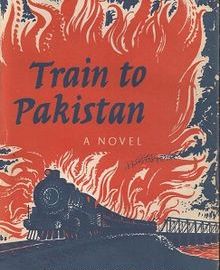
Khushwant Singh (born Khushal Singh, 2 February 1915 – 20 March 2014) was an Indian author, lawyer, diplomat, journalist and politician and. His experience in the 1947 Partition of India inspired him to write ‘Train to Pakistan’ in 1956 (made into a film in 1998), which became his most well-known novel. He is one of the prime English authors of India.
Born in Punjab, Khushwant Singh was educated in New Delhi, and studied law at St, Stephen’s College, Delhi, and King’s College London. After working as a lawyer in Lahore Court for eight years, he joined the Indian Foreign Service upon Independence of India from British Empire in 1947. He was appointed journalist in the All India Radio in 1951, and then moved to the Department of Mass Communications in UNESCO at Paris in 1956. His last two careers encouraged him to pursue a literary career. As a writer, he was best known for his trenchant secularism, humour, sarcasm and an abiding love of poetry. His comparisons of social and behaviour characteristics of Westerners and Indians are laced with acid wit. He served as the editor of several literary and news magazines, as well as two newspapers, through the 1970s and 1980s. Between, 1980-1986 he served as Member of Parliament in Rajya Sabha, the upper house of the Parliament of India.
Khushwant Singh was bestowed with Padma Bhushan in 1974. But he returned the award in 1984 as a protest against Operation Blue Star in which the Indian Army raided Darbar Sahab in Amritsar. In 2007 he was awarded the Padma Vibhushan, the second-highest civilian award of India.
Khushwant Singh was born in Hadali, Khushab District, Punjab (which now lies in Pakistan), into a Sikh family. He was the younger son of Sir Sobha Singh and Veeran Bai. Since births and deaths were not recorded in those times, his father simply made up 2 February 1915 for his school enrolment at Modern School, New Delhi. But his grandmother Lakshmi Bai asserted that he was born in August, so he later set the date for himself as 15 August. Sobha Singh was a prominent builder in Lutyens Delhi. His uncle Sardar Ujjal Singh (1895–1983) was previously Governor of Punjab and Tamil Nadu.
His birth name, given by his grandmother, was Khushal Singh (meaning a “Prosperous Lion”). He was called by a pet name “Shalee”. At school his name earned him ridicule as other boys would mock at him with an expression, “Shalee Shoolie, Bagh dee Moolee” (meaning, “This shalee or shoolee is the radish of some garden.”) He chose Khushwant so that it rhymes with his elder brother’s name Bhagwant. (He declared that his new name was “self-manufactured and meaningless”. But he later discovered that there was a Hindu physician with the same name, and the number subsequently increased).
He entered Delhi Modern School in 1920 and studied there till 1930. There he met his future wife, Kawal Malik, one year his junior. He continued higher education at Government College, Lahore, St. Stephen’s College Delhi, and King’s College London, before reading for the Bar at the Inner Temple.
Khushwant Singh started his professional career as a practising lawyer in 1939. He worked at Lahore Court for eight years. In 1947 he entered the Indian Foreign Service for the newly independent India. He started as Information Officer of the Government of India in Toronto, Canada. He was a Press Attaché and Public Officer for the Indian High Commission for four years in London and Ottawa. In 1951 he joined the All India Radio as a journalist. Between 1954 and 1956 he worked in Department of Mass Communication of the UNESCO at Paris. From 1956 he turned to editorial services. He founded and edited Yojana, an Indian government journal in 1951 -1953; and also The Illustrated Weekly of India, a newsweekly; and two major Indian newspapers, The National Herald and the Hindustan Times. During his tenure, The Illustrated Weekly became India’s pre-eminent newsweekly, with its circulation raising from 65,000 to 400000. After working for nine years in the weekly, on 25 July 1978, a week before he was to retire, the management asked Singh to leave “with immediate effect”. A new editor was installed the same day. After Singh’s departure, the weekly suffered a huge drop in readership. In 2016 Khushwant Singh entered Limca Book of Records as a tribute.
From 1980 to 1986, Singh was a member of Rajya Sabha, the upper house of the Indian parliament. He was awarded Padma Bhushan in 1974 for his service to the country. In 1984, he returned the award in protest against the siege of the Golden Temple by the Indian Army. In 2007, the Indian government awarded Khushwant Singh the Padma Vibhushan. As a public figure, Khushwant Singh was accused of favouring the ruling Congress Party, especially during the reign of Indira Gandhi. He was derisively called an ‘establishment liberal’. Singh’s faith in the Indian political system was shaken by the anti-Sikh riots that followed Indira Gandhi’s assassination, in which major Congress politicians are alleged to be involved; but he remained resolutely positive on the promise of Indian democracy and worked via Citizen’s Justice Committee floated by H.S. Phoolka a senior advocate of Delhi High Court.
Singh was a votary of greater diplomatic relations with Israel at a time when India did not want to displease Arab nations where thousands of Indians found employment. He visited Israel in the 1970s and was impressed by its progress.
Khushwant Singh was married to Kawal Malik. Malik was his childhood friend who had moved to London earlier. They met again when he studied law at King’s College London, and soon got married. They had a son, named Rahul Singh, and a daughter, named Mala. His wife predeceased him in 2001. Actress Amrita Singh is the daughter of his brother Daljit Singh’s son – Shavinder Singh and Rukhsana Sultana. He stayed in “Sujan Singh Park”, near Khan Market New Delhi, Delhi’s first apartment complex, built by his father in 1945, and named after his grandfather. His grandniece Tisca Chopra is a noted TV and Film Actress.
Khushwant Singh was a self-proclaimed agnostic, as the title of his 2011 book suggests: ‘Agnostic Khushwant: There is no God explicitly revealed.’ He was particularly against organised religion. He was evidently inclined towards atheism, as he once said, “One can be a saintly person without believing in God and also a detestable villain while believing in him. In my personalised religion, There Is No God!” He also once said, “I don’t believe in rebirth or in reincarnation, in the day of judgement or in heaven or hell. I accept the finality of death.” His last book, ‘The Good, The Bad and The Ridiculous’ was published in October 2013, following which he retired from writing. The book was his continued critique of religion and especially its practice in India, including the critique of the clergy and the priests. It earned a lot of acclaim in India.
Singh died of natural causes on 20 March 2014 at his Delhi residence, at the age of 99. His death was mourned by many including the President, Vice-President and Prime Minister of India. He is survived by his son and daughter. He was cremated at Lodhi Crematorium in Delhi at 4 in the afternoon of the same day. During his lifetime, Khushwant Singh was keen on burial because he believed that with a burial we give back to the earth what we have taken. He had requested the management of Bahai Faith if he could be buried in their cemetery. After initial agreement, they had proposed some conditions which were unacceptable to Singh, and hence the idea was later abandoned. He was born in Hadali, Khushab District, in the Punjab Province of modern Pakistan, in 1915. According to his wishes, some of his ashes were brought and scattered in Hadali.
In 1943 he had already written his own obituary, included in his collection of short stories Posthumous. Under the headline “Sardar Khushwant Singh Dead”, the text reads:
We regret to announce the sudden death of Sardar Khushwant Singh at 6 pm last evening. He leaves behind a young widow, two infant children and a large number of friends and admirers. Amongst those who called at the late sardar’s residence were the PA to the chief justice, several ministers, and judges of the high court.
He also prepared an epitaph for himself, which runs as follows:
Here lies one who spared neither man nor God; Waste not your tears on him, he was a sod; Writing nasty things he regarded as great fun; Thank the Lord he is dead, this son of a gun.
He was cremated and his ashes are buried in Hadali school, where a plaque is placed bearing the inscription:
IN MEMORY OF SARDAR KHUSHWANT SINGH (1915–2014)
A SIKH, A SCHOLAR AND A SON OF HADALI (Punjab) ‘This is where my roots are. I have nourished them with tears of nostalgia.
Shravan Charity Mission is an NGO that works for poor children suffering from life threatening diseases especially cancer. Our posts are meant for our readers that includes both children and adults and it has a huge variety in terms of content. We also accept donations for our mission. Should you wish to donate for the cause. The bank details are given below:
NAME OF ACCOUNT: SHRAVAN CHARITY MISSION
Account no: 680510110004635 (BANK OF INDIA)
IFSC code: BKID0006805
*
Our publications
GLOOM BEHIND THE SMILE
(The book is about a young cancer patient. Now archived in 7 prestigious libraries of the US, including, Harvard University and Library of Congress. It can also be accessed in MIT through Worldcat.org. Besides, it is also available for reading in Libraries and archives of Canada and Cancer Aid and Research Foundation Mumbai)
ONE TO TANGO … RIA’S ODYSSEY
(Is a book on ‘singlehood’ about a Delhi girl now archived in Connemara Library, Chennai and Delhi Public Library, GOI, Ministry of Culture, Delhi)
AADAB LUCKNOW … FOND MEMORIES
(Is a fiction written around the great city of Nawabs—Lucknow. It describes Lucknow in great detail and also talks about its Hindu-Muslim amity. That happens to be its undying characteristic. The book was launched in Lucknow International Literary Festival of 2014)
REFRACTIONS … FROM THE PRISM OF GOD
(Co-published by Cankids–Kidscan, a pan India NGO and Shravan Charity Mission, that works for Child cancer in India. The book is endorsed by Ms Preetha Reddy, MD Apollo Hospitals Group. It was launched in Lucknow International Literary Festival 2016)
TYPICAL TALE OF AN INDIAN SALESMAN
(Is a story of an Indian salesman who is, humbly qualified. Yet he fights his ways through unceasing uncertainties to reach the top. A good read not only for salesmen. The book was launched on 10th February, 2018 in Gorakhpur Lit-Fest. Now available in Amazon, Flipkart and Onlinegatha)
RHYTHM … in poems
(Published in January 2019. The book contains 50 poems. The poems describe our day to day life. The book is available in Amazon, Flipkart and Onlinegatha)
(ALL THE ABOVE TITLES ARE AVAILABLE FOR SALE IN AMAZON, FLIPKART AND OTHER ONLINE STORES OR YOU COULD EVEN WRITE TO US FOR A COPY)
The difference between an enemy and an adversary. An adversary is someone you want to defeat, an enemy is someone you have to destroy. Our political leaders have started treating their adversaries as enemies which is sad.
What does the expression mutually exclusive mean: If two events are mutually exclusive, it means, that they cannot occur at the same time. For example, the two possible outcomes of a coin flip are mutually exclusive; when you flip a coin. It cannot land both on heads and tails simultaneously.
A rat’s ass: I don’t give a rat’s ass means a minimum degree of interest. The phrase is considered vulgar. Generally meaning minimum amount or degree of care or interest—usually used in the phrase don’t give a rat’s ass.
The boom barrier (also known as the boom gate) fell on gate no. 28C, of the Chunar-Chopan, railway crossing near Khairahi railway station, 180km from Allahabad, in the recent past. With this the last unmanned level crossing on Indian Railway’s 67,300-km track comes to an end.
The founder of the Brahma-Kumaris taught seekers not to renounce hearth and home, nor worldly responsibilities to get spiritual salvation but to attain it by balancing material life with the spiritual, through regular practice of soul-consciousness.
To be fair the British Raj did impoverish India. In this regard there are credible estimates available, from the leading British economist Angus Maddison that shows India’s share of world GDP shrunk from 24.6% to 3.8% between 1700 and 1952. However, Maddison also notes that in terms of per-capita GDP, India has consistently lagged behind several European nations even 2,000 years ago. By 1700, per-capita income of countries like the Netherlands and Britain was double or thereabouts that of India.
Ancient India had its time under the sun, but that is over. The modern world, led by China, is now playing a completely different ballgame. Today, China is known as the world’s factory.
The UAE launched in 2009 an ambitious 10-year plan to teach English to locals to prepare them for a future without oil, attracting English teachers from all around the world to come and teach local children. Meanwhile, the English-speaking population of the Philippines, Indonesia and Sri Lanka has already taken over India’s burgeoning BPO industry. So, India needs to wake up fast.
A huge tusker was crossing a wooden bridge. A fly was perched on his left earlobe. After they got across, the fly said, ‘Hey didn’t we really shake up that bridge?’ That sums up the human attitude today. Though we are a microscopic speck in the cosmic scale, we delude ourselves that we are the centre of creation. We think the planet is in peril when only human existence and their well-being are truly imperilled.
Though John Maynard Keynes was one of the most influential economic policy makers of the 20th century. Keynes did not actually have a degree in economics. In fact, his total professional training came to little more than eight weeks. All the rest was learnt on the job.
Despite the Rs 1.6 lakh crore annual PDS (public distribution system) subsidy. India ranks at 103 out of 119 countries in the world Hunger Index, and 21% of Indian children between 0-5 years are malnourished. India’s touted demographic dividend could partly turn out to be a demographic time bomb.
India with the world’s youngest workforce, comprising, nearly a fifth of the world’s millennial is struggling to keep pace with changing times. Millennial or Generation Y, comprising 34% of India’s population are already 45% of the Indian workforce and by 2025 this number is expected to reach 75%.
According to a 2016, millennial survey by Deloitte, 16.8% of millennial evaluate career opportunities by good work-life balance, followed by 13.4% who look for opportunities to progress, and 11% who seek flexibility. Companies where millennial talent is a significant part of the workforce are implementing initiatives like relaxed dress codes and flexi-timing to attract and retain talent. Living in the gig economy, key skill for millennial is preparedness to move across industries and roles.
There are 1.3 million Anganwadi centres across India. Anganwadi is a type of rural child care centre. They were started by the Indian Government in 1975 as part of the Integrated Child Development Services Program to combat child hunger and malnutrition. Anganwadi means “courtyard shelter” in Indian languages.
The Greeks probably invented the idea of organised competitive sports. Where, organised team as well as individual sports came mostly from the British.
Lights are very tricky. See how they behave. When blue green and red lights combine, they produce a white light. On the other hand, intersection of magenta, (purplish red) yellow and cyan, (greenish blue) leads to black that absorbs all colours. So be careful with lights.
Two-third of the paddy procurement in India is just from 5 states led by Punjab.
US confirms 90% of addicts experience a relapse shortly after undergoing de-addiction treatment. Around 22.5% of the world’s population is tobacco-dependent and 4.9% people have alcohol use disorder.
Over 80% of India’s workforce is employed in the unorganised and informal sector.
When over 18.6 million adults remain unemployed in India, what is the reason India still employs over 10 million children.
Fascism arose in Europe as a reaction to communism.
No Hindu worships the primary God of the Vedas today. Have you seen a temple of Indra today?
In 1934, the AICC passed a resolution prohibiting Congress members from also being members of the RSS, Hindu Mahasabha or the Muslim League.
14 of the world’s 15 most polluted cities are in India.
India Pakistan partition of 1947 was an event that displaced around 15 million and killed a million.
Interesting lines & quotes:
I think Mark Twain sums it up pretty nicely: “Twenty years from now you will be more disappointed by the things that you didn’t do then by the ones you did do. So throw off the bowlines. Sail away from the safe harbour. Catch the trade winds in your sails. Explore. Dream. Discover.”
Whoever, fights monsters should see to it that in the process he does not become a monster—FRIEDRICH NIETZSCHE, German philosopher, poet and cultural critic.
Words on the street is that elections are already over, only the polling is left.
Mahatma Gandhi once said—’there is no way to peace, peace is the way.’
Misery is the by-product of a lazy mind. Happiness is the by-product of an alert mind. Stop kicking yourself with regrets and guilt feelings. Give up feelings of being guilty. You will find yourself happy—SWAMI SUKHABODHANANDA
Shravan Charity Mission is an NGO that works for poor children suffering from life threatening diseases especially cancer. Our posts are meant for our readers that includes both children and adults and it has a huge variety in terms of content. We also accept donations for our mission. Should you wish to donate for the cause. The bank details are given below:
NAME OF ACCOUNT: SHRAVAN CHARITY MISSION
Account no: 680510110004635 (BANK OF INDIA)
IFSC code: BKID0006805
*
Our publications
GLOOM BEHIND THE SMILE
(The book is about a young cancer patient. Now archived in 7 prestigious libraries of the US, including, Harvard University and Library of Congress. It can also be accessed in MIT through Worldcat.org. Besides, it is also available for reading in Libraries and archives of Canada and Cancer Aid and Research Foundation Mumbai)
ONE TO TANGO … RIA’S ODYSSEY
(Is a book on ‘singlehood’ about a Delhi girl now archived in Connemara Library, Chennai and Delhi Public Library, GOI, Ministry of Culture, Delhi)
AADAB LUCKNOW … FOND MEMORIES
(Is a fiction written around the great city of Nawabs—Lucknow. It describes Lucknow in great detail and also talks about its Hindu-Muslim amity. That happens to be its undying characteristic. The book was launched in Lucknow International Literary Festival of 2014)
REFRACTIONS … FROM THE PRISM OF GOD
(Co-published by Cankids–Kidscan, a pan India NGO and Shravan Charity Mission, that works for Child cancer in India. The book is endorsed by Ms Preetha Reddy, MD Apollo Hospitals Group. It was launched in Lucknow International Literary Festival 2016)
TYPICAL TALE OF AN INDIAN SALESMAN
(Is a story of an Indian salesman who is, humbly qualified. Yet he fights his ways through unceasing uncertainties to reach the top. A good read not only for salesmen. The book was launched on 10th February, 2018 in Gorakhpur Lit-Fest. Now available in Amazon, Flipkart and Onlinegatha)
RHYTHM … in poems
(Published in January 2019. The book contains 50 poems. The poems describe our day to day life. The book is available in Amazon, Flipkart and Onlinegatha)
(ALL THE ABOVE TITLES ARE AVAILABLE FOR SALE IN AMAZON, FLIPKART AND OTHER ONLINE STORES OR YOU COULD EVEN WRITE TO US FOR A COPY)
Once upon a time during the partition of India there were three refugees who landed up in Calcutta. The three had walked for many miles over the days and were tired and hungry. They were looking for alms as they had no money to buy food.
As tired souls, they looked around the streets, markets and even nearby colonies. But no one provided them with either money nor food. Tired, they filled their stomach with some tap water, after which, they walked across the road, and entered a park, to rest under a tree.
They had not, adequately, befriended themselves, even when, they were together for the last couple of days, because their focus was on, rest and food as they were tired, hungry and even sick. For them crossing the border, organizing food, water, shelter and survival was the immediate priority during the days that they had traveled together, and not so much befriending themselves.
Their hunger was now reaching a burst point. When a group of people from a charitable organisation came up to their rescue, having realized they were refugees. They gave them a dozen bananas each. Upon receiving the bananas they were thrilled, and they started jumping in joy as if they had recovered their lost fortune.
Soon, the first refugee, who appeared the most hungry had all the bananas in a go and burped loudly, and then decided to rest.
The second refugee, had six out of them, and kept the balance six bananas close to his chest and decided to take some rest.
The third refugee, after having six bananas got up with the remaining six, and told the remaining two, that he is going up to the nearby market and will return soon.
Now see what happens:
The first refugee who had finished all the bananas was rather puzzled at the banana-behaviour of the balance two refugees. As hitherto, they were cribbing, they were extremely hungry and could eat a man, but when they got bananas to eat, they couldn’t finish it. By now about half-an-hour had passed when he saw the third refugee walking back without bananas in his hand. Upon seeing the third refugee without bananas, number one’s inquisition started tickling him. He couldn’t resist and without waiting for the third refugee, he suddenly asked the second one.
‘Arrey yaar, you were so hungry but you didn’t finish all the bananas. Why are you keeping these six bananas with you?’
The second refugee replied, ‘I have kept it for the evening. For who knows in this unknown city you might not get any charity again, so as a precaution I have kept it for my dinner.’
‘And, what about you? You had gone out with six bananas but now you have none with you.’ The first refugee asked the third refugee.
‘Well … well I ate six and sold six and now I have money for two more meals.’ Replied the third person.
The story conveys a smart worldly message. The first refugee ate all the bananas thinking some other Good Samaritan or God perhaps will not let him go hungry. The second refugee showed a streak of saving and cautiousness for the rainy day so he ate six and kept six for dinner but the third refugee had that entrepreneurial drive so he ate six and sold six.
Introspect, what would you have done under the circumstances?
Shravan Charity Mission is an NGO that works for poor children suffering from life threatening diseases. Should you wish to donate for the cause the bank details are given below:
NAME OF ACCOUNT: SHRAVAN CHARITY MISSION
Account no: 680510110004635 (BANK OF INDIA)
IFSC code: BKID0006805
*
Our publications
GLOOM BEHIND THE SMILE
ONE TO TANGO … RIA’S ODYSSEY
AADAB LUCKNOW … FOND MEMORIES
REFRACTIONS … FROM THE PRISM OF GOD
(CAN BE BOUGHT FROM ON LINE BOOK STORES OR WRITE TO US FOR COPIES)








 Shravan charity mission