INTERESTING FACTS, FIGURES & QUOTES EPISODE 29

Copyright@shravancharitymission

According to Central Water Commission, India has 5,264 large dams in operation, of which 75% are over 25 years old and 164 big dams more than 100 years old. Until 2018, there were 36 large dam failures, possibly making recent Tiware breach the 37th failure. Maharashtra accounts for the largest chunk of India’s big dams—2069 dams.

The pre-monsoon season this year has been the second driest in 65 years with the country witnessing 99 mm of rainfall during this period as against the average of 131.5 mm. About 42% of the country is abnormally dry—6% more than last year. Add to this a delay in the onset of monsoon and circumstances are indeed grim.

It is projected that over the coming years there will be a deficit of 43% between water availability and requirement. This will increase to 50% by 2030 unless usage patterns change.

Asceticism doesn’t lie in mere words; he is an ascetic who treats everyone alike. Asceticism doesn’t lie in visiting burial places; it lies not in wandering about, nor in bathing at places of pilgrimage. Asceticism is to remain pure amidst impurities—Guru Nanak

BT cotton is the only transgenic crop approved for cultivation in India. In the 17 years since it was approved, successive governments have declined to approve any other transgenic crop even after the relevant regulator, Genetic Engineering Appraisal Committee (GEAC), recommended commercial cultivation.

In 2009, Genetic Engineering Appraisal Committee (GEAC) after a five year scrutiny, approved commercial cultivation of BT Brinjal. But it failed to win an approval at the next stage: political executive. Even a change in government didn’t matter. In 2017, GEAC approved cultivation of GM mustard, a variety developed at Delhi University. But it met with the same fate as brinjal.

According to government sources, the regulatory process for approval of transgenic crop covers at least six stages. In response to a question from a parliamentary committee, government said that, on an average, a proposal from lab stage to decision making on clearances takes at least 10 years.

A farmers organisation, Shetkari Sanghatana has come out in support of farmers who are growing transgenic crops without approval.

Grow organic, eat organic. If Sikkim can be a totally organic state why can’t others?

In almost all leading countries of the world a doctor in a government hospital checks a maximum of 30 patients a day. In India any doctor on an average checks at least 150 patients a day.

‘Golden Hour’ is the time when doctors put in their best efforts to save the life of a patient. In some cases they succeed. In some they don’t.

Garment factories are India’s second largest employer of women with 1.2 crore women.

1% owns 48% of global wealth since 2009. 1 in 9 people don’t have enough to eat.

The Fiscal Responsibility & Budget Management (FRBM) act prescribes that the central government deficit should not exceed 3% of GDP.

It is generally believed in the Indian context, the acceptable level of inflation is 4%, and the comfort zone is +/- 2%. In developed economies, the acceptable level of inflation is only 2%.

China’s economy today is 30 times larger than it was three decades ago. Indeed in PPP China’s economy is already larger than America’s.

The length of the Mexican wall to be built to stop illegal immigrants is 900 miles. It is the southern border of the US with Mexico.

Plan your work and work out your plan—SWAMI CHINMAYANANDA.

The saying goes that you become criminal only when you’re caught.

Conspectus means a summary or overview of a subject.

A typical 300 room five-star hotel generates direct employment for around 500 people, 90% of whom are waiters, housekeeping staff, front desk and concierge staff, besides cooks, chefs, managers, financial and clerical staff. There are a host of others employed in associated services such as the spa, gift shops and swimming pool.

When you compress the supply of cash and widen the tax net, money shifts from private hands to government.

It has always seemed strange to me … the things we admire in men, kindness and generosity, openness, honesty, understanding and feeling, are the concomitants of failure in our system—JOHN STEINBECK

There is a verse in Bhagavad Gita which means—masses follow the classes.

We re the world’s third most obese country and also the diabetic capital of the world—Sachin Tendulkar

By Kamlesh Tripathi

*

https://kamleshsujata.wordpress.com

*

Share it if you like it

*

Shravan Charity Mission is an NGO that works for poor children suffering from life threatening diseases especially cancer. Our posts are meant for our readers that includes both children and adults and it has a huge variety in terms of content. We also accept donations for our mission. Should you wish to donate for the cause. The bank details are given below:

NAME OF ACCOUNT: SHRAVAN CHARITY MISSION

Account no: 680510110004635 (BANK OF INDIA)

IFSC code: BKID0006805

*

Our publications

GLOOM BEHIND THE SMILE

(The book is about a young cancer patient. Now archived in 7 prestigious libraries of the US, including, Harvard University and Library of Congress. It can also be accessed in MIT through Worldcat.org. Besides, it is also available for reading in Libraries and archives of Canada and Cancer Aid and Research Foundation Mumbai)  

ONE TO TANGO … RIA’S ODYSSEY

(Is a book on ‘singlehood’ about a Delhi girl now archived in Connemara Library, Chennai and Delhi Public Library, GOI, Ministry of Culture, Delhi)

AADAB LUCKNOW … FOND MEMORIES

(Is a fiction written around the great city of Nawabs—Lucknow. It describes Lucknow in great detail and also talks about its Hindu-Muslim amity. That happens to be its undying characteristic. The book was launched in Lucknow International Literary Festival of 2014)

REFRACTIONS … FROM THE PRISM OF GOD

(Co-published by Cankids–Kidscan, a pan India NGO and Shravan Charity Mission, that works for Child cancer in India. The book is endorsed by Ms Preetha Reddy, MD Apollo Hospitals Group. It was launched in Lucknow International Literary Festival 2016)

TYPICAL TALE OF AN INDIAN SALESMAN

(Is a story of an Indian salesman who is, humbly qualified. Yet he fights his ways through unceasing uncertainties to reach the top. A good read not only for salesmen. The book was launched on 10th February, 2018 in Gorakhpur Lit-Fest. Now available in Amazon, Flipkart and Onlinegatha)

RHYTHM … in poems

(Published in January 2019. The book contains 50 poems. The poems describe our day to day life. The book is available in Amazon, Flipkart and Onlinegatha)

(ALL THE ABOVE TITLES ARE AVAILABLE FOR SALE IN AMAZON, FLIPKART AND OTHER ONLINE STORES OR YOU COULD EVEN WRITE TO US FOR A COPY)

*****


WHAT YOU DON’T KNOW ABOUT TREES

Copyright@shravancharitymission

    Over the course of its life, an average tree can absorb a ton of carbon dioxide. Only about one in a million acorns makes it all the way to becoming a mature oak tree.

    Trees form by far the bulk of Earth’s biomass. In life and in death trees contribute to the biosphere by making oxygen, moving water, storing carbon dioxide, enriching soil with dead  and decaying parts, and recycling the nutrients that life on Earth depends on.

    Trees are vascular plants that develop a single woody stem known as a trunk. Generally, trees grow to 15 feet or taller. Trees differ from shrubs, which are shorter and usually have multiple stems. Trees span the three botanical groups that represent vascular plants—pteridophytes, gymnosperms, and angiosperms.

    Gymnosperms and angiosperms propagate by seeds. In the former type, seeds are exposed, or naked, on a structure such as a cone; on the latter, they are within the ovary of a flower. Pteridophytes, on the other hand, are seedless vascular plants such as the tree fern.

    Not all parts of a tree are alive at one time, especially, in mature trees. Keeping so much mass alive all the time would require more energy than a tree’s system could handle. The inner core of the trunk, called the heartwood, is composed of out-of-commission xylem that no longer transports water throughout the tree. Similarly, the oldest layers of phloem, which transports the food manufactured through photosynthesis, form the outer, dead bark of the tree’s surface.

    In between the heartwood and bark lies the tree’s sapwood, its living energy-storage tissue.

WHY DO LEAVES CHANGE COLOUR?

    As days grow shorter and temperatures cooler, deciduous trees prepare for winter dormancy. Lacking sufficient light and water, photosynthesis shuts down, and trees must live off food stored during the growing season.

    In spring, leaves lay the groundwork for their demise. A special layer of cells forms at the base of each leaf, called the abscission or separation layer. Its work is to transport water to the leaf and take food, created by photosynthesis, back to the tree.

    In autumn, the cells of this layer begin to swell and the bottom of this layer forms a corklike substance that eventually cuts off all transfer between leaf and tree. Meanwhile, the top of the layer begins to disintegrate, making it easy for the leaf to detach.

    As photosynthesis ceases, the leaves lose their chlorophyll, which gives them their green colour. Without chlorophyll, other colours emerge. Yellow and orange, for example, are normally present in the leaves but are overshadowed by the chlorophyll. Maple-leaf red occurs because glucose remains when photosynthesis shuts down. Drab oak-leaf brown represents wastes left in the leaves.

A TREE FROM AGES PAST

    The long-needled Wollemi pine is a survivor from the age of dinosaurs. While fossil records made the 200-million-year-old species known to us, it was believed to be extinct. Then, in 1994, an Australian parks officer found a single tree in the Blue Mountains in Wollemi National Park. Subsequently, a hundred adult trees were counted there. Conservation efforts funded in part from the sale of saplings go to save and strengthen the species.

By Kamlesh Tripathi

*

https://kamleshsujata.wordpress.com

*

Share it if you like it

*

Shravan Charity Mission is an NGO that works for poor children suffering from life threatening diseases especially cancer. Our posts are meant for our readers that includes both children and adults and it has a huge variety in terms of content. We also accept donations for our mission. Should you wish to donate for the cause. The bank details are given below:

NAME OF ACCOUNT: SHRAVAN CHARITY MISSION

Account no: 680510110004635 (BANK OF INDIA)

IFSC code: BKID0006805

*

Our publications

GLOOM BEHIND THE SMILE

(The book is about a young cancer patient. Now archived in 7 prestigious libraries of the US, including, Harvard University and Library of Congress. It can also be accessed in MIT through Worldcat.org. Besides, it is also available for reading in Libraries and archives of Canada and Cancer Aid and Research Foundation Mumbai)  

ONE TO TANGO … RIA’S ODYSSEY

(Is a book on ‘singlehood’ about a Delhi girl now archived in Connemara Library, Chennai and Delhi Public Library, GOI, Ministry of Culture, Delhi)

AADAB LUCKNOW … FOND MEMORIES

(Is a fiction written around the great city of Nawabs—Lucknow. It describes Lucknow in great detail and also talks about its Hindu-Muslim amity. That happens to be its undying characteristic. The book was launched in Lucknow International Literary Festival of 2014)

REFRACTIONS … FROM THE PRISM OF GOD

(Co-published by Cankids–Kidscan, a pan India NGO and Shravan Charity Mission, that works for Child cancer in India. The book is endorsed by Ms Preetha Reddy, MD Apollo Hospitals Group. It was launched in Lucknow International Literary Festival 2016)

TYPICAL TALE OF AN INDIAN SALESMAN

(Is a story of an Indian salesman who is, humbly qualified. Yet he fights his ways through unceasing uncertainties to reach the top. A good read not only for salesmen. The book was launched on 10th February, 2018 in Gorakhpur Lit-Fest. Now available in Amazon, Flipkart and Onlinegatha)

RHYTHM … in poems

(Published in January 2019. The book contains 50 poems. The poems describe our day to day life. The book is available in Amazon, Flipkart and Onlinegatha)

(ALL THE ABOVE TITLES ARE AVAILABLE FOR SALE IN AMAZON, FLIPKART AND OTHER ONLINE STORES OR YOU COULD EVEN WRITE TO US FOR A COPY)

*****


SHORT STORY: PERCEPTION VS REALITY BY KAMLESH TRIPATHI

Copyright@shravancharitymission

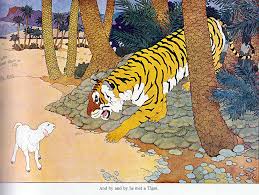
    Once a baby lamb was going with his mother. They were walking on a jungle road when all of a sudden they saw a tiger approaching them from the front. It appeared the tiger was either hungry or sick and therefore it was growling off and on. Upon seeing the hungry tiger both mother and the baby lamb froze, and stood on the road quietly as there was no time to hide. The tiger in meantime kept walking towards them. The mother lamb started worrying profusely. She signalled the baby lamb to remain quiet. Soaked in fraught she started getting horrible thoughts of they being, eaten up, by the hungry tiger. She decided she would offer herself to the tiger first, and in exchange plead, to let go, her baby lamb. With all these terrifying thoughts they were now waiting for the tiger to attack them. When the tiger was about twenty feet away there was a gush of strong breeze announcing a dust storm but the tiger was undeterred and kept walking towards them. Both mother and the baby were now shivering out of fear, but to their utter surprise the tiger soon went past them, when suddenly, a fowl ran out of the bushes that was close to the tiger. There was flapping of wings resulting in commotion. The tiger upon hearing the flapping sound, ran after the fowl and managed to lay his paw on the bird and killed it on the spot. In the meanwhile, the frightened mother and the baby lamb, tiptoed their way back to their home.

    Can you guess, as to why, the mother and the baby lamb were given a gift of life by the tiger? If not then let me tell you why. The fact is, that the tiger was blind so he couldn’t see the baby lamb and his mother standing there, and when he was about twenty feet away from the mother and the lamb, God created a dust storm to stop the body smell of the mother and baby lamb to reach the tiger. But the unfortunate fowl who was sitting pretty behind the bushes did not know that the tiger was blind even when he saw the tiger walking past the baby lamb and the mother, and so, he ran, out of the bush, to save himself, thinking that the tiger had seen him. But sadly for the fowl, the tiger could kill him only because of his sense of sound—the flapping of wings, as even his faculty to smell had momentarily vanished in the dust storm … and of course he was blind.

   Moral of the story: Stop worrying and never jump to fast conclusions for there could be a humongous difference between perception, optics and reality. Think of all possibilities before taking a leap.

    This short story of mine was published in Bhavan’s Journal, October 15, 2019 edition.

By Kamlesh Tripathi

*

https://kamleshsujata.wordpress.com

*

Share it if you like it

*

Shravan Charity Mission is an NGO that works for poor children suffering from life threatening diseases especially cancer. Our posts are meant for our readers that includes both children and adults and it has a huge variety in terms of content. We also accept donations for our mission. Should you wish to donate for the cause. The bank details are given below:

NAME OF ACCOUNT: SHRAVAN CHARITY MISSION

Account no: 680510110004635 (BANK OF INDIA)

IFSC code: BKID0006805

*

Our publications

GLOOM BEHIND THE SMILE

(The book is about a young cancer patient. Now archived in 7 prestigious libraries of the US, including, Harvard University and Library of Congress. It can also be accessed in MIT through Worldcat.org. Besides, it is also available for reading in Libraries and archives of Canada and Cancer Aid and Research Foundation Mumbai)  

ONE TO TANGO … RIA’S ODYSSEY

(Is a book on ‘singlehood’ about a Delhi girl now archived in Connemara Library, Chennai and Delhi Public Library, GOI, Ministry of Culture, Delhi)

AADAB LUCKNOW … FOND MEMORIES

(Is a fiction written around the great city of Nawabs—Lucknow. It describes Lucknow in great detail and also talks about its Hindu-Muslim amity. That happens to be its undying characteristic. The book was launched in Lucknow International Literary Festival of 2014)

REFRACTIONS … FROM THE PRISM OF GOD

(Co-published by Cankids–Kidscan, a pan India NGO and Shravan Charity Mission, that works for Child cancer in India. The book is endorsed by Ms Preetha Reddy, MD Apollo Hospitals Group. It was launched in Lucknow International Literary Festival 2016)

TYPICAL TALE OF AN INDIAN SALESMAN

(Is a story of an Indian salesman who is, humbly qualified. Yet he fights his ways through unceasing uncertainties to reach the top. A good read not only for salesmen. The book was launched on 10th February, 2018 in Gorakhpur Lit-Fest. Now available in Amazon, Flipkart and Onlinegatha)

RHYTHM … in poems

(Published in January 2019. The book contains 50 poems. The poems describe our day to day life. The book is available in Amazon, Flipkart and Onlinegatha)

(ALL THE ABOVE TITLES ARE AVAILABLE FOR SALE IN AMAZON, FLIPKART AND OTHER ONLINE STORES OR YOU COULD EVEN WRITE TO US FOR A COPY)

*****


BOOK REVIEW: INSIDE THE HAVELI BY RAMA MEHTA

Copyright@shravancharitymission


Khidki (Window)

–Read India Initiative—

This is only an attempt to create interest in reading. We may not get the time to read all the books in our lifetime. But such reviews, talk and synopsis will at least convey what the book is all about.

    ‘Inside the Haveli’ is a novel written by Rama Mehta. For this novel Rama Mehta was conferred ‘Sahitya Akademi Award’ in the year 1979. The story of the novel revolves around a young girl from Mumbai, India. She gets married to the son of a former Indian prince and post-marriage she relocates to Udaipur, Rajasthan. This book was first published by Gulab Vazirani in 1977. The initial price of this book at the time of publication was Rs 40. The book completes in about 264 pages. But before I move ahead let me tell you a few things about author Rama Mehta.

    Rama Mehta was born in Nainital, India, in 1923. She rose to become a top sociologist, lecturer and even a novelist. Her non-fiction writings include The Western Educated Hindu Woman, The Hindu Divorced Woman, and ‘From Purdah to Modernity.’ One of the first women to be appointed to India’s Foreign Service, Rama Mehta was forced to resign from her position upon marriage. She died in 1978. The novel has received several compliments. Some are as follows:

    ‘A wonderfully interesting account … women should not miss it; neither should men—John Kenneth Galbraith, Canadian-born economist, public official, and diplomat.

    Says novelist Anita Desai, ‘I remember the surprised delight with which I first came upon Rama Mehta’s novel and encountered the freshness of her prose, the simplicity and tenderness of her evocation of an ancient and traditional way of life, and the understanding she brought to it.’

    Throughout her life, the principal theme of Rama Mehta’s writings was the position of women in tradition-bound but rapidly changing India. For, in addition to her three novels, she wrote a number of sociological books about the contemporary Indian woman including The Western Educated Hindu Woman and The Hindu Divorced Woman. And, just before she died in June 1978, Mehta completed a study of women in the Hindu nuclear family. It is, therefore, appropriate that her last novel, Inside the Haveli, should have won, though posthumously, that year’s Sahitya Akademy award for the best Indian novel in English.

    In essence it’s a modern classic about an independent young woman’s struggle to hold on to her identity in a traditional world.    The book in no manner has a very engrossing storyline. As mentioned earlier it is about Geeta, an educated and vivacious Bombay girl, who marries into a conservative family and abruptly finds herself living in purdah in her husband’s ancestral haveli at Udaipur. Faced with this and even certain other age old traditions that threaten to snuff out, her independence and progressive views, Geeta puts up an unnoticed fight to maintain her modernity that she has always lived by.

    It is always tough for an author to churn out a novel without a piercing story line, which Rama Mehta has done quite successfully. She has detailed it so very well that one gets to feel as if she was part of the family and has lived with them for a duration of time only to write this novel.

    Some other important characters apart from Geeta in the novel are Ajay Singh, husband of Geeta; Pari an old maid; Lakshmi another maid; Vijay Geeta’s daughter and Sita Lakshmi’s daughter.

    The novel depicts the beginnings of a social change in the life of the women from Mewar who continued, until 20th century, to practice the system of purdah long after Hindu women discarded it as an out-moded custom. It gives a detailed account of old Udaipur. Something like they eat in Silver thalis.

    In that manner ‘Inside the Haveli’ is an excellent novel about a young, college-educated girl of Bombay who marries the son of an ex-prime minister of the former princely state of Mewar and comes to her husband’s traditional haveli in Udaipur.

   The moment she steps out of the train, Geeta the main protagonist gets the biggest shock of her life, for not only is her face instantaneously covered by her women relatives and maid-servants who take complete charge of her, but she, also, immediately finds, herself, engulfed in a pattern of life which is totally alien to her modern upbringing in Bombay.

    As soon as she reaches “home”, she is further shocked by the realisation that the men and women live in different parts of the huge haveli, without any contact with each other. Indeed, life inside the haveli is governed by an impossibly rigid etiquette of dos and don’ts, and for her, as for all the other women, there is no life outside the high walls of the haveli.

    The youthful Geeta finds herself unable to reconcile with the idea of spending the rest of her life in purdah. But at the same time she sees no escape from this out-dated way of life, for her husband is too deeply rooted in his traditions and too deeply attached to his parents to take up a job in some other city.

    Moreover, she gradually comes to realise that, in spite of their exacting demands of conformity with the family tradition, her parents-in-law are essentially warm hearted and generous.

    Slowly and painfully Geeta finds herself adjusting with the life in the haveli with the thought of merging her identity and that of her children in the tradition of her husband’s ancient family.

    But in the process she succeeds in initiating certain reforms for the women of these ancient havelis by starting literacy classes for them and by sending the female children to school. Her women relatives, of course, oppose her plans, but her father-in-law, realising that with the end of the princely era, the old pattern of life could not possibly continue for long, supports Geeta’s attempt to make the women less dependent on the havelis.

    It is a fascinating novel in which the author has succeeded in conveying the essence and feel of a world which is fast disappearing.

    Jeewan Niwas is the centre-stage around which the entire clan of the ruling class, Rana’s stay. Traditionally these families have also served the Maharana of Udaipur, who was like God to them. They all seem to be together but yes there are internal rivalries too.

    A change of mindset is in the offing when Geeta is blessed with a daughter and celebrations break through. Lakshmi their maid leaves the haveli on some misunderstanding. Thereafter her daughter Sita is brought up by Bhagwat Singh ji’s wife who is Geeta’s mother-in-law.

    There is almost a chapter on young Sita’s wedding who is daughter of Lakshmi. The scene is very emotional and well described. It gives a vivid description of such marriages.

    Author has crafted some original and interesting words such as, ‘twig fire lit in a earthenware pot,’ than you have butter lamp’ and ‘fire-hot rotis’ to name a few.

    Overall it’s a very slow moving book, but well detailed with precise punctuation and simple language easy to understand. The book doesn’t sink in you unless you complete it in five to six sittings, nor does it have any recall quotient barring a peep into the havelis this is because of the faint story line. It has too many characters difficult to remember especially when it’s not a very happening book.

    You can pick up this book to understand what really goes on inside a haveli. I would give it eight out of ten for it meets the purpose for which it was written.

By Kamlesh Tripathi

*

https://kamleshsujata.wordpress.com

*

Share it if you like it

*

Shravan Charity Mission is an NGO that works for poor children suffering from life threatening diseases especially cancer. Our posts are meant for our readers that includes both children and adults and it has a huge variety in terms of content. We also accept donations for our mission. Should you wish to donate for the cause. The bank details are given below:

NAME OF ACCOUNT: SHRAVAN CHARITY MISSION

Account no: 680510110004635 (BANK OF INDIA)

IFSC code: BKID0006805

*

Our publications

GLOOM BEHIND THE SMILE

(The book is about a young cancer patient. Now archived in 7 prestigious libraries of the US, including, Harvard University and Library of Congress. It can also be accessed in MIT through Worldcat.org. Besides, it is also available for reading in Libraries and archives of Canada and Cancer Aid and Research Foundation Mumbai)  

ONE TO TANGO … RIA’S ODYSSEY

(Is a book on ‘singlehood’ about a Delhi girl now archived in Connemara Library, Chennai and Delhi Public Library, GOI, Ministry of Culture, Delhi)

AADAB LUCKNOW … FOND MEMORIES

(Is a fiction written around the great city of Nawabs—Lucknow. It describes Lucknow in great detail and also talks about its Hindu-Muslim amity. That happens to be its undying characteristic. The book was launched in Lucknow International Literary Festival of 2014)

REFRACTIONS … FROM THE PRISM OF GOD

(Co-published by Cankids–Kidscan, a pan India NGO and Shravan Charity Mission, that works for Child cancer in India. The book is endorsed by Ms Preetha Reddy, MD Apollo Hospitals Group. It was launched in Lucknow International Literary Festival 2016)

TYPICAL TALE OF AN INDIAN SALESMAN

(Is a story of an Indian salesman who is, humbly qualified. Yet he fights his ways through unceasing uncertainties to reach the top. A good read not only for salesmen. The book was launched on 10th February, 2018 in Gorakhpur Lit-Fest. Now available in Amazon, Flipkart and Onlinegatha)

RHYTHM … in poems

(Published in January 2019. The book contains 50 poems. The poems describe our day to day life. The book is available in Amazon, Flipkart and Onlinegatha)

(ALL THE ABOVE TITLES ARE AVAILABLE FOR SALE IN AMAZON, FLIPKART AND OTHER ONLINE STORES OR YOU COULD EVEN WRITE TO US FOR A COPY)

*****


BRIEF HISTORY OF CONTINENTS

Copyright@shravancharitymission

CONTINENTAL AREAS

ASIA: 17,208,000 SQUARE MILES

AFRICA: 11,608,000 SQUARE MILES

NORTH AMERICA: 9,449,000 SQUARE MILES

SOUTH AMERICA: 6,880,000 SQUARE MILES

ANTARCTICA: 5,100,000 SQUARE MILES

EUROPE: 3,841,000 SQUARE MILES

AUSTRALIA: 2,970,000 SQUARE MILES

    Out of the total earth area, around one-third is land, and balance two-third is water–ocean. Yet, the major land divisions—the continents—are the ones that give shape and physical identity to the planet.

    The seven continents represent some 57 million square miles in area, portioned unequally among them. They range in size from Asia, being the largest, to Australia, being the smallest. Although Europe and Asia form one large mass, they are usually regarded as two continents, mainly due to the cultural differences between their peoples.

    The seven continents as they appear today represent just one episode in an ongoing scenario of the wandering land masses. It is a process whose history dates back to the initial formation of continental material on Earth’s crust almost four billion years ago—a process called ‘plate tectonics.’

    The crust and the top portion of the mantle form a rigid shell around the planet that is broken up into 16 large sections known as plates. Heat generated inside Earth is distributed through convection current which causes the plates to move slowly. This sort of movement has been going on for hundreds of millions of years.

    Most geologists believe that the ‘continents’ were created when vast plates of rock collided, forcing one to slide under another in a process called ‘subduction.’ The crust then melted and formed magma, or molten rock. Erupting to the surface, the magma built volcanic islands that eventually fused with other islands on adjoining plates—becoming the first continental material.

HOW WERE CONTINENTS FORMED

    As Earth’s continental masses grew bigger, moving all the while, they shifted in relation with each other and coalesced into different arrangements over hundreds of millions of years. The current configuration of continents is just a temporary one in the eons-long process of the plate tectonics.

    Three times during the past billion years, drifting landmasses have merged to form supercontinents.

    In between these stages of continental drift, they split into smaller landmasses before recombining again. Scientists predict that a new supercontinent, ‘Pangaea Ultima,’ will eventually form, 250 million years from now.

TERMINOLOGY 

CONTINENT: Comes from the Latin continens, “held together.” One of Earth’s seven large masses of land.

TECTONICS: Comes from the Greek tekton, “builder.” Study of the changes in Earth’s crust and the forces that produce such changes.

SUBDUCTION ZONE: The oceanic trench area in which the seafloor ‘underthrusts’ an adjacent plate, dragging, accumulated sediments, downward into Earth’s upper mantle.

ALFRED WEGENER THE EARTH SCIENTIST

    German Earth Scientist Alfred Wegener (1880-1930), was among the first to use balloons to track air currents. He participated in expeditions to Greenland to study polar air circulation but became better known for his theory of continental drift. People had already noticed that the coastlines of western Africa and eastern South America seemed to match, but Wegener found evidence that the continents had been joined: because of similar fossils from both sides of the Atlantic and tropical species in Arctic areas. He posited the existence of a supercontinent, Pangaea (All Lands) that eventually broke up, and he presented his ideas in the Origin of Continents and Oceans—but few believed him. In the 1950s and 1960s, studies of the ocean floor demonstrated a mechanism for crustal movement, is when Wegener’s theory of continental drift gained acceptance.

BRIEF HISTORY OF EARTH

500 MILLION YEARS ago, a chunk broke off a single continent. Shallow waters spawned the first multicellular creatures.

300 MILLION YEARS ago, some of today’s mountains formed. A new ice age covered Earth’s southern regions.

225 MILLION YEARS AGO, the earliest dinosaurs roamed a single continent that stretched from Pole to Pole.

100 MILLION YEARS ago, cracks across the one continent, known as Pangaea, formed rifts that evolved into oceans.

50 MILLION YEARS ago, a climate changing meteor crashed into Earth and the highest mountains began their uprise.

20,000 YEARS ago, ice sheets a mile deep gouged out the Great Lakes and then receded, raising sea levels.

Posted by Kamlesh Tripathi

*

https://kamleshsujata.wordpress.com

*

Share it if you like it

*

Shravan Charity Mission is an NGO that works for poor children suffering from life threatening diseases especially cancer. Our posts are meant for our readers that includes both children and adults and it has a huge variety in terms of content. We also accept donations for our mission. Should you wish to donate for the cause. The bank details are given below:

NAME OF ACCOUNT: SHRAVAN CHARITY MISSION

Account no: 680510110004635 (BANK OF INDIA)

IFSC code: BKID0006805

*

Our publications

GLOOM BEHIND THE SMILE

(The book is about a young cancer patient. Now archived in 7 prestigious libraries of the US, including, Harvard University and Library of Congress. It can also be accessed in MIT through Worldcat.org. Besides, it is also available for reading in Libraries and archives of Canada and Cancer Aid and Research Foundation Mumbai)  

ONE TO TANGO … RIA’S ODYSSEY

(Is a book on ‘singlehood’ about a Delhi girl now archived in Connemara Library, Chennai and Delhi Public Library, GOI, Ministry of Culture, Delhi)

AADAB LUCKNOW … FOND MEMORIES

(Is a fiction written around the great city of Nawabs—Lucknow. It describes Lucknow in great detail and also talks about its Hindu-Muslim amity. That happens to be its undying characteristic. The book was launched in Lucknow International Literary Festival of 2014)

REFRACTIONS … FROM THE PRISM OF GOD

(Co-published by Cankids–Kidscan, a pan India NGO and Shravan Charity Mission, that works for Child cancer in India. The book is endorsed by Ms Preetha Reddy, MD Apollo Hospitals Group. It was launched in Lucknow International Literary Festival 2016)

TYPICAL TALE OF AN INDIAN SALESMAN

(Is a story of an Indian salesman who is, humbly qualified. Yet he fights his ways through unceasing uncertainties to reach the top. A good read not only for salesmen. The book was launched on 10th February, 2018 in Gorakhpur Lit-Fest. Now available in Amazon, Flipkart and Onlinegatha)

RHYTHM … in poems

(Published in January 2019. The book contains 50 poems. The poems describe our day to day life. The book is available in Amazon, Flipkart and Onlinegatha)

(ALL THE ABOVE TITLES ARE AVAILABLE FOR SALE IN AMAZON, FLIPKART AND OTHER ONLINE STORES OR YOU COULD EVEN WRITE TO US FOR A COPY)

*****


SHORT STORY: THE INTELLIGENT JACKAL

Copyright@shravancharitymission

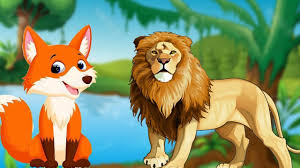
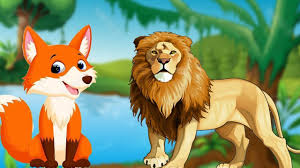
    There was once a ferocious lion who lived in a dense jungle.  One day, he could not prey upon a single animal in spite of wandering around in search of food the whole day. It was almost sunset, and the lion started returning, even when, he was very hungry. On his way back, he saw a big cave, and thought to himself, “For sure some animal must be living in this big cave. Such a nice cave cannot be empty, someone has to be there. At sunset, which ever animal lives here, is bound to return. So, I shall hide myself inside the cave and wait for my dinner to arrive.” 
    The cave was home to a jackal, who arrived, a little while after the lion had hidden himself inside. But while entering he noticed the footprints of the lion leading into the cave, but could not find any footprint coming out. 

    He thought, “If a lion has indeed entered the cave, I will be dead as soon as I enter. But, how can I, be sure? There is no reason for me to stay away from my home if there is no lion inside. I must find out a way to confirm if the lion is still inside.”  

    The jackal thought of a plan, and while standing in front of the cave, began to shout, “Hello Cave! Hello Cave! Can I come inside?” For a few moments, he waited in silence and shouted again, “Hello Cave! Have you forgotten our understanding of all these years? I always wait for your reply before I enter. Why are you silent today? I shall then go to some other cave if you do not reply.” 
    Upon hearing this, the lion thought, “The cave must reply to the jackal when he returns at sunset. It is, because I am inside, the cave is not replying today. So, I must invite the jackal on behalf of the cave, or the jackal will go away.” 
    So, the lion replied from inside the cave, “Hello Jackal, you may enter. It is safe inside.” But the reply was frightening due to the echo from the walls of the cave. The jackal at once knew that the lion was waiting for him to enter and make a meal out of him. He ran off, as fast as he could to save himself. 
Moral of the story: Use your brains to protect yourself from destruction.

Posted by Kamlesh Tripathi

*

https://kamleshsujata.wordpress.com

*

Share it if you like it

*

Shravan Charity Mission is an NGO that works for poor children suffering from life threatening diseases especially cancer. Our posts are meant for our readers that includes both children and adults and it has a huge variety in terms of content. We also accept donations for our mission. Should you wish to donate for the cause. The bank details are given below:

NAME OF ACCOUNT: SHRAVAN CHARITY MISSION

Account no: 680510110004635 (BANK OF INDIA)

IFSC code: BKID0006805

*

Our publications

GLOOM BEHIND THE SMILE

(The book is about a young cancer patient. Now archived in 7 prestigious libraries of the US, including, Harvard University and Library of Congress. It can also be accessed in MIT through Worldcat.org. Besides, it is also available for reading in Libraries and archives of Canada and Cancer Aid and Research Foundation Mumbai)  

ONE TO TANGO … RIA’S ODYSSEY

(Is a book on ‘singlehood’ about a Delhi girl now archived in Connemara Library, Chennai and Delhi Public Library, GOI, Ministry of Culture, Delhi)

AADAB LUCKNOW … FOND MEMORIES

(Is a fiction written around the great city of Nawabs—Lucknow. It describes Lucknow in great detail and also talks about its Hindu-Muslim amity. That happens to be its undying characteristic. The book was launched in Lucknow International Literary Festival of 2014)

REFRACTIONS … FROM THE PRISM OF GOD

(Co-published by Cankids–Kidscan, a pan India NGO and Shravan Charity Mission, that works for Child cancer in India. The book is endorsed by Ms Preetha Reddy, MD Apollo Hospitals Group. It was launched in Lucknow International Literary Festival 2016)

TYPICAL TALE OF AN INDIAN SALESMAN

(Is a story of an Indian salesman who is, humbly qualified. Yet he fights his ways through unceasing uncertainties to reach the top. A good read not only for salesmen. The book was launched on 10th February, 2018 in Gorakhpur Lit-Fest. Now available in Amazon, Flipkart and Onlinegatha)

RHYTHM … in poems

(Published in January 2019. The book contains 50 poems. The poems describe our day to day life. The book is available in Amazon, Flipkart and Onlinegatha)

(ALL THE ABOVE TITLES ARE AVAILABLE FOR SALE IN AMAZON, FLIPKART AND OTHER ONLINE STORES OR YOU COULD EVEN WRITE TO US FOR A COPY)

*****


INTERESTING FACTS FIGURES & QUOTES–28

Copyright@shravancharitymission

Some southern states of India have more doctors than WHO norms of 1 doctor per 1000 people.

Dozens of private radio stations have paid huge sums for spectrum, but cannot broadcast their own news and political analysis. They can buy news capsules from AIR. This merely reinforces the AIR monopoly. When private TV can carry news and analysis, the ban on private radio is absurd. This misuse of public radio is a Congress-era invention, adopted happily today by the BJP.

 Islam is the only religion where over a dozen countries are officially Islamic. Many of them are not democratic, and where, fundamentalists have a big say in how to run these countries.

A coach simply needs to understand the team, the individuals, their goals and the dynamics between them, in order to be successful.

 Sexual predators: Only one in four cases end in conviction.

 If you move into a new town, it is not easy to find an electrician or plumber quickly. Alexa is all about connecting seamlessly with apps, with services, with people. Alexa is now available in 14 languages.

Since 2017-18 states have passed laws protecting doctors and healthcare workers from attacks, but enforcement remains questionable.

According to an estimate, only around, one in five rural household has a piped water connection.

Israel recycles around 94% of the water that it uses. Recycling can increase water availability even in times of rainfall deficiency. This can end the perennial water crises Chennai suffers for instance.

Rate your police thana. State of country’s police forces, leaves a lot to be desired. Union Home Ministry kicked off an exercise to rank the country’s best police stations. A similar exercise had been taken in 2017. But this time the exercise is expected to be more comprehensive with the police stations being judged on seven parameters such as crime prevention, proactive measures adopted and citizen’s perception and feedback. The overall goal here is to spur competition between police stations and create incentives to improve policing.

Pure water is the world’s first and foremost medicine—a Slovak proverb.

 India will benefit hugely if it can position itself as an attractive investment destination for companies looking to relocate production from China.

 Guru Nanak believed there were only two kinds of people. Gurmukhi, the God-oriented and Manmukhi, those who are self-oriented. A Gurmukhi devotes himself to God. He preaches truth and works for the welfare of human kind. Whereas, Manmukhi follows his own thinking and practices falsehood and selfishness.

A New York times investigation uncovered a surveillance system manufactured by Huawei and a state backed Chinese company being used in Ecuador to track individuals through mobile phones.

 ‘Squaring off’ is a term of English language that means to ‘settle the difference.’

 The ‘chakra’ the Asoka wheel, which is there in our flag, embodies for us a great idea. It conveys Asoka was one of the greatest emperors. Look at the words of H.G. Wells regarding Ashoka, ‘Highnesses, Magnificence’s, Excellences, Serenities, Majesties;’ among them all, he shines alone a star Asoka, the greatest of all Monarchs.’

 Lorraine Toussaint, the Trinidadian American actress says: ‘We all have a dark side. Most of us go through life avoiding direct confrontation with that aspect of ourselves, which I call the shadow self. There is a reason why. It carries a great deal of energy.’

 One piece of log creates a small fire, adequate to warm you up, add just a few more pieces to blast an immense bonfire, large enough to warm up your entire circle of friends; needless to say that individuality counts but team work dynamities—Jin Kwon.

 A company is known by the salesman it keeps—a quote from a book—Typical Tale of an Indian Salesman.

Don’t blow off another’s candle for it won’t make yours shine brighter—JAACHYNMA NE AGU,  Nigerian writer.

By Kamlesh Tripathi

*

https://kamleshsujata.wordpress.com

*

Share it if you like it

*

Shravan Charity Mission is an NGO that works for poor children suffering from life threatening diseases especially cancer. Our posts are meant for our readers that includes both children and adults and it has a huge variety in terms of content. We also accept donations for our mission. Should you wish to donate for the cause. The bank details are given below:

NAME OF ACCOUNT: SHRAVAN CHARITY MISSION

Account no: 680510110004635 (BANK OF INDIA)

IFSC code: BKID0006805

*

Our publications

GLOOM BEHIND THE SMILE

(The book is about a young cancer patient. Now archived in 7 prestigious libraries of the US, including, Harvard University and Library of Congress. It can also be accessed in MIT through Worldcat.org. Besides, it is also available for reading in Libraries and archives of Canada and Cancer Aid and Research Foundation Mumbai)  

ONE TO TANGO … RIA’S ODYSSEY

(Is a book on ‘singlehood’ about a Delhi girl now archived in Connemara Library, Chennai and Delhi Public Library, GOI, Ministry of Culture, Delhi)

AADAB LUCKNOW … FOND MEMORIES

(Is a fiction written around the great city of Nawabs—Lucknow. It describes Lucknow in great detail and also talks about its Hindu-Muslim amity. That happens to be its undying characteristic. The book was launched in Lucknow International Literary Festival of 2014)

REFRACTIONS … FROM THE PRISM OF GOD

(Co-published by Cankids–Kidscan, a pan India NGO and Shravan Charity Mission, that works for Child cancer in India. The book is endorsed by Ms Preetha Reddy, MD Apollo Hospitals Group. It was launched in Lucknow International Literary Festival 2016)

TYPICAL TALE OF AN INDIAN SALESMAN

(Is a story of an Indian salesman who is, humbly qualified. Yet he fights his ways through unceasing uncertainties to reach the top. A good read not only for salesmen. The book was launched on 10th February, 2018 in Gorakhpur Lit-Fest. Now available in Amazon, Flipkart and Onlinegatha)

RHYTHM … in poems

(Published in January 2019. The book contains 50 poems. The poems describe our day to day life. The book is available in Amazon, Flipkart and Onlinegatha)

(ALL THE ABOVE TITLES ARE AVAILABLE FOR SALE IN AMAZON, FLIPKART AND OTHER ONLINE STORES OR YOU COULD EVEN WRITE TO US FOR A COPY)

*****


BOOK REVIEW: TOPAZ BY RUSKIN BOND

Copyright@shravancharitymission

Khidki (Window)

–Read India Initiative—

This is only an attempt to create interest in reading. We may not get the time to read all the books in our lifetime. But such reviews, talk and synopsis will at least convey what the book is all about.

    Ruskin Bond as we all know, is an Indian author of British descent. He has made exemplary contribution in the field of children’s books and even ghost stories. Topaz is one such story that I’ve picked up for you. The story is set up in the backdrop of Himalayas. It is written in first person. Where, at a point the narrator or the protagonist confirms he is a writer, and that, in a way also confirms that it is the author himself narrating the story.

    The story opens in the pine-clad slopes of the Himalayas. The protagonist, is, in his room, listening to some music that reminds him of the strains of “The Blue Danube” and concurrently the wonderful sight of Pine-clad slopes of Himalayas. He has a new record player with old records that he has picked up from the junk-shop behind the Mall.

    Below the pines there are oaks. Surprisingly, one oak-tree in particular catches his eye. It is the biggest of the lot and stands by itself on a little hillock below his cottage. There is breeze but not strong enough to sway its heavy branches. There is also something moving, swinging gently from the tree, keeping pace with the music of the waltz, dancing ….

    It appears as if someone is hanging from the tree.

    A rope oscillates in the breeze, when a dead body turns slowly, turns this way and that way, is when he sees the face of a girl, her hair hanging loose, her eyes sightless, hands and feet limp; just turning, turning, while the waltz plays on.

    He turns off the player and runs downstairs.

    Down the path through the trees, and on to the grassy hillock where the big oak stood.

    A long-tailed magpie takes fright and flies out from the branches, swooping low across the ravine. In the tree there is no one. A great branch extends half-way across the hillock, and it is possible for him to reach up and touch it. But a girl could not have reached it without climbing the tree. He thinks.

    As he stands there, gazing at the branches, someone speaks to him from behind.

    ‘What are you looking at?’

    He swings around. Only to see a girl standing around in the clearing, facing him. A girl of seventeen or eighteen; alive, healthy, with bright eyes and a tantalizing smile. She is indeed lovely to look at. He hadn’t seen such a pretty girl in years.

    ‘You startled me,’ he says. ‘You came up so unexpectedly.’ he added.

    ‘Did you see anything—in the tree?’ she asked.

    ‘I thought I saw someone from my window. That’s why I came down. Did you see anything?’ said the writer.

    ‘Oh no!’ She exclaimed and shook her head, the smile escaping her face for a moment. ‘I don’t see anything. But other people do—sometimes.’

    ‘What do they see?’ asked the writer.   

    ‘My sister?’ she replied.

    ‘Your sister?’ rebounded the writer.

    ‘Yes she hanged herself from this tree. It was many years ago. So, sometimes you can see her hanging there.’ She answered in a mechanical fashion.

    She spoke matter-of-factly: whatever had happened seemed very remote to her.

    After which they moved some distance away from the tree. Above the hillock, on a disused private tennis-court (a relic from the hill station’s colonial past) was a small stone bench. She sat on it: and, after a moment’s hesitation, the writer too sat down beside her.

    ‘Do you live close by?’ he asked.

    ‘Further up the hill. My father has a small bakery.’

    She then discloses her name as Hameeda. She also says she has two younger brothers.

    ‘You must have been quite small when your sister died.’ says the writer.

    ‘Yes. But I remember her. She was pretty.’

    ‘Like you.’ interjects the writer.

     She laughs in disbelief. ‘Oh, I am nothing to her. You should have seen my sister.’

    ‘Why did she kill herself?’

    ‘Because she did not want to live. She was to have been married but she loved someone else, someone who was not of our own community. It’s an old story and the end is always sad, isn’t it?’

    ‘Not always. But what happened to the boy—the one she loved? Did he kill himself too?’ asked the writer.

    ‘No, he took up a job in some other place. Jobs are not easy to get, are they?’

    ‘I don’t know. I’ve never tried for one.’

    ‘Then what do you do?’

    ‘I write stories.’ said the writer.

    ‘Do people buy stories?’

    ‘Why not? If your father can sell bread, I can sell stories.’

    ‘People have to have bread. But they can live without stories.’

    ‘No, Hameeda, you’re wrong. People can’t live without stories.’

        By now infatuation had made way in the writer’s heart for Hameeda. He couldn’t help loving her. Although, no fierce desire or passion had taken hold of him. He was happy by just looking at her, watch her while she sat on the grass outside his cottage, her lips stained with the juice of wild bilberries. She chatted away—about her friends, her clothes, her favourite things.

    ‘Won’t your parents mind if you come here every day?’ the writer asked.

    ‘I have told them you are teaching me.’

    ‘Teaching you what?’ he asked.

    ‘They did not ask. So, you can tell me stories.’

    As a result the writer told her some stories.

    It was midsummer.

    The sun glinted on the ring she wore on her third finger: a translucent golden topaz, set in silver.

    ‘That’s a pretty ring,’ remarked the writer.

    ‘You wear it,’ she said, impulsively removing it from her hand. ‘It will give you good thoughts. It will help you to write better stories.’

    She slipped it on to the writer’s little finger.

    ‘I’ll wear it for a few days,’ he said. ‘Then you must let me give it back to you.’ he added.

    On a day that promised rain the writer took the path down to the stream at the bottom of the hill. There he found Hameeda gathering ferns from the shady places along the rocky ledges above the water.

    ‘What will you do with them?’ he asked.

    ‘This is a special kind of fern. You can cook it as a vegetable.’

    ‘Is it tasty?’ he asked.

    ‘No, but it is good for rheumatism.’

    ‘Do you suffer from rheumatism?’

    ‘Of course not. They are for my grandmother, she is very old.’ she said.

    ‘There are more ferns further upstream,’ he said. ‘But we’ll have to get into the water.’

    They remove their shoes and start paddling, up stream. The ravine becomes shadier and narrower, until the sun is completely shut out. The ferns have grown right down up to the water’s edge. They bend to pick them up but instead find themselves in each other’s arms; and sink slowly, as if in a dream, into the soft bed of ferns, while overhearing a whistling thrush burst out in dark sweet song.

    ‘It isn’t time that’s passing by,’ it seemed to say. ‘It is you and I. It is you and I …’

    Post that the writer waits for her the following day, but she doesn’t come.

    Several days pass without, he being able to see her.

    Is she sick? Has she been kept at home? Has she been sent away? He doesn’t even know where she lives, so he cannot ask. And, if at all, he is able to ask, what would he ask?

     Then one day he sees a boy delivering bread and pastries at the little tea-shop about a mile down the road. From the upward slant of his eyes, there is a slight resemblance with Hameeda. As he leaves the shop, the writer follows him up the hill. And, when he comes abreast of him, he asks: ‘Do you have your own bakery?’

    He nods cheerfully, ‘Yes. Do you want anything—bread, biscuits, cakes? I can bring them all to your house.’

    ‘Oh of course. But don’t you have a sister? A girl called Hameeda?’

    His expression changes suddenly. He is no longer friendly. He looks puzzled and slightly apprehensive.

    ‘Why do you want to know?’

    ‘Because, I haven’t seen her for some time now?’ replies the writer

    ‘We have not seen her either.’

    ‘Do you mean she has gone away?’

    ‘Didn’t you know? You must have been away a long time. It is many years since she died. She killed herself. You did not hear about it?’ said the boy.

    ‘But wasn’t that her sister—your other sister?’ asked the writer.

    ‘I had only one sister—Hameeda—and she died, when I was very young. It’s an old story, ask someone else about it.’

    With that he turned away and quickened his pace, and the writer was left standing in the middle of the road, with his head full of questions that couldn’t be answered.

    That night there was a thunderstorm. Writer’s bedroom window kept banging in the wind. He got up to close it and, as he looked out, there was a flash of lightning and he saw that frail body again, swinging from the oak tree.

    He tried a make out the features, but the head hung down and the hair was blowing in the wind.

    Was it all a dream? He thought.

    It was impossible to say. But the topaz ring on him glowed softly in the darkness. And a whisper from the forest seemed to say, ‘It isn’t time that’s passing by, my friend. It is you and I … ‘

    So that’s all for today. It’s a neat little story with a tinge of enigma for you to discover. I would give the story seven out of ten.

Posted by Kamlesh Tripathi

*

https://kamleshsujata.wordpress.com

*

Share it if you like it

*

Shravan Charity Mission is an NGO that works for poor children suffering from life threatening diseases especially cancer. Our posts are meant for our readers that includes both children and adults and it has a huge variety in terms of content. We also accept donations for our mission. Should you wish to donate for the cause. The bank details are given below:

NAME OF ACCOUNT: SHRAVAN CHARITY MISSION

Account no: 680510110004635 (BANK OF INDIA)

IFSC code: BKID0006805

*

Our publications

GLOOM BEHIND THE SMILE

(The book is about a young cancer patient. Now archived in 7 prestigious libraries of the US, including, Harvard University and Library of Congress. It can also be accessed in MIT through Worldcat.org. Besides, it is also available for reading in Libraries and archives of Canada and Cancer Aid and Research Foundation Mumbai)  

ONE TO TANGO … RIA’S ODYSSEY

(Is a book on ‘singlehood’ about a Delhi girl now archived in Connemara Library, Chennai and Delhi Public Library, GOI, Ministry of Culture, Delhi)

AADAB LUCKNOW … FOND MEMORIES

(Is a fiction written around the great city of Nawabs—Lucknow. It describes Lucknow in great detail and also talks about its Hindu-Muslim amity. That happens to be its undying characteristic. The book was launched in Lucknow International Literary Festival of 2014)

REFRACTIONS … FROM THE PRISM OF GOD

(Co-published by Cankids–Kidscan, a pan India NGO and Shravan Charity Mission, that works for Child cancer in India. The book is endorsed by Ms Preetha Reddy, MD Apollo Hospitals Group. It was launched in Lucknow International Literary Festival 2016)

TYPICAL TALE OF AN INDIAN SALESMAN

(Is a story of an Indian salesman who is, humbly qualified. Yet he fights his ways through unceasing uncertainties to reach the top. A good read not only for salesmen. The book was launched on 10th February, 2018 in Gorakhpur Lit-Fest. Now available in Amazon, Flipkart and Onlinegatha)

RHYTHM … in poems

(Published in January 2019. The book contains 50 poems. The poems describe our day to day life. The book is available in Amazon, Flipkart and Onlinegatha)

(ALL THE ABOVE TITLES ARE AVAILABLE FOR SALE IN AMAZON, FLIPKART AND OTHER ONLINE STORES OR YOU COULD EVEN WRITE TO US FOR A COPY)

*****



INTERESTING FACTS FIGURES & QUOTES—EPISODE 27

Copyright@shravancharitymission

The West Indies cricket team is a multinational cricket team representing the Anglophone (English speaking) Caribbean region. It is administered by Cricket West Indies. The players of this composite team are selected from a chain of fifteen Caribbean territories, which are parts of several different countries and dependencies. As of 24 June 2018, the West Indies cricket team was ranked ninth in the world in Tests, ninth in One-Day Internationals (ODIs) and seventh in Twenty20 Internationals (T20Is) in the official International Cricket Council (ICC) rankings.

*

India runs the cheapest space programme in the world, where, she has received the maximum returns when compared to all other space faring nations.

*

Balkanisation- is a geopolitical term, originally used to describe the process of fragmentation or division of a region or a state into smaller regions or states that are often hostile or uncooperative with one another.

*

Once in a blue moon even a thought can become larger than its creator.

*

In a complex churning of data on income tax, national accounts, and household surveys, it concluded, that the top 1%, of income earners, in India in 2014, earned, 22% of the national income, the highest share since 1922 when Income Tax was introduced.

*

 India’s central paramilitary forces are almost a million strong.

*

 Magistracy means office or authority of a magistrate.

*

 India is possibly the most holidaying country in the world.

*

 “Storm in a tea cup”—means great outrage or excitement about a trivial matter.

*

 “Make subject’s hair stand on end”— to make someone very frightened, generally used in informal conversation. The thought of jumping out of a plane makes my hair stand on end. Basically it means frightened and scared.

*

‘Animal spirits’ is a term that refers to the emotions and instincts that guide the behaviour of investors and consumers in a market economy. It was coined by British economist John Maynard Keynes in his 1936 book The General Theory of Employment, Interest, and Money, to explain the persistence of economic fluctuations under capitalism. Keynes argued that investment and consumption are often based on how people feel about the overall economy rather than on unbiased, rational analysis of facts. Critics have argued that while people are not perfectly rational, they are not completely guided by emotions either; hence, animal spirits cannot sufficiently explain economic cycles.

*

 The Great Depression was a severe worldwide economic depression that took place mostly during the 1930s, beginning in the US. The timing of the Great Depression varied across nations. In most countries it started in 1929 and lasted until the late 1930s. It was the longest, deepest, and most widespread depression of the 20th century. In the 21st century, the Great Depression is commonly used as an example of how intensely the world’s economy can decline. The Great Depression started in the United States after a major fall in stock prices that began around September 4, 1929, and became worldwide news with the stock market crash of October 29, 1929, (known as the Black Tuesday). Between 1929 and 1932, worldwide gross domestic product (GDP) fell by an estimated 15%. By comparison, worldwide GDP fell by less than 1% from 2008 to 2009 during the Great Recession. Some economies started to recover by the mid-1930s. However, in many countries the negative effects of the Great Depression lasted until the beginning of the World War II. The Great Depression had devastating effects in countries both rich and poor. Personal income, tax revenue, profits and prices dropped, while international trade plunged by more than 50%. Unemployment in the U.S. rose to 25% and in some countries rose as high as 33%. Cities around the world were hit hard, especially those dependent on heavy industry. Construction was virtually halted in many countries. Farming communities and rural areas suffered as crop prices fell by about 60%.

*

Historian Angus Maddison, shows that India’s share of world GDP shrunk from 24.6% to 3.8% between 1700 and 1952. However, Maddison also notes that in terms of per capita GDP, India has consistently lagged behind several European nations even 2000 years ago. By 1700, per-capita income of countries like the Netherlands and Britain was double or thereabouts that of India.

*

The expression ‘Run of the mill’ means: Not outstanding in quality or rarity: average, ordinary.

*

Whole of India is dogged by rash driving. NCRB (National Crime records Bureau’s) data points to 1.35 lakh incidents of rash driving in 2016 causing 1.5 lakh deaths. Rash driving led to 3.5 lakh cases of causing simple and serious injuries and accounted for 39%, the largest category, of IPC offences against the human body.

*

Everyone talks about the rock these days; the problem is they forget about the roll— This quote is by Keith Richards, English musician, singer, and songwriter.

*

If you regard life as a struggle, it will become one, and you will have little joy. It is far better to think of life as a journey in which the difficulties are hills to climb … and it is worth the effort—RICHARD E TURNER, a fighter pilot with the 9th Air Force in the European Theatre during World War II and early in the Korean War.

*

The more people think only of themselves, the more exclusive they become, and less able they become to accept others.

*

Pen is mightier than the sword.

*

Wealth has no permanence: it comes in the morning, and at night it is scattered to the winds. Physical beauty too has no importance, for a rosy face is made pale by the scratch of a single thorn—JALALUDDIN RUMI, 13th century Persian poet.

****

By Kamlesh Tripathi

*

https://kamleshsujata.wordpress.com

*

Share it if you like it

*

Shravan Charity Mission is an NGO that works for poor children suffering from life threatening diseases especially cancer. Our posts are meant for our readers that includes both children and adults and it has a huge variety in terms of content. We also accept donations for our mission. Should you wish to donate for the cause. The bank details are given below:

NAME OF ACCOUNT: SHRAVAN CHARITY MISSION

Account no: 680510110004635 (BANK OF INDIA)

IFSC code: BKID0006805

*

Our publications

GLOOM BEHIND THE SMILE

(The book is about a young cancer patient. Now archived in 7 prestigious libraries of the US, including, Harvard University and Library of Congress. It can also be accessed in MIT through Worldcat.org. Besides, it is also available for reading in Libraries and archives of Canada and Cancer Aid and Research Foundation Mumbai)  

ONE TO TANGO … RIA’S ODYSSEY

(Is a book on ‘singlehood’ about a Delhi girl now archived in Connemara Library, Chennai and Delhi Public Library, GOI, Ministry of Culture, Delhi)

AADAB LUCKNOW … FOND MEMORIES

(Is a fiction written around the great city of Nawabs—Lucknow. It describes Lucknow in great detail and also talks about its Hindu-Muslim amity. That happens to be its undying characteristic. The book was launched in Lucknow International Literary Festival of 2014)

REFRACTIONS … FROM THE PRISM OF GOD

(Co-published by Cankids–Kidscan, a pan India NGO and Shravan Charity Mission, that works for Child cancer in India. The book is endorsed by Ms Preetha Reddy, MD Apollo Hospitals Group. It was launched in Lucknow International Literary Festival 2016)

TYPICAL TALE OF AN INDIAN SALESMAN

(Is a story of an Indian salesman who is, humbly qualified. Yet he fights his ways through unceasing uncertainties to reach the top. A good read not only for salesmen. The book was launched on 10th February, 2018 in Gorakhpur Lit-Fest. Now available in Amazon, Flipkart and Onlinegatha)

RHYTHM … in poems

(Published in January 2019. The book contains 50 poems. The poems describe our day to day life. The book is available in Amazon, Flipkart and Onlinegatha)

(ALL THE ABOVE TITLES ARE AVAILABLE FOR SALE IN AMAZON, FLIPKART AND OTHER ONLINE STORES OR YOU COULD EVEN WRITE TO US FOR A COPY)

*****


SHORT STORY: GURU

Copyright@shravancharitymission

    Scriptures say that a ‘jiva atma’ meets a guru only when there is an intense yearning  in him for the same. It is only then that the guru comes to the seeker. A true guru destroys illusion and radiates light. The following story illustrates this very point:

    Once there lived a man who developed an intense craving for an embodied guru, but did not know how and where to get one from. So, he started praying earnestly for a guru. He took a vow to abstain from food and other pleasures till a guru came into his life.

    In a nearby village lived a sage who went daily into the forest on a standard path, to collect firewood. The sage would be in meditation and the horse would automatically take him to the fixed spot. One day, he opened his eyes to see that his horse had brought him to the door of a hut. Knowing this could be a divine intervention, he dismounted and knocked the door. The seeker of the guru who had taken the vow opened the door, and bowed to the sage with deep reverence. The all-knowing sage initiated him and took him under his spiritual umbrella.

    Today, material comforts and conveniences are not guaranteeing peace of mind. There is, widespread despair and alarming degree of collective angst. This is where an enlightened guru can show the path of serenity and salvation to his disciple.

By Kamlesh Tripathi

*

https://kamleshsujata.wordpress.com

*

Share it if you like it

*

Shravan Charity Mission is an NGO that works for poor children suffering from life threatening diseases especially cancer. Our posts are meant for our readers that includes both children and adults and it has a huge variety in terms of content. We also accept donations for our mission. Should you wish to donate for the cause. The bank details are given below:

NAME OF ACCOUNT: SHRAVAN CHARITY MISSION

Account no: 680510110004635 (BANK OF INDIA)

IFSC code: BKID0006805

*

Our publications

GLOOM BEHIND THE SMILE

(The book is about a young cancer patient. Now archived in 7 prestigious libraries of the US, including, Harvard University and Library of Congress. It can also be accessed in MIT through Worldcat.org. Besides, it is also available for reading in Libraries and archives of Canada and Cancer Aid and Research Foundation Mumbai)  

ONE TO TANGO … RIA’S ODYSSEY

(Is a book on ‘singlehood’ about a Delhi girl now archived in Connemara Library, Chennai and Delhi Public Library, GOI, Ministry of Culture, Delhi)

AADAB LUCKNOW … FOND MEMORIES

(Is a fiction written around the great city of Nawabs—Lucknow. It describes Lucknow in great detail and also talks about its Hindu-Muslim amity. That happens to be its undying characteristic. The book was launched in Lucknow International Literary Festival of 2014)

REFRACTIONS … FROM THE PRISM OF GOD

(Co-published by Cankids–Kidscan, a pan India NGO and Shravan Charity Mission, that works for Child cancer in India. The book is endorsed by Ms Preetha Reddy, MD Apollo Hospitals Group. It was launched in Lucknow International Literary Festival 2016)

TYPICAL TALE OF AN INDIAN SALESMAN

(Is a story of an Indian salesman who is, humbly qualified. Yet he fights his ways through unceasing uncertainties to reach the top. A good read not only for salesmen. The book was launched on 10th February, 2018 in Gorakhpur Lit-Fest. Now available in Amazon, Flipkart and Onlinegatha)

RHYTHM … in poems

(Published in January 2019. The book contains 50 poems. The poems describe our day to day life. The book is available in Amazon, Flipkart and Onlinegatha)

(ALL THE ABOVE TITLES ARE AVAILABLE FOR SALE IN AMAZON, FLIPKART AND OTHER ONLINE STORES OR YOU COULD EVEN WRITE TO US FOR A COPY)

*****