Shravan Charity Mission is an NGO that works for poor children suffering from life-threatening diseases, especially cancer. Our posts are meant for our readers, including children and adults, and have a huge variety of content. We also accept donations for our mission. Should you wish to donate to the cause of cancer? The bank details are given below:
TIMES OF INDIA: 15/6/25 WHY A SMALL JHARKHAND TOWN STILL ADORES THE WRITER OF PATHER PANCHALI
Flanked by a restless Subarnarekha river and an unassuming railway line that runs through the small town, Ghatsila reminds you of idyllic Nischindipur, where Satyajit Ray’s iconic Pather Panchali (Song of the Road) unfolds. It’s a drowsy, almost diffident, place that seems to have been bypassed by time. Maybe the resemblance is not entirely coincidental. This is where celebrated writer Bibhuti Bhusan Bandyopadhyay, who penned the unforgettable Bengali novel, spent many creative years of his life and breathed his last at the age of 56 in 1950. The finest works of Bibhuti Babu, as every one refers to him in Ghatsila, include ‘Aparajito (Undefeated)’, ‘Aranyak (Of The Forest)’, and ‘Chander Pahar (Mountain Of The Moon)’. Director Shakti Samanta’s ‘Amar Prem’ (1972), a melancholic story of unrealised love, starring Rajesh Khanna and Sharmila Tagore, was based on a Bandyopadhyay short story, Hinger Kochuri. It has been 75 years since he passed away. But Bibhuti Babu remains Ghatsila’s calling card. Hotels are named after him. So are sightseeing spots, libraries and grammar schools. He is present even on restaurant menus. In fact, the writer is everywhere. Ghatsila is nestled in the lap of the Dalma hills in Jharkhand’s East. Singhbhum district shares a border with West Bengal’s Jhargram and Purulia districts to the east and north, and Odisha’s Mayurbhanj to the south. At the spot where NH 33 turns towards Ghatsila, the Jharkhand tourism department has built a hotel called Bibhuti Vihar. The town also has a Bibhuti Inn, owned by a businessman. A popular hotel on the banks of the Subarnarekha is named after a spot where the writer used to sit on moonlit nights, and that he had named ‘Ratmohana’ (charmer of the night). The house where Bibhuti Babu lived is located in Dahigora, now the poshest part of the town. The residence is called Gourikunj, after his first wife, who died during childbirth. The road leading to Gourikunj is called Apur Path– the road of Apu, the protagonist of the semi-autobiographical Pather Panchali. There’s more. A local society for the preservation of Bandyopadhyay’s house and his legacy is called Gourikunj Unnayan Samiti. Says its president, Tapas Chatterjee, “Nobody commands more respect than Bibhuti Babu in Ghatsila.” “Not an inch of his house was encroached upon, even though nobody lived there for 57 years. In 1950, when Bibhuti Babu died, his second wife, Rama Chattopadhyay, and son Taradas Bandyopadhyay, who was three then, left the town. Taradas ji gave us the NOC to construct this memorial in 2007, three years before his death. In between, the house lay in utter neglect and ruins.” Chatterjee said. The Samiti also runs a Bengali language grammar school on Sundays, called Apur Pathshala, and a library called Bibhuti Smriti Sansthagar in Ghatshila. A cultural festival is hosted every year on September 12 to mark the writer’s birth anniversary. The story of how Bibhuti Babu came to live in Ghatsila is fascinating. According to Chatterjee, a contractor from Ghatsila called Ashok Gupta had taken a loan from the writer when the latter was working as a teacher in Calcutta. Unable to pay him back in cash, Gupta decided to register the house in Ghatsila in Bibhuti babu’s name. “Bibhuti Babu wanted his younger brother, Nutbihari Bandyopadhyay, who was a doctor, to settle in this town and had visited Ghatsila in 1938. He fell in love with this house and the town and never returned.” Chatterjee said. Since he was already an established name in Bengali literature, many other Calcutta writers, including Sahitya Akademi Awardee Gajendra Kumar Mitra (1908-1994), Pramatha Nath Bishi (1901-1985) and Subodh Ghosh (1909-1980), also built homes in Ghatsila. Bimal Roy’s ‘Sujata’ (1960) and Gulzar’s ‘Ijaazat’ (1989) were based on stories written by Ghosh. However, all left in due course. Except Bibhuti babu, who stayed on and wrote some of his most famous works in this town. As a writer, Bibhuti Babu shared a special bond with the quiet jungles on the town’s edge, the free-flowing river and forest dwellers. He had witnessed the exploitation of natural resources in the name of development when he went to Bhagalpur in Bihar as the assistant manager of a forest estate in January 1924. That assignment left a lasting impression on the writer and funds mentioned in works such as ‘Aranyak’ and the essay, ‘Hey Aranya Katha kao (Oh Forest, Speak)’. Ghatsila is full of such natural spots, like Burudi dam, Phuldungri Pahar and the banks of the Subarnarekha, where Bibhuti Babu would sit with a pen and notebook for hours. Situated 54 km from Jamshedpur and 240 km away from Kolkata, Ghatsila is a favourite of tourists from Bengal. Nearly 80% of the population here, including tribals, now speak the Bengali language. The locals, however, rue how some things are no longer the same. “Earlier, tourists came for longer durations, a month or, at times even longer. They would rent out homes and stay like locals. Since they came here for a change of air, we called them ‘changers’,” said Rohit Kumar, manager of a private lodge in Ghatsila’s Phuldungri. The new-age tourists come for a day or two. The neighbouring hill town of Belpahari in Jhargram district of West Bengal offers better amenities and takes away a major chunk of tourists. But appreciation of the legacy of Bibhuti Babu isn’t confined to visitors anymore. Supriti Murmu, wife of prominent Jharkhand state agitation leader Bablu Murmu, says, “I was drawn to this town because of Bibhuti Babu. As a student of Bangla literature, we were influenced by his writings and wanted to experience the rural life he portrayed in his books. Supriti Murmu used to be a prominent left-wing student leader and was pursuing her graduation in Bangla literature in neighbouring Jhargram when her activism and her love for the writer brought her to Ghatsila in 1987. “I have been here since then,” she said. Bandyopadhyay’s works and his love for the forest dwellers resonate with the local tribal population as much as his books appeal to the Bengali intelligentsia. At Gourikunj, his real legacy is the bond shared by everyone. An artist from Bengal recently painted scenes from Bandyopadhyay’s daily life in Ghatsila on the boundary walls of the house. On his birthday anniversary, girls from tribal communities decorated Apur Path, the lane leading to the house, with beautiful Santhal patterns in the form of rangolis. Everyone and everything is coming together to celebrate their one and only Bibhuti Babu.
Shravan Charity Mission is an NGO that works for poor children suffering from life-threatening diseases, especially cancer. Our posts are meant for our readers, including children and adults, and have a huge variety of content. We also accept donations for our mission. Should you wish to donate to the cause of cancer? The bank details are given below:
Happy to see two of my titles on the book stand of the leading book-seller in Lucknow. … AADAB LUCKNOW and AWADH ASSAM AND DALAI LAMA. (Extreme left/top stand) Happy reading.
Shravan Charity Mission is an NGO that works for poor children suffering from life-threatening diseases, especially cancer. Our posts are meant for our readers, including children and adults, and have a huge variety of content. We also accept donations for our mission. Should you wish to donate to the cause of cancer? The bank details are given below:
Shravan Charity Mission is an NGO that works for poor children suffering from life-threatening diseases, especially cancer. Our posts are meant for our readers, including children and adults, and have a huge variety of content. We also accept donations for our mission. Should you wish to donate to the cause of cancer? The bank details are given below:
“Power corrupts, and absolute power corrupts absolutely. Hope Nepal will return to normalcy soon”
**
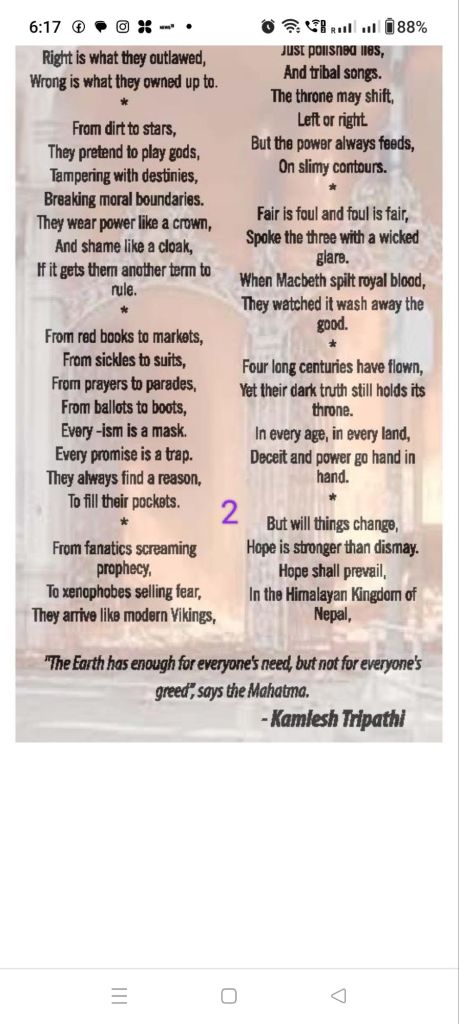
In the theatre of today, There is no right, There is no wrong, Only the Right wing’s roar, And the Left wing’s furore, Both drawing blood-red lines in the sand.
*
There is no truth, Only talking points. No justice, Just vote-bank coins. They don’t serve the people, They fill their pockets.
*
They’ve auctioned off, What was once good. They rebranded evil, When it suited their mood. Right is what they outlawed, Wrong is what they owned up to. *
From dirt to stars, They pretend to play gods, Tampering with destinies, Breaking moral boundaries. They wear power like a crown, And shame like a cloak, If it gets them another term to rule.
*
From red books to markets, From sickles to suits, From prayers to parades, From ballots to boots, Every -ism is a mask. Every promise is a trap. They always find a reason, To fill their pockets.
*
From fanatics screaming prophecy, To xenophobes selling fear, They arrive like modern Vikings, Looters of hope, Peddlers of rage. Isms and faiths, March in lockstep, Crushing dissent beneath their boots.
*
They bank on your simplicity, They bank on your despair, They hand out crumbs, And call it care. They flatter your fears, They bribe your dreams, Then burn both in the name of schemes.
*
There is nothing right. There is nothing wrong. Just polished lies, And tribal songs. The throne may shift, Left or right. But the power always feeds, On slimy contours.
*
Fair is foul and foul is fair, Spoke the three with a wicked glare. When Macbeth spilt royal blood, They watched it wash away the good.
*
Four long centuries have flown, Yet their dark truth still holds its throne. In every age, in every land, Deceit and power go hand in hand.
*
But will things change,
Hope is stronger than dismay.
Hope shall prevail,
In the Himalayan Kingdom of Nepal,
*
“The Earth has enough for everyone’s need, but not for everyone’s greed”, says the Mahatma.
Shravan Charity Mission is an NGO that works for poor children suffering from life-threatening diseases, especially cancer. Our posts are meant for our readers, including children and adults, and have a huge variety of content. We also accept donations for our mission. Should you wish to donate to the cause of cancer? The bank details are given below:
Shravan Charity Mission is an NGO that works for poor children suffering from life-threatening diseases, especially cancer. Our posts are meant for our readers, including children and adults, and have a huge variety of content. We also accept donations for our mission. Should you wish to donate to the cause of cancer? The bank details are given below:
Shravan Charity Mission is an NGO that works for poor children suffering from life-threatening diseases, especially cancer. Our posts are meant for our readers, including children and adults, and have a huge variety of content. We also accept donations for our mission. Should you wish to donate to the cause of cancer? The bank details are given below:
Shravan Charity Mission is an NGO that works for poor children suffering from life-threatening diseases, especially cancer. Our posts are meant for our readers, including children and adults, and have a huge variety of content. We also accept donations for our mission. Should you wish to donate to the cause of cancer? The bank details are given below:
VIKING SAGAS ON COMBAT AND CURIOSITY ECONOMIC TIMES 17/2/24 LIFE WAS TOUGH FOR VIKINGS, THEY WERE FIERCELY INDEPENDENT PEOPLE, AND VALUED TRUST AND TEAMWORK DEVDUTT PATTNAIK… AUTHOR OF BUSINESS SUTRA
The Greeks had inspired the Romans 2500 years ago. The Romans established a great empire around the Mediterranean for over a thousand years. Around the time they turned Christians, they began encountering barbarians from the North. The Celts, the Gauls, the Goths, in the western or Latin end of the Empire, around 500 AD, and later, the Vikings, in the eastern or Greek end of the Empire, around 1000 AD. Like the Greeks, life was tough for the Vikings, and they were fiercely independent people. Some, not all of them, travelled on ships to distant lands to raid. The shipping experience taught them the value of trust and teamwork. Vikings lived in Northern Europe (Scandinavia), in cold, dark, wintry lands, close to the Arctic. They had to fight to survive. So their mythological sagas spoke of battle all the time. Their gods fought frost giants in icy lands, and trolls who lived in dark, damp spaces. The gods even fought each other. The realm of the gods was located on branches of a giant tree, and it was feared that the roots of this would eventually be gnawed by demons, and everything would one day come to an end, even for the gods. A depressing worldview. The Vikings believed that if they died bravely in battle, they would be taken by Valkyries to Valhalla, a great hall to wine, dine, and fight with the gods themselves. This motivated the Vikings to fight. And to face death fearlessly. Those Vikings who died non-violent deaths, because of disease, accidents, and old age, had an unremarkable afterlife in the land of shadows ruled by Hel, a goddess who never smiled. The Vikings had two sets of gods, the Vanir, who enjoyed trade and the Aesir, who preferred the raid, as revealed in the following story. The Vanir and the Aesir were both gods, but very different. Vanir had magic, and Aesir had strength. Freyja of the Vanir visited the Aesir and displayed her gold, giving it to all those who made her happy. Under the spell of gold, the Aesir soon forgot all about loyalty to the clan and kept seeking more and more of the shiny stuff, offering gods and services in exchange. They stored more and shared less. Aesir blamed Freya’s magical gold for this shift in values. Aesir tried to burn Freya alive, but she resurrected herself each time, for she had magic. This led to war between Vanir and Aesir, which was inconclusive. Finally, the Vanir and the Aesir decided to make peace. Two Vanir went to live with the Aesir, and two Aesir went to live with the Vanir. Thus, they would learn about each other’s ways. The two Vanir, Freyr and Frerja, children of the wealthy Njord, taught the Aesir how the fertility of the earth and the sea can help them survive, and how accounting ensures fairness. The two Aesir, Hoenir and Mimir, taught Vanir about the value of loyalty and comradeship over being calculative. The Vanir liked the handsome well spoken Hoenir, but not the silent Mimir, who only whispered in Hoenir’s ear and spoke to no one else. Hoenir and Mimir always travelled together, talking to each other secretly, and this made the Vanir so uncomfortable that they killed Mimir. They did not realise that while Hoenir was handsome and charming, he needed Mimir’s counsel to make smart decisions. The two worked well as a team. Without Mimir, Hoenir had no good counsel. All he could say to the Vanir in meetings when they sought a decision was, ‘Let others decide!’ This story reminds us that different cultures value different things, and for a civilisation to thrive, we have to learn how different cultures function. The Aesir had to learn the trading ways of the Vanir based on agreements and negotiations. The Vanir had to learn the raiding ways of the Aesir based on trust, teamwork, and unquestioning loyalty. The Aesir were traders and accountants who valued policies and profit over people. This creates a fair professional ecosystem where relationships do not matter and nepotism does not take root. The Vanir were all about people, about bonding, about passion and trust. Here, connections matter: you bypass the rule for the relationship, like breaking the protocol for the benefit of a friend. The Romans saw the Vikings are barbarians and were eager to make them Christian, for they believed their truth was the universal truth. They were not interested in learning from ‘lesser’ people. For Romans, the other had to be subjugated. They were resources and rivals to be enslaved and brought into the Roman fold. In time, the Viking lands of Scandinavia would give rise to the Dutch, who would change the world forever by inventing the stock market, a financial revolution that provided vast amounts of credit to the newly emerging industrial economy. Was this because the Vikings turned Christians, or was it because the Vikings remembered their old ways– the ways of the Aesir and the Vanir? We can only speculate.
Shravan Charity Mission is an NGO that works for poor children suffering from life-threatening diseases, especially cancer. Our posts are meant for our readers, including children and adults, and have a huge variety of content. We also accept donations for our mission. Should you wish to donate to the cause of cancer? The bank details are given below:
In today’s digital world, where attention spans are shrinking and reading habits are on the decline, it is about time we rethink how we educate and connect with the younger generation. A powerful and often overlooked tool is the classic Indian cinema. Just like the manner in which William Shakespeare’s plays are studied in schools and colleges for their literary merit and social relevance, classic Indian films, too, deserve a place in our school and college syllabi.
It is said that old books and films are windows to the past. They serve as mirrors reflecting the values, struggles, and ethos of a bygone era. A few months ago, on the occasion of Mother’s Day, while reminiscing about my late mother, I stumbled upon the evergreen classic ‘Mother India’ on television. Although I had watched it several times before, especially because my one-time close friend, the late Sajid Khan, had played a role in it as the young Sunil Dutt, this time it felt different. As if I wasn’t just watching the movie ‘Mother India.’ But I was watching the real India of 1957.
The film tells the touching story of Radha, an impoverished, rural village woman who struggles against all odds to raise her sons in her husband’s absence. She encounters severe poverty, exploitation by a moneylender, and personal tragedy, yet she emerges as an emblem of strength, sacrifice, and moral integrity. In several ways, she becomes the archetype of the traditional Indian woman.
Mother India is more than just a typical film. It holds cultural and social significance. It vividly depicts the struggles of rural India in the post-independence period. Watching this movie is like stepping back in time to understand what our ancestors endured. ‘Mother India’ is one of the many classics preserved in the archives of Bollywood, as well as in the regional film centres of Tollywood and Kollywood.
There are many such classic, cult and epic films and TV serials like Dosti, Do Bigha Zamin, Guide, Haqueeqat, Gandhi, Sholay, Pather Panchali, Ramayana, Mahabharat, to name a few, that vividly capture different aspects of Indian life. It could be from social inequality, the British Raj, mythology, penance, the fight for India’s freedom or the wars with Pakistan and China. These films provide context, depth, and real-life visuals to what students might otherwise only read or cram in history or literature books.
It is about time the Government considers constituting a national panel to select a curated list of classic Indian films for inclusion in school and college syllabi. These films could be rotated class-wise or standard-wise, or stream-wise. They could be aligned with topics in history, literature, sociology, ethics, and more. The way Shakespearean plays are studied for their literary value and insights into human behaviour, Indian classics can also be studied for their cultural, emotional, and historical richness.
65% of India’s population is under 35. Digital distractions are everywhere; therefore, classic films can be a more engaging add-on to traditional textbooks. Surveys show that young people today often struggle to read even 500 words at a stretch, but they can easily sit through a well-written storyline in a movie. Visual learning is known to improve retention and understanding. It makes classic movies an effective educational tool.
This approach need not be limited to domestic films alone. Historical and biographical classics from Hollywood or other international cinemas, such as Cromwell, Nuremberg or Schindler’s List, could also be part of an extended curriculum. This will especially benefit students planning to work or study abroad. It will help them gain cultural and historical awareness about the countries they are headed to.
Incorporating cinema into education doesn’t mean replacing books, but it would mean enhancing the learning experience. Students could watch in-syllabus films followed by classroom discussions, essays, or creative projects. It would not only build their analytical and emotional intelligence. It will also cultivate a deeper appreciation of India’s cinematic and historical heritage.
Furthermore, in business and professional schools, an extracurricular cinema curriculum could be developed to help students understand global cultures, leadership models, historical contexts, and ethical dilemmas, all of which are frequently depicted in well-made films.
Cinema is not just entertainment. It is a form of art that captures the values of society, its history, and love for humanity. Though Indian classic movies are rich in content, emotion, and social commentary, they are a forgotten treasure. They can educate, inspire, and connect the youth to their roots.
In this digital era, where attention spans are short and reading habits are waning, integrating timeless films into the academic curriculum may well be the most impactful way to preserve our cultural heritage and prepare students for a more thoughtfully aware future.
Shravan Charity Mission is an NGO that works for poor children suffering from life-threatening diseases, especially cancer. Our posts are meant for our readers, including children and adults, and have a huge variety of content. We also accept donations for our mission. Should you wish to donate to the cause of cancer? The bank details are given below: