Category Archives: casual causerie

The Statesman

Copyright@shravancharitymission
    Last week, a false report of a death came as a sad shock to many, including myself. It was like hearing that an elderly and ailing relative, whom one had close touch with for a while but had nostalgic memories of, had finally passed away.

    The wrongly reported death was not that of a person but of a newspaper. The Statesman. For many, like my father, ‘The Statesman’ was more than a newspaper; it was a living legend.

    My father would make my sisters read it every day, not so much for the news it carried but for the purity and precision of its language. He would not know that his son who was yet to be born would one day work and write for his beloved Statesman.

    By chance, I became one of the four-member team which in 1967 launched ‘The Junior Statesman weekly,’ The Statesman’s youth magazine. Relations between the paper and the young magazine were like those between a conservative parent and a brash teenager, paradoxically linked by a generation gap. When the Junior Statesman, JS, was shut down in 1977 by the diktat of the then managing director of The Statesman, I was inducted as an assistant editor in the paper.

    The sanctum sanctorum of The Statesman was its editorial page, and its high priests were its editorial writers. I had never met them, but my hero was Niranjan Mazumdar, editorial writer par excellence.

    The story went that when the editor asked Niranjan what the editorial he was about to write was about, Niranjan replied ‘I don’t know—but my typewriter does.’

    I never aspired to be a Niranjan. For one thing I could never type but when my first editorial was published, by Niranjan’s boon companion, Lindsay Emerson, I felt as though I’d been awarded the Nobel Prize for Literature.

    By the time I left The Statesman in 1987 to join The Times of India in Delhi, titans like Niranjan and Lindsay belonged to the mythic past. The Statesman had become a shadow of its former self.

    But those who remember its past glory hold it in enduring affection.

Moral of the story: The life of an organisation no matter how big depends on its people and performance. Performance creates the name, name doesn’t create the performance.

By Kamlesh Tripathi

*

https://kamleshsujata.wordpress.com

*

Share it if you like it

*

Shravan Charity Mission is an NGO that works for poor children suffering from life threatening diseases especially cancer. Our posts are meant for our readers that includes both children and adults and it has a huge variety in terms of content. We also accept donations for our mission. Should you wish to donate for the cause. The bank details are given below:

NAME OF ACCOUNT: SHRAVAN CHARITY MISSION

Account no: 680510110004635 (BANK OF INDIA)

IFSC code: BKID0006805

*

Our publications

GLOOM BEHIND THE SMILE

(The book is about a young cancer patient. Now archived in 7 prestigious libraries of the US, including, Harvard University and Library of Congress. It can also be accessed in MIT through Worldcat.org. Besides, it is also available for reading in Libraries and archives of Canada and Cancer Aid and Research Foundation Mumbai)  

ONE TO TANGO … RIA’S ODYSSEY

(Is a book on ‘singlehood’ about a Delhi girl now archived in Connemara Library, Chennai and Delhi Public Library, GOI, Ministry of Culture, Delhi)

AADAB LUCKNOW … FOND MEMORIES

(Is a fiction written around the great city of Nawabs—Lucknow. It describes Lucknow in great detail and also talks about its Hindu-Muslim amity. That happens to be its undying characteristic. The book was launched in Lucknow International Literary Festival of 2014)

REFRACTIONS … FROM THE PRISM OF GOD

(Co-published by Cankids–Kidscan, a pan India NGO and Shravan Charity Mission, that works for Child cancer in India. The book is endorsed by Ms Preetha Reddy, MD Apollo Hospitals Group. It was launched in Lucknow International Literary Festival 2016)

TYPICAL TALE OF AN INDIAN SALESMAN

(Is a story of an Indian salesman who is, humbly qualified. Yet he fights his ways through unceasing uncertainties to reach the top. A good read not only for salesmen. The book was launched on 10th February, 2018 in Gorakhpur Lit-Fest. Now available in Amazon, Flipkart and Onlinegatha)

RHYTHM … in poems

(Published in January 2019. The book contains 50 poems. The poems describe our day to day life. The book is available in Amazon, Flipkart and Onlinegatha)

(ALL THE ABOVE TITLES ARE AVAILABLE FOR SALE IN AMAZON, FLIPKART AND OTHER ONLINE STORES OR YOU COULD EVEN WRITE TO US FOR A COPY)

*****


THE STORY OF UTANGA & LORD KRISHNA … from Mahabharat

Copyright@sgravancharitymission

    Once when the great battle of Kurukshetra was over, Lord Krishna bade farewell to the Pandavas and left for Dwarka. On his way he met his old Brahmin friend Utanga. Krishna stopped and alighted from his stupendous chariot and wished the Brahmin. Utanga, delighted at the sight of mighty Krishna, returned his greetings and proceeded to make the usual enquiries about the health and welfare of his relatives.

       He enquired if Krishna’s cousins Pandavas and Kauravas loved one another as brothers, and whether they all were flourishing well enough. The innocent Brahmin had not heard about the great battle of Mahabharat that had already been fought.     Lord Krishna was astounded by this question of his and for a moment he stood silent not knowing what to say in reply.

    He then softly narrated what all had happened. How a great battle had been fought where almost all the Kauravas had been exterminated. Upon hearing the story Utanga got very angry. He retorted at Krishna telling him forcefully that He had failed in His duties and warned Him to be prepared to receive his curse. In reply the Lord just smiled and asked him not to use up the fruits of his hard earned penances.

    He then proceeded to show Utanga his Visvarupa primarily to explain to him the message of Bhagavad Gita just as He had done for Arjuna. After this explanation of Krishna, Utanga recovered his calm and with that the Lord was at ease. He told the Brahmin to ask for any boon that he desired. Utanga said, that after having witnessed You—Lord Krishna in your Universal form there isn’t anything left in this world to be desired.

    But when Krishna insisted, Utanga relented by saying that he should be able to find water whenever he felt thirsty in his long journeys. The Lord thus blessed him and went on His way.

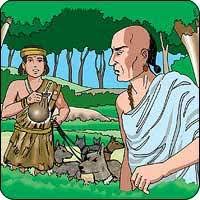
    Later when Utanga was passing through a desert he felt very thirsty and remembered the boon he had received from Lord Krishna. He decided to make use of it. The very moment, a nishad (Shudra) appeared before him attired in rags. He had five hunting hounds (dogs) in leash and an animal skin water bag strapped to his shoulder. He offered the bamboo spout of his water bag to the Brahmin to drink from.

    Utanga stared at the man in disgust and told him he was not thirsty and asked him to go. Having said this, he re-approached the Lord in his mind for the boon that He had granted him. The outcaste, meanwhile pressed upon the fastidious Brahmin Utanga, over and over again, to quench his thirst, but it only made Utanga more and more angry, and he refused to drink the water. Finally, the outcaste disappeared.

    Observing the strange disappearance of the Nishad the brahmin reflected, who was he? He could not have been a real Nishad. It was certainly my test where I blundered miserably. I rejected the holy water offered by the outcaste and proved myself to be an arrogant fool. Utanga was now in great anguish when a moment later Krishna Himself appeared before him with his conch shell and discus—Sudershan chakra.

    O Purushottama! Exclaimed Utanga, was it right of You to have sent an outcaste, to offer unclean water to a Brahmin like me? Was this a kind gesture on your part? Asked Utanga in a bitter tone.

    Lord replied smiling, Hey Utanga! It was only for your sake I had asked Indra to take ‘Amrita’ and give it to you as water. He said he would on no account give nectar to a mortal. But I prevailed upon him and he agreed to do so only if I allowed him to test you in the form of a chandal. I accepted the challenge believing you had attained that stage of understanding and wisdom. But you have made me suffer defeat at the hands of Indra. This story is from Mahabharat.

    Moral of the story: Although, the Brahmin asked the Lord only for water, Lord gave him nectar, out of His causeless mercy. The Lord always cares for us more than we do for ourselves. And we just need to have the vision to understand His mercy.

By Kamlesh Tripathi

*

https://kamleshsujata.wordpress.com

*

Share it if you like it

*

Shravan Charity Mission is an NGO that works for poor children suffering from life threatening diseases especially cancer. Our posts are meant for our readers that includes both children and adults and it has a huge variety in terms of content. We also accept donations for our mission. Should you wish to donate for the cause. The bank details are given below:

NAME OF ACCOUNT: SHRAVAN CHARITY MISSION

Account no: 680510110004635 (BANK OF INDIA)

IFSC code: BKID0006805

*

Our publications

GLOOM BEHIND THE SMILE

(The book is about a young cancer patient. Now archived in 7 prestigious libraries of the US, including, Harvard University and Library of Congress. It can also be accessed in MIT through Worldcat.org. Besides, it is also available for reading in Libraries and archives of Canada and Cancer Aid and Research Foundation Mumbai)  

ONE TO TANGO … RIA’S ODYSSEY

(Is a book on ‘singlehood’ about a Delhi girl now archived in Connemara Library, Chennai and Delhi Public Library, GOI, Ministry of Culture, Delhi)

AADAB LUCKNOW … FOND MEMORIES

(Is a fiction written around the great city of Nawabs—Lucknow. It describes Lucknow in great detail and also talks about its Hindu-Muslim amity. That happens to be its undying characteristic. The book was launched in Lucknow International Literary Festival of 2014)

REFRACTIONS … FROM THE PRISM OF GOD

(Co-published by Cankids–Kidscan, a pan India NGO and Shravan Charity Mission, that works for Child cancer in India. The book is endorsed by Ms Preetha Reddy, MD Apollo Hospitals Group. It was launched in Lucknow International Literary Festival 2016)

TYPICAL TALE OF AN INDIAN SALESMAN

(Is a story of an Indian salesman who is, humbly qualified. Yet he fights his ways through unceasing uncertainties to reach the top. A good read not only for salesmen. The book was launched on 10th February, 2018 in Gorakhpur Lit-Fest. Now available in Amazon, Flipkart and Onlinegatha)

RHYTHM … in poems

(Published in January 2019. The book contains 50 poems. The poems describe our day to day life. The book is available in Amazon, Flipkart and Onlinegatha)

(ALL THE ABOVE TITLES ARE AVAILABLE FOR SALE IN AMAZON, FLIPKART AND OTHER ONLINE STORES OR YOU COULD EVEN WRITE TO US FOR A COPY)

*****



LITERARY CORNER: THE POWER OF YOUR SUBCONSCIOUS MIND — Dr Joseph Murphy

Copyright@shravancharitymission

Khidki (Window)

–Read India Initiative—

This is only an attempt to create interest in reading. We may not get the time to read all the books in our lifetime. But such reviews, talk and synopsis will at least convey what the book is all about.

    Joseph Murphy was born in Ireland. He happened to be the son of a private boy’s school headmaster. He was raised as a Roman Catholic. Murphy studied for the priesthood and joined the Jesuits. In his twenties, an experience with a healing prayer led him to leave the Jesuits and move to the United States, where he became a pharmacist in New York (having a degree in chemistry by that time). Here he attended the Church of the Healing Christ (part of the Church of Divine Science), where Emmet Fox a ‘New Thought’ spiritual leader of the early 20th century, during the great depression had become minister in 1931. His large Divine Science church services were held in New York City.

    In the mid-1940s, Murphy moved to Los Angeles, where he met ‘Religious Science’ founder Ernest Holmes, and was ordained into ‘Religious Science’ by Holmes in 1946. Thereafter, while teaching at the Institute of Religious Science. Where, a meeting with ‘Divine Science Association’ president Erwin Gregg led to him being re-ordained into Divine Science, and he became the minister of the Los Angeles Divine Science Church in 1949, which he built into one of the largest ‘New Thought’ congregations in the country. In the next decade, Murphy married, earned a PhD in psychology from the University of Southern California and started writing. After his first wife died in 1976, he remarried a fellow ‘Divine Science’ minister who was his longstanding secretary. Murphy died in 1981.

    One of the pioneering voices of affirmative thinking, Dr. Joseph Murphy can unlock the truly staggering powers, of your subconscious mind, through this book.

    The Power of Your Subconscious Mind has been a bestseller since its first publication in 1963, selling millions of copies since its original publication. It is one of the most brilliant and beloved, spiritual self-help works, of all times that can help you heal yourself, banish your fears, make you sleep better, enjoy better relationships and just feel happier. The techniques are simple and results are seen fast. You can improve your relationships, your finances, and even your physical well-being.

    Dr Joseph Murphy explains that life events are actually the result of the workings of your conscious and subconscious minds. He suggests practical techniques through which one can change one’s destiny, principally by focusing and redirecting this miraculous energy. Years of research studying the world’s major religions convinced him that some Great Power lay behind all spiritual life and that this power is within each of us.

    ‘The Power of Your Subconscious Mind’ will open a world of success, happiness, prosperity, and peace for you.

    In this remarkable book, Dr Murphy combines spiritual wisdom and scientific research to explain how your subconscious mind influences every single aspect of your life. By understanding and harnessing its powers, you can control and improve the quality of your daily life. From getting that promotion you deserve, to overcoming phobias and bad habits, strengthening interpersonal relationships, and increasing your wealth. The Power of Your Subconscious Mind can open a world of success, happiness, prosperity, and peace for you.

    The book has wide claims. It is the ultimate in releasing the miracle working power. As per Dr Murphy miracles will happen. Why is one person sad and another person happy? Why is one person fearful and anxious and another full of faith and confidence.

    The power of subconscious mind is tremendous. A personal healing will always be the most convincing evidence of our subconscious powers. Sub conscious is the God the miracle in you. Many years ago Dr Murphy managed to cure himself of a malignancy—in medical terminology it is called a sarcoma—by using the healing power of his subconscious. As per the author this book can work miracles in your life.

    The contents of the book are rich. It has some twenty chapters all very striking and further divided into sub-chapters for easy readability and better retention as follows:

  • The treasure house within you.
  • How your mind works.
  • The Miracle—Working Power of Your Subconscious.
  • Mental Healings in Ancient Times.
  • Mental Healings in Modern Times.
  • Practical Techniques in Mental Healings.
  • The Tendency of the Subconscious is Lifeward.
  • How to Get the Results You Want.
  • How to Use the Power of Your Subconscious for Wealth.
  • Your, right to be rich.
  • Your Subconscious Mind as a Partner in Success.
  • How Scientists Use the Subconscious Mind.
  • Your Subconscious and the Wonders of Sleep.
  • Your Subconscious Mind and Marital Problems.
  • Your Subconscious Mind and Your Happiness.
  • Your Subconscious Mind and Your Harmonious Human Relationships.
  • How to Use Your Subconscious Mind for Forgiveness.
  • How Your Subconscious Removes Mental Blocks.
  • How to Use Your Subconscious Mind to Remove Fear.
  • How to Stay Young in Spirit Forever.

Some great takeaways from the book are:

  • The law of life is the law of belief.
  • Within your subconscious mind you will find the solution for every problem.
  • Worry, anxiety, fear, and depression interfere with the normal functioning of the heart, lungs, stomach, and intestines.
  • On every continent, in every land, there are shrines at which cures take place. Some are world famous. Others are known only to those who live nearby. Whether celebrated or obscure, the healings that happen at these shrines happen for the same reasons and by way of the same powers of the subconscious mind.
  • Unless you love your work, you cannot possibly consider yourself successful at it, even as, all the rest of the world hails you as a great success.
  • You have used the power to the point where it begins to use you.
  • You spend about eight out of every twenty-four hours, or one-third of your entire life, in sleep. This is an inexorable law of life. Sleep is a divine law, and many answers to our problems come to us when we sound asleep.
  • Nothing rests in sleep. Your heart, lungs, and all your vital organs function while you are asleep. If you eat prior to sleep, the food is digested and assimilated. Your skin secretes perspiration. Your nails and hair continue to grow.
  • Do the thing you are afraid to do, and the death of fear is certain.
  • The only obstacle to your success and achievement is your own thought or mental image.
  • As a man thinketh in his heart (subconscious mind), so is he.
  • Your body is an emotional disk that records your beliefs and impressions.

The book is full of interesting anecdotes. It conveys one simple message of life and that is about your subconscious. Your sub-conscious can heal all your problems. Be it may social, marital, financial, medical, health and even career. Of course to convey this message the author has taken a very descriptive route.

    Just in case you are looking for any solution this indeed is something you could try out.

    I would give the book seven out of ten.

By Kamlesh Tripathi

*

https://kamleshsujata.wordpress.com

*

Share it if you like it

*

Shravan Charity Mission is an NGO that works for poor children suffering from life threatening diseases especially cancer. Our posts are meant for our readers that includes both children and adults and it has a huge variety in terms of content. We also accept donations for our mission. Should you wish to donate for the cause. The bank details are given below:

NAME OF ACCOUNT: SHRAVAN CHARITY MISSION

Account no: 680510110004635 (BANK OF INDIA)

IFSC code: BKID0006805

*

Our publications

GLOOM BEHIND THE SMILE

(The book is about a young cancer patient. Now archived in 7 prestigious libraries of the US, including, Harvard University and Library of Congress. It can also be accessed in MIT through Worldcat.org. Besides, it is also available for reading in Libraries and archives of Canada and Cancer Aid and Research Foundation Mumbai)  

ONE TO TANGO … RIA’S ODYSSEY

(Is a book on ‘singlehood’ about a Delhi girl now archived in Connemara Library, Chennai and Delhi Public Library, GOI, Ministry of Culture, Delhi)

AADAB LUCKNOW … FOND MEMORIES

(Is a fiction written around the great city of Nawabs—Lucknow. It describes Lucknow in great detail and also talks about its Hindu-Muslim amity. That happens to be its undying characteristic. The book was launched in Lucknow International Literary Festival of 2014)

REFRACTIONS … FROM THE PRISM OF GOD

(Co-published by Cankids–Kidscan, a pan India NGO and Shravan Charity Mission, that works for Child cancer in India. The book is endorsed by Ms Preetha Reddy, MD Apollo Hospitals Group. It was launched in Lucknow International Literary Festival 2016)

TYPICAL TALE OF AN INDIAN SALESMAN

(Is a story of an Indian salesman who is, humbly qualified. Yet he fights his ways through unceasing uncertainties to reach the top. A good read not only for salesmen. The book was launched on 10th February, 2018 in Gorakhpur Lit-Fest. Now available in Amazon, Flipkart and Onlinegatha)

RHYTHM … in poems

(Published in January 2019. The book contains 50 poems. The poems describe our day to day life. The book is available in Amazon, Flipkart and Onlinegatha)

(ALL THE ABOVE TITLES ARE AVAILABLE FOR SALE IN AMAZON, FLIPKART AND OTHER ONLINE STORES OR YOU COULD EVEN WRITE TO US FOR A COPY)

*****


OTHELLO by William Shakespeare

Copyright@shravancharitymission

Khidki (Window)

–Read India Initiative—

This is only an attempt to create interest in reading. We may not get the time to read all the books in our lifetime. But such reviews, talk and synopsis will at least convey what the book is all about.

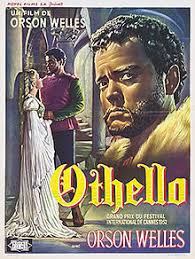
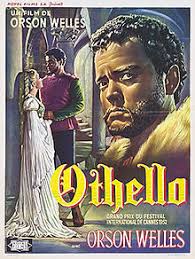
    Othello is also referred as the (The Tragedy of Othello, or the Moor of Venice) a tragedy written by William Shakespeare, believed to have been written in 1603. It is based on the story Un Capitano Moro (“A Moorish Captain”) by Cinthio, a disciple of Boccaccio, first published in 1565. The story revolves around its two central characters: Othello, a Moorish general in the Venetian army and his unfaithful ensign, Iago. Given its varied and enduring themes of racism, love, jealousy, betrayal, revenge and repentance. Othello is still often performed in professional and community theatre alike, and has been the source for numerous operatic, film, and literary adaptations. .

    Othello begins on a street in Venice, in the midst of an argument between Roderigo, a rich man, and Iago. Roderigo has been paying Iago to help him in his suit to Desdemona. But Roderigo has just learned that Desdemona has married Othello, a general whom Iago begrudgingly serves as an ensign. Iago says he hates Othello, who recently passed him over for the position of lieutenant in favor of an inexperienced soldier Michael Cassio. Unseen, Iago and Roderigo cry out to Brabanzio that his daughter Desdemona has been stolen by and married off to Othello, the Moor.

    Brabanzio finds that his daughter is indeed missing, and he gathers some officers to find Othello. Not wanting his hatred of Othello to be known, Iago leaves Roderigo and hurries back to Othello before Brabanzio sees him. At Othello’s lodgings, Cassio arrives with an urgent message from the duke: Othello’s help is needed in the matter of the imminent Turkish invasion of Cyprus. Not long afterward, Brabanzio arrives with Roderigo and others, and accuses Othello of stealing his daughter by way of witchcraft. When he finds out that Othello is on his way to speak with the duke. Brabanzio decides to go along and accuse Othello before the assembled senate.

    But Brabanzio’s plan backfires. The duke and the senate are very sympathetic towards Othello. Given a chance to speak for himself, Othello explains that he wooed and won Desdemona not by witchcraft but with the stories of his adventures in travel and war. The duke finds Othello’s explanation convincing, and Desdemona herself enters at this point to defend her choice in marriage and to announce to her father that her allegiance is now towards her husband.

    By now Brabanzio is frustrated, but acquiesces and allows the senate meeting to resume. The duke says that Othello must go to Cyprus to aid in the defence against the Turks, who are headed for the island. Desdemona insists that she accompany her husband on his trip, and preparations are made for them to depart that very night.

    In Cyprus the following day, two gentlemen stand on the shore with Montano, the governor of Cyprus. A third gentleman arrives and reports that the Turkish fleet has been wrecked in a storm at the sea. Cassio, whose ship did not suffer the same fate, arrives soon after, followed by a second ship carrying Iago, Roderigo, Desdemona, and Emilia, Iago’s wife. Once they have landed, Othello’s ship is sighted, and the group goes to the harbour. As they wait for Othello, Cassio greets Desdemona by clasping her hand. While watching them, Iago tells the audience that he will use, “as little a web as this hand-holding” to ensnare Cassio.

    Othello arrives, greets his wife, and announces that there will be reveling or enjoyment that evening to celebrate Cyprus’s safety from the Turks. Once everyone has left, Roderigo complains to Iago that he has no chance of breaking up Othello’s marriage. Iago assures Roderigo that as soon as Desdemona’s, “blood is made dull with the act of sport,” she will lose interest in Othello and seek sexual satisfaction elsewhere. However, Iago warns that “elsewhere” will likely be with Cassio. Iago counsels Roderigo that he should cast Cassio into disgrace by starting a fight with Cassio at the evening’s party revels. In a soliloquy, Iago explains to the audience that eliminating Cassio is the first crucial step in his plan to ruin Othello. That night, Iago gets Cassio drunk and then sends Roderigo to start a fight with him. Apparently provoked by Roderigo, Cassio chases Roderigo across the stage. Governor Montano attempts to hold Cassio down, but Cassio stabs him. Iago sends Roderigo to raise an alarm in the town.

    The alarm is rung, and Othello, who had left earlier with plans to consummate his marriage, soon arrives to still the commotion. When Othello demands to know who began the fight, Iago feigns reluctance to implicate his “friend” Cassio, but he ultimately tells the whole story. Othello then strips Cassio of his rank of lieutenant. At this Cassio is extremely upset, and he laments to Iago, once everyone else has gone, that his reputation has been ruined forever. Iago assures Cassio that he can get back into Othello’s good graces by using Desdemona as an intermediary. Then in a soliloquy, Iago tells us that he will frame Cassio and Desdemona as lovers to make-Othello jealous.

    In an attempt to reconcile, Cassio sends some musicians to play beneath Othello’s window. Othello, however, sends his clown to tell the musicians to go away. Hoping to arrange a meeting with Desdemona, Cassio asks the clown, a peasant who serves Othello, to send Emilia to him. After the clown departs, Iago passes by and tells Cassio that he will get Othello out of the way so that Cassio can speak with Desdemona privately. Othello, Iago, and a gentleman go to examine some of the town’s fortifications.

    Desdemona is quite sympathetic to Cassio’s request and promises that she will do everything she can to make Othello forgive his former lieutenant. As Cassio is about to leave, Othello and Iago return. Feeling uneasy, Cassio leaves without talking to Othello. Othello inquires whether it was Cassio who just parted from his wife, and Iago, beginning to kindle Othello’s fire of jealousy, replies, “No, sure, I cannot think it, that he would steal away so guilty-like, Seeing your coming”.

    Othello turns upset and edgy, when Iago furthers his goal of removing both Cassio and Othello by suggesting that Cassio and Desdemona are involved in an affair. Desdemona’s entreaties to Othello to reinstate Cassio as lieutenant add to Othello’s almost immediate conviction that his wife is unfaithful. After Othello’s conversation with Iago, Desdemona comes to call Othello for supper and finds him feeling unwell. She offers him her handkerchief to wrap around his head, but he finds it to be “too little” and lets it drop to the floor. Desdemona and Othello go for dinner, when Emilia picks up the handkerchief, mentioning to the audience that Iago has always wanted her to steal it for him.

    Iago is ecstatic when Emilia gives him the handkerchief, which he plants in Cassio’s room as “evidence” of his affair with Desdemona. When Othello demands “ocular or visual proof” that his wife is unfaithful, Iago says that he has seen Cassio “wipe his beard” with Desdemona’s handkerchief—the first gift Othello ever gave her. The first seed of suspicion is thus born. Othello vows to take vengeance on his wife and on Cassio, and Iago vows that he will help him. When Othello sees Desdemona later that evening, he demands the handkerchief of her, but she tells him that she does not have it with her and attempts to change the subject by continuing her request or suit on Cassio’s behalf. This drives Othello into a further rage, and he storms out. Later, Cassio comes onstage, wondering about the handkerchief he has just found in his chamber. He is greeted by Bianca, a prostitute, whom he asks to take the handkerchief and copy its embroidery for him.

    Through Iago’s machinations, Othello becomes so consumed by jealousy that he falls into a trance and has a fit of epilepsy. As he writhes on the ground, Cassio walks in, but Iago tells him to come back in a few minutes to talk. Once Othello recovers, Iago tells him of the meeting he has planned with Cassio. He instructs Othello to hide nearby and watch as Iago extracts from Cassio the story of his affair with Desdemona. While Othello stands out of earshot, or beyond the point from where he could listen clearly Iago pumps Cassio for information about Bianca the prostitute, causing Cassio to laugh and confirm Othello’s suspicions. Bianca herself then enters with Desdemona’s handkerchief, reprimanding Cassio for making her copy out the embroidery of a love token given to him by another woman. When Desdemona enters with Lodovico and Lodovico subsequently gives Othello a letter from Venice calling him home and instating Cassio as his replacement, Othello goes over the edge, striking Desdemona and then storming out.

    That night, Othello accuses Desdemona of being a whore. He ignores her protestations, seconded by Emilia, that she is innocent. Iago assures Desdemona that Othello is simply upset about matters of state. Later that night, however, Othello ominously tells Desdemona to wait for him in bed and to send Emilia away. Meanwhile, Iago assures the still-complaining Roderigo that everything is going as planned. And in order to prevent Desdemona and Othello from leaving, Roderigo must kill Cassio. Then he will have a clear avenue to his love.

    Iago instructs Roderigo to ambush Cassio, but Roderigo misses his mark and Cassio wounds him instead. Meanwhile, Iago wounds Cassio and runs away. When Othello hears Cassio’s cry, he assumes that Iago has killed Cassio as he said he would. Meanwhile, Lodovico and Graziano enter to see what the commotion is all about. Iago enters shortly thereafter and flies into a pretend rage as he “discovers” Cassio’s assailant Roderigo, whom he murders. Cassio is taken to have his wound dressed.

Meanwhile, Othello stands over his sleeping wife in their bedchamber, preparing to kill her. Desdemona wakes and attempts to plead with Othello. She asserts her innocence, but Othello smothers her. Emilia enters with the news that Roderigo is dead. Othello asks if Cassio is dead too and is mortified when Emilia says he is not. After crying out that she has been murdered, Desdemona changes her story before she dies, claiming that she has committed suicide. Emilia asks Othello what happened, and Othello tells her that he has killed Desdemona for her infidelity, which Iago brought to his attention.

    Montano, Graziano, and Iago come into the room. Iago attempts to silence Emilia, who realizes what Iago has done. At first, Othello insists that Iago has told the truth, citing the handkerchief as evidence. Once Emilia tells him how she found the handkerchief and gave it to Iago, Othello is devastated and begins to weep. He tries to kill Iago but is disarmed. Iago kills Emilia and flees, but he is caught by Lodovico and Montano (Lodovico is a member of Venice’s diplomatic service and also a cousin of Desdemona, who return holding Iago captive. They also bring Cassio, who is now in a chair because of his wound. Othello wounds Iago but is disarmed. Lodovico tells Othello that he must come with them back to Venice to be tried. Othello makes a speech about how he would like to be remembered, then kills himself with a sword he had hidden on his person. The play closes with a speech by Lodovico. He gives Othello’s house and goods to Graziano who is Desdemona’s uncle and orders that Iago be executed.

    People like Iago have lived in all centuries. We should therefore be careful about them. And of course we should never act in haste and suspicion the way Othello did and that ended his life, and that of his wife Desdemona too in great tragedy.

By Kamlesh Tripathi

*

https://kamleshsujata.wordpress.com

*

Share it if you like it

*

Shravan Charity Mission is an NGO that works for poor children suffering from life threatening diseases especially cancer. Our posts are meant for our readers that includes both children and adults and it has a huge variety in terms of content. We also accept donations for our mission. Should you wish to donate for the cause. The bank details are given below:

NAME OF ACCOUNT: SHRAVAN CHARITY MISSION

Account no: 680510110004635 (BANK OF INDIA)

IFSC code: BKID0006805

*

Our publications

GLOOM BEHIND THE SMILE

(The book is about a young cancer patient. Now archived in 7 prestigious libraries of the US, including, Harvard University and Library of Congress. It can also be accessed in MIT through Worldcat.org. Besides, it is also available for reading in Libraries and archives of Canada and Cancer Aid and Research Foundation Mumbai)  

ONE TO TANGO … RIA’S ODYSSEY

(Is a book on ‘singlehood’ about a Delhi girl now archived in Connemara Library, Chennai and Delhi Public Library, GOI, Ministry of Culture, Delhi)

AADAB LUCKNOW … FOND MEMORIES

(Is a fiction written around the great city of Nawabs—Lucknow. It describes Lucknow in great detail and also talks about its Hindu-Muslim amity. That happens to be its undying characteristic. The book was launched in Lucknow International Literary Festival of 2014)

REFRACTIONS … FROM THE PRISM OF GOD

(Co-published by Cankids–Kidscan, a pan India NGO and Shravan Charity Mission, that works for Child cancer in India. The book is endorsed by Ms Preetha Reddy, MD Apollo Hospitals Group. It was launched in Lucknow International Literary Festival 2016)

TYPICAL TALE OF AN INDIAN SALESMAN

(Is a story of an Indian salesman who is, humbly qualified. Yet he fights his ways through unceasing uncertainties to reach the top. A good read not only for salesmen. The book was launched on 10th February, 2018 in Gorakhpur Lit-Fest. Now available in Amazon, Flipkart and Onlinegatha)

RHYTHM … in poems

(Published in January 2019. The book contains 50 poems. The poems describe our day to day life. The book is available in Amazon, Flipkart and Onlinegatha)

(ALL THE ABOVE TITLES ARE AVAILABLE FOR SALE IN AMAZON, FLIPKART AND OTHER ONLINE STORES OR YOU COULD EVEN WRITE TO US FOR A COPY)

*****

The Atomic Bombing of Japan in World War II, 1945

Copyright@shravancharitymission

    The United States dropped atomic bombs on the Japanese cities of Hiroshima and Nagasaki in August 1945 only to hasten the end of the World War II in the Pacific. Although, it was the first, and to date the only, actual use of such weapons of “mass destruction,” the mushroom clouds have hung over every military and political policy since then.

    Less than five months after the sneak attack by the Japanese on Pearl Harbour, in Hawaii the Americans launched a small carrier-based bomber raid against Tokyo. While the attack was good for the American morale, it accomplished little other than to demonstrate to the Japanese that their shores were not invulnerable. Later in the war, U.S. bombers were able to attack the Japanese home islands from bases in China, but it was not until late 1944 that the United States could mount a sustained bombing campaign.

    Because of the distance to Japan, American bombers could not reach the targets and safely return to friendly bases in the Pacific until the island-hopping campaign had captured the Northern Mariana Islands located in (Western north pacific islands). From bases on the Mariana Islands, long-range Boeing B-29 Super-fortresses conducted high altitude bombing runs on November 24, 1944. On March 9, 1945, an armada of 234 B-29s descended to less than 7,000 feet and dropped 1,667 tons of incendiaries on Tokyo. By the time the fire storm finally abated, a sixteen-square-mile corridor that had contained a quarter million homes was in ashes, and more than 80,000 Japanese, mostly civilians, lay dead. Only the Allied fire-bombing of Dresden, in East Germany, the previous month, had killed 135,000, people that exceeded the destruction of the Tokyo raid.

    Both Tokyo and Dresden were primarily civilian rather than military targets. Prior to World War II, international law regarded the bombing of civilians as illegal and barbaric. But after several years of warfare, however, neither the Allies nor the Axis distinguished between military and civilian air targets. Interestingly, while a pilot could drop tons of explosives and firebombs on civilian cities, an infantryman often faced a court-martial for even minor mistreatment of non-combatants. 

    Despite the air raids and their shrinking territory outside their home islands, the Japanese fought on. Their warrior code did not allow for surrender, and soldiers and civilians alike often chose suicide rather than giving up. By July 1945, the Americans were launching more than 1200 bombing sorties a week against Japan. The bombing had killed more than a quarter million (about 2.50 lacs) and left more than nine million homeless. Still, the Japanese gave no indication of surrender as the Americans prepared to invade the home islands.

    While the air attacks and plans for a land invasion continued in the Pacific, a top-secret project back in the United States was coming to fruition. On July 16, 1945, the Manhattan Engineer District successfully carried out history’s first atomic explosion. When President Harry Truman learned of the successful experiment, he remarked in his diary, “It seems to be the most terrible thing ever discovered, but it can be made the most useful.” 

    Truman realized that the “most terrible thing” could shorten the war and prevent as many as a million Allied casualties, as well as untold Japanese deaths, by preventing a ground invasion of Japan. On July 27, the United States issued an ultimatum: surrender or the U.S. would drop a “super weapon.” But Japan refused. In the early morning hours of August 6, 1945, a B-29 Superfortress Bomber named Enola Gay piloted by Lieutenant Colonel Paul Tibbets lifted off from Tinian Island in the Marianas. Aboard was a single atomic bomb weighing 8,000 pounds and containing the destructive power of 12.5 kilotons of TNT. Tibbets headed his plane towards Hiroshima, selected as the primary target because of its military bases and industrial areas. It also had not yet been bombed to any extent, so it would have provided an excellent evaluation of the bomb’s destructive power. 

    At 8:15 A.M., the Enola Gay dropped the device called “Little Boy.” A short time later, Tibbets noted, “A bright light filled the plane. We turned back to look at Hiroshima. The city was hidden by that awful cloud … boiling up, mushrooming.” The immediate impact of Little Boy killed at least 70,000 Hiroshima residents. Some estimates claim three times that number but exact figures are impossible to calculate because the blast destroyed all of the city’s records. 

    Truman again demanded that Japan surrender. After three days when there was no response, a B-29 took off again from Tinian with an even larger atomic bomb aboard. When the crew found their primary target of Kokura obscured by clouds, they turned towards their secondary target, Nagasaki. At 11:02 A.M. on August 9, 1945, they dropped the atomic device known as “Fat Man” that destroyed most of the city and killed more than 60,000 of its inhabitants. 

    Conventional bombing raids were also conducted against other Japanese cities on August 9, and five days later, 800 B-29s raided across the country. On August 15 (Tokyo time), the Japanese finally accepted unconditional surrender. World War II was over. 

    Much debate has occurred since the atomic bombings. While some evidence indicates that the Japanese were considering surrender, but far more information indicates otherwise. Apparently the Japanese were planning to train civilians to use rifles and spears to join the military in resisting a land invasion. Protesters of the Atomic bombings ignore the conventional incendiaries dropped on Tokyo and Dresden that claimed more casualties. Some historians even note that the losses at Hiroshima and Nagasaki were far fewer than the anticipated Japanese casualties from an invasion and continued conventional bombing. 

    Whatever the debate, there can be no doubt that the dropping of the atomic bombs on Japan shortened the war. The strikes against Hiroshima and Nagasaki are the only air battles that directly affected the outcome of a conflict. Air warfare, both before and since, has merely supplemented ground fighting. As confirmed by the recent Allied bombing of Iraq in Desert Storm and in Bosnia, air attacks can harass and make life miserable for civilian population, but battles and wars continue to be decided by ground forces. 

    In addition to hastening the end of the war with Japan, the development and use of the atomic bomb provided the United States with unmatched military superiority—at least for a brief time, until the Soviet Union exploded their own atomic device. The two superpowers then began competitive advancements in nuclear weaponry that brought the world to the edge of destruction. Only tentative treaties and the threat of mutual total destruction kept nuclear arms harnessed, producing the Cold War period in which the U.S., along with the USSR, worked out their differences through conventional means.

By Kamlesh Tripathi

*

https://kamleshsujata.wordpress.com

*

Share it if you like it

*

Shravan Charity Mission is an NGO that works for poor children suffering from life threatening diseases especially cancer. Our posts are meant for our readers that includes both children and adults and it has a huge variety in terms of content. We also accept donations for our mission. Should you wish to donate for the cause. The bank details are given below:

NAME OF ACCOUNT: SHRAVAN CHARITY MISSION

Account no: 680510110004635 (BANK OF INDIA)

IFSC code: BKID0006805

*

Our publications

GLOOM BEHIND THE SMILE

(The book is about a young cancer patient. Now archived in 7 prestigious libraries of the US, including, Harvard University and Library of Congress. It can also be accessed in MIT through Worldcat.org. Besides, it is also available for reading in Libraries and archives of Canada and Cancer Aid and Research Foundation Mumbai)  

ONE TO TANGO … RIA’S ODYSSEY

(Is a book on ‘singlehood’ about a Delhi girl now archived in Connemara Library, Chennai and Delhi Public Library, GOI, Ministry of Culture, Delhi)

AADAB LUCKNOW … FOND MEMORIES

(Is a fiction written around the great city of Nawabs—Lucknow. It describes Lucknow in great detail and also talks about its Hindu-Muslim amity. That happens to be its undying characteristic. The book was launched in Lucknow International Literary Festival of 2014)

REFRACTIONS … FROM THE PRISM OF GOD

(Co-published by Cankids–Kidscan, a pan India NGO and Shravan Charity Mission, that works for Child cancer in India. The book is endorsed by Ms Preetha Reddy, MD Apollo Hospitals Group. It was launched in Lucknow International Literary Festival 2016)

TYPICAL TALE OF AN INDIAN SALESMAN

(Is a story of an Indian salesman who is, humbly qualified. Yet he fights his ways through unceasing uncertainties to reach the top. A good read not only for salesmen. The book was launched on 10th February, 2018 in Gorakhpur Lit-Fest. Now available in Amazon, Flipkart and Onlinegatha)

RHYTHM … in poems

(Published in January 2019. The book contains 50 poems. The poems describe our day to day life. The book is available in Amazon, Flipkart and Onlinegatha)

(ALL THE ABOVE TITLES ARE AVAILABLE FOR SALE IN AMAZON, FLIPKART AND OTHER ONLINE STORES OR YOU COULD EVEN WRITE TO US FOR A COPY)

*****


THE TWELVE JYOTIRLINGAS

Copyright@shravancharitymission

    Just in case you have not read Shivpurana let me tell you it is all about Lord Shiva. It contains 24,000 verses divided into twelve Samhitas. Out of these one of them Roudra-samhita narrates the following story.

    Once, Brahma tried to claim superiority over the trinity of Shiva, Mahavishnu and Brahma himself. He vented this thought of his to Mahavishnu. When, suddenly, a huge column of fire, burst out of the earth, between the two and rose into the sky. Brahma flew upwards on his swan to see the tip of the fire while Vishnu as a boar dug deep into the earth to see the lower end of the pillar of fire. Both failed in their mission and returned. It was then that Shiva appeared at the centre of the fire column. This was the first Jyotirlinga.

    Jyotirlingas, represent the beginningless and the endless Stambha or Pillar, indicating the infinite nature of Shiva. In India, there are twelve Jyotirlinga shrines as follows:

  1. SOMNATH

    The Somnath Temple of Gujarat, is near Veraval in the Kathiawad district of Saurashtra. This is a Jyotirlinga shrine. This region is also known as Prabhasa Thirtha. According to the Shivpurana, the Moon God married all the 27 daughters of Daksha Prajapati. However, he liked Rohini more than others. Rohini’s sisters complained to Prajapati, who cursed the moon. As a result, the moon lost his radiance. So, he went to Veraval and prayed to Lord Shiva in a temple. And by the Lord’s grace, he regained his lost shine. Since then, the temple came to be known as Somnath Mandir. It was ransacked and destroyed as many as seventeen times by Muslim invaders, and each time, it was resurrected.

  1. MALLIKARJUNA

    This Jyotirlinga can be seen in Shrishailam Mountain, on the banks of the Krishna River in Andhra Pradesh. According to Shiva Purana, Lord Ganesha got married before Kartikeya. So, an angry Kartikeya left the place and went to Shri-shailam. Seeing their son offended, Shiva and Parvati followed him there. Shiva assumed the form of a Jyotirlinga and resided there as Mallikarjuna. Where, Mallika means Parvati, while Arjuna is another name for Shiva.

  1. MAHAKALESHWAR

    This Jyotirlinga is located on the banks of river Kshipra in the dense Mahakal forest in Ujjain, Madhya Pradesh. It was known as Avantika in ancient times. Legend has it that a five-year-old boy by the name Shrikar was amazed at the devotion of King Chandrasena of Ujjain towards Lord Shiva. Shrikar took a stone and started worshipping it as Shiva. Many people tried to discourage him in different ways, but his devotion only grew. Pleased by his devotion, Lord Shiva assumed the form of a Jyotirlinga and decided to stay in the Mahakal forest.

  1. OMKARESHWAR

    This Jyotirlinga is also in Madhya Pradesh. It is situated on an island called Mandhata or Shivapuri in the Narmada River. The island is shaped like an ‘Om,’ as written in Sanskrit. Omkareshwar means ‘Lord of Omkara,’ the sacred syllable Om. Once, when the Asuras defeated the Devas, the latter prayed to Lord Shiva. Pleased with their prayer, the Lord emerged in the form of Omkareshwar and defeated the Asuras.

  1. VAIDYANATH

    Also known as Vaijnath or Baidyanath, this Jyotirlinga is located at Deogarh in Jharkhand. This place is also called Chitaa-bhoomi. According to a well-known legend, Ravana once requested Lord Shiva to reside in Sri Lanka permanently. Shiva gave him a Jyotirlinga and told him that he should not place it on the ground before reaching Lanka. On the way, however, Ravana felt an urgent need to relieve himself. When a young boy who appeared there offered to hold the lingam in the meantime. The boy, was no one else but Vishnu in disguise, placed the lingam on the ground and disappeared, for he knew that Shiva’s presence would make wicked Ravana’s Lanka invincible. The lingam got fixed to the spot. On his return, Ravana saw what had happened. To propitiate Shiva, he cut off nine of his ten heads. But Shiva joined the severed heads of Ravana’s body, like a Vaidya. Hence the name of the Jyotirlinga became Vaidynath.

  1. BHIMA SHANKAR

    This Jyotirlinga is located on the banks of Bhima River in the Sahyadri region of Pune, Maharashtra. Legend has it that Kumbhakarna’s son, Bhima, vowed to take revenge on Lord Vishnu who, in His incarnation as Rama had killed his father. He began a severe penance and Lord Brahma was pleased and granted him immense power. Soon, Bhima the demon started creating havoc in the world. In the end, Lord Shiva reduced him to ashes. The Gods were overjoyed. On their request, Shiva made the place one of his abodes and manifested himself in the form of Bhima-shankar Jyotirlinga.

  1. RAMESWARAM

    This Jyotirlinga is located on the island of Rameswaram in Tamil Nadu. On his way to Sri Lanka, Sri Rama had stopped at Rameswaram, and worshipped a linga that he had made out of sand. Lord Shiva blessed Rama and then remained at Rameswaram in the form of Jyotirlinga.

  1. NAGESH

    The Nageshwar or Nagnath Jyotirlinga is situated on an island near Dwarka in Gujarat. The place is also known as Daaru-kavan. This Jyotirlinga is known far and wide for protecting devotees from poisons of all kinds. As per the legend in the Shivapurana, a demon by the name of Daruka imprisoned Supriya, a devotee of Shiva. On Supriya’s advice, the other prisoners began chanting, ‘Aum Namah Shivaya.’ Daaruka was enraged on hearing this chant. He sprang forward to kill Supriya. Suddenly, Lord Shiva appeared and put an end to the demon. He then remained on the island as a Jyotirlinga.

  1. VISHVANATH

    The Jyotirlinga at Vishvanath temple is located in Varanasi or Kashi, one of the most ancient cities of the world. It is believed that it was here that the pillar of fire representing Lord Shiva’s endless power broke through the earth’s crust and splayed towards heaven. The faithful are certain that those who die here attain salvation. The original Visvanath temple was destroyed and rebuilt many times. Emperor Aurangzeb destroyed the temple for the last time and built the Gyanvapi Mosque in its place. Later Ahilabai Holkar constructed the present temple adjacent to the mosque.

  1. TRIMBAK

     The Trimbakeshwar temple is located about 30 km from Nashik in Maharashtra, near the Brahmagiri Mountain. It is from this mountain that the river Godavari, also called the Gautami Ganga flows. Long ago, Maharishi Gautam, through his penance, had obtained an everlasting supply of grains. Some Gods became envious of the Maharishi and sent a cow to the granary. The cow was accidentally killed by the sage. On realising this, Maharishi requested Lord Shiva to get the premises purified. Shiva asked Ganga to flow through Nashik and He himself remained there as Trimbakeshwar Jyotirlinga.

  1. KEDARNATH

    At a height of 3,583 metres (12,000 feet) in Uttarakhand, the Kedarnath temple is located on the Rudra Himalaya range. It opens for only six months in a year, from May to November. During the other months, all the mountains here get fully snow clad. It is believed that in ancient times, Lord Shiva, pleased by the penance of Rishis Nara and Narayana, who were incarnations of Lord Vishnu, made a permanent abode in Kedarnath in the form of a Jyotirlinga. Many believe that the Pandavas had come here after the Mahabharta war to pray to Lord Shiva.

  1. GHRISHMESHVAR

    The Ghrish-meshvar or Ghush-meshvar Jyotirlinga is located in a village named Verul, near Aurangabad in Maharashtra. The place is not far from the famous Ajanta and Ellora caves. According to Shivapurana, there was a man named Sudharm, who had two wives, Sudeha and Ghush-ma. They were sisters. When Ghushma bore a son to Sudharm, Sudeha became jealous and threw the baby into a lake. Ghushma, a devotee of Shiva, prayed to the Lord and got her son back. On Sudharm’s request, Shiva manifested himself in the form of Jyotirlinga at that spot and assumed the name Ghush-meshvar.

By Kamlesh Tripathi

*

https://kamleshsujata.wordpress.com

*

Share it if you like it

*

Shravan Charity Mission is an NGO that works for poor children suffering from life threatening diseases especially cancer. Our posts are meant for our readers that includes both children and adults and it has a huge variety in terms of content. We also accept donations for our mission. Should you wish to donate for the cause. The bank details are given below:

NAME OF ACCOUNT: SHRAVAN CHARITY MISSION

Account no: 680510110004635 (BANK OF INDIA)

IFSC code: BKID0006805

*

Our publications

GLOOM BEHIND THE SMILE

(The book is about a young cancer patient. Now archived in 7 prestigious libraries of the US, including, Harvard University and Library of Congress. It can also be accessed in MIT through Worldcat.org. Besides, it is also available for reading in Libraries and archives of Canada and Cancer Aid and Research Foundation Mumbai)  

ONE TO TANGO … RIA’S ODYSSEY

(Is a book on ‘singlehood’ about a Delhi girl now archived in Connemara Library, Chennai and Delhi Public Library, GOI, Ministry of Culture, Delhi)

AADAB LUCKNOW … FOND MEMORIES

(Is a fiction written around the great city of Nawabs—Lucknow. It describes Lucknow in great detail and also talks about its Hindu-Muslim amity. That happens to be its undying characteristic. The book was launched in Lucknow International Literary Festival of 2014)

REFRACTIONS … FROM THE PRISM OF GOD

(Co-published by Cankids–Kidscan, a pan India NGO and Shravan Charity Mission, that works for Child cancer in India. The book is endorsed by Ms Preetha Reddy, MD Apollo Hospitals Group. It was launched in Lucknow International Literary Festival 2016)

TYPICAL TALE OF AN INDIAN SALESMAN

(Is a story of an Indian salesman who is, humbly qualified. Yet he fights his ways through unceasing uncertainties to reach the top. A good read not only for salesmen. The book was launched on 10th February, 2018 in Gorakhpur Lit-Fest. Now available in Amazon, Flipkart and Onlinegatha)

RHYTHM … in poems

(Published in January 2019. The book contains 50 poems. The poems describe our day to day life. The book is available in Amazon, Flipkart and Onlinegatha)

(ALL THE ABOVE TITLES ARE AVAILABLE FOR SALE IN AMAZON, FLIPKART AND OTHER ONLINE STORES OR YOU COULD EVEN WRITE TO US FOR A COPY)

*****


VAND CHAKNA … IN SIKHISM

Copyright@shravancharitymission

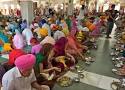
    Vand Chakna in Sikhism, is best explained as “sharing and caring.” On one occasion, when Guru Nanak was with his two sons and Lehna (Guru Angad Dev) there was a corpse covered with a cloth lying there. He asked who will eat this. No one responded, but Lehna, having full faith in his master, accepted it and when he removed the cloth, he saw there was a tray full of sacred food, which he served to his master and ate the leftovers. On this Guru Nanak said, “Lehna, you are blessed with sacred food because you shared it. Similarly, people should use wealth, not only for themselves, but share it with others. If one consumes it only for himself then it is like a corpse. But when we share it with others it becomes sacred.”

    This constitutes the basis for “Langar” the community kitchen, and Dasvandh, that is sharing one-tenth of one’s earnings with the community.

By Kamlesh Tripathi

*

https://kamleshsujata.wordpress.com

*

Share it if you like it

*

Shravan Charity Mission is an NGO that works for poor children suffering from life threatening diseases especially cancer. Our posts are meant for our readers that includes both children and adults and it has a huge variety in terms of content. We also accept donations for our mission. Should you wish to donate for the cause. The bank details are given below:

NAME OF ACCOUNT: SHRAVAN CHARITY MISSION

Account no: 680510110004635 (BANK OF INDIA)

IFSC code: BKID0006805

*

Our publications

GLOOM BEHIND THE SMILE

(The book is about a young cancer patient. Now archived in 7 prestigious libraries of the US, including, Harvard University and Library of Congress. It can also be accessed in MIT through Worldcat.org. Besides, it is also available for reading in Libraries and archives of Canada and Cancer Aid and Research Foundation Mumbai)  

ONE TO TANGO … RIA’S ODYSSEY

(Is a book on ‘singlehood’ about a Delhi girl now archived in Connemara Library, Chennai and Delhi Public Library, GOI, Ministry of Culture, Delhi)

AADAB LUCKNOW … FOND MEMORIES

(Is a fiction written around the great city of Nawabs—Lucknow. It describes Lucknow in great detail and also talks about its Hindu-Muslim amity. That happens to be its undying characteristic. The book was launched in Lucknow International Literary Festival of 2014)

REFRACTIONS … FROM THE PRISM OF GOD

(Co-published by Cankids–Kidscan, a pan India NGO and Shravan Charity Mission, that works for Child cancer in India. The book is endorsed by Ms Preetha Reddy, MD Apollo Hospitals Group. It was launched in Lucknow International Literary Festival 2016)

TYPICAL TALE OF AN INDIAN SALESMAN

(Is a story of an Indian salesman who is, humbly qualified. Yet he fights his ways through unceasing uncertainties to reach the top. A good read not only for salesmen. The book was launched on 10th February, 2018 in Gorakhpur Lit-Fest. Now available in Amazon, Flipkart and Onlinegatha)

RHYTHM … in poems

(Published in January 2019. The book contains 50 poems. The poems describe our day to day life. The book is available in Amazon, Flipkart and Onlinegatha)

(ALL THE ABOVE TITLES ARE AVAILABLE FOR SALE IN AMAZON, FLIPKART AND OTHER ONLINE STORES OR YOU COULD EVEN WRITE TO US FOR A COPY)

*****


LITERARY CORNER: THE INDIAN MUTINY OF 1857

Copyright@shravancharitymission

Khidki (Window)

–Read India Initiative—

This is only an attempt to create interest in reading. We may not get the time to read all the books in our lifetime. But such reviews, talk and synopsis will at least convey what the book is all about.

THE INDIAN MUTINY OF 1857

by

George Bruce Malleson.

Pages 278

Publisher: Rupa Publications.

Price Rs 278.

(Caveat: Most foreign writers especially of British origin call it a ‘mutiny’ which means a rebellion against authority. Whereas, Indian writers and more so Indians like calling it a ‘War of Independence)

    The fifth print or impression of this book came out in 2016. Malleson lived from (8 May 1825 to 1 March 1898). He was an English officer born in Wimbledon and educated at Winchester. Thereafter, he obtained a cadetship in the Bengal infantry in 1842, and served through the second Burmese War. He was a prolific writer. He had written extensively on the Sepoy Mutiny. His important works include, ‘History of the Indian Mutiny of 1857-58’ that runs into six volumes, ‘History of the French in India’ and the ‘Decisive Battles of India.’

    He even authored the biographies of the Mughal Emperor Akbar, the French Governor-General Dupleix and the British officer Robert Clive for the Rulers of India series. He died in London on 1st march 1898.

        Mutiny of 1857 remains an event shrouded in mystery and intrigue. Its very significance, whether it can be considered as the first war of Independence, continues to be questioned. The causes of the mutiny are many but all elusive, and so are the consequences of the mutiny. But the moot point is did the mutiny ring the death knell of the British Empire, or was it a mere speck of exaggerated trouble? The book takes you through that.

    It serves to fill a tremendous gap in narrative accounts of the mutiny, and demystifies lay assumptions. It begins with a sizeable background on the genesis of the British Raj in India—a move not deliberate but powerful enough to shape history for decades to come. The author delves in great detail into the causes of the mutiny, unlike preceding writers who mostly concentrated on the consequences. And this the author could do because he was a serving officer and therefore privy to many decisions and happenings. With the aid of personal knowledge and observation he attempts to pin-point the ‘latent power’ that drove the mutiny on.

    He provides a realistic account of all the important operations that took place, praising the heroic and criticizing the undeserving. He is careful not to overlay his work with too much tedious detail, where his writing remains lucid and interesting. 

    The subject book captures successfully, and even uncompromisingly, an event that was perhaps disorganized but large in scale. It deals with each individual and geographical area separately, analysing the causes and effects, both locally and nation-wide. It captures the spirit of the time, its people who fought and died, and the changing attitudes of the British Raj, which was gradually losing control of its Empire.

    In writing this short History of the Indian Mutiny of 1857. The author has aimed at the compilation of a work, which when complete in itself, should narrate the causes as well as the consequences of a movement unforeseen, and even undreamt of. For the mutiny as per the author was sudden and swift in its action, and therefore taxed utmost the energies of the British people. Preceding writers on the same subject, whilst dealing very amply with the consequences, have, with one exception, but dimply shadowed forth the causes. Even the very actors of the Mutiny failed to detect them.

    Sir John Lawrence the then Viceroy of India from 1864 to 1869, himself, writing with full knowledge of events in which he played a very conspicuous part, mistook the instrument for the chief cause. He stopped at the greased cartridge. But the greased cartridge was never issued to the great body of troops, if indeed to any. There must have been a latent motive power to make of an unissued cartridge a grievance so terrible as to rouse into revolting men whose fathers and whose father’s father had contributed in the making of the British Empire in India. The greased cartridge, too, did not concern those landowners and cultivators of Oudh and the North-Western Provinces, who rose almost to a man. What that latent motive power was, the author has described fully, in this volume.

    In the early chapters of the book the author communicates, ‘That his belief about the mutiny is founded on personal knowledge and personal observation. Locally chief of the Commissariat Department at Kanhpur when, in January 1856, Sir James Outram crossed the Ganges to depose or remove from office the King of Oudh, I had witnessed the indignation which the very rumour of his purpose caused among the sipahis of my own guard. I reported their excited state to my superiors, and was laughed at for my pains. But, impressed with the accuracy of my forecast, viz., that the annexation of Oudh would rouse indignation and anger in the sipahi army. Nevertheless, I continued. After my transfer, two months later, to an appointment in the Military Audit Department in Calcutta, to keep a careful record of several occurrences, all apparently of minor importance, which supervened when the effects of the annexation of Oudh had been thoroughly realised by the sipahis. My observations led to the conclusion that they were thoroughly angered, and, a little later, that their minds were being mysteriously worked upon. I kept copious notes of the matters I observed, and discussed them with my brother officers, without, finding that my views were shared by any one of them. Essentially, it was not alone the greased cartridge but a host of other factors that brought about the mutiny of 1857. It would seem, however, that the officer who held the responsible post of Town major. His name Major, Orfeur Cavenagh, had, from his own observation, arrived at conclusions not dissimilar. He has narrated in his admirable work the observations forced upon him by the changed demeanour of the natives of the North-Western Provinces in 1856. But he too, stood, amongst high-placed Europeans, almost alone in his convictions. The fact is that, up to the very outbreak of the mutiny at Mirath, which is present day Meerut, no one, from highest to lowest, believed in the possibility of a general combination. Those, and they could be counted on the fingers of one hand, who endeavoured to hint at an opposite conclusion were ridiculed as alarmists. So ingrained was the belief in the loyalty of the sipahis, and so profound was the ignorance as to the manner in which their minds were affected, that neither the outbreak at Mirath nor the seizure of Delhi entirely removed it.

    The book is divided into twenty eight chapters that begins with the introduction and then talks about the conspirators, to the first mutterings of the storm and the happenings at Barrackpur, Calcutta and the North-West. The revolt at Mirath present day Meerut is significant along with the seizure of Delhi. The effect of the seizure of Delhi across India. The author then goes on to describe the progress of the insurrection in the North-West. There are several other chapters as a spill over of the mutiny that leads to the march to Delhi and the author has listed the reactions and activities that flared up in Kanhpur, Lakhnao, Allahabad, and Calcutta. It also describes in great detail the Britishers taking back famous monuments from the mutineers such as ‘The Residency’ at Lucknow after Havelock’s first attempts to relieve it failed.

    The other places that the book covers are the events in Sagar and Narbada territories, Central India, Rajputana, the Mirath Districts, Rohilkhand and the Punjab province and even Gwalior.

   It then talks of the second attempt to takeover Lakhnao Residency and the Gwalior contingent. It also describes how Sir, Colin Campbell recovers the Duab area of Punjab.

    The book also covers the rebellion in Eastern Bengal, Eastern Bihar, Azamgarh, Allahabad and Eastern Oudh.

    The author has used the old names of the cities and places as they were spelt during those times.

    The book does impact you only if you read it in a continuous stretch. It brings you to a point where you start thinking that sure enough the ‘mutiny of 1857’ the forerunner to the fight for freedom in India that the Indians launched on the British Raj in the twentieth century under Mahatma Gandhi.

    Overall the book is a treat for history lovers. It is meticulously punctuated and that changes the style of writing automatically, and with that the speed of reading, where, you might take some extra hours to finish the book, as compared to some other present day book of similar pages. I would give the book seven out of ten. A must read for history students.

By Kamlesh Tripathi

*

https://kamleshsujata.wordpress.com

*

Share it if you like it

*

Shravan Charity Mission is an NGO that works for poor children suffering from life threatening diseases especially cancer. Our posts are meant for our readers that includes both children and adults and it has a huge variety in terms of content. We also accept donations for our mission. Should you wish to donate for the cause. The bank details are given below:

NAME OF ACCOUNT: SHRAVAN CHARITY MISSION

Account no: 680510110004635 (BANK OF INDIA)

IFSC code: BKID0006805

*

Our publications

GLOOM BEHIND THE SMILE

(The book is about a young cancer patient. Now archived in 7 prestigious libraries of the US, including, Harvard University and Library of Congress. It can also be accessed in MIT through Worldcat.org. Besides, it is also available for reading in Libraries and archives of Canada and Cancer Aid and Research Foundation Mumbai)  

ONE TO TANGO … RIA’S ODYSSEY

(Is a book on ‘singlehood’ about a Delhi girl now archived in Connemara Library, Chennai and Delhi Public Library, GOI, Ministry of Culture, Delhi)

AADAB LUCKNOW … FOND MEMORIES

(Is a fiction written around the great city of Nawabs—Lucknow. It describes Lucknow in great detail and also talks about its Hindu-Muslim amity. That happens to be its undying characteristic. The book was launched in Lucknow International Literary Festival of 2014)

REFRACTIONS … FROM THE PRISM OF GOD

(Co-published by Cankids–Kidscan, a pan India NGO and Shravan Charity Mission, that works for Child cancer in India. The book is endorsed by Ms Preetha Reddy, MD Apollo Hospitals Group. It was launched in Lucknow International Literary Festival 2016)

TYPICAL TALE OF AN INDIAN SALESMAN

(Is a story of an Indian salesman who is, humbly qualified. Yet he fights his ways through unceasing uncertainties to reach the top. A good read not only for salesmen. The book was launched on 10th February, 2018 in Gorakhpur Lit-Fest. Now available in Amazon, Flipkart and Onlinegatha)

RHYTHM … in poems

(Published in January 2019. The book contains 50 poems. The poems describe our day to day life. The book is available in Amazon, Flipkart and Onlinegatha)

(ALL THE ABOVE TITLES ARE AVAILABLE FOR SALE IN AMAZON, FLIPKART AND OTHER ONLINE STORES OR YOU COULD EVEN WRITE TO US FOR A COPY)

*****


INTERESTING FACTS & QUOTES-19

Copyright@shravancharitymission

Boiling the ocean: Means to go overboard or to delve deep into such small details that a project becomes impossible. The phrase, boil the ocean, appears in business as well as other group settings. In the literal sense, boiling the ocean is  impossible because there’s too much water for it to be possible.

What are brown, grey and white goods? Brown goods are consumer electronics, grey goods are computers etc., and white goods are domestic appliances. These are collective names for different types of electric and electronic equipment. These goods also include equipment powered by batteries such as computers, monitors, industrial dishwashers, ventilation units, etc.

 Difference between advertising and publicity: Advertising is what a company says about its own product, but Publicity is what others says about a product. Conversely, publicity is done by a third party which is not related to any company. Whereas, advertising is under the control of the company which is just opposite to publicity.

Mumbai discharges 750 metric tonnes of plastic every day, which is a sixth of its total garbage.

Mckinsey & Company an American worldwide management consulting firm estimates that tech giants worldwide spent anywhere between $20-30 billion on artificial intelligence in 2016.

Till 1985 marijuana and cannabis, that is, ganja and bhang derivatives, were legally sold in the country through authorised retail shops in India. It is believed moderate consumption of marijuana is far less harmful than tobacco and alcohol.

An old Rabbi once asked his pupils how they could tell when the night had ended and the day had begun. “Could it be”, asked one of the students, “when you can see an animal at a distance and tell for sure, whether it’s a sheep or a dog?” “No”, answered the Rabbi. “Is it, when you can look at a tree at a distance and tell whether it’s a fig tree or a peach tree?” wondered another. Again, the Rabbi answered “No”. The impatient pupils demanded: “Then what is it?” “Well … it is, when you can look at the face of any man or a woman and see that it is your sister or brother: Till then it is still midnight.”

Although we are second to China in population, our country is adding almost an entire Australia each year.

Recently published data shows that a quarter of white extremist’s attacks, in Europe since 2015 targeted Muslims and mosques. And now you have the retaliatory Sri-Lanka terror attack.

It’s always been the nature of government that it underpays at the top and overpays at the bottom.

The latest report of the UN’s Inter-governmental Panel on Climate Change (IPCC), released recently, states that Indian agriculture may be significantly impacted even by a 1.5 degree centigrade increase in average global temperature.

According to the Indian healthcare market research report 2016, our healthcare sector is one of the largest in terms of employment and revenue generation. Growing at a CAGR (compound annual growth rate) of 16.5%, it will possibly be worth $280 billion by 2020. The 2017 national health policy seeks to increase government spending from the abysmally low 1.4% to 2.5% of India’s GDP.

Russia has lost more than it has won through its policy of confronting the west.

Rivers have been the lifeline of all civilizations. No wonder they are considered sacred across cultures. In India, the Ganga symbolises knowledge, Yamuna was known for love stories, Narmada stood for bhakti, knowledge and logic, Saraswati for brilliance and architecture, and India got its name from the Sindhu also known as Indus.

The name Punjab has been derived from five rivers, which are Jhelum, Chenab, Ravi, Beas and Sutlej that collectively signify “five waters” or “the land of five waters.” Starting off in the Tibetan highland of western China near Lake Mansarovar in Tibet Autonomous Region, the Indus river flows through the Ladakh district of Jammu and Kashmir.

One of the longest rivers in the world, the Sindhu also known as Indus has a total length of over 2,000 miles and runs south from the Kailash Mountain in Tibet all the way to the Arabian Sea in Karachi, Pakistan. Where, Jhelum, Chenab, Ravi, Beas, and Sutlej—eventually flow into the Indus.

Russia has no companies in the top 100 global brands. The three most valuable companies in Russia today were also the three most valuable 10 years ago.

The brain contains 10 billion nerve cells, making thousands of billions of connections with each other. It is the most powerful data processor we know, but at the same time it is incredibly delicate. As soft as a ripe avocado, the brain has to be encased in the tough bones of the skull, and floats in its own waterbed of fluid. An adult brain weighs over 3 lb and fills the skull. It receives one-fifth of the blood pumped out by the heart at each beat.

82% of the wealth generated last year went to the richest 1% of the global population, while the 3.7 billion people who make up the poorest half of the world saw no increase in their wealth. Adding Indian dimension to the horror story of global inequity, the report, added India’s richest 1% garnered as much as 73% of the total wealth generated in the country in 2017.

India is a water stressed country with a per-capita water availability reducing from 1820 to 1545 cubic metres between 2001 to 2011.

Online retail in India is estimated to grow to $200 billion by 2026, up from just $15 billion in 2016.

Car penetration—India is around 20 per 1000 people, China is at 90 per 1000 people, and the US is at 750 1000 people.

Greenpeace International, an NGO estimated that the beverage giant Coca Cola produced 110 billion throwaway plastic bottles in 2015. Most of these go for landfills or to the ocean. Owing up to its responsibility the company recently announced that it would make all its packaging recyclable by 2030.

Tripura has one of the highest unemployment rates in the country and suffers from lack of infrastructure. Manik Sarkar of the Communist Party of India (Marxist) served as the Chief Minister of Tripura from 1998 to 2018. His reign was the longest in the state’s history.

Prices are the only thing that defy the law of gravity.

Interesting quotes and lines.

‘In depth of the winter I finally learned that there was in me an invincible summer’—ALBERT CAMUS, French philosopher, author,  and journalist.

‘God’s in His Heaven, All’s right with the world’–Robert Browning.

Don Marquis once joked, ‘an idea is not responsible for the people who believe in it.’

‘Everyone dies. But not everyone lives’—Shobha De.

‘Life is like riding a bicycle. To keep your balance, you must keep moving’—ALBERT EINSTEIN

By Kamlesh Tripathi

*

https://kamleshsujata.wordpress.com

*

Share it if you like it

*

Shravan Charity Mission is an NGO that works for poor children suffering from life threatening diseases especially cancer. Our posts are meant for our readers that includes both children and adults and it has a huge variety in terms of content. We also accept donations for our mission. Should you wish to donate for the cause. The bank details are given below:

NAME OF ACCOUNT: SHRAVAN CHARITY MISSION

Account no: 680510110004635 (BANK OF INDIA)

IFSC code: BKID0006805

*

Our publications

GLOOM BEHIND THE SMILE

(The book is about a young cancer patient. Now archived in 7 prestigious libraries of the US, including, Harvard University and Library of Congress. It can also be accessed in MIT through Worldcat.org. Besides, it is also available for reading in Libraries and archives of Canada and Cancer Aid and Research Foundation Mumbai)  

ONE TO TANGO … RIA’S ODYSSEY

(Is a book on ‘singlehood’ about a Delhi girl now archived in Connemara Library, Chennai and Delhi Public Library, GOI, Ministry of Culture, Delhi)

AADAB LUCKNOW … FOND MEMORIES

(Is a fiction written around the great city of Nawabs—Lucknow. It describes Lucknow in great detail and also talks about its Hindu-Muslim amity. That happens to be its undying characteristic. The book was launched in Lucknow International Literary Festival of 2014)

REFRACTIONS … FROM THE PRISM OF GOD

(Co-published by Cankids–Kidscan, a pan India NGO and Shravan Charity Mission, that works for Child cancer in India. The book is endorsed by Ms Preetha Reddy, MD Apollo Hospitals Group. It was launched in Lucknow International Literary Festival 2016)

TYPICAL TALE OF AN INDIAN SALESMAN

(Is a story of an Indian salesman who is, humbly qualified. Yet he fights his ways through unceasing uncertainties to reach the top. A good read not only for salesmen. The book was launched on 10th February, 2018 in Gorakhpur Lit-Fest. Now available in Amazon, Flipkart and Onlinegatha)

RHYTHM … in poems

(Published in January 2019. The book contains 50 poems. The poems describe our day to day life. The book is available in Amazon, Flipkart and Onlinegatha)

(ALL THE ABOVE TITLES ARE AVAILABLE FOR SALE IN AMAZON, FLIPKART AND OTHER ONLINE STORES OR YOU COULD EVEN WRITE TO US FOR A COPY)

*****


SHORT STORY: LESSON FROM THE OAK TREE

Copyright @shravancharitymission

    Chinese sage Chaung Tsu narrates the story of a huge old oak tree that was declared worthless by a carpenter because its timber was of bad quality and anything made from it would break, rot or wither away. Subsequently, in the story, the tree told the carpenter that it had turned useless on purpose because it wished to live a natural and happy life. Had its timber been useful it would have been cut into pieces, made into something else and would have been dead long ago. The sage enlightens us further by saying that in trying to be valued, desirable and significant in the eyes of the world, we usually end up relinquishing our deeper essence and we start living artificially. Despite assuming a grandiose form, our life is then fraught with meaninglessness and misery.

    Moral of the story: Think of yourself before you think of becoming useful for the world.

By Kamlesh Tripathi

*

https://kamleshsujata.wordpress.com

*

Share it if you like it

*

Shravan Charity Mission is an NGO that works for poor children suffering from life threatening diseases especially cancer. Our posts are meant for our readers that includes both children and adults and it has a huge variety in terms of content. We also accept donations for our mission. Should you wish to donate for the cause. The bank details are given below:

NAME OF ACCOUNT: SHRAVAN CHARITY MISSION

Account no: 680510110004635 (BANK OF INDIA)

IFSC code: BKID0006805

*

Our publications

GLOOM BEHIND THE SMILE

(The book is about a young cancer patient. Now archived in 7 prestigious libraries of the US, including, Harvard University and Library of Congress. It can also be accessed in MIT through Worldcat.org. Besides, it is also available for reading in Libraries and archives of Canada and Cancer Aid and Research Foundation Mumbai)  

ONE TO TANGO … RIA’S ODYSSEY

(Is a book on ‘singlehood’ about a Delhi girl now archived in Connemara Library, Chennai and Delhi Public Library, GOI, Ministry of Culture, Delhi)

AADAB LUCKNOW … FOND MEMORIES

(Is a fiction written around the great city of Nawabs—Lucknow. It describes Lucknow in great detail and also talks about its Hindu-Muslim amity. That happens to be its undying characteristic. The book was launched in Lucknow International Literary Festival of 2014)

REFRACTIONS … FROM THE PRISM OF GOD

(Co-published by Cankids–Kidscan, a pan India NGO and Shravan Charity Mission, that works for Child cancer in India. The book is endorsed by Ms Preetha Reddy, MD Apollo Hospitals Group. It was launched in Lucknow International Literary Festival 2016)

TYPICAL TALE OF AN INDIAN SALESMAN

(Is a story of an Indian salesman who is, humbly qualified. Yet he fights his ways through unceasing uncertainties to reach the top. A good read not only for salesmen. The book was launched on 10th February, 2018 in Gorakhpur Lit-Fest. Now available in Amazon, Flipkart and Onlinegatha)

RHYTHM … in poems

(Published in January 2019. The book contains 50 poems. The poems describe our day to day life. The book is available in Amazon, Flipkart and Onlinegatha)

(ALL THE ABOVE TITLES ARE AVAILABLE FOR SALE IN AMAZON, FLIPKART AND OTHER ONLINE STORES OR YOU COULD EVEN WRITE TO US FOR A COPY)

*****