All posts by shravancharitymission

Unknown's avatar

About shravancharitymission

Ex- Senior corporate- writer, author and social activist currently working for poor children suffering from life threatening diseases.

ANOTHER WAY TO REMEMBER #ST VALENTINE; NGO ACTIVITY ON 14TH FEB 2015

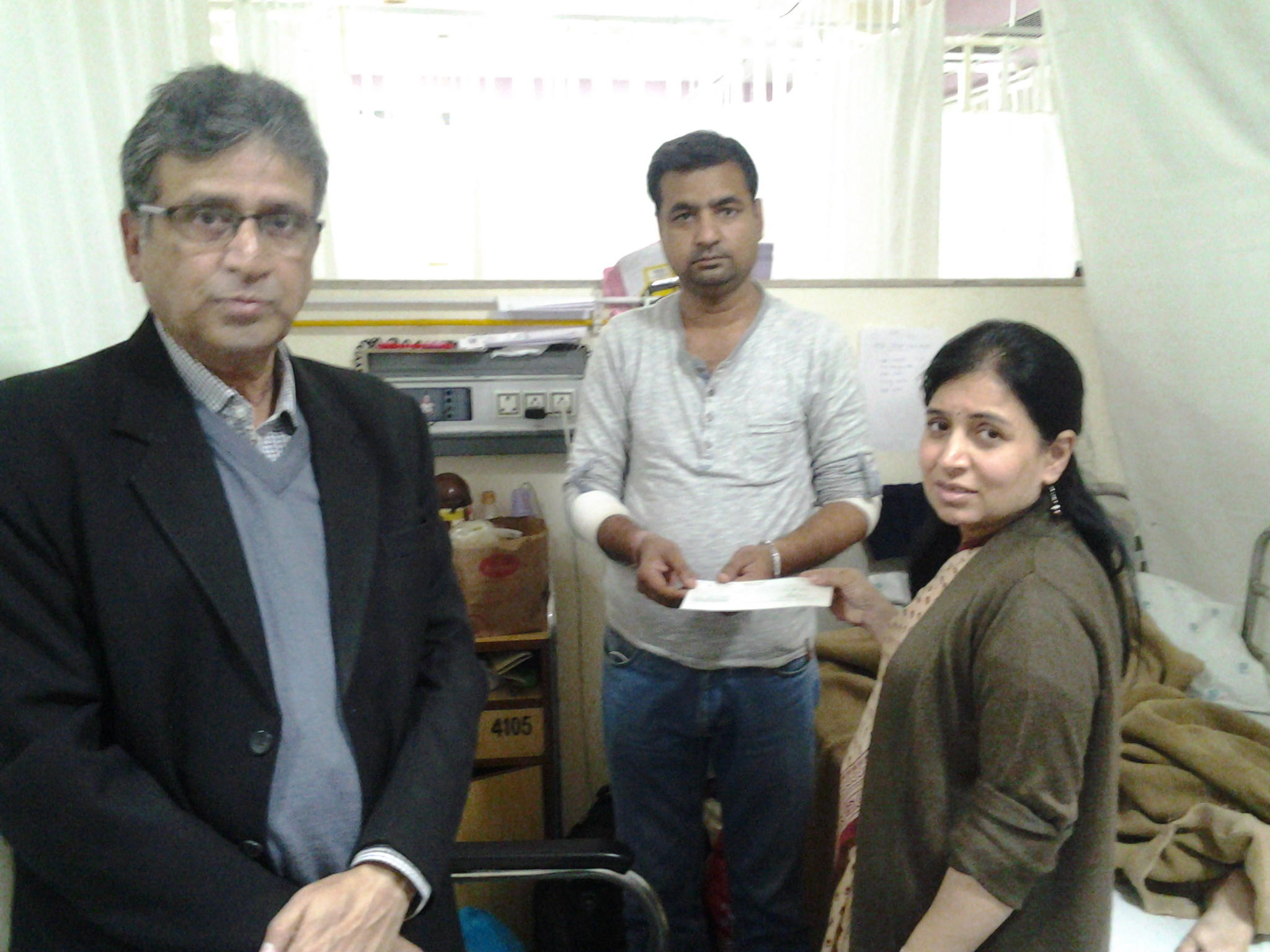
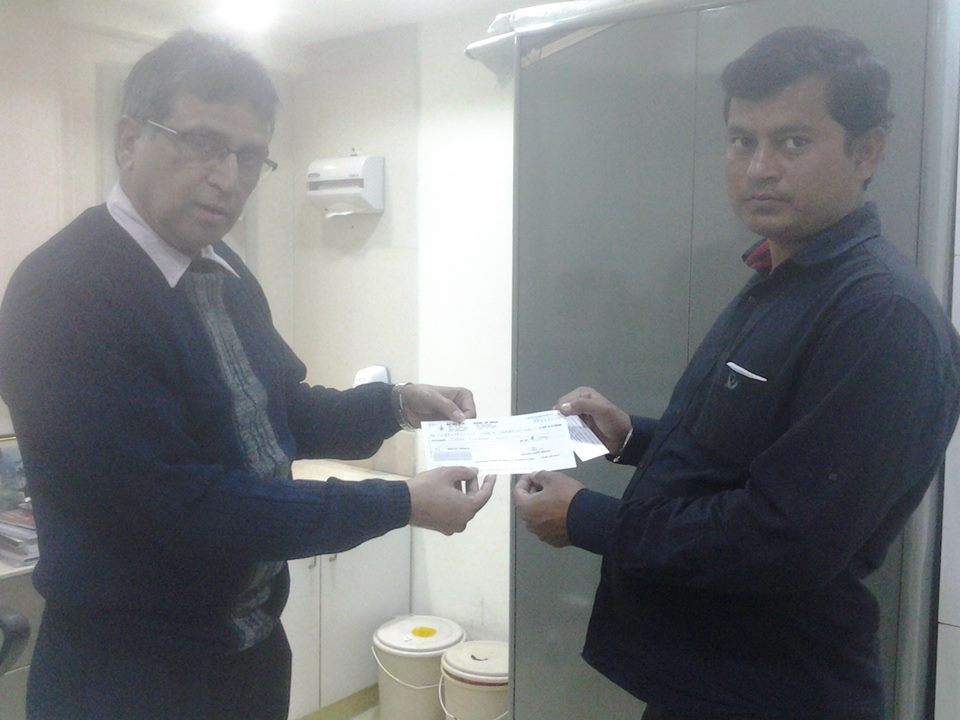
Dr Amita Mahajan, Apollo Hospital handing over medical assitance cheque

NGO ACTIVITY ON 14TH FEBRUARY 2015

We all have read instances of ‘healing’ where God in some form heals a person from extreme suffering. And he may not be in position to do this each time personally so he sends his representative; and in today’s context it happens to be St Valentine who is primarily remembered for his ‘human concern’ which also includes sheltering of ‘love’ and those struggling for love.

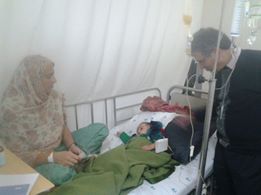
And on this blessed occasion our NGO was back to those unfortunate poor children; in the poor children’s ward of Apollo Hospital New Delhi. As usual it was sad to see them in that state, when they had not even seen the world; but were lying on those cold hospital beds with beady eyes not knowing when they will go home and be able to lay their hands on their toys or on the shoulders of their friends who must be eagerly waiting for them.

And, I consider myself fortunate for having met these children and their Parents together with Dr Amita Mahajan, Pediatric Oncologist, Apollo Hospitals to give them cheer and hope in a small way. For they all were in the hospital for weeks where no one had come to meet them; and for a change, I felt so nice, seeing that my being was bringing a smile, on someone’s face.

It was heart rendering seeing little Jia age approximately 2 years suffering from acute leukemia; and after some cajoling she smiled at me; for anyone who came to her was only with medicines and injections that she hated, perhaps.

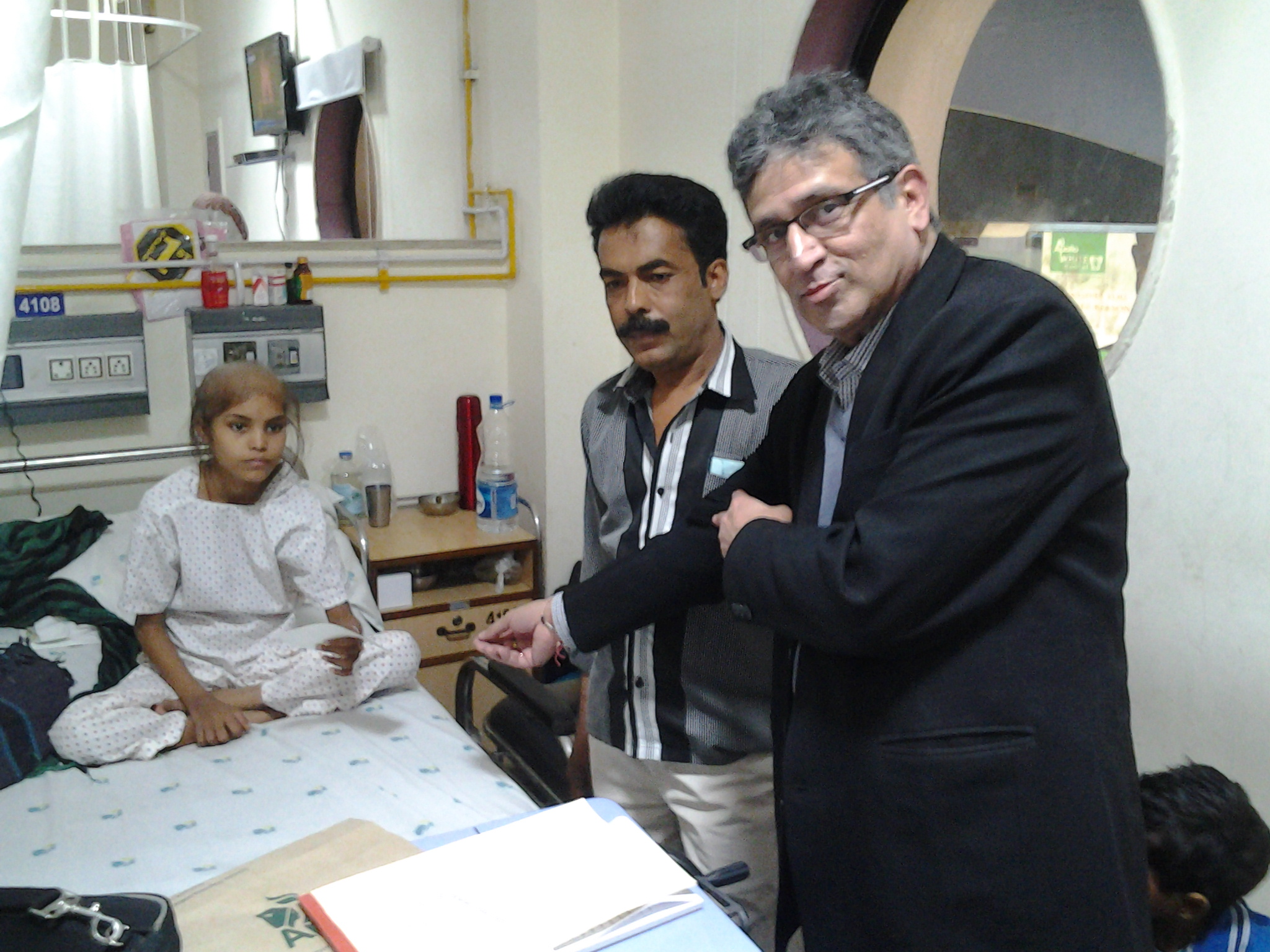
Brave Uzma age approximately 10, suffering from AML, form of acute leukemia was sitting on her bed, is when I approached her. She had gone through a round of chemotherapy. I could see her daring eyes telling me she will come out of it in flying colours.

20150214_152415

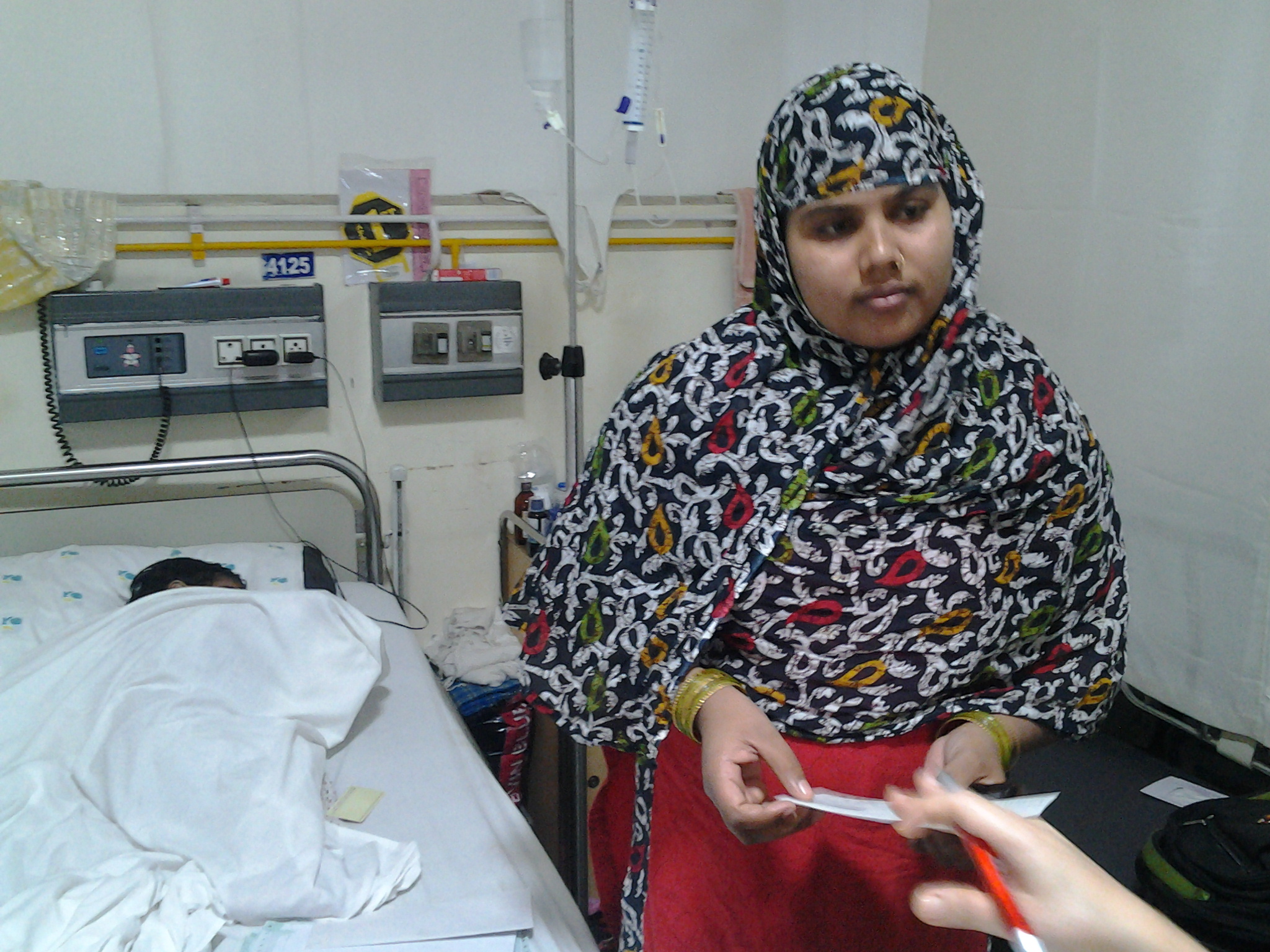
Fayaz Ahmed from Bihar age approximately 3, suffering from acute lymphoblastic leukemia was fast asleep when her mother woke him up to meet us. He didn’t like it, but then I did hold him in my arms for a moment and passed him on to his mother.

20150214_153021

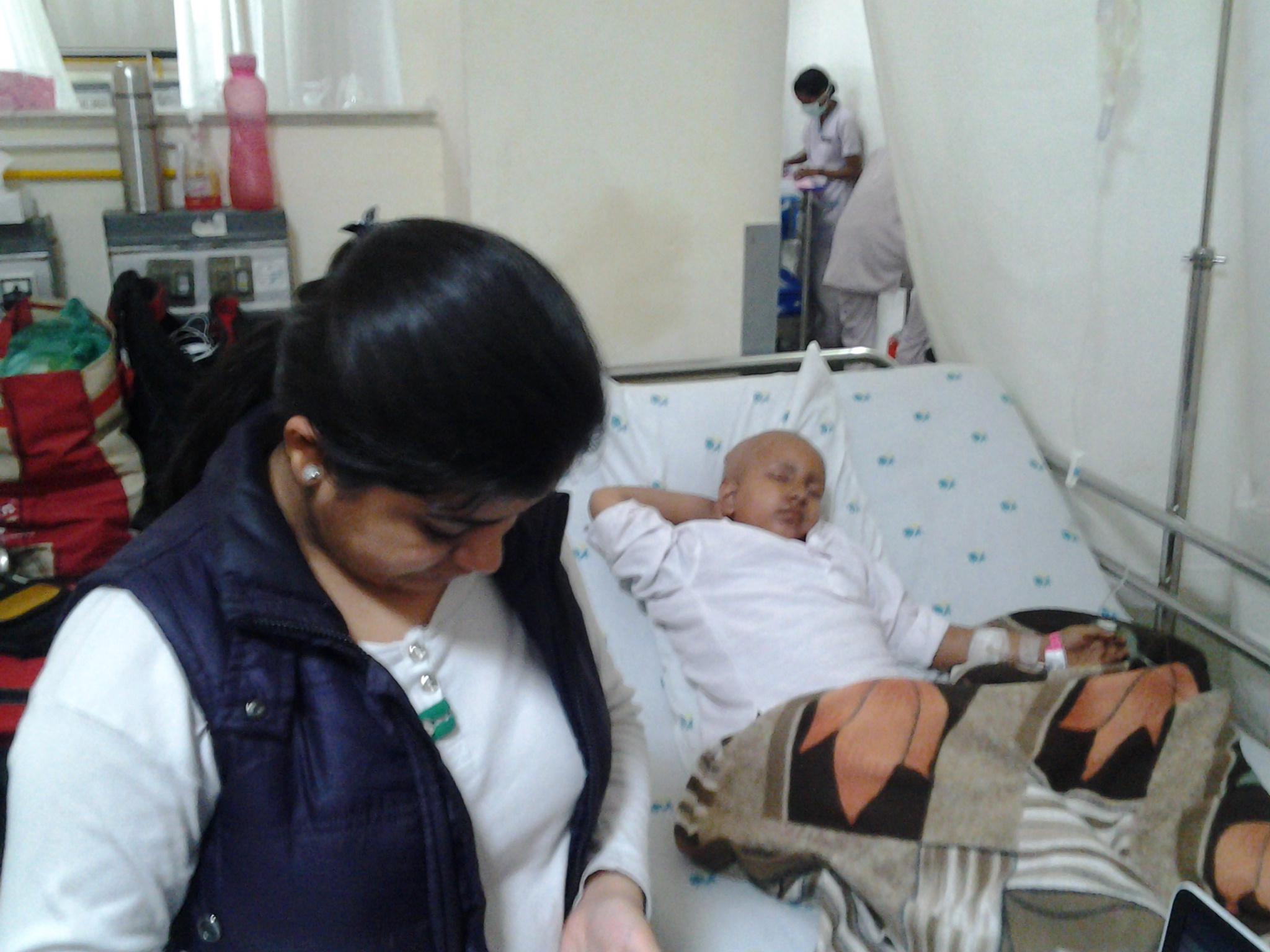
And brave Tushar Khattar age approximately 8 years, suffering from brain tumour was lying on the bed from where he looked at me and smiled as if nothing had happened and that told me what courage is all about.

20150214_153302

Brave parents with parched lips, dry throats, unruly hair and drained faces only projected their brute struggle and determination to take the fight against cancer to another level. May God give them the strength.

For donations:

Cheques in favour of “Shravan charity mission” account no (680510110004635) Bank of India

FOR NET TRANSFER

‘shravan charity mission’

Bank of India account no- 680510110004635

IFSC CODE: BKID0006805

THE OBSOLETE SWING OF 9 TO 5 – OFFICE HOURS

index mm mmm

With the rough noose of target around one’s neck and loads of life to carry on with; merely observing office timings has become more of a head count drill and a calculation of salary mechanism for the accounts and HR. For what, if I only observe office timings but don’t achieve my targets. I may still be sacked, even when I am a regular office attendee. But what, if I achieve my business targets and don’t achieve my attendance target. I may have to take a salary cut along with a sack for breaking office discipline, in spite of achieving my business targets. Where, management, at sweet will may be kind enough to sanction my accrued incentives.

Perhaps, there has always been a simmer of sorts between the Management and the employees on this account– office attendance–leave and the targets. Mind you, mere office presence, between 9 to 5 does not get you to your targets, with present day complexities and the sordid hustle and bustle of life. So something, close to high octane energy, something different together with a meandering passion is required to achieve those never ending and ever accruing professional targets of life.

The stated 48 hours of office in a week is just about sufficient to prepare the springboard from where you could dive to pluck your target. But the tedious groundwork starts brewing the moment you get up from your bed; is when your soul starts mating full flow with the business targets. That then moves with you to every corner of your house that you go to, including your precious morning throne. Supposedly your most private moment, where not even your better half is allowed, but those business targets are.

And, beyond the breakfast table, or to any other morning ritual of yours, including your morning prayers, and prayers collectively in tandem with your colleagues for targets. Thus, building the spiritual bulwark for the organization.

The average travel time to office in big cities has increased to over an hour one way and during this time also, you are glued mostly to your business and organizational targets. Where, all you do is to think, plan and set up a daily bit-by-bit approach towards achieving those milestones moments. For in the mornings it is not a rare sight to see business executives waiting impatiently to speak to their clients while they may take any mode of conveyance, including personal cars and two-wheelers, crowded buses and metro rail or a suburban local. And your business pursuit doesn’t just get over when you leave office for most us carry it home whether you like it or not. And the buck doesn’t stop there, as post a Sunday afternoon siesta, when the Monday morning blues erupt in you, is when you open your laptop to prepare for the Monday morning review, cutting into your well deserved weekend. For, if the review goes well your week is made, else, you need to build your entire week all over again. So, what earlier was in the confines of 9 to 5 has spilled beyond the time warp. Some management’s who are abreast to this reality, are sailing through competently with tweaked systems and procedures-employee friendly, but some are still struggling, only to conceive the reality.

The intricacies and pressures of both sides could be better understood. Only, if the modern day employer more appropriately termed as ‘management’ had ever done a job and the ‘employee’ ever ran an enterprise. For both uselessly keep visualizing the other side of the grass is greener, when it is actually a bald zone.

The point of essence is; today’s employee is not a 9 to 5 guy but a 24 x7 guy. Who at times operates from the designated office, from the road, his personal car or even a two-wheeler, airport, railway station, jam packed bus or a bus stand, cab, crowded local suburban, metro rail and at some lucky moments from his residence; for you can’t exist anymore on a obsolete routine of a mere 9 to 5 show up. And in all of this your gadgets (Smart phones and laptops) have become your office.

*****

Title : Mahindra rise moment of Life

‘MAHINDRA RISE MOMENT’ OF MY LIFE

BECOMING MARKET LEADER IN TAMILNADU

    In the year 1991 I was transferred from Jaipur to Chennai as Area Manager. It was a sector shift from Automotive to Farm Equipment. A cross country movement and an exposure to a new work culture. And I vividly remember, how a colleague of mine had even jokingly remarked at that time about my transfer from automobiles to tractors–‘So Kamlesh! now your ‘speed’ reduces but ‘torque’ increases.’ Quite connoting to the characteristics of an automobile and a tractor. But there was a bigger barrier beyond speed and torque. That was the local vernacular ‘Tamil language’ that was utter Greek to me. And my palate that was not akin to the local culinary in all frankness. So, I felt, overall, it was a dim and a losing proposition for me. I landed in Chennai draped in apprehensions. Not knowing fully the local ball game. Yet I was oozing with some valid convictions and arrived procedures as a springboard.

    As a territory, I had Tamilnadu (TN), Kerala and the Andamans. To sell and service, the rugged, Red Mahindra Tractor. Therefore, I needed to rub shoulders with TAFE the local giant. I was told we had an effective network of well laid out, ebullient, dealers and officers. The HO mandate was to become Market leader in two years. More pronounced and reminded often by M&M icon Mr Alan Durante, President and Head of Marketing, AD & FES then.

    If my memory serves me right. TN market was then on an upswing and hovering around 8k-10k tractors annually, between 1992 -1996. TAFE were market leaders, followed by us. But the gap was only widening. With great expectations I had landed in Chennai. When, I decided to do three simple things that I thought would help us achieve our goals:

1.     I took a whirlwind tour of all Dealerships. Basically to establish an effective interpersonal rapport with the owners and their employees that was required as a force multiplier, and even more because I hailed from the North. Bought an English to Tamil translation book to learn and remember some key words. Required for day to day business.

2.     Took a complete inventory of Dealer infrastructure- (hardware, software, systems and processes) from all our Dealerships and branches and did a similar exercise for competitors. To understand where we stood. And, that was an eye opener.

3.     Launched a local ground level tactics “To be the best in each activity.”  Such as paid up stock, availability of spare parts, Dealer finance, Manpower training, Showroom display, Field contact, Tractor workshop record, Vehicle downtimes, Dealer branches and service points for doorstep service.

    During my first year in Chennai. We did not get significant results. To establish ourselves as market leaders. But on realising our level of activities. TAFE too pulled up their socks and started with aggressive wholesale, in districts of Chengalpet, Madurai and Tirunelvelli. I still remember the stinkers I then used to get from Mr Alan for not becoming market leaders.

    But the crafty tempest of TAFE did not deter us, and we continued with our sincere efforts in programming and monitoring the market almost on a daily basis.

    And then on a particular month in F-93, if I remember correctly. We did become Market Leaders for that particular month beating TAFE in their own home ground. For a couple of months we played down this big achievement. To let any fluke pass over. But our efforts were beginning to manifest and soon we became market leaders in all 25, 35 and 45 HP categories.

    Soon Chennai office was also adjudged runners-up, winners and runners-up in financial year’s f-93, f-94 and f-95 in Area Office performance award.

        Today I realise. That was truly a ‘Mahindra rise moment’ for me.

By Kamlesh Tripathi

shravancharitymission@gmail.com

By Kamlesh Tripathi

*

https://kamleshsujata.wordpress.com

*

Share it if you like it

*

Shravan Charity Mission is an NGO that works for poor children suffering from life threatening diseases. Should you wish to donate for the cause the bank details are given below:

NAME OF ACCOUNT: SHRAVAN CHARITY MISSION

Account no: 680510110004635 (BANK OF INDIA)

IFSC code: BKID0006805

*

Our publications

GLOOM BEHIND THE SMILE

(Archived in 7 prestigious libraries of the US, including, Harvard University and Library of Congress. It can also be accessed in MIT through Worldcat.org. Besides, it is also available for reading in Libraries and archives of Canada and Cancer Aid and Research Foundation Mumbai)  

ONE TO TANGO … RIA’S ODYSSEY

(Archived in Connemara Library, Chennai and Delhi Public Library, GOI, Ministry of Culture)

AADAB LUCKNOW … FOND MEMORIES

(Launched in Lucknow International Literary Festival 2014)

REFRACTIONS … FROM THE PRISM OF GOD

(Co-published by Cankids–Kidscan, a pan India NGO and Shravan Charity Mission, that works for Child cancer in India. The book is endorsed by Ms Preetha Reddy, MD Apollo Hospitals Group. Book was launched in Lucknow International Literary Festival 2016)

TYPICAL TALE OF AN INDIAN SALESMAN

Story of an Indian salesman who is lowly qualified but fights his ways through uncertainities to reach the top. A good read for all salesmen. Now available in Amazon.com

(CAN BE BOUGHT FROM ON LINE BOOK STORES OR WRITE TO US FOR COPIES)

*****


ARTICLE: LIVELIHOOD SECURITY IN RURAL INDIA – CHALLENGES

Copyright@shravan charity mission


    Livelihood is the means by which a person or household makes a decent living over a period of time. ‘Livelihood Security’ has been defined differently by various institutions, entities, and scholars. In a broad sense, it implies dignity, in a secure and just society. Being able to withstand stresses of death, disease, natural disasters or even economic slumps.

    It means adequate and sustainable access to income and resources to meet basic needs. Including adequate access to food, potable water, health facilities, educational opportunities, housing and time for community participation and social integration. As said by W. Somerset Maugham, ‘There is nothing so degrading as the constant anxiety about one’s means of livelihood.’

    Swaminathan (1991) has defined sustainable livelihood security as, ‘livelihood options that are ecologically secure, economically efficient and socially equitable in order to underscore three aspects- ecology, economics and equity.’

    In simple terms, job and income are the most critical components of ‘Livelihoods.’

CHALLENGES IN FRONT OF INDIA

    With 60% of India’s population employed in the agriculture sector, that contributes only 15% to India’s currently sulking GDP, challenges of livelihood security in India are getting more and more complex each day. Farm based jobs have remained stagnant due to structural changes in the Indian economy. The share of primary sector in GDP has progressively declined from 26% to 15% between 1998 and 2013. While, the share of the rural population, which was dependent on this sector, has reduced only marginally. This means India’s development models have to be robust enough to deliver dignity of life and sustainability of livelihoods at a scale. And in a pluralistic context that cannot be compared to any other country in the world.

FRAGMENTED LAND HOLDINGS

    India is a land of small farmers. According to Agri-Census 2000-01. Out of around 120 million total land households in the country, there are an estimated 98 million small and marginal holdings. The average size of small holdings is 1.4 ha which has squared down from 2.3 ha in 1971-72. The small holding character of Indian agriculture is much more prominent today than ever before. Though from efficiency point of view, small holdings are equal or better than large holdings. Poverty for small holding farmers is much higher than other farmers as small holdings do not raise enough agricultural income, so as to lift the marginal and small farm households above poverty level.

LOW LEVEL OF FORMAL EDUCATION:

    Education and skills are important for improving farming practices, investment and productivity. The low level of farmers’ education limits public dissemination of knowledge. The NSSO Farmers’ survey shows that awareness about bio-fertilizers, minimum support prices and WTO is associated with education levels.

    The literacy rate and mean years of education for unorganized farm workers is 53.4% compared to national average literacy of 74%.

FINANCIAL INCLUSION:

    Access to finance is critical for empowerment of rural communities. Though various initiatives have been taken by the Government and civil society organizations to mobilize the poor into self help groups (SHGs) and provide micro credit, much needs to be achieved. And as per the NSSO 59th round results:

  • 4% of farmer households are financially excluded from both formal and informal sources.
  • Overall, 73% of farmer households have no access to formal sources of credit.

GLOBALIZATION CHALLENGES:

    Increasing globalization has added to the problems faced by the small holding agriculture. The policies of huge subsidies and protection policies by developed countries have negative effects on small holding farmers in developing countries.

INSUFFICIENT CAPACITY BUILDING OF BENEFICIARIES:

    Out of the estimated 70 million rural below poverty line (BPL) households, 45 million households still need to be organized into SHGs. A significant number of these households are extremely vulnerable. In the absence of aggregate institutions for the poor, such as SHG federations, the poor households could not access higher order support services for productivity enhancement, marketing linkage, risk management among others. Most of the SHGs remain crowded in low productivity and primary sector activities.

POOR ABSORPTION OF TECHNOLOGY:

    ICT can play a significant role in taking best livelihood practices to the rural poor. However, absorption of technology remains poor in the countryside primarily due to lack of basic IT infrastructure, poor penetration of the internet and lack of awareness. Though mobile penetration has been robust, rural internet penetration has been estimated at just 6.7% in December 2013. There is a huge scope for open source software technology suitable for low resource settings especially for the under privileged communities.

WOMEN’S OWNERSHIP AND MANAGEMENT OF LAND:

    There are 400 million women who constitute 33% of the total population of India as per Census of India 2011. Land, in a rural agrarian economy is the source of food security, income and credit power. On the other hand, Indian agriculture is being progressively feminized with women doing the bulk of work. While 63% of India’s rural male work force is engaged in agriculture, the figure is as high as 79% for women. Women are increasingly engaging in pre-production, production and post-production activities abandoning the taboo associated with women ploughing the fields. Average farm labour by women in rural production is 55-66% of the total labour.

    In contrast to the large proportion of farm labour contributed by women, only 9.3% of rural women actually own land. In most of the landless and semi-landless families, women and children suffer from acute poverty, malnutrition and illiteracy. 83% of women engaged in agriculture don’t own the land. Since women don’t own land, they are not recognized as ‘farmers’ in Indian agricultural policy even though they are working on it full time- thus labour on their own land.

    HUMAN RESOURCES:

There is extreme dearth of qualified professionals willing to work in livelihood programs. Though management graduates can develop competency to handle livelihood projects. They are generally wired towards running businesses rather than managing livelihood issues which are connected with heterogeneous stakeholders and participants. Therefore, a special thrust to entice skilled professionals to work in this field will be a key challenge for the Government.

    So, it still remains a big challenge for India to uplift the marginal rural poor.

*****

By Kamlesh Tripathi

*

https://kamleshsujata.wordpress.com

*

Share it if you like it

*

Shravan Charity Mission is an NGO that works for poor children suffering from life threatening diseases especially cancer. Should you wish to donate for the cause. The bank details are given below:

NAME OF ACCOUNT: SHRAVAN CHARITY MISSION

Account no: 680510110004635 (BANK OF INDIA)

IFSC code: BKID0006805

*

Our publications

GLOOM BEHIND THE SMILE

(The book is about a young cancer patient. Now archived in 7 prestigious libraries of the US, including, Harvard University and Library of Congress. It can also be accessed in MIT through Worldcat.org. Besides, it is also available for reading in Libraries and archives of Canada and Cancer Aid and Research Foundation Mumbai)  

ONE TO TANGO … RIA’S ODYSSEY

(Is a book on ‘singlehood’ about a Delhi girl now archived in Connemara Library, Chennai and Delhi Public Library, GOI, Ministry of Culture, Delhi)

AADAB LUCKNOW … FOND MEMORIES

(Is a fiction written around the great city of Nawabs—Lucknow. It describes Lucknow in great detail and also talks about its Hindu-Muslim amity. That happens to be its undying characteristic. The book was launched in Lucknow International Literary Festival of 2014)

REFRACTIONS … FROM THE PRISM OF GOD

(Co-published by Cankids–Kidscan, a pan India NGO and Shravan Charity Mission, that works for Child cancer in India. The book is endorsed by Ms Preetha Reddy, MD Apollo Hospitals Group. It was launched in Lucknow International Literary Festival 2016)

TYPICAL TALE OF AN INDIAN SALESMAN

(Is a story of an Indian salesman who is, humbly qualified. Yet he fights his ways through unceasing uncertainties to reach the top. A good read not only for salesmen. The book was launched on 10th February, 2018 in Gorakhpur Lit-Fest. Now available in Amazon, Flipkart and Onlinegatha

(ALL THE ABOVE TITLES ARE AVAILABLE FOR SALE IN AMAZON, FLIPKART AND OTHER ONLINE STORES OR YOU COULD EVEN WRITE TO US FOR A COPY)

*****


FRAUD IN #ICICI ATM AT SARITA VIHAR, NEW DELHI

Open letter to #ICICI #ChandaKochhar on the methodology of one sided investigation.

CC #RBI #FinanceMinistry #PMO #Supremecourt

Customer account no: 008301504072

Dear Sir,

I had lodged a complaint vide SR343511500 regarding fraud withdrawal of Rs 9500from my account as mentioned above which was acknowledged vide your letter ref no 102114/752593B dated October 24th 2014.

I am sad to say after a lapse of almost three months I have received a very callous reply stating that the amount will not be reimbursed to my account since it has been disbursed; and that I should visit any of your branches to see a clip of a person vide SR352286789. Kindly note I have visited the bank and the person seen in the clip is definitely not me, in which case can I expect a refund now? And in the above context I would also like to seek the following clarifications:

  • Just by your writing that you have investigated the matter does the matter get over. Because it does not give any satisfaction to the aggrieved party who has lost money on account of fraud. On the contrary I could say it is just a one sided enquiry and should be reopened.
  • I am sure you must be keeping a technical report of all your machines. And with that logic I need to know the time difference between the time the ATM was punched for cash and when the cash came out. I checked in Sarita Vihar and people told me many a times because of satellite link failure the ATM has disbursed cash after even 5 minutes and this is dangerous as the account holder might move out thinking ATM is out of order is when the cash will be disbursed
  • Why is it that the #Finance #Ministry and the #RBI is taking this so lightly and in fact they should institute a system whereby some third neutral party should be involved in investigating such frauds.

Kindly let me have a suitable reply.

Thankingyou

Kamlesh Tripathi

Title: DALBADLUS, TURNCOATS, POACHED AND WILD CARD ENTRIES- HAVING A FIELD DAY IN INDIAN POLITICS

    Probity has always been the hallmark of public life. As a result of which it has always been bracketed as a ‘domain ideology’ suiting a certain section of the society. Therefore, it always required the platform of an ‘ideology’ from where it could operate with probity being, it’s chastity belt.

    This gave the world many ideological terminologies such as Communist, Marxist, Socialist, Capitalist, Secular, Rightist, Leftist to name a few. Almost, like poster signs for various sections of society to choose and follow. And, individual add-ups of these manifested as political parties flagging their brand of ideology. It was therefore difficult to swim through politics without ideological waters until sometime back. But the scenario is now fast changing.

IS TRADITIONAL POLITICKING IRKING THE PRESENT DAY POLITICAN?

Yes, and if I were to say the genesis of traditional ‘ideology’ in politics has become the nemesis of Indian Politics today. I won’t be wrong. Because the heart-throb, of Traditional Indian Politics, the so called the ‘isms’ that behaved as attractive flag-posts such as Communism, Socialism, Capitalism, Secularism to name a few have slowly vaporized into thin air. The pledge to ‘serve’ has transformed into ‘somehow rule.’ The competencies and prowess required earlier to stay afloat in politics too have changed to winnability, glamour, backstabbing, chamchagiri and of course criminality.

BUT WHO GAINS IN ALL OF THIS?

Traditional politicians, who still delve deep in rooted ‘isms’ may lose out to the new wild card entries. As, in the present, a courtship with politics is deemed fashionable only if it is flirting with those political parties, that are high on political libido.

Glaringly in the case of Delhi elections, and that too specifically in BJP. Where, Kiran Bedi was made to paratroop as a CM candidate. Leaving the entire cadre of BJP high and dry. Turncoats like Krishna Tirath, a dalit leader and former union minister who when out of power walked into BJP shamelessly, as if poached like a sitting duck.

But the craziest of all was the induction of dalbadlus like Shazia Ilmi into BJP. Who until a year back was a staunch supporter of AAP. But when it did not suit her, on some flimsy grounds, she left the party. Ostentatiously, exhibiting that she didn’t believe in any moral ‘isms.’ And what was more surprising was her entry into the number one, national ruling party BJP. Just because she happened to be a local glamorous Muslim face. BJP not only didn’t shirk in inducting her but also made her a front line canvasser. Thereby, in many ways announcing ‘isms’ don’t matter anymore. What shockingly matters is the ‘wining of elections’ says a desperate Amit Shah- BJP Head.

TALENT POACHING IN POLITICS

The complexity of present day politics, demands talent of poaching which is more of a lift-off from the ever old corporate inc. Where domain experts are hired laterally to serve certain specialized skill-sets. But there also, in spite of intense competition, corporate professionals don’t forget the salt of the previous company. Unlike poached politicians who spew venom at their previous mentors, and that reminds me of Shazia Ilmi and her tirade against Arvind Kejriwal. That was bereft of any moral standards, and also Kiran Bedi’s out of turn and unwarranted comments about Kejriwal. So does this exhibit the final nailing of ‘isms’in the coffin?

MUFFLER TAKES ON THE TEN LAKH NAME EMBLAZONED SUIT

Some political parties are moving at a pace at which the Indian voter is not moving, and that may take them, to a disconnect with the voters; and there lies the caution.

For make no mistake, at the fall of many ‘isms’ rises the ‘ist’ the ‘anarchist.’ Whose muffler takes on the ten lakh name emblazoned suit. So are ‘isms’ converting into ‘ists’ is what we have to wait and watch?

*****


NGO ACTIVITY: CARING FOR POOR CHILD CANCER PATIENTS

Few days back I visited this hospital to handover some cheques, to these gutsy Parents of unfortunate children, suffering from Cancer, as a small reprieve from our ‪#‎NGO ‪#‎SHRAVANCHARITYMISSION.

In the picture below you see an infant, about 3-4 months old having come all the way with her mother from a border district of Rajasthan for treatment of ‪#‎bloodcancer; how painful.

551456_732929150126824_5042714517670501672_nkkk

And each time when I go for this duty of mine, and as i enter the hospital i get a sense of hope; and each time when i come out i hear as if these kids are saying continue with your human efforts; as the world is nothing else but a unbroken human chain – many holding hands and some standing away; nevertheless humans.

ARTICLE: KILLING FOR FALSE HONOUR, BUT DYING FOR REAL LOVE

Islamabad and Delhi are located around seven hundred km apart and are divided by an explosive and turbulent international border, with ever increasing aggressive efforts to keep each side sanitized from the overall influence of the other. Yet there appears to be a commonality of sorts that refuses to die. The madness of honour killing. The ethnicity of large parts of Pakistan and that of north India was never too different before independence and even now per se. But post independence India opened up, and moved on- though not whole hog. But Pakistan preferred to remain where it was, rather took some steps backwards.


index rr jjj ppp

Yalda Hakim, Afghanistan born correspondent and presenter of BBC World News, highlights. How in Pakistan women who dare to pursue relationships of their own choice are in danger of losing their lives. She says in her recently published article in TOI- “Dying for Love”

‘In a country fighting to preserve patriarchal and tribal traditions, Pakistan’s women can face brutality- and even death- if they fall in love with the wrong person.

Arifa 25, dared to stand up to her family, running away with the man she fell in love with and secretly marrying him. The following day in a busy street in Karachi, Pakistan’s most populous city, her male family members surrounded the newlyweds and, at gunpoint, dragged Arifa away. After great difficulty her husband, Abdul Malik, managed to establish that she was alive and had been hidden somewhere. Fearing for his life, he has lived in hiding for three months. He says,

“In Pakistan, love is a big sin. Centuries have passed, the world has made so much progress- men have reached the heavens. But our men are still following age-old customs –which focus on denying women freedom.”

In May 2014, the case of the young pregnant woman Farzana Parveen shocked the world. She was stoned to death by her family for marrying the man she was in love with, rather than the man they had chosen for her. This happened outside Lahore high court, in front of the policemen and passersby.

In November, following worldwide media attention, Parveen’s father, brother, cousin and former fiancé were all found guilty of murder and given death sentence. But more often than not, those who commit these brutal acts against women are never charged, protected by tribal laws.

Last year alone, more than 1,000 women were murdered for so-called honour crimes. Some hard-line religious scholars believe that only through the killing of an offending family member-usually a woman-can honour be restored to the rest of the family and tribe. Few people in Pakistan nowadays are willing to challenge these tribal traditions and customs. In fact, according to a recent survey, an overwhelming majority of Pakistanis support the full implementation of Sharia law- Islam’s legal system.’

In 1979, General Zia-ul-Haq, Pakistan’s military dictator, introduced the so called Hudood Ordinance- a controversial set of laws that attempted to Islamise Pakistan. Among other things, it made adultery punishable by stoning and lashing. In 2006, the then President Pervez Musharraf tried to protect women, but the enforcement of his reforms has been limited and adultery remains a crime. Karachi’s central prison for women is where many of those accused of adultery end up.’

BUT IS NORTH INDIA ANY DIFFERENT THAN PAKISTAN IN TERMS OF HONOUR KILLINGS?

Yes only in terms of the scale which is less. While we can say what happens in Pakistan is barbaric, but then honour killings are often reported in the northern regions of India also, and mainly from the states of Punjab, Haryana, Rajasthan and Uttar Pradesh as a result of marrying without their family’s acceptance and sometimes also for marrying outside their caste.

And in contrast honour killings are a rarity in South India and the western states of Maharastra and Gujarat. In some other parts of India, notably West Bengal, honour killings completely ceased about a century ago, largely due to activism and influence of reformists such as Vivekananda, Ramakrishna, Vidyasagar and Raja Ram Mohan Roy. Wish they had also spread their activism in North India.

REPORTS OF SOME SPECIFIC HONOUR KILLINGS IN NORTH INDIA

The Indian state of Punjab has a large number of honour killings. According to the data compiled by the Punjab Police, 34 honour killings were reported in the state between 2008 and 2010: 10 in 2008, 20 in 2009 and four in 2010’

Haryana is also notorious for incidents of honour killing, mainly in the upper caste of the society, among Rajputs and Jaats; considered literate. And, so can we say it has nothing to do with literacy levels?

Bhagalpur in the eastern state of Bihar has also been notorious for honour killings. Recent cases include a 16-year-old girl, Imrana, from Bhojpur who was set on fire inside her house in a case of what the police called ‘moral vigilantism.’ The victim had screamed for help for about 20 minutes before neighbours arrived, only to find her smouldering body. She was admitted to a local hospital, where she later died from her injuries. In May 2008, Jayvirsingh Bhadodiya shot his daughter Vandana Bhadodiya and struck her on the head with an axe. In June some incidents were reported from Delhi.

In June 2012, a man chopped off his 20-year-old daughter’s head with a sword in Rajasthan after learning that she was dating men. According to police officer Omkar Singh, the accused told the court that his daughter Manju had relations with several men. He had asked her to mend her ways several times in the past. However, she did not pay heed. Out of pure rage, he chopped off her head with the sword.

A young couple who were planning to marry were brutally murdered in Garnauthi village, state of Haryana on 18 September 2013 because they were having a love affair. The woman, Nidhi, was beaten to death and the man, Dharmender, was dismembered alive. People in the village and neighbouring villages approved of the killings.

MEASURES AGAINST HONOUR KILLINGS

In 1990 the National Commission for Women set up a statutory body in order to address the issues of honor killings among some ethnic groups in North India. This body reviewed constitutional, legal, and other provisions as well as challenges women faced. The NCW’s activism has contributed significantly towards the reduction of honor killings in rural areas of North India. According to Pakistani activists Hina Jilani and Eman M. Ahmed, Indian women are considerably better protected against honor killings by Indian law and government than Pakistani women, and they have suggested that governments of countries affected by honor killings use Indian law as a model in order to prevent honor killings in their respective societies.

In a landmark judgement in March 2010, Karnal district court ordered the execution of five perpetrators of an honour killing in Kaithal, and imprisoning for life the khap (local caste-based council) chief who ordered the killings of Manoj Banwala (23) and Babli (19) a man and woman of the same clan who eloped and married in June 2007. Despite having been given police protection on court orders, they were kidnapped; their mutilated bodies were found a week later in an irrigation canal.

In June 2010, scrutinizing the increasing number of honor killings, the Supreme Court of India issued notices to the Central Government and six states including Uttar Pradesh, Punjab, Haryana and Rajasthan, to take preventive measures against honor killings.

Alarmed by the rise of honor killings, the Government planned to bring a bill in the Monsoon Session of Parliament July 2010 to provide for deterrent punishment for ‘honor’ killings.

In recent times, the Khap system has attracted criticism from groups, citing the stark prejudice that such groups allegedly hold against others. Women’s Organisation AIDWA has made allegations, in some cases where the Khaps are alleged to have initiated threats of murder and violence to couples who marry outside of the circle.

Supreme Court has declared these ‘Khap panchayats’ as illegal, which often decree or encourage honour killings or other institutionalised atrocities against boys and girls of different castes and religions who wish to get married or have married.

So honour killing is utterly illegal and has to be ruthlessly stamped out. There is no honour in these killings and atrocities. In fact, it is nothing else but barbaric and shameful. Brutal atrocities committed by feudal-minded persons deserve very harsh punishments. And only by acting against it can we stamp out this atrocious feudal mentality. The other thing that needs to be crushed along with it are the Kangaroo courts that are mushrooming all over.

But in all of this the most scathing has been the behavior of some political parties both in Pakistan and India who in the interest of votes have never taken a bulldozing approach either jointly or severally towards all such individuals and self styled institutions who promote honour killings.

*****

ARTICLE: #MUFFLERMAN- BEWARE #MUFFLER IS ONLY FOR THE WINTER SEASON

Arvind Kejriwal had quit as Chief Minister of Delhi, just after 49 turbulent days of taking charge. Putting the blame of his Government’s demise on Congress and BJP, whom he accused of colluding to thwart Aam Aadmi Party’s efforts to get Jan Lokpal Bill approved. Even if the intention was noble, it backfired on him. As, now many call him an escapist or even a Bhagora.

He announced his resignation, screaming victimization, without realizing Delhi is a city of doers and achievers. Who don’t give up so easily even if it happens to be corruption. Therefore, he was found wanting in the skill of ‘power-struggle’ and a complete non-starter in managing a coalition- considered so vital in politics. So one can say, the speed with which he rose was fast, but the direction was wrong, and as they say direction is more important than speed, so he came crashing down. This brings us to an important analysis about Kejriwal himself.

Whether Kejriwal is a man for all seasons or only for the ideal season? Popularly referred as ‘Mufflerman’ juxtaposed to a common man. But mufflers are only seasonal, perhaps he did not realize this; else, he would have preferred himself to be called as a ‘Kurtaman’ implying –man for all seasons, even before the typecast kurtas of Narendra Modi made waves nationally.

That apart, his ostentatious resignation now becomes his own nemesis. Owing to his lack of political acumen, for which the public of Delhi should forgive him as he is not an outright politician. He came and he conquered but couldn’t hold on to his success- perhaps ill at ease. Today, he crowds the streets of Delhi to seek pardon for his self forced resignation from the public. But, whom all, will he try and convince about his noble intentions and who all will even believe in him.

For he blundered even further, by jumping into the general elections. Thereby opening another front before closing the important one at hand-Delhi. Perhaps, he didn’t believe in, one in hand. And this gave him a very untidy look in the shelf of politicians. Or, was it the case of him not being able to handle success. Which could be termed as an operational deficiency, or a case of simple greed. Trying to amass Pan-India political power in an abrupt fashion, even when he was both on the right side of age and providence. And defying his party colleagues at all stages exhibits the dictatorial streak in him.

Voters may have a short memory, but a voter doesn’t. So Kejriwal now needs to repackage his old distillery with some new wine. And the muffler-man needs to quell certain anxieties of his voters, and not remain in the muffler forever. Rather come out of it. In the next ten days he should assure the people of Delhi on the following points:

Because, unless he clarifies  he may not win the election.

  1. Will he form a coalition government? And if he forms, and becomes the Chief Minister, will he be tempted to resign again if his Party’s agenda is not supported by the coalition?
  2. Will he form a coalition government only if he becomes the CM or will he support a party in forming the government; and whether it will be blanket support or issue based.
  3. If he doesn’t get a majority what will his role be as an opposition party- Staging dharnas or pursuing issues of public interest, and which are those issues?
  4. If he sits in the opposition what are the key deliverables he would like to extract from the ruling party.

*****

Article: ARE RURAL SCHOOLS PLAYING WITH THE FUTURE OF OUR CHILDREN AND INDIA?

Copyright@shravancharitymission

r2rr3

NGO Pratham has done well in bringing out an outstanding report called the Annual Status of Education Report (ASER 2014). ASER is an annual household survey to assess children’s schooling status and basic learning levels in Reading and Arithmetic. It is the tenth such survey facilitated by Pratham. This is the largest and most comprehensive annual household survey of children in rural India. It surveyed 16,497 villages located in 577 districts across India covering 341,070 households and 569,229 children.

POSITIVES AT SCHOOL LEVEL:

India, would love to hear, that enrolments in schools, are at a level of 96% and that too for the 6th year in a row. So, most of our kids are now at least, sauntering down the school classrooms. And, to toast the occasion there are regular mid-day meals, to take care of their nourishment and over 80% of our schools have improved infrastructure. And the buck doesn’t stop here, as 75% of rural schools now have provision for drinking water, while 65% even have toilets, which is significantly higher than about half a decade ago.

NON-ACHIEVEMENTS AT SCHOOL LEVEL:

So, while we have made steady progress on the infrastructure side of our schools, what still remains deficient is on the teaching side – how well are these schools teaching their pupils? In depth details are available online. But here are some disturbing points:

  • Almost 50% of the kids in class 5 cannot read simple sentences that are taught in class 2.
  • 50% of the kids in class 5 cannot do basic two digit subtraction which is taught in class 2.
  • And half the kids in class 8 cannot do even simple division that is taught in class 4

So then what is going on in these schools? As half of our school children after having spent more than half a decade in school cannot read basic sentences and do even simple arithmetic; when they could have learnt this in 2-3 years of urban education or in any private school. So do these teachers employed with these schools have any accountability?

ruralrr4

SO THEN, WHERE ARE HEADING TO?

Are these schools responsible for creating a talent pool in our country or are we just to rejoice over enrollment numbers and mid-day meals and forget the core issue of educating our children. In the literacy chain of India this could be the weakest link. For what is literacy anyway? Is it just being able to write your name or learn the bare minimum skill of being able to read and solve those basic arithmetical problems. A skill that you will require lifelong. Or is it something much more than that.

Basic skill of reading and arithmetic is vital for survival in today’s world; as life in any form will require these skills. And if the basics are not strong. No matter how much of education you add in later years will only go for a waste. As the data explains adding number of years of education to such laggards will be of no use. And, also, such laggards though counted in enrollment will never get educated.

And, mind you the percentage of such students is very high, and at a staggering fifty percent. India could have lived with a miniscule percentage of such students but because it is half our students, it depicts an applecart failure in our education system.