“The vibrant monsoon is a bonanza that revives the flora and fauna. Each drip and drop of rain feels like manna, falling from heaven and breathing life into Planet Earth.”
**
When the clouds occupy the sky,
And the day becomes overcast,
When the raindrops begin to fall,
My mind slips into a flashback.
*
When the downpour turns generous,
The world begins to hum in mellifluous,
The gardens swell with spirited life,
And streets flush clear, washed of strife.
*
The trees stand rinsed and tall,
Leaves shimmer in the rainfall,
Flowers beam their brightest hue,
The air feels clean, the world feels new.
*
My flashback swells and opens wide,
Revealing the joy I once kept inside,
The cool breeze brushes against my skin,
With the gentle warmth of life within.
*
The rainy day,
Pulls me out of my hideout,
For once,
Outside appears to be better than the inside.
*
In the slush and storm, I start my stride,
No longer wishing to hide,
The atmosphere becomes soothing,
When each moment becomes moving.
*
While sitting on the park bench,
I notice the droplet that lands on the shining leaf,
It remains there for a brief,
And then starts rolling down the leaf,
Taking with it all the heat.
*
The scourge of global warming,
Momentarily cools under the heavy downpour,
But the Hydra-Headed Monster,
Will soon rise, fears Mother Earth.
*
Life transforms and becomes mellifluent, Thoughts become benevolent, The air, though soaked, feels light and delirious, Each moment is sweetly reminiscent.
*
The beauty of life sleeps in off time,
It awakens when the monsoon arrives,
It dresses up when the showers go by,
So enjoy the rain, the biggest gift to mankind.
**
“Monsoons give renewed life to Planet Earth. Typically, we don’t attach much importance to them. But can you imagine life on Planet Earth without the drip and drop of Rain?”
Shravan Charity Mission is an NGO that works for poor children suffering from life-threatening diseases, especially cancer. Our posts are meant for our readers, including children and adults, and have a huge variety of content. We also accept donations for our mission. Should you wish to donate to the cause of cancer? The bank details are given below:
TIMES OF INDIA 18.1.22 : INDIA MUST GIVE TAIWAN A HELPING HAND BY BRAHMA CHELLANEY
After swallowing Hong Kong, redrawing the South China Sea’s geopolitical map and encroaching on Indian and Bhutanese borderlands, an expansionist China is itching to move on Taiwan. This island democracy is a technological powerhouse central to the international semiconductor business. Taiwan also plays an indirect role in the defence of India because its autonomous existence ties up a sizable portion of China’s armed forces. CHINA’S EXAGGERATED CLAIMS Beijing’s claim that Taiwan has “always been” part of China is dubious, at best, and based on revisionist history. For most of its history, Taiwan was inhabited by Malayo-Polynesian tribes and had no ties with China until the island’s Dutch colonial rulers in the 17th century invited Chinese workers to emigrate. In that sense, Taiwan is closer to the Philippines than China. The world cannot afford to let Taiwan go the way of the once-autonomous Tibet, which was gobbled up by the Mao Zedong’s regime in the early 1950s. Tibet’s annexation remains one of the most far-reaching geopolitical developments in post-World War II history, which resulted in China imposing itself as India’s neighbour and waging unending aggression. Today, Taiwan has all the attributes of a robust independent state, and most Taiwanese want it to stay that way. But China’s new Mao, Xi Jingping, calls the island’s incorporation a “historic mission”. Xi is working to implement the expansionist agenda that Mao left unfinished, which explains why he has not spared even tiny Bhutan. In the way a porcupine’s quills protect it from larger predators by making it difficult to digest, Taiwan needs to create porcupine-like defences with weapons like anti-ship and anti-aircraft missiles. By turning a Chinese invasion into a bloody and protracted guerrilla campaign, a porcupine Taiwan would inflict high costs on China, including major military casualties. CREATING INTERNATIONAL SPACE But no less important than bolstering its defences is Taiwan’s imperative to carve out greater international space for itself. If Taiwan gains greater presence on the global stage, it will be able to shore up its status as a defacto nation, making it more difficult for China to seize the island in the way it occupied Tibet and Xinjiang soon after coming under communist rule in 1949. The then-independent Tibet, for example, should have applied for United Nations membership shortly after that international body came into existence in 1945, but it never did. China, as a step towards annexing Taiwan, is working to wipe out its international identity by bribing countries to break off diplomatic ties with Taipei and by vetoing Taiwan’s presence even in international forums. Its poaching has left only 13 nations and the Vatican is still recognising Taiwan. But recently, China has been forced to eat humble pie by a puny nation. Lithuania, with just 18,500 active military personnel, has set an example for bigger countries on how to stand up to the global Goliath’s bullying. Undeterred by China’s sanctions campaign against it, Lithuania has allowed Taiwan to open a de facto embassy. With some other European states- from the Czech Republic and Poland to Slovakia – already seeking to deepen ties with Taiwan, Lithuania indeed promises to serve as a bellwether of sorts. THE INDIA CONNECT India, locked in several military standoffs with China, needs to think and act creatively, including helping Taiwan by learning from its historical mistake on Tibet. When China invaded Tibet in 1950, India opposed Tibet’s desperate plea for a UN discussion before acquiescing in the Chinese annexation of the buffer, including withdrawing its military escorts from Tibet and handing over Tibet’s postal, telegraph and telephone services that it was running. If Taiwan is not to go Tibet’s way, India must do its part to help Taiwan reinforce its defences and self-governing status. India must follow the lead of Japan and the US in strengthening ties with Taipei. And it should emulate the example set by minnow Lithuania and allow Taiwan to rename its “Taipei Economic and Cultural Centre” in New Delhi as the “Taiwanese Representative Office”, while rebranding its own mission in Taipei as the “India Representative Office”. Make no mistake: Taiwan is on the frontline of international defence against Xi’s totalitarianism and expansionism, which have spawned a Muslim gulag Xinjiang, brutal repression in Tibet and Himalayan aggression. Major democracies must act before it becomes too late to save Taiwan, a democratic success story. If China succeeds in recolonising Taiwan, India’s security will come under greater pressure. (The writer is a professor of strategic studies, Centre for Policy Research) Times of India 18/1/22
Shravan Charity Mission is an NGO that works for poor children suffering from life-threatening diseases, especially cancer. Our posts are meant for our readers, including children and adults, and have a huge variety of content. We also accept donations for our mission. Should you wish to donate to the cause of cancer? The bank details are given below:
World Music Day, also known as Fête de la Musique, celebrates the beauty and diversity of music. Sangeet transcends boundaries, cultures, and genres. People worldwide embrace music and its profound impact on their lives. In his essay Music at Night, Aldous Huxley rightly said, “After silence, which comes nearest to expressing the inexpressible is music.” Music is to the soul what words are to the mind. Everything in the universe has a rhythm; everything dances.
Science has proven that rhythmic tones diminish the feral instincts not only in humans but also in animals. Rangers at Kruger National Park in South Africa play instruments to tranquilise rogue elephants. Urdu poet Naubat Rai ‘Nazar’ wrote, “Pathar ke seene mein bhi dil ubhar aata hai/ Iss qadar asar hota hai mausiki ka” – Heart appears even in a stone/This is how music impacts. The Arabic word mausiqi became music in English.
The universal language of symphonic serenity, which the cosmos uses to express itself, has neither geographical barriers nor requires learning a new language to appreciate. One only needs ears to appreciate nature’s soulful cadences. “Kaanon mein jo shahad ghol de/Pahunchaye jo dil ko sukoon/ Usi ko naam diya hai mausiqi ka” — What pours honey into the years/ Gives solace to the heart/ That’s what we call music.
Don’t we say in English that it’s mellifluous to our ears? Anything with the power and quality to transport us to an ethereal realm is tuneful. Listen to Chopin’s classical piano masterpieces, Yehudi Menuhin and Niccolo Paganini’s gossamer creations on a violin or Beethoven’s most famous compositions, including Symphony No 5 in C Minor, you’re bound to say, ‘Agar firdaus var roo e zameenast/Hameenst, Hameenst, Hameenst – if there’s heaven elsewhere on earth/ It’s here, here and here. Tuneful soulfulness also has a therapeutic impact on the human mind.
Many prisons in the Western world have a specific room where prisoners can go and listen to symphonies because rhythms can curb criminal tendencies. In other words, music has a humanising quality. It makes us human and humane. Tunes and tenors are also cathartic. That’s the reason heartbroken people listen to sad songs and ghazals. They feel better after that because sangeet purifies from within and is heart-cleansing. To quote Mirza Ghalib, “Rone se aur ishq mein bebaak ho gaye/ Dhoye gaye hum aise ke bas paak ho gaye” — I felt more liberated in love/Once I shed tears and became sanctified. Let’s listen to soothing music in these times of utter cacophony and merge ourselves into the Elysian bliss because Life is for living/ Death is for the dead. Let life be like music/ And death a note unsaid. Remember, some people have lives; others have musical notes as boon companions. Doesn’t it sound like an ethereal symphony to your ears? June 21 is World Music Day ***
(SPEAKING TREE TIMES OF INDIA, JUNE 21, 2025, “LET YOUR LIFE BE LIKE MUSIC” BY SUMIT PAUL, JUNE 21 IS WORLD MUSIC DAY )
Shravan Charity Mission is an NGO that works for poor children suffering from life-threatening diseases, especially cancer. Our posts are meant for our readers, including children and adults, and have a huge variety of content. We also accept donations for our mission. Should you wish to donate to the cause of cancer? The bank details are given below:
Once upon a time, there lived a daitya king named Bali, also known as Mahabali, Indrasenan, or Maveli. He was the noble grandson of Maharaja Prahlad. Though born of a demon lineage, King Bali aspired to rule over the devatas (celestial beings). To fulfil his ambition, he performed a fire-sacrifice (Yajna) and received a boon of powerful weapons from the Fire-God.
Armed with these divine weapons, King Bali marched toward the Indraloka. Upon hearing of Bali’s intent, Indra—the king of Indraloka—sought advice from his guru, Brihaspati. On his guru’s counsel, Indra fled and went into hiding. Bali seized control of Indra’s kingdom and performed a grand sacrifice to gain even greater power than the devatas.
Aditi, the mother of the devatas, was distressed by the demon king’s rule. She turned to her husband, the great sage Kashyapa, for help. He advised her to observe payovrata—a vow of subsisting only on milk for a set period—to please Lord Vishnu. “Only Lord Vishnu can help us,” he said.
Pleased with Aditi’s devotion, Lord Vishnu appeared before her and promised, “I will take birth as your son and protect the devatas.” Aditi was overjoyed. In time, Lord Vishnu incarnated as her son, Vamana, a dwarf brahman. All the devatas and sages came to greet the divine child.
Sage Brihaspati conducted Vamana’s upanayanam (sacred thread ceremony), while Yamaraja chanted the Gayatri Mantra. Indra gifted Vamana an umbrella; Brahma gave a Kamandalu (water pot). Chandra offered a shaft, and the seven sages presented Kusha grass.
Meanwhile, King Bali was performing the Ashvamedha Yajna to increase his dominion. Vamana, now a radiant young brahman, entered Bali’s palace. His brilliance astonished the king and the assembled sages.
King Bali welcomed Vamana with great respect and asked, “Lord, what can I do for you?”
Pleased with the king’s hospitality, Vamana praised his lineage and humbly requested, “Grant me just three steps of land, measured by my feet.”
Amused by such a modest request, Bali replied, “I am a king! You may ask for villages, gold, cows—anything you desire.” But Vamana smiled and insisted on only three steps of land.
Maharaj Bali agreed to the request, but his guru, Shukracharya, warned him, “This is no ordinary brahman. He is Lord Vishnu in disguise, come to destroy you and restore the devatas.”
Even after realising Vamana’s true identity, Bali stood firm in his promise. He chose to honour his word over his guru’s warning. He performed the ritual and granted Vamana the three steps of land.
At once, Lord Vamana began to grow—taller and taller—until his form encompassed the entire earth with his first step. The galaxies became his crown. As he grew further, they became his necklace, waistband, and anklets. With his second step, he covered all the worlds.
Then Vamana turned to Bali and asked, “Where is the land for my third step?”
In a gesture of absolute surrender, King Bali offered his head for the final step. Touched by Bali’s devotion and integrity, Lord Vamana blessed him and granted him rule over the lower realms, promising, “I will be your gatekeeper, so you may always have my darshan.”
The devatas showered flowers from the heavens and praised both Lord Vamana and King Bali for their selfless devotion.
King Mahabali is revered in early Hindu texts as a noble and generous ruler. His reign was marked by fairness, prosperity, and happiness for his people. It is believed that in the next Yuga, Mahabali will become the king of heaven.
In Kerala, Mahabali is remembered as the greatest ruler of all time. His legend forms the heart of the annual Onam festival. His story is also celebrated across Maharashtra, Karnataka, Gujarat, Telangana, and Andhra Pradesh as Balipratipada, Balipadyami, or simply Bali.
Shravan Charity Mission is an NGO that works for poor children suffering from life-threatening diseases, especially cancer. Our posts are meant for our readers, including children and adults, and have a huge variety of content. We also accept donations for our mission. Should you wish to donate to the cause of cancer? The bank details are given below:
Once upon a time, during India’s partition, three refugees landed in a city. They had walked for many miles over the past few days and were tired and hungry. They were looking for alms as they had no money to buy food.
As tired souls, they went around the streets, markets and even the nearby colonies, but no one provided them with either money or food. Tired, they filled their stomach with some tap water, after which they crossed the road and entered a park to rest under a tree.
They hadn’t adequately befriended themselves, even when they were together for the last couple of days because their focus was purely on food and shelter as they were tired, hungry and even sick. For them, fleeing persecution, organizing food, water, shelter, and survival was of immediate consequence during the days that they had been together, and not so much befriending themselves.
Their hunger was now reaching a burst point. Luckily a group of people from a charitable organisation came to their rescue, having realised they were refugees. They gave them a dozen bananas each. Upon receiving the bananas, they were thrilled. They started jumping in joy as if they had recovered their lost fortune.
Soon, the first refugee, who appeared to be the most hungry, ate all his twelve bananas in a go and burped loudly, and then decided to rest.
The second refugee, ate six and kept the balance six close to his chest and decided to take some rest.
The third refugee, after eating six got up with the remaining six in his hand. He told his comrades that he was going to the nearby market and would return soon.
The first refugee who had eaten all his bananas was rather puzzled at this banana-behaviour of the balance two refugees. As hitherto, they were cribbing, they were ravenous, but when they got bananas to eat, they wouldn’t finish it. And by now, about half-an-hour had passed when he saw the third refugee at a distance, walking towards him, without bananas in his hand. Upon seeing the third refugee without bananas, the number one refugee got a little suspicious. He couldn’t resist, and without waiting for the third refugee to arrive, he suddenly asked the second one.
‘Hello, comrade! You were so hungry, but you didn’t finish all the bananas. Why are you keeping these six bananas with you?’
The second refugee replied, ‘I have kept it for the evening. For who knows in this unknown city you might not get any charity again, so as a precaution I have kept it for my dinner.’
‘And what about you? You had gone to the market with six bananas, but now you have none with you.’ The first refugee asked the third refugee who had arrived by then.
‘Well … well, I ate six and sold six, and now I have money to buy two meals.’ Replied the third refugee.
The parable conveys a smart worldly message. The first refugee ate all the bananas in one go, thinking some Good Samaritan or God would not let him go hungry. The second refugee showed a streak of saving and cautiousness for the rainy day, so he ate six and kept six for dinner, but the third refugee had that entrepreneurial drive in him, so he ate six and sold six.
Introspect, who made the wise decision under the circumstances, and what would you have done under such trying conditions?
Shravan Charity Mission is an NGO that works for poor children suffering from life-threatening diseases, especially cancer. Our posts are meant for our readers, including children and adults, and have a huge variety of content. We also accept donations for our mission. Should you wish to donate to the cause of cancer? The bank details are given below:
Shravan Charity Mission is an NGO that works for poor children suffering from life-threatening diseases, especially cancer. Our posts are meant for our readers, including children and adults, and have a huge variety of content. We also accept donations for our mission. Should you wish to donate to the cause of cancer? The bank details are given below:
Sabharwal and Swami were both way senior to me in the company in every manner. Our office was on the illustrious Parliament Street in New Delhi, right opposite the VIP police station and not too far from Connaught Circus—the lifeline of New Delhi.
Sabharwal, a carefree Punjabi Khatri, lived in Kirti Nagar, while Swami, a sober Tamil Brahmin, called Karol Bagh his home. Karol Bagh then was the South Indian capital of Delhi. Sabharwal and Swami were a bubbling mix of Punjabi bhangra and Tamil classical music. Sabharwal was the liaison manager, living life on the edge, completely embodying the “YOLO” spirit. Swami, on the other hand, was the company’s admin manager and lived like he had just stepped out of a spiritual retreat—practically a walking textbook of South Indian customs. And yes, he had the chandantilak on his forehead every day, which by the time he reached the office used to dry up and change colour as if displaying his mood swing.
Despite their differences, they were the office’s cynosure. Sabharwal, with his hair flying in the wind, would race to work on his rickety Vespa, and Swami, like a well-trained disciple, would sit behind him. Until one, unforgettable day.
It started like any other morning. Sabharwal, helmet strapped, so tight that it made him virtually deaf to the world, zipped through the chaotic traffic of Karol Bagh, expecting Swami to hop on the scooter behind him. Like a seasoned Vespa rider, he revved the engine and took off, full throttle, into the mayhem of Delhi traffic—completely convinced that Swami was behind him.
After thirty minutes, Sabharwal rolled into the office parking lot, feeling like a hero in an action movie, only to realize something felt… off. The scooter felt unusually light. Too light. That’s when it struck him: Oh no, I’ve left Swami behind!! Like a man who just realized he’s lost his car keys in his own pocket. Sabharwal stood there, frozen, looking around in a panic, half-expecting Swami to appear out of thin air and shake his head at him like some kind of divine reprimand.
After what felt like a thousand years of awkward silence (well, more like five minutes), Sabharwal trudged up to the office. Still in denial, still thinking “Maybe Swami’s taking a longer route. Maybe he’s meditating on the way.” But no, Swami wasn’t there.
And then, out of nowhere—entered Swami, storming in like a man on a mission. He marched in, red-faced and fuming, his deportment like an ancient sage on a warpath. Without missing a beat, he trod right up to Sabharwal, fists clenched like he was about to drop the wisdom of the ages on him. And he did.
“Arrey Baba, kya hua? I was all set to hop on, and then… vroom!! You moved the scooter when my leg was midair and I was left behind! I almost pulled a muscle, yaar!” he exploded as if this was the greatest betrayal.
Sabharwal, still recovering from the shock of his mistake, sputtered, “Arrey Swami, I am so sorry, yaar! I was in deep thought about how to deal with that bloke in Udyog Bhawan. I thought you were on board! You were so quiet today, I figured you were stressed about work! It wasn’t until I reached Patel Chowk and realized my scooter was suspiciously light that I turned around—and boom, you weren’t there!”
Swami appeared like he was about to lose his mind, but realized how ridiculous it was, and let out a sigh. And just then both of them burst into laughter. The kind of laugh where you can’t help but snort, giggle, and question your life choices.
We all laughed so hard that we nearly toppled over from our chairs. Sabharwal was practically in tears with laughter, and Swami, despite his serious demeanour, couldn’t help but chuckle too. Life is full of misunderstandings, missteps, and plenty of laughter.
Shravan Charity Mission is an NGO that works for poor children suffering from life-threatening diseases, especially cancer. Our posts are meant for our readers, including children and adults, and have a huge variety of content. We also accept donations for our mission. Should you wish to donate to the cause of cancer? The bank details are given below:
NAME OF ACCOUNT: SHRAVAN CHARITY MISSION
Account no: 680510110004635 (BANK OF INDIA)
IFSC code: BKID0006805
*
Publications of Kamlesh Tripathi
BOOK TITLE: GLOOM BEHIND THE SMILE
(The book is about a young cancer patient. Now archived in eight prestigious libraries of the US which include Harvard College Library; Harvard University Library; Library of Congress; University of Washington, Seattle; University of Minnesota, Minneapolis; Yale University, New Haven; University of Chicago; University of North Carolina, at Chapel Hill University Libraries. It can also be accessed at MIT through Worldcat.org. Besides, it is also available for reading in the libraries and archives of Canada; the Open Library; Cancer Aid and Research Foundation Mumbai; Jaipuria Institute of Management, Noida, India; Shoolini University, Yogananda Knowledge Center, Himachal Pradesh and Azim Premzi University, Bangalore and the Library of Cancer Aid and Research Foundation, Mumbai. The title also finds a mention in a book titled ‘Enduring Cancer: Life, Death and Diagnosis in Delhi’ by Dwaipayan Banerjee published by the Duke University Press).
BOOK TITLE: ONE TO TANGO … RIA’S ODYSSEY
(It is a book on ‘singlehood’ about a Delhi girl now archived in Connemara Library, Chennai and Delhi Public Library, GOI, Ministry of Culture, Delhi; It is also available for reading in the Indian National Bibliography, March 2016, in the literature section, in Central Reference Library, Ministry of Culture, India, Belvedere, Kolkata-700022)
BOOK TITLE: AADAB LUCKNOW … FOND MEMORIES
(This is a fiction written around the great city of Nawabs—Lucknow. It describes Lucknow in great detail and also talks about its Hindu-Muslim amity, which is the undying characteristic of Lucknow. The book was launched at the Lucknow International Literary Festival in 2014. It is catalogued and included for reading in Askews and Holts Library Services, Lancashire, U.K; Herrick District Library, Holland; Charlotte-Mecklenburg Library, Mecklenburg County, North Carolina, USA; Black Gold Cooperative Library Administration, Arroyo Grande, California; Berkeley Library, University of California; The Peshastin Public Library and The George Public Library near Washington, a Northern Central Washington Libraries branch; the Flagstaff City-Coconino County Public Library in Arizona in the US and the Salina Public Library, Kansas, USA.
BOOK TITLE: REFRACTIONS … FROM THE PRISM OF GOD
(Co-published by Cankids–Kidscan, a pan India NGO and Shravan Charity Mission, that works for child cancer in India. The book is endorsed by Ms Preetha Reddy, MD Apollo Hospitals Group. It was launched at the Lucknow International Literary Festival in 2016).
BOOK TITLE: TYPICAL TALE OF AN INDIAN SALESMAN
(Is a story of an Indian salesman who is, humbly qualified. Yet he fights his way through unceasing uncertainties to reach the top. A good read not only for salesmen but for any reader. The book was launched on 10th February 2018 at Gorakhpur Lit-Fest. Now available on Amazon, Flipkart and Onlinegatha)
BOOK TITLE: RHYTHM … IN POEMS
(Published in January 2019. The book contains 50 poems. The poems are about our day-to-day life. Poems from this book have been published in Shillong Times, Bandra Times, Bhavan’s Journal and Arunachal Times and Goan net. The book is available on Amazon, Flipkart and Onlinegatha)
BOOK TITLE: MIRAGE
(Published in February 2020. The book is a collection of eight short stories available on Amazon, Flipkart and Notion Press)
BOOK TITLE: AWADH ASSAM AND DALAI LAMA … The Kalachakra
(It is the story of the man who received His Holiness The Dalai Lama and his retinue in 1959 as a GOI representative when he fled Tibet in 1959. The book was launched on 21st November 2022 by His Holiness The Dalai Lama at Dharmshala. The title is archived in the library of the Department of Information and International Relations (DIIR) Government of Tibet, Tibet Policy Institute (TPI) and the personal library of His Holiness The Dalai Lama. The title is also archived in The Ohio Digital Library, USA. It was recently included in the digital library of the world-renowned company APPLE. Included in the library of Friends of Tibet and Maharashtra Mitra Mandal Library in Bandra, Mumbai.
(POEMS, SHORT STORIES AND ARTICLES OF KAMLESH TRIPATHI PUBLISHED IN NEWSPAPERS, JOURNALS AND MAGAZINES)
THE TIMES OF INDIA
SPEAKING TREE: Basant Celebrates Ma Saraswati, Shiv, And Spring 1.2.25; 2. Mahashivratri: A Night of Divine Illumination, 26.2.25;
BHAVANS JOURNAL
Short stories, Book reviews and Articles published in Bhavan’s Journal: 1. Reality and Perception, 15.10.19; 2. Sending the Wrong Message, 31.5.20; 3. Eagle versus Scholars, June, 15 & 20, 2020; 4. Indica, 15.8.20; 5. The Story of King Chitraketu, August 31 2020; 6. Breaking Through the Chakravyuh, September 30 2020. 7. The Questioning Spouse, October 31, 2020; 8. Happy Days, November 15, 2020; 9. The Karma Cycle of Paddy and Wheat, December 15, 2020; 10. Power Vs Influence, January 31, 2021; 11. Three Refugees, March 15, 2021; 12. Rise and Fall of Ajatashatru, March 31, 2021; 13. Reformed Ruler, May 15, 2021; 14. A Lasting Name, May 31, 2021; 15. Are Animals Better Teachers? June 16, 2021; 16. Book Review: The Gram Swaraj, 1.7.21; 17. Right Age for Achievements, 15.7.21; 18. Big Things Have Small Beginnings, 15.8.21; 19. Where is Gangaridai?, 15.9.21; 20. Confront the Donkey Within You 30.9.21; 21. Know Your Strengths 15.10.21; 22. Poverty 15.11.21; 23. Top View 30.11.21; 24. The Bansuriwala 15.1.22; 25. Sale of Alaska 15.2.22; 26. The Dimasa Kingdom 28.2.22;27. Buried Treasure 15.4.22; 28. The Kingdom of Pragjyotisha 30.4.22; 29. Who is more useful? 15.5.22; 30. The White Swan from Lake Mansarovar 30.6.22; 31. Bhool Bhulayya 15.9.22; 32. Good Karma 30.9.22; 33. Good Name vs Bad Name 15.10.22; 34. Uttarapath—The Grand Trunk Road 1.12.22; 35. When Gods Get Angry 1.1.23; 36. Holinshed’s Chronicles 15.1.23; 37. Theogony 15.2.23; 38. Poem: Mother 14.5.23; 39. The Nag Mandir 30.6.23; 40. The Story of Garuda 30.7.23; 41. Janmabhoomi vs Karmabhoomi 31.8.23; 42. The Ghost Town of Kuldhara 15.9.23; 43. The Tale of Genji 15.10.23; 44. The Soul Connection 1.12.23; 45.Book review: Jungle Nama … a story of the Sundarban 16.3.24; 46. Book review: A Forgotten Chapter 16.5.24; 47. Exploring Ancient Egypt, 1.8.24; 48. The Story of Dhruva, 16.8.24; 49. Two Hundred Years of Tea in Assam 16.9.24; 50. The Cosmic Messenger 16.10.24; 51. Biblioburro: The Four-Legged Library 16.11.24; 52. The Cologne Cathedral 1.1.25; 53. Gandhi to Mahatma 16.1.25; 54. Huxley’s Take on Translated Works 16.2.25;
THE SHILLONG TIMES
Articles & Poems: 1. Poem: Happy New Year 8.1.23; 2.Poem: Spring 12.3.23; 3.Poem: Right and Wrong 20.3.23; 4.The Gush of Emotion—Writing, 26.3.23; 5. The Nag Mandir, 7.5.23; 6. Poem: Mother 7.5.23; 7. Poem: Rain Rain 9.7.23; 8. Poem:You Come Alone You Go Alone 6.8.23; 9. Poem: Rain Rain (Second Time) 10.8.23; 10. Poem: Guru Teacher 1.10.23; 11. Poem: Autumn … The Interim Heaven 15.10.23; 12. Poem: Happy Diwali 12.11.23; 13. Overcoming Blindness: Learn it the John Milton Way 10.12.23; 14. The Happy Prince and The Happy Man’s Shirt 31.12.23; 15. Annus Mirabilis -2024 7.1.24; 16. Gandhi to Mahatma Gandhi- Incidents that Shaped Gandhi in South Africa 28.1.24; 17. Poem: Together But Not Made For Each Other, 11.2.24; 18. The Birds Bees and The Spiders of Nicholas Guildford and Jonathan Swift 25.2.24; 19. The Overcoats of Nikolai Gogol and Ruskin Bond 10.3.24; 20. The Ethnic Colours of Holi 24.3.24; 21. A Lesson from Dalai Lama, 21.4.24; 22. Poem: Morning Walk 28.4.24; 23. Trip to Rhine Falls, Switzerland, 19.5.24; 24. Poem: Hurt 2.6.24; 25. Poem: Your Conscience Was My Sign On 16.6.24; 26.Poem: The Eerie Ways of Time 7.7.24; 27.Poem: Celebrating the T20 World Champions 14.7.24;28. Read to Rise above mediocrity, 4.8.24; 29. Poem: Desire vs Reality 11.8.24; 30. Jack Ma’s Pristine Advice to Employers, Employees and the Youth 22.9.24; 31. Tagore and Kipling 3.11.24; 32. Poem: Merry Christmas 22.12.24; 33. Poem: The Sunset Point, 5.1.25; 34. Cancer Warning Labels on Alcoholic Beverages, 12.1.25; 35. Poem: Hope … In the Arc of Twilight, 19.1.25; 36. Basant Panchami, celebrates the Arrival of Spring 2.2.25; 37. Poem: The Falling World Order, 9.2.25; 38. A Peep into Native American Literature’ 39. Poem: Good day Bad day 9.3.25;
THE ASSAM TRIBUNE
Article: 1. The Magic of Reading 11.12.23; 2. Gandhi to Mahatma 29.1.24; 3. Geography of Solitude 8.4.24; 4. A Lesson From Dalai Lama, 22.4.24; 5. A Source of Inspiration, 29.4.24; 6. The Four-LeggedLibrary, 12.5.24; 7. Age and Achievement, 10.6.24; 8. Read … To Rise Above Mediocrity, 1.7.24; 9. Crusade for a College, 25.8.24; 10. Hemingway’s Iceberg Theory (Panorama) 27.9.24; 11. Short story: Love in the Air, 20.10.24; 12. Short story: The Prick of Conscience, 5.1.25; 13. Lost in translation, 6.1.25; 14. Travellers’ tales 20.1.2025; 15. Audit your days 17.2.25;
THE ARUNACHAL TIMES
Poem: 1. Hope—In The Arc of Twilight, 13.8.23; 2.Poem: Spring 3.3.24; 3.Poem: The Morning Walk 10.3.24;
BANDRA TIMES, MUMBAI
Articles & Poems: 1. Poem: SPRING, 1.4.23; 2. Poem: Mother, 1.6.23; 3. Poem: Rain Rain, 1.8.23; 4. A Lesson From Dalai Lama, 1.6.24; 5. Read to rise above Mediocrity 1.8.24; 6. Poem: Merry Christmas 1.12.24; 7. Poem: Happy New Year 1.12.24; 8. The Enduring Colours of Holi 1.2.25;
THE GOAN NET
Poem: 1. Autumn – The Interim Heaven, 6.10.24; 2. Reader’s Rewind 17.11.84; 3. Reader’s Rewind: The Irony of Tash Moustache or Mooch 5.12.24; 4. The Sunset Point 22.12.24; 5. Reader’s Rewind: The Joy of a Morning Walk, 3.1.25; 6. Harmony in creation 26.1.25; 7. Poem: What is truly Good for me? 2.1.25; 8. Poem: We both were left behind, 9.2.25; 9. India Afloat like Ship of Theseus; 10. Maha Shivratri: A night of divine illumination, spiritual awakening, 26.2.25; 11. Poem: Good Day Bad Day, 2.3.25;
ARTICLES IN THE DIGITAL MAGAZINE ESAMSKRITI
Articles: 1. 29.12.2020: Indica by Megasthenes; 2. 14.3.22: About The Dimasa Kingdom Assam; 3. 10.12.22: Grand Trunk Road–Uttarapath; 4. 5.10.23: The Ghost Town of Kuldhara Near Jaisalmer;
(ALL THE ABOVE BOOK TITLES ARE AVAILABLE FOR SALE ON AMAZON, FLIPKART AND OTHER ONLINE STORES OR YOU COULD EVEN WRITE TO US FOR A COPY)
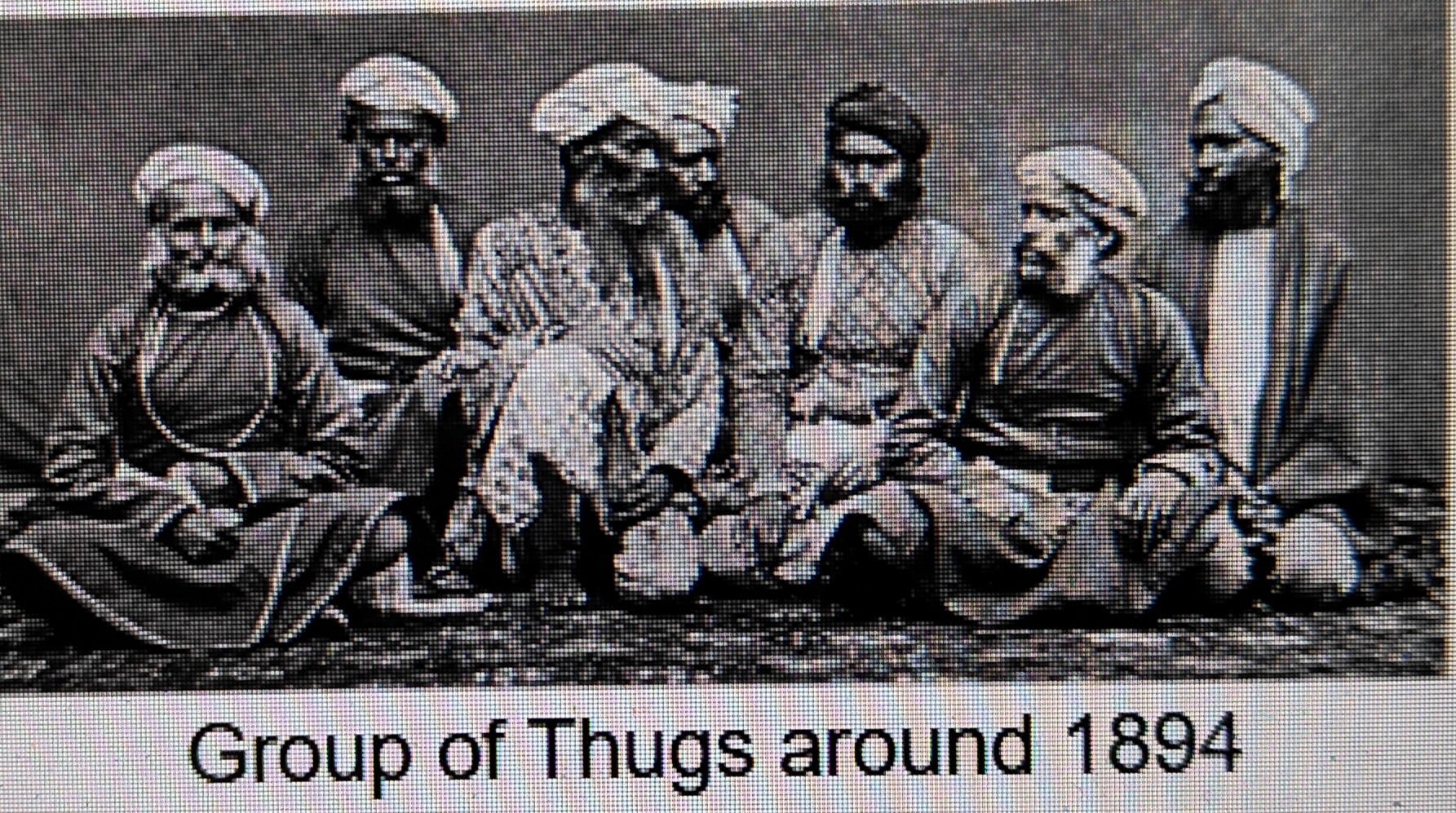
The heinous acts of ‘Thugs’ were called ‘Thuggee.’ They were organised gangs of robbers and murderers. The English word ‘Thug’ originates from the Hindi word Thug which means a ‘swindler’ or a ‘deceiver’.’ ‘Thugee’ entailed an act of murder and robbery of travellers. It was rampant in the northern parts of the Indian subcontinent.
Thugs travelled in groups. There are numerous folklore about their origin. One recorded by D.F. McLeod an Anglo-Indian civil servant traced it back to the Muslim tribes originating from those who fled Delhi after murdering a physician. Another traced it to certain renowned Muslim families who fled after murdering a favourite slave of Akbar. These original Muslim thugs cultivated thuggee, amongst various communities and castes of Hindus. According to some other folklore, thugs were Kanjars or descended from those, who worked in Mughal barracks. Others blamed the rise of thugs on the disbanding of armies in the employment of Indian rulers after the British conquest. Thugs operated in gangs as highway robbers, first tricking and later strangling their victims.
To take advantage of the victims, the thugs would join travellers to first gain their confidence. This would facilitate them to surprise and strangle the travellers with a handkerchief or a noose. They would then rob, kill and bury the victims. This gave the thugs the name Phansigar, one who kills with a noose. During the 1830s, the Governor-General of India, Lord William Bentinck and his chief captain, William Henry Sleeman, targeted the elimination of thugs.
In physical appearance, the thugs resembled the travellers. They wore turbans and carried some baggage in person. Their attire would deceive, any traveller.
The idea of ‘Thugee’ was to steal maximum loot without being apprehended. The thugs did not accost travellers until their own numbers were greater than their target. They first flattered the travellers they met, which gave them a chance to gauge how many valuables they were carrying. Thugs avoided committing thuggee close to their native place, so their crimes were difficult to discover. They pretended to be either Hindu or Muslim to fool their victims.
They usually attacked in the evening. A common way was to distract their targets while attempting to strangle them from behind. They carried only a few swords for self-defence to avoid any suspicion. At times they even mutilated the corpses of their victims to avoid detection. The corpse was then hidden or buried.
The leader of the gang was called Jamadar. They used ranks such as jamadar and subedar, to suggest that their organisation had a military construct. They spoke a secret language called ‘Ramasee’ to disguise their real intentions from their targets. Although strangulation was one of their most recognised methods of murder, they also used blades and poison.
Thugs were made up of men, who inherited thuggee as a family vocation, as well as those, who were forced to turn to it because of circumstances. The head of the gang was based on inheritance with family members sometimes serving together in the same band. These thugs were known as aseel. Certain thugs, insisted, that beginners were not taught thuggee, by their own family members but by outsiders who were often more skilled and experienced. They were called gurus. Thugs usually kept their acts secret. There were female thugs too who were called baronee in their secret language Ramasee, while an important male thug was called baroo.
Thugs often avoided, the killing of a victim’s child, instead they would adopt the child. At times they murdered women and children to eliminate witnesses. Some thugs avoided killing of victims they considered proscribed according to their beliefs and let other unscrupulous members commit the murder.
It is on record that during the 14th century, a thousand thugs were captured and hanged on the streets of Delhi. Two-hundred years later Sher Shah Suri organised a cavalry of 1,200 men to keep them at bay. Akbar and his successors launched drives against the thugs, but it was only in the 19th century that Sir W. H. Sleeman succeeded in wiping them out after a relentless operation lasting seven years.
The initial references to the thugs as a fraternity, rather than ordinary thieves, is found in Zia-ud-din Barni’s History of Firoz Shah written around 1356, where he narrated an incident of sultan Jalal-ud-din Khalji, having arrested 1,000 thugs.
Poet Surdas, in his couplets, mentioned, robbers called “thugs.” The Janamsakhis, the legendary biographies of Guru Nanak, used the term thug to refer to a robber who used to lure pilgrims. Jean de Thevenot, a French traveller in his account referred to a band of robbers who used a “certain slip with a running noose” to strangle their victims. John Fryer an English doctor of the Royal Society, mentioned a similar method of strangling used by robbers from Surat whom he saw being given capital punishment by the Mughals in 1675. An edict issued by Aurangzeb in 1672 refers to a similar method and uses the term “Phansigar”.
The garrotte (killing by strangulation) is often depicted as a weapon of the thuggee. Thugs committed their murders with nooses of rope or catgut, but later they adopted the use of a length of cloth that could be used as a sash or scarf, and thus more easily concealed. This cloth is sometimes described as a rumal (head covering or kerchief), translated as “yellow scarf”; “yellow”, in this case, may refer to a natural cream or khaki colour rather than bright yellow.
Thug’s preference for strangulation might have originated from a quirk of the law under the Mughal Empire that ruled most of India from the 1500s. For a murderer to be sentenced to death, he or she must have shed the blood of the victim. Those who murdered but did not shed blood might face imprisonment, hard labour and paying of a penalty—but they would not risk execution.
A poison called Datura, derived from a plant in the Nightshade family, was sometimes used by thugs to induce drowsiness making strangulation easier.
The “River Thugs” killed people which included Hindu pilgrims, travelling through the River Ganga, and were active mostly during the winter. Their vocabulary of Ramasee differed from the one used by the thugs on land. They used boats taken on lease from the boat-builders or a jamadar called Khuruck Baboo. Sleeman states that they tapped three times to give the signal to murder, which they always committed during the day. To avoid detection of a corpse, they broke its back and threw it in the river to be eaten by crocodiles and only looted money or jewels.
By the 1870s, the ‘thug cult’ was largely extinct. However, the history of thuggee contributed to the establishment of the Criminal Tribes Act (CTA) of 1871. The CTA was repealed after India gained independence. The Thuggee and Dacoity Department continued to operate until 1904 when it was replaced by the Central Criminal Intelligence Department (CID). Numerous Bollywood movies have been made on ‘Thuggee’, including Gunga Din (1939), Sunghursh (1968), and Thugs of Hindostan.
Shravan Charity Mission is an NGO that works for poor children suffering from life-threatening diseases, especially cancer. Our posts are meant for our readers, including children and adults, and have a huge variety of content. We also accept donations for our mission. Should you wish to donate to the cause of cancer? The bank details are given below:
NAME OF ACCOUNT: SHRAVAN CHARITY MISSION
Account no: 680510110004635 (BANK OF INDIA)
IFSC code: BKID0006805
*
Publications of Kamlesh Tripathi
BOOK TITLE: GLOOM BEHIND THE SMILE
(The book is about a young cancer patient. Now archived in eight prestigious libraries of the US which include Harvard College Library; Harvard University Library; Library of Congress; University of Washington, Seattle; University of Minnesota, Minneapolis; Yale University, New Haven; University of Chicago; University of North Carolina, at Chapel Hill University Libraries. It can also be accessed at MIT through Worldcat.org. Besides, it is also available for reading in the libraries and archives of Canada; the Open Library; Cancer Aid and Research Foundation Mumbai; Jaipuria Institute of Management, Noida, India; Shoolini University, Yogananda Knowledge Center, Himachal Pradesh and Azim Premzi University, Bangalore and the Library of Cancer Aid and Research Foundation, Mumbai. The title also finds a mention in a book titled ‘Enduring Cancer: Life, Death and Diagnosis in Delhi’ by Dwaipayan Banerjee published by the Duke University Press).
BOOK TITLE: ONE TO TANGO … RIA’S ODYSSEY
(It is a book on ‘singlehood’ about a Delhi girl now archived in Connemara Library, Chennai and Delhi Public Library, GOI, Ministry of Culture, Delhi; It is also available for reading in the Indian National Bibliography, March 2016, in the literature section, in Central Reference Library, Ministry of Culture, India, Belvedere, Kolkata-700022)
BOOK TITLE: AADAB LUCKNOW … FOND MEMORIES
(This is a fiction written around the great city of Nawabs—Lucknow. It describes Lucknow in great detail and also talks about its Hindu-Muslim amity, which is the undying characteristic of Lucknow. The book was launched at the Lucknow International Literary Festival in 2014. It is catalogued and included for reading in Askews and Holts Library Services, Lancashire, U.K; Herrick District Library, Holland; Charlotte-Mecklenburg Library, Mecklenburg County, North Carolina, USA; Black Gold Cooperative Library Administration, Arroyo Grande, California; Berkeley Library, University of California; The Peshastin Public Library and The George Public Library near Washington, a Northern Central Washington Libraries branch; the Flagstaff City-Coconino County Public Library in Arizona in the US and the Salina Public Library, Kansas, USA.
BOOK TITLE: REFRACTIONS … FROM THE PRISM OF GOD
(Co-published by Cankids–Kidscan, a pan India NGO and Shravan Charity Mission, that works for child cancer in India. The book is endorsed by Ms Preetha Reddy, MD Apollo Hospitals Group. It was launched at the Lucknow International Literary Festival in 2016).
BOOK TITLE: TYPICAL TALE OF AN INDIAN SALESMAN
(Is a story of an Indian salesman who is, humbly qualified. Yet he fights his way through unceasing uncertainties to reach the top. A good read not only for salesmen but for any reader. The book was launched on 10th February 2018 at Gorakhpur Lit-Fest. Now available on Amazon, Flipkart and Onlinegatha)
BOOK TITLE: RHYTHM … IN POEMS
(Published in January 2019. The book contains 50 poems. The poems are about our day-to-day life. Poems from this book have been published in Shillong Times, Bandra Times, Bhavan’s Journal and Arunachal Times and Goan net. The book is available on Amazon, Flipkart and Onlinegatha)
BOOK TITLE: MIRAGE
(Published in February 2020. The book is a collection of eight short stories available on Amazon, Flipkart and Notion Press)
BOOK TITLE: AWADH ASSAM AND DALAI LAMA … The Kalachakra
(It is the story of the man who received His Holiness The Dalai Lama and his retinue in 1959 as a GOI representative when he fled Tibet in 1959. The book was launched on 21st November 2022 by His Holiness The Dalai Lama at Dharmshala. The title is archived in the library of the Department of Information and International Relations (DIIR) Government of Tibet, Tibet Policy Institute (TPI) and the personal library of His Holiness The Dalai Lama. The title is also archived in The Ohio Digital Library, USA. It was recently included in the digital library of the world-renowned company APPLE. Included in the library of Friends of Tibet and Maharashtra Mitra Mandal Library in Bandra, Mumbai.
(POEMS, SHORT STORIES AND ARTICLES OF KAMLESH TRIPATHI PUBLISHED IN JOURNALS AND MAGAZINES)
BHAVANS JOURNAL
Short stories, Book reviews and Articles published in Bhavan’s Journal: 1. Reality and Perception, 15.10.19; 2. Sending the Wrong Message, 31.5.20; 3. Eagle versus Scholars, June, 15 & 20, 2020; 4. Indica, 15.8.20; 5. The Story of King Chitraketu, August 31 2020; 6. Breaking Through the Chakravyuh, September 30 2020. 7. The Questioning Spouse, October 31, 2020; 8. Happy Days, November 15, 2020; 9. The Karma Cycle of Paddy and Wheat, December 15, 2020; 10. Power Vs Influence, January 31, 2021; 11. Three Refugees, March 15, 2021; 12. Rise and Fall of Ajatashatru, March 31, 2021; 13. Reformed Ruler, May 15, 2021; 14. A Lasting Name, May 31, 2021; 15. Are Animals Better Teachers? June 16, 2021; 16. Book Review: The Gram Swaraj, 1.7.21; 17. Right Age for Achievements, 15.7.21; 18. Big Things Have Small Beginnings, 15.8.21; 19. Where is Gangaridai?, 15.9.21; 20. Confront the Donkey Within You 30.9.21; 21. Know Your Strengths 15.10.21; 22. Poverty 15.11.21; 23. Top View 30.11.21; 24. The Bansuriwala 15.1.22; 25. Sale of Alaska 15.2.22; 26. The Dimasa Kingdom 28.2.22;27. Buried Treasure 15.4.22; 28. The Kingdom of Pragjyotisha 30.4.22; 29. Who is more useful? 15.5.22; 30. The White Swan from Lake Mansarovar 30.6.22; 31. Bhool Bhulayya 15.9.22; 32. Good Karma 30.9.22; 33. Good Name vs Bad Name 15.10.22; 34. Uttarapath—The Grand Trunk Road 1.12.22; 35. When Gods Get Angry 1.1.23; 36. Holinshed’s Chronicles 15.1.23; 37. Theogony 15.2.23; 38. Poem: Mother 14.5.23; 39. The Nag Mandir 30.6.23; 40. The Story of Garuda 30.7.23; 41. Janmabhoomi vs Karmabhoomi 31.8.23; 42. The Ghost Town of Kuldhara 15.9.23; 43. The Tale of Genji 15.10.23; 44. The Soul Connection 1.12.23; 45.Book review: Jungle Nama … a story of the Sundarban 16.3.24; 46. Book review: A Forgotten Chapter 16.5.24; 47. Exploring Ancient Egypt, 1.8.24; 48. The Story of Dhruva, 16.8.24; 49. Two Hundred Years of Tea in Assam 16.9.24; 50. The Cosmic Messenger 16.10.24; 51. Biblioburro: The Four-Legged Library 16.11.24
THE SHILLONG TIMES
Articles & Poems: 1. Poem: Happy New Year 8.1.23; 2.Poem: Spring 12.3.23; 3.Poem: Right and Wrong 20.3.23; 4.The Gush of Emotion—Writing, 26.3.23; 5. The Nag Mandir, 7.5.23; 6. Poem: Mother 7.5.23; 7. Poem: Rain Rain 9.7.23; 8. Poem:You Come Alone You Go Alone 6.8.23; 9. Poem: Rain Rain (Second Time) 10.8.23; 10. Poem: Guru Teacher 1.10.23; 11. Poem: Autumn … The Interim Heaven 15.10.23; 12. Poem: Happy Diwali 12.11.23; 13. Overcoming Blindness: Learn it the John Milton Way 10.12.23; 14. The Happy Prince and The Happy Man’s Shirt 31.12.23; 15. Annus Mirabilis -2024 7.1.24; 16. Gandhi to Mahatma Gandhi- Incidents that Shaped Gandhi in South Africa 28.1.24; 17. Poem: Together But Not Made For Each Other, 11.2.24; 18. The Birds Bees and The Spiders of Nicholas Guildford and Jonathan Swift 25.2.24; 19. The Overcoats of Nikolai Gogol and Ruskin Bond 10.3.24; 20. The Ethnic Colours of Holi 24.3.24; 21. A Lesson from Dalai Lama, 21.4.24; 22. Poem: Morning Walk 28.4.24; 23. Trip to Rhine Falls, Switzerland, 19.5.24; 24. Poem: Hurt 2.6.24; 25. Poem: Your Conscience Was My Sign On 16.6.24; 26.Poem: The Eerie Ways of Time 7.7.24; 27.Poem: Celebrating the T20 World Champions 14.7.24;28. Read to Rise above mediocrity, 4.8.24; 29. Poem: Desire vs Reality 11.8.24; 30. Jack Ma’s Pristine Advice to Employers, Employees and the Youth 22.9.24; 31. Tagore and Kipling 3.11.24; 32. Poem: Merry Christmas 22.12.24;
THE ASSAM TRIBUNE
Article: 1. The Magic of Reading 11.12.23; 2. Gandhi to Mahatma 29.1.24; 3. Geography of Solitude 8.4.24; 4. A Lesson From Dalai Lama, 22.4.24; 5. A Source of Inspiration, 29.4.24; 6. The Four-LeggedLibrary, 12.5.24; 7. Age and Achievement, 10.6.24; 8. Read … To Rise Above Mediocrity, 1.7.24; 9. Crusade for a College, 25.8.24; 10. Hemingway’s Iceberg Theory (Panorama) 27.9.24; 11. Short story: Love in the Air, 20.10.24;
THE ARUNACHAL TIMES
Poem: 1. Hope—In The Arc of Twilight, 13.8.23; 2.Poem: Spring 3.3.24; 3.Poem: The Morning Walk 10.3.24;
BANDRA TIMES, MUMBAI
Articles & Poems: 1. Poem: SPRING, 1.4.23; 2. Poem: Mother, 1.6.23; 3. Poem: Rain Rain, 1.8.23; 4. A Lesson From Dalai Lama, 1.6.24; 5. Read to rise above Mediocrity 1.8.24
THE GOAN NET
Poem: 1. Autumn – The Interim Heaven, 6.10.24; 2. Reader’s Rewind 17.11.84; 3. Reader’s Rewind: The Irony of Tash Moustache or Mooch 5.12.24; 4. The Sunset Point 22.12.24;
ARTICLES IN THE DIGITAL MAGAZINE ESAMSKRITI
Aritcles: 29.12.2020: Indica by Megasthenes; 14.3.22: About The Dimasa Kingdom Assam; 10.12.22: Grand Trunk Road–Uttarapath; 5.10.23: The Ghost Town of Kuldhara Near Jaisalmer;
(ALL THE ABOVE BOOK TITLES ARE AVAILABLE FOR SALE ON AMAZON, FLIPKART AND OTHER ONLINE STORES OR YOU COULD EVEN WRITE TO US FOR A COPY)
The world has become colourful. But the ‘Happy Prince’ is no more alive to see it. So is the swallow, who carried out his last orders, but died in the frost, at his feet, before escaping to Egypt. The lead metal statue of the ‘Happy Prince’ cracks in agony but his leaden heart still beats for his kingdom and his junta. But are there any such rulers left, anymore? Well, they are practically extinct. Perhaps, you might know the author who wrote the story ‘Happy Prince.’ I’m forgetting his name. Oh! I remember now it was Oscar Wilde, par naam me kya rakha hai, Oscar can rewrite the story in the context of the present-day while residing in heaven. And is there a ‘happy man’ without a shirt, anymore, as told in the Italian tale, or like the half-naked fakir—Mahatma Gandhi in India, the father of the nation without a shirt who was given the abrasive title by the British Prime Minister, Winston Churchill. I’m sure there isn’t a happy man without a shirt anymore because the man now wears not only shirts but also colourful shirts, yet he remains unhappy.
The Utopia is now seized of radiant colours, such as red—blue, green and saffron, and some adamant tenets, and philosophies, required to rule, and the so-called isms, the right wing and the left wing in the central hall of democracy. Have we gone back in time? Are we proving Hesiod’s Theogony to be right, that propagated initially, the theory that said, the dense darkness covered everything, until the earth was born out of chaos? With earth came the mountains, the sea, the sky and the Uranus. Uranus and Earth came together and gave birth to the Titans. Later the Titans and Gods both from the same lineage and class fought for supremacy and the Greek God Zeus won just like Lord Krishna.
But halt there. Take time off to think because the world leaders of today suffer from the same fear as Uranus, Cronus and the Kansa Mama of Mathura, who killed their would-be adversaries. Even Nigas tried swallowing Lord Vishnu but that was in a different context. Ajatashatru killed his father Bimbisara to take the throne of Magadha and in return, his son too killed him for the throne. The Robinhoods are extinct now. The two biggest democracies are always in the news but at times for the wrong reasons. The world is full of Brutus in today’s times which may put the original Brutus to shame and the Bard into a wonder—to be or not to be.
It appears as if goodness has become a ghost which is rarely seen and experienced. Much has evolved, but more is yet to come. So wait and watch. Be on the lookout for that happy man without a shirt, and the happy prince, with a lead heart that beats for the public even now. Hopefully, I dreamt, Utopia will remain Utopia and not become a Dystopia.
Shravan Charity Mission is an NGO that works for poor children suffering from life-threatening diseases, especially cancer. Our posts are meant for our readers, including children and adults, and have a huge variety of content. We also accept donations for our mission. Should you wish to donate to the cause of cancer? The bank details are given below:
NAME OF ACCOUNT: SHRAVAN CHARITY MISSION
Account no: 680510110004635 (BANK OF INDIA)
IFSC code: BKID0006805
*
Publications of Kamlesh Tripathi
BOOK TITLE: GLOOM BEHIND THE SMILE
(The book is about a young cancer patient. Now archived in eight prestigious libraries of the US which include Harvard College Library; Harvard University Library; Library of Congress; University of Washington, Seattle; University of Minnesota, Minneapolis; Yale University, New Haven; University of Chicago; University of North Carolina, at Chapel Hill University Libraries. It can also be accessed at MIT through Worldcat.org. Besides, it is also available for reading in the libraries and archives of Canada; the Open Library; Cancer Aid and Research Foundation Mumbai; Jaipuria Institute of Management, Noida, India; Shoolini University, Yogananda Knowledge Center, Himachal Pradesh and Azim Premzi University, Bangalore and the Library of Cancer Aid and Research Foundation, Mumbai. The title also finds a mention in a book titled ‘Enduring Cancer: Life, Death and Diagnosis in Delhi,’ by Dwaipayan Banerjee published by the Duke University Press).
BOOK TITLE: ONE TO TANGO … RIA’S ODYSSEY
(It is a book on ‘singlehood’ about a Delhi girl now archived in Connemara Library, Chennai and Delhi Public Library, GOI, Ministry of Culture, Delhi; It is also available for reading in the Indian National Bibliography, March 2016, in the literature section, in Central Reference Library, Ministry of Culture, India, Belvedere, Kolkata-700022)
BOOK TITLE: AADAB LUCKNOW … FOND MEMORIES
(This is a fiction written around the great city of Nawabs—Lucknow. It describes Lucknow in great detail and also talks about its Hindu-Muslim amity, which is the undying characteristic of Lucknow. The book was launched at the Lucknow International Literary Festival in 2014. It is catalogued and included for reading in Askews and Holts Library Services, Lancashire, U.K; Herrick District Library, Holland; Charlotte-Mecklenburg Library, Mecklenburg County, North Carolina, USA; Black Gold Cooperative Library Administration, Arroyo Grande, California; Berkeley Library, University of California; The Peshastin Public Library and The George Public Library near Washington, a Northern Central Washington Libraries branch; the Flagstaff City-Coconino County Public Library in Arizona in the US and the Salina Public Library, Kansas, USA.
BOOK TITLE: REFRACTIONS … FROM THE PRISM OF GOD
(Co-published by Cankids–Kidscan, a pan India NGO and Shravan Charity Mission, that works for child cancer in India. The book is endorsed by Ms Preetha Reddy, MD Apollo Hospitals Group. It was launched at the Lucknow International Literary Festival in 2016).
BOOK TITLE: TYPICAL TALE OF AN INDIAN SALESMAN
(Is a story of an Indian salesman who is, humbly qualified. Yet he fights his way through unceasing uncertainties to reach the top. A good read not only for salesmen but for any reader. The book was launched on 10th February 2018 at Gorakhpur Lit-Fest. Now available on Amazon, Flipkart and Onlinegatha)
BOOK TITLE: RHYTHM … IN POEMS
(Published in January 2019. The book contains 50 poems. The poems are about our day-to-day life. Poems from this book have been published in Shillong Times, Bandra Times, Bhavan’s Journal and Arunachal Times and Goan Net. The book is available on Amazon, Flipkart and Onlinegatha)
BOOK TITLE: MIRAGE
(Published in February 2020. The book is a collection of eight short stories available on Amazon, Flipkart and Notion Press)
BOOK TITLE: AWADH ASSAM AND DALAI LAMA … The Kalachakra
(It is the story of the man who received His Holiness The Dalai Lama and his retinue in 1959 as a GOI representative when he fled Tibet in 1959. The book was launched on 21st November 2022 by His Holiness The Dalai Lama at Dharmshala. The title is archived in the library of the Department of Information and International Relations (DIIR) Government of Tibet, Tibet Policy Institute (TPI) and the personal library of His Holiness The Dalai Lama. The title is also archived in The Ohio Digital Library, USA. It was recently included in the digital library of the world-renowned company APPLE. Included in the library of Friends of Tibet and Maharashtra Mitra Mandal Library in Bandra, Mumbai.
(POEMS, SHORT STORIES AND ARTICLES OF KAMLESH TRIPATHI PUBLISHED IN JOURNALS AND MAGAZINES)
BHAVANS JOURNAL
Short stories, Book reviews and Articles published in Bhavan’s Journal: 1. Reality and Perception, 15.10.19; 2. Sending the Wrong Message, 31.5.20; 3. Eagle versus Scholars, June, 15 & 20, 2020; 4. Indica, 15.8.20; 5. The Story of King Chitraketu, August 31 2020; 6. Breaking Through the Chakravyuh, September 30 2020. 7. The Questioning Spouse, October 31, 2020; 8. Happy Days, November 15, 2020; 9. The Karma Cycle of Paddy and Wheat, December 15, 2020; 10. Power Vs Influence, January 31, 2021; 11. Three Refugees, March 15, 2021; 12. Rise and Fall of Ajatashatru, March 31, 2021; 13. Reformed Ruler, May 15, 2021; 14. A Lasting Name, May 31, 2021; 15. Are Animals Better Teachers? June 16, 2021; 16. Book Review: The Gram Swaraj, 1.7.21; 17. Right Age for Achievements, 15.7.21; 18. Big Things Have Small Beginnings, 15.8.21; 19. Where is Gangaridai?, 15.9.21; 20. Confront the Donkey Within You 30.9.21; 21. Know Your Strengths 15.10.21; 22. Poverty 15.11.21; 23. Top View 30.11.21; 24. The Bansuriwala 15.1.22; 25. Sale of Alaska 15.2.22; 26. The Dimasa Kingdom 28.2.22;27. Buried Treasure 15.4.22; 28. The Kingdom of Pragjyotisha 30.4.22; 29. Who is more useful? 15.5.22; 30. The White Swan from Lake Mansarovar 30.6.22; 31. Bhool Bhulayya 15.9.22; 32. Good Karma 30.9.22; 33. Good Name vs Bad Name 15.10.22; 34. Uttarapath—The Grand Trunk Road 1.12.22; 35. When Gods Get Angry 1.1.23; 36. Holinshed’s Chronicles 15.1.23; 37. Theogony 15.2.23; 38. Poem: Mother 14.5.23; 39. The Nag Mandir 30.6.23; 40. The Story of Garuda 30.7.23; 41. Janmabhoomi vs Karmabhoomi 31.8.23; 42. The Ghost Town of Kuldhara 15.9.23; 43. The Tale of Genji 15.10.23; 44. The Soul Connection 1.12.23; 45.Book review: Jungle Nama … a story of the Sundarban 16.3.24; 46. Book review: A Forgotten Chapter 16.5.24; 47. Exploring Ancient Egypt, 1.8.24; 48. The Story of Dhruva, 16.8.24; 49. Two Hundred Years of Tea in Assam 16.9.24; 50. The Cosmic Messenger 16.10.24; 51. Biblioburro: The Four-Legged Library 16.11.24
THE SHILLONG TIMES
Articles & Poems: 1. Poem: Happy New Year 8.1.23; 2.Poem: Spring 12.3.23; 3.Poem: Right and Wrong 20.3.23; 4.The Gush of Emotion—Writing, 26.3.23; 5. The Nag Mandir, 7.5.23; 6. Poem: Mother 7.5.23; 7. Poem: Rain Rain 9.7.23; 8. Poem:You Come Alone You Go Alone 6.8.23; 9. Poem: Rain Rain (Second Time) 10.8.23; 10. Poem: Guru Teacher 1.10.23; 11. Poem: Autumn … The Interim Heaven 15.10.23; 12. Poem: Happy Diwali 12.11.23; 13. Overcoming Blindness: Learn it the John Milton Way 10.12.23; 14. The Happy Prince and The Happy Man’s Shirt 31.12.23; 15. Annus Mirabilis -2024 7.1.24; 16. Gandhi to Mahatma Gandhi- Incidents that Shaped Gandhi in South Africa 28.1.24; 17. Poem: Together But Not Made For Each Other, 11.2.24; 18. The Birds Bees and The Spiders of Nicholas Guildford and Jonathan Swift 25.2.24; 19. The Overcoats of Nikolai Gogol and Ruskin Bond 10.3.24; 20. The Ethnic Colours of Holi 24.3.24; 21. A Lesson from Dalai Lama, 21.4.24; 22. Poem: Morning Walk 28.4.24; 23. Trip to Rhine Falls, Switzerland, 19.5.24; 24. Poem: Hurt 2.6.24; 25. Poem: Your Conscience Was My Sign On 16.6.24; 26.Poem: The Eerie Ways of Time 7.7.24; 27.Poem: Celebrating the T20 World Champions 14.7.24;28. Read to Rise above mediocrity, 4.8.24; 29. Poem: Desire vs Reality 11.8.24; 30. Jack Ma’s Pristine Advice to Employers, Employees and the Youth 22.9.24; 31. Tagore and Kipling 3.11.24;
THE ASSAM TRIBUNE
Article: 1. The Magic of Reading 11.12.23; 2. Gandhi to Mahatma 29.1.24; 3. Geography of Solitude 8.4.24; 4. A Lesson From Dalai Lama, 22.4.24; 5. A Source of Inspiration, 29.4.24; 6. The Four-LeggedLibrary, 12.5.24; 7. Age and Achievement, 10.6.24; 8. Read … To Rise Above Mediocrity, 1.7.24; 9. Crusade for a College, 25.8.24; 10. Hemingway’s Iceberg Theory (Panorama) 27.9.24; 11. Short story: Love in the Air, 20.10.24;
THE ARUNACHAL TIMES
Poem: 1. Hope—In The Arc of Twilight, 13.8.23; 2.Poem: Spring 3.3.24; 3.Poem: The Morning Walk 10.3.24;
BANDRA TIMES, MUMBAI
Articles & Poems: 1. Poem: SPRING, 1.4.23; 2. Poem: Mother, 1.6.23; 3. Poem: Rain Rain, 1.8.23; 4. A Lesson From Dalai Lama, 1.6.24; 5. Read to rise above Mediocrity 1.8.24
THE GOAN NETEVERYDAY
Poem: 1. Autumn – The Interim Heaven, 6.10.24; 2. Reader’s Rewind 17.11.84; 3. Reader’s Rewind: The Irony of Tash Moustache and Mooch 5.12.24;
ARTICLES IN THE DIGITAL MAGAZINE ESAMSKRITI
Aritcles: 29.12.2020: Indica by Megasthenes; 14.3.22: About The Dimasa Kingdom Assam; 10.12.22: Grand Trunk Road–Uttarapath; 5.10.23: The Ghost Town of Kuldhara Near Jaisalmer;
(ALL THE ABOVE BOOK TITLES ARE AVAILABLE FOR SALE ON AMAZON, FLIPKART AND OTHER ONLINE STORES OR YOU COULD EVEN WRITE TO US FOR A COPY)
Primordial times are privy to the fact that nothing is achieved in life without effort. The effort could be either positive or negative. The choice is yours as God doesn’t control your Karma. A negative effort could lead to the dropping of the atomic bomb on Japan’s Hiroshima and Nagasaki eradicating it completely. In contrast, a positive effort could be the construction of the Suez Canal which shortened the maritime distance considerably, between Asia and Europe, thereby accelerating the cargo and passenger movement by sea. And every inch of effort bears a proportionate result, as per the law of nature.
Hu Shih, a former Chinese diplomat to America who was also an essayist, fiction writer, literary scholar, philosopher and politician once said, ‘Life on its own does not mean anything – it takes on any meaning that you decide to give it. Instead of spending all day contemplating the meaning of life, we may as well attempt to do something that gives it one.
Be bold when making a case and cautious in seeking evidence; be earnest in all matters and solemn in your conduct. We must be firm in believing that today’s failure is yesterday’s lack of hard work and effort and that today’s effort and hard work will surely lead to tomorrow’s great success.
The moments when you are sad and disappointed are the times when you need courage and faith the most. You need to firmly believe that no effort and hard work ever goes wasted in this world. I may not be the one to succeed – yet no effort will go in vain.
Every part of yesterday makes up for what I am today; do not think too far ahead and grieve. From now on, I shall reap as I sow.’
The sane advice from the Buddhist Dharmapada is, ‘The effort is like a treasure. Those who make positive efforts are mindful, pure in conduct, self-disciplined, and live in accordance with the Dharma, have ever-increasing glory. Through effort, heedfulness, and self-discipline, the wise make a continent for themselves that cannot be submerged by flood. The foolish and ignorant indulge in heedlessness, while the wise guard his heedlessness as if protecting a gem’.
‘There is a story of effort behind every success’ says the Chinese venerable master Hsing Yun. He says ‘The name of the effort may vary. Just as, to succeed, one needs hardships; to be celebrated one needs pressure; to gain honour one needs to labour; to achieve one needs to sacrifice and be dedicated. An ancient tree survives wind and frost. A skyscraper is raised with money and sweat. An old business has its ups and downs. An old man is tested by misfortune. Those who don’t look back have no past. Those who don’t look forward have no future. Those who don’t seize the moment have no present. Those who don’t master themselves will not change the society.’
Hsing Yun further says ‘Repeated action becomes a habit, the habit becomes a character, the character becomes fate and fate rules your life and when you work hard, don’t worry about success or failure. When you have done your best don’t worry if you’ve failed, for no effort goes in vain.
Here I’m also reminded of the Greek tragedian Sophocles who said, ‘Success is dependent on effort’, and have you ever seen an idle man succeed?
Shravan Charity Mission is an NGO that works for poor children suffering from life-threatening diseases, especially cancer. Our posts are meant for our readers, including children and adults, and have a huge variety of content. We also accept donations for our mission. Should you wish to donate to the cause of cancer? The bank details are given below:
NAME OF ACCOUNT: SHRAVAN CHARITY MISSION
Account no: 680510110004635 (BANK OF INDIA)
IFSC code: BKID0006805
*
Publications of Kamlesh Tripathi
BOOK TITLE: GLOOM BEHIND THE SMILE
(The book is about a young cancer patient. Now archived in eight prestigious libraries of the US which include Harvard College Library; Harvard University Library; Library of Congress; University of Washington, Seattle; University of Minnesota, Minneapolis; Yale University, New Haven; University of Chicago; University of North Carolina, at Chapel Hill University Libraries. It can also be accessed at MIT through Worldcat.org. Besides, it is also available for reading in the libraries and archives of Canada; the Open Library; Cancer Aid and Research Foundation Mumbai; Jaipuria Institute of Management, Noida, India; Shoolini University, Yogananda Knowledge Center, Himachal Pradesh and Azim Premzi University, Bangalore and the Library of Cancer Aid and Research Foundation, Mumbai. The title also finds a mention in a book titled ‘Enduring Cancer: Life, Death and Diagnosis in Delhi’ by Dwaipayan Banerjee published by the Duke University Press).
BOOK TITLE: ONE TO TANGO … RIA’S ODYSSEY
(It is a book on ‘singlehood’ about a Delhi girl now archived in Connemara Library, Chennai and Delhi Public Library, GOI, Ministry of Culture, Delhi; It is also available for reading in the Indian National Bibliography, March 2016, in the literature section, in Central Reference Library, Ministry of Culture, India, Belvedere, Kolkata-700022)
BOOK TITLE: AADAB LUCKNOW … FOND MEMORIES
(This is a fiction written around the great city of Nawabs—Lucknow. It describes Lucknow in great detail and also talks about its Hindu-Muslim amity, which is the undying characteristic of Lucknow. The book was launched at the Lucknow International Literary Festival in 2014. It is catalogued and included for reading in Askews and Holts Library Services, Lancashire, U.K; Herrick District Library, Holland; Charlotte-Mecklenburg Library, Mecklenburg County, North Carolina, USA; Black Gold Cooperative Library Administration, Arroyo Grande, California; Berkeley Library, University of California; The Peshastin Public Library and The George Public Library near Washington, a Northern Central Washington Libraries branch; the Flagstaff City-Coconino County Public Library in Arizona in the US and the Salina Public Library, Kansas, USA.
BOOK TITLE: REFRACTIONS … FROM THE PRISM OF GOD
(Co-published by Cankids–Kidscan, a pan India NGO and Shravan Charity Mission, that works for child cancer in India. The book is endorsed by Ms Preetha Reddy, MD Apollo Hospitals Group. It was launched at the Lucknow International Literary Festival in 2016).
BOOK TITLE: TYPICAL TALE OF AN INDIAN SALESMAN
(Is a story of an Indian salesman who is, humbly qualified. Yet he fights his way through unceasing uncertainties to reach the top. A good read not only for salesmen but for any reader. The book was launched on 10th February 2018 at Gorakhpur Lit-Fest. Now available on Amazon, Flipkart and Onlinegatha)
BOOK TITLE: RHYTHM … IN POEMS
(Published in January 2019. The book contains 50 poems. The poems are about our day-to-day life. Poems from this book have been published in Shillong Times, Bandra Times, Bhavan’s Journal and Arunachal Times. The book is available on Amazon, Flipkart and Onlinegatha)
BOOK TITLE: MIRAGE
(Published in February 2020. The book is a collection of eight short stories available on Amazon, Flipkart and Notion Press)
BOOK TITLE: AWADH ASSAM AND DALAI LAMA … The Kalachakra
(It is the story of the man who received His Holiness The Dalai Lama and his retinue in 1959 as a GOI representative when he fled Tibet in 1959. The book was launched on 21st November 2022 by His Holiness The Dalai Lama at Dharmshala. The title is archived in the library of the Department of Information and International Relations (DIIR) Government of Tibet, Tibet Policy Institute (TPI) and the personal library of His Holiness The Dalai Lama. The title is also archived in The Ohio Digital Library, USA. It was recently included in the digital library of the world-renowned company APPLE). Included in the library of Friends of Tibet.
(POEMS, SHORT STORIES AND ARTICLES OF KAMLESH TRIPATHI PUBLISHED IN JOURNALS AND MAGAZINES)
BHAVANS JOURNAL
Short stories, Book reviews and Articles published in Bhavan’s Journal: 1. Reality and Perception, 15.10.19; 2. Sending the Wrong Message, 31.5.20; 3. Eagle versus Scholars, June, 15 & 20, 2020; 4. Indica, 15.8.20; 5. The Story of King Chitraketu, August 31 2020; 6. Breaking Through the Chakravyuh, September 30 2020. 7. The Questioning Spouse, October 31, 2020; 8. Happy Days, November 15, 2020; 9. The Karma Cycle of Paddy and Wheat, December 15, 2020; 10. Power Vs Influence, January 31, 2021; 11. Three Refugees, March 15, 2021; 12. Rise and Fall of Ajatashatru, March 31, 2021; 13. Reformed Ruler, May 15, 2021; 14. A Lasting Name, May 31, 2021; 15. Are Animals Better Teachers? June 16, 2021; 16. Book Review: The Gram Swaraj, 1.7.21; 17. Right Age for Achievements, 15.7.21; 18. Big Things Have Small Beginnings, 15.8.21; 19. Where is Gangaridai?, 15.9.21; 20. Confront the Donkey Within You 30.9.21; 21. Know Your Strengths 15.10.21; 22. Poverty 15.11.21; 23. Top View 30.11.21; 24. The Bansuriwala 15.1.22; 25. Sale of Alaska 15.2.22; 26. The Dimasa Kingdom 28.2.22;27. Buried Treasure 15.4.22; 28. The Kingdom of Pragjyotisha 30.4.22; 29. Who is more useful? 15.5.22; 30. The White Swan from Lake Mansarovar 30.6.22; 31. Bhool Bhulayya 15.9.22; 32. Good Karma 30.9.22; 33. Good Name vs Bad Name 15.10.22; 34. Uttarapath—The Grand Trunk Road 1.12.22; 35. When Gods Get Angry 1.1.23; 36. Holinshed’s Chronicles 15.1.23; 37. Theogony 15.2.23; 38. Poem: Mother 14.5.23; 39. The Nag Mandir 30.6.23; 40. The Story of Garuda 30.7.23; 41. Janmabhoomi vs Karmabhoomi 31.8.23; 42. The Ghost Town of Kuldhara 15.9.23; 43. The Tale of Genji 15.10.23; 44. The Soul Connection 1.12.23; 45.Book review: Jungle Nama … a story of the Sundarban 16.3.24; 46. Book review: A Forgotten Chapter 16.5.24; 47. Exploring Ancient Egypt, 1.8.24; 48. The Story of Dhruva, 16.8.24; 49. Two Hundred Years of Tea in Assam 16.9.24;
THE SHILLONG TIMES
Articles & Poems: 1. Poem: Happy New Year 8.1.23; 2.Poem: Spring 12.3.23; 3.Poem: Right and Wrong 20.3.23; 4.The Gush of Emotion—Writing, 26.3.23; 5. The Nag Mandir, 7.5.23; 6. Poem: Mother 7.5.23; 7. Poem: Rain Rain 9.7.23; 8. Poem:You Come Alone You Go Alone 6.8.23; 9. Poem: Rain Rain (Second Time) 10.8.23; 10. Poem: Guru Teacher 1.10.23; 11. Poem: Autumn … The Interim Heaven 15.10.23; 12. Poem: Happy Diwali 12.11.23; 13. Overcoming Blindness: Learn it the John Milton Way 10.12.23; 14. The Happy Prince and The Happy Man’s Shirt 31.12.23; 15. Annus Mirabilis -2024 7.1.24; 16. Gandhi to Mahatma Gandhi- Incidents that Shaped Gandhi in South Africa 28.1.24; 17. Poem: Together But Not Made For Each Other, 11.2.24; 18. The Birds Bees and The Spiders of Nicholas Guildford and Jonathan Swift 25.2.24; 19. The Overcoats of Nikolai Gogol and Ruskin Bond 10.3.24; 20. The Ethnic Colours of Holi 24.3.24; 21. A Lesson from Dalai Lama, 21.4.24; 22. Poem: Morning Walk 28.4.24; 23. Trip to Rhine Falls, Switzerland, 19.5.24; 24. Poem: Hurt 2.6.24; 25. Poem: Your Conscience Was My Sign On 16.6.24; 26.Poem: The Eerie Ways of Time 7.7.24; 27.Poem: Celebrating the T20 World Champions 14.7.24;28. Read to Rise above mediocrity, 4.8.24; 29. Poem: Desire vs Reality 11.8.24; 30. Jack Ma’s Pristine Advice to Employers, Employees and the Youth 22.9.24;
THE ASSAM TRIBUNE
Article: 1. The Magic of Reading 11.12.23; 2. Gandhi to Mahatma 29.1.24; 3. Geography of Solitude 8.4.24; 4. A Lesson From Dalai Lama, 22.4.24; 5. A Source of Inspiration, 29.4.24; 6. The Four-LeggedLibrary, 12.5.24; 7. Age and Achievement, 10.6.24; 8. Read … To Rise Above Mediocrity, 1.7.24; 9. Crusade for a College, 25.8.24; 10. Hemingway’s Iceberg Theory (Panorama) 27.9.24;
THE ARUNACHAL TIMES
Poem: 1. Hope—In The Arc of Twilight, 13.8.23; 2.Poem: Spring 3.3.24; 3.Poem: The Morning Walk 10.3.24;
BANDRA TIMES, MUMBAI
Articles & Poems: 1. Poem: SPRING, 1.4.23; 2. Poem: Mother, 1.6.23; 3. Poem: Rain Rain, 1.8.23; 4. A Lesson From Dalai Lama, 1.6.24; 5. Read to rise above Mediocrity 1.8.24
THE GOANNET
1. Poem: Autumn – The Interim Heaven, 6.10.24
ARTICLES IN THE DIGITAL MAGAZINE ESAMSKRITI
29.12.2020: Indica by Megasthenes; 14.3.22: About The Dimasa Kingdom Assam; 10.12.22: Grand Trunk Road–Uttarapath; 5.10.23: The Ghost Town of Kuldhara Near Jaisalmer;
(ALL THE ABOVE BOOK TITLES ARE AVAILABLE FOR SALE ON AMAZON, FLIPKART AND OTHER ONLINE STORES OR YOU COULD EVEN WRITE TO US FOR A COPY)







 Shravan charity mission