In Shakespeare’s play, ‘The Merchant of Venice’, Gratiano, a close friend of Antonio, while addressing him, says,
Let me play the fool; /With mirth and laughter let old wrinkles come;/ And let my liver rather heat with wine/Than my heart cool with mortifying groans./Why should a man whose blood is warm within/Sit like his grandsire cut in alabaster,/Sleep when he wakes, and creep into the jaundice/By being peevish? I tell thee what, Antonio — I love thee, and ’tis my love that speaks — There are a sort of men whose visages/ Do cream and mantle like the standing pond.
In this address, Gratiano argues that a life without mirth is like living death. He prefers to “play the fool” and age naturally through laughter rather than grow emotionally cold through constant seriousness. Using the bodily imagery of liver, heart, and blood, Shakespeare contrasts warmth, passion, and circulation with ‘mortification,’ which literally means killing the spirit. Gratiano mocks men who, despite having ‘warm blood,’ sit rigid and joyless like alabaster tomb statues, alive in body but dead in feeling. Such people ‘sleep when they wake’ and even make themselves ill through peevishness, as suggested by the image of jaundice. Spoken out of affection for Antonio, the speech criticises cultivated melancholy and false gravity, asserting that true wisdom lies in emotional vitality, openness, and engagement with life rather than in frozen solemnity.
Although he speaks generally about a “sort of men” who cultivate solemnity. He directly names Antonio in the middle of the passage—“I tell you what, Antonio — I love thee, and ’tis my love that speaks”. This makes it clear that the speech is an affectionate rebuke of Antonio’s habitual melancholy at the beginning of The Merchant of Venice (Act I, Scene i). Gratiano urges Antonio to abandon his excessive seriousness and embrace warmth, mirth, and emotional vitality.
Excessive gravity dries up life, while laughter, warmth, and engagement are signs of true wisdom. Gratiano’s defence of mirth belongs to a long humanistic tradition. Numerous authors and texts have conveyed the concept of a fulfilling life. “Life is too important to be taken seriously”, says Oscar Wilde. L’Allegro (“The Cheerful Man”) and Il Penseroso (“The Pensive/Melancholy Man”) are companion poems by John Milton that explore two contrasting, yet complementary, ways of life: one embracing mirth, nature, and social joy, and the other favouring solitary contemplation, deep study, and serious thought, with both leading to profound insights and true happiness. They present a balanced view of a perfect life, showing the value in both active pleasure and deep reflection, often described as ‘twin poems.’
Gratiano’s defence of mirth and emotional warmth reflects a worldview strikingly close to that found in Hindu mythology, where life is understood not as grim endurance but as lila, the cosmic-divine play. Figures like Lord Krishna, who laughs, dances, and plays the flute even while guiding the world’s moral order, embody the belief that wisdom need not wear a solemn face. Similarly, Nataraja, the cosmic dancer, is a depiction of God Shiva, the great ascetic, suggesting that restraint and ecstasy must coexist. Both Shakespeare and Hindu mythology thus challenge the notion that gravity alone equals depth. They affirm that true understanding flows from warmth, movement, andengagement with life, where joy becomes not frivolity but a profound expression of spiritual and human vitality.
The Bhagavad Gita celebrates the Inner Cheerfulness, ‘Natushyati, na kanksati’ which means – The sthitaprajna (One with steady wisdom) neither grieves nor desires. He remains cheerful in himself. It rejects anxiety and gloom, valuing inner brightness and balance, much like Gratiano’s refusal to sit in sorrow. “Life itself is the greatest of gifts says Mahabharata – The epic repeatedly says that life, with all its struggles, is worth cherishing, and one should engage in it energetically.
Shravan Charity Mission is an NGO that works for poor children suffering from life-threatening diseases, especially cancer. Our posts are meant for our readers, including children and adults, and have a huge variety of content. We also accept donations for our mission. Should you wish to donate to the cause of cancer? The bank details are given below:
Appreciate and rejoice without any expectations. It doesn’t matter if people are nasty to you … betray you … don’t even say ‘thank you’ to you. By appreciating everything around you, from happy experiences to upsetting experiences, your life could be so meaningful, full of understanding, happiness, joy, strength and full of fearlessness … GYALWANG DRUPKA * The worst speculative sceptic I ever knew was a much better Man than the best superstitious Devotee and Bigot … Scottish enlightenment philosopher … David Hume * History is what hurts … FREDRIC JAMESON * A mind not to be changed by place or time. The mind is its own place, and in itself can make heav’n of hell, a hell of heav’n … John Milton, Paradise Lost * War is the continuation of business by other means, Brecht famously said, in his play, Mother Courage and Her Children. He wrote it in direct response to Hitler’s invasion of Poland in 1939 * Grand vision of justice, without adequate means of securing it and efficient means of delivering it would benefit none … SA BOBDE * Unless you doubt, your ‘wisdom’ itself is in doubt is a Greek adage * Authority is not truth; truth is the only authority * Ram’s example reminds us that being human is super * So paraphrasing Rene Descartes’ famous dictum… Cognito, Ergo, Sum- I think, therefore, I am, you doubt, therefore, you are. * Spiritually, there’s nothing big or small. Such ideas are like those of the literary people who think writing a poem is a high work and making shoes … is a small … low one … all are equal in the eyes of the Spirit … it is the spirit with which they are done that matters …SRI AUROBINDO * Shakespeare’s lines in As You Like It: ” Do you not know I am a woman. When I think I must speak.” * Only a fruit-laden tree has rocks thrown at it… Indian proverb * Being a woman is a terribly difficult task, since it consists principally in dealing with men … Joseph Conrad * If you lose, you learn and, therefore, you win. * If we all look into our own homes, how difficult we find it sometimes to smile at each other … Let us always meet each other with a smile, for the smile is the beginning of love, and once we begin to love each other naturally, we want to do something … MOTHER TERESA * Even if the vilest sinner worships me with exclusive devotion … Speedily he becomes virtuous and attains peace … Fix your mind on me, be devoted to me, worship me and make obeisance to me; thus linking yourself to me and entirely depending on me, you shall come to me … THE BHAGWAT GITA * When the heart speaks, the mind finds it indecent to object … Novelist Milan Kundera * It is often said in English that hunches seldom let you down. What emanates from the recesses of the heart doesn’t go in vain. * Hakim Sanai writes in one of his couplets in Pahlavi, ‘Zee an az Mee manzil zaaq-e-zehan/Shee’ and mansookh aawaaz-e-dil sehan’ … So long as I listened to my mind, I failed to reach my destination/ The moment I listened to the voice of my heart, the destination was before me. * Mind misleads, heart heals … An old adage * The symphony of the heart doesn’t have a single flawed note. It’s divinely prophetic * Who would deny that a single shelf of a good European library was worth the whole literature of India and Arabia. … Thomas Macaulay * There is a flower I meet on my walk … these days. It has sprung out of a … mug in Mrs D’s little balcony and is always nodding and dancing in the breeze. It is a happy flower, deserving of a happy, light name. I have named it Merry Heart, and sealed our friendship … RUSKIN BOND * The opposite of forgetfulness is mindfulness. Mindfulness is when you’re truly there, mind and body together… When your mind is there with your body, you are established in the present moment. Then you can recognise the many conditions of happiness that are in you and around you, and happiness just comes naturally … THICH NHAT HANH * Your heart, mind, object – may all these be One. So shall you prosper, all, and live in peace … God harnesses you all to the same yoke; the sacrificial Fire of Spirit tends ye all with one intent … walk ye together … and may your minds all know the Self-Same Truth … RIG VEDA * “The thing is to be happy,” he said. “No matter what… try that. You can. It gets to be easier and easier. It’s nothing to do with circumstances. You wouldn’t believe how good it is. Accept everything, and then tragedy disappears. Or tragedy lightens … you’re… there, going along easy in the world.” … ALICE MUNRO, DEAR LIFE * It is often said in policy making that let not the perfect be the enemy of the good. * Remarking that only a work that “reveals an unknown fragment of human existence” can be called literature, he added, “to be a writer does not mean to preach the truth, it means to discover the truth.” * A referendum may look smart, but to get into its tight outfit, one has to unhook citizenship of its ribcage and place most of its vital organs in deep freeze … DIPANKAR GUPTA * Humorist Kin Hubbard says … no one ever forgets where he buried the hatchet. * I forgive all living beings; may all living beings forgive me. I cherish friendliness towards all and harbour enmity towards none … Renouncing all passions and delusions with a pure heart, I beg your forgiveness if I have not been prudent in my behaviour towards you due to inadvertence… Achara Samhita * Every twelfth year of the Chinese calendar is considered the year of the tiger, and children born in that year are considered lucky and powerful …29.7.23 SPEAKING TREE SWAMI SUKHABODHANANDA * During my childhood … the … years I spent at school, and again while I was working in Bengal … the time I spent in the jungles held unalloyed happiness for me … My happiness resulted from the fact that all wildlife is happy in its natural surroundings. In nature, there is no sorrow and no repining …JIM CORBETT * Certainly, old age has a great sense of calm and freedom; when the passions relax their hold, then, as Sophocles says, we are freed from the grasp not of one mad master only, but of many … he who is of a calm and happy nature will hardly feel the pressure of age. … PLATO, THE REPUBLIC * Laughter is far more sacred than prayer, because prayer can be done by anyone; it does not require much intelligence. Laughter requires intelligence; it requires presence of mind, a quickness of seeing into things … In deep laughter, the ego disappears … If the ego is there, it will keep you serious. OSHO * Cows are of various colours, milk is one colour; The wise man looks upon the soul as milk, of bodies as cows of different garba. Knowledge is hidden, as butter is in milk.* There is more power in rock music, videos, blue jeans…than in the entire Red Army. REGIS DEBRAY * It was only a smile… It didn’t make anything all right… A leaf in the woods, shaking in the wake of a startled bird’s flight. But I’ll take it. With open arms. Because when spring comes, it melts the snow one flake at a time, and maybe I just witnessed the first flake melting … Khaled Hosseini * The two most important days of your life are the day you were born and the day you understand why … MARK TWAIN * We build too many walls and not enough bridges … Isaac Newton * If you have nothing nice to say, don’t say anything at all * Feminism is not about making women stronger. It is about changing the way the world perceives their strength … Geena D Anderson, Australian feminist * To grow up is one thing, and to grow old is yet another thing. Growing up involves adding life to your years. Growing old involves adding years to your life. * Citizenship is the chance to make a difference to the place where you belong … CHARLES HANDY * Men owe something at all times, whether in peace or in war, for the privilege of citizenship an that the burden rested equally on rich and poor … Theodore Roosevelt * You cannot escape the responsibility of tomorrow by evading it today … ABRAHAM LINCOLN * This city is what it is because our citizens are what they are … PLATO * Forget not that the earth delights to feel your bare feet and the winds long to play with your hair… KHALIL GIBRAN * If God is all you have, you have all you need … Biblical message * A rose by any other name,’ remarked William Shakespeare in ‘Romeo and Juliet’, ‘Would smell as sweet.’ * The timber’s already a boat; the rice is cooked … CHINESE SAYING * What great ones do, the less will prattle of … Twelfth Night, Shakespeare * For murder, though it has no tongue, will speak … Hamlet, William Shakespeare * The harlot’s cheek, beautified with plastering art, … HAMLET * To be, or not to be: that is the question … Whether ’tis nobler in mind to suffer The slings and arrows of outrageous fortune, Or to take arms against a sea of troubles … HAMLET
Shravan Charity Mission is an NGO that works for poor children suffering from life-threatening diseases, especially cancer. Our posts are meant for our readers, including children and adults, and have a huge variety of content. We also accept donations for our mission. Should you wish to donate to the cause of cancer? The bank details are given below:
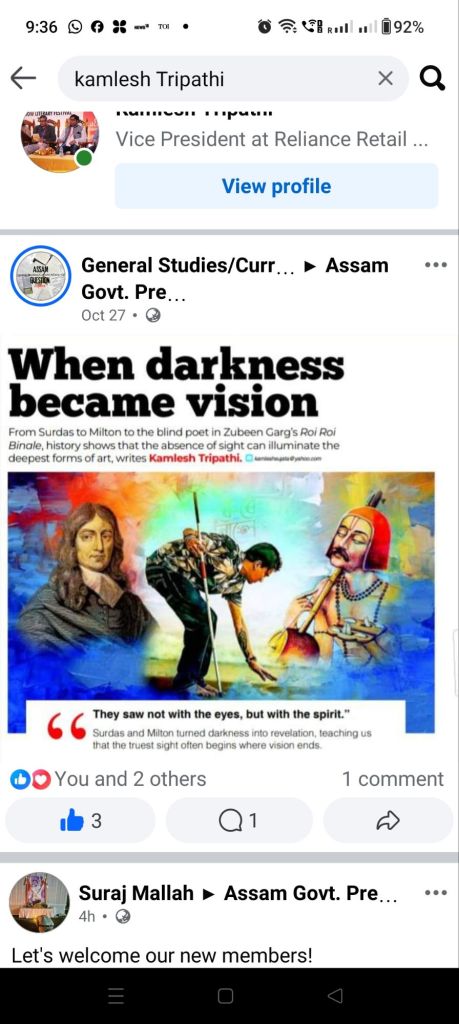
Though, John Milton and Surdas lived in a similar world of poetry, they were separated by continents, century, race and culture. Surdas lived between 1479-1586, while Milton lived between, 1608–1674. Both are remembered today not only for the brilliance of their poetry, but also for their profound inner vision, which becomes even more brilliant by the fact that they both composed their enduring works after losing their eyesight.
Milton was an English Puritan poet and a political thinker, whereas the Indian Surdas was a devotional Hindi saint-poet who spearheaded the Bhakti movement. They both belonged to different religions — Christianity and Hinduism, respectively but with a fire for poetry.
Surdas was either born blind or had lost his eyesight in early childhood. Milton, on the other hand, lost his eyesight in his forties, around 1652, most likely due to glaucoma.
Despite limitations, Surdas is widely recognised as a major figure in the Bhakti movement, primarily devoted to Lord Krishna. His emotive and spiritual dohas (verses) are said to have been passed down orally and later compiled in the Sursagar, or ‘Ocean of melodies or Ocean of tunes.’ His compositions, which were mostly in Braj Bhasha, are a dialect of Hindi spoken in the region associated with Krishna’s early life.
By the time Milton lost his eyesight, he was already an accomplished poet and an intellectual. Milton’s blindness, instead of stalling his creativity, seemed to refine it. He composed his greatest epics–Paradise Lost, Paradise Regained, and Samson Agonistes through dictation, relying on aides to transcribe his verses. Like Surdas, Milton too did not see blindness as a handicap but as a pathway leading to a higher form of spiritual attainment.
Both poets had a religious mind. Although stylistically different, both had infused their works with philosophical and devotional seriousness. Milton, a devout Christian, wrote with the spontaneous aim of interpreting and elevating spiritual truth. In Paradise Lost, he sets out “to justify the ways of God to men.” He addresses themes such as the Fall of Man, temptation, obedience, and redemption. He wrote in Paradise Lost, “Solitude sometimes is the best society,” which reminds you of Ernest Hemingway’s words in his 1954 Nobel Acceptance Speech, “Writing, at its best, is a lonely life.” Milton’s theological affinity, shaped by the rigorous study of scripture and classical texts, transforms into a poetic splendour. Meanwhile, Surdas’s creations are acts of loving surrender. Krishna appears in multiple forms in his dohas (verses): as a mischievous child, a divine lover, and also the supreme being. Lines such as “Ka mangu kachu thira na rahai” (What should I ask for, when nothing is permanent?) captures the essence of his Bhakti without expectation.
Milton’s epics are not just stories but musings on justice, free will, human suffering, and divine grace. His works show outstanding intellectual discipline, theological depth, and poetic mastery. Surdas, too, uses his poetic expressions to explore the soul’s belongingness, the relevance of humility, and the spiritual path to surrender before God. Their works are more than a literary endeavour. They become a vehicle for exploring human conditions and articulating metaphysical realities.
Another uniting theme between Milton and Surdas was their poetic sense of duty. Neither viewed poetry as mere personal or artistic expression. For both, it was a sacred responsibility, a way to convey, inspire and elevate. Milton’s epic verse seeks to engage the intellect and the soul, guiding readers towards a better understanding of divine justice and human morality. Surdas’s dohas were intended for oral performance and collective singing. It invited listeners into a shared space of devotion and spiritual intimacy. The duo’s poetry continues to be read, sung, studied, and revered, not only for its beauty but also for its power to move the soul.
Language, for both the poets, was of the essence. Milton promoted the English language to unprecedented heights at a time when Latin was still seen as the language of serious scholarship. Milton chose English and, through his use of blank verse, gave it towering dignity. His English stood along with the classical languages of Homer and Virgil. On the other hand, Surdas did something outstandingly transformative. He wrote in Braj Bhasha, a regional and vernacular dialect. Braj Bhasha is written in the Devanagari script. By using it to express the spiritual and emotional state of his mind, he not only made religious ideas accessible to the masses but also raised Braj to the level of a respected literary language. Through them, both English and Braj Bhasha became vessels of sacred expression.
Finally, what makes Milton and Surdas an enduring duo is not just their literary genius, but their ability to transform personal blindness into a powerful metaphor for inner vision. Where physical sight failed, spiritual insight flourished. Through their works, both poets remind us that the deepest prayers are often seen not with the eyes but with the heart. Whether through the sonorous cadences of Milton’s blank verse or the lilting melodies of Surdas’s bhajans, they teach us that poetry can be a form of prayer, and vision a matter of the soul. Surely, where there is a will there is a way.
Shravan Charity Mission is an NGO that works for poor children suffering from life-threatening diseases, especially cancer. Our posts are meant for our readers, including children and adults, and have a huge variety of content. We also accept donations for our mission. Should you wish to donate to the cause of cancer? The bank details are given below:
Shravan Charity Mission is an NGO that works for poor children suffering from life-threatening diseases, especially cancer. Our posts are meant for our readers, including children and adults, and have a huge variety of content. We also accept donations for our mission. Should you wish to donate to the cause of cancer? The bank details are given below:
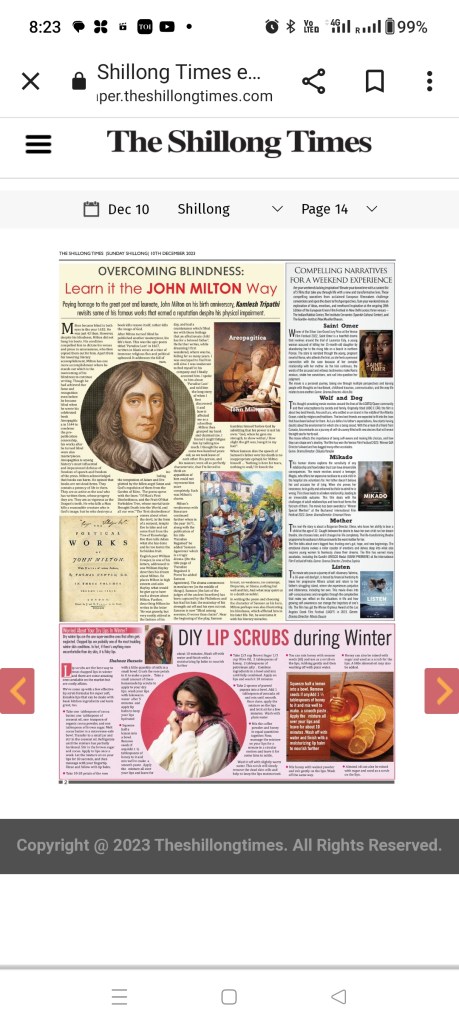
Article published in the Sunday Shillong Times on 10th December 2023. We all must learn how John Milton turned his personal tragedy into his life’s biggest opportunity,
Shravan Charity Mission is an NGO that works for poor children suffering from life-threatening diseases, especially cancer. Our posts are meant for our readers, including children and adults, and have a huge variety in content. We also accept donations for our mission. Should you wish to donate to the cause? The bank details are given below:
NAME OF ACCOUNT: SHRAVAN CHARITY MISSION
Account no: 680510110004635 (BANK OF INDIA)
IFSC code: BKID0006805
*
Kamlesh Tripathi’s Publications
GLOOM BEHIND THE SMILE
(The book is about a young cancer patient. Now archived in 8 prestigious libraries of the US which include Harvard College Library; Harvard University Library; Library of Congress; University of Washington, Seattle; University of Minnesota, Minneapolis; Yale University, New Haven; University of Chicago; University of North Carolina, at Chapel Hill University Libraries. It can also be accessed at MIT through Worldcat.org. Besides, it is also available for reading in libraries and archives of Canada; Cancer Aid and Research Foundation Mumbai; Jaipuria Institute of Management, Noida, India; Shoolini University, Yogananda Knowledge Center, Himachal Pradesh and Azim Premzi University, Bangalore).
ONE TO TANGO … RIA’S ODYSSEY
(Is a book on ‘singlehood’ about a Delhi girl now archived in Connemara Library, Chennai and Delhi Public Library, GOI, Ministry of Culture, Delhi; It is also available for reading in the Indian National Bibliography, March 2016, in the literature section, in Central Reference Library, Ministry of Culture, India, Belvedere, Kolkata-700022)
AADAB LUCKNOW … FOND MEMORIES
(Is a fiction written around the great city of Nawabs—Lucknow. It describes Lucknow in great detail and also talks about its Hindu-Muslim amity, which is the undying characteristic of Lucknow. The book was launched at the Lucknow International Literary Festival in 2014. It is included for reading in Askews and Holts Library Services, Lancashire, U.K; Herrick District Library, Holland and Charlotte-Mecklenburg Library, Mecklenburg County in North Carolina, USA; Black Gold Cooperative Library Administration, Arroyo Grande, California; Berkeley Library, University of California).
REFRACTIONS … FROM THE PRISM OF GOD
(Co-published by Cankids–Kidscan, a pan India NGO and Shravan Charity Mission, that works for child cancer in India. The book is endorsed by Ms Preetha Reddy, MD Apollo Hospitals Group. It was launched at the Lucknow International Literary Festival in 2016).
TYPICAL TALE OF AN INDIAN SALESMAN
(Is a story of an Indian salesman who is, humbly qualified. Yet he fights his way through unceasing uncertainties to reach the top. A good read not only for salesmen. The book was launched on 10th February 2018 at Gorakhpur Lit-Fest. Now available on Amazon, Flipkart and Onlinegatha)
RHYTHM … in poems
(Published in January 2019. The book contains 50 poems. The poems describe our day-to-day life. A few poems from the book have been published in Shillong Times, Bandra Times and Bhavan’s Journal. The book is available on Amazon, Flipkart and Onlinegatha)
MIRAGE
(Published in February 2020. The book is a collection of eight short stories available on Amazon, Flipkart and Notion Press)
AWADH ASSAM AND DALAI LAMA … The Kalachakra
(The story of the man who received His Holiness The Dalai Lama and his retinue in 1959 as a GOI representative when he fled Tibet in 1959. The book was launched on 21st November 2022 by His Holiness The Dalai Lama at Dharmshala. The title is archived in the library of the Department of Information and International Relations (DIIR) Government of Tibet, Tibet Policy Institute (TPI) and the personal library of His Holiness The Dalai Lama. The title is also archived in The Ohio Digital Library, USA. It was recently included in the digital library of the world-renowned company APPLE).
BHAVANS JOURNAL
Short stories, Book reviews and Articles published in Bhavan’s Journal: 1. Reality and Perception, 15.10.19; 2. Sending the Wrong Message, 31.5.20; 3.Eagle versus Scholars June, 15 & 20, 2020; 4.Indica, 15.8.20; 5.The Story of King Chitraketu, August 31 2020; 6.Breaking Through the Chakravyuh, September 30 2020. 7. The Questioning Spouse, October 31, 2020; 8. Happy Days, November 15, 2020; 9.The Karma Cycle of Paddy and Wheat, December 15, 2020; 10.Power Vs Influence, January 31, 2021; 11.Three Refugees, March 15, 2021; 12.Rise and Fall of Ajatashatru, March 31, 2021; 13.Reformed Ruler, May 15, 2021; 14.A Lasting Name, May 31, 2021; 15.Are Animals Better Teachers? June 16, 2021; 16.Book Review: The Gram Swaraj, 1.7.21; 17.Right Age for Achievements, 15.7.21; 18.Big Things Have Small Beginnings, 15.8.21; 19.Where is Gangaridai?, 15.9.21; 20.Confront the Donkey Within You 30.9.21; 21. Know Your Strengths 15.10.21; 22. Poverty 15.11.21; 23. Top View 30.11.21; 24. The Bansuriwala 15.1.22; 25.Sale of Alaska 15.2.22; 26.The Dimasa Kingdom 28.2.22; 27. Buried Treasure 15.4.22; 28. The Kingdom of Pragjyotisha 30.4.22; 29.Who is more useful? 15.5.22; 30. The White Swan from Lake Mansarovar 30.6.22; 31. Bhool Bhulayya 15.9.22; 32. Good Karma 30.9.22; 33. Good Name vs Bad Name 15.10.22; 34.Uttarapath—The Grand Trunk Road 1.12.22; 35.When Gods Get Angry 1.1.23; 36. Holinshed’s Chronicles 15.1.23; 37. Theogony 15.2.23; 38. Poem: Mother 14.5.23; 39. THE NAG MANDIR 30.6.23; 40. The Story of Garuda 30.7.23; 41. Janmabhoomi vs Karmabhoomi 31.8.23; 42. The Ghost Town of Kuldhara 15.9.23; 43. The Tale of Genji 15.10.23; 44. The Soul Connection 1.12.23;
SHILLONG TIMES—SUNDAY EDITION
ARTICLES & POEMS: 1. POEM: HAPPY NEW YEAR 8.1.23; 2. POEM: SPRING 12.3.23; 3. POEM: RIGHT AND WRONG 20.3.23; 4. THE GUSH OF EMOTION—WRITING, 26.3.23; 5. THE NAG MANDIR, 7.5.23; 6. POEM:MOTHER 7.5.23; 7. POEM: RAIN RAIN 9.7.23; 8. POEM:YOU COME ALONE YOUGO ALONE 6.8.23; 9. RAIN RAIN (SECOND TIME) 10.8.23; 10. POEM: GURU TEACHER 10.8.23; 11. POEM: AUTUMN … THE INTERIM HEAVEN 15.10.23; 12. POEM: HAPPY DIWALI 12.11.23; 13. OVERCOMING BLINDNESS: LEARN IT THE JOHN MILTON WAY 10.12.23;
29.12.2020: INDICA BY MEGASTHENES; 14.3.22: ABOUT THE DIMASA KINGDOM ASSAM; 10.12.22: GRAND TRUNK ROAD-UTTARAPATH; 5.10.23: THE GHOST TOWN OF KULDHARA NEAR JAISALMER;
(ALL THE ABOVE BOOK TITLES ARE AVAILABLE FOR SALE ON AMAZON, FLIPKART AND OTHER ONLINE STORES OR YOU COULD EVEN WRITE TO US FOR A COPY)
Milton became blind in both eyes in the year 1652. He was just 43 then. But despite his blindness, Milton did not hang his boots. His blindness forced him to dictate his verses and prose to amanuenses, who then copied them out for him. Apart from his towering literary accomplishment, Milton has one more accomplishment where he stands out which is the overcoming of his blindness to continue writing. Though he had achieved due fame and recognition even before he became blind when he wrote his celebrated book Areopagitica in 1644 to condemn the pre-publication censorship, his works after he turned blind were also masterpieces. Areopagitica is among history’s most influential and impassioned defences of freedom of speech and freedom of the press. Milton acknowledged that books can harm. He opined that books are not dead items. They contain a potency of life in them. They are as active as the soul who has written them, whose progeny they are. They are as vigorous as the Dragon’s teeth. He who kills a Man kills a reasonable creature who is God’s image; but he who destroys a book kills reason itself, rather kills the image of God.
After Milton turned blind he published another masterpiece, his life’s best. This was the epic poem titled ‘Paradise Lost’ in 1667, written in blank verse at a time of immense religious flux and political upheaval. It addresses the fall of man, including the temptation of Adam and Eve plotted by the fallen angel Satan and God’s expulsion of them from the Garden of Eden. The poem opens with the lines: “Of Man’s First Disobedience, and the Fruit Of that Forbidden Tree, whose mortal taste Brought Death into the World, and all our woe.” The ‘first disobedience’ comes about when the devil, in the form of a serpent, tempts Eve to take and eat some fruit from the Tree of Knowledge. Eve then tells Adam what she has done and he too tastes the forbidden fruit.
English poet William Cowper, in one of his letters, addressed to one William Hayley describes his dream about Milton. He places Milton in high esteem and asks Hayley, what would he give up to have such a dream about Milton. Further, describing Milton he writes in the letter ‘He was gravely, but very neatly attired in the fashion of his day, and had a countenance which filled me with those feelings that an affectionate child has for a beloved father’. He further writes, while dreaming I first wondered, where was he, hiding for so many years. I was overjoyed to find him still alive. I was exuberant to find myself in his company and I finally accosted him. I spoke to him about ‘Paradise Lost’ and told him the long story of when I first discovered it and how it affected me as a schoolboy. Milton then grasped my hand and charmed me. I feared I might fatigue him by talking too much. I thought he was some two hundred years old, so we took leave of each other. His person, and his manner, were all so perfectly characteristic, that I’m forced to think an apparition of him could not represent him more completely. Such was Milton’s charm.
Milton’s rendezvous with literature continued further when in the year 1671, along with the publication of his title ‘Paradise Regained’ he added ‘Samson Agonistes’ which is a tragic drama. (On the title page of ‘Paradise Regained A Poem’ he added Samson Agonistes). The drama commences in medias res (in the middle of things). Samson (the last of the judges of the ancient Israelites) has been captured by the Philistines and has had his hair, the mainstay of his strength cut off and his eyes cut out. Samson is now “Blind among enemies, O worse than chains”. Near the beginning of the play, Samson humbles himself before God by admitting that his power is not his own: “God, when he gave me strength, to show withal / How slight the gift was, hung it in my hair”.
When Samson dies the speech of Samson’s father over his death is no inappropriate epitaph for Milton himself … ‘Nothing is here for tears, nothing to wail/ Or knock the breast, no weakness, no contempt, Disparate, or blame, nothing but well and fair, And what may quiet us in a death so noble’.
In writing the poem and choosing the character of Samson as his hero, Milton perhaps was also illustrating his blindness, which afflicted him in his later life. Yet, he overcame it with his literary miracles.
Shravan Charity Mission is an NGO that works for poor children suffering from life-threatening diseases, especially cancer. Our posts are meant for our readers, including children and adults, and have a huge variety in content. We also accept donations for our mission. Should you wish to donate to the cause? The bank details are given below:
NAME OF ACCOUNT: SHRAVAN CHARITY MISSION
Account no: 680510110004635 (BANK OF INDIA)
IFSC code: BKID0006805
*
Kamlesh Tripathi’s Publications
GLOOM BEHIND THE SMILE
(The book is about a young cancer patient. Now archived in 8 prestigious libraries of the US which include Harvard College Library; Harvard University Library; Library of Congress; University of Washington, Seattle; University of Minnesota, Minneapolis; Yale University, New Haven; University of Chicago; University of North Carolina, at Chapel Hill University Libraries. It can also be accessed at MIT through Worldcat.org. Besides, it is also available for reading in libraries and archives of Canada; Cancer Aid and Research Foundation Mumbai; Jaipuria Institute of Management, Noida, India; Shoolini University, Yogananda Knowledge Center, Himachal Pradesh and Azim Premzi University, Bangalore).
ONE TO TANGO … RIA’S ODYSSEY
(Is a book on ‘singlehood’ about a Delhi girl now archived in Connemara Library, Chennai and Delhi Public Library, GOI, Ministry of Culture, Delhi; It is also available for reading in the Indian National Bibliography, March 2016, in the literature section, in Central Reference Library, Ministry of Culture, India, Belvedere, Kolkata-700022)
AADAB LUCKNOW … FOND MEMORIES
(Is a fiction written around the great city of Nawabs—Lucknow. It describes Lucknow in great detail and also talks about its Hindu-Muslim amity, which is the undying characteristic of Lucknow. The book was launched at the Lucknow International Literary Festival in 2014. It is included for reading in Askews and Holts Library Services, Lancashire, U.K; Herrick District Library, Holland and Charlotte-Mecklenburg Library, Mecklenburg County in North Carolina, USA; Black Gold Cooperative Library Administration, Arroyo Grande, California; Berkeley Library, University of California).
REFRACTIONS … FROM THE PRISM OF GOD
(Co-published by Cankids–Kidscan, a pan India NGO and Shravan Charity Mission, that works for child cancer in India. The book is endorsed by Ms Preetha Reddy, MD Apollo Hospitals Group. It was launched at the Lucknow International Literary Festival in 2016).
TYPICAL TALE OF AN INDIAN SALESMAN
(Is a story of an Indian salesman who is, humbly qualified. Yet he fights his way through unceasing uncertainties to reach the top. A good read not only for salesmen. The book was launched on 10th February 2018 at Gorakhpur Lit-Fest. Now available on Amazon, Flipkart and Onlinegatha)
RHYTHM … in poems
(Published in January 2019. The book contains 50 poems. The poems describe our day-to-day life. A few poems from the book have been published in Shillong Times, Bandra Times and Bhavan’s Journal. The book is available on Amazon, Flipkart and Onlinegatha)
MIRAGE
(Published in February 2020. The book is a collection of eight short stories available on Amazon, Flipkart and Notion Press)
AWADH ASSAM AND DALAI LAMA … The Kalachakra
(The story of the man who received His Holiness The Dalai Lama and his retinue in 1959 as a GOI representative when he fled Tibet in 1959. The book was launched on 21st November 2022 by His Holiness The Dalai Lama at Dharmshala. The title is archived in the library of the Department of Information and International Relations (DIIR) Government of Tibet, Tibet Policy Institute (TPI) and the personal library of His Holiness The Dalai Lama. The title is also archived in The Ohio Digital Library, USA. It was recently included in the digital library of the world-renowned company APPLE).
BHAVANS JOURNAL
Short stories, Book reviews and Articles published in Bhavan’s Journal: 1. Reality and Perception, 15.10.19; 2. Sending the Wrong Message, 31.5.20; 3.Eagle versus Scholars June, 15 & 20, 2020; 4.Indica, 15.8.20; 5.The Story of King Chitraketu, August 31 2020; 6.Breaking Through the Chakravyuh, September 30 2020. 7. The Questioning Spouse, October 31, 2020; 8. Happy Days, November 15, 2020; 9.The Karma Cycle of Paddy and Wheat, December 15, 2020; 10.Power Vs Influence, January 31, 2021; 11.Three Refugees, March 15, 2021; 12.Rise and Fall of Ajatashatru, March 31, 2021; 13.Reformed Ruler, May 15, 2021; 14.A Lasting Name, May 31, 2021; 15.Are Animals Better Teachers? June 16, 2021; 16.Book Review: The Gram Swaraj, 1.7.21; 17.Right Age for Achievements, 15.7.21; 18.Big Things Have Small Beginnings, 15.8.21; 19.Where is Gangaridai?, 15.9.21; 20.Confront the Donkey Within You 30.9.21; 21. Know Your Strengths 15.10.21; 22. Poverty 15.11.21; 23. Top View 30.11.21; 24. The Bansuriwala 15.1.22; 25.Sale of Alaska 15.2.22; 26.The Dimasa Kingdom 28.2.22; 27. Buried Treasure 15.4.22; 28. The Kingdom of Pragjyotisha 30.4.22; 29.Who is more useful? 15.5.22; 30. The White Swan from Lake Mansarovar 30.6.22; 31. Bhool Bhulayya 15.9.22; 32. Good Karma 30.9.22; 33. Good Name vs Bad Name 15.10.22; 34.Uttarapath—The Grand Trunk Road 1.12.22; 35.When Gods Get Angry 1.1.23; 36. Holinshed’s Chronicles 15.1.23; 37. Theogony 15.2.23; 38. Poem: Mother 14.5.23; 39. THE NAG MANDIR 30.6.23; 40. The Story of Garuda 30.7.23; 41. Janmabhoomi vs Karmabhoomi 31.8.23; 42. The Ghost Town of Kuldhara 15.9.23; 43. The Tale of Genji 15.10.23; 44. The Soul Connection 1.12.23;
SHILLONG TIMES—SUNDAY EDITION
ARTICLES & POEMS: 1. POEM: HAPPY NEW YEAR 8.1.23; 2. POEM: SPRING 12.3.23; 3. POEM: RIGHT AND WRONG 20.3.23; 4. THE GUSH OF EMOTION—WRITING, 26.3.23; 5. THE NAG MANDIR, 7.5.23; 6. POEM:MOTHER 7.5.23; 7. POEM: RAIN RAIN 9.7.23; 8. POEM:YOU COME ALONE YOUGO ALONE 6.8.23; 9. RAIN RAIN (SECOND TIME) 10.8.23; 10. POEM: GURU TEACHER 10.8.23; 11. POEM: AUTUMN … THE INTERIM HEAVEN 15.10.23; 12. POEM: HAPPY DIWALI 12.11.23
29.12.2020: INDICA BY MEGASTHENES; 14.3.22: ABOUT THE DIMASA KINGDOM ASSAM; 10.12.22: GRAND TRUNK ROAD-UTTARAPATH; 5.10.23: THE GHOST TOWN OF KULDHARA NEAR JAISALMER;
(ALL THE ABOVE BOOK TITLES ARE AVAILABLE FOR SALE ON AMAZON, FLIPKART AND OTHER ONLINE STORES OR YOU COULD EVEN WRITE TO US FOR A COPY)


 Shravan charity mission