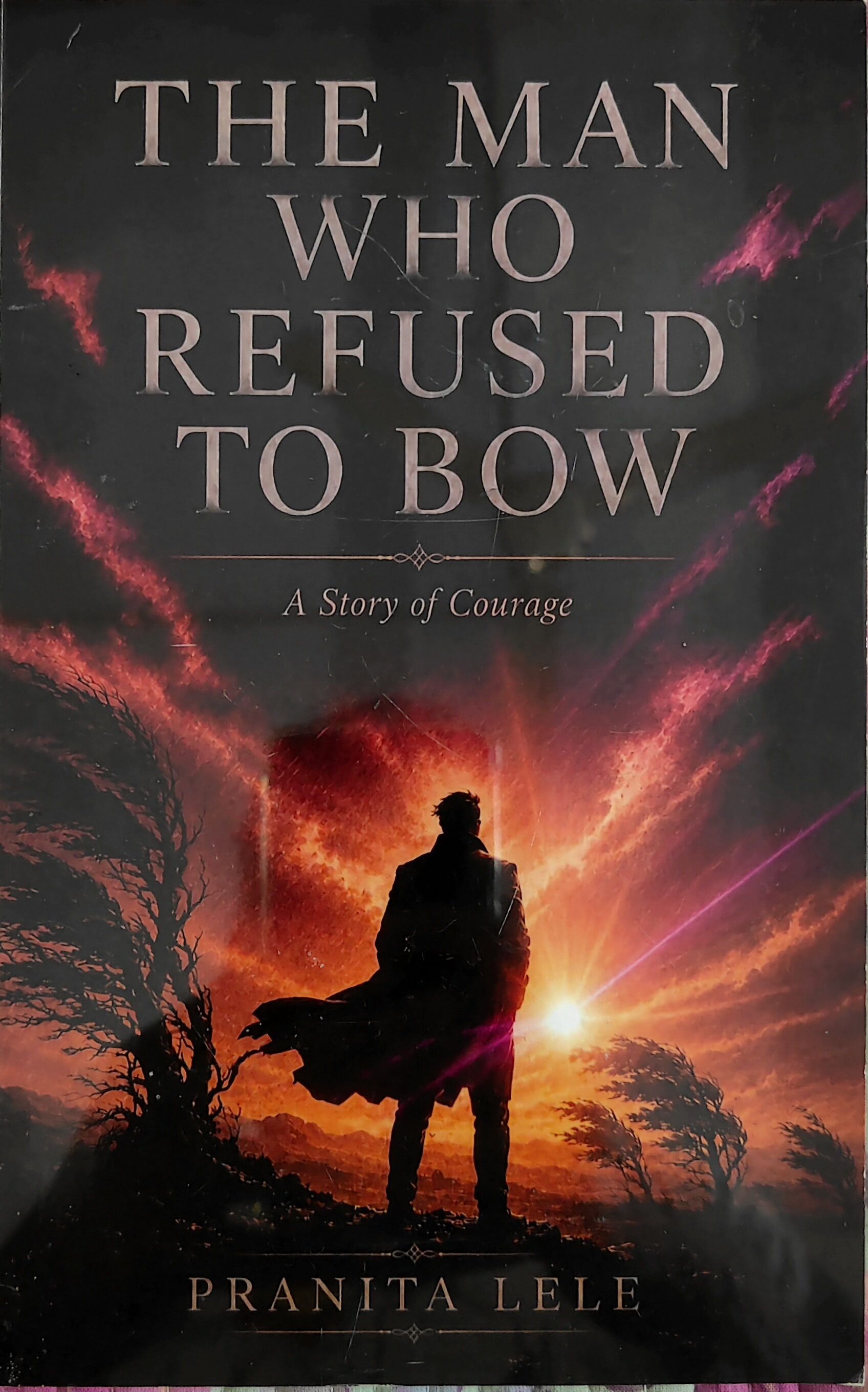
The Man Who Refused to Bow… A Story of Courage … by Pranita Lele
Reviewed by: Kamlesh Tripathi
The book is a personal account of author Pranita Lele, who is combating horrific situations that life has offered her. Her husband is suffering from Cancer. Cancer, as one can say, is the reverse of the Midas touch. Just as the Midas touch converts everything into gold, cancer can transform life into a gruelling journey. Cancer can walk into anyone’s life surreptitiously, and as an uninvited guest, without any warning, just as it walked into Vikram Lele’s life, the author’s husband. You need a Satyavati to retrieve her husband from the menace of cancer. I’m reminded of the famous story of Satyavati, Satyavan and Yama. The analogy may sound similar. Pranita and Vikram’s story evokes the celebrated episode of Savitri and Satyavan in the Mahabharata. When Satyavan suddenly fell ill while working in the forest, Savitri cradled his head in her lap. When Yama, the god of death, arrived to claim her husband’s life, she refused to abandon him and followed Yama, ultimately persuading him to restore Satyavan’s life. Truly, a kindred metaphor.
Another glimpse that one gets is of the 1963 Bollywood hit … Dil Ek Mandir, starring Meena Kumari, Rajendra Kumar and Raj Kumar. For a closer fit, consider Elizabeth Barrett Browning and Robert Browning, whose relationship involved emotional support during difficult periods, though it is not principally a story of a wife nursing a seriously ill husband.
I’m reminded of the first stanza of one of my poems titled, ‘I’m Life,’ where life says: You think you know me/Well, everyone thinks that way/But believe me/ I’m very sneaky/I’m very tricky/And I rarely play by the rules you make for me.
Spread across 40 chapters and around 170 pages, the book presents its central message in a precise, concise and accessible manner. Normally, such books are unplanned because tragedies strike without notice, and the author has to play it by ear. The narration is in easy English, in short sentences with a pleasant trickle and flow like a flowing river.
The book intertwines life’s onerous circumstances with biological calamities. Aged parents above 90. Vikram, after recovering from brain haemorrhage, falls prey to oesophageal cancer. And in this global world, one cannot expect children to be by your side always. And in these frightful circumstances, one finds author Pranita walking through a dark isthmus all by herself.
But to every downside there is an upside. The world survives because of the balance. The plane has wings. It will glide through high turbulence, provided the pilot is competent and the support system is good. This is where the Oncology Department of Max Hospital Lucknow comes into play. Its team of doctors and support staff extended extensive support to Vikram and Pranita throughout the treatment. The subject book is definitely to honour the entire team of Max Hospital.
The author has painstakingly acknowledged friends and relatives, contacts, including overseas contacts and hospital staff, for what they did for Vikram.
The book doesn’t bear a sombre and morose tone. It is filled with lively episodes that take you away from the pain of the patient and the family.
The author has used the correct terminology in terms of describing each stage of illness. The narrative helps in building the doctor-patient relationship. The narration has a separate chapter for each doctor and support staff. It describes Chemotherapy, Radiation, immunotherapy, and targeted therapy in simple language.
Pranita Lele’s steadfast companionship also recalls the enduring ideal of marital devotion found in English literature. In John Milton’s Paradise Lost (there is a thematic echo), Adam and Eve’s relationship, despite its trials and consequences, explores the profound bond between husband and wife. While the circumstances differ considerably from Vikram and Pranita’s struggle with cancer, the work invites reflection on companionship when life becomes difficult. Pranita’s story brings this ideal into the everyday world of medical appointments, uncertainty and caregiving, showing how commitment is expressed not merely through words but through continued presence and practical acts of love…. A real page-turner.
Written and posted by Kamlesh Tripathi
Author, Poet, & Columnist
Appreciation received from a reader.
Wow .I read the article .So well written .His writing proves that he is an highly intellectual person .So much depth and meaning in his writing . Great work Pranita .I am sure and confident with all your support ,prayers and positivity Vikram will be fine .Our prayers and best wishes are always with you both .God bless .👍❤️❤️❤️
Shravan Charity Mission is an NGO that works for poor children suffering from life-threatening diseases, especially cancer. Our posts are meant for our readers, including children and adults, and have a huge variety of content. We also accept donations for our mission. Should you wish to donate to the cause of cancer? The bank details are given below:
Though, John Milton and Surdas lived in a similar world of poetry, they were separated by continents, century, race and culture. Surdas lived between 1479-1586, while Milton lived between, 1608–1674. Both are remembered today not only for the brilliance of their poetry, but also for their profound inner vision, which becomes even more brilliant by the fact that they both composed their enduring works after losing their eyesight.
Milton was an English Puritan poet and a political thinker, whereas the Indian Surdas was a devotional Hindi saint-poet who spearheaded the Bhakti movement. They both belonged to different religions — Christianity and Hinduism, respectively but with a fire for poetry.
Surdas was either born blind or had lost his eyesight in early childhood. Milton, on the other hand, lost his eyesight in his forties, around 1652, most likely due to glaucoma.
Despite limitations, Surdas is widely recognised as a major figure in the Bhakti movement, primarily devoted to Lord Krishna. His emotive and spiritual dohas (verses) are said to have been passed down orally and later compiled in the Sursagar, or ‘Ocean of melodies or Ocean of tunes.’ His compositions, which were mostly in Braj Bhasha, are a dialect of Hindi spoken in the region associated with Krishna’s early life.
By the time Milton lost his eyesight, he was already an accomplished poet and an intellectual. Milton’s blindness, instead of stalling his creativity, seemed to refine it. He composed his greatest epics–Paradise Lost, Paradise Regained, and Samson Agonistes through dictation, relying on aides to transcribe his verses. Like Surdas, Milton too did not see blindness as a handicap but as a pathway leading to a higher form of spiritual attainment.
Both poets had a religious mind. Although stylistically different, both had infused their works with philosophical and devotional seriousness. Milton, a devout Christian, wrote with the spontaneous aim of interpreting and elevating spiritual truth. In Paradise Lost, he sets out “to justify the ways of God to men.” He addresses themes such as the Fall of Man, temptation, obedience, and redemption. He wrote in Paradise Lost, “Solitude sometimes is the best society,” which reminds you of Ernest Hemingway’s words in his 1954 Nobel Acceptance Speech, “Writing, at its best, is a lonely life.” Milton’s theological affinity, shaped by the rigorous study of scripture and classical texts, transforms into a poetic splendour. Meanwhile, Surdas’s creations are acts of loving surrender. Krishna appears in multiple forms in his dohas (verses): as a mischievous child, a divine lover, and also the supreme being. Lines such as “Ka mangu kachu thira na rahai” (What should I ask for, when nothing is permanent?) captures the essence of his Bhakti without expectation.
Milton’s epics are not just stories but musings on justice, free will, human suffering, and divine grace. His works show outstanding intellectual discipline, theological depth, and poetic mastery. Surdas, too, uses his poetic expressions to explore the soul’s belongingness, the relevance of humility, and the spiritual path to surrender before God. Their works are more than a literary endeavour. They become a vehicle for exploring human conditions and articulating metaphysical realities.
Another uniting theme between Milton and Surdas was their poetic sense of duty. Neither viewed poetry as mere personal or artistic expression. For both, it was a sacred responsibility, a way to convey, inspire and elevate. Milton’s epic verse seeks to engage the intellect and the soul, guiding readers towards a better understanding of divine justice and human morality. Surdas’s dohas were intended for oral performance and collective singing. It invited listeners into a shared space of devotion and spiritual intimacy. The duo’s poetry continues to be read, sung, studied, and revered, not only for its beauty but also for its power to move the soul.
Language, for both the poets, was of the essence. Milton promoted the English language to unprecedented heights at a time when Latin was still seen as the language of serious scholarship. Milton chose English and, through his use of blank verse, gave it towering dignity. His English stood along with the classical languages of Homer and Virgil. On the other hand, Surdas did something outstandingly transformative. He wrote in Braj Bhasha, a regional and vernacular dialect. Braj Bhasha is written in the Devanagari script. By using it to express the spiritual and emotional state of his mind, he not only made religious ideas accessible to the masses but also raised Braj to the level of a respected literary language. Through them, both English and Braj Bhasha became vessels of sacred expression.
Finally, what makes Milton and Surdas an enduring duo is not just their literary genius, but their ability to transform personal blindness into a powerful metaphor for inner vision. Where physical sight failed, spiritual insight flourished. Through their works, both poets remind us that the deepest prayers are often seen not with the eyes but with the heart. Whether through the sonorous cadences of Milton’s blank verse or the lilting melodies of Surdas’s bhajans, they teach us that poetry can be a form of prayer, and vision a matter of the soul. Surely, where there is a will there is a way.
Shravan Charity Mission is an NGO that works for poor children suffering from life-threatening diseases, especially cancer. Our posts are meant for our readers, including children and adults, and have a huge variety of content. We also accept donations for our mission. Should you wish to donate to the cause of cancer? The bank details are given below:
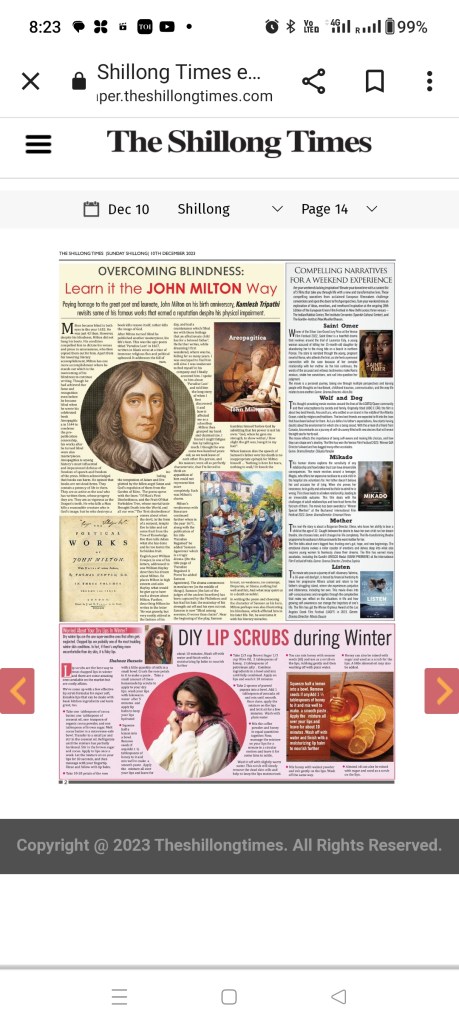
Article published in the Sunday Shillong Times on 10th December 2023. We all must learn how John Milton turned his personal tragedy into his life’s biggest opportunity,
Shravan Charity Mission is an NGO that works for poor children suffering from life-threatening diseases, especially cancer. Our posts are meant for our readers, including children and adults, and have a huge variety in content. We also accept donations for our mission. Should you wish to donate to the cause? The bank details are given below:
NAME OF ACCOUNT: SHRAVAN CHARITY MISSION
Account no: 680510110004635 (BANK OF INDIA)
IFSC code: BKID0006805
*
Kamlesh Tripathi’s Publications
GLOOM BEHIND THE SMILE
(The book is about a young cancer patient. Now archived in 8 prestigious libraries of the US which include Harvard College Library; Harvard University Library; Library of Congress; University of Washington, Seattle; University of Minnesota, Minneapolis; Yale University, New Haven; University of Chicago; University of North Carolina, at Chapel Hill University Libraries. It can also be accessed at MIT through Worldcat.org. Besides, it is also available for reading in libraries and archives of Canada; Cancer Aid and Research Foundation Mumbai; Jaipuria Institute of Management, Noida, India; Shoolini University, Yogananda Knowledge Center, Himachal Pradesh and Azim Premzi University, Bangalore).
ONE TO TANGO … RIA’S ODYSSEY
(Is a book on ‘singlehood’ about a Delhi girl now archived in Connemara Library, Chennai and Delhi Public Library, GOI, Ministry of Culture, Delhi; It is also available for reading in the Indian National Bibliography, March 2016, in the literature section, in Central Reference Library, Ministry of Culture, India, Belvedere, Kolkata-700022)
AADAB LUCKNOW … FOND MEMORIES
(Is a fiction written around the great city of Nawabs—Lucknow. It describes Lucknow in great detail and also talks about its Hindu-Muslim amity, which is the undying characteristic of Lucknow. The book was launched at the Lucknow International Literary Festival in 2014. It is included for reading in Askews and Holts Library Services, Lancashire, U.K; Herrick District Library, Holland and Charlotte-Mecklenburg Library, Mecklenburg County in North Carolina, USA; Black Gold Cooperative Library Administration, Arroyo Grande, California; Berkeley Library, University of California).
REFRACTIONS … FROM THE PRISM OF GOD
(Co-published by Cankids–Kidscan, a pan India NGO and Shravan Charity Mission, that works for child cancer in India. The book is endorsed by Ms Preetha Reddy, MD Apollo Hospitals Group. It was launched at the Lucknow International Literary Festival in 2016).
TYPICAL TALE OF AN INDIAN SALESMAN
(Is a story of an Indian salesman who is, humbly qualified. Yet he fights his way through unceasing uncertainties to reach the top. A good read not only for salesmen. The book was launched on 10th February 2018 at Gorakhpur Lit-Fest. Now available on Amazon, Flipkart and Onlinegatha)
RHYTHM … in poems
(Published in January 2019. The book contains 50 poems. The poems describe our day-to-day life. A few poems from the book have been published in Shillong Times, Bandra Times and Bhavan’s Journal. The book is available on Amazon, Flipkart and Onlinegatha)
MIRAGE
(Published in February 2020. The book is a collection of eight short stories available on Amazon, Flipkart and Notion Press)
AWADH ASSAM AND DALAI LAMA … The Kalachakra
(The story of the man who received His Holiness The Dalai Lama and his retinue in 1959 as a GOI representative when he fled Tibet in 1959. The book was launched on 21st November 2022 by His Holiness The Dalai Lama at Dharmshala. The title is archived in the library of the Department of Information and International Relations (DIIR) Government of Tibet, Tibet Policy Institute (TPI) and the personal library of His Holiness The Dalai Lama. The title is also archived in The Ohio Digital Library, USA. It was recently included in the digital library of the world-renowned company APPLE).
BHAVANS JOURNAL
Short stories, Book reviews and Articles published in Bhavan’s Journal: 1. Reality and Perception, 15.10.19; 2. Sending the Wrong Message, 31.5.20; 3.Eagle versus Scholars June, 15 & 20, 2020; 4.Indica, 15.8.20; 5.The Story of King Chitraketu, August 31 2020; 6.Breaking Through the Chakravyuh, September 30 2020. 7. The Questioning Spouse, October 31, 2020; 8. Happy Days, November 15, 2020; 9.The Karma Cycle of Paddy and Wheat, December 15, 2020; 10.Power Vs Influence, January 31, 2021; 11.Three Refugees, March 15, 2021; 12.Rise and Fall of Ajatashatru, March 31, 2021; 13.Reformed Ruler, May 15, 2021; 14.A Lasting Name, May 31, 2021; 15.Are Animals Better Teachers? June 16, 2021; 16.Book Review: The Gram Swaraj, 1.7.21; 17.Right Age for Achievements, 15.7.21; 18.Big Things Have Small Beginnings, 15.8.21; 19.Where is Gangaridai?, 15.9.21; 20.Confront the Donkey Within You 30.9.21; 21. Know Your Strengths 15.10.21; 22. Poverty 15.11.21; 23. Top View 30.11.21; 24. The Bansuriwala 15.1.22; 25.Sale of Alaska 15.2.22; 26.The Dimasa Kingdom 28.2.22; 27. Buried Treasure 15.4.22; 28. The Kingdom of Pragjyotisha 30.4.22; 29.Who is more useful? 15.5.22; 30. The White Swan from Lake Mansarovar 30.6.22; 31. Bhool Bhulayya 15.9.22; 32. Good Karma 30.9.22; 33. Good Name vs Bad Name 15.10.22; 34.Uttarapath—The Grand Trunk Road 1.12.22; 35.When Gods Get Angry 1.1.23; 36. Holinshed’s Chronicles 15.1.23; 37. Theogony 15.2.23; 38. Poem: Mother 14.5.23; 39. THE NAG MANDIR 30.6.23; 40. The Story of Garuda 30.7.23; 41. Janmabhoomi vs Karmabhoomi 31.8.23; 42. The Ghost Town of Kuldhara 15.9.23; 43. The Tale of Genji 15.10.23; 44. The Soul Connection 1.12.23;
SHILLONG TIMES—SUNDAY EDITION
ARTICLES & POEMS: 1. POEM: HAPPY NEW YEAR 8.1.23; 2. POEM: SPRING 12.3.23; 3. POEM: RIGHT AND WRONG 20.3.23; 4. THE GUSH OF EMOTION—WRITING, 26.3.23; 5. THE NAG MANDIR, 7.5.23; 6. POEM:MOTHER 7.5.23; 7. POEM: RAIN RAIN 9.7.23; 8. POEM:YOU COME ALONE YOUGO ALONE 6.8.23; 9. RAIN RAIN (SECOND TIME) 10.8.23; 10. POEM: GURU TEACHER 10.8.23; 11. POEM: AUTUMN … THE INTERIM HEAVEN 15.10.23; 12. POEM: HAPPY DIWALI 12.11.23; 13. OVERCOMING BLINDNESS: LEARN IT THE JOHN MILTON WAY 10.12.23;
29.12.2020: INDICA BY MEGASTHENES; 14.3.22: ABOUT THE DIMASA KINGDOM ASSAM; 10.12.22: GRAND TRUNK ROAD-UTTARAPATH; 5.10.23: THE GHOST TOWN OF KULDHARA NEAR JAISALMER;
(ALL THE ABOVE BOOK TITLES ARE AVAILABLE FOR SALE ON AMAZON, FLIPKART AND OTHER ONLINE STORES OR YOU COULD EVEN WRITE TO US FOR A COPY)
Milton became blind in both eyes in the year 1652. He was just 43 then. But despite his blindness, Milton did not hang his boots. His blindness forced him to dictate his verses and prose to amanuenses, who then copied them out for him. Apart from his towering literary accomplishment, Milton has one more accomplishment where he stands out which is the overcoming of his blindness to continue writing. Though he had achieved due fame and recognition even before he became blind when he wrote his celebrated book Areopagitica in 1644 to condemn the pre-publication censorship, his works after he turned blind were also masterpieces. Areopagitica is among history’s most influential and impassioned defences of freedom of speech and freedom of the press. Milton acknowledged that books can harm. He opined that books are not dead items. They contain a potency of life in them. They are as active as the soul who has written them, whose progeny they are. They are as vigorous as the Dragon’s teeth. He who kills a Man kills a reasonable creature who is God’s image; but he who destroys a book kills reason itself, rather kills the image of God.
After Milton turned blind he published another masterpiece, his life’s best. This was the epic poem titled ‘Paradise Lost’ in 1667, written in blank verse at a time of immense religious flux and political upheaval. It addresses the fall of man, including the temptation of Adam and Eve plotted by the fallen angel Satan and God’s expulsion of them from the Garden of Eden. The poem opens with the lines: “Of Man’s First Disobedience, and the Fruit Of that Forbidden Tree, whose mortal taste Brought Death into the World, and all our woe.” The ‘first disobedience’ comes about when the devil, in the form of a serpent, tempts Eve to take and eat some fruit from the Tree of Knowledge. Eve then tells Adam what she has done and he too tastes the forbidden fruit.
English poet William Cowper, in one of his letters, addressed to one William Hayley describes his dream about Milton. He places Milton in high esteem and asks Hayley, what would he give up to have such a dream about Milton. Further, describing Milton he writes in the letter ‘He was gravely, but very neatly attired in the fashion of his day, and had a countenance which filled me with those feelings that an affectionate child has for a beloved father’. He further writes, while dreaming I first wondered, where was he, hiding for so many years. I was overjoyed to find him still alive. I was exuberant to find myself in his company and I finally accosted him. I spoke to him about ‘Paradise Lost’ and told him the long story of when I first discovered it and how it affected me as a schoolboy. Milton then grasped my hand and charmed me. I feared I might fatigue him by talking too much. I thought he was some two hundred years old, so we took leave of each other. His person, and his manner, were all so perfectly characteristic, that I’m forced to think an apparition of him could not represent him more completely. Such was Milton’s charm.
Milton’s rendezvous with literature continued further when in the year 1671, along with the publication of his title ‘Paradise Regained’ he added ‘Samson Agonistes’ which is a tragic drama. (On the title page of ‘Paradise Regained A Poem’ he added Samson Agonistes). The drama commences in medias res (in the middle of things). Samson (the last of the judges of the ancient Israelites) has been captured by the Philistines and has had his hair, the mainstay of his strength cut off and his eyes cut out. Samson is now “Blind among enemies, O worse than chains”. Near the beginning of the play, Samson humbles himself before God by admitting that his power is not his own: “God, when he gave me strength, to show withal / How slight the gift was, hung it in my hair”.
When Samson dies the speech of Samson’s father over his death is no inappropriate epitaph for Milton himself … ‘Nothing is here for tears, nothing to wail/ Or knock the breast, no weakness, no contempt, Disparate, or blame, nothing but well and fair, And what may quiet us in a death so noble’.
In writing the poem and choosing the character of Samson as his hero, Milton perhaps was also illustrating his blindness, which afflicted him in his later life. Yet, he overcame it with his literary miracles.
Shravan Charity Mission is an NGO that works for poor children suffering from life-threatening diseases, especially cancer. Our posts are meant for our readers, including children and adults, and have a huge variety in content. We also accept donations for our mission. Should you wish to donate to the cause? The bank details are given below:
NAME OF ACCOUNT: SHRAVAN CHARITY MISSION
Account no: 680510110004635 (BANK OF INDIA)
IFSC code: BKID0006805
*
Kamlesh Tripathi’s Publications
GLOOM BEHIND THE SMILE
(The book is about a young cancer patient. Now archived in 8 prestigious libraries of the US which include Harvard College Library; Harvard University Library; Library of Congress; University of Washington, Seattle; University of Minnesota, Minneapolis; Yale University, New Haven; University of Chicago; University of North Carolina, at Chapel Hill University Libraries. It can also be accessed at MIT through Worldcat.org. Besides, it is also available for reading in libraries and archives of Canada; Cancer Aid and Research Foundation Mumbai; Jaipuria Institute of Management, Noida, India; Shoolini University, Yogananda Knowledge Center, Himachal Pradesh and Azim Premzi University, Bangalore).
ONE TO TANGO … RIA’S ODYSSEY
(Is a book on ‘singlehood’ about a Delhi girl now archived in Connemara Library, Chennai and Delhi Public Library, GOI, Ministry of Culture, Delhi; It is also available for reading in the Indian National Bibliography, March 2016, in the literature section, in Central Reference Library, Ministry of Culture, India, Belvedere, Kolkata-700022)
AADAB LUCKNOW … FOND MEMORIES
(Is a fiction written around the great city of Nawabs—Lucknow. It describes Lucknow in great detail and also talks about its Hindu-Muslim amity, which is the undying characteristic of Lucknow. The book was launched at the Lucknow International Literary Festival in 2014. It is included for reading in Askews and Holts Library Services, Lancashire, U.K; Herrick District Library, Holland and Charlotte-Mecklenburg Library, Mecklenburg County in North Carolina, USA; Black Gold Cooperative Library Administration, Arroyo Grande, California; Berkeley Library, University of California).
REFRACTIONS … FROM THE PRISM OF GOD
(Co-published by Cankids–Kidscan, a pan India NGO and Shravan Charity Mission, that works for child cancer in India. The book is endorsed by Ms Preetha Reddy, MD Apollo Hospitals Group. It was launched at the Lucknow International Literary Festival in 2016).
TYPICAL TALE OF AN INDIAN SALESMAN
(Is a story of an Indian salesman who is, humbly qualified. Yet he fights his way through unceasing uncertainties to reach the top. A good read not only for salesmen. The book was launched on 10th February 2018 at Gorakhpur Lit-Fest. Now available on Amazon, Flipkart and Onlinegatha)
RHYTHM … in poems
(Published in January 2019. The book contains 50 poems. The poems describe our day-to-day life. A few poems from the book have been published in Shillong Times, Bandra Times and Bhavan’s Journal. The book is available on Amazon, Flipkart and Onlinegatha)
MIRAGE
(Published in February 2020. The book is a collection of eight short stories available on Amazon, Flipkart and Notion Press)
AWADH ASSAM AND DALAI LAMA … The Kalachakra
(The story of the man who received His Holiness The Dalai Lama and his retinue in 1959 as a GOI representative when he fled Tibet in 1959. The book was launched on 21st November 2022 by His Holiness The Dalai Lama at Dharmshala. The title is archived in the library of the Department of Information and International Relations (DIIR) Government of Tibet, Tibet Policy Institute (TPI) and the personal library of His Holiness The Dalai Lama. The title is also archived in The Ohio Digital Library, USA. It was recently included in the digital library of the world-renowned company APPLE).
BHAVANS JOURNAL
Short stories, Book reviews and Articles published in Bhavan’s Journal: 1. Reality and Perception, 15.10.19; 2. Sending the Wrong Message, 31.5.20; 3.Eagle versus Scholars June, 15 & 20, 2020; 4.Indica, 15.8.20; 5.The Story of King Chitraketu, August 31 2020; 6.Breaking Through the Chakravyuh, September 30 2020. 7. The Questioning Spouse, October 31, 2020; 8. Happy Days, November 15, 2020; 9.The Karma Cycle of Paddy and Wheat, December 15, 2020; 10.Power Vs Influence, January 31, 2021; 11.Three Refugees, March 15, 2021; 12.Rise and Fall of Ajatashatru, March 31, 2021; 13.Reformed Ruler, May 15, 2021; 14.A Lasting Name, May 31, 2021; 15.Are Animals Better Teachers? June 16, 2021; 16.Book Review: The Gram Swaraj, 1.7.21; 17.Right Age for Achievements, 15.7.21; 18.Big Things Have Small Beginnings, 15.8.21; 19.Where is Gangaridai?, 15.9.21; 20.Confront the Donkey Within You 30.9.21; 21. Know Your Strengths 15.10.21; 22. Poverty 15.11.21; 23. Top View 30.11.21; 24. The Bansuriwala 15.1.22; 25.Sale of Alaska 15.2.22; 26.The Dimasa Kingdom 28.2.22; 27. Buried Treasure 15.4.22; 28. The Kingdom of Pragjyotisha 30.4.22; 29.Who is more useful? 15.5.22; 30. The White Swan from Lake Mansarovar 30.6.22; 31. Bhool Bhulayya 15.9.22; 32. Good Karma 30.9.22; 33. Good Name vs Bad Name 15.10.22; 34.Uttarapath—The Grand Trunk Road 1.12.22; 35.When Gods Get Angry 1.1.23; 36. Holinshed’s Chronicles 15.1.23; 37. Theogony 15.2.23; 38. Poem: Mother 14.5.23; 39. THE NAG MANDIR 30.6.23; 40. The Story of Garuda 30.7.23; 41. Janmabhoomi vs Karmabhoomi 31.8.23; 42. The Ghost Town of Kuldhara 15.9.23; 43. The Tale of Genji 15.10.23; 44. The Soul Connection 1.12.23;
SHILLONG TIMES—SUNDAY EDITION
ARTICLES & POEMS: 1. POEM: HAPPY NEW YEAR 8.1.23; 2. POEM: SPRING 12.3.23; 3. POEM: RIGHT AND WRONG 20.3.23; 4. THE GUSH OF EMOTION—WRITING, 26.3.23; 5. THE NAG MANDIR, 7.5.23; 6. POEM:MOTHER 7.5.23; 7. POEM: RAIN RAIN 9.7.23; 8. POEM:YOU COME ALONE YOUGO ALONE 6.8.23; 9. RAIN RAIN (SECOND TIME) 10.8.23; 10. POEM: GURU TEACHER 10.8.23; 11. POEM: AUTUMN … THE INTERIM HEAVEN 15.10.23; 12. POEM: HAPPY DIWALI 12.11.23
29.12.2020: INDICA BY MEGASTHENES; 14.3.22: ABOUT THE DIMASA KINGDOM ASSAM; 10.12.22: GRAND TRUNK ROAD-UTTARAPATH; 5.10.23: THE GHOST TOWN OF KULDHARA NEAR JAISALMER;
(ALL THE ABOVE BOOK TITLES ARE AVAILABLE FOR SALE ON AMAZON, FLIPKART AND OTHER ONLINE STORES OR YOU COULD EVEN WRITE TO US FOR A COPY)