Tag Archives: hinduism

U.P. THE LAND OF SUPERNORMAL ROLE MODELS

Copyright@shravancharitymission

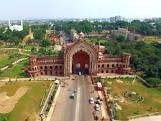
 

    In the complex understructure of India, UP sits like her invisible heart and spiritual voice. One can also address her as a headstrong folklore and tradition champion. Indeed the most populated state that celebrates its lineage in its diversity. It has an irrefutable matrix of society that hails, from two major communities, the Hindus and the Muslims—both passionate lovers of their native.

    Even though, the expanse of Hinduism resonates much beyond India and goes right up to the global frontiers. UP has always been its formidable pillar in the ever lengthening axis. Rather, it has been the primordial hub of religiosity since time immemorial. If we deconstruct her, she expands to a vast region much before it was converted into administrative hedges like states and districts. Which, Gods loved and nature adored. So, one can say she has been the showcase, the playground and even the reliable archives of Hinduism since grand old times.

    She doesn’t require administrate boundaries to conjoin. As, she, connects, consolidates and even identifies herself in many other ways. To begin with she is the mix of Pancha Bhoota—where the elements of Prithvi (Earth), Jal (Water), Agni (fire), Vayu (air) and Akash (ether or the sky) combine for her cosmic creation.

    If we translate this into ground realities we find. Starting from the texture of the soil, to the pitch of the lingo it is one. It has no less than Gods and super humans, as its role models. To say, some of its role models are even better known than the land they belong to won’t be a misnomer. And they all performed their incredible leelas in this very soil. We will come to that a little later.

    UP has that enduring fix of festivals, along with bucolic handholding and even similarity in cereal crops to live and breathe in congruence. There is no life without water they say and water forms the lifeline of any society. To that effect there are vaguely a series of some six or seven imposing rivers, leaving aside many small ones that almost run parallel but certainly from the western side of the state to the eastern corner. And finally,   they all merge as tributaries with Ma Ganga. The main stem of Ganga, begins with the confluence of Bhagirathi and Alaknanda rivers in the town of Devprayag in Uttara Khand. As per mythology she was brought to earth by king Bhagiratha, where, eventually she grew up to the status of Ma Janani in the vast expanse of the state. She is indeed the queen mother of all the water bodies as she carries along with her almost all the rivers. Therefore, for certain she can be called the icon of motherhood the provider—an unbeatable role model again. So blessed is the state that there is hardly a district or a town that is not within the easy catch of a river. Where, inhabitants even identify themselves with the rivers, such as ‘Sarjupari’—person living across river Sarju. There are many annual melas that connect the rural fraternity and its vendors across the sub-regions like Ballia and Nauchandi, to name a few.

    Hinduism has four ashrams when it comes to completing a lifetime—Brahamcharya, (Balkal … Birth to student like), Grihasta (householder), Vanaprastha (retired) and Sannyasa (renunciation). The holy land of UP connects you to some quintessential examples of how some incarnations or avatars of Maha Vishnu have spent their time in these defined ashrams. Hinduism doesn’t come through, without UP. And all lessons of life are available here.

    It teaches us, nothing is easy and everything needs to be fought for, whether you’re an incarnation of God or just a human form. Even, when, Lord Krishna was the 8th incarnation of Maha Vishnu. Mathura was under turmoil at least the night little Krishna was born in Dwaparyuga (the 3rd Yuga). He demonstrated the victory of good over evil when he killed his maternal uncle Kans. And by lifting the Goverdhan Parvat he proclaimed nothing is impossible if you are hell bent upon doing it. On bhakti (devotion) no one can beat Radha as a role model and it all happened in the Braj Bhoomi that is now divided into many districts. But Krishna leela has no boundaries.

    In the same land Bhagwan Sri Ram was born in Ayodhya as the 7th incarnation of Maha Vishnu in Treta Yuga (2nd yuga). Although, he was born before Krishna I’m describing him after Krishna because he had a steady childhood, whereas, Krishna had a fighting one. But Sri Ram exemplified himself as Maryada Purshottam—the quintessential example of respecting contemporary times and fairness accentuating into super goodness. He had many mid life crises which he fought through valiantly all by himself and his devoted team. Prime was 14 years of Banvas (exile into forest) and the abduction of his wife by Ravana. Where, on the one hand he did show grief but on the other hand as a true karmyogi he found his bearings and organized himself to fight the great battle of Lanka to get his wife back. But while doing so he ensured he didn’t overstep the laid down tenets of science and its concomitants, even, when, he was an avatar of Lord Vishnu. Today, Sri Ram is a household name and a role model that is not confined to any district or a religion and where his queen Sita is an epitome of devotion. His entire leela happened along the plains of river Saryu and the famous kingdom of Ayodhya where he ruled. Important to say—role models can be followed by any person from any religion or sect.

    Further, the great war of Mahabharat too, had its roots in Hastinapur near Meerut, again in UP. A well known mythological story of intensely disagreeing, blood thirsty royal cousins, that eventually escalated into a holy war. It is said, what is not seen and read in Mahabharat doesn’t exist in the world. It has again given many role models to the world while it was fought in Dwaparyug. It had many stalwarts. Some important names that one can immediately reflect upon are Krishna, Yudhistir, Bhishma Pitamah, Dronacharya, Kripacharya, Kunti, Karan, Yudhistir, Bhimsen, Arjun, Nakul, Sahdev, Draupadi, Veer Abhimanyu to name a few.

    Krishna derives his umbilical and founding legacy from Braj Bhoomi. From where he goes on to recite those ultimate verses of Gita, that is destined to happen, only once-in-a-planet-time, to a tranced Arjun, challenging him to pick up arms and fight for righteousness. The heft of Krishna thus becomes so very onerous for any one human form to carry as a role model. Resultantly, he spends his life in the little fragments of his teachings to promote his cause.

    Post the battles of Lanka and Mahabharat you had those iconic—blazing writers and poets like Valmiki, Tulsidas and Ved Vyas capturing the vivid description of the proceedings that led to the deadly wars. Together with awesome description of the scenes of war that remain unparalleled even today.

    And going forward when it comes to Vanaprastha and Sanyas we have Varanasi to teach us how to approach retirement and death as a role model. People come to Varanasi to see live Hinduism and even to die. The pyre is ever lit in Manikarnika Ghat and they say if a person is cremated there he or she goes to heaven directly.

    It is one of the oldest ghats of Varanasi. It is revered in Hindu mythology that when Mata Sati, Lord Shiva’s wife sacrificed her life and set her body ablaze after Raja Daksh Prajapati, her father and one of the sons of Lord Brahma tried to humiliate her husband Shiva in the Yagya. Lord Shiva took her burning body to Himalaya. On seeing the unending sorrow of Lord Shiva, Vishnu sent his divine Sudershan Chakra to cut the body into 51 parts which fell on earth. Lord Shiva established Shakti Peeth wherever Sati’s body had fallen. At Manikarnika ghat Mata Sati’s ornament had fallen. The lesson therefore is loaded with the despicable arrogance of king Daksh and the pristine relationship of Sati and Shiva—that can’t be emulated as a role model.

    In the treasured mythological scriptures such as Purans and Upanishads, battles between the Devatas (Gods) and Asuras (Demons) have often been described in great detail and on many occasions. Asuras, have always troubled Devatas for some reason or the other. In fact, they were mostly stronger than the Devatas in strength, and therefore Devatas were always scared of them. Even Devraj Indra who was extremely powerful and laced with a lot of divine offence could not harm them in any manner.  Many such wars were even fought, in an around, the present day UP.   Samudra Mathan (Churning of ocean) resulting into Kumbh, has also seen the bitter war between the Devatas and the Asuras for Amrit (Divine Nectar). Where, Lord Vishnu had to intervene. Because, had Asuras drank Amrit they would have become immortal, and that would have meant destruction of the goodness in the world.

    There are innumerable stories and one can go on and on. But the moot point is, whether, the present day generation of the state is living up to the values created by these role models.

*

By Kamlesh Tripathi

*

                                                      https://kamleshsujata.wordpress.com

*

Share if you like it

*

Shravan Charity Mission is an NGO that works for poor children suffering from life threatening diseases. Should you wish to donate for the cause the bank details are given below:

NAME OF ACCOUNT: SHRAVAN CHARITY MISSION

Account no: 680510110004635 (BANK OF INDIA)

IFSC code: BKID0006805

*

Our publications

GLOOM BEHIND THE SMILE

ONE TO TANGO … RIA’S ODYSSEY

AADAB LUCKNOW … FOND MEMORIES

REFRACTIONS … FROM THE PRISM OF GOD

(CAN BE BOUGHT FROM ON LINE BOOK STORES OR WRITE TO US FOR COPIES)

*****


DOCTRINE OF KARMA AND REINCARNATION

Copyright@shravancharitymission


    Why do Hindus believe in these two doctrines? One being karma and the other being reincarnation. Because these doctrines not only explain the unusual occurrences logically. They also shed light on day-to-day events of life. Hindus do not consider life and death to be mutually exclusive. But intertwined and inseparable. Like the two sides of the same coin. If there are disparities between two individuals at the time of birth, and if these disparities can be seen. Then the cause for these disparities must have preceded their births.

  • Karma: The word karma means “action.” In accordance with the cosmic laws of karma. Each individual reaps the fruits of his actions, performed in this lifetime or in former lives. This logically explains the disparities in creation, between various individuals, environments and situations. No deed, small or great, good or bad, can be without an effect—this essentially is the law of karma, the law of casualty. In fact one begins to feel as if it is Newton’s 3rd law of motion—‘to every action there is an equal and opposite reaction’ was drawn out of the doctrine of karma.
  • Karma is no fate. Fate implies helplessness in a human being, to determine his own destiny. The law of karma states that the individual is the creator of his own destiny, because his conscious choices in life determines his actions and the fruits thereof.
  • Reincarnation: Hindus believe that the jiva, or the individual being, travels from life to life. Acquiring bodies and environments best suited to exhaust his vasanas (vices) or innate tendencies that are expressed as desires, emotions, and actions. The exhaustion of vasanas allows the jiva to reach his ultimate goal: complete freedom from the cycle of birth and death through the realization of his true nature as the Self, or Brahman.

—synopsis from a book on Hinduism—by Chinmaya Mission Trust—

*

By Kamlesh Tripathi

*

https://kamleshsujata.wordpress.com

*

Share if you like it

*

Shravan Charity Mission is an NGO that works for poor children suffering from life threatening diseases. Should you wish to donate for the cause the bank details are given below:

NAME OF ACCOUNT: SHRAVAN CHARITY MISSION

Account no: 680510110004635 (BANK OF INDIA)

IFSC code: BKID0006805

*

Our publications

GLOOM BEHIND THE SMILE

(Archived in 7 prestigious libraries of the US, including, Harvard University and Library of Congress. It can also be accessed in MIT through Worldcat.org. Besides, it is also available for reading in Libraries and archives of Canada and Cancer Aid and Research Foundation Mumbai)  

ONE TO TANGO … RIA’S ODYSSEY

(Archived in Connemara Library, Chennai and Delhi Public Library, GOI, Ministry of Culture)

AADAB LUCKNOW … FOND MEMORIES

(Launched in Lucknow International Literary Festival 2014)

REFRACTIONS … FROM THE PRISM OF GOD

(Co-published by Cankids–Kidscan, a pan India NGO and Shravan Charity Mission, that works for Child cancer in India. The book is endorsed by Ms Preetha Reddy, MD Apollo Hospitals Group. Book was launched in Lucknow International Literary Festival 2016)

(CAN BE BOUGHT FROM ON LINE BOOK STORES OR WRITE TO US FOR COPIES)

*****


STORY: THE CORRELATION BETWEEN KARMA AND TAPASYA

Copyright@shravancharitymission


THE CORRELATION BETWEEN KARMA AND TAPASYA


    It is widely believed that Hinduism is not a religion but a way of life, where one could continue to remain a Hindu even without really practicing it. But when you run through the religious texts it doesn’t say so, that simplistically. In fact, it won’t be a misnomer to say Hinduism is all about good and bad Karma—and ‘Karma’ alone is the essence of Hinduism. While Karma emanates from your mindset, tapasya (prolonged, intense and rigorous form of meditation) is the versatile vehicle of karma that takes you to your goal, and in case of any misdeeds it also acts as the penance, to pull you through tough times. Hence, one could say a ‘Tapasya’ in many ways is only a planned and focused karma.

    If you go through the Hindu texts dispassionately you would find, there were no free lunches, not even for Gods. Everyone had to fight for each specific issue where opponents could not be taken for granted just because someone commanded a superior position, breed, hierarchy or a better brand. And, competitor intelligence then, was a prevalent strategy vital for survival. While one could continue in life, being an average and inactive person. But for a Herculean milestone and phenomenal achievements one had to go in for long and arduous tapasyas where even avatars and Gods were not spared from the drill.

    When Pandavas were exiled from their kingdom, Lord God Krishna advised Arjun to obtain Divyastras (divine weapons of various Gods) as that would have helped Pandavas in the future, while combating the Kauravas. But Divyastras were not available off the shelf, even when Arjun was a very close sakha (friend) of Lord God Krishna. And, for Divyastras, the only way out was to perform rigorous tapasya to please respective Gods to bless him with their weapon, which Arjun did successfully. Specific Devatas (God) had specific powers but, no, one, Devata had all the powers vested in her or him. Devatas on many occasions were even found weaker than asuras and danavs since power and might were never a constant factor, as mentioned in the famous and historic episode of Samudra Manthan (churning of the ocean). So Devatas often had to perform long tapasyas to win over asuras. And asuras too were not behind in this, as they often performed mind boggling tapasyas to obtain vardans (blessings) which they used for destructive purposes.

    Ravan the king of Lanka had done a lifetime of tapasya and was well entrenched, as a tall pundit but his tapasya was not followed by good karma and so all his knowledge went for a waste. So in Hinduism, can not one say both karma and tapasya work in tandem? Good karma with intense tapasya will yield good results, while good karma with intense tapasya followed by bad karma will only dilute the effects of tapasya. And as long as the arch of good karma continues time shall be kind to you.

    Let me also tell you another story. That will give you a flavour of how even Gods had to go in for intense tapasyas for specific events. As, no one had unlimited powers, and how at times they had to be interdependent  on each other to attain self goals by keeping aside their personal egos. And that is why it is said, it is extremely difficult to shoo the ego in us. Every person has his ups and downs in life where karma gives us the flexibility of adjusting to these ups and downs through the prowess of tapasya.

    Once when Lord Brahma (the creator of universe) was narrating a story to Rishi Narad he said,

    Dear Narad! Once when Prajapati Daksh left for Mandirachal Parwat (mountain). I too decided to perform a difficult vrat (a religious practice to carry out certain obligations with a view to achieve divine blessings for fulfillment of certain desires) and started praying to Devi Jagbamba. Wherein, I repeatedly told her in my prayers what I wanted. When Jagdamba was pleased with my vrat she gave me darshan (divine audience). I bowed in respect and said ‘pranam Devi,’ she asked. ‘Tell me Brahman! Why have you been praying so passionately, and tell me soon.’

   On hearing this, I folded my hands and politely said—‘Mother! A God named Rudra who happens to be an avatar (incarnation) of God Sadashiv has insulted me. So, I desire you take the form of Sati (Shiva’s first wife) and destroy his arrogance. Kindly take birth as Prajapati Daksh’s daughter to attract God Sadashiv towards you. Bhagwati! Barring you, there is no one else in this universe with the power to attract him erotically. And in anticipation that you’ll accede to our request, and so very excited to receive you as his daughter, Prajapati Daksh is already underway his intense tapasya in Mandirachal Parwat.

    On my saying so Bhagwati was shocked and surprised beyond words and she even looked worried. When she said—‘what is this, that you are saying Brahma ji? You want me to attract Lord God Sadashiv, and for this malicious job you’re seeking my help. Therefore, in reality whatever you’re doing is only Lord God Sadashiv’s criticism. This is a big mistake. Everyone knows I cannot do anything against God Sadashiv. Tell me, what will I gain by attracting the nirvikalp (that does not have an alternative) God Sadashiv, as I am only like his menial maid. And for the salvation of his devotees only he has taken the avatar of Rudra. Lord God Sadashiv is the undisputed emperor of all the three Lokas. He is also yours, as well as Lord Vishnu’s swami. Even in yoga, he is ahead of both of you. I am indeed astounded to hear this foolish thought coming from you, where Lord Brahma wants to captivate Lord God Sadashiv who happens to be the king of Maya (the supernatural power wielded by Gods and demons) and I am truly dumbfounded at this.’ And after saying this Devi Jagdamba went back to meditation, when she received a message from Lord God Sadashiv that without my blessings nothing happens. With my consent only Sri Brahma and Prajapati Daksh are in intense vrat and meditation. So give them the vardan and take birth in Prajapati Daksh’s family and I’ll accept you. Important: Even Lord God Sadashiv had to seek interpersonal help in a polite manner by requesting Devi Jagdamba.

   After receiving instructions from Lord God Sadashiv, Devi Bhagwati said, ‘Brahma ji—‘its fine. I will try my best, so that Lord God Shiva falls for me, and marries me as his second wife. As such there is no one in the world who can break Lord God Shiva’s concentration and attract him sensually, and even I don’t have this power and capacity. Nevertheless, I will endeavour to attract him after obtaining an avatar to fulfil your desire.’ And after this she disappeared.

    Meanwhile Prajapati Daksh was into deep and rigorous tapasya in Mandirchal Parvat. He kept meditating for three thousand years. In summers he used to meditate in the middle of fire and in severe winters he used to immerse himself in cold water, and in between tapasyas he also obtained proficiency in pranayam.  At last when Bhagwati was happy with his tapasya she gave him darshan.

    Bhagwati Shiva knew everything and so she said to Prajapati Daksh—I’m extremely happy with your tapasya and therefore you can ask for a vardan (blessings). Daksh with folded hands said—Devi! If you are happy with me then you please take birth in my family as my daughter, since Lord God Sadashiv has taken a new avatar in the name of Rudra as Brahma’s son, and there is no one to match him and therefore you need to take an avatar to marry him. Because, in this entire universe there is no other person who can do this. Brahma ji for this very important work has sent me here to Mandirachal Parvat for a long-long tapasya. Now with your attractive maya (illusions) try and attract Lord God Sadashiv and oblige the world. Jagdamba said—‘Tathastu–it will happen in this manner only. From your wife’s womb I shall take birth as your daughter, and to endear Lord God Sadashiv I will do intense tapasya.’ And after saying all this Bhagwati Shiva disappeared as she had a long to-do-list to be completed.

    Karma is the opportunity to do important things in life while tapasya the intense preperation and that alone differentiates between the Devata and the man.

*

Posted by Kamlesh Tripathi

*

https://kamleshsujata.wordpress.com

*

Share if you like it

*

Shravan Charity Mission is an NGO that works for poor children suffering from life threatening diseases. Should you wish to donate for the cause the bank details are given below:

NAME OF ACCOUNT: SHRAVAN CHARITY MISSION

Account no: 680510110004635 (BANK OF INDIA)

IFSC code: BKID0006805

*

Our publications

GLOOM BEHIND THE SMILE

(Archived in 7 prestigious libraries of the US, including, Harvard University and Library of Congress. It can also be accessed in MIT through Worldcat.org. Besides, it is also available for reading in Libraries and archives of Canada and Cancer Aid and Research Foundation Mumbai)  

ONE TO TANGO … RIA’S ODYSSEY

(Archived in Connemara Library, Chennai and Delhi Public Library, GOI, Ministry of Culture)

AADAB LUCKNOW … FOND MEMORIES

(Launched in Lucknow International Literary Festival 2014)

REFRACTIONS … FROM THE PRISM OF GOD

(Co-published by Cankids–Kidscan, a pan India NGO and Shravan Charity Mission, that works for Child cancer in India. The book is endorsed by Ms Preetha Reddy, MD Apollo Hospitals Group. Book was launched in Lucknow International Literary Festival 2016)

(CAN BE BOUGHT FROM ON LINE BOOK STORES OR WRITE TO US FOR COPIES)

*****


SHORT STORY: FTII- WHY DID KALCHAKRA HAVE TO PUNISH GAJENDRA SINGH CHAUHAN

Copyright@shravancharitymission

By Kamlesh Tripathi

goi gajendra chauhan kalchakra

Long time back I had read a story about a small sparrow; that goes as follows:

THE STORY OF THE SPARROW


On a beautiful winter day in Siberia, encouraged by the warm rays of the sun in a clear blue sky, a little sparrow left the security of his nest to fly and frolic in the air, but the 40o below zero temperature quickly overcame the imprudent bird who fell on the ground, frozen, and found himself buried in the snow where he would certainly have died in an instant. But by chance a cow trotted by at that moment, and at the very spot where the sparrow was struggling for his last breath, she dropped a large soft cow-dung on top of the bird. The warmth of this dung-bath resuscitated the moribund sparrow. He was so happy, he raised his head out of the cow-shit and started to twitter joyfully, which drew the attention of a wandering homeless cat who delicately pulled the sparrow out of the shit and devoured him.

The moral of this story: Your enemy is not necessarily the one who shits on your head. Your friend, however, is not necessarily the one who pulls you out of the shit. And besides, one should never twitter when one is buried in shit.

The recent controversy in FTII in which actor Gajendra Singh Chauhan got caught up reminded me of the above story, where for no fault of his, Gajendra is in the cross fire. Can we call it the wrath of Kalchakra?

For Gajendra too like the little sparrow was perched in his warm nest, quite away from the limelight doing small roles in movies and television serials, is when the GOI approached him as the warm rays of Siberia and Gajendra then dared to fly out of his nest, quite unaware of the Siberian winters—in this case being the sting of FTII- students.

The new job like the cow-dung covered Gajendra for a while when the wandering cats of Bollywood, Social Media, TV-channels and some Political Parties and so also the students union of FTII, who thought he did not have the tall stature, and moreover, he had committed the grevious crime of acting as Yudhistir in Mahabharat, thereby promoting Hinduism was definitely not suitable for the post. Because, in current day India even talking about Hinduism is considered non-secular by some.

While the wandering cats have so far not devoured the so called sparrow—Gajendra, but the Kalchakra has definitely crushed his film career. For Gajendra Singh Chauhan will now be known more for his poor stalk in Bollywood than the hard-work he has put in to make a career in Bollywood. And quite unknowingly and unintentionally he has antagonised and estranged many bigwigs of Bollywood and the social media; and has emerged as a full-fledged victim of Kalchakra.

    But what was his fault in all of this; that the electronic media almost stripped him naked as far as his career credentials went, that people who didn’t know about his average career also know about it now.

Kalchakra is not in the business of compensating losses and therefore won’t compensate Gajendra Singh Chauhan, for having torn apart his career and making him a laughing stock. I don’t know about GOI how they will view it. But the reality is,

    In life you often don’t get into problems because of your own doings, but it could also be the doing of others and in this case it was clearly the Kalchakra disguised as GOI.

For in life you really don’t know what will come and hit you, or who is friend and how distant is your enemy. But mind you Kalchakra spares no one, not even the wandering cats.

***