Copyright@shravancharitymission
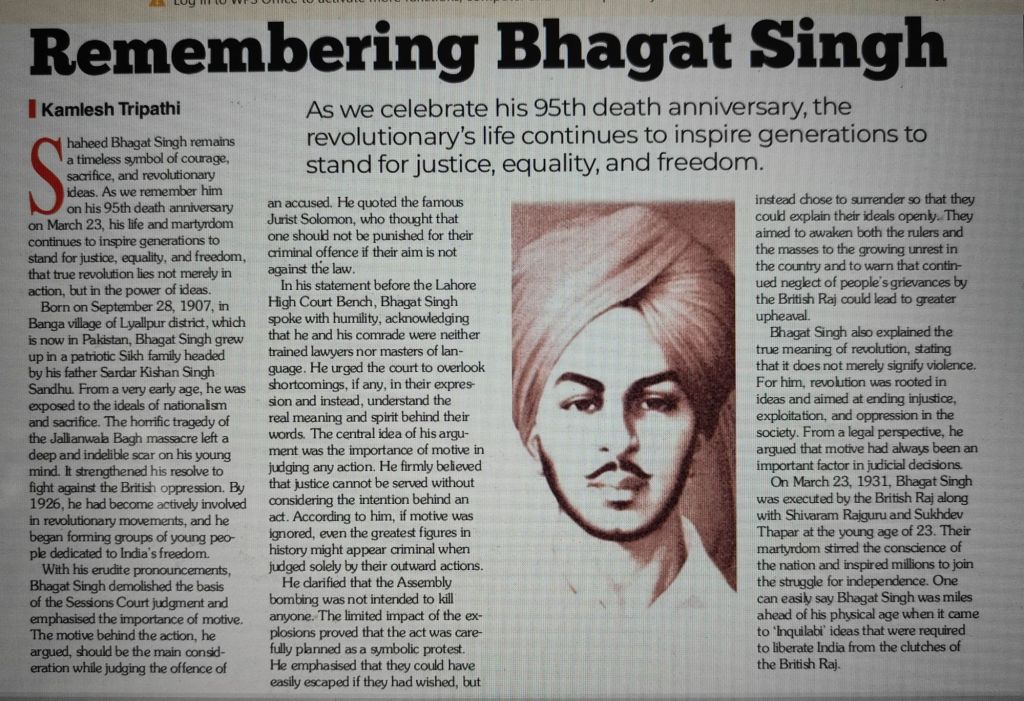
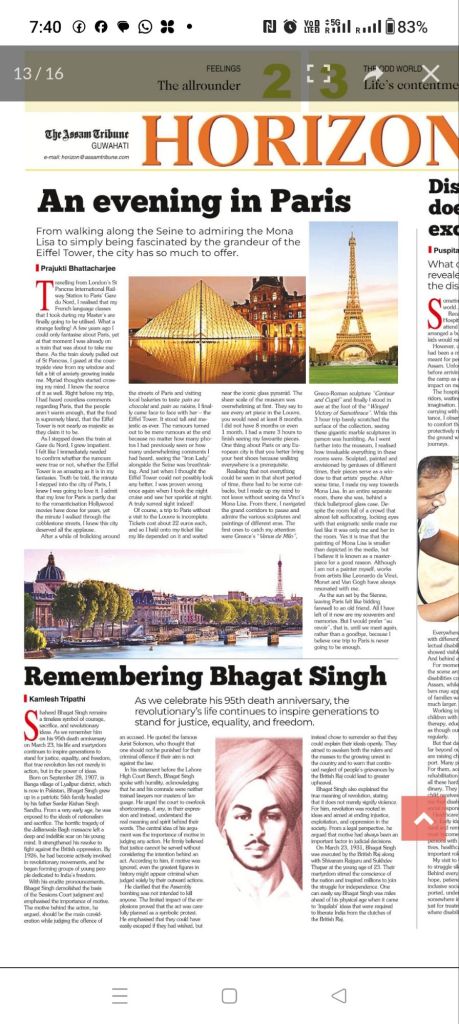
Happy to share my piece ‘Kasauli: A Jewel in the Himalayan Crown’ published today in The Goan Everyday newspaper. Happy reading.

Copyright@shravancharitymission
Happy to share my piece ‘Kasauli: A Jewel in the Himalayan Crown’ published today in The Goan Everyday newspaper. Happy reading.

Copyright@shravancharitymission
READER’S REWIND: I DREAMT OF UTOPIA
Kamlesh Tripathi
The world has become colourful. But the ‘Happy Prince’ is no longer alive to see it. So is the swallow, who carried out his last orders, but died in the frost, at his feet, before he could escape to Egypt. The lead metal statue of the ‘Happy Prince’ cracks in agony, but his leaden heart still beats for his kingdom and his subjects. But are there any such rulers left, anymore? Well, they are practically extinct or very rare. Perhaps you might remember the name of the author who wrote the story ‘The Happy Prince.’ I’m forgetting his name. Oh! I remember now. It was Oscar Wilde. But “What’s in a name? Wrote Shakespeare. “That which we call a rose / By any other name would smell as sweet.” Maybe Oscar Wilde would like to rewrite the story ‘Happy Prince’ in the context of the present day while residing in heaven. But does a happy man without a shirt exist anymore, as told in the Italian tale ‘The Happy Man’s Shirt’? A quintessential example in recent times was India’s Mahatma Gandhi, the father of the nation, whose simple attire—a loincloth and shawl (without shirt) during the 1930s, particularly around the 1931 Round Table Conference- was given the abrasive title of ‘half-naked fakir’ by the British Prime Minister, Winston Churchill, to mock him. I’m more than sure there isn’t a happy man without a shirt anymore because the man now wears not only shirts but also colourful shirts, yet he remains unhappy.
Utopia is now seized of polarising colours, such as red, blue, green and saffron, and certain adamant tenets and philosophies that rule the roost, along with the so-called isms, the right wing and the left wing, in the central pillar of democracy. Have we gone back in time? Are we proving the Greek epic poem Hesiod’s Theogony correct, which propagated the initial theory that dense darkness covered everything until the earth was born out of chaos? With Earth came the mountains, the sea, the sky and Uranus. Uranus and Earth came together and gave birth to the Titans. Later, the Titans and Gods, both from the same lineage and class, fought for supremacy, in which the Greek God Zeus won, just like Lord Krishna.
But halt there. Take time off to think because the world leaders of today suffer from the same fear as Uranus, Cronus or the Kansa Mama of Mathura, who killed their would-be adversaries. Even Nigas tried to swallow Lord Vishnu in a television series, but that was in a different context. Ajatashatru killed his father Bimbisara to ascend the throne of the Magadha Empire, and in return, his son too killed him for the same throne. The Robinhoods are extinct now. The two biggest democracies are always in the news, but at times for the wrong reasons. The world is full of Brutus in present times, which may put the original Brutus to shame and the Bard into a wonder, ‘to be or not to be’.
One can say goodness has eclipsed and is rarely seen and experienced. Much has evolved, but more is yet to come. So wait and watch. Be on the lookout for that happy man without a shirt, and the happy prince, with a lead heart that beats for the public even now. Fortunately, I dreamt, Utopia shall remain Utopia and not become a Dystopia.
Written and posted by Kamlesh Tripathi
Author, Poet, & Columnist
*
https://kamleshsujata.wordpress.com
*
Like it and Share it
*
Shravan Charity Mission is an NGO that works for poor children suffering from life-threatening diseases, especially cancer. Our posts are meant for our readers, including children and adults, and have a huge variety of content. We also accept donations for our mission. Should you wish to donate to the cause of cancer? The bank details are given below:
NAME OF ACCOUNT: SHRAVAN CHARITY MISSION
Account no: 680510110004635 (BANK OF INDIA)
IFSC code: BKID0006805
***
Published by the GOAN EVERYDAY Newspaper on 25/1/26

Copyright@shravancharitymission
A Happy Republic Day to Indians
*
Kamlesh Tripathi
**
The twenty-sixth of January dawns
a morning stitched with memory and resolve,
When time salutes the nation,
That chose law over power,
And conscience over crown.
*
In nineteen fifty,
The ink became destiny.
The Constitution awoke,
As a commemoration of independence,
With pages breathing justice, liberty,
equality and fraternity.
*
And India rose… not merely free,
But self-governing,
From Kashmir to Kanyakumari,
From Arunachal to Kutch.
A republic by her own word.
*
The long shadow of the Raj fell away,
Chains melted into clauses,
Subjects transformed into citizens,
Power flowed downward.
*
Into the hands of many,
Where ballots replaced commands,
And democracy learned to speak,
In a hundred tongues.
*
The Republic Day reminds you of more,
The cry of Purna-Swaraj in nineteen thirty,
When freedom was first declared in spirit,
Long before it arrived, in fact.
Hope marched ahead of history,
and history followed to cement the victory.
*
Along Kartavya Path—earlier Raj Path,
Boots strike the earth in measured pride,
The mighty Indian Army and para-forces march in style,
With tanks and guns galore,
The mighty Air Force’s flypast on the fore,
Where tableaux bloom with colour and culture,
The bands play melodious tunes,
And folk songs dance beside steel resolve.
*
The Tricolour rises,
The President salutes,
Where sacrifice is honoured,
In silence louder than drums.
*
Across the land,
Homes pause, hearts reflect.
A nation remembers its duties
as much as its rights.
*
The final notes of Beating Retreat,
Fade into the night,
Leaving behind a promise renewed,
That India is on the move.
*
Republic Day is not just a day or a date,
It is a vow repeated every year:
To guard the Constitution,
To deepen democracy,
And to keep India, always,
A Republic of the people.
Jai Hind.
Written and posted by Kamlesh Tripathi
Author, Poet, & Columnist
*
https://kamleshsujata.wordpress.com
*
Like it and Share it
*
Shravan Charity Mission is an NGO that works for poor children suffering from life-threatening diseases, especially cancer. Our posts are meant for our readers, including children and adults, and have a huge variety of content. We also accept donations for our mission. Should you wish to donate to the cause of cancer? The bank details are given below:
NAME OF ACCOUNT: SHRAVAN CHARITY MISSION
Account no: 680510110004635 (BANK OF INDIA)
IFSC code: BKID0006805
***
Copyright@shravancharitymission
The Famous Five spend their summer holidays at Finniston Farm as paying guests. On arrival, they are greeted by the pleasant Mrs Philpot and her identical twins, Henry and Harriet. The twins seem to take an instant dislike to the Five, who also meet two fellow paying guests: an American, Mr Henning and his son, Junior. Mr Henning plans to buy antique pieces from the farm and sell them in America. Mr and Mrs Philpot agree to sell their farm treasures as they need the money. However, the family’s hot-tempered Great Granddad feels the antiques should remain in England.
Mr Henning and his son Junior prove themselves a nuisance to the household by rudely ordering Mrs Philpot around. Sympathetic to her, the Five offer to help with farm chores. When Junior demands breakfast in bed, George teaches him a lesson, making him agree to be more pleasant. This wins the hearts of the twins, and they make friends with the Five.
Anne and George visit a nearby antique shop, owned by a Mr Finniston, who tells them about a secret passage from Finniston Castle to an old chapel and cellars where royal treasure might be hidden. The girls excitedly reveal the news to the boys and the twins. Together, they plan to hunt for the cellars on the farm. They come across the castle’s kitchen midden and realise they are close to finding the treasure.
Junior spies on them and goes to break the news to his father and his father’s friend, Mr Durleston, who decide to excavate the castle site, find the fortune and sell the antique treasure in America. Mr and Mrs Philpot consent to the excavation, much to the dismay of the children. The children dig around the site, hoping to beat the men in finding the treasure. Initially, they are unsuccessful, but the twins’ dog, Snippet and their jacksaw, Nosey, lead them to a burrow, beneath which the secret passage stretches out.
The children discover the cellars and the treasure, including old daggers, sword and gold, which are worth a fortune; only to become trapped inside the tunnel when the entrance caves in. They take another way and reach a trapdoor under the old chapel, which is now used as a storehouse. The farmhands, Bill and Jamie, hear their shouts and let them out. The children get back to the farm and tell their exciting story to the astonished adults. The next day, Mr Henning and Mr Durleston try to trick the Philpots into believing the site has no treasure and offer them a meagre amount. However, Mr Philpot, backed up by his granddad and Mr (William) Finniston, declines the offer, making it clear they will excavate the site themselves and no longer want the Americans to stay. The adventure ends with Julian, Dick, Anne and George, along with Timmy, planning to stay at the farm to observe the excavation of the treasure.
It is an interesting read, and I would give it eight out of ten.
Written and posted by Kamlesh Tripathi
Author, Poet, & Columnist
*
https://kamleshsujata.wordpress.com
*
Like it and Share it
*
Shravan Charity Mission is an NGO that works for poor children suffering from life-threatening diseases, especially cancer. Our posts are meant for our readers, including children and adults, and have a huge variety of content. We also accept donations for our mission. Should you wish to donate to the cause of cancer? The bank details are given below:
NAME OF ACCOUNT: SHRAVAN CHARITY MISSION
Account no: 680510110004635 (BANK OF INDIA)
IFSC code: BKID0006805
***
Copyright@shravancharitymission
Why Basant Panchami Still Matters
Kamlesh Tripathi
Observed on the fifth day of the bright fortnight of the lunar month of Magha, usually in late January or early February, Basant Panchami anticipates spring nearly forty days before its official arrival. Traditional belief holds that seasons do not change overnight; rather, they unfold gradually. The festival, therefore, acts as a harbinger to spring, often called the ‘King of Seasons,’ symbolising hope, vitality, and regeneration after winter’s inertia.
In an age dominated by speed and spectacle, the festival of Basant Panchami arrives discreetly, with lasting effects. It is also celebrated as Saraswati Puja. It serves as a benchmark for values that remain essential, for learning and creativity. Celebrated across the length and breadth of India, the festival announces the advent of spring while venerating Goddess Saraswati, the embodiment of knowledge, wisdom, music, and arts.
Basant Panchami marks the turning point of the season. In northern India, the winter still lingers on, while central and western regions begin to experience a softer, spring-like weather. The festival captures this vivid moment of transition. This is when nature moves from dormancy toward growth, mirroring the human journey from inertia to wilful action.
The prominence of yellow during Basant Panchami is deeply symbolic. Associated with Goddess Saraswati, the colour represents knowledge, clarity, and creativity. It also reflects the mustard fields that bloom across much of northern and central India during this time. The custom of wearing yellow and preparing yellow-coloured food expresses collective optimism and intellectual resumption.
Education lies at the heart of Basant Panchami. Families traditionally encourage children to write their first letters on this day, marking the beginning of their learning. Music, learning, and artistic pursuits are considered auspicious during the festival. It reaffirms Goddess Saraswati’s central position in cultural consciousness, underscoring the belief that knowledge is both sacred and transformational.
The fever of kite flying, especially popular in the north and west of India, adds to the festive celebrations of the day. Skies filled with colourful kites speak of the collective joy and shared celebration. It reminds communities of the simple pleasures that accompany the change of season.
Mythology lends further fillip to the occasion. In several traditions, Basant Panchami is associated with Kamadeva, the god of love, and his consort Rati. The well-known episode of Kamadeva awakening Lord Shiva from deep meditation highlights the central philosophical theme, the tug-of-war between desire and discipline. Once, when Shiva’s third eye reduced Kamadeva to ashes at Umananda Islet in the River Brahmaputra at Guwahati, it highlighted the destructive potential of unchecked desire. Kamadeva’s revival later, following Shiva’s marriage to Parvati, represents the restoration of balance between worldly engagement and spiritual life-lessons. The lesson remains strikingly relevant in contemporary life.
The festival is not only celebrated in the sub-continent of India but also in Nepal, Bali, Indonesia, and other continents of the world with a Hindu diaspora, thus transcending geography and religious boundaries. At its core, the festival reminds us that the renewal of seasons, ideas, and values requires patience, balance, and reverence for knowledge. In a rapidly changing world, this message remains as vital as ever.
Basant Panchami also carries a historical significance beyond Hindu traditions, as Maharaja Ranjit Singh encouraged its observance as a day of social gathering within Sikh communities, particularly in gurdwaras. The day additionally commemorates the martyrdom of Haqiqat Rai, who was executed in 1741 for refusing religious conversion. His remembrance adds a solemn note to the festival.
Written and posted by Kamlesh Tripathi
Author, Poet, & Columnist
*
https://kamleshsujata.wordpress.com
*
Like it and Share it
*
Shravan Charity Mission is an NGO that works for poor children suffering from life-threatening diseases, especially cancer. Our posts are meant for our readers, including children and adults, and have a huge variety of content. We also accept donations for our mission. Should you wish to donate to the cause of cancer? The bank details are given below:
NAME OF ACCOUNT: SHRAVAN CHARITY MISSION
Account no: 680510110004635 (BANK OF INDIA)
IFSC code: BKID0006805
***
VERSATILE BARDS OF AWADH
“Lucknow has been the cradle of literary brilliance for centuries. From Urdu’s ‘Khuda-e-Sukhan’ Mir Taqi Mir to revolutionary voices like Hasrat Mohani and progressive Hindi writers like Amritlal Nagar, the city remains poetry’s eternal hub. Mohita Tewari revisits the literary journey of the city …”
Often dubbed as the city of poets and writers, Lucknow has been the cradle for numerous renowned writers and poets over the past 250 years since it became the capital of Awadh for the first time in 1775.
From Insha Allah Khan, the author of the first grammar of Urdu language, Darya-e-Latafat, to MirTaqi Mir, known as Khuda-e-Sukhan (God of poetry), and Maulana Hasrat Mohani, the Urdu poet and freedom fighter who coined the legendary slogan Inquilab Zindabad (Long live the revolution), the city has been a fertile ground for literary excellence.
INSHA ALLAH KHAN (1752-1817)
Insha Allah Khan served as a distinguished Urdu poet in the royal courts of Lucknow and Delhi during the late 1700s and early 1800s. A versatile scholar proficient in multiple languages, he authored the pioneering Urdu grammar text, Darya-e-Latafat.
Born in Murshidabad, Khan produced significant literary works in Lucknow, where he remained until his death in 1817. His legacy rests on two major contributions: Rani Ketki Ki Kahani, an early Hindi prose narrative composed without Arabic or Persian vocabulary, and Darya-e-Latafat (1807), a Persian treatise examining Urdu grammar, rhetoric, and the distinctive dialects of Delhi and Lucknow. This groundbreaking text established grammatical conventions that remain relevant today.
DD National, India’s public broadcasting network Doordarshan, adapted Rani Ketki Ki Kahani into a television programme.
MIR TAQI MIR (1723-1810)
Mir Taqi Mir is celebrated as one of the finest poets who explored profound themes of romance, bereavement, and human nature. His renowned couplets include Dikhaai diye yun ki bekhud kiya, hamein aap se bhi juda kar chale.
His poetry is noted for its emotional depth and poetic finesse. Born in Agra in 1723, Mir spent much of his life in Lucknow until his death in September 21, 1810.
Recognised as a foundational figure in Urdu literature, he earned the title Khuda-e-Sukhan.
His contributions, particularly in ghazals, have solidified his status as an exemplary practitioner of this poetic form.
MUNSHI NAWAL KISHORE (1836-1895)
Munshi Nawal Kishore often referred to as the Caxton of India, established the Munshi Nawal Kishore Press on Nov 23, 1858, at the age of 22. He began publishing the weekly newspaper Avadh Akhbar, also known as Oudh Akhbar, in 1859. His publishing enterprise became Asia’s oldest printing and publishing establishment, releasing over 5,000 publications in various languages, including Arabic, Bengali, Hindi, English, Marathi, Punjabi, Pashto, Persian, Sanskrit and Urdu, between 1858 and 1885.
His legacy continued through his sons, who founded the Ram Kumar Press and Tej Kumar Press as successors to the original Nawal Kishore Press.
Ghalib acknowledged the influence of Nawal Kishore Press by stating, “Divan of whosoever Nawal Kishore published, his name and fame reached the sky.”
Ameer Hasan Noorani, in his 1982 publication Munshi Nawal Kishore Haalat aur Khidmaat, noted that “as soon as one mentions the words ‘Nawal Kishore Press’, the pleasing and awe-inspiring thought of thousands of books fills one heart.”
Urdu scholar Aziz Ahmed observed, “Had it not been for Sir Syed Ahmed Khan and Munshi Nawal Kishore after the 1857 War of Independence, the general awakening of India to a different environ and the preservation of our cultural heritage would not have been possible. If Nawal Kishore had not rediscovered our invaluable cultural treasure through printing and publishing, it would have been lost forever after the calamity of 1857.”
Abdul Halim Sharar (1860-1926)
Abdul Halim Sharar, distinguished Urdu litterateur, made significant contributions as a short-story writer and novelist. He earned widespread recognition for pioneering Islamic historical novels in Urdu literature, creating exceptional literary works that enriched the language. His professional journey began at the Awadh newspaper in Lucknow, followed by positions at various newspapers, magazines, and journals. He later published his own chronicles, with Dil-Gudaz achieving remarkable success and appreciation across diverse readerships. He also composed poetry under the pen name ‘Sharar’. His book Guzashta Lucknow is still considered one of the best narratives describing the genesis of the city and its culture.
Ameer Minal (1829-1909)
Ameer Minal, an esteemed Urdu poet of his times, gained widespread recognition for composing the ghazal, Sarakti jaye hai rukh se naqab aahista aahista, which was later sung by Jagjit Singh. His ghazals have been performed by renowned vocalists including Ghulam Ali, Farida Khanum, and Jagjit Singh. He also wrote under the pen name ‘Ameer’, Minal’s most significant contribution was Ameer-ul-Lughaat, an extensive Urdu-to-Urdu dictionary planned as an eight-volume collection. However, only two volumes were completed and released and released in 1891 and 1892. Despite his proficiency in various poetic forms, his ghazals brought him the greatest acclaim. His notable works include Mirat-ul-Ghalib (1868) Gauhar-e-Intekab (1896), and Sanam-khana-e-Ishq (1896)
Hasrat Mohani (1878-1951)
Inquilab Zindabad (long live the revolution) is the most used slogan, both during the pre-independence era, and afterwards. Popularized by Bhagat Singh, one of the most revered revolutionaries, the slogan was coined by Hasrat Mohani, a freedom fighter and a legendary poet from Lucknow.
Born as Syed Fazlul Hasan in Mohan in Unnao, a neighbouring district in Lucknow, Mohani established himself as a notable personality in Lucknow. His reputation stemmed from his poetic works, social activism, and significant role in India’s freedom struggle.
His diverse contributions included establishing the influential publication Urdu-i-Mualla and serving in key positions within the Indian National Congress. He actively participated in the Swadeshi movement and introduced the pioneering resolution for complete independence.
His leadership extended across various organisations, presiding over sessions of the Indian National Congress, Muslim League, Jamiat-ul Ulama-i-Hind, and the Communist Party of India, which he helped establish. He knew the art of writing ghazals in simple language. His ‘ghazals’ like ‘Chupke Chupke Rat Din’ still figures in the playlist of every household.
WINDS OF CHANGE
At a time when the Progressive Writers’ Movement was sweeping India, Asrarul Haq Majaz (1911-1955), gave vent to the angst of the youth in Lucknow with Inquilab, and Aahang-e-Nau. Known as the ‘Keats of Urdu poetry’, Majaz was one of the few poets who romanticised revolution. His pen spews fire when he says, ‘Dekh Shamsheer hai ye, saaz hai ye, jaam hai ye; Tu jo Shamsheer utha le to bada kaam hai ye. His work Aawara (Aye gam-e-dil kya karoon) is considered one of his best poetic works.
Safi Lakhnawi (1862-1950) His simple yet unique style and writings on socio-political issues made him the people’s poet. Later, poets like Wali Asi (1939-2002) (Phailta jaata hai nafrat ka dhuan ishq karo), Krishna Bihari ‘Noor’ (1926-2003) (Zindagi se badi sazaa hi nahi), and Sardar Khushbir Singh ‘Shaad’ (born 1954) emerged as the torch bearers of Lucknow’s literary tradition.
Poet, lyricist and screenwriter Javed Akhtar and his brother Salman Akhtar, sons of illustrious poet and lyricist Jaan Nisar Akhtar, also have a deep connection with Lucknow.
Poet Munawwar Rana (1952-2024) gave a new dimension to poetry by making the love for mother as the central theme of his poetry.
Historian, writer, poet and a storyteller par excellence, Yogesh Praveen (1938-2021) was a walking encyclopedia on Lucknow. He wrote over two dozen books capturing the history, culture and beauty of Awadh.
His poetic works include Shabnam, Peele Gulab, Anjuman, and Indradhanush. He is also known for his contribution in the making of cinematic masterpieces like Shatranj Ke Khiladi, Junoon and Umrao jaan..
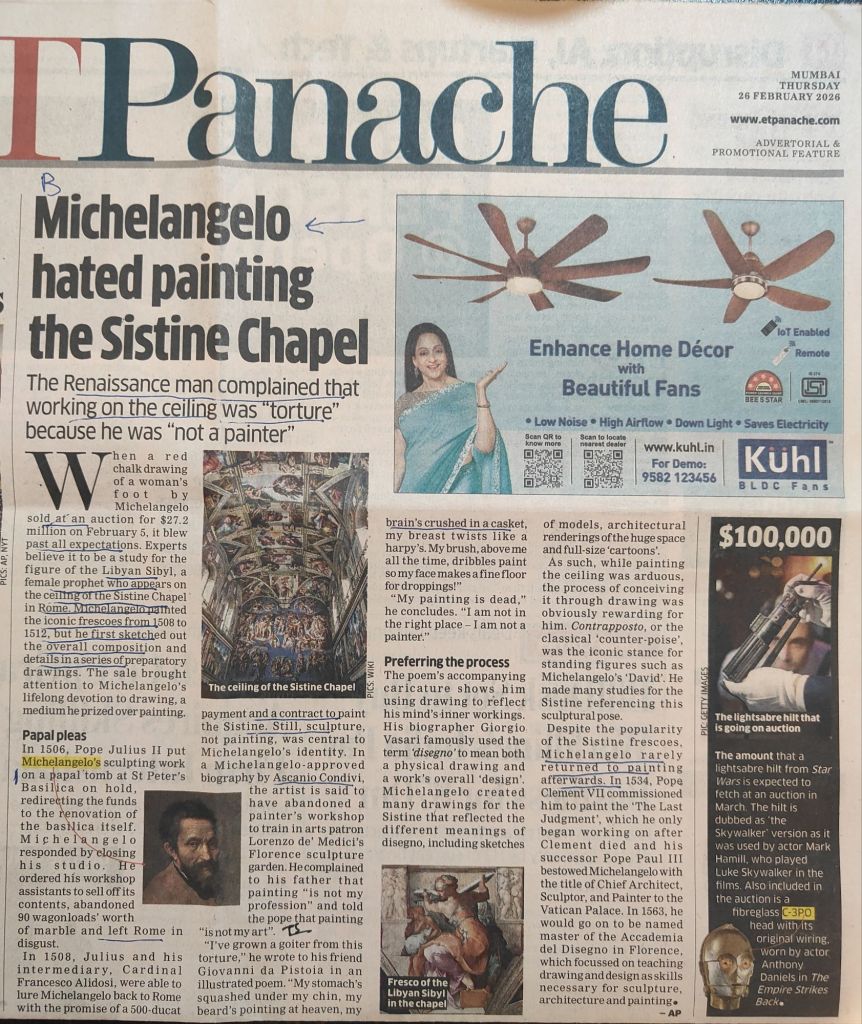
TOI 30/8/25

Copyright@shravancharitymission
Poem: Be the Wise Man
Kamlesh Tripathi
It is the wise man who knows his trade,
Who measures his steps where paths are laid.
It is the wise man who understands the intricacies of life,
Who measures his moments to avoid shocks.
*
The days are numbered, marked and traced,
Do not let even one be laid to waste,
The breaths are counted; spend them chaste.
Spend them gently, not in haste.
*
The wheat knows well the weight of its grain,
Each kernel complete, none borne in vain.
It bows to earth in humble refrain,
Achieving abundance through measured gain.
*
The sun knows when to rise and when to rest,
Never hurried, never late, never distressed.
It keeps its promise from dawn to dusk,
Unmoved by praise, untouched by elate.
*
The rivers know their destined shore,
They rush, but forget not what for.
The stars keep a watch in measured flight,
Time itself moves by sacred signs.
All things stand in dharma’s frame,
Each plays its part, each knows its name.
*
Do not disturb what you did not design,
Do not wound the balance so fine.
Be the creator, not the hand of ruin,
Choose the art of life, not the boast of death.
Build with patience, heal with care,
Leave behind more light than despair.
*
“It is a wise father who knows his child,”
So speaks Lancelot—comic, yet styled,
With truth that mocks the proud and sure,
To know one’s child is to know the core.
Not flesh alone, nor face, nor claim,
But the soul is shaped through love and pain.
*
A man must know what he brings to birth,
His deeds, his children upon the earth.
The Self that knows, the Self that sees,
Builds the world as it builds itself—wisely.
kamleshsujata@yahoo.com
Written and posted by Kamlesh Tripathi
Author, Poet, & Columnist
*
https://kamleshsujata.wordpress.com
*
Like it and Share it
*
Shravan Charity Mission is an NGO that works for poor children suffering from life-threatening diseases, especially cancer. Our posts are meant for our readers, including children and adults, and have a huge variety of content. We also accept donations for our mission. Should you wish to donate to the cause of cancer? The bank details are given below:
NAME OF ACCOUNT: SHRAVAN CHARITY MISSION
Account no: 680510110004635 (BANK OF INDIA)
IFSC code: BKID0006805
***

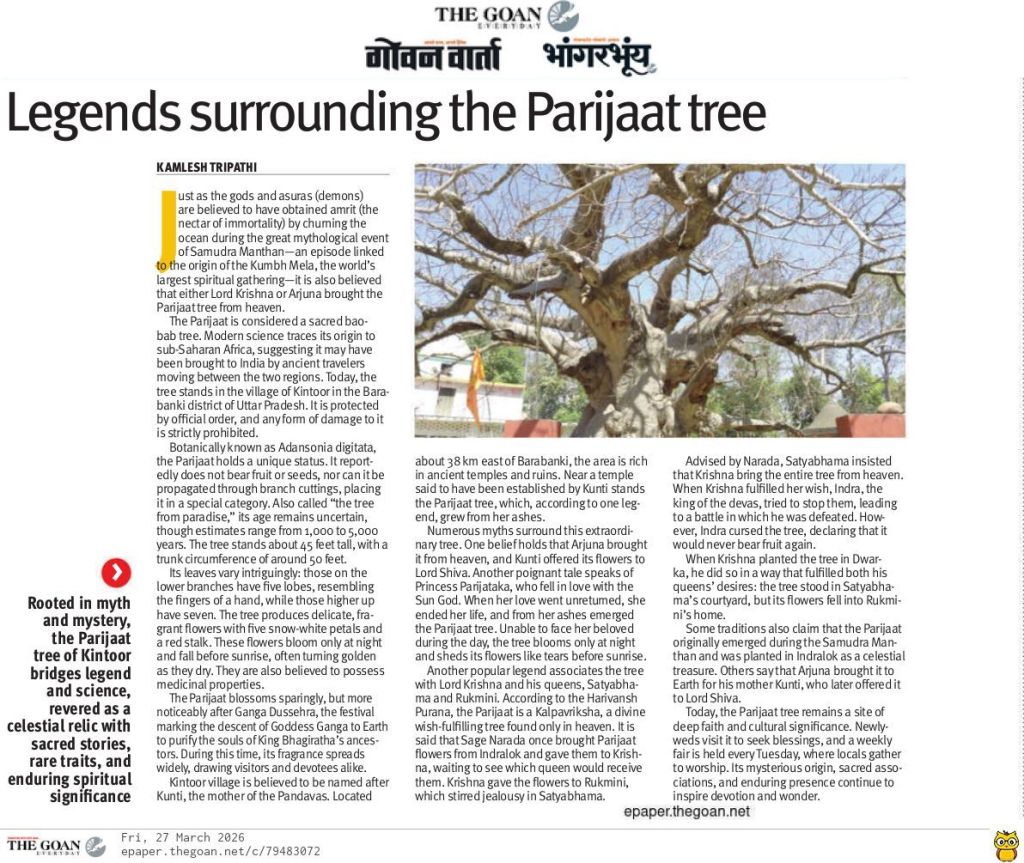
Copyright@shravancharitymission
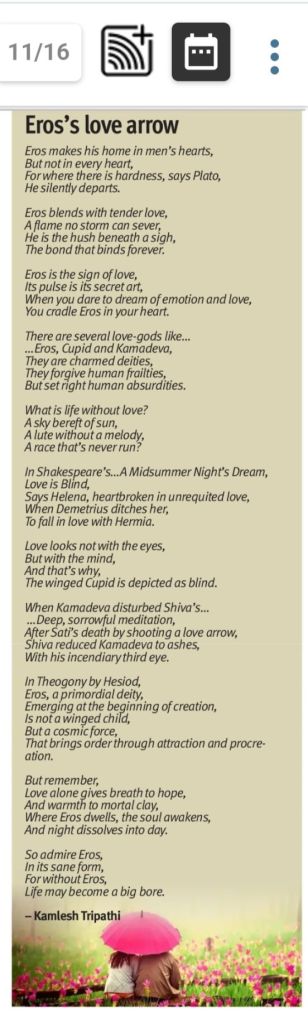
Happy to share my poem published in the Shillong Times on 11.1.26.
Written and posted by Kamlesh Tripathi
Author, Poet, & Columnist
*
https://kamleshsujata.wordpress.com
*
Like it and Share it
*
Shravan Charity Mission is an NGO that works for poor children suffering from life-threatening diseases, especially cancer. Our posts are meant for our readers, including children and adults, and have a huge variety of content. We also accept donations for our mission. Should you wish to donate to the cause of cancer? The bank details are given below:
NAME OF ACCOUNT: SHRAVAN CHARITY MISSION
Account no: 680510110004635 (BANK OF INDIA)
IFSC code: BKID0006805
***