Copyright@shravancharitymission
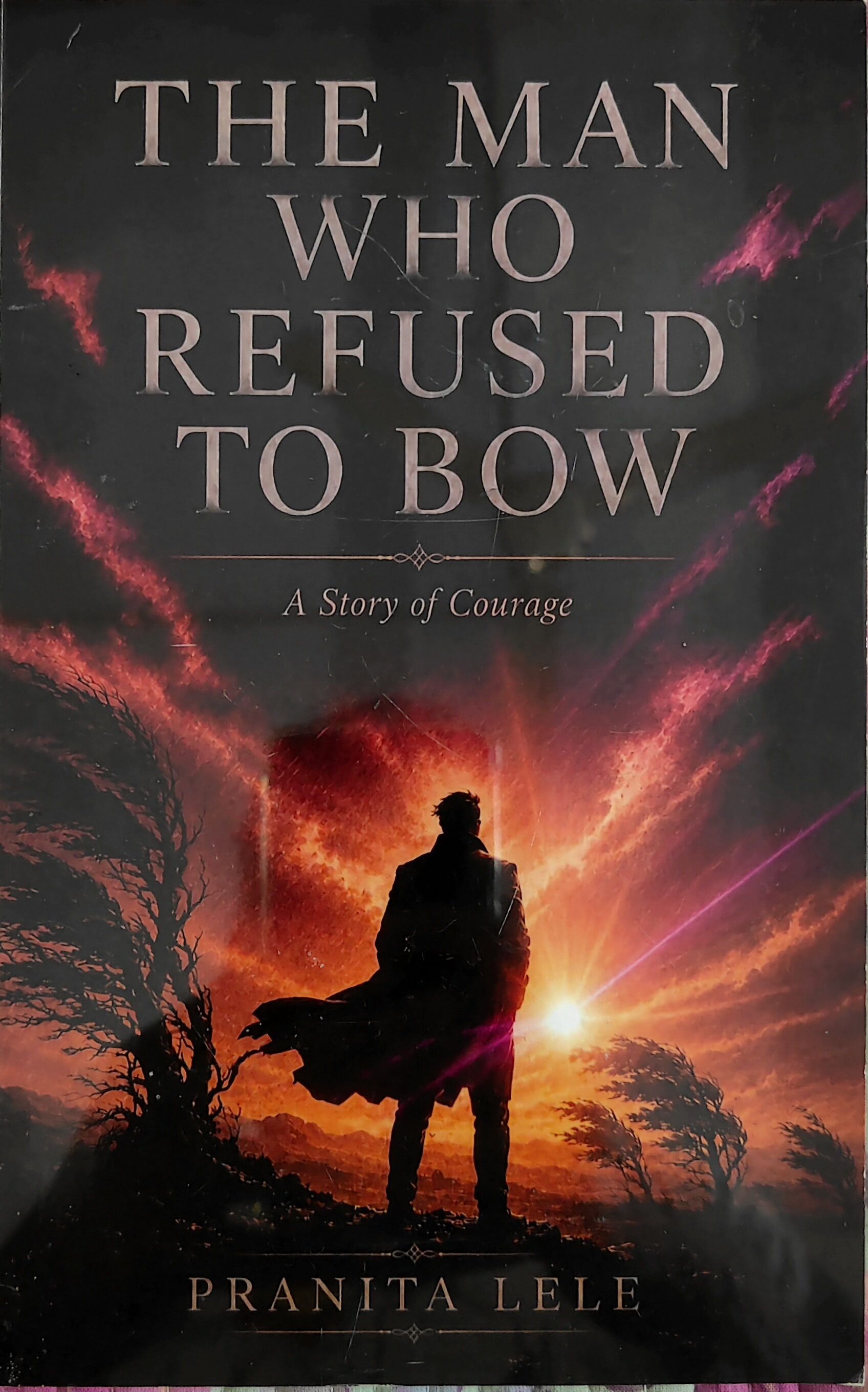
The Man Who Refused to Bow… A Story of Courage … by Pranita Lele
Reviewed by: Kamlesh Tripathi
The book is a personal account of author Pranita Lele, who is combating horrific situations that life has offered her. Her husband is suffering from Cancer. Cancer, as one can say, is the reverse of the Midas touch. Just as the Midas touch converts everything into gold, cancer can transform life into a gruelling journey. Cancer can walk into anyone’s life surreptitiously, and as an uninvited guest, without any warning, just as it walked into Vikram Lele’s life, the author’s husband. You need a Satyavati to retrieve her husband from the menace of cancer. I’m reminded of the famous story of Satyavati, Satyavan and Yama. The analogy may sound similar. Pranita and Vikram’s story evokes the celebrated episode of Savitri and Satyavan in the Mahabharata. When Satyavan suddenly fell ill while working in the forest, Savitri cradled his head in her lap. When Yama, the god of death, arrived to claim her husband’s life, she refused to abandon him and followed Yama, ultimately persuading him to restore Satyavan’s life. Truly, a kindred metaphor.
Another glimpse that one gets is of the 1963 Bollywood hit … Dil Ek Mandir, starring Meena Kumari, Rajendra Kumar and Raj Kumar. For a closer fit, consider Elizabeth Barrett Browning and Robert Browning, whose relationship involved emotional support during difficult periods, though it is not principally a story of a wife nursing a seriously ill husband.
I’m reminded of the first stanza of one of my poems titled, ‘I’m Life,’ where life says: You think you know me/Well, everyone thinks that way/But believe me/ I’m very sneaky/I’m very tricky/And I rarely play by the rules you make for me.
Spread across 40 chapters and around 170 pages, the book presents its central message in a precise, concise and accessible manner. Normally, such books are unplanned because tragedies strike without notice, and the author has to play it by ear. The narration is in easy English, in short sentences with a pleasant trickle and flow like a flowing river.
The book intertwines life’s onerous circumstances with biological calamities. Aged parents above 90. Vikram, after recovering from brain haemorrhage, falls prey to oesophageal cancer. And in this global world, one cannot expect children to be by your side always. And in these frightful circumstances, one finds author Pranita walking through a dark isthmus all by herself.
But to every downside there is an upside. The world survives because of the balance. The plane has wings. It will glide through high turbulence, provided the pilot is competent and the support system is good. This is where the Oncology Department of Max Hospital Lucknow comes into play. Its team of doctors and support staff extended extensive support to Vikram and Pranita throughout the treatment. The subject book is definitely to honour the entire team of Max Hospital.
The author has painstakingly acknowledged friends and relatives, contacts, including overseas contacts and hospital staff, for what they did for Vikram.
The book doesn’t bear a sombre and morose tone. It is filled with lively episodes that take you away from the pain of the patient and the family.
The author has used the correct terminology in terms of describing each stage of illness. The narrative helps in building the doctor-patient relationship. The narration has a separate chapter for each doctor and support staff. It describes Chemotherapy, Radiation, immunotherapy, and targeted therapy in simple language.
Pranita Lele’s steadfast companionship also recalls the enduring ideal of marital devotion found in English literature. In John Milton’s Paradise Lost (there is a thematic echo), Adam and Eve’s relationship, despite its trials and consequences, explores the profound bond between husband and wife. While the circumstances differ considerably from Vikram and Pranita’s struggle with cancer, the work invites reflection on companionship when life becomes difficult. Pranita’s story brings this ideal into the everyday world of medical appointments, uncertainty and caregiving, showing how commitment is expressed not merely through words but through continued presence and practical acts of love…. A real page-turner.
Written and posted by Kamlesh Tripathi
Author, Poet, & Columnist
Appreciation received from a reader.
Wow .I read the article .So well written .His writing proves that he is an highly intellectual person .So much depth and meaning in his writing .
Great work Pranita .I am sure and confident with all your support ,prayers and positivity Vikram will be fine .Our prayers and best wishes are always with you both .God bless .👍❤️❤️❤️
*
https://kamleshsujata.wordpress.com
*
Like it and Share it
*
Shravan Charity Mission is an NGO that works for poor children suffering from life-threatening diseases, especially cancer. Our posts are meant for our readers, including children and adults, and have a huge variety of content. We also accept donations for our mission. Should you wish to donate to the cause of cancer? The bank details are given below:
NAME OF ACCOUNT: SHRAVAN CHARITY MISSION
Account no: 680510110004635 (BANK OF INDIA)
IFSC code: BKID0006805
***

