Category Archives: snippet

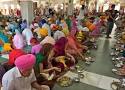
VAND CHAKNA … IN SIKHISM

Copyright@shravancharitymission

    Vand Chakna in Sikhism, is best explained as “sharing and caring.” On one occasion, when Guru Nanak was with his two sons and Lehna (Guru Angad Dev) there was a corpse covered with a cloth lying there. He asked who will eat this. No one responded, but Lehna, having full faith in his master, accepted it and when he removed the cloth, he saw there was a tray full of sacred food, which he served to his master and ate the leftovers. On this Guru Nanak said, “Lehna, you are blessed with sacred food because you shared it. Similarly, people should use wealth, not only for themselves, but share it with others. If one consumes it only for himself then it is like a corpse. But when we share it with others it becomes sacred.”

    This constitutes the basis for “Langar” the community kitchen, and Dasvandh, that is sharing one-tenth of one’s earnings with the community.

By Kamlesh Tripathi

*

https://kamleshsujata.wordpress.com

*

Share it if you like it

*

Shravan Charity Mission is an NGO that works for poor children suffering from life threatening diseases especially cancer. Our posts are meant for our readers that includes both children and adults and it has a huge variety in terms of content. We also accept donations for our mission. Should you wish to donate for the cause. The bank details are given below:

NAME OF ACCOUNT: SHRAVAN CHARITY MISSION

Account no: 680510110004635 (BANK OF INDIA)

IFSC code: BKID0006805

*

Our publications

GLOOM BEHIND THE SMILE

(The book is about a young cancer patient. Now archived in 7 prestigious libraries of the US, including, Harvard University and Library of Congress. It can also be accessed in MIT through Worldcat.org. Besides, it is also available for reading in Libraries and archives of Canada and Cancer Aid and Research Foundation Mumbai)  

ONE TO TANGO … RIA’S ODYSSEY

(Is a book on ‘singlehood’ about a Delhi girl now archived in Connemara Library, Chennai and Delhi Public Library, GOI, Ministry of Culture, Delhi)

AADAB LUCKNOW … FOND MEMORIES

(Is a fiction written around the great city of Nawabs—Lucknow. It describes Lucknow in great detail and also talks about its Hindu-Muslim amity. That happens to be its undying characteristic. The book was launched in Lucknow International Literary Festival of 2014)

REFRACTIONS … FROM THE PRISM OF GOD

(Co-published by Cankids–Kidscan, a pan India NGO and Shravan Charity Mission, that works for Child cancer in India. The book is endorsed by Ms Preetha Reddy, MD Apollo Hospitals Group. It was launched in Lucknow International Literary Festival 2016)

TYPICAL TALE OF AN INDIAN SALESMAN

(Is a story of an Indian salesman who is, humbly qualified. Yet he fights his ways through unceasing uncertainties to reach the top. A good read not only for salesmen. The book was launched on 10th February, 2018 in Gorakhpur Lit-Fest. Now available in Amazon, Flipkart and Onlinegatha)

RHYTHM … in poems

(Published in January 2019. The book contains 50 poems. The poems describe our day to day life. The book is available in Amazon, Flipkart and Onlinegatha)

(ALL THE ABOVE TITLES ARE AVAILABLE FOR SALE IN AMAZON, FLIPKART AND OTHER ONLINE STORES OR YOU COULD EVEN WRITE TO US FOR A COPY)

*****


LEADERSHIP A TOUGH BALL GAME OR A CHILD’S PLAY

Copyright@shravancharitymission

    U.S. academic environments, define leadership as, ‘a process of social influence in which a person can enlist the aid and support of others in the accomplishment of a common task.’ Leadership is a primordial trait. Where, the ancient leaders were of course, the ‘Blue Bloods.’

        Says Henry Kissinger, ‘The task of the leader is to get his people from where they are to where they have not been.’     Says John C Maxwell, American author, ‘A leader is one who knows the way, goes the way, and shows the way.’

    To me, leadership is neither a tough ball game, for all times to come, nor a child’s play, but the cyclic median of the two. It’s about motivating people to achieve both, covert and overt success, in their hitherto unproven life. For people, who enjoy leadership challenges, it’s a child’s play right up to the grand finale, and for those who don’t, it’s a tough ball game … a Herculean task, akin to boiling the ocean or even the ‘Achilles heel.’ But I guess the toughness of ‘leadership’ wanes in front of dexterity, passion and perseverance, the hallmarks to fame.

    Sanskrit literature professes ten types of leaders. Aristocratic thinkers of the past have postulated that leadership depends on one’s ‘blue blood’ or ‘genes’. Where monarchy takes an extreme view of the same idea.

    The flock of leadership largely depends on the number of challenges that the environment emits. Environment could be both micro and macro. As and when the number of challenges goes up, one will find new leaders are born to handle those challenges. So, one can safely assume that challenges create leadership and concomitantly one can say leaderships envision new challenges?

    Leadership is a stubborn labyrinth to begin with and so, a hard nut to crack at the initial stages. But once the tricks of the trade are learnt, it becomes a feather touch to operate.

    A number of theories have sprung up on leadership. Where, the trait theory, explores at length about the authority of monarchs, lords and even bishops and how their authority later began to wane, is sumptuously spoken about. The writings of Thomas Carlyle, Scottish philosopher, and Francis Galton, a Victorian era statistician, whose works have prompted decades of research on the subject are equally popular. Carlyle identified the talents, skills, and physical characteristics of people who rose to power. Meanwhile, Galton’s Hereditary Genius (1869) examined leadership qualities, in the families of powerful men. However, the numbers of eminent relatives dropped off when his focus moved from first-degree to second-degree relatives, Galton concluded that qualities of leadership are inherited. In other words, leaders are born, not developed. So, both these notable works, lent, great initial support to the notion that leadership is rooted in the characteristics of a leader. But then, how does one decipher if leadership is a tough ball game or a child’s play. Also, how do you explain a recent example of Prime Minister, Narendra Modi who is not a blue blood nor a born dynast and comes from a humble back ground? Yet, he turns out to be one of the most popular Prime Ministers of India.

    Over a period of time the essence of leadership has evolved into, simplification of traits and virtues. But before I move forward let me also tell you, that leadership is, an extensively written and described art, that touches the research area along with practical skills that burnishes the brand of an organization, and within that the team or an individual, to achieve the specialised goal. Exceptions are however there. Just as we have Orwellian states running into dystopia we also have Orwellian organisations that semaphores as one man show. But then that is not the epitome of sound leadership.

    Leadership has an umbrella of qualities. I would for your immediate practice, list out some of them. These are indeed effective tools to practice.

    ‘The supreme quality for leadership is unquestionably integrity. Without it, no real success is possible, no matter whether it is on a section gang, a football field, in an army, or in an office.’—said President Dwight D Eisenhower. Honesty and integrity are two bliss ingredients that make a good leader. How can one expect, one’s followers, to be honest when you yourself lack in these qualities. Leaders succeed when they stick to their values and core beliefs. Remember, without ethics, this will not be possible.

    Confidence is the core attribute an effective leader must have, at his, or her command. If you are unsure about your own decisions, then your subordinates will never follow you. As a leader, you have to be oozing with confidence. Where, one needs to exhibit a ray of swagger and assertiveness to gain the confidence of one’s subordinates. But the caution is that confidence should not translate into overconfidence.

    A leader needs to inspire his or her subjects. They look up to him for guidance. The most difficult job of a leader is to persuade others to follow him. You can only inspire by setting a good example. When the going gets tough the tough get going, and that is where you come in. A positive leader is calm and positive in all situations and keeps the motivation level high. Says American statesman, John Quincy Adams, “If your actions inspire others to dream more, learn more, do more and become more, you are a leader.”  

    If you have commitment and passion in you nothing remains a challenge. When your teammates see a hands on person they too will give their best shot.

    An effective leader needs to be an effective communicator too. Until you communicate clearly and effectively to your team things will not move. The other important prowess of leadership qualities is the art of decision making. Sound decision making comes with good on the job knowledge. This also requires long term vision.  And then we come to accountability. Where, one needs to follow the approach of late Arnold H Glasow, a U.S. businessman when he said, “A good leader takes little more than his share of the blame and little less than his share of the credit.”

    Focus on the core issues. Issues that will take the organisation to greater heights and into the formidable bracket, while delegate and empower the rest to your subordinates. For that will give the right synergy, to both, the organisation and the subordinates to grow.

    Steve Jobs was way ahead of times along with his visionary thoughts and ideas. Perhaps, he had the sixth, the seventh and even the eight sense about leadership. He went on to say ‘Innovation distinguishes between a leader and a follower.’  True enough, in order to get ahead in today’s fast-paced world, a leader must be both creative and innovative at the same time. Creative thinking and constant innovation is what makes you and your team stand out from the crowd. Think out of the box to come up with unique ideas and turn those ideas and goals into reality.

    Last but not the least is empathy. A true leader should have a reserve of empathy for his followers. But on the contrary, most leaders, only follow a dictatorial style of working these days, that lacks empathy altogether. Due to this, they fail to make a closer connect with their followers. The first step towards becoming an effective leader is to understand the problems and feel the pain of your followers. This should be supplemented by the endeavour to provide them with suitable solutions to solve their issues.

    There is no fixed mould of learning for an effective leader. The path traverses through the high frequency highs and lows of life. And that is why for some people leadership is a tough ball game and for some others a child’s play. But yes, there is a lot to learn from the day-to-day.

    Let me cite the example of the most influential economist of the twentieth century. His name was John Maynard Keynes. Although, he was an economist, he did not have a formal degree in Economics. And, if I remember correctly, he had, just about eight days of formal training and the rest was all, on the job learning. Yet, he turned out to be one of the most influential economist of the world. A revered leader.

   The offbeat para above, solely, tells us, that for an open mind everything is a child’s play. But for a closed mind everything is a hard ball game. And of course in life one thing that doesn’t have a cul-de-sac is the razzmatazz of leadership.

By Kamlesh Tripathi

*

https://kamleshsujata.wordpress.com

*

Share it if you like it

*

Shravan Charity Mission is an NGO that works for poor children suffering from life threatening diseases especially cancer. Our posts are meant for our readers that includes both children and adults and it has a huge variety in terms of content. We also accept donations for our mission. Should you wish to donate for the cause. The bank details are given below:

NAME OF ACCOUNT: SHRAVAN CHARITY MISSION

Account no: 680510110004635 (BANK OF INDIA)

IFSC code: BKID0006805

*

Our publications

GLOOM BEHIND THE SMILE

(The book is about a young cancer patient. Now archived in 7 prestigious libraries of the US, including, Harvard University and Library of Congress. It can also be accessed in MIT through Worldcat.org. Besides, it is also available for reading in Libraries and archives of Canada and Cancer Aid and Research Foundation Mumbai)  

ONE TO TANGO … RIA’S ODYSSEY

(Is a book on ‘singlehood’ about a Delhi girl now archived in Connemara Library, Chennai and Delhi Public Library, GOI, Ministry of Culture, Delhi)

AADAB LUCKNOW … FOND MEMORIES

(Is a fiction written around the great city of Nawabs—Lucknow. It describes Lucknow in great detail and also talks about its Hindu-Muslim amity. That happens to be its undying characteristic. The book was launched in Lucknow International Literary Festival of 2014)

REFRACTIONS … FROM THE PRISM OF GOD

(Co-published by Cankids–Kidscan, a pan India NGO and Shravan Charity Mission, that works for Child cancer in India. The book is endorsed by Ms Preetha Reddy, MD Apollo Hospitals Group. It was launched in Lucknow International Literary Festival 2016)

TYPICAL TALE OF AN INDIAN SALESMAN

(Is a story of an Indian salesman who is, humbly qualified. Yet he fights his ways through unceasing uncertainties to reach the top. A good read not only for salesmen. The book was launched on 10th February, 2018 in Gorakhpur Lit-Fest. Now available in Amazon, Flipkart and Onlinegatha)

RHYTHM … in poems

(Published in January 2019. The book contains 50 poems. The poems describe our day to day life. The book is available in Amazon, Flipkart and Onlinegatha)

(ALL THE ABOVE TITLES ARE AVAILABLE FOR SALE IN AMAZON, FLIPKART AND OTHER ONLINE STORES OR YOU COULD EVEN WRITE TO US FOR A COPY)

*****


LITERARY CORNER: THE INDIAN MUTINY OF 1857

Copyright@shravancharitymission

Khidki (Window)

–Read India Initiative—

This is only an attempt to create interest in reading. We may not get the time to read all the books in our lifetime. But such reviews, talk and synopsis will at least convey what the book is all about.

THE INDIAN MUTINY OF 1857

by

George Bruce Malleson.

Pages 278

Publisher: Rupa Publications.

Price Rs 278.

(Caveat: Most foreign writers especially of British origin call it a ‘mutiny’ which means a rebellion against authority. Whereas, Indian writers and more so Indians like calling it a ‘War of Independence)

    The fifth print or impression of this book came out in 2016. Malleson lived from (8 May 1825 to 1 March 1898). He was an English officer born in Wimbledon and educated at Winchester. Thereafter, he obtained a cadetship in the Bengal infantry in 1842, and served through the second Burmese War. He was a prolific writer. He had written extensively on the Sepoy Mutiny. His important works include, ‘History of the Indian Mutiny of 1857-58’ that runs into six volumes, ‘History of the French in India’ and the ‘Decisive Battles of India.’

    He even authored the biographies of the Mughal Emperor Akbar, the French Governor-General Dupleix and the British officer Robert Clive for the Rulers of India series. He died in London on 1st march 1898.

        Mutiny of 1857 remains an event shrouded in mystery and intrigue. Its very significance, whether it can be considered as the first war of Independence, continues to be questioned. The causes of the mutiny are many but all elusive, and so are the consequences of the mutiny. But the moot point is did the mutiny ring the death knell of the British Empire, or was it a mere speck of exaggerated trouble? The book takes you through that.

    It serves to fill a tremendous gap in narrative accounts of the mutiny, and demystifies lay assumptions. It begins with a sizeable background on the genesis of the British Raj in India—a move not deliberate but powerful enough to shape history for decades to come. The author delves in great detail into the causes of the mutiny, unlike preceding writers who mostly concentrated on the consequences. And this the author could do because he was a serving officer and therefore privy to many decisions and happenings. With the aid of personal knowledge and observation he attempts to pin-point the ‘latent power’ that drove the mutiny on.

    He provides a realistic account of all the important operations that took place, praising the heroic and criticizing the undeserving. He is careful not to overlay his work with too much tedious detail, where his writing remains lucid and interesting. 

    The subject book captures successfully, and even uncompromisingly, an event that was perhaps disorganized but large in scale. It deals with each individual and geographical area separately, analysing the causes and effects, both locally and nation-wide. It captures the spirit of the time, its people who fought and died, and the changing attitudes of the British Raj, which was gradually losing control of its Empire.

    In writing this short History of the Indian Mutiny of 1857. The author has aimed at the compilation of a work, which when complete in itself, should narrate the causes as well as the consequences of a movement unforeseen, and even undreamt of. For the mutiny as per the author was sudden and swift in its action, and therefore taxed utmost the energies of the British people. Preceding writers on the same subject, whilst dealing very amply with the consequences, have, with one exception, but dimply shadowed forth the causes. Even the very actors of the Mutiny failed to detect them.

    Sir John Lawrence the then Viceroy of India from 1864 to 1869, himself, writing with full knowledge of events in which he played a very conspicuous part, mistook the instrument for the chief cause. He stopped at the greased cartridge. But the greased cartridge was never issued to the great body of troops, if indeed to any. There must have been a latent motive power to make of an unissued cartridge a grievance so terrible as to rouse into revolting men whose fathers and whose father’s father had contributed in the making of the British Empire in India. The greased cartridge, too, did not concern those landowners and cultivators of Oudh and the North-Western Provinces, who rose almost to a man. What that latent motive power was, the author has described fully, in this volume.

    In the early chapters of the book the author communicates, ‘That his belief about the mutiny is founded on personal knowledge and personal observation. Locally chief of the Commissariat Department at Kanhpur when, in January 1856, Sir James Outram crossed the Ganges to depose or remove from office the King of Oudh, I had witnessed the indignation which the very rumour of his purpose caused among the sipahis of my own guard. I reported their excited state to my superiors, and was laughed at for my pains. But, impressed with the accuracy of my forecast, viz., that the annexation of Oudh would rouse indignation and anger in the sipahi army. Nevertheless, I continued. After my transfer, two months later, to an appointment in the Military Audit Department in Calcutta, to keep a careful record of several occurrences, all apparently of minor importance, which supervened when the effects of the annexation of Oudh had been thoroughly realised by the sipahis. My observations led to the conclusion that they were thoroughly angered, and, a little later, that their minds were being mysteriously worked upon. I kept copious notes of the matters I observed, and discussed them with my brother officers, without, finding that my views were shared by any one of them. Essentially, it was not alone the greased cartridge but a host of other factors that brought about the mutiny of 1857. It would seem, however, that the officer who held the responsible post of Town major. His name Major, Orfeur Cavenagh, had, from his own observation, arrived at conclusions not dissimilar. He has narrated in his admirable work the observations forced upon him by the changed demeanour of the natives of the North-Western Provinces in 1856. But he too, stood, amongst high-placed Europeans, almost alone in his convictions. The fact is that, up to the very outbreak of the mutiny at Mirath, which is present day Meerut, no one, from highest to lowest, believed in the possibility of a general combination. Those, and they could be counted on the fingers of one hand, who endeavoured to hint at an opposite conclusion were ridiculed as alarmists. So ingrained was the belief in the loyalty of the sipahis, and so profound was the ignorance as to the manner in which their minds were affected, that neither the outbreak at Mirath nor the seizure of Delhi entirely removed it.

    The book is divided into twenty eight chapters that begins with the introduction and then talks about the conspirators, to the first mutterings of the storm and the happenings at Barrackpur, Calcutta and the North-West. The revolt at Mirath present day Meerut is significant along with the seizure of Delhi. The effect of the seizure of Delhi across India. The author then goes on to describe the progress of the insurrection in the North-West. There are several other chapters as a spill over of the mutiny that leads to the march to Delhi and the author has listed the reactions and activities that flared up in Kanhpur, Lakhnao, Allahabad, and Calcutta. It also describes in great detail the Britishers taking back famous monuments from the mutineers such as ‘The Residency’ at Lucknow after Havelock’s first attempts to relieve it failed.

    The other places that the book covers are the events in Sagar and Narbada territories, Central India, Rajputana, the Mirath Districts, Rohilkhand and the Punjab province and even Gwalior.

   It then talks of the second attempt to takeover Lakhnao Residency and the Gwalior contingent. It also describes how Sir, Colin Campbell recovers the Duab area of Punjab.

    The book also covers the rebellion in Eastern Bengal, Eastern Bihar, Azamgarh, Allahabad and Eastern Oudh.

    The author has used the old names of the cities and places as they were spelt during those times.

    The book does impact you only if you read it in a continuous stretch. It brings you to a point where you start thinking that sure enough the ‘mutiny of 1857’ the forerunner to the fight for freedom in India that the Indians launched on the British Raj in the twentieth century under Mahatma Gandhi.

    Overall the book is a treat for history lovers. It is meticulously punctuated and that changes the style of writing automatically, and with that the speed of reading, where, you might take some extra hours to finish the book, as compared to some other present day book of similar pages. I would give the book seven out of ten. A must read for history students.

By Kamlesh Tripathi

*

https://kamleshsujata.wordpress.com

*

Share it if you like it

*

Shravan Charity Mission is an NGO that works for poor children suffering from life threatening diseases especially cancer. Our posts are meant for our readers that includes both children and adults and it has a huge variety in terms of content. We also accept donations for our mission. Should you wish to donate for the cause. The bank details are given below:

NAME OF ACCOUNT: SHRAVAN CHARITY MISSION

Account no: 680510110004635 (BANK OF INDIA)

IFSC code: BKID0006805

*

Our publications

GLOOM BEHIND THE SMILE

(The book is about a young cancer patient. Now archived in 7 prestigious libraries of the US, including, Harvard University and Library of Congress. It can also be accessed in MIT through Worldcat.org. Besides, it is also available for reading in Libraries and archives of Canada and Cancer Aid and Research Foundation Mumbai)  

ONE TO TANGO … RIA’S ODYSSEY

(Is a book on ‘singlehood’ about a Delhi girl now archived in Connemara Library, Chennai and Delhi Public Library, GOI, Ministry of Culture, Delhi)

AADAB LUCKNOW … FOND MEMORIES

(Is a fiction written around the great city of Nawabs—Lucknow. It describes Lucknow in great detail and also talks about its Hindu-Muslim amity. That happens to be its undying characteristic. The book was launched in Lucknow International Literary Festival of 2014)

REFRACTIONS … FROM THE PRISM OF GOD

(Co-published by Cankids–Kidscan, a pan India NGO and Shravan Charity Mission, that works for Child cancer in India. The book is endorsed by Ms Preetha Reddy, MD Apollo Hospitals Group. It was launched in Lucknow International Literary Festival 2016)

TYPICAL TALE OF AN INDIAN SALESMAN

(Is a story of an Indian salesman who is, humbly qualified. Yet he fights his ways through unceasing uncertainties to reach the top. A good read not only for salesmen. The book was launched on 10th February, 2018 in Gorakhpur Lit-Fest. Now available in Amazon, Flipkart and Onlinegatha)

RHYTHM … in poems

(Published in January 2019. The book contains 50 poems. The poems describe our day to day life. The book is available in Amazon, Flipkart and Onlinegatha)

(ALL THE ABOVE TITLES ARE AVAILABLE FOR SALE IN AMAZON, FLIPKART AND OTHER ONLINE STORES OR YOU COULD EVEN WRITE TO US FOR A COPY)

*****


INTERESTING FACTS & QUOTES-19

Copyright@shravancharitymission

Boiling the ocean: Means to go overboard or to delve deep into such small details that a project becomes impossible. The phrase, boil the ocean, appears in business as well as other group settings. In the literal sense, boiling the ocean is  impossible because there’s too much water for it to be possible.

What are brown, grey and white goods? Brown goods are consumer electronics, grey goods are computers etc., and white goods are domestic appliances. These are collective names for different types of electric and electronic equipment. These goods also include equipment powered by batteries such as computers, monitors, industrial dishwashers, ventilation units, etc.

 Difference between advertising and publicity: Advertising is what a company says about its own product, but Publicity is what others says about a product. Conversely, publicity is done by a third party which is not related to any company. Whereas, advertising is under the control of the company which is just opposite to publicity.

Mumbai discharges 750 metric tonnes of plastic every day, which is a sixth of its total garbage.

Mckinsey & Company an American worldwide management consulting firm estimates that tech giants worldwide spent anywhere between $20-30 billion on artificial intelligence in 2016.

Till 1985 marijuana and cannabis, that is, ganja and bhang derivatives, were legally sold in the country through authorised retail shops in India. It is believed moderate consumption of marijuana is far less harmful than tobacco and alcohol.

An old Rabbi once asked his pupils how they could tell when the night had ended and the day had begun. “Could it be”, asked one of the students, “when you can see an animal at a distance and tell for sure, whether it’s a sheep or a dog?” “No”, answered the Rabbi. “Is it, when you can look at a tree at a distance and tell whether it’s a fig tree or a peach tree?” wondered another. Again, the Rabbi answered “No”. The impatient pupils demanded: “Then what is it?” “Well … it is, when you can look at the face of any man or a woman and see that it is your sister or brother: Till then it is still midnight.”

Although we are second to China in population, our country is adding almost an entire Australia each year.

Recently published data shows that a quarter of white extremist’s attacks, in Europe since 2015 targeted Muslims and mosques. And now you have the retaliatory Sri-Lanka terror attack.

It’s always been the nature of government that it underpays at the top and overpays at the bottom.

The latest report of the UN’s Inter-governmental Panel on Climate Change (IPCC), released recently, states that Indian agriculture may be significantly impacted even by a 1.5 degree centigrade increase in average global temperature.

According to the Indian healthcare market research report 2016, our healthcare sector is one of the largest in terms of employment and revenue generation. Growing at a CAGR (compound annual growth rate) of 16.5%, it will possibly be worth $280 billion by 2020. The 2017 national health policy seeks to increase government spending from the abysmally low 1.4% to 2.5% of India’s GDP.

Russia has lost more than it has won through its policy of confronting the west.

Rivers have been the lifeline of all civilizations. No wonder they are considered sacred across cultures. In India, the Ganga symbolises knowledge, Yamuna was known for love stories, Narmada stood for bhakti, knowledge and logic, Saraswati for brilliance and architecture, and India got its name from the Sindhu also known as Indus.

The name Punjab has been derived from five rivers, which are Jhelum, Chenab, Ravi, Beas and Sutlej that collectively signify “five waters” or “the land of five waters.” Starting off in the Tibetan highland of western China near Lake Mansarovar in Tibet Autonomous Region, the Indus river flows through the Ladakh district of Jammu and Kashmir.

One of the longest rivers in the world, the Sindhu also known as Indus has a total length of over 2,000 miles and runs south from the Kailash Mountain in Tibet all the way to the Arabian Sea in Karachi, Pakistan. Where, Jhelum, Chenab, Ravi, Beas, and Sutlej—eventually flow into the Indus.

Russia has no companies in the top 100 global brands. The three most valuable companies in Russia today were also the three most valuable 10 years ago.

The brain contains 10 billion nerve cells, making thousands of billions of connections with each other. It is the most powerful data processor we know, but at the same time it is incredibly delicate. As soft as a ripe avocado, the brain has to be encased in the tough bones of the skull, and floats in its own waterbed of fluid. An adult brain weighs over 3 lb and fills the skull. It receives one-fifth of the blood pumped out by the heart at each beat.

82% of the wealth generated last year went to the richest 1% of the global population, while the 3.7 billion people who make up the poorest half of the world saw no increase in their wealth. Adding Indian dimension to the horror story of global inequity, the report, added India’s richest 1% garnered as much as 73% of the total wealth generated in the country in 2017.

India is a water stressed country with a per-capita water availability reducing from 1820 to 1545 cubic metres between 2001 to 2011.

Online retail in India is estimated to grow to $200 billion by 2026, up from just $15 billion in 2016.

Car penetration—India is around 20 per 1000 people, China is at 90 per 1000 people, and the US is at 750 1000 people.

Greenpeace International, an NGO estimated that the beverage giant Coca Cola produced 110 billion throwaway plastic bottles in 2015. Most of these go for landfills or to the ocean. Owing up to its responsibility the company recently announced that it would make all its packaging recyclable by 2030.

Tripura has one of the highest unemployment rates in the country and suffers from lack of infrastructure. Manik Sarkar of the Communist Party of India (Marxist) served as the Chief Minister of Tripura from 1998 to 2018. His reign was the longest in the state’s history.

Prices are the only thing that defy the law of gravity.

Interesting quotes and lines.

‘In depth of the winter I finally learned that there was in me an invincible summer’—ALBERT CAMUS, French philosopher, author,  and journalist.

‘God’s in His Heaven, All’s right with the world’–Robert Browning.

Don Marquis once joked, ‘an idea is not responsible for the people who believe in it.’

‘Everyone dies. But not everyone lives’—Shobha De.

‘Life is like riding a bicycle. To keep your balance, you must keep moving’—ALBERT EINSTEIN

By Kamlesh Tripathi

*

https://kamleshsujata.wordpress.com

*

Share it if you like it

*

Shravan Charity Mission is an NGO that works for poor children suffering from life threatening diseases especially cancer. Our posts are meant for our readers that includes both children and adults and it has a huge variety in terms of content. We also accept donations for our mission. Should you wish to donate for the cause. The bank details are given below:

NAME OF ACCOUNT: SHRAVAN CHARITY MISSION

Account no: 680510110004635 (BANK OF INDIA)

IFSC code: BKID0006805

*

Our publications

GLOOM BEHIND THE SMILE

(The book is about a young cancer patient. Now archived in 7 prestigious libraries of the US, including, Harvard University and Library of Congress. It can also be accessed in MIT through Worldcat.org. Besides, it is also available for reading in Libraries and archives of Canada and Cancer Aid and Research Foundation Mumbai)  

ONE TO TANGO … RIA’S ODYSSEY

(Is a book on ‘singlehood’ about a Delhi girl now archived in Connemara Library, Chennai and Delhi Public Library, GOI, Ministry of Culture, Delhi)

AADAB LUCKNOW … FOND MEMORIES

(Is a fiction written around the great city of Nawabs—Lucknow. It describes Lucknow in great detail and also talks about its Hindu-Muslim amity. That happens to be its undying characteristic. The book was launched in Lucknow International Literary Festival of 2014)

REFRACTIONS … FROM THE PRISM OF GOD

(Co-published by Cankids–Kidscan, a pan India NGO and Shravan Charity Mission, that works for Child cancer in India. The book is endorsed by Ms Preetha Reddy, MD Apollo Hospitals Group. It was launched in Lucknow International Literary Festival 2016)

TYPICAL TALE OF AN INDIAN SALESMAN

(Is a story of an Indian salesman who is, humbly qualified. Yet he fights his ways through unceasing uncertainties to reach the top. A good read not only for salesmen. The book was launched on 10th February, 2018 in Gorakhpur Lit-Fest. Now available in Amazon, Flipkart and Onlinegatha)

RHYTHM … in poems

(Published in January 2019. The book contains 50 poems. The poems describe our day to day life. The book is available in Amazon, Flipkart and Onlinegatha)

(ALL THE ABOVE TITLES ARE AVAILABLE FOR SALE IN AMAZON, FLIPKART AND OTHER ONLINE STORES OR YOU COULD EVEN WRITE TO US FOR A COPY)

*****


SHORT STORY: LESSON FROM THE OAK TREE

Copyright @shravancharitymission

    Chinese sage Chaung Tsu narrates the story of a huge old oak tree that was declared worthless by a carpenter because its timber was of bad quality and anything made from it would break, rot or wither away. Subsequently, in the story, the tree told the carpenter that it had turned useless on purpose because it wished to live a natural and happy life. Had its timber been useful it would have been cut into pieces, made into something else and would have been dead long ago. The sage enlightens us further by saying that in trying to be valued, desirable and significant in the eyes of the world, we usually end up relinquishing our deeper essence and we start living artificially. Despite assuming a grandiose form, our life is then fraught with meaninglessness and misery.

    Moral of the story: Think of yourself before you think of becoming useful for the world.

By Kamlesh Tripathi

*

https://kamleshsujata.wordpress.com

*

Share it if you like it

*

Shravan Charity Mission is an NGO that works for poor children suffering from life threatening diseases especially cancer. Our posts are meant for our readers that includes both children and adults and it has a huge variety in terms of content. We also accept donations for our mission. Should you wish to donate for the cause. The bank details are given below:

NAME OF ACCOUNT: SHRAVAN CHARITY MISSION

Account no: 680510110004635 (BANK OF INDIA)

IFSC code: BKID0006805

*

Our publications

GLOOM BEHIND THE SMILE

(The book is about a young cancer patient. Now archived in 7 prestigious libraries of the US, including, Harvard University and Library of Congress. It can also be accessed in MIT through Worldcat.org. Besides, it is also available for reading in Libraries and archives of Canada and Cancer Aid and Research Foundation Mumbai)  

ONE TO TANGO … RIA’S ODYSSEY

(Is a book on ‘singlehood’ about a Delhi girl now archived in Connemara Library, Chennai and Delhi Public Library, GOI, Ministry of Culture, Delhi)

AADAB LUCKNOW … FOND MEMORIES

(Is a fiction written around the great city of Nawabs—Lucknow. It describes Lucknow in great detail and also talks about its Hindu-Muslim amity. That happens to be its undying characteristic. The book was launched in Lucknow International Literary Festival of 2014)

REFRACTIONS … FROM THE PRISM OF GOD

(Co-published by Cankids–Kidscan, a pan India NGO and Shravan Charity Mission, that works for Child cancer in India. The book is endorsed by Ms Preetha Reddy, MD Apollo Hospitals Group. It was launched in Lucknow International Literary Festival 2016)

TYPICAL TALE OF AN INDIAN SALESMAN

(Is a story of an Indian salesman who is, humbly qualified. Yet he fights his ways through unceasing uncertainties to reach the top. A good read not only for salesmen. The book was launched on 10th February, 2018 in Gorakhpur Lit-Fest. Now available in Amazon, Flipkart and Onlinegatha)

RHYTHM … in poems

(Published in January 2019. The book contains 50 poems. The poems describe our day to day life. The book is available in Amazon, Flipkart and Onlinegatha)

(ALL THE ABOVE TITLES ARE AVAILABLE FOR SALE IN AMAZON, FLIPKART AND OTHER ONLINE STORES OR YOU COULD EVEN WRITE TO US FOR A COPY)

*****


SHORT STORY: JOB ENRICHMENT … learn it from a tehsildar in Karnataka

Copyright@shravancharitymission

    Some bureaucrats have the gumption to transform even small positions, into powerful and meaningful ones, and some indolent bureaucrats would transform, even powerful and prestigious positions, into inconsequential jobs. So it’s all in the incumbent, and depends on the person occupying the chair. This is where B.N. Girish a tehsildar in Karnataka’s Shivamogga district outshines his bureaucratic fraternity. He shows the way as to how an upright bureaucracy can make a difference.

    As a tehsildar in Karnataka’s Shivamogga district he went undercover as a labourer to work at a stone quarry and check for irregularities then returned to raid the place.  This exemplifies the critical role of bureaucracy in India. Since January 2017, BN Girish has been on a crusade against illegal stone and sand mining in the taluk, following up on tips from local people, conducting raids and seizing vehicles. Sand mining owing to the construction boom has become a lucrative industry in rural India but the state’s limited capacity for regulation has inflicted severe ecological damage to hills, rivers and forests.

    Imagine, for a moment, if a corrupt or indifferent officer was in Girish’s place. He would have made enough black money for himself, and at the same time damaged the environment. Now size up the damage such rapacious mining in just one taluk wreaks on the environment, and the losses to public exchequer; and the weakening of law and order machinery when illegal activity gains impunity and profit. Then multiply this by the thousands of taluks in India and we will get a sense of the importance of the lower bureaucracy. Politics was meant to take power to the people and cut through red tape. But in India the Neta-Babu nexus has for long taken advantage of hierarchical inequalities to subvert the system.

    Says Girish. “Locals told me about the Gejjinahalli quarry in March. I had raided it earlier. But labourers stopped work when they spotted my vehicle. Miners have such a strong network that when unknown vehicles enter, they stop work and flee. That’s when I decided to go in disguise so that no one would recognise me.”

    He adds further. “They realised he was an officer only when he started the inquiry. Gejjenahalli has several stone quarries, but I could raid only four as the men in other places got information and ran away. I plan to use a similar method to tackle illegal sand mining problem in the taluk.”

    Such illegal happenings have run their course and have to change now. The RTI Act, the spread of education, ubiquitous smartphones, rising aspirations and worries over environmental degradation are empowering communities to speak up against illegality. It also helps when honest officers come to the aid of hapless citizens. Not surprisingly, the struggles of bureaucrats like Ashok Khemka against successive Haryana governments struck a chord with the public. Perhaps, a new breed of civil servants with a can-do attitude has emerged in recent years with popular following that even rivals politicians. But the likes of B.N. Girish who go the extra mile must become the norm, not the exception.

   So, a big salute to Tehsildar B.N Girish.

By Kamlesh Tripathi

*

https://kamleshsujata.wordpress.com

*

Share it if you like it

*

Shravan Charity Mission is an NGO that works for poor children suffering from life threatening diseases especially cancer. Our posts are meant for our readers that includes both children and adults and it has a huge variety in terms of content. We also accept donations for our mission. Should you wish to donate for the cause. The bank details are given below:

NAME OF ACCOUNT: SHRAVAN CHARITY MISSION

Account no: 680510110004635 (BANK OF INDIA)

IFSC code: BKID0006805

*

Our publications

GLOOM BEHIND THE SMILE

(The book is about a young cancer patient. Now archived in 7 prestigious libraries of the US, including, Harvard University and Library of Congress. It can also be accessed in MIT through Worldcat.org. Besides, it is also available for reading in Libraries and archives of Canada and Cancer Aid and Research Foundation Mumbai)  

ONE TO TANGO … RIA’S ODYSSEY

(Is a book on ‘singlehood’ about a Delhi girl now archived in Connemara Library, Chennai and Delhi Public Library, GOI, Ministry of Culture, Delhi)

AADAB LUCKNOW … FOND MEMORIES

(Is a fiction written around the great city of Nawabs—Lucknow. It describes Lucknow in great detail and also talks about its Hindu-Muslim amity. That happens to be its undying characteristic. The book was launched in Lucknow International Literary Festival of 2014)

REFRACTIONS … FROM THE PRISM OF GOD

(Co-published by Cankids–Kidscan, a pan India NGO and Shravan Charity Mission, that works for Child cancer in India. The book is endorsed by Ms Preetha Reddy, MD Apollo Hospitals Group. It was launched in Lucknow International Literary Festival 2016)

TYPICAL TALE OF AN INDIAN SALESMAN

(Is a story of an Indian salesman who is, humbly qualified. Yet he fights his ways through unceasing uncertainties to reach the top. A good read not only for salesmen. The book was launched on 10th February, 2018 in Gorakhpur Lit-Fest. Now available in Amazon, Flipkart and Onlinegatha)

RHYTHM … in poems

(Published in January 2019. The book contains 50 poems. The poems describe our day to day life. The book is available in Amazon, Flipkart and Onlinegatha)

(ALL THE ABOVE TITLES ARE AVAILABLE FOR SALE IN AMAZON, FLIPKART AND OTHER ONLINE STORES OR YOU COULD EVEN WRITE TO US FOR A COPY)

*****



LITERARY CORNER VIDEO: WHY I AM A HINDU by Shashi Tharoor

Copyright@shravancharitymission


By Kamlesh Tripathi

Author & Blogger

*

https://kamleshsujata.wordpress.com

*

Share it if you like it

*

Shravan Charity Mission is an NGO that works for poor children suffering from life threatening diseases especially cancer. Our posts are meant for our readers that includes both children and adults and it has a huge variety in terms of content. We also accept donations for our mission. Should you wish to donate for the cause. The bank details are given below:

NAME OF ACCOUNT: SHRAVAN CHARITY MISSION

Account no: 680510110004635 (BANK OF INDIA)

IFSC code: BKID0006805

*

Our publications

GLOOM BEHIND THE SMILE

(The book is about a young cancer patient. Now archived in 7 prestigious libraries of the US, including, Harvard University and Library of Congress. It can also be accessed in MIT through Worldcat.org. Besides, it is also available for reading in Libraries and archives of Canada and Cancer Aid and Research Foundation Mumbai)  

ONE TO TANGO … RIA’S ODYSSEY

(Is a book on ‘singlehood’ about a Delhi girl now archived in Connemara Library, Chennai and Delhi Public Library, GOI, Ministry of Culture, Delhi)

AADAB LUCKNOW … FOND MEMORIES

(Is a fiction written around the great city of Nawabs—Lucknow. It describes Lucknow in great detail and also talks about its Hindu-Muslim amity. That happens to be its undying characteristic. The book was launched in Lucknow International Literary Festival of 2014)

REFRACTIONS … FROM THE PRISM OF GOD

(Co-published by Cankids–Kidscan, a pan India NGO and Shravan Charity Mission, that works for Child cancer in India. The book is endorsed by Ms Preetha Reddy, MD Apollo Hospitals Group. It was launched in Lucknow International Literary Festival 2016)

TYPICAL TALE OF AN INDIAN SALESMAN

(Is a story of an Indian salesman who is, humbly qualified. Yet he fights his ways through unceasing uncertainties to reach the top. A good read not only for salesmen. The book was launched on 10th February, 2018 in Gorakhpur Lit-Fest. Now available in Amazon, Flipkart and Onlinegatha)

RHYTHM … in poems

(Published in January 2019. The book contains 50 poems. The poems describe our day to day life. The book is available in Amazon, Flipkart and Onlinegatha)

(ALL THE ABOVE TITLES ARE AVAILABLE FOR SALE IN AMAZON, FLIPKART AND OTHER ONLINE STORES OR YOU COULD EVEN WRITE TO US FOR A COPY)

*****


LITERARY CORNER: WHY I AM A HINDU by Shashi Tharoor

Copyright@shravancharitymission

Khidki (Window)

–Read India Initiative—

This is only an attempt to create interest in reading. We may not get the time to read all the books in our lifetime. But such reviews, talk and synopsis will at least convey what the book is all about.

WHY I AM A HINDU’

by Shashi Tharoor

Publisher Aleph

Year of publication: 2018

    The price of the book is Rs 699. It’s a 300 page book loaded with some palpable stuff—quite typical of Shashi Tharoor. The book has three main chapters divided into seven sub chapters.

    It starts off quite well with the author glossing over reasons as to why he decided to write this book. Where, he takes you through the essence of Hinduism, but not so much through the rituals but essentially through the religious-socio-cultural plank. He gets into meticulous detailing such as how a Sanskrit word ‘Jagannath’ came to be known as ‘Juggernaut.’ He takes you through the Bhakti movement. He talks about the Advaita Vedanta, the vedic learnings with lots of anecdotes—interesting ones. He describes in great detail the wisdom of Swami Vivekananda and Adi Shankracharya. Talks about his own childhood entangled in Hinduism. The ‘sanskars’ that he got from his parents. While Shashi loves Hinduism he admonishes Hindutva in his hot narration.

    The author, initially appears, quite as a baby faced admirer and a harmless volunteer of Hinduism till around page hundred and forty. But thereafter he changes gear and moves into the domain of political Hinduism.

    Where, he goes unsparingly after Savarkar, Golwalkar and Deen Dayal Upadhyay all stalwarts of the Sangh Parivar. And, as expected of Shashi Tharoor, he does make, a piercing commotion about the atrocities committed by the British Raj on Hinduism, but remains somewhat vague about the atrocities of the Muslim invaders, perhaps, offering them benefit of doubt. He feigns or genuinely believes Hindus are large hearted or even dodos, and will never react to the persecution that they were subjected to at the hands of the British Raj and the devious invaders, even in a millennium which is not quite clear. While he allows Deen Dayal Upadhyay to pass off as a more tolerable face of the Sangh Parivar. For Savarkar and Golwalkar, he projects unalloyed despise rising up to hate, but doesn’t really touch Hedgewar the founding Sangh Chalak even with a bargepole.  Shashi cannot imagine leave alone believing that RSS may have been an initial emotional reaction to the atrocities of the British Raj and the Islamization during Jinnah before and even after the partition. Just as Islamization could have been a reaction to American atrocities on the Muslims as believed by many and not some. And why forget the fascism of Europe that arose primarily because of Communism.

    Beyond page 140 the author shows his real face and that is his attack on Hindutva. The point that he makes is about the ancient Indian culture of hospitality where India has always been a great host to all communities. The population of India is 80% Hindus but they have always looked after the minority communities in terms of Muslims, Christians, Sikhs, Jains, Parsis and others. When you cruise through the book further what becomes more apparent is that Hindutva is the brain child of RSS. And till the time Congress was well in control of India the Indian society was an Utopia and now it has become a dystopia. The book is excellent in terms of narration and flow. And is action packed with all the appreciated fantasies of the Congress regime. Yet, I was left with the following gaps for which I did not find answers or were the answers held back. I really don’t know?

   The book has a good spread of Hinduism’s history but lacks in precipitating/ Hindu emotions because of obvious reasons. It churns out great details about Hinduism yet it does make you feel a depreciated Hindu. The author talks about large scale conversion of Hindus, at the hands of Muslims and even Christians but at the same time is short of saying that both Muslims and Christians are fanatics in that manner.

    Although, he goes after Hindutva with a gun yet he doesn’t give any plausible explanation as to why Hindutva flourished in the last 25-30 years. Was it a pent up emotional need of the Hindus or the failure of Congress party that ruled for so many years. All he does is to blame the Sangh and the BJP. The author having criticised the BJP and the Sangh so vehemently, should have suggested a socio-religious-cultural alternative to BJP which he hasn’t. Muslims have their mosque and Christians their Church but where do Hindus go barring their defining book Gita. And is BJP a reaction to 70 years of Congress rule is the question the author needs to answer to complete the book? BJP has come up through a democratic process. It started with just two seats in the parliament and now occupies almost a full house. If all was going so well for the Hindus in India why did Hindutva gain so much ground. For which there is no elaborate answer from the author barring the cliché of the divisive policy of the RSS and BJP.

    Book is a little too much to digest in one go for an average reader. It’s outright verbose—Shashi Tharoor style. And yes read it with a pinch of salt. The book leans towards Congress. In which he has mixed society, religion and politics. It has excellent flow and detailing. Author admits his erudite team has also helped him in this narration. A large part of the book is all about RSS and BJP bashing. Though India is projected well in the eyes of the world, which, Shashi always does. The first half and even all along, the book is all about the uniqueness of Hindu religion. It covers the Sikh riots in just about half a paragraph just because Congress was to blame for it. Whereas, he criticizes forcefully the doctrine of Hindutva. And mildly conveys about the invaders who came and plundered India from time to time. He sings the same old tune of secularism. He compares India with Pakistan. In Pakistan all non-Muslims have it written on their passports as non-Muslims, signifying they are second rate citizens.

    The book doesn’t reveal the dynamics of an evolving society. One will agree, Hindutva was not in the agenda of things when India got independence. But obviously, there have been factors that propagated the concept of Hindutva later on. Intermittently Shashi criticizes the caste system propagated by the Britishers and subsequently upheld by the Congress party.

    Author doesn’t accept Hindutva as a reaction to Muslim radicalisation. And even fails to say that if Muslim radicalisation continues there is a likelihood of Christian radicalisation too, maybe not in India but in various Christian majority states of the world.

    The book is excellent in terms of detailing and of course the content, language and the flow.

    But surprisingly, it nowhere deciphers between the temperaments of Hindus settled in south and the ones in the north who mostly took the wrath of these Muslim invaders.

    Towards the final chapters the author takes you through some iconic inventions in the realm of Hinduism and Science, especially the inventions of numerals in terms of Shunya or zero. At one point he also tries to justify the invaders and that includes the Mughals starting from Babar. He compares them with the Britishers only to say that Britishers took the loot to their own country whereas, the Muslim invaders spent it here in India. Then he goes on to talk about holy cows, changing the name of Aurangzeb road and even the independence movement.

    Overall it’s an excellent read if you don’t mind the politics that the book generates. I would give the book eight out of ten for the content, detailing, information, language flow and of course Shashi’s guts in being one-sided and the frankness.

By Kamlesh Tripathi

*

https://kamleshsujata.wordpress.com

*

Share it if you like it

*

Shravan Charity Mission is an NGO that works for poor children suffering from life threatening diseases especially cancer. Our posts are meant for our readers that includes both children and adults and it has a huge variety in terms of content. We also accept donations for our mission. Should you wish to donate for the cause. The bank details are given below:

NAME OF ACCOUNT: SHRAVAN CHARITY MISSION

Account no: 680510110004635 (BANK OF INDIA)

IFSC code: BKID0006805

*

Our publications

GLOOM BEHIND THE SMILE

(The book is about a young cancer patient. Now archived in 7 prestigious libraries of the US, including, Harvard University and Library of Congress. It can also be accessed in MIT through Worldcat.org. Besides, it is also available for reading in Libraries and archives of Canada and Cancer Aid and Research Foundation Mumbai)  

ONE TO TANGO … RIA’S ODYSSEY

(Is a book on ‘singlehood’ about a Delhi girl now archived in Connemara Library, Chennai and Delhi Public Library, GOI, Ministry of Culture, Delhi)

AADAB LUCKNOW … FOND MEMORIES

(Is a fiction written around the great city of Nawabs—Lucknow. It describes Lucknow in great detail and also talks about its Hindu-Muslim amity. That happens to be its undying characteristic. The book was launched in Lucknow International Literary Festival of 2014)

REFRACTIONS … FROM THE PRISM OF GOD

(Co-published by Cankids–Kidscan, a pan India NGO and Shravan Charity Mission, that works for Child cancer in India. The book is endorsed by Ms Preetha Reddy, MD Apollo Hospitals Group. It was launched in Lucknow International Literary Festival 2016)

TYPICAL TALE OF AN INDIAN SALESMAN

(Is a story of an Indian salesman who is, humbly qualified. Yet he fights his ways through unceasing uncertainties to reach the top. A good read not only for salesmen. The book was launched on 10th February, 2018 in Gorakhpur Lit-Fest. Now available in Amazon, Flipkart and Onlinegatha)

RHYTHM … in poems

(Published in January 2019. The book contains 50 poems. The poems describe our day to day life. The book is available in Amazon, Flipkart and Onlinegatha)

(ALL THE ABOVE TITLES ARE AVAILABLE FOR SALE IN AMAZON, FLIPKART AND OTHER ONLINE STORES OR YOU COULD EVEN WRITE TO US FOR A COPY)

*****


ARTICLE: A REQUIEM FOR TIGRESS AVNI

Copyright@shravancharitymission

    One of the notable events of 2018 highlighted by the Press on New Year’s eve was the death of the five year old tigress, Avni, in Maharastra. Animal-lovers and activists, among them a Union Minister, alleged that is was a deliberate act of killing, of a fine specimen of an endangered species. The feeling of loss was heightened by the fact that Avni is survived by two two-month old cubs.

    It looked as if the newspapers revelled in the controversy that erupted after the tragic end of Avni. From November 3 to December 10, day after day, sparks flew and the Press carried reports of allegations by the activists and defensive statements by the alleged perpetrators of the crime, namely, the State Government at the ministerial level and the sharp-shooters, father and son. The Union Minister wanted nothing less than the State Forest Minister’s scalp, to wit, his dismissal or resignation. The latter retorted that those who held animal life more precious than human life should show the way.

    According to one report, the big cat had killed at least 7 out of the 13 who had died during May 2016 and August 2017, in the Loni village Relegaon tehsil, Yavatmal District in the Vidharbha region of Maharastra. In August 2017, Avni made short work of at least three persons. The Forest Department then decided to do away with the animal but the activists in protest took the matter  to the High Court, and later to the Supreme Court. Both the courts nodded their assent for killing the animal. After prolonged but futile efforts at capturing Avni, the State Government engaged two sharp-shooters, Shafath Ali Khan and his son Asghar Ali from Hyderabad, and they accomplished the job on November 2.

    Meanwhile, the activists were up in arms. They maintained that the animal should have been captured rather than killed. They alleged that the land was cleared of wildlife to help a private party to set up a factory. Some experts held that several Acts were violated in the diabolic process. Asghar Ali claimed that the animal was shot dead in self-defence. The Hyderabad Forensic Laboratory, on December 10, 2018, confirmed the attempt at tranquilising the animal.

    It would appear that so much vehemence in the protest against the killing  and the excessive publicity given to the controversy were disproportionate to the intrinsic importance  of the event itself. The tiger, no doubt a marvel of creation, is not ecologically very important. The Project Tiger, which was launched in 1973, to preserve wildlife, set out with the aim in moderate terms viz. ‘to maintain a viable population of tigers in India for scientific, economic, aesthetic, cultural and ecological values.’ It must be said to the credit of the Government that, unlike other Asian countries such as Japan and Korea where the species is extinct, the wildlife conservation measures have paid up in India. From 2500 in 1972, the tiger population increased to 3642 in 2001-2002; the number of ‘Tiger Reserves’ rose from 9, covering an area of 14,000 sq km in 1973 to 27, covering an area of 37,761 sq. km, spread over 17 states.

TIGER IN LITERATURE

    ‘Magnificent’ is the word that comes to my mind when one thinks of this gorgeously striped (in yellow and black) creature. It has inspired poets, novelists and animal lovers no end. William Blake (1757-1827) in a popular poem, gave expression to his wonder:

    ‘What immortal hand or eye could frame thy fearful symmetry?’

    He poised the following question for which we have no answer to this day. ‘Did He who made the lamb make thee?’

    The tiger as an object of worship, as Valmik Thapar points out in his informative book ‘The Cult of the Tiger’ (Penguin 2002), had been prevalent from Siberia to South-East Asia; perhaps, it continues here and there.

    In India, Shiva of the Trinity of Gods, wears the tiger skin vyaagrasina ambara-dhara, as Sri Shankara says in his Shivaashtakam. Even as the Sabarimala Temple of Kerala is in the news, one remembers that the deity brought a tiger home when the Queen of Pandalam wanted Ayyappa to fetch tiger’s milk from the forest. The Supreme Goddess Durga has for her vehicle the tiger.

    The literature on the tiger is vast; about 55 books are listed  as of Indian origin in Valmik Thapar’s book.

    While sympathising with the two surviving cubs, let us have a Requeim for Avni.

RELIGIOUS BELIEF AND CONSERVATION

    India in the 21st century has over one billion people and also boasts of half of the world’s tiger population, half of the world’s Asiatic elephant population and along with these charismatic species, an array of other living organisms. Could any of this have been possible without a core belief in nature? Could the Asiatic elephant have been safe without a belief in Ganesha, the elephant God? Could the tiger have survived had it not been the vehicle of Durga? And would the snake, the turtle, the peacock, the cranes and some of our trees have survived without a bank of beliefs in them?  –Valmik Thapar.

(This article was written by V.S.R.K. and published in Bhavan’s journal in recent months)

Posted by Kamlesh Tripathi

*

https://kamleshsujata.wordpress.com

*

Share it if you like it

*

Shravan Charity Mission is an NGO that works for poor children suffering from life threatening diseases especially cancer. Our posts are meant for our readers that includes both children and adults and it has a huge variety in terms of content. We also accept donations for our mission. Should you wish to donate for the cause. The bank details are given below:

NAME OF ACCOUNT: SHRAVAN CHARITY MISSION

Account no: 680510110004635 (BANK OF INDIA)

IFSC code: BKID0006805

*

Our publications

GLOOM BEHIND THE SMILE

(The book is about a young cancer patient. Now archived in 7 prestigious libraries of the US, including, Harvard University and Library of Congress. It can also be accessed in MIT through Worldcat.org. Besides, it is also available for reading in Libraries and archives of Canada and Cancer Aid and Research Foundation Mumbai)  

ONE TO TANGO … RIA’S ODYSSEY

(Is a book on ‘singlehood’ about a Delhi girl now archived in Connemara Library, Chennai and Delhi Public Library, GOI, Ministry of Culture, Delhi)

AADAB LUCKNOW … FOND MEMORIES

(Is a fiction written around the great city of Nawabs—Lucknow. It describes Lucknow in great detail and also talks about its Hindu-Muslim amity. That happens to be its undying characteristic. The book was launched in Lucknow International Literary Festival of 2014)

REFRACTIONS … FROM THE PRISM OF GOD

(Co-published by Cankids–Kidscan, a pan India NGO and Shravan Charity Mission, that works for Child cancer in India. The book is endorsed by Ms Preetha Reddy, MD Apollo Hospitals Group. It was launched in Lucknow International Literary Festival 2016)

TYPICAL TALE OF AN INDIAN SALESMAN

(Is a story of an Indian salesman who is, humbly qualified. Yet he fights his ways through unceasing uncertainties to reach the top. A good read not only for salesmen. The book was launched on 10th February, 2018 in Gorakhpur Lit-Fest. Now available in Amazon, Flipkart and Onlinegatha)

RHYTHM … in poems

(Published in January 2019. The book contains 50 poems. The poems describe our day to day life. The book is available in Amazon, Flipkart and Onlinegatha)

(ALL THE ABOVE TITLES ARE AVAILABLE FOR SALE IN AMAZON, FLIPKART AND OTHER ONLINE STORES OR YOU COULD EVEN WRITE TO US FOR A COPY)

*****


INTERESTING FACTS & QUOTES–17

Copyright@shravancharitymission

Shoot the breeze—to have a casual conversation or to spend time talking about things that are not important.

Cut the cackle and come to the horses—to get down to business. Leave out the non-essentials and come to the part that matters. Agatha Christie was quite fond of this idiom and she has used it in some of her novels.

Not turn a hair—to remain unmoved or unaffected.

Shakespeare—arguably is the greatest wordsmith in the history of English language. Americans loved the Bard because they saw in him a pioneer: an inventive wordsmith who coined new words and expressions—some 1700 by one estimate.

Running the Parliament costs Rs 2.5 lakhs per minute or Rs 2 crore a day. MPs get Rs 2000 per day to attend Parliament. But does the country get the real worth out of the Parliament is the big question.

China has increased its investments enormously in the US in the last decade, employing 1,00,000 US workers compared to 10,000 in 2006.

Wang Jianlin is China’s richest man and the largest Chinese investor in the US.

A joint secretary in the Government of India is the administrative head of a department and has critical influence on its efficacy.

IPL ranks in the world’s top five sporting leagues.

A recent study by UNICEF on the economic impact of sanitation has estimated that in an open defecation free village, each family saves over Rs 50,000 per annum on account of avoided medical costs.

The ministry of law and justice has admitted that as of July last year, 24 high courts were functioning with only 615 out of the total sanctioned strength of 1079 judges. Where, center and state governments account for nearly 70% of cases in courts.

According to RBI data, total debit cards in India went up from 623.67 million (about 62 crore) in November 2015 to 867.35 million (about 87 crore) in September 2016 (a 39% jump, even if many people have multiple cards). Similarly, payments through pre-paid instruments like m-wallet or PPI cards went up from 62.66 million (more than 6 crore) in November 2015 to 97.07 million (that is more than 9 crores) in September 2016 (a jump of 54.9%).

There are 250-300 million or say 25-30 crore Indians with a smart phone.

The stark fact is that in a country of 1.2 billion people, we currently have only 2.50 lakh ATM machines.

I am told there is a magnificent archaeological site in western Africa—the vast ruins of Djenne in Mali. Apparently, this was a city of over 1,00,000 people one thousand years ago—a world class metropolis in the first millennium. A visitor to the site observed: “Its art was stunning. Its architecture reflected a complex society … what struck me the most, however, was the fact that it had been completely ignored by western archaeologists for decades, because they found no evidence of military constructions! The Djenne civilisation did not find its strength through military conquest or intimidation of its people, but through cooperation. It was a great city built not on fear, but friendship.

Stubble burning: Labour has become expensive, therefore mechanical harvesting is done for big fields. But the machine for harvesting leaves 25% of the stem during the harvest. This again, has to be cut, by another machine. So, burning the crop residue is easier and that is called stubble burning. There is an imposition of a maximum fine of Rs 15,000 for stubble burning for farmers.

India occupies 2.4% of the world’s land area and supports over 17.5% of the world’s population. India has more arable land area than any other country except for the United States, and more water area than any other country except Canada and the United States. Indian life therefore revolves mostly around agriculture and allied activities in small villages, where the overwhelming majority of the population live.

As per the 2001 census, 72.2% of the Indian population lives in about 638,000 villages and the remaining 27.8% lives in more than 5,100 towns and over 380 urban agglomerations.

In 1901 the world population was 1.6 billion. By 1960, it became 3 billion, and by 1987, 5 billion and in 1999, 6 billion. Currently, one billion people are added every 12 – 13 years.

When we see the population growth in India we find the population of the country was 27.13 crore in the year 1900, from where it decreased to 26.31 crore in 1925 which sounds impossible and then from there it increased to 35.04 crore in 1950 and 36.23 crore in 1951. From here onwards the population growth took exponential proportions of growth to 43.88 crore in 1961, 54.79 crore in 1971, 68.52 crore in 1981, 84.39 crore in 1991, and 102.70 crore in 2001.

With over 1 billion people, India is currently the World’s second largest populated Country. India crossed one billion mark in the year 2000 that is one year after the World’s population crossed the six billion threshold. It is expected that India’s population will surpass the population of China by 2030 when it would have more than 153 crore of population while China would be number two with a population of 146 crore.

Since 1947, the population of India has more than tripled which has resulted in increasingly impoverished and sub-standard conditions in the growing segments of the Indian population.  In 2007, India ranked 126th on the United Nation’s Human Development Index, which takes into account social, health, and educational conditions in a country.

Britian is already the largest investor in India among the G20 countries and India invests more in the UK than in any other country.

Gotra—is the male bloodline that links Hindus with a range of ancient sages.

The value of rupee has changed from Rs 17.50 per dollar in 1990 to Rs 74 per dollar today.

Interesting quotes and lines:

“Your work is going to fill a large part of your life, and the only way to be truly satisfied is to do what you believe is great work. And the only way to do great work is to love what you do”—Steve Jobs.

Alexander the great might just be right. “I’m not afraid of an army of lions led by a sheep; I’m afraid of an army of sheep led by a lion.”

“Virtue has a veil, vice a mask”—Victor Hugo.

“To error is human; to forgive divine”—Alexander Pope, English poet.

  “The first   requisite of civilisation is that of justice”—Sigmund Freud.

“Man is not worried by real problems so much as by his imagined anxieties about real problems”—Greek philosopher, Epictetus.

By Kamlesh Tripathi

*

https://kamleshsujata.wordpress.com

*

Share it if you like it

*

Shravan Charity Mission is an NGO that works for poor children suffering from life threatening diseases especially cancer. Our posts are meant for our readers that includes both children and adults and it has a huge variety in terms of content. We also accept donations for our mission. Should you wish to donate for the cause. The bank details are given below:

NAME OF ACCOUNT: SHRAVAN CHARITY MISSION

Account no: 680510110004635 (BANK OF INDIA)

IFSC code: BKID0006805

*

Our publications

GLOOM BEHIND THE SMILE

(The book is about a young cancer patient. Now archived in 7 prestigious libraries of the US, including, Harvard University and Library of Congress. It can also be accessed in MIT through Worldcat.org. Besides, it is also available for reading in Libraries and archives of Canada and Cancer Aid and Research Foundation Mumbai)  

ONE TO TANGO … RIA’S ODYSSEY

(Is a book on ‘singlehood’ about a Delhi girl now archived in Connemara Library, Chennai and Delhi Public Library, GOI, Ministry of Culture, Delhi)

AADAB LUCKNOW … FOND MEMORIES

(Is a fiction written around the great city of Nawabs—Lucknow. It describes Lucknow in great detail and also talks about its Hindu-Muslim amity. That happens to be its undying characteristic. The book was launched in Lucknow International Literary Festival of 2014)

REFRACTIONS … FROM THE PRISM OF GOD

(Co-published by Cankids–Kidscan, a pan India NGO and Shravan Charity Mission, that works for Child cancer in India. The book is endorsed by Ms Preetha Reddy, MD Apollo Hospitals Group. It was launched in Lucknow International Literary Festival 2016)

TYPICAL TALE OF AN INDIAN SALESMAN

(Is a story of an Indian salesman who is, humbly qualified. Yet he fights his ways through unceasing uncertainties to reach the top. A good read not only for salesmen. The book was launched on 10th February, 2018 in Gorakhpur Lit-Fest. Now available in Amazon, Flipkart and Onlinegatha)

RHYTHM … in poems

(Published in January 2019. The book contains 50 poems. The poems describe our day to day life. The book is available in Amazon, Flipkart and Onlinegatha)

(ALL THE ABOVE TITLES ARE AVAILABLE FOR SALE IN AMAZON, FLIPKART AND OTHER ONLINE STORES OR YOU COULD EVEN WRITE TO US FOR A COPY)

*****