Category Archives: book talk

BOOK TALK: WILL YOU STILL LOVE ME? … by Ravinder Singh

Copyright@shravancharitymission

Khidki (Window)

–Read India Read initiative–

This is an attempt to create interest in reading books. We may not get time to read all the books. But such reviews and synopsis will at least convey what the book is all about.

TITLE: WILL YOU STILL LOVE ME?

RAVINDER SINGH

Publisher: Penguin

 Abridged in about thousand words for your quick assimilation

    There are times when a frightful mishap might instigate you to write a novel around it. This appears to be one such instance. Where, the author opens the book with an insinuation of a personal tragedy. He as if nudges his dad—who is enduring through the aftermath of a road accident, and then coming to terms with his life, which is not easy. Especially, when, life is not going to be the same there on.’

    This stimulates the author to make a valid point by highlighting some deplorable statistics that happens to be a sad reality of our country—‘Around a lakh and fifty thousand people die in road accidents each year in India. Just in case a disease would have taken these many lives. It would have been pronounced long back, as an epidemic. But sadly in India it is still not considered so. In less than every four minutes, carelessness claims a life on Indian roads. By the time you finish reading this book, probably, it would have claimed a lot many of us.’

    CENTRAL THEME: Of course … it is a love story.  With an overdose of coincidences, that spirals into a stunning romance. That would generally appeal to the young and perky age group or the likes of them. There is also a life lesson that the book offers in the ultimate. But that could have been scripted, more forcefully, in all sincerity. The book tow chain’s between the regular chapters narrating the past and the in-between lackluster chapters narrating the present, titled as the ‘Present’ that comes at regular intervals. That is after the completion of a few regular chapters. The author could have avoided this to make the continuity of the plot more weighing and the end more wholesome.

    PLOT: The series of coincidences, commence, when Rajbeer and Lavanya are juxtaposed in an aircraft flying from Mumbai to Chandigarh. Rajbeer hails from Patiala, where he owns a garment store along with his brother and father. He comes from a Sikh background but he himself is a cut-sardar.     

    Lavanya is a girl from Assam who has spent her childhood and teens in Shillong. The scenic hill capital of Meghalaya. So we are now talking of a North and North-East alliance. She now works in Mumbai, and is on her way to attend her best friend Shalini’s wedding in Chandigarh. They both start chatting in the aircraft that soon evolves into a warm friendship with some rollicking banters. This is followed by another coincidence. When at the airport they inadvertently lift the wrong bags that looked similar. This warrants Rajbeer to return half way from Patiala. When, he realizes the mistake and decides to track down Lavanya through the airlines, to retrieve his bag that is laden with cash as her bag was with him. This gives them the opportunity to be together for some more time. After the wedding Lavanya goes back to Mumbai. This is followed by another coincidence when Lavanya gets her MBA admission in Indian School of Business at Mohalli. So she is back with Rajbeer once again when the courtship only grows and intensifies. But by now one begins to feel as if one is watching an Anand Bakshi movie of the seventies starring Rajesh Khanna. A quote from the book, ‘who knows if love is a creation of conspiracy’ surely justifies the string of coincidences.

    Gradually, the romance peaks into a full blown love story. When, the protagonists finally decide to spend their lives together by getting married. While doing her MBA, Lavanya also starts teaching destitute children in the slums. That happens to be her prime mission and passion of life. In fact earlier she had given up her Google job because of this undying passion of hers.  She is extremely talented—a graduate from IIT Bombay who follows her heart. Where, Rajbeer is from GuruNanak Dev Engineering College of Punjab that gives him a fleeting complex of sorts.

    But then Rajbeer’s family has reservations about Lavanya, because she has chinky features with ‘almond eyes’ so to say and is sadly described as a ‘Chinese’ by Rajbeer’s father. A typical mindset of North Indian’s when it comes to people from the North-East. To which Rajbeer revolts in a soft manner when he doesn’t go with his family to Darbar Sahab in Amritsar. Instead he escorts Lavanya to Shillong on a holiday. The trek scene of Shillong is described quite in detail by the author—especially for those who love trekking.

    Lavanya with her exceptional talent continues with her classes for the destitute. Soon she is shortlisted by her college for a debate. Where, she represents the state of Punjab even when she is from the North-East. And as luck would have it. She figures in a tweet sent out from the twitter handle of the Chief Minister of Punjab. This makes her a local celebrity overnight. When, the family of Rajbeer finally agrees to marry them.

    But then the story takes a bizarre turn from chapter twenty three. When, Rajbeer tries to locate Lavanya and Chutki the young daughter of a police constable Madhav Singh. Who regularly attends Lavanya’s classes in the slums, in the midst of a severe storm and rain, one evening. Where, his inveterate habit of breaking traffic rules and speeding to madness finally makes the horrendous dent in their lives. I should not reveal the suspense I guess.

    The story has a plethora of intimate scenes. Perhaps, that happens to be the key driver of, such romantic novels.

    On the whole it was not a very moving story for me. However the book has its strength in terms of detailing and imagination of the author that includes:

    A trek in Shillong/A Punjabi wedding/ Bhangra dance/A sensual scene in the kitchen while making tea/Description of Guwahati and Shillong/Passionate feelings of Lavanya and Rajbeer all throughout/Description of a … typical Punjabi family/Local market of Patiala/A well defined buying process of salwar kameez perhaps he had lived the role/ Detailing of Patiala town/A scene of the hospital.

    About running through this book. The choice is yours …..

 *****  

By Kamlesh Tripathi

*

https://kamleshsujata.wordpress.com

*

Share it if you like it

*

Shravan Charity Mission is an NGO that works for poor children suffering from life threatening diseases especially cancer. Should you wish to donate for the cause. The bank details are given below:

NAME OF ACCOUNT: SHRAVAN CHARITY MISSION

Account no: 680510110004635 (BANK OF INDIA)

IFSC code: BKID0006805

*

By Kamlesh Tripathi

*

https://kamleshsujata.wordpress.com

*

Share it if you like it

*

Shravan Charity Mission is an NGO that works for poor children suffering from life threatening diseases. Should you wish to donate for the cause the bank details are given below:

NAME OF ACCOUNT: SHRAVAN CHARITY MISSION

Account no: 680510110004635 (BANK OF INDIA)

IFSC code: BKID0006805

*

Our publications

GLOOM BEHIND THE SMILE

(The book is about a young cancer patient. Now archived in 7 prestigious libraries of the US, including, Harvard University and Library of Congress. It can also be accessed in MIT through Worldcat.org. Besides, it is also available for reading in Libraries and archives of Canada and Cancer Aid and Research Foundation Mumbai)  

ONE TO TANGO … RIA’S ODYSSEY

(Is a book on ‘singlehood’ about a Delhi girl now archived in Connemara Library, Chennai and Delhi Public Library, GOI, Ministry of Culture, Delhi)

AADAB LUCKNOW … FOND MEMORIES

(Is a fiction written around the great city of Nawabs—Lucknow. It describes Lucknow in great detail and also talks about its Hindu-Muslim amity. That happens to be its undying characteristic. The book was launched in Lucknow International Literary Festival of 2014)

REFRACTIONS … FROM THE PRISM OF GOD

(Co-published by Cankids–Kidscan, a pan India NGO and Shravan Charity Mission, that works for Child cancer in India. The book is endorsed by Ms Preetha Reddy, MD Apollo Hospitals Group. It was launched in Lucknow International Literary Festival 2016)

TYPICAL TALE OF AN INDIAN SALESMAN

(Is a story of an Indian salesman who is, humbly qualified. Yet he fights his ways through unceasing uncertainties to reach the top. A good read not only for salesmen. The book was launched on 10th February, 2018 in Gorakhpur Lit-Fest. Now available in Amazon, Flipkart and Onlinegatha

(ALL THE ABOVE TITLES ARE AVAILABLE FOR SALE IN AMAZON, FLIPKART AND OTHER ONLINE STORES OR YOU COULD EVEN WRITE TO US FOR A COPY)

*****


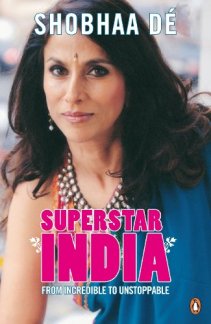
BOOKISH VIEW: SUPERSTAR INDIA–FROM INCREDIBLE TO UNSTOPPABLE–SHOBHAA DE

Copyright@shravancharitymission

Khidki (Window)

–Read India Read initiative–

TITLE: SUPERSTAR INDIA

–FROM INCREDIBLE TO UNSTOPPABLE–

SHOBHAA DE

PUBLISHED BY PENGUIN IN 2008– 456 pages 

Abridged for a quick read


    The book is full of masala … quite like the proverbial Bhanmati ka pitara—the wonder casket. It seems, whatever, dawned her mind and heart. She just penned it down—so in many ways she has opened her heart. Shobhaa is, as old as independent India. So, she runs through India keeping that in mind, in her flamboyant narrative style. But the content is quite scattered and even skewed at places. In fact any regular gazer of a newspaper or a periodical may find a great amount of familiarity with the content. So, while reading the book the reader might just start reminiscing, where he or she had read it earlier. As ‘SUPERSTAR INDIA’ is not some deeply treasured secret in this day and age of internet, driven by search engines, and the aggressive paper and electronic media. So a lot of it seems to be a lift-off from there. True enough. The book is well styled, well ornamented, orotund, and is quite generous. With the munificent usage of ‘within-the-brackets’ that simplifies or elaborates the meaning of many of its subtle sentences—her aristocratic and well born writing style—I guess. Also, in galore there are ellipses and punctuation marks. The narration is loudly verbose but with sound construct of sentences, of course to zenith the literary astuteness. In a nutshell it is a good detailing of, the already circulating India’s contemporary and ancient history of those times, in a monotonous and drowsy speed and style. Where, she could have sharpened the content by not leaving it open ended and maybe with some sub-chapters and even span breakers.

    Nevertheless, the book also has some latent strengths, within the long spans of boredom. She is indeed very bold and doesn’t spare anyone which is plus point. She brings in a wide range of topics. But it doesn’t tie up all to well, to derive any lessons of life. So an average reader may not find it very interesting. Especially, if he has mistook the book for an interesting stretched out story. Although the title of the book is SUPERSTAR INDIA. But in reality she is more critical than appreciative about her. Where, I’m forced to think. As to why did Shobhaa think of writing this book at all? It remains a mystery to me. Did she want to criticize the West? Or did she want to praise India. Down the line she also criticizes Indian men to raise the flag of Indian women? She praises India only when she compares her with the Western World. Otherwise, she is critical about her most of the times.

    She starts off well with her visit to Agra but then she goes all over the place after some sixty odd pages. Where, she covers personalities, political system, Indian beliefs, Hollywood, Bollywood, the Mayawatis and the ilks, schedule caste and tribe in great detail. 

    She downloads most of what she knows about India. But then it does not add up to a formidable plot. No doubt she throws her heart out, by being abusive, frank and quite unbothered. But all of that doesn’t churn into an interesting read. Let’s not forget the acid test of any book is the impact it leaves behind after you’ve completed it. She has flagged some great facts and some interesting points as mentioned below:

    People still correlate Bollywood with old songs and not the new ones/She appreciates India here and there, but also criticizes her, no end. But when she compares India with the western world she begins to praise her/Describes how India is evolving sexually/Talks about Indian realities/Promotes the Taj Mahal/Paints a picture of Indian hospitality/Book satisfies the Indian ego but only partially. As it even magnifies the chinks of Indian civilzation/Reveals many hidden facts about Indian Corporate Inc/Facts about foreign citizens of Indian origin … like Zubin Mehta and Laxmi Narain Mittal to name a few/India’s great culture of sacrifice/She sounds like an American Born Confused Desi (ABCD) herself. When she makes fun of Indians when it comes to their age old customs and habits/Her views are quite clear about how we treat our elders/describes an Indian family life/ She also talks of metro cities and its cultures but doesn’t go so much in detail about the rural areas barring the established religious and social practices/Indian weddings including destination weddings/Intermittently even speaks of her family/Talks about big brother America and page 3 culture/At quite a few places it is India versus the Western world/Talks of Indian spices in the US/Talks of Indians being superior in many ways where she builds the tempo in certain pages/Very vividly she describes the contemporary lifestyle  of the Indian megapolis/Indian shamelessness while defecating in the open/She even errs out to see love making in Bombay chawls/Bathroom habits/Death rituals/Bombay municipal corporation/Describes Indians as sex machines/Writes quite bluntly about sex/Talks about ‘nazar’—the evil eye. And calls herself a firm believer of that/She even talks of death rituals/ She is very bold and doesn’t spare anyone—is what I liked about the book/She is descriptive but doesn’t connect the dotted lines/ She describes the lives in China and Pakistan quite well.

 Some catchy lines from the book

    ‘When all hell fails, we pull out Gandhi. The Mahatma has saved India’s ass in more ways than one. If he only knew how frequently and arbitrarily we use the Gandhi trick to impress outsiders.’

    ‘Most Indians are like elastic bands, ready to stretch themselves or shrink, depending on circumstances.’

    ‘Adjust’ is a favourite word in India, and is used across the board, even by those who barely speak intelligible English.’

    ‘The trouble is Indians aren’t used to being prosperous. We are more comfortable dealing with poverty—after all, poverty is a staple here, and has been for centuries.’

    Well … if you have the glorious time and patience pick it up.

*****  

By Kamlesh Tripathi

*

https://kamleshsujata.wordpress.com

*

Share it if you like it

*

Shravan Charity Mission is an NGO that works for poor children suffering from life threatening diseases especially cancer. Should you wish to donate for the cause. The bank details are given below:

NAME OF ACCOUNT: SHRAVAN CHARITY MISSION

Account no: 680510110004635 (BANK OF INDIA)

IFSC code: BKID0006805

*

By Kamlesh Tripathi

*

https://kamleshsujata.wordpress.com

*

Share it if you like it

*

Shravan Charity Mission is an NGO that works for poor children suffering from life threatening diseases. Should you wish to donate for the cause the bank details are given below:

NAME OF ACCOUNT: SHRAVAN CHARITY MISSION

Account no: 680510110004635 (BANK OF INDIA)

IFSC code: BKID0006805

*

Our publications

GLOOM BEHIND THE SMILE

(The book is about a young cancer patient. Now archived in 7 prestigious libraries of the US, including, Harvard University and Library of Congress. It can also be accessed in MIT through Worldcat.org. Besides, it is also available for reading in Libraries and archives of Canada and Cancer Aid and Research Foundation Mumbai)  

ONE TO TANGO … RIA’S ODYSSEY

(Is a book on ‘singlehood’ about a Delhi girl now archived in Connemara Library, Chennai and Delhi Public Library, GOI, Ministry of Culture, Delhi)

AADAB LUCKNOW … FOND MEMORIES

(Is a fiction written around the great city of Nawabs—Lucknow. It describes Lucknow in great detail and also talks about its Hindu-Muslim amity. That happens to be its undying characteristic. The book was launched in Lucknow International Literary Festival of 2014)

REFRACTIONS … FROM THE PRISM OF GOD

(Co-published by Cankids–Kidscan, a pan India NGO and Shravan Charity Mission, that works for Child cancer in India. The book is endorsed by Ms Preetha Reddy, MD Apollo Hospitals Group. It was launched in Lucknow International Literary Festival 2016)

TYPICAL TALE OF AN INDIAN SALESMAN

(Is a story of an Indian salesman who is, humbly qualified. Yet he fights his ways through unceasing uncertainties to reach the top. A good read not only for salesmen. The book was launched on 10th February, 2018 in Gorakhpur Lit-Fest. Now available in Amazon, Flipkart and Onlinegatha

(ALL THE ABOVE TITLES ARE AVAILABLE FOR SALE IN AMAZON, FLIPKART AND OTHER ONLINE STORES OR YOU COULD EVEN WRITE TO US FOR A COPY)

*****


BOOK TALK: And Then There Were None–Agatha Christie

Copyright@shravancharitymission

 Khidki (Window)

–Read India Read Initiative—

Title: ‘And then there were none’

(Also published as—‘Ten Little Indians’)

Agatha Christie

St Martin’s paperback

A 275 page novel abridged to around eighteen hundred words (ten minutes) for your quick assimilation

Hindi movie ‘Gumnam’ was only an adaptation of this book. So, were the movies made in Hollywood on the theme of this novel.

    I’m sure many of you must have read this amazing novel sometime in the past. Well, I read it for the third time only recently. What an amazing book it is. A master suspense and a masterpiece, and the most difficult of her books to write confessed the lady author. It was first published in the UK by Collins Crime Club in November 1939, as Ten Little Niggers, after the British blackface song that serves as a major plot point. The US edition was not released until 1939. Its American reprints and adaptations were all re-titled as ‘And Then There Were None.’

    The narration is so precise and intricate that you tend to forget after a while. And when you read it again you get a feel as if you’ve not read it earlier. It is Christie’s best-selling novel with more than 100 million copies sold. It is also the world’s best-selling mystery and one of the best-selling books of all times. Publications international lists the novel as the seventh best-selling title. So, if you’ve not had the chance or time to read this book earlier  at least go through the synopsis below.   

CENTRAL IDEA

    The novel starts with a bunch of people being lured into coming to an island under various pretexts such as offers of employment, to enjoy a late summer holiday, or even to meet old friends. And mind you. All have been complicit in the deaths of some other human beings. But have either escaped justice or committed an act that was not legal. The guests and the two servants who are present there are ‘charged’ with their respective ‘crimes’ by a gramophone recording after dinner on the first night and informed that they have been brought to the island to pay for their sins.

    They are the only people on the island, and cannot escape due to the distance from the mainland and the inclement weather. Gradually all the ten are killed, one after the other. Each, in a manner, that seems to match, the nursery rhyme. Nobody else seems to be left alive on the island by the time of the last apparent death. A confession in the form of a postscript to the novel, unveils how the killings took place and who was responsible.

PLOT

    On a hot day in early August, sometime in the late 1930s, eight people arrive on a small, isolated island off the Devon coast of England. Each appears to have an invitation tailored to his or her personal circumstances. Such as, an offer of employment or an unexpected late summer holiday invitation. Where, they are received by Thomas and Ethel Rogers. The butler and the cook-cum-housekeeper, who state that their hosts, Mr Ulick Norman Owen and his wife Mrs Una Nancy Owen, whom they have not yet met in person have not arrived. But have left instructions, which strikes, as odd to all the guests.

    A framed copy of a nursery rhyme ‘Ten Little Niggers (called ‘Ten Little Indians’ or Ten Little Soldiers in later editions), hangs in every guest’s room, and ten figurines sit on the dining room table. After supper, a gramophone record is played. It contains a recording that describes each visitor in turn. And accuses each of having committed a murder but escaping justice, and then asks if any of the ‘accused’ wishes to offer a defence. All but Anthony Marston and Philip Lombard deny the charges, and Miss Brent even refuses to discuss the matter.

    They discover that none of them actually know Owens and conclude that the name ‘U.N. Owen’ is shorthand for ‘Unknown’. In the aftermath of the recording, Marston finishes his drink and immediately dies of from cyanide poisoning. The remaining guests notice that one of the ten figurines is now broken, and the nursery rhyme appears to reflect the manner of death (‘One choked his little self and then there were nine.’)

    The next morning, Mrs Rogers’ corpse is found in her bed. She had died in her sleep from an overdose of chloral hydrate. By lunchtime, General MacArthur is also found dead, from a heavy blow to his head. Two more figurines are found to be broken, and again the deaths parallel the rhyme. Miss Brent, who had refused to speak with the men present, relates the account of the gramophone charge against her to Vera Claythorne, who later tells the others.

     A search for ‘Mr Owen’ shows that nobody else is on the island except the remaining seven. The island is a ‘bare rock’ with no hiding places (see how Christie had planned the story) and no one could have arrived or left. Thus they uncomfortably conclude that any one of the seven remaining person is indeed the killer. Justice Wargrave leads the group in determining that as of yet, none of them can definitively be ruled out as the murderer. The next morning, Rogers is found dead while chopping wood, and after breakfast, Miss Brent is found dead in the kitchen, where she had been left alone after complaining of feeling unwell. She had been injected with potassium cyanide with a hypodermic needle.

    Wargrave then suggests searching of all the rooms, and locking up of any potentially dangerous items. Suddenly, Lombard’s gun goes missing from his room. When Vera goes upstairs to take a bath, she is shocked by the smell of seaweed left hanging from the ceiling of her room and screams. The remaining guests rush upstairs to her room. Wargrave, however, is still downstairs. The others find him seated, immobile and crudely dressed up in the attire of a judge. Wargrave is examined briefly by Dr Armstrong and pronounced dead from a gunshot to the forehead.

    That night, Lombard appears surprised when he finds his gun returned to his room. Blore catches a glimpse of someone leaving the house but loses the trail. He then discovers Armstrong is absent from his room, and the remaining three guests conclude that Armstrong must be the killer. Vera, Blore and Lombard decide to stay together at all times. In the morning, they unsuccessfully attempt to signal SOS to the mainland from outside by using a mirror and sunlight. Blore then decides to return to the house for food by himself—the others are not hungry—and is killed by a heavy bear-shaped clock statue that is pushed from Vera’s window sill, crushing his skull.

    Vera and Lombard are now confident that Armstrong is the killer. However, shortly afterwards, the duo come upon Armstrong’s body washed up on the beach, which they do not immediately recognise due to decomposition. They realise that Armstrong could not have killed Blore. Panicked, each concludes the other must be the killer, overlooking that neither had the opportunity as they were together on the beach and when they found Blore’s body. Quickly regaining her composure, Vera suggests moving the doctor’s body past the shore, but this is a pretext. She manages to lift Lombard’s gun. When Lombard lunges at her to get it back, she shoots him dead.

    She returns to the house in a shaken dreamlike state, relieved to be alive. She finds a noose and chair arranged in her room, and a strong smell of the sea. With visions of her former lover, Hugo, urging her on, in a post-traumatic state, she adjusts the noose and kicks the chair out from under her.

    Two Scotland Yard officials are puzzled by the identity of U. N. Owen. Although they can ostensibly reconstruct the deaths from Marston to Wargrave with the help of the victims’ diaries and a coroner’s careful report, they are forced to conclude that ‘U. N. Owen’ was one of the victims, but are unable to determine which one. They note that the chair on which Vera stood to hang herself had been set back upright, indicating that someone—presumably the killer—was still alive on the island after her suicide.

POSTSCRIPT FROM THE KILLER

    In a postscript, a fishing ship picks up a bottle inside its trawling nets. The bottle contains a written confession of the killings, which is then sent to Scotland Yard. It is not clear how long after the killings the bottle was discovered.

    In the confession, Justice Wargrave writes that he has long wished to set an unsolvable puzzle of murder, but is morally limited to victims who are themselves guilty and deserving of such an end. He explains how he tricked the gullible Dr. Armstrong into helping him fake his own death under the pretext that it would supposedly give him the freedom to help the group identify the killer, and also explains that after Vera died, he replaced the chair in her room neatly against the wall. Finally, he reveals how he used the gun and some elastic to ensure his own death matched the account in the guests’ diaries. Although he wished to create an unsolvable mystery, he acknowledges in the missive a “pitiful human” need for recognition, hence the confession.

He also describes how his first chronological victim was actually Isaac Morris, the sleazy lawyer and drugs trafficker who anonymously purchased the island and arranged the invitations on his behalf. Morris was poisoned before Wargrave departed for the island. Wargrave’s intention is that when the police arrive they will find ten bodies, with evidence that someone had been alive after each death, but nobody else on the island, and no way to trace the killer through his invitations or preparations. He states that, although there are three clues that could guide the police to the correct killer, he is confident they will be unable to do so and that the mystery will remain unsolved until the confession is retrieved.

Current published version of the rhyme

Ten Little Indians

Ten little Soldier Boys went out to dine;
One choked his little self and then there were nine.

Nine little Soldier Boys sat up very late;
One overslept himself and then there were eight.

Eight little Soldier Boys travelling in Devon;
One said he’d stay there and then there were seven.

Seven little Soldier Boys chopping up sticks;
One chopped himself in halves and then there were six.

Six little Soldier Boys playing with a hive;
A bumblebee stung one and then there were five.

Five little Soldier Boys going in for law;
One got in Chancery and then there were four.

Four little Soldier Boys going out to sea;
A red herring swallowed one and then there were three.

Three little Soldier Boys walking in the zoo;
A big bear hugged one and then there were two.

Two little Soldier Boys sitting in the sun;
One got frizzled up and then there was one.

One little Soldier Boy left all alone;
He went out and hanged himself and then there were none.

*****

By Kamlesh Tripathi

*

https://kamleshsujata.wordpress.com

*

Share it if you like it

*

Shravan Charity Mission is an NGO that works for poor children suffering from life threatening diseases especially cancer. Should you wish to donate for the cause. The bank details are given below:

NAME OF ACCOUNT: SHRAVAN CHARITY MISSION

Account no: 680510110004635 (BANK OF INDIA)

IFSC code: BKID0006805

*

By Kamlesh Tripathi

*

https://kamleshsujata.wordpress.com

*

Share it if you like it

*

Shravan Charity Mission is an NGO that works for poor children suffering from life threatening diseases. Should you wish to donate for the cause the bank details are given below:

NAME OF ACCOUNT: SHRAVAN CHARITY MISSION

Account no: 680510110004635 (BANK OF INDIA)

IFSC code: BKID0006805

*

Our publications

GLOOM BEHIND THE SMILE

(The book is about a young cancer patient. Now archived in 7 prestigious libraries of the US, including, Harvard University and Library of Congress. It can also be accessed in MIT through Worldcat.org. Besides, it is also available for reading in Libraries and archives of Canada and Cancer Aid and Research Foundation Mumbai)  

ONE TO TANGO … RIA’S ODYSSEY

(Is a book on ‘singlehood’ about a Delhi girl now archived in Connemara Library, Chennai and Delhi Public Library, GOI, Ministry of Culture, Delhi)

AADAB LUCKNOW … FOND MEMORIES

(Is a fiction written around the great city of Nawabs—Lucknow. It describes Lucknow in great detail and also talks about its Hindu-Muslim amity. That happens to be its undying characteristic. The book was launched in Lucknow International Literary Festival of 2014)

REFRACTIONS … FROM THE PRISM OF GOD

(Co-published by Cankids–Kidscan, a pan India NGO and Shravan Charity Mission, that works for Child cancer in India. The book is endorsed by Ms Preetha Reddy, MD Apollo Hospitals Group. It was launched in Lucknow International Literary Festival 2016)

TYPICAL TALE OF AN INDIAN SALESMAN

(Is a story of an Indian salesman who is, humbly qualified. Yet he fights his ways through unceasing uncertainties to reach the top. A good read not only for salesmen. The book was launched on 10th February, 2018 in Gorakhpur Lit-Fest. Now available in Amazon, Flipkart and Onlinegatha

(ALL THE ABOVE TITLES ARE AVAILABLE FOR SALE IN AMAZON, FLIPKART AND OTHER ONLINE STORES OR YOU COULD EVEN WRITE TO US FOR A COPY)

*****


BOOK TALK: RIP VAN WINKLE by Washington Irving

Copyright@shravancharitymission

KHIDKI (WINDOWS)

–Read India Read Initiative—

This is an attempt to create interest in reading books. We may not get time to read all the books. But such reviews and synopsis will at least convey what the book is all about.

‘RIP VAN WINKLE’

WASHINGTON IRVING

    It is an old American short story that takes you back in times. Luckily, I got an opportunity to read it once again after many years in a book titled, ‘Great American Short Stories’ published by Barnes & Noble that has around thirty four short stories. Where, I would like to introduce the publication, through this evergreen fable, titled—RIP VAN WINKLE. Maybe, some other time I’ll take you through some other stories too, out of the book. The volume is illustriously introduced by Jane Smiley who happens to be an American novelist. She won the Pulitzer Prize for Fiction in 1992 for her novel ‘A Thousand Acres.’

    The setting of the story is in and around the Kaatskill mountains above the Hudson river. At the foot of these fairy mountains there is this antique little village founded by some Dutch colonists. The country side was then still a province of Great Britian. Where, a simple good natured fellow, of the name of Rip Van Winkle lived. He was a descendant of the Van Winkles who figured so gallantly in the chivalrous days of Stuyvesant of New Netherland now in the states of New York, New Jersey, Pennysylvania, Maryland, Connecticut, and Delaware. But he inherited little of the martial character of his ancestors.

    He was a simple good-natured man. A kind neighbour, and an obedient hen-pecked husband. He had a termagant wife by the name of Dame Van Winkle. The children of the village too, would shout with joy whenever he approached. He assisted at their sports, made their playthings, taught them to fly kites and shoot marbles. He also told them long stories of ghosts, witches and Indians. Whenever he went dodging about the village, he was often surrounded by a troop of them, hanging on to his skirts.

    The minus point in Rip’s composition was an insuperable aversion to all kinds of money making labour. He avoided work but spent time in helping others and gallivanting here and there for frivolous things.

    Rip Van Winkle was one of those happy-go-lucky types, of well oiled dispositions. Who took the world to be easy, ate white bread or brown, whichever could be got with least thought or trouble. He would rather starve on a penny than work for a pound. And his wife kept continually dining in his ears about his idleness, his carelessness, and the ruin he was bringing on his family.

    Rip’s sole domestic adherent was his dog Wolf. Who was as much hen-pecked as his master. For Dame Van Winkle regarded them as companions in idleness. For a long while he consoled himself, when driven from home, by frequenting a kind of perpetual club of the sages, philosophers, and other idle persons of the village, which helped its sessions on a bench before a small inn, designated by a rubicund portrait of His Majesty George the Third. They often gossiped when some old newspaper fell in their hands from some passing traveller. And how solemnly, they would listen to Derrick Van Bummel the school master. The opinion of this junto were, completely controlled by Nicholas Vedder, a patriarch of the village, and landlord of the inn, at the door of which he took his seat from morning till night.

    Gradually, poor Rip was reduced to despair. His only alternative, to escape from the labour of the farm and clamour of his wife, was to take his gun in hand and saunter away into the woods. Here he would sometimes seat himself at the foot of a tree, and share the contents of his wallet with wolf, with whom he sympatised as a fellow-sufferer in persecution. “Poor Wolf,” he would say, “thy mistress leads thee a dog’s life of it; but never mind, my lad, whilst I live thou shalt never want a friend to stand by thee!”

    One day while Rip was on a long ramble on a fine autumnal day. He had unconsciously scrambled to one of the highest parts of the Kaatskill mountains. Where, he was at his favourite sport of squirrel shooting in the desolate solitudes that echoed and re-echoed with the reports of his gun. Panting and fatigued, he threw himself, late in the afternoon on a green knoll covered with mountain herbage from where he saw the brimming Hudson below him. Slowly the mountains began to throw their long blue shadows over the valleys. So he lay there musing on this scene. He visualized it would be dark before he reaches the village. So he heaved a long sigh when he thought of encountering the terrors of Dame Van Winkle.

    And as he was about to, commence his descent, to the village. He heard a voice from a distance, hallooing, “Rip Van Winkle! Rip Van Winkle!” He looked round, but could see nothing but for a crow winging its solitary flight across the mountain. He thought his fancy must have deceived him, and turned to descend, when he again heard the same cry ring through the still evening air; “Rip Van Winkle! Rip Van Winkle!” He turned around and was surprised to see any human being in this lonely and unfrequented place. He thought it was some neighbour asking for assistance. Is when Van Winkle saw a man wearing antiquated Dutch clothing; he was carrying a keg up the mountain and required help. Together, the men and Wolf proceed to a hollow in which Rip discovered the source of thunderous noises: a group of ornately dressed, silent, bearded men who were playing nine-pins.

    Rip Van Winkle did not ask who they are or how they knew his name. Instead, he began to drink some of their jenever (liquor) and soon fell asleep. When, he awoke on the mountain. He discovered shocking changes: His musket was rotting and had become rusty, his beard was a foot long, and his dog was nowhere to be found. He returned to his village, where he recognized no one.

    Rip had returned just after an election, and people were asking how he had voted. Never having cast a ballot in his life, he proclaimed himself as a faithful subject of King George III. Unaware, that the American Revolution had taken place. He nearly got himself into trouble with the townspeople. Until one elderly woman recognized him as the long forgotten and the long-lost Rip Van Winkle.

    King George’s portrait on the inn’s sign had been replaced with one of George Washington. Rip learnt that most of his friends were killed while fighting in the American Revolution. He was also perplexed and disturbed when he found another man by the name of Rip Van Winkle. But surprisingly he turned out to be his own son, now grown up. Rip also discovered that his wife had died some time ago but was not saddened, by the sad news.

    He learnt that the men he met in the mountains are rumoured to be the ghosts of Hendrick (Henry) Hudson’s crew. Which had vanished long ago, and that he had been away from the village for at least 20 years. His grown up daughter finally takes him home. He resumes his usual idleness. His strange tale is solemnly taken to heart by the Dutch settlers. Particularly by the children who say that whenever thunder is heard, the men in the mountains must be playing nine-pins. The henpecked husbands in the area often wish they could have had a sip of Van Winkle’s elixir to sleep through their own wives’ nagging.

    In the ultimate analysis Rip Van Winkle suffered because of his laziness. His punishment was to remain asleep for 20 years, because a person asleep, naturally misses the advent of the setting change. So, he missed the change: Both the pre-revolutionary and post revolutionary America. And that happens to be the central theme of the short story.

    *****

By Kamlesh Tripathi

*

https://kamleshsujata.wordpress.com

*

Share it if you like it

*

Shravan Charity Mission is an NGO that works for poor children suffering from life threatening diseases especially cancer. Should you wish to donate for the cause. The bank details are given below:

NAME OF ACCOUNT: SHRAVAN CHARITY MISSION

Account no: 680510110004635 (BANK OF INDIA)

IFSC code: BKID0006805

*

By Kamlesh Tripathi

*

https://kamleshsujata.wordpress.com

*

Share it if you like it

*

Shravan Charity Mission is an NGO that works for poor children suffering from life threatening diseases. Should you wish to donate for the cause the bank details are given below:

NAME OF ACCOUNT: SHRAVAN CHARITY MISSION

Account no: 680510110004635 (BANK OF INDIA)

IFSC code: BKID0006805

*

Our publications

GLOOM BEHIND THE SMILE

(The book is about a young cancer patient. Now archived in 7 prestigious libraries of the US, including, Harvard University and Library of Congress. It can also be accessed in MIT through Worldcat.org. Besides, it is also available for reading in Libraries and archives of Canada and Cancer Aid and Research Foundation Mumbai)

ONE TO TANGO … RIA’S ODYSSEY

(Is a book on ‘singlehood’ about a Delhi girl now archived in Connemara Library, Chennai and Delhi Public Library, GOI, Ministry of Culture, Delhi)

AADAB LUCKNOW … FOND MEMORIES

(Is a fiction written around the great city of Nawabs—Lucknow. It describes Lucknow in great detail and also talks about its Hindu-Muslim amity. That happens to be its undying characteristic. The book was launched in Lucknow International Literary Festival of 2014)

REFRACTIONS … FROM THE PRISM OF GOD

(Co-published by Cankids–Kidscan, a pan India NGO and Shravan Charity Mission, that works for Child cancer in India. The book is endorsed by Ms Preetha Reddy, MD Apollo Hospitals Group. It was launched in Lucknow International Literary Festival 2016)

TYPICAL TALE OF AN INDIAN SALESMAN

(Is a story of an Indian salesman who is, humbly qualified. Yet he fights his ways through unceasing uncertainties to reach the top. A good read not only for salesmen. The book was launched on 10th February, 2018 in Gorakhpur Lit-Fest. Now available in Amazon, Flipkart and Onlinegatha

(ALL THE ABOVE TITLES ARE AVAILABLE FOR SALE IN AMAZON, FLIPKART AND OTHER ONLINE STORES OR YOU COULD EVEN WRITE TO US FOR A COPY)

*****
 

Short story: THE KING AND THE GARDENER

Copyright@shravancharitymission

By Kamlesh Tripathi


Nausherwan the king of Faras was famous for his judicial acumen. He was a big philanthropist too. One day he set out with his ministers to go around the city to ascertain what all was happening. While going around he saw an old gardener in an orchard busy planting walnut saplings. The king entered the orchard and went up to him. He asked—‘are you a servant here or this is your own orchard?’

The gardener replied—‘My Lord I don’t serve anymore. This orchard was planted by my forefathers, so it belongs to me.’

The king said—‘you are planting these walnut saplings. But do you even know it takes twenty years for it to flower and bear fruits. Do you think you’ll live for twenty years to eat the fruits?’

The gardener heard the king dutifully and then politely said–‘My Lord, till now I had so many fruits from trees planted by others. Now it is my duty to plant trees for others. It will be extremely selfish on my part if I plant trees that only bear fruits for me.’

The king was extremely happy with the reply the old gardener had given and as a reward he gave him two asharfees (gold coins).

Moral of the story: One must continuously think of others as others have thought about us.

*****


SHORT STORY: HUMAN ATROCITIES- Message from Imperial pigeon

Copyright@shravancharitymission


animal atrocity imperial pigeon imperial pigeon1


                                                                           Khidki (Window)

–Read India Initiative—

    Human beings are the biggest killers on earth. They have the discredit of liquidating many species for their own whims and fancies. They alone had the devious mind to invent fire-lance much before firearms. But the question remains who is a bigger destroyer of fauna; the inventor of firearms or the user. The debate will ever be on.

    But in the milieu of the killing world. This is what the Burmese tribal have to say about the green imperial pigeon that I read in a novel. Although a fiction but the very thought puts human species in shame as it is so very touchy.
    ” “Look out!” said Flory, “here’s an imperial pigeon, Let’s have him!”

    A large heavy bird, with flight much slower than the others, was flapping overheard. Elizabeth did not care to fire after her previous failure. She watched Flory thrust a cartridge into the breech and raise his gun, and the white plume of smoke leapt up from the muzzle. The bird planed heavily down, his wing broken. Flo and Ko S’la came running excitedly up, Flo with the big imperial pigeon in her mouth, and Ko S’la grinning and producing two green pigeons from his Kachin bag.

    Flory took one of the little green corpses to show to Elizabeth. “Look at it. Aren’t they lovely things? The most beautiful in bird Asia.”

    Elizabeth touched its smooth feathers with her finger-tip. It filled her with bitter envy, because she had not shot it. And yet it was curious, but she felt almost an adoration for Flory now that she had seen how he could shoot.

    “Just look at its breast-feathers; like a jewel. It’s a murder to shoot them. The Burmese say that when you kill one of these birds they vomit, meaning to say, ‘Look, here is all I possess, and I’ve taken nothing of yours. Why do you kill me?’ I’ve never seen one do it, I must admit.”

   “Are they good to eat?”

    “Very. Even so, I always feel it’s a shame to kill them.”

     This is a page out of the famous book ‘Burmese Days’ by British author George Orwell. Sadly, a man can never give up his savage instinct of harming others, and thus draw strength from there.

*****

By Kamlesh Tripathi

*

https://kamleshsujata.wordpress.com

*

Share it if you like it

*

Shravan Charity Mission is an NGO that works for poor children suffering from life threatening diseases especially cancer. Should you wish to donate for the cause. The bank details are given below:

NAME OF ACCOUNT: SHRAVAN CHARITY MISSION

Account no: 680510110004635 (BANK OF INDIA)

IFSC code: BKID0006805

*

Our publications

GLOOM BEHIND THE SMILE

(The book is about a young cancer patient. Now archived in 7 prestigious libraries of the US, including, Harvard University and Library of Congress. It can also be accessed in MIT through Worldcat.org. Besides, it is also available for reading in Libraries and archives of Canada and Cancer Aid and Research Foundation Mumbai)  

ONE TO TANGO … RIA’S ODYSSEY

(Is a book on ‘singlehood’ about a Delhi girl now archived in Connemara Library, Chennai and Delhi Public Library, GOI, Ministry of Culture, Delhi)

AADAB LUCKNOW … FOND MEMORIES

(Is a fiction written around the great city of Nawabs—Lucknow. It describes Lucknow in great detail and also talks about its Hindu-Muslim amity. That happens to be its undying characteristic. The book was launched in Lucknow International Literary Festival of 2014)

REFRACTIONS … FROM THE PRISM OF GOD

(Co-published by Cankids–Kidscan, a pan India NGO and Shravan Charity Mission, that works for Child cancer in India. The book is endorsed by Ms Preetha Reddy, MD Apollo Hospitals Group. It was launched in Lucknow International Literary Festival 2016)

TYPICAL TALE OF AN INDIAN SALESMAN

(Is a story of an Indian salesman who is, humbly qualified. Yet he fights his ways through unceasing uncertainties to reach the top. A good read not only for salesmen. The book was launched on 10th February, 2018 in Gorakhpur Lit-Fest. Now available in Amazon, Flipkart and Onlinegatha

(ALL THE ABOVE TITLES ARE AVAILABLE FOR SALE IN AMAZON, FLIPKART AND OTHER ONLINE STORES OR YOU COULD EVEN WRITE TO US FOR A COPY)

*****


GLOOM BEHIND THE SMILE : by Kamlesh Tripathi

Copyright@shravancharitymission

cvi94_9788184653113_Cover

–Read India Read–

Print media available in all online stores. E-book in Antrik.com

    This book is catalogued in the ‘LIBRARY OF CONGRESS’- Washington DC, ‘AMES LIBRARY’- University of Minnesota, Library of ‘UNIVERSITY OF CHICAGO, ‘LIBRARIES AND ARCHIVES’ of Canada, and LIBRARY of CANCER AID AND RESEARCH FOUNDATION, Mumbai.

    GLOOM BEHIND THE SMILE a real life story of a young child cancer patient who battled Cancer for 14 years. He was diagnosed of brain cancer when he was around 2 years and he expired when he was sweet sixteen. Long … long battle. Written in a positive tone.
.
    Read the endorsements below which are on the cover page. To get the flavour of the book: Quote
    ‘Kamlesh Tripathi and his family have gone through a great tragedy. It is a tribute to their resilience of spirit that they have succeeded in extracting a positive outcome even from the grimmest of circumstances by penning this book. By sharing the story of his son’s battle with cancer and how the family coped with it, Kamlesh has sent out a beacon of hope that will guide and sustain those in similar circumstances. It is an inspirational account of the power of the human spirit to endure and triumph over adversity. There can be no better memorial to young Shravan than this book and the impact it will have on the lives of others.
… Mr. Anand Mahindra, Vice Chairman & Managing Director, Mahindra & Mahindra Ltd.

    ‘This book tells the story of a family journey no-one hopes to experience.
Notwithstanding the dark space in which all were operating, this is a book which finds positives, hope and humanity. In that it promises to be an uplifting reflection of the human spirit and thus a book of hope.’
… HE Mr. Rupert Holborow, High Commissioner, New Zealand High Commission, New Delhi.

    ‘A touching story of a strong willed young cancer patient- Shravan lived with determination and that changes our expectation of human perspectives.’
… Mr Rajan Nanda, Chairman and Managing Director, Escorts Group.

    ‘I am sure that this selfless act of helping and sharing with others will kindle and nurture hope in those other families who may be going through similar travails, and in this, I must particularly commend Kamlesh’s endeavour, for, of all the ingredients in the will to live, hope is the most vital. Our prayers for the family.’
Dr. Prathap C Reddy, Chairman Apollo Hospitals

    E-book is available in http://www.antrik.com for Rs 150 or equivalent. In case you require a print copy kindly contact flipkart, Crossword or any online book store or send us a message and we will organise it for you. The price would be Rs 150 + 30 courier charges.
Shravan Charity Mission is a NGO that works for poor children suffering from Cancer. The proceeds of this book too would be spent on such unfortunate children. 


By Kamlesh Tripathi

*

https://kamleshsujata.wordpress.com

*

Share it if you like it

*

Shravan Charity Mission is an NGO that works for poor children suffering from life threatening diseases especially cancer. Should you wish to donate for the cause. The bank details are given below:

NAME OF ACCOUNT: SHRAVAN CHARITY MISSION

Account no: 680510110004635 (BANK OF INDIA)

IFSC code: BKID0006805

*

By Kamlesh Tripathi

*

https://kamleshsujata.wordpress.com

*

Share it if you like it

*

Shravan Charity Mission is an NGO that works for poor children suffering from life threatening diseases. Should you wish to donate for the cause the bank details are given below:

NAME OF ACCOUNT: SHRAVAN CHARITY MISSION

Account no: 680510110004635 (BANK OF INDIA)

IFSC code: BKID0006805

*

Our publications

GLOOM BEHIND THE SMILE

(The book is about a young cancer patient. Now archived in 7 prestigious libraries of the US, including, Harvard University and Library of Congress. It can also be accessed in MIT through Worldcat.org. Besides, it is also available for reading in Libraries and archives of Canada and Cancer Aid and Research Foundation Mumbai)  

ONE TO TANGO … RIA’S ODYSSEY

(Is a book on ‘singlehood’ about a Delhi girl now archived in Connemara Library, Chennai and Delhi Public Library, GOI, Ministry of Culture, Delhi)

AADAB LUCKNOW … FOND MEMORIES

(Is a fiction written around the great city of Nawabs—Lucknow. It describes Lucknow in great detail and also talks about its Hindu-Muslim amity. That happens to be its undying characteristic. The book was launched in Lucknow International Literary Festival of 2014)

REFRACTIONS … FROM THE PRISM OF GOD

(Co-published by Cankids–Kidscan, a pan India NGO and Shravan Charity Mission, that works for Child cancer in India. The book is endorsed by Ms Preetha Reddy, MD Apollo Hospitals Group. It was launched in Lucknow International Literary Festival 2016)

TYPICAL TALE OF AN INDIAN SALESMAN

(Is a story of an Indian salesman who is, humbly qualified. Yet he fights his ways through unceasing uncertainties to reach the top. A good read not only for salesmen. The book was launched on 10th February, 2018 in Gorakhpur Lit-Fest. Now available in Amazon, Flipkart and Onlinegatha

(ALL THE ABOVE TITLES ARE AVAILABLE FOR SALE IN AMAZON, FLIPKART AND OTHER ONLINE STORES OR YOU COULD EVEN WRITE TO US FOR A COPY)

*****