Copyright@shravancharitymission
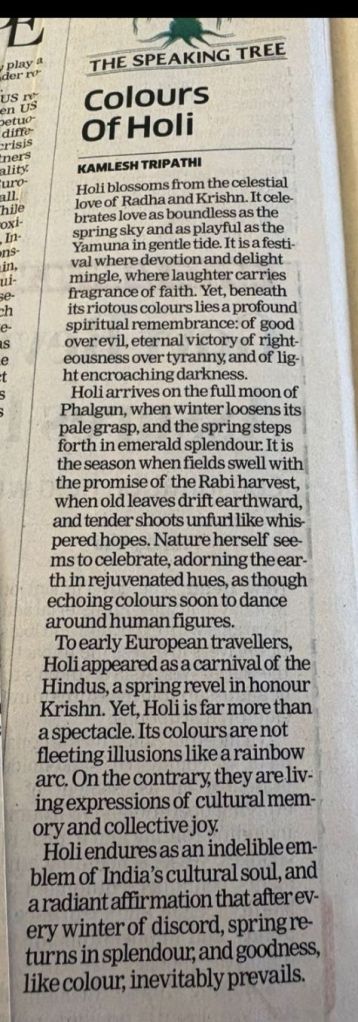
Holi is celebrated on the full moon day of Phalguna (February-March). It coincides with the arrival of spring and the tail of winter. Spring is the season of change close to the Rabi harvest. This is when the old foliage begins to shred (abscission) and the new leaves arrive (leaf out). It is during Holi that nature reviews Mother Earth.
The Europeans were particularly fascinated by the festival of colours. They described it as ‘“the carnival of the Hindus,” or the “Hindu spring festival” in the honour of Krishna, the amorous cowherd.’ Though Holi reminds you of the colourful rainbow, it is certainly not an illusion but a cultural reality of spirit and shades that bucks India up in the backdrop of Maja-Masti, reminding you of the famous Amitabh Bachchan song, ‘Khai Ke Pan Banaras Wala’ from film Don. Holi has given countless movies and dance sequences to Bollywood the entertainment centre of India, like, ‘Holi Aayi Re’ from the film Mashaal,the famous Hema Malini (Holi) dance sequence from the film ‘Sholay’ and the all-time great iconic Holi song, ‘Rang Barse Bhige Chunar Wali’ picturised on Rekha, Jaya, Amitabh and Sanjeev Kumar, in film Silsila.
Holi celebrates the empyrean love of Radha and Krishna. It highlights the ascendancy of good over evil and marks the victory of Lord Vishnu as Narasimha over Hiranyakashipu. There is a legend in the Bhagavata Purana that elucidates why Holi is celebrated as a festival of triumph, of good over evil in the honour of Lord Vishnu and his devotee Prahalada. King Hiranyakashipu, the father of Prahlada, was the king of the demoniac Asuras. He had earned a boon that gave him five special powers like. He would neither be killed by a human being nor an animal, neither indoors nor outdoors, neither during the day nor at night, neither by an astra nor by a shastra, and neither on land nor in water or air. This made Hiranyakashipu arrogant. He thought he had become God, and demanded that everyone worship him. Hiranyakashipu’s son, Prahalada, however, remained devoted to Vishnu. This infuriated Hiranyakashipu. He subjected Prahlada to several punishments, but none changed Prahalada or his resolve to do what he thought was right. Finally, Holika, Prahlada’s sinful aunt, tricked him into sitting on a pyre with her. She had the boon of not getting incinerated by fire but on that fateful day, the reverse happened. She got burnt and Prahalada came out unscathed. Soon, Lord Vishnu appeared as an avatar to restore Dharma and took the form of Narasimha – half human and half lion (which is neither human nor an animal), at dusk (when it was neither day nor night). He took Hiranyakashyapu to the doorstep (which was neither indoor nor outdoor), placed him on his lap (which was neither land, water nor air), and then eviscerated and killed him with his lion claws (which were neither a handheld weapon nor a projectile).
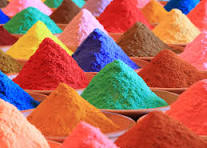
Holi is played with dry (Abir & Gulal) and wet colours with a traditional pichkari (water gun) that reminds you of the Bollywood song ‘Balam Pichkari’from the film ‘Yeh Jawaani Hai Deewani.’ The revellers even chorus ‘bura na mano Holi hai’. People form tolis (small groups) and move from one house to the other, to their friends and relatives wishing them a ‘Happy-Holi’ and singing songs and bhajans. They also hug (Gale Milna) each other on the occasion. The dry and wet playing colours depend on the weather. On the foregoing night of Holi, a bonfire is lit on the roads which is symbolic of the Holika-Dahan (the incineration of Holika) the victory of good over evil—Prahalada over Hiranyakashipu. Celebrants get smouldering twigs of that fire to their homes as a symbol of the victory of right over wrong and to rid their homes of any evil omens. People eat and drink mithai, gujia, shakkarpaare, dahi-vada, bhang and thandai. They forgive and forget their past differences and come together once again. Nature has created umpteen occasions for human beings to come together and Holi is one of them.
For foreigners, the bright colours of Holi and India have always had a fond connection. Holi is predominantly celebrated in the Indian subcontinent but has also spread to other regions of Asia and parts of the Western world through the diaspora. At times it is associated with exoticism or primitivity, nevertheless, the festival for years has been seen as an essential segment of the Indian cultural landscape.
***
By Kamlesh Tripathi
*
https://kamleshsujata.wordpress.com
*
Like it and Share it
*
Shravan Charity Mission is an NGO that works for poor children suffering from life-threatening diseases, especially cancer. Our posts are meant for our readers, including children and adults, and have a huge variety in content. We also accept donations for our mission. Should you wish to donate to the cause? The bank details are given below:
NAME OF ACCOUNT: SHRAVAN CHARITY MISSION
Account no: 680510110004635 (BANK OF INDIA)
IFSC code: BKID0006805
*
Kamlesh Tripathi’s Publications
GLOOM BEHIND THE SMILE
(The book is about a young cancer patient. Now archived in 8 prestigious libraries of the US which include Harvard College Library; Harvard University Library; Library of Congress; University of Washington, Seattle; University of Minnesota, Minneapolis; Yale University, New Haven; University of Chicago; University of North Carolina, at Chapel Hill University Libraries. It can also be accessed at MIT through Worldcat.org. Besides, it is also available for reading in libraries and archives of Canada; Cancer Aid and Research Foundation Mumbai; Jaipuria Institute of Management, Noida, India; Shoolini University, Yogananda Knowledge Center, Himachal Pradesh and Azim Premzi University, Bangalore).
ONE TO TANGO … RIA’S ODYSSEY
(Is a book on ‘singlehood’ about a Delhi girl now archived in Connemara Library, Chennai and Delhi Public Library, GOI, Ministry of Culture, Delhi; It is also available for reading in the Indian National Bibliography, March 2016, in the literature section, in Central Reference Library, Ministry of Culture, India, Belvedere, Kolkata-700022)
AADAB LUCKNOW … FOND MEMORIES
(Is a fiction written around the great city of Nawabs—Lucknow. It describes Lucknow in great detail and also talks about its Hindu-Muslim amity, which is the undying characteristic of Lucknow. The book was launched at the Lucknow International Literary Festival in 2014. It is included for reading in Askews and Holts Library Services, Lancashire, U.K; Herrick District Library, Holland and Charlotte-Mecklenburg Library, Mecklenburg County in North Carolina, USA; Black Gold Cooperative Library Administration, Arroyo Grande, California; Berkeley Library, University of California).
REFRACTIONS … FROM THE PRISM OF GOD
(Co-published by Cankids–Kidscan, a pan India NGO and Shravan Charity Mission, that works for child cancer in India. The book is endorsed by Ms Preetha Reddy, MD Apollo Hospitals Group. It was launched at the Lucknow International Literary Festival in 2016).
TYPICAL TALE OF AN INDIAN SALESMAN
(Is a story of an Indian salesman who is, humbly qualified. Yet he fights his way through unceasing uncertainties to reach the top. A good read not only for salesmen. The book was launched on 10th February 2018 at Gorakhpur Lit-Fest. Now available on Amazon, Flipkart and Onlinegatha)
RHYTHM … in poems
(Published in January 2019. The book contains 50 poems. The poems describe our day-to-day life. A few poems from the book have been published in Shillong Times, Bandra Times and Bhavan’s Journal. The book is available on Amazon, Flipkart and Onlinegatha)
MIRAGE
(Published in February 2020. The book is a collection of eight short stories available on Amazon, Flipkart and Notion Press)
AWADH ASSAM AND DALAI LAMA … The Kalachakra
(The story of the man who received His Holiness The Dalai Lama and his retinue in 1959 as a GOI representative when he fled Tibet in 1959. The book was launched on 21st November 2022 by His Holiness The Dalai Lama at Dharmshala. The title is archived in the library of the Department of Information and International Relations (DIIR) Government of Tibet, Tibet Policy Institute (TPI) and the personal library of His Holiness The Dalai Lama. The title is also archived in The Ohio Digital Library, USA. It was recently included in the digital library of the world-renowned company APPLE).
BHAVANS JOURNAL
Short stories, Book reviews and Articles published in Bhavan’s Journal: 1. Reality and Perception, 15.10.19; 2. Sending the Wrong Message, 31.5.20; 3. Eagle versus Scholars June, 15 & 20, 2020; 4. Indica, 15.8.20; 5. The Story of King Chitraketu, August 31 2020; 6. Breaking Through the Chakravyuh, September 30 2020. 7. The Questioning Spouse, October 31, 2020; 8. Happy Days, November 15, 2020; 9. The Karma Cycle of Paddy and Wheat, December 15, 2020; 10. Power Vs Influence, January 31, 2021; 11. Three Refugees, March 15, 2021; 12. Rise and Fall of Ajatashatru, March 31, 2021; 13. Reformed Ruler, May 15, 2021; 14. A Lasting Name, May 31, 2021; 15. Are Animals Better Teachers? June 16, 2021; 16. Book Review: The Gram Swaraj, 1.7.21; 17. Right Age for Achievements, 15.7.21; 18. Big Things Have Small Beginnings, 15.8.21; 19. Where is Gangaridai?, 15.9.21; 20. Confront the Donkey Within You 30.9.21; 21. Know Your Strengths 15.10.21; 22. Poverty 15.11.21; 23. Top View 30.11.21; 24. The Bansuriwala 15.1.22; 25. Sale of Alaska 15.2.22; 26. The Dimasa Kingdom 28.2.22;27. Buried Treasure 15.4.22; 28. The Kingdom of Pragjyotisha 30.4.22; 29. Who is more useful? 15.5.22; 30. The White Swan from Lake Mansarovar 30.6.22; 31. Bhool Bhulayya 15.9.22; 32. Good Karma 30.9.22; 33. Good Name vs Bad Name 15.10.22; 34. Uttarapath—The Grand Trunk Road 1.12.22; 35. When Gods Get Angry 1.1.23; 36. Holinshed’s Chronicles 15.1.23; 37. Theogony 15.2.23; 38. Poem: Mother 14.5.23; 39. THE NAG MANDIR 30.6.23; 40. The Story of Garuda 30.7.23; 41. Janmabhoomi vs Karmabhoomi 31.8.23; 42. The Ghost Town of Kuldhara 15.9.23; 43. The Tale of Genji 15.10.23; 44. The Soul Connection 1.12.23; 45.Book review: Jungle Nama … a story of the Sundarban 16.3.24;
THE SHILLONG TIMES
ARTICLES & POEMS: 1. POEM: HAPPY NEW YEAR 8.1.23; 2. POEM: SPRING 12.3.23; 3. POEM: RIGHT AND WRONG 20.3.23; 4. THE GUSH OF EMOTION—WRITING, 26.3.23; 5. THE NAG MANDIR, 7.5.23; 6. POEM: MOTHER 7.5.23; 7. POEM: RAIN RAIN 9.7.23; 8. POEM: YOU COME ALONE YOU GO ALONE 6.8.23; 9. RAIN RAIN (SECOND TIME) 10.8.23; 10. POEM: GURU TEACHER 10.8.23; 11. POEM: AUTUMN … THE INTERIM HEAVEN 15.10.23; 12. POEM: HAPPY DIWALI 12.11.23; 13. OVERCOMING BLINDNESS: LEARN IT THE JOHN MILTON WAY 10.12.23; 14. THE HAPPY PRINCE AND THE HAPPY MAN’S SHIRT 31.12.23; 15. ANNUS MIRABILIS 2024 7.1.24; 16. GANDHI TO MAHATMA GANDHI- Incidents that Shaped Gandhi in South Africa 28.1.24; 17. POEM: TOGETHER BUT NOT MADE FOR EACH OTHER, 11.2.24; 18. THE BIRDS BEES AND THE SPIDERS OF NICHOLAS GUILDFORD AND JONATHAN SWIFT 25.2.24; 19. THE OVERCOATS OF NIKOLAI GOGOL AND RUSKIN BOND 10.3.24; 20. THE ETHNIC COLOURS OF HOLI 24.3.24
THE ASSAM TRIBUNE
ARTICLE: 1. THE MAGIC OF READING 11.12.23; 2. GANDHI TO MAHATMA 29.1.24;
BANDRA TIMES, MUMBAI
ARTICLES & POEMS: 1. POEM: SPRING, 1.4.23; 2. POEM: MOTHER, 1.6.23; 3. POEM: RAIN RAIN, 1.8.23;
ARTICLES IN THE DIGITAL MAGAZINE ESAMSKRITI
29.12.2020: INDICA BY MEGASTHENES; 14.3.22: ABOUT THE DIMASA KINGDOM ASSAM; 10.12.22: GRAND TRUNK ROAD-UTTARAPATH; 5.10.23: THE GHOST TOWN OF KULDHARA NEAR JAISALMER;
(ALL THE ABOVE BOOK TITLES ARE AVAILABLE FOR SALE ON AMAZON, FLIPKART AND OTHER ONLINE STORES OR YOU COULD EVEN WRITE TO US FOR A COPY)
*****




 Shravan charity mission