Tag Archives: new york

BOOK CORNER: “JAWS” by Peter Benchley

Copyright@shravancharitymission

Khidki (Window)

–Read India Initiative—

This is only an attempt to create interest in reading. We may not get the time to read all the books in our lifetime. But such reviews, talk and synopsis will at least convey what the book is all about.

    This book was written in the year 1974 by American writer Peter Benchley. It tells the story of a great white shark that preys upon a small resort town and the voyage and determination of three men trying to kill it. So it’s a superb adventure novel. The novel, emanates out of Benchley’s interest in shark attacks after he learned about the exploits of a shark fisherman Frank Mundus in 1964. Doubleday is the publisher of this book, who commissioned Benchley to write the novel in 1971, a period when he worked as a freelance journalist. The book was a great hit. It stayed in the bestseller list for 44 weeks. The novel was later adapted into an exciting movie, by film producers, Richard Zanuck and David Brown, at Universal Pictures.

    The story is set in Amity, a seaside resort town, on Long Island, New York. Before I enter the plot. Let me describe in brief, the main characters to you, because it’s a very fast moving story, where, one needs to be crystal clear about each character. There are eleven of them and their names and brief descriptions are as follows:

  1. Chrissie Watkins—she is the young lady tourist killed by the shark.
  2. Martin Brody—is the police chief of Long island.
  3. Larry Vaughan—is the mayor of the island.
  4. Harry Meadows—Editor of the local newspaper.
  5. Alex Kintner—a young boy killed by shark.
  6. Ben Gardner—Local fisherman.
  7. Leonard Hendricks—Deputy Police Chief.
  8. Matt Hooper—Marine Biologist and also the younger brother of David Hooper.
  9. Ellen—Brody’s wife.
  10. David Hooper—a man whom Ellen used to date earlier.
  11. Quint—a professional shark hunter.

    One night, a massive great white shark kills a young tourist named Chrissie Watkins while she skinny dips in the open waters. After finding the remains of her body washed up on the beach, the investigators realize she was attacked by a shark. Police chief Martin Brody orders closure of Amity beach. But the mayor Larry Vaughan and the town’s selectmen overrule him out of fear for damage to summer tourism, which happens to be the town’s main industry. So, with the connivance of Harry Meadows, the editor of the local newspaper, they hush up the attack.

    But a few days later, the shark kills a young boy named Alex Kintner and thereafter an old man not far from the shore. A local fisherman, Ben Gardner, is then sent by Amity’s authorities to kill the shark, but he too disappears in the water. Brody and his deputy Leonard Hendricks find Gardner’s boat anchored off-shore, empty but with large bite holes, one of which has a massive shark tooth stuck in it. Blaming himself for these deaths, Brody again tries to close the beaches, while Meadows this time investigates the Mayor’s business contacts, only to determine why he wants to keep the beaches open. Finally, Meadows, uncovers, the mayor’s links with the Mafia, who pressure Vaughan to keep the beaches open in order to protect the value of Amity’s real estate, in which the Mafia has invested a great deal of money. Meadows in the meanwhile recruits a marine biologist by the name of Matt Hooper from the Woods Hole Institute to advise them on how to deal with the shark.

    Meanwhile, Brody’s wife Ellen starts missing the affluent life she once had before marrying Brody and having children. She therefore starts a romantic relationship with Matt Hooper, the marine biologist who is also the younger brother of David Hooper, a man Ellen used to date earlier, and the two have a brief affair in a motel outside the town. Throughout the rest of the novel, Brody suspects Ellen and Matt to be having a relationship and is continuously haunted by these miserable thoughts.

    With the beaches still open, people pour into the town, hoping to glimpse the killer shark. Brody sets up patrols to track the fish. After a boy narrowly escapes another attack close to the shore. Brody this time closes the beaches and hires Quint, a professional shark hunter, to kill the shark. After which Brody, Quint and Hooper set out on Quint’s vessel, the name of which is Orca. But the trio are soon at odds with one another. Quint’s ways, anger Hooper, especially when he disembowels a blue shark, and then uses an illegally fished unborn baby dolphin for bait. All the while, Quint pokes fun at Hooper as a rich college boy when Hooper refuses to shoot at the beer cans with them. Brody and Hooper also argue, as Brody’s suspicion about Hooper’s possible affair with Ellen grows stronger; at one point, Brody unsuccessfully attempts to strangle Hooper.

    Their first two days at sea are unproductive, although they do come in contact with the shark by the end of the second day. Upon seeing it for the first time, Hooper estimates the animal to be at least twenty feet long. He is visibly excited and in awe at the size of it. Meanwhile Mayor Larry Vaughan arrives at Brody’s house before Brody returns home and informs Ellen that he and his wife are leaving Amity. But before he leaves, he tells Ellen that he always thought they would make a great couple. After he leaves, Ellen reflects that her life with Brody is much more fulfilling than any other life she might have had with Vaughan, and feels somewhat guilty for her prior thoughts of missing the life she had before marrying Brody.

    After seeing the size of the shark, on the third day Matt Hooper wants to bring along a shark-proof cage, to help take photos of it, and then to use it for killing it with a bang stick. Initially Quint refuses to bring the cage on board, even after Hooper’s offer of hundred dollars, considering it a suicidal idea, but he relents later after Hooper and Brody get into a big argument with him.

        Later that day, after several unsuccessful attempts by Quint to harpoon the shark, Hooper goes underwater and into the shark cage. Where, the shark attacks the cage, something Hooper did not expect it would do, and, after ramming the bars apart, kills and eats Hooper. In the meanwhile Brody informs Quint that the town can no longer afford to pay him to hunt the shark. But Quint no longer cares about the money and resolves to continue until he has killed it.

    When they return to sea the following day, the shark starts ramming the boat. Quint is able to harpoon it several times. The shark leaps out of the water and onto the stern of the Orca ripping a huge hole in the aft section of the boat thereby causing the boat to start sinking. Quint plunges another harpoon into the shark’s belly. With that it falls back into the water, but sadly Quint’s foot gets entangled in the rope of the harpoon, and he is dragged underwater to his death. Brody, now floating on a seat cushion, spots the shark swimming towards him and since he has no choice now he prepares for his death. However, just as the shark gets within a few feet of him, it succumbs to its many wounds, and rolls over in the water and dies before it can kill Brody. The deadly fish sinks down, and goes out of sight, dragging Quint’s still entangled body behind it. The lone survivor of the ordeal, Brody now paddles back to the shore on his makeshift float.

     It’s an excellent book both in terms of storyline, adventure, speed and even the narration. Where, the author has quite vividly described the action scenes in perfect vocabulary, which is not easy, on the contrary extremely painstaking. It leaves a spine chilling impact on you. You begin to hate sharks … at least for some time. I would give the book eight out of ten.

Synopsis by Kamlesh Tripathi

*

https://kamleshsujata.wordpress.com

*

Share it if you like it

*

Shravan Charity Mission is an NGO that works for poor children suffering from life threatening diseases especially cancer. Our posts are meant for our readers that includes both children and adults and it has a huge variety in terms of content. We also accept donations for our mission. Should you wish to donate for the cause. The bank details are given below:

NAME OF ACCOUNT: SHRAVAN CHARITY MISSION

Account no: 680510110004635 (BANK OF INDIA)

IFSC code: BKID0006805

*

Our publications

GLOOM BEHIND THE SMILE

(The book is about a young cancer patient. Now archived in 7 prestigious libraries of the US, including, Harvard University and Library of Congress. It can also be accessed in MIT through Worldcat.org. Besides, it is also available for reading in Libraries and archives of Canada and Cancer Aid and Research Foundation Mumbai)  

ONE TO TANGO … RIA’S ODYSSEY

(Is a book on ‘singlehood’ about a Delhi girl now archived in Connemara Library, Chennai and Delhi Public Library, GOI, Ministry of Culture, Delhi)

AADAB LUCKNOW … FOND MEMORIES

(Is a fiction written around the great city of Nawabs—Lucknow. It describes Lucknow in great detail and also talks about its Hindu-Muslim amity. That happens to be its undying characteristic. The book was launched in Lucknow International Literary Festival of 2014)

REFRACTIONS … FROM THE PRISM OF GOD

(Co-published by Cankids–Kidscan, a pan India NGO and Shravan Charity Mission, that works for Child cancer in India. The book is endorsed by Ms Preetha Reddy, MD Apollo Hospitals Group. It was launched in Lucknow International Literary Festival 2016)

TYPICAL TALE OF AN INDIAN SALESMAN

(Is a story of an Indian salesman who is, humbly qualified. Yet he fights his ways through unceasing uncertainties to reach the top. A good read not only for salesmen. The book was launched on 10th February, 2018 in Gorakhpur Lit-Fest. Now available in Amazon, Flipkart and Onlinegatha)

RHYTHM … in poems

(Published in January 2019. The book contains 50 poems. The poems describe our day to day life. The book is available in Amazon, Flipkart and Onlinegatha)

(ALL THE ABOVE TITLES ARE AVAILABLE FOR SALE IN AMAZON, FLIPKART AND OTHER ONLINE STORES OR YOU COULD EVEN WRITE TO US FOR A COPY)

*****


BOOK CORNER: THE SUBTLE ART OF NOT GIVING A F*CK by Mark Manson

Coypright@shravancharitymission


By Kamlesh Tripathi

*

https://kamleshsujata.wordpress.com

*

Share it if you like it

*

Shravan Charity Mission is an NGO that works for poor children suffering from life threatening diseases especially cancer. Our posts are meant for our readers that includes both children and adults and it has a huge variety in terms of content. We also accept donations for our mission. Should you wish to donate for the cause. The bank details are given below:

NAME OF ACCOUNT: SHRAVAN CHARITY MISSION

Account no: 680510110004635 (BANK OF INDIA)

IFSC code: BKID0006805

*

Our publications

GLOOM BEHIND THE SMILE

(The book is about a young cancer patient. Now archived in 7 prestigious libraries of the US, including, Harvard University and Library of Congress. It can also be accessed in MIT through Worldcat.org. Besides, it is also available for reading in Libraries and archives of Canada and Cancer Aid and Research Foundation Mumbai)  

ONE TO TANGO … RIA’S ODYSSEY

(Is a book on ‘singlehood’ about a Delhi girl now archived in Connemara Library, Chennai and Delhi Public Library, GOI, Ministry of Culture, Delhi)

AADAB LUCKNOW … FOND MEMORIES

(Is a fiction written around the great city of Nawabs—Lucknow. It describes Lucknow in great detail and also talks about its Hindu-Muslim amity. That happens to be its undying characteristic. The book was launched in Lucknow International Literary Festival of 2014)

REFRACTIONS … FROM THE PRISM OF GOD

(Co-published by Cankids–Kidscan, a pan India NGO and Shravan Charity Mission, that works for Child cancer in India. The book is endorsed by Ms Preetha Reddy, MD Apollo Hospitals Group. It was launched in Lucknow International Literary Festival 2016)

TYPICAL TALE OF AN INDIAN SALESMAN

(Is a story of an Indian salesman who is, humbly qualified. Yet he fights his ways through unceasing uncertainties to reach the top. A good read not only for salesmen. The book was launched on 10th February, 2018 in Gorakhpur Lit-Fest. Now available in Amazon, Flipkart and Onlinegatha)

RHYTHM … in poems

(Published in January 2019. The book contains 50 poems. The poems describe our day to day life. The book is available in Amazon, Flipkart and Onlinegatha)

(ALL THE ABOVE TITLES ARE AVAILABLE FOR SALE IN AMAZON, FLIPKART AND OTHER ONLINE STORES OR YOU COULD EVEN WRITE TO US FOR A COPY)

*****


SHORT STORY: ASPIRATIONS OF A ROCKSTAR

Copyright@shravancharitymission

    This story is from the US. In the year 1983 a talented young guitarist was kicked out of his band in the most unceremonious manner. The band had just been signed up for a remarkable deal. They were about to record their first album. But only a couple of days before the recording. The band showed the guitarist the door. In other words he was asked to leave. There was no warning, no discussion, and no melodrama. They literally woke him up one day, and handed him, a bus ticket home.

    While on the bus, back to Los Angeles from New York, the guitarist kept asking himself. What was his fault? How did all of this happen? What was his mistake? Did he rub someone the wrong way? Such stupendous contracts, didn’t just, fall out of the sky, especially for the raucous, upstart metal bands. And had he missed his chance of a lifetime?

    But by the time the bus rolled into Los Angeles, the guitarist had got over his self-pity. He vowed to start a new band. He decided that his new band would be so very successful, that his old band would forever regret their decision of firing him. He would become so very famous that they would be subjected to years of seeing his face on TV, hearing him on the radio, and seeing his posters on the streets, and his pictures in magazines. While they’d be flipping burgers in some dingy eatery, loading vans, from their shitty club gigs, obese and drunk with their ugly wives, while he’d be rocking out in front of the stadium crowds, live on television. And as a sadist he would bathe in the tears of his betrayers, and each tear would be wiped dry by a crisp clean hundred dollar bill.

    Thereon, the guitarist worked as if possessed by some musical demon. He spent months recruiting the best musicians he could find—far better than his previous band mates. He wrote dozens of songs and practiced meticulously. His seething anger fuelled his ambition. Revenge became his muse. Within a couple of years his new band had signed a record deal of their own, and a year later their first album was going gold. In other words it had achieved a sales level meriting a gold disc.

    The guitarist’s name was Dave Mustaine and the band he formed was the legendary heavy-metal band Megadeth. Megadeth went on to sell over 25 million albums and went around the world many times. Today, Mustaine is considered one of the most brilliant and influential musicians, in the history of heavy-metal music.

   But unfortunately. The band that he was kicked out of, was Metallica, which has sold over 180 million albums worldwide. Metallica is considered by many to be one of the greatest rock bands of all times.

    And because of this, in an exclusive and intimate interview in 2003, a tearful Mustaine admitted, that he couldn’t help but still consider himself, a failure despite all that he had accomplished in his mind. For he would always be the guy who got kicked out of Metallica.

    Dave Mustaine knowingly or unknowingly chose to measure himself by the inconsequential fact whether he was more successful and popular than Metallica. The experience of getting thrown out of his former band Metallica, was so painful for him. That he considered his success relative to Metallica and as the metric by which to measure himself and his music career.

    Despite churning that horrible event of his life into something positive, when Mustaine created Megadeth, his choice to hold on to Metallica’s success, as his life-defining metric continued to hurt him even decades later. Despite all the money, and the fans and the accolades, he still considered himself a failure.

    Now you and I may wonder at Dave Mustaine’s situation. This is because you and I have different values than Mustaine has. Because we measure ourselves with a different metrics. Whereas, Mustaine’s yardstick of being better than Metallica helped him launch an incredibly successful music career. But the same yardstick later on tortured him, in spite of his success.

    Moral of the story: Be content with what you have in life, and stop comparing yourself with others, especially, your peers.

Synopsis by Kamlesh Tripathi

*

https://kamleshsujata.wordpress.com

*

Share it if you like it

*

Shravan Charity Mission is an NGO that works for poor children suffering from life threatening diseases especially cancer. Our posts are meant for our readers that includes both children and adults and it has a huge variety in terms of content. We also accept donations for our mission. Should you wish to donate for the cause. The bank details are given below:

NAME OF ACCOUNT: SHRAVAN CHARITY MISSION

Account no: 680510110004635 (BANK OF INDIA)

IFSC code: BKID0006805

*

Our publications

GLOOM BEHIND THE SMILE

(The book is about a young cancer patient. Now archived in 7 prestigious libraries of the US, including, Harvard University and Library of Congress. It can also be accessed in MIT through Worldcat.org. Besides, it is also available for reading in Libraries and archives of Canada and Cancer Aid and Research Foundation Mumbai)  

ONE TO TANGO … RIA’S ODYSSEY

(Is a book on ‘singlehood’ about a Delhi girl now archived in Connemara Library, Chennai and Delhi Public Library, GOI, Ministry of Culture, Delhi)

AADAB LUCKNOW … FOND MEMORIES

(Is a fiction written around the great city of Nawabs—Lucknow. It describes Lucknow in great detail and also talks about its Hindu-Muslim amity. That happens to be its undying characteristic. The book was launched in Lucknow International Literary Festival of 2014)

REFRACTIONS … FROM THE PRISM OF GOD

(Co-published by Cankids–Kidscan, a pan India NGO and Shravan Charity Mission, that works for Child cancer in India. The book is endorsed by Ms Preetha Reddy, MD Apollo Hospitals Group. It was launched in Lucknow International Literary Festival 2016)

TYPICAL TALE OF AN INDIAN SALESMAN

(Is a story of an Indian salesman who is, humbly qualified. Yet he fights his ways through unceasing uncertainties to reach the top. A good read not only for salesmen. The book was launched on 10th February, 2018 in Gorakhpur Lit-Fest. Now available in Amazon, Flipkart and Onlinegatha)

RHYTHM … in poems

(Published in January 2019. The book contains 50 poems. The poems describe our day to day life. The book is available in Amazon, Flipkart and Onlinegatha)

(ALL THE ABOVE TITLES ARE AVAILABLE FOR SALE IN AMAZON, FLIPKART AND OTHER ONLINE STORES OR YOU COULD EVEN WRITE TO US FOR A COPY)

*****


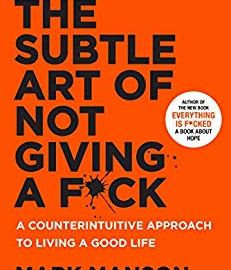
BOOK CORNER: THE SUBTLE ART OF NOT GIVING A F*CK–a counterintuitive approach to living a good life by Mark Manson

Copyright@shravancharitymission


Khidki (Window)

–Read India Initiative—

This is only an attempt to create interest in reading. We may not get the time to read all the books in our lifetime. But such reviews, talk and synopsis will at least convey what the book is all about.


    ‘Fuck’ is a scandalous and a vulgar cuss word not meant for the civilized society. But then it has a lot to do with the making and breaking of life. Before, I move ahead let me refresh you with the meaning of this word. One of course is the usual one—to have a sexual intercourse. And running alongside that, it is also used, while expressing, extreme anger, or to add force, to what is being said. Some words get ostracised because of its dirty meaning. According to Oxford dictionary, fuck also means ‘your ruins.’ Let me now construct, two sentences for you, using the four letter word. One is.

  1. I don’t give a fuck—which means I don’t care.
  2. I give a fuck—which means I care.

    I am telling you all of this, to make you understand the book even better. The book has a long title supported by an even longer sub-title that goes as, “THE SUBTLE ART OF NOT GIVING A F*CK—a counter-intuitive approach to living a good life.” by Mark Manson. Counterintuitive means, contrary to intuition, or a kind of common-sense expectation. I would call this book a wonder book, because the author converts the four letter word ‘fuck’ into a handy an appropriate life lesson for readers. New York Times and Globe and mail a Canadian chronicle have declared it, as a bestseller. The other word extensively used in this book is sucks which is an expression of disappointment. The book is priced at $17.99, published in 2016 by Harperone.   The book lives up to its title in all boisterousness. Mark Manson is a star blogger, with more than two million readers. He lives in New York City. The Subtle Art of Not Giving a F*ck, is his, first book.

     For this day and age the book is a self-help guide, written by a super-star blogger. It charts the course for us, to make us happier and stronger. The real panacea of which is how to handle adversity better, and stop trying to be positive all the time. Of course the gap between the two is quite wide.

    For the past few years, Mark Manson through his ecstatically popular blog, has been working on correcting, our delusional expectations, for ourselves and for the world. He now brings his hard fought wisdom to this ground breaking book. Manson makes the argument that human beings by nature are imperfects and even limited. As he writes, ‘not everybody can be extraordinary—there are winners and losers in society, and some of it is not fair or your fault.” Manson advises us to get to know your limitations and accept them as they are. This he says, is the real source of empowerment. Once we embrace our fears, faults and uncertainties. Once we stop running from and avoiding, and start confronting, painful truths—we will begin to find the courage and confidence we desperately need.

    In life, we all have a limited amount of fucks to give. So, you must choose your fucks wisely. Manson brings a much needed, grab-you-by-the-shoulders-an-look-you-in-the-eyes moment, of real-talk, filled with entertaining stories, and profane, ruthless humor. This narration is a refreshing pat on the face of all, so that we can start living a more contented and grounded life.

     The book is a little over two hundred pages and if one goes at an uninterrupted pace, one could finish it within two days. It is in many ways a page turner written in lucid English quite easy to comprehend. It has long gripping sentences with appropriate pauses in terms of sentence breaks and well suited prepositions. The author has curtailed unnecessary flab in his narration. Within a para, the breaks are few and that gives a good flow of thoughts so very necessary for such life-lesson emitting books. Many sentences are somewhat unconventional, and more than that the thoughts are quite out-of-the-box. It is divided into nine chapters with sub-chapters. The book hinges on two prime words—‘fuck’ and ‘sucks.’

    Everyone believes. The key to a good life is a nice job, a sexy limousine, or a pretty girlfriend. The world keeps telling you over-and-over again, that the matrix for a successful life is to have more … more … and … more. Buy more, own more. You are constantly bombarded with messages to give a fuck about everything, and at all times. But the key to a good life is not giving a fuck about more; but giving a fuck about less, or giving a fuck about only what is true and immediate and important. I’m sorry for having used the four letter word so very often in this narration. But without which you wouldn’t have got the real feel of the book.

    The book has many interesting stories and anecdotes that I would not like to disclose in great detail. But yes of course. I liked the one about the Japanese second lieutenant and the Rock Star band. The book teaches that life is essentially an endless series of problems. Problems never stop they only get exchanged or upgraded. Happiness is a constant work-in-progress. It teaches you the value of suffering. Human beings often dedicate a large part of their lives to seemingly useless and destructive causes.

    It says happiness is a problem yet happiness comes by solving problems. And mind you, you are not special. The book defines certain values as shitty and even obsolete. It says a lot of time in our life is wasted in choosing. And of course failure is the way forward. It talks about action, inspiration and even motivation. Most of us commit to action only if we feel a certain level of motivation. And we feel motivated only when we find enough emotional inspiration.

    The book inspires you to believe that you’re wrong about everything. The author cites examples in terms of cartographers who some five hundred years ago believed that California was an island. Doctors believed that by slicing a person’s arm open (or by causing bleeding anywhere) one could cure a disease. Scientists believed that fire was made out of something called phlogiston (a combustible substance). Women believed that rubbing dog urine on their face had anti-aging benefits. Astronomers believed that the sun revolved around the earth. But then were they right?

    I would recommend this book. If not for anything else, at least it will advise you how to be comfortable in negative situations. While reading this book I was even reminded of my own poem that I wrote sometime back. The title of which is … ‘Bad times is a friend of all times’ published in a book titled, ‘Rhythm … in poems.’ I would give this debut book of Mark Manson eight out of ten.

   Synopsis by Kamlesh Tripathi

*

https://kamleshsujata.wordpress.com

*

Share it if you like it

*

Shravan Charity Mission is an NGO that works for poor children suffering from life threatening diseases especially cancer. Our posts are meant for our readers that includes both children and adults and it has a huge variety in terms of content. We also accept donations for our mission. Should you wish to donate for the cause. The bank details are given below:

NAME OF ACCOUNT: SHRAVAN CHARITY MISSION

Account no: 680510110004635 (BANK OF INDIA)

IFSC code: BKID0006805

*

Our publications

GLOOM BEHIND THE SMILE

(The book is about a young cancer patient. Now archived in 7 prestigious libraries of the US, including, Harvard University and Library of Congress. It can also be accessed in MIT through Worldcat.org. Besides, it is also available for reading in Libraries and archives of Canada and Cancer Aid and Research Foundation Mumbai)  

ONE TO TANGO … RIA’S ODYSSEY

(Is a book on ‘singlehood’ about a Delhi girl now archived in Connemara Library, Chennai and Delhi Public Library, GOI, Ministry of Culture, Delhi)

AADAB LUCKNOW … FOND MEMORIES

(Is a fiction written around the great city of Nawabs—Lucknow. It describes Lucknow in great detail and also talks about its Hindu-Muslim amity. That happens to be its undying characteristic. The book was launched in Lucknow International Literary Festival of 2014)

REFRACTIONS … FROM THE PRISM OF GOD

(Co-published by Cankids–Kidscan, a pan India NGO and Shravan Charity Mission, that works for Child cancer in India. The book is endorsed by Ms Preetha Reddy, MD Apollo Hospitals Group. It was launched in Lucknow International Literary Festival 2016)

TYPICAL TALE OF AN INDIAN SALESMAN

(Is a story of an Indian salesman who is, humbly qualified. Yet he fights his ways through unceasing uncertainties to reach the top. A good read not only for salesmen. The book was launched on 10th February, 2018 in Gorakhpur Lit-Fest. Now available in Amazon, Flipkart and Onlinegatha)

RHYTHM … in poems

(Published in January 2019. The book contains 50 poems. The poems describe our day to day life. The book is available in Amazon, Flipkart and Onlinegatha)

(ALL THE ABOVE TITLES ARE AVAILABLE FOR SALE IN AMAZON, FLIPKART AND OTHER ONLINE STORES OR YOU COULD EVEN WRITE TO US FOR A COPY)

*****


BOOK CORNER: Amitav Ghosh … A CRITICAL COMPANION

Copyright@shravancharitymission


Khidki (Window)

–Read India Initiative—

This is only an attempt to create interest in reading. We may not get the time to read all the books in our lifetime. But such reviews, talk and synopsis will at least convey what the book is all about.

Amitav Ghosh

A CRITICAL COMPANION

Edited by Tabish Khair

    In the next twenty minutes or so I would take you through one of the finest pieces of narration. Where, one legend describes the other. Yes, when, Amitav Ghosh describes Satyajit Ray this is all one can say. Amitav Ghosh is a winner of 54th Jnanpith award and also a Padma Shri. I have pulled out this narration from a book titled ‘Amitav Ghosh … a critical companion.’ I have summarised and simplified the article for you to the best of my ability.

    Amitav in this article of his, has gone back to 1989. When he was enjoying his extended stay in the overwhelming city of New York. He had then finished writing of The Shadow Lines. The novel for some reason had a striking influence of Ray in it.

    He was then struck by a sudden wave of Ray nostalgia. And it struck to him that Ray too had once been a stranger in this city and that he too had walked the streets of Manhattan in Kolkata—bought shoes.

     One day, these pent up thoughts propelled Amitav to meet director James Ivory, who he knew to be a good friend of Ray. And later that week he went to interview Ivory, cassette recorder in hand. This is how Ivory described his first meeting with Ray, in the winter of 1960.

    “I looked him up in Calcutta,’ Ivory said. I had never met him. I had seen at that point, Pather Panchali (Song of the Road) and Aparijito (Undefeated). I knew that Apur Sansar (The World of Apu) existed and that sooner or later it would get to New York, but up till then it hadn’t come. And then some Indian friends of mine in Delhi said that apart from The Trilogy he had also made some other films in that time—the late fifties. They described Jalsaghar (The Music Room) to me and that sounded like something I would love to see. Then I made a long trip to Calcutta and went down to Puri and Bhubaneshwar and Madras. While I was in Calcutta I just decided to call him. Just to meet him, but also to ask him if it would be possible to see Jalsaghar. My friend in Delhi said he was very approachable (which he was) and I just called him up. He was in the phone book, so I just called him up and told him who I was. He said fine, he would try and arrange Jalsaghar for me. We agreed to meet in Coffee House and I went there. He was alone and we talked.

    He was immensely tall; he was probably the tallest Indian I have ever met and that seemed symbolically apt. He had a kind of straight forward majesty about him; he was obviously a king, but he was an approachable king. We were friends all his life as long as he lived. Whenever there was something he needed we tried to help. He always helped us. When there was some tremendous thing that would happen to us in the course of our own movie making in India—for instance when Utpal Dutt was put in prison (for his Maoist sympathies) while we were making ‘The Guru’ he helped to get him out. He called up or wrote to Mrs Gandhi and said this is a disgrace, this shouldn’t be allowed—things like that.”

    I asked Ivory what they talked about at that first meeting. ‘He was waiting in the coffee house.’ Ivory said, ‘while the censor was seeing Devi (the Coffee House was in the shadow of the Metro Cinema). Then somebody came from his staff and said that Devi had gone down well with the censors. He was kind of nervous about it because of the retrograde view of Hindu life at its most superstitious let’s say. He was afraid they would make him cut it. But no, it had gone down all right, and he said, would I like to come to the premiere of it, which I did, so I saw the film at the premiere and I was also introduced to Sharmila Tagore, who was very young then. And then he arranged for me to see ‘Jalsaghar’ so he went to the studio in Tollygunge where he made all his films and he sat next to me and translated for me at important moments. I thought it was a marvellous, marvellous movie and I jumped up and told him so at the end. He was surprised that I thought it was so marvellous. He said, well, he thought technically it wasn’t so good, wasn’t quite up to the mark. I said well, it didn’t strike me like that and I asked if there were any plans to show it in the west for I thought people would really like it. He said no, he didn’t have any plans. It had been shown at the Moscow Film Festival but the Russians didn’t like it because they thought it was decadent and that had discouraged him. I said, I thought he might get a different reception in the west if he pursued it. It was released here in the fall of 1963, and as you know a few years ago it was released in Paris and it was a tremendous success—ran for a year or something.’

    Ray was to collaborate with James Ivory and Ismail Merchant on two of their films: he wrote the music of Shakespeare-wallah and helped with the editing of ‘The Householder.’ I asked Ivory how the collaboration had come about.’ After ‘Householder’ was edited,’ he said ‘he still seemed very unwieldy, not very nicely done. I didn’t really have a very good editor—by this time I had met him (Ray) and I asked if I could bring the film to show him. He said sure come on. So Ismail (Merchant) and I climbed on the train—we took the Hindi version of it, all those cans, there must have 24 cans or something. We went from Bombay to Calcutta with all that film. He saw it and liked it—he thought there was something there to work with. I asked him whether he could give us any suggestions about the cutting and he said, yes. He would recut it, but he didn’t want me to interfere while doing that. He said let me have a go at it, I’ll do it my way, you can be in the editing room if you want to be, when we’re all done you can change it if you want to, that’s your business, but let me do what I want to do. So then, he and his editor Dulal Dutt recut the film. They took about four days, and gave it a new shape. It was he (Ray) who suggested that it go into a flashback form.

    Ray was always awfully generous with his time, always, always. I don’t know how he did it; because there was always many many people there, who wanted things done, people who just came to catch a glimpse of him and so on. How he had any kind of life of his own and how he made his movies I don’t know.

    Pather Panchali, to my mind the greatest of Ray’s films, was completed in 1955. It premiered not in Kolkata, but in New York, at the museum of Modern Art. This is how it came about: in 1954 Huston was on his way to India to scout locations for The Man Who Would Be King, when he came to hear of a young advertising-executive who was making a film on a tiny budget. By the time Huston arrived in Kolkata, the film had been stalled for several months, because of lack of money. At the time of Huston’s visit the dominant genre in India was the Bombay film. Ray’s work took Huston by surprise. It was apparent from the rushes that this film belonged in a different order of film-making. Huston was quick to recognize the genius of work. He viewed only twenty-minutes or so of the film, but recalling the occasion in 1987, he said: I’ recognised the footage as the work of a great film-maker.’ Returning to the United States, Huston’s reports of the film were instrumental in persuading the Museum of Modern Art to send Ray some money. MOMA’s advance went a long way towards the completion of Pather Panchali.

    Hollywood had long cast a binding spell on Ray: he was an ardent admirer of such American film-makers as John Ford and Billy Wilder. Although he never worked there. Hollywood came to play a peculiarly serendipitous role in his life; never more so than when one of his idols, John Huston, made it possible for him to complete Pather Panchali. And thus it happened that this most famous of contemporary Indian films premiered not in Kolkata or Mumbai, but in New York. It was first shown at the Museum of Modern Art in April 1955, to a small invited audience.

    Pather Panchali was released in the US (by Edward Harrison) in September 1958 at New York’s Fifth Avenue Theatre. The release was the occasion of Ray’s first visit to the country: he was then thirty-seven. The reception of the film was by no means uniformly enthusiastic. As Ivory describes it: ‘There was a famous review by Bosley Crowther which was meant to have been such a putdown. I read that again the other day and actually he was trying to like it. He was baffled, he made false assumptions, he didn’t really know what to say, but he had to admit that he knew or felt, somehow, dimly that there was something great there and he better not say something too bad about it. And apparently there were many people who wrote angry letters about his review.”

    Thirty one years later, in Columbia University’s Butler Library, I dug up a copy of an interview that Ray gave to Howard Thompson (of the New York Times) on the day of the release. Ray evidently made quite an impression on Thompson: ‘A strapping swarthy chap, with strong features, he (Ray) talks like a realistic poet, without the slightest foreign accent, looking fresh from the American gridiron.’

    Thompson continues: ‘On the day after his arrival he (Ray) stepped inside a fashionable hotel dining room, comfortably clad in occidental garb, and gamely stooped to let the head waiter pin on a Plaza tie. Presently, wearing a casually alert expression, the big rangy Calcuttan sat at a table, opening a package of cigarettes with long, tapering fingers. He had been up early, he said, just walking, camera in hand, an old habit of ‘an old film fam.’

    This is how Ray described the filming of Pather Panchali to Thompson: ‘We shot in and around Calcutta, then had to stop for six months because I was flat broke. I even sold part of my record collection, some old seventy-eights of Bach, Mozart and Beethoven—and part of my wife’s jewelry, not that her mother knew. All that was shown again to the same (financiers). No reaction. Then a year’s gap.’

    Ray was able to continue filming only because of an unlikely intervention: a powerful West Bengal politician, reputed to be ‘close’ to one of Ray’s aunts, authorised a grant from the state government. He was under the impression evidently, that Pather Panchali was a documentary about community development.

    In response to a question about the future of Indian film, Ray told Thompson: ‘I don’t know if our pictures generally will ever spread to a world market, though we have two or three young directors with the right ideas. Our industry centers productionally in Bengal, Madras and Bombay, but those from Bengal are better, more serious. As for why you don’t see more of ours—well, we have our own problems and we’re not so sure Westerners care.’

    ‘The generous mouth widened slightly,’ Thompson continues. ‘Do you?’ he enquired. The penetrating brown eyes twinkled pensively.

    Looking back now, I am sure more than ever aware of the part that Ray played in shaping the imaginary universe of my childhood and youth. I see this even in such details as my interest in science and science fiction; in ghost stories and the fantastical. One of my favourite Ray films to this day, remains Paras Pathar (The Philosopher’s Stone), a neglected masterpiece that deserves a place of honour in the canon of surrealist cinema. When I saw Agantuk (The Stranger), in which the main character is an anthropologist, I began to wonder whether my interest in anthropology too, owed something, perhaps subconsciously, to Ray: I recalled suddenly that references to anthropology go back to some of his earliest work, starting with the African mask in Apur Sansar.

    Ray’s influence extended even to the material world that I inhabited in my early years; a world which he formed to a quite astonishing degree through his influence on typography and through his visual style—a style that was itself a development on a distinctive design traditions of Bengal. That he could exert such great influence was due in part to the fact that this work extended and developed the legacy of the generations preceding his. His greatness as an artist is no way diminished by the fact that he was a rivet in an unbroken chain of aesthetic and intellectual effort that stretches back to mid-nineteenth century—a chain in which I too am, I hope, a small link.

    Ray was for me, not just a great artist; he was something even rarer; an artist who had crafted his life so that it could serve as an example to others. In a world where people in the arts are often expected, even encouraged, to be mindful of those around them, he was exemplary in his dealings with people. This was, I think one of the reasons why he was able to sustain his creative energies for as long as he did: because he refused to make a fetish of himself. As a student I had heard him speak on several occasions: it always seemed to me that there was something very private about his manner. I had the sense that it was by holding the world at arm’s length that he had managed to be as productive as he had. This was a stance I respected then and respect even more today, now that I am more aware of how easy it is to be distracted by the demands of public life.

    Ray was consistent in fighting off the pressures of the wider world. After the success of Pather Panchali he was feted by Jawaharlal Nehru and Indira Gandhi. It was a measure of his integrity that he never allowed their praise and attention to distract him from his own projects. Unlike many other film-makers in India, Ray consciously avoided seeking government financing for his projects, preferring to raise the money from commercial sponsors. He was always deeply aware of his audience in Kolkata and gloried in the discipline they imposed on him—primarily that of keeping his work accessible. This meant that he could never permit himself the luxury of avant-gardism in the manner of his European contemporaries such as Fellini, Bergman and Godard: nor indeed did he ever want to. To the end one of his greatest strengths was his ability to resolve enormously complex plots and themes into deceptively simple narrative structures.

    My favourite Ray story is one I came upon soon after I learnt of the appalling human cost of Werner Herzog’s Fitzcarraldo. Once, while filming an overhead shot, a falling piece of machinery gravely injured a studio-hand who was working on one of Ray’s sets. Ray never used an overhead shot again.

    In 1992 when Hollywood awarded him an Oscar for Lifetime Achievement, Ray was so ill that he received the award lying in his hospital bed. The scene was broadcast on TV and when I saw it I realized that Ray’s illness was so serious that he might not recover. I had always assumed I would meet Ray one day, but I had never made an effort to seek him out. He was such an integral part of my imaginative world that I’d fought shy of meeting him face-to-face: what can one possibly say to someone to whom one owes so great a debt? In 1989 and 1990 I had had several telephone conversations with him. In one of them he’d told me that he greatly enjoyed my first novel, The Circle of Reason. Now I saw that it was I who had been remiss in expressing my admiration and gratitude. In light of his condition this assumed a sudden urgency. I decided to write a letter to Ray, asking if I could visit him. My letter began:

    Dear Mr Ray,

    I have wanted to write to you for many years now, but have always put it off because I knew it would not be easy to say what I wanted too …

It ended:

    The Japanese have a custom which allows people to pay homage to artists they admire by standing outside their houses, alone and in silence, until they are invited in. you are the only person in the world for whom I would gladly do that …

    The letter was dated February 6, 1992. I gave it to Shri Nirmalaya Acharya, a close associate of Ray’s and himself one Kolkata’s legendary literary figures (now sadly deceased and much-missed by all who knew him). Nirmalaya-babu promised to hand it to Ray once he was well enough to read. Alas that day never came: Satyajit Ray died on April 23 1992.

    The day of Satyajit Ray’s death was like none that Kolkata had ever seen before. When the news began to spread, a pall of silence descended on the city. Next morning hundreds of thousands of people filed past his body, braving the intense heat. In the evening when his body was taken to the crematorium, the streets were thickly lined up with people standing in silent vigil. Many held up placards which referred to him as ‘The King.’ The whole city was sunk in an inexpressible sadness: everybody knew that an era had ended, and with it, Kolkata’s claim to primacy in arts. The city was orphaned: its king was gone and there was none to take his place.

    I wandered the streets for hours that night, watching the silent crowds, reading the placards. I was surprised by the depth of my own sense of loss. Yet I was conscious also of an immense sense of privilege, of gratitude, that having been born in Kolkata I had, in some small way, been endowed with a special entitlement to Ray’s universe; gratitude at having had his work to illuminate my surroundings and my past. This is what narrative arts do, at their very best: they shape the world as they relate them. To this day Ray’s work is one of the main anchors that moors me—often despite myself—to the imaginative landscape of Bengal: indeed, to the essential terrain of my own work.

Amitav Ghosh

January 17, 2002

Posted by Kamlesh Tripathi

*

https://kamleshsujata.wordpress.com

*

Share it if you like it

*

Shravan Charity Mission is an NGO that works for poor children suffering from life threatening diseases especially cancer. Our posts are meant for our readers that includes both children and adults and it has a huge variety in terms of content. We also accept donations for our mission. Should you wish to donate for the cause. The bank details are given below:

NAME OF ACCOUNT: SHRAVAN CHARITY MISSION

Account no: 680510110004635 (BANK OF INDIA)

IFSC code: BKID0006805

*

Our publications

GLOOM BEHIND THE SMILE

(The book is about a young cancer patient. Now archived in 7 prestigious libraries of the US, including, Harvard University and Library of Congress. It can also be accessed in MIT through Worldcat.org. Besides, it is also available for reading in Libraries and archives of Canada and Cancer Aid and Research Foundation Mumbai)  

ONE TO TANGO … RIA’S ODYSSEY

(Is a book on ‘singlehood’ about a Delhi girl now archived in Connemara Library, Chennai and Delhi Public Library, GOI, Ministry of Culture, Delhi)

AADAB LUCKNOW … FOND MEMORIES

(Is a fiction written around the great city of Nawabs—Lucknow. It describes Lucknow in great detail and also talks about its Hindu-Muslim amity. That happens to be its undying characteristic. The book was launched in Lucknow International Literary Festival of 2014)

REFRACTIONS … FROM THE PRISM OF GOD

(Co-published by Cankids–Kidscan, a pan India NGO and Shravan Charity Mission, that works for Child cancer in India. The book is endorsed by Ms Preetha Reddy, MD Apollo Hospitals Group. It was launched in Lucknow International Literary Festival 2016)

TYPICAL TALE OF AN INDIAN SALESMAN

(Is a story of an Indian salesman who is, humbly qualified. Yet he fights his ways through unceasing uncertainties to reach the top. A good read not only for salesmen. The book was launched on 10th February, 2018 in Gorakhpur Lit-Fest. Now available in Amazon, Flipkart and Onlinegatha)

RHYTHM … in poems

(Published in January 2019. The book contains 50 poems. The poems describe our day to day life. The book is available in Amazon, Flipkart and Onlinegatha)

(ALL THE ABOVE TITLES ARE AVAILABLE FOR SALE IN AMAZON, FLIPKART AND OTHER ONLINE STORES OR YOU COULD EVEN WRITE TO US FOR A COPY)

*****