Tag Archives: employer

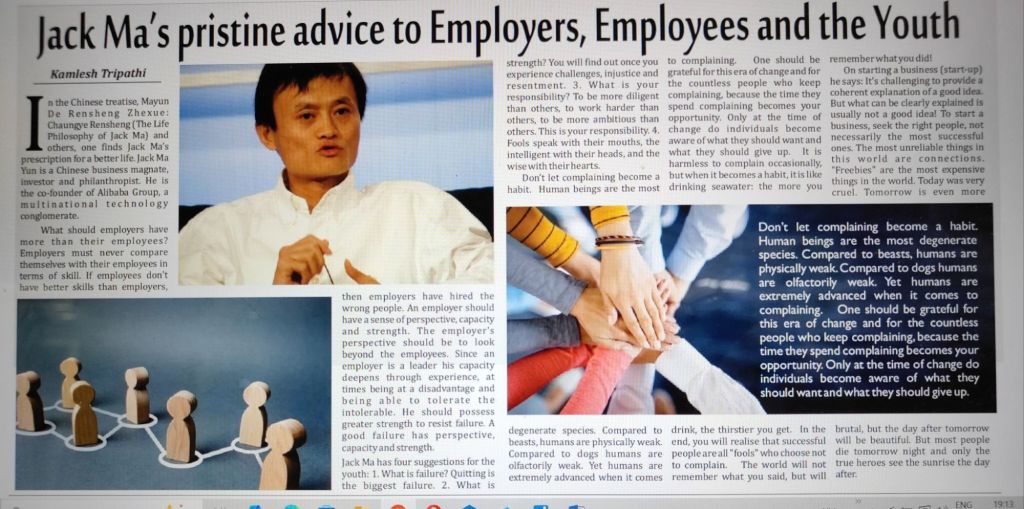
ARTICLE: JACK MA’S PRISTINE ADVICE TO EMPLOYERS, EMPLOYEES AND THE YOUTH

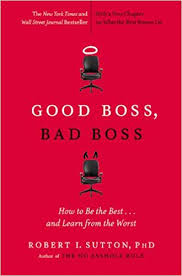
Literary corner: Good Boss Bad Boss–Robert Sutton

Copyright@shravancharitymission

Khidki (Window)

–Read India Initiative—

This is only an attempt to create interest in reading. We may not get the time to read all the books in our lifetime. But such reviews, talk and synopsis will at least convey what the book is all about.

    Robert Sutton is a professor in Stanford University. This book was first published in the year 2010. In life we all have bosses. Some are good and so remembered. Some are atrocious and are soon forgotten. So, quickly analyse yourself as to in which category you fall.

    Numerous studies around the world drew similar conclusions, noting that 75% of the workforce reports that their immediate superior is the most stressful part of their job. And a lot of feudalism still exists out there. Professor Sutton, the best-selling author of ‘The No Asshole rule,’ explores how good and bad bosses affect the workplace and what distinguishes one from the other.

    Sutton’s research is comprehensive and his anecdotes are interesting and far out. As you might guess from the title of his last book. He indulges in salty language and profanity, so be warned. With that caveat, I recommend his book to anyone who has a boss—or—is—a boss. I have divided the summary into 3 parts. The first part being:

NEGATIVE IMPACT OF BAD BOSSES     Bad bosses, especially bullies, have a profound negative impact on their workplaces. In a 2007 survey of almost 8,000 U.S. adults, 37 percent had experienced being bullied at work. Of those respondents, 72 percent said they suffered abuse from their superiors. Employees with their obnoxious bosses were more likely to make intentional mistakes that is (30% as against 6 %), and report sick when they were healthy (29 % as against 4 %), and put minimal effort into their work (33 % vs. 9 %).

    A boss can be bad in many ways, but whatever the permutation, ill-behaved bosses make people feel sick. In England, researchers tracked 6,000 civil service workers for 20 years. Those with bosses who were hypercritical, poor listeners or stingy with praise experienced higher rates of angina, heart attacks and death from heart disease than those working for benevolent bosses.

    Finnish or (Finland) and Swedish studies show similar results. Employees working for bad bosses frequently report feeling angry, stressed out, emotionally numb, depressed or even anxious. It is normally said an employee doesn’t leave the company but he leaves the boss. On the flip side, employees are more satisfied and productive when they feel their bosses care for them.

    Organisations with good bosses enjoy healthier employees, more profitability and greater employee retention.

BALANCE DETERMINATION AND “SMALL WINS.”

    Good bosses are not micromanagers who suppress creativity and interrupt workflow, and they’re not laid-back, like bosses who fail to achieve company goals. Good bosses walk the line between stepping in when necessary and letting their employees work without interference. Good managers have determination, or “grit”—that is, “perseverance and passion towards long-term goals.” Bosses with grit regard work as a marathon, not a sprint. They sustain effort through adversity and never stop learning.

    Good bosses don’t just plan to meet long term goals. They also set out to achieve small wins along the way and they also motivate staffers to reach for lofty goals. For example, some people ‘freak out or freeze up’ when their tasks become overwhelming or too complex. People are more effective when they conquer smaller tasks and celebrate small victories. Helping staff members stay calm and confident is one reason to break projects into manageable, and contained segments.

    Bosses must meet certain performance goals without destroying their workforce. Partners at one law firm made, on an average, almost $1 million a year, but over time they became exhausted by their quest to achieve enough billable hours to satisfy their bosses. Like many other high pressure leaders, this manager was oblivious to his nasty behaviour and bad reputation. Bad bosses tend to have inflated views of their own abilities and performance. By contrast, great bosses strive for a balance between performance and humanity.

    As the research shows, the more time you spend around rotten apples—those lousy, lazy, grumpy and nasty people—the more damage you will suffer. When people are emotionally depleted, they stop focussing on their jobs and instead work on improving their moods. If you find that there are a few subordinates who are so unpleasant that, day after day, they sap your energy you need to inspire others and feel good about your own job, where my advice is—if you can’t get rid of them—spend as little time around them as possible.

    Flipping through the pages further. I see a list that includes the 11 Commandments for wise bosses. Further, there are topics like: How to lead a good fight; tricks for taking charge; and a recipe for an effective apology—which is interesting and the one I liked the most.

    The components of an effective apology are: No sugar coating, take the blame fully, apologize fully, take immediate control over what you can. Explain what you have learned, communicate what you will do differently, and get credit for improvements. Sutton describes how this looks when it is successful.

    In late August 2008, Maple Leaf Foods was responsible for a number of deaths and illnesses caused by bacteria in the meats produced in its plant. So then, how did the CEO, Michael McCain handle the situation? The CEO Michael McCain, announced in a press conference that the plant was closed. He apologized to those hurt by his firm’s products and admitted that he and others in the plant were responsible for the tragedy. He went into detail about the steps Maple Leaf was planning to rectify the problem and emphasised that it was his job to restore the faith of the Canadian people in Maple Leaf.

    By December 2008, polls indicated that confidence in Maple had risen from 60% to 91% since the crisis began. McCain’s swift actions and willingness to take personal responsibility were largely responsible for the turnaround.

    The author has also included sections on issues that bosses deal with every day, including how to create Psychological safety for your employees and how to shield them from “red tape, interfering executives, nosy visitors, unnecessary meetings, and a host of other insults, intrusions and time wasters.”

    These techniques not burdening your employees with excessive meetings, which are notorious time and energy suckers, intercepting and dealing with problems and people so that your employees can focus on their work, and proactively intervening with

upper management when bad directives come down that your people either cannot implement or that will likely harm the company.

    Then there is a chapter titled, “Don’t Shirk the Dirty Work”. Bosses are the ones who have to lay people off, confront poor productivity, or do other things that will hurt others. Author says that dirty work does less harm when bosses add four antidotes into the mix: That is production, control, understanding and compassion.

    First this, predictably helps people know when to relax versus when dread and vigilance are warranted, which protects them from the emotional and physical exhaustion that results when people never feel safe from harm for even a moment. Bosses, for example, can warn people that layoffs are imminent or, conversely, that workers are safe for the next three months.

    Second, the best bosses know that it is better to give people explanations they like than no explanation at all. Employees who are given sound and believable explanations for unsettling changes are less prone to become angry and anxious, retaliate, quit, steal, or become less productive. When fear is in the air, your mantra should be: Simple, concrete, credible and repetitive.

    Third, great bosses help followers feel powerful rather than powerless, especially during rough times. This means that dirty work will do less harm if you can give people some control over when and how bad things happen to them. Fired employees will suffer less if they have control over where they go next, how they leave, and when they leave.

    Fourth the best bosses convey empathy when they make and implement tough decisions. For example, don’t lay people off using text messages, email, or in a public place. Do realize that one day you may be on the other side of the table, so treat people the way you’d like to be treated in this situation.

THE 11 COMMANDMENTS FOR WISE BOSSES

  1. Have strong opinions but weakly held beliefs.
  2. Do not treat others as if they are idiots.
  3. Listen attentively to your people. Don’t just pretend to hear what they say.
  4. Ask a lot of good questions.
  5. Request others for help and gratefully accept their assistance.
  6. Do not hesitate to say, ‘I don’t know.’
  7. Forgive people when they fail, remember the lessons, and teach them to everyone.
  8. Fight as if you’re right, and listen as if you’re wrong.
  9. Do not hold grudges after losing an argument. Instead, help the victors implement their ideas with all their might.
  10. Know your weaknesses and flaws, and work with people who correct and compensate for your weaknesses.
  11. Express gratitude to your people.

    The worst bosses condemn their people to live in constant fear as they wait for the next wave of bad news, which always seems to hit without warning and at random intervals. The best bosses do everything possible to communicate when and how distressing events will unfold. When the timing of a stressful event can be predicted, so can its absence: Psychologist Martin Seligman called this the safety signal hypothesis.

     Predictability helps people know when to relax versus when dread and vigilance are warranted—which protects them from emotional and physical exhaustion that results when people never feel safe from harm for even a moment. Seligman illustrated his hypothesis with air-raid sirens used during the German bombing of London during World War II.

    The sirens were so reliable that people went about their lives most of the time without fear. They didn’t need to worry about running to the shelters unless the sirens sounded.

    The second way was explained to the author by a group of General Electric executives. I pressed them about their rather extreme ‘rank and yank’ system (which has been modified recently, but not much), where each year the bottom 10% of employees that is (‘C Category Players) are fired, the top 20% (A category Players) get the lion’s share—about 80%—of the bonus money, and the mediocre middle 70% (B category Players) get the remaining crumbs.

    I pressed them because a pile of studies shows that giving a few top performers most of the goodies damages team and organizational performance. This happens because people have no incentive to help others—but do have an incentive to undermine, bad-mouth, and demoralise co-workers, because pushing down others decreases the competition they face. The performance also suffers because hard workers who aren’t ‘A’ players become bitter and withhold effort.

    All bosses can be more effective when they work with the peer culture, rather than against, the peer culture. Bosses who are known as fair and consistent will get more support from the peer culture when they do their dirty work. Research on punishment shows that co-workers often believe that offenders are let off too easily by bosses—especially when they have violated the rules consistently, shown little remorse, and a fair process was used to convict and punish the wrongdoer.

    In the best of workplaces, bosses and their charges agree on what is right and what is wrong, and peers—not the boss—dish out punishment. Research on employee theft’ shows that ridicule, rejection, and nasty gossip by peers is 250% more effective for preventing stealing than formal punishment by supervisors.

    Here are a few great quotes from the book.

  1. ‘The best bosses dance on the edge of overconfidence, but a healthy dose of self-doubt and humility saves them from turning arrogant and pig-headed.

Bosses who fail to strike this balance are incompetent, dangerous to follow, and downright demeaning.’

  1. ‘The best bosses don’t just recruit people with stellar solo skills; they bring in employees who will weave their vigour and talents with others … no man or woman is an island.’
  2. ‘Bosses shape how people spend their days and whether they experience joy or despair, perform well or badly or are healthy or sick. Unfortunately, there are hoards of mediocre and downright rotten bosses out there, and big gaps between the best and the worst.’
  3. ‘Psychological safety is the key to creating a workplace where people can be confident enough to act without undue fear of being ridiculed, punished or fired—and be humble enough to openly doubt what is believed and done. As Amy Edmond-son’s research shows, psychological safety emerges when those in power persistently praise, reward, and promote people who have the courage to act, talk about their doubts, successes and failures.
  4. ‘Talented employees who put their need ahead of their colleagues and the company are dangerous.’
  5. ‘The best management is sometimes less management or no management at all. William Coyne, who led 3M’s R&D efforts for over a decade, believed a big part of his job was to leave his people alone and protect them from other curious executives. As he put it: ‘After you plant a seed in the ground, you don’t dig it up every week to see how it is doing.’
  6. ‘The best bosses do more than charge up people and recruit and breed energizers. They eliminate negative because even a few bad apples and destructive acts can undermine many good people and constructive acts.’
  7. Harry S. Truman said, ‘It is amazing what you can accomplish if you do not care who gets the credit.’

    It’s a thrilling, educative and an impacting  book on management practices full of exciting quotes. I would give the book eight out of ten. A good read.

Posted by Kamlesh Tripathi

*

https://kamleshsujata.wordpress.com

*

Share it if you like it

*

Shravan Charity Mission is an NGO that works for poor children suffering from life threatening diseases especially cancer. Our posts are meant for our readers that includes both children and adults and it has a huge variety in terms of content. We also accept donations for our mission. Should you wish to donate for the cause. The bank details are given below:

NAME OF ACCOUNT: SHRAVAN CHARITY MISSION

Account no: 680510110004635 (BANK OF INDIA)

IFSC code: BKID0006805

*

Our publications

GLOOM BEHIND THE SMILE

(The book is about a young cancer patient. Now archived in 7 prestigious libraries of the US, including, Harvard University and Library of Congress. It can also be accessed in MIT through Worldcat.org. Besides, it is also available for reading in Libraries and archives of Canada and Cancer Aid and Research Foundation Mumbai)  

ONE TO TANGO … RIA’S ODYSSEY

(Is a book on ‘singlehood’ about a Delhi girl now archived in Connemara Library, Chennai and Delhi Public Library, GOI, Ministry of Culture, Delhi)

AADAB LUCKNOW … FOND MEMORIES

(Is a fiction written around the great city of Nawabs—Lucknow. It describes Lucknow in great detail and also talks about its Hindu-Muslim amity. That happens to be its undying characteristic. The book was launched in Lucknow International Literary Festival of 2014)

REFRACTIONS … FROM THE PRISM OF GOD

(Co-published by Cankids–Kidscan, a pan India NGO and Shravan Charity Mission, that works for Child cancer in India. The book is endorsed by Ms Preetha Reddy, MD Apollo Hospitals Group. It was launched in Lucknow International Literary Festival 2016)

TYPICAL TALE OF AN INDIAN SALESMAN

(Is a story of an Indian salesman who is, humbly qualified. Yet he fights his ways through unceasing uncertainties to reach the top. A good read not only for salesmen. The book was launched on 10th February, 2018 in Gorakhpur Lit-Fest. Now available in Amazon, Flipkart and Onlinegatha)

RHYTHM … in poems

(Published in January 2019. The book contains 50 poems. The poems describe our day to day life. The book is available in Amazon, Flipkart and Onlinegatha)

(ALL THE ABOVE TITLES ARE AVAILABLE FOR SALE IN AMAZON, FLIPKART AND OTHER ONLINE STORES OR YOU COULD EVEN WRITE TO US FOR A COPY)

*****


THE OBSOLETE SWING OF 9 TO 5 – OFFICE HOURS

index mm mmm

With the rough noose of target around one’s neck and loads of life to carry on with; merely observing office timings has become more of a head count drill and a calculation of salary mechanism for the accounts and HR. For what, if I only observe office timings but don’t achieve my targets. I may still be sacked, even when I am a regular office attendee. But what, if I achieve my business targets and don’t achieve my attendance target. I may have to take a salary cut along with a sack for breaking office discipline, in spite of achieving my business targets. Where, management, at sweet will may be kind enough to sanction my accrued incentives.

Perhaps, there has always been a simmer of sorts between the Management and the employees on this account– office attendance–leave and the targets. Mind you, mere office presence, between 9 to 5 does not get you to your targets, with present day complexities and the sordid hustle and bustle of life. So something, close to high octane energy, something different together with a meandering passion is required to achieve those never ending and ever accruing professional targets of life.

The stated 48 hours of office in a week is just about sufficient to prepare the springboard from where you could dive to pluck your target. But the tedious groundwork starts brewing the moment you get up from your bed; is when your soul starts mating full flow with the business targets. That then moves with you to every corner of your house that you go to, including your precious morning throne. Supposedly your most private moment, where not even your better half is allowed, but those business targets are.

And, beyond the breakfast table, or to any other morning ritual of yours, including your morning prayers, and prayers collectively in tandem with your colleagues for targets. Thus, building the spiritual bulwark for the organization.

The average travel time to office in big cities has increased to over an hour one way and during this time also, you are glued mostly to your business and organizational targets. Where, all you do is to think, plan and set up a daily bit-by-bit approach towards achieving those milestones moments. For in the mornings it is not a rare sight to see business executives waiting impatiently to speak to their clients while they may take any mode of conveyance, including personal cars and two-wheelers, crowded buses and metro rail or a suburban local. And your business pursuit doesn’t just get over when you leave office for most us carry it home whether you like it or not. And the buck doesn’t stop there, as post a Sunday afternoon siesta, when the Monday morning blues erupt in you, is when you open your laptop to prepare for the Monday morning review, cutting into your well deserved weekend. For, if the review goes well your week is made, else, you need to build your entire week all over again. So, what earlier was in the confines of 9 to 5 has spilled beyond the time warp. Some management’s who are abreast to this reality, are sailing through competently with tweaked systems and procedures-employee friendly, but some are still struggling, only to conceive the reality.

The intricacies and pressures of both sides could be better understood. Only, if the modern day employer more appropriately termed as ‘management’ had ever done a job and the ‘employee’ ever ran an enterprise. For both uselessly keep visualizing the other side of the grass is greener, when it is actually a bald zone.

The point of essence is; today’s employee is not a 9 to 5 guy but a 24 x7 guy. Who at times operates from the designated office, from the road, his personal car or even a two-wheeler, airport, railway station, jam packed bus or a bus stand, cab, crowded local suburban, metro rail and at some lucky moments from his residence; for you can’t exist anymore on a obsolete routine of a mere 9 to 5 show up. And in all of this your gadgets (Smart phones and laptops) have become your office.

*****