Tag Archives: bollywood

SHORT STORY: FTII- WHY DID KALCHAKRA HAVE TO PUNISH GAJENDRA SINGH CHAUHAN

Copyright@shravancharitymission

By Kamlesh Tripathi

goi gajendra chauhan kalchakra

Long time back I had read a story about a small sparrow; that goes as follows:

THE STORY OF THE SPARROW


On a beautiful winter day in Siberia, encouraged by the warm rays of the sun in a clear blue sky, a little sparrow left the security of his nest to fly and frolic in the air, but the 40o below zero temperature quickly overcame the imprudent bird who fell on the ground, frozen, and found himself buried in the snow where he would certainly have died in an instant. But by chance a cow trotted by at that moment, and at the very spot where the sparrow was struggling for his last breath, she dropped a large soft cow-dung on top of the bird. The warmth of this dung-bath resuscitated the moribund sparrow. He was so happy, he raised his head out of the cow-shit and started to twitter joyfully, which drew the attention of a wandering homeless cat who delicately pulled the sparrow out of the shit and devoured him.

The moral of this story: Your enemy is not necessarily the one who shits on your head. Your friend, however, is not necessarily the one who pulls you out of the shit. And besides, one should never twitter when one is buried in shit.

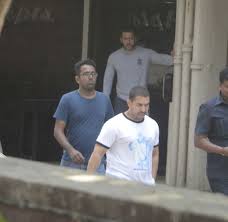
The recent controversy in FTII in which actor Gajendra Singh Chauhan got caught up reminded me of the above story, where for no fault of his, Gajendra is in the cross fire. Can we call it the wrath of Kalchakra?

For Gajendra too like the little sparrow was perched in his warm nest, quite away from the limelight doing small roles in movies and television serials, is when the GOI approached him as the warm rays of Siberia and Gajendra then dared to fly out of his nest, quite unaware of the Siberian winters—in this case being the sting of FTII- students.

The new job like the cow-dung covered Gajendra for a while when the wandering cats of Bollywood, Social Media, TV-channels and some Political Parties and so also the students union of FTII, who thought he did not have the tall stature, and moreover, he had committed the grevious crime of acting as Yudhistir in Mahabharat, thereby promoting Hinduism was definitely not suitable for the post. Because, in current day India even talking about Hinduism is considered non-secular by some.

While the wandering cats have so far not devoured the so called sparrow—Gajendra, but the Kalchakra has definitely crushed his film career. For Gajendra Singh Chauhan will now be known more for his poor stalk in Bollywood than the hard-work he has put in to make a career in Bollywood. And quite unknowingly and unintentionally he has antagonised and estranged many bigwigs of Bollywood and the social media; and has emerged as a full-fledged victim of Kalchakra.

    But what was his fault in all of this; that the electronic media almost stripped him naked as far as his career credentials went, that people who didn’t know about his average career also know about it now.

Kalchakra is not in the business of compensating losses and therefore won’t compensate Gajendra Singh Chauhan, for having torn apart his career and making him a laughing stock. I don’t know about GOI how they will view it. But the reality is,

    In life you often don’t get into problems because of your own doings, but it could also be the doing of others and in this case it was clearly the Kalchakra disguised as GOI.

For in life you really don’t know what will come and hit you, or who is friend and how distant is your enemy. But mind you Kalchakra spares no one, not even the wandering cats.

***

SARBJIT SINGH’S SISTER RECOUNTS THE 3 TIMES SHE MET HIM IN 23 YEARS BEFORE HE DIED IN 2013

Copyright@shravancharitymission

By Kamlesh Tripathi

New Doc 67_1New Doc 68_1

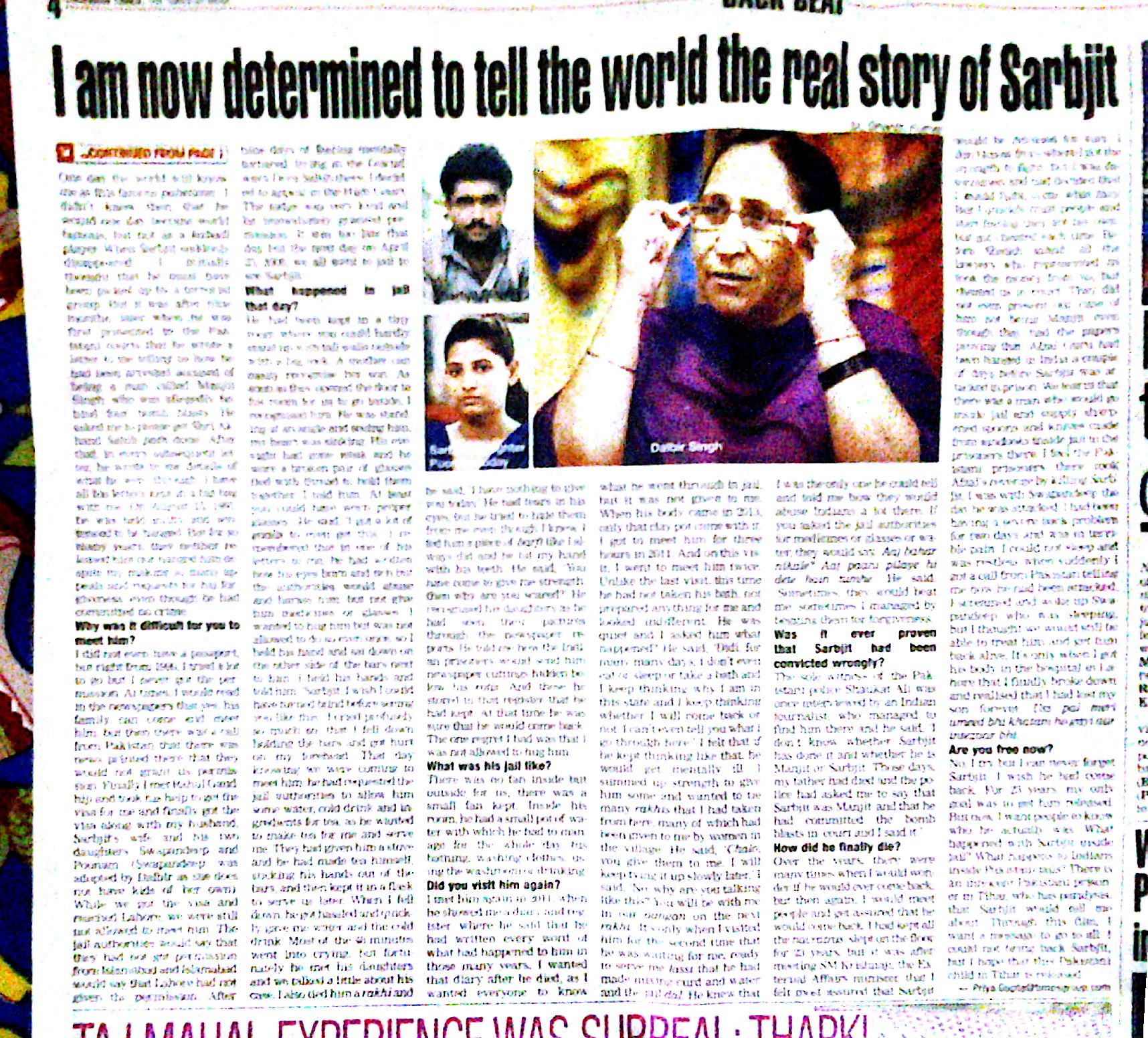
This is a nostalgic account narrated by Dalbir Singh, elder sister of Sarbjit Singh:

  • Sarbjit Singh had to spend 23 years in a Pakistani prison for a small mistake he committed unknowingly, and eventually he was murdered there—He headed in the wrong direction, towards Pakistan, at night after working in his fields located close to the LOC in Punjab and was nabbed by Pakistani rangers.
  • It is an emotional account of a sister; and pixels well about their relationship.
  • Dalbir Singh, Sarabjit’s elder sister considered him as her son. And after Sarabjit was whisked away by Pakistani authorities for 23 years she slept on the floor to please her God for his safe return.
  • It is said; sometimes there is success in defeat and sometimes there is defeat in success—it was success in defeat for Dalbir. For one cannot fathom the turbulence Dalbir must have undergone for 23 long years, each time blaming only herself that she hasn’t done enough to save her brother and she must continue with bigger and untiring efforts—so that was her success; and in the end not being able to save Sarbjit, her defeat.
  • I liked the account as it reminded me of my defeat, when I too could not save my ailing son from cancer, but like Dalbir the untiring  efforts that me and my family had put in gave a whiff of success. For in life one should only try his best and not get intimidated by what is beyond one’s capacity.
  • It also gives an account of how Indian prisoners are treated in Pakistani prisons.

  • Briefly describes how Indian prisoners are treated in Pakistani prisons.
  • Soon to be released as a film.

TOI- 26.5.15

SARBJIT SINGH’S SISTER RECOUNTS THE 3 TIMES SHE MET HIM IN 23 YEARS BEFORE HE DIED IN 2013

I am now determined to tell the world the real story of Sarbjit

Dalbir Singh, 61, is the older sister of Sarbjit Singh, a farmer from Bhikhiwind in Punjab (just 5 kms from the the Indo-Pakistan border). He by mistake crossed over in 1990 while farming, got mistaken as an Indian spy, was given capital punishment in 1991, but was not hanged. He was kept in Kot Lakhpat jail in Lahore for 23 years, before he was killed by inmates a few days after the death of Afzal Guru in India. During his 23 years in jail, his older sister Dalbir Singh who treated him more like her son than her brother, made it her life’s agenda to get him released. While she finally did not succeed, she is determined to reach his real story to the world through a film being made based on his life. The film will be directed by Omung Kumar, the National Award-winning director of Mary Kom. Dalbir Singh met her brother only three times in those 23 years. She opens up to us for the first time after her brother’s death in 2013 and recounts the three times she met her brother in jail. Excerpts:

Did instance like the Kargil War affect you?

At the time of Kargil, I got very scared. There is a nearby village called Khasa, where many army officers live. I went to meet them and asked Brigadier sahab, given the situation how it would affect the way Pakistan would treat our prisoners. I was scared that if there would be war, how would the prisoners come out? I met another Brigadier who told me that if there would be war, we would open up the jail and release the prisoners, so that an innocent man should not get bombed and die in jail. But he didn’t know what the Pakistanis would do. We would feel scared that Khuda na kare, if there was a bomb thrown in jail, how would he be able to run? My heart would sink if there was a flood or earthquake in Lahore.

How did Sarbjit actually cross over to Pakistan?

Our village is just about 4-5 kms from the border. I myself have gone many times to the other side while working together with the women from the other side on our fields. We would be working on our respective fields and sometimes, even eat a meal together with the Pakistani brothers and sisters on the other side.

Gradually and slowly, the situation got bad to worse and they first put a rough line to segregate a boundary and then, there were some fundamentalists on both sides who did not have good thoughts. Though I believe that ours were not as negative as the people on the other side. There would be things smuggled in across the borders, but the women had good behaviour towards each other and there was no enemity. However, if there was anybody who went the other side by mistake, they would be caught and put behind bars termed as ‘spies’. That night, we had finished our dinner when a friend of Sarbjit came and took him to the fields to work. The field was right next to the border. As is usually the case in Punjab, the men drink and then work. Sarbjit and his friend too had their full share of drinks and then, Sarbjit put his axe on his shoulder and not realising which direction he was walking, he walked into the Pakistan side. At that time, there was not even a wire to show the borderline. He was caught and blindfolded and only the next morning, he realised that he was in Lahore’s Kot Lakhpat jail, accused of being an Indian spy by the name of Manjit Singh. Sarbjit was very fond of playing kabaddi and he would often tell me, ‘You wait and see. One day the world will know me as this famous pahelwan.’ I didn’t know then that he would one day become world famous, but not as a kabaddi player. When Sarabjit suddenly disappeared, I initially thought that he must have been picked up by a terrorist group. But it was after nine months, later when he was first presented in the Pakistani courts that he wrote a letter to me telling us how he had been arrested accused of being a man called Manjit Singh, who was allegedly behind four bomb blasts. He asked to please get Shri Akhand Sahib path done. After that in every subsequent letter; he wrote to me details of what he went through. I have all his letters kept in a big bag with me. On August 15, 1991, he was held guilty and sentenced to be hanged. But for so many years, they neither released him nor hanged him despite my making so many appeals and requests for his forgiveness, even though he had committed no crime.

Why was it difficult for you to meet him?

I did not even have a passport, but right from 1990, I tried a lot to go but I never got the permission. At times, I would read in the newspapers that yes, his family can come and meet him, but then there was a call from Pakistan that there was news printed there that they would not grant us permission. Finally I met Rahul Gandhi and took his help to get the visa for me and finally got the visa along with my husband, Sarbjit’s wife and his two daughters Swapandeep and Poonam (Swapandeep was adopted by Dalbir as she does not have kids of her own). While we got the visa and reached Lahore, we were still not allowed to meet him. The jail authorities would say that they had not got permission from Islamabad and Islamabad would say that Lahore had not given the permission. After nine days of feeling mentally tortured, living in Gurudwara Dera Sahib there, I decided to appeal in the High Court. The judge was very kind and he immediately granted permission. It was too late that day, but the next day on April 23, 2008, we all went to jail to see Sarbjit.

What happened in jail that day?

He had been kept in a tiny room where you could hardly stand up with tall walls outside with a big lock. A mother can easily recognise her son. As soon as they opened the door to his room for us to go inside, I recognised him. He was standing at an angle and seeing him, my heart was sinking. His eyesight had gone weak and he wore a broken pair of glasses tied with a thread to hold them together: I told him, ‘At least you could have worn proper glasses.’ He said, ‘I got a lot of gaalis to even get this.’ I remembered that in one of his letters to me, he had written how his eyes burn and itch but the authorities would abuse and harass him, but not give him medicines and glasses. I wanted to hug him but I was not allowed to do so even once, so I held his hand and sat down on the other side of the bars next to him. I held his hands and told him, “Sarbjit, I wish I could have turned blind before seeing you like this.’ I cried profusely so much so, that I fell down holding the bars and got hurt in my forehead. That day knowing we were coming to meet him, he had requested the jail authorities to allow him some water, cold drink and ingredients for tea, as he wanted to make tea for me and serve me. They had given him a stove and he had made tea himself, sticking his hands out of the bars, and then kept it in a flask to serve us later. When I fell down, he got hassled and quickly gave me water and cold drink. Most of the 48 minutes went into crying, but fortunately he met his daughters and we talked a little about his case. I also tied him rakhi and he said, ‘I have nothing to give you today.’ He had tears in his eyes, but he tried to hide them from me even though I knew. I fed him with a piece of barfi like I always did and he bit my hand with his teeth. He said, ‘You have come to give me strength, then why are you scared?’ He recognised his daughters as he had seen their pictures through the newspaper reports. He told me how the Indian prisoners would send him newspaper cuttings hidden behind his rotis. And these he stored in the register he had kept. At that time he was sure he would come back. The one regret that I had was that I was not allowed to hug him.

What was his jail like?

There was no fan inside but outside for us, there was a small fan kept. Inside his room, he had a small pot of water with which he had to manage for the whole day, his bathing, washing clothes, using the washroom or drinking.

Did you visit him again?

I met him again in 2011, when he showed me a diary and register, where he said that he had written every word of what had happened to him in those many years. I wanted that diary after he died, as I wanted everyone to know what he went through in jail, but it was not given to me. When his body came in 2013, only that clay pot came with it. I got to meet him for three hours in 2011. And on this visit, I went to visit him twice. Unlike the last visit, this time he had not taken his bath, not prepared anything for me and looked indifferent. He was quiet and I asked him what happened? He said, ‘Didi, for many days, I don’t even eat or sleep or take a bath and I keep thinking why I am in this state and I keep thinking whether I will come back or not. I can’t even tell you what I go through here.’ I felt that if he kept thinking like that, he would get mentally ill. I summed up strength to give him some and wanted to tie many rakhis that I had taken from here, many of which had been given to me by women in the village. He said, ‘Chalo, you give them to me. I will keep tying it up slowly later.’ I said, ‘No, why are you talking like this? You will be with me in our aangan on the next rakhi.’ It’s only when I visited him for the second time that he was waiting for me, ready to serve me lassi that he had made mixing curd and water and the jail dal. He knew that I was the only one he could tell and told me how they would abuse Indians a lot there. If you ask the jail authorities for medicines or glasses or water, they would say, ‘Aaj bahar nikale? Aaj paani pilaye hi dete hain tumhe.’ He said, ‘Sometimes, they would beat me, sometimes I managed by begging them for forgiveness.’

Was it ever proven that Sarbjit had been convicted wrongly?

The sole witness of the Pakistani police Shaukat Ali was once interviewed by an Indian journalist, who managed to find him there and he said, ‘I don’t know whether Sarbjit has done it and whether he is Manjit or Sarbjit. Those days, my father had died and the police had asked me to say that Sarbjit was Manjit and that he had committed the bomb blasts in court and I said it.’

How did he finally die?

Over the years, there were many times when I would wonder if he would ever come back, but then again, I would meet people and get assured that he would come back. I had kept all the navratras, slept on the floor for 23 years, but it was after meeting SM Krishnaji, the External Affairs minister, that I felt most assured that Sarbjit would be released for sure. I don’t know from where I got the strength to fight, but I was determined and had decided that I would fight, come what may. But I quickly trust people and start feeling they are my own, but got cheated each time. Before Sheikh sahab, all the lawyers who represented us took the money from us, but cheated us in court. They did not even present our case of him not being Manjit even though they had the papers proving that. Afzal Guru had been hanged in India a couple of days before Sarbjit was attacked in prison. We learnt that there was a man who would go inside jail and supply sharpened spoons and knives made from sandooks inside jail to the prisoners there. I feel the Pakistani prisoners there took Afzal’s revenge by killing Sarabjit. I was with Swapandeep the day he was attacked. I had been having a severe back problem for two days and was in terrible pain. I could not sleep and was restless when suddenly I got a call from Pakistan telling me how he had been attacked. I screamed and woke up Swapandeep who was sleeping, but I thought we would still be able to treat him and get him back alive. It’s only when I got his body in the hospital in Lahore that I finally broke down and realised that I had lost my son forever: Uss pal meri umeed bhi khatam ho gayi aur intezaar bhi.

Are you free now?

No, I try but I can never forget Sarbjit. I wish he had come back. For 23 years, my only goal was to get him released. But now, I want people to know who he actually was. What happened with Sarbjit inside jail? What happens to Indians inside Pakistani jails? There is an innocent Pakistani prisoner in Tihar, who has paralysis, that Sarbjit would tell me about. Through this film, I want a message to go to all. I could not bring back Sarbjit, but I hope that this Pakistani child in Tihar is released.

Priya.Gupta@timesgroup.com

 

A-SATYAMAVE JAYATE

Copyright@shravancharitymission

By Kamlesh Tripathi

satya

Aamir Khan conducts ‘Satyamave Jayate’ a high moral–integrity TV serial that often takes up themes for the common man of India. In fact he could have done an episode on “Speedy justice for the common man” based on Salman Khan’s hit and run case, but instead he chose to flaunt his solidarity with a Salman. So is ‘Satyamave Jayate’ behind the scenes ‘A-satyamave Jayate?’

#BOLLYWOOD’S BARK IN #PLAYBACK’S VOICE

Copyright@shravancharitymission

By Kamlesh Tripathi

download images

KUTTE RD PE SOYAGA KUTTE KI MAUT MAREGA, ROAD GARIB KE BAAP KI NAHI HAI- I WAS HOMLESS YEAR NVR SLEPT ON ROAD

MILESTONE-MILLENNIUM DIALOGUE WRITTEN AND TWEETED BY- ABHIJEET BHATTACHARYA

On the big screen Bollywood vehemently fought for people who slept on pavements and roads of Mumbai, until Abhijeet Bhattacharya-playback singer spilled the beans. In fact some twenty to thirty years back when India was awakening Javed Akhtar and his likes would have written just converse to this dialogue and would have slanted it much in favour of the iconic Garib of India. And, many big Bollywood stars including Amitabh Bachchan, Dilip Kumar, Dharmendra and Vinod Khanna to name a few owe a lot to the pavement dwellers of Mumbai and India for their iconic status and fan following in having acted as the revolutionary young garib naujawan of India. Bollywood too has revved up; thanks to the countless Garibs and slum dwellers, who even with their shoe string budgets never missed an opportunity to see Bollywood movies where they could identify themselves with these heroes. But, did Abhijeet Bhattacharya turn around the real face of today’s Bollywood? And so the lines are for him,

Bollywood, owes it to them,
But you showed it to them,
Their place—Abhijeet,

Yes, so now more sign ups and songs for I have backed Salman,
By calling garibs kutta?
For in this wood of woods—Bollywood it doesn’t matter,
For I need to thrive, not just survive,
And I have company in Farah

But won’t Amitabh of Coolie and Amitabh of Dewar weep?
Go ask him,
As I need heaps, as I wait for some more occasions to tweet.

And where are you going?
Back to the pavement,
Without, seeing the movie?
Yes because dogs not see movies.
*****

MAHARASHTRA GOVT DIRECTIVE TO MULTIPLEXES: TO SCREEN MARATHI FILMS IN PRIME TIME

Copyright@shravancharitymission

s1 s2s3

Neither Popcorn nor Vadapaav, nor Prime-Time shows can force people, to see Marathi movies. If the movie has content it doesn’t require any of these support systems and if doesn’t, then support systems may help once or may be twice but not beyond that. And, it is indeed ironic that Devendra Fadnavis, CM of Maharashtra sitting in the thicket of Indian film industry missed this moot point, or he shammed, by offering an expired political lollipop. For at his beck and call is the entire Bollywood film industry who could have suggested better ways to promote Marathi movies, and thereby, Marathi culture. But before that the CM needs to make up his mind if he wants to Promote ‘Marathi’ culture only via Marathi movies; and have all other ways and means of promoting Marathi culture, been exhausted?

Promoting a ‘culture’ is a two way process and not a three hour film show as being made out. Movies can definitely provide a fillip to cultures, but then ‘cultures’ per se, also need to reach out to areas and population where it too wants to spread.

And, in fact the great old ‘Marathi’ culture does not require the crutches of any Marathi film, positioned in prime time and posh PVRs. But, what it requires is the seamless intermingling and hand holding with other communities, languages and societies and for this to happen some Marathi Netas should stop their periodic tirades against people who have settled in Mumbai and Maharashtra from other states.

For, let us not forget, though all-time great, Chatrapati Shivaji Maharaj had an iron grip on his sword, he also had a family called ‘Bharat’ also called ‘India.’

O MY FAIR LADY!

Copyright@shravancharitymission

  2my fair ladt

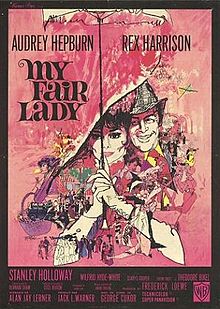
    Our formative years were full of fun and coupled to them was a careless, happy –go- lucky lifestyle that went naturally with it. The gay abandon and freedom we enjoyed was all within the family for we enjoyed doing things together. Life was simple and modes of entertainment simpler. No Cineplex, no DVDs, or play stations or speed dating. A good game of cricket followed by a refreshing ice soda, topped by a steaming cup of coffee with a bun, perhaps, was the ultimate luxury. My interest in movies as a source of entertainment was influenced by my uncle who belonged to the era of Douglas Fairbanks, Spencer Tracey, Clark Gable, Cary Grant, Gregory Peck and a host of others who gave that aura of sheer mysticism and glamour to Hollywood, which makes it what it is today. Uncle was particular about the movies we saw, especially the English movies. He out rightly discouraged the slam-bang-wham types, excepting, of course, the Westerns starring John Wayne, Gary Cooper and the ilk. Uncle acquainted us with the top genre movies including the noire category made by Hollywood. The list of films ranged from Ten Commandments, Ben Hur, My Fair Lady, The Sound of Music to Scapegoat, Stagecoach and Gunfight at O.K. Coral. However, my all time favourite is The Sound of Music. ‘Do Re Me Fa…’ , ‘I’m sixteen going on seventeen….’, oh, what numbers, simply out of this world-or mind blowing by today’s parlance. For sheer magic of music and visual excellence the movie is miles ahead of its genre.

But for unalloyed intellectual treat My Fair Lady takes the cake. Elders at home took great pains to explain the essential hypocrisy of the British and their unique trait of laughing at themselves. That, perhaps, has moulded my present opinion. Based on Pygmalion by the great English dramatist, GBS, this captivating musical, a Twentieth Century Fox Production, won the best film Oscar(1964). The name Pygmalion refers to the king of Cyprus who fell in love with a statue of his own making. The beautiful statue was bestowed with life and turned into a more beautiful maiden whom Pygmalion married, or so the story goes. Henry Higgins is an English linguistics professor without peer. He is also a misogynistic bachelor-brash, arrogant but totally committed to his work. The Covent Garden scene where he meets scruffy Eliza Dolittle, superbly portrayed by Audrey Hepburn, a common flower girl with a Cockney accent, is uniquely scripted and refreshingly filmed.

Professor Higgins takes on Eliza under his tutelage in order to transform her from a rustic flower girl to a lady who captures the majesty and grandeur of the English language with impeccable articulation. They train together and enter into a cantankerous relationship where Eliza threatens Higgins, “Just you wait Henry Higgins”. Eliza has to work unceremoniously as part of his innovative speech devices much to the anguish of Col Pickering who sympathises with the girl for the ordeals she suffers. Higgins bets with Pickering that he will be able to pass Eliza off as a Duchess in six months time. The big day finally arrives. Pretenders, masqueraders, and polyglots arrive incognito to de-mask Eliza. They tease, torment and taunt Eliza who stands unnerved by their verbal sallies. Eliza steals the show with His Majesty leading the dance with her, much like the Cindrella of the fairy tale. Eliza transcends expectations beyond measure. Higgins finds it difficult to believe in his own handiwork and concedes defeat, saying: “ I have grown accustomed to her face”.

Astonishing sets, captivating costumes and excellent photography together with immortal tunes like’ “Get me to the church in time”, “I could have danced all night” transform the movie into a classic. Down to this day the movie ranks as an all time favourite for our entire family. The supporting cast in the form of Alfred Dolittle (Stanley Holloway) in the role of Eliza’s eccentric yet charismatic father is no less endearing. Alfred delivers some of the finest lines in the film, and remains my favourite character to this day. Our own Bollywood has many a times borrowed thematic contents from Hollywood classics of the early sixties and seventies. Dil Hai Ki Manta Nahi and picked up its theme from It Happened One Night, while The Sound Of Music provided the concept for Parichay. Devanand’s Manpasand adapted substantially from My Fair Lady. In doing so the Bollywood  attempt was bold but not a patch on the great movie. However, Devanand as Higgins and Girish Karnad as Col Pickering just manage to keep the movie afloat.

Going back to my favourite, the most exciting part of the movie is where Higgins and Eliza sing the ditty “The Rain In Spain Falls Mainly in the Plain”.  Suddenly Eliza discovers that the tone, timbre and modulation of her voice have acquired the Queen’s accent. The exhilaration and joy of the Professor is a delight to watch. Even Pickering and the house maids join in the fun as the song goes on and on. The scene is one of the high point of the movie. The acerbic wit in the allegory authored by the redoubtable GBS is commendably brought out in the film which for me remains a moving experience.

A.K.Tripathi,                                                                                                                                        Guwahati-Assam

March-2015

First published in Local Area Magazine titled ‘Nava Arunodoi’ in 2009. The article has since been re-edited.

#KISHORE-KUMAR- NOT A RECIPIENT OF ANY “PADMA” AWARD EVEN AFTER 27 YEARS OF HIS DEATH

Copyright@shravancharitymission

523

Does it require something more than sterling- unquestioned-talent to earn these awards?

    It is already stinking. But before it starts rotting. The present government should correct, one of the biggest follies of the previous governments of not awarding any ‘Padma’ award to legendary, genius and ever green Kishore Kumar. One of the biggest all time singers of India- who died 27 years ago.

    He spent 41 years in the industry as an actor and a singer and that too par excellence. And all rolled into one as a producer, director, lyricist, music director and a scriptwriter. So, it is indeed intriguing to note why government after government failed to include him in the awardee list- not even a Padma Shri … which is so very pathetic.

    Kishore Kumar was a cynosure of every Indian, cutting across religion, mother- tongue, regions and states. And, I’m more than sure. Indians will be most eager to know as to why this son-of-the-soil has been denied the prestigious ‘Padma’ award. Especially, when we compare this iconic film personality with many others who have received ‘Padma’ awards much earlier in their careers. It gives you an eerie feeling loaded with bias.

    By not including him in the awardee list we have not only insulted Kishore Kumar but every Indian who has a song or two of Kishore on his lips. And may curse be upon all those, who with ulterior motives, kept omitting his name from the list of awardees year after year.

    But a ray of hope comes from Prime Minister Narendra Modi who is now busy correcting many wrongs of India, committed in the past and I am sure he will take up this wrong too.

    Kishore Kumar has sung 2,703 songs in 1188 Hindi films. He has also sung 156 Bengali and 8 Telugu songs. May Kishore Da rest in peace.

*

By Kamlesh Tripathi

*

                                                    https://kamleshsujata.wordpress.com

*

Share if you like it

*

Shravan Charity Mission is an NGO that works for poor children suffering from life threatening diseases. Should you wish to donate for the cause the bank details are given below:

NAME OF ACCOUNT: SHRAVAN CHARITY MISSION

Account no: 680510110004635 (BANK OF INDIA)

IFSC code: BKID0006805

*

Our publications

GLOOM BEHIND THE SMILE

ONE TO TANGO … RIA’S ODYSSEY

AADAB LUCKNOW … FOND MEMORIES

REFRACTIONS … FROM THE PRISM OF GOD

(CAN BE BOUGHT FROM ON LINE BOOK STORES OR WRITE TO US FOR COPIES)

*****