Tag Archives: shravancharitymission

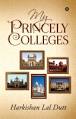
BOOK REVIEW: MY PRINCELY COLLEGES BY HARIKISHAN LAL DUTT

Copyright@shravancharitymission
Khidki (Window)

–Read India Initiative—

This is only an attempt to create interest in reading. We may not get the time to read all the books in our lifetime. But such reviews, talk and synopsis will at least convey what the book is all about.

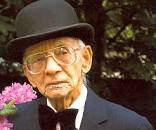
    Mr H.L. Dutt happens to be my college teacher, my Guru, and the erstwhile Principal of Colvin Taluqdar’s College Lucknow, where I studied. He taught me English. I still remember the splendour of his English class, especially, that of Sheakespeare’s, Merchant of Venice, in 1974-75, that is, still etched, like the sparkle of a diamond in my mind, where, even, the onslaught of time has not been able to faint it, in any manner.

    ‘It is a wise father that knows his own child’—says Lancelot, in act 2 scene 2 of Merchant of Venice. Mr Dutt knew each student like his father. Most certainly one of the best English teachers I’ve ever known. Erudite, handsome, with a tall pedigree, and, an, appropriate convent English accent—something that everyone, envied those days. The manner in which he monitored the college reminds me of another quote from Merchant of Venice—‘young in limbs, in Judgment old’—Morocco in act 2 scene 7.

    The publishers of this book are Notion Press. They have done a good job. The author dedicates the book to his wife—Bina Dutt, his rock of Gibraltar, his daughters Alka & Anu and his son Harsh. The price of the book is Rs 450 for a print copy and Rs 60 for a Kindle one.

    The book is a personal account of Mr H.L.Dutt—his auto-biography. A book I would recommend to teachers and students especially. It is a 161 page book, constructed over twenty eight chapters, describing the journey of his career life, and thereafter his retreat, his retirement that he is now enjoying.

    The book starts with the chapter destiny, his early days, his outdoors, and co-curricular activities. Then the scene changes to England, where, he goes for a bursary, acquires a foreign degree and then returns to Mayo College Ajmer again, where, he teaches for a good number of years and then bids adieu in the year 1966 looking for wider exposure in career terms.

    He then joins Cambridge school, followed by Pilani and then he marches into Colvin Taluqdars College Lucknow. He further goes on to teach in Hyderabad Public School, The Daly College Indore, and then returns to Mayo College Ajmer again, and even starts Mayo College Girls School.

    In short Mr Dutt started his teaching career from Mayo College Ajmer in 1954. He had splendid days there. Full of learnings and excitement. He gives a very animated account of his stay in Mayo Ajmer that includes a plethora of campus activities, excursions, sighting of animals and even shikar when it was permitted. Mayo in those times was a princely college, with children of, most princely states, of India studying there.

    He talks of the various college houses like Bharatpur House, Udaipur House, Jhalawar House, Jaisalmer House, Kota House and even talks about his campus accommodation.

    After leaving Mayo in 1966 he joined Cambridge School Delhi, followed by Pilani and then Colvin Taluqdar’s College Lucknow, spread across 99 acres on the banks of river Gomti.

    In Colvin he took over from Principal H.N. Kashyap. Reading about Colvin was nostalgic as I had studied there. The author has given quite a detailed account of his tenure in Colvin-Lucknow. He starts with the titling of Lucknow as the ‘City of Nawabs.’ He then goes on to describe the college houses such as—Hind, Anjuman, Awadh Taxila. The celebration of Janmashtami. And he hasn’t forgotten the nawabs and the Rajahs and the Taluqdars of Uttar Pradesh such as—Raja of Oel, Mankapur, Kotwara, Pratapgarh, Amethi, Kalakankar, Bhinga and Mahmoodabad. He highlights the Tandoori Chicken, Kababs and Roomali Roti and the dinner invitation of Raja Sajid Husain of Kotwara.

    The author vividly remembers Mrs M Seeley, Head Mistress of the junior school, faculty L.P. Bhardwaj and senior master P.C. Chaube.

    Colvin indeed was a powerhouse of academics producing IITians, doctors and bureaucrats galore. Some unforgettable sportsmen that he remembers are Hamidullah, Birbal, Razdan and Puri. Then the ace debaters like Trivedi, Pandey, Sharma brothers, Lakhtakia and Luv-Kush Verma, and of course Ashok Prasad and Head Prefect Satnam Singh.

    He also hasn’t forgotten S.N. Tandon, S.B Singh, Samiullah, Amanat Ullah, Sudhir Dayal, Jaiswal, G.V. Singh and Brinda Shankar.

    He fondly remembers his exquisite bungalow and even his gardeners, and the famous Darbar Day the busiest day of the college. And the old boys and their parents.

    An interesting point that the author makes is that he found certain names starting with the letter “A” to be more prominent in class and academics such as Alok, Ashok, Anil, Arun and Arunendra. In the process in no way he disparages other letters.

    The author then goes on to narrate his experiences of Hyderabad Public School. In June 1979 he takes up a new assignment—The Daly College, Indore. A princely college built by princes of Malwa.

    Finally the author returns to Mayo College, Ajmer with a great amount of nostalgia. The book also covers his starting of Mayo Girls College. But the author’s career circle is yet not complete.

    Then in 2006 Mr Dutt is invited by Dr Sanjay Singh, Raja Amethi, to head the college once again to bring back its glory at the age of 76 which he does, after which Mr H.L Dutt takes his retirement and settles in Gurgaon. His contribution to public colleges shall always be remembered. He stood for excellence.

    Friends before I close this review let me tell you. The book is a treat to read and I’m not saying this just because the author happens to be my Guru and Principal.

    What I liked about the book was the segmentation and presentation of the text into small chapters where the emotions of the author were captured very well and without being obvious. He has used plain but enticing English keeping students in mind and has desisted from verbosity. The sentences are soothing, pleasing and inviting where you don’t feel like putting the book down—a real page turner.

    I wish Mr H.L. Dutt good health and a happy retired life.

By Kamlesh Tripathi

*

https://kamleshsujata.wordpress.com

*

Share it if you like it

*

Shravan Charity Mission is an NGO that works for poor children suffering from life threatening diseases especially cancer. Our posts are meant for our readers that includes both children and adults and it has a huge variety in terms of content. We also accept donations for our mission. Should you wish to donate for the cause. The bank details are given below:

NAME OF ACCOUNT: SHRAVAN CHARITY MISSION

Account no: 680510110004635 (BANK OF INDIA)

IFSC code: BKID0006805

*

Our publications

GLOOM BEHIND THE SMILE

(The book is about a young cancer patient. Now archived in 7 prestigious libraries of the US, including, Harvard University and Library of Congress. It can also be accessed in MIT through Worldcat.org. Besides, it is also available for reading in Libraries and archives of Canada and Cancer Aid and Research Foundation Mumbai)  

ONE TO TANGO … RIA’S ODYSSEY

(Is a book on ‘singlehood’ about a Delhi girl now archived in Connemara Library, Chennai and Delhi Public Library, GOI, Ministry of Culture, Delhi)

AADAB LUCKNOW … FOND MEMORIES

(Is a fiction written around the great city of Nawabs—Lucknow. It describes Lucknow in great detail and also talks about its Hindu-Muslim amity. That happens to be its undying characteristic. The book was launched in Lucknow International Literary Festival of 2014)

REFRACTIONS … FROM THE PRISM OF GOD

(Co-published by Cankids–Kidscan, a pan India NGO and Shravan Charity Mission, that works for Child cancer in India. The book is endorsed by Ms Preetha Reddy, MD Apollo Hospitals Group. It was launched in Lucknow International Literary Festival 2016)

TYPICAL TALE OF AN INDIAN SALESMAN

(Is a story of an Indian salesman who is, humbly qualified. Yet he fights his ways through unceasing uncertainties to reach the top. A good read not only for salesmen. The book was launched on 10th February, 2018 in Gorakhpur Lit-Fest. Now available in Amazon, Flipkart and Onlinegatha)

RHYTHM … in poems

(Published in January 2019. The book contains 50 poems. The poems describe our day to day life. The book is available in Amazon, Flipkart and Onlinegatha)

(ALL THE ABOVE TITLES ARE AVAILABLE FOR SALE IN AMAZON, FLIPKART AND OTHER ONLINE STORES OR YOU COULD EVEN WRITE TO US FOR A COPY)

*****



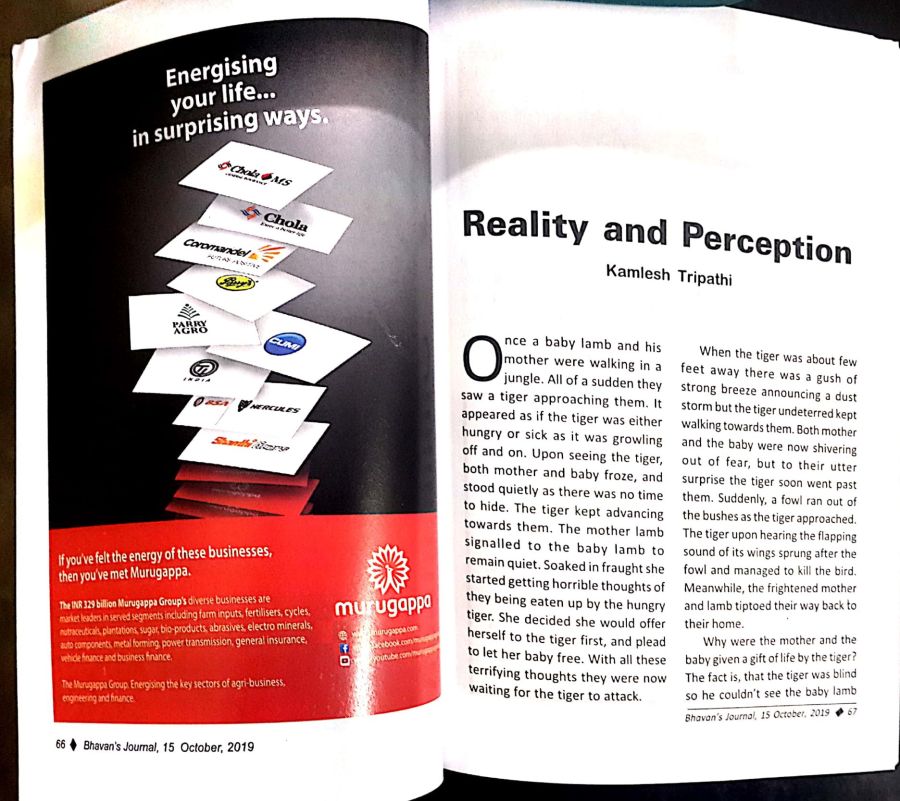
SHORT STORY: PERCEPTION & REALITY by Kamlesh Tripathi

My story as published in Bhavan’s Journal

By Kamlesh Tripathi

*

https://kamleshsujata.wordpress.com

*

Share it if you like it

*

Shravan Charity Mission is an NGO that works for poor children suffering from life threatening diseases especially cancer. Our posts are meant for our readers that includes both children and adults and it has a huge variety in terms of content. We also accept donations for our mission. Should you wish to donate for the cause. The bank details are given below:

NAME OF ACCOUNT: SHRAVAN CHARITY MISSION

Account no: 680510110004635 (BANK OF INDIA)

IFSC code: BKID0006805

*

Our publications

GLOOM BEHIND THE SMILE

(The book is about a young cancer patient. Now archived in 7 prestigious libraries of the US, including, Harvard University and Library of Congress. It can also be accessed in MIT through Worldcat.org. Besides, it is also available for reading in Libraries and archives of Canada and Cancer Aid and Research Foundation Mumbai)  

ONE TO TANGO … RIA’S ODYSSEY

(Is a book on ‘singlehood’ about a Delhi girl now archived in Connemara Library, Chennai and Delhi Public Library, GOI, Ministry of Culture, Delhi)

AADAB LUCKNOW … FOND MEMORIES

(Is a fiction written around the great city of Nawabs—Lucknow. It describes Lucknow in great detail and also talks about its Hindu-Muslim amity. That happens to be its undying characteristic. The book was launched in Lucknow International Literary Festival of 2014)

REFRACTIONS … FROM THE PRISM OF GOD

(Co-published by Cankids–Kidscan, a pan India NGO and Shravan Charity Mission, that works for Child cancer in India. The book is endorsed by Ms Preetha Reddy, MD Apollo Hospitals Group. It was launched in Lucknow International Literary Festival 2016)

TYPICAL TALE OF AN INDIAN SALESMAN

(Is a story of an Indian salesman who is, humbly qualified. Yet he fights his ways through unceasing uncertainties to reach the top. A good read not only for salesmen. The book was launched on 10th February, 2018 in Gorakhpur Lit-Fest. Now available in Amazon, Flipkart and Onlinegatha)

RHYTHM … in poems

(Published in January 2019. The book contains 50 poems. The poems describe our day to day life. The book is available in Amazon, Flipkart and Onlinegatha)

(ALL THE ABOVE TITLES ARE AVAILABLE FOR SALE IN AMAZON, FLIPKART AND OTHER ONLINE STORES OR YOU COULD EVEN WRITE TO US FOR A COPY)

*****


BOOK CORNER: AROUND A TEMPLE by R K Narayan

Copyright@shravancharitymission

Khidki (Window)

–Read India Initiative—

This is only an attempt to create interest in reading. We may not get the time to read all the books in our lifetime. But such reviews, talk and synopsis will at least convey what the book is all about.

In the short story The Talkative Man narrates:

    ‘Some years ago there was a forestry officer in this town who always scoffed at things. He was sent for this posting by his department for some special work in Mempi Forest and he had his headquarters here. He had spent a couple of years abroad, and after returning home he was full of contempt for all our practices and institutions He was a hard core ‘rational’ by which he meant that he believed only in things he could touch, see, hear and smell. God didn’t pass any of these tests, at any rate the God we believed in. Accordingly to most of us, God resides in the Anjaneya (hanuman) temple we see on the way.

    ‘It is a very small temple, no doubt, but it is very ancient. It is right in the centre of the town, at the cutting of the two most important roads—Lawley Road running east and west and the Trunk Road running north and south; and any person going out anywhere, whether to the court or the college, the market or the Extension, has to pass the temple. And no one is so foolish as to ignore God and carry on as He is very real and He can make His power felt. I do not say that He showers good fortune only on those who bow at Him … I do not mean that at all. But I also do not mean that it is very simple to please a god. It costs about a quarter-of-an-anna a week and five minutes of prayer on a Saturday evening. Ninety-nine out of a hundred do it. On any Saturday evening you will find a thousand people at the temple, going round the image and burning camphor.

    ‘I have said that the temple is at an important crossing and every time our friend passed up and down either to his office or club, he had to pass it, and you may be sure, particularly Saturday evenings, the crowd around the temple caused dislocation of traffic. Where, lesser beings faced it cheerfully. But our friend was always annoyed. He would remark to his driver. “Run over the blasted crowd. Superstitious mugs. If this town had a sane municipality this temple would have been pulled down years ago ….”

    ‘On a Sunday morning the driver asked: “May I have the afternoon off, sir?”

    ‘Why?’

    ‘When my child fell ill some days ago I vowed I would visit the crossroad shrine with my family …’

    ‘Today?’

    ‘Yes, sir. On other days it is crowded.’

    ‘You can’t go today.’

    ‘I have to, sir. It is a duty ….’

    ‘You can’t go. You can’t have leave for all your superstitious humbugging.’ The driver was so insistent that the officer told him a few minutes later: ‘All right, go. Come on the first of next month and take your pay. You are dismissed.’

    ‘At five o’clock when he started for his club he felt irritated. He had no driver. ‘I will do without these fellows,’ he said to himself. ‘Why should I depend upon anyone?’

    ‘The chief reason why he depended upon others was that he was too nervous to handle a car. His head was a whirl of confusion when he sat at the wheel. He had not driven more than fifty miles in all his life though he had a driving licence and renewed it punctually every year. Now as he thought of the race of chauffeurs he felt bitter. ‘I will teach these beggars a lesson. Drivers aren’t heaven-born. Just ordinary fellows. It is all a question of practice; one has to make a beginning somewhere. I will teach these superstitious beggars a lesson. India will never become a first-rate nation as long as it worships traffic-obstructing gods, which any sensible municipality ought to remove.’

     ‘It was years since he had driven a car. With trepidation he opened the garage door and climbed in. At a speed of about twenty-five miles an hour his car shot out of the gate after it had finally emerged from the throes of gear-changing. It flew past the temple when our friend realised that somehow he could not turn to his left, which he must, if he wanted to reach his club. He could only steer to his right. Nor could he stop the car when he wanted. He felt that applying the brakes was an extraordinary queer business. When he tried to stop he committed so many blunders that the car rocked, danced and threatened to burst. He felt it safest to go up the road till a favourable opportunity presented itself for him to turn right, and then again right, and about-turn. He whizzed past the temple back to his bungalow, where he could not stop, and so had to proceed again, turn right, go up to Trunk Road, turn right again, and come down the road past the temple.

    ‘Half-an-hour later the dismissed driver arrived at the shrine with his family and was nearly run over. He stepped aside and had hardly recovered from the shock when the car reappeared. The driver put away his basket of offerings, took his family to a place of safety, and came out.

    When the car appeared again he asked, “What is the matter sir?” His master looked at him pathetically and before he could answer the car came around again: “Can’t stop.”

    “Use the hand-brake, sir, the foot-brake’s rather loose.”

    “I can’t,” panted our friend.

    The driver realised that the only thing his master could do with a car was to turn its wheel right and blow the horn. He asked, “Have you put in any petrol, sir?”

    “No.”

    “It had only one-and-a-half gallons; let it run it out.” The driver went in, performed puja, sent away his family and attempted to jump on the footboard. He couldn’t. He stood aside on a temple step with folded hands, patiently waiting for the car to exhaust its petrol.

    The car soon came to a stop. The gentleman gave a gasp and fainted on the steering-wheel. He was revived. When he regained consciousness, the priest of the temple held before him a plate and said, “Sir, you have circled the temple over five hundred times today. Ordinarily people go around only nine times, and on special occasions one hundred-and-eight times. I haven’t closed the doors thinking you might like to offer coconut and camphor at the end of your rounds.”

    The officer flung a coin on the tray.

    The driver asked, “Can I be of any service, sir?”

    “Yes drive the car home.”

    He reinstated the driver, who demanded a raise a fortnight later. And thereafter whenever our friend passed the temple, he exercised great self-control and never let an impatient word cross his lips. I won’t say that he became very devout all of a sudden, but he certainly checked his temper and tongue when he was in the vicinity of the temple. And wasn’t it enough achievement for a god?

Such are the ways of God friends.

By Kamlesh Tripathi

*

https://kamleshsujata.wordpress.com

*

Share it if you like it

*

Shravan Charity Mission is an NGO that works for poor children suffering from life threatening diseases especially cancer. Our posts are meant for our readers that includes both children and adults and it has a huge variety in terms of content. We also accept donations for our mission. Should you wish to donate for the cause. The bank details are given below:

NAME OF ACCOUNT: SHRAVAN CHARITY MISSION

Account no: 680510110004635 (BANK OF INDIA)

IFSC code: BKID0006805

*

Our publications

GLOOM BEHIND THE SMILE

(The book is about a young cancer patient. Now archived in 7 prestigious libraries of the US, including, Harvard University and Library of Congress. It can also be accessed in MIT through Worldcat.org. Besides, it is also available for reading in Libraries and archives of Canada and Cancer Aid and Research Foundation Mumbai)  

ONE TO TANGO … RIA’S ODYSSEY

(Is a book on ‘singlehood’ about a Delhi girl now archived in Connemara Library, Chennai and Delhi Public Library, GOI, Ministry of Culture, Delhi)

AADAB LUCKNOW … FOND MEMORIES

(Is a fiction written around the great city of Nawabs—Lucknow. It describes Lucknow in great detail and also talks about its Hindu-Muslim amity. That happens to be its undying characteristic. The book was launched in Lucknow International Literary Festival of 2014)

REFRACTIONS … FROM THE PRISM OF GOD

(Co-published by Cankids–Kidscan, a pan India NGO and Shravan Charity Mission, that works for Child cancer in India. The book is endorsed by Ms Preetha Reddy, MD Apollo Hospitals Group. It was launched in Lucknow International Literary Festival 2016)

TYPICAL TALE OF AN INDIAN SALESMAN

(Is a story of an Indian salesman who is, humbly qualified. Yet he fights his ways through unceasing uncertainties to reach the top. A good read not only for salesmen. The book was launched on 10th February, 2018 in Gorakhpur Lit-Fest. Now available in Amazon, Flipkart and Onlinegatha)

RHYTHM … in poems

(Published in January 2019. The book contains 50 poems. The poems describe our day to day life. The book is available in Amazon, Flipkart and Onlinegatha)

(ALL THE ABOVE TITLES ARE AVAILABLE FOR SALE IN AMAZON, FLIPKART AND OTHER ONLINE STORES OR YOU COULD EVEN WRITE TO US FOR A COPY)

*****


KHUSHWANT SINGH

Copyright@shravancharitymission

    Khushwant Singh (born Khushal Singh, 2 February 1915 – 20 March 2014) was an Indian author, lawyer, diplomat, journalist and politician and. His experience in the 1947 Partition of India inspired him to write ‘Train to Pakistan’ in 1956 (made into a film in 1998), which became his most well-known novel. He is one of the prime English authors of India.

    Born in Punjab, Khushwant Singh was educated in New Delhi, and studied law at St, Stephen’s College, Delhi, and King’s College London. After working as a lawyer in Lahore Court for eight years, he joined the Indian Foreign Service upon Independence of India from British Empire in 1947. He was appointed journalist in the All India Radio in 1951, and then moved to the Department of Mass Communications in UNESCO at Paris in 1956. His last two careers encouraged him to pursue a literary career. As a writer, he was best known for his trenchant secularism, humour, sarcasm and an abiding love of poetry. His comparisons of social and behaviour characteristics of Westerners and Indians are laced with acid wit. He served as the editor of several literary and news magazines, as well as two newspapers, through the 1970s and 1980s. Between, 1980-1986 he served as Member of Parliament in Rajya Sabha, the upper house of the Parliament of India.

    Khushwant Singh was bestowed with Padma Bhushan in 1974. But he returned the award in 1984 as a protest against Operation Blue Star in which the Indian Army raided Darbar Sahab in Amritsar. In 2007 he was awarded the Padma Vibhushan, the second-highest civilian award of India.

    Khushwant Singh was born in Hadali, Khushab District, Punjab (which now lies in Pakistan), into a Sikh family. He was the younger son of Sir Sobha Singh and Veeran Bai. Since births and deaths were not recorded in those times, his father simply made up 2 February 1915 for his school enrolment at Modern School, New Delhi. But his grandmother Lakshmi Bai asserted that he was born in August, so he later set the date for himself as 15 August. Sobha Singh was a prominent builder in Lutyens Delhi. His uncle Sardar Ujjal Singh (1895–1983) was previously Governor of Punjab and Tamil Nadu.

    His birth name, given by his grandmother, was Khushal Singh (meaning a “Prosperous Lion”). He was called by a pet name “Shalee”. At school his name earned him ridicule as other boys would mock at him with an expression, “Shalee Shoolie, Bagh dee Moolee” (meaning, “This shalee or shoolee is the radish of some garden.”) He chose Khushwant so that it rhymes with his elder brother’s name Bhagwant. (He declared that his new name was “self-manufactured and meaningless”. But he later discovered that there was a Hindu physician with the same name, and the number subsequently increased).

    He entered Delhi Modern School in 1920 and studied there till 1930. There he met his future wife, Kawal Malik, one year his junior. He continued higher education at Government College, Lahore, St. Stephen’s College Delhi, and King’s College London, before reading for the Bar at the Inner Temple.

    Khushwant Singh started his professional career as a practising lawyer in 1939. He worked at Lahore Court for eight years. In 1947 he entered the Indian Foreign Service for the newly independent India. He started as Information Officer of the Government of India in Toronto, Canada. He was a Press Attaché and Public Officer for the Indian High Commission for four years in London and Ottawa. In 1951 he joined the All India Radio as a journalist. Between 1954 and 1956 he worked in Department of Mass Communication of the UNESCO at Paris. From 1956 he turned to editorial services. He founded and edited Yojana, an Indian government journal in 1951 -1953; and also The Illustrated Weekly of India, a newsweekly; and two major Indian newspapers, The National Herald and the Hindustan Times. During his tenure, The Illustrated Weekly became India’s pre-eminent newsweekly, with its circulation raising from 65,000 to 400000. After working for nine years in the weekly, on 25 July 1978, a week before he was to retire, the management asked Singh to leave “with immediate effect”. A new editor was installed the same day. After Singh’s departure, the weekly suffered a huge drop in readership. In 2016 Khushwant Singh entered Limca Book of Records as a tribute.

    From 1980 to 1986, Singh was a member of Rajya Sabha, the upper house of the Indian parliament. He was awarded Padma Bhushan in 1974 for his service to the country. In 1984, he returned the award in protest against the siege of the Golden Temple by the Indian Army. In 2007, the Indian government awarded Khushwant Singh the Padma Vibhushan. As a public figure, Khushwant Singh was accused of favouring the ruling Congress Party, especially during the reign of Indira Gandhi. He was derisively called an ‘establishment liberal’. Singh’s faith in the Indian political system was shaken by the anti-Sikh riots that followed Indira Gandhi’s assassination, in which major Congress politicians are alleged to be involved; but he remained resolutely positive on the promise of Indian democracy and worked via Citizen’s Justice Committee floated by H.S. Phoolka a senior advocate of Delhi High Court.

    Singh was a votary of greater diplomatic relations with Israel at a time when India did not want to displease Arab nations where thousands of Indians found employment. He visited Israel in the 1970s and was impressed by its progress.

    Khushwant Singh was married to Kawal Malik. Malik was his childhood friend who had moved to London earlier. They met again when he studied law at King’s College London, and soon got married. They had a son, named Rahul Singh, and a daughter, named Mala. His wife predeceased him in 2001. Actress Amrita Singh is the daughter of his brother Daljit Singh’s son – Shavinder Singh and Rukhsana Sultana. He stayed in “Sujan Singh Park”, near Khan Market New Delhi, Delhi’s first apartment complex, built by his father in 1945, and named after his grandfather. His grandniece Tisca Chopra is a noted TV and Film Actress.

    Khushwant Singh was a self-proclaimed agnostic, as the title of his 2011 book suggests: ‘Agnostic Khushwant: There is no God explicitly revealed.’ He was particularly against organised religion. He was evidently inclined towards atheism, as he once said, “One can be a saintly person without believing in God and also a detestable villain while believing in him. In my personalised religion, There Is No God!” He also once said, “I don’t believe in rebirth or in reincarnation, in the day of judgement or in heaven or hell. I accept the finality of death.” His last book, ‘The Good, The Bad and The Ridiculous’ was published in October 2013, following which he retired from writing. The book was his continued critique of religion and especially its practice in India, including the critique of the clergy and the priests. It earned a lot of acclaim in India.

    Singh died of natural causes on 20 March 2014 at his Delhi residence, at the age of 99. His death was mourned by many including the President, Vice-President and Prime Minister of India. He is survived by his son and daughter. He was cremated at Lodhi Crematorium in Delhi at 4 in the afternoon of the same day. During his lifetime, Khushwant Singh was keen on burial because he believed that with a burial we give back to the earth what we have taken. He had requested the management of Bahai Faith if he could be buried in their cemetery. After initial agreement, they had proposed some conditions which were unacceptable to Singh, and hence the idea was later abandoned. He was born in Hadali, Khushab District,  in the Punjab Province of modern Pakistan, in 1915. According to his wishes, some of his ashes were brought and scattered in Hadali.

    In 1943 he had already written his own obituary, included in his collection of short stories Posthumous. Under the headline “Sardar Khushwant Singh Dead”, the text reads:

    We regret to announce the sudden death of Sardar Khushwant Singh at 6 pm last evening. He leaves behind a young widow, two infant children and a large number of friends and admirers. Amongst those who called at the late sardar’s residence were the PA to the chief justice, several ministers, and judges of the high court.

    He also prepared an epitaph for himself, which runs as follows:

Here lies one who spared neither man nor God;
Waste not your tears on him, he was a sod;
Writing nasty things he regarded as great fun;
Thank the Lord he is dead, this son of a gun.

He was cremated and his ashes are buried in Hadali school, where a plaque is placed bearing the inscription:

IN MEMORY OF
SARDAR KHUSHWANT SINGH
(1915–2014)

A SIKH, A SCHOLAR AND A SON OF HADALI (Punjab)
‘This is where my roots are. I have nourished them with tears of nostalgia.

By Kamlesh Tripathi

*

https://kamleshsujata.wordpress.com

*

Share it if you like it

*

Shravan Charity Mission is an NGO that works for poor children suffering from life threatening diseases especially cancer. Our posts are meant for our readers that includes both children and adults and it has a huge variety in terms of content. We also accept donations for our mission. Should you wish to donate for the cause. The bank details are given below:

NAME OF ACCOUNT: SHRAVAN CHARITY MISSION

Account no: 680510110004635 (BANK OF INDIA)

IFSC code: BKID0006805

*

Our publications

GLOOM BEHIND THE SMILE

(The book is about a young cancer patient. Now archived in 7 prestigious libraries of the US, including, Harvard University and Library of Congress. It can also be accessed in MIT through Worldcat.org. Besides, it is also available for reading in Libraries and archives of Canada and Cancer Aid and Research Foundation Mumbai)  

ONE TO TANGO … RIA’S ODYSSEY

(Is a book on ‘singlehood’ about a Delhi girl now archived in Connemara Library, Chennai and Delhi Public Library, GOI, Ministry of Culture, Delhi)

AADAB LUCKNOW … FOND MEMORIES

(Is a fiction written around the great city of Nawabs—Lucknow. It describes Lucknow in great detail and also talks about its Hindu-Muslim amity. That happens to be its undying characteristic. The book was launched in Lucknow International Literary Festival of 2014)

REFRACTIONS … FROM THE PRISM OF GOD

(Co-published by Cankids–Kidscan, a pan India NGO and Shravan Charity Mission, that works for Child cancer in India. The book is endorsed by Ms Preetha Reddy, MD Apollo Hospitals Group. It was launched in Lucknow International Literary Festival 2016)

TYPICAL TALE OF AN INDIAN SALESMAN

(Is a story of an Indian salesman who is, humbly qualified. Yet he fights his ways through unceasing uncertainties to reach the top. A good read not only for salesmen. The book was launched on 10th February, 2018 in Gorakhpur Lit-Fest. Now available in Amazon, Flipkart and Onlinegatha)

RHYTHM … in poems

(Published in January 2019. The book contains 50 poems. The poems describe our day to day life. The book is available in Amazon, Flipkart and Onlinegatha)

(ALL THE ABOVE TITLES ARE AVAILABLE FOR SALE IN AMAZON, FLIPKART AND OTHER ONLINE STORES OR YOU COULD EVEN WRITE TO US FOR A COPY)

*****


INTERESTING FACTS FIGURES & QUOTES-37

Copyright@shravancharitymission

A river is a permanent body of running water. The United Nations, recognizes in all 193 countries, some of which host impressive rivers like the Amazon and Mississippi. In fact, some countries have a network of more than 1,000 rivers. For example, Russia has approximately 100,000 rivers, which is more than any other country in the world. Rivers are important sources of livelihood, as they provide water, and are important sources for fish and hydroelectric power. Additionally, rivers such as Amazon even attract thousands of tourists annually. However, there are 17 countries that do not have any rivers. They are Bahamas, Bahrain, Comoros in Africa, Kiribati in Pacific, Saudi Arabia, Kuwait, Oman, Yemen, Qatar, Malta, Maldives, Nauru in Oceania, Libya, Monaco, Marshall Islands in Central Pacific, Tuvalu in Pacific, UAE and The Vatican city.

    The British pound is the world’s oldest currency still in use – it is 1,200 years old. Dating back to Anglo-Saxon times. Pound has gone through many changes before evolving into the currency we recognise today. On the other hand Sterling silver pennies have been around since 775AD, with King  Offa, of Mercia, generally credited, for being responsible for the widespread adoption of the coins. The first fully printed banknotes were introduced in 1853. Before that, following its establishment in 1694, the Bank of England only issued partially printed notes with the ‘£’ sign as well as the first digit. The numbers had to be added by hand and each note had to be signed by one of the bank’s cashiers. Today’s banknotes developed out of these original handwritten notes.

The smallest bird is the bee hummingbird (Mellisuga helenae) of Cuba and the Isle of Youth. Males measure 57 mm (2.24 in) in total length, half of which is taken up by the bill and the tail, and weigh 1.6 g (0.056 oz). Females are slightly larger. This is believed to be the lowest weight limit for any warm blooded animal.

A research study on worry reveals that more than one-third of what people worry about, are things that never happen. Another one-third of worry deals with things that have already happened in the past and that cannot be changed. The remaining one-third of the worry is divided between worrying about things that concern other people, and a small percentage are the real things about which we should worry. Just think of how often we worry about things, yet they never happen. So ponder well before you worry.

The primary problem with Indian Agricultue is that the average size of land holding at 2.28 hectares in (1970-71) has now halved to 1.08 hectares in (2015-16), creating immense pressure on land. Persons dependent on agriculture are still 43% of all Indians. Thus most of the farmers are shifting to cash crops and or allied activities to survive.

By Kamlesh Tripathi

*

https://kamleshsujata.wordpress.com

*

Share it if you like it

*

Shravan Charity Mission is an NGO that works for poor children suffering from life threatening diseases especially cancer. Our posts are meant for our readers that includes both children and adults and it has a huge variety in terms of content. We also accept donations for our mission. Should you wish to donate for the cause. The bank details are given below:

NAME OF ACCOUNT: SHRAVAN CHARITY MISSION

Account no: 680510110004635 (BANK OF INDIA)

IFSC code: BKID0006805

*

Our publications

GLOOM BEHIND THE SMILE

(The book is about a young cancer patient. Now archived in 7 prestigious libraries of the US, including, Harvard University and Library of Congress. It can also be accessed in MIT through Worldcat.org. Besides, it is also available for reading in Libraries and archives of Canada and Cancer Aid and Research Foundation Mumbai)  

ONE TO TANGO … RIA’S ODYSSEY

(Is a book on ‘singlehood’ about a Delhi girl now archived in Connemara Library, Chennai and Delhi Public Library, GOI, Ministry of Culture, Delhi)

AADAB LUCKNOW … FOND MEMORIES

(Is a fiction written around the great city of Nawabs—Lucknow. It describes Lucknow in great detail and also talks about its Hindu-Muslim amity. That happens to be its undying characteristic. The book was launched in Lucknow International Literary Festival of 2014)

REFRACTIONS … FROM THE PRISM OF GOD

(Co-published by Cankids–Kidscan, a pan India NGO and Shravan Charity Mission, that works for Child cancer in India. The book is endorsed by Ms Preetha Reddy, MD Apollo Hospitals Group. It was launched in Lucknow International Literary Festival 2016)

TYPICAL TALE OF AN INDIAN SALESMAN

(Is a story of an Indian salesman who is, humbly qualified. Yet he fights his ways through unceasing uncertainties to reach the top. A good read not only for salesmen. The book was launched on 10th February, 2018 in Gorakhpur Lit-Fest. Now available in Amazon, Flipkart and Onlinegatha)

RHYTHM … in poems

(Published in January 2019. The book contains 50 poems. The poems describe our day to day life. The book is available in Amazon, Flipkart and Onlinegatha)

(ALL THE ABOVE TITLES ARE AVAILABLE FOR SALE IN AMAZON, FLIPKART AND OTHER ONLINE STORES OR YOU COULD EVEN WRITE TO US FOR A COPY)

*****


INTERESTING FACTS FIGURES AND QUOTES-36

Copyright@shravancharitymission

India carries out a census, of its tiger population, at intervals of four years. The result of the most recent one, released in July 19 shows the tiger population has increased by one-third over the last five years. And that indeed is good news.

Project tiger, is now known as National Tiger Conservation Authority (NTCA).

Lok Sabha recently passed the Dam Safety Bill, 2019, which provides an institutional mechanism for inspection and maintenance, to avert dam breaches.

Discipline is the soul of an army. It makes small numbers formidable— GEORGE WASHINGTON.

It’s welcome that the first batch of army reforms is slated to kick off any day, entailing the relocating of 229 officers to operational posts from the army’s headquarters in Delhi. In any case, the army is too top heavy with a shortage of officers in fighting ranks of Lt-Colonels and below. Overall the army needs to shed around 1.5 lakh personnel over the next six to seven years. That’ll save around Rs 7,000 crore annually.

China has slashed its army strength by three lakh troops. Plus it has a head start in integration with the PLA (Peoples Liberation Army), and then they have PLA strategic support force, PLA rocket force, PLA navy and PLA air force much better integrated under Beijing’s central military commission.

 Danube is Europe’s second longest river, after the Volga. It is located in Central and Eastern Europe. The Danube was once a long-standing frontier of the Roman Empire, and today flows through 10 countries, more than any other river in the world.

Many call Indians in America the model minority. Their success is most visible in technology, where Indians have ascended to the top of the biggest firms and have founded an estimated 10-20% of Silicon Valley start-ups.

 The term Laffer Curve in economics illustrates a theoretical relationship between rates of taxation and the resulting levels of government revenue. It illustrates the concept of taxable income elasticity—i.e., taxable income changes in response to changes in the rate of taxation.

Cutting off the nose to spite the face” is an expression to describe a needlessly self-destructive over-reaction to a problem: “Don’t cut off your nose to spite your face” is a warning against acting out of pique, or against pursuing revenge in a way that would damage oneself more than the object of one’s anger.

The third verse of the Book of Genesis in the King James Bible says I quote, “And God said, Let there be light: and there was light.” Similarly when a Hindu God is pleased with a bhakt and wants to favour him, he just has to say “Tathastu” and the bhakt is blessed.

It was in the year 49 BC when a general in northeast Italy, Gaius Julius, took the momentous decision to cross a shallow river called Rubicon to march into the city of Rome. Roman law forbade entering the city of Rome with armies. Julius’s action led to a civil war and eventual conquest of the empire by him. He became Julius Caesar. Through this action he gave birth to the metaphor ‘crossing the Rubicon.’

“Life is like riding a bicycle. To keep your balance, you must keep moving.” This famous quote is by Albert Einstein.

A UN report highlights how the population in India living in multi-dimensional poverty has almost halved itself from 55.1% to 27.9% between 2005-2006 and 2015-16, uplifting as many as 271 million people.

Mark Twain once said: Kindness is the language which the deaf can hear, and blind can see.

 Lao Tzu wrote: Kindness in words, creates confidence. Kindness in thinking, creates profoundness. Kindness in giving, creates Love.”

When Nakul asked Bhishma, the grand patriarch of the Mahabharata, the night before Kurukshetra war, as to what was the actual reason for this inevitable confrontation between Kauravas and Pandavas, Bhishma told him in one line, ‘Paarsparyam avnati vedanti’—In English it would mean, ‘The decline of reciprocity between the two.’ When reciprocity suffers or dwindles, misunderstanding raises its ugly head and things go haywire.

 Life is short, but there is always time enough for courtesy—said Ralph Waldo Emerson.

Are you aware of the situation where the army’s Eastern Command works from Kolkata, the navy’s from Vishakapatnam and air force from Shillong. Perhaps, the chief of staff is required to streamline operations.

Numerous studies show that forests have been best preserved where tribal communities reside.

Your best ideas, those eureka  moments that turn the world upside down, seldom come when you’re juggling emails, rushing to meet deadlines or in a high-stress meeting. They come when you’re walking the dog, soaking in the bath or swinging in a hammock—says best selling author CARL HONORE

The government bowls many loose balls, but can the opposition score off them?

The Dingo Fence in south-east Australia, is the longest fence in the world having a length of 5,614 km (3,488 mi). The construction of which was finished in 1885.

If foreigners cannot sell their goods to us, they will not have the revenues to pay for the goods they buy from us.

A research group that conducted a survey across 24 countries found 47% of the respondents believed in the existence of an intelligent alien civilisation, of which 60% said we should try to communicate with these aliens. The survey found 68% believers of alien life to be in Russia, and 24% Dutch and balance elsewhere.

By Kamlesh Tripathi

*

https://kamleshsujata.wordpress.com

*

Share it if you like it

*

Shravan Charity Mission is an NGO that works for poor children suffering from life threatening diseases especially cancer. Our posts are meant for our readers that includes both children and adults and it has a huge variety in terms of content. We also accept donations for our mission. Should you wish to donate for the cause. The bank details are given below:

NAME OF ACCOUNT: SHRAVAN CHARITY MISSION

Account no: 680510110004635 (BANK OF INDIA)

IFSC code: BKID0006805

*

Our publications

GLOOM BEHIND THE SMILE

(The book is about a young cancer patient. Now archived in 7 prestigious libraries of the US, including, Harvard University and Library of Congress. It can also be accessed in MIT through Worldcat.org. Besides, it is also available for reading in Libraries and archives of Canada and Cancer Aid and Research Foundation Mumbai)  

ONE TO TANGO … RIA’S ODYSSEY

(Is a book on ‘singlehood’ about a Delhi girl now archived in Connemara Library, Chennai and Delhi Public Library, GOI, Ministry of Culture, Delhi)

AADAB LUCKNOW … FOND MEMORIES

(Is a fiction written around the great city of Nawabs—Lucknow. It describes Lucknow in great detail and also talks about its Hindu-Muslim amity. That happens to be its undying characteristic. The book was launched in Lucknow International Literary Festival of 2014)

REFRACTIONS … FROM THE PRISM OF GOD

(Co-published by Cankids–Kidscan, a pan India NGO and Shravan Charity Mission, that works for Child cancer in India. The book is endorsed by Ms Preetha Reddy, MD Apollo Hospitals Group. It was launched in Lucknow International Literary Festival 2016)

TYPICAL TALE OF AN INDIAN SALESMAN

(Is a story of an Indian salesman who is, humbly qualified. Yet he fights his ways through unceasing uncertainties to reach the top. A good read not only for salesmen. The book was launched on 10th February, 2018 in Gorakhpur Lit-Fest. Now available in Amazon, Flipkart and Onlinegatha)

RHYTHM … in poems

(Published in January 2019. The book contains 50 poems. The poems describe our day to day life. The book is available in Amazon, Flipkart and Onlinegatha)

(ALL THE ABOVE TITLES ARE AVAILABLE FOR SALE IN AMAZON, FLIPKART AND OTHER ONLINE STORES OR YOU COULD EVEN WRITE TO US FOR A COPY)

*****


ABOUT AUTHOR: NIRAD C CHAUDHURI

Copyright@shravancharitymission

    Nirad Chandra Chaudhuri – lifespan (23 November 1897 – 2001) was an English-language writer of Indian origin. He authored numerous works in English and Bengali. His oeuvre provides a magisterial appraisal of the histories and cultures of India, especially in the context of British colonialism of the 19th and 20th centuries. Chaudhuri is best known for ‘The Autobiography of an Unknown Indian’ published in 1951. Over the course of his literary career, he received numerous accolades for his writing. In 1966, his work ‘The Continent of Circe’ was awarded, the Duff Cooper Memorial Award, making Chaudhuri the first and the only Indian till date, to be given the prize. The Sahitya Akedemi, India’s national Academy of Letters, awarded Chaudhuri the Sahitya Akademi Award for his biography on Max Muller, Scholar Extraordinary.

    In 1990, Oxford University awarded Chaudhuri, who by then had become a long-time resident of the city of Oxford, an Honorary Degree in Letters. In 1992, he was made an honorary Commander of the Order of the British Empire (CBE). Although, he was highly critical of the post-independence Congress party establishment, Chaudhuri was more sympathetic to the right-wing Hindu nationalist movement in India. He refused to criticise the destruction of mosques. He wrote “Muslims do not have the slightest right to complain about the desecration of one mosque in Ayodhya. From 1000 AD every temple from Kathiawar to Bihar, from the Himalayas to the Vindhyas has been sacked and ruined. Not one temple was left standing all over northern India. They escaped destruction only where Muslim power did not gain access to them for reasons such as dense forests. Otherwise, it was a continuous spell of vandalism. No nation with any self-respect will forgive this. What happened in Ayodhya would not have happened had the Muslims acknowledged this historical argument even once.”

    Chaudhuri was born in Kishoregunj, Mymensingh, East Bengal, British India (now Bangladesh), the second of eight children of Upendra Narayan Chaudhuri, a lawyer, and of Sushila Sundarani Chaudhurani. His parents were liberal middle-class Hindus who belonged to the Brahmo Samaj movement.

    Chaudhuri was educated in Kishorganj and Kolkata (then, Calcutta). For his FA (school-leaving) course he attended Ripon College in Calcutta along with the famous Bengali writer Bibhutibhushan Bandopadhyay. Following this, he attended Scottish Church College, Calcutta, where he studied history as his undergraduate major. He graduated with honors in history and topped the University of Calcutta merit list. At Scottish Church College, Calcutta, he attended the seminars of the noted historian, Professor Kalidas Nag. After graduation, he enrolled for M.A. at the University of Calcutta. However, he did not attend all of his final exams, and consequently was not able to complete his M.A. degree. From 1937 to 1941 he worked as a secretary to Sharatchandra Bose (Subhas Chandra Bose’s brother).

    After studies, he took a position as a clerk in the Accounting Department of the Indian Army. At the same time, he started contributing articles to popular magazines. His first article on Bharat Chandra (a famous Bengali poet of the 18th century) appeared in the most prestigious English magazine of the time, Modern Review.

    Chaudhuri left his position in the Accounting Department shortly after, and started a new career as a journalist and editor. During this period he was a boarder in Mirzapur Street near College Square, Kolkata, living together with the writers Bibhuti Bhushan Banerjee and Dakshinaranjan Mitra Majumder. He was involved in the editing of the then well-known English and Bengali magazines Modern Review, Prabasi and Sonibarer Chithi. In addition, he also founded two short-lived but highly esteemed Bengali magazines, Sama-samayik and Notun Patrika. Fed up with Bengali insularity, he later left Calcutta to settle down in Delhi, and took up a government job there. He worked for All India Radio from 1941 to 1952. But sadly he found Delhi, too, was full of Philistines.

    In 1932, he married Amiya Dhar, a well-known writer herself. The couple had three sons.     In 1938, when Chaudhuri obtained a job, as a secretary, to Sarat Chandra Bose, a political leader in the freedom movement of India. He was able to interact with political leaders such as Mahatma Gandhi, Jawaharlal Nehru, and the brother of Sarat Chandra Bose, Subhas Chandra Bose (also known as Netaji).

    Apart from his career as secretary, Chaudhuri continued to contribute articles in Bengali and English, to newspapers and magazines. He was also appointed as a political commentator on the Kolkata branch of the All India Radio. In 1941, he started working for the Delhi Branch of the All India Radio.

    He was a prolific writer even in the very last years of his life, publishing his last work at the age of 99. His wife Amiya Chaudhuri died in 1994 in Oxford, England. He too died in Oxford, three months short of his 102nd birthday, in 1999.         He lived at 20 Lathbury Road from 1982 until his death, where, a blue plaque is installed by the Oxfordshire Blue Placks Plaques Board in 2008.

    Student historian Dipayan Pal wrote some interesting things about Nirad C. Chaudhuri in The Statesman in 2016. Why was he always in love with England, though he had never visited the land before the age of 57? These questions perplexed me and the only answer I could decipher is that perhaps Nirad Chaudhuri was in search of a home that he could call his own. And perhaps this street in Oxfordshire of 1980s took him closer to the novels of Hardy and Austen. Lovers of literature not only see texts through their lives but also sculpt life through the texts they read. His textual affinity was coupled with the colonial aura he grew up with. We must remember that he spent his first 50 years in an empire where the sun never set.

    His England was a realisation of certain dominant sensibilities and visions he idealized but they were far from reality. Places like 20, Lathbury Road makes me wonder why people choose to migrate and why certain places receive more sanctity than others. For Nirad Chaudhuri, England was sacred as for some America is. The solution to this onerous puzzle cannot be found in better living standard or socio-economic conditions of higher wages.

    Furthermore, certain places celebrate certain people. Nirad Chaudhuri would have been immensely happy if he knew about the blue plaque as it would fit his sensibilities perfectly. Even Oxford County Council was happy enough to remember this person who was, “an original thinker, forthright in his opinions and an internationalist, in the sense of one who embraces the best of all cultures but never loses his own.”

    His masterpiece, The Autobiography of an Unknown Indian, published in 1951, put him on the long list of great Indian writers. Chaudhari had said that The Autobiography of an Unknown Indian is ‘more of an exercise in descriptive ethology than autobiography.’

    The book describes Kishanganj, the country town in which he lived till he was twelve. Bangram, his ancestral village, and Kalikutch, his mother’s village. A fourth chapter is devoted to England, which occupied a large place in his imagination. Later in the book he talks about Kolkatta, the Indian Renaissance, the beginnings of the Nationalist Movement, and his experience of Englishmen in India, as opposed to the idyllic pictures of a civilization he considered perhaps the greatest in the world. These themes remain his preoccupations in most of his works, as does his deterministic view of culture and politics. He courted controversy in the newly independent India due to the dedication of this book to the British Empire that said, ‘To the memory of the British Empire in India,
Which conferred subject hood upon us, but withheld citizenship. To which yet every one of us threw out the challenge: “Civis Britannicus sum.” Because all that was good and living within us was made, shaped and quickened by the same British rule.

    The dedication infuriated many Indians, particularly the political and bureaucratic establishment. “The wogs took the bait and having read only dedication sent up howls of protest,” commented Chaudhuri’s friend, editor, historian and novelist, Khushwant Singh. Chaudhuri was hounded out of government service, deprived of his pension, blacklisted as a writer in India and forced to live a life of penury. Furthermore, he had to give up his job as a political commentator in All India Radio as the Government of India promulgated a law that prohibited employees from publishing memoirs. Chaudhuri argued that his critics were not careful-enough readers; “the dedication was really a condemnation of the British rulers for not treating us as equals”, he wrote in a 1997 special edition of Granta a magazine. Typically, to demonstrate what exactly he had been trying to say, he drew on a parallel with Ancient Rome. The book’s dedication, Chaudhuri observed, “was an imitation of what Cicero said about the conduct of Verres, a Roman proconsul of Sicily who oppressed Sicilian Roman citizens, who in their desperation cried out: “Civis Romanus Sum.”

    In 1955, the British Council and the BBC jointly made arrangements to take Chaudhuri to England for eight weeks. He was asked to contribute lectures to the BBC, and wrote eight of these. His impressions of England and Europe were later collected in his book ‘A Passage to England.’ on the other hand ‘The Continent of Circe,’ published in 1965, traces Chaudhuri’s doggedly independent-minded ideas on the social, geopolitical, and historical aspects of sub-continental India across millennia. An extended sequel to his famous autobiography, titled, ‘Thy Hand, Great Anarch’ was published in 1988. His last book Three Horsemen of the New Apocalypse, was published in 1997, coincided with his hundredth year.

    At the age of 57, in 1955 for the first time Chaudhari went abroad. After coming back he wrote a novel Passage to England (1959). In this novel he talked about his visits, and an account of five weeks in England, two weeks in Paris and one week in Rome.

    Chaudhuri was deeply distressed by what he saw as the deep hypocrisy in Bengali social life and in particular those that resulted from class and caste distinctions. His historical research revealed to him that the rigid Victorianesque morality of middle class Bengali women was a socially enforced construct, that had less to do with religion, choice and judgment, but more to do with upbringing, social acceptance and intergenerational transference of values.

    His prose was highly influenced by Sanskrit and the older version of the Bengali language, the Shadhu-bhasha. He had little respect for the proletarian language, Choltibhasha, which he regarded as being common in taste and scope. He avoided the use of words and very common expressions originating from Arabic, Urdu and Persian in modern Bengali.

Controversies

Nirad C Chaudhuri is accused of being in secret connivance with the British and leaked information about the whereabouts of Sarat Chandra Bose. This may have led to arrest of Sarat Bose in 1941. He was awarded DLitt from Oxford University in 1990. Sahitya Akademi Award in 1975.

By Kamlesh Tripathi

*

https://kamleshsujata.wordpress.com

*

Share it if you like it

*

Shravan Charity Mission is an NGO that works for poor children suffering from life threatening diseases especially cancer. Our posts are meant for our readers that includes both children and adults and it has a huge variety in terms of content. We also accept donations for our mission. Should you wish to donate for the cause. The bank details are given below:

NAME OF ACCOUNT: SHRAVAN CHARITY MISSION

Account no: 680510110004635 (BANK OF INDIA)

IFSC code: BKID0006805

*

Our publications

GLOOM BEHIND THE SMILE

(The book is about a young cancer patient. Now archived in 7 prestigious libraries of the US, including, Harvard University and Library of Congress. It can also be accessed in MIT through Worldcat.org. Besides, it is also available for reading in Libraries and archives of Canada and Cancer Aid and Research Foundation Mumbai)  

ONE TO TANGO … RIA’S ODYSSEY

(Is a book on ‘singlehood’ about a Delhi girl now archived in Connemara Library, Chennai and Delhi Public Library, GOI, Ministry of Culture, Delhi)

AADAB LUCKNOW … FOND MEMORIES

(Is a fiction written around the great city of Nawabs—Lucknow. It describes Lucknow in great detail and also talks about its Hindu-Muslim amity. That happens to be its undying characteristic. The book was launched in Lucknow International Literary Festival of 2014)

REFRACTIONS … FROM THE PRISM OF GOD

(Co-published by Cankids–Kidscan, a pan India NGO and Shravan Charity Mission, that works for Child cancer in India. The book is endorsed by Ms Preetha Reddy, MD Apollo Hospitals Group. It was launched in Lucknow International Literary Festival 2016)

TYPICAL TALE OF AN INDIAN SALESMAN

(Is a story of an Indian salesman who is, humbly qualified. Yet he fights his ways through unceasing uncertainties to reach the top. A good read not only for salesmen. The book was launched on 10th February, 2018 in Gorakhpur Lit-Fest. Now available in Amazon, Flipkart and Onlinegatha)

RHYTHM … in poems

(Published in January 2019. The book contains 50 poems. The poems describe our day to day life. The book is available in Amazon, Flipkart and Onlinegatha)

(ALL THE ABOVE TITLES ARE AVAILABLE FOR SALE IN AMAZON, FLIPKART AND OTHER ONLINE STORES OR YOU COULD EVEN WRITE TO US FOR A COPY)

*****


Book review: The Secret Woman–Victoria Holt

Copyright@shravancharitymission

Khidki (Window)

–Read India Initiative—

This is only an attempt to create interest in reading. We may not get the time to read all the books in our lifetime. But such reviews, talk and synopsis will at least convey what the book is all about.

THE SECRET WOMAN

ELEANOR HIBBERT

   Pseudonym: Victoria Holt

    The Secret Woman is a Gothic romance (mysteries, often involving the supernatural heavily tinged with horror, and they were usually set against dark backgrounds of medieval ruins and even haunted castles) and suspense novel written by English author Eleanor Hibbert under the pseudonym Victoria Holt. It was originally published in 1970 and is considered to be a bestseller. Set in 1887, it chronicles Anna Brett’s scandalous romance with a married ship captain Redvers Stretton. As they sail across the South Seas, tensions build up, among Anna, Redvers, and everyone else on-board ‘The Serene Lady.’ It is a mystery involving murder, destruction of ship called The Secret Woman, where, the missing fortune of diamonds begins to unravel.

    The first edition of The Secret Woman was published in the United States in 1970 by Doubleday & Company Inc., in New York. Since its initial release, several other versions of it have also been made. The most recent publication was done by Sourcebooks Casablanca Inc., in Naperville, Illinois in 2014.

    The Secret Woman is considered a bestseller of 1970, along with Erich Segal’s Love Story and John Fowles’ The French Lietenant’s Woman. The book’s success was a likelihood but it was also bolstered by the success of Hibbert’s previous novels such as ‘Mistress of Mellyn’ and ‘The Shivering Sands.’ The positive reception of these works eventually gave Hibbert the title of “Queen of Romantic Suspense” driving the sales of Victoria Holt novels to over 56 million copies worldwide.

    The main characters of this novel are:

    Anna Brett – narrator and protagonist in her late 20s. Heiress to Charlotte Brett’s antique business and governess to Redvers Stretton’s son, Edward.

    Charlotte Brett – Anna’s spinster aunt, who runs an antique business out of the Queen’s House.

    Redvers Stretton – is a sailor, captain of The Secret Woman and The Serene Lady, and happens to be Anna’s love interest.

    Chantel Loman – Charlotte Monique’s nurse; and Anna’s closest friend.

    Rex Crediton – Redvers’ half-brother, and heir to Lady Crediton’s business and riches and Chantel’s love interest.

    Monique Stretton – Redvers’ wife and Edward’s mother; a native of the island of Coralle.

    Anna Brett was born in India, due to her father being in the Indian Army. But when she was about eight years old her parents moved her to live in Langmouth, England with her Aunt Charlotte into what is referred to as the Queen’s House. While in Langmouth, Anna was educated and began to learn the ways of Aunt Charlotte’s antique business as she grew up.

Central theme

    On one autumn night, a sailor named Redvers Stretton comes to see Anna and their romantic interest in each other starts to grow from there. As Aunt Charlotte grows older and weaker, she hires a nurse, Chantel Loman, to look after her. Chantel seems to brighten up the otherwise dreary Queen’s House and quickly becomes close friends with Anna. Then one morning, Chantel finds Charlotte dead from an opium tablet overdose. And, because she would have benefited from Charlotte’s death, people suspect Anna of killing her aunt, but Chantel successfully defends her and the death is declared a suicide. Thereafter, Chantel takes up a job at the nearby Castle Crediton, caring for Monique Stretton, wife of Redvers that Anna had not previously known about. Anna discovers she has inherited serious debts from Aunt Charlotte and decides to sell her antique furniture and even rent out the Queen’s House. During her time at the castle, Chantel and Rex Crediton, Redvers’ half-brother, begin spending a lot of time together. She finds out that Rex and Monique are going to sail on Redvers’ ship ‘The Serene Lady’ to Australia and Monique’s home island of Coralle. In the meanwhile Chantel helps Anna to get hired, as Edward’s governess who is Redver’s son.

    During the voyage, Edward is drugged. Anna suspects someone on board is planning to throw him overboard, but most of the passengers assume, it is just a prank. Once the ship arrives on the island of Coralle, Redver declares his love to Anna and gives her a letter asking for her to wait, to be with him just before he departs.

    There is an increasing sense of tension and doom during Anna and Chantel’s two-month long stay on the island; Monique grows more and more distraught and angry over the thought that Redver her husband doesn’t love her, and Anna finds out that Chantel had married Rex before they set sail. Upon The Serene Lady’s return, Chantel gives Anna a long letter explaining that she had been plotting to take over Castle Crediton and that she was in fact responsible for Aunt Charlotte’s death. For Chantel and Rex to inherit the castle and the family riches, both Redver and Edward would have to be dead, so Chantel had drugged Edward on the ship in an attempt to kill him, but the plan failed. Then, in Coralle Island, Chantel had poisoned some coffee that Monique was going to give to Redver her husband in order to frame his wife for his murder, but Chantel accidentally drinks the coffee herself and dies.

    Anna returns to England and continues to be Edward’s governess until he starts attending school. She then returns to the Queen’s House where one of her maids, informs her, that Monique in fact had died in the island of Coralle only. Redver returns to England so that he and Anna can finally begin their life together.

    It’s an old book but well written and I would give it seven out of ten.

By Kamlesh Tripathi

*

https://kamleshsujata.wordpress.com

*

Share it if you like it

*

Shravan Charity Mission is an NGO that works for poor children suffering from life threatening diseases especially cancer. Our posts are meant for our readers that includes both children and adults and it has a huge variety in terms of content. We also accept donations for our mission. Should you wish to donate for the cause. The bank details are given below:

NAME OF ACCOUNT: SHRAVAN CHARITY MISSION

Account no: 680510110004635 (BANK OF INDIA)

IFSC code: BKID0006805

*

Our publications

GLOOM BEHIND THE SMILE

(The book is about a young cancer patient. Now archived in 7 prestigious libraries of the US, including, Harvard University and Library of Congress. It can also be accessed in MIT through Worldcat.org. Besides, it is also available for reading in Libraries and archives of Canada and Cancer Aid and Research Foundation Mumbai)  

ONE TO TANGO … RIA’S ODYSSEY

(Is a book on ‘singlehood’ about a Delhi girl now archived in Connemara Library, Chennai and Delhi Public Library, GOI, Ministry of Culture, Delhi)

AADAB LUCKNOW … FOND MEMORIES

(Is a fiction written around the great city of Nawabs—Lucknow. It describes Lucknow in great detail and also talks about its Hindu-Muslim amity. That happens to be its undying characteristic. The book was launched in Lucknow International Literary Festival of 2014)

REFRACTIONS … FROM THE PRISM OF GOD

(Co-published by Cankids–Kidscan, a pan India NGO and Shravan Charity Mission, that works for Child cancer in India. The book is endorsed by Ms Preetha Reddy, MD Apollo Hospitals Group. It was launched in Lucknow International Literary Festival 2016)

TYPICAL TALE OF AN INDIAN SALESMAN

(Is a story of an Indian salesman who is, humbly qualified. Yet he fights his ways through unceasing uncertainties to reach the top. A good read not only for salesmen. The book was launched on 10th February, 2018 in Gorakhpur Lit-Fest. Now available in Amazon, Flipkart and Onlinegatha)

RHYTHM … in poems

(Published in January 2019. The book contains 50 poems. The poems describe our day to day life. The book is available in Amazon, Flipkart and Onlinegatha)

(ALL THE ABOVE TITLES ARE AVAILABLE FOR SALE IN AMAZON, FLIPKART AND OTHER ONLINE STORES OR YOU COULD EVEN WRITE TO US FOR A COPY)

*****


INTERESTING FACTS FIGURES & QUOTES-34

Copyright@shravancharitymission

A tiger economy is the economy of a country which undergoes rapid economic growth, usually accompanied by an increase in the standard of living. The term was originally used for the Four Asian Tigers (South Korea, Taiwan, Hong Kong, and Singapore).

 Of the nearly 50 major political  parties in India, just about seven are not dynasty driven.

Fly on the wall means: One would like to hear what will be said, or see what will happen, while not being noticed: For eg, ‘I’d love to be a fly on the wall when those two get home.’

Only 5% of Indian marriages are inter-caste.

India has around a little over 1,000 diplomats which is far fewer than Britain that has over 6,000 and China that has around 7,500 diplomats.

Prosperity of India currently depends on its urban centers which already contributes a little over two-thirds of the Indian GDP.

If the bee disappeared off the face of the earth, man would only have four years to live—Maurice Maeterlinck–Belgian playwright, poet, and essayist.

The contribution of nuclear energy in electricity generation in India is not more than 3.5%.

World’s military expenditure is estimated to have been $1.74 trillion in 2013 or 2.4% of the global GDP.

Discipline is the soul of an army. it makes small numbers formidable—George Washington

Religion is like a knife: you can either use it to cut bread, or stick it in someone’s back—Desmond Titu

Compound interest is considered one of the greatest miracles of all human history and economics. Albert Einstein described it as the most powerful force in our society. When you let money accumulate at compound interest over a long period of time, it increases more than you can ever imagine.

Law of Accelerating Acceleration: The faster you move towards financial freedom, the faster financial freedom moves towards you. The first corollary of the law of Accelerating Acceleration says: 80% of your success will come in the last 20% of the time you invest.

The three keys to real estate selection are location, location and location. You make your money when you buy your property but you realize it only when you sell it.

Indian Railways is the second biggest procurement agency after defence, spending almost Rs 1 lakh crore a year. It is also the largest buyer of diesel in India.

National Optic Fibre Network (NOFN) aims to link India’s 2.5 lakh Gram Panchayats through 70,000 km of high speed optic fibre in the next three years- thereby enabling 600 million Indians to harness the benefits of modern communication.

The first modern Caesarean section was performed by German Gynecologist Ferdinand Adolf Kehrer in 1881.

Restaurants abroad that pass of as Indian are often run by Bangladeshis and Pakistanis, rather than persons of Indian origin.

Our urban population is 377 million or 31% of the total population. By 2031 it is projected to rise to 600 million.

According to an Indian readership survey 2017, just 28 million Indians read an English newspaper. Though reliable statistics are hard to come by, the website Statista estimates, that only about 7.8 million of India’s 1.3 billion people use twitter.

Nobel laureate Milton Firedman once said, we can eat imports but not exports. Once slipped out exports are no longer available to us.

Buddha once told a king that if he believed that sacrificing an animal will take him to heaven then sacrificing a human being will perhaps help him better. Thus Buddha urged the king to spare the animals and accept him as a sacrifice

 Einstein once gave an exam and 15 minutes into the exam, one of his students stood and asked. ‘aren’t the questions in this year’s exam the same as last year’s exam?’ Einstein replied, ‘don’t worry, the answers are different this year.’ The joke reflects how Einstein thought about things. He saw no problems in different answers for the same question.

There’s so much pollution in the air now that if it weren’t for our lungs there’d be no place to put it all-ROBERT ORBEN, US COMEDIAN

By Kamlesh Tripathi

*

https://kamleshsujata.wordpress.com

*

Share it if you like it

*

Shravan Charity Mission is an NGO that works for poor children suffering from life threatening diseases especially cancer. Our posts are meant for our readers that includes both children and adults and it has a huge variety in terms of content. We also accept donations for our mission. Should you wish to donate for the cause. The bank details are given below:

NAME OF ACCOUNT: SHRAVAN CHARITY MISSION

Account no: 680510110004635 (BANK OF INDIA)

IFSC code: BKID0006805

*

Our publications

GLOOM BEHIND THE SMILE

(The book is about a young cancer patient. Now archived in 7 prestigious libraries of the US, including, Harvard University and Library of Congress. It can also be accessed in MIT through Worldcat.org. Besides, it is also available for reading in Libraries and archives of Canada and Cancer Aid and Research Foundation Mumbai)  

ONE TO TANGO … RIA’S ODYSSEY

(Is a book on ‘singlehood’ about a Delhi girl now archived in Connemara Library, Chennai and Delhi Public Library, GOI, Ministry of Culture, Delhi)

AADAB LUCKNOW … FOND MEMORIES

(Is a fiction written around the great city of Nawabs—Lucknow. It describes Lucknow in great detail and also talks about its Hindu-Muslim amity. That happens to be its undying characteristic. The book was launched in Lucknow International Literary Festival of 2014)

REFRACTIONS … FROM THE PRISM OF GOD

(Co-published by Cankids–Kidscan, a pan India NGO and Shravan Charity Mission, that works for Child cancer in India. The book is endorsed by Ms Preetha Reddy, MD Apollo Hospitals Group. It was launched in Lucknow International Literary Festival 2016)

TYPICAL TALE OF AN INDIAN SALESMAN

(Is a story of an Indian salesman who is, humbly qualified. Yet he fights his ways through unceasing uncertainties to reach the top. A good read not only for salesmen. The book was launched on 10th February, 2018 in Gorakhpur Lit-Fest. Now available in Amazon, Flipkart and Onlinegatha)

RHYTHM … in poems

(Published in January 2019. The book contains 50 poems. The poems describe our day to day life. The book is available in Amazon, Flipkart and Onlinegatha)

(ALL THE ABOVE TITLES ARE AVAILABLE FOR SALE IN AMAZON, FLIPKART AND OTHER ONLINE STORES OR YOU COULD EVEN WRITE TO US FOR A COPY)

*****


INTERESTING FACTS FIGURES & QUOTES-33

Copyright@shravancharitymission

4000 Drops of water makes a litre of water—So save every drop.

Thomas hardy’s admonition—“Take care of the small things and the big things will take care of themselves.”

A 2017 report of the Travel and Tourism Council says that tourism contributed 9% to India’s GDP and 8% to its total employment.

Industry data suggests that 65% of foreign travelers to India only visit six ASI monuments. We have around 3,000 such monuments that equally deserve tourist footfalls in droves.

According to 2017 data, the number of foreign tourists in India, remain low, at 10.5 million, but domestic numbers, are huge at 1652 million, and growing steadily. However, policies are formulated, keeping in mind, only inbound tourists.

Repo rate is the rate at which RBI lends to its clients generally against government securities. Reverse repo rate is the rate at which RBI borrows money from the commercial banks.

IMF recently lowered its growth forecast for India in 2019 to 7.0%. But what should bother India’s economic policy makers is that this year every successive revision has been downward.

The fallout of US-China trade friction has allowed Vietnam to attract more direct investment from companies. India should grab this opportunity while it lasts. To do so, government should reverse the policy of the last couple of years where protectionism has been used to help domestic companies.

Economy could be summed up in a few short phrases: If it moves, tax it. If it keeps moving, regulate it. And if it stops moving, subsidise it—Ronald Reagan

No nation has sustained growth rates of 9-10% for two or more decades without succeeding in global markets. China’s share in global merchandise exports rose from 2% in 1991 to 12.4% in 2012. These two decades saw China fully transform from a primarily, agrarian economy to a modern industrial economy.

A strong rupee keeps imports artificially cheap for citizens and exports artificially expensive for foreigners.

The Shinkansen HSR (high speed railways) was launched in Japan in 1964. Shinkansen trains perhaps have the best safety record in HSR. Another country, with a quick HSR roll out is china which has developed, about 22,000 km of HSR since 2007-08.

Japanese exports to India rose from Rs 22,900 crore in 2005 to Rs 57,800 crore in 2015, and as of today about 1,305 Japanese companies have branches in India.

Mumbai-Delhi is one of the busiest air corridors of the world.

In the absence of actual knowledge, God is different for different persons and for the same person, different on different occasions.

When your methods are doubtful, said Mahatma, you cannot get good ends.

Well known sci-fi author Ron Hubbard once said, ‘If you really want to make big money, you should start a religion.’

In July 2017 Facebook announced a 71% increase in global profits. And India is one of its fastest growing markets. A lot of its success is well deserved and users now spend an average of 50 minutes a day on its platforms.

India has 11,000 skill training institutes while china has 500,000. Not surprising, only about 2% in the age group 15-59 in India have some skill training.

You can stop speaking to someone, but you cannot stop being related—BURMESE PROVERB

George Patton Jr once said, “I don’t measure man’s success by how high he climbs, but how high he bounces back when he hits the bottom.”

A commonly quoted aphorism says, ‘New beginnings are often disguised as painful endings.’

From the play … Julius Caesar—‘the fault, dear Brutus, is not in our stars but in ourselves, that we are underlings.’

Society is never interested in religion because religion is individual and society is always afraid of individuals—Osho

India is very important because of its size. So for the world to do well, we need India to do well.

By Kamlesh Tripathi

*

https://kamleshsujata.wordpress.com

*

Share it if you like it

*

Shravan Charity Mission is an NGO that works for poor children suffering from life threatening diseases especially cancer. Our posts are meant for our readers that includes both children and adults and it has a huge variety in terms of content. We also accept donations for our mission. Should you wish to donate for the cause. The bank details are given below:

NAME OF ACCOUNT: SHRAVAN CHARITY MISSION

Account no: 680510110004635 (BANK OF INDIA)

IFSC code: BKID0006805

*

Our publications

GLOOM BEHIND THE SMILE

(The book is about a young cancer patient. Now archived in 7 prestigious libraries of the US, including, Harvard University and Library of Congress. It can also be accessed in MIT through Worldcat.org. Besides, it is also available for reading in Libraries and archives of Canada and Cancer Aid and Research Foundation Mumbai)  

ONE TO TANGO … RIA’S ODYSSEY

(Is a book on ‘singlehood’ about a Delhi girl now archived in Connemara Library, Chennai and Delhi Public Library, GOI, Ministry of Culture, Delhi)

AADAB LUCKNOW … FOND MEMORIES

(Is a fiction written around the great city of Nawabs—Lucknow. It describes Lucknow in great detail and also talks about its Hindu-Muslim amity. That happens to be its undying characteristic. The book was launched in Lucknow International Literary Festival of 2014)

REFRACTIONS … FROM THE PRISM OF GOD

(Co-published by Cankids–Kidscan, a pan India NGO and Shravan Charity Mission, that works for Child cancer in India. The book is endorsed by Ms Preetha Reddy, MD Apollo Hospitals Group. It was launched in Lucknow International Literary Festival 2016)

TYPICAL TALE OF AN INDIAN SALESMAN

(Is a story of an Indian salesman who is, humbly qualified. Yet he fights his ways through unceasing uncertainties to reach the top. A good read not only for salesmen. The book was launched on 10th February, 2018 in Gorakhpur Lit-Fest. Now available in Amazon, Flipkart and Onlinegatha)

RHYTHM … in poems

(Published in January 2019. The book contains 50 poems. The poems describe our day to day life. The book is available in Amazon, Flipkart and Onlinegatha)

(ALL THE ABOVE TITLES ARE AVAILABLE FOR SALE IN AMAZON, FLIPKART AND OTHER ONLINE STORES OR YOU COULD EVEN WRITE TO US FOR A COPY)

*****