In Greek mythology, Tartarus is the deep abyss that is used as a dungeon of torment and suffering for the wicked and as the prison for the Titans. Tartarus is the place where, according to Plato’s Gorgias (Plato was an Athenian philosopher and Gorgias was the Socratic dialogue written by Plato. In rhetoric, Socratic dialogue is an argument (or series of arguments) using the question-and-answer method employed by Socrates in Plato’s Dialogues. Also known as Platonic dialogue). So according to Plato’s Gorgias, souls are judged after death and where the wicked receive divine punishment. Tartarus is also considered to be a primordial force or a deity alongside entities such as the Earth, Night and Time.
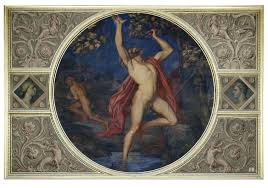
Tantalus, in ancient Greek is a mythological figure. He is most famous for his eternal punishment in Tartarus. He was also called Atys.
He was made to stand in a pool of water beneath a fruit tree with low branches, with the fruit ever eluding his grasp, and the water always receding before he could take a sip.
He was the father of Pelops, Niobe and Broteas, and was the son of Zeus and the nymph Plouto. (Although the scholion ie interpretation of Euripides in his play Orestes, names Tmolos as the father). Thus, like other heroes in Greek mythology such as Theseus and the Dioskouroi, Tantalus had both a hidden and divine parent and a mortal one.
The Greeks used the proverb “Tantalean punishments” in reference to those who have good things but are not permitted to enjoy them.
The word tantalize comes from a Greek story about a guy named Tantalus who was so evil that the gods of the underworld came up with a special punishment just for him (they were really good at that). They put him in a pool of water that drained away every time he bent down to drink.
Shravan Charity Mission is an NGO that works for poor children suffering from life threatening diseases especially cancer. Our posts are meant for our readers that includes both children and adults and it has a huge variety in terms of content. We also accept donations for our mission. Should you wish to donate for the cause. The bank details are given below:
NAME OF ACCOUNT: SHRAVAN CHARITY MISSION
Account no: 680510110004635 (BANK OF INDIA)
IFSC code: BKID0006805
*
Our publications
GLOOM BEHIND THE SMILE
(The book is about a young cancer patient. Now archived in 8 prestigious libraries of the US that includes Harvard College Library; Harvard University Library; Library of Congress; University of Washington, Seattle; University of Minnesota, Minneapolis; Yale University, New Haven; University of Chicago; University of North Carolina, at Chapel Hill University Libraries. It can also be accessed in MIT through Worldcat.org. Besides, it is also available for reading in libraries and archives of Canada, Cancer Aid and Research Foundation Mumbai and Jaipuria Institute of Management, Noida, India)
ONE TO TANGO … RIA’S ODYSSEY
(Is a book on ‘singlehood’ about a Delhi girl now archived in Connemara Library, Chennai and Delhi Public Library, GOI, Ministry of Culture, Delhi)
AADAB LUCKNOW … FOND MEMORIES
(Is a fiction written around the great city of Nawabs—Lucknow. It describes Lucknow in great detail and also talks about its Hindu-Muslim amity. That happens to be the undying characteristics of Lucknow. The book was launched in Lucknow International Literary Festival of 2014. It is included for reading in Askews and Holts Library Services, Lancashire, U.K.)
REFRACTIONS … FROM THE PRISM OF GOD
(Co-published by Cankids–Kidscan, a pan India NGO and Shravan Charity Mission, that works for Child cancer in India. The book is endorsed by Ms Preetha Reddy, MD Apollo Hospitals Group. It was launched in Lucknow International Literary Festival 2016)
TYPICAL TALE OF AN INDIAN SALESMAN
(Is a story of an Indian salesman who is, humbly qualified. Yet he fights his ways through unceasing uncertainties to reach the top. A good read not only for salesmen. The book was launched on 10th February, 2018 in Gorakhpur Lit-Fest. Now available in Amazon, Flipkart and Onlinegatha)
RHYTHM … in poems
(Published in January 2019. The book contains 50 poems. The poems describe our day to day life. The book is available in Amazon, Flipkart and Onlinegatha)
MIRAGE
(Published in February 2020. The book is a collection of eight short stories. It is available in Amazon, Flipkart and Notion Press)
Short stories and Articles published in Bhavan’s Journal: Reality and Perception 15.10.19; Sending the Wrong Message 31.5.20; Eagle versus Scholars June 15 & 20 2020; Indica 15.8.20; The Story of King Chitraketu August 31 2020; Breaking Through the Chakravyuh September 30 2020.
(ALL THE ABOVE TITLES ARE AVAILABLE FOR SALE IN AMAZON, FLIPKART AND OTHER ONLINE STORES OR YOU COULD EVEN WRITE TO US FOR A COPY)
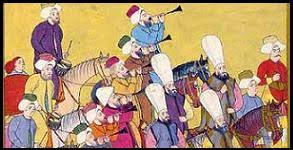
The Period of the Gunpowder Empires is also known as the Era of the Islamic Gunpowders. It refers to the epoch of the Ottoman, Safavid and Mughal empires from the 16th to the 18th century. The three empires were among the strongest and most stable out of the early modern period, leading to expansion and greater patronage of culture, while their political and legal institutions were consolidated with an increasing degree of centralisation. They underwent a significant increase in income and population and a sustained pace of technological innovation. These empires were spread from the Eastern Europe and North Africa in the west, to between today’s modern Bangladesh and Myanmar in the east.
They were Islamic, and had, considerable military and economic success. Vast amount of territories were conquered by the Islamic Gunpowder Empires, with the use and development of the newly invented firearms, especially cannon and small arms, in the course of imperial construction. Unlike in Europe, the introduction of gunpowder weapons prompted changes well beyond military organization. The Mughals, based in the Indian subcontinent, are recognised for their lavish architecture, while the Safavids created an efficient and modern state administration for Iran, and sponsored major developments in the fine arts, and the sultan of the Constantinople-based Ottoman caliphate—an Islamic state, also known as the Caesar of Rome, was the Custodian of the two Holy Mosques, and thus head of the Islamic world. Their powers, wealth, architecture, and various contributions significantly influenced the course of Asian history.
The Period of the Gunpowder Empires refers to the epoch of the Ottoman, in present Modern Turkish, was a state that controlled much of Southeastern Europe, Western Asia, and Northern Africa between the 14th and early 20th centuries. In addition you had the Safavid a Persian dynasty, romanized was one of the most significant ruling dynasties of Iran, from 1501 to 1736. The Safavid dynasty had its origin in the Safavid order of Sufism, which was established, in the city of, Ardabil in the Iranian Azerbaijan region. It was an Iranian dynasty of Kurdish origin, but during their rule they intermarried with Turkoman, Georgian, Circassian (Sunni Muslim people of the north-western Caucasus– between the Caspian Sea and the Black Sea in Caucasia—the white skinned Europeans), and Pontic Greek who are dignitaries that lived on the southern coast of Black Sea. From their base in Ardabil, the Safavids established control over parts of Greater Iran and reasserted the Iranian identity of the region, thus becoming the first native dynasty since the Sasanian Empire, officially known as the Empire of Iranians to establish a national state officially known as Iran.
The Ottoman, Safa-vid and Mughal empires from the 16th century to the 18th century were the most muscular empires and amongst the most brawny.
But how did this term Gunpowder Empire come into play. Well, it’s a Hodgson-McNeill concept. The phrase Gunpowder Empire was coined by Marshall G.S. Hodgson and his colleague William H. McNeill at the University of Chicago. Hodgson used the phrase in the title of Book 5 (“The Second Flowering: The Empires of Gunpowder Times”) of his highly influential three-volume work, The Venture of Islam (1974). Hodgson saw gunpowder weapons as the key to the “military patronage or military centered states of the Later Middle Period” which replaced the unstable, geographically limited, confederations of Turkic clans that prevailed in post-Mongol times. Hodgson defined a “military patronage state” as one having three characteristics:
First, a legitimization of, independent dynastic law. Second, the conception of the whole state as a single military force. Third, the attempt to explain all economic and high cultural resources as appanages or grants of the chief military families.
Such states grew “out of Mongol notions of greatness,” but such notions could mature fully and create stable bureaucratic empires only after gunpowder weapons and their specialized technology attained a primary place in military life of the state.
McNeill argued that whenever such states “were able to monopolize the new artillery, central authorities were able to unite larger territories into new, or consolidate new empires.” So, monopolization was the key. Although Europe pioneered the development of new artillery in the fifteenth century, no state monopolized it. Gun-casting know-how had been concentrated in the Low Countries near the mouths of the Scheldt and Rhine rivers in Europe. France and the Habsburgs, generally the rulers of Germany, Austria and Spain divided those territories among themselves, resulting in an arms standoff. By contrast, such monopolies allowed states to create militarized empires in Western Asia, Russia, and India, and “in a considerably, modified fashion” in China, Korea, and Japan.
More recently, the Hodgson-McNeill Gunpowder-Empire hypothesis has been termed into disfavour, as it offers neither “adequate nor accurate” explanation, although the term remains in use.
Reasons other than or in addition to military technology have been offered for the nearly simultaneous rise of three centralized military empires in contiguous areas dominated by decentralized Turkic tribes. One explanation, called “Confessionalization” by historians of fifteenth century Europe, invokes examination of how the relation of church and state “mediated through confessional statements and church ordinances” led to the origins of absolutist polities.
The first of the three empires to acquire gunpowder weapons was the Ottoman Empire. By the 14th century, the Ottomans had adopted gunpowder artillery. The adoption of the gunpowder weapons by the Ottomans was so rapid that they preceded both their European and Middle Eastern adversaries in establishing centralized and permanent troops specialized in the manufacturing and handling of firearms. But it was their use of artillery that shocked their adversaries and impelled the other two Islamic empires to accelerate their weapons programs. The Ottomans had artillery at least by the reign of Bayezid the Ottoman Sultan, and these were used by them in the sieges of Constantinople in 1399 and 1402. They finally proved their worth as siege engines in the successful siege of Salonica in the Ottoman kingdom in 1430. The Ottomans employed Middle-Eastern as well as European foundries to cast their cannons, and by the siege of Constanti-nople in 1453, they had large enough cannons to batter the walls of any city, to the surprise of the defenders.
The Ottoman military’s regularized use of firearms proceeded ahead of the pace of their European counterparts. The Janissaries (Ottoman Sultan’s household troops) had been an infantry bodyguard using bows and arrows. During the rule of Sultan Mehmed II they were drilled with firearms and became “perhaps the first standing infantry force equipped with firearms in the world.” The Janissaries are thus considered the first modern standing armies. The combination of artillery and Janissary firepower proved decisive at Battle of Varna, eastern Bulgaria in 1444 against a force of Crusaders, Baskent in 1473 against the Aq Qoyunlu, (a Sunni Turkoman Tribal) and Mohacs in 1526 against Hungary. But the battle which convinced the Safavids and the Mughals of the efficacy of the gunpowder was Chaldiran in 1514. A victory of Ottoman over Sadavid.
The musket gun later appeared in the Ottoman Empire by 1465. Damascus steel was later used in the production of firearms such as the musket from the 16th century. At the Battle of Mohacs in 1526, the Janissaries equipped with 2000 tüfenks (usually translated as musket) “formed nine consecutive rows and they fired their weapons row by row,” in a “kneeling or standing position without the need for additional support or rest.” The Chinese later adopted the Ottoman kneeling position for firing. In 1598, Chinese writer Zhao Shizhen described Turkish muskets as being superior to European muskets.
The Dardanelles Gun or the great Turkish canon was designed and cast in bronze in 1464 by one Munir Ali. The Dardanelles Gun was still present for duty more than 340 years later in 1807, when a Royal Navy force appeared and commenced the Dardanelles Operation. Turkish forces loaded the ancient relics with propellant and Projectiles, then fired them at the British ships. The British squadron suffered 28 casualties from this bombardment.
Shravan Charity Mission is an NGO that works for poor children suffering from life threatening diseases especially cancer. Our posts are meant for our readers that includes both children and adults and it has a huge variety in terms of content. We also accept donations for our mission. Should you wish to donate for the cause. The bank details are given below:
NAME OF ACCOUNT: SHRAVAN CHARITY MISSION
Account no: 680510110004635 (BANK OF INDIA)
IFSC code: BKID0006805
*
Our publications
GLOOM BEHIND THE SMILE
(The book is about a young cancer patient. Now archived in 8 prestigious libraries of the US that includes Harvard College Library; Harvard University Library; Library of Congress; University of Washington, Seattle; University of Minnesota, Minneapolis; Yale University, New Haven; University of Chicago; University of North Carolina, at Chapel Hill University Libraries. It can also be accessed in MIT through Worldcat.org. Besides, it is also available for reading in libraries and archives of Canada, Cancer Aid and Research Foundation Mumbai and Jaipuria Institute of Management, Noida, India)
ONE TO TANGO … RIA’S ODYSSEY
(Is a book on ‘singlehood’ about a Delhi girl now archived in Connemara Library, Chennai and Delhi Public Library, GOI, Ministry of Culture, Delhi)
AADAB LUCKNOW … FOND MEMORIES
(Is a fiction written around the great city of Nawabs—Lucknow. It describes Lucknow in great detail and also talks about its Hindu-Muslim amity. That happens to be the undying characteristics of Lucknow. The book was launched in Lucknow International Literary Festival of 2014. It is included for reading in Askews and Holts Library Services, Lancashire, U.K.)
REFRACTIONS … FROM THE PRISM OF GOD
(Co-published by Cankids–Kidscan, a pan India NGO and Shravan Charity Mission, that works for Child cancer in India. The book is endorsed by Ms Preetha Reddy, MD Apollo Hospitals Group. It was launched in Lucknow International Literary Festival 2016)
TYPICAL TALE OF AN INDIAN SALESMAN
(Is a story of an Indian salesman who is, humbly qualified. Yet he fights his ways through unceasing uncertainties to reach the top. A good read not only for salesmen. The book was launched on 10th February, 2018 in Gorakhpur Lit-Fest. Now available in Amazon, Flipkart and Onlinegatha)
RHYTHM … in poems
(Published in January 2019. The book contains 50 poems. The poems describe our day to day life. The book is available in Amazon, Flipkart and Onlinegatha)
MIRAGE
(Published in February 2020. The book is a collection of eight short stories. It is available in Amazon, Flipkart and Notion Press)
Short stories and Articles published in Bhavan’s Journal: Reality and Perception 15.10.19; Sending the Wrong Message 31.5.20; Eagle versus Scholars June 15 & 20 2020; Indica 15.8.20; The Story of King Chitraketu August 31 2020; Breaking Through the Chakravyuh September 30 2020.
(ALL THE ABOVE TITLES ARE AVAILABLE FOR SALE IN AMAZON, FLIPKART AND OTHER ONLINE STORES OR YOU COULD EVEN WRITE TO US FOR A COPY)
This is only an attempt to create interest in reading. We may not get the time to read all the books in our lifetime. But such reviews, talk and synopsis will at least convey what the book is all about.
Edgar Allan Poe was born Edgar Poe (January 19, 1809 –October 7, 1849), was an American writer, poet, editor, and a literary critic. Poe is best known for his poetry and short stories, particularly his tales of mystery and the macabre. He is widely regarded as a central figure of Romanticism, an intellectual and literary movement in the United States, and of American literature as a whole. He was one of country’s earliest patronisers of short story. He is also considered the inventor of the detective fiction genre. Further credited, for contributing, to the emerging genre of science fiction. Edgar Poe was the first well-known American writer to earn a living through writing alone, even though, resulting in a financially difficult life and career.
The Black Cat is one of Edgar’s popular short story. It was first published in August 19, 1843, in an edition of ‘The Saturday Evening Post.’ It is a study of psychology, a study of guilt, often paired, in analysis with Poe’s another short story titled, ‘The Tell-Tale Heart” where an unnamed narrator, endeavours to convince the reader, of the narrator’s sanity, while simultaneously describing a murder, the narrator has committed. In both the stories, the murderer carefully conceals his crime and believes himself unassailable, but eventually he breaks down and reveals himself, impelled, by a nagging reminder of his guilt.
The story is written in first-person narrative using an unreliable narrator. But in reality he is a condemned man as detailed at the very outset of the story. The narrator tells us, that from an early age he loved animals. He and his wife had many pets, including a large, beautiful black cat named Pluto as described by him. The cat is especially fond of the narrator and it is also vice versa. Their mutual friendship lasts for several years till the narrator becomes an alcoholic. One night, after coming home completely intoxicated, the narrator believes, the cat is avoiding him. When he tries to catch him, the frightened cat responds by biting the narrator, and in a fit of drunken rage he holds the animal, pulls out a pen-knife from his pocket, and mercilessly gouges out the cat’s eye.
From that moment onwards, the cat flees in terror upon his master’s approach. At first, the narrator is remorseful and regrets his cruelty. He says, “But this feeling soon gave to irritation. And then came, as if to my final and irrevocable overthrow, the spirit of perverseness.” Later, in another fit of drunken fury, the narrator takes the cat out in the garden one morning and ties a noose around its neck, and hangs it from a tree where it dies. But that very night his house mysteriously catches fire, forcing the narrator, his wife and their servant to flee the premises premisis.
The next day, the narrator returns to the ruins of his home only to find, imprinted, on the single wall that survived the fire, the apparition of a gigantic cat with a rope around the animal’s neck.
At first, the image deeply disturbs the narrator, but gradually he derives a logical explanation for it. Someone outside had cut the cat from the tree and thrown its corpse into the bedroom to wake him up during the fire. Soon the narrator begins to miss Pluto and hate himself for his actions, feeling guilty. Sometime later, he finds a similar cat in a tavern. It is the same size and colour as the original and is even without one eye. The only difference being a large white patch on the animal’s chest. The narrator takes it home, but soon begins to fear and loathe the creature, due to the fact that it amplifies his feeling of guilt. After some time, the white patch of fur begins to take shape and, much to the narrator’s horror, forms the shape of the gallows. This terrifies and angers him more, and he avoids the cat whenever and wherever possible. Then, one day when the narrator and his wife are visiting the cellar in their new home, the cat gets under his master’s feet and nearly trips him down the stairs. This amplifies the rage of the alcoholic narrator, and he grabs an axe and tries to kill the cat but is stopped by his wife. Being unable to take out his drunken fury on the cat, he angrily kills his wife with the axe instead. To conceal her body he removes bricks from a protrusion in the wall, and places her body there, and then repairs the hole. A few days later, when the police show up at the house to investigate the wife’s disappearance, they find nothing and the narrator goes scot free. The cat, which he intended to kill as well, has also gone missing. This grants him the freedom to sleep without the burden of a murder.
But on the last day of the investigation, the narrator accompanies the police into the cellar. They still find nothing significant. With this the narrator lowers his guards. He is now completely confident of his own insulation from being arrested for the crime. This when he comments on the sturdiness of the building and taps the wall that he had built around his wife’s body. When a loud, inhuman wailing sound fills the room. The police alarmed tear down the wall and find the wife’s corpse. Sitting on the corpse’s rotting head, to the utter horror of the narrator is, the squealing black cat. The terrified narrator is shattered by this reminder of his crime, which he had believed to be safe from discovery, and the appearance of the cat. As he words it: “I had walled the monster up within the tomb!”
The story is extremely well written if you like horror. I would give it seven out of ten.
Shravan Charity Mission is an NGO that works for poor children suffering from life threatening diseases especially cancer. Our posts are meant for our readers that includes both children and adults and it has a huge variety in terms of content. We also accept donations for our mission. Should you wish to donate for the cause. The bank details are given below:
NAME OF ACCOUNT: SHRAVAN CHARITY MISSION
Account no: 680510110004635 (BANK OF INDIA)
IFSC code: BKID0006805
*
Our publications
GLOOM BEHIND THE SMILE
(The book is about a young cancer patient. Now archived in 8 prestigious libraries of the US that includes Harvard College Library; Harvard University Library; Library of Congress; University of Washington, Seattle; University of Minnesota, Minneapolis; Yale University, New Haven; University of Chicago; University of North Carolina, at Chapel Hill University Libraries. It can also be accessed in MIT through Worldcat.org. Besides, it is also available for reading in libraries and archives of Canada, Cancer Aid and Research Foundation Mumbai and Jaipuria Institute of Management, Noida, India)
ONE TO TANGO … RIA’S ODYSSEY
(Is a book on ‘singlehood’ about a Delhi girl now archived in Connemara Library, Chennai and Delhi Public Library, GOI, Ministry of Culture, Delhi)
AADAB LUCKNOW … FOND MEMORIES
(Is a fiction written around the great city of Nawabs—Lucknow. It describes Lucknow in great detail and also talks about its Hindu-Muslim amity. That happens to be the undying characteristics of Lucknow. The book was launched in Lucknow International Literary Festival of 2014. It is included for reading in Askews and Holts Library Services, Lancashire, U.K.)
REFRACTIONS … FROM THE PRISM OF GOD
(Co-published by Cankids–Kidscan, a pan India NGO and Shravan Charity Mission, that works for Child cancer in India. The book is endorsed by Ms Preetha Reddy, MD Apollo Hospitals Group. It was launched in Lucknow International Literary Festival 2016)
TYPICAL TALE OF AN INDIAN SALESMAN
(Is a story of an Indian salesman who is, humbly qualified. Yet he fights his ways through unceasing uncertainties to reach the top. A good read not only for salesmen. The book was launched on 10th February, 2018 in Gorakhpur Lit-Fest. Now available in Amazon, Flipkart and Onlinegatha)
RHYTHM … in poems
(Published in January 2019. The book contains 50 poems. The poems describe our day to day life. The book is available in Amazon, Flipkart and Onlinegatha)
MIRAGE
(Published in February 2020. The book is a collection of eight short stories. It is available in Amazon, Flipkart and Notion Press)
Short stories and Articles published in Bhavan’s Journal: Reality and Perception 15.10.19; Sending the Wrong Message 31.5.20; Eagle versus Scholars June 15 & 20 2020; Indica 15.8.20; The Story of King Chitraketu August 31 2020.
(ALL THE ABOVE TITLES ARE AVAILABLE FOR SALE IN AMAZON, FLIPKART AND OTHER ONLINE STORES OR YOU COULD EVEN WRITE TO US FOR A COPY)
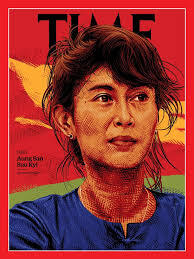
Aung San Suu Kyi was born in Rangoon, what was British Burma then, on 19 June 1945. Aung San Suu Kyi, like any other Burmese name, doesn’t comprise a surname. It is only a personal name, in her case, derived from, three of her relatives name that is: “Aung San” father, “Suu” paternal grandmother, and “Kyi” out of her mother—Khin Chi Kyi. For writing convenience let me refer her as Suu Kyi. She is a Burmese politician, diplomat, author and a 1991 Nobel Peace Prize laureate. She happens to be the first State Counsellor a position equivalent to the Prime Minister of Myanmar. She is also the leader of the National League for Democracy and played a vital role in the state’s transition from the military junta to partial democracy.
Suu Kyi is the youngest daughter of Aung San, the father of the nation of modern-day Myanmar, who founded the modern Burmese Army that liberated the country from Japanese occupation during World War II and his wife Khin Kyi. Khin Kyi, was a Burmese politician and a diplomat, best known for her marriage to the country’s leader, Aung San, with whom she had four children, including Aung San Suu Kyi. Suu Kyi was born in Rangoon, British Burma, the capital of Yangon region and the largest city of Myanmar. British Burma was under British rule that lasted from 1824 to 1948.
After graduating from the University of Delhi in 1964 and University of Oxford in 1968, Suu Kyi worked at the United Nations for three years. There, she married Michael Aris in 1972, with whom she had two children. Suu Kyi rose to prominence in the 1988 Uprisings, and became the General Secretary of the National League for Democracy (NLD), which she had newly formed with the help of several retired army officials who had criticized the military junta. In the 1990 elections, NLD won 81% of the seats in Parliament, but the results were nullified, as the military refused to hand over power to the Parliament, resulting in an international outcry. She had already been detained under house arrest before the elections. She remained under a long house arrest for almost 15 of the 21 years from 1989 to 2010, becoming one of the world’s most prominent political prisoners. In 1999, Time Magazine named her as one of the “Children of Gandhi” and a keen follower of nonviolence.
Her party boycotted the 2010 elections, resulting in a decisive victory for the military-backed Union Solidarity and Development Party. Suu Kyi became a Pyithu Hluttaw MP, the lower house of the bicameral legislature of Myanmar (Burma), while her party won 43 of the 45 vacant seats in the 2012 by-elections. In the 2015 elections, her party won a landslide victory taking 86% of the seats in the Assembly of the Union – well more than the 67% supermajority needed to ensure, that its preferred candidates, were elected President and Vice President in the Presidential Electoral College. Although she was prohibited from becoming the President due to an inconvenient clause in the constitution– that her late husband and children are foreign citizens, she assumed the newly created role of the State Counsellor, a role, akin to the Prime Minister or the head of the government.
Since acquiring the role of the State Counsellor, Suu Kyi has drawn criticism from several countries, organisations and figures over her alleged inaction in response to the genocide of the Rohingya people in the Rakhine State and her refusal to accept that Myanmar’s military has committed massacres. Under her leadership, Myanmar has also drawn criticism for prosecutions of journalists. In 2019, Suu Kyi appeared in the International Court of Justice where she defended the Burmese military against allegations of genocide against the Rohingyas.
When Suu Kyi was two years old, her father, who headed the shadow Burmese Government under the British rule, was assassinated by a political rival. Her mother, Khin Kyi, was later appointed Burmese ambassador to India.
In 1962, democratic rule in Burma ended with a military coup headed by General Ne Win. For the next 26 years, the military enforced the ‘Burmese Way to Socialism’ which led to the establishment of one party rule under the Burma Socialist Programme Party (BSPP) in 1974.
In 1988, Suu Kyi, after delivering her two sons returned to Burma to care for her ailing mother. This coincided with a bloody military response, to some peaceful student demonstrations, against one party rule and the resignation of General Ne Win as head of the BSPP.
On 26th August, in Rangoon, Suu Kyi stood under a large poster of her slain father and addressed a large gathering of democratic supporters and proposed the establishment of a People’s Consultative Committee to help resolve the crisis.
In October, the democratic movement was brutally crushed by another military coup headed by General Saw Maung when Burma’s second struggle for independence began.
Although Suu Kyi had lived overseas for most of her life, she could not ‘remain indifferent’ to Burma’s long struggle. She became the leader of the National League of Democracy and was first placed under house arrest in Rangoon in July 1989. Under martial law, this meant that she could be detained for three years without trial. Her husband and sons visited her for what would be, the last time, as a family in September 1989. The following year, the military government attempted to cut her contact with the outside world.
Separated from her family and denied her personal liberty and freedom of speech, Suu Kyi continued to speak out against Burma’s military rule. A stance that saw her win the 1990 Sakharov Prize for Freedom of Thought (awarded by the European Parliament), in the year 1991 Nobel Peace Prize and the 1992 Nehru Peace Prize.
Although, she was released from house detention in 1995 and was briefly reunited with her husband, she refused to leave Burma because she knew she would not be allowed to re-enter her own country. As a result, all of Suu Kyi’s famous speeches were delivered by third parties, either by video or in essay form.
The commencement address at the American University, Washington DC, on 26 January, 1997, was delivered on her behalf by her husband, Dr. Michael Aris, upon her receiving an Honorary Doctor in law. Although Michael Aris was sick with prostate cancer, the Burmese government which was renamed the Union of Myanmar by the military government in 1989 did not allow him to visit his wife.
When her husband Michael Aris passed away in 1999, Suu Kyi confessed the separation as ‘one of the sacrifices she had had to make in order to work for a free Burma.’ Suu Kyi was placed under house arrest again in September 2000, but was freed after nineteen months. She was later held under ‘secret detention’ for three months before being returned to house arrest.
Suu Kyi was released from house arrest in 2010. She led the National league for Democracy (NLD) to a majority win in Myanmar’s first openly contested election in 25 years in November 2015. Her official title is State Counsellor.
Suu Kyi is often called ‘Daw’ Aung San Suu Kyi in her homeland, which is a title for affection meaning a favourite aunt.
Shravan Charity Mission is an NGO that works for poor children suffering from life threatening diseases especially cancer. Our posts are meant for our readers that includes both children and adults and it has a huge variety in terms of content. We also accept donations for our mission. Should you wish to donate for the cause. The bank details are given below:
NAME OF ACCOUNT: SHRAVAN CHARITY MISSION
Account no: 680510110004635 (BANK OF INDIA)
IFSC code: BKID0006805
*
Our publications
GLOOM BEHIND THE SMILE
(The book is about a young cancer patient. Now archived in 7 prestigious libraries of the US, including, Harvard University and Library of Congress. It can also be accessed in MIT through Worldcat.org. Besides, it is also available for reading in Libraries and archives of Canada, Cancer Aid and Research Foundation Mumbai and Jaipuria Institute of Management, Noida, India)
ONE TO TANGO … RIA’S ODYSSEY
(Is a book on ‘singlehood’ about a Delhi girl now archived in Connemara Library, Chennai and Delhi Public Library, GOI, Ministry of Culture, Delhi)
AADAB LUCKNOW … FOND MEMORIES
(Is a fiction written around the great city of Nawabs—Lucknow. It describes Lucknow in great detail and also talks about its Hindu-Muslim amity. That happens to be the undying characteristics of Lucknow. The book was launched in Lucknow International Literary Festival of 2014. It is included for reading in Askews and Holts Library Services, Lancashire, U.K.)
REFRACTIONS … FROM THE PRISM OF GOD
(Co-published by Cankids–Kidscan, a pan India NGO and Shravan Charity Mission, that works for Child cancer in India. The book is endorsed by Ms Preetha Reddy, MD Apollo Hospitals Group. It was launched in Lucknow International Literary Festival 2016)
TYPICAL TALE OF AN INDIAN SALESMAN
(Is a story of an Indian salesman who is, humbly qualified. Yet he fights his ways through unceasing uncertainties to reach the top. A good read not only for salesmen. The book was launched on 10th February, 2018 in Gorakhpur Lit-Fest. Now available in Amazon, Flipkart and Onlinegatha)
RHYTHM … in poems
(Published in January 2019. The book contains 50 poems. The poems describe our day to day life. The book is available in Amazon, Flipkart and Onlinegatha)
MIRAGE
(Published in February 2020. The book is a collection of eight short stories. It is available in Amazon, Flipkart and Notion Press)
Short stories and Articles published in Bhavan’s Journal: Reality and Perception 15.10.19; Sending the Wrong Message 31.5.20; Eagle versus Scholars June 15 & 20 2020; Indica 15.8.20; The Story of King Chitraketu August 31 2020.
(ALL THE ABOVE TITLES ARE AVAILABLE FOR SALE IN AMAZON, FLIPKART AND OTHER ONLINE STORES OR YOU COULD EVEN WRITE TO US FOR A COPY)
When one, stops talking, and starts listening intently to the other person the relevance and meaning of what the other person is saying is understood much better. But here, the interpretation, of what one makes out, of what is being said is also of extreme importance. In this context let me narrate and episode out of Lord Buddha’s sermon. Once, it so happened Buddha was addressing a gathering in a very peaceful and focused manner. Where, he went on to say, ‘do not forget to complete all your duties before you go to sleep.’ His disciples who were keenly listening to him took his word as the gospel truth. They immediately started meditating after Buddha’s sermon was over. After which they made a to-do-list of all their duties and activities, and resolved, to have a discipline, of completing them, before they went off to sleep.
But sadly in the audience there was also a thief who was following Buddha, quite eagerly. Soon thereafter, he went into an introspection. He was a professional thief so he questioned himself. ‘What is my job?’ His devious mind replied to him. ‘You are a thief and your job is to thieve and just now even Buddha has endorsed your profession and your actions.’
So by interpreting Buddha’s teaching in the wrong manner to suit himself the thief continued with his treacherous acts of thievery day after day before he went off to sleep.
It is very important to interpret what you hear in the right spirit and in the most dutiful way. God has given us one mouth and two ears so that we speak less and listen more and interpret our actions and deeds accordingly.
Shravan Charity Mission is an NGO that works for poor children suffering from life threatening diseases especially cancer. Our posts are meant for our readers that includes both children and adults and it has a huge variety in terms of content. We also accept donations for our mission. Should you wish to donate for the cause. The bank details are given below:
NAME OF ACCOUNT: SHRAVAN CHARITY MISSION
Account no: 680510110004635 (BANK OF INDIA)
IFSC code: BKID0006805
*
Our publications
GLOOM BEHIND THE SMILE
(The book is about a young cancer patient. Now archived in 7 prestigious libraries of the US, including, Harvard University and Library of Congress. It can also be accessed in MIT through Worldcat.org. Besides, it is also available for reading in Libraries and archives of Canada, Cancer Aid and Research Foundation Mumbai and Jaipuria Institute of Management, Noida, India)
ONE TO TANGO … RIA’S ODYSSEY
(Is a book on ‘singlehood’ about a Delhi girl now archived in Connemara Library, Chennai and Delhi Public Library, GOI, Ministry of Culture, Delhi)
AADAB LUCKNOW … FOND MEMORIES
(Is a fiction written around the great city of Nawabs—Lucknow. It describes Lucknow in great detail and also talks about its Hindu-Muslim amity. That happens to be the undying characteristics of Lucknow. The book was launched in Lucknow International Literary Festival of 2014. It is included for reading in Askews and Holts Library Services, Lancashire, U.K.)
REFRACTIONS … FROM THE PRISM OF GOD
(Co-published by Cankids–Kidscan, a pan India NGO and Shravan Charity Mission, that works for Child cancer in India. The book is endorsed by Ms Preetha Reddy, MD Apollo Hospitals Group. It was launched in Lucknow International Literary Festival 2016)
TYPICAL TALE OF AN INDIAN SALESMAN
(Is a story of an Indian salesman who is, humbly qualified. Yet he fights his ways through unceasing uncertainties to reach the top. A good read not only for salesmen. The book was launched on 10th February, 2018 in Gorakhpur Lit-Fest. Now available in Amazon, Flipkart and Onlinegatha)
RHYTHM … in poems
(Published in January 2019. The book contains 50 poems. The poems describe our day to day life. The book is available in Amazon, Flipkart and Onlinegatha)
MIRAGE
(Published in February 2020. The book is a collection of eight short stories. It is available in Amazon, Flipkart and Notion Press)
Short stories and Articles published in Bhavan’s Journal: Reality and Perception 15.10.19; Sending the Wrong Message 31.5.20; Eagle versus Scholars June 15 & 20 2020; Indica 15.8.20; The Story of King Chitraketu August 31 2020.
(ALL THE ABOVE TITLES ARE AVAILABLE FOR SALE IN AMAZON, FLIPKART AND OTHER ONLINE STORES OR YOU COULD EVEN WRITE TO US FOR A COPY)
This is only an attempt to create interest in reading. We may not get the time to read all the books in our lifetime. But such reviews, talk and synopsis will at least convey what the book is all about.
All Quiet on the Western Front (German: Im Westen nichts Neues, literal German translation ‘Nothing New In the West’) is a novel by a German war veteran of World War I. The book describes the German Soldiers, extreme physical and mental stress during the war, and their detachment from the civilian life, felt by, many of these soldiers, upon returning home from the front. The novel was first published in November and December 1928 in a German newspaper, Vossische Zeitung and later, in book form in late January 1929. The book and its sequel, “The Road Back” (1930), were among the books banned and burned in Nazi Germany. All Quiet on the Western Front sold 2.5 million copies in 22 languages in its first 18 months in print.
In 1930, the book was adapted as an Academy-Award-winning film of the same name, directed by Lewis Milestone. It was adapted again in 1979 by Delbert Mann, this time as a television film, starring Richard Thomas and Ernest Borgnine.
The main characters of the novel are as follows:
Paul Baumer is the main protagonist.
Albert Kropp: A classmate of Paul at school. He is described as the clearest thinker of the group as well as the smallest. Kropp is wounded towards the end of the novel and undergoes a leg amputation.
Haie Westhus: He is described as being tall and strong, and a peat-digger by profession. Overall, his size and behaviour make him seem older than Paul, yet he is, the same age as Paul and his school-friend.
Friedrich Muller: He is 19 and one of Bäumer’s classmates. He too joins the German army as a volunteer, ready to go to war. He carries his old school books to the battlefield that constantly reminds him of the importance of learning and education.
Stanislaus “Kat” Katczinsky: Kat has the most positive influence on Paul and his comrades on the battlefield. Katczinsky, a recalled reserve militiaman, was a cobbler (shoemaker) in civilian life. He is older than Paul Bäumer and his comrades, say about 40 years old, and serves as their leadership figure. Kit is hit by a shrapnel at the end of the story.
The book tells the story of Paul Baumer, who belongs to a group of German soldiers on the Western Front during World War I. The patriotic speeches of his teacher Kantorek had led the whole class to volunteer for military service shortly after the start of World War I. He didn’t have any experience when going to the war but he still went in with an open mind and a loving heart. Paul otherwise lived with his father, mother and sister in a charming German village, and attended school, where, his class was scattered along the platoons, and amongst Frisian (Germanic) fishermen, peasants, and labourers. Baumer arrives at the Western Front with his friends and schoolmates named Leer, Muller, Kropp and a number of other characters. There they meet Stanialaus Katczinsky, an older soldier, nicknamed Kat, who becomes Paul’s mentor. While in the front, Baumer and his comrades engage in frequent battles and endure the treacherous and filthy conditions of trench warfare.
At the beginning of the book, Remarque writes, “This book is to be neither an accusation nor a confession, and least of all an adventure, for death is not an adventure for those, who stand face to face with it. It will try simply to tell of a generation of men who, even though they may have escaped (its) shells, were destroyed by the war.” The book does not focus on heroic stories of bravery, but rather gives a view of the conditions in which the soldiers find themselves. The monotony between battles, the constant threat of artillery fire and bombardments, the struggle to find food, the lack of training of young recruits with lower chances of survival, and the overarching role of random chance, in the lives and deaths of the soldiers are described in detail.
The battles fought here have no names and seem to have little overall significance, except for the impending possibility of injury or death for Baumer and his comrades. Where, only, insignificant small pieces of land are gained, about the size of a football field, which are also lost again later. Remarque often refers to the living soldiers as old and dead, emotionally drained and shaken. He says, “We are not youth any longer. We don’t want to take the world by storm. We are fleeing from ourselves, from our life. We were eighteen and had begun to love life and the world; and we had to shoot it to pieces.”
Paul’s visit to his home highlights the cost of war on his psyche. The town has not changed since he went off to war. However, he finds that he does not belong to here anymore, for it is a foreign world. He feels disconnected from most of the townspeople. His father asks him “stupid and distressing” questions about his war experiences, not understanding “that a man cannot talk of such things.” An old schoolmaster lectures him about strategy and advancing to Paris while insisting that Paul and his friends know only their “own little sector” of the war but nothing of the big picture.
Indeed, the only person he remains connected to is his dying mother, with whom he shares a tender, yet restrained relationship. The night before he is to return from leave, he stays up with her, exchanging small expressions of love and concern for each other. He thinks to himself, “Ah! Mother, Mother! How can it be that I must part from you? Here I sit and there you are lying; we have so much to say, and we shall never say it.” In the end, he concludes that he “ought never to have come (home) on leave.”
Paul feels glad upon being reunited with his comrades. Soon after, he volunteers to go on a patrol where he kills a man for the first time in a hand-to-hand combat. He watches the man die in pain for hours. He feels remorse and asks forgiveness from the man’s corpse. He is devastated and later confesses to Kat and Albert, who try to comfort him and reassure him that it is only a part of the war. They are then sent on what Paul calls a “good job.” They must guard a supply depot in a village that was evacuated due to heavy shelling. During this time, the men are able to adequately feed themselves, unlike the near-starvation conditions in the German trenches. In addition, the men enjoy themselves living off the spoils of the village and officers’ luxuries, from the supply depot such as fine cigars. While evacuating the villagers, the enemy civilians, Paul and Albert are taken by surprise by the artillery fired at the civilian convoy, when Albert is wounded by a shell. On the train back home, Albert takes a turn for the worse and cannot complete the journey, so he is offloaded from the train and sent to recuperate in a Catholic hospital. Paul uses a combination of bartering and manipulation to stay by Albert’s side. Albert eventually has his leg amputated, while Paul is deemed fit for service and is returned to the front.
By now, the war is nearing its end and the German Army is retreating. In despair, Paul watches as his friends fall one by one. It is the death of Kat that eventually makes Paul careless about living. In the final chapter, he comments that peace is about to come, but he does not see the future to be bright and shining with hope. Paul feels that he has no aims or goals left in life and that their generation will be different and misunderstood.
In October 1918, Paul is finally killed on a remarkably peaceful day. The situation report from the frontline states, a simple phrase: “All quiet on the Western Front.” Paul’s corpse displays a calm expression on its face, “as though almost glad the end had come.”
Shravan Charity Mission is an NGO that works for poor children suffering from life threatening diseases especially cancer. Our posts are meant for our readers that includes both children and adults and it has a huge variety in terms of content. We also accept donations for our mission. Should you wish to donate for the cause. The bank details are given below:
NAME OF ACCOUNT: SHRAVAN CHARITY MISSION
Account no: 680510110004635 (BANK OF INDIA)
IFSC code: BKID0006805
*
Our publications
GLOOM BEHIND THE SMILE
(The book is about a young cancer patient. Now archived in 7 prestigious libraries of the US, including, Harvard University and Library of Congress. It can also be accessed in MIT through Worldcat.org. Besides, it is also available for reading in Libraries and archives of Canada, Cancer Aid and Research Foundation Mumbai and Jaipuria Institute of Management, Noida, India)
ONE TO TANGO … RIA’S ODYSSEY
(Is a book on ‘singlehood’ about a Delhi girl now archived in Connemara Library, Chennai and Delhi Public Library, GOI, Ministry of Culture, Delhi)
AADAB LUCKNOW … FOND MEMORIES
(Is a fiction written around the great city of Nawabs—Lucknow. It describes Lucknow in great detail and also talks about its Hindu-Muslim amity. That happens to be the undying characteristics of Lucknow. The book was launched in Lucknow International Literary Festival of 2014. It is included for reading in Askews and Holts Library Services, Lancashire, U.K.)
REFRACTIONS … FROM THE PRISM OF GOD
(Co-published by Cankids–Kidscan, a pan India NGO and Shravan Charity Mission, that works for Child cancer in India. The book is endorsed by Ms Preetha Reddy, MD Apollo Hospitals Group. It was launched in Lucknow International Literary Festival 2016)
TYPICAL TALE OF AN INDIAN SALESMAN
(Is a story of an Indian salesman who is, humbly qualified. Yet he fights his ways through unceasing uncertainties to reach the top. A good read not only for salesmen. The book was launched on 10th February, 2018 in Gorakhpur Lit-Fest. Now available in Amazon, Flipkart and Onlinegatha)
RHYTHM … in poems
(Published in January 2019. The book contains 50 poems. The poems describe our day to day life. The book is available in Amazon, Flipkart and Onlinegatha)
MIRAGE
(Published in February 2020. The book is a collection of eight short stories. It is available in Amazon, Flipkart and Notion Press)
Short stories and Articles published in Bhavan’s Journal: Reality and Perception 15.10.19; Sending the Wrong Message 31.5.20; Eagle versus Scholars June 15 & 20 2020; Indica 15.8.20
(ALL THE ABOVE TITLES ARE AVAILABLE FOR SALE IN AMAZON, FLIPKART AND OTHER ONLINE STORES OR YOU COULD EVEN WRITE TO US FOR A COPY)
One day a paddy plant was talking to his aged farmer Sardar Mahender Singh. Paddy said.
‘Master! I have never met a wheat plant in my life. By the time I’m sown wheat is harvested, and by the time I’m harvested wheat is not sown.’ Mahender thought for a moment and then said.
‘Yes, you’re right my dear Paddy. You both haven’t met. And you both are very different. I should say poles apart. Wheat is rough and tough, with long awns like stiff-bristles, just like my son Jagga and grows in leaps and bounds in the cold weather. Roots of wheat are the deepest. They can go up to two-metres. Irrigate the wheat on time, give it some seven-eight showers of water and up it comes. It even has the prowess to kill the weeds around it, unlike you my dear paddy. Yet, you, dear paddy, you are eaten, as kernels, I mean the whole grain, whereas, wheat is crushed to flour for consumption, what an irony.’
‘But why is that master?’ Asked Paddy.
‘Wheat is harvested from the very same place where it is sown. But you, my dear Paddy, your case is different. You are delicate. We first sow you in a nursery where we protect you from the weeds, otherwise, they’ll just throttle you to death. Once you are slightly old, say around forty days, we transplant you to the main field, which is first filled with water, where, we take good care of you again in terms of weeding and irrigation. You’re just like my daughter Preetinder, who too is very delicate, and who too, requires, as much water as you, for her livelihood. No wonder, you’re sown during the monsoon.
‘But how and when can I meet my friend wheat in this field?’ Asked the Paddy.
‘Never.’ Said Mahender.
‘But why master?’ Asked Paddy.
‘Because, even though, you have the same karma of feeding the hungry and the same karma bhoomi, your timings to perform your karma are totally different. Imagine if your timings are reversed what’ll happen? Imagine what’ll happen if you’re sown in the freezing winters and wheat is sown under the scorching sun?’
‘Both of us will not fructify master.’
‘That’s right my dear paddy.’
‘So then, do you now understand the co-relation between Karma and timing?’ Asked Mahender.
‘Yes master I do.’ Replied Paddy.
Moral of the story: Only when karma is done at the right time does one receive the fruits of it. God has created various time zones and seasons only to remind us that each karma should be done at the right time for best results and the seasons don’t really overlap to give man the scope to interfere with the seasons.
Shravan Charity Mission is an NGO that works for poor children suffering from life threatening diseases especially cancer. Our posts are meant for our readers that includes both children and adults and it has a huge variety in terms of content. We also accept donations for our mission. Should you wish to donate for the cause. The bank details are given below:
NAME OF ACCOUNT: SHRAVAN CHARITY MISSION
Account no: 680510110004635 (BANK OF INDIA)
IFSC code: BKID0006805
*
Our publications
GLOOM BEHIND THE SMILE
(The book is about a young cancer patient. Now archived in 7 prestigious libraries of the US, including, Harvard University and Library of Congress. It can also be accessed in MIT through Worldcat.org. Besides, it is also available for reading in Libraries and archives of Canada, Cancer Aid and Research Foundation Mumbai and Jaipuria Institute of Management)
ONE TO TANGO … RIA’S ODYSSEY
(Is a book on ‘singlehood’ about a Delhi girl now archived in Connemara Library, Chennai and Delhi Public Library, GOI, Ministry of Culture, Delhi)
AADAB LUCKNOW … FOND MEMORIES
(Is a fiction written around the great city of Nawabs—Lucknow. It describes Lucknow in great detail and also talks about its Hindu-Muslim amity. That happens to be the undying characteristics of Lucknow. The book was launched in Lucknow International Literary Festival of 2014. It is included for reading in Askews and Holts Library Services, Lancashire, U.K.)
REFRACTIONS … FROM THE PRISM OF GOD
(Co-published by Cankids–Kidscan, a pan India NGO and Shravan Charity Mission, that works for Child cancer in India. The book is endorsed by Ms Preetha Reddy, MD Apollo Hospitals Group. It was launched in Lucknow International Literary Festival 2016)
TYPICAL TALE OF AN INDIAN SALESMAN
(Is a story of an Indian salesman who is, humbly qualified. Yet he fights his ways through unceasing uncertainties to reach the top. A good read not only for salesmen. The book was launched on 10th February, 2018 in Gorakhpur Lit-Fest. Now available in Amazon, Flipkart and Onlinegatha)
RHYTHM … in poems
(Published in January 2019. The book contains 50 poems. The poems describe our day to day life. The book is available in Amazon, Flipkart and Onlinegatha)
MIRAGE
(Published in February 2020. The book is a collection of eight short stories. It is available in Amazon, Flipkart and Notion Press)
Short stories and Articles published in Bhavan’s Journal: Reality and Perception 15.10.19; Sending the Wrong Message 31.5.20; Eagle versus Scholars June 15 & 20 2020; Indica 15.8.20
(ALL THE ABOVE TITLES ARE AVAILABLE FOR SALE IN AMAZON, FLIPKART AND OTHER ONLINE STORES OR YOU COULD EVEN WRITE TO US FOR A COPY)
You might have heard of, some kings and queens, who might have abdicated their thrones for the sake of love—their heart throb. Well I have one such world famous story to tell you in this regard and that is about King Edward the VIII of the United Kingdom.
King Edward the VIII (1894-1972) became the king of the United Kingdom upon the death of his father, George V, on 20 January 1936. He was then in his early forties and a bachelor. Edward VIII was both popular and good-looking. He very quickly made his desire known, to marry an American woman, Wallis Warfield (Spencer) Simpson, whom he had known since 1931. But when King Edward VIII in this regard sought the approval of his family, the Church of England, Prime Minister Stanley Baldwin and his government in order to marry her, he met with complete opposition. Reason being: Wallis Simpson had been married twice before. Her second divorce was still pending and her ability to provide an heir to the throne was questionable as she was already forty, and childless.
It was on 16 November 1936, King Edward VIII, invited Prime Minister Baldwin to Buckingham Palace and expressed his desire to marry Simpson when she became free to remarry. Baldwin informed him that his subjects would deem the marriage morally unacceptable, largely because remarriage after divorce was opposed by the Church of England, and the people would not tolerate Simpson as the queen. Reason being: King Edward was the titular head of the Church, and the clergy expected him to support the Church’s teachings. The Archbishop of Canterbury, Cosmo Gordon Lang, was therefore vocal in insisting that King Edward must go.
Edward proposed an alternative solution of a morganatic marriage, also called, left-handed marriage, in which he would remain king but Simpson would not become the queen consort. She would enjoy a lesser title instead, and any children that they might have, would not inherit the throne. The proposal was supported by senior politician Winston Churchill in principle, but some historians, even suggest, that Churchill even conceived the plan for Edward. Ultimately, the plan was rejected by the British Cabinet as well as other Dominion governments. Their views were sought, pursuant, to the Statute of Westminster 1931, which provided in part that “any alteration in the law touching the Succession to the Throne or the Royal Style and Titles shall hereafter require the assent, as well, of the Parliaments, of all the Dominions, as well as the Parliament of the United Kingdom.”
So, on 10 December, King Edward VIII submitted his abdication and became the only British monarch to voluntarily resign his station. The decision was endorsed by the Parliament on 11 December, and on that day Edward publicly announced his decision via radio to a breathless, worldwide audience. This is a historical speech. It was a Radio broadcast in London, England, on 11 December 1936. Below is the gist of it.
‘At long last I am able to say a few words of my own. I have never wanted to withhold anything, but until now it has not been constitutionally possible for me to speak.
A few hours ago I discharged my last duty as King and Emperor, and now that I have been succeeded by my brother, the Duke of York, my first words must be to declare my allegiance to him. This I do with all my heart.
You all know the reasons which have impelled me to renounce the throne. But I want you to understand that in making up my mind I did not forget the country or the empire, which, as Prince of Wales and lately as King, I have for twenty-five years tried to serve.
But you must believe me when I tell you that I have found it impossible to carry the heavy burden of responsibility and to discharge my duties as King as I would wish to do without the help and support of the woman I love. (So he abdicates the crown of UK as he is unable to marry his lady love). He further goes on to say,
And I want you to know that the decision I have made has been mine and mine alone. This was a thing I had to judge entirely for myself. The other person most nearly concerned has tried up to the last to persuade me to take a different course.
I have made this, the most serious decision of my life, only upon the single thought of what would, in the end, be best for all.
This decision is less difficult for me because of the sure knowledge that my brother, with his long training in public affairs of this country and with his fine qualities, will be able to take my place forthwith without interruption or injury to the life and progress of the empire. And he has one matchless blessing, enjoyed by so many of you, and not bestowed on me—a happy home with his wife and children.
During these hard days I have been comforted by Her Majesty, my mother, and by my family. The ministers of the crown, and in particular, Mr Baldwin, the Prime Minister, have always treated me with full consideration. There has never been any constitutional difference between me and them, and between me and the Parliament. Bred in the constitutional tradition, by my father, I should never have allowed any such issue to arise.
Ever since I was Prince of Wales, and later on when I occupied the throne, I have been treated with the greatest kindness by all classes of people, wherever, I have lived or journeyed throughout the empire. For that I’m very grateful.
I now quit altogether public affairs and I lay down my burden. It may be sometime before I return to my native land, but I shall always follow the fortunes of the British race and empire with profound interest, and if at any time in the future I can be found of service to His Majesty in a private station, I shall not fail.
And now, we all have a new king. I wish him and you, his people, happiness and prosperity with all my heart. God bless you all! God save the King!’
Edward’s younger brother, George VI, took over the throne and immediately gave Edward VIII the title, ‘Duke of Windsor.’ The Duke and Mrs Simpson (who was given the title of Duchess of Windsor) were married in France on 3 June, 1937 and lived in Paris. As an apparent, personal appeasement, of Hitler’s Nazi regime (the Windsors met the German Chancellor in 1937 and found him ‘charming’) made them something of an embarrassment when World War II broke out. Edward and Wallis were sent to the Commonwealth outposts of Bermuda and the Bahamas to serve out the conflict, with the former monarch serving as a Governor. The family of King George VI, especially his wife Mary (the Queen Mother) and daughter Elizabeth (later Queen Elizabeth II) never forgave Edward for abdicating and exposing his brother George to the throne. They indirectly blamed Edward for the premature death of George VI—a quiet, shy man with a nervous stutter. He died of cancer in 1953, at the age of 57.
Edward VIII died in Paris on 28 May, 1972, forever estranged from his family and former subjects. On 28 May 1972, ten days after the Queen’s visit, the Duke died at his home in Paris, less than a month before his 78th birthday. His body was returned to Britain, lying in state at St George’s Chapel, Windsor Castle. His wife, the former Mrs Simpson, also died there, on April 24, 1986, a virtual recluse. She was buried beside her late husband in Windsor Castle.
Almost 67 years after King Edward VIII’s abdication, the British Parliament and the Church of England avoided another potential constitutional crisis and allowed Charles, Prince of Wales and the heir to the throne, to marry fellow divorcee Camilla Parker-Bowles in April 2005. So friends that’s what happens when you abdicate your duties and responsibilities because of love that is not acceptable to the family.
Shravan Charity Mission is an NGO that works for poor children suffering from life threatening diseases especially cancer. Our posts are meant for our readers that includes both children and adults and it has a huge variety in terms of content. We also accept donations for our mission. Should you wish to donate for the cause. The bank details are given below:
NAME OF ACCOUNT: SHRAVAN CHARITY MISSION
Account no: 680510110004635 (BANK OF INDIA)
IFSC code: BKID0006805
*
Our publications
GLOOM BEHIND THE SMILE
(The book is about a young cancer patient. Now archived in 7 prestigious libraries of the US, including, Harvard University and Library of Congress. It can also be accessed in MIT through Worldcat.org. Besides, it is also available for reading in Libraries and archives of Canada and Cancer Aid and Research Foundation Mumbai)
ONE TO TANGO … RIA’S ODYSSEY
(Is a book on ‘singlehood’ about a Delhi girl now archived in Connemara Library, Chennai and Delhi Public Library, GOI, Ministry of Culture, Delhi)
AADAB LUCKNOW … FOND MEMORIES
(Is a fiction written around the great city of Nawabs—Lucknow. It describes Lucknow in great detail and also talks about its Hindu-Muslim amity. That happens to be the undying characteristics of Lucknow. The book was launched in Lucknow International Literary Festival of 2014. It is included for reading in Askews and Holts Library Services, Lancashire, U.K.)
REFRACTIONS … FROM THE PRISM OF GOD
(Co-published by Cankids–Kidscan, a pan India NGO and Shravan Charity Mission, that works for Child cancer in India. The book is endorsed by Ms Preetha Reddy, MD Apollo Hospitals Group. It was launched in Lucknow International Literary Festival 2016)
TYPICAL TALE OF AN INDIAN SALESMAN
(Is a story of an Indian salesman who is, humbly qualified. Yet he fights his ways through unceasing uncertainties to reach the top. A good read not only for salesmen. The book was launched on 10th February, 2018 in Gorakhpur Lit-Fest. Now available in Amazon, Flipkart and Onlinegatha)
RHYTHM … in poems
(Published in January 2019. The book contains 50 poems. The poems describe our day to day life. The book is available in Amazon, Flipkart and Onlinegatha)
MIRAGE
(Published in February 2020. The book is a collection of eight short stories. It is available in Amazon, Flipkart and Notion Press)
Short stories and Articles published in Bhavan’s Journal: Reality and Perception 15.10.19; Sending the Wrong Message 31.5.20; Eagle versus Scholars June 15 & 20 2020; Indica 15.8.20
(ALL THE ABOVE TITLES ARE AVAILABLE FOR SALE IN AMAZON, FLIPKART AND OTHER ONLINE STORES OR YOU COULD EVEN WRITE TO US FOR A COPY)
There was once a argumentative wife. She used to argue with her husband at the drop of a hat. If the husband wanted to go to the market the wife would argue why? In case the husband said he is coming late from work she would argue why? If the husband wanted to have a particular dish she would argue why? If the husband wanted to sleep she would ask him to be awake, and if he wanted to be awake, she expected him to sleep.
Soon the husband started feeling extremely dejected and even suffocated. He did not know how to tackle the situation. Depressed, one day he decided, that for peace in his life, henceforth, he would convey to his wife, only the opposite of what he actually wanted. So, on the days he wanted to go to the market, he would say to his wife he wanted to rest at home. When he wanted to have a particular dish, he would request for some other dish. When he wanted to sleep he would express he wanted to be awake and when he wanted to be awake he would express he wanted to sleep. This brought down the confrontation levels at home. Soon, he started getting whatever he wanted without much of a bickering.
This carried on for some time, giving the husband some relief, as he would readily give-in to his wife’s defiance, which in fact, was his own preference.
But the wife was intelligent enough to gauge the change. After a few weeks she noticed a fleck of unusual peace and calm on her husband’s face. Then after some time his face had a glow. He was looking happy as he was meeting his preferences. This made the wife suspicious and even uncomfortable. She understood that the husband was asking for things that he didn’t want, so that, he actually gets what he wants.
But driven by her hubris, the wife continued to disagree with her husband on most issues as it was working out well for her ego. When the husband felt like going for a movie she accompanied him to the market. When he wanted to come home late from office she disagreed bitterly. When he wanted a particular dish, she cooked something else that only turned out to be her husband’s preference. So, while the arrangement in a manner of speaking was working out for both, it had also become onerous for both.
Soon, it escalated into a cold war that continued for some weeks. Now both were uncomfortable, but were not willing to talk it out because of their egos.
Soon the husband started feeling, each time, he has to only tell lies, to his wife, to actually get, what he wants. On the contrary, the wife began to feel, each time, she only has to slyly contest her husband’s lies to actually give him what he wants.
One day the wife thought of changing her strategy. She decided to agree to whatever the husband asked for. When the husband asked for tea she gave him tea. When he wanted to see a particular TV-channel she allowed him to see that, without any argument. When he wanted to wear a particular shirt she said okay. But this turned out to be a setback for the husband as he now started getting things that he didn’t want, because, the wife had mentally agreed to give the husband whatever he asked for.
So the husband too, thought of changing his strategy. He now started asking for things that he actually needed. For tea he would ask for tea, for a cold drink he asked for cold drink, for a particular movie he asked for that movie only, so on and so forth. And, he was surprised, he had now started getting what he wanted.
In all of this there was no square conversation between the two about the cold war that was brewing between them, but yes, their eyes, often met, to welcome the change. Time flew. After a few years one day the husband asked the wife about the change in her attitude. The wife replied. When you started telling lies about things you wanted I found you peaceful and your face suddenly had a glow. I then decided this peace, calm and glow shouldn’t come on the spreads of lies rather it should come on the holy wings of truth so I re-engineered myself.
Moral of the story: Bury the ego. Give space to your spouse. Don’t drive her, or him, to a situation, where she, or he, starts telling lies. Look at your spouse’s face, each day, for the loving expressions that are more vocal than the tongue.
Shravan Charity Mission is an NGO that works for poor children suffering from life threatening diseases especially cancer. Our posts are meant for our readers that includes both children and adults and it has a huge variety in terms of content. We also accept donations for our mission. Should you wish to donate for the cause. The bank details are given below:
NAME OF ACCOUNT: SHRAVAN CHARITY MISSION
Account no: 680510110004635 (BANK OF INDIA)
IFSC code: BKID0006805
*
Our publications
GLOOM BEHIND THE SMILE
(The book is about a young cancer patient. Now archived in 7 prestigious libraries of the US, including, Harvard University and Library of Congress. It can also be accessed in MIT through Worldcat.org. Besides, it is also available for reading in Libraries and archives of Canada and Cancer Aid and Research Foundation Mumbai)
ONE TO TANGO … RIA’S ODYSSEY
(Is a book on ‘singlehood’ about a Delhi girl now archived in Connemara Library, Chennai and Delhi Public Library, GOI, Ministry of Culture, Delhi)
AADAB LUCKNOW … FOND MEMORIES
(Is a fiction written around the great city of Nawabs—Lucknow. It describes Lucknow in great detail and also talks about its Hindu-Muslim amity. That happens to be the undying characteristics of Lucknow. The book was launched in Lucknow International Literary Festival of 2014. It is included for reading in Askews and Holts Library Services, Lancashire, U.K.)
REFRACTIONS … FROM THE PRISM OF GOD
(Co-published by Cankids–Kidscan, a pan India NGO and Shravan Charity Mission, that works for Child cancer in India. The book is endorsed by Ms Preetha Reddy, MD Apollo Hospitals Group. It was launched in Lucknow International Literary Festival 2016)
TYPICAL TALE OF AN INDIAN SALESMAN
(Is a story of an Indian salesman who is, humbly qualified. Yet he fights his ways through unceasing uncertainties to reach the top. A good read not only for salesmen. The book was launched on 10th February, 2018 in Gorakhpur Lit-Fest. Now available in Amazon, Flipkart and Onlinegatha)
RHYTHM … in poems
(Published in January 2019. The book contains 50 poems. The poems describe our day to day life. The book is available in Amazon, Flipkart and Onlinegatha)
MIRAGE
(Published in February 2020. The book is a collection of eight short stories. It is available in Amazon, Flipkart and Notion Press)
Short stories and Articles published in Bhavan’s Journal: Reality and Perception 15.10.19; Sending the Wrong Message 31.5.20; Eagle versus Scholars June 15 & 20 2020; Indica 15.8.20
(ALL THE ABOVE TITLES ARE AVAILABLE FOR SALE IN AMAZON, FLIPKART AND OTHER ONLINE STORES OR YOU COULD EVEN WRITE TO US FOR A COPY)
Hi Friends Namaste. 15 August happens to be my mother’s hundred and third birthday. She was better known as ‘Ammaji.’
A few lines I wrote in her honour in my book titled, ‘Rhythm … in poems’ follows:
Moms are special. They are never too old for their children. They continue to bless. Even more special, are their memories, when they are gone that keeps rocking their children all their lives.
Years don’t distort, Time doesn’t warp, Lifetime doesn’t blot, As mother’s priceless memory, Always remains atop.
Even when I know you’re not there, Yet, there is always something, That keeps telling me, You’re somewhere here and somewhere there, For my life and for my care. So I still feel she’s somewhere around me.
On this occasion friends let me introduce a book that she had written long back. Say somewhere around 1960s titled, Nari aur Samaj.’ (Women and Society). I had read it long time back, and, as it always happens, with time, this priceless book, disappeared somewhere. But I was fortunate to get one copy from my brother Ajit who stays in Guwahati. I have converted the book into a small video clip that you’re about to see. In between the pages you would have Ajit, Shakuntala, Sujata and Suniti giving their comments. I hope you enjoy our effort.
Ammaji was not a highly educated person as many in our family which she admits in her book yet she was the first author, of a book, in the family, and a voracious reader, and quite expert on mythology. She also wrote many articles that were published in many newspaper around sixties. She also had a good understanding of all-time great authors and has quoted some like Shakespeare, Sir Thomas Roe, Munshi Prem Chand and others in the title book, and what they thought about women.
And that apart, she was the one who taught me that one can achieve what one wants even without a qualification. Hosle buland Rakho. Thanks Ammaji for everything that you did for us in life.
Shravan Charity Mission is an NGO that works for poor children suffering from life threatening diseases especially cancer. Our posts are meant for our readers that includes both children and adults and it has a huge variety in terms of content. We also accept donations for our mission. Should you wish to donate for the cause. The bank details are given below:
NAME OF ACCOUNT: SHRAVAN CHARITY MISSION
Account no: 680510110004635 (BANK OF INDIA)
IFSC code: BKID0006805
*
Our publications
GLOOM BEHIND THE SMILE
(The book is about a young cancer patient. Now archived in 7 prestigious libraries of the US, including, Harvard University and Library of Congress. It can also be accessed in MIT through Worldcat.org. Besides, it is also available for reading in Libraries and archives of Canada and Cancer Aid and Research Foundation Mumbai)
ONE TO TANGO … RIA’S ODYSSEY
(Is a book on ‘singlehood’ about a Delhi girl now archived in Connemara Library, Chennai and Delhi Public Library, GOI, Ministry of Culture, Delhi)
AADAB LUCKNOW … FOND MEMORIES
(Is a fiction written around the great city of Nawabs—Lucknow. It describes Lucknow in great detail and also talks about its Hindu-Muslim amity. That happens to be the undying characteristics of Lucknow. The book was launched in Lucknow International Literary Festival of 2014. It is included for reading in Askews and Holts Library Services, Lancashire, U.K.)
REFRACTIONS … FROM THE PRISM OF GOD
(Co-published by Cankids–Kidscan, a pan India NGO and Shravan Charity Mission, that works for Child cancer in India. The book is endorsed by Ms Preetha Reddy, MD Apollo Hospitals Group. It was launched in Lucknow International Literary Festival 2016)
TYPICAL TALE OF AN INDIAN SALESMAN
(Is a story of an Indian salesman who is, humbly qualified. Yet he fights his ways through unceasing uncertainties to reach the top. A good read not only for salesmen. The book was launched on 10th February, 2018 in Gorakhpur Lit-Fest. Now available in Amazon, Flipkart and Onlinegatha)
RHYTHM … in poems
(Published in January 2019. The book contains 50 poems. The poems describe our day to day life. The book is available in Amazon, Flipkart and Onlinegatha)
MIRAGE
(Published in February 2020. The book is a collection of eight short stories. It is available in Amazon, Flipkart and Notion Press)
Short stories and Articles published in Bhavan’s Journal: Reality and Perception 15.10.19; Sending the Wrong Message 31.5.20; Eagle versus Scholars June 15 & 20 2020; Indica 15.8.20
(ALL THE ABOVE TITLES ARE AVAILABLE FOR SALE IN AMAZON, FLIPKART AND OTHER ONLINE STORES OR YOU COULD EVEN WRITE TO US FOR A COPY)





 Shravan charity mission