Satrajit, a Yadava king, was a great devotee of the Sun-God Surya. He had ten wives and three daughters named Satyabhama, Bratini and Prasvapini. Sun-God Surya, greatly pleased, offered him the dazzling Syamantaka jewel as a present, which had the power of conferring great wealth upon its owner. When Satrajit wore the jewel, its brilliance was such that he was mistaken for the sun god himself.
During a meeting, Krishna asked Satrajit to let King Ugrasena have the jewel, so that it could be used for the good of all. Proud of his possession, Satrajit refused to part with the Syamantaka.Top of Form
One day, Satrajit’s brother, Prasena, borrowed the jewel from Satrajit and went into a forest to hunt. There, a lion killed him, took the jewel, and went inside a cave. The cave was of Jambavan, the immortal king of the bears. Jambavan killed the lion and took the jewel, and offered it to his son as a toy. When Satrajit did not hear from his brother, he suspected that his brother must have been killed for the jewel, and suspected Krishna of committing the deed. The rumour spread, and Krishna set out to recover the jewel himself in vindication.
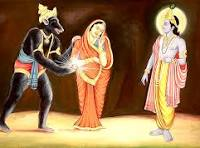
Learning that Prasena had been slain by a lion, which had in turn been killed by a bear on the side of a mountain, Krishna entered the bear’s den. He discovered that the jewel was being used as a toy by a child. Hearing the child’s nurse scream at the sight of the intruder, an enraged Jambavan attacked Krishna. They fought for 28 days and nights before Jambavan finally realised that Krishna was Rama’s reincarnation. Awestruck, Jambavan glorified Krishna and offered the Syamantaka, as well as his daughter, Jambavati, in marriage to the deity. Krishna accepted both of them and provided moksha to the bear king. He then summoned Satrajit to a royal assembly and narrated the tale of the recovery of the Syamantaka. He restored the jewel into the hands of the Yadav king Satrajit. Deeply ashamed of his accusation, Satrajit decided to offer Krishna the hand of his daughter, Satyabhama, regarded as a ‘jewel among women’, as well as the Syamantaka. Krishna married Satyabhama, but declined to receive the jewel, regarding it to be the property of Satrajit, as its donor had been Surya.
Shravan Charity Mission is an NGO that works for poor children suffering from life-threatening diseases, especially cancer. Our posts are meant for our readers, including children and adults, and have a huge variety of content. We also accept donations for our mission. Should you wish to donate to the cause of cancer? The bank details are given below:
5/10/25 SPEAKING TREE PEOPLE, ANIMALS & ENVIRONMENT
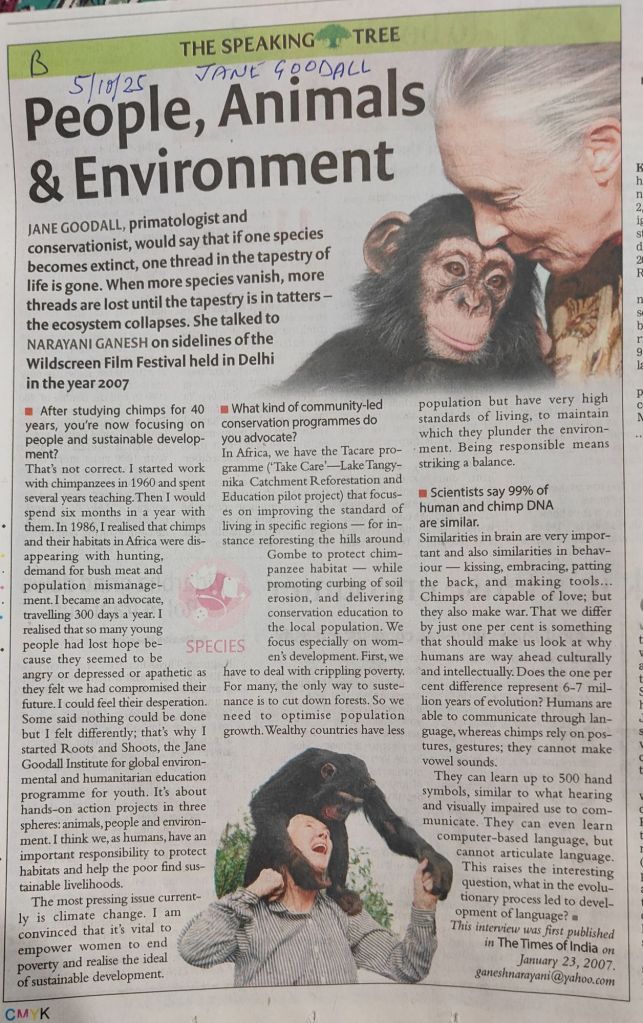
JANE GOODALL, primatologist and conservationist, would say that if one species becomes extinct, one thread in the tapestry of life is gone. When more species vanish, more threads are lost until the tapestry is in tatters– the ecosystem collapses. She spoke with NARAYANI GANESH on the sidelines of the Wildscreen Film Festival held in Delhi in 2007. Q. After studying chimps for 40 years, you’re now focusing on people and sustainable development? That’s not correct. I started work with chimpanzees in 1960 and spent several years teaching. Then I would spend six months of the year with them. In 1986, I realised that chimps and their habitats in Africa were disappearing with hunting, demand for bush meat and population mismanagement. I became an advocate, travelling 300 days a year. I realised that so many young people had lost hope because they seemed to be angry or depressed, or apathetic, as they felt we had compromised their future. I could feel their desperation. Some said nothing could be done, but I felt differently; that’s why I started Roots and Shoots, the Jane Goodall Institute for global environmental and humanitarian education programmes for youth. It’s about hands-on action projects in three spheres: animals, people and the environment. I think we, as humans, have an important responsibility to protect habitats and help the poor find sustainable livelihoods. The most pressing issue currently is climate change. I am convinced that it’s vital to empower women to end poverty and realise the ideal of sustainable development. Q. What kind of community-led conservation programmes do you advocate? In Africa, we have the Tacare programme (‘Take Care’—Lake Tanganyika Catchment Reforestation and Education pilot project) that focuses on improving the standard of living in specific regions — for instance, reforesting the hills around Gombe to protect chimpanzee habitat– while promoting curbing of soil erosion, and delivering conservation education to the local population. We focus especially on women’s development. First, we have to deal with crippling poverty. For many, the only way to sustain themselves is to cut down forests. So we need to optimise population growth. Wealthy countries have less population but have very high standards of living, to maintain which they plunder the environment. Being responsible means striking a balance. Q. Scientists say 99% of human and chimp DNA are similar. Similarities in the brain are very important, and also similarities in behaviour-kissing, embracing, patting the back, and making tools… Chimps are capable of love, but they also make war. That we differ by just one per cent is something that should make us look at why humans are way ahead culturally and intellectually. Does the one per cent difference represent 6-7 million years of evolution? Humans are able to communicate through language, whereas chimps rely on postures, gestures; they cannot make vowel sounds. They can learn up to 500 hand symbols, similar to what hearing and visually impaired people use to communicate. They can even learn computer-based language, but cannot articulate language. This raises the interesting question: what in the evolutionary process led to the development of language?
(This interview was first published in The Times of India on January 23, 2007, ganeshnarayani@yahoo.com
Shravan Charity Mission is an NGO that works for poor children suffering from life-threatening diseases, especially cancer. Our posts are meant for our readers, including children and adults, and have a huge variety of content. We also accept donations for our mission. Should you wish to donate to the cause of cancer? The bank details are given below:
Every morning, I walk up to the IT College metro station from my house, which is about ten minutes, cutting across the sprawling Police Lines. Today was a similar drill. I took the metro from there to Hazratganj Station, which is just three stations away. And today, being a holiday, the metro was absolutely empty. In fact, I was the only chap, I think, who got down at the Hazratganj station. Even as I was returning, I was the only person who boarded from there.
In Hazratganj, I usually walk for about half an hour every day. But the air was heavy today, even when the roads and the footpath were empty. There was a heavy security deployment near the Khadi Gram showroom where Yogi ji, the Chief Minister of U.P., was to arrive to pay homage to Mahatma Gandhi, today being his birth anniversary. I continued walking till I arrived at my usual joint, The Shukla tea stall, on Church Road, Hazratganj, that serves tea and street food.
The place is heavily crowded. Today was no different. I normally have a Kulhad chai there, which reminds me of the cutting Chai in Mumbai. While I was having Chai, two police motorcycles, blaring their sirens, landed at the tea stall. They started coaxing the drivers to remove their cars and scooters from there. It appeared as a special security drill on the 2nd of October. I was happy to note that I had landed in Hazratganj by metro and was on foot, so I didn’t have to bother about my car. I felt liberated. As a result, the tea tasted even sweeter, the weather even more pleasant, and the walk even more energising, and the mind relaxed. See what blaring sirens can do to you when you don’t have a car.
Shravan Charity Mission is an NGO that works for poor children suffering from life-threatening diseases, especially cancer. Our posts are meant for our readers, including children and adults, and have a huge variety of content. We also accept donations for our mission. Should you wish to donate to the cause of cancer? The bank details are given below:
VIKING SAGAS ON COMBAT AND CURIOSITY ECONOMIC TIMES 17/2/24 LIFE WAS TOUGH FOR VIKINGS, THEY WERE FIERCELY INDEPENDENT PEOPLE, AND VALUED TRUST AND TEAMWORK DEVDUTT PATTNAIK… AUTHOR OF BUSINESS SUTRA
The Greeks had inspired the Romans 2500 years ago. The Romans established a great empire around the Mediterranean for over a thousand years. Around the time they turned Christians, they began encountering barbarians from the North. The Celts, the Gauls, the Goths, in the western or Latin end of the Empire, around 500 AD, and later, the Vikings, in the eastern or Greek end of the Empire, around 1000 AD. Like the Greeks, life was tough for the Vikings, and they were fiercely independent people. Some, not all of them, travelled on ships to distant lands to raid. The shipping experience taught them the value of trust and teamwork. Vikings lived in Northern Europe (Scandinavia), in cold, dark, wintry lands, close to the Arctic. They had to fight to survive. So their mythological sagas spoke of battle all the time. Their gods fought frost giants in icy lands, and trolls who lived in dark, damp spaces. The gods even fought each other. The realm of the gods was located on branches of a giant tree, and it was feared that the roots of this would eventually be gnawed by demons, and everything would one day come to an end, even for the gods. A depressing worldview. The Vikings believed that if they died bravely in battle, they would be taken by Valkyries to Valhalla, a great hall to wine, dine, and fight with the gods themselves. This motivated the Vikings to fight. And to face death fearlessly. Those Vikings who died non-violent deaths, because of disease, accidents, and old age, had an unremarkable afterlife in the land of shadows ruled by Hel, a goddess who never smiled. The Vikings had two sets of gods, the Vanir, who enjoyed trade and the Aesir, who preferred the raid, as revealed in the following story. The Vanir and the Aesir were both gods, but very different. Vanir had magic, and Aesir had strength. Freyja of the Vanir visited the Aesir and displayed her gold, giving it to all those who made her happy. Under the spell of gold, the Aesir soon forgot all about loyalty to the clan and kept seeking more and more of the shiny stuff, offering gods and services in exchange. They stored more and shared less. Aesir blamed Freya’s magical gold for this shift in values. Aesir tried to burn Freya alive, but she resurrected herself each time, for she had magic. This led to war between Vanir and Aesir, which was inconclusive. Finally, the Vanir and the Aesir decided to make peace. Two Vanir went to live with the Aesir, and two Aesir went to live with the Vanir. Thus, they would learn about each other’s ways. The two Vanir, Freyr and Frerja, children of the wealthy Njord, taught the Aesir how the fertility of the earth and the sea can help them survive, and how accounting ensures fairness. The two Aesir, Hoenir and Mimir, taught Vanir about the value of loyalty and comradeship over being calculative. The Vanir liked the handsome well spoken Hoenir, but not the silent Mimir, who only whispered in Hoenir’s ear and spoke to no one else. Hoenir and Mimir always travelled together, talking to each other secretly, and this made the Vanir so uncomfortable that they killed Mimir. They did not realise that while Hoenir was handsome and charming, he needed Mimir’s counsel to make smart decisions. The two worked well as a team. Without Mimir, Hoenir had no good counsel. All he could say to the Vanir in meetings when they sought a decision was, ‘Let others decide!’ This story reminds us that different cultures value different things, and for a civilisation to thrive, we have to learn how different cultures function. The Aesir had to learn the trading ways of the Vanir based on agreements and negotiations. The Vanir had to learn the raiding ways of the Aesir based on trust, teamwork, and unquestioning loyalty. The Aesir were traders and accountants who valued policies and profit over people. This creates a fair professional ecosystem where relationships do not matter and nepotism does not take root. The Vanir were all about people, about bonding, about passion and trust. Here, connections matter: you bypass the rule for the relationship, like breaking the protocol for the benefit of a friend. The Romans saw the Vikings are barbarians and were eager to make them Christian, for they believed their truth was the universal truth. They were not interested in learning from ‘lesser’ people. For Romans, the other had to be subjugated. They were resources and rivals to be enslaved and brought into the Roman fold. In time, the Viking lands of Scandinavia would give rise to the Dutch, who would change the world forever by inventing the stock market, a financial revolution that provided vast amounts of credit to the newly emerging industrial economy. Was this because the Vikings turned Christians, or was it because the Vikings remembered their old ways– the ways of the Aesir and the Vanir? We can only speculate.
Shravan Charity Mission is an NGO that works for poor children suffering from life-threatening diseases, especially cancer. Our posts are meant for our readers, including children and adults, and have a huge variety of content. We also accept donations for our mission. Should you wish to donate to the cause of cancer? The bank details are given below:
DEVDUTT PATTNAIK 16/8/25 ECONOMIC TIMES DRAVIDIAN IRON FOR THE ARYAN HORSE
(Aryans came for newly smelted iron and offered domesticated horses in exchange. They were neither invaders nor migrants: they were traders.) PICTURE OF DEVDUTT PATTNAIK AUTHOR OF BUSINESS SUTRA
Colonial historians argued the ‘Aryan invasion theory’ that light-skinned chariot-riding people destroyed Harappan cities, conquered India, enslaved local dark-skinned people and created the caste system. To counter this, there was the ‘out of India’ theory popularised by many Brahmins, that Harappa was Vedic, that Aryans were originally India who migrated out of India, taking civilisation to the world. Both were wrong. Neither explained what motivated these Aryans to move in, or out, of India. Now it seems increasingly clear that Aryans came for (newly smelted) iron, and they offered (newly domesticated) horses in exchange. Aryans were neither invaders nor migrants: they were traders. And like many merchants and sailors, they had local wives, which accounts for the spread of their genes (R1aZ93), language (proto-Sanskrit) and patriarchal culture in India. In Hindu myth, the horse-headed Vishnu rescued the Vedas and gave them to Brahma for safekeeping. For over 3,000 years, Brahmins of India have therefore meticulously transmitted the Vedic songs containing some of the oldest descriptions of horses, chariots and composite bows in the world (Rig Veda 1.163.10 and 6.75.2). The Brahmins saw these Vedic hymns as timeless (sanatan), not of human origin (a-paurusheya). Today, thanks to ancient DNA analysis, archaeology and linguistics, we know that this is not true. Horses, originally bred for meat and milk, were fully domesticated only 4,000 years ago, around 2000 BC, in the region north of the Black and the Caucasian sea, west of the Ural mountains. The early horse were too small for adult humans to ride. This led to invention of the earliest spoked-wheel chariots, light light enough to be pulled by horses. They have been found in burial sites in Southern Russia, at Sintashta, east of the Ural mountains, also dated to 2000 BC. Composite bows (made of wood, bow and sinew) were invented around the same time, at the same place. This new military technology (horse, chariot, bow) spread to Egypt (indicated by wall art) in the east, Scandinavia (indicated by bronze statues) in the north and China (indicated in burial sites) and India (expressed in Vedic poetry) in the east by 1500 BC. With the horse-breeders, spread a new language Proto-indo-European (PIE). The eastern migration saw the spread of a gene variant found only in Steppe pastoral men, present in Y-chromosome, identified as R1a-Z93. It is currently seen across Central Asia, Iran and amongst all Brahmins of India. Those with these gene have another mutation that enables adults to digest milk. North Indians can digest milk easily. South Indians prefer curd. The men who came bearing these genes referred to themselves as Aryan or noble (this term was appropriated by racist Europeans causing much academic confusion). Rig Vedic verse (Mandala 4, Sukta 24) refers to bargaining a fair price. These traders would have had to repeatedly return to Central Asia to fetch more horses as horses do not breed in India. A simple fact that most people miss. The monsoon climate is not conducive to horse breeding. So Aryans were neither invaders nor migrants. They were traders, probably with wives on either side of the mountain trade route. The mothers gave their children voiced aspirated consonants (gh, jh, h, dh, bh) and retroflex consonants (t, d, n, s). The spoked-wheel chariot pulled by horses could carry two men: a driver and an archer. This image is immortalised in the Bhagavad-Gita, with Krishna holding the reins of four white horses, and Arjuna holding his mighty bow, the Gandiva. Both riders blow conch shells. The Rig Veda does not mention this conch-shell; the Atharva Veda does. They are only found off the Gujarat coast, in the Indian Ocean. Recent excavations in Keeladi, Tamil Nadu, are drawing attention to iron smelting technology that was invented in India, in regions associated with Dravidian and Munda languages. This requires very high temperatures. Sites in Deccan have ash mounds indicating a long-standing enquiry into fire technology. Along with Anatolia (modern Turkey) and Africa (Bantu people), India seems to be another site where iron was first extracted. This could be a good reason why Aryans came to India from the Oxus river basin through treacherous mountain passes (not flat enough for wheeled wagons). Horse breeding in India came very late, after 1400 AD, in parts of Gujarat, Rajasthan, Punjab and Maharashtra. So for nearly 3,000 years, every year, horse breeders would bring their horses from Central Asia for local Indian kings, who would use the horse in war, to conquer new lands, and even slaughter them as part of land acquisition ceremonies (Ashwamedha). Traders had no reason to ‘invade’ or ‘migrate’ to India. They had to go back to fetch more horses from Central Asia, where horse breeding was easy. (SKETCH: ILLUSTRATION DEVDUTT PATTNAIK)
Shravan Charity Mission is an NGO that works for poor children suffering from life-threatening diseases, especially cancer. Our posts are meant for our readers, including children and adults, and have a huge variety of content. We also accept donations for our mission. Should you wish to donate to the cause of cancer? The bank details are given below:
At the conference in New Delhi where Lord Mountbatten disclosed Britain’s partition plan for India (left to right) Indian nationalist leader Jawaharlal Nehru (1869 – 1964), adviser to Mountbatten Lord Ismay, Viceroy of India Lord Louis Mountbatten, and President of the All-India Muslim League Muhammad Ali Jinnah. (Photo by Keystone/Getty Images)
When India got freedom, but didn’t know what its boundaries were TIMES NEWS NETWORK, 22.8.21
On the midnight of August 15, 1947, we knew that India had kept its tryst with destiny, we knew that the subcontinent had been divided, that we were now two countries, India and Pakistan, but what we didn’t know was where India ended and Pakistan began. The boundary lines were still unknown.
That had been Viceroy Lord Mountbatten’s idea. He didn’t want the celebrations to be marred by recriminations on both sides. As if that was possible.
The British had long lost the opportunity for a peaceful and orderly handover of power. With the failure of the 1942 Cripps’ mission and then the three-member 1946 Cabinet delegation (with Sir Stafford Cripps playing the key role again), partition was inevitable. But how do you divide a subcontinent? Drawing the line was never going to be easy.
The man chosen for the task was Sir Cyril Radcliffe, a man who hadn’t travelled further east than the Gibraltar. But it fell on this 48-year-old Inner Temple barrister to do this impossible task– and that, too, in just five weeks.
While Radcliffe may have known little or nothing of India, he was, after all, the ultimate establishment man, which is probably why he was picked for the job. He had studied at Haileybury (Clement Attlee, the British Prime Minister then, also went to the same school) and then Oxford. After that, he had a brilliant career as a barrister. During the war, he had been director-general in the Ministry of Information, responsible for censorship and propaganda. It was Radcliffe who had run a campaign against Nehru’s sister Vijaya Lakshmi Pandit when she visited the United States. Radcliffe had also harassed P.G. Wodehouse ‘when he made ill-judged broadcasts while in German captivity’, wrote Patrick French.
So, the Establishment Man reached India and began work as a ‘neutral umpire’ in New Delhi on July 8. He would live separately, guarded by a massive Punjabi armed with two pistols. He would take his own decisions; no one would be around to influence him. But it wasn’t such a secluded existence for Radcliffe, after all. He dined with British military commander Claude Auchinleck (maybe the Auk needed consoling; his wife had run away with his friend), Lord Mountbatten, Punjab Governor Sir Evan Jenkins and many other members of the British high society.
It’s hard to believe that Radcliffe did not discuss the boundary issue with the others, who all knew much more about India than he did. But more than anything else, Radcliffe had a cheat sheet. In February 1946, the ever-underrated Archibald Wavell, the Viceroy of India, was unceremoniously sacked by the British Prime Minister, Clement Attlee, while sending in Mountbatten, as he had drawn up a contingency plan. Wavell knew what was coming. And he understood the need for a well-thought-out boundary line. Helping him were Reforms Commissioner V.P. Menon and Benegal Rau.
So, what did Radcliffe have to go with? Maybe some advice from veterans, Wavell’s map, and outdated census data. And with this, he had to divide a subcontinent in 36 days. Its people, villages, rivers, canals, roads. And to compound matters, the weather was frightfully hot, and Radcliffe came down with a bout of dysentery.
Seventy-four years later, it might be easy to say, ‘Poor fellow, he was only a lawyer with a brief; what more could he possibly have done? But in 1947, everything hinged on this lawyer and his brief. Would he award Gurdaspur to India or Pakistan? Would he really award a part of Ferozepur to Pakistan, so that it had better control over its water supply?
In fact, he almost gave away a part of Ferozepur to Pakistan. In the first week of August, during a lunch with his commissioners at a club in Simla, he said he would give Pakistan a part of Ferozepur because India was getting Gurdaspur. But that was not to be. When word got out, there was frenzied behind-the-scenes activity that made the ‘neutral umpire’ change his mind– and the boundary line — within days.
He handed over all the Awards to Mountbatten on August 13, but Mountbatten ruled that the Awards would not be made public till August 16. So, on August 15, a free India still did not know its exact boundaries.
When at 5 pm, on August 16, Liaquat Ali Khan, Jawaharlal Nehru, Sardar Patel and Baldev Singh gathered in the Council Chamber of Government House, three hours after the Awards had been sent to them, no one looked happy. It would be months before things settled down. For the moment, freedom had arrived, and with it the horrors of Partition.
For Radcliffe, it was time to go home. He boarded a flight out on August 17. He never came back. Later, when a reporter asked him if he would ever like to visit India, he said: ‘God forbid. Not even if they asked me. I suspect they would shoot me out of hand– both sides.’
The piece also includes the following pictures and press clippings
** PICTURE SEPT 1947 REFUGEES CROWD ONTO TRAINS FOR PAKISTAN AS THEY LEAVE NEW DELHI ** PRESS CLIPPING AUG 18, 1947 PUNJAB & BENGAL BOUNDARY AWARD ANNOUNCED NO AGREED SOLUTION: WIDE DIVERGENCE OF OPINION
ASSENT TO CHAIRMAN’S OWN DECISION
DEMARCATION OF BORDERS OF DIVIDED PROVINCES
AUG 18 MOVES TO RESTORE PEACE IN PUNJAB… PINDI CUT OFF FROM REST OF INDIA ** AUG 19 PUNJAB PROMISED AID IN SUPPRESSING DISORDERS… PLANS FOR IMMEDIATE CONCERTED ACTION FORMULATED ** AUG 23 ENDING PUNJAB AND QUETTA LAWLESSNESS … PAKISTAN CABINET’S DECISION
Shravan Charity Mission is an NGO that works for poor children suffering from life-threatening diseases, especially cancer. Our posts are meant for our readers, including children and adults, and have a huge variety of content. We also accept donations for our mission. Should you wish to donate to the cause of cancer? The bank details are given below:
In the afternoon, we set off for Germany. Our destination was Cologne. We planned to visit the renowned Cologne Cathedral after dinner at an Indian restaurant called Rangoli. Sunset in Europe is quite late in August, so we could go sightseeing even after dinner. Since it was the holiday season in Europe, there wasn’t much traffic either. We reached the restaurant by seven, after a four-hour drive. After dinner, we took a leisurely walk to reach the Cologne Cathedral.
The following day, we were to travel across Germany through the Black Forest and reach the Rhine Falls (waterfall) in Switzerland and then to our hotel, Seadamm Plaza in Pfaeffikon, Zurich. The drive was through the mystique Bavarian Alps with misty mountains and fast, lane-observing traffic. The weather was cold and overcast. We left at eight in the morning, towards the Black Forest. While negotiating the scenic mountain windings in the Bavarian Alps, I kept nostalgically recollecting my good old days in the thick of those absorbing musical instrumentals of my all-time favourites streaming in a sequence on my mobile. I was reminded of the best scene of Dr Zhivago when Omar Sharif runs up to the room above, and breaks the glass pane to have one last glimpse of Julie Christie from the window as the image of the sledge pulled by horses, carting her, starts diminishing in the snowy surroundings. This is when the melodious ‘Lara’s theme’ fills the ambience in the movie theatre. This is followed by the ‘Love theme’ from Romeo and Juliet, by Dutch violinist Andre Rieu, and then comes the famous Scarborough Fair (some call it a hymn) by British flautist Adrian Bret. What followed was the fond memory of the great Richard Burton and his famous Alistair Maclean movie ‘Where Eagles Dare’, which had so much to do with the Bavarian Alps located in Germany and Austria.
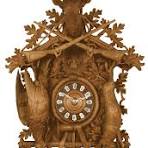
The Black Forest in the German language is called ‘Schwarzwald,’ which is famously known for the Cuckoo Clock Industry, Cloud Fisheries Industry and the Black Forest Cake.
We reached the car park of the Cuckoo Clock factory at about 1.45 PM local time. The place is known as Titisee-Brietnau, where clocks are manufactured. It also manufactures glass toys. We were given a live demonstration on how clocks are made. We also saw a live show of a Cuckoo Clock that squeaks and chimes at two in the afternoon, and the dancing dolls come out to dance with their partners. In the deep recesses of Germany, we had a rather sumptuous lunch in great style and variety. We were served Dahi Vadas, Veg Pulao, Grilled Chicken, French Fries, Cutlets and Pastries. The group shopped to its delight and was all for the traditional Cuckoo Clock.
Shravan Charity Mission is an NGO that works for poor children suffering from life-threatening diseases, especially cancer. Our posts are designed for our readers, including children and adults, and feature a diverse range of content. We also accept donations for our mission. Should you wish to contribute to the cause of cancer, the bank details are given below:
HOW HYDERABAD, JUNAGADH HELD UP INDIA’S INTEGRATION TIMES NEWS NETWORK
Under British rule, India contained more than 500 princely states that, upon independence, had the choice of joining either India or Pakistan. But uniting the dominion was no easy task, and several princely states held out for autonomy. But Sardar Patel’s special skills–of persuasion, sometimes maybe a little coercion–made them fall in line.
AUG 17 (PRESS CLIPPING) HYDERABAD (DN.), SATURDAY
“Today when I bid Farewell To the last of the Residents in my State, it is still my desire and the desire of Hyderabad to remain within the family of nations known as the British Commonwealth which looks to His Majesty the King as the living symbol of its unity,” declared the Nizam proposing the toast of Mr. C. G. Herbert, the last Resident in Hyderabad at a Farewell at the Jubilee Hall last night.
1/Hyderabad
After Independence, the princely state of Hyderabad decided against joining India, with the Nizam preferring to remain a “sovereign state” under the British Commonwealth. Hyderabad was a key strategic state between India’s north and south, which ruled out complete autonomy as an option for the government.
AUG 19 (PRESS CLIPPING) MORE CLASHES IN SECUNDERABAD TRANSPORT PARALYSED
From Our Own Correspondent HYDERABAD (Dn.) Aug. 18 Owing to a fresh outbreak of communal trouble, Secunderabad town has been almost isolated. Railway and bus services have ceased to function, and all approaches to the town have been cordoned off by the armed police.
Hyderabad refused to sign the Instrument of Accession, the standard legal framework offered to all princely states to join India, following which it signed a ‘standstill agreement’ to maintain the status quo for a year. But Hyderabad was also seeing communal violence break out, and was struggling to quell a communist uprising and the growing influence of an extremist Muslim militia. In September 1948, the continued instability in the state resulted in the Indian Army attacking Hyderabad as part of ‘Operation Polo’ and annexing it.
2/JUNAGADH
Upon Independence, the nawab of Hindu majority Junagadh opted to join Pakistan despite not sharing a border with it. The Indian government, unhappy with the accession, feared further communal violence if Junagadh was allowed to join Pakistan. To force a reversal, the government secured the accession of two of Junagadh’s vassal states, cut off supply lines to the state and surrounded it with its troops. In Bombay, a ‘provisional government of Junagadh’ was set up and led the popular agitation against the accession to Pakistan, after which the nawab fled to Karachi, allowing India to annex the state. A plebiscite was also held in February 1948, with more than 90% of the vote in favour of joining India.
AUG 21 PRESS CLIPPING
ACCESSION OF JUNAGADH TO PAKISTAN
UNION DISAPPROVAL —-***—- BHOPAL MAY JOIN INDIAN DOMINION From Our Special Representative NEW DELHI, August 20. Strong objection has been raised by the Dominion Government of India to Junagadh’s
3/INDORE
Indore was among the few princely states that had yet to accede to India prior to August 15. But Maharaja Holkar’s acceptance came just hours after Independence — positive news for the government as Hyderabad and Junagadh resisted.
PRESS CLIPPING AUG 21 INDORE’S ACCESSION On midnight of August 14/15 when British Paramountcy lapsed, only four of those States contiguous with the Indian Dominion had still not acceded to the Indian Dominion. If these, Indore has now signed the Instrument of Accession, which, however, is said to have reached the States Department six hours after the lapse of Paramountcy.
4/Oudh
Though Oudh, in present-day UP, had been annexed by the British just before the 1857 rebellion, Yusuf Mirza, the grandson of its last ruler Wajid Ali Shah, ‘assumed sovereign authority’ of the territory after a secret coronation.
PRESS CLIPPING AUG 17 SHAH YUSUF “ASCENDS” OUDH THRONE LUCKNOW, Saturday: Shah Yusuf Mirza, grandson of Nawab Wajid Ali Shah, the last king of Oudh, has issued a “royal proclamation formally ascending ‘the throne’ and assuming all the sovereign authority’ and power over the dominions of Oudh’ by virtue of our right of inheritance and in the name of our people.” The proclamation followed a two-hour meeting of the council of Action of the Oudh Restoration Mission held yesterday evening. It is reported that a quiet Coronation was held at midnight, where Prince Yusuf Mirza was installed on the throne at Sheesh Mahal, the ancient palace of the Nawab of Oudh. The ceremony was attended by members of the Royal Family of Oudh and members of the Council of Action. The territory … Of Oudh comprises
KEY STATES THAT PAVED THE WAY TO UNITY
Some major princely states ultimately joined the dominion prior to Independence, laying down a marker for others, but not without making it difficult for the government.
5/TRAVANCORE
In 1946, the dewan of Travancore had insisted the state would remain independent after the British left but was willing to sign treaties with India and Pakistan. Some British politicians and Mohammad Ali Jinnah supported the prospect of an independent Travancore, which buoyed the dewan. But in July 1947, the dewan survived an assassination attempt by a member of the Kerala Socialist Party. The incident led to a change of heart and Travancore acceded within days.
6/BHOPAL
The nawab of Bhopal, which was a Hindu-majority state, had close ties with Jinnah and saw Congress as an adversary. He feared Independence would leave Muslims ‘helpless, unorganised and unsupported’ and turn India into a communist nation, and suggested Bhopal would remain independent. But a letter from Lord Mountbatten — and seeing other princely states accede– changed the nawab’s mind. The only concession he sought was for the announcement of the accession to be delayed to 10 days after Independence.
7/JODHPUR
Jodhpur was an exception among states that had hesitated to join India — it had a Hindu ruler and a Hindu-majority population. Though the king was willing to join India, he was also negotiating terms with Pakistan in July 1947. Losing Jodhpur, a border state, would have dealt a major blow to India as it may have pushed neighbouring states towards Pakistan. But Sardar Vallabhbhai Patel intervened, offering some concessions and asking him whose side he would take in the event of communal clashes, after which the king agreed to accede.
Shravan Charity Mission is an NGO that works for poor children suffering from life-threatening diseases, especially cancer. Our posts are meant for our readers, including children and adults, and have a huge variety of content. We also accept donations for our mission. Should you wish to donate to the cause of cancer? The bank details are given below:
Hope, wrote Alexander Pope, lies eternal in the human breast. To never despair, even in the bleakest of winter. And, nothing exemplifies this more than the soul-stirring story of Viktor Frankel, who survived the horrors of Auschwitz through his search for the meaning of life. In his ‘Man’s Search for Meaning’ written after his liberation from the concentration camp, he talks about the source of his will to live. To paraphrase: we are bound to face adversities. How you handle these vicissitudes is determined by your attitude. And, attitude is something that each of us controls. This determines what becomes of you mentally and physically. This is true also of suffering that is a part of life–without and death, human life would not be complete. The test is how we react to the suffering. We need to have a higher purpose– a goal that will help us overcome the challenges. Frankel quotes. Nietzsche, ‘He who has a why to live can bear almost any how’, to explain this. The meaning of life is found by our choice to do the right thing. Frankel helped his fellow prisoners by emphasising that striving for meaning, not power nor pleasure, is what keeps us alive. These lessons are even more relevant today. A positive attitude, willingness to take responsibility and a purpose in life will help each of us find meaning in our lives. Life is, after all, far too precious to fritter away aimlessly.
Shravan Charity Mission is an NGO that works for poor children suffering from life-threatening diseases, especially cancer. Our posts are meant for our readers, including children and adults, and have a huge variety of content. We also accept donations for our mission. Should you wish to donate to the cause of cancer? The bank details are given below:
WE TREAT INDIA-PAK HOSTILITY AS INEVITABLE, BUT THESE DIVIDES FORMED WITHIN LIVING MEMORY (FOR THE RECORD)
Sam Dalrymple was set for a career in particle physics until a family trip to Afghanistan to visit the remains of the Bamiyan Buddha rerouted him into history. He started a virtual reality project connecting Partition survivors, which, in turn, inspired his debut book 'Shattered Lands', tracing the unravelling of the Indian Empire. In an interview with Neelam Raaj, he talks about why our complex pasts shouldn't be ignored.
Q. Several years ago, you co-founded Project Dastaan, connecting those displaced by the 1947 Partition through virtual reality. Was it Dastaan that sparked off this deep dive into the five partitions or something else? A. Dastaan was very much the origin of the book. In 2018, my college friends and I began reconnecting individuals displaced in the 1947 Partition of India, the largest forced migration in history, to their ancestral villages through VR. It was while researching the impact of Partition on Tripura and North East India for Dastaan that the book idea first came together: I was chatting with an academic in the region, and when I asked about Partition, he said, "Which one? Burma in 1937, Pakistan in 1947 or Bangladesh in 1971." That conversation made me think about the multiple ruptures and borders that have carved their way through the subcontinent.
Q. The five partitions you write about are the separation of Burma, Arabia and Pakistan from India, the division of 500 princely states, and finally, the creation of Bangladesh. Why did you want to tell this story? A. We live with the consequences of these partitions every day. Just look at the recent war between India and Pakistan. Today, South Asia is one of the most bordered regions in the world, and you can actually see its borders from space. However, 100 years ago, none of these borders were foreseen. Demands for 'independence' were widespread, but no one could have suspected that the nations India, Pakistan, Bangladesh, Yemen and Burma would soon emerge from the wreckage of British India. Nor would anyone have imagined that tiny princely states like Bhutan and Dubai would last until the end of the century, while massive states like Hyderabad would not.
Q. Your book challenges some widely held beliefs, like the idea that India's borders were drawn solely by Cyril Radcliffe. Could you tell us more about that? A. Cyril Radcliffe was famously charged with drawing the Partition border that would slice through British India. Jinnah had suggested his name because he had never been east of Paris, and supposedly his obliviousness would make him impartial. This, of course, had deadly consequences. But what we often forget is that he only drew the lines dividing Punjab and Bengal. Both the LoC and the entire stretch of the India-Pakistan Border from the Arabian Sea to Sri Ganganagar - collectively 81% of the present India-Pakistan Border fence-result from the decisions of seven local princes and have nothing to do with Radcliffe. Thirty-six per cent of the border with East Pakistan (modern Bangladesh) was made by another ten. Had states like Jodhpur joined Pakistan, or had states like Bahawalpur joined India, the border would look very, very different.
Q. The chapter on the Arabian Peninsula ties a global moment -- the British withdrawal from Aden (now in Yemen)-- to a personal story about Dhirubhai Ambani. How did that shape the trajectory of Reliance?, A. We often forget today that Aden was the Dubai of the 1960s. It was the great business hub of its time, and this remained the case right until 1967 when the British pulled out and the revolutionary NLF took over. Dhirubhai Ambani had worked in Aden until the late 1950s, and after the British evacuation from Aden, he found himself perfectly placed to hire his dispossessed colleagues and found use of 'a ready-made source of educated managers, accountants and salesmen, drilled to European standards'. He had just ended a business partnership with his cousin and gone solo, forming a new company called Reliance Commercial Corporation. Reliance ballooned in the years after the fall of Aden, underpinned by a generation of Indian-origin Adenis versed in free market capitalism rather than Nehruvian socialism.
Q. Given that your book comes out against the backdrop of India-Pakistan tensions, what is the perspective you hope readers will take away? A.So often, we treat the hostility between India and Pakistan as inevitable. Even President Trump chimed in, telling reporters aboard Air Force One that India and Pakistan had been fighting "for a thousand years, probably longer than that." But this really isn't the case. These divisions were formed within living memory --as were the divisions between India and Bangladesh, Burma and Yemen, etc. Today, the region's borders have become so embedded in our subconscious that it is easy to forget there were other possibilities for a post-colonial South Asia. Several prominent national figures, including PM Nehru and Burma's founding father Aung San, had once spoken of an 'Asiatic federation' in the 'not very, very distant future', a 'United Nations of South Asia' encompassing India, Pakistan, Ceylon and Burma. Long after the British departed, many still hoped the new borders might prove temporary. Yet in every single one of these countries, governments have made sure to paper over the shared cross-border heritage of their peoples. The last decade has witnessed the decline of globalisation, the strengthening of borders and the resurgence of nationalism across the world. India's partitions are a direct warning of what such a future might hold.
Q. Your Dad, historian William Dalrymple, sparked a lot of debate recently, saying that academics don't make their work as accessible as popular historians. Where do you stand on this? A. I don't think they have to stand in opposition at all. We obviously need both. ***
Shravan Charity Mission is an NGO that works for poor children suffering from life-threatening diseases, especially cancer. Our posts are meant for our readers, including children and adults, and have a huge variety of content. We also accept donations for our mission. Should you wish to donate to the cause of cancer? The bank details are given below: