Diwali is a Festival of Lights, A victory of day over the night, Of good over the evil’s might, Of truth, of hope, and what is right.
*
Diwali fetches five days of vibrant cheer, With sweets, lamps and love sincere. With rangoli, hues and lanterns bright, And fireworks swirling throughout the night sky.
*
It highlights an all-time victory, Where knowledge breaks through every blind, Of ignorance and veils of gloom, And radiant joy begins to bloom.
*
As per the holy Panchang, Diwali recalls tales of yore. When the month of Ashwin wanes and Kartik begins, And Amavasya plays a significant innings.
*
It’s the darkest night, With a lunar grace and swastik signs,
When the world looks prime,
At an opportune time.
*
It coincides with the harvest’s golden end, Before the frost and chill descend. Communities emerge in joy, As golden diyas paint the skies.
*
As autumn breathes its cooler air, October–November marks the affair. The heart of fall, the soul of light, Diwali shines in full delight.
*
Myths unravel, tales unfold, Of Gods and demons, celestial and corporeal. From Dhanteras to the climax day, Lakshmi and Ganesh light the way.
*
Ayodhya celebrates and lights up, On Rama’s arrival amidst the crowd. With Sita, Laxman by his side, And Hanuman’s attendance, sanctified.
*
With Shiva, Vishnu, and Krishna’s grace, Durga’s might and Kali’s face, And eventually, Narakasura’s fatal end, As deities and demons come face-to-face.
*
From Ravana’s end to Rama’s victory, From Dhanvantri’s healing touch, The churning ocean’s mystic art, Each finds a mention in Diwali’s heart.
*
Sparks erupt in the skies, With sparklers, phuljhadis that rise high. The demons flee, the gods descend, And in that event, the miseries end.
*
In life’s struggle, in daily strife, Diwali comes as a breath of life. As does an oasis in a wide desert, As a gentle pause, where peace can bide.
*
On Amavasya’s cold, dark night, Beyond the stars and in the cosmos, The lights of Diwali softly bloom, Spreading hope, dissolving gloom.
*
The cosmos sports its finest robe, Adorned in lights and loveliness. And every heart, with joy infinite, Sings together: Happy Diwali Night!
Shravan Charity Mission is an NGO that works for poor children suffering from life-threatening diseases, especially cancer. Our posts are meant for our readers, including children and adults, and have a huge variety of content. We also accept donations for our mission. Should you wish to donate to the cause of cancer? The bank details are given below:
Shravan Charity Mission is an NGO that works for poor children suffering from life-threatening diseases, especially cancer. Our posts are meant for our readers, including children and adults, and have a huge variety of content. We also accept donations for our mission. Should you wish to donate to the cause of cancer? The bank details are given below:
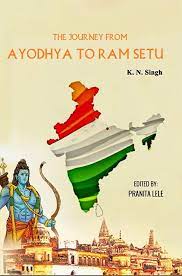
Today, I have for you a rare title, written by Sri K.N. Singh and edited by his daughter Pranita Lele. The book’s long title is “The Journey From Ayodhya to Ram Setu”. Ram Setu, as we all know is the bridge that Lord Ram had built to cross over to Lanka when he waged the war to kill Ravana, who had abducted his pious wife Sita in the most cunning manner. I’m sure the author must have undertaken an enduring comprehensive research of various scriptures before penning this book. Pranita, the editor of this title has also edited the work with great accuracy. So kudos to both.
K.N.SINGH
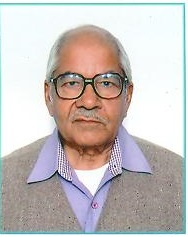
The publisher of the title is Bookrivers.com. It is available in almost all online bookstores. The price of the book is Rs 250. For reference Sri K.N. Singh was born in a small village in Uttar Pradesh in 1937. By profession, he is a Geologist. Geologists are earth scientists. That’s why I’m calling this title rare because it has the scientific perspective of a geologist who narrates the illustrious journey of Lord Ram. Sri K.N. Singh has earlier written articles for the Daily Gulf and Khaleej Times in Bahrain and Dubai. The other book that he has written is titled ‘Geoscientific Perspective of Samudramanthan.’
Pranita Lele
The narration unfolds in about 220 pages. The Foreword is by Anand Vardhan Singh, Senior Journalist, Writer and Editor at The Public India. The author has divided the narration into twenty chapters and each chapter has sub-chapters. We all know the story of Lord Ram. Lord Ram is known as the “Maryada-Purshottam.” The book builds on this title of his and brings to you those minute features that makes him God. Each human perspective was important to him even while fighting the war. Remember even Bali questioned his righteousness and he replied to him convincingly.
The narration takes off with the description of Suryavansh and Chandravansha. The title recounts The Ramayana and its retellings, beginning right from Lord Shiva’s original narration, followed by Kaag Bhusund’s Ramayana, Valmiki Ramayana, Vat Vriksha, Tulsidas’s Ramayana, Jain and Buddhist Ramayana, The spectre of A.K. Ramanujan and the Ram-Lila. The author compares the great Sita Swayamvara with the forgotten ritual of women empowerment that is gaining momentum now.
The book narrates the story of enlightened Ayodhyans (residents of Ayodhya). It describes the sumptuous childhood of the Rajkumars in Ayodhya and gives a good account of what all happened in Ayodhya because of which Lord Ram had gone into exile for 14 years. We may not realise the consequences of our devious fancies that can bring about great devastation to human life. The case in point here is Kaikeyi’s fancies that were schemed.
The vanvas commences when Lord Ram moves to Chitrakoot along with his wife Sita and brother Lakshman. In the narration, I really liked the description of Parnashala—The Idyllic Home … and the Science of Vastu Shastra. It is a sturdy little cottage made of dry wood and leaves, built by Lakshman where the trio settles in Chitrakoot. It was completed on a Sunday when the ‘Uttrayan Sun’ was in the Rohini Nakshatra—the most favourable time for Vastu-shanti writes the author. The death of King Dasharath was an event that shook the tectonic plates of Mother Earth. It was followed by a war where apart from human beings even nature suffered silently. The story of sage Atri and Anasuya remains interesting. There are umpteen mythological stories that make the book quite enjoyable. In the process, you recap the stories that you’ve known for years and also discover new stories that you’ve not known. The descriptions of the Vindhyas and the Narmada are superb. How they entwine with the tragedy of Lord Ram. The Dandakaranya—is the turning point of the Ramayana. The ashrams of various Munis and how they lived their lives are noteworthy. Sitá’s advice, King’s dharma. Mandakarni’s Underwater Inhabitation and the chapters on the greatest of the great Agastya Muni are quite absorbing.
The chapter on Panchavati describes the genealogy of Jatayu and his brother and reflects on Lakshman’s devotion. It talks of the web of illusion about the bratty woman Surpanakha and gives an ethical and cultural perspective of her persona. The killing of Khara and Bhushan, the weaponry in ancient India and Surpanakha’s beseeching Ravan to restore her honour were perhaps the immediate causes of the war.
Your unjust desires may get you in trouble. Desire could fire or misfire your life where the story of Maricha and the Golden Deer comes in handy. Maricha was the person who changed form and became the golden deer that Sita fell for. Then comes Sita’s accusation that Lakshman did not help Rama. The chapter on Aerodynamics sounds a bit to far-fetched when you consider the nature of the book, but when you read about the Pushpak Viman, Jataiyu and Lepakshi you can clearly establish the connection. The book is engrossing right till the end especially the portion of Lord Hanuman and his visits to Ashok Vatika in Lanka. Vibhishan’s picturization, Lanka Dahan and Pampa-Sarovar are equally engrossing. There is a phenomenal adventure in the story of Ramayana. In the closing chapters, you have the crossing of the ocean. Was Ram Setu man-made or natural—find it out yourself while reading the book.
The author has used plain English to express himself. He has tried to give it a non-religious tinge by quoting well-known authors. Geology has a very different way of looking at Ram’s journey from Chitrakoot to Ram-Setu which you’ll discover in the pages of this book. It is quite well-detailed. It delineates small details that we don’t know. The life of Lord Ram emits great values and the author has tried to connect it with today’s political class. The narration leaves behind many sound life lessons. The author juxtaposes Ram’s struggle and Ram-Rajya with the present times. For this, the book deviates from the main plot for a while. There are many stories within the main plot. Worldly dos and don’ts are skillfully mingled with the main theme. The book undertakes a suggestive political lesson on page 176 and 177 and has a somewhat sudden ending but not before the author has penned his thoughts prolifically on the relevance of Rama in modern times.
If you think you know all about Ramayana definitely read this book to find out what you didn’t know about it. I would call it a must-read as it brings to the fore the unknown trail of mythology that at least I didn’t know.
Shravan Charity Mission is an NGO that works for poor children suffering from life-threatening diseases, especially cancer. Our posts are meant for our readers that include both children and adults and it has a huge variety in terms of content. We also accept donations for our mission. Should you wish to donate for the cause. The bank details are given below:
NAME OF ACCOUNT: SHRAVAN CHARITY MISSION
Account no: 680510110004635 (BANK OF INDIA)
IFSC code: BKID0006805
*
Our Publications
GLOOM BEHIND THE SMILE
(The book is about a young cancer patient. Now archived in 8 prestigious libraries of the US that includes Harvard College Library; Harvard University Library; Library of Congress; University of Washington, Seattle; University of Minnesota, Minneapolis; Yale University, New Haven; University of Chicago; University of North Carolina, at Chapel Hill University Libraries. It can also be accessed in MIT through Worldcat.org. Besides, it is also available for reading in libraries and archives of Canada, Cancer Aid and Research Foundation Mumbai; Jaipuria Institute of Management, Noida, India; Shoolini University, Yogananda Knowledge Center, Himachal Pradesh and Azim Premzi University, Bangalore).
ONE TO TANGO … RIA’S ODYSSEY
(Is a book on ‘singlehood’ about a Delhi girl now archived in Connemara Library, Chennai and Delhi Public Library, GOI, Ministry of Culture, Delhi; Available for reading in Indian National Bibliography, March 2016, in the literature section in Central Reference Library, Ministry of Culture, India, Belvedere, Kolkata-700022)
AADAB LUCKNOW … FOND MEMORIES
(Is a fiction written around the great city of Nawabs—Lucknow. It describes Lucknow in great detail and also talks about its Hindu-Muslim amity that happens to be the undying characteristic of Lucknow. The book was launched at the Lucknow International Literary Festival in 2014. It is included for reading in Askews and Holts Library Services, Lancashire, U.K; Herrick District Library, Holland; Charlotte-Mecklenburg Library, Mecklenburg County in North Carolina, USA; Black Gold Cooperative Library Administration, Arroyo Grande, California; Berkeley Library, University of California).
REFRACTIONS … FROM THE PRISM OF GOD
(Co-published by Cankids–Kidscan, a pan India NGO and Shravan Charity Mission, that works for Child cancer in India. The book is endorsed by Ms Preetha Reddy, MD Apollo Hospitals Group. It was launched at Lucknow International Literary Festival in 2016)
TYPICAL TALE OF AN INDIAN SALESMAN
(Is a story of an Indian salesman who is humbly qualified. Yet he fights his way through unceasing uncertainties to reach the top. A good read not only for salesmen. The book was launched on 10th February 2018 at Gorakhpur Lit-Fest. Now available on Amazon, Flipkart and Onlinegatha)
RHYTHM … in poems
(Published in January 2019. The book contains 50 poems. The poems describe our day-to-day life. A few poems from the book have been published in Shillong Times, Bandra Times and Bhavan’s Journal. The book is available on Amazon, Flipkart and Onlinegatha)
MIRAGE
(Published in February 2020. The book is a collection of eight short stories available in Amazon, Flipkart and Notion Press)
AWADH ASSAM AND DALAI LAMA … The Kalachakra
(The story of the man who received His Holiness The Dalai Lama and his retinue in 1959 as a GOI representative when he fled Tibet in 1959. The book was launched on 21st November 2022 by His Holiness The Dalai Lama at Dharmshala. The title is archived in the library of the Department of Information and International Relations (DIIR) Government of Tibet, Tibet Policy Institute (TPI) and the personal library of His Holiness. The title is also archived in The Ohio Digital Library, USA. It is also included in the library of the world-renowned company APPLE).
BHAVANS JOURNAL
Short stories, Book reviews and Articles published in Bhavan’s Journal: 1. Reality and Perception, 15.10.19; 2. Sending the Wrong Message, 31.5.20; 3.Eagle versus Scholars June, 15 & 20 2020; 4.Indica, 15.8.20; 5.The Story of King Chitraketu, August 31 2020; 6.Breaking Through the Chakravyuh, September 30 2020. 7. The Questioning Spouse, October 31, 2020; 8. Happy Days, November 15, 2020; 9.The Karma Cycle of Paddy and Wheat, December 15, 2020; 10.Power Vs Influence, January 31, 2021; 11.Three Refugees, March 15, 2021; 12.Rise and Fall of Ajatashatru, March 31, 2021; 13.Reformed Ruler, May 15, 2021; 14.A Lasting Name, May 31, 2021; 15.Are Animals Better Teachers? June 16, 2021; 16.Book Review: The Gram Swaraj, 1.7.21; 17.Right Age for Achievements, 15.7.21; 18.Big Things Have Small Beginnings, 15.8.21; 19.Where is Gangaridai?, 15.9.21; 20.Confront the Donkey Within You 30.9.21; 21. Know Your Strengths 15.10.21; 22. Poverty 15.11.21; 23. Top View 30.11.21; 24. The Bansuriwala 15.1.22; 25.Sale of Alaska 15.2.22; 26.The Dimasa Kingdom 28.2.22; 27. Buried Treasure 15.4.22; 28. The Kingdom of Pragjyotisha 30.4.22; 29.Who is more useful? 15.5.22; 30. The White Swan from Lake Mansarovar 30.6.22; 31. Bhool Bhulayya 15.9.22; 32. Good Karma 30.9.22; 33. Good Name vs Bad Name 15.10.22; 34.Uttarapath—The Grand Trunk Road 1.12.22; 35.When Gods Get Angry 1.1.23; 36. Holinshed’s Chronicles 15.1.23; 37. Theogony 15.2.23; 38. Poem: Mother 14.5.23; 39. THE NAG MANDIR 30.6.23; 40. The Story of Garuda 30.7.23; 41. Janmabhoomi vs Karmabhoomi 31.8.23; 42. The Ghost Town of Kuldhara 15.9.23;
SUNDAY SHILLONG TIMES
ARTICLES & POEMS: 1. POEM: HAPPY NEW YEAR 8.1.23; 2. POEM: SPRING 12.3.23; 3. POEM: RIGHT AND WRONG 20.3.23; 4. THE GUSH OF EMOTION—WRITING, 26.3.23; 5.THE NAG MANDIR, 7.5.23; 6. POEM:MOTHER 7.5.23;7. POEM: RAIN RAIN 9.7.23; 8. POEM:YOU COME ALONE YOUGO ALONE 6.8.23; 9. RAIN RAIN (SECOND TIME) 10.8.23: 10.POEM: GURU TEACHER 1.10.23;
Goverdhan was a docile but a mighty mountain that co-existed in harmony with his father, Dronachala, centuries ago. One day, the great sage, Pulastya, happened to pass by the mountain. And, he took such an instant liking to Govardhan that he desired to carry him off to Banaras, so that he could perform his meditation peacefully, in the secluded caves of Govardhan.
Respecting the sage, Govardhan agreed to go, but on one condition. That wherever and whenever, Pulastya, would keep him down, after lifting him up, he would not move from that spot. The sage readily agreed to this. He lifted Goverdhan, and began to fly towards Banaras. But, as they flew over Vrindavan, Goverdhan felt, an intense attraction to settle down there. So, with his mystic power, he caused an irresistible urge in Pulastya, to attend to nature’s call. Sage Pulastya, forgetting, the one and only one condition, was compelled to place Govardhan down, in Vrindavan.
After relieving himself, when, Pulastya tried to lift Goverdhan to continue his onward journey to Banaras, but the mountain didn’t budge an inch. Pulastya, tried with all his might but Goverdhan stayed put. This enraged the sage. He cursed Goverdhan, to shrink in size and eventually become a small hillock. Govardhan, accepted the curse with a woeful heart, taking it, as the unshakeable will of the Almighty.
But as fate would have it. Much later in Treta Yuga, God Hanuman, lifted ‘Govardhan Parbat’ for bringing it to Dhanushkodi, as part of the magnificent bridge that was being constructed for Lord God Rama to cross over the present day Palk-Strait (India to Sri Lanka). But, suddenly a mysterious voice resounded (Akashwani) in the sky, announcing, that the bridge was already completed. Disappointed, God Hanuman, returned to the spot from where he had lifted Govardhan and placed him back in that same very spot, in Vraja-bhoomi, where the mountain stood earlier.
Goverdhan, felt sad because he missed a golden opportunity to serve the divine mission of lord God Rama. Yet, he waited patiently for many years hoping against hope, to be of some service to Lord God Krishna in Dvapara yuga.
When Krishna grew up, into a young boy, his heart was irresistibly attracted to this magic hill, Goverdhan, whose slopes were full of lush pasture grounds, for crows to graze, and also served as a playground for Krishna and the cowherd boys, and girls to revel in various sport and relax and refresh themselves in the crystal clear waters of Govardhan’s lake, and secluded caves.
Krishna wanted to teach Indra a lesson, since he had become too proud, because of the traditional ‘yajna’ that the Vraja-wasis were offering to him. So, he convinced Nanda baba, to discontinue the ‘Indra-yajna,’ and instead, have a glorious festival, to honour Govardhan. Deeply mortified, the enraged king of heaven decided to drown the inhabitants of Vraja with unseasonal devastating rains, stormy winds and hailstorm for seven long days.
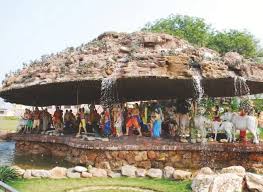
Krishna, however, thwarted Indra’s ruthless plan by effortlessly holding Govardhan on his little finger, like a gigantic umbrella, for the protection of the terrified residents of Vraja Bhoomi.
In stark contrast to Indra’s arrogance and reckless conduct, Govardhan’s gentle and submissive nature attracted the favour of Krishna who elevated the mountain to the status of a sacred deity.
Govardhan Parvat, adds special charm and enchantment to the holy land of Vraja-bhoomi and whom millions of devotees circumambulate throughout the year, even till date.
Shravan Charity Mission is an NGO that works for poor children suffering from life threatening diseases especially cancer. Our posts are meant for our readers that includes both children and adults and it has a huge variety in terms of content. We also accept donations for our mission. Should you wish to donate for the cause. The bank details are given below:
NAME OF ACCOUNT: SHRAVAN CHARITY MISSION
Account no: 680510110004635 (BANK OF INDIA)
IFSC code: BKID0006805
*
Our publications
GLOOM BEHIND THE SMILE
(The book is about a young cancer patient. Now archived in 8 prestigious libraries of the US that includes Harvard College Library; Harvard University Library; Library of Congress; University of Washington, Seattle; University of Minnesota, Minneapolis; Yale University, New Haven; University of Chicago; University of North Carolina, at Chapel Hill University Libraries. It can also be accessed in MIT through Worldcat.org. Besides, it is also available for reading in libraries and archives of Canada, Cancer Aid and Research Foundation Mumbai and Jaipuria Institute of Management, Noida, India)
ONE TO TANGO … RIA’S ODYSSEY
(Is a book on ‘singlehood’ about a Delhi girl now archived in Connemara Library, Chennai and Delhi Public Library, GOI, Ministry of Culture, Delhi; Available for reading in Indian National Bibliography, March 2016, in the literature section, in Central Reference Library, Ministry of Culture, India, Belvedere, Kolkata-700022)
AADAB LUCKNOW … FOND MEMORIES
(Is a fiction written around the great city of Nawabs—Lucknow. It describes Lucknow in great detail and also talks about its Hindu-Muslim amity. That happens to be the undying characteristics of Lucknow. The book was launched in Lucknow International Literary Festival of 2014. It is included for reading in Askews and Holts Library Services, Lancashire, U.K.)
REFRACTIONS … FROM THE PRISM OF GOD
(Co-published by Cankids–Kidscan, a pan India NGO and Shravan Charity Mission, that works for Child cancer in India. The book is endorsed by Ms Preetha Reddy, MD Apollo Hospitals Group. It was launched in Lucknow International Literary Festival 2016)
TYPICAL TALE OF AN INDIAN SALESMAN
(Is a story of an Indian salesman who is, humbly qualified. Yet he fights his ways through unceasing uncertainties to reach the top. A good read not only for salesmen. The book was launched on 10th February, 2018 in Gorakhpur Lit-Fest. Now available in Amazon, Flipkart and Onlinegatha)
RHYTHM … in poems
(Published in January 2019. The book contains 50 poems. The poems describe our day to day life. The book is available in Amazon, Flipkart and Onlinegatha)
MIRAGE
(Published in February 2020. The book is a collection of eight short stories. It is available in Amazon, Flipkart and Notion Press)
Short stories and Articles published in Bhavan’s Journal: Reality and Perception, 15.10.19; Sending the Wrong Message, 31.5.20; Eagle versus Scholars June, 15 & 20 2020; Indica, 15.8.20; The Story of King Chitraketu, August 31 2020; Breaking Through the Chakravyuh, September 30 2020. The Questioning Spouse, October 31, 2020; Happy Days, November 15, 2020,
(ALL THE ABOVE TITLES ARE AVAILABLE FOR SALE IN AMAZON, FLIPKART AND OTHER ONLINE STORES OR YOU COULD EVEN WRITE TO US FOR A COPY)
Whenever Yamraj, the Lord of Death attempted to meet Lord Rama, to tell him about, the amount of time, he had, in his human form, Hanuman would refuse entry to him. Yamraj was aware of Hanuman’s strength and the boon of immortality granted to him, so he did not wish to cross him.
Rama, however, understood, that a human life has to complete the cycle of birth and death. He knew Hanuman was trying to protect him from his death by avoiding his meeting with Yamaraj. But Rama knew at some point in time he has to meet Yamaraj. But he realised that it was not possible to do so with Hanuman around.
One day Rama and Hanuman went out for a walk. Rama took off his ring and began playing with it. He then discreetly dropped it into a small crack on the ground, and then requested Hanuman, ‘I have dropped my ring somewhere. Will you please retrieve it for me.?’
Hanuman nodded. He then transformed his body into a miniature so that he could easily get into the crack on the ground. But the closer he got to the ring, the more, the ring fell below and below. He had no choice but to follow it.
After sometime the ring reached Patala Lok. There Hanuman met Nagaraja, the king of the serpents. Hanuman said, ‘Dear Sir, Rama’s ring has fallen somewhere here. Will you please give it back to me? I must return it to him. Nagaraja replied.
‘I have a room full of rings. Everything that falls from the earth is kept there. You can go to the room and search for it yourself.’
Hanuman acquiesced and entered the room, where he saw hundreds of rings on display. He kept searching until he found the ring that he was looking for. It seemed to take barely a few minutes. Hanuman thanked Nagaraja and made his way back to Ayodhya. But time takes on a different meaning in Patala Lok. A second there is worth many years on earth. By the time Hanuman reached the city, a lot of time had already passed, and Rama had already left his mortal body and achieved Nirvana.
To his dismay, Hanuman realized that he had missed seeing Lord Rama exit the earth. Hanuman felt miserable but knew that Lord Rama wanted things to play out in that manner.
Even today, Hanuman continues to live on our planet. There is a strong belief that whenever there are prayers for Rama. Hanuman appears in his invisible form to bless the devotees.
Shravan Charity Mission is an NGO that works for poor children suffering from life threatening diseases especially cancer. Our posts are meant for our readers that includes both children and adults and it has a huge variety in terms of content. We also accept donations for our mission. Should you wish to donate for the cause. The bank details are given below:
NAME OF ACCOUNT: SHRAVAN CHARITY MISSION
Account no: 680510110004635 (BANK OF INDIA)
IFSC code: BKID0006805
*
Our publications
GLOOM BEHIND THE SMILE
(The book is about a young cancer patient. Now archived in 7 prestigious libraries of the US, including, Harvard University and Library of Congress. It can also be accessed in MIT through Worldcat.org. Besides, it is also available for reading in Libraries and archives of Canada and Cancer Aid and Research Foundation Mumbai)
ONE TO TANGO … RIA’S ODYSSEY
(Is a book on ‘singlehood’ about a Delhi girl now archived in Connemara Library, Chennai and Delhi Public Library, GOI, Ministry of Culture, Delhi)
AADAB LUCKNOW … FOND MEMORIES
(Is a fiction written around the great city of Nawabs—Lucknow. It describes Lucknow in great detail and also talks about its Hindu-Muslim amity. That happens to be its undying characteristic. The book was launched in Lucknow International Literary Festival of 2014)
REFRACTIONS … FROM THE PRISM OF GOD
(Co-published by Cankids–Kidscan, a pan India NGO and Shravan Charity Mission, that works for Child cancer in India. The book is endorsed by Ms Preetha Reddy, MD Apollo Hospitals Group. It was launched in Lucknow International Literary Festival 2016)
TYPICAL TALE OF AN INDIAN SALESMAN
(Is a story of an Indian salesman who is, humbly qualified. Yet he fights his ways through unceasing uncertainties to reach the top. A good read not only for salesmen. The book was launched on 10th February, 2018 in Gorakhpur Lit-Fest. Now available in Amazon, Flipkart and Onlinegatha)
RHYTHM … in poems
(Published in January 2019. The book contains 50 poems. The poems describe our day to day life. The book is available in Amazon, Flipkart and Onlinegatha)
(ALL THE ABOVE TITLES ARE AVAILABLE FOR SALE IN AMAZON, FLIPKART AND OTHER ONLINE STORES OR YOU COULD EVEN WRITE TO US FOR A COPY)
This is only an attempt to create interest in reading. We may not get the time to read all the books in our lifetime. But such reviews, talk and synopsis will at least convey what the book is all about.
In the short story The Talkative Man narrates:
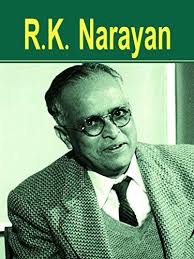
‘Some years ago there was a forestry officer in this town who always scoffed at things. He was sent for this posting by his department for some special work in Mempi Forest and he had his headquarters here. He had spent a couple of years abroad, and after returning home he was full of contempt for all our practices and institutions He was a hard core ‘rational’ by which he meant that he believed only in things he could touch, see, hear and smell. God didn’t pass any of these tests, at any rate the God we believed in. Accordingly to most of us, God resides in the Anjaneya (hanuman) temple we see on the way.
‘It is a very small temple, no doubt, but it is very ancient. It is right in the centre of the town, at the cutting of the two most important roads—Lawley Road running east and west and the Trunk Road running north and south; and any person going out anywhere, whether to the court or the college, the market or the Extension, has to pass the temple. And no one is so foolish as to ignore God and carry on as He is very real and He can make His power felt. I do not say that He showers good fortune only on those who bow at Him … I do not mean that at all. But I also do not mean that it is very simple to please a god. It costs about a quarter-of-an-anna a week and five minutes of prayer on a Saturday evening. Ninety-nine out of a hundred do it. On any Saturday evening you will find a thousand people at the temple, going round the image and burning camphor.
‘I have said that the temple is at an important crossing and every time our friend passed up and down either to his office or club, he had to pass it, and you may be sure, particularly Saturday evenings, the crowd around the temple caused dislocation of traffic. Where, lesser beings faced it cheerfully. But our friend was always annoyed. He would remark to his driver. “Run over the blasted crowd. Superstitious mugs. If this town had a sane municipality this temple would have been pulled down years ago ….”
‘On a Sunday morning the driver asked: “May I have the afternoon off, sir?”
‘Why?’
‘When my child fell ill some days ago I vowed I would visit the crossroad shrine with my family …’
‘Today?’
‘Yes, sir. On other days it is crowded.’
‘You can’t go today.’
‘I have to, sir. It is a duty ….’
‘You can’t go. You can’t have leave for all your superstitious humbugging.’ The driver was so insistent that the officer told him a few minutes later: ‘All right, go. Come on the first of next month and take your pay. You are dismissed.’
‘At five o’clock when he started for his club he felt irritated. He had no driver. ‘I will do without these fellows,’ he said to himself. ‘Why should I depend upon anyone?’
‘The chief reason why he depended upon others was that he was too nervous to handle a car. His head was a whirl of confusion when he sat at the wheel. He had not driven more than fifty miles in all his life though he had a driving licence and renewed it punctually every year. Now as he thought of the race of chauffeurs he felt bitter. ‘I will teach these beggars a lesson. Drivers aren’t heaven-born. Just ordinary fellows. It is all a question of practice; one has to make a beginning somewhere. I will teach these superstitious beggars a lesson. India will never become a first-rate nation as long as it worships traffic-obstructing gods, which any sensible municipality ought to remove.’
‘It was years since he had driven a car. With trepidation he opened the garage door and climbed in. At a speed of about twenty-five miles an hour his car shot out of the gate after it had finally emerged from the throes of gear-changing. It flew past the temple when our friend realised that somehow he could not turn to his left, which he must, if he wanted to reach his club. He could only steer to his right. Nor could he stop the car when he wanted. He felt that applying the brakes was an extraordinary queer business. When he tried to stop he committed so many blunders that the car rocked, danced and threatened to burst. He felt it safest to go up the road till a favourable opportunity presented itself for him to turn right, and then again right, and about-turn. He whizzed past the temple back to his bungalow, where he could not stop, and so had to proceed again, turn right, go up to Trunk Road, turn right again, and come down the road past the temple.
‘Half-an-hour later the dismissed driver arrived at the shrine with his family and was nearly run over. He stepped aside and had hardly recovered from the shock when the car reappeared. The driver put away his basket of offerings, took his family to a place of safety, and came out.
When the car appeared again he asked, “What is the matter sir?” His master looked at him pathetically and before he could answer the car came around again: “Can’t stop.”
“Use the hand-brake, sir, the foot-brake’s rather loose.”
“I can’t,” panted our friend.
The driver realised that the only thing his master could do with a car was to turn its wheel right and blow the horn. He asked, “Have you put in any petrol, sir?”
“No.”
“It had only one-and-a-half gallons; let it run it out.” The driver went in, performed puja, sent away his family and attempted to jump on the footboard. He couldn’t. He stood aside on a temple step with folded hands, patiently waiting for the car to exhaust its petrol.
The car soon came to a stop. The gentleman gave a gasp and fainted on the steering-wheel. He was revived. When he regained consciousness, the priest of the temple held before him a plate and said, “Sir, you have circled the temple over five hundred times today. Ordinarily people go around only nine times, and on special occasions one hundred-and-eight times. I haven’t closed the doors thinking you might like to offer coconut and camphor at the end of your rounds.”
The officer flung a coin on the tray.
The driver asked, “Can I be of any service, sir?”
“Yes drive the car home.”
He reinstated the driver, who demanded a raise a fortnight later. And thereafter whenever our friend passed the temple, he exercised great self-control and never let an impatient word cross his lips. I won’t say that he became very devout all of a sudden, but he certainly checked his temper and tongue when he was in the vicinity of the temple. And wasn’t it enough achievement for a god?
Shravan Charity Mission is an NGO that works for poor children suffering from life threatening diseases especially cancer. Our posts are meant for our readers that includes both children and adults and it has a huge variety in terms of content. We also accept donations for our mission. Should you wish to donate for the cause. The bank details are given below:
NAME OF ACCOUNT: SHRAVAN CHARITY MISSION
Account no: 680510110004635 (BANK OF INDIA)
IFSC code: BKID0006805
*
Our publications
GLOOM BEHIND THE SMILE
(The book is about a young cancer patient. Now archived in 7 prestigious libraries of the US, including, Harvard University and Library of Congress. It can also be accessed in MIT through Worldcat.org. Besides, it is also available for reading in Libraries and archives of Canada and Cancer Aid and Research Foundation Mumbai)
ONE TO TANGO … RIA’S ODYSSEY
(Is a book on ‘singlehood’ about a Delhi girl now archived in Connemara Library, Chennai and Delhi Public Library, GOI, Ministry of Culture, Delhi)
AADAB LUCKNOW … FOND MEMORIES
(Is a fiction written around the great city of Nawabs—Lucknow. It describes Lucknow in great detail and also talks about its Hindu-Muslim amity. That happens to be its undying characteristic. The book was launched in Lucknow International Literary Festival of 2014)
REFRACTIONS … FROM THE PRISM OF GOD
(Co-published by Cankids–Kidscan, a pan India NGO and Shravan Charity Mission, that works for Child cancer in India. The book is endorsed by Ms Preetha Reddy, MD Apollo Hospitals Group. It was launched in Lucknow International Literary Festival 2016)
TYPICAL TALE OF AN INDIAN SALESMAN
(Is a story of an Indian salesman who is, humbly qualified. Yet he fights his ways through unceasing uncertainties to reach the top. A good read not only for salesmen. The book was launched on 10th February, 2018 in Gorakhpur Lit-Fest. Now available in Amazon, Flipkart and Onlinegatha)
RHYTHM … in poems
(Published in January 2019. The book contains 50 poems. The poems describe our day to day life. The book is available in Amazon, Flipkart and Onlinegatha)
(ALL THE ABOVE TITLES ARE AVAILABLE FOR SALE IN AMAZON, FLIPKART AND OTHER ONLINE STORES OR YOU COULD EVEN WRITE TO US FOR A COPY)
Follow the teachings only, don’t attempt to imitate God- Gita
“Man should attempt to follow the spiritual teachings of God. Either by following the God directly or through his avatars on whom he has vested such powers. His updesh (sermons) alone are good enough for the welfare of mankind, which any intelligent person can explain to us in a proper manner.
It is indeed in the interest of human beings to draw their lessons only from the sermons of God and never try and attempt to either imitate or emulate his actions for that could be hazardous. A devotee of Lord God Shiva shouldn’t attempt to consume poison. Just as he drank all of it that came out from the SamudraManthan (Churning of the sea).
We should consider God as the supreme power and his avatars the forces that reign and control the direction and speed of the sun and the moon. Any person without such powers, in his own interest should not try and imitate the all powerful God almighty.
Lord God Shiva consumed all the poison that came out of Samudra manthan, because he had the capacity and ability to do so. But if an ordinary person tries to consume even a drop of poison he will die. Lord Shiva has many ardent devotees and followers who consume ganja (Cannabis) and other intoxicating stuff, thinking they are permitted to follow suit just because Lord God Shiva consumes it. Such devotees and followers are only killing themselves, because their body and soul does not have the capacity to sustain this poison over a long period of time like Lord Shiva.
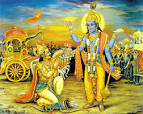
In the same manner there are many devotees of Lord Krishna who intend to practice and imitate his Rass-Lila or love dance, but forget that he also had the capacity to lift the Goverdhan Parvat which an ordinary person can’t.
Therefore, the best option would be not to imitate the all powerful God and his Avatars and only follow their updesh. Without eligibility and capacity one should not try and copy what God does as it will only hurt. And there are many God’s and Avatars who too don’t have the powers of God Almighty yet they are God’s.







 Shravan charity mission