Copyright@shravancharitymission
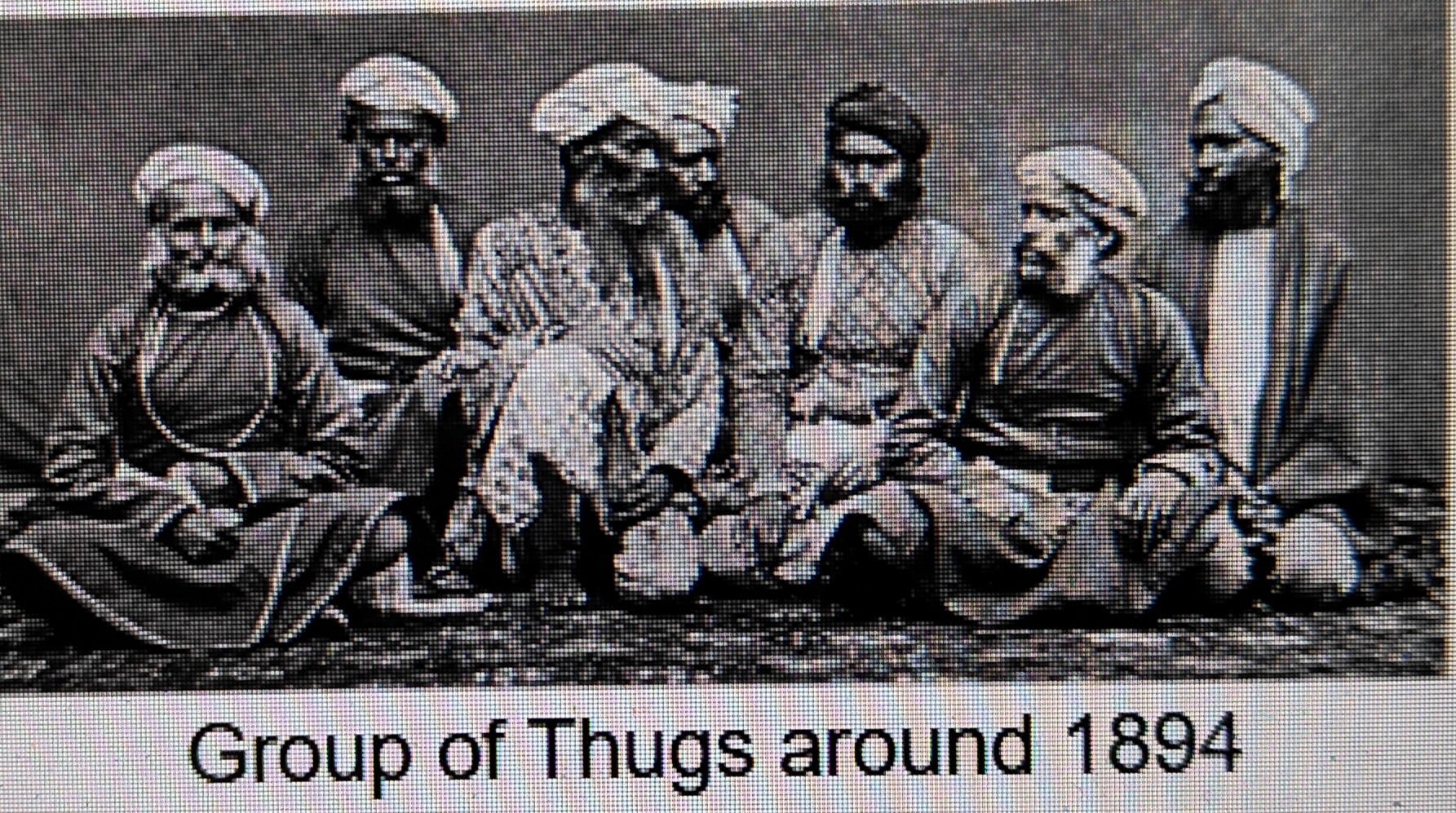
The heinous acts of ‘Thugs’ were called ‘Thuggee.’ They were organised gangs of robbers and murderers. The English word ‘Thug’ originates from the Hindi word Thug which means a ‘swindler’ or a ‘deceiver’.’ ‘Thugee’ entailed an act of murder and robbery of travellers. It was rampant in the northern parts of the Indian subcontinent.
Thugs travelled in groups. There are numerous folklore about their origin. One recorded by D.F. McLeod an Anglo-Indian civil servant traced it back to the Muslim tribes originating from those who fled Delhi after murdering a physician. Another traced it to certain renowned Muslim families who fled after murdering a favourite slave of Akbar. These original Muslim thugs cultivated thuggee, amongst various communities and castes of Hindus. According to some other folklore, thugs were Kanjars or descended from those, who worked in Mughal barracks. Others blamed the rise of thugs on the disbanding of armies in the employment of Indian rulers after the British conquest. Thugs operated in gangs as highway robbers, first tricking and later strangling their victims.
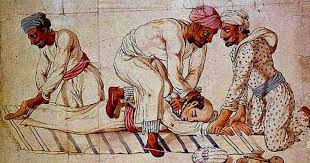
To take advantage of the victims, the thugs would join travellers to first gain their confidence. This would facilitate them to surprise and strangle the travellers with a handkerchief or a noose. They would then rob, kill and bury the victims. This gave the thugs the name Phansigar, one who kills with a noose. During the 1830s, the Governor-General of India, Lord William Bentinck and his chief captain, William Henry Sleeman, targeted the elimination of thugs.
In physical appearance, the thugs resembled the travellers. They wore turbans and carried some baggage in person. Their attire would deceive, any traveller.
The idea of ‘Thugee’ was to steal maximum loot without being apprehended. The thugs did not accost travellers until their own numbers were greater than their target. They first flattered the travellers they met, which gave them a chance to gauge how many valuables they were carrying. Thugs avoided committing thuggee close to their native place, so their crimes were difficult to discover. They pretended to be either Hindu or Muslim to fool their victims.
They usually attacked in the evening. A common way was to distract their targets while attempting to strangle them from behind. They carried only a few swords for self-defence to avoid any suspicion. At times they even mutilated the corpses of their victims to avoid detection. The corpse was then hidden or buried.
The leader of the gang was called Jamadar. They used ranks such as jamadar and subedar, to suggest that their organisation had a military construct. They spoke a secret language called ‘Ramasee’ to disguise their real intentions from their targets. Although strangulation was one of their most recognised methods of murder, they also used blades and poison.
Thugs were made up of men, who inherited thuggee as a family vocation, as well as those, who were forced to turn to it because of circumstances. The head of the gang was based on inheritance with family members sometimes serving together in the same band. These thugs were known as aseel. Certain thugs, insisted, that beginners were not taught thuggee, by their own family members but by outsiders who were often more skilled and experienced. They were called gurus. Thugs usually kept their acts secret. There were female thugs too who were called baronee in their secret language Ramasee, while an important male thug was called baroo.
Thugs often avoided, the killing of a victim’s child, instead they would adopt the child. At times they murdered women and children to eliminate witnesses. Some thugs avoided killing of victims they considered proscribed according to their beliefs and let other unscrupulous members commit the murder.
It is on record that during the 14th century, a thousand thugs were captured and hanged on the streets of Delhi. Two-hundred years later Sher Shah Suri organised a cavalry of 1,200 men to keep them at bay. Akbar and his successors launched drives against the thugs, but it was only in the 19th century that Sir W. H. Sleeman succeeded in wiping them out after a relentless operation lasting seven years.
The initial references to the thugs as a fraternity, rather than ordinary thieves, is found in Zia-ud-din Barni’s History of Firoz Shah written around 1356, where he narrated an incident of sultan Jalal-ud-din Khalji, having arrested 1,000 thugs.
Poet Surdas, in his couplets, mentioned, robbers called “thugs.” The Janamsakhis, the legendary biographies of Guru Nanak, used the term thug to refer to a robber who used to lure pilgrims. Jean de Thevenot, a French traveller in his account referred to a band of robbers who used a “certain slip with a running noose” to strangle their victims. John Fryer an English doctor of the Royal Society, mentioned a similar method of strangling used by robbers from Surat whom he saw being given capital punishment by the Mughals in 1675. An edict issued by Aurangzeb in 1672 refers to a similar method and uses the term “Phansigar”.
The garrotte (killing by strangulation) is often depicted as a weapon of the thuggee. Thugs committed their murders with nooses of rope or catgut, but later they adopted the use of a length of cloth that could be used as a sash or scarf, and thus more easily concealed. This cloth is sometimes described as a rumal (head covering or kerchief), translated as “yellow scarf”; “yellow”, in this case, may refer to a natural cream or khaki colour rather than bright yellow.
Thug’s preference for strangulation might have originated from a quirk of the law under the Mughal Empire that ruled most of India from the 1500s. For a murderer to be sentenced to death, he or she must have shed the blood of the victim. Those who murdered but did not shed blood might face imprisonment, hard labour and paying of a penalty—but they would not risk execution.
A poison called Datura, derived from a plant in the Nightshade family, was sometimes used by thugs to induce drowsiness making strangulation easier.
The “River Thugs” killed people which included Hindu pilgrims, travelling through the River Ganga, and were active mostly during the winter. Their vocabulary of Ramasee differed from the one used by the thugs on land. They used boats taken on lease from the boat-builders or a jamadar called Khuruck Baboo. Sleeman states that they tapped three times to give the signal to murder, which they always committed during the day. To avoid detection of a corpse, they broke its back and threw it in the river to be eaten by crocodiles and only looted money or jewels.
By the 1870s, the ‘thug cult’ was largely extinct. However, the history of thuggee contributed to the establishment of the Criminal Tribes Act (CTA) of 1871. The CTA was repealed after India gained independence. The Thuggee and Dacoity Department continued to operate until 1904 when it was replaced by the Central Criminal Intelligence Department (CID). Numerous Bollywood movies have been made on ‘Thuggee’, including Gunga Din (1939), Sunghursh (1968), and Thugs of Hindostan.
Posted by Kamlesh Tripathi
*
https://kamleshsujata.wordpress.com
*
Like it and Share it
*
Shravan Charity Mission is an NGO that works for poor children suffering from life-threatening diseases, especially cancer. Our posts are meant for our readers, including children and adults, and have a huge variety of content. We also accept donations for our mission. Should you wish to donate to the cause of cancer? The bank details are given below:
NAME OF ACCOUNT: SHRAVAN CHARITY MISSION
Account no: 680510110004635 (BANK OF INDIA)
IFSC code: BKID0006805
*
Publications of Kamlesh Tripathi
BOOK TITLE: GLOOM BEHIND THE SMILE
(The book is about a young cancer patient. Now archived in eight prestigious libraries of the US which include Harvard College Library; Harvard University Library; Library of Congress; University of Washington, Seattle; University of Minnesota, Minneapolis; Yale University, New Haven; University of Chicago; University of North Carolina, at Chapel Hill University Libraries. It can also be accessed at MIT through Worldcat.org. Besides, it is also available for reading in the libraries and archives of Canada; the Open Library; Cancer Aid and Research Foundation Mumbai; Jaipuria Institute of Management, Noida, India; Shoolini University, Yogananda Knowledge Center, Himachal Pradesh and Azim Premzi University, Bangalore and the Library of Cancer Aid and Research Foundation, Mumbai. The title also finds a mention in a book titled ‘Enduring Cancer: Life, Death and Diagnosis in Delhi’ by Dwaipayan Banerjee published by the Duke University Press).
BOOK TITLE: ONE TO TANGO … RIA’S ODYSSEY
(It is a book on ‘singlehood’ about a Delhi girl now archived in Connemara Library, Chennai and Delhi Public Library, GOI, Ministry of Culture, Delhi; It is also available for reading in the Indian National Bibliography, March 2016, in the literature section, in Central Reference Library, Ministry of Culture, India, Belvedere, Kolkata-700022)
BOOK TITLE: AADAB LUCKNOW … FOND MEMORIES
(This is a fiction written around the great city of Nawabs—Lucknow. It describes Lucknow in great detail and also talks about its Hindu-Muslim amity, which is the undying characteristic of Lucknow. The book was launched at the Lucknow International Literary Festival in 2014. It is catalogued and included for reading in Askews and Holts Library Services, Lancashire, U.K; Herrick District Library, Holland; Charlotte-Mecklenburg Library, Mecklenburg County, North Carolina, USA; Black Gold Cooperative Library Administration, Arroyo Grande, California; Berkeley Library, University of California; The Peshastin Public Library and The George Public Library near Washington, a Northern Central Washington Libraries branch; the Flagstaff City-Coconino County Public Library in Arizona in the US and the Salina Public Library, Kansas, USA.
BOOK TITLE: REFRACTIONS … FROM THE PRISM OF GOD
(Co-published by Cankids–Kidscan, a pan India NGO and Shravan Charity Mission, that works for child cancer in India. The book is endorsed by Ms Preetha Reddy, MD Apollo Hospitals Group. It was launched at the Lucknow International Literary Festival in 2016).
BOOK TITLE: TYPICAL TALE OF AN INDIAN SALESMAN
(Is a story of an Indian salesman who is, humbly qualified. Yet he fights his way through unceasing uncertainties to reach the top. A good read not only for salesmen but for any reader. The book was launched on 10th February 2018 at Gorakhpur Lit-Fest. Now available on Amazon, Flipkart and Onlinegatha)
BOOK TITLE: RHYTHM … IN POEMS
(Published in January 2019. The book contains 50 poems. The poems are about our day-to-day life. Poems from this book have been published in Shillong Times, Bandra Times, Bhavan’s Journal and Arunachal Times and Goan net. The book is available on Amazon, Flipkart and Onlinegatha)
BOOK TITLE: MIRAGE
(Published in February 2020. The book is a collection of eight short stories available on Amazon, Flipkart and Notion Press)
BOOK TITLE: AWADH ASSAM AND DALAI LAMA … The Kalachakra
(It is the story of the man who received His Holiness The Dalai Lama and his retinue in 1959 as a GOI representative when he fled Tibet in 1959. The book was launched on 21st November 2022 by His Holiness The Dalai Lama at Dharmshala. The title is archived in the library of the Department of Information and International Relations (DIIR) Government of Tibet, Tibet Policy Institute (TPI) and the personal library of His Holiness The Dalai Lama. The title is also archived in The Ohio Digital Library, USA. It was recently included in the digital library of the world-renowned company APPLE. Included in the library of Friends of Tibet and Maharashtra Mitra Mandal Library in Bandra, Mumbai.
(POEMS, SHORT STORIES AND ARTICLES OF KAMLESH TRIPATHI PUBLISHED IN JOURNALS AND MAGAZINES)
BHAVANS JOURNAL
Short stories, Book reviews and Articles published in Bhavan’s Journal: 1. Reality and Perception, 15.10.19; 2. Sending the Wrong Message, 31.5.20; 3. Eagle versus Scholars, June, 15 & 20, 2020; 4. Indica, 15.8.20; 5. The Story of King Chitraketu, August 31 2020; 6. Breaking Through the Chakravyuh, September 30 2020. 7. The Questioning Spouse, October 31, 2020; 8. Happy Days, November 15, 2020; 9. The Karma Cycle of Paddy and Wheat, December 15, 2020; 10. Power Vs Influence, January 31, 2021; 11. Three Refugees, March 15, 2021; 12. Rise and Fall of Ajatashatru, March 31, 2021; 13. Reformed Ruler, May 15, 2021; 14. A Lasting Name, May 31, 2021; 15. Are Animals Better Teachers? June 16, 2021; 16. Book Review: The Gram Swaraj, 1.7.21; 17. Right Age for Achievements, 15.7.21; 18. Big Things Have Small Beginnings, 15.8.21; 19. Where is Gangaridai?, 15.9.21; 20. Confront the Donkey Within You 30.9.21; 21. Know Your Strengths 15.10.21; 22. Poverty 15.11.21; 23. Top View 30.11.21; 24. The Bansuriwala 15.1.22; 25. Sale of Alaska 15.2.22; 26. The Dimasa Kingdom 28.2.22;27. Buried Treasure 15.4.22; 28. The Kingdom of Pragjyotisha 30.4.22; 29. Who is more useful? 15.5.22; 30. The White Swan from Lake Mansarovar 30.6.22; 31. Bhool Bhulayya 15.9.22; 32. Good Karma 30.9.22; 33. Good Name vs Bad Name 15.10.22; 34. Uttarapath—The Grand Trunk Road 1.12.22; 35. When Gods Get Angry 1.1.23; 36. Holinshed’s Chronicles 15.1.23; 37. Theogony 15.2.23; 38. Poem: Mother 14.5.23; 39. The Nag Mandir 30.6.23; 40. The Story of Garuda 30.7.23; 41. Janmabhoomi vs Karmabhoomi 31.8.23; 42. The Ghost Town of Kuldhara 15.9.23; 43. The Tale of Genji 15.10.23; 44. The Soul Connection 1.12.23; 45.Book review: Jungle Nama … a story of the Sundarban 16.3.24; 46. Book review: A Forgotten Chapter 16.5.24; 47. Exploring Ancient Egypt, 1.8.24; 48. The Story of Dhruva, 16.8.24; 49. Two Hundred Years of Tea in Assam 16.9.24; 50. The Cosmic Messenger 16.10.24; 51. Biblioburro: The Four-Legged Library 16.11.24
THE SHILLONG TIMES
Articles & Poems: 1. Poem: Happy New Year 8.1.23; 2.Poem: Spring 12.3.23; 3.Poem: Right and Wrong 20.3.23; 4. The Gush of Emotion—Writing, 26.3.23; 5. The Nag Mandir, 7.5.23; 6. Poem: Mother 7.5.23; 7. Poem: Rain Rain 9.7.23; 8. Poem: You Come Alone You Go Alone 6.8.23; 9. Poem: Rain Rain (Second Time) 10.8.23; 10. Poem: Guru Teacher 1.10.23; 11. Poem: Autumn … The Interim Heaven 15.10.23; 12. Poem: Happy Diwali 12.11.23; 13. Overcoming Blindness: Learn it the John Milton Way 10.12.23; 14. The Happy Prince and The Happy Man’s Shirt 31.12.23; 15. Annus Mirabilis -2024 7.1.24; 16. Gandhi to Mahatma Gandhi- Incidents that Shaped Gandhi in South Africa 28.1.24; 17. Poem: Together But Not Made For Each Other, 11.2.24; 18. The Birds Bees and The Spiders of Nicholas Guildford and Jonathan Swift 25.2.24; 19. The Overcoats of Nikolai Gogol and Ruskin Bond 10.3.24; 20. The Ethnic Colours of Holi 24.3.24; 21. A Lesson from Dalai Lama, 21.4.24; 22. Poem: Morning Walk 28.4.24; 23. Trip to Rhine Falls, Switzerland, 19.5.24; 24. Poem: Hurt 2.6.24; 25. Poem: Your Conscience Was My Sign On 16.6.24; 26.Poem: The Eerie Ways of Time 7.7.24; 27.Poem: Celebrating the T20 World Champions 14.7.24;28. Read to Rise above mediocrity, 4.8.24; 29. Poem: Desire vs Reality 11.8.24; 30. Jack Ma’s Pristine Advice to Employers, Employees and the Youth 22.9.24; 31. Tagore and Kipling 3.11.24; 32. Poem: Merry Christmas 22.12.24;
THE ASSAM TRIBUNE
Article: 1. The Magic of Reading 11.12.23; 2. Gandhi to Mahatma 29.1.24; 3. Geography of Solitude 8.4.24; 4. A Lesson From Dalai Lama, 22.4.24; 5. A Source of Inspiration, 29.4.24; 6. The Four-Legged Library, 12.5.24; 7. Age and Achievement, 10.6.24; 8. Read … To Rise Above Mediocrity, 1.7.24; 9. Crusade for a College, 25.8.24; 10. Hemingway’s Iceberg Theory (Panorama) 27.9.24; 11. Short story: Love in the Air, 20.10.24;
THE ARUNACHAL TIMES
Poem: 1. Hope—In The Arc of Twilight, 13.8.23; 2.Poem: Spring 3.3.24; 3.Poem: The Morning Walk 10.3.24;
BANDRA TIMES, MUMBAI
Articles & Poems: 1. Poem: SPRING, 1.4.23; 2. Poem: Mother, 1.6.23; 3. Poem: Rain Rain, 1.8.23; 4. A Lesson From Dalai Lama, 1.6.24; 5. Read to rise above Mediocrity 1.8.24
THE GOAN NET
Poem: 1. Autumn – The Interim Heaven, 6.10.24; 2. Reader’s Rewind 17.11.84; 3. Reader’s Rewind: The Irony of Tash Moustache or Mooch 5.12.24; 4. The Sunset Point 22.12.24;
ARTICLES IN THE DIGITAL MAGAZINE ESAMSKRITI
Aritcles: 29.12.2020: Indica by Megasthenes; 14.3.22: About The Dimasa Kingdom Assam; 10.12.22: Grand Trunk Road–Uttarapath; 5.10.23: The Ghost Town of Kuldhara Near Jaisalmer;
(ALL THE ABOVE BOOK TITLES ARE AVAILABLE FOR SALE ON AMAZON, FLIPKART AND OTHER ONLINE STORES OR YOU COULD EVEN WRITE TO US FOR A COPY)
*****
$$



 Shravan charity mission