–Via a culture that’s open to change and normalises risk-taking–
The US-China big power competition is the defining geopolitical issue of our times. Undergirding this dynamic is the race for tech, especially AI. In The New Geography Of Innovation: The Global Contest For Breakthrough Technologies, Mehran Gul investigates whether US’s Silicon Valley still retains near-monopoly over cutting-edge tech, or have other global locations such as China’s Shenzhen and even the greater London area taken over that mantle. Plus, what’s truly conducive for creating a hot tech eco-system? Is there a secret sauce that America has and China appears to have replicated? The answers are complex. At first glance. China’s breakneck development in tech over the last decade appears to be eclipsing Silicon Valley. But closer inspection reveals a nuanced picture. True, Silicon Valley is undergoing change – described in the book as a vibrant rainforest being converted into controlled farmlands. But that necessarily doesn’t translate into US tech decline, the author says. New American tech hubs are coming up in New York, Miami and Austin that are taking the flame of Silicon Valley forward. China, on the other hand, has created its own tech champions like Tencent, Baidu and ByteDance in record time. It certainly has speed on its side, and it’s quality and volume of research has also improved tremendously. But it’s still not doing pathbreaking research like US. Why? A combination of factors that includes strict guardrails of the Communist Party -exemplified by the 2021 crackdown on Chinese tech firms – a Chinese university system that is not quite yet at par with American universities, and an environment where govt policy guides the direction of innovation. But to settle the debate, one statistic is enough to confirm US’s continued tech dominance: Apple became the first American tech company to cross a trillion-dollar valuation in 2018 with seven other American companies joining it since, but the rest of the whole world, including China, doesn’t even have one. What then is the secret to successful tech eco-systems? The author interviews scores of tech entrepreneurs and stalwarts across geographies and comes to a somewhat underwhelming answer: there is no set formula. Almost all successful tech companies look the same. But they can come up in very different circumstances. In UK, the Greater London area is where all the action is. But that has come at the cost of increasing regional disparity that not only puts London at a risk but also undermines the dynamism of UK’s tech story. This disparity was also a reason for Brexit. Switzerland and Germany have great education and no shortage of talent or infra, but their local cultural preference for stability over risk means they are just not able to realise the same tech innovation potential as US or China. South Korea and Singapore created their miracles through huge govt support. But there are also limitations to this approach as seen by calls to reform Korea’s chaebols. But one thing appears clear, according to the author; societies that are more receptive to change appear to have a better chance of fostering tech successes. That means openness to talent, openness to Innovation, and openness to risks. In the Indian context, we may have Bengaluru. But we need many more Bengalurus that incentivise tech entrepreneurship and risk taking. That means a policy framework that fosters innovation and a culture shift that normalises failure. India has lots of catching up to do.
Shravan Charity Mission is an NGO that works for poor children suffering from life-threatening diseases, especially cancer. Our posts are meant for our readers, including children and adults, and have a huge variety of content. We also accept donations for our mission. Should you wish to donate to the cause of cancer? The bank details are given below:
Shravan Charity Mission is an NGO that works for poor children suffering from life-threatening diseases, especially cancer. Our posts are meant for our readers, including children and adults, and have a huge variety of content. We also accept donations for our mission. Should you wish to donate to the cause of cancer? The bank details are given below:
(PHANTOM POLICE? TIMES OF INDIA EDITORIAL 11/10/25)
Seoul has a hologram cop. Not everyone thrilled. He doesn’t quite crash land but takes form all of a sudden – a life-size apparition in uniform, if you find yourself in Seoul’s popular Jeo Dong Park. Don’t let him spook you – it’s only a hologram of a cop, appearing every two minutes between 7 pm and 10 pm to, well, spook those up to no good. Police claim the made-in-UK ‘assistant officer’ lowered crime rates in the bustling neighbourhood under Seoul Jungbu police station by as much as 22%, between Oct 2024, when the pilot was launched, and May 2025. The cop was officially posted in the park in Aug. So, if you’re wandering around, under the influence of whatever’s your poison, and itching to pick up a fight, well, chances are the sight of a ghostly cop could nudge you to abandon the idea. No need to break into a cold sweat or run, for he’ll disappear in two minutes. So what does this hologram cop do if it comes across a fight? He can’t chase, let alone handcuff you. Yet, ‘Enhanced features’ are a work in progress. His role now is surveillance, a deterrent to low-key ‘impulsive’ crime. Privacy may be globally dead, but still, the idea hasn’t gone down well with everyone. Visitors find him annoying, while his ghostly presence is fast creating an urban legend of a ‘haunted park’. Clearly, tech-savvy policing is not yet a smooth walk in the park.
Shravan Charity Mission is an NGO that works for poor children suffering from life-threatening diseases, especially cancer. Our posts are meant for our readers, including children and adults, and have a huge variety of content. We also accept donations for our mission. Should you wish to donate to the cause of cancer? The bank details are given below:
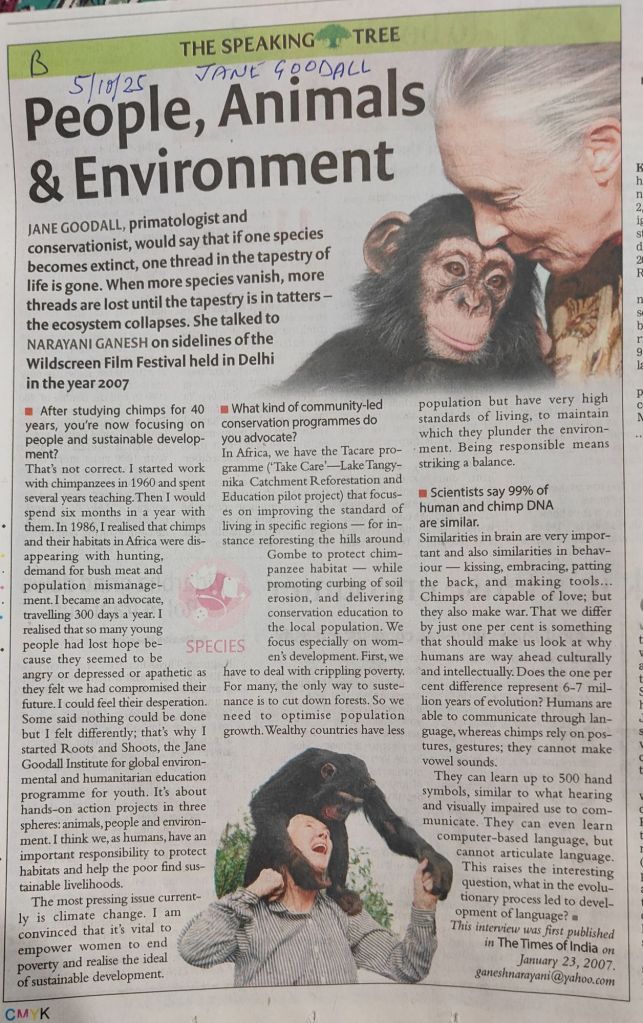
5/10/25 SPEAKING TREE PEOPLE, ANIMALS & ENVIRONMENT
JANE GOODALL, primatologist and conservationist, would say that if one species becomes extinct, one thread in the tapestry of life is gone. When more species vanish, more threads are lost until the tapestry is in tatters– the ecosystem collapses. She spoke with NARAYANI GANESH on the sidelines of the Wildscreen Film Festival held in Delhi in 2007. Q. After studying chimps for 40 years, you’re now focusing on people and sustainable development? That’s not correct. I started work with chimpanzees in 1960 and spent several years teaching. Then I would spend six months of the year with them. In 1986, I realised that chimps and their habitats in Africa were disappearing with hunting, demand for bush meat and population mismanagement. I became an advocate, travelling 300 days a year. I realised that so many young people had lost hope because they seemed to be angry or depressed, or apathetic, as they felt we had compromised their future. I could feel their desperation. Some said nothing could be done, but I felt differently; that’s why I started Roots and Shoots, the Jane Goodall Institute for global environmental and humanitarian education programmes for youth. It’s about hands-on action projects in three spheres: animals, people and the environment. I think we, as humans, have an important responsibility to protect habitats and help the poor find sustainable livelihoods. The most pressing issue currently is climate change. I am convinced that it’s vital to empower women to end poverty and realise the ideal of sustainable development. Q. What kind of community-led conservation programmes do you advocate? In Africa, we have the Tacare programme (‘Take Care’—Lake Tanganyika Catchment Reforestation and Education pilot project) that focuses on improving the standard of living in specific regions — for instance, reforesting the hills around Gombe to protect chimpanzee habitat– while promoting curbing of soil erosion, and delivering conservation education to the local population. We focus especially on women’s development. First, we have to deal with crippling poverty. For many, the only way to sustain themselves is to cut down forests. So we need to optimise population growth. Wealthy countries have less population but have very high standards of living, to maintain which they plunder the environment. Being responsible means striking a balance. Q. Scientists say 99% of human and chimp DNA are similar. Similarities in the brain are very important, and also similarities in behaviour-kissing, embracing, patting the back, and making tools… Chimps are capable of love, but they also make war. That we differ by just one per cent is something that should make us look at why humans are way ahead culturally and intellectually. Does the one per cent difference represent 6-7 million years of evolution? Humans are able to communicate through language, whereas chimps rely on postures, gestures; they cannot make vowel sounds. They can learn up to 500 hand symbols, similar to what hearing and visually impaired people use to communicate. They can even learn computer-based language, but cannot articulate language. This raises the interesting question: what in the evolutionary process led to the development of language?
(This interview was first published in The Times of India on January 23, 2007, ganeshnarayani@yahoo.com
Shravan Charity Mission is an NGO that works for poor children suffering from life-threatening diseases, especially cancer. Our posts are meant for our readers, including children and adults, and have a huge variety of content. We also accept donations for our mission. Should you wish to donate to the cause of cancer? The bank details are given below:
Shravan Charity Mission is an NGO that works for poor children suffering from life-threatening diseases, especially cancer. Our posts are meant for our readers, including children and adults, and have a huge variety of content. We also accept donations for our mission. Should you wish to donate to the cause of cancer? The bank details are given below:
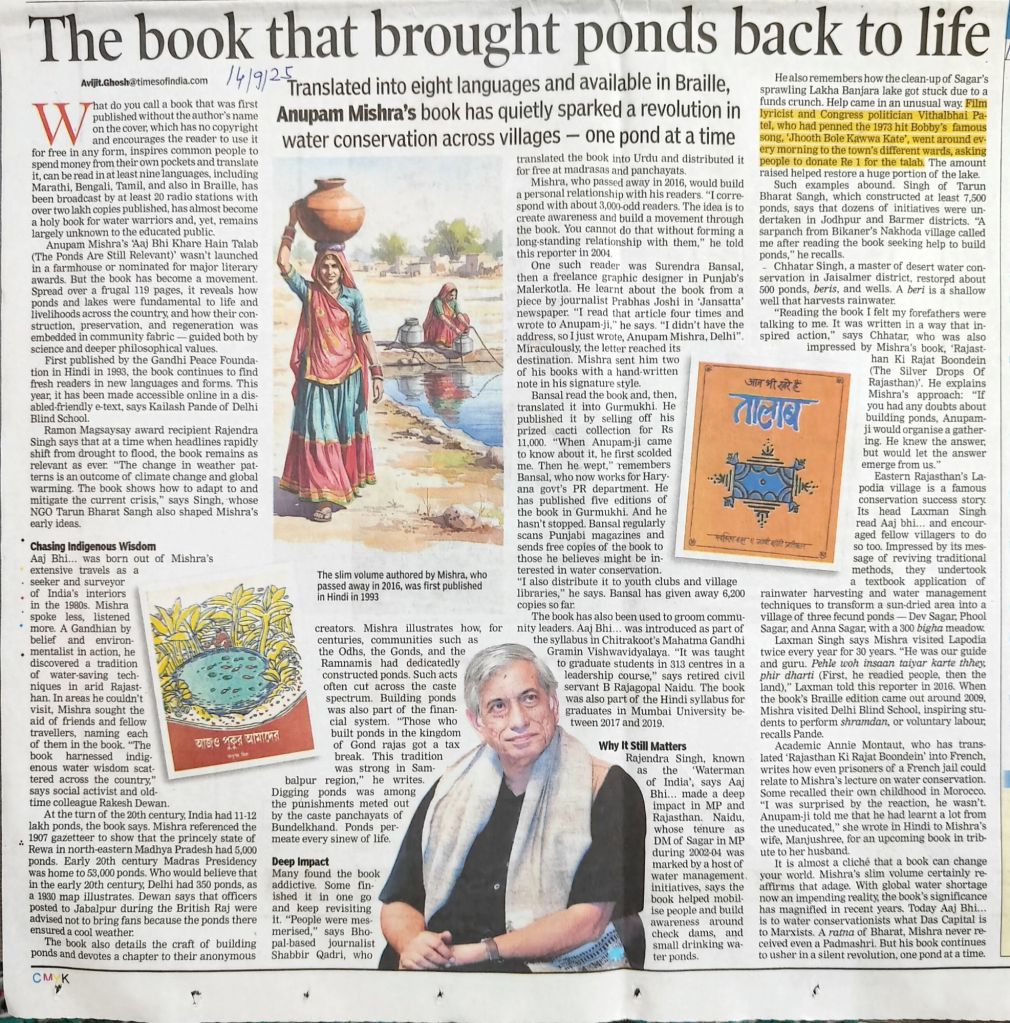
TOI article- 14/9/25 THE BOOK THAT BROUGHT PONDS BACK TO LIFE
Book Title: “Aaj Bhi Khare Hain Talaab (Ponds Are Still Relevant)” by Anupam Mishra “Translated into eight languages and available in Braille, Anupam Mishra’s book has quietly sparked a revolution in water conservation across villages — one pond at a time” What do you call a book that was first published without the author’s name on the cover, which has no copyright and encourages the reader to use it for free in any form, inspires common people to spend money from their own pockets and translate it, can be read in atleast nine languages, including Marathi, Bengali, Tamil, and also in Braille, has been broadcast by atleast 20 radio stations with over two lakh copies published, has almost become a holy book for water warriors and, yet, remains largely unknown to the educated public. Anupam Mishra’s ‘Aaj Bhi Khare Hain Talab (The Ponds Are Still Relevant)’ wasn’t launched in a farmhouse or nominated for major literary awards. But the book has become a movement. Spread over a frugal 119 pages, it reveals how ponds and lakes were fundamental to life and livelihoods across the country, and how their construction, preservation, and regeneration were embedded in community fabric-guided both by science and deeper philosophical values. First published by the Gandhi Peace Foundation in Hindi in 1993, the book continues to find fresh readers in new languages and forms. This year, it has been made accessible online in a disability-friendly e-text, says Kailash Pande of Delhi Blind School. Ramon Magsaysay award recipient Rajendra Singh says that at a time when headlines rapidly shift from drought to flood, the book remains as relevant as ever. “The change in weather patterns is an outcome of climate change and global warming. The book shows how to adapt to and mitigate the current crisis,” says Singh, whose NGO Tarun Bharat Sangh also shaped Mishra’s early ideas. Chasing Indigenous Wisdom: Aaj Bhi … was born out of Mishra’s extensive travels as a seeker and surveyor of India’s interiors in the 1980s. Mishra spoke less, listened more. A Gandhian by belief and environmentalist in action, he discovered a tradition of water-saving techniques in arid Rajasthan. In areas he couldn’t visit, Mishra sought the aid of friends and fellow travellers, naming each of them in the book. “The book harnessed indigenous water wisdom scattered across the country,” says social activist and old-time colleague Rakesh Dewan. At the turn of the 20th century, India had 11-12 lakh ponds, the book says. Mishra referenced the 1907 gazetteer to show that the princely state of Rewa in north-eastern Madhya Pradesh had 5,000 ponds. The early 20th-century Madras Presidency was home to 53,000 ponds. Who would believe that in the early 20th century, Delhi had 350 ponds, as a 1930 map illustrates. Dewan says that officers posted to Jabalpur during the British Raj were advised not to bring fans because the ponds there ensured a cool weather. The book also details the craft of building ponds and devotes a chapter to their anonymous creators. Mishra illustrates how, for centuries, communities such as the Odhs, the Gonds, and the Ramnamis had dedicatedly constructed ponds. Such acts often cut across the caste spectrum. Building ponds was also part of the financial system. “Those who built ponds in the kingdom of Gond rajas got a tax break. This tradition was strong in the Sambalpur region,” he writes. Digging ponds was among the punishments meted out by the caste panchayats of Bundelkhand. Ponds permeate every sinew of life. Deep Impact: Many found the addictive. Some finished it in one go and keep revisiting it. “People were mesmerised,” says Bhopal-based journalist Shabbir Quadri, who translated the book into Urdu and distributed it for free at madrasas and panchayats. Mishra, who passed away in 2016, would build a personal relationship with his readers. “I correspond with about 3,000-odd readers. The idea is to create awareness and build a movement through the book. You cannot do that without forming a long-standing relationship with them,” he told this reporter in 2004. One such reader was Surendra Bansal, then a freelance graphic designer in Punjab’s Malerkotla. He learnt about the book from a piece by journalist Prabhas Joshi in the ‘Jansatta’ newspaper. “I read that article four times and wrote to Anupam-Ji,” he says. “I didn’t have the address, so I just wrote, Anupam Mishra, Delhi”. Miraculously, the letter reached its destination. Mishra sent him two of his books with a handwritten note in his signature style. Bansal read the book and then translated it into Gurmukhi. He published it by selling off his prized cacti collection for Rs 11,000. “When Anupam-ji came to know about it, he first scolded me. Then he wept,” remembers Bansal, who now works for Haryana govt’s PR department. He has published five editions of the book in Gurmukhi. And he hasn’t stopped. Bansal regularly scans Punjabi magazines and sends free copies of the book to those he believes might be interested in water conservation. “I also distribute it to youth clubs and village libraries,” he says. Bansal has given away 6,200 copies so far. The book has also been used to groom community leaders. Aaj Bhi … was introduced as part of the syllabus in Chitrakoot’s Mahatma Gandhi Gramin Vishwavidyalaya. “It was taught to graduate students in 313 centres in a leadership course,” says retired civil servant B Rajagopal Naidu. The book was also part of the Hindi syllabus for graduates in Mumbai University between 2017 and 2019. Why It Still Matters Rajendra Singh, known as the ‘Waterman of India’, says Aaj Bhi … made a deep impact in MP and Rajasthan. Naidu, whose tenure as DM of Sagar in MP during 2002-04 was marked by a host of water management initiatives, says the book helped mobilise people and build awareness around check dams, and small drinking water ponds. He also remembers how the clean-up of Sagar’s sprawling Lakha Banjara lake got stuck due to a funds crunch. Help came in an unusual way. Film lyricist and Congres politician Vithalbhai Patel, who had penned the 1973 hit Bobby’s famous song, ‘Jhooth Bole Kawwa Kate’, went around every morning to the town’s different wards, asking people to donate Re 1 for the talab. The amount raised helped restore a huge portion of the lake. Such examples abound. Singh of Tarun Bharat Sangh, which constructed at least 7,500 ponds, says that dozens of initiatives were undertaken in Jodhpur and Barmer districts. “A sarpanch from Bikaner’s Nakhoda village called me after reading the book seeking help to build ponds,” he recalls. Chhatar Singh, a master of desert water conservation in Jaisalmer district, restored about 500 ponds, beris, and wells. A beri is a shallow well that harvests rainwater. “Reading the book, I felt my forefathers were talking to me. It was written in a way that inspired action,” says Chhatar, who was also impressed by Mishra’s book, ‘Rajasthan Ki Rajat Boondein (The Silver Drops Of Rajasthan)’. He explains Mishra’s approach: “If you had any doubts about building ponds, Anupam ji would organise a gathering. He knew the answer, but would let the answer emerge from us.” Eastern Rajasthan’s Lapodia village is a famous conservation success story. Its head, Laxman Singh, read Aaj bhi… and encouraged fellow villagers to do so too. Impressed by its message of reviving traditional methods, they undertook a textbook application of rainwater harvesting and water management techniques to transform a sun-dried area into a village of three fecund ponds–Dev Sagar, Phool Sagar, and Anna Sagar, with a 300 bigha meadow. Laxman Singh says Mishra visited Lapodia twice every year for 30 years. “He was our guide and guru. Pehle woh insaan taiyar karte thhey, phir dharti (First, he readied people, then the land),” Laxman told this reporter in 2016. When the book’s Braille edition came out around 2009, Mishra visited Delhi Blind School, inspiring students to perform shramdan, or voluntary labour, recalls Pande. Academic Annie Montaut, who has translated ‘Rajasthan Ki Rajat Boondein’ into French, writes how even prisoners of a French jail could relate to Mishra’s lecture on water conservation. Some recalled their own childhood in Morocco. “I was surprised by the reaction; he wasn’t. Anupam-ji told me that he had learnt a lot from the uneducated,” she wrote in Hindi to Mishra’s wife, Manjushree, for an upcoming book in tribute to her husband. It is almost a cliché that a book can change your world. Mishra’s slim volume certainly reaffirms that adage. With global water shortage now an impending reality, the book’s significance has magnified in recent years. Today Aaj Bhi… is to water conservationists what Das Capital is to Marxists. A Ratna of Bharat, Mishra, never received even a Padmashri. But his book continues to usher in a silent revolution, one pond at a time.
Shravan Charity Mission is an NGO that works for poor children suffering from life-threatening diseases, especially cancer. Our posts are meant for our readers, including children and adults, and have a huge variety of content. We also accept donations for our mission. Should you wish to donate to the cause of cancer? The bank details are given below:
Enjoy my short story published in The Assam Tribune on January 5, 2025. Happy reading.
THE PRICK OF CONSCIENCE
It reminds me of a time when I used to go to a park every day, early in the morning. The place was absolutely still and quiet and reminded me of those neat and peaceful words — pin-drop silence. It was a long walk from where I stayed. It was also the midway for me, where I used to take a break. The park was located on the banks of a river and was about 25 to 30 feet higher than the normal flow of the river water, and in between the two, there was a deep gradient. To secure the area from anyone falling into the river, a rugged railing had been raised only recently. The other end of the park touched the busy road, coming all the way from the airport and passing into the main city. Beyond the river, there was a tall, dark hillock that gave a great sense of scenic fulfilment. All around, it was lush green, especially during the monsoons, when the gushing water level, at times, used to rise and ripple past the edges of the gradient to enter the park. I normally sat there each day for about ten to 15 minutes, for some meditation and introspection that refreshed me to take on the tough day ahead. I had relocated to the city some six months ago as an inspector in the police department. In the park, I also met many health freaks coming for morning walks, and some just to lollygag. Close to the main gate of the park, there was a small tea stall. I guess it grossed all its revenue early in the morning while serving the morning walkers. Once in a while, it also served hot bhajiyas that tasted deadly with the hot tea. I had become a little pally with the tea stall owner, who was young and appeared somewhat educated. There was always a newspaper lying in the stall where tea buffs often rushed through the latest headlines, only to exchange informal barbs. As a regular visitor, I had started recognising quite a few faces there. Gradually, I even got to know the names of a few. One out of them happened to be an old person who was normally quiet. One day, the stall owner, who knew that I was a police inspector, introduced me to him. His name was Robert. In a matter of days, I started interacting with Robert and referred to him as ‘Uncle’. He must have been around 70. He spoke very little. But whenever he did, he was to the point. He was normally in his own world, and nothing amused him. The days passed on as usual. One day, Robert walked up to me and asked, “Are you in the police?” I said, “Yes.” “Then can you do me a favour?” I asked, “What favour?” He looked at me for a while and said, “Many years ago, when I was young, while playing in this park, I fought with my best friend. Unfortunately, the fight took an ugly turn. As a result, I pushed him down the slope over there. Sadly, he fell into the river. It was the peak of the monsoon when the river was in spate and he was swept away, never to return.” “Oh God! But did you tell the police that you had pushed him down the slope?” “No!” “But why?” “Because I was scared I’ll be arrested. So, the police registered a case of an accident stating that he didn’t know how to swim, so he drowned.” “So then, why are you telling me your story now, after so many years?” “After 50 years, to be precise, to clear my conscience. You’re in the police, if you want, you can still arrest me for the crime.” “Have you told this to anyone else?” “No.” “But why?” “Because he was my next-door neighbour.” “So how does that matter?” “It matters because, years later, I married his sister.” “But does she know that you were the one who pushed her brother?” “A few years ago, I did tell her. She couldn’t bear the shock and passed away within weeks.” “And what about your children?” “I have two sons. Both are in Australia. They don’t know about my crime. But maybe you can tell them after I’m arrested or I’m gone.” After that, he picked up his walking stick and started walking. Perhaps, he was heading home. After the unwelcome conversation, a couple of days passed, but I did not see Robert. One day, when I reached the tea stall. I was informed by the stall owner that Robert had committed suicide. I was shocked to hear the news. Perhaps, he was preparing for it, mentally, when he told me about his act of crime. I morosely attended his funeral, where I even got to meet his two sons, Richard and Simon, but I did not mention anything. After that, I continued with my morning walk, as usual. One day, when I arrived at the tea stall, the owner gave me a sealed envelope that Robert had left for me. I opened it. There was another sealed cover within, bearing the name and address of Richard in Australia, with a request to send it to him through a reliable courier, which I did. Robert, after losing his wife, couldn’t have taken a chance with his sons– he didn’t want them to commit suicide. But he wanted to confess his crime to his children, which he did after he was gone. Most certainly, your pricking conscience is the most relentless jury in you.
Shravan Charity Mission is an NGO that works for poor children suffering from life-threatening diseases, especially cancer. Our posts are meant for our readers, including children and adults, and have a huge variety of content. We also accept donations for our mission. Should you wish to donate to the cause of cancer? The bank details are given below:
You thought your hometown was your favourite town, But the hometown had something else to convey, Upon your return after decades.
*
Though the name of the town had remained the same, Everything else in it had changed.
*
The spires and minarets were dwarfed by skyscrapers, Schools had become colleges, Shops had become malls, Parks had become dump yards.
*
Barren fields had turned into housing societies, Playing fields had turned into gated communities. All around, the view was different, Where the docile town had turned into a bustling city.
*
Early friends had become senior citizens, Roads had become flyovers, The skyline now had a metro, Locations had a new look.
*
Eateries had new banners, Markets had a new behaviour.
Childlike had metamorphosed into adultlike, It was when I returned to the city after decades.
*
From a pleasant child’s face, I had now become an unknown and grown-up face. So, everywhere in the hometown, I was required to introduce myself.
*
It was the same town you had left with hope, That someday you would return as a familiar face. But that was not to be, For the hometown had its own fortune to make.
*
Though your name was in the air, You had now become an unknown face. Though you remembered the names of your friends, Their faces, too, had changed.
*
It was now your karma-bhoomi versus your hometown, One had given you identity, The other had given you a career opportunity. One had given you fond and affectionate memories, The other had given you a professional name.
*
So was it a letdown? To return to your hometown? Yes, in some ways. So don’t have blind faith, Whether it is your hometown or your workplace, For both have their own legacies to make.
**
“The biggest permanence of life is change. Don’t expect your hometown to be the same as it was when you left it decades ago. So return if you have to, but with a pinch of salt.”
Shravan Charity Mission is an NGO that works for poor children suffering from life-threatening diseases, especially cancer. Our posts are designed for our readers, including children and adults, and feature a diverse range of content. We also accept donations for our mission. Should you wish to contribute to the cause of cancer research? The bank details are given below:
Every morning, I walk up to the IT College metro station from my house, which is about ten minutes, cutting across the sprawling Police Lines. Today was a similar drill. I took the metro from there to Hazratganj Station, which is just three stations away. And today, being a holiday, the metro was absolutely empty. In fact, I was the only chap, I think, who got down at the Hazratganj station. Even as I was returning, I was the only person who boarded from there.
In Hazratganj, I usually walk for about half an hour every day. But the air was heavy today, even when the roads and the footpath were empty. There was a heavy security deployment near the Khadi Gram showroom where Yogi ji, the Chief Minister of U.P., was to arrive to pay homage to Mahatma Gandhi, today being his birth anniversary. I continued walking till I arrived at my usual joint, The Shukla tea stall, on Church Road, Hazratganj, that serves tea and street food.
The place is heavily crowded. Today was no different. I normally have a Kulhad chai there, which reminds me of the cutting Chai in Mumbai. While I was having Chai, two police motorcycles, blaring their sirens, landed at the tea stall. They started coaxing the drivers to remove their cars and scooters from there. It appeared as a special security drill on the 2nd of October. I was happy to note that I had landed in Hazratganj by metro and was on foot, so I didn’t have to bother about my car. I felt liberated. As a result, the tea tasted even sweeter, the weather even more pleasant, and the walk even more energising, and the mind relaxed. See what blaring sirens can do to you when you don’t have a car.
Shravan Charity Mission is an NGO that works for poor children suffering from life-threatening diseases, especially cancer. Our posts are meant for our readers, including children and adults, and have a huge variety of content. We also accept donations for our mission. Should you wish to donate to the cause of cancer? The bank details are given below:




 Shravan charity mission