Copyright@shravancharitymission
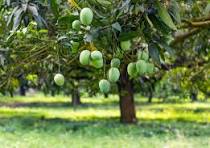
(THE TIMES OF INDIA 21/7/24 SWEET MANGO FACES A BITTER HEAT CHALLENGE
Be it the sweet and succulent Dussehri of Maal-Malihabad, Langda of Varanasi, Saharanpur’s Chausa, or Rataul variety of Baghpat – mango, the king of fruits, continues to reign supreme.
Another significant constituent of UP’s diverse mango wealth is Gaurjeet of Gorakhpur, for which the UP government is trying to get a GI tag. If this happens, UP will become the state with the maximum GI-tagged mango varieties.
What, however, has emerged as a challenge for mangoes in UP in the last few years is the unpredictable weather. Lucknow-based ICAR lab, Central Institute for Subtropical Horticulture (CISH), is working to make mangoes climate-resilient by introducing new technologies and, also, new varieties.
“Last year, it was the untimely rain, and this time, it was the extreme temperature and heat which affected the crops.” Said director, CISH, T Damodaran.
CISH Lab conducts research on mandated subtropical fruits, mangoes being the one, to come with improved varieties.
In the case of mangoes, Dussehri, being an early ripening variety, is 80% more susceptible to heat and high temperatures. “In many fruits, we saw premature ripening this time, ” the director said.
To deal with the impact of weather on mangoes, CISH is working at two levels – developing climate-resilient technologies and making efforts to come up with genetically improved hybrids. Many orchards in Malihabad had mangoes covered with paper bags this year, to control the impact of the heat. “This was only one of the ways devised to tackle the impact of heat. We have also come up with technologies to control the attack of pests on mangoes, as unpredictable weather may also trigger that,” he said.
The institute has already released two hybrid mangoes – Ambika and Arunika. The varieties are genetically improved and were tested over a period before they were released for commercial production. Each is a cross of two types of mangoes.
Ambika is a cross of Amrapali and Janardan Pasand, and Arunika is a cross of Amrapali and Vanraj, a mango from Gujarat.
Two more varieties developed by CISH, Samriddhi and Madhurika, are ready for release shortly. Besides, at least 11 other hybrid mangoes may be up for screening by the institute to be released for commercial production.
The hybrids are genetically improved, have high productivity and yield a better-quality fruit. They are also tolerant to heat waves and biotic stress due to the attack of pests and insects. The varieties developed scientifically are also nutraceutically improved. Along with this, CISH has also come up with improved varieties of Dussehri.
It is by mid-March that a Dussehri tree usually completes its flowering stage, and within a week, the fruit may set in. In Dussehri’s cycle of growth, rain in March may be damaging because that is when the flowers just open and pollination takes place. “Rain may make flowers either drop or turn black, something that happened last year,” said Naseeb Khan, a mango entrepreneur in Malihabad.
In that case, some fruits that develop may be false fruits as they would lack seeds. Mangoes need a temperature between 27 degrees Celsius and 35 degrees Celsius to grow ideally in March and April. The varying temperature damages the fruit. Cloudy weather, high humidity and high velocity winds may further hit the crop. “In many fruits, this year, the seed may become soggy, affecting the taste. It was because of the extreme heat,” said Khan. UP accounts for over 23% of the total mango production in the country. Lucknow, Saharanpur and Meerut are the main mango-producing regions. In the last few years, mango varieties from the state have been exported to Singapore, Malaysia, the US, England and Dubai.
(PICTURES OF MANGO VARIETIES ON A PLATTER)
(‘OG’ (ORIGINAL) MANGOES OF UP)
– Dussehri from Maal-Malihabad in Lucknow, Langda from Varanasi, Rataul from Baghpat, Gaurpreet from Gorakhpur and Chausa from Saharanpur grow naturally in UP.
– Dussehri, Rataul and Langda are GI tagged. The UP government has sought a GI tag for Chausa and Gaurpreet.
– Dussehri, Langda and Chausa are exported outside UP and India and are commercially successful and popular.
FIRST HYBRID MANGO VARIETIES
– Work to develop hybrid varieties of mangoes started in the 1960s at the Indian Agricultural Research Institute, New Delhi
– The purpose was to develop varieties that would bear every year and have high productivity, besides yielding good quality fruits.
– Amrapali (cross of Dussehri and Neelam) and Mallika (cross of Neelam and Dussehri) were the first hybrids.
– Dussehri is from North India, and Neelam is from South India. While North Indian varieties are biennial, those from South India bear annually.
– CISH CONSERVES AND PROPAGATES 775 MANGO VARIETIES
– CISH has the biggest collection of mango germplasm in the world.
– Many varieties are now extinct at their places of origin
– Collection started in 1975 when the institute started as the Central Mango Research Station.
– Kensington Pride from Australia was the first exotic variety brought to the institute.
– Today, it has 17 others, including Tommy Atkins, Sensation, Edward, Eldon, Keitt, Kent, Osteen, Palmer, Kitchner, Starch, Filipino, Lilly, Maya, Carabao, Kowasaji Patel, St Alexander & Prior-de-Amroesia.
– Mangoes have been sourced from nurseries and orchard owners over a period of time, and are used to develop new varieties.
Posted by Kamlesh Tripathi
Author, Poet, & Columnist
*
https://kamleshsujata.wordpress.com
*
Like it and Share it
*
Shravan Charity Mission is an NGO that works for poor children suffering from life-threatening diseases, especially cancer. Our posts are meant for our readers, including children and adults, and have a huge variety of content. We also accept donations for our mission. Should you wish to donate to the cause of cancer? The bank details are given below:
NAME OF ACCOUNT: SHRAVAN CHARITY MISSION
Account no: 680510110004635 (BANK OF INDIA)
IFSC code: BKID0006805
***



 Shravan charity mission