At the conference in New Delhi where Lord Mountbatten disclosed Britain’s partition plan for India (left to right) Indian nationalist leader Jawaharlal Nehru (1869 – 1964), adviser to Mountbatten Lord Ismay, Viceroy of India Lord Louis Mountbatten, and President of the All-India Muslim League Muhammad Ali Jinnah. (Photo by Keystone/Getty Images)
When India got freedom, but didn’t know what its boundaries were TIMES NEWS NETWORK, 22.8.21
On the midnight of August 15, 1947, we knew that India had kept its tryst with destiny, we knew that the subcontinent had been divided, that we were now two countries, India and Pakistan, but what we didn’t know was where India ended and Pakistan began. The boundary lines were still unknown.
That had been Viceroy Lord Mountbatten’s idea. He didn’t want the celebrations to be marred by recriminations on both sides. As if that was possible.
The British had long lost the opportunity for a peaceful and orderly handover of power. With the failure of the 1942 Cripps’ mission and then the three-member 1946 Cabinet delegation (with Sir Stafford Cripps playing the key role again), partition was inevitable. But how do you divide a subcontinent? Drawing the line was never going to be easy.
The man chosen for the task was Sir Cyril Radcliffe, a man who hadn’t travelled further east than the Gibraltar. But it fell on this 48-year-old Inner Temple barrister to do this impossible task– and that, too, in just five weeks.
While Radcliffe may have known little or nothing of India, he was, after all, the ultimate establishment man, which is probably why he was picked for the job. He had studied at Haileybury (Clement Attlee, the British Prime Minister then, also went to the same school) and then Oxford. After that, he had a brilliant career as a barrister. During the war, he had been director-general in the Ministry of Information, responsible for censorship and propaganda. It was Radcliffe who had run a campaign against Nehru’s sister Vijaya Lakshmi Pandit when she visited the United States. Radcliffe had also harassed P.G. Wodehouse ‘when he made ill-judged broadcasts while in German captivity’, wrote Patrick French.
So, the Establishment Man reached India and began work as a ‘neutral umpire’ in New Delhi on July 8. He would live separately, guarded by a massive Punjabi armed with two pistols. He would take his own decisions; no one would be around to influence him. But it wasn’t such a secluded existence for Radcliffe, after all. He dined with British military commander Claude Auchinleck (maybe the Auk needed consoling; his wife had run away with his friend), Lord Mountbatten, Punjab Governor Sir Evan Jenkins and many other members of the British high society.
It’s hard to believe that Radcliffe did not discuss the boundary issue with the others, who all knew much more about India than he did. But more than anything else, Radcliffe had a cheat sheet. In February 1946, the ever-underrated Archibald Wavell, the Viceroy of India, was unceremoniously sacked by the British Prime Minister, Clement Attlee, while sending in Mountbatten, as he had drawn up a contingency plan. Wavell knew what was coming. And he understood the need for a well-thought-out boundary line. Helping him were Reforms Commissioner V.P. Menon and Benegal Rau.
So, what did Radcliffe have to go with? Maybe some advice from veterans, Wavell’s map, and outdated census data. And with this, he had to divide a subcontinent in 36 days. Its people, villages, rivers, canals, roads. And to compound matters, the weather was frightfully hot, and Radcliffe came down with a bout of dysentery.
Seventy-four years later, it might be easy to say, ‘Poor fellow, he was only a lawyer with a brief; what more could he possibly have done? But in 1947, everything hinged on this lawyer and his brief. Would he award Gurdaspur to India or Pakistan? Would he really award a part of Ferozepur to Pakistan, so that it had better control over its water supply?
In fact, he almost gave away a part of Ferozepur to Pakistan. In the first week of August, during a lunch with his commissioners at a club in Simla, he said he would give Pakistan a part of Ferozepur because India was getting Gurdaspur. But that was not to be. When word got out, there was frenzied behind-the-scenes activity that made the ‘neutral umpire’ change his mind– and the boundary line — within days.
He handed over all the Awards to Mountbatten on August 13, but Mountbatten ruled that the Awards would not be made public till August 16. So, on August 15, a free India still did not know its exact boundaries.
When at 5 pm, on August 16, Liaquat Ali Khan, Jawaharlal Nehru, Sardar Patel and Baldev Singh gathered in the Council Chamber of Government House, three hours after the Awards had been sent to them, no one looked happy. It would be months before things settled down. For the moment, freedom had arrived, and with it the horrors of Partition.
For Radcliffe, it was time to go home. He boarded a flight out on August 17. He never came back. Later, when a reporter asked him if he would ever like to visit India, he said: ‘God forbid. Not even if they asked me. I suspect they would shoot me out of hand– both sides.’
The piece also includes the following pictures and press clippings
** PICTURE SEPT 1947 REFUGEES CROWD ONTO TRAINS FOR PAKISTAN AS THEY LEAVE NEW DELHI ** PRESS CLIPPING AUG 18, 1947 PUNJAB & BENGAL BOUNDARY AWARD ANNOUNCED NO AGREED SOLUTION: WIDE DIVERGENCE OF OPINION
ASSENT TO CHAIRMAN’S OWN DECISION
DEMARCATION OF BORDERS OF DIVIDED PROVINCES
AUG 18 MOVES TO RESTORE PEACE IN PUNJAB… PINDI CUT OFF FROM REST OF INDIA ** AUG 19 PUNJAB PROMISED AID IN SUPPRESSING DISORDERS… PLANS FOR IMMEDIATE CONCERTED ACTION FORMULATED ** AUG 23 ENDING PUNJAB AND QUETTA LAWLESSNESS … PAKISTAN CABINET’S DECISION
Shravan Charity Mission is an NGO that works for poor children suffering from life-threatening diseases, especially cancer. Our posts are meant for our readers, including children and adults, and have a huge variety of content. We also accept donations for our mission. Should you wish to donate to the cause of cancer? The bank details are given below:
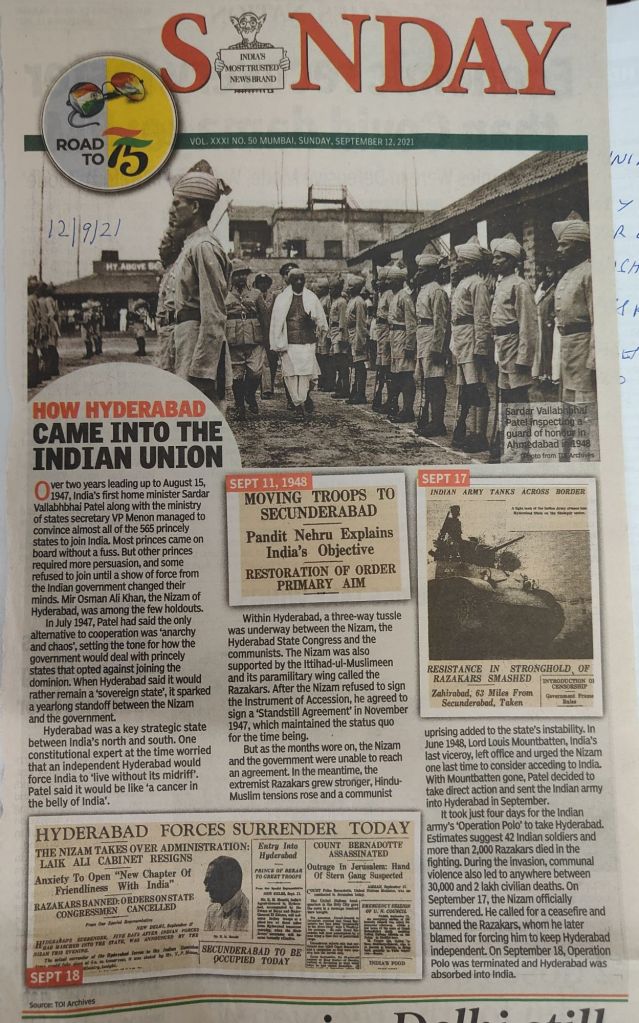
Over two years leading up to August 15, 1947, India’s first home minister, Sardar Vallabhbhai Patel, along with the Ministry of States secretary VP Menon, managed to convince almost all the 565 princely states to join India. Most princes came on board without a fuss. But other princes required more persuasion, and some refused to join until a show of force from the Indian government changed their minds. Mir Osman Ali Khan, the Nizam of Hyderabad, was among the few holdouts. In July 1947, Patel had said the only alternative to cooperation was ‘anarchy and chaos’, setting the tone for how the government would deal with princely states that opted against joining the dominion. When Hyderabad said it would rather remain a ‘sovereign state’, it sparked a year-long standoff between the Nizam and the government. Hyderabad was a key strategic state between India’s north and south. One constitutional expert at the time worried that an independent Hyderabad would force India to ‘live without the midriff’. Patel said it would be like ‘a cancer in the belly of India’. Within Hyderabad, a three-way tussle was underway between the Nizam, the Hyderabad State Congress and the communists. The Nizam was also supported by the Ittihad-ul-Muslimeen and its paramilitary wing called the Razakars. After the Nizam refused to sign the instrument of Accession, he agreed to sign a ‘Standstill Agreement’ in November 1947, which maintained the status quo for the time being. But as the months wore on, the Nizam and the government were unable to reach an agreement. In the meantime, the extremist Razakars grew stronger, Hindu-Muslim tensions rose and a communist uprising added to the state’s instability. In June 1948, Lord Louis Mountbatten, India’s last viceroy, left office and urged the Nizam one last time to consider acceding to India. With Mountbatten gone, Patel decided to take direct action and sent the Indian army into Hyderabad in September. It took just four days for the Indian army’s ‘Operation Polo’ to take Hyderabad. Estimates suggest 42 Indian soldiers and more than 2,000 Razakars died in the fighting. During the invasion, communal violence also led to anywhere between 30,000 and 2 lakh civilian deaths. On September 17, the Nizam officially surrendered. He called for a ceasefire and banned the Razakars, whom he later blamed for forcing him to keep Hyderabad independent. On September 18, Operation Polo was terminated, and Hyderabad was absorbed into India.
Shravan Charity Mission is an NGO that works for poor children suffering from life-threatening diseases, especially cancer. Our posts are meant for our readers, including children and adults, and have a huge variety of content. We also accept donations for our mission. Should you wish to donate to the cause of cancer? The bank details are given below:
Why were so many dharnas, agitations and public movements required to build Assam and the North East? Find it out for yourself by reading the book. The voluminous text under the guise of Assam covers the political history of undivided Assam, more precisely the northeast. It covers the period between 1947 and 1971. I would fancy calling this treatise the Political History of the North East as it was only after the independence that Assam was divided into various smaller states in the decades to follow.
But let’s stop here for a moment to ponder if such narrations (Political History) are conducive and should be written. Well, they are useful, provided, they capture the untold story of the state from reliable sources. Dr. Himanta Biswa Sarma, Chief Minister of Assam, deserves praise for approving this.
The uniqueness of the title is that it stems from the archives of the state and the central government, the public sector, libraries, newspapers, columns, books by citizens, and recorded statements of political and social heads who squarely construct the narrative. It is not a politically driven narrative but a neutral one based on facts. The archive records put the ruling dispensation of those times, especially the government of India, in poor light.
The title enumerates the linguistic and ethnic fissures of the North East after independence. It tells the gory story of the partition of India on the eastern border and the scheming role of the Muslim League in dividing her. The leaders of the Muslim League allowed Muslims from East Pakistan to enter India and live here only to build a sizeable Muslim population and dwarf the local population of Hindus, the effects of which are still visible. It also reveals the names of certain Indian Muslim leaders of that era who were close to Mohammed Ali Jinnah.
The editor appears dispassionate in his job because of which the narration enjoys that flush of impartiality. Eminent people from all walks of life have contributed munificently in bringing this spine to light. The book is divided into eight chapters, which are further divided into sub-chapters. This does not include the customary chapters. The catchy foreword is by the honourable Chief Minister of Assam.
A striking point that repeatedly comes up chapter after chapter is how the Congress government of Assam had to entreat the government of India for projects and issues relevant to the North East. To succinctly put it, Assam and the North East required many agitations, protests, and strikes to progress. No state, region or country is complete without the panorama of its history and mythology. The book does well to cover that. As a border region, the northeast had to face many invasions and wars described well in the pages one after another. The Tea industry has been the mainstay of Assam. The chapter is a real eye-opener when it comes to tea. The book is a comprehensive assortment of institutions, movements, local heroes and the all-time great personalities of India. It has some explosive chapters too. For example, did Nehru for the sake of the vote bank tamper with the ethnic and demographic tapestry of Assam and the northeast? The answer lies embedded in the pages of the title.
Why were things not as easy for the North East as they were for the western borders of India? So many dharnas and agitation were required to build Assam. Assam unlike Punjab (both border states) which was close to the capital had tough logistics and credibility issues while tackling the government of India. The central leadership was perhaps not aware of the complexities of the region. For every small project, Assam had to confront the government of India.
The book does well in capturing the ancient history of the land. The sources of data collection are extensive. Northeast is a complete potpourri of cultures. There was bitterness and mistrust between the plains (Assam), the hills and the government. Language was always a sensitive issue. The people of the northeast had to continuously fight for their identity. This spoke of the complexity of the land where they belonged to. The curse of partition and its shady manoeuvres haunts Assam and the northeast even today. Northeast was subject to linguistic dissensions. Assam is a politically sensitive border state. There was a time when people called it a Cinderella State.
The narrative is a brilliant effort by the Government of Assam. Congratulations to the education minister and the editor too. The idea should be embraced by all Indian states to understand their current position and trace their origins.
Shravan Charity Mission is an NGO that works for poor children suffering from life-threatening diseases, especially cancer. Our posts are meant for our readers, including children and adults, and have a huge variety in content. We also accept donations for our mission. Should you wish to donate to the cause? The bank details are given below:
NAME OF ACCOUNT: SHRAVAN CHARITY MISSION
Account no: 680510110004635 (BANK OF INDIA)
IFSC code: BKID0006805
*
Kamlesh Tripathi’s Publications
GLOOM BEHIND THE SMILE
(The book is about a young cancer patient. Now archived in 8 prestigious libraries of the US which include Harvard College Library; Harvard University Library; Library of Congress; University of Washington, Seattle; University of Minnesota, Minneapolis; Yale University, New Haven; University of Chicago; University of North Carolina, at Chapel Hill University Libraries. It can also be accessed at MIT through Worldcat.org. Besides, it is also available for reading in libraries and archives of Canada; Cancer Aid and Research Foundation Mumbai; Jaipuria Institute of Management, Noida, India; Shoolini University, Yogananda Knowledge Center, Himachal Pradesh and Azim Premzi University, Bangalore).
ONE TO TANGO … RIA’S ODYSSEY
(Is a book on ‘singlehood’ about a Delhi girl now archived in Connemara Library, Chennai and Delhi Public Library, GOI, Ministry of Culture, Delhi; It is also available for reading in the Indian National Bibliography, March 2016, in the literature section, in Central Reference Library, Ministry of Culture, India, Belvedere, Kolkata-700022)
AADAB LUCKNOW … FOND MEMORIES
(Is a fiction written around the great city of Nawabs—Lucknow. It describes Lucknow in great detail and also talks about its Hindu-Muslim amity, which is the undying characteristic of Lucknow. The book was launched at the Lucknow International Literary Festival in 2014. It is included for reading in Askews and Holts Library Services, Lancashire, U.K; Herrick District Library, Holland and Charlotte-Mecklenburg Library, Mecklenburg County in North Carolina, USA; Black Gold Cooperative Library Administration, Arroyo Grande, California; Berkeley Library, University of California).
REFRACTIONS … FROM THE PRISM OF GOD
(Co-published by Cankids–Kidscan, a pan India NGO and Shravan Charity Mission, that works for child cancer in India. The book is endorsed by Ms Preetha Reddy, MD Apollo Hospitals Group. It was launched at the Lucknow International Literary Festival in 2016).
TYPICAL TALE OF AN INDIAN SALESMAN
(Is a story of an Indian salesman who is, humbly qualified. Yet he fights his way through unceasing uncertainties to reach the top. A good read not only for salesmen. The book was launched on 10th February 2018 at Gorakhpur Lit-Fest. Now available on Amazon, Flipkart and Onlinegatha)
RHYTHM … in poems
(Published in January 2019. The book contains 50 poems. The poems describe our day-to-day life. A few poems from the book have been published in Shillong Times, Bandra Times and Bhavan’s Journal. The book is available on Amazon, Flipkart and Onlinegatha)
MIRAGE
(Published in February 2020. The book is a collection of eight short stories available on Amazon, Flipkart and Notion Press)
AWADH ASSAM AND DALAI LAMA … The Kalachakra
(The story of the man who received His Holiness The Dalai Lama and his retinue in 1959 as a GOI representative when he fled Tibet in 1959. The book was launched on 21st November 2022 by His Holiness The Dalai Lama at Dharmshala. The title is archived in the library of the Department of Information and International Relations (DIIR) Government of Tibet, Tibet Policy Institute (TPI) and the personal library of His Holiness The Dalai Lama. The title is also archived in The Ohio Digital Library, USA. It was recently included in the digital library of the world-renowned company APPLE).
BHAVANS JOURNAL
Short stories, Book reviews and Articles published in Bhavan’s Journal: 1. Reality and Perception, 15.10.19; 2. Sending the Wrong Message, 31.5.20; 3. Eagle versus Scholars June, 15 & 20, 2020; 4. Indica, 15.8.20; 5. The Story of King Chitraketu, August 31 2020; 6. Breaking Through the Chakravyuh, September 30 2020. 7. The Questioning Spouse, October 31, 2020; 8. Happy Days, November 15, 2020; 9. The Karma Cycle of Paddy and Wheat, December 15, 2020; 10. Power Vs Influence, January 31, 2021; 11. Three Refugees, March 15, 2021; 12. Rise and Fall of Ajatashatru, March 31, 2021; 13. Reformed Ruler, May 15, 2021; 14. A Lasting Name, May 31, 2021; 15. Are Animals Better Teachers? June 16, 2021; 16. Book Review: The Gram Swaraj, 1.7.21; 17. Right Age for Achievements, 15.7.21; 18. Big Things Have Small Beginnings, 15.8.21; 19. Where is Gangaridai?, 15.9.21; 20. Confront the Donkey Within You 30.9.21; 21. Know Your Strengths 15.10.21; 22. Poverty 15.11.21; 23. Top View 30.11.21; 24. The Bansuriwala 15.1.22; 25. Sale of Alaska 15.2.22; 26. The Dimasa Kingdom 28.2.22;27. Buried Treasure 15.4.22; 28. The Kingdom of Pragjyotisha 30.4.22; 29. Who is more useful? 15.5.22; 30. The White Swan from Lake Mansarovar 30.6.22; 31. Bhool Bhulayya 15.9.22; 32. Good Karma 30.9.22; 33. Good Name vs Bad Name 15.10.22; 34. Uttarapath—The Grand Trunk Road 1.12.22; 35. When Gods Get Angry 1.1.23; 36. Holinshed’s Chronicles 15.1.23; 37. Theogony 15.2.23; 38. Poem: Mother 14.5.23; 39. The Nag Mandir 30.6.23; 40. The Story of Garuda 30.7.23; 41. Janmabhoomi vs Karmabhoomi 31.8.23; 42. The Ghost Town of Kuldhara 15.9.23; 43. The Tale of Genji 15.10.23; 44. The Soul Connection 1.12.23; 45.Book review: Jungle Nama … a story of the Sundarban 16.3.24; 46. Book review: A Forgotten Chapter 16.5.24;
THE SHILLONG TIMES
ARTICLES & POEMS: 1. POEM: HAPPY NEW YEAR 8.1.23; 2. POEM: SPRING 12.3.23; 3. POEM: RIGHT AND WRONG 20.3.23; 4.THE GUSH OF EMOTION—WRITING, 26.3.23; 5. THE NAG MANDIR, 7.5.23; 6. POEM:MOTHER 7.5.23; 7. POEM: RAIN RAIN 9.7.23; 8. POEM:YOU COME ALONE YOUGO ALONE 6.8.23; 9. RAIN RAIN (SECOND TIME) 10.8.23; 10. POEM: GURU TEACHER 1.10.23; 11. POEM: AUTUMN … THE INTERIM HEAVEN 15.10.23; 12. POEM: HAPPY DIWALI 12.11.23; 13. OVERCOMING BLINDNESS: LEARN IT THE JOHN MILTON WAY 10.12.23; 14. THE HAPPY PRINCE AND THE HAPPY MAN’S SHIRT 31.12.23; 15. ANNUS MIRABILIS 2024 7.1.24; 16. GANDHI TO MAHATMA GANDHI- Incidents that Shaped Gandhi in South Africa 28.1.24; 17. POEM: TOGETHER BUT NOT MADE FOR EACH OTHER, 11.2.24; 18. THE BIRDS BEES AND THE SPIDERS OF NICHOLAS GUILDFORD AND JONATHAN SWIFT 25.2.24; 19. THE OVERCOATS OF NIKOLAI GOGOL AND RUSKIN BOND 10.3.24; 20. THE ETHNIC COLOURS OF HOLI 24.3.24; 21. A LESSON FROM DALAI LAMA, 21.4.24; 22. POEM: MORNING WALK 28.4.24; 23. TRIP TO RHINE FALLS, SWITZERLAND, 19.5.24; 24. POEM: HURT 2.6.24; 25. POEM: YOUR CONSCIENCE WAS MY SIGN ON 16.6.24; 26. THE EERIE WAYS OF TIME 7.7.24;
THE ASSAM TRIBUNE
ARTICLE: 1. THE MAGIC OF READING 11.12.23; 2. GANDHI TO MAHATMA 29.1.24; 3. GEOGRAPHY OF SOLITUDE 8.4.24; 4. A LESSON FROM DALAI LAMA, 22.4.24; 5. A SOURCE OF INSPIRATION, 29.4.24; 6. THE FOUR-LEGGED LIBRARY, 12.5.24; 7. AGE AND ACHIEVEMENT, 10.6.24; 8. READ … TO RISE ABOVE MEDIOCRITY, 1.7.24;
THE ARUNACHAL TIMES
POEM: 1. HOPE—IN THE ARC OF TWIGHT 2. SPRING 3.3.24; 3. POEM: THE MORNING WALK 10.3.24;
BANDRA TIMES, MUMBAI
ARTICLES & POEMS: 1. POEM: SPRING, 1.4.23; 2. POEM: MOTHER, 1.6.23; 3. POEM: RAIN RAIN, 1.8.23; 4. A LESSON FROM DALAI LAMA 1.6.24;
ARTICLES IN THE DIGITAL MAGAZINE ESAMSKRITI
29.12.2020: INDICA BY MEGASTHENES; 14.3.22: ABOUT THE DIMASA KINGDOM ASSAM; 10.12.22: GRAND TRUNK ROAD-UTTARAPATH; 5.10.23: THE GHOST TOWN OF KULDHARA NEAR JAISALMER;
(ALL THE ABOVE BOOK TITLES ARE AVAILABLE FOR SALE ON AMAZON, FLIPKART AND OTHER ONLINE STORES OR YOU COULD EVEN WRITE TO US FOR A COPY)
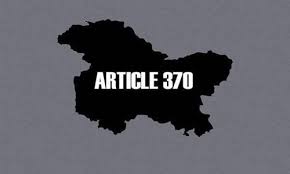
Until the Modi government moved to end it with a presidential ordnance, Jammu & Kashmir had enjoyed a special constitutional relationship with the Union of India because of the circumstances in which Maharaja Hari Singh, the ruler of Kashmir, signed the Instrument of Accession after Independence in 1947 ended British paramountcy over his princely state. Government’s move has not repealed 370; it has effectively made it defunct. It has done away with Article 35A, which emanated from it.
1947: WHY MAHARAJA BIT THE ACCESSION BULLET
The instrument of accession was executed on October 26, 1947 by Hari Singh and accepted by Lord Mountbatten. The circumstances and timing of the signing are important. A few days before that, Pashtun “tribesman” and Pakistani irregulars had crossed into his state and were moving towards Srinagar. The Maharaja turned to India for help, but India could only defend, provided it was a formal part of her territory.
Clause 5 of the document said that the terms of accession “shall not be varied” by any amendment to the Govt of India Act of 1935 or the Indian independence Act 1947 unless accepted by Hari Singh in a supplementary instrument. Clause 6 disallowed the making of laws to acquire land in the state “for any purpose” but permitted Hari Singh to do so for the Dominion of India for a law applicable to the state. Clause 7 said no future Constitution of India (which was still to be written) could be imposed on the state.
In 1950, in the original Constitution of India, J&K was listed as a Part B state, along with the other princely states that had merged by Instruments of Accession, including Hyderabad and Mysore.
Part B states were then abolished and J&K was by an amendment of the Constitution put into Article 1 as India’s 15th state and irrevocably part of the “territory of India.” It continued to enjoy the special status granted to it under Article 370.
PLEBISCITE OUT, SPECIAL STATUS IN
Article 370 was incorporated in Part XXI (temporary provisions with respect to the State of Jammu and Kashmir) of the Constitution. The state’s constituent assembly had wanted only those aspects of the Indian Constitution that reflected what Hari Singh had signed away. Besides Article 1, it was the only other article of the Indian Constitution that automatically applied to J&K. The other provisions of the Indian statute could apply to the state only if its constituent assembly concurred.
Article 370 provided Jammu & Kashmir with special status, allowing it, its own state constitution. The Union of India could legislate act only in defence, foreign affairs and communications.
Since the 1950s, there have been efforts to pull the state into a deeper embrace with the Union, but Article 370 was strengthened when Sheikh Abdullah, who had become the second Prime Minister of J&K in 1948 and was later dismissed came to an agreement—after spells of detention—with Prime Minister Indira Gandhi in 1975. In return for giving up his demand for a plebiscite, special status for J&K was allowed to continue and Sheikh Abdullah became the chief minister.
However, over the years, the state was made subject to many Indian laws through various amendments in concurrence with the state assembly, the logic being that it was the natural successor to the J&K constituent assembly, which by definition was a transitional body.
35A DEFINES WHO IS A PERMANENT RESIDENT.
Article 35A was made part of the Indian Constitution in 1954, through a presidential order—though its genesis goes back to early 20th century Dogra apprehensions of an influx from Punjab, which they feared would change the State’s demographic and land ownership patterns. The article, which defines who is a permanent resident of J&K and lays down laws restricting property purchase and ownership to such permanent residents, also discriminated against women, depriving them of their state subject rights if they married non-permanent residents. The J&K high court ruled against this aspect in 2002.
It had been the subject of acrimonious political debate and was challenged in the Supreme Court in 2014 on the grounds that it had been added to the Constitution not through an amendment passed by Parliament but by Presidential decree. Recent Constitution (Application to Jammu and Kashmir) Order 2019 supersedes the 1954 order, in effect scrapping Article 35A.
SADR-I-RIYASAT OR GUV: IT’S ALL IN A WORD
Article 370 said no changes could be made to the Constitution regarding the status of J&K without the concurrence of the state’s constituent assembly. The constituent assembly, though, was dissolved in November 1956 without providing any alternative to obtaining its concurrence. Article 370, originally written as a temporary measure, was treated in several court orders as therefore having become permanent. However, a presidential declaration on November 15, 1952, under Article 370 (3), had defined the “Government” of J&K as meaning the Sadr-i-Riyasat of the state acting under the advice of the state’s Council of Ministers. Then, in 1965, the term “Sadr-i-Riyasat” was changed to “Governor” by the Constitution of Jammu and Kashmir (6th Amendment) Act, 1965. The change meant that a Sadr-i-Riyasat elected by the state assembly was replaced by a governor appointed by the President of India.
August 6 Constitution Order 2019 was issued by the President under Article 370, Clause 1, with the concurrence of the “Government of J&K”. “Government” here means the “Governor”.
Shravan Charity Mission is an NGO that works for poor children suffering from life threatening diseases especially cancer. Our posts are meant for our readers that includes both children and adults and it has a huge variety in terms of content. We also accept donations for our mission. Should you wish to donate for the cause. The bank details are given below:
NAME OF ACCOUNT: SHRAVAN CHARITY MISSION
Account no: 680510110004635 (BANK OF INDIA)
IFSC code: BKID0006805
*
Our publications
GLOOM BEHIND THE SMILE
(The book is about a young cancer patient. Now archived in 7 prestigious libraries of the US, including, Harvard University and Library of Congress. It can also be accessed in MIT through Worldcat.org. Besides, it is also available for reading in Libraries and archives of Canada and Cancer Aid and Research Foundation Mumbai)
ONE TO TANGO … RIA’S ODYSSEY
(Is a book on ‘singlehood’ about a Delhi girl now archived in Connemara Library, Chennai and Delhi Public Library, GOI, Ministry of Culture, Delhi)
AADAB LUCKNOW … FOND MEMORIES
(Is a fiction written around the great city of Nawabs—Lucknow. It describes Lucknow in great detail and also talks about its Hindu-Muslim amity. That happens to be its undying characteristic. The book was launched in Lucknow International Literary Festival of 2014)
REFRACTIONS … FROM THE PRISM OF GOD
(Co-published by Cankids–Kidscan, a pan India NGO and Shravan Charity Mission, that works for Child cancer in India. The book is endorsed by Ms Preetha Reddy, MD Apollo Hospitals Group. It was launched in Lucknow International Literary Festival 2016)
TYPICAL TALE OF AN INDIAN SALESMAN
(Is a story of an Indian salesman who is, humbly qualified. Yet he fights his ways through unceasing uncertainties to reach the top. A good read not only for salesmen. The book was launched on 10th February, 2018 in Gorakhpur Lit-Fest. Now available in Amazon, Flipkart and Onlinegatha)
RHYTHM … in poems
(Published in January 2019. The book contains 50 poems. The poems describe our day to day life. The book is available in Amazon, Flipkart and Onlinegatha)
(ALL THE ABOVE TITLES ARE AVAILABLE FOR SALE IN AMAZON, FLIPKART AND OTHER ONLINE STORES OR YOU COULD EVEN WRITE TO US FOR A COPY)
This is only an attempt to create interest in reading. We may not get the time to read all the books in our lifetime. But such reviews, talk and synopsis will at least convey what the book is all about.
WHAT INDIA MEANT TO ME
By Lord Mountbatten of Burma
(An excerpt from the lost pages)
(Lord Mountbatten of Burma is a title in the peerage of the United Kingdom. In 1947 it was for rear admiral Louis Mount Batten, 1st viscount, Mount Batten of Burma and the last viceroy of India)
Lord Mountbatten had both emotional as well as a professional cause for loving India:
There was a special reason why Lord Mountbatten had an additional warm spot in his heart for India. While he was in Delhi staying at the old makeshift viceregal lodge, a young girl, of whom he had become very fond in England had come to stay with the viceroy, Lord Reading. Her name was Edwina Ashley. On 14 February 1922, during a dance in the house he sat out with her during the fifth dance in a small sitting room and proposed marriage to her. She accepted his proposal and all his happiness started from there … what you call India.
The Prince of Wales (the heir apparent to the British throne) was delighted at this and was most helpful. Mountbatten had to have the king’s permission to marry and he saw all that. Later he discovered there had only been one dissenting voice when he and Edwina announced their engagement—and that was the vicereine—lady Reading, who wrote to Edwina’s aunt and said: ‘I’m afraid she has definitely made up her mind about him. I hope she could have cared for someone older, with more of a career behind him.’
Soon both Edwina and Mountbatten were tied to India with a possible bond of memory and affection, which clearly played an important part in their lives when he came out in 1947, as the last viceroy and indeed when he started as the first Governor-General of independent India
Mountbatten makes another interesting highlight. In 1943 when he set up the supreme allied command in South-East Asia, he had closed on a million, Indian sailors, soldiers and airmen serving under him. He was particularly proud of this and admired their courage and steadfastness. They certainly fought magnificently and made a great international name for themselves.
Thus when he finally came out as a viceroy he could add to his feeling of twenty-five years of love for India his two and a half years association with so many fighting men in war.
No wonder it was easy for him to feel the real happiness at being back in India, a country where Edwina and Mountbatten had grown to love among the people they admired and liked so much.
What India meant to him can be summed up in one phrase in his own words:
‘Fascination, affection and happiness.’
(LOUIS FRANCIS ALBERT NICHOLAS GEORGE MOUNTBATTEN, First Earl Mountbatten of Burma, British admiral and statesman, was the last Viceroy and the first Governor-General of independent India. He died in 1979 at the age of 79).
Shravan Charity Mission is an NGO that works for poor children suffering from life threatening diseases especially cancer. Should you wish to donate for the cause. The bank details are given below:
NAME OF ACCOUNT: SHRAVAN CHARITY MISSION
Account no: 680510110004635 (BANK OF INDIA)
IFSC code: BKID0006805
*
Our publications
GLOOM BEHIND THE SMILE
(The book is about a young cancer patient. Now archived in 7 prestigious libraries of the US, including, Harvard University and Library of Congress. It can also be accessed in MIT through Worldcat.org. Besides, it is also available for reading in Libraries and archives of Canada and Cancer Aid and Research Foundation Mumbai)
ONE TO TANGO … RIA’S ODYSSEY
(Is a book on ‘singlehood’ about a Delhi girl now archived in Connemara Library, Chennai and Delhi Public Library, GOI, Ministry of Culture, Delhi)
AADAB LUCKNOW … FOND MEMORIES
(Is a fiction written around the great city of Nawabs—Lucknow. It describes Lucknow in great detail and also talks about its Hindu-Muslim amity. That happens to be its undying characteristic. The book was launched in Lucknow International Literary Festival of 2014)
REFRACTIONS … FROM THE PRISM OF GOD
(Co-published by Cankids–Kidscan, a pan India NGO and Shravan Charity Mission, that works for Child cancer in India. The book is endorsed by Ms Preetha Reddy, MD Apollo Hospitals Group. It was launched in Lucknow International Literary Festival 2016)
TYPICAL TALE OF AN INDIAN SALESMAN
(Is a story of an Indian salesman who is, humbly qualified. Yet he fights his ways through unceasing uncertainties to reach the top. A good read not only for salesmen. The book was launched on 10th February, 2018 in Gorakhpur Lit-Fest. Now available in Amazon, Flipkart and Onlinegatha
(ALL THE ABOVE TITLES ARE AVAILABLE FOR SALE IN AMAZON, FLIPKART AND OTHER ONLINE STORES OR YOU COULD EVEN WRITE TO US FOR A COPY)





 Shravan charity mission