Category Archives: Uncategorized

SPINDRIFT

Copyright@shravancharitymission

    Finding is such pure joy. And how rare, too! It had been several years since I had picked up anything when I found a penknife, a Hindi thriller and a five rupee coin, the last named beaming at me from below the seat of a ramshackle bus plying in our very own metropolis. Recalling that Elvis ditty ‘finders keepers, losers weepers’ I closed my eyes, stiffened my sinews and commended my soul to God before picking up the coin glistening in the errant sunbeam which had chanced through one of the innumerable slits in the roof. Nobody noticed. The conductor did raise a quizzical eye brow but that was about all. The term ‘conductor’ through over use has lost its semantic substance. The fellow is basically a logistics manager and with training can outsmart any sophisticated route operator. Even a funambulist might take a cue from the number of jobs he juggles while on board the boneshaker. This perception is wholly reserved for our country. Now coming back to the treasure trove -the Hindi thriller was a disappointment- not a patch on the Col  Vinod and Capt  Hameed  era  whodunits. Hindi detective fiction since then has been on the decline, virtually on the ‘endangered species’ list. Such a sorry state is inexplicable considering the vast treasure of Indian fiction available in genres like Sorcery, Witchcraft, Tilism, and detective fiction. ‘Chandrakanta’ and ‘Bhootnath’ had once fired the imagination of generation of readers and also contributed immensely to the popularity of Hindi language. These works of Devaki Nandan Khatri have outlived the copyright regime and are in the public domain since the early 60s. That is why they were churning out Chandrakanta serials decades ago paying scant regard to the original text and plot. But perhaps I am digressing.

    In a life time frittered away looking at the mirror I scarcely noticed the ‘sixpence lying at my feet’.  I was never much of a chance finder. At times one does strike a gold mine but the instances are so far removed that they vanish like the may snow drift. Once while waiting to get my vintage Ambassador car serviced I came across an unclaimed copy  Of Human Bondage  by Somerset Maugham. I was familiar with the works of Maugham and therefore happy to add to my collection of Moon and the Sixpence  and Eyeless in Gaza. The neo-intellectuals in my college days would talk of Camus, Kafka and Maugham in the same breath. Perusal of their works was considered the hallmark of intellectual prowess and was a sure passport to the local salons where deipnosophists abound. Photograph of Camus in a trench coat and fedora with a cigarette dangling loosely from the corner of the mouth, looking very much the Bogart of the noir genre, was one of the most widely reproduced photograph of the time.

humphreyHUMPHRY BOGART

    God’s largesse did not end with the book. This time it was a crumpled hundred rupee note with remnants of superfine khaini , the closest western variant being the snuff, much in vogue among the aristocracy of Europe in the days of yore. This bonanza came my way while going to Ranchi town from my college campus at Mesra. It was not one of those savoury trips one looks forward to but an undignified exit due to hostel vacation orders. As the college had been closed sine die it was being hotly debated whether to push homewards or to foregather in some cosy pastoral retreat for some good times together. It all depended on the pelf and riches.

    Emboldened by the find I decided to join the merry revelers, home being at ‘Lands End’. Though I put the money to good use I still haven’t been able to figure out what made the fellow to ‘crumple it’ and to tuck the promissory note under the seat. Perhaps he was a chance finder like me and had acted the way he did to avoid detection by fellow passengers. Of course he would take the booty away while disembarking. Another plausible theory was that he has merely stored the surplus khaini there for a rainy day quite forgetting the king’s ransom in the form of a crumpled note.

    I might add, that now and then, perhaps a ball pen, pocket comb or a sparsely populated purse  or some such trifles, no matter how well supplied one may be with, cannot be acquired without a thrill. Think of a Blackbury or a Rayban thus found. We all live and learn. A defeatist may venture something like “it takes all sorts”.

    The essence of finding something which brings to us unalloyed joy is half unexpectedness and half uniqueness. There being no aposematic forecast, no intuitive premonition and the ‘gift’ coming to you by chance: no one is to be thanked, no one to be owed anything. “Something for nothing …  ” Ay, there’s the rub…”. Shakespeare has put these things so beautifully. To look for the thing is to transform the whole plot-to rob it of its ‘sublime suddenness’-perchance to become even concerned or greedy.

    In its larger context we may use the word discovery-something akin to Columbus discovering America or was it the West Indies. Our concern for trifles and small findings are at once so stimulating and pure joy that to meddle with it would only appeal to a killjoy. Yet there are people who have an unsavoury sense of the sport!

    I recall the small rustic game or charade being played out by stringing a purse or paper money (bill or note) or any such desirable object which the casual walker gleefully stoops to pick up. The pranksters conveniently hidden from view have a field day as they pull the string leading the unsuspecting wayfarer on a merry chase. There are many clever variants which the fun-seeking lads have in their repertoire. In this cyber age of ours such diversions may seem blasé. But for a country whose half the population lives below poverty line there may still be some relevance left in such innocuous and simple pastimes.

    One common thread which runs through this serendipity is the absence of haste. My once rural seat and current urban dwellings present contrasting styles in time management. Reckon a simple activity like breakfast. Absence of haste is anathema to modern spirit. For most commuters it is always charged with disturbing quiet. The unnerving scenario of buses disappearing round the corner and the cacophony of traffic jams brood over the chota hazri , transforming mild God-fearing men into wild harpies as they sprint out like bats from hell. Down at the rural seat the meals are leisurely and indolent- a perfect epitome of laid-back country life of a cultured man. It is a breakfast of ease and languescent mood, a meal of ‘soft murmurs and rustling papers’.

    Circumstances afford little options. This harum-scarum age of ours has everything excepting time where brutish bolting of food is the in-thing. However, a quiet leisurely, laid- back meal by the crackling logs in winter has its unwavering charm.

    Let’s take a little time off for ourselves.

    “We look before and after

    And pine for what is not”

    A.K.Tripathi,

    Guwahati-2015

*****

ACCHEY DIN IN ANDHRA PRADESH!!

Copyright@shravancharitymission

New Doc 7_1 (1)

Seshachalam forest massacre

Entire India is upset with what has happened in Seshachalam forest except, perhaps, the Government of Andhra Pradesh which one way or the other is trying to justify this dastardly act and has no sense of proportion when it kills 20 woodcutters for 20 logs that were recovered from the sight as per TOI.

But is this any way of carrying a dead body?  Isn’t it inhuman and violates human dignity?  And who will resign on this absurdity, the CM Chandrababu Naidu or the DGP of Andhra Pradesh, JV Ramudu? Can one think of carrying any VIPs dead body like this then why a labourers body? You are bringing shame to India.

The gift of the Magi

Copyright@shravancharitymission

lifestylesimple living

Not very long ago I was on the lookout for a suitable birthday gift for my wife. As we have come of age I mentally rejected those silly romantic and valentinesque gifts. There was plenty of time. I could select at leisure, not knowing there is never time enough. In such situations it flies on the wings of a dove, and lo and behold the birthday was well nigh-It was the birth day eve and I hadn’t made a choice. I decided to take the bull by the horns and walked into a shopping mall. I tried this and that but right choice eluded me. I wanted to be sure it would not turn out to be something on the lines of ‘the gift of the Magi’. The brilliantly lit cut glass bottles caught my eyes. The perfumes-yes of course-that was what I was looking for. It was difficult to select from a variety of foreign brands because all were Greek to me. I delved into the recesses of my mind and came up with BVLGARI. The quaint, almost unpronounceable name had remained stuck in my memory after watching a foreign serial where a girl goes shopping and among many things she pauses before a glittering array of perfume bottles. The name stood out like a sore thumb. BVLGARI- must be good. That’s how I purchased the gift. Obviously, the serial had robbed me off some hard earned wampum but I was happy. The triumph of advertisement or casual memory-retention had done the trick. Reminds me of something I read somewhere:  “Advertising is the art of arresting human intelligence just long enough to get money from it.”

A.K.Tripathi,                                                                                                                                                                                       Guwahati-Assam-march -2015

‘MARWARIS’ HAVE SHOWN- TRADITION, MODERNITY & BUSINESS CAN GO HAND IN HAND


Copyright@shravancharitymission

143

For, a very long time now that dips beyond pre-independence days, Marwaris have been the back bone of Indian business; considered almost a generic term for business in India. They crafted some of the country’s oldest industrial empires- Birlas, Dalmias, Jhunjhunwalas, Goenkas; the list is long and accounts for a quarter of Indian names in the Forbes billionaire list. And in the process Marwari surnames have almost become household names.

2

And there is no denying the fact that first generation of Marwari businessmen started in a very modest way. There are stories galore about them, which you tend to believe, even without feeling the need to ratify; and knowing the finer details owing to their present stalk in Indian business scenario. For, you can’t help but believe in the hearsay that late Ghanshyam Das Birla mortgaged his lota (a round waterpot, typically of polished brass) in Hissar long ago, then a small town of Haryana for some pennies to start his business in the early twentieth century and when India liberated from the British Raj the worth of Birla group was somewhere around 60 lakh. Their histories and life philosophy of ‘simple living and high thinking’ has led them to the vying mantra of success and has always been a matter of great inquisition for many other communities that wanted to emulate Marwaris.

And there penchant to tread unknown areas for new business opportunities is time immemorial. They swarmed into Bengal and North-East of India as business entrepreneurs when many in India feared these areas.

Thomas A Timberg, author of a recent book, ‘The Marwaris’ wrote his doctoral thesis on them at Harvard back in 1978, and he has something interesting to say about Marwaris in an interview with Times of India.

In popular belief all shopkeepers and traders are Marwaris. But going by the definition of All-India Marwari Sammelan – all of those traders and business families from Rajasthan and some adjacent areas of Haryana are Marwaris. The Jodhpur region of Rajasthan is called Marwar. But many of the leading business families hail from the Shekhawati belt- Sikar, Jhunjhunu, Churu and Nagaur districts. Some are from Jaisalmer area. So I include the whole state of Rajasthan.

And, on how they became so successful he says, ‘It’s a long story.’ But what can be said is they all had common features that helped in their success. Starting from about the 1820s, they moved to Bengal to build a network of traders that covered large parts of the countryside too. This upcountry network was indeed their backbone and also the school for learning the ropes.

They developed a local sophisticated system of book-keeping called the ‘parta.’ By early 20th century this was updated in real time through phone. They had a well though-out personnel policy, with loyal and qualified people placed at key points. They had a system of incentives for good performance. Finally, they were very adaptable to changing economic or political situations.

In the 1970s, during the height of Naxalite terror, I met a Bengali lady and a Marwari insurance agent at breakfast in the guest house, where I was staying. The lady got irritated at the man’s boasting and said that the Naxalites would get him someday. The trader chuckled and said, “Before that can happen, we would join them.”

And to build a trade, one needs money. So, where did all the money come from, initially? Timberg feels different families have different tales. But during the British times, some of today’s successful families took advantage of the speculative market, as in opium and also jute. In the early 20th century when the British were easing off on opium (which they exported to China), some Mawari families in Bombay made a killing. They used their connections in Malwa where opium was grown to do so. Another family owes its origin to playing the international silver market through tiny loans. What these stories tell us about this community is that they had the ability to take risks and also that they acted on market information. And of course this should be seen in the context of tremendous hard work that these families did in going to distant places, staying in community messes (basa) and building their trade from the ground.

Their entrepreneurial spirit fared well even in the Nehruvian, economic regime controls, and most seem to have done pretty well for themselves. A 2010 study by Tarun Khanna and Krishna Palepu of Harvard Business School has shown that the share of Marwari and other family business groups in the ownership of large scale business in India is not so different from what it was in 1939, 1969 and 1997. Some like the Bajaj family, suffered for several years. Dalmia too had problems. But by and large the Marwaris benefited from their networks and especially, from their ability to negotiate with the governments of the day.

And how about the modern Marwari business houses following the same traditional practices that made them successful earlier? Some features may survive, others may get replaced. A lot of study has been done on the academic question: is tradition hostile to modernity? The Marwaris have successfully gone from being traders to industrial houses (Birlas, Goenkas, Dalmiyas) they have both tight focus and diffuse focus groups. They have largely resolved the succession problem, something that dogs every family business.

They have embraced new technologies, especially IT. In fact Birlas gave up their traditional book-keeping system for an IT based system a few years ago. Many have encouraged their daughters to study and take over business responsibilities. In fact most of the young Marwaris are now educated in Western Business schools; however there are exceptions and I’m only talking of the general trend.

SYMBOLIC LEGEND WHY HOLI IS CELEBRATED

Copyright@shravancharitymission

213

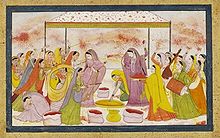
We all through our Dada, Dadi, Nana, Nani, Ma or Pa must have heard why Holi is celebrated as a colour festival. But in the hustle and bustle of life, at times, these mythological stories become hazy in our minds. So, let me remove the haze for you.

A symbolic legend is there to explain why holi is celebrated as a colour festival. The very word “Holi” originates from “Holika,” the evil sister of the iconic demon and king Hiranyakashipu. King Hiranyakashipu had earned a boon that made him virtually indestructible. The special powers of his had blinded him and he had grown very arrogant and thought he was God and demanded that everyone worship, only him.

Hiranyakashipu’s own son Prahlada however disagreed to this as he was a staunch devotee of Vishnu and this infuriated Hiranyakashipu. He subjected Prahalada to various kinds of cruel punishments, none of which affected the boy or his resolve, to do what he thought was right.

Finally, Holika – Prahalada’s evil aunt tricked him into sitting on a pyre with her. Holika was wearing a cloak (shawl) that made her immune to injury from fire, while Prahlada was not. But as the flames went up the cloak flew away from Holika and encased Prahlada; and so Holika burned while Prahlada survived. Vishnu then appeared and killed Hiranyakashipu.

The bonfire is therefore a reminder of the symbolic victory of good over the evel, or Prahlada over Hiranyakashipu. The day after Holika bonfire is celebrated as Holi

Holi is an important festival of Hindus. It is celebrated at the end of the winter season on the last full moon day of the lunar month Phalgun (February/March), (Phalgun Purnima) which usually falls in March and sometimes in late February

MAKE #CRICKET AS POPULAR AS #SOCCER–START ANOTHER #WORLD #CUP AMONGST CRICKET PLAYING CONTINENTS

downloaddownload (1)Copyright@shravancharitymission

By Kamlesh Tripathi

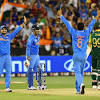
In the Cricket world cup 2015 only fourteen teams are playing. Which are divided into two pools that will play 49 matches in two countries, to decide the world cup title. International Cricket Council (ICC) recognizes more than 125 countries that play cricket. But many are not up to the mark to be included in the international circuit, such as the World Cup. ICC has 10 full members, 38 Associate Members and 59 Affiliate Members and that adds up to 107 countries. The West Indies cricket team does not represent a single country.

The world today has 196 countries and with that logic, cricket looks like an isolated game with only 14 countries, vying for the world cup which is far from a world phenomenon. Even when the cheer and clapping is getting louder each day as the tournament progresses in those 14 countries. And so, this magnificent pageant that is hosted every 4 years is only witnessed by a small section of the world. As the game is not as popular as soccer which is played in almost all the countries.

download (2)download (3)

In the same fashion we also have the shorter version of the game called the T-20 cricket world cup, every four years. And, in addition we keep having individual test matches, ODIs and T-20 series between countries which are generally followed by the supporters of their respective countries only. Recently, BCCI has also launched IPL series to promote, both domestic and international cricket. But, even with all of this, cricket is not getting sold exponentially beyond the 14 countries that participate in the world cup. So, there is a greater need to popularize cricket in less and non-cricket playing countries, by shedding traditional, autocratic and bureaucratic ways of thinking and dealing with cricket.

download (4)

The 14 countries that currently play in the international world cup circuit are- India, Pakistan, Sri Lanka, Bangla Desh, Australia, New Zealand, Afghanistan, UAE, South Africa, Zimbabwe, West Indies, England, Ireland & Scotland.

This more or less promotes cricket in their respective countries only, and to a certain extent in their neighbouring countries. But if cricket needs to spread to other countries by leaps and bounds. Something out-of-the-box needs to be thought through. A better way of popularizing cricket would be to have another world class tournament. Where, we could bunch teams of 3-4 countries, continent wise, and have a world cup tournament amongst them, such as;

Team 1: India, Sri Lanka & Bangladesh

Team 2: Australia, New Zealand

Team 3: Pakistan, Afghanistan and UAE

Team 4: South Africa, Zimbabwe

Team 5: West Indies, England, Ireland and Scotland

HOW WILL THIS HELP IN PROMOTING CRICKET?

Cricket was never played in India, Pakistan, Bangladesh and Sri Lanka, since Adam was a lad. It only came along with the Britishers and became an endearing and formidable game, close to a religion. Which goes to show, if publicized, facilitated and marketed well. It has the potential to become a game as popular as soccer.

Individual countries, and more pointedly India, may have done well to promote cricket in their own country. But Cricket as such has not seen a deluge of popularity, breaking barriers of borders and continents. Rather, it cocooned in its ego and bureaucracy and never butterflied across the world as soccer or lawn tennis. To sight and example, for so many years Bangladesh had to wait to get Test status and same goes for countries like Ireland and Scotland, that are still waiting.

WHAT WILL CHANGE BY BUNCHING TEAMS AND HAVING A WORLD CUP AMONGST CONTINENTS?

Just citing an example. Increase the team members in the squad of Team 1, as referred above (India, Sri Lanka and Bangladesh) by 3-5 and include new talent from China, Nepal, Myanmar, Maldives or any other country close by and give them a chance in warm up matches, or even just let them be with the team or include them in practice sessions or as twelfth man to be viewed by spectators back home. As this also will popularize the game back in their countries in a big way. For, didn’t it suddenly make a world of difference when some of our athletes were seen on world stage, in various disciplines at the Olympics?

And, hold this world cup tournament among continents every two years. As this will help in good publicity and brand building because public memory is too short, and keep the venue in some non-playing country or countries that play, but are not world class like China, Nepal, Myanmar, Maldives, Kabul, Spain, or the US to name a few. Request their dignitaries or popular figures to inaugurate and play the game at these inaugural matches. ICC is rich and could allocate a budget for this. Also, give special incentives including discounted tickets to tourists who want to watch the game of cricket from non-cricket playing countries. And just before the tournament, legendary and star cricketers depending upon their popularity like Sachin Tendulkar, Imran Khan, Viv Richards, Ricky Ponting, Sanat Jaisurya, to name a few, could give cricketing lessons to youngsters who want to play cricket.

Give this world cup tournament a well thought through, heavy weight title, making it look like a competition among titans, continents, giants, bravo juggernauts or even ET. For, this will have a domino effect in popularizing the game by leaps and bounds. Especially, in non playing continents or even non-playing countries or countries where the game is not played to its full potential. For where is the continued rejoice if the game continues to hover and be competed around in the same surroundings. Perhaps, the present day cricket may give you a feeling. As if it has been discarded and rejected by rest of the world and only adopted by few countries, with world potential still to be realized; and all in the interest of cricket.

*****