–Via a culture that’s open to change and normalises risk-taking–
The US-China big power competition is the defining geopolitical issue of our times. Undergirding this dynamic is the race for tech, especially AI. In The New Geography Of Innovation: The Global Contest For Breakthrough Technologies, Mehran Gul investigates whether US’s Silicon Valley still retains near-monopoly over cutting-edge tech, or have other global locations such as China’s Shenzhen and even the greater London area taken over that mantle. Plus, what’s truly conducive for creating a hot tech eco-system? Is there a secret sauce that America has and China appears to have replicated? The answers are complex. At first glance. China’s breakneck development in tech over the last decade appears to be eclipsing Silicon Valley. But closer inspection reveals a nuanced picture. True, Silicon Valley is undergoing change – described in the book as a vibrant rainforest being converted into controlled farmlands. But that necessarily doesn’t translate into US tech decline, the author says. New American tech hubs are coming up in New York, Miami and Austin that are taking the flame of Silicon Valley forward. China, on the other hand, has created its own tech champions like Tencent, Baidu and ByteDance in record time. It certainly has speed on its side, and it’s quality and volume of research has also improved tremendously. But it’s still not doing pathbreaking research like US. Why? A combination of factors that includes strict guardrails of the Communist Party -exemplified by the 2021 crackdown on Chinese tech firms – a Chinese university system that is not quite yet at par with American universities, and an environment where govt policy guides the direction of innovation. But to settle the debate, one statistic is enough to confirm US’s continued tech dominance: Apple became the first American tech company to cross a trillion-dollar valuation in 2018 with seven other American companies joining it since, but the rest of the whole world, including China, doesn’t even have one. What then is the secret to successful tech eco-systems? The author interviews scores of tech entrepreneurs and stalwarts across geographies and comes to a somewhat underwhelming answer: there is no set formula. Almost all successful tech companies look the same. But they can come up in very different circumstances. In UK, the Greater London area is where all the action is. But that has come at the cost of increasing regional disparity that not only puts London at a risk but also undermines the dynamism of UK’s tech story. This disparity was also a reason for Brexit. Switzerland and Germany have great education and no shortage of talent or infra, but their local cultural preference for stability over risk means they are just not able to realise the same tech innovation potential as US or China. South Korea and Singapore created their miracles through huge govt support. But there are also limitations to this approach as seen by calls to reform Korea’s chaebols. But one thing appears clear, according to the author; societies that are more receptive to change appear to have a better chance of fostering tech successes. That means openness to talent, openness to Innovation, and openness to risks. In the Indian context, we may have Bengaluru. But we need many more Bengalurus that incentivise tech entrepreneurship and risk taking. That means a policy framework that fosters innovation and a culture shift that normalises failure. India has lots of catching up to do.
Shravan Charity Mission is an NGO that works for poor children suffering from life-threatening diseases, especially cancer. Our posts are meant for our readers, including children and adults, and have a huge variety of content. We also accept donations for our mission. Should you wish to donate to the cause of cancer? The bank details are given below:
TIMES OF INDIA: 15/6/25 WHY A SMALL JHARKHAND TOWN STILL ADORES THE WRITER OF PATHER PANCHALI
Flanked by a restless Subarnarekha river and an unassuming railway line that runs through the small town, Ghatsila reminds you of idyllic Nischindipur, where Satyajit Ray’s iconic Pather Panchali (Song of the Road) unfolds. It’s a drowsy, almost diffident, place that seems to have been bypassed by time. Maybe the resemblance is not entirely coincidental. This is where celebrated writer Bibhuti Bhusan Bandyopadhyay, who penned the unforgettable Bengali novel, spent many creative years of his life and breathed his last at the age of 56 in 1950. The finest works of Bibhuti Babu, as every one refers to him in Ghatsila, include ‘Aparajito (Undefeated)’, ‘Aranyak (Of The Forest)’, and ‘Chander Pahar (Mountain Of The Moon)’. Director Shakti Samanta’s ‘Amar Prem’ (1972), a melancholic story of unrealised love, starring Rajesh Khanna and Sharmila Tagore, was based on a Bandyopadhyay short story, Hinger Kochuri. It has been 75 years since he passed away. But Bibhuti Babu remains Ghatsila’s calling card. Hotels are named after him. So are sightseeing spots, libraries and grammar schools. He is present even on restaurant menus. In fact, the writer is everywhere. Ghatsila is nestled in the lap of the Dalma hills in Jharkhand’s East. Singhbhum district shares a border with West Bengal’s Jhargram and Purulia districts to the east and north, and Odisha’s Mayurbhanj to the south. At the spot where NH 33 turns towards Ghatsila, the Jharkhand tourism department has built a hotel called Bibhuti Vihar. The town also has a Bibhuti Inn, owned by a businessman. A popular hotel on the banks of the Subarnarekha is named after a spot where the writer used to sit on moonlit nights, and that he had named ‘Ratmohana’ (charmer of the night). The house where Bibhuti Babu lived is located in Dahigora, now the poshest part of the town. The residence is called Gourikunj, after his first wife, who died during childbirth. The road leading to Gourikunj is called Apur Path– the road of Apu, the protagonist of the semi-autobiographical Pather Panchali. There’s more. A local society for the preservation of Bandyopadhyay’s house and his legacy is called Gourikunj Unnayan Samiti. Says its president, Tapas Chatterjee, “Nobody commands more respect than Bibhuti Babu in Ghatsila.” “Not an inch of his house was encroached upon, even though nobody lived there for 57 years. In 1950, when Bibhuti Babu died, his second wife, Rama Chattopadhyay, and son Taradas Bandyopadhyay, who was three then, left the town. Taradas ji gave us the NOC to construct this memorial in 2007, three years before his death. In between, the house lay in utter neglect and ruins.” Chatterjee said. The Samiti also runs a Bengali language grammar school on Sundays, called Apur Pathshala, and a library called Bibhuti Smriti Sansthagar in Ghatshila. A cultural festival is hosted every year on September 12 to mark the writer’s birth anniversary. The story of how Bibhuti Babu came to live in Ghatsila is fascinating. According to Chatterjee, a contractor from Ghatsila called Ashok Gupta had taken a loan from the writer when the latter was working as a teacher in Calcutta. Unable to pay him back in cash, Gupta decided to register the house in Ghatsila in Bibhuti babu’s name. “Bibhuti Babu wanted his younger brother, Nutbihari Bandyopadhyay, who was a doctor, to settle in this town and had visited Ghatsila in 1938. He fell in love with this house and the town and never returned.” Chatterjee said. Since he was already an established name in Bengali literature, many other Calcutta writers, including Sahitya Akademi Awardee Gajendra Kumar Mitra (1908-1994), Pramatha Nath Bishi (1901-1985) and Subodh Ghosh (1909-1980), also built homes in Ghatsila. Bimal Roy’s ‘Sujata’ (1960) and Gulzar’s ‘Ijaazat’ (1989) were based on stories written by Ghosh. However, all left in due course. Except Bibhuti babu, who stayed on and wrote some of his most famous works in this town. As a writer, Bibhuti Babu shared a special bond with the quiet jungles on the town’s edge, the free-flowing river and forest dwellers. He had witnessed the exploitation of natural resources in the name of development when he went to Bhagalpur in Bihar as the assistant manager of a forest estate in January 1924. That assignment left a lasting impression on the writer and funds mentioned in works such as ‘Aranyak’ and the essay, ‘Hey Aranya Katha kao (Oh Forest, Speak)’. Ghatsila is full of such natural spots, like Burudi dam, Phuldungri Pahar and the banks of the Subarnarekha, where Bibhuti Babu would sit with a pen and notebook for hours. Situated 54 km from Jamshedpur and 240 km away from Kolkata, Ghatsila is a favourite of tourists from Bengal. Nearly 80% of the population here, including tribals, now speak the Bengali language. The locals, however, rue how some things are no longer the same. “Earlier, tourists came for longer durations, a month or, at times even longer. They would rent out homes and stay like locals. Since they came here for a change of air, we called them ‘changers’,” said Rohit Kumar, manager of a private lodge in Ghatsila’s Phuldungri. The new-age tourists come for a day or two. The neighbouring hill town of Belpahari in Jhargram district of West Bengal offers better amenities and takes away a major chunk of tourists. But appreciation of the legacy of Bibhuti Babu isn’t confined to visitors anymore. Supriti Murmu, wife of prominent Jharkhand state agitation leader Bablu Murmu, says, “I was drawn to this town because of Bibhuti Babu. As a student of Bangla literature, we were influenced by his writings and wanted to experience the rural life he portrayed in his books. Supriti Murmu used to be a prominent left-wing student leader and was pursuing her graduation in Bangla literature in neighbouring Jhargram when her activism and her love for the writer brought her to Ghatsila in 1987. “I have been here since then,” she said. Bandyopadhyay’s works and his love for the forest dwellers resonate with the local tribal population as much as his books appeal to the Bengali intelligentsia. At Gourikunj, his real legacy is the bond shared by everyone. An artist from Bengal recently painted scenes from Bandyopadhyay’s daily life in Ghatsila on the boundary walls of the house. On his birthday anniversary, girls from tribal communities decorated Apur Path, the lane leading to the house, with beautiful Santhal patterns in the form of rangolis. Everyone and everything is coming together to celebrate their one and only Bibhuti Babu.
Shravan Charity Mission is an NGO that works for poor children suffering from life-threatening diseases, especially cancer. Our posts are meant for our readers, including children and adults, and have a huge variety of content. We also accept donations for our mission. Should you wish to donate to the cause of cancer? The bank details are given below:
Illness … doctor … pathologist … investigation … diagnosis … treatment. Yes, I’m talking about THE FINAL DIAGNOSIS by Arthur Hailey.
At times, even an ace pathologist might have to send his findings in the form of slides to two experts who are contemporaries in the same discipline. Where one might say the tumour is malignant and the other non-malignant or benign.
So then, what does Chief Pathologist, Dr Joseph Pearson, finally script as his … final diagnosis? The basis on which the surgeon would have to decide whether the amputation of the leg is required or not. The pathologist is often known as the doctor the patient seldom sees.
In ‘THE FINAL DIAGNOSIS’, author Arthur Hailey unveils the tension-packed drama that is being played in the mammoth complexity of a great hospital. A world where one faulty diagnosis or one irrevocable error precipitates into appalling tragedies.
In the enthralling story, there is a continuous struggle between the Chief of Surgery, Kent O’ Donnel and Dr Joe (Joseph) Pearson, Chief Pathologist, who was once an ace pathologist, but with the passage of time, he has stagnated, which he realises towards the end of his career.
The book also describes the struggle of a young pathologist, David Coleman, who happens to be Dr Joe Pearson’s deputy, in terms of restoring the standards of a hospital laboratory. Controlled by the ageing but once brilliant doctor Joseph Pearson, Hailey takes us behind the reception areas, and into those emergency rooms and the bustling world of medicine, to reveal those hidden corridors of a world that the patient never gets to see.
The centre of action is the three-counties hospital in Burlington in Pennsylvania. The novel has a plethora of characters … the prime being:
Orden Brown—Chairman of Three Counties Hospital
Eustace Swayne—Board Member and a retail magnet of a departmental store empire.
Doctor Joseph Pearson—Chief Pathologist around whom the entire novel revolves.
Doctor Kent O’ Donnel—Chief of Surgery and Head of the Medical Board.
Doctor David Coleman—Deputy to Doctor Joseph Pearson
Doctor Charles Dornberger—The baby’s doctor … Paediatrician
Doctor Lucy Grainger—Orthopaedic Surgeon
Hilda Straugham—Chief Dietitian
Vivian Lobourton—Trainee nurse
Mike Seddons—Doctor
Alexander and his wife, Elizabeth.
The language is moving and precise, with tailor-made sentences that fit the bill. There is usage of high-toned vocabulary, but it doesn’t give that shade of verbosity. The intensity and tone of the sentences change as frequently as the change of scene. The flow of the book gives you a feel as if you’re seeing and not reading—something close to a movie. Most descriptions are vivid as if you are witnessing the scene. Especially, the ones that describe the happenings in autopsy, pathology and even surgery.
The novel makes an important point for doctors through the Chief Pathologist, Dr Pearson. One should never give up his or her pursuit as far as the latest inventions in the medical world are concerned, no matter how much pressure of work there is. For that was the sole cause of doctor Pearson’s failure. And that holds good for any career today.
And the scenes when Vivian is diagnosed with cancer and when Alexanders lose their newborn baby because of a faulty medical blood test report in the hospital are nail-biting and highly emotive.
I would give nine out of ten to this book. So, don’t just miss it.
One last point—I was amazed at the manner in which these doctors smoked in the hospital and drank at parties. And to their patients, they must be canvassing otherwise. It is said about authors that they try and paint the real picture of the times when the novel was written. I now believe in it ever more. This novel was written way back in 1959. Pick it up even if you have to find time.
Shravan Charity Mission is an NGO that works for poor children suffering from life-threatening diseases, especially cancer. Our posts are meant for our readers, including children and adults, and have a huge variety of content. We also accept donations for our mission. Should you wish to donate to the cause of cancer? The bank details are given below:
‘Awadh Assam and Dalai Lama… The Kalachakra’ has been archived in several prestigious institutions, both in India and internationally. Here’s a summary of its archival presence:
📚 International Archives
Department of Information and International Relations (DIIR), Government of Tibet: The book is archived in the DIIR, which is responsible for the administration and dissemination of information related to the Tibetan Government-in-Exile.
Tibet Policy Institute (TPI): The TPI, an institution that focuses on research related to Tibet, has archived the book, highlighting its relevance to Tibetan studies.
Personal Library of His Holiness the 14th Dalai Lama: The book is included in the personal collection of His Holiness the Dalai Lama, reflecting its significance in Tibetan history and culture.
The Ohio Digital Library, USA: Your book is available in this digital library, making it accessible to a global audience interested in Tibetan and Indian history. (Holy Books)
Apple Digital Library: The book has been included in Apple’s digital library, broadening its reach to readers worldwide.
🇮🇳 Indian Archives
Friends of Tibet Library: This library, dedicated to preserving Tibetan culture and history, has archived the book.
Maharashtra Mitra Mandal Library, Bandra, Mumbai: A prominent library in Mumbai has included your book in its collection, making it available to local readers.
These archival placements underscore the importance of the work in documenting the historical and cultural narratives of the region.
Shravan Charity Mission is an NGO that works for poor children suffering from life-threatening diseases, especially cancer. Our posts are meant for our readers, including children and adults, and have a huge variety of content. We also accept donations for our mission. Should you wish to donate to the cause of cancer? The bank details are given below:
Hi friends. I’ve just finished reading this book titled ‘India’s Greatest Speeches’ compiled by Nitin Agarwal. The publisher of this book is Grapevine India Publishers Ltd. The title was published in 2014, but it got to my hands late. The price of this book is Rs 195. It comprises 325 pages. Most of these speeches are available in the archives. Yet, I would say Nitin has done a good job of providing them in a readymade platter. The selection of speeches and the introduction of the personality before each speech is also quite absorbing. At times, we feel we know a celebrity quite well, but when you start reading about them, you feel otherwise.
Overall, it’s a stimulating collection of thoughtful speeches delivered by some of the most prominent personalities of India. But then, one viewpoint could be, why read these speeches at all? What do you gain from them? Well, let me tell you. Behind every speech lies the covert and overt accomplishment of the personality. Rather, the essence of an orator’s personality, which knowingly or unknowingly, directly or indirectly comes out for the betterment of the common man. There is a verse in the Gita that says, ‘Masses follow the classes.’ Moreover, speeches often silhouette the inveterate mindset of the orator. It, at times, even doubles up as a mini biography of the personality.
Set to inspire, the book includes some of the most stirring and eloquent addresses by Rabindranath Tagore, Swami Vivekananda, Sardar Vallabhbhai Patel, Mother Teresa, JRD Tata, Abdul Kalam, Narendra Modi and many other influential Indian leaders.
The book starts with a short insight from the Bhagavad Gita. It then goes on to cover twenty-five speeches of 23 cynosure personalities of India. One will find a good amount of historical perspective in some of the speeches. Almost all speeches are loaded with aspects of challenge, failure, success, struggle, decision making, telling tough tales and life lessons and ultimately, the making of those towering personalities.
An interesting pattern that inadvertently emerges from the book is the ground feel of what India and the bigwigs of India were, towards the end of the nineteenth century, when Swami Vivekananda delivered that famous speech in Chicago in 1893. And it extends to almost a decade and a half after independence, say 1965. It also gives you a flavour of how India changed after 1965, because of the altered mindsets of Indian personalities, which included their viewpoints, their values and even their ambitions.
The world today has become extremely complex. Competition has intensified, and struggles have become longer and even tougher. Global perspectives have taken over issues, and nothing is isolated; most things are transparent. The speeches post 1965 in the book reflect that in some way or the other. The collection of speeches extends from 1893 to 2014.
There are two speeches of Mahatma Gandhi delivered in the years 1912 and 1922. When you read these speeches, you get an eerie feeling as to how different India has become since then. Shaheed Bhagat Singh’s famous and daring statement before the Lahore High Court Bench exhibits his jasba … passion for his motherland–India. The narration is a bouquet of important speeches.
In the year 1937, Veer Damodar Savarkar, then president of Akhil Bharatiya Hindu Mahasabha, delivered a speech in Karnavati defining Hinduism. There are other master pieces from Tagore in 1941, and Dr Radhakrishnan in 1947. Then you have the famous speeches of Subhas Chandra Bose—Give me Blood and I promise you Freedom, and Nehru’s ‘Tryst with Destiny.’
In the year 1948, Sardar Vallabhbhai Patel delivered his famous speech at Calcutta Maidan on the unification of states. Pandit Deendayal Upadhyaya, a very important leader of Jana Sangh (now BJP) in the year 1965, addressed a full house on Integral Humanism.
One is really moved by the humbleness of Mother Teresa when she made that historic speech in 1979 upon the acceptance of the Nobel Peace Prize, and JRD Tata’s superlative speech in the year 1982 on his Historic Flight Re-enactment, and the famous speech of Mrs Gandhi, her last in 1984, after which she was assassinated.
Who can forget Atal Bihari Vajpayee’s famous 2001 address at the United Nations General Assembly? And, Natayana Murthy, in 2007, during the pre-commencement address at New York University, describing his volatile journey.
There are two Speeches by Prime Minister Modi delivered in 2014, at FICCI Ahmedabad and the Independence Day, that outline India’s future and what he intends to do for the country. The speech of Par excellence Ex-President, APJ Abdul Kalam, in 2011, defining the vision of India, can never be forgotten. It is superb and so very educational.
On the creative side, there is AR Rahman’s 2009 Oscar Awards Acceptance address and Shah Rukh Khan’s famous ‘Courage in Success’ delivered in 2013.
Lifetime Achievement Awards don’t come easy. Everyone knows about the struggle Azim Premji had to undertake to establish his mighty company. His speech on the occasion at the Economic Times Awards in the year 2013 is also in the list of speeches.
And last but not least, the making of the world champions. Sports achievements are one of the toughest, where you start alone, and if you’re not successful, you go into a depression followed by oblivion. There are three wonderful speeches by Viswanathan Anand, 2007, Speech at NIIT Chennai, Abhinav Bindra, 2013, GoSports Foundation Conclave and Master Blaster Sachin Tendulkar, 2013, A Farewell to Cricket.
Overall, it’s an interesting read if you want to know about these personalities and their tedious journey to success.
The list of speeches:
Swami Vivekananda, 1893, The Chicago Address (Opening Day)
Mahatma Gandhi, 1912 Banaras Hindu University Speech
Mahatma Gandhi, 1922 The Great Trial of 1922
Shaheed Bhagat Singh 1930 Statement before the Lahore High Court Bench
Shravan Charity Mission is an NGO that works for poor children suffering from life-threatening diseases, especially cancer. Our posts are meant for our readers, including children and adults, and have a huge variety of content. We also accept donations for our mission. Should you wish to donate to the cause of cancer? The bank details are given below:
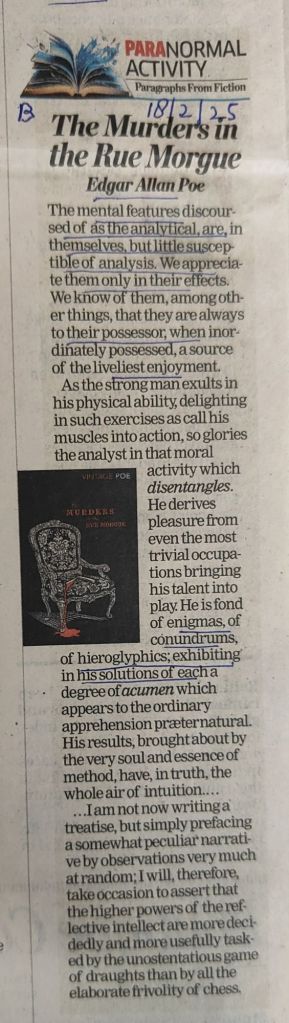
The Murders in the Rue Morgue … Edgar Allan Poe (Economic Times 18.2.25)
The mental features discoursed of as the analytical are, in themselves, but little susceptible of analysis. We appreciate them only in their effects. We know of them, among other things, that they are always to their possessor, when inordinately possessed, a source of the loveliest enjoyment. As the strong man exults in his physical ability, delighting in such exercises as call his muscles into action, so glories the analyst in that moral activity which disentangles. He derives pleasure from even the most trivial occupations, bringing his talent into play. He is fond of enigmas, of conundrums, of hieroglyphics; exhibiting in his solutions of each a degree of acumen which appears to the ordinary apprehension praeternatural. His results, brought about by the very soul and essence of method, have, in truth, the whole air of intuition … … I am not now writing a treatise, but simply prefacing a somewhat peculiar narrative by observations very much at random; I will, therefore, take occasion to assert that the higher powers of the reflective intellect are more decidedly and more usefully tasked by the unostentatious game of draughts than by all the elaborate frivolity of chess.
Shravan Charity Mission is an NGO that works for poor children suffering from life-threatening diseases, especially cancer. Our posts are meant for our readers, including children and adults, and have a huge variety of content. We also accept donations for our mission. Should you wish to donate to the cause of cancer? The bank details are given below:
Don’t miss reading this intriguing title, Áwadh Assam and Dalai Lama … the Kalachakra. The title is available on all online book stores, including Google.
Shravan Charity Mission is an NGO that works for poor children suffering from life-threatening diseases, especially cancer. Our posts are meant for our readers, including children and adults, and have a huge variety of content. We also accept donations for our mission. Should you wish to donate to the cause of cancer? The bank details are given below:
Shravan Charity Mission is an NGO that works for poor children suffering from life-threatening diseases, especially cancer. Our posts are meant for our readers, including children and adults, and have a huge variety of content. We also accept donations for our mission. Should you wish to donate to the cause of cancer? The bank details are given below:
Shravan Charity Mission is an NGO that works for poor children suffering from life-threatening diseases, especially cancer. Our posts are meant for our readers, including children and adults, and have a huge variety of content. We also accept donations for our mission. Should you wish to donate to the cause of cancer? The bank details are given below:
Shravan Charity Mission is an NGO that works for poor children suffering from life-threatening diseases, especially cancer. Our posts are meant for our readers, including children and adults, and have a huge variety of content. We also accept donations for our mission. Should you wish to donate to the cause of cancer? The bank details are given below:
NAME OF ACCOUNT: SHRAVAN CHARITY MISSION
Account no: 680510110004635 (BANK OF INDIA)
IFSC code: BKID0006805
*
Publications of Kamlesh Tripathi
BOOK TITLE: GLOOM BEHIND THE SMILE
(The book is about a young cancer patient. Now archived in eight prestigious libraries of the US which include Harvard College Library; Harvard University Library; Library of Congress; University of Washington, Seattle; University of Minnesota, Minneapolis; Yale University, New Haven; University of Chicago; University of North Carolina, at Chapel Hill University Libraries. It can also be accessed at MIT through Worldcat.org. Besides, it is also available for reading in the libraries and archives of Canada; the Open Library; Cancer Aid and Research Foundation Mumbai; Jaipuria Institute of Management, Noida, India; Shoolini University, Yogananda Knowledge Center, Himachal Pradesh and Azim Premzi University, Bangalore and the Library of Cancer Aid and Research Foundation, Mumbai. The title also finds a mention in a book titled ‘Enduring Cancer: Life, Death and Diagnosis in Delhi’ by Dwaipayan Banerjee published by the Duke University Press).
BOOK TITLE: ONE TO TANGO … RIA’S ODYSSEY
(It is a book on ‘singlehood’ about a Delhi girl now archived in Connemara Library, Chennai and Delhi Public Library, GOI, Ministry of Culture, Delhi; It is also available for reading in the Indian National Bibliography, March 2016, in the literature section, in Central Reference Library, Ministry of Culture, India, Belvedere, Kolkata-700022)
BOOK TITLE: AADAB LUCKNOW … FOND MEMORIES
(This is a fiction written around the great city of Nawabs—Lucknow. It describes Lucknow in great detail and also talks about its Hindu-Muslim amity, which is the undying characteristic of Lucknow. The book was launched at the Lucknow International Literary Festival in 2014. It is catalogued and included for reading in Askews and Holts Library Services, Lancashire, U.K; Herrick District Library, Holland; Charlotte-Mecklenburg Library, Mecklenburg County, North Carolina, USA; Black Gold Cooperative Library Administration, Arroyo Grande, California; Berkeley Library, University of California; The Peshastin Public Library and The George Public Library near Washington, a Northern Central Washington Libraries branch; the Flagstaff City-Coconino County Public Library in Arizona in the US and the Salina Public Library, Kansas, USA.
BOOK TITLE: REFRACTIONS … FROM THE PRISM OF GOD
(Co-published by Cankids–Kidscan, a pan India NGO and Shravan Charity Mission, that works for child cancer in India. The book is endorsed by Ms Preetha Reddy, MD Apollo Hospitals Group. It was launched at the Lucknow International Literary Festival in 2016).
BOOK TITLE: TYPICAL TALE OF AN INDIAN SALESMAN
(Is a story of an Indian salesman who is, humbly qualified. Yet he fights his way through unceasing uncertainties to reach the top. A good read not only for salesmen but for any reader. The book was launched on 10th February 2018 at Gorakhpur Lit-Fest. Now available on Amazon, Flipkart and Onlinegatha)
BOOK TITLE: RHYTHM … IN POEMS
(Published in January 2019. The book contains 50 poems. The poems are about our day-to-day life. Poems from this book have been published in Shillong Times, Bandra Times, Bhavan’s Journal and Arunachal Times. The book is available on Amazon, Flipkart and Onlinegatha)
BOOK TITLE: MIRAGE
(Published in February 2020. The book is a collection of eight short stories available on Amazon, Flipkart and Notion Press)
BOOK TITLE: AWADH ASSAM AND DALAI LAMA … The Kalachakra
(It is the story of the man who received His Holiness The Dalai Lama and his retinue in 1959 as a GOI representative when he fled Tibet in 1959. The book was launched on 21st November 2022 by His Holiness The Dalai Lama at Dharmshala. The title is archived in the library of the Department of Information and International Relations (DIIR) Government of Tibet, Tibet Policy Institute (TPI) and the personal library of His Holiness The Dalai Lama. The title is also archived in The Ohio Digital Library, USA. It was recently included in the digital library of the world-renowned company APPLE). Included in the library of Friends of Tibet.
(POEMS AND ARTICLES OF KAMLESH TRIPATHI PUBLISHED IN JOURNALS AND MAGAZINES)
BHAVANS JOURNAL
Short stories, Book reviews and Articles published in Bhavan’s Journal: 1. Reality and Perception, 15.10.19; 2. Sending the Wrong Message, 31.5.20; 3. Eagle versus Scholars, June, 15 & 20, 2020; 4. Indica, 15.8.20; 5. The Story of King Chitraketu, August 31 2020; 6. Breaking Through the Chakravyuh, September 30 2020. 7. The Questioning Spouse, October 31, 2020; 8. Happy Days, November 15, 2020; 9. The Karma Cycle of Paddy and Wheat, December 15, 2020; 10. Power Vs Influence, January 31, 2021; 11. Three Refugees, March 15, 2021; 12. Rise and Fall of Ajatashatru, March 31, 2021; 13. Reformed Ruler, May 15, 2021; 14. A Lasting Name, May 31, 2021; 15. Are Animals Better Teachers? June 16, 2021; 16. Book Review: The Gram Swaraj, 1.7.21; 17. Right Age for Achievements, 15.7.21; 18. Big Things Have Small Beginnings, 15.8.21; 19. Where is Gangaridai?, 15.9.21; 20. Confront the Donkey Within You 30.9.21; 21. Know Your Strengths 15.10.21; 22. Poverty 15.11.21; 23. Top View 30.11.21; 24. The Bansuriwala 15.1.22; 25. Sale of Alaska 15.2.22; 26. The Dimasa Kingdom 28.2.22;27. Buried Treasure 15.4.22; 28. The Kingdom of Pragjyotisha 30.4.22; 29. Who is more useful? 15.5.22; 30. The White Swan from Lake Mansarovar 30.6.22; 31. Bhool Bhulayya 15.9.22; 32. Good Karma 30.9.22; 33. Good Name vs Bad Name 15.10.22; 34. Uttarapath—The Grand Trunk Road 1.12.22; 35. When Gods Get Angry 1.1.23; 36. Holinshed’s Chronicles 15.1.23; 37. Theogony 15.2.23; 38. Poem: Mother 14.5.23; 39. The Nag Mandir 30.6.23; 40. The Story of Garuda 30.7.23; 41. Janmabhoomi vs Karmabhoomi 31.8.23; 42. The Ghost Town of Kuldhara 15.9.23; 43. The Tale of Genji 15.10.23; 44. The Soul Connection 1.12.23; 45.Book review: Jungle Nama … a story of the Sundarban 16.3.24; 46. Book review: A Forgotten Chapter 16.5.24; 47. Exploring Ancient Egypt, 1.8.24; 48. The Story of Dhruva, 16.8.24; 49. Two Hundred Years of Tea in Assam 16.9.24;
THE SHILLONG TIMES
Articles & Poems: 1. Poem: Happy New Year 8.1.23; 2.Poem: Spring 12.3.23; 3.Poem: Right and Wrong 20.3.23; 4.The Gush of Emotion—Writing, 26.3.23; 5. The Nag Mandir, 7.5.23; 6. Poem: Mother 7.5.23; 7. Poem: Rain Rain 9.7.23; 8. Poem:You Come Alone You Go Alone 6.8.23; 9. Poem: Rain Rain (Second Time) 10.8.23; 10. Poem: Guru Teacher 1.10.23; 11. Poem: Autumn … The Interim Heaven 15.10.23; 12. Poem: Happy Diwali 12.11.23; 13. Overcoming Blindness: Learn it the John Milton Way 10.12.23; 14. The Happy Prince and The Happy Man’s Shirt 31.12.23; 15. Annus Mirabilis -2024 7.1.24; 16. Gandhi to Mahatma Gandhi- Incidents that Shaped Gandhi in South Africa 28.1.24; 17. Poem: Together But Not Made For Each Other, 11.2.24; 18. The Birds Bees and The Spiders of Nicholas Guildford and Jonathan Swift 25.2.24; 19. The Overcoats of Nikolai Gogol and Ruskin Bond 10.3.24; 20. The Ethnic Colours of Holi 24.3.24; 21. A Lesson from Dalai Lama, 21.4.24; 22. Poem: Morning Walk 28.4.24; 23. Trip to Rhine Falls, Switzerland, 19.5.24; 24. Poem: Hurt 2.6.24; 25. Poem: Your Conscience Was My Sign On 16.6.24; 26.Poem: The Eerie Ways of Time 7.7.24; 27.Poem: Celebrating the T20 World Champions 14.7.24;28. Read to Rise above mediocrity, 4.8.24; 29. Poem: Desire vs Reality 11.8.24; 30. Jack Ma’s Pristine Advice to Employers, Employees and the Youth 22.9.24;
THE ASSAM TRIBUNE
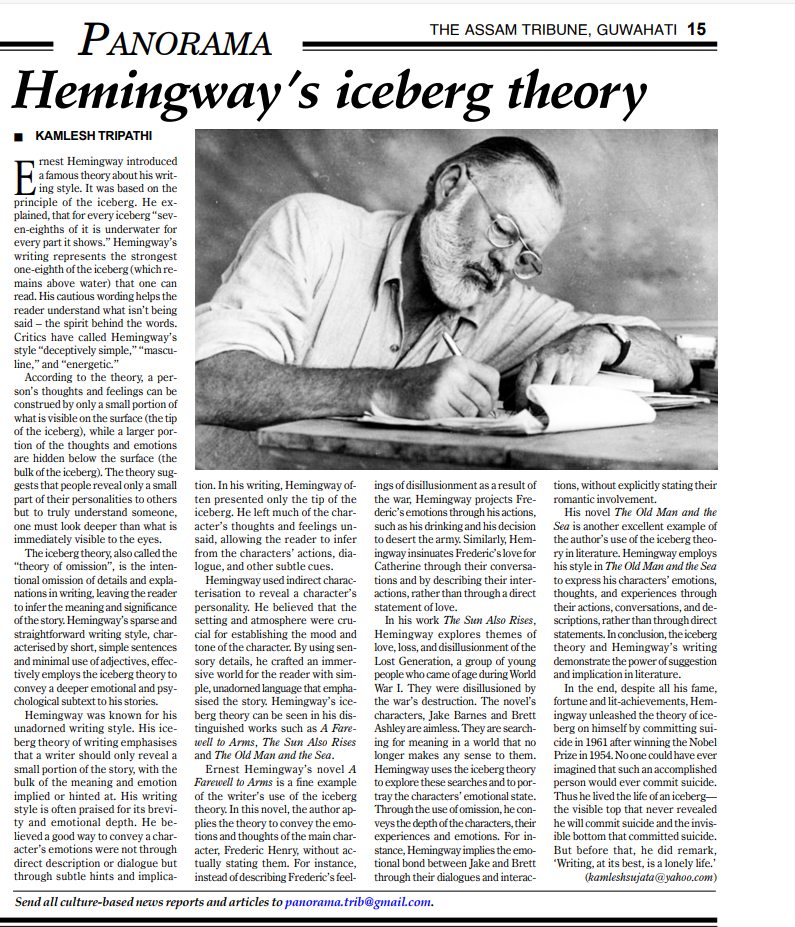
Article: 1. The Magic of Reading 11.12.23; 2. Gandhi to Mahatma 29.1.24; 3. Geography of Solitude 8.4.24; 4. A Lesson From Dalai Lama, 22.4.24; 5. A Source of Inspiration, 29.4.24; 6. The Four-LeggedLibrary, 12.5.24; 7. Age and Achievement, 10.6.24; 8. Read … To Rise Above Mediocrity, 1.7.24; 9. Crusade for a College, 25.8.24; 10. Hemingway’s Iceberg Theory (Panorama) 27.9.24;
THE ARUNACHAL TIMES
Poem: 1. Hope—In The Arc of Twilight, 13.8.23; 2.Poem: Spring 3.3.24; 3.Poem: The Morning Walk 10.3.24;
BANDRA TIMES, MUMBAI
Articles & Poems: 1. Poem: SPRING, 1.4.23; 2. Poem: Mother, 1.6.23; 3. Poem: Rain Rain, 1.8.23; 4. A Lesson From Dalai Lama, 1.6.24; 5. Read to rise above Mediocrity 1.8.24
ARTICLES IN THE DIGITAL MAGAZINE ESAMSKRITI
29.12.2020: Indica by Megasthenes; 14.3.22: About The Dimasa Kingdom Assam; 10.12.22: Grand Trunk Road–Uttarapath; 5.10.23: The Ghost Town of Kuldhara Near Jaisalmer;
(ALL THE ABOVE BOOK TITLES ARE AVAILABLE FOR SALE ON AMAZON, FLIPKART AND OTHER ONLINE STORES OR YOU COULD EVEN WRITE TO US FOR A COPY)





 Shravan charity mission