
Reincarnation of the Dalai Lama in a Free World

Copyright@shravancharitymission
POEM: I WANT MORE (DIL MANGE MORE)
–A man is never satisfied with what he has. He always wants more. But what is the limit for that more?
***
I have enough,
Yet, I want more,
Since enough doesn’t prescribe a limit,
I wish to have more.
*
More and enough are two of a kind,
They are mutually inclusive,
They work in tandem,
To fulfil your greedy aspirations.
*
Enough doesn’t remain adequate,
More doesn’t become surplus,
Because greed expands,
And together they consume mankind.
*
The baskets and trolleys in the malls,
The stock-keeping units and the brands,
The war cry of enough and more,
The floors and the expanse of the malls,
The queues and the billing counters,
They all expand with the burgeoning footfalls.
*
One enters the supermarket as if a pauper,
And comes out like a king,
After consuming a range of food dishes,
And buying a range of things.
*
Between enough and more,
There is a bridge of uncertainty,
That convinces the human mind,
To keep stocking till eternity.
There is no limit to wanting more,
But the idea of life is to enjoy,
The grace of satisfaction,
Which comes when you have enough,
And you don’t want more.
The gap between enough and more,
Is a thin line called satisfaction?
So, let satisfaction be your motto of life,
And do away with the idea of I want more.
–There is no limit to the mind wanting (mange) more. Come out of that mindset, as it only leads to disaster—
2.5.25
Written and posted by Kamlesh Tripathi
Author, Poet, & Columnist
*
https://kamleshsujata.wordpress.com
*
Like it and Share it
*
Shravan Charity Mission is an NGO that works for poor children suffering from life-threatening diseases, especially cancer. Our posts are meant for our readers, including children and adults, and have a huge variety of content. We also accept donations for our mission. Should you wish to donate to the cause of cancer? The bank details are given below:
NAME OF ACCOUNT: SHRAVAN CHARITY MISSION
Account no: 680510110004635 (BANK OF INDIA)
IFSC code: BKID0006805
***
Copyright@shravancharitymission
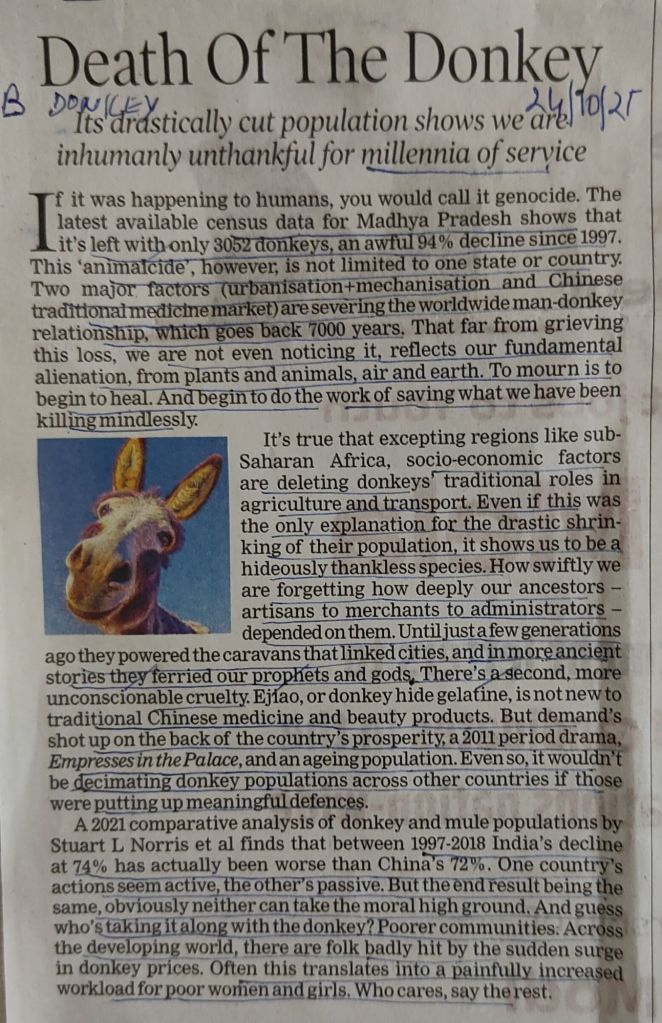
Its drastically cut population shows we are inhumanly unthankful for millennia of service
If it were happening to humans, you would call it genocide. The latest available census data for Madhya Pradesh shows that it’s left with only 3052 donkeys, an awful 94% decline since 1997. This ‘animalcide’, however, is not limited to one state or country. Read the TOI 24/10/25 editorial.
Posted by Kamlesh Tripathi
Author, Poet, & Columnist
*
https://kamleshsujata.wordpress.com
*
Like it and Share it
*
Shravan Charity Mission is an NGO that works for poor children suffering from life-threatening diseases, especially cancer. Our posts are meant for our readers, including children and adults, and have a huge variety of content. We also accept donations for our mission. Should you wish to donate to the cause of cancer? The bank details are given below:
NAME OF ACCOUNT: SHRAVAN CHARITY MISSION
Account no: 680510110004635 (BANK OF INDIA)
IFSC code: BKID0006805
***
Copyright@shravancharitymission
KNOW ETERNAL RUMI
11/10/25 Times of India
The poet suggests that love and compassion should transcend religious boundaries, promoting a vision of inclusiveness that is particularly vital in today’s divided world, writes SUMIT PAUL
Persian mystic and poet Jalaluddin Rumi needs no elaborate introduction as the very name is enough to evoke a deep sense of respect and reverence. He was born in Balkh in Northern Afghanistan and shuffled off this mortal coil in Konya (Turkey). However, his influence extends far beyond geographical boundaries and the realm of poetry. His teachings have had a profound impact on various aspects of contemporary culture, including music, literature, and spirituality. His timeless wisdom continues to resonate with people from all walks of life, crossing religious, cultural, and linguistic boundaries. Rumi’s popularity in the west has surged in recent decades, with his works translated into multiple languages. His profound messages of love, unity, and self-discovery have made him one of the most widely read and revered poets in the world. His writings serve as a bridge between different faiths and cultures, emphasising the universal message of love and the pursuit of enlightenment. Rumi’s words invite readers to embark on a transformative journey, where love and divine union are ultimate destinations. Many of his sublime thoughts transport us to the realms of love, beauty, enlightenment and introspection. For example, The Essential Rumi, chapter 12, includes: “A sufi’s book is not composed of ink and the alphabet. A scholar loves, and lives on, the marks of a pen. A sufi loves footprints!”
Rumi contrasts an intellectual approach to spirituality with an experiential path taken by the Sufis. While scholars rely on written knowledge, Sufis derive wisdom from lived experiences and traces left by those who walked the spiritual path before them. This reflects a belief in the transformative power of direct experience over mere study. This also shows the humility and absence of a burning desire to flaunt one’s name and fame. Rumi didn’t write his poetry while living in an ivory tower. His poetry was poetry of self-experiences. Rumi’s repertoire is based on the philosophy of self-effacement. We all have encumbered the earth, thanks to our wretched existence. In a brief life, man leaves no stone unturned, to leave a mark behind; a legacy for posterity. There’s always a burning desire in every individual to make his presence felt. While the desire to be remembered is innate in every individual, the wish to efface oneself from the big slate of the world is also there, albeit in very few individuals. Only the fully evolved and enlightened human beings don’t wish to be liabilities to earth and others.
Despite differences in beliefs and practices, Rumi sees the underlying essence of spirituality that connects all faiths. He suggests that love and compassion should transcend religious boundaries, promoting a vision of inclusiveness that is particularly vital in today’s divided world. He uses roses as metaphors to explain that the Divine love is just like the sun emitting, light and energy to a branching rosebush that grows elegantly on many levels and within several worlds– all at once. Just as a rosebush branches out, so too knowledge, offering different perspectives and insights. It evokes the idea that spiritual understanding can flourish through embracing diversity and appreciating multiple paths.
We need to imbibe the universal spirit of Rumi and assimilate it into the collective consciousness of humanity. We’ve been sparring over petty things and differences without realising the power of love. Rumi says gamble everything for love, if you’re a true human being. If not, leave this gathering, emphasising the transformative nature of love and necessity of commitment and courage in seeking true connection.
He advocates for risking everything in pursuit of love, suggesting that half-hearted attempts will yield shallow results. It serves as a reminder that authentic love requires boldness and sincerity. We all want this bold and intrepid love to connect with each other and unite in a single thread and a solitary breath, for your task is not to seek love, but merely to seek and find all barriers within yourself that you have built against it. So, let yourself be drawn by the stronger pull of that which you truly love. For Rumi, glue of love is the strongest glue.

Posted by Kamlesh Tripathi
Author, Poet, & Columnist
*
https://kamleshsujata.wordpress.com
*
Like it and Share it
*
Shravan Charity Mission is an NGO that works for poor children suffering from life-threatening diseases, especially cancer. Our posts are meant for our readers, including children and adults, and have a huge variety of content. We also accept donations for our mission. Should you wish to donate to the cause of cancer? The bank details are given below:
NAME OF ACCOUNT: SHRAVAN CHARITY MISSION
Account no: 680510110004635 (BANK OF INDIA)
IFSC code: BKID0006805
***
Copyright@shravancharitymission
Aristotle’s Poetics, written in the 4th century BCE, is one of the earliest and most influential works of literary theory in the Western tradition. Though originally part of a larger body of work, only the section concerning tragedy has survived in full, while other parts, especially those dealing with comedy and epic poetry, are largely lost or only referenced in later writings. Despite its incomplete nature, Poetics has had a profound and lasting impact on how literature, particularly drama, is analysed and understood.
At its core, Poetics is Aristotle’s attempt to systematically explain the principles of dramatic art, with a specific focus on tragedy. Drawing from earlier Greek drama and the works of playwrights like Sophocles and Euripides, Aristotle establishes a framework for evaluating and constructing effective tragedies. His method is analytic and empirical: he studies successful tragedies to derive general principles, rather than constructing abstract theories without reference to practice.
One of the central concepts introduced in Poetics is mimesis, often translated as “imitation.” Aristotle asserts that all art is essentially an imitation of life, but this imitation is not mere copying. Instead, it represents a process of distillation and representation through which the artist conveys universal truths. In tragedy, mimesis takes the form of portraying serious and complete actions that evoke specific emotional responses from the audience.
Aristotle identifies six essential elements of tragedy: plot (mythos), character (ethos), thought (dianoia), diction (lexis), melody (melos), and spectacle (opsis). Among these, he places the highest importance on plot, defining it as “the soul of tragedy.” For Aristotle, a good plot must have unity, meaning all its parts contribute to a single, coherent whole. It should also possess a beginning, middle, and end, adhering to a logical and chronological sequence of events.
A key feature of an effective plot, according to Aristotle, is peripeteia (reversal) and anagnorisis (recognition). Peripeteia is a sudden reversal of fortune for the protagonist, often from good to bad, while anagnorisis is the moment of critical discovery or recognition, particularly of a character’s true identity or situation. These elements are central to achieving the emotional effect that Aristotle sees as the primary goal of tragedy: catharsis.
Catharsis, one of the most debated concepts in Poetics, refers to the purging or purification of the emotions of pity and fear that tragedy is meant to elicit. While scholars disagree on whether Aristotle meant catharsis as a psychological cleansing or a moral-ethical clarification, it is clear that he viewed the emotional experience of the audience as essential to the function of tragedy. By experiencing intense emotions in a controlled environment, the audience gains insight, self-awareness, and emotional balance.
Character is the second most important element after plot. Aristotle emphasizes that characters should be “good,” “appropriate,” “lifelike,” and “consistent.” However, he makes it clear that character is subordinate to plot: it is not the portrayal of character that makes a tragedy powerful, but how the characters serve the unfolding of the action. The protagonist of a tragedy is typically a person of noble status who possesses a tragic flaw or hamartia—a mistake or error in judgment—that leads to their downfall. This flaw is not necessarily a moral failing, but rather a misstep that triggers a chain of events ending in catastrophe.
Aristotle contrasts tragedy with epic poetry, noting that while both share many elements, tragedy is more concentrated and immediate. Epic poetry, exemplified by Homer’s works, can encompass many stories and span long periods of time. Tragedy, by contrast, confines itself to a single plotline and typically takes place within the span of a single day. This concentration, Aristotle argues, gives tragedy a greater intensity and impact.
Though Poetics focuses almost entirely on tragedy, it laid the groundwork for centuries of literary criticism and theory. The Renaissance saw a revival of Aristotelian principles in the dramatic unities of time, place, and action, which were extrapolated from his emphasis on unity of plot. Later thinkers, including German philosophers like Hegel and Nietzsche, further developed Aristotelian ideas, while modern theorists have both built upon and challenged his assertions.
Critics of Poetics have pointed out its limitations, especially its narrow focus on a particular type of Greek tragedy. Aristotle privileges structure and form over thematic depth or emotional complexity in character, which contrasts with later literary traditions that emphasise character development or social commentary. Moreover, his prescriptions for drama may seem rigid when applied to diverse literary forms across cultures and time periods.
Nevertheless, the enduring influence of Poetics lies in its pioneering effort to systematize literary analysis. Aristotle’s emphasis on structure, causality, and emotional effect continues to inform the way stories are told and understood, not only in literature but also in film, theater, and even narrative psychology.
In conclusion, Poetics represents a milestone in the study of literature. Aristotle’s dissection of tragedy into its constituent elements and his articulation of how and why it works remain relevant to this day. While the specifics of dramatic form have evolved, the core questions Aristotle raised—about the nature of art, the function of narrative, and the emotional impact of storytelling—continue to resonate in contemporary discourse.
Written and posted by Kamlesh Tripathi
Author, Poet, & Columnist
*
https://kamleshsujata.wordpress.com
*
Like it and Share it
*
Shravan Charity Mission is an NGO that works for poor children suffering from life-threatening diseases, especially cancer. Our posts are meant for our readers, including children and adults, and have a huge variety of content. We also accept donations for our mission. Should you wish to donate to the cause of cancer? The bank details are given below:
NAME OF ACCOUNT: SHRAVAN CHARITY MISSION
Account no: 680510110004635 (BANK OF INDIA)
IFSC code: BKID0006805
***
Copyright@shravancharitymission

Diwali—The Festival of Lights
**
–Kamlesh Tripathi—
**
Diwali is a Festival of Lights,
A victory of day over the night,
Of good over the evil’s might,
Of truth, of hope, and what is right.
*
Diwali fetches five days of vibrant cheer,
With sweets, lamps and love sincere.
With rangoli, hues and lanterns bright,
And fireworks swirling throughout the night sky.
*
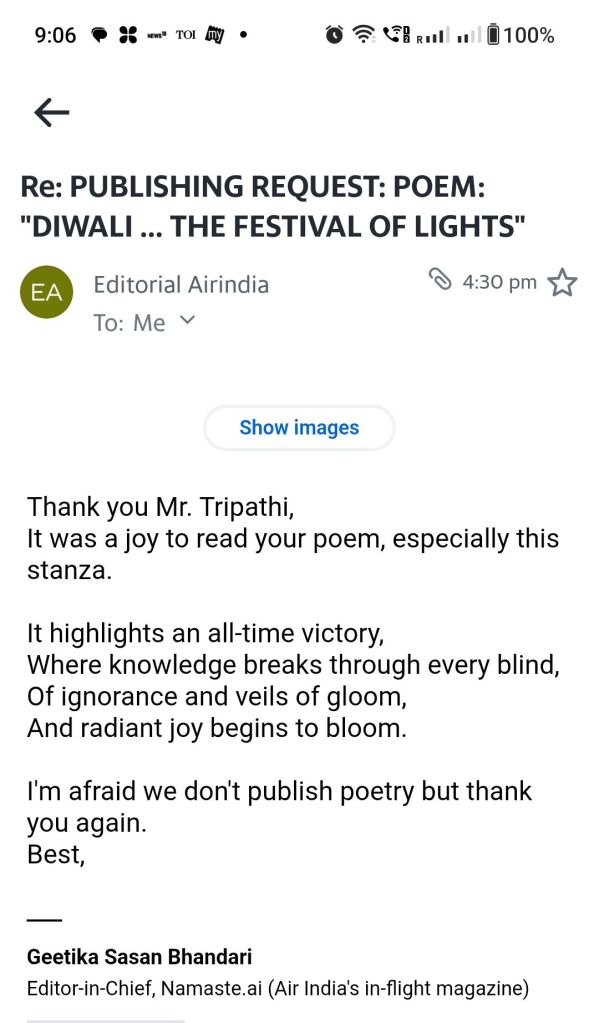
It highlights an all-time victory,
Where knowledge breaks through every blind,
Of ignorance and veils of gloom,
And radiant joy begins to bloom.
*
As per the holy Panchang,
Diwali recalls tales of yore.
When the month of Ashwin wanes and Kartik begins,
And Amavasya plays a significant innings.
*
It’s the darkest night,
With a lunar grace and swastik signs,
When the world looks prime,
At an opportune time.
*
It coincides with the harvest’s golden end,
Before the frost and chill descend.
Communities emerge in joy,
As golden diyas paint the skies.
*
As autumn breathes its cooler air,
October–November marks the affair.
The heart of fall, the soul of light,
Diwali shines in full delight.
*
Myths unravel, tales unfold,
Of Gods and demons, celestial and corporeal.
From Dhanteras to the climax day,
Lakshmi and Ganesh light the way.
*
Ayodhya celebrates and lights up,
On Rama’s arrival amidst the crowd.
With Sita, Laxman by his side,
And Hanuman’s attendance, sanctified.
*
With Shiva, Vishnu, and Krishna’s grace,
Durga’s might and Kali’s face,
And eventually, Narakasura’s fatal end,
As deities and demons come face-to-face.
*
From Ravana’s end to Rama’s victory,
From Dhanvantri’s healing touch,
The churning ocean’s mystic art,
Each finds a mention in Diwali’s heart.
*
Sparks erupt in the skies,
With sparklers, phuljhadis that rise high.
The demons flee, the gods descend,
And in that event, the miseries end.
*
In life’s struggle, in daily strife,
Diwali comes as a breath of life.
As does an oasis in a wide desert,
As a gentle pause, where peace can bide.
*
On Amavasya’s cold, dark night,
Beyond the stars and in the cosmos,
The lights of Diwali softly bloom,
Spreading hope, dissolving gloom.
*
The cosmos sports its finest robe,
Adorned in lights and loveliness.
And every heart, with joy infinite,
Sings together: Happy Diwali Night!
**
***
Written and posted by Kamlesh Tripathi
Author, Poet, & Columnist
*
https://kamleshsujata.wordpress.com
*
Like it and Share it
*
Shravan Charity Mission is an NGO that works for poor children suffering from life-threatening diseases, especially cancer. Our posts are meant for our readers, including children and adults, and have a huge variety of content. We also accept donations for our mission. Should you wish to donate to the cause of cancer? The bank details are given below:
NAME OF ACCOUNT: SHRAVAN CHARITY MISSION
Account no: 680510110004635 (BANK OF INDIA)
IFSC code: BKID0006805
***
Copyright@shravancharitymission
TIMES OF INDIA 11/10/25
HOW DO YOU CREATE A HOT TECH HUB?
–Via a culture that’s open to change and normalises risk-taking–
The US-China big power competition is the defining geopolitical issue of our times. Undergirding this dynamic is the race for tech, especially AI. In The New Geography Of Innovation: The Global Contest For Breakthrough Technologies, Mehran Gul investigates whether US’s Silicon Valley still retains near-monopoly over cutting-edge tech, or have other global locations such as China’s Shenzhen and even the greater London area taken over that mantle. Plus, what’s truly conducive for creating a hot tech eco-system? Is there a secret sauce that America has and China appears to have replicated? The answers are complex.
At first glance. China’s breakneck development in tech over the last decade appears to be eclipsing Silicon Valley. But closer inspection reveals a nuanced picture. True, Silicon Valley is undergoing change – described in the book as a vibrant rainforest being converted into controlled farmlands. But that necessarily doesn’t translate into US tech decline, the author says. New American tech hubs are coming up in New York, Miami and Austin that are taking the flame of Silicon Valley forward.
China, on the other hand, has created its own tech champions like Tencent, Baidu and ByteDance in record time. It certainly has speed on its side, and it’s quality and volume of research has also improved tremendously. But it’s still not doing pathbreaking research like US. Why? A combination of factors that includes strict guardrails of the Communist Party -exemplified by the 2021 crackdown on Chinese tech firms – a Chinese university system that is not quite yet at par with American universities, and an environment where govt policy guides the direction of innovation.
But to settle the debate, one statistic is enough to confirm US’s continued tech dominance: Apple became the first American tech company to cross a trillion-dollar valuation in 2018 with seven other American companies joining it since, but the rest of the whole world, including China, doesn’t even have one.
What then is the secret to successful tech eco-systems? The author interviews scores of tech entrepreneurs and stalwarts across geographies and comes to a somewhat underwhelming answer: there is no set formula. Almost all successful tech companies look the same. But they can come up in very different circumstances. In UK, the Greater London area is where all the action is. But that has come at the cost of increasing regional disparity that not only puts London at a risk but also undermines the dynamism of UK’s tech story. This disparity was also a reason for Brexit.
Switzerland and Germany have great education and no shortage of talent or infra, but their local cultural preference for stability over risk means they are just not able to realise the same tech innovation potential as US or China. South Korea and Singapore created their miracles through huge govt support. But there are also limitations to this approach as seen by calls to reform Korea’s chaebols.
But one thing appears clear, according to the author; societies that are more receptive to change appear to have a better chance of fostering tech successes. That means openness to talent, openness to Innovation, and openness to risks. In the Indian context, we may have Bengaluru. But we need many more Bengalurus that incentivise tech entrepreneurship and risk taking. That means a policy framework that fosters innovation and a culture shift that normalises failure. India has lots of catching up to do.
Posted by Kamlesh Tripathi
Author, Poet, & Columnist
*
https://kamleshsujata.wordpress.com
*
Like it and Share it
*
Shravan Charity Mission is an NGO that works for poor children suffering from life-threatening diseases, especially cancer. Our posts are meant for our readers, including children and adults, and have a huge variety of content. We also accept donations for our mission. Should you wish to donate to the cause of cancer? The bank details are given below:
NAME OF ACCOUNT: SHRAVAN CHARITY MISSION
Account no: 680510110004635 (BANK OF INDIA)
IFSC code: BKID0006805
***

Copyright@shravancharitymission
The Shillong Times 19.10.25

Written and posted by Kamlesh Tripathi
Author, Poet, & Columnist
*
https://kamleshsujata.wordpress.com
*
Like it and Share it
*
Shravan Charity Mission is an NGO that works for poor children suffering from life-threatening diseases, especially cancer. Our posts are meant for our readers, including children and adults, and have a huge variety of content. We also accept donations for our mission. Should you wish to donate to the cause of cancer? The bank details are given below:
NAME OF ACCOUNT: SHRAVAN CHARITY MISSION
Account no: 680510110004635 (BANK OF INDIA)
IFSC code: BKID0006805
***
Copyright@shravancharitymission
(PHANTOM POLICE? TIMES OF INDIA EDITORIAL 11/10/25)
Seoul has a hologram cop. Not everyone thrilled.
He doesn’t quite crash land but takes form all of a sudden – a life-size apparition in uniform, if you find yourself in Seoul’s popular Jeo Dong Park. Don’t let him spook you – it’s only a hologram of a cop, appearing every two minutes between 7 pm and 10 pm to, well, spook those up to no good. Police claim the made-in-UK ‘assistant officer’ lowered crime rates in the bustling neighbourhood under Seoul Jungbu police station by as much as 22%, between Oct 2024, when the pilot was launched, and May 2025. The cop was officially posted in the park in Aug. So, if you’re wandering around, under the influence of whatever’s your poison, and itching to pick up a fight, well, chances are the sight of a ghostly cop could nudge you to abandon the idea. No need to break into a cold sweat or run, for he’ll disappear in two minutes.
So what does this hologram cop do if it comes across a fight? He can’t chase, let alone handcuff you. Yet, ‘Enhanced features’ are a work in progress. His role now is surveillance, a deterrent to low-key ‘impulsive’ crime. Privacy may be globally dead, but still, the idea hasn’t gone down well with everyone. Visitors find him annoying, while his ghostly presence is fast creating an urban legend of a ‘haunted park’. Clearly, tech-savvy policing is not yet a smooth walk in the park.
Posted by Kamlesh Tripathi
Author, Poet, & Columnist
*
https://kamleshsujata.wordpress.com
*
Like it and Share it
*
Shravan Charity Mission is an NGO that works for poor children suffering from life-threatening diseases, especially cancer. Our posts are meant for our readers, including children and adults, and have a huge variety of content. We also accept donations for our mission. Should you wish to donate to the cause of cancer? The bank details are given below:
NAME OF ACCOUNT: SHRAVAN CHARITY MISSION
Account no: 680510110004635 (BANK OF INDIA)
IFSC code: BKID0006805
***

 Shravan charity mission