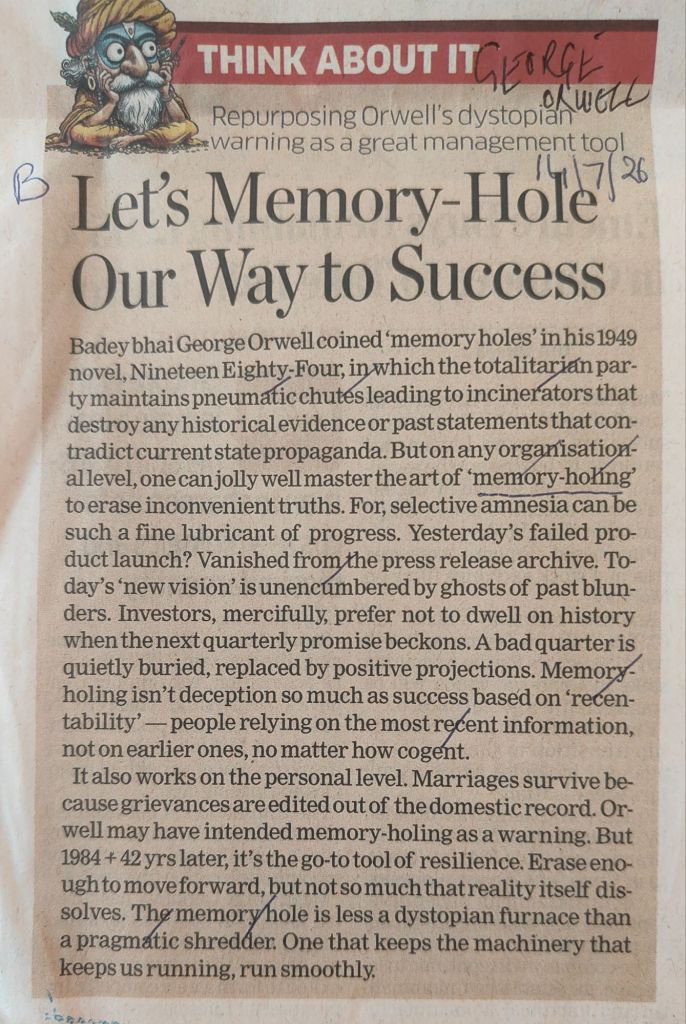
14/7/26 GEORGE ORWELL’S DYSTOPIAN WARNING, JUST IN JEST

Copyright@shravancharitymission
If you do not know how to greet, offer a namaste. If words fail you in the introduction, offer a namaste. A wise man once said, for a learned man, no land is alien. Just as with folded hands in a namaste, no person remains a stranger. Namaste softens the rigid edges of ego. It is an invisible arm, gently soothing the pride of another, opening doors to harmony, setting the tone for an amicable meeting. Namaste is usually spoken with a slight bow with hands pressed together, palms touching each other, and fingers pointing upwards, and thumbs close to the chest.
More than a greeting, it is a gesture of reverence. A silent acknowledgement of dignity, a language beyond speech. It carries a spiritual whisper: “I bow to the divine in you.” Echoing the timeless wisdom of the Rigveda and resonating through the verses of the Mahabharata.
The gesture of folding hands during a namaste is called the Anjali Mudra. In addition to namaste, this mudra is one of the postures found in Indian classical dance, such as Bharatanatyam. It is also found in Hindu temples, mandapams and in yoga practice. In moments of tension, on a crowded street, and in rising anger, a simple namaste can dissolve conflicts, turning discord into friendship. With a gentle bow and folded hands, known as the sacred Anjali Mudra, palms unite, fingers rise, and the heart speaks through silence. Namaste is derived from Sanskrit, namas (bow) and te (to you). It means, simply and profoundly, “I bow to you.” And within that simplicity lies a universe of respect, humility, connection, and peace. In a world searching for understanding, perhaps the answer lies not in words, but in a quiet, graceful namaste. Excavations in the Indus Valley Civilisation sites have found male and female terracotta figures in Anjali Mudra like postures, doing a namaste.
“The light in me honours the light in you,” says Deepak Chopra, the new age guru. One of the most insightful interpretations of namaste comes from renowned English author Aldous Huxley, who explored Indian spirituality deeply. In works like The Perennial Philosophy, he reflects on the idea that the divine resides within every individual, an idea closely aligned with the spirit of namaste.
According to professor and sociologist Holly Oxhandler, namaste is a Hindu term which means “the sacred in me recognises the sacred in you”. E. M. Forster, in his novel ‘A Passage to India’, captures the subtleties of Indian manners and gestures. While he doesn’t formally analyse namaste, his portrayal of respectful distance, non-contact greetings, and cultural sensitivity reflects the ethos underlying it. Likewise, German Spiritual teacher Eckhart Tolle speaks of recognising the “presence” or consciousness in others, again, philosophically mirroring the meaning of namaste.
Even historians and Indologists writing in English, such as Stephen H. Phillips, have analysed the word namaste, linguistically and culturally, explaining how it conveys reverence, humility, and a subtle acknowledgement of the divine. So while namaste is rooted in Sanskrit and Indian tradition, its essence has been widely described in English, not always by name, but through ideas of inner divinity, humility, and universal respect.
I bow not to form, nor name, nor face, but to the silent light in your inner space. Thus, namaste speaks what words cannot declare. It is a gratitude to each soul, irrespective of its flair. Namaste is a respectful form of greeting, acknowledging and welcoming a relative, guest or stranger. In some contexts, namaste is used by one person to express gratitude for assistance offered or given, and to thank the other person for their generous kindness.
Since namaste is a non-contact form of greeting, some world leaders adopted the gesture as an alternative to handshaking during the 2020 Coronavirus pandemic as a means to prevent the spread of the virus.
Written and posted by Kamlesh Tripathi
Courtesy Shravan Charity mission
The comparison between Jains in India and Jews in Europe reveals two remarkably similar minority communities with profoundly different historical destinies. Both occupied economically influential positions disproportionate to their demographic size. Both cultivated strong internal discipline, dietary codes, educational traditions and merchant ethics. Yet while Europe repeatedly produced violent anti Semitism culminating in genocide, India never generated a sustained exterminatory anti-Jainism. This reveals a civilisation difference. Historically, Jain communities flourished across western and southern India as bankers, traders, financiers, jewel merchants, tax intermediaries and patrons of temples and manuscripts. They performed economic functions similar to Jewish merchant and banking communities in mediaeval Europe. Both contributed to various social institutions like schools, hospitals and cultural centres. But the similarities ended there. The most important difference was theological location. Jews in Christian Europe were permanent outsiders. Jews were accused of rejecting Christ and became embedded in Christian imagination as witnesses to spiritual failure. This hostility was built into the religious structure itself. Jains, by contrast, emerged within the broader Indic religious ecosystem. There was much in common between Brahmins and Jains: ideas of karma, rebirth, renunciation, pilgrimage, sacred geography, fasting, monasticism, cosmology and ritual purity. Jains mocked the Vedic ritual of sacrificing animals and eventually convinced many Brahmin communities to change their ways. A Shaiva king hostile in one generation could sponsor Jain monks in another. Boundaries remained porous. The second difference lay in political structure. Europe increasingly developed centralised religious authority through the Church. Orthodoxy became tied to political order. Heresy threatened social collapse. Jews, meanwhile, remained outside Christian salvation history entirely. This enabled continent-wide expulsions and co-ordinated persecution: England in 1290, France repeatedly, Spain in 1492, numerous German territories. India historically lacked a single centralised ecclesiastical institution capable of organising pan-Indian religious extermination. Power remained fragmented among kingdoms, sects, castes, temples, monasteries and regional traditions. Even when conflict emerged, it remained localised. South India did witness anti-Jain movements between the 7th and 12th centuries as Bhakti Shaivism and Vaishnavism rose under royal patronage. Tamil Shaiva literature described debates, humiliations, and even legendary impalements of Jains. These stories reflected real competition for political patronage and public prestige. But they did not produce a Europe-style project of total elimination. The reason was also economic. Jewish communities in Europe often became trapped within narrow financial occupations because Christian doctrine restricted usury among Christians. Kings borrowed heavily from Jewish financiers and periodically erased debts through expulsion or confiscation. During famine, plague, or war, Jews became convenient scapegoats. Economic resentment fused with religious hostility. In India, Jain merchant power existed within a far broader and more decentralised commercial system. Trade and finance were distributed among many communities: Banias, Chettiars, Sahukars, Komatis, Marwaris, Brahmin accountants, Muslim traders and various caste networks. No single minority monopolised credit or commerce to the same extent. Caste played a key role–every group kept distance, with rituals and food restricted to the courtyard. Many practices now associated with “Hindu” upper-caste life carried strong Jain influence: vegetarian prestige, fasting traditions, merchant ethics, temple donation culture and notions of purity and pollution. Europe moved in the opposite direction. From medieval Christianity to modern nationalism, identity hardened. By the 19th century, anti-semitism transformed from theology into race theory. Jews were increasingly imagined not merely as wrong believers but as biologically dangerous outsiders. Modern nationalism, pseudo-science and industrial bureaucracy eventually culminated in the Holocaust. Jains were never imagined as foreign invaders, racial contaminants or enemies of civilization itself. Jains certainly faced political displacement, temple appropriation, literary humiliation, loss of patronage and occasional violence. But Indian civilization historically preferred hierarchy, absorption and negotiation over extermination. The contrast therefore revealed two different civilizational logics. Europe often sought unity through exclusion. India often managed diversity through layered coexistence and hierarchy. Realising the power and reach of Jains, 21st century politicians in India abandoned the term Hindutva and embraced Sanatan Dharma, to include Jains in their fold. Today, a foreign dignitary is served only vegetarian food, not the food of the majority, indicating the influence of the satvik ahimsa lobby, spearheaded by Jain munis. The key conceptual difference between Jews and Jains is the idea of rebirth. Jews believed in one life, negotiating God’s laws and always being right. Jains believe in karmic balance sheet, subjectivity, conditionality, negotiation.
***
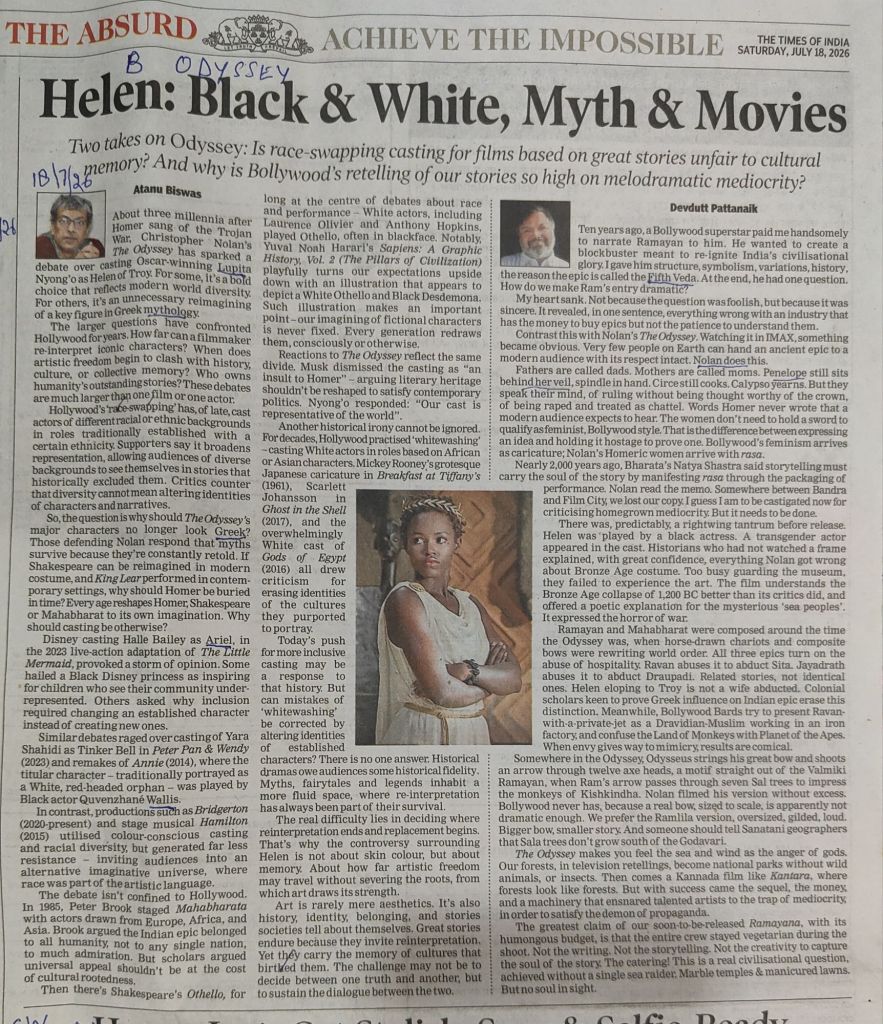
Copyright@shravancharitymission
“Wintry Peacock” by D.H. Lawrence – Summary:
“Wintry Peacock” is a short story by D.H. Lawrence that explores themes of memory, longing, and the disconnect between past and present. Set in the English countryside during winter, the story reflects Lawrence’s deep sensitivity to nature and human emotion.
The narrator, staying in a country house during winter, notices a peacock roaming the snowy grounds — an unusual and vivid sight against the bleak, white landscape. The peacock seems out of place in the wintry setting, symbolizing lost beauty, exoticism, or a forgotten past.
Intrigued, the narrator inquires about the bird and learns it once belonged to an Indian officer’s wife who had lived there. She had brought the peacock from India, but after her departure, the bird was left behind, much like a remnant of a bygone, colonial life.
The story ends on a reflective note, with the peacock becoming a haunting emblem of memory, change, and the quiet melancholy of things that no longer belong but remain lingering in the present.
Elsie is a servant or local woman who has a close connection to the estate. She is talkative, curious, and somewhat gossipy — typical of Lawrence’s portrayals of rural working-class women. She tells the narrator the story behind the peacock, including how it was brought from India by an officer’s wife who used to live at the house. Elsie seems emotionally connected to the house’s past and carries a sense of lingering nostalgia.
Alfred is Elsie’s husband. He plays a smaller role in the story but is mentioned as a practical, no-nonsense man who helps take care of things around the house. He is less sentimental than Elsie and represents a more grounded, rural perspective.
Mrs. Goyte is a key but absent character in D.H. Lawrence’s short story “Wintry Peacock.” Though she never appears directly in the narrative, her presence is felt through the memories and conversations of other characters — particularly Elsie, who tells the narrator about her.
Written and posted by Columnist and author Kamlesh Tripathi
Copyright@shravancharitymission
JANMASHTAMI: Celebrating Krishna’s Arrival
Kamlesh Tripathi
Janmashtami celebrates the stormy midnight birth of Lord Krishna, the eighth avatar of Lord Vishnu, on the eighth day (Ashtami) of the dark fortnight (Krishna Paksha) in the Hindu month of Bhadrapada, during the waning phase of the moon. The hour is symbolic.
The story begins with Kansa, the tyrannical king of Mathura. A divine prophecy warned him that the eighth child of his cousin, Devaki, would cause his death. Terrified, Kansa imprisoned Devaki and her husband Vasudeva and killed their first six children. The seventh child, Balarama, was miraculously transferred to the womb of Rohini, the first consort of Vasudeva and was thus saved.
A comparison can be drawn with the Greek hero Perseus, who survives despite his grandfather Acrisius’ dastardly attempt to kill him. Though he is abandoned and left adrift in a wooden chest at sea with his mother, the gods protect him. On the other hand, Krishna, the eighth child of Devaki, is secretly carried away from the prison and saved, while Kansa kills infants in his attempt to escape fate. Both narratives show the failure of human power against divine will.
Krishna was born in the prison of Mathura. Legend has it that when divine forces intervened, the chains of Vasudeva fell away, the prison doors opened, and the guards were overcome by sleep. Vasudeva carried the newborn Krishna across the swollen Yamuna to Gokul, where he left him in the care of Nanda and Yashoda. In return, he brought back their newborn daughter.
Although born to Devaki and Vasudeva, Krishna became the beloved son of Yashoda and Nanda. He belonged simultaneously to the royal world of Mathura and the pastoral world of Gokul and Vrindavan.
Krishna stole butter, teased the gopis, played his flute and wandered through the lanes of Vrindavan with his friends. His childhood is remembered not for grandeur but for mischief. Yashoda sometimes had to chase him, scold him and even tie him to a wooden mortar.
The famous episode of Yashoda looking into Krishna’s mouth is especially symbolic. She saw the entire universe in it. The child she was trying to discipline was none other than the cosmic being himself. He is simultaneously the God, child, philosopher, prankster, warrior, lover, king and the cowherd.
In temples and homes, devotees fast and stay awake until midnight, waiting for the moment believed to be Krishna’s birth. At midnight, the idol of the infant Krishna is placed in a cradle. He is bathed and dressed in new clothes and adorned with flowers. Devotees sing bhajans and chant Hare Krishna, Hare Krishna as bells ring and conch shells are blown.
In Maharashtra, the festival takes a particularly lively form through Dahi Handi. Inspired by Krishna’s childhood habit of stealing butter, young men and women form human pyramids to reach and break a pot of curd or butter suspended high above the ground.
In Mathura and Vrindavan, the celebrations have a special emotional intensity. These are the lands associated with Krishna’s childhood, his flute, his friends and the Gopis. Temples are beautifully decorated, devotional music fills the streets, and the atmosphere becomes one of collective remembrance. Even homes are decorated with jhankis of Krishna. Janmashtami is celebrated all over India and in many parts of the world by the Indian diaspora. In Dwarka, the main ritual and midnight Abhishek take place at 12:00 AM, marking the birth of Lord Krishna.
Krishna’s greatest gift to humanity is his wisdom. On the battlefield of Kurukshetra, Krishna became the charioteer of Arjuna and delivered the Bhagavad Gita. There he addressed one of humanity’s oldest dilemmas: That one must perform one’s duty without becoming enslaved by the fruits of action. Karmanye vadhikaraste ma phaleshu kadachana—you have a right to action, but not to its fruits.
He also teaches balance. Life is neither entirely about renunciation nor entirely about indulgence. Krishna played the flute, loved music, enjoyed friendship, fought battles, ruled a kingdom and imparted spiritual wisdom. His life embraced the world without becoming imprisoned by it.
To a child, he is the mischievous Kanha who steals butter. To a mother, he is the adorable little boy whom Yashoda lovingly disciplines. To a devotee, he is the supreme Lord. To a philosopher, he is the teacher of the Gita. To a lover of poetry and music, he is the flute-playing Krishna of Vrindavan. And to those facing moral dilemmas, he remains the divine charioteer of Kurukshetra.
Janmashtami asks us to discover Krishna within ourselves. It is the courage to confront Kansa-like forces of fear and tyranny. The symbolism of his midnight birth is perhaps the most powerful message of all. When the world appears darkest, hope can still be born. When injustice seems invincible, righteousness can still emerge. And when life appears imprisoned by circumstances, a new beginning may be waiting behind the closed doors. That is the enduring magic of Janmashtami.
Written and posted by Kamlesh Tripathi
Author, Poet, & Columnist
*
https://kamleshsujata.wordpress.com
*
Like it and Share it
*
Shravan Charity Mission is an NGO that works for poor children suffering from life-threatening diseases, especially cancer. Our posts are meant for our readers, including children and adults, and have a huge variety of content. We also accept donations for our mission. Should you wish to donate to the cause of cancer? The bank details are given below:
NAME OF ACCOUNT: SHRAVAN CHARITY MISSION
Account no: 680510110004635 (BANK OF INDIA)
IFSC code: BKID0006805
***
Copyright@shravancharitymission
QUOTE 1
If you would not be forgotten as soon as you are dead & rotten, either write things worth reading, or do things worth the writing… BENJAMIN FRANKLIN
*
An old tree dies. Grief arrives. The ancient oak that, according to folklore, sheltered Robin Hood in England’s Sherwood Forest, has fallen. (TOI EDITORIAL 20/6/26)
*
As The Who sang, “Meet the new boss, same as the old boss.”
*
Ever has it been that love knows not its own depth until the hour of separation…KAHLIL GIBRAN
*
Even a sheet of paper has two side… JAPANESE PROVERB
*
We carry within us
The wonders we seek outside.
Rumi
*
What is not good for the beehive is not good for the bee…MARCUS AURLEUS
*
No tree is an island…
*
I think that I shall never see/ A poem lovely as a tree…JOYCE KILMER
*
Billy Bragg described the courts as: This isn’t a court of justice son, this is a court of law.
*
Every thinking person is an atheist… ERNEST HEMINGWAY
*
Any role is possible when our soul and role work together…BRAHMA KUMARI ASHA
*
Roman poet Horace’s ‘Carpe diem, quam minimum credula postero’ is a powerful reminder of the importance of seizing the day and not relying too much on the future.
*
Yesterday is history, tomorrow is a mystery, and today is a gift.
*
Rumi says: ‘Taz een lamha meen az haamil shuvad’ — the next moment is forever in the womb of incertitude. The future depends on what we do today.
*
‘Realise deeply that the present moment is all you have’ … ECKHART TOLLE
*
A mortar board is superior to the hard hat
*
I yam what I yam…Pop Eye. I am because we are… Ubuntu
*
Life’s pleasures are best when they float with contradiction.
*
He that is born to be hanged will never be drowned… William Shakespeare in Tempest
*
All lost to prayers, to prayers all lost… TEMPEST
*
Swam and gusset and band, stitch, stitch, stitch, in poverty, hunger, diet…a shroud as well as a shirt. So went a Victorian poem on the monotonous misery of seamstresses toiling for starvation wages.
*
Good wombs have borne bad sons… Says Miranda in Tempest, William Shakespeare
*
Whether it is intellectually preferable to endure the tribulations of conscious existence or to terminate one’s biological viability via self-inflicted cessation presents a fundamental ontological dilemma… It has been taken from the play Hamlet…”To be or not to be, that is the question” by William Shakespeare.
*
Hell is empty, And all the devils are here… Ariel, Tempest, William Shakespeare
*
Ekam sat vipra babudha vadanti, Rig Ved verse 1.164.46… there is only one truth expressed differently by observers
*
Men may come and men may go… TENNYSON
*
The old village truth: When the whole village is on fire, wisdom lies in everyone coming together to save the village, rather than each person trying to save only their own house.
*
Posted by Columnist Kamlesh Tripathi
Copyright@shravancharitymission
QUOTE 1
If you would not be forgotten as soon as you are dead & rotten, either write things worth reading, or do things worth the writing… BENJAMIN FRANKLIN
*
An old tree dies. Grief arrives. The ancient oak that, according to folklore, sheltered Robin Hood in England’s Sherwood Forest, has fallen.
*
As The Who sang, “Meet the new boss, same as the old boss.”
*
Ever has it been that love knows not its own depth until the hour of separation…KAHLIL GIBRAN
*
Even a sheet of paper has two side… JAPANESE PROVERB
*
We carry within us
The wonders we seek outside.
Rumi
*
What is not good for the beehive is not good for the bee…MARCUS AURLEUS
*
No tree is an island…
*
I think that I shall never see/ A poem lovely as a tree…JOYCE KILMER
*
Billy Bragg described the courts as: This isn’t a court of justice son, this is a court of law.
*
Posted by Columnist Kamlesh Tripathi
Copyright@shravancharitymission
QUOTES 25/8/26
*
The function of a private health insurance is to make as much money as possible. Every dollar not in claims is another dollar made in profits for the company…BERNIE SANDERS
*
I think I know enough of hate
To say that for destruction ice
Is also great and would suffice
ROBERT FROST, Poem
*
If we want users to like our software, we should design it to behave like a likeable person…ALAN COOPER
*
It is a good rule in life never to apologise. The right sort of people do not want apologies, and the wrong sort take a mean advantage of them…PG WODEHOUSE
*
You stick a credit card in a machine, and you pay $3 or whatever it is to get cash- your own money…BILL JANKLOW
*
Modesty is invisibility. To be seen – to be seen- is to be… penetrated. What you must be girls, is impenetrable… MARGARET ATWOOD, The Handmaid’s Tale
*
Communism has never come to power in a country that was not disrupted by war or corruption, or both…JOHN F KENNEDY
*
A doctor gave a man six months to live. The man couldn’t pay his bill, so he gave him another six months…HENNY YOUNGMAN
*
I am mindful that the goal of protest is not more protest, but the goal of protest is change…DERAY MCKESSON
*
The court is like a palace of marble; it’s composed of people very hard and very polished…JEAN DE LA BRUYERE
*
No change of circumstances can repair a defect of character…RALPH WALDO EMERSON
*
The avoidance of taxes is the only intellectual pursuit that still carries any reward…JOHN MAYNARD KEYNES
*
Bring it on. Dissent is central to any democracy…HARRY BELAFONTE
*
For men may come and men may go,
But I go on forever… TENNYSON, The Brook
*
Rights are not a matter of numbers- and there can be no such thing, in law or in morality, as actions forbidden to an individual, but permitted to a mob…AYN RAND
*
The only thing that’s real is this lonely road tonight…JOE COCKER, song
*
Animal shall not be measured by man…They are other nations, caught with ourselves in the net of life and time, fellow prisoners of the splendour and travail of the earth…HENRY BESTON
*
The problem with ratings is that you can give yourself a million reasons why they are what they are…JULIE PLEC
*
Everything is a miracle. It is a miracle that one does not dissolve in one’s bath like a lump of sugar…PABLO PICASSO
*
I’ve never had a problem with drugs. I’ve had problems with the police…KEITH RICHARDS
***
Copyright@shravancharitymission
The Tempest is one of Shakespeare’s final plays, believed to have been written around 1610–1611. It is a story of betrayal, power, revenge, forgiveness, magic and reconciliation. The central character, Prospero, is the former Duke of Milan who uses magic to bring his enemies to an island and ultimately chooses forgiveness over revenge.
The play begins with a violent storm at sea. A ship carrying Alonso, the King of Naples, his son Ferdinand, his brother Sebastian, and several nobles is apparently wrecked. However, the storm has been deliberately created by Prospero, the rightful Duke of Milan, who now lives on a remote island with his daughter Miranda.
Prospero was once the Duke of Milan, but his brother Antonio, with the help of Alonso, betrayed him and took his position. Prospero and the young Miranda were forced into exile and eventually reached the island. There, Prospero developed great knowledge of magic and gained control over the island’s spirits.
His principal servant is Ariel, a magical spirit whom Prospero had rescued from imprisonment. Another inhabitant of the island is Caliban, the son of the witch Sycorax. Caliban considers the island his inheritance, while Prospero regards him as his servant.
After the shipwreck, Ferdinand becomes separated from the others. He meets Miranda, and the two immediately fall in love. Prospero initially tests Ferdinand by making him perform difficult work. Eventually, he accepts their love.
Meanwhile, Alonso and his companions wander around the island. Alonso believes that Ferdinand has drowned and is overcome with grief.
Prospero’s old enemies are still capable of betrayal. Antonio encourages Sebastian to consider murdering Alonso and taking the throne of Naples. Their plan, however, is prevented.
At the same time, Caliban meets Stephano, a drunken servant from the ship, and Trinculo, another comic character. Caliban mistakenly believes Stephano can help him overthrow Prospero. Together they plan to seize control of the island.
Prospero has complete power over his enemies. Through Ariel and his magic, he creates illusions and controls events on the island. He has the opportunity to punish Antonio and Alonso for the wrongs they committed against him.
But Prospero gradually realizes that revenge will not bring true happiness.
Ariel tells Prospero that if he could feel human emotions, he would probably feel pity for the suffering men. Prospero responds with one of the play’s central ideas:
“The rarer action is / In virtue than in vengeance.”
Prospero therefore chooses forgiveness instead of revenge.
Prospero reveals himself to Alonso and the others. Alonso is astonished to discover that Prospero is alive. Prospero forgives his brother Antonio and restores his dukedom.
Even more happily, Alonso discovers that Ferdinand is alive and has fallen in love with Miranda. Their marriage promises to unite the families and heal the political divisions of the past.
Prospero also frees Ariel, fulfilling his promise to the spirit. Caliban remains on the island after recognizing the foolishness of his rebellion.
Having achieved reconciliation, Prospero gives up his magical powers. He breaks his magic staff and prepares to return to Milan.
The play ends with Prospero and the others leaving the island. Prospero’s final act is not one of domination but of forgiveness and release.
1. Forgiveness versus Revenge
The most important theme is Prospero’s decision to forgive those who betrayed him. Shakespeare suggests that forgiveness requires greater strength than revenge.
2. Power and Responsibility
Prospero possesses enormous magical power, but the play asks whether power should be used to control others or to bring about justice and reconciliation.
3. Freedom and Slavery
Ariel longs for freedom, while Caliban resists Prospero’s authority. Their relationships raise questions about domination, obedience and liberty.
4. Colonialism and Control
Prospero’s treatment of Caliban has often been interpreted through the lens of colonialism. Prospero arrives on the island, claims authority over it and imposes his language and values on its inhabitants.
5. Love and Reconciliation
The love between Ferdinand and Miranda provides a hopeful future and helps unite the previously divided political families.
6. Illusion and Reality
The island is filled with magic, music and illusions. Shakespeare uses these to question what is real and what is temporary in human life.
The Tempest is the story of a betrayed ruler who uses magic to bring his enemies under his control but ultimately discovers that forgiveness, freedom and reconciliation are more powerful than revenge.
Written and posted by Columnist and author Kamlesh Tripathi

