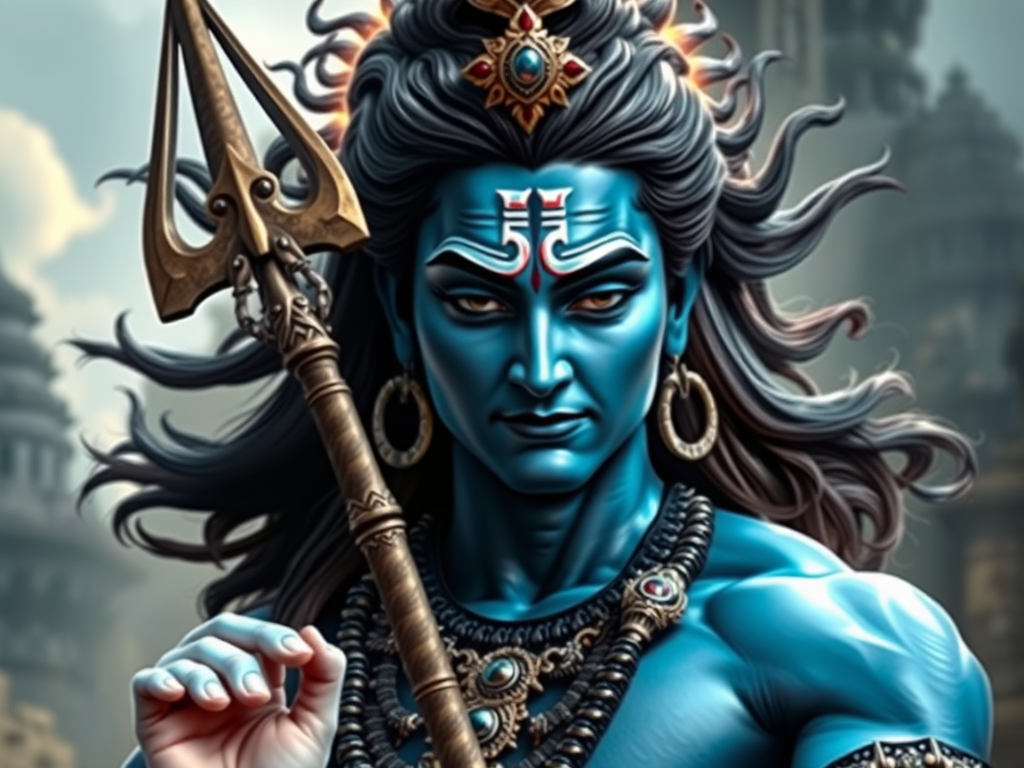
Satrajit, a Yadava king, was a great devotee of the Sun-God Surya. He had ten wives and three daughters named Satyabhama, Bratini and Prasvapini. Sun-God Surya, greatly pleased, offered him the dazzling Syamantaka jewel as a present, which had the power of conferring great wealth upon its owner. When Satrajit wore the jewel, its brilliance was such that he was mistaken for the sun god himself.
During a meeting, Krishna asked Satrajit to let King Ugrasena have the jewel, so that it could be used for the good of all. Proud of his possession, Satrajit refused to part with the Syamantaka.Top of Form
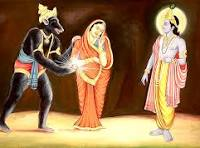
One day, Satrajit’s brother, Prasena, borrowed the jewel from Satrajit and went into a forest to hunt. There, a lion killed him, took the jewel, and went inside a cave. The cave was of Jambavan, the immortal king of the bears. Jambavan killed the lion and took the jewel, and offered it to his son as a toy. When Satrajit did not hear from his brother, he suspected that his brother must have been killed for the jewel, and suspected Krishna of committing the deed. The rumour spread, and Krishna set out to recover the jewel himself in vindication.
Learning that Prasena had been slain by a lion, which had in turn been killed by a bear on the side of a mountain, Krishna entered the bear’s den. He discovered that the jewel was being used as a toy by a child. Hearing the child’s nurse scream at the sight of the intruder, an enraged Jambavan attacked Krishna. They fought for 28 days and nights before Jambavan finally realised that Krishna was Rama’s reincarnation. Awestruck, Jambavan glorified Krishna and offered the Syamantaka, as well as his daughter, Jambavati, in marriage to the deity. Krishna accepted both of them and provided moksha to the bear king. He then summoned Satrajit to a royal assembly and narrated the tale of the recovery of the Syamantaka. He restored the jewel into the hands of the Yadav king Satrajit. Deeply ashamed of his accusation, Satrajit decided to offer Krishna the hand of his daughter, Satyabhama, regarded as a ‘jewel among women’, as well as the Syamantaka. Krishna married Satyabhama, but declined to receive the jewel, regarding it to be the property of Satrajit, as its donor had been Surya.
Shravan Charity Mission is an NGO that works for poor children suffering from life-threatening diseases, especially cancer. Our posts are meant for our readers, including children and adults, and have a huge variety of content. We also accept donations for our mission. Should you wish to donate to the cause of cancer? The bank details are given below:
TIMES OF INDIA: 15/6/25 WHY A SMALL JHARKHAND TOWN STILL ADORES THE WRITER OF PATHER PANCHALI
Flanked by a restless Subarnarekha river and an unassuming railway line that runs through the small town, Ghatsila reminds you of idyllic Nischindipur, where Satyajit Ray’s iconic Pather Panchali (Song of the Road) unfolds. It’s a drowsy, almost diffident, place that seems to have been bypassed by time. Maybe the resemblance is not entirely coincidental. This is where celebrated writer Bibhuti Bhusan Bandyopadhyay, who penned the unforgettable Bengali novel, spent many creative years of his life and breathed his last at the age of 56 in 1950. The finest works of Bibhuti Babu, as every one refers to him in Ghatsila, include ‘Aparajito (Undefeated)’, ‘Aranyak (Of The Forest)’, and ‘Chander Pahar (Mountain Of The Moon)’. Director Shakti Samanta’s ‘Amar Prem’ (1972), a melancholic story of unrealised love, starring Rajesh Khanna and Sharmila Tagore, was based on a Bandyopadhyay short story, Hinger Kochuri. It has been 75 years since he passed away. But Bibhuti Babu remains Ghatsila’s calling card. Hotels are named after him. So are sightseeing spots, libraries and grammar schools. He is present even on restaurant menus. In fact, the writer is everywhere. Ghatsila is nestled in the lap of the Dalma hills in Jharkhand’s East. Singhbhum district shares a border with West Bengal’s Jhargram and Purulia districts to the east and north, and Odisha’s Mayurbhanj to the south. At the spot where NH 33 turns towards Ghatsila, the Jharkhand tourism department has built a hotel called Bibhuti Vihar. The town also has a Bibhuti Inn, owned by a businessman. A popular hotel on the banks of the Subarnarekha is named after a spot where the writer used to sit on moonlit nights, and that he had named ‘Ratmohana’ (charmer of the night). The house where Bibhuti Babu lived is located in Dahigora, now the poshest part of the town. The residence is called Gourikunj, after his first wife, who died during childbirth. The road leading to Gourikunj is called Apur Path– the road of Apu, the protagonist of the semi-autobiographical Pather Panchali. There’s more. A local society for the preservation of Bandyopadhyay’s house and his legacy is called Gourikunj Unnayan Samiti. Says its president, Tapas Chatterjee, “Nobody commands more respect than Bibhuti Babu in Ghatsila.” “Not an inch of his house was encroached upon, even though nobody lived there for 57 years. In 1950, when Bibhuti Babu died, his second wife, Rama Chattopadhyay, and son Taradas Bandyopadhyay, who was three then, left the town. Taradas ji gave us the NOC to construct this memorial in 2007, three years before his death. In between, the house lay in utter neglect and ruins.” Chatterjee said. The Samiti also runs a Bengali language grammar school on Sundays, called Apur Pathshala, and a library called Bibhuti Smriti Sansthagar in Ghatshila. A cultural festival is hosted every year on September 12 to mark the writer’s birth anniversary. The story of how Bibhuti Babu came to live in Ghatsila is fascinating. According to Chatterjee, a contractor from Ghatsila called Ashok Gupta had taken a loan from the writer when the latter was working as a teacher in Calcutta. Unable to pay him back in cash, Gupta decided to register the house in Ghatsila in Bibhuti babu’s name. “Bibhuti Babu wanted his younger brother, Nutbihari Bandyopadhyay, who was a doctor, to settle in this town and had visited Ghatsila in 1938. He fell in love with this house and the town and never returned.” Chatterjee said. Since he was already an established name in Bengali literature, many other Calcutta writers, including Sahitya Akademi Awardee Gajendra Kumar Mitra (1908-1994), Pramatha Nath Bishi (1901-1985) and Subodh Ghosh (1909-1980), also built homes in Ghatsila. Bimal Roy’s ‘Sujata’ (1960) and Gulzar’s ‘Ijaazat’ (1989) were based on stories written by Ghosh. However, all left in due course. Except Bibhuti babu, who stayed on and wrote some of his most famous works in this town. As a writer, Bibhuti Babu shared a special bond with the quiet jungles on the town’s edge, the free-flowing river and forest dwellers. He had witnessed the exploitation of natural resources in the name of development when he went to Bhagalpur in Bihar as the assistant manager of a forest estate in January 1924. That assignment left a lasting impression on the writer and funds mentioned in works such as ‘Aranyak’ and the essay, ‘Hey Aranya Katha kao (Oh Forest, Speak)’. Ghatsila is full of such natural spots, like Burudi dam, Phuldungri Pahar and the banks of the Subarnarekha, where Bibhuti Babu would sit with a pen and notebook for hours. Situated 54 km from Jamshedpur and 240 km away from Kolkata, Ghatsila is a favourite of tourists from Bengal. Nearly 80% of the population here, including tribals, now speak the Bengali language. The locals, however, rue how some things are no longer the same. “Earlier, tourists came for longer durations, a month or, at times even longer. They would rent out homes and stay like locals. Since they came here for a change of air, we called them ‘changers’,” said Rohit Kumar, manager of a private lodge in Ghatsila’s Phuldungri. The new-age tourists come for a day or two. The neighbouring hill town of Belpahari in Jhargram district of West Bengal offers better amenities and takes away a major chunk of tourists. But appreciation of the legacy of Bibhuti Babu isn’t confined to visitors anymore. Supriti Murmu, wife of prominent Jharkhand state agitation leader Bablu Murmu, says, “I was drawn to this town because of Bibhuti Babu. As a student of Bangla literature, we were influenced by his writings and wanted to experience the rural life he portrayed in his books. Supriti Murmu used to be a prominent left-wing student leader and was pursuing her graduation in Bangla literature in neighbouring Jhargram when her activism and her love for the writer brought her to Ghatsila in 1987. “I have been here since then,” she said. Bandyopadhyay’s works and his love for the forest dwellers resonate with the local tribal population as much as his books appeal to the Bengali intelligentsia. At Gourikunj, his real legacy is the bond shared by everyone. An artist from Bengal recently painted scenes from Bandyopadhyay’s daily life in Ghatsila on the boundary walls of the house. On his birthday anniversary, girls from tribal communities decorated Apur Path, the lane leading to the house, with beautiful Santhal patterns in the form of rangolis. Everyone and everything is coming together to celebrate their one and only Bibhuti Babu.
Shravan Charity Mission is an NGO that works for poor children suffering from life-threatening diseases, especially cancer. Our posts are meant for our readers, including children and adults, and have a huge variety of content. We also accept donations for our mission. Should you wish to donate to the cause of cancer? The bank details are given below:
DEVDUTT PATTNAIK 16/8/25 ECONOMIC TIMES DRAVIDIAN IRON FOR THE ARYAN HORSE
(Aryans came for newly smelted iron and offered domesticated horses in exchange. They were neither invaders nor migrants: they were traders.) PICTURE OF DEVDUTT PATTNAIK AUTHOR OF BUSINESS SUTRA
Colonial historians argued the ‘Aryan invasion theory’ that light-skinned chariot-riding people destroyed Harappan cities, conquered India, enslaved local dark-skinned people and created the caste system. To counter this, there was the ‘out of India’ theory popularised by many Brahmins, that Harappa was Vedic, that Aryans were originally India who migrated out of India, taking civilisation to the world. Both were wrong. Neither explained what motivated these Aryans to move in, or out, of India. Now it seems increasingly clear that Aryans came for (newly smelted) iron, and they offered (newly domesticated) horses in exchange. Aryans were neither invaders nor migrants: they were traders. And like many merchants and sailors, they had local wives, which accounts for the spread of their genes (R1aZ93), language (proto-Sanskrit) and patriarchal culture in India. In Hindu myth, the horse-headed Vishnu rescued the Vedas and gave them to Brahma for safekeeping. For over 3,000 years, Brahmins of India have therefore meticulously transmitted the Vedic songs containing some of the oldest descriptions of horses, chariots and composite bows in the world (Rig Veda 1.163.10 and 6.75.2). The Brahmins saw these Vedic hymns as timeless (sanatan), not of human origin (a-paurusheya). Today, thanks to ancient DNA analysis, archaeology and linguistics, we know that this is not true. Horses, originally bred for meat and milk, were fully domesticated only 4,000 years ago, around 2000 BC, in the region north of the Black and the Caucasian sea, west of the Ural mountains. The early horse were too small for adult humans to ride. This led to invention of the earliest spoked-wheel chariots, light light enough to be pulled by horses. They have been found in burial sites in Southern Russia, at Sintashta, east of the Ural mountains, also dated to 2000 BC. Composite bows (made of wood, bow and sinew) were invented around the same time, at the same place. This new military technology (horse, chariot, bow) spread to Egypt (indicated by wall art) in the east, Scandinavia (indicated by bronze statues) in the north and China (indicated in burial sites) and India (expressed in Vedic poetry) in the east by 1500 BC. With the horse-breeders, spread a new language Proto-indo-European (PIE). The eastern migration saw the spread of a gene variant found only in Steppe pastoral men, present in Y-chromosome, identified as R1a-Z93. It is currently seen across Central Asia, Iran and amongst all Brahmins of India. Those with these gene have another mutation that enables adults to digest milk. North Indians can digest milk easily. South Indians prefer curd. The men who came bearing these genes referred to themselves as Aryan or noble (this term was appropriated by racist Europeans causing much academic confusion). Rig Vedic verse (Mandala 4, Sukta 24) refers to bargaining a fair price. These traders would have had to repeatedly return to Central Asia to fetch more horses as horses do not breed in India. A simple fact that most people miss. The monsoon climate is not conducive to horse breeding. So Aryans were neither invaders nor migrants. They were traders, probably with wives on either side of the mountain trade route. The mothers gave their children voiced aspirated consonants (gh, jh, h, dh, bh) and retroflex consonants (t, d, n, s). The spoked-wheel chariot pulled by horses could carry two men: a driver and an archer. This image is immortalised in the Bhagavad-Gita, with Krishna holding the reins of four white horses, and Arjuna holding his mighty bow, the Gandiva. Both riders blow conch shells. The Rig Veda does not mention this conch-shell; the Atharva Veda does. They are only found off the Gujarat coast, in the Indian Ocean. Recent excavations in Keeladi, Tamil Nadu, are drawing attention to iron smelting technology that was invented in India, in regions associated with Dravidian and Munda languages. This requires very high temperatures. Sites in Deccan have ash mounds indicating a long-standing enquiry into fire technology. Along with Anatolia (modern Turkey) and Africa (Bantu people), India seems to be another site where iron was first extracted. This could be a good reason why Aryans came to India from the Oxus river basin through treacherous mountain passes (not flat enough for wheeled wagons). Horse breeding in India came very late, after 1400 AD, in parts of Gujarat, Rajasthan, Punjab and Maharashtra. So for nearly 3,000 years, every year, horse breeders would bring their horses from Central Asia for local Indian kings, who would use the horse in war, to conquer new lands, and even slaughter them as part of land acquisition ceremonies (Ashwamedha). Traders had no reason to ‘invade’ or ‘migrate’ to India. They had to go back to fetch more horses from Central Asia, where horse breeding was easy. (SKETCH: ILLUSTRATION DEVDUTT PATTNAIK)
Shravan Charity Mission is an NGO that works for poor children suffering from life-threatening diseases, especially cancer. Our posts are meant for our readers, including children and adults, and have a huge variety of content. We also accept donations for our mission. Should you wish to donate to the cause of cancer? The bank details are given below:
‘Awadh Assam and Dalai Lama… The Kalachakra’ has been archived in several prestigious institutions, both in India and internationally. Here’s a summary of its archival presence:
📚 International Archives
Department of Information and International Relations (DIIR), Government of Tibet: The book is archived in the DIIR, which is responsible for the administration and dissemination of information related to the Tibetan Government-in-Exile.
Tibet Policy Institute (TPI): The TPI, an institution that focuses on research related to Tibet, has archived the book, highlighting its relevance to Tibetan studies.
Personal Library of His Holiness the 14th Dalai Lama: The book is included in the personal collection of His Holiness the Dalai Lama, reflecting its significance in Tibetan history and culture.
The Ohio Digital Library, USA: Your book is available in this digital library, making it accessible to a global audience interested in Tibetan and Indian history. (Holy Books)
Apple Digital Library: The book has been included in Apple’s digital library, broadening its reach to readers worldwide.
🇮🇳 Indian Archives
Friends of Tibet Library: This library, dedicated to preserving Tibetan culture and history, has archived the book.
Maharashtra Mitra Mandal Library, Bandra, Mumbai: A prominent library in Mumbai has included your book in its collection, making it available to local readers.
These archival placements underscore the importance of the work in documenting the historical and cultural narratives of the region.
Shravan Charity Mission is an NGO that works for poor children suffering from life-threatening diseases, especially cancer. Our posts are meant for our readers, including children and adults, and have a huge variety of content. We also accept donations for our mission. Should you wish to donate to the cause of cancer? The bank details are given below:
At the conference in New Delhi where Lord Mountbatten disclosed Britain’s partition plan for India (left to right) Indian nationalist leader Jawaharlal Nehru (1869 – 1964), adviser to Mountbatten Lord Ismay, Viceroy of India Lord Louis Mountbatten, and President of the All-India Muslim League Muhammad Ali Jinnah. (Photo by Keystone/Getty Images)
When India got freedom, but didn’t know what its boundaries were TIMES NEWS NETWORK, 22.8.21
On the midnight of August 15, 1947, we knew that India had kept its tryst with destiny, we knew that the subcontinent had been divided, that we were now two countries, India and Pakistan, but what we didn’t know was where India ended and Pakistan began. The boundary lines were still unknown.
That had been Viceroy Lord Mountbatten’s idea. He didn’t want the celebrations to be marred by recriminations on both sides. As if that was possible.
The British had long lost the opportunity for a peaceful and orderly handover of power. With the failure of the 1942 Cripps’ mission and then the three-member 1946 Cabinet delegation (with Sir Stafford Cripps playing the key role again), partition was inevitable. But how do you divide a subcontinent? Drawing the line was never going to be easy.
The man chosen for the task was Sir Cyril Radcliffe, a man who hadn’t travelled further east than the Gibraltar. But it fell on this 48-year-old Inner Temple barrister to do this impossible task– and that, too, in just five weeks.
While Radcliffe may have known little or nothing of India, he was, after all, the ultimate establishment man, which is probably why he was picked for the job. He had studied at Haileybury (Clement Attlee, the British Prime Minister then, also went to the same school) and then Oxford. After that, he had a brilliant career as a barrister. During the war, he had been director-general in the Ministry of Information, responsible for censorship and propaganda. It was Radcliffe who had run a campaign against Nehru’s sister Vijaya Lakshmi Pandit when she visited the United States. Radcliffe had also harassed P.G. Wodehouse ‘when he made ill-judged broadcasts while in German captivity’, wrote Patrick French.
So, the Establishment Man reached India and began work as a ‘neutral umpire’ in New Delhi on July 8. He would live separately, guarded by a massive Punjabi armed with two pistols. He would take his own decisions; no one would be around to influence him. But it wasn’t such a secluded existence for Radcliffe, after all. He dined with British military commander Claude Auchinleck (maybe the Auk needed consoling; his wife had run away with his friend), Lord Mountbatten, Punjab Governor Sir Evan Jenkins and many other members of the British high society.
It’s hard to believe that Radcliffe did not discuss the boundary issue with the others, who all knew much more about India than he did. But more than anything else, Radcliffe had a cheat sheet. In February 1946, the ever-underrated Archibald Wavell, the Viceroy of India, was unceremoniously sacked by the British Prime Minister, Clement Attlee, while sending in Mountbatten, as he had drawn up a contingency plan. Wavell knew what was coming. And he understood the need for a well-thought-out boundary line. Helping him were Reforms Commissioner V.P. Menon and Benegal Rau.
So, what did Radcliffe have to go with? Maybe some advice from veterans, Wavell’s map, and outdated census data. And with this, he had to divide a subcontinent in 36 days. Its people, villages, rivers, canals, roads. And to compound matters, the weather was frightfully hot, and Radcliffe came down with a bout of dysentery.
Seventy-four years later, it might be easy to say, ‘Poor fellow, he was only a lawyer with a brief; what more could he possibly have done? But in 1947, everything hinged on this lawyer and his brief. Would he award Gurdaspur to India or Pakistan? Would he really award a part of Ferozepur to Pakistan, so that it had better control over its water supply?
In fact, he almost gave away a part of Ferozepur to Pakistan. In the first week of August, during a lunch with his commissioners at a club in Simla, he said he would give Pakistan a part of Ferozepur because India was getting Gurdaspur. But that was not to be. When word got out, there was frenzied behind-the-scenes activity that made the ‘neutral umpire’ change his mind– and the boundary line — within days.
He handed over all the Awards to Mountbatten on August 13, but Mountbatten ruled that the Awards would not be made public till August 16. So, on August 15, a free India still did not know its exact boundaries.
When at 5 pm, on August 16, Liaquat Ali Khan, Jawaharlal Nehru, Sardar Patel and Baldev Singh gathered in the Council Chamber of Government House, three hours after the Awards had been sent to them, no one looked happy. It would be months before things settled down. For the moment, freedom had arrived, and with it the horrors of Partition.
For Radcliffe, it was time to go home. He boarded a flight out on August 17. He never came back. Later, when a reporter asked him if he would ever like to visit India, he said: ‘God forbid. Not even if they asked me. I suspect they would shoot me out of hand– both sides.’
The piece also includes the following pictures and press clippings
** PICTURE SEPT 1947 REFUGEES CROWD ONTO TRAINS FOR PAKISTAN AS THEY LEAVE NEW DELHI ** PRESS CLIPPING AUG 18, 1947 PUNJAB & BENGAL BOUNDARY AWARD ANNOUNCED NO AGREED SOLUTION: WIDE DIVERGENCE OF OPINION
ASSENT TO CHAIRMAN’S OWN DECISION
DEMARCATION OF BORDERS OF DIVIDED PROVINCES
AUG 18 MOVES TO RESTORE PEACE IN PUNJAB… PINDI CUT OFF FROM REST OF INDIA ** AUG 19 PUNJAB PROMISED AID IN SUPPRESSING DISORDERS… PLANS FOR IMMEDIATE CONCERTED ACTION FORMULATED ** AUG 23 ENDING PUNJAB AND QUETTA LAWLESSNESS … PAKISTAN CABINET’S DECISION
Shravan Charity Mission is an NGO that works for poor children suffering from life-threatening diseases, especially cancer. Our posts are meant for our readers, including children and adults, and have a huge variety of content. We also accept donations for our mission. Should you wish to donate to the cause of cancer? The bank details are given below:
HOW HYDERABAD, JUNAGADH HELD UP INDIA’S INTEGRATION TIMES NEWS NETWORK
Under British rule, India contained more than 500 princely states that, upon independence, had the choice of joining either India or Pakistan. But uniting the dominion was no easy task, and several princely states held out for autonomy. But Sardar Patel’s special skills–of persuasion, sometimes maybe a little coercion–made them fall in line.
AUG 17 (PRESS CLIPPING) HYDERABAD (DN.), SATURDAY
“Today when I bid Farewell To the last of the Residents in my State, it is still my desire and the desire of Hyderabad to remain within the family of nations known as the British Commonwealth which looks to His Majesty the King as the living symbol of its unity,” declared the Nizam proposing the toast of Mr. C. G. Herbert, the last Resident in Hyderabad at a Farewell at the Jubilee Hall last night.
1/Hyderabad
After Independence, the princely state of Hyderabad decided against joining India, with the Nizam preferring to remain a “sovereign state” under the British Commonwealth. Hyderabad was a key strategic state between India’s north and south, which ruled out complete autonomy as an option for the government.
AUG 19 (PRESS CLIPPING) MORE CLASHES IN SECUNDERABAD TRANSPORT PARALYSED
From Our Own Correspondent HYDERABAD (Dn.) Aug. 18 Owing to a fresh outbreak of communal trouble, Secunderabad town has been almost isolated. Railway and bus services have ceased to function, and all approaches to the town have been cordoned off by the armed police.
Hyderabad refused to sign the Instrument of Accession, the standard legal framework offered to all princely states to join India, following which it signed a ‘standstill agreement’ to maintain the status quo for a year. But Hyderabad was also seeing communal violence break out, and was struggling to quell a communist uprising and the growing influence of an extremist Muslim militia. In September 1948, the continued instability in the state resulted in the Indian Army attacking Hyderabad as part of ‘Operation Polo’ and annexing it.
2/JUNAGADH
Upon Independence, the nawab of Hindu majority Junagadh opted to join Pakistan despite not sharing a border with it. The Indian government, unhappy with the accession, feared further communal violence if Junagadh was allowed to join Pakistan. To force a reversal, the government secured the accession of two of Junagadh’s vassal states, cut off supply lines to the state and surrounded it with its troops. In Bombay, a ‘provisional government of Junagadh’ was set up and led the popular agitation against the accession to Pakistan, after which the nawab fled to Karachi, allowing India to annex the state. A plebiscite was also held in February 1948, with more than 90% of the vote in favour of joining India.
AUG 21 PRESS CLIPPING
ACCESSION OF JUNAGADH TO PAKISTAN
UNION DISAPPROVAL —-***—- BHOPAL MAY JOIN INDIAN DOMINION From Our Special Representative NEW DELHI, August 20. Strong objection has been raised by the Dominion Government of India to Junagadh’s
3/INDORE
Indore was among the few princely states that had yet to accede to India prior to August 15. But Maharaja Holkar’s acceptance came just hours after Independence — positive news for the government as Hyderabad and Junagadh resisted.
PRESS CLIPPING AUG 21 INDORE’S ACCESSION On midnight of August 14/15 when British Paramountcy lapsed, only four of those States contiguous with the Indian Dominion had still not acceded to the Indian Dominion. If these, Indore has now signed the Instrument of Accession, which, however, is said to have reached the States Department six hours after the lapse of Paramountcy.
4/Oudh
Though Oudh, in present-day UP, had been annexed by the British just before the 1857 rebellion, Yusuf Mirza, the grandson of its last ruler Wajid Ali Shah, ‘assumed sovereign authority’ of the territory after a secret coronation.
PRESS CLIPPING AUG 17 SHAH YUSUF “ASCENDS” OUDH THRONE LUCKNOW, Saturday: Shah Yusuf Mirza, grandson of Nawab Wajid Ali Shah, the last king of Oudh, has issued a “royal proclamation formally ascending ‘the throne’ and assuming all the sovereign authority’ and power over the dominions of Oudh’ by virtue of our right of inheritance and in the name of our people.” The proclamation followed a two-hour meeting of the council of Action of the Oudh Restoration Mission held yesterday evening. It is reported that a quiet Coronation was held at midnight, where Prince Yusuf Mirza was installed on the throne at Sheesh Mahal, the ancient palace of the Nawab of Oudh. The ceremony was attended by members of the Royal Family of Oudh and members of the Council of Action. The territory … Of Oudh comprises
KEY STATES THAT PAVED THE WAY TO UNITY
Some major princely states ultimately joined the dominion prior to Independence, laying down a marker for others, but not without making it difficult for the government.
5/TRAVANCORE
In 1946, the dewan of Travancore had insisted the state would remain independent after the British left but was willing to sign treaties with India and Pakistan. Some British politicians and Mohammad Ali Jinnah supported the prospect of an independent Travancore, which buoyed the dewan. But in July 1947, the dewan survived an assassination attempt by a member of the Kerala Socialist Party. The incident led to a change of heart and Travancore acceded within days.
6/BHOPAL
The nawab of Bhopal, which was a Hindu-majority state, had close ties with Jinnah and saw Congress as an adversary. He feared Independence would leave Muslims ‘helpless, unorganised and unsupported’ and turn India into a communist nation, and suggested Bhopal would remain independent. But a letter from Lord Mountbatten — and seeing other princely states accede– changed the nawab’s mind. The only concession he sought was for the announcement of the accession to be delayed to 10 days after Independence.
7/JODHPUR
Jodhpur was an exception among states that had hesitated to join India — it had a Hindu ruler and a Hindu-majority population. Though the king was willing to join India, he was also negotiating terms with Pakistan in July 1947. Losing Jodhpur, a border state, would have dealt a major blow to India as it may have pushed neighbouring states towards Pakistan. But Sardar Vallabhbhai Patel intervened, offering some concessions and asking him whose side he would take in the event of communal clashes, after which the king agreed to accede.
Shravan Charity Mission is an NGO that works for poor children suffering from life-threatening diseases, especially cancer. Our posts are meant for our readers, including children and adults, and have a huge variety of content. We also accept donations for our mission. Should you wish to donate to the cause of cancer? The bank details are given below:
Raksha Bandhan is observed on the last day of the Hindu lunar calendar month (Panchang) of Shravan. It normally falls in August. Raksha Bandhan is also known as Rakhi. It is also referred as Saluno. It is an affectionate festival that celebrates the unbreakable bond between brothers and sisters. It’s a day when sisters tie a sacred thread, called “rakhi,” on the wrists of their brothers, symbolising protection and love. In return, the brothers offer gifts and the promise to protect their sisters.
It is an admired and traditional Hindu ritual and festival celebrated every year. Apart from India, it is also celebrated in other parts of the world influenced by the Hindu culture. On this day, sisters of all ages tie a talisman or lucky charm called ‘rakhi’ on the wrists of their brothers. The sisters symbolically protect the brothers by doing this. In return, they receive a gift. Its spiritual significance lies in the protection and interconnectedness of the relationship between the brother and the sister. The expression “Raksha Bandhan” comprehensively describes this ritual.
It is traditionally rooted in the curriculum of territorial or village marriages. The bride is married out of her natal village or town, and her parents, by custom, do not visit her in her married home. In rural north India, village marriage is quite prevalent. Married women travel to their parents’ homes every year to celebrate Raksha Bandhan. Their brothers, who usually live with their parents or somewhere close by, at times, travel to their sisters’ married homes to escort them back. Some brides arrive a few weeks earlier at their natal homes and stay there till the ceremony is over. The brothers serve as lifelong intermediaries between their married sisters’ and parental homes, as well as their potential protectors.
In modern India, where families have become increasingly nuclear, the festival has become more symbolic, yet it remains highly popular. The rituals of this festival have spread beyond their traditional regions. They have transformed owing to migration and technology. Factors influencing are movies, social media, and the religious bent of mind. We all remember the famous Bollywood song ‘Bhaiya mere Rakhi ke bandhan ko nibhana’. Even among females and males who are not blood relatives, tying of the rakhi has promoted the tradition of voluntary kin, crossing lines of caste, class, and religion.
So much has been written about Raksha-Bandhan to establish its credentials. According to the Oxford English Dictionary, the Hindi word Rakhi derives its origin from the Sanskrit word Rakshika, meaning a protector or guardian. The earliest mention of the word Rakhi in the English language dates back to 1829, in Lieutenant Colonel James Tod’s book, Annals & Antiquities of Rajasthan.
Indian poet Nazeer Akbarabadi (1735–1830) wrote one of the first nazms in the Hindustani language on Rakhi. The august poet imagines that he, despite being a Muslim, would like to dress up as a “Bamhan” (Brahmin priest), with a sacred thread and a mark on the forehead, so that he can tie the threads on the wrists of all the beautiful people around him.
Much has been captured about Rakhi in various treatises, dictionaries, and books. Notable examples include the Dictionary of Hindustani and English, authored by Duncan Forbes in 1857. Raksha Bandhan’s reference in the mythology comes out in chapter 137 of the Uttara Parva of the Bhavishya Purana. Here, Lord Krishna narrates to Yudhishthira the ritual of having a raksha thread tied to his right wrist by the royal priest (rajpurohit) on the day of purnima (full moon day) of the Hindu lunar month of Shravan.
Though traditionally, Raksha-Bandhan is observed in northern India. It also encircles central and western India, Nepal, and some other parts of the country, as well as overseas Hindu communities such as Fiji. It is primarily a Hindu festival. Besides India and Nepal, other countries also celebrate Raksha Bandhan. Pakistan and Mauritius are two other countries where Hindus celebrate this festival. In addition wherever we have Hindu diaspora Raksha Bandhan is celebrated.
Folklorist and American anthropologist Susan Snow Wadley writes: ‘In Savan, greenness abounds as the newly planted crops take root in the wet soil. It is a month of joy and gaiety, with swings hanging from tall trees. Girls and women swing high into the sky, singing their joy. The gaiety is even greater because women, especially the young ones, are expected to return to their natal homes for an annual visit during Savan.’
The brothers serve as lifelong intermediaries between their married sisters’ and parental homes, as well as their potential protectors. That’s the bond of Raksha-Bandhan.
Shravan Charity Mission is an NGO that works for poor children suffering from life-threatening diseases, especially cancer. Our posts are meant for our readers, including children and adults, and have a huge variety of content. We also accept donations for our mission. Should you wish to donate to the cause of cancer? The bank details are given below:
Operation Sindoor was launched on 7 May 2025, in retaliation for the brutal terror attack in Pahalgam, Jammu and Kashmir, on 22 April, in which 26 civilian tourists lost their lives.
Pakistan is an atrocious copy-paste master. After having lost the plot, Prime Minister Shehbaz Sharif implemented several measures to create a false image among the Pakistani public that they had emerged victorious. This, despite their Director General of Military Operations (DGMO) having called his Indian counterpart to request a cessation of hostilities.
After the temporary suspension of armed hostilities, Prime Minister Narendra Modi visited the Adampur air base in Punjab on Tuesday, May 13, 2025, to boost the morale of the armed forces. Modi’s visit came just days after Indian armed forces executed Operation Sindoor with clinical precision. Air Force Station, Adampur, was one of the active bases during the mission. PM Modi was welcomed with chants of “Bharat Mata ki Jai” and “Vande Mataram,” as air warriors and soldiers celebrated the operation’s success. Copying the Indian Prime Minister Narendra Modi’s move, Shehbaz Sharif also decided to visit the forces. However, lacking the courage to do so effectively, he merely stood on a tank to address them. He was widely ridiculed and trolled for this: Khet mein tank, jeet ka prank.
The Government of India formed seven all-party parliamentary delegations to visit various countries as part of a strategic diplomatic outreach, aiming to garner international support and convey India’s stance: that India is a peace-loving nation suffering from terrorism originating in Pakistan. As expected, Pakistan mimicked this move too, sending a delegation under Bilawal Bhutto abroad to falsely portray Pakistan as a victim rather than a perpetrator of terrorism.
But this act of imitating India isn’t new for Pakistan. It began with Mohammad Ali Jinnah himself. In his piece ‘Ranade, Gandhi and Jinnah’, Dr B. R. Ambedkar describes Gandhi and Jinnah, noting that Jinnah and the Muslim League copied Gandhi and the Congress even before India’s independence. The Qaid-i-Azam of Pakistan simply followed Gandhi’s lead. The politics between these two iconic figures became a contest of one-upmanship from Jinnah’s end. If Gandhi was the Mahatma, Jinnah had to be Qaid-i-Azam. Pakistan has always believed in copying India, a pattern visible even during Jinnah’s lifetime. Jinnah didn’t innovate; he imitated Gandhi.
Politics in the hands of these two great leaders turned into a competition of extravagance. If Gandhi was known as the Mahatma, Jinnah insisted on being known as Qaid-i-Azam. If Gandhi had the Congress Party, Jinnah ensured the existence of the Muslim League. If the Congress had a Working Committee and an All India Congress Committee, the Muslim League had to have its own Working Committee and Council. A session of the Congress was inevitably followed by one of the Muslim League.
If the Congress issued a political statement, the Muslim League had to issue one too. If the Congress passed a resolution of 17,000 words, the Muslim League’s resolution had to be at least 1,000 words longer. If the Congress President held a press conference, the Muslim League President followed suit. If the Congress addressed the United Nations, the Muslim League made sure not to be outdone.
Gandhi insisted Jinnah admit he was one of the Muslim leaders; Jinnah insisted Gandhi admit he was a Hindu. This dynamic is clearly depicted in Ambedkar’s piece, ‘Ranade, Gandhi and Jinnah’.
During the partition, Jinnah and the Muslim League imitated Gandhi and the Congress Party. This could have been a great moment for the Congress to reflect, mock, and point out Pakistan’s persistent habit of mimicry, showing that the mindset of Jinnah and the Muslim League carried on into the Pakistani state post-partition and portraying Congress as the lynchpin of India.
Instead, the Congress began mimicking Pakistan—and in doing so, fell from grace. Big opportunity lost.
Shravan Charity Mission is an NGO that works for poor children suffering from life-threatening diseases, especially cancer. Our posts are meant for our readers, including children and adults, and have a huge variety of content. We also accept donations for our mission. Should you wish to donate to the cause of cancer? The bank details are given below:
POEM THE SPIRIT OF INDIA: SONG OF A BILLION SOULS HARSH GOENKA SPEAKING TREE TOI 23/6/25
* I am the rhythm of the dhol and whisper of the veena, I am the smile in Holi’s colour, And the silence in your Diwali prayer, And bow with folded hands at Ajmer Sharif. * I beat the drums in a tribal dance in Bastar, And recite verses from the Vedas under Banyan trees, And fly kites across the sky on Makar Sankranti. I serve langar in golden bowls at Amritsar, And offer ‘roze ka iftar’ to my brother next door. * I am the cheer of children in Shillong’s monsoon, I sow rice in the fields of Tamil Nadu, I herd yaks in Arunachal… And fish in the deltas of Bengal. * I dance Garba all night in Ahmedabad’s courtyards, And whisper lullabies on a house boat in Dal Lake. I chant on the ghats of Varanasi, And meditate in the caves of Ellora. * I wear the lungi, the lehenga, the sherwani, the sari, I am the tilak, the chandan, the rudraksha and the rosary. I write in Marathi, think in Bengali, sing in Kannada, And dream in all the tongues of my land. * I am the army fighter’s cry in the borders, The farmer’s hope in Vidharbha. I build software in Bengaluru, And craft poetry in Kolkata cafes. I race camels in Rajasthan’s sands. * I am not one. I am many. I am contradiction and harmony. I am the one who prays, and the one who protests. I am youth, I am age. I am ancient, and I am tomorrow. * I walk through every temple gate and every church aisle, Every dargah door and gurudwara corridor. I am welcomed everywhere with ‘aadaab’, ‘pranam’, ‘vanakkam’ and ‘namaste’. * I am the spirit of India.
Shravan Charity Mission is an NGO that works for poor children suffering from life-threatening diseases, especially cancer. Our posts are meant for our readers, including children and adults, and have a huge variety of content. We also accept donations for our mission. Should you wish to donate to the cause of cancer? The bank details are given below:
His Holiness the Dalai Lama’s 90th birthday marks a day of peace, wisdom and compassion. He is not only a spiritual leader of Tibetan Buddhism. He is also a global symbol of peace and compassion.
It is with great honour and deep respect that we inaugurate the screening of Kundun (koon-dohn), a deeply moving and visually stunning film directed by Martin Scorsese (Skaw-say-zee) and written by the late Melissa Mathison. Based on the life and teachings of His Holiness the 14th Dalai Lama, Kundun (Koondohn) offers a powerful and poetic portrayal of one of the most revered spiritual leaders of our time.
The film takes us on a journey through a critical period in Tibetan history, spanning from 1937 to 1959—a time of both great spiritual promise and immense political upheaval. Beginning in the rural province of Amdo, where the young reincarnation is discovered, Kundun (Koondohn) follows the Dalai Lama’s path to Lhasa, his spiritual and political development, and ultimately, his decision to flee into exile as Tibet faces brutal suppression by the Chinese Communist regime.
The word “Kundun” (Koon-dohn), meaning “presence” in Tibetan, beautifully captures the essence of the Dalai Lama’s enduring influence. More than just a biographical account, the film serves as a meditation on faith, identity, compassion, and resilience in the face of overwhelming adversity.
Visually, the film is a masterpiece. Cinematographer Roger Deakins captures the rich textures and sacred landscapes of Tibet with painterly elegance. The hypnotic and emotionally resonant score by Philip Glass heightens the spiritual and contemplative tone, blending seamlessly with the film’s narrative and imagery. Every frame is a tribute to Tibetan culture, tradition, and philosophy.
Despite the political controversy that surrounded its release, Kundun (Koondohn) remains a landmark in spiritual cinema. It was courageously made, despite global political pressures, and continues to shine as a quiet but powerful act of cultural preservation and artistic integrity.
We are grateful to Martin Scorsese (Skaw-say-zee), Melissa Mathison, and the entire creative team for their dedication to telling this story with honesty and reverence. As we watch Kundun (Koon-dohn) today, may we reflect not only on the life of the Dalai Lama but also on the universal values of peace, non-violence, and the strength of the human spirit.
Let this screening be more than a cinematic experience—let it be a moment of reflection, dialogue, and inspiration.
Shravan Charity Mission is an NGO that works for poor children suffering from life-threatening diseases, especially cancer. Our posts are meant for our readers, including children and adults, and have a huge variety of content. We also accept donations for our mission. Should you wish to donate to the cause of cancer? The bank details are given below: