Tag Archives: china

THE SHADOW CIRCUS: THE CIA IN TIBET

https://kamleshsujata.wordpress.com

*

POEM: THE FAILING WORLD ORDER

BOOK REVIEW: THE EDGE OF THE PLAIN: HOW BORDERS MAKE AND BREAK OUR WORLD … by James Crawford

Copyright@shravancharitymission

    In today’s world, there are innumerable borders than ever before in the history of mankind. To be true in life it’s all about the borders we make and how they make us. Those human demarcations those human barriers on the ground are a source of extreme misery.

    China hustles India with infrastructure build-ups, salami slicing and recurrent confrontations on the line of actual control. So it becomes a tense and ghastly activity. Another example is that of Ukraine which is being bombarded at its borders by Russia. These arbitrary lines that cleave the world have enormous power over our lives. The book combines history and reportage to explore this intricate global network of lines and their crossings.

    Borders come up in areas where human beings live and move around. This barrier then limits and directs our activities. The landscape may be the same, from one blade of grass to the next, but the lines, fences, and checkpoints make it different. And that makes all the difference to human destinies. The book traces back the idea that Amitav Ghosh called the “enchantment of the lines” while writing about the Indian Partition.

    Borders are the volatile flashpoints for political conflagration – but are they also the symptom or the cause of trouble one needs to examine?

    Nowhere are these questions about boundaries as knotty as in Israel/Palestine. The book tracks the West Bank border where a wall has come up as a fortified line of separation. The Israeli state draws a line to cleave the territory, leaving people in an illegal limbo, and then follows up with detentions, land seizures and house demolitions.

    The border wall has been disputed, segment by segment in the courts, but it keeps morphing and surviving. Israel’s obsession and surfeit of borders have made a mockery of them, bringing home the point that the only real borders are the ones we come to expect, orates the book.

    The US was born out of restless borders, declaring its independence from British colonisers by refusing to be contained within its boundaries, as pointed out by the Mason-Dixon Line. The settlers’ “manifest destiny” was to claim all of North America, violently displacing Native Americans and warring with Mexico. Pushing the frontier remains essential to America’s idea of itself. And yet, it is also taken over by the ‘hypnosis of the map’. The book traces the dangerous border between the US and Mexico, where thousands of migrants have died to date trying to cross it.

    The book also takes you to sites such as Melilla in Spain and Lampedusa an island near Italy, from where desperate migrants and refugees try to make it to Europe. Masses of people scale fences and razor wire and brave military police, knowing some of them will be picked up, yet gambling and getting through. The darkness and uncertainty of these places make them a fertile ground for far-right parties and movements. Throughout history, wherever physical barriers are erected, they provide clashes between people trying to cross over. In this book, James Crawford argues that our enduring obsession with borders has brought us to a crisis point: We are now entering the endgame of a process that began thousands of years ago when we first started dividing the earth.

    The book explores the notion of borders not just as physical walls, but also as other kinds of fortification and defence. The Great Firewall of China is a national barrier in cyberspace. It filters content unwanted by the authorities and nurtures China’s own internet companies. It also explores the ‘cordon sanitaire’ that arose to defend against pandemics.

    Meanwhile, climate change is shifting landscapes and changing borders too. The Alpine watershed between Italy and Austria is literally melting. In the Sahara, the Great Green Wall is an experiment in tree planting, an attempt to stave off the desertification off the coast. It’s a wall that doesn’t divide people but unites them under a common goal.

    The book is wide-ranging. Its basic message is about how humans define borders, and then they define us.

    Beginning with the earliest known marker which denoted the end of one land and the beginning of the next, the author follows the story of borders into our fragile and uncertain future – towards the virtual frontiers of the internet, and the shifting geography of a world beset by climate change.

     In the process, the author travels to many borders old and new. From a melting border high in the glacial landscapes of the Austrian-Italian Alps to the only place on land where Europe and Africa meet; from the artist Banksy’s ‘Walled Off Hotel’ in the conflict-torn West Bank to the Sonoran Desert and the fault lines of the US/Mexico border. Combining history, travel and reportage, The Edge of the Plain explores how borders have grown and evolved to control our landscapes, memories, identities and destinies. As nationalism, climate change, globalisation, technology and mass migration all collide with ever-hardening borders, something has to break. Can we let go of the lines that separate us? Or are we fated to repeat the mistakes of the past, as our angry, warming and segregated planet lurches towards catastrophe?

***

By Kamlesh Tripathi

*

https://kamleshsujata.wordpress.com

*

Share it please

*

Shravan Charity Mission is an NGO that works for poor children suffering from life threatening diseases especially cancer. Our posts are meant for our readers that includes both children and adults and it has a huge variety in terms of content. We also accept donations for our mission. Should you wish to donate for the cause. The bank details are given below:

NAME OF ACCOUNT: SHRAVAN CHARITY MISSION

Account no: 680510110004635 (BANK OF INDIA)

IFSC code: BKID0006805

*

Our Publications

GLOOM BEHIND THE SMILE

(The book is about a young cancer patient. Now archived in 8 prestigious libraries of the US that includes Harvard College Library; Harvard University Library; Library of Congress; University of Washington, Seattle; University of Minnesota, Minneapolis; Yale University, New Haven; University of Chicago; University of North Carolina, at Chapel Hill University Libraries. It can also be accessed in MIT through Worldcat.org. Besides, it is also available for reading in libraries and archives of Canada, Cancer Aid and Research Foundation Mumbai; Jaipuria Institute of Management, Noida; India. Shoolini University, Yogananda Knowledge Center, Himachal Pradesh and Azim Premzi University, Bangalore).  

ONE TO TANGO … RIA’S ODYSSEY

(Is a book on ‘singlehood’ about a Delhi girl now archived in Connemara Library, Chennai and Delhi Public Library, GOI, Ministry of Culture, Delhi; Available for reading in Indian National Bibliography, March 2016, in the literature section, in Central Reference Library, Ministry of Culture, India, Belvedere, Kolkata-700022)

AADAB LUCKNOW … FOND MEMORIES

(Is a fiction written around the great city of Nawabs—Lucknow. It describes Lucknow in great detail and also talks about its Hindu-Muslim amity. That happens to be the undying characteristics of Lucknow. The book was launched in Lucknow International Literary Festival of 2014. It is included for reading in Askews and Holts Library Services, Lancashire, U.K; Herrick District Library, Holland and Charlotte-Mecklenburg Library, Mecklenburg County in North Carolina, USA; Black Gold Cooperative Library Administration, Arroyo Grande, California).

REFRACTIONS … FROM THE PRISM OF GOD

(Co-published by Cankids–Kidscan, a pan India NGO and Shravan Charity Mission, that works for Child cancer in India. The book is endorsed by Ms Preetha Reddy, MD Apollo Hospitals Group. It was launched in Lucknow International Literary Festival 2016)

TYPICAL TALE OF AN INDIAN SALESMAN

(Is a story of an Indian salesman who is, humbly qualified. Yet he fights his way through unceasing uncertainties to reach the top. A good read not only for salesmen. The book was launched on 10th February 2018 in Gorakhpur Lit-Fest. Now available on Amazon, Flipkart and Onlinegatha)

RHYTHM … in poems

(Published in January 2019. The book contains 50 poems. The poems describe our day-to-day life. The book is available on Amazon, Flipkart and Onlinegatha)

MIRAGE

(Published in February 2020. The book is a collection of eight short stories available in Amazon, Flipkart and Notion Press)

AWADH ASSAM AND DALAI LAMA … The Kalachakra

(The story of the man who received His Holiness The Dalai Lama and his retinue in 1959 as a GOI representative when he fled Tibet in 1959. The book was launched on 21st November 2022 by His Holiness The Dalai Lama at Dharmshala. The titled is archived in the library of the Department of Information and International Relations (DIIR) Government of Tibet, Tibet Policy Institute (TPI) and the personal library of His Holiness. The title is also archived in The Ohio Digital Library, USA).

BHAVANS JOURNAL

Short stories, Book reviews and Articles published in Bhavan’s Journal: 1. Reality and Perception, 15.10.19; 2. Sending the Wrong Message, 31.5.20; 3. Eagle versus Scholars June, 15 & 20 2020; 4. Indica, 15.8.20; 5. The Story of King Chitraketu, August 31 2020; 6. Breaking Through the Chakravyuh, September 30 2020. 7. The Questioning Spouse, October 31, 2020; 8. Happy Days, November 15, 2020; 9. The Karma Cycle of Paddy and Wheat, December 15, 2020; 10. Power Vs Influence, January 31, 2021; 11. Three Refugees, March 15, 2021; 12. Rise and Fall of Ajatashatru, March 31, 2021; 13. Reformed Ruler, May 15, 2021; 14. A Lasting Name, May 31, 2021; 15. Are Animals Better Teachers?, June 16, 2021; 16. Book Review: The Gram Swaraj, 1.7.21; 17. Right Age for Achievements, 15.7.21; 18. Big Things Have Small Beginnings, 15.8.21; 19. Where is Gangaridai?, 15.9.21; 20. Confront the Donkey Within You 30.9.21; 21. Know Your Strengths 15.10.21; 22. Poverty 15.11.21; 23. Top View 30.11.21; 24. The Bansuriwala 15.1.22; 25. Sale of Alaska 15.2.22; 26. The Dimasa Kingdom 28.2.22; 27. Buried Treasure 15.4.22; 28. The Kingdom of Pragjyotisha 30.4.22; 29. Who is more useful? 15.5.22; 30. The White Swan from Lake Mansarovar 30.6.22; 31. Bhool Bhulayya 15.9.22; 32. Good Karma 30.9.22; 33. Good name vs Bad Name 15.10.22; 34. Uttarapath—The Grand Trunk Road 1.12.22; 35. When Gods Get Angry 1.1.23; 36. Holinshed’s Chronicles 15.1.23; 37. Theogony 15.2.23

SUNDAY SHILLONG TIMES

ARTICLES & POEMS: 1. POEM: HAPPY NEW YEAR 8.1.23; 2. POEM: SPRING 12.3.23; 3. POEM: RIGHT AND WRONG 20.3.23, 4. THE GUSH OF EMOTION—WRITING, 26.3.23;

BANDRA TIMES, MUMBAI

ARTICLES & POEMS: 1. POEM SPRING, 1.4.23;

(ALL THE ABOVE BOOK TITLES ARE AVAILABLE FOR SALE ON AMAZON, FLIPKART AND OTHER ONLINE STORES OR YOU COULD EVEN WRITE TO US FOR A COPY)

*****
BOOK CORNER: THE TALE OF GENJI

Copyright@shravancharitymission

    ‘The Tale of Genji’ is regarded as one of the oldest novels ever written.  It was written around the year 1000 A.D., during the Heian Period. It’s a classic work of Japanese literature written in the early 11th century by a noblewoman and lady-in-waiting. Her name was Murasaki Shikibu. The original manuscript of this book was created around the peak of the Heian period and during the last lapse of classical Japanese history, between 794 and 1185 A.D. which no longer exists. It was created on “concertina” a free-reed musical instrument or Orihon, a type of book, prevalent during the Tang dynasty in China in which several sheets of paper are pasted together and folded alternately in one direction and then the other.

    The work is a rare account of the lifestyles of high courtiers during the Heian period. It is scribbled in the archaic language in a poetic and complex fashion making it unreadable to the average Japanese reader or speaker without specialized study. It was not until the early 20th century that the narration was translated into modern Japanese by poet Akiko Yosana. The first English translation of the narration was attempted in 1882 by Suematsu Kencho, but was of poor quality and also incomplete.

    The novel is about the Japanese high society. The work recounts the life of handsome Hikaru Genji, or say the “Shining Genji”, who is the son of an ancient Japanese emperor known to readers as Emperor Kiritsubo and a low-ranking concubine who is Kiritsubo’s Consort. For some political reasons, the emperor removes Genji from the line of succession, demoting him to a commoner by giving him the surname ‘Minamoto’ a surname vouchsafed by the Emperors of Japan upon members of the imperial family who were excluded from the line of succession. Thereafter, a choiceless Genji pursues a career as an imperial officer. The tale focuses on Genji’s romantic life and describes the customs of the aristocratic society of those times. It is perhaps the world’s first novel. One could even say it is the first psychological novel, as claimed by Argentinian short-story writer Jorge Luis Borges, and the first novel yet to be considered a classic, particularly in the context of Japanese literature. There is debate over how much of the novel was actually written by Murasaki Shikibu. The debates over the novel’s authorship have gone on for centuries now, and are unlikely to be settled ever unless some major archival discovery comes about.

    The title has a rather lascivious plot. It starts with the death of Genji’s mother when he is three years old. Emperor Kiritsubo who is deeply in love with her cannot forget her. But soon, the Emperor meets a woman by the name of Lady Fujitsubo, formerly a princess of the preceding emperor, who resembles Kiritsubo’s deceased concubine and the mother of Genji. Later Lady Fujitsubo becomes one of his wives. Genji first loves her as a stepmother, but later as a woman when they fall in love with each other. But Genji is frustrated because of his forbidden love for Lady Fujitsubo and is therefore on irritable terms with his wife. His wife’s name is Aoi-No-Ue or Lady Aoi. Even though Genji feels guilty he soon engages in a string of love affairs with other women. These love affairs are however unfulfilling, as in most cases his advances are rebuffed, or his lover dies suddenly, or he is bored of them.

    Genji visits Kitayama, a rural hilly area to the north of Kyoto. There he finds a beautiful ten-year-old girl by the name of Murasaki. He is fascinated by her. Genji discovers that she happens to be the niece of Lady Fujitsubo. He kidnaps her and brings her to his own palace and educates her to be like Lady Fujitsubo, who is, Genji’s ideal woman. During this time Genji also meets Lady Fujitsubo secretly, and she bears his son, Reizei. Everyone except the two lovers believes that the father of the child is Emperor Kiritsubo. Later the boy becomes the Crown Prince and Lady Fujitsubo the Empress. Genji and Lady Fujitsubo swear to keep the child’s true parentage a secret.

    Genji and his wife, Lady Aoi, finally reconcile. She gives birth to a son but dies soon after. Genji is sorrowful but finds solace in Murasaki, whom he marries. Later Genji’s father, Emperor Kiritsubo, also dies. He is succeeded by his son Suzaku, whose mother Kokiden, together with Emperor Kiritsubo’s political enemies, grabs power in the kingdom. Thereafter another adultery or secret love affair of Genji is exposed: Genji and a concubine of Emperor Suzaku are caught while meeting in secrecy. Emperor Suzaku quietly conveys his amusement to Genji at his exploits with the woman named Oborozukiyo but is duty-bound to punish him even though he is his half-brother. He exiles Genji to the town of Suma in rural Harima Province now part of Kobe in Hyogo Prefecture. There, an affluent man by the name of Akashi Novice entertains Genji. Genji has an affair with Akashi’s daughter. She gives birth to Genji’s only daughter, who later becomes the Empress.

    In the capital, Emperor Suzaku is unsettled by certain dreams of his late father Kiritsubo, and something begins to affect his eyes. Meanwhile, his mother, Kokiden, falls ill, which weakens her influence over the throne, and culminates in Emperor Suzaku ordering Genji to be pardoned. Genji returns to Kyoto. His son from Lady Fujitsubo, whose name is Reizei, becomes the emperor. The new Emperor Reizei knows Genji is his biological father and raises Genji’s rank to the highest level possible and that is Genji’s apogee.

    However, when Genji turns 40 years old, his life begins to retard. His political status does not change, but his love and emotional life begin to incrementally dwindle as middle age takes charge of him. He marries another lady, the Third Princess known as Onna-Sannomiya. But Genji’s nephew, Kashiwagi, later forces himself on the Third Princess, and she bears his child Kaoru who is in a similar situation to that of Reizei and is legally known as the son of Genji. That reminds Genji of his past. Genji’s new marriage changes his relationship with Murasaki, who expresses her desire of becoming a nun (a bikuni) but the wish is rejected by Genji. Later Genji’s beloved Murasaki passes away.

    In the following chapter, ‘Maboroshi’ which means “Illusion”, Genji ponders how fleeting life is. And immediately after the chapter titled Maboroshi, there is a chapter titled ‘Kumogakure’ which means”Vanished into the Clouds”, which is left blank. It insinuates the death of Genji after leading a salacious life.

    The book is made of 54 chapters. Chapters 45–54 are known as the “Uji Chapters”. These chapters are about Kaoru and his best friend, Niou. Niou is an imperial prince, the son of Genji’s daughter, and the current Empress because Reizei has abdicated the throne. Kaoru is known to the world as Genji’s son but is fathered by Genji’s nephew. The chapters involve Kaoru and Niou’s rivalry over several daughters of an imperial prince who lives in Uji, a place a little away from the capital. The tale ends abruptly, with Kaoru wondering if Niou is hiding Kaoru’s former lover away from him. Kaoru has at times been called the first anti-hero in literature.

    The tale has an abrupt ending. Opinions vary on whether this was intended by the author. Arthur Waley, who drafted the first English translation of the whole of ‘The Tale of Genji,’ believed that the work was completed. Ivan Morris, the author of ‘The World of the Shining Prince,’ believed that it was not complete and that later chapters were missing. Edward Seidensticker, who made the second translation of ‘The tale of Genji,’ believed that Murasaki Shikibu didn’t have a planned story structure with an ending in mind but would have simply continued writing as long as she could have. Since the novel is about 1000 years old there are missing linkages that cannot be corroborated.

***

By Kamlesh Tripathi

*

https://kamleshsujata.wordpress.com

*

Share it if you like it

*

Shravan Charity Mission is an NGO that works for poor children suffering from life threatening diseases especially cancer. Our posts are meant for our readers that includes both children and adults and it has a huge variety in terms of content. We also accept donations for our mission. Should you wish to donate for the cause. The bank details are given below:

NAME OF ACCOUNT: SHRAVAN CHARITY MISSION

Account no: 680510110004635 (BANK OF INDIA)

IFSC code: BKID0006805

*

Our Publications

GLOOM BEHIND THE SMILE

(The book is about a young cancer patient. Now archived in 8 prestigious libraries of the US that includes Harvard College Library; Harvard University Library; Library of Congress; University of Washington, Seattle; University of Minnesota, Minneapolis; Yale University, New Haven; University of Chicago; University of North Carolina, at Chapel Hill University Libraries. It can also be accessed in MIT through Worldcat.org. Besides, it is also available for reading in libraries and archives of Canada, Cancer Aid and Research Foundation Mumbai; Jaipuria Institute of Management, Noida; India. Shoolini University, Yogananda Knowledge Center, Himachal Pradesh and Azim Premzi University, Bangalore).  

ONE TO TANGO … RIA’S ODYSSEY

(Is a book on ‘singlehood’ about a Delhi girl now archived in Connemara Library, Chennai and Delhi Public Library, GOI, Ministry of Culture, Delhi; Available for reading in Indian National Bibliography, March 2016, in the literature section, in Central Reference Library, Ministry of Culture, India, Belvedere, Kolkata-700022)

AADAB LUCKNOW … FOND MEMORIES

(Is a fiction written around the great city of Nawabs—Lucknow. It describes Lucknow in great detail and also talks about its Hindu-Muslim amity. That happens to be the undying characteristics of Lucknow. The book was launched in Lucknow International Literary Festival of 2014. It is included for reading in Askews and Holts Library Services, Lancashire, U.K; Herrick District Library, Holland and Charlotte-Mecklenburg Library, Mecklenburg County in North Carolina, USA; Black Gold Cooperative Library Administration, Arroyo Grande, California).

REFRACTIONS … FROM THE PRISM OF GOD

(Co-published by Cankids–Kidscan, a pan India NGO and Shravan Charity Mission, that works for Child cancer in India. The book is endorsed by Ms Preetha Reddy, MD Apollo Hospitals Group. It was launched in Lucknow International Literary Festival 2016)

TYPICAL TALE OF AN INDIAN SALESMAN

(Is a story of an Indian salesman who is, humbly qualified. Yet he fights his way through unceasing uncertainties to reach the top. A good read not only for salesmen. The book was launched on 10th February 2018 in Gorakhpur Lit-Fest. Now available on Amazon, Flipkart and Onlinegatha)

RHYTHM … in poems

(Published in January 2019. The book contains 50 poems. The poems describe our day-to-day life. The book is available on Amazon, Flipkart and Onlinegatha)

MIRAGE

(Published in February 2020. The book is a collection of eight short stories available in Amazon, Flipkart and Notion Press)

AWADH ASSAM AND DALAI LAMA … The Kalachakra

(The story of the man who received His Holiness The Dalai Lama and his retinue in 1959 as a GOI representative when he fled Tibet in 1959. The book was launched on 21st November 2022 by His Holiness The Dalai Lama).

BHAVANS JOURNAL

Short stories, Book reviews and Articles published in Bhavan’s Journal: 1. Reality and Perception, 15.10.19; 2. Sending the Wrong Message, 31.5.20; 3. Eagle versus Scholars June, 15 & 20 2020; 4. Indica, 15.8.20; 5. The Story of King Chitraketu, August 31 2020; 6. Breaking Through the Chakravyuh, September 30 2020. 7. The Questioning Spouse, October 31, 2020; 8. Happy Days, November 15, 2020; 9. The Karma Cycle of Paddy and Wheat, December 15, 2020; 10. Power Vs Influence, January 31, 2021; 11. Three Refugees, March 15, 2021; 12. Rise and Fall of Ajatashatru, March 31, 2021; 13. Reformed Ruler, May 15, 2021; 14. A Lasting Name, May 31, 2021; 15. Are Animals Better Teachers?, June 16, 2021; 16. Book Review: The Gram Swaraj, 1.7.21; 17. Right Age for Achievements, 15.7.21; 18. Big Things Have Small Beginnings, 15.8.21; 19. Where is Gangaridai?, 15.9.21; 20. Confront the Donkey Within You 30.9.21; 21. Know Your Strengths 15.10.21; 22. Poverty 15.11.21; 23. Top View 30.11.21; 24. The Bansuriwala 15.1.22; 25. Sale of Alaska 15.2.22; 26. The Dimasa Kingdom 28.2.22; 27. Buried Treasure 15.4.22; 28. The Kingdom of Pragjyotisha 30.4.22; 29. Who is more useful? 15.5.22; 30. The White Swan from Lake Mansarovar 30.6.22; 31. Bhool Bhulayya 15.9.22; 32. Good Karma 30.9.22; 33. Good name vs Bad Name 15.10.22; 34. Uttarapath—The Grand Trunk Road 1.12.22; 35. When Gods Get Angry 1.1.23; 36. Holinshed’s Chronicles 15.1.23

SUNDAY SHILLONG TIMES

POEM HAPPY NEW YEAR 8.1.23;

(ALL THE ABOVE BOOK TITLES ARE AVAILABLE FOR SALE ON AMAZON, FLIPKART AND OTHER ONLINE STORES OR YOU COULD EVEN WRITE TO US FOR A COPY)

*****

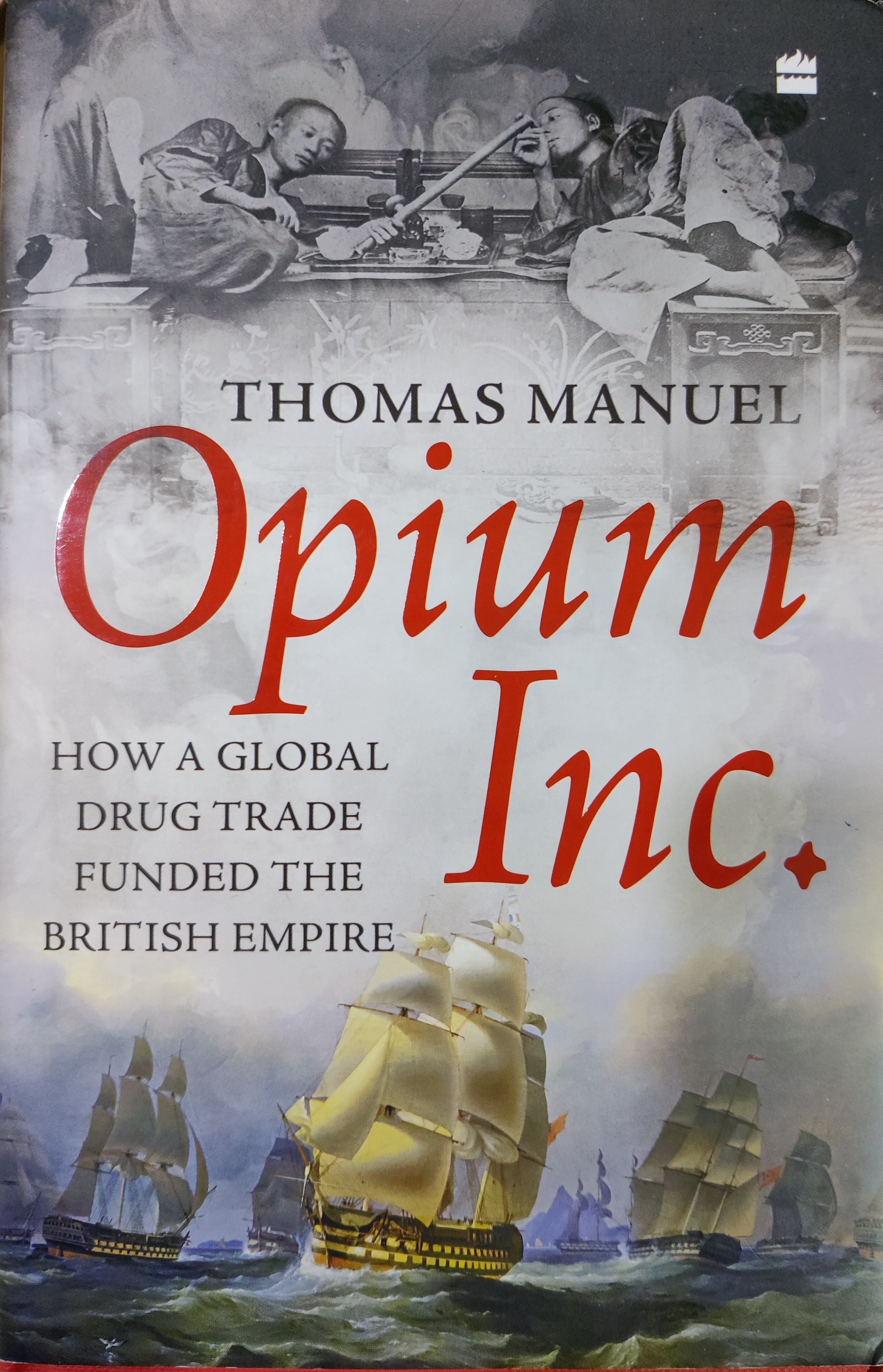
BOOK CORNER: ‘OPIUM INC. … How a Global Drug Trade Funded the British Empire by Thomas Manuel

Copyright@shravancharitymission

    Book Review: ‘OPIUM INC. … How a Global Drug Trade Funded the British Empire’ by Thomas Manuel.

     The subject book brings to us the story of the world’s biggest drug deal ever, first published in India in 2021 by Harper Collins. It wouldn’t be out of context to mention at the very outset that the author must have researched to the hilt, digging deep into various historical texts, available, on the global opium supply chain and opium trade, before he penned the book.

     Author Thomas Manuel is a journalist. He is also an award-winning playwright whose work revolves around history, science, education, or the intersection of all three. His words can be found in Lapham’s Quarterly, Nib, Wire and The Hindu, among other publications. In 2016, he won The Hindu Playwright Award for his play Hamlet and Angad. He currently works at India Ink, a public history project where he makes videos about how the past continues to affect the world today.

    Contents: It starts with the Prologue: The Great Opium Triangle. The book is divided into eleven chapters. I would briefly take you through all of them without being a spoiler. It starts with the ‘Poppy Pioneers’ and then talks of how the opium trade flourished and travelled ‘From Calcutta to Canton’ in China. Canton is also known as Guanzhou. It was captured by the British during the first Opium War. This is followed by the ‘Smugglers of Malwa.’ Then there is also ‘The Bombay Boom’ that comes with the opium money. One of the book’s most interesting sections is ‘The Opium Wars’ which gave rise to ‘Anti-Opium Crusaders.’ The narration also takes you through ‘Opium and Independence’, its ‘Endings and Legacies’. One of the prominent chapters of the book is about the spread of ‘Opium, Cotton, Sugar and slavery’, followed by ‘Opium Smoke and Mirrors’ and it ends with ‘Opium Today’. This is followed by the Index and then a half-page on the author. The language of the author is plain English which is easy to comprehend but is garnished with a plethora of quotes from various texts that make up for a large part of the plot.

    What the book offers: This is the story of the world’s biggest drug dealers. In the 19th century, the British East India Company operated a triangle of trade that straddled the globe, running from India to China to Britain. From India to China they took opium. From China to Britain they took tea. From Britain to India, they brought the British Empire. To paraphrase the historian Tan Chung: The Chinese got opium, the British got tea, and the Indians got colonialism. It was a machination that belied what was really going on: The British were enabling the longest-running drug deal ever in the history of the world. It was a devious plan that worked with cheap Indian land and labour and spun money for them. This is the story about the banality of evil, the birth of mega-corporations and the world’s first narco-state. The British had two problems, though. They were importing enormous amounts of tea from China, but the Celestial Empire (China) looked down on British goods and only wanted silver in return. Simultaneously, the expanding colony in India was proving far too expensive to maintain. The British solved both problems with opium, which became the source of income on which they built their empire.  For more than a century, the British knew that the drug was dangerous but continued to trade in it anyway and today they talk of morality. They put their colony to work to produce something that the Chinese would buy even if they didn’t want it and that was opium. Over the 18th and 19th centuries, the British transformed the entire farming economies in Bengal and Bihar into opium-producing zones. And their agents smuggled the drug illegally into China, exchanging it for tea. Suddenly, the balance of trade leaned the other way. Silver started flowing back, out of China and into the British hands. Slowly this new equation solidified into a stable mechanism: The Great Opium Triangle. The story of the opium trade is not just about the narcotics that were stored in chests and packed in ships. It was also about how that trade shaped the world we live in today. It left an undying legacy in India, whether it was Bihar’s poverty or the affluence of Bombay, the story of opium is one of immense pain for many and huge privileges for a few.

My take on the book: If you haven’t read about opium you wouldn’t know what havoc it created and continues to create in the world. Opium Inc. sensitises you towards that. While reading the book one gets a feeling as if the author has collated the data from various texts and churned it into a book. In a span of 252 pages, he has plugged around 350 notations from various documents of various authors that go to show the extent of his extensive fact-finding. Every chapter is summarised in the preface itself in a few sentences which creates that initial enamour to run through the book. It has plenty of inside stories and anecdotes some hitherto unheard of. The detailing of how opium was processed in those times is enumerated quite well. From the opium seed to the market, the narration is comprehensive. How the opium markets in China operated is explained substantially well that many would not know. The description of Hong Merchant Pan Zhencheng in the chapter from Calcutta to Canton is engrossing. The book gets interestingly descriptive in the middle. The chapter ‘Smugglers from Malwa’ is elaborate on opium farming, its production and its trading. This is a book with a lot of yarn which otherwise for an average reader would be difficult to ferret out.

    The author must have spent an aeon reading and collecting relevant data for the title. Information such as the first clipper in India was built in the 19th century in Howrah was a treat to read, even when, it was an opium clipper. The history of Bombay (Mumbai) is well carved out with its opium past and so are the daring stories of Jamsetjee Jejeebhoy and Sasson who flourished there.

    We all talk of contract farming today. The cultivation of opium under ‘contract farming’ started way before it came to other crops in the opium-growing areas. The author has also covered the story of Lin Zexu a high Chinese official best known for his role in the ‘First Opium War’ in whose honour a statue has been erected in Chatham Square in China Town, New York. The book proclaims that the opium wars were akin to the lethal world wars. After page 136 the pace of narration slows down a bit as it is loaded with minute details and names which are difficult to remember. There is one story after another and episode after episode. The narration covers the long history of sugar, opium, tea and cotton in a triangular context—India, China and Great Britain in elaborate detail. It gives a scheming view of the cross-ocean business mercantile.

    What the book delivers: The real success of any book is how it impacts you after you’ve read it, and more so, do you feel knowledge-rich after reading it? Well, on those accounts the book is sterling. It tells you how the British demolished Asia. The narration transcends from opium to sugar to cotton under the umbrella of The East India Company. It touches upon most writers who consumed opium or have written on opium and it also includes all those languishing documents on opium. There are some rare pictures too in the book on the manufacturing of opium such as—The Mixing Room, The stacking room, The Examining Hall at the Opium Factory, Patna, 1850; and the Opium Fleet on the Ganges, 1850.

    It breezes past romantic poets who were opium users and quotes the lines of a few. The book spans from the historical past of opium to the present. A line from the poem ‘Kubla Khan’ by the English Romantic poet Samuel Taylor Coleridge sums up all too well. It goes as follows:

Beware! Beware!

His flashing eyes, his floating hair!

Weave a circle round him thrice,

And close your eyes with holy dread,

For he on honey-dew hath fed,

And drunk the milk of Paradise.

    But whether the ‘milk of Paradise’ that climaxes the lines of Coleridge is opium isn’t clear. But it’s true that Coleridge consumed opium regularly. I would give the book a high rating. It definitely enhances your knowledge base when it comes to opium, tea, cotton and the triangle connecting India, China and the British Crown through The East India Company.

***

By Kamlesh Tripathi

*

https://kamleshsujata.wordpress.com

*

Share it if you like it

*

Shravan Charity Mission is an NGO that works for poor children suffering from life threatening diseases especially cancer. Our posts are meant for our readers that includes both children and adults and it has a huge variety in terms of content. We also accept donations for our mission. Should you wish to donate for the cause. The bank details are given below:

NAME OF ACCOUNT: SHRAVAN CHARITY MISSION

Account no: 680510110004635 (BANK OF INDIA)

IFSC code: BKID0006805

*

Our Publications

GLOOM BEHIND THE SMILE

(The book is about a young cancer patient. Now archived in 8 prestigious libraries of the US that includes Harvard College Library; Harvard University Library; Library of Congress; University of Washington, Seattle; University of Minnesota, Minneapolis; Yale University, New Haven; University of Chicago; University of North Carolina, at Chapel Hill University Libraries. It can also be accessed in MIT through Worldcat.org. Besides, it is also available for reading in libraries and archives of Canada, Cancer Aid and Research Foundation Mumbai; Jaipuria Institute of Management, Noida; India. Shoolini University, Yogananda Knowledge Center, Himachal Pradesh and Azim Premzi University, Bangalore).  

ONE TO TANGO … RIA’S ODYSSEY

(Is a book on ‘singlehood’ about a Delhi girl now archived in Connemara Library, Chennai and Delhi Public Library, GOI, Ministry of Culture, Delhi; Available for reading in Indian National Bibliography, March 2016, in the literature section, in Central Reference Library, Ministry of Culture, India, Belvedere, Kolkata-700022)

AADAB LUCKNOW … FOND MEMORIES

(Is a fiction written around the great city of Nawabs—Lucknow. It describes Lucknow in great detail and also talks about its Hindu-Muslim amity. That happens to be the undying characteristics of Lucknow. The book was launched in Lucknow International Literary Festival of 2014. It is included for reading in Askews and Holts Library Services, Lancashire, U.K; Herrick District Library, Holland and Charlotte-Mecklenburg Library, Mecklenburg County in North Carolina, USA; Black Gold Cooperative Library Administration, Arroyo Grande, California).

REFRACTIONS … FROM THE PRISM OF GOD

(Co-published by Cankids–Kidscan, a pan India NGO and Shravan Charity Mission, that works for Child cancer in India. The book is endorsed by Ms Preetha Reddy, MD Apollo Hospitals Group. It was launched in Lucknow International Literary Festival 2016)

TYPICAL TALE OF AN INDIAN SALESMAN

(Is a story of an Indian salesman who is, humbly qualified. Yet he fights his way through unceasing uncertainties to reach the top. A good read not only for salesmen. The book was launched on 10th February 2018 in Gorakhpur Lit-Fest. Now available on Amazon, Flipkart and Onlinegatha)

RHYTHM … in poems

(Published in January 2019. The book contains 50 poems. The poems describe our day-to-day life. The book is available on Amazon, Flipkart and Onlinegatha)

MIRAGE

(Published in February 2020. The book is a collection of eight short stories available in Amazon, Flipkart and Notion Press)

AWADH ASSAM AND DALAI LAMA … The Kalachakra

(The story of the man who received His Holiness The Dalai Lama and his retinue in 1959 as a GOI representative when he fled Tibet in 1959. The book was recently launched on 21st November 2022 by His Holiness The Dalai Lama and is archived in his library).

BHAVANS JOURNAL

Short stories, Book reviews and Articles published in Bhavan’s Journal: 1. Reality and Perception, 15.10.19; 2. Sending the Wrong Message, 31.5.20; 3. Eagle versus Scholars June, 15 & 20 2020; 4. Indica, 15.8.20; 5. The Story of King Chitraketu, August 31 2020; 6. Breaking Through the Chakravyuh, September 30 2020. 7. The Questioning Spouse, October 31, 2020; 8. Happy Days, November 15, 2020; 9. The Karma Cycle of Paddy and Wheat, December 15, 2020; 10. Power Vs Influence, January 31, 2021; 11. Three Refugees, March 15, 2021; 12. Rise and Fall of Ajatashatru, March 31, 2021; 13. Reformed Ruler, May 15, 2021; 14. A Lasting Name, May 31, 2021; 15. Are Animals Better Teachers?, June 16, 2021; 16. Book Review: The Gram Swaraj, 1.7.21; 17. Right Age for Achievements, 15.7.21; 18. Big Things Have Small Beginnings, 15.8.21; 19. Where is Gangaridai?, 15.9.21; 20. Confront the Donkey Within You 30.9.21; 21. Know Your Strengths 15.10.21; 22. Poverty 15.11.21; 23. Top View 30.11.21; 24. The Bansuriwala 15.1.22; 25. Sale of Alaska 15.2.22; 26. The Dimasa Kingdom 28.2.22; 27. Buried Treasure 15.4.22; 28. The Kingdom of Pragjyotisha 30.4.22; 29. Who is more useful? 15.5.22; 30. The White Swan from Lake Mansarovar 30.6.22; 31. Bhool Bhulayya 15.9.22; 32. Good Karma 30.9.22; 33. Good name vs Bad Name 15.10.22; 34. Uttarapath—The Grand Trunk Road 1.12.22; 35. When Gods Get Angry 1.1.23; 36. Holinshed’s Chronicles 15.1.23

SUNDAY SHILLONG TIMES

POEM HAPPY NEW YEAR 8.1.23;

(ALL THE ABOVE BOOK TITLES ARE AVAILABLE FOR SALE ON AMAZON, FLIPKART AND OTHER ONLINE STORES OR YOU COULD EVEN WRITE TO US FOR A COPY)

*****

BOOK REVIEW: AWADH ASSAM AND DALAI LAMA … THE KALACHAKRA

Copyright@shravancharitymission

By Kamlesh Tripathi

*

https://kamleshsujata.wordpress.com

*

Share it if you like it

*

Shravan Charity Mission is an NGO that works for poor children suffering from life threatening diseases especially cancer. Our posts are meant for our readers that includes both children and adults and it has a huge variety in terms of content. We also accept donations for our mission. Should you wish to donate for the cause. The bank details are given below:

NAME OF ACCOUNT: SHRAVAN CHARITY MISSION

Account no: 680510110004635 (BANK OF INDIA)

IFSC code: BKID0006805

*

Our Publications

GLOOM BEHIND THE SMILE

(The book is about a young cancer patient. Now archived in 8 prestigious libraries of the US that includes Harvard College Library; Harvard University Library; Library of Congress; University of Washington, Seattle; University of Minnesota, Minneapolis; Yale University, New Haven; University of Chicago; University of North Carolina, at Chapel Hill University Libraries. It can also be accessed in MIT through Worldcat.org. Besides, it is also available for reading in libraries and archives of Canada, Cancer Aid and Research Foundation Mumbai; Jaipuria Institute of Management, Noida; India. Shoolini University, Yogananda Knowledge Center, Himachal Pradesh and Azim Premzi University, Bangalore).  

ONE TO TANGO … RIA’S ODYSSEY

(Is a book on ‘singlehood’ about a Delhi girl now archived in Connemara Library, Chennai and Delhi Public Library, GOI, Ministry of Culture, Delhi; Available for reading in Indian National Bibliography, March 2016, in the literature section, in Central Reference Library, Ministry of Culture, India, Belvedere, Kolkata-700022)

AADAB LUCKNOW … FOND MEMORIES

(Is a fiction written around the great city of Nawabs—Lucknow. It describes Lucknow in great detail and also talks about its Hindu-Muslim amity. That happens to be the undying characteristics of Lucknow. The book was launched in Lucknow International Literary Festival of 2014. It is included for reading in Askews and Holts Library Services, Lancashire, U.K; Herrick District Library, Holland and Charlotte-Mecklenburg Library, Mecklenburg County in North Carolina, USA; Black Gold Cooperative Library Administration, Arroyo Grande, California).

REFRACTIONS … FROM THE PRISM OF GOD

(Co-published by Cankids–Kidscan, a pan India NGO and Shravan Charity Mission, that works for Child cancer in India. The book is endorsed by Ms Preetha Reddy, MD Apollo Hospitals Group. It was launched in Lucknow International Literary Festival 2016)

TYPICAL TALE OF AN INDIAN SALESMAN

(Is a story of an Indian salesman who is, humbly qualified. Yet he fights his way through unceasing uncertainties to reach the top. A good read not only for salesmen. The book was launched on 10th February 2018 in Gorakhpur Lit-Fest. Now available on Amazon, Flipkart and Onlinegatha)

RHYTHM … in poems

(Published in January 2019. The book contains 50 poems. The poems describe our day-to-day life. The book is available on Amazon, Flipkart and Onlinegatha)

MIRAGE

(Published in February 2020. The book is a collection of eight short stories available in Amazon, Flipkart and Notion Press)

AWADH ASSAM AND DALAI LAMA … The Kalachakra

(The story of the man who received His Holiness The Dalai Lama and his retinue in 1959 as a GOI representative when he fled Tibet in 1959. The book was recently launched on 21st November 2022 by His Holiness The Dalai Lama).

BHAVANS JOURNAL

Short stories, Book reviews and Articles published in Bhavan’s Journal: 1. Reality and Perception, 15.10.19; 2. Sending the Wrong Message, 31.5.20; 3. Eagle versus Scholars June, 15 & 20 2020; 4. Indica, 15.8.20; 5. The Story of King Chitraketu, August 31 2020; 6. Breaking Through the Chakravyuh, September 30 2020. 7. The Questioning Spouse, October 31, 2020; 8. Happy Days, November 15, 2020; 9. The Karma Cycle of Paddy and Wheat, December 15, 2020; 10. Power Vs Influence, January 31, 2021; 11. Three Refugees, March 15, 2021; 12. Rise and Fall of Ajatashatru, March 31, 2021; 13. Reformed Ruler, May 15, 2021; 14. A Lasting Name, May 31, 2021; 15. Are Animals Better Teachers?, June 16, 2021; 16. Book Review: The Gram Swaraj, 1.7.21; 17. Right Age for Achievements, 15.7.21; 18. Big Things Have Small Beginnings, 15.8.21; 19. Where is Gangaridai?, 15.9.21; 20. Confront the Donkey Within You 30.9.21; 21. Know Your Strengths 15.10.21; 22. Poverty 15.11.21; 23. Top View 30.11.21; 24. The Bansuriwala 15.1.22; 25. Sale of Alaska 15.2.22; 26. The Dimasa Kingdom 28.2.22; 27. Buried Treasure 15.4.22; 28. The Kingdom of Pragjyotisha 30.4.22; 29. Who is more useful? 15.5.22; 30. The White Swan from Lake Mansarovar 30.6.22; 31. Bhool Bhulayya 15.9.22; 32. Good Karma 30.9.22; 33. Good name vs Bad Name 15.10.22; 34. Uttarapath—The Grand Trunk Road 1.12.22; 35. When Gods Get Angry 1.1.23; 36. Holinshed’s Chronicles 15.1.23

SUNDAY SHILLONG TIMES

POEM HAPPY NEW YEAR 8.1.23;

(ALL THE ABOVE BOOK TITLES ARE AVAILABLE FOR SALE ON AMAZON, FLIPKART AND OTHER ONLINE STORES OR YOU COULD EVEN WRITE TO US FOR A COPY)

*****

BOOK CORNER: ‘INFLUENCE EMPIRE … The story of Tencent and China’s Tech Ambition’ by journalist Lulu Chen.

Copyright@shravancharitymission

BOOK CORNER: ‘INFLUENCE EMPIRE … The story of Tencent and China’s Tech Ambition’ by journalist Lulu Chen. The print length of the book is 283 pages. The publisher is Hodder & Stoughton. The Kindle version is priced at Rs 324.50 and the paperback is Rs 629.00.

    The title is a fascinating study of the tech giant and its symbiotic relationship with the Chinese government’ – Guardian.

    The title has been shortlisted for the ‘FINANCIAL TIMES BUSINESS BOOK 2022’ and *A TIMES BUSINESS BOOK OF THE YEAR 2022*.

    It is a story of a Chinese tech giant and the Chinese state. Behind the great firewall of China, there is a parallel universe. There’s a Baidu instead of Google, a Weibo rather than Twitter, an Alibaba instead of an Amazon or eBay. Lulu tells the story of a world-beating Chinese corporation that stays low-key.

    ‘Influence Empire by Lulu Yilun Chen is so much more than the long-awaited story of Tencent and its vital everything app, WeChat, the messaging tool used by 1.3 billion people. It’s also the sobering account of an entire generation of high-flying Chinese tech entrepreneurs, whose wings were clipped by the omnipotent hand of their own government.’ — Brad Stone, author of Amazon Unbound and The Everything Store.

    Tencent WeChat is an ‘everything’ app in China. It unfolds the features of WhatsApp and Facebook, TikTok and Tinder. It is an indispensable virtual town hall and marketplace. But it also has enormous clout in the world, with tentacles in Silicon Valley, finance, gaming and Hollywood. It is heavily invested in Tesla, Spotify, Epic Games and companies around the world including Flipkart and Ola. It is estimated to be the biggest video game company in the world.

    But what is Tencent exactly? Well, it sees itself as the ultimate connector. Its talk of internet+ is about connecting any industry with the internet to revolutionise it. Its first product QQ was modelled on ICQ, the Israeli chat service from the early days of the Web. Despite the charge that it was a copycat venture, it was moulded to the needs of Chinese users in internet cafes.

    It aggressively fended off Microsoft’s MSN, and became a Goliath in the tech industry. This growth spurt was based on an unusual technique. It opened up its platform, sharing traffic and tech know-how with companies it invested in. Today, China’s two tech titans Pony Ma and Jack Ma, the founders of Tencent and Alibaba, are locked in a fierce rivalry. They have warred over mobile payments, over start-ups, and new digital ventures and are compelled to take sides in this duopoly.

    Tencent rose as China rose. Its digital economy also boomed. In the middle of the last decade, when Tencent was on a tear, China’s internet users had expanded 36-fold. One unicorn was born every 3.8 days, and two billionaires were created every week.

    Of course, this also meant operating within the defined lines of the state. Tencent was careful not to cross the Communist Party and had to oblige with censorship and surveillance calls, blocking keywords from disclosing user information. It doesn’t matter how big a company is or how entrenched it is overseas, it cannot assume any independence from the state’s interest. When Alibaba the co-founder criticised Chinese inefficiencies, Alipay’s parent group Ant Group Co bore the brunt. In the ensuing stock market crackdown, Alibaba, Tencent and their industry peers lost $1.5 billion in market value.

    Today, Tencent finds itself facing not just global but also local pressures. Deng Xiaoping’s tolerance of a few people getting rich first has given way to Xi Jinping’s ‘common prosperity’ mantra that frowns on the ‘disorderly expansion of capital’. The government’s tech priorities have shifted to hardcore tech—semiconductors, robotics and fundamental research—to reduce reliance on the US.

    The overweening tech giants of the last decade had to be disciplined. While Tencent was already compliant with the party, it too has now embarked on a string of divestments and asset sales.

    While it is actively looking to the next frontier, investing in the cloud business and technologies that will succeed the smartphone—the metaverse? A decentralised Web3? Tencent will have a delicate manoeuvre on its hands, keeping the state on its side,

    In 2017, a company known as Tencent overtook Facebook to become the world’s fifth-largest company. It was a watershed moment, a wake-up call for those in the West accustomed to regarding the global tech industry through the prism of Silicon Valley: Facebook, Google, Apple and Microsoft.
    Founded by the enigmatic billionaire Pony Ma, the firm that began life as a simple text-message operator invested in and created some of China’s most iconic games en route to dreaming up WeChat – the Swiss Army knife super-app that combines messaging, shopping and entertainment. Through billions of dollars of global investments in marquee names from Fortnite to Tesla and a horde of start-ups, Ma’s company went on to build a near-unparalleled empire of influence.

In this fascinating narrative – crammed with insider interviews and exclusive details – Lulu Chen tells the story of how Tencent created the golden era of Chinese technology and delves into key battles involving Didi, Meituan and Alibaba. It’s a chronicle of critical junctures and asks just what it takes to be a successful entrepreneur in China.


    ‘Lulu Yilun Chen has written a sharply informed, smart and compelling account of the rise of some of the most powerful companies in China, which also stand among the biggest and richest tech giants in the world. Despite their enormous size and power, few outsides of China know of or understand these companies. Now, thanks to Influence Empire: Inside the Story of Tencent and China’s Tech Ambition that will finally change — Howard French, former NY Times Shanghai bureau chief and author of ‘Everything Under the Heavens: How the Past Helps Shape China’s Push for Global Power’.

‘There’s so much fascinating detail here.’ — The Times

By Kamlesh Tripathi

*

https://kamleshsujata.wordpress.com

*

Share it if you like it

*

Shravan Charity Mission is an NGO that works for poor children suffering from life threatening diseases especially cancer. Our posts are meant for our readers that includes both children and adults and it has a huge variety in terms of content. We also accept donations for our mission. Should you wish to donate for the cause. The bank details are given below:

NAME OF ACCOUNT: SHRAVAN CHARITY MISSION

Account no: 680510110004635 (BANK OF INDIA)

IFSC code: BKID0006805

*

Our Publications

GLOOM BEHIND THE SMILE

(The book is about a young cancer patient. Now archived in 8 prestigious libraries of the US that includes Harvard College Library; Harvard University Library; Library of Congress; University of Washington, Seattle; University of Minnesota, Minneapolis; Yale University, New Haven; University of Chicago; University of North Carolina, at Chapel Hill University Libraries. It can also be accessed in MIT through Worldcat.org. Besides, it is also available for reading in libraries and archives of Canada, Cancer Aid and Research Foundation Mumbai; Jaipuria Institute of Management, Noida; India. Shoolini University, Yogananda Knowledge Center, Himachal Pradesh and Azim Premzi University, Bangalore).  

ONE TO TANGO … RIA’S ODYSSEY

(Is a book on ‘singlehood’ about a Delhi girl now archived in Connemara Library, Chennai and Delhi Public Library, GOI, Ministry of Culture, Delhi; Available for reading in Indian National Bibliography, March 2016, in the literature section, in Central Reference Library, Ministry of Culture, India, Belvedere, Kolkata-700022)

AADAB LUCKNOW … FOND MEMORIES

(Is a fiction written around the great city of Nawabs—Lucknow. It describes Lucknow in great detail and also talks about its Hindu-Muslim amity. That happens to be the undying characteristics of Lucknow. The book was launched in Lucknow International Literary Festival of 2014. It is included for reading in Askews and Holts Library Services, Lancashire, U.K; Herrick District Library, Holland and Charlotte-Mecklenburg Library, Mecklenburg County in North Carolina, USA; Black Gold Cooperative Library Administration, Arroyo Grande, California).

REFRACTIONS … FROM THE PRISM OF GOD

(Co-published by Cankids–Kidscan, a pan India NGO and Shravan Charity Mission, that works for Child cancer in India. The book is endorsed by Ms Preetha Reddy, MD Apollo Hospitals Group. It was launched in Lucknow International Literary Festival 2016)

TYPICAL TALE OF AN INDIAN SALESMAN

(Is a story of an Indian salesman who is, humbly qualified. Yet he fights his way through unceasing uncertainties to reach the top. A good read not only for salesmen. The book was launched on 10th February 2018 in Gorakhpur Lit-Fest. Now available on Amazon, Flipkart and Onlinegatha)

RHYTHM … in poems

(Published in January 2019. The book contains 50 poems. The poems describe our day-to-day life. The book is available on Amazon, Flipkart and Onlinegatha)

MIRAGE

(Published in February 2020. The book is a collection of eight short stories available in Amazon, Flipkart and Notion Press)

AWADH ASSAM AND DALAI LAMA … The Kalachakra

(The story of the man who received His Holiness The Dalai Lama and his retinue in 1959 as a GOI representative when he fled Tibet in 1959. The book was recently launched on 21st November 2022 by His Holiness The Dalai Lama).

Short stories, Book reviews and Articles published in Bhavan’s Journal: 1. Reality and Perception, 15.10.19; 2. Sending the Wrong Message, 31.5.20; 3. Eagle versus Scholars June, 15 & 20 2020; 4. Indica, 15.8.20; 5. The Story of King Chitraketu, August 31 2020; 6. Breaking Through the Chakravyuh, September 30 2020. 7. The Questioning Spouse, October 31, 2020; 8. Happy Days, November 15, 2020; 9. The Karma Cycle of Paddy and Wheat, December 15, 2020; 10. Power Vs Influence, January 31, 2021; 11. Three Refugees, March 15, 2021; 12. Rise and Fall of Ajatashatru, March 31, 2021; 13. Reformed Ruler, May 15, 2021; 14. A Lasting Name, May 31, 2021; 15. Are Animals Better Teachers?, June 16, 2021; 16. Book Review: The Gram Swaraj, 1.7.21; 17. Right Age for Achievements, 15.7.21; 18. Big Things Have Small Beginnings, 15.8.21; 19. Where is Gangaridai?, 15.9.21; 20. Confront the Donkey Within You 30.9.21; 21. Know Your Strengths 15.10.21; 22. Poverty 15.11.21; 23. Top View 30.11.21; 24. The Bansuriwala 15.1.22; 25. Sale of Alaska 15.2.22; 26. The Dimasa Kingdom 28.2.22; 27. Buried Treasure 15.4.22; 28. The Kingdom of Pragjyotisha 30.4.22; 29. Who is more useful? 15.5.22; 30. The White Swan from Lake Mansarovar 30.6.22; 31. Bhool Bhulayya 15.9.22; 32. Good Karma 30.9.22; 33. Good name vs Bad Name 15.10.22; 34. Uttarapath—The Grand Trunk Road 1.12.22; 35. When Gods Get Angry 1.1.23

(ALL THE ABOVE BOOK TITLES ARE AVAILABLE FOR SALE IN AMAZON, FLIPKART AND OTHER ONLINE STORES OR YOU COULD EVEN WRITE TO US FOR A COPY)

*****
BOOK CORNER: THE DEOLI WALLAHS: The True Story of the 1962 Chinese-Indian Internment … Joy Ma … Dilip D’Souza

Copyright@shravancharitymission

    ‘THE DEOLI WALLAHS—The True Story of the 1962 Chinese—Indian Internment’ by Joy Ma & Dilip D’Souza.

    The subject title was first published in 2020 by Pan Macmillan. A citation at the bottom of the cover page of the book by Pratap Bhanu Mehta an Indian Political Scientist says, ‘Humanly compelling, beautifully told … brings to light a forgotten chapter of Indian history, one we need to remember in these troubled times.’

    The title is an untold account of the internment of some 3,000 Chinese—Indians just after the 1962 Sino-Indian War. The narration commences with a long ‘Preface’ followed by the ‘Origins’ chapter which explains where these Chinese-Indians came from. It describes the Chinese debut in India in Achipur and Calcutta, to begin with, and later their migration to other parts of the country which slowly expanded for nearly 200 years after Atchew’s arrival—The first ancestor of the Chinese in India.  

    The title is a mid-length narration of fewer than 200 pages divided into 17 chapters plus Notes and Annexures. In Chinese, they refer to Deoli Camp as chap chung yin (Hakka) or chi chung yin (Pinyin) which translates into a ‘gathered-together camp’ or a ‘concentration camp.’ The Deoli Camp was also used for incarcerating Indian political prisoners and for prisoners of war during World War II.

    Just after the Sino-Indian War of 1962, about 3,000 Chinese-Indians were sent to languish in a disused World War II prisoner of war camp in Deoli, Rajasthan, marking the beginning of a painful five-year-long internment without resolution. At the time of war with China, these ‘Chinese-looking’ people had fallen prey to government suspicion and paranoia which soon seeped into the public consciousness just because their features were Chinese. This is a page of Indian history that comes wrapped in prejudice and fear and is today largely forgotten. But over five decades on, survivors of the internment camp are finally starting to tell their stories. So, is there an apology due from the Government of India to them is a point in question raised in the book.

    The authors of the book record these untold stories through extensive interviews of survivors of the Deoli internment. Through these personal accounts, the authors not only discover a crucial chapter in our history but also document for the first time how the Chinese came to be in India, how they made this country their home and became a significant community, until the war of 1962 that brought on a terrible incarceration, displacement and tragedy to them. The narration is primarily structured around the Chinese-Indian community, who open their hearts and minds to the authors. The Chinese-Indians were considered spies during those times of the Indo-China conflict. I know it for sure because I lived in Shillong then, where my father was a minister in the Assam Cabinet. But then the government had little leeway in terms of thinking otherwise.

    And now my observation on the storytelling. The narration could have been even more forthright. The language is plain English in easy to read format. Since the narration has many personal accounts it gives you a feel as if much is happening in the book but the general plot moves slowly. I particularly found the chapter titled ‘A CONTESTED LINE’ to be very interesting and informative. It gives you a good open view of why the Chinese conflict took place at all. After the Indian-Chinese were released from Deoli Prison they had a long struggle rebuilding their lives. Some stayed back in India and some left for greener pastures abroad. Not many would know that even a ship had docked at the Madras port to take the internees from Deoli to China the ones who were willing to go. The book is a gratifying mix of the China conflict and Deoli’s internment camp in the 5th chapter titled ‘WAR.’ But was there any sense in adding this chapter to the narration because to me it diluted the central agonizing story of those interned at the Deoli camp? However, the chapter titled ‘War’ does raise the Indian flag when it describes the Rezang La Ridge, the scene of the fierce battle that is still remembered in India as the lone glorious chapter in the otherwise depressing story of the 1962 war. But yes, the continuity of the story is momentarily derailed by the chapter titled ‘WAR.’ The book has some illustrating pictures of the Deoli barracks too. The narration lacks the flourish of emotions considering what the families of the protagonists underwent. The authors could have definitely scripted the narrative to be more emotional taking into account the sentiments of the protagonists. The narration of the central plot is not a continuous happening in the book. It is in staccato-bursts because of the several personal accounts. The sequencing of the chapters could have been better. The historical facts are engrossing and interesting when you look back. I guess the chapters don’t sequence well because of certain heavyweight chapters in between the normal chapters that override the main plot of the book but then they are vital for the consummation of the ultimate story. The plot reveals that the Indian Government’s approach towards the ‘Chinese-Indian’ in those times was not soft due to their being treated as spies.

    The authors have compared the Deoli prison camp with the Manzanar prison camp in the US where American-Japanese prisoners were housed during World War II. The book makes a gentle request to the Government of India for a ‘Chinese-Indian memorial’ to mark their trauma. The narration compares the Chinese-Indian prisoners of India with the Japanese-American prisoners of the US which is asymmetric. It highlights that a majority of the Japanese internees remained in the US after their release and even got an official apology from the government of the US after forty-six years, whereas a majority of the Chinese internees left India to start a new life in other countries and never got an apology from the government of India. Towards the end, the narration expresses a flurry of holistic emotions.

    As a reader, I felt the narration should have been more along the central theme of the book than deviating from it off and on or the sequencing of the chapters could have been shuffled when the authors had a meaty story to tell. Of course, the book is more like a personal account of several families that were interned.

    Buried under the ‘Himalayan Blunder’ of 1962 – the humiliating India-China war – is also a tragic story of many Chinese-Indian that is not known to most of India and was quietly ignored by successive governments. Did one know that Deoli in Rajasthan had an internment camp during World War II? Starting in 1931 the British used to detain various leaders of the burgeoning Indian freedom struggle. Five hundred freedom fighters from Bengal to begin with and then, in the 1940s, Jayaprakash Narayan, S.A. Dange, Muhammad Ali Jinnah, Jawaharlal Nehru, B.T. Ranadive, S.S. Batliwala, S.G. Patkar and many others were detained here. In the National Archives in New Delhi, there are petitions from the wives of some of these men, asking for a maintenance allowance during their husbands’ incarceration or for their travel expenses to meet their husbands to be reimbursed. The British not surprisingly, rejected them all.

     What I liked about the book was the initiative of the authors to have woven a book around the happenings of the Indo-China conflict which otherwise was unknown to Indians especially when it affected only a minuscule of Chinese-Indian population. The story sets you thinking.

By Kamlesh Tripathi

*

https://kamleshsujata.wordpress.com

*

Share it if you like it

*

Shravan Charity Mission is an NGO that works for poor children suffering from life threatening diseases especially cancer. Our posts are meant for our readers that includes both children and adults and it has a huge variety in terms of content. We also accept donations for our mission. Should you wish to donate for the cause. The bank details are given below:

NAME OF ACCOUNT: SHRAVAN CHARITY MISSION

Account no: 680510110004635 (BANK OF INDIA)

IFSC code: BKID0006805

*

Our Publications

GLOOM BEHIND THE SMILE

(The book is about a young cancer patient. Now archived in 8 prestigious libraries of the US that includes Harvard College Library; Harvard University Library; Library of Congress; University of Washington, Seattle; University of Minnesota, Minneapolis; Yale University, New Haven; University of Chicago; University of North Carolina, at Chapel Hill University Libraries. It can also be accessed in MIT through Worldcat.org. Besides, it is also available for reading in libraries and archives of Canada, Cancer Aid and Research Foundation Mumbai; Jaipuria Institute of Management, Noida; India. Shoolini University, Yogananda Knowledge Center, Himachal Pradesh and Azim Premzi University, Bangalore).  

ONE TO TANGO … RIA’S ODYSSEY

(Is a book on ‘singlehood’ about a Delhi girl now archived in Connemara Library, Chennai and Delhi Public Library, GOI, Ministry of Culture, Delhi; Available for reading in Indian National Bibliography, March 2016, in the literature section, in Central Reference Library, Ministry of Culture, India, Belvedere, Kolkata-700022)

AADAB LUCKNOW … FOND MEMORIES

(Is a fiction written around the great city of Nawabs—Lucknow. It describes Lucknow in great detail and also talks about its Hindu-Muslim amity. That happens to be the undying characteristics of Lucknow. The book was launched in Lucknow International Literary Festival of 2014. It is included for reading in Askews and Holts Library Services, Lancashire, U.K; Herrick District Library, Holland and Charlotte-Mecklenburg Library, Mecklenburg County in North Carolina, USA; Black Gold Cooperative Library Administration, Arroyo Grande, California).

REFRACTIONS … FROM THE PRISM OF GOD

(Co-published by Cankids–Kidscan, a pan India NGO and Shravan Charity Mission, that works for Child cancer in India. The book is endorsed by Ms Preetha Reddy, MD Apollo Hospitals Group. It was launched in Lucknow International Literary Festival 2016)

TYPICAL TALE OF AN INDIAN SALESMAN

(Is a story of an Indian salesman who is, humbly qualified. Yet he fights his way through unceasing uncertainties to reach the top. A good read not only for salesmen. The book was launched on 10th February 2018 in Gorakhpur Lit-Fest. Now available on Amazon, Flipkart and Onlinegatha)

RHYTHM … in poems

(Published in January 2019. The book contains 50 poems. The poems describe our day-to-day life. The book is available on Amazon, Flipkart and Onlinegatha)

MIRAGE

(Published in February 2020. The book is a collection of eight short stories available in Amazon, Flipkart and Notion Press)

AWADH ASSAM AND DALAI LAMA … The Kalachakra

(The story of the man who received His Holiness The Dalai Lama and his retinue in 1959 as a GOI representative when he fled Tibet in 1959. The book was recently launched on 21st November 2022 by His Holiness The Dalai Lama).

Short stories, Book reviews and Articles published in Bhavan’s Journal: 1. Reality and Perception, 15.10.19; 2. Sending the Wrong Message, 31.5.20; 3. Eagle versus Scholars June, 15 & 20 2020; 4. Indica, 15.8.20; 5. The Story of King Chitraketu, August 31 2020; 6. Breaking Through the Chakravyuh, September 30 2020. 7. The Questioning Spouse, October 31, 2020; 8. Happy Days, November 15, 2020; 9. The Karma Cycle of Paddy and Wheat, December 15, 2020; 10. Power Vs Influence, January 31, 2021; 11. Three Refugees, March 15, 2021; 12. Rise and Fall of Ajatashatru, March 31, 2021; 13. Reformed Ruler, May 15, 2021; 14. A Lasting Name, May 31, 2021; 15. Are Animals Better Teachers?, June 16, 2021; 16. Book Review: The Gram Swaraj, 1.7.21; 17. Right Age for Achievements, 15.7.21; 18. Big Things Have Small Beginnings, 15.8.21; 19. Where is Gangaridai?, 15.9.21; 20. Confront the Donkey Within You 30.9.21; 21. Know Your Strengths 15.10.21; 22. Poverty 15.11.21; 23. Top View 30.11.21; 24. The Bansuriwala 15.1.22; 25. Sale of Alaska 15.2.22; 26. The Dimasa Kingdom 28.2.22; 27. Buried Treasure 15.4.22; 28. The Kingdom of Pragjyotisha 30.4.22; 29. Who is more useful? 15.5.22; 30. The White Swan from Lake Mansarovar 30.6.22; 31. Bhool Bhulayya 15.9.22; 32. Good Karma 30.9.22; 33. Good name vs Bad Name 15.10.22; Uttarapath—The Grand Trunk Road 1.12.22;

(ALL THE ABOVE BOOK TITLES ARE AVAILABLE FOR SALE IN AMAZON, FLIPKART AND OTHER ONLINE STORES OR YOU COULD EVEN WRITE TO US FOR A COPY)

*****

BOOK CORNER: “CHIP WAR: The fight for the World’s Most Critical Technology” by Chris Miller.

Copyright@shravancharitymission

    Today’s title for review is “CHIP WAR: The fight for the World’s Most Critical Technology” by Chris Miller. The book is vivaciously convincing. It’s about semiconductors and the coming US-China confrontation. Just like the semiconductor chips, Miller has packed a million history and information in this extraordinary book. The title is a remarkable, eye-popping work, a unique combination of economic and technological and strategic analysis … says PAUL KENNEDY, the bestselling author of “The Rise and Fall of the Great Powers.”

    As India takes baby steps into chip manufacturing, the history of this technology turns out to be a useful guide. A chip which is also called a semiconductor or an integrated circuit is a piece of silicon with tiny transistors carved into it that switch the 1s and the 0s. It is the material on which the entire digital world rests. It is what gives Silicon Valley its fancy name, and it is fuelling the biggest US-China confrontation.

    The book is about the evolution of the semiconductor business, and its role in the global economy and international politics. In the 1960s, Fairchild Semiconductor (and later Intel) co-founder Gordon Moore famously predicted that computing power on chips would grow exponentially, doubling every two years. Moore’s law has exceeded all expectations. Sixty years ago, a cutting-edge chip had four transistors. It has about 11.8 billion now. Each 3D transistor is smaller than a coronavirus.

    Chips are the core of digital computing, which also makes them essential to the modern world, undergirding aeroplanes, weapons, appliances, drones and toys. The next generation of networking technology and AI (Artificial Intelligence) applications make them only more necessary. And so, the clutch of firms that design and produce chips are of immense strategic importance.

    All personal computing relies on DRAM (Dynamic Random Access Memory) chips, which are made by two companies in Korea and one in the US. Further five firms—(American, Dutch and Japanese)—control the lighting process by which patterns are carved into silicon wafers. Fabricating and miniaturising chips are the greatest engineering challenge of our time, claims the book, for which Taiwan’s TSMC (Taiwan Semiconductor Manufacturing Company) is indispensable at the moment.

    As their uses proliferated, chips have become central to strategic interests. This evolution was not shaped just by corporations and consumers, but also by governments and militaries. While the Soviets had tried to keep up with the US advances in semiconductor technology, they were largely forced to rely on stealing and copying.

    In the 1980s, the Japanese juggernaut of high-quality low-cost DRAM chips posed competition to the US. Chips powered personal electronics, microwaves, camcorders and walkmans. It became clear that this technology was the crude oil of the 1980s—a resource whose control mattered to military supremacy.

    So, other Asian nations became contenders. As the US-Japan rivalry grew—South Korea and Taiwan too got into it, and so did China later. There have been missteps along the way. In the 90s, Japan failed to see the PC revolution coming, just as Intel later failed to spot the smartphone boom when it passed up on making chips for iPhones.

    Today, despite the fact that the US dissipated its lead in semiconductor fabrication and lithography, it still remains the design hub and maintains its chokehold on the technology, even as China puts billions of dollars and its best engineers into it. America’s unipolar moment and globalisation rhetoric have receded, and the tech wars have heated up as Xi Jinping crafts a new digital authoritarianism. Donald Trump called Huawei, ‘Spyway’, and slapped an export ban on China, grinding to a halt, its most advanced DRAM firm, SMIC (Semiconductor Manufacturing International Corporation).

    The disruptions during the pandemic revealed just how critical, this chip supply chain is—if any of the steps in the interconnected production process is endangered, so is the world’s supply of computing power.

By Kamlesh Tripathi

*

https://kamleshsujata.wordpress.com

*

Share it if you like it

*

Shravan Charity Mission is an NGO that works for poor children suffering from life threatening diseases especially cancer. Our posts are meant for our readers that includes both children and adults and it has a huge variety in terms of content. We also accept donations for our mission. Should you wish to donate for the cause. The bank details are given below:

NAME OF ACCOUNT: SHRAVAN CHARITY MISSION

Account no: 680510110004635 (BANK OF INDIA)

IFSC code: BKID0006805

*

Our Publications

GLOOM BEHIND THE SMILE

(The book is about a young cancer patient. Now archived in 8 prestigious libraries of the US that includes Harvard College Library; Harvard University Library; Library of Congress; University of Washington, Seattle; University of Minnesota, Minneapolis; Yale University, New Haven; University of Chicago; University of North Carolina, at Chapel Hill University Libraries. It can also be accessed in MIT through Worldcat.org. Besides, it is also available for reading in libraries and archives of Canada, Cancer Aid and Research Foundation Mumbai; Jaipuria Institute of Management, Noida; India. Shoolini University, Yogananda Knowledge Center, Himachal Pradesh and Azim Premzi University, Bangalore).  

ONE TO TANGO … RIA’S ODYSSEY

(Is a book on ‘singlehood’ about a Delhi girl now archived in Connemara Library, Chennai and Delhi Public Library, GOI, Ministry of Culture, Delhi; Available for reading in Indian National Bibliography, March 2016, in the literature section, in Central Reference Library, Ministry of Culture, India, Belvedere, Kolkata-700022)

AADAB LUCKNOW … FOND MEMORIES

(Is a fiction written around the great city of Nawabs—Lucknow. It describes Lucknow in great detail and also talks about its Hindu-Muslim amity. That happens to be the undying characteristics of Lucknow. The book was launched in Lucknow International Literary Festival of 2014. It is included for reading in Askews and Holts Library Services, Lancashire, U.K; Herrick District Library, Holland and Charlotte-Mecklenburg Library, Mecklenburg County in North Carolina, USA; Black Gold Cooperative Library Administration, Arroyo Grande, California).

REFRACTIONS … FROM THE PRISM OF GOD

(Co-published by Cankids–Kidscan, a pan India NGO and Shravan Charity Mission, that works for Child cancer in India. The book is endorsed by Ms Preetha Reddy, MD Apollo Hospitals Group. It was launched in Lucknow International Literary Festival 2016)

TYPICAL TALE OF AN INDIAN SALESMAN

(Is a story of an Indian salesman who is, humbly qualified. Yet he fights his way through unceasing uncertainties to reach the top. A good read not only for salesmen. The book was launched on 10th February 2018 in Gorakhpur Lit-Fest. Now available on Amazon, Flipkart and Onlinegatha)

RHYTHM … in poems

(Published in January 2019. The book contains 50 poems. The poems describe our day-to-day life. The book is available on Amazon, Flipkart and Onlinegatha)

MIRAGE

(Published in February 2020. The book is a collection of eight short stories available in Amazon, Flipkart and Notion Press)

AWADH ASSAM AND DALAI LAMA … The Kalachakra

(The story of the man who received His Holiness The Dalai Lama and his retinue in 1959 as a GOI representative when he fled Tibet in 1959. The book was recently launched on 21st November 2022 by His Holiness The Dalai Lama).

Short stories, Book reviews and Articles published in Bhavan’s Journal: 1. Reality and Perception, 15.10.19; 2. Sending the Wrong Message, 31.5.20; 3. Eagle versus Scholars June, 15 & 20 2020; 4. Indica, 15.8.20; 5. The Story of King Chitraketu, August 31 2020; 6. Breaking Through the Chakravyuh, September 30 2020. 7. The Questioning Spouse, October 31, 2020; 8. Happy Days, November 15, 2020; 9. The Karma Cycle of Paddy and Wheat, December 15, 2020; 10. Power Vs Influence, January 31, 2021; 11. Three Refugees, March 15, 2021; 12. Rise and Fall of Ajatashatru, March 31, 2021; 13. Reformed Ruler, May 15, 2021; 14. A Lasting Name, May 31, 2021; 15. Are Animals Better Teachers?, June 16, 2021; 16. Book Review: The Gram Swaraj, 1.7.21; 17. Right Age for Achievements, 15.7.21; 18. Big Things Have Small Beginnings, 15.8.21; 19. Where is Gangaridai?, 15.9.21; 20. Confront the Donkey Within You 30.9.21; 21. Know Your Strengths 15.10.21; 22. Poverty 15.11.21; 23. Top View 30.11.21; 24. The Bansuriwala 15.1.22; 25. Sale of Alaska 15.2.22; 26. The Dimasa Kingdom 28.2.22; 27. Buried Treasure 15.4.22; 28. The Kingdom of Pragjyotisha 30.4.22; 29. Who is more useful? 15.5.22; 30. The White Swan from Lake Mansarovar 30.6.22; 31. Bhool Bhulayya 15.9.22; 32. Good Karma 30.9.22; 33. Good name vs Bad Name 15.10.22

(ALL THE ABOVE BOOK TITLES ARE AVAILABLE FOR SALE IN AMAZON, FLIPKART AND OTHER ONLINE STORES OR YOU COULD EVEN WRITE TO US FOR A COPY)

*****

BOOK CORNER: DANGER ZONE: The Coming Conflict with China … by Hal Brands and Michael Beckley

Copyright@shravancharitymission


    The book enumerates the possibility of why the US-China conflict can happen soon. It is because Beijing is worried that its power is peaking soon. The subject book claims that a decisive showdown between the US and China could come sooner than anyone thinks. Sino-US rivalry is not a marathon, but a sprint that will play out in this very decade only, says the book.

    The book starts with a highly plausible doomsday scenario in January 2025, in a situation where China has invaded Taiwan, putting the US in a bind, and the world on the brink of World War III. It could have been avoided, by reading the signs right, the book claims.

    The authors counter the Thucydides trap theory about a great power replacing another—the threat is not because of China’s inexorable rise but because it knows it has peaked and is desperate. It is strong enough to disrupt the existing order but is losing confidence that time is on its side. This gives it incentives to use force against Japan, and India or teach the Philippines a lesson, or even bring Taiwan to heel.

    The Chinese Communist Party wants to maintain its iron grip on power, regain territories like Taiwan, and force settlements on border disputes with countries from India to Japan. It aims to marginalise the US in Asia.

    This means nothing less than an epochal change in regional and global rules. China’s relentless military build-up, its trade, infrastructure and investment gambits across Eurasia (ie. land consisting of Europe and Asia), its overland supply routes and access to the Indian Ocean, its power play in international institutions and its ideological offensive against liberal democracy—in all of this China knows the US is in its way, invested as it is in preventing a rival in Eurasia.

    The US-China relationship, the book says, unravelled gradually, then suddenly in recent years, with Donald Trump’s presidency, Covid and Xi Jinping’s own sense of urgency. China has been concealing a sharp slowdown, resource shortfalls, and a demographic catastrophe brought on by its one-child policy. They see the red alerts about their country’s rise and the CCP’s (Chinese Communist Party’s) fate.

    The confrontation is forcing others to take sides, creating a ring of rivals. The Galwan clash of 2020 with India might be a victory for China, but it lost more than it gained, as New Delhi accelerated its swing towards America. Chinese aggression is beginning to backfire, as it creates fear and resistance from countries near and far that have benefitted from the American world order.

    Australia has leaned towards the US, the EU calls China a ‘systematic rival’. As China seeks greater arks of influence, it is confronting greater arcs of hostility. Even the Sino-Russian autocratic axis has its costs, as Vladimir Putin’s aggression in Ukraine raises the costs of teaming up with him. CCP officials are haunted by the twin spectres of economic decay and geopolitical encirclement, claims the book—and this peaking-power dynamic is precisely where the danger lies. A revisionist power that feels its moment is slipping away will act more impulsively than the one that thinks tomorrow will be better than today.

    The book advises the US to take calculated risks, and avoid reckless ones. It must take on China’s high-tech economic imperialism, digital authoritarianism and its intent to take Taiwan. It must be willing to anger China and bait it into strategic blunders, rather than push it into a corner where violence becomes the only option.

By Kamlesh Tripathi

*

https://kamleshsujata.wordpress.com

*

Share it if you like it

*

Shravan Charity Mission is an NGO that works for poor children suffering from life threatening diseases especially cancer. Our posts are meant for our readers that includes both children and adults and it has a huge variety in terms of content. We also accept donations for our mission. Should you wish to donate for the cause. The bank details are given below:

NAME OF ACCOUNT: SHRAVAN CHARITY MISSION

Account no: 680510110004635 (BANK OF INDIA)

IFSC code: BKID0006805

*

Our Publications

GLOOM BEHIND THE SMILE

(The book is about a young cancer patient. Now archived in 8 prestigious libraries of the US that includes Harvard College Library; Harvard University Library; Library of Congress; University of Washington, Seattle; University of Minnesota, Minneapolis; Yale University, New Haven; University of Chicago; University of North Carolina, at Chapel Hill University Libraries. It can also be accessed in MIT through Worldcat.org. Besides, it is also available for reading in libraries and archives of Canada, Cancer Aid and Research Foundation Mumbai; Jaipuria Institute of Management, Noida; India. Shoolini University, Yogananda Knowledge Center, Himachal Pradesh and Azim Premzi University, Bangalore).  

ONE TO TANGO … RIA’S ODYSSEY

(Is a book on ‘singlehood’ about a Delhi girl now archived in Connemara Library, Chennai and Delhi Public Library, GOI, Ministry of Culture, Delhi; Available for reading in Indian National Bibliography, March 2016, in the literature section, in Central Reference Library, Ministry of Culture, India, Belvedere, Kolkata-700022)

AADAB LUCKNOW … FOND MEMORIES

(Is a fiction written around the great city of Nawabs—Lucknow. It describes Lucknow in great detail and also talks about its Hindu-Muslim amity. That happens to be the undying characteristics of Lucknow. The book was launched in Lucknow International Literary Festival of 2014. It is included for reading in Askews and Holts Library Services, Lancashire, U.K; Herrick District Library, Holland and Charlotte-Mecklenburg Library, Mecklenburg County in North Carolina, USA; Black Gold Cooperative Library Administration, Arroyo Grande, California).

REFRACTIONS … FROM THE PRISM OF GOD

(Co-published by Cankids–Kidscan, a pan India NGO and Shravan Charity Mission, that works for Child cancer in India. The book is endorsed by Ms Preetha Reddy, MD Apollo Hospitals Group. It was launched in Lucknow International Literary Festival 2016)

TYPICAL TALE OF AN INDIAN SALESMAN

(Is a story of an Indian salesman who is, humbly qualified. Yet he fights his ways through unceasing uncertainties to reach the top. A good read not only for salesmen. The book was launched on 10th February, 2018 in Gorakhpur Lit-Fest. Now available in Amazon, Flipkart and Onlinegatha)

RHYTHM … in poems

(Published in January 2019. The book contains 50 poems. The poems describe our day to day life. The book is available in Amazon, Flipkart and Onlinegatha)

MIRAGE

(Published in February 2020. The book is a collection of eight short stories available in Amazon, Flipkart and Notion Press)

Short stories, Book reviews and Articles published in Bhavan’s Journal: 1.Reality and Perception, 15.10.19; 2.Sending the Wrong Message, 31.5.20; 3. Eagle versus Scholars June, 15 & 20 2020; 4. Indica, 15.8.20; 5. The Story of King Chitraketu, August 31 2020; 6. Breaking Through the Chakravyuh, September 30 2020. 7. The Questioning Spouse, October 31, 2020; 8. Happy Days, November 15, 2020; 9. The Karma Cycle of Paddy and Wheat, December 15, 2020; 10. Power Vs Influence, January 31, 2021; 11. Three Refugees, March 15, 2021; 12. Rise and Fall of Ajatashatru, March 31, 2021; 13. Reformed Ruler, May 15, 2021; 14. A Lasting Name, May 31, 2021; 15. Are Animals Better Teachers?, June 16, 2021; 16. Book Review: The Gram Swaraj, 1.7.21; 17. Right Age for Achievements, 15.7.21; 18. Big Things Have Small Beginnings, 15.8.21; 19. Where is Gangaridai?, 15.9.21; 20. Confront the Donkey Within You 30.9.21; 21. Know Your Strengths 15.10.21; 22. Poverty 15.11.21; 23. Top View 30.11.21; 24. The Bansuriwala 15.1.22; 25. Sale of Alaska 15.2.22; 26. The Dimasa Kingdom 28.2.22; 27. Buried Treasure 15.4.22; 28. The Kingdom of Pragjyotisha 30.4.22; 29. Who is more useful? 15.5.22; 30. The White Swan from Lake Mansarovar 30.6.22; 31. Bhool Bhulayya 15.9.22; 32. Good Karma 30.9.22; 33. Good name vs Bad Name 15.10.22

(ALL THE ABOVE BOOK TITLES ARE AVAILABLE FOR SALE IN AMAZON, FLIPKART AND OTHER ONLINE STORES OR YOU COULD EVEN WRITE TO US FOR A COPY)

*****