BOOK REVIEW: ‘THE OVERCOAT’ – Nikolai Gogol

Copyright@shravancharitymission

Khidki (Window)

–Read Initiative—

This is only an attempt to create interest in reading. We may not get the time to read all the books in our lifetime. But such reviews, talk and synopsis will at least convey what the book is all about.

“The Overcoat” sometimes also translated as ‘The Cloak’ was written by Ukrainian-born Russian author Nikolai Gogol. It is a short story that was published in the year 1842. Both the story and the author have had a great influence on Russian literature, as expressed in a quote about Russian realist writers, by French lit-critic Eugene-Melchoir de Vogue, often misattributed to Russian Novelist Fyodor Dostoyevsky that says, “We all come out from Gogol’s ‘Overcoat’.” While writing in 1941, American-Russian novelist Vladmir Nabakov called it ‘The greatest Russian short story ever written.’ The story has been adapted into a variety of stage and film interpretations.

    The story narrates very sharply the life and death of a titular councillor Akaky Akakievich Bashmachkin, an impoverished government clerk and copyist in the Russian capital of St. Petersburg. Although Akaky is dedicated to his job, he is faintly recognized in his department for his hard work. Instead, the younger clerks tease him and attempt to distract him whenever they can. His threadbare overcoat is often the centre of their jokes. One day Akaky decides it is now necessary to have the coat repaired. He takes it to his tailor Petrovich, who declares, the coat is now irreparable, and tells him that he must now buy a new overcoat.

    The cost of a new overcoat is beyond Akaky’s meager salary, so he forces himself to live within a strict budget to save sufficient money to buy the new overcoat. Meanwhile, he and Petrovich frequently meet to discuss the style of the new coat. During that time, Akaky’s zeal for his work of copying is replaced with excitement about his new overcoat, to the point that he stops thinking about anything else. Finally, with the addition of an unexpected large holiday salary bonus, Akaky has saved enough money to buy a new overcoat.

    Akaky and Petrovich go to various shops in St. Petersburg and pick the finest materials that they can afford. Marten fur is too expensive, so they use cat fur for the collar. The new coat finally emerges impressive and of good quality and appearance and becomes the talk of Akaky’s office on the day he arrives wearing it. His superior decides to host a party in the honour of the new overcoat, but Akaky who is habitually solitary feels out of place. After the party, Akaky goes home, far later than he normally would. But en route home, two ruffians short shrift him, take his coat, kick him down badly, and leave him in the snow to die.

    Akaky gets no help from the authorities in recovering his lost overcoat. Finally, on the advice of another clerk in his department, he asks for help from an important person, a Russian general recently promoted to his position who belittles and shouts at his subordinates to solidify his self-importance. After keeping Akaky waiting, the general demands of him exactly why he has brought such a trivial matter to him, personally, and not presented it to his secretary. Socially inept, Akaky makes an unflattering remark about departmental secretaries, provoking, so powerful a scolding from the general that he nearly faints and has to be led away from the general’s office. Soon thereafter, Akaky falls seriously ill with fever. In his last hours, he is delirious, imagining himself again sitting before the general. At first, Akaky pleads forgiveness, but as his death nears, he curses the general.

    Soon, a corpse, identified as Akaky’s ghost, haunts areas of St. Petersburg, taking overcoats from people. The police find it difficult to capture him. Finally, Akaky’s ghost catches up with the general—who, since Akaky’s death, had begun to feel guilty over having mistreated him—and takes his overcoat by frightening him intensely. Satisfied, Akaky is not seen again. The narrator ends his narration with the account of another ghost seen in another part of the city.

    Apparently it is a simple story of a common man and his tribulations, and the final denouement. But when you dig in deeper, you see the condition of Russia in the early 1800s, and a parable of the yoke of feudalism and how it crushes individuality. Akaky-Bashmachkin is the representation of the common man that is victimized under the feudal regime and its social and economic structure. He is a man who has no grasp at all of the true meaning of freedom. Gogol expresses it very well through the fabric of a simple, everyday story of that subaltern copying clerk.

    Gogol is considered the father of realism in Russian literature, and he, along with Pushkin brought about the emergence of Russian literature as we know it. He wrote about people on the ground and his protagonists and their troubles are troubles of your and mines. The Overcoat is a good read.

By Kamlesh Tripathi

*

https://kamleshsujata.wordpress.com

*

Share it if you like it

*

Shravan Charity Mission is an NGO that works for poor children suffering from life threatening diseases especially cancer. Our posts are meant for our readers that includes both children and adults and it has a huge variety in terms of content. We also accept donations for our mission. Should you wish to donate for the cause. The bank details are given below:

NAME OF ACCOUNT: SHRAVAN CHARITY MISSION

Account no: 680510110004635 (BANK OF INDIA)

IFSC code: BKID0006805

*

Our publications

GLOOM BEHIND THE SMILE

(The book is about a young cancer patient. Now archived in 8 prestigious libraries of the US that includes Harvard College Library; Harvard University Library; Library of Congress; University of Washington, Seattle; University of Minnesota, Minneapolis; Yale University, New Haven; University of Chicago; University of North Carolina, at Chapel Hill University Libraries. It can also be accessed in MIT through Worldcat.org. Besides, it is also available for reading in libraries and archives of Canada, Cancer Aid and Research Foundation Mumbai and Jaipuria Institute of Management, Noida, India)  

ONE TO TANGO … RIA’S ODYSSEY

(Is a book on ‘singlehood’ about a Delhi girl now archived in Connemara Library, Chennai and Delhi Public Library, GOI, Ministry of Culture, Delhi)

AADAB LUCKNOW … FOND MEMORIES

(Is a fiction written around the great city of Nawabs—Lucknow. It describes Lucknow in great detail and also talks about its Hindu-Muslim amity. That happens to be the undying characteristics of Lucknow. The book was launched in Lucknow International Literary Festival of 2014. It is included for reading in Askews and Holts Library Services, Lancashire, U.K.)

REFRACTIONS … FROM THE PRISM OF GOD

(Co-published by Cankids–Kidscan, a pan India NGO and Shravan Charity Mission, that works for Child cancer in India. The book is endorsed by Ms Preetha Reddy, MD Apollo Hospitals Group. It was launched in Lucknow International Literary Festival 2016)

TYPICAL TALE OF AN INDIAN SALESMAN

(Is a story of an Indian salesman who is, humbly qualified. Yet he fights his ways through unceasing uncertainties to reach the top. A good read not only for salesmen. The book was launched on 10th February, 2018 in Gorakhpur Lit-Fest. Now available in Amazon, Flipkart and Onlinegatha)

RHYTHM … in poems

(Published in January 2019. The book contains 50 poems. The poems describe our day to day life. The book is available in Amazon, Flipkart and Onlinegatha)

MIRAGE

(Published in February 2020. The book is a collection of eight short stories. It is available in Amazon, Flipkart and Notion Press)

Short stories and Articles published in Bhavan’s Journal: Reality and Perception 15.10.19; Sending the Wrong Message 31.5.20; Eagle versus Scholars June 15 & 20 2020; Indica 15.8.20; The Story of King Chitraketu August 31 2020; Breaking Through the Chakravyuh September 30 2020.

(ALL THE ABOVE TITLES ARE AVAILABLE FOR SALE IN AMAZON, FLIPKART AND OTHER ONLINE STORES OR YOU COULD EVEN WRITE TO US FOR A COPY)

*****
SHORT STORY: TANTALUS

Copyright@shravancharitymission

In Greek mythology, Tartarus is the deep abyss that is used as a dungeon of torment and suffering for the wicked and as the prison for the Titans. Tartarus is the place where, according to Plato’s Gorgias (Plato was an Athenian philosopher and Gorgias was the Socratic dialogue written by Plato. In rhetoric, Socratic dialogue is an argument (or series of arguments) using the question-and-answer method employed by Socrates in Plato’s Dialogues. Also known as Platonic dialogue). So according to Plato’s Gorgias, souls are judged after death and where the wicked receive divine punishment. Tartarus is also considered to be a primordial force or a deity alongside entities such as the Earth, Night and Time.

    Tantalus, in ancient Greek is a mythological figure. He is most famous for his eternal punishment in Tartarus. He was also called Atys.

    He was made to stand in a pool of water beneath a fruit tree with low branches, with the fruit ever eluding his grasp, and the water always receding before he could take a sip.

    He was the father of Pelops, Niobe and Broteas, and was the son of Zeus and the nymph Plouto. (Although the scholion ie interpretation of Euripides in his play Orestes, names Tmolos as the father). Thus, like other heroes in Greek mythology such as Theseus and the Dioskouroi, Tantalus had both a hidden and divine parent and a mortal one.

    The Greeks used the proverb “Tantalean punishments” in reference to those who have good things but are not permitted to enjoy them.

    The word tantalize comes from a Greek story about a guy named Tantalus who was so evil that the gods of the underworld came up with a special punishment just for him (they were really good at that). They put him in a pool of water that drained away every time he bent down to drink.

By Kamlesh Tripathi

*

https://kamleshsujata.wordpress.com

*

Share it if you like it

*

Shravan Charity Mission is an NGO that works for poor children suffering from life threatening diseases especially cancer. Our posts are meant for our readers that includes both children and adults and it has a huge variety in terms of content. We also accept donations for our mission. Should you wish to donate for the cause. The bank details are given below:

NAME OF ACCOUNT: SHRAVAN CHARITY MISSION

Account no: 680510110004635 (BANK OF INDIA)

IFSC code: BKID0006805

*

Our publications

GLOOM BEHIND THE SMILE

(The book is about a young cancer patient. Now archived in 8 prestigious libraries of the US that includes Harvard College Library; Harvard University Library; Library of Congress; University of Washington, Seattle; University of Minnesota, Minneapolis; Yale University, New Haven; University of Chicago; University of North Carolina, at Chapel Hill University Libraries. It can also be accessed in MIT through Worldcat.org. Besides, it is also available for reading in libraries and archives of Canada, Cancer Aid and Research Foundation Mumbai and Jaipuria Institute of Management, Noida, India)  

ONE TO TANGO … RIA’S ODYSSEY

(Is a book on ‘singlehood’ about a Delhi girl now archived in Connemara Library, Chennai and Delhi Public Library, GOI, Ministry of Culture, Delhi)

AADAB LUCKNOW … FOND MEMORIES

(Is a fiction written around the great city of Nawabs—Lucknow. It describes Lucknow in great detail and also talks about its Hindu-Muslim amity. That happens to be the undying characteristics of Lucknow. The book was launched in Lucknow International Literary Festival of 2014. It is included for reading in Askews and Holts Library Services, Lancashire, U.K.)

REFRACTIONS … FROM THE PRISM OF GOD

(Co-published by Cankids–Kidscan, a pan India NGO and Shravan Charity Mission, that works for Child cancer in India. The book is endorsed by Ms Preetha Reddy, MD Apollo Hospitals Group. It was launched in Lucknow International Literary Festival 2016)

TYPICAL TALE OF AN INDIAN SALESMAN

(Is a story of an Indian salesman who is, humbly qualified. Yet he fights his ways through unceasing uncertainties to reach the top. A good read not only for salesmen. The book was launched on 10th February, 2018 in Gorakhpur Lit-Fest. Now available in Amazon, Flipkart and Onlinegatha)

RHYTHM … in poems

(Published in January 2019. The book contains 50 poems. The poems describe our day to day life. The book is available in Amazon, Flipkart and Onlinegatha)

MIRAGE

(Published in February 2020. The book is a collection of eight short stories. It is available in Amazon, Flipkart and Notion Press)

Short stories and Articles published in Bhavan’s Journal: Reality and Perception 15.10.19; Sending the Wrong Message 31.5.20; Eagle versus Scholars June 15 & 20 2020; Indica 15.8.20; The Story of King Chitraketu August 31 2020; Breaking Through the Chakravyuh September 30 2020.

(ALL THE ABOVE TITLES ARE AVAILABLE FOR SALE IN AMAZON, FLIPKART AND OTHER ONLINE STORES OR YOU COULD EVEN WRITE TO US FOR A COPY)

*****

INTERESTING FACTS: THE GUNPOWDER EMPIRES

Copyright@shravancharitymission

    The Period of the Gunpowder Empires is also known as the Era of the Islamic Gunpowders. It refers to the epoch of the Ottoman, Safavid and Mughal empires from the 16th to the 18th century. The three empires were among the strongest and most stable out of the early modern period, leading to expansion and greater patronage of culture, while their political and legal institutions were consolidated with an increasing degree of centralisation. They underwent a significant increase in income and population and a sustained pace of technological innovation. These empires were spread from the Eastern Europe and North Africa in the west, to between today’s modern Bangladesh and Myanmar in the east.

    They were Islamic, and had, considerable military and economic success. Vast amount of territories were conquered by the Islamic Gunpowder Empires, with the use and development of the newly invented firearms, especially cannon and small arms, in the course of imperial construction. Unlike in Europe, the introduction of gunpowder weapons prompted changes well beyond military organization. The Mughals, based in the Indian subcontinent, are recognised for their lavish architecture, while the Safavids created an efficient and modern state administration for Iran, and sponsored major developments in the fine arts, and the sultan of the Constantinople-based Ottoman caliphate—an Islamic state, also known as the Caesar of Rome, was the Custodian of the two Holy Mosques, and thus head of the Islamic world. Their powers, wealth, architecture, and various contributions significantly influenced the course of Asian history.

    The Period of the Gunpowder Empires refers to the epoch of the Ottoman, in present Modern Turkish, was a state that controlled much of Southeastern Europe, Western Asia, and Northern Africa between the 14th and early 20th centuries. In addition you had the Safavid a Persian dynasty, romanized was one of the most significant ruling dynasties of Iran, from 1501 to 1736. The Safavid dynasty had its origin in the Safavid order of Sufism, which was established, in the city of, Ardabil in the Iranian Azerbaijan region. It was an Iranian dynasty of Kurdish origin, but during their rule they intermarried with Turkoman, Georgian, Circassian (Sunni Muslim people of the north-western Caucasus– between the Caspian Sea and the Black Sea in Caucasia—the white skinned Europeans), and Pontic Greek  who are dignitaries that lived on the southern coast of Black Sea. From their base in Ardabil, the Safavids established control over parts of Greater Iran and reasserted the Iranian identity of the region, thus becoming the first native dynasty since the Sasanian Empire, officially known as the Empire of Iranians to establish a national state officially known as Iran.

    The Ottoman, Safa-vid and Mughal empires from the 16th century to the 18th century were the most muscular empires and amongst the most brawny.

        But how did this term Gunpowder Empire come into play. Well, it’s a Hodgson-McNeill concept. The phrase Gunpowder Empire was coined by Marshall G.S. Hodgson and his colleague William H. McNeill at the University of Chicago. Hodgson used the phrase in the title of Book 5 (“The Second Flowering: The Empires of Gunpowder Times”) of his highly influential three-volume work, The Venture of Islam (1974). Hodgson saw gunpowder weapons as the key to the “military patronage or military centered states of the Later Middle Period” which replaced the unstable, geographically limited, confederations of Turkic clans that prevailed in post-Mongol times. Hodgson defined a “military patronage state” as one having three characteristics:

    First, a legitimization of, independent dynastic law. Second, the conception of the whole state as a single military force. Third, the attempt to explain all economic and high cultural resources as appanages or grants of the chief military families.

    Such states grew “out of Mongol notions of greatness,” but such notions could mature fully and create stable bureaucratic empires only after gunpowder weapons and their specialized technology attained a primary place in military life of the state.

    McNeill argued that whenever such states “were able to monopolize the new artillery, central authorities were able to unite larger territories into new, or consolidate new empires.” So, monopolization was the key. Although Europe pioneered the development of new artillery in the fifteenth century, no state monopolized it. Gun-casting know-how had been concentrated in the Low Countries near the mouths of the Scheldt and Rhine rivers in Europe. France and the Habsburgs, generally the rulers of Germany, Austria and Spain divided those territories among themselves, resulting in an arms standoff. By contrast, such monopolies allowed states to create militarized empires in Western Asia, Russia, and India, and “in a considerably, modified fashion” in China, Korea, and Japan.

    More recently, the Hodgson-McNeill Gunpowder-Empire hypothesis has been termed into disfavour, as it offers neither “adequate nor accurate” explanation, although the term remains in use.

     Reasons other than or in addition to military technology have been offered for the nearly simultaneous rise of three centralized military empires in contiguous areas dominated by decentralized Turkic tribes. One explanation, called “Confessionalization” by historians of fifteenth century Europe, invokes examination of how the relation of church and state “mediated through confessional statements and church ordinances” led to the origins of absolutist polities.

    The first of the three empires to acquire gunpowder weapons was the Ottoman Empire. By the 14th century, the Ottomans had adopted gunpowder artillery. The adoption of the gunpowder weapons by the Ottomans was so rapid that they preceded both their European and Middle Eastern adversaries in establishing centralized and permanent troops specialized in the manufacturing and handling of firearms. But it was their use of artillery that shocked their adversaries and impelled the other two Islamic empires to accelerate their weapons programs. The Ottomans had artillery at least by the reign of Bayezid the Ottoman Sultan, and these were used by them in the sieges of Constantinople in 1399 and 1402. They finally proved their worth as siege engines in the successful siege of Salonica in the Ottoman kingdom in 1430. The Ottomans employed Middle-Eastern as well as European foundries to cast their cannons, and by the siege of Constanti-nople in 1453, they had large enough cannons to batter the walls of any city, to the surprise of the defenders.

    The Ottoman military’s regularized use of firearms proceeded ahead of the pace of their European counterparts. The Janissaries (Ottoman Sultan’s household troops) had been an infantry bodyguard using bows and arrows. During the rule of Sultan Mehmed II they were drilled with firearms and became “perhaps the first standing infantry force equipped with firearms in the world.” The Janissaries are thus considered the first modern standing armies. The combination of artillery and Janissary firepower proved decisive at Battle of Varna, eastern Bulgaria in 1444 against a force of Crusaders, Baskent in 1473 against the Aq Qoyunlu, (a Sunni Turkoman Tribal) and Mohacs in 1526 against Hungary. But the battle which convinced the Safavids and the Mughals of the efficacy of the gunpowder was Chaldiran in 1514. A victory of Ottoman over Sadavid.

  The musket gun later appeared in the Ottoman Empire by 1465. Damascus steel was later used in the production of firearms such as the musket from the 16th century. At the Battle of Mohacs in 1526, the Janissaries equipped with 2000 tüfenks (usually translated as musket) “formed nine consecutive rows and they fired their weapons row by row,” in a “kneeling or standing position without the need for additional support or rest.” The Chinese later adopted the Ottoman kneeling position for firing. In 1598, Chinese writer Zhao Shizhen described Turkish muskets as being superior to European muskets. 

     The Dardanelles Gun or the great Turkish canon was designed and cast in bronze in 1464 by one Munir Ali. The Dardanelles Gun was still present for duty more than 340 years later in 1807, when a Royal Navy force appeared and commenced the Dardanelles Operation. Turkish forces loaded the ancient relics with propellant and Projectiles, then fired them at the British ships. The British squadron suffered 28 casualties from this bombardment.

    It’s a long topic. I’ve just given you a flavour.

By Kamlesh Tripathi

*

https://kamleshsujata.wordpress.com

*

Share it if you like it

*

Shravan Charity Mission is an NGO that works for poor children suffering from life threatening diseases especially cancer. Our posts are meant for our readers that includes both children and adults and it has a huge variety in terms of content. We also accept donations for our mission. Should you wish to donate for the cause. The bank details are given below:

NAME OF ACCOUNT: SHRAVAN CHARITY MISSION

Account no: 680510110004635 (BANK OF INDIA)

IFSC code: BKID0006805

*

Our publications

GLOOM BEHIND THE SMILE

(The book is about a young cancer patient. Now archived in 8 prestigious libraries of the US that includes Harvard College Library; Harvard University Library; Library of Congress; University of Washington, Seattle; University of Minnesota, Minneapolis; Yale University, New Haven; University of Chicago; University of North Carolina, at Chapel Hill University Libraries. It can also be accessed in MIT through Worldcat.org. Besides, it is also available for reading in libraries and archives of Canada, Cancer Aid and Research Foundation Mumbai and Jaipuria Institute of Management, Noida, India)  

ONE TO TANGO … RIA’S ODYSSEY

(Is a book on ‘singlehood’ about a Delhi girl now archived in Connemara Library, Chennai and Delhi Public Library, GOI, Ministry of Culture, Delhi)

AADAB LUCKNOW … FOND MEMORIES

(Is a fiction written around the great city of Nawabs—Lucknow. It describes Lucknow in great detail and also talks about its Hindu-Muslim amity. That happens to be the undying characteristics of Lucknow. The book was launched in Lucknow International Literary Festival of 2014. It is included for reading in Askews and Holts Library Services, Lancashire, U.K.)

REFRACTIONS … FROM THE PRISM OF GOD

(Co-published by Cankids–Kidscan, a pan India NGO and Shravan Charity Mission, that works for Child cancer in India. The book is endorsed by Ms Preetha Reddy, MD Apollo Hospitals Group. It was launched in Lucknow International Literary Festival 2016)

TYPICAL TALE OF AN INDIAN SALESMAN

(Is a story of an Indian salesman who is, humbly qualified. Yet he fights his ways through unceasing uncertainties to reach the top. A good read not only for salesmen. The book was launched on 10th February, 2018 in Gorakhpur Lit-Fest. Now available in Amazon, Flipkart and Onlinegatha)

RHYTHM … in poems

(Published in January 2019. The book contains 50 poems. The poems describe our day to day life. The book is available in Amazon, Flipkart and Onlinegatha)

MIRAGE

(Published in February 2020. The book is a collection of eight short stories. It is available in Amazon, Flipkart and Notion Press)

Short stories and Articles published in Bhavan’s Journal: Reality and Perception 15.10.19; Sending the Wrong Message 31.5.20; Eagle versus Scholars June 15 & 20 2020; Indica 15.8.20; The Story of King Chitraketu August 31 2020; Breaking Through the Chakravyuh September 30 2020.

(ALL THE ABOVE TITLES ARE AVAILABLE FOR SALE IN AMAZON, FLIPKART AND OTHER ONLINE STORES OR YOU COULD EVEN WRITE TO US FOR A COPY)

*****
SHORT STORY: RUMPELSTILTSKIN

Copyright@shravancharitymission

    An interesting fairy tale that we might have read in our childhood. The name Rumpelstilzchen, in German, literally means, “little rattle stilt,” which means a dwarf in the German folktale who spins flax or straw into gold for a young woman on the condition that she give him her first child or else guess his name.

    In order to appear superior, a miller lies to the king, telling him that his daughter can spin straw into gold.  The king calls for the girl, shuts her in a tower room, filled with straw and a spinning wheel, and demands she spin the straw into gold by morning or he will cut her head off. In other versions the king threatens to lock her up in a dungeon forever, or to punish her father for lying. And, when she has given up all hope, an imp (a mysterious devil like creature) appears in the room and spins the straw into gold in return for her necklace (the imp only comes to people after seeking a deal). Next morning the king takes the girl to a larger room filled with straw to repeat the feat, the imp, once again spins, in return for the girl’s ring. But on the third day, when the girl is taken to an even larger room filled with straw and told by the king that he will marry her if she can fill this room with gold, or execute her, if she cannot, the girl has nothing left, with which, she can pay the strange creature. So, he extracts from her a promise that she will give him her firstborn child, and so, he spins the straw into gold one final time. In some versions, the imp appears and begins to turn the straw into gold, paying no heed to the girl’s protests that she has nothing to pay him with. When he finishes the task, he states that the price is her first child, and the horrified girl objects because she never agreed to this arrangement.

    The king keeps his promise to marry the miller’s daughter, but when their first child is born, the imp returns to claim his payment, the newly born daughter, and says, “Now give me what you promised.” She offers him all the wealth she has to keep the child, but the imp has no interest in her riches.

    He finally consents to give up his claim to the child if she can guess his name within three days. Some versions have the imp limiting the number of daily guesses to three and hence the total number of guesses allowed to a maximum of nine.

    Her many guesses fail. But before the final night, she wanders into the woods. In some versions of the story, she sends her servant into the woods instead of going herself, in order to keep the king’s suspicions at bay, looking for him and comes across his remote mountain cottage and watches Rumpelstiltskin, unseen, as he hops about his fire and sings. “Tonight tonight, my plans I make, tomorrow tomorrow the baby I take. The queen will never win the game, for Rumpelstiltskin is my name”— and thereby he reveals his name.

    When the imp comes to the queen on the third day, after first feigning ignorance, she reveals his name, Rumpelstiltskin, when Rumpelstiltskin loses his temper and the bargain. Versions vary about whether he accuses the devil or witches of having revealed his name to the queen. In the 1812 edition of the Brothers Grimm tales, Rumpelstiltskin then “ran away angrily, and never came back.” The ending was revised in an 1857 edition to a more gruesome ending wherein Rumpelstiltskin “in his rage drove his right foot so far into the ground that it sank in up to his waist; then in a fit he seized the left foot with both hands and tore himself in two.” Other versions have Rumpelstiltskin driving his right foot so far into the ground that he creates a chasm and falls into it, never to be seen again. In the oral version originally collected by the Brothers Grimm, Rumpelstiltskin flies out of the window on a cooking ladle.

    The theme prominent in this story is mainly power and greed. The poor miller, the King, and Rumpelstiltskin all want power or what you call the upper hand. The poor miller wants to be seen as more powerful in the King’s eyes and so he fabricates about his daughter’s talent which wasn’t really there.

By Kamlesh Tripathi

*

https://kamleshsujata.wordpress.com

*

Share it if you like it

*

Shravan Charity Mission is an NGO that works for poor children suffering from life threatening diseases especially cancer. Our posts are meant for our readers that includes both children and adults and it has a huge variety in terms of content. We also accept donations for our mission. Should you wish to donate for the cause. The bank details are given below:

NAME OF ACCOUNT: SHRAVAN CHARITY MISSION

Account no: 680510110004635 (BANK OF INDIA)

IFSC code: BKID0006805

*

Our publications

GLOOM BEHIND THE SMILE

(The book is about a young cancer patient. Now archived in 8 prestigious libraries of the US that includes Harvard College Library; Harvard University Library; Library of Congress; University of Washington, Seattle; University of Minnesota, Minneapolis; Yale University, New Haven; University of Chicago; University of North Carolina, at Chapel Hill University Libraries. It can also be accessed in MIT through Worldcat.org. Besides, it is also available for reading in libraries and archives of Canada, Cancer Aid and Research Foundation Mumbai and Jaipuria Institute of Management, Noida, India)  

ONE TO TANGO … RIA’S ODYSSEY

(Is a book on ‘singlehood’ about a Delhi girl now archived in Connemara Library, Chennai and Delhi Public Library, GOI, Ministry of Culture, Delhi)

AADAB LUCKNOW … FOND MEMORIES

(Is a fiction written around the great city of Nawabs—Lucknow. It describes Lucknow in great detail and also talks about its Hindu-Muslim amity. That happens to be the undying characteristics of Lucknow. The book was launched in Lucknow International Literary Festival of 2014. It is included for reading in Askews and Holts Library Services, Lancashire, U.K.)

REFRACTIONS … FROM THE PRISM OF GOD

(Co-published by Cankids–Kidscan, a pan India NGO and Shravan Charity Mission, that works for Child cancer in India. The book is endorsed by Ms Preetha Reddy, MD Apollo Hospitals Group. It was launched in Lucknow International Literary Festival 2016)

TYPICAL TALE OF AN INDIAN SALESMAN

(Is a story of an Indian salesman who is, humbly qualified. Yet he fights his ways through unceasing uncertainties to reach the top. A good read not only for salesmen. The book was launched on 10th February, 2018 in Gorakhpur Lit-Fest. Now available in Amazon, Flipkart and Onlinegatha)

RHYTHM … in poems

(Published in January 2019. The book contains 50 poems. The poems describe our day to day life. The book is available in Amazon, Flipkart and Onlinegatha)

MIRAGE

(Published in February 2020. The book is a collection of eight short stories. It is available in Amazon, Flipkart and Notion Press)

Short stories and Articles published in Bhavan’s Journal: Reality and Perception 15.10.19; Sending the Wrong Message 31.5.20; Eagle versus Scholars June 15 & 20 2020; Indica 15.8.20; The Story of King Chitraketu August 31 2020.

(ALL THE ABOVE TITLES ARE AVAILABLE FOR SALE IN AMAZON, FLIPKART AND OTHER ONLINE STORES OR YOU COULD EVEN WRITE TO US FOR A COPY)

*****

BOOK REVIEW: THE BLACK CAT by Edgar Allan Poe

Copyright@shravancharitymission

Khidki (Window)

–Read Initiative—

This is only an attempt to create interest in reading. We may not get the time to read all the books in our lifetime. But such reviews, talk and synopsis will at least convey what the book is all about.

    Edgar Allan Poe was born Edgar Poe (January 19, 1809 –October 7, 1849), was an American writer, poet, editor, and a literary critic. Poe is best known for his poetry and short stories, particularly his tales of mystery and the macabre. He is widely regarded as a central figure of Romanticism, an intellectual and literary movement in the United States, and of American literature as a whole. He was one of country’s earliest patronisers of short story. He is also considered the inventor of the detective fiction genre. Further credited, for contributing, to the emerging genre of science fiction. Edgar Poe was the first well-known American writer to earn a living through writing alone, even though, resulting in a financially difficult life and career.

    The Black Cat is one of Edgar’s popular short story. It was first published in August 19, 1843, in an edition of ‘The Saturday Evening Post.’ It is a study of psychology, a study of guilt, often paired, in analysis with Poe’s another short story titled, ‘The Tell-Tale Heart” where an unnamed narrator, endeavours to convince the reader, of the narrator’s sanity, while simultaneously describing a murder, the narrator has committed. In both the stories, the murderer carefully conceals his crime and believes himself unassailable, but eventually he breaks down and reveals himself, impelled, by a nagging reminder of his guilt.

    The story is written in first-person narrative using an unreliable narrator. But in reality he is a condemned man as detailed at the very outset of the story. The narrator tells us, that from an early age he loved animals. He and his wife had many pets, including a large, beautiful black cat named Pluto as described by him. The cat is especially fond of the narrator and it is also vice versa. Their mutual friendship lasts for several years till the narrator becomes an alcoholic. One night, after coming home completely intoxicated, the narrator believes, the cat is avoiding him. When he tries to catch him, the frightened cat responds by biting the narrator, and in a fit of drunken rage he holds the animal, pulls out a pen-knife from his pocket, and mercilessly gouges out the cat’s eye.

    From that moment onwards, the cat flees in terror upon his master’s approach. At first, the narrator is remorseful and regrets his cruelty. He says, “But this feeling soon gave to irritation. And then came, as if to my final and irrevocable overthrow, the spirit of perverseness.” Later, in another fit of drunken fury, the narrator takes the cat out in the garden one morning and ties a noose around its neck, and hangs it from a tree where it dies. But that very night his house mysteriously catches fire, forcing the narrator, his wife and their servant to flee the premises premisis.

    The next day, the narrator returns to the ruins of his home only to find, imprinted, on the single wall that survived the fire, the apparition of a gigantic cat with a rope around the animal’s neck.

    At first, the image deeply disturbs the narrator, but gradually he derives a logical explanation for it. Someone outside had cut the cat from the tree and thrown its corpse into the bedroom to wake him up during the fire. Soon the narrator begins to miss Pluto and hate himself for his actions, feeling guilty. Sometime later, he finds a similar cat in a tavern. It is the same size and colour as the original and is even without one eye. The only difference being a large white patch on the animal’s chest. The narrator takes it home, but soon begins to fear and loathe the creature, due to the fact that it amplifies his feeling of guilt. After some time, the white patch of fur begins to take shape and, much to the narrator’s horror, forms the shape of the gallows. This terrifies and angers him more, and he avoids the cat whenever and wherever possible. Then, one day when the narrator and his wife are visiting the cellar in their new home, the cat gets under his master’s feet and nearly trips him down the stairs. This amplifies the rage of the alcoholic narrator, and he grabs an axe and tries to kill the cat but is stopped by his wife. Being unable to take out his drunken fury on the cat, he angrily kills his wife with the axe instead. To conceal her body he removes bricks from a protrusion in the wall, and places her body there, and then repairs the hole. A few days later, when the police show up at the house to investigate the wife’s disappearance, they find nothing and the narrator goes scot free. The cat, which he intended to kill as well, has also gone missing. This grants him the freedom to sleep without the burden of a murder.

    But on the last day of the investigation, the narrator accompanies the police into the cellar. They still find nothing significant. With this the narrator lowers his guards. He is now completely confident of his own insulation from being arrested for the crime. This when he comments on the sturdiness of the building and taps the wall that he had built around his wife’s body. When a loud, inhuman wailing sound fills the room. The police alarmed tear down the wall and find the wife’s corpse. Sitting on the corpse’s rotting head, to the utter horror of the narrator is, the squealing black cat. The terrified narrator is shattered by this reminder of his crime, which he had believed to be safe from discovery, and the appearance of the cat. As he words it: “I had walled the monster up within the tomb!”

    The story is extremely well written if you like horror. I would give it seven out of ten.

By Kamlesh Tripathi

*

https://kamleshsujata.wordpress.com

*

Share it if you like it

*

Shravan Charity Mission is an NGO that works for poor children suffering from life threatening diseases especially cancer. Our posts are meant for our readers that includes both children and adults and it has a huge variety in terms of content. We also accept donations for our mission. Should you wish to donate for the cause. The bank details are given below:

NAME OF ACCOUNT: SHRAVAN CHARITY MISSION

Account no: 680510110004635 (BANK OF INDIA)

IFSC code: BKID0006805

*

Our publications

GLOOM BEHIND THE SMILE

(The book is about a young cancer patient. Now archived in 8 prestigious libraries of the US that includes Harvard College Library; Harvard University Library; Library of Congress; University of Washington, Seattle; University of Minnesota, Minneapolis; Yale University, New Haven; University of Chicago; University of North Carolina, at Chapel Hill University Libraries. It can also be accessed in MIT through Worldcat.org. Besides, it is also available for reading in libraries and archives of Canada, Cancer Aid and Research Foundation Mumbai and Jaipuria Institute of Management, Noida, India)  

ONE TO TANGO … RIA’S ODYSSEY

(Is a book on ‘singlehood’ about a Delhi girl now archived in Connemara Library, Chennai and Delhi Public Library, GOI, Ministry of Culture, Delhi)

AADAB LUCKNOW … FOND MEMORIES

(Is a fiction written around the great city of Nawabs—Lucknow. It describes Lucknow in great detail and also talks about its Hindu-Muslim amity. That happens to be the undying characteristics of Lucknow. The book was launched in Lucknow International Literary Festival of 2014. It is included for reading in Askews and Holts Library Services, Lancashire, U.K.)

REFRACTIONS … FROM THE PRISM OF GOD

(Co-published by Cankids–Kidscan, a pan India NGO and Shravan Charity Mission, that works for Child cancer in India. The book is endorsed by Ms Preetha Reddy, MD Apollo Hospitals Group. It was launched in Lucknow International Literary Festival 2016)

TYPICAL TALE OF AN INDIAN SALESMAN

(Is a story of an Indian salesman who is, humbly qualified. Yet he fights his ways through unceasing uncertainties to reach the top. A good read not only for salesmen. The book was launched on 10th February, 2018 in Gorakhpur Lit-Fest. Now available in Amazon, Flipkart and Onlinegatha)

RHYTHM … in poems

(Published in January 2019. The book contains 50 poems. The poems describe our day to day life. The book is available in Amazon, Flipkart and Onlinegatha)

MIRAGE

(Published in February 2020. The book is a collection of eight short stories. It is available in Amazon, Flipkart and Notion Press)

Short stories and Articles published in Bhavan’s Journal: Reality and Perception 15.10.19; Sending the Wrong Message 31.5.20; Eagle versus Scholars June 15 & 20 2020; Indica 15.8.20; The Story of King Chitraketu August 31 2020.

(ALL THE ABOVE TITLES ARE AVAILABLE FOR SALE IN AMAZON, FLIPKART AND OTHER ONLINE STORES OR YOU COULD EVEN WRITE TO US FOR A COPY)

*****
SHORT STORY: ‘HAPPY DAYS’ – Kamlesh Tripathi

Copyright@shravancharitymission

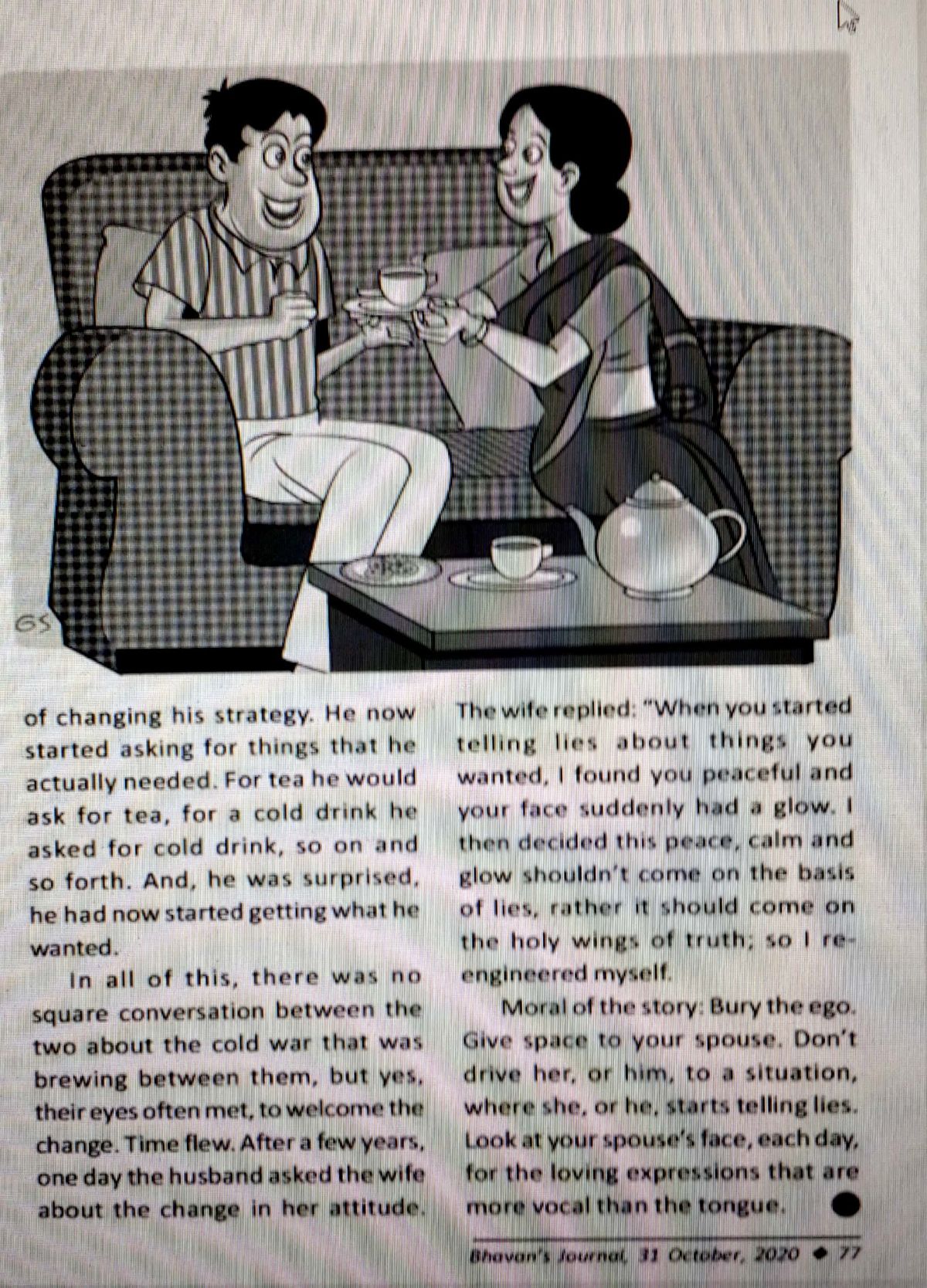
    There was once a king who was perennially unhappy. Either he was warring with his neighbours or he was sulking in his kingdom. He never had happy days, barring the days on which he expanded his frontiers and therefore over a period of time he had become a total expansionist, perhaps, to be happy. One day a learned Sadhu came to his kingdom. The king asked the Sadhu. ‘Hey Budhijivi. I’m often disturbed and never happy and because of this nature of mine even my citizens are not happy. So, can you suggest some ways and means for me to be happy?

    Sadhu thought for a moment and then asked.

    ‘Maharaj, do you keep a count of your happy days?’

    ‘No.’ replied the king.

    ‘Then I suggest start keeping. Tell your house-keeper to call a painter and ask him to mark your happy days on the outer side of the boundary wall of your castle.’

    ‘But, how will that help and will it make me happy?’ Asked the king.

    ‘I’m not very sure, but I think it may. So make a small beginning and I’ll see you after six months.’ After this the Sadhu left.

    The king called for a painter and instructed him, that on the days, he is happy, the painter should make a green mark on the outer side of the boundary wall of his castle. But sadly in the next ten days the painter only sat idle as the king was not happy. One day the king left for a battle. After winning it, he returned happy, and told the painter to colour the first mark of happiness on the boundary wall of his castle.

    Upon seeing the green mark on the wall a passer-by asked the painter, ‘what is this green mark for?’ The painter replied, ‘the mark means that the king is happy today.’

    The passer-by was aghast to hear this. He asked, ‘does it mean that the king is not happy on the days you don’t put the green mark?’

    ‘Yes.’ Said the painter. The passer-by was rather surprised at this novel way, the king had adopted to communicate his happiness to his riyaya. He reached home and told his wife that the king is happy today.

    ‘How do you know?’ She asked.

    ‘Because the king has instructed his painter to put a green mark on the boundary wall of his castle on the days he’s happy.’

    Soon the news spread like wild fire that the king is happy and thus the kingdom started celebrating. But in the castle after that day there was no other green mark that was painted and the painter happened to be merrily sleeping. Based on the reports a few more citizens came looking for the green mark on the boundary wall, but, there were none, barring the first one. This had a negative impact when the news started spreading in the kingdom that the king is now unhappy again and that saddened the riyaya of the kingdom once again.

   Thereafter, on the few days, that the painter painted the green mark on the wall, the citizenry of the kingdom was happy, but on a majority of days, it was otherwise, so the citizenry of the kingdom was largely unhappy, even when, the king was an efficient ruler. This kept happening for a few months in the kingdom but the king was unaware about it.

    One day a close minister of the king came to meet the king and gave him the feedback of how the citizenry was reacting to the king’s mood. The intelligent king at once realised his mistake—that on most days, the citizenry was unhappy, because the green mark was not put on the boundary wall, because he was unhappy.

    Soon the king instructed the painter to increase the frequency of the green mark which the painter did and that blossomed the mood of the citizenry even when the king continued with his spells of gloom which was part of his inherent nature.

    After six months the Sadhu returned. He asked the king if his solution had worked. The king replied, ‘it didn’t work for me, but yes, it did make me realise that a leader no matter under what circumstances, should wear a cheerful mask in front of his subjects at all times.

    The Sadhu replied. ‘Maharaj well begun is half done.’

By Kamlesh Tripathi

*

https://kamleshsujata.wordpress.com

*

Share it if you like it

*

Shravan Charity Mission is an NGO that works for poor children suffering from life threatening diseases especially cancer. Our posts are meant for our readers that includes both children and adults and it has a huge variety in terms of content. We also accept donations for our mission. Should you wish to donate for the cause. The bank details are given below:

NAME OF ACCOUNT: SHRAVAN CHARITY MISSION

Account no: 680510110004635 (BANK OF INDIA)

IFSC code: BKID0006805

*

Our publications

GLOOM BEHIND THE SMILE

(The book is about a young cancer patient. Now archived in 8 prestigious libraries of the US that includes Harvard College Library; Harvard University Library; Library of Congress; University of Washington, Seattle; University of Minnesota, Minneapolis; Yale University, New Haven; University of Chicago; University of North Carolina, at Chapel Hill University Libraries. It can also be accessed in MIT through Worldcat.org. Besides, it is also available for reading in libraries and archives of Canada, Cancer Aid and Research Foundation Mumbai and Jaipuria Institute of Management, Noida, India)  

ONE TO TANGO … RIA’S ODYSSEY

(Is a book on ‘singlehood’ about a Delhi girl now archived in Connemara Library, Chennai and Delhi Public Library, GOI, Ministry of Culture, Delhi)

AADAB LUCKNOW … FOND MEMORIES

(Is a fiction written around the great city of Nawabs—Lucknow. It describes Lucknow in great detail and also talks about its Hindu-Muslim amity. That happens to be the undying characteristics of Lucknow. The book was launched in Lucknow International Literary Festival of 2014. It is included for reading in Askews and Holts Library Services, Lancashire, U.K.)

REFRACTIONS … FROM THE PRISM OF GOD

(Co-published by Cankids–Kidscan, a pan India NGO and Shravan Charity Mission, that works for Child cancer in India. The book is endorsed by Ms Preetha Reddy, MD Apollo Hospitals Group. It was launched in Lucknow International Literary Festival 2016)

TYPICAL TALE OF AN INDIAN SALESMAN

(Is a story of an Indian salesman who is, humbly qualified. Yet he fights his ways through unceasing uncertainties to reach the top. A good read not only for salesmen. The book was launched on 10th February, 2018 in Gorakhpur Lit-Fest. Now available in Amazon, Flipkart and Onlinegatha)

RHYTHM … in poems

(Published in January 2019. The book contains 50 poems. The poems describe our day to day life. The book is available in Amazon, Flipkart and Onlinegatha)

MIRAGE

(Published in February 2020. The book is a collection of eight short stories. It is available in Amazon, Flipkart and Notion Press)

Short stories and Articles published in Bhavan’s Journal: Reality and Perception 15.10.19; Sending the Wrong Message 31.5.20; Eagle versus Scholars June 15 & 20 2020; Indica 15.8.20; The Story of King Chitraketu August 31 2020.

(ALL THE ABOVE TITLES ARE AVAILABLE FOR SALE IN AMAZON, FLIPKART AND OTHER ONLINE STORES OR YOU COULD EVEN WRITE TO US FOR A COPY)

*****
INTERESTING FACTS: THUGEE IN INDIA

Copyright@shravancharitymission

     ‘Thuggee’ refers to the acts of ‘Thugs,’ who were, organised gangs of professional robbers and murderers. The English word thug traces its roots to the Hindi word thug, which means ‘swindler’ or ‘deceiver’. Related words are its verbs thugna ‘to deceive,’ from the Sanskrit स्थग ‘sthaga’  cunningsly or fraudulent.’ The term ‘Thugee’ describes murder and robbery of travellers, which was popular in the northern parts of the Indian subcontinent.

    Thugs are said to have travelled in groups across the Indian subcontinent. There were numerous traditions about their origin. One recorded by D.F. McLeod traced it to some Muslim tribes formed from those who fled Delhi after murdering a physician. Another traced it to some great Muslim families who fled after murdering a favourite slave of Akbar. These, original Muslim thugs’ spread, thuggee, amongst Rajputs, Hindus, Lodhis and Ahirs. According to some other traditions, thugs were Kanjars or they descended from those, who worked in Mughal camps. Others have blamed the rise of thugs on the disbanding of armies in employment of Indian rulers after the British conquest. Thugs are said to have operated as gangs of highway robbers, tricking and later strangling their victims.

    To take advantage of their victims, the thugs would join travellers and first gain their confidence. This would allow them to surprise and strangle the travellers with a handkerchief or a noose later. They would then rob and bury the victims. This led to the thugs being called Phansigar (person killing with a noose). During the 1830s, thugs were targeted for eradication by the then Governor-General of India, Lord William Bentinck, and his chief captain, William Henry Sleeman.

    Thugs resembled travellers in physicality. Initially they wore turbans and carried with them some kind of baggage. Their attire as travellers, would deceive, any peasant and royal alike.

    The methods used in ‘Thuggee’ were meant to reap maximum loot without being caught. They did not accost travellers unless their own numbers were greater than the target. They first flattered the travellers they met, and that gave them a chance to assess, what wealth they were carrying. Many thugs avoided committing thuggee close to their native. So that their crimes were difficult to discover. They often pretended to be either Hindu or Muslim to fool their victims.

    They usually attacked in the evening. A common method used by them was to distract their targets while attempting to strangle them from behind. In order to avoid any suspicion, they avoided carrying more than a few swords for self-defense. Sometimes they even mutilated corpses of their victims to avoid detection. The corpses were then hidden or buried.

    The leader of a gang was called jamadar. Usage of military-style ranks such as jamadar and subedar among thugs, suggests, that the organisation of their gangs had a military construct. They used a secret language known as ‘Ramasee’ to disguise their real intentions from their targets. Although strangulation was one of their most-recognised methods of murder, they also used blades and poison.

    The thugs comprised, both men, who had inherited thuggee as a family vocation, as well as those, who were forced to turn to it out of necessity. The leadership of many of the groups tended to be hereditary with family members sometimes serving together in the same band. Such thugs were known as aseel. Many thugs, insisted, that novices were not taught thuggee, by their own family members but by others who were often more skilled and experienced. They were called a guru. Thugs usually kept their acts a secret. Female thugs also existed and were called baronee in the secret language Ramasee, while an important male thug was called baroo.

    They would often avoid, killing children of victims, and instead they would adopt them. At times they tended to murder women and children to eliminate witnesses or in case they had substantial loot. Some of the thugs avoided murdering victims they considered proscribed according to their beliefs and let other unscrupulous members commit the murder.

    It is on record that during the 14th century 1,000 thugs were captured and hanged in the streets of Delhi. And, 200 years later Sher Shah Suri organised a cavalry of 1,200 men to keep them at bay. Akbar and his successors also launched widespread drives against the thugs, though it was only in the 19th century that Sir W. H. Sleeman succeeded in wiping them out after a relentless operation lasting seven years.

    The earliest known reference to the Thugs as a band or fraternity, rather than ordinary thieves, is found in Zia-ud din Barni’s History of Firoz Shah written around 1356. He narrated an incident of sultan Jalal-ud-din Khalji, having 1,000 arrested thugs, being sent to Lakhnauti or Gaur:

    Surdas, in his allegorical couplet, mentioned robbers called “thugs” who lured a victim, while also, killing and looting his property. The Janamsakhis, the legendary biographies of Guru Nanak, used the term thug to refer to a robber who used to lure pilgrims. Jean de Thevenot, a French traveller in his account referred to a band of robbers who used a “certain Slip with a running noose” to strangle their victims. John Fryer an English doctor and Fellow of the Royal Society, mentions, a similar method of strangling used by robbers from Surat whom he saw being given capital punishment by the Mughals in 1675. He further mentions that three out of them were relatives, which Kim Wagner a Danish-British historian notices, is similar to the thugs, who were thought to have engaged in this as a family profession. A decree issued by Aurangzeb in 1672 refers to a similar method and uses the term “Phansigar”.

    The garrotte (killing by strangulation) is often depicted as a weapon of the thuggee. Other evidences suggest that the Katar (dagger) was their personal status weapon. A thuggee wore this weapon proudly across his chest. Early references to thugs reported they committed their strangulation murders with nooses of rope or catgut, but later they adopted the use of a length of cloth that could be used as a sash or scarf, and thus more easily concealed. This cloth is sometimes described as a rumal (head covering or kerchief), translated as “yellow scarf”; “yellow”, in this case, may refer to a natural cream or khaki colour rather than bright yellow.

    Thugs preference for strangulation might have originated from a quirk of the law under the Mughal Empire that ruled most of India from the 1500s. For a murderer to be sentenced to death, he or she must have shed the blood of their victim. Those who murdered but did not shed blood might face imprisonment, hard labour and paying a penalty—but they would not risk execution.

    A poison called Datura, derived from a plant in the Nightshade family, was sometimes used by thugs to induce drowsiness or stupefaction, making strangulation easier.

    The “River Thugs” preyed upon people including Hindu pilgrims, travelling through the Ganga River, and became, mostly active during the winter like their compatriots from Murena, Bundelkhand and Awadh. Their dialect of Ramasee differed from the one used by their compatriots on land and used boats taken on lease from their builders or from a jamadar called Khuruck Baboo. Sleeman states that they tapped three times to give the signal to murder, which they always committed during the day. To avoid detection of a corpse, they broke its back and threw it in the river to be eaten by crocodiles and only looted money or jewels.

    By the 1870s the ‘thug cult’ was essentially extinct, but the history of thuggee led to the Criminal Tribes Act (CTA) of 1871. Although the CTA was repealed upon Indian independence, tribes considered criminals still exist in India. The Thuggee and Dacoity Department remained in existence until 1904, when it was replaced by the central Criminal Intelligence Department (CID).

    There are many movies that have been made by Bollywood on thuggee,  such as Gunga Din in 1939, Sunghursh in 1968 and Thugs of Hindostan to name a few.

By Kamlesh Tripathi

*

https://kamleshsujata.wordpress.com

*

Share it if you like it

*

Shravan Charity Mission is an NGO that works for poor children suffering from life threatening diseases especially cancer. Our posts are meant for our readers that includes both children and adults and it has a huge variety in terms of content. We also accept donations for our mission. Should you wish to donate for the cause. The bank details are given below:

NAME OF ACCOUNT: SHRAVAN CHARITY MISSION

Account no: 680510110004635 (BANK OF INDIA)

IFSC code: BKID0006805

*

Our publications

GLOOM BEHIND THE SMILE

(The book is about a young cancer patient. Now archived in 8 prestigious libraries of the US that includes Harvard College Library; Harvard University Library; Library of Congress; University of Washington, Seattle; University of Minnesota, Minneapolis; Yale University, New Haven; University of Chicago; University of North Carolina, at Chapel Hill University Libraries. It can also be accessed in MIT through Worldcat.org. Besides, it is also available for reading in libraries and archives of Canada, Cancer Aid and Research Foundation Mumbai and Jaipuria Institute of Management, Noida, India)  

ONE TO TANGO … RIA’S ODYSSEY

(Is a book on ‘singlehood’ about a Delhi girl now archived in Connemara Library, Chennai and Delhi Public Library, GOI, Ministry of Culture, Delhi)

AADAB LUCKNOW … FOND MEMORIES

(Is a fiction written around the great city of Nawabs—Lucknow. It describes Lucknow in great detail and also talks about its Hindu-Muslim amity. That happens to be the undying characteristics of Lucknow. The book was launched in Lucknow International Literary Festival of 2014. It is included for reading in Askews and Holts Library Services, Lancashire, U.K.)

REFRACTIONS … FROM THE PRISM OF GOD

(Co-published by Cankids–Kidscan, a pan India NGO and Shravan Charity Mission, that works for Child cancer in India. The book is endorsed by Ms Preetha Reddy, MD Apollo Hospitals Group. It was launched in Lucknow International Literary Festival 2016)

TYPICAL TALE OF AN INDIAN SALESMAN

(Is a story of an Indian salesman who is, humbly qualified. Yet he fights his ways through unceasing uncertainties to reach the top. A good read not only for salesmen. The book was launched on 10th February, 2018 in Gorakhpur Lit-Fest. Now available in Amazon, Flipkart and Onlinegatha)

RHYTHM … in poems

(Published in January 2019. The book contains 50 poems. The poems describe our day to day life. The book is available in Amazon, Flipkart and Onlinegatha)

MIRAGE

(Published in February 2020. The book is a collection of eight short stories. It is available in Amazon, Flipkart and Notion Press)

Short stories and Articles published in Bhavan’s Journal: Reality and Perception 15.10.19; Sending the Wrong Message 31.5.20; Eagle versus Scholars June 15 & 20 2020; Indica 15.8.20; The Story of King Chitraketu August 31 2020.

(ALL THE ABOVE TITLES ARE AVAILABLE FOR SALE IN AMAZON, FLIPKART AND OTHER ONLINE STORES OR YOU COULD EVEN WRITE TO US FOR A COPY)

*****
   

SHORT STORY: PUNISHMENT OF SISYPHUS

Copyright@shravancharitymission

        Beware of what you do in the journey of life as your actions can lead to a tough lifelong punishment. Here is an example of that, out of the Greek mythology.

    There was once a King by the name of Sisyphus. He went on to annoy Gods with his trickery. As a consequence, he was condemned for eternity to roll a huge rock, up, a long steep hill, in the underworld, only to watch it, roll back, down the hill.

    Sisyphus is a figure from the Greek mythology, who as the founder king of, Corinth an ancient city in Greece, became infamous for his general trickery and cheating death twice. He ultimately got his comeuppance when Zeus the Greek God of sky and thunder dealt him the eternal punishment of, rolling a boulder forever, up a hill in the depths of Hades the god of dead and the king of underworld. Sisyphus was the founder of the Isthmian Games believed to have originated as funeral games, and grandfather of Bellerophon, a hero of Greek mythology and slayer of monsters. Sisyphus is now best remembered as a poignant symbol of the folly of those who seek to trifle with the natural order of things and avoid humanity’s sad but inescapable lot of mortality. The adjective Sisyphean denotes a task which can never be completed.

By Kamlesh Tripathi

*

https://kamleshsujata.wordpress.com

*

Share it if you like it

*

Shravan Charity Mission is an NGO that works for poor children suffering from life threatening diseases especially cancer. Our posts are meant for our readers that includes both children and adults and it has a huge variety in terms of content. We also accept donations for our mission. Should you wish to donate for the cause. The bank details are given below:

NAME OF ACCOUNT: SHRAVAN CHARITY MISSION

Account no: 680510110004635 (BANK OF INDIA)

IFSC code: BKID0006805

*

Our publications

GLOOM BEHIND THE SMILE

(The book is about a young cancer patient. Now archived in 8 prestigious libraries of the US that includes Harvard College Library; Harvard University Library; Library of Congress; University of Washington, Seattle; University of Minnesota, Minneapolis; Yale University, New Haven; University of Chicago; University of North Carolina, at Chapel Hill University Libraries. It can also be accessed in MIT through Worldcat.org. Besides, it is also available for reading in libraries and archives of Canada, Cancer Aid and Research Foundation Mumbai and Jaipuria Institute of Management, Noida, India)  

ONE TO TANGO … RIA’S ODYSSEY

(Is a book on ‘singlehood’ about a Delhi girl now archived in Connemara Library, Chennai and Delhi Public Library, GOI, Ministry of Culture, Delhi)

AADAB LUCKNOW … FOND MEMORIES

(Is a fiction written around the great city of Nawabs—Lucknow. It describes Lucknow in great detail and also talks about its Hindu-Muslim amity. That happens to be the undying characteristics of Lucknow. The book was launched in Lucknow International Literary Festival of 2014. It is included for reading in Askews and Holts Library Services, Lancashire, U.K.)

REFRACTIONS … FROM THE PRISM OF GOD

(Co-published by Cankids–Kidscan, a pan India NGO and Shravan Charity Mission, that works for Child cancer in India. The book is endorsed by Ms Preetha Reddy, MD Apollo Hospitals Group. It was launched in Lucknow International Literary Festival 2016)

TYPICAL TALE OF AN INDIAN SALESMAN

(Is a story of an Indian salesman who is, humbly qualified. Yet he fights his ways through unceasing uncertainties to reach the top. A good read not only for salesmen. The book was launched on 10th February, 2018 in Gorakhpur Lit-Fest. Now available in Amazon, Flipkart and Onlinegatha)

RHYTHM … in poems

(Published in January 2019. The book contains 50 poems. The poems describe our day to day life. The book is available in Amazon, Flipkart and Onlinegatha)

MIRAGE

(Published in February 2020. The book is a collection of eight short stories. It is available in Amazon, Flipkart and Notion Press)

Short stories and Articles published in Bhavan’s Journal: Reality and Perception 15.10.19; Sending the Wrong Message 31.5.20; Eagle versus Scholars June 15 & 20 2020; Indica 15.8.20; The Story of King Chitraketu August 31 2020.

(ALL THE ABOVE TITLES ARE AVAILABLE FOR SALE IN AMAZON, FLIPKART AND OTHER ONLINE STORES OR YOU COULD EVEN WRITE TO US FOR A COPY)

*****

BOOK REVIEW: SPEECHES THAT SHAPED THE WORLD – Alan J. Whiticker

Copyright@shravancharitymission

Khidki (Window)

–Read Initiative—

This is only an attempt to create interest in reading. We may not get the time to read all the books in our lifetime. But such reviews, talk and synopsis will at least convey what the book is all about.

     The book is edited and partially written by Alan J. Whiticker. He is an Australian non-fiction author, publisher, with over, forty published books, including Speeches that Changed the World. He is a former teacher and a lecturer, but now works, as a freelance writer, and a commissioning editor for a publishing company.

    Says Greek philosopher Aristotle, ‘In making a speech one must study three points: first, the means of producing persuasion; second, the language; third, the proper arrangement of the various parts of the speech.

    Speeches tell you, what the person is all about. It tells you what the person’s vision, and value is, and that helps the world to carve a moralistic and decisive path ahead.

    The book is a collection of the greatest speeches of the 20th Century says the author.  The speeches are indeed all time great that have helped in shaping and changing the world for the better. The speeches in this special volume are, out of the speeches, from the bestselling book, ‘Speeches that Shaped the Modern World (2005) and speeches that reshaped the Modern World (2008) as well as speeches from the new millennium, that have also moved us, as citizens of this universe—both emotionally, politically and even socially.

    The subject book was first published in the year 2016 by New Holland Publishers Pty Ltd., and later in 2018 by Jaico. The Jaico price of the book is Rs 350.

    The speeches in this book reflect the life and achievements of some of history’s most famous and infamous personalities such as, Mahatma Gandhi, Adolf Hitler, Nelson Mandela, the Kennedy family, Fidel Castro and Barack Obama to name, but a few. Many of these speeches such as—Franklin D Roosevelt’s ‘A Day that will live in Infamy’ in 1941; Martin Luther King’s ‘I Have a Dream’ in 1963, and Queen Elizabeth II’s ‘Annus Horribilis’ in 1962, have become iconic signposts over a period of time.

    While the United States has a plethora of great leaders. Only Theodore Roosevelt, Dwight D. Eisenhower, Robert Kennedy, Malcolm X, Barack Obama and a few more American leaders feature in this volume. The volume however covers other international leaders. It is also heartening to see so many high profile female leaders featuring in this narration such as, Hillary Clinton, Indira Gandhi, Malala Yousafzai and Aung San Suu Kyi —who provide important perspectives on social issues such as equality, human rights and education.

    The book is not meant to be a definitive list of the ‘greatest’ of speeches of all time—which have already been done by other authors. This eclectic group of speeches reinforce recurring themes, such as politics, war and peace, freedom and justice, civil rights and human rights and cover many of the historic events and issues of the past century. Net-net these are speeches that have already resonated in the world over a period of time and still guide us. Included in this volume are also some of the priceless speeches by Steve Jobs, Stephen Hawking, Julia Gillard, Pope Francis and Barack Obama.

    The thing that I liked the most about the book was that, the author-cum-editor, has endeavoured to provide a historical context, for each speech and a biographical background of each speaker. Wherever possible, the author has avoided, offering his own critique, of the merits, of each speech. He believes, let the words speak for themselves, as they are, after all, the speeches that have shaped the world.

    Some of the speeches covered in this narration are extremely relevant for the world even today. Let me take you through all the topics on which these orations were delivered in just a para, as that will give you the essence and flavour of the book. I’m deliberately not mentioning the orators name which you can find out when you read the book.

   It starts with the muck-raking journalist, compared cleverly with political and journalistic mudslinging. Followed by ‘Freedom, or death, a fund raising speech. Against the War is another speech, always a relevant topic, in this belligerent world. But you must have a peace plan, a good lecture by someone. Can you think of a monarch who can abdicate his throne his power for the love of his life and he delivers a heartfelt speech after that. Then you have the ‘The Jewish Question.’ Followed by, the famous speech ‘We shall fight in the beaches.’ Followed by ‘A date which will live in infamy when USA was suddenly and deliberately attacked by naval and air forces of the Empire of Japan. Then comes the Quit India speech. ‘Aggression anywhere in the world, is a threat to peace everywhere in the world, and that takes us to a famous speech on MacArthur and Korea. Then you have ‘Cross of Iron’ a speech to the American Society of Newspaper Editors. And not to forget the ‘United Nations Address’ The longest speech in the history of United Nations. Then comes The Wind of Change—an address to the South African Parliament in Cape Town. And quite historical is a speech on, ‘The Cuban Missile Crisis.’ Quite gripping is the speech, ‘Lincoln Memorial, Washington—I have a Dream. Then comes, ‘The Bullet or the Ballot’ Cleveland, Ohio about the victim of white supremacist group. And what comes next is the famous speech on, ‘Announcement of Martin Luther King’s Death.’ Next is the ‘Eulogy for Robert F Kennedy. ‘Farewell to the White House.’ ‘Peace with Justice,’ an address to the Israeli Knesset, in Tel Aviv. What follows is ‘True liberation of Women.’ The Falklands War. A long speech on the Berlin Wall. An address to the US Congress. Dissolving of the Soviet Union. And then Annus Horribilis a speech in Guildhall, London. Release from Prison, an address to a rally, upon release from prison at Cape Town. Then you have a speech ‘On Women’s Rights, UN World Conference on Women, in Beijing, China. Then you have a Eulogy for Diana, Princess of Wales, in Westminster Abbey, London. Freedom of Thought—American University, Washington DC. ‘Yekaterinburg Apology,’ St Petersburg, Russia. A Great People has been Moved, Washington DC. Stanford University Commencement Address, Stanford University, California. Questioning the Universe, Technology, Entertainment and Design Talk, Vancouver. Misogyny Speech, Australian House of Representative, Canberra. A World at School Speech, UN General Assembly, New York. Apology to Church Victims of Sexual Abuse, St. Charles Borromeo Seminary, Montgomery County. Common-Sense Gun Safety Reform, White House, Washington DC.

    These speeches highlight recurring themes such as politics and power, war and peace, civil rights and human rights. What they all have in common is the power to inspire—emotionally, politically and socially.

    Different events and many nations are represented in these pages. Each speech is presented along with its historical context and the biographical background of the speaker to enhance your reading experience.

    In its 283 pages the book covers thirty eight speeches across eras, geographies, issues and causes. The language of the book is rich meant for niche reading. I would give it seven out of ten. A good read.

By Kamlesh Tripathi

*

https://kamleshsujata.wordpress.com

*

Share it if you like it

*

Shravan Charity Mission is an NGO that works for poor children suffering from life threatening diseases especially cancer. Our posts are meant for our readers that includes both children and adults and it has a huge variety in terms of content. We also accept donations for our mission. Should you wish to donate for the cause. The bank details are given below:

NAME OF ACCOUNT: SHRAVAN CHARITY MISSION

Account no: 680510110004635 (BANK OF INDIA)

IFSC code: BKID0006805

*

Our publications

GLOOM BEHIND THE SMILE

(The book is about a young cancer patient. Now archived in 8 prestigious libraries of the US that includes Harvard College Library; Harvard University Library; Library of Congress; University of Washington, Seattle; University of Minnesota, Minneapolis; Yale University, New Haven; University of Chicago; University of North Carolina, at Chapel Hill University Libraries. It can also be accessed in MIT through Worldcat.org. Besides, it is also available for reading in libraries and archives of Canada, Cancer Aid and Research Foundation Mumbai and Jaipuria Institute of Management, Noida, India)  

ONE TO TANGO … RIA’S ODYSSEY

(Is a book on ‘singlehood’ about a Delhi girl now archived in Connemara Library, Chennai and Delhi Public Library, GOI, Ministry of Culture, Delhi)

AADAB LUCKNOW … FOND MEMORIES

(Is a fiction written around the great city of Nawabs—Lucknow. It describes Lucknow in great detail and also talks about its Hindu-Muslim amity. That happens to be the undying characteristics of Lucknow. The book was launched in Lucknow International Literary Festival of 2014. It is included for reading in Askews and Holts Library Services, Lancashire, U.K.)

REFRACTIONS … FROM THE PRISM OF GOD

(Co-published by Cankids–Kidscan, a pan India NGO and Shravan Charity Mission, that works for Child cancer in India. The book is endorsed by Ms Preetha Reddy, MD Apollo Hospitals Group. It was launched in Lucknow International Literary Festival 2016)

TYPICAL TALE OF AN INDIAN SALESMAN

(Is a story of an Indian salesman who is, humbly qualified. Yet he fights his ways through unceasing uncertainties to reach the top. A good read not only for salesmen. The book was launched on 10th February, 2018 in Gorakhpur Lit-Fest. Now available in Amazon, Flipkart and Onlinegatha)

RHYTHM … in poems

(Published in January 2019. The book contains 50 poems. The poems describe our day to day life. The book is available in Amazon, Flipkart and Onlinegatha)

MIRAGE

(Published in February 2020. The book is a collection of eight short stories. It is available in Amazon, Flipkart and Notion Press)

Short stories and Articles published in Bhavan’s Journal: Reality and Perception 15.10.19; Sending the Wrong Message 31.5.20; Eagle versus Scholars June 15 & 20 2020; Indica 15.8.20; The Story of King Chitraketu August 31 2020.

(ALL THE ABOVE TITLES ARE AVAILABLE FOR SALE IN AMAZON, FLIPKART AND OTHER ONLINE STORES OR YOU COULD EVEN WRITE TO US FOR A COPY)

*****
INTERESTING FACTS: LIFE OF AUNG SAN SUU KYI

Copyright@shravancharitymission

       Aung San Suu Kyi was born in Rangoon, what was British Burma then, on 19 June 1945. Aung San Suu Kyi, like any other Burmese name, doesn’t comprise a surname. It is only a personal name, in her case, derived from, three of her relatives name that is: “Aung San” father, “Suu” paternal grandmother, and “Kyi” out of her mother—Khin Chi Kyi. For writing convenience let me refer her as Suu Kyi. She is a Burmese politician, diplomat, author and a 1991 Nobel Peace Prize laureate. She happens to be the first State Counsellor a position equivalent to the Prime Minister of Myanmar. She is also the leader of the National League for Democracy and played a vital role in the state’s transition from the military junta to partial democracy.

    Suu Kyi is the youngest daughter of Aung San, the father of the nation of modern-day Myanmar, who founded the modern Burmese Army that liberated the country from Japanese occupation during World War II and his wife Khin Kyi. Khin Kyi, was a Burmese politician and a diplomat, best known for her marriage to the country’s leader, Aung San, with whom she had four children, including Aung San Suu Kyi. Suu Kyi was born in Rangoon, British Burma, the capital of Yangon region and the largest city of Myanmar. British Burma was under British rule that lasted from 1824 to 1948.

    After graduating from the University of Delhi in 1964 and University of Oxford in 1968, Suu Kyi worked at the United Nations for three years. There, she married Michael Aris in 1972, with whom she had two children. Suu Kyi rose to prominence in the 1988 Uprisings, and became the General Secretary of the National League for Democracy (NLD), which she had newly formed with the help of several retired army officials who had criticized the military junta. In the 1990 elections, NLD won 81% of the seats in Parliament, but the results were nullified, as the military refused to hand over power to the Parliament, resulting in an international outcry. She had already been detained under house arrest before the elections. She remained under a long house arrest for almost 15 of the 21 years from 1989 to 2010, becoming one of the world’s most prominent political prisoners. In 1999, Time Magazine named her as one of the “Children of Gandhi” and a keen follower of nonviolence.

    Her party boycotted the 2010 elections, resulting in a decisive victory for the military-backed Union Solidarity and Development Party. Suu Kyi became a Pyithu Hluttaw MP, the lower house of the bicameral legislature of Myanmar (Burma), while her party won 43 of the 45 vacant seats in the 2012 by-elections. In the 2015 elections, her party won a landslide victory taking 86% of the seats in the Assembly of the Union – well more than the 67% supermajority needed to ensure, that its preferred candidates, were elected President and Vice President in the Presidential Electoral College. Although she was prohibited from becoming the President due to an inconvenient clause in the constitution– that her late husband and children are foreign citizens, she assumed the newly created role of the State Counsellor, a role, akin to the Prime Minister or the head of the government.

    Since acquiring the role of the State Counsellor, Suu Kyi has drawn criticism from several countries, organisations and figures over her alleged inaction in response to the genocide of the Rohingya people in the Rakhine State and her refusal to accept that Myanmar’s military has committed massacres. Under her leadership, Myanmar has also drawn criticism for prosecutions of journalists. In 2019, Suu Kyi appeared in the International Court of Justice where she defended the Burmese military against allegations of genocide against the Rohingyas.

        When Suu Kyi was two years old, her father, who headed the shadow Burmese Government under the British rule, was assassinated by a political rival. Her mother, Khin Kyi, was later appointed Burmese ambassador to India.

    In 1962, democratic rule in Burma ended with a military coup headed by General Ne Win. For the next 26 years, the military enforced the ‘Burmese Way to Socialism’ which led to the establishment of one party rule under the Burma Socialist Programme Party (BSPP) in 1974.

    In 1988, Suu Kyi, after delivering her two sons returned to Burma to care for her ailing mother. This coincided with a bloody military response, to some peaceful student demonstrations, against one party rule and the resignation of General Ne Win as head of the BSPP.

    On 26th August, in Rangoon, Suu Kyi stood under a large poster of her slain father and addressed a large gathering of democratic supporters and proposed the establishment of a People’s Consultative Committee to help resolve the crisis.

    In October, the democratic movement was brutally crushed by another military coup headed by General Saw Maung when Burma’s second struggle for independence began.

    Although Suu Kyi had lived overseas for most of her life, she could not ‘remain indifferent’ to Burma’s long struggle. She became the leader of the National League of Democracy and was first placed under house arrest in Rangoon in July 1989. Under martial law, this meant that she could be detained for three years without trial. Her husband and sons visited her for what would be, the last time, as a family in September 1989. The following year, the military government attempted to cut her contact with the outside world.

    Separated from her family and denied her personal liberty and freedom of speech, Suu Kyi continued to speak out against Burma’s military rule. A stance that saw her win the 1990 Sakharov Prize for Freedom of Thought (awarded by the European Parliament), in the year 1991 Nobel Peace Prize and the 1992 Nehru Peace Prize.

    Although, she was released from house detention in 1995 and was briefly reunited with her husband, she refused to leave Burma because she knew she would not be allowed to re-enter her own country. As a result, all of Suu Kyi’s famous speeches were delivered by third parties, either by video or in essay form.

    The commencement address at the American University, Washington DC, on 26 January, 1997, was delivered on her behalf by her husband, Dr. Michael Aris, upon her receiving an Honorary Doctor in law. Although Michael Aris was sick with prostate cancer, the Burmese government which was renamed the Union of Myanmar by the military government in 1989 did not allow him to visit his wife.

    When her husband Michael Aris passed away in 1999, Suu Kyi confessed the separation as ‘one of the sacrifices she had had to make in order to work for a free Burma.’ Suu Kyi was placed under house arrest again in September 2000, but was freed after nineteen months. She was later held under ‘secret detention’ for three months before being returned to house arrest.

    Suu Kyi was released from house arrest in 2010. She led the National league for Democracy (NLD) to a majority win in Myanmar’s first openly contested election in 25 years in November 2015. Her official title is State Counsellor.

    Suu Kyi is often called ‘Daw’ Aung San Suu Kyi in her homeland, which is a title for affection meaning a favourite aunt.

By Kamlesh Tripathi

*

https://kamleshsujata.wordpress.com

*

Share it if you like it

*

Shravan Charity Mission is an NGO that works for poor children suffering from life threatening diseases especially cancer. Our posts are meant for our readers that includes both children and adults and it has a huge variety in terms of content. We also accept donations for our mission. Should you wish to donate for the cause. The bank details are given below:

NAME OF ACCOUNT: SHRAVAN CHARITY MISSION

Account no: 680510110004635 (BANK OF INDIA)

IFSC code: BKID0006805

*

Our publications

GLOOM BEHIND THE SMILE

(The book is about a young cancer patient. Now archived in 7 prestigious libraries of the US, including, Harvard University and Library of Congress. It can also be accessed in MIT through Worldcat.org. Besides, it is also available for reading in Libraries and archives of Canada, Cancer Aid and Research Foundation Mumbai and Jaipuria Institute of Management, Noida, India)  

ONE TO TANGO … RIA’S ODYSSEY

(Is a book on ‘singlehood’ about a Delhi girl now archived in Connemara Library, Chennai and Delhi Public Library, GOI, Ministry of Culture, Delhi)

AADAB LUCKNOW … FOND MEMORIES

(Is a fiction written around the great city of Nawabs—Lucknow. It describes Lucknow in great detail and also talks about its Hindu-Muslim amity. That happens to be the undying characteristics of Lucknow. The book was launched in Lucknow International Literary Festival of 2014. It is included for reading in Askews and Holts Library Services, Lancashire, U.K.)

REFRACTIONS … FROM THE PRISM OF GOD

(Co-published by Cankids–Kidscan, a pan India NGO and Shravan Charity Mission, that works for Child cancer in India. The book is endorsed by Ms Preetha Reddy, MD Apollo Hospitals Group. It was launched in Lucknow International Literary Festival 2016)

TYPICAL TALE OF AN INDIAN SALESMAN

(Is a story of an Indian salesman who is, humbly qualified. Yet he fights his ways through unceasing uncertainties to reach the top. A good read not only for salesmen. The book was launched on 10th February, 2018 in Gorakhpur Lit-Fest. Now available in Amazon, Flipkart and Onlinegatha)

RHYTHM … in poems

(Published in January 2019. The book contains 50 poems. The poems describe our day to day life. The book is available in Amazon, Flipkart and Onlinegatha)

MIRAGE

(Published in February 2020. The book is a collection of eight short stories. It is available in Amazon, Flipkart and Notion Press)

Short stories and Articles published in Bhavan’s Journal: Reality and Perception 15.10.19; Sending the Wrong Message 31.5.20; Eagle versus Scholars June 15 & 20 2020; Indica 15.8.20; The Story of King Chitraketu August 31 2020.

(ALL THE ABOVE TITLES ARE AVAILABLE FOR SALE IN AMAZON, FLIPKART AND OTHER ONLINE STORES OR YOU COULD EVEN WRITE TO US FOR A COPY)

*****