https://www.overdrive.com/media/9379499/awadh-assam-and-dalai-lama-the-kalachakra
World Music Day: An Intertwining of Rhythm and Soul
Copyright@shravancharitymission

World Music Day is also known as Fête de la Musique. It is celebrated annually on June 21. It originated in France, where citizens were encouraged to play music in their homes and neighbourhoods. The English word ‘music’ originates from the Arabic word ‘Mausiki.’
The world has never been bereft of music. The veena of Goddess Saraswati symbolises the harmony of the universe. It is the melodic balance of speech, sound, and silence. Meera Bai’s bhajans captivate listeners with love and devotion. She sang for Lord Krishna. “Mere to Giridhar Gopal, doosro na koi” (I belong only to Giridhar Gopal, no one else.) In her Vakhs, Lal Ded, the 14th-century Kashmiri mystic poet, speaks of an inner sound or vibration that leads to spiritual awakening. The idea supports the Indian philosophical concept of Nada Brahma—the belief that the universe itself is the divine sound.
“Mujh se pehli si mohabbat meri mehboob na maang, Mausiki mein bhi ab woh halaat nahin rahe.” (Do not ask me for the love I once gave you. Music no longer holds the same sweetness.) In this line, Urdu poet Faiz Ahmed Faiz intertwines lost love with the fading joy in music, linking emotion with melody.
Tansen believed music was the path to the divine. His practice was deeply spiritual, and he often sang in praise of Lord Krishna. According to legends, Tansen could light lamps with Raga Deepak, bring rain with Raga Megh Malhar, and calm wild animals with appropriate ragas. Though these tales may be exaggerated, they reflect the belief that music is a natural force, not merely an art form, but a form of sadhana (spiritual discipline). Tansen said, “Raag aur taal ke bina sangeet adhoora hai. Sangeet vo hai jo man ko shaant kare aur bhagwan se milaye.” (“Music without raga and rhythm is incomplete. True music is that which calms the mind and brings one closer to God.”)
Mystic poet Kabir did not regard music merely as an art but as a sacred practice and a direct path to the divine. His verses (dohas) often express the idea that true music arises from within, when the soul becomes attuned to the divine presence.
Greek composer Vangelis, whose iconic theme ‘Çhariots of Fire’ (fit to be the Olympic hymn) won him an Academy Award in 1981, conveys his underlying craving for music. He believed that music shaped the universe and that he understood the world through music. Vangelis believed in ‘Sadhana’.
André Rieu, the famous Dutch violinist and conductor, emphasises the emotional and universal nature of music: “I make music to touch the souls of people as it’s a language we all can speak.” German philosopher Friedrich Nietzsche famously stated, “Without music, life would be a mistake.” Persian Poet Rumi believed passionately in the use of music, poetry, and dance as a path for reaching God. For Rumi, music helped devotees concentrate their whole being on the divine. Rumi encouraged Sama to listen to music and engage in the sacred dance. Rumi’s favourite musical instrument was the reed flute … ‘Listen to the reed and the tale it tells’.
“The music is not in the notes, but in the silence between,” was Mozart’s take, and “Music should strike fire from the heart of man and bring tears from the eyes of woman,” proclaimed Beethoven. “If music be the food of love, play on,” wrote Shakespeare, in Twelfth Night.
And finally, life is best described in the musical song ‘Que Sera Sera. Whatever will be will be,’ written by Jay Livingston and Ray Evans. Let music be your companion in joy, in sorrow, and in silence. Happy World Music Day.
Posted by Kamlesh Tripathi
Author, Poet, & Columnist
*
https://kamleshsujata.wordpress.com
*
Like it and Share it
*
Shravan Charity Mission is an NGO that works for poor children suffering from life-threatening diseases, especially cancer. Our posts are meant for our readers, including children and adults, and have a huge variety of content. We also accept donations for our mission. Should you wish to donate to the cause of cancer? The bank details are given below:
NAME OF ACCOUNT: SHRAVAN CHARITY MISSION
Account no: 680510110004635 (BANK OF INDIA)
IFSC code: BKID0006805
***
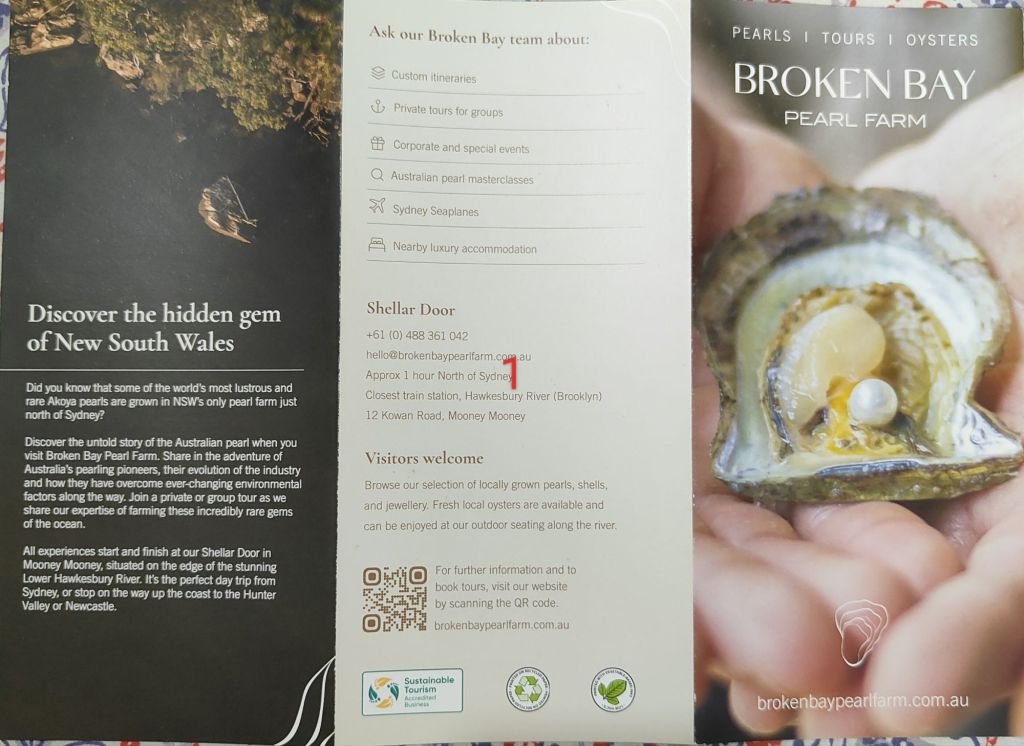
AUSTRALIA: NEW SOUTH WALES … PEARL FARM
Copyright@shravancharitymission
Don’t miss the Broken Bay, Pearl Farm while in Australia

Posted by Kamlesh Tripathi
Author, Poet, & Columnist
*
https://kamleshsujata.wordpress.com
*
Like it and Share it
*
Shravan Charity Mission is an NGO that works for poor children suffering from life-threatening diseases, especially cancer. Our posts are meant for our readers, including children and adults, and have a huge variety of content. We also accept donations for our mission. Should you wish to donate to the cause of cancer? The bank details are given below:
NAME OF ACCOUNT: SHRAVAN CHARITY MISSION
Account no: 680510110004635 (BANK OF INDIA)
IFSC code: BKID0006805
***
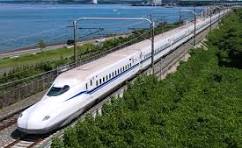
INTERESTING FACTS: BULLET TRAIN SHINKANSEN
Copyright@shravancharitymission
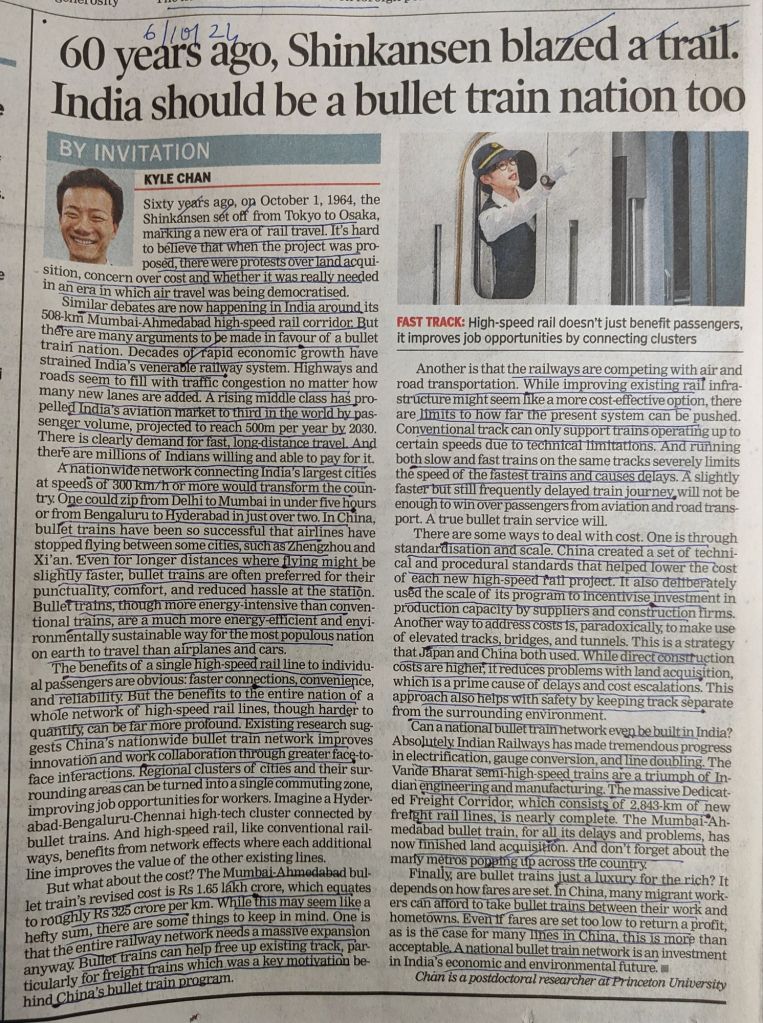
60 YEARS AGO, SHINKANSEN BLAZED A TRAIL. INDIA SHOULD BE A BULLET TRAIN NATION TOO.
BY INVITATION: KYLE CHAN
Sixty years ago, on October 1, 1964, the Shinkansen set off from Tokyo to Osaka, marking a new era of rail travel. It’s hard to believe that when the project was proposed, there were protests over land acquisition, concern over cost and whether it was really needed in an era in which air travel was being democratised.
Similar debates are now happening in India around its 508-km Mumbai-Ahmedabad high speed rail corridor. But there are many arguments to be made in favour of a bullet train nation. Decades of rapid economic growth have strained India’s venerable railway system. Highways and roads seem to be filled with traffic congestion no matter how many new lanes are added. A rising middle class has propelled India’s aviation market to third in the world by passenger volume, projected to reach 500m per year by 2030. There is clearly demand for fast, long-distance travel. And there are millions of Indians willing and able to pay for it.
A nationwide network connecting India’s largest cities at speeds of 300 km/h or more would transform the country. One could zip from Delhi to Mumbai in under five hours or from Bengaluru to Hyderabad in just over two. In China, bullet trains have been so successful that airlines have stopped flying between some cities, such as Zhengzhou and Xi’an. Even for longer distances where flying might be slightly faster, bullet trains are often preferred for their punctuality, comfort, and reduced hassle at the station. Bullet trains, though more energy-intensive than conventional trains, are a much more energy-efficient and environmentally sustainable way for the most populous nation on earth to travel than airplanes and cars.
The benefits of a single high-speed rail line to individual passengers are obvious: faster connections, convenience, and reliability. But the benefits to the entire nation of a whole network of high-speed rail lines, though harder to quantify, can be far more profound. Existing research suggests China’s nationwide bullet train network improves innovation and work collaboration through greater face-to-face interactions. Regional clusters of cities and their surrounding areas can be turned into a single commuting zone, improving job opportunities for workers. Imagine a Hyderabad-Bengaluru-Chennai high-tech cluster connected by bullet trains. And high-speed rail, like conventional railways, benefits from network effects where each additional line improves the value of other existing lines.
But what about the cost? The Mumbai-Ahmedabad bullet train’s revised cost is Rs 1.65 lakh crore, which equates to roughly Rs 325 crore per km. While this may seem like a hefty sum, there are some things to keep in mind. One is that the entire railway network needs a massive expansion anyway. Bullet trains can help free up existing track, particularly for freight trains, which was a key motivation behind China’s bullet train program.
(FAST TRACK: HIGH SPEED RAIL DOESN’T JUST BENEFIT PASSENGERS, IT IMPROVES JOB OPPORTUNITIES BY CONNECTING CLUSTERS)
Another is that the railways are competing with air and road transportation. While improving existing rail infrastructure might seem like a more cost-effective option, there are limits to how far the present system can be pushed. Conventional track can only support trains operating up to certain speeds due to technical limitations. And running both slow and fast trains on the same tracks severely limits the speed of the fastest trains and causes delays. A slightly faster but still frequently delayed train journey will not be enough to win over passengers from aviation and road transport. A true bullet train service will.
There are some ways to deal with the cost. One is through standardisation and scale. China created a set of technical and procedural standards that helped lower the cost of each new high-speed rail project. It also deliberately used the scale of its program to incentivise investment in production capacity by suppliers and construction firms. Another way to address costs is, paradoxically, to make use of elevated tracks, bridges and tunnels. This is a strategy that Japan and China both used. While direct construction costs are higher; it reduces problems with land acquisition, which is a prime cause of delays and cost escalations. This approach also helps with safety by keeping track separate from the surrounding environment.
Can a national bullet train network even be built in India? Absolutely. Indian Railways has made tremendous progress in electrification, gauge conversion, and line doubling. The Vande Bharat semi-high-speed trains are a triumph of Indian engineering and manufacturing. The massive Dedicated Freight Corridor, which consists of 2,843-km of new freight rail lines, is nearly complete. The Mumbai-Ahmedabad bullet train, for all its delays and problems, has now finished land acquisition. And don’t forget about the many metros popping up across the country.
Finally, are bullet trains just a luxury for the rich? It depends on how the fares are set. In China, many migrant workers can afford to take bullet trains between their work and their hometowns. Even if fares are set too low to return a profit, as is the case for many lines in China, this is more than acceptable. A national bullet train network is an investment in India’s economic and environmental future.
(Chan is a postdoctoral researcher at Princeton University)
The Times of India 6/10/24
Posted by Kamlesh Tripathi
Author, Poet, & Columnist
*
https://kamleshsujata.wordpress.com
*
Like it and Share it
*
Shravan Charity Mission is an NGO that works for poor children suffering from life-threatening diseases, especially cancer. Our posts are meant for our readers, including children and adults, and have a huge variety of content. We also accept donations for our mission. Should you wish to donate to the cause of cancer? The bank details are given below:
NAME OF ACCOUNT: SHRAVAN CHARITY MISSION
Account no: 680510110004635 (BANK OF INDIA)
IFSC code: BKID0006805
***
POEM: MONSOON MELODIES
Copyright@shravancharitymission

MONSOON MELODIES
*
“The vibrant monsoon is a bonanza that revives the flora and fauna. Each drip and drop of rain feels like manna, falling from heaven and breathing life into Planet Earth.”
**
When the clouds occupy the sky,
And the day becomes overcast,
When the raindrops begin to fall,
My mind slips into a flashback.
*
When the downpour turns generous,
The world begins to hum in mellifluous,
The gardens swell with spirited life,
And streets flush clear, washed of strife.
*
The trees stand rinsed and tall,
Leaves shimmer in the rainfall,
Flowers beam their brightest hue,
The air feels clean, the world feels new.
*
My flashback swells and opens wide,
Revealing the joy I once kept inside,
The cool breeze brushes against my skin,
With the gentle warmth of life within.
*
The rainy day,
Pulls me out of my hideout,
For once,
Outside appears to be better than the inside.
*
In the slush and storm, I start my stride,
No longer wishing to hide,
The atmosphere becomes soothing,
When each moment becomes moving.
*
While sitting on the park bench,
I notice the droplet that lands on the shining leaf,
It remains there for a brief,
And then starts rolling down the leaf,
Taking with it all the heat.
*
The scourge of global warming,
Momentarily cools under the heavy downpour,
But the Hydra-Headed Monster,
Will soon rise, fears Mother Earth.
*
Life transforms and becomes mellifluent,
Thoughts become benevolent,
The air, though soaked, feels light and delirious,
Each moment is sweetly reminiscent.
*
The beauty of life sleeps in off time,
It awakens when the monsoon arrives,
It dresses up when the showers go by,
So enjoy the rain, the biggest gift to mankind.
**
“Monsoons give renewed life to Planet Earth. Typically, we don’t attach much importance to them. But can you imagine life on Planet Earth without the drip and drop of Rain?”
**
Posted by Kamlesh Tripathi
Author, Poet, & Columnist
*
https://kamleshsujata.wordpress.com
*
Like it and Share it
*
Shravan Charity Mission is an NGO that works for poor children suffering from life-threatening diseases, especially cancer. Our posts are meant for our readers, including children and adults, and have a huge variety of content. We also accept donations for our mission. Should you wish to donate to the cause of cancer? The bank details are given below:
NAME OF ACCOUNT: SHRAVAN CHARITY MISSION
Account no: 680510110004635 (BANK OF INDIA)
IFSC code: BKID0006805
***
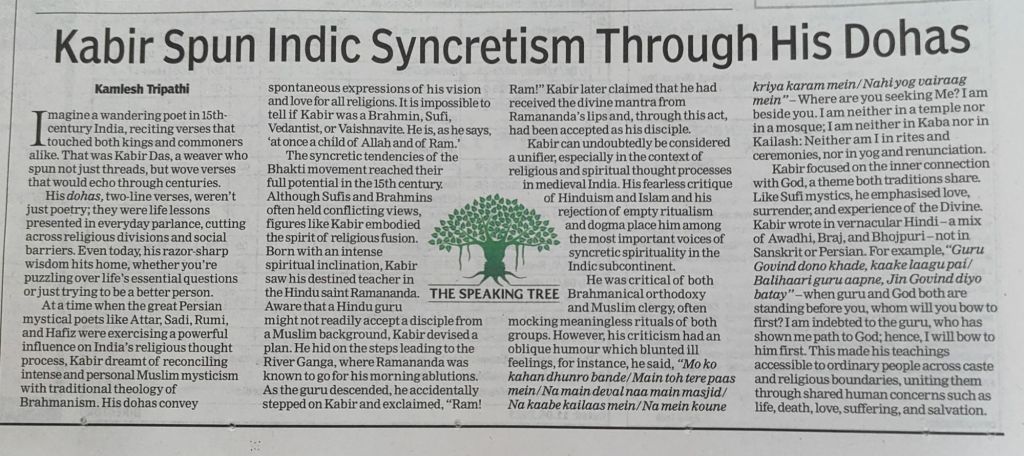
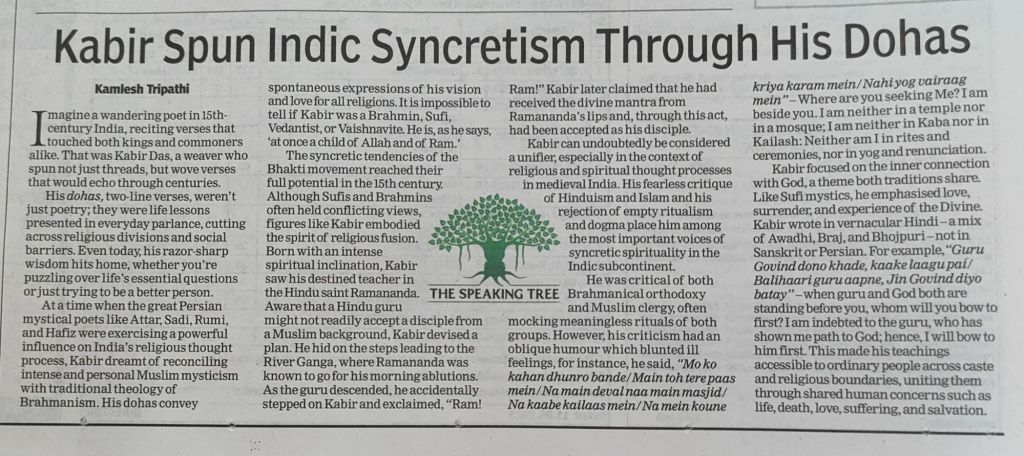
Kabir Spun Indic Syncretism Through His Dohas- The Times of India
Copyright@shravancharitymission
The Times of India 12.6.25
Kabir Spun Indic Syncretism Through His Dohas https://timesofindia.indiatimes.com/speaking-tree/daily-ecstasy/kabir-spun-indic-syncretism-through-his-dohas/articleshow/121800933.cms Download the TOI app now: https://timesofindia.onelink.me/mjFd/toisupershare
Posted by Kamlesh Tripathi
Author, Poet, & Columnist
*
https://kamleshsujata.wordpress.com
*
Like it and Share it
*
Shravan Charity Mission is an NGO that works for poor children suffering from life-threatening diseases, especially cancer. Our posts are meant for our readers, including children and adults, and have a huge variety of content. We also accept donations for our mission. Should you wish to donate to the cause of cancer? The bank details are given below:
NAME OF ACCOUNT: SHRAVAN CHARITY MISSION
Account no: 680510110004635 (BANK OF INDIA)
IFSC code: BKID0006805
***
Speaking Tree: Kabir Spun Indic Syncretism Through His Dohas … by Kamlesh Tripathi
Copyright@shravancharitymission

Written and posted by Kamlesh Tripathi
Author, Poet, & Columnist
*
https://kamleshsujata.wordpress.com
*
Like it and Share it
*
Shravan Charity Mission is an NGO that works for poor children suffering from life-threatening diseases, especially cancer. Our posts are meant for our readers, including children and adults, and have a huge variety of content. We also accept donations for our mission. Should you wish to donate to the cause of cancer? The bank details are given below:
NAME OF ACCOUNT: SHRAVAN CHARITY MISSION
Account no: 680510110004635 (BANK OF INDIA)
IFSC code: BKID0006805
***
Kabir Spun Syncretism Through His Dohas 12/6/25
Copyright@shravancharitymission
Read my piece published in the Times of India dated 12.6.25. Hope you like it.

Written by Kamlesh Tripathi
Author, Poet, & Columnist
*
https://kamleshsujata.wordpress.com
*
Like it and Share it
*
Shravan Charity Mission is an NGO that works for poor children suffering from life-threatening diseases, especially cancer. Our posts are meant for our readers, including children and adults, and have a huge variety of content. We also accept donations for our mission. Should you wish to donate to the cause of cancer? The bank details are given below:
NAME OF ACCOUNT: SHRAVAN CHARITY MISSION
Account no: 680510110004635 (BANK OF INDIA)
IFSC code: BKID0006805
***
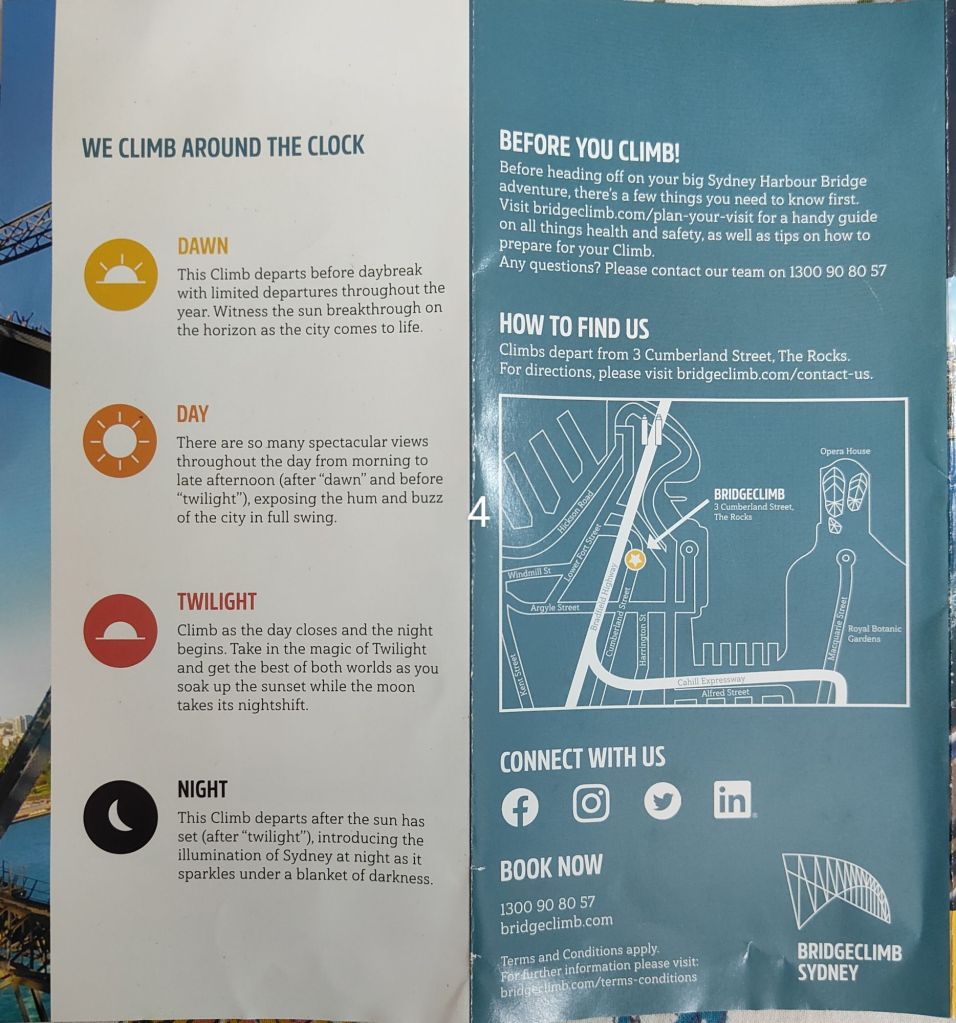
AUSTRALIA BRIDGE CLIMB
Copyright@shravancharitymission
BRIDGECLIMB SYDNEY– Don’t miss it if you happen to be in sydney.


Posted by Kamlesh Tripathi
Author, Poet, & Columnist
*
https://kamleshsujata.wordpress.com
*
Like it and Share it
*
Shravan Charity Mission is an NGO that works for poor children suffering from life-threatening diseases, especially cancer. Our posts are meant for our readers, including children and adults, and have a huge variety of content. We also accept donations for our mission. Should you wish to donate to the cause of cancer? The bank details are given below:
NAME OF ACCOUNT: SHRAVAN CHARITY MISSION
Account no: 680510110004635 (BANK OF INDIA)
IFSC code: BKID0006805
***
Mythological Story: When God’s get angry by Kamlesh Tripathi
Copyright@shravancharitymission
Enjoy the story published in Bhavans Journal


Written and posted by Kamlesh Tripathi
Author, Poet, & Columnist
*
https://kamleshsujata.wordpress.com
*
Like it and Share it
*
Shravan Charity Mission is an NGO that works for poor children suffering from life-threatening diseases, especially cancer. Our posts are meant for our readers, including children and adults, and have a huge variety of content. We also accept donations for our mission. Should you wish to donate to the cause of cancer? The bank details are given below:
NAME OF ACCOUNT: SHRAVAN CHARITY MISSION
Account no: 680510110004635 (BANK OF INDIA)
IFSC code: BKID0006805
***
 Shravan charity mission