Copyright@shravancharitymission
Enjoy my poem
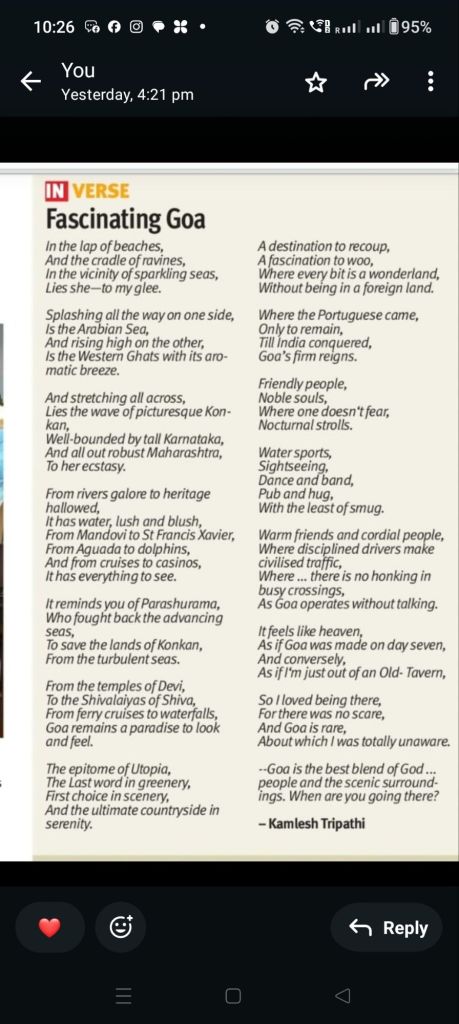
Copyright@shravancharitymission
Enjoy my poem
Copyright@shravancharitymission
WHEN BILLIONAIRES SPEAK OF ANTICHRIST (Economic Times 25/10/25)
“Peter Thiel’s argument reveals the engineering obsession of seeing everything as a problem and seeking the final solution”
DEVDUTT PATTANAIK, AUTHOR OF BUSINESS SUTRA
Peter Thiel– venture capitalist and PayPal co-founder — recently used the Christian myth of Antichrist to describe everyone who fears and resists technological change. In other words, for him, technology is Christ, saviour, God even.
In his recent lecture series and interviews, he develops a worldview that fuses Christian apocalyptic language with libertarian suspicion of regulation. It reveals the anxieties that plague him despite great wealth, power and success. Here is a man of science appealing to humans to ‘trust’ technology. Like the know-it-all guru.
Christian myth never talks of nature. It considers human suffering the direct result of failure to obey God. Christ exists to save humanity. He offers the promise of paradise. He is the shepherd of lost sheep. The Antichrist is the great king who opposes him, who wants humanity to stay trapped in sin and suffering. This notion is elaborated in the Book of Revelation that speaks of the end of times as a great war– the Apocalypse. This evangelical language is very popular in America. It is how every politician speaks.
This myth makes no sense to the Chinese or to Indians who subscribe to other kinds of myths, one where the world has no beginning or end, where nature is always greater than culture. Neither Chinese nor Indian myth speaks of saviours, Judgement Day or Apocalypse. The idea of endless progress and growth makes no sense in these ancient worldviews.
By contrast, the West has always wanted to save the world. Hollywood movies keep repeating the trope– Superman, Batman, Harry Potter, everyone is busy saving the world from evil. It is how the West saw itself when it spread Christianity and later Industrialization. This is how colonization and slavery was justified. Globalization was also meant to save the world. As was cryptocurrency. Now AI is the new Jesus.
Thiel’s argument reveals the engineering obsession of seeing everything as a problem and seeking the final solution. Western myth always ends with tales of great wars: Apocalypse. Hence the finality in Thiel’s declaration that the Antichrist wants to stop all science, slow or control AI, biotechnology, and other transformative tools of the 21st century. In his mind, today’s climate activists and global regulators echo the biblical warnings of false saviours who promise safety in exchange for obedience. For years, he’s warned about technological stagnation –his famous line, “We wanted flying cars, instead we got 140 characters,” became a rallying cry for those who feel innovation has been suffocated by bureaucracy. Now, he’s dressing that grievance in religious robes. The danger for him is not runaway technology, but runaway bureaucracy.
Thiel’s political philosophy valorises individual freedom. His Christ has nothing to do with love. It has everything to do with efficiency, effectiveness and productivity. Like most materialists, he believes food takes away hunger. He does not wonder why his success has not made him content. The world is as bad, or worse, as it was before he existed. He does not see his own addiction to wealth, power, and control. He is oblivious of his own delusion. Like most technocrats, he is very smart, but not wise. Wisdom demands perspective and empathy. Thiel’s way of thinking reveals what happens when science rips out the study of culture and mocks it as stories, when success makes you think you are indispensable. These are core Buddhist and Jain ideas that are at odds with Christian myth.
Thiel’s Antichrist may seem like a mirror held up to our anxieties about the future: who will control it, and at what cost. But he is no different from the ‘woke’ who until recently accused all those restraining them as being ‘fascist’ and relished in ‘cancel culture’
Thiel’s words can be used against him. That he is the clever Antichrist who seeks to enslave humanity with his tools and technology, determining who must live, who must die, who has the IQ worthy of being insured. He forgets that technology cannot regulate emotions. Technology does not resolve human insecurity. Technology will never make the world predictable, for someone will always disrupt old technology with new technology. Every technocrat wants to play God and views his competitors and opponents, and his tax-collector, as the Antichrist.
Ultimately, Thiel’s language reminds us that despite science and technology, despite billions in the bank, no humans can ever escape the myth that shapes the way they see the world.

Posted by Kamlesh Tripathi
Author, Poet, & Columnist
*
https://kamleshsujata.wordpress.com
*
Like it and Share it
*
Shravan Charity Mission is an NGO that works for poor children suffering from life-threatening diseases, especially cancer. Our posts are meant for our readers, including children and adults, and have a huge variety of content. We also accept donations for our mission. Should you wish to donate to the cause of cancer? The bank details are given below:
NAME OF ACCOUNT: SHRAVAN CHARITY MISSION
Account no: 680510110004635 (BANK OF INDIA)
IFSC code: BKID0006805
***
Copyright@shravancharitymission

Five Go to Demon’s Rocks is the nineteenth novel in The Famous Five series by Enid Blyton. It was first published in 1961.
Irascible scientist Quentin Kirrin informs his wife, Fanny, that his colleague, Professor Hayling, will be arriving a week early for a stay at Kirrin Cottage. The professor is accompanied by his son, Tinker, who often has a sudden urge to start imitating vehicular noises and has brought his pet monkey, Mischief. It is also described that Tinker imitates such noises when he is upset or when someone has been ‘horrid’ to him. Also arriving are Quentin and Fanny’s daughter, George, and her cousins, Julian, Dick and Anne, and George’s dog, Timmy. The ensuing crowded and noisy household upsets the two scientists, prompting Tinker to propose that the children spend their holiday at his abandoned lighthouse at Demon’s Rocks, located 10 miles away.
After settling in at the lighthouse, the children meet an elderly retired sailor, Jeremiah Boogle, who tells them of his youthful encounters with three villains who lured ships to Demon’s Rocks and plundered the wrecks. He says the ringleader, One-Ear Bill, hid a treasure trove which has never been found. Two of One-Ear Bill’s descendants, Jacob and Ebenezer, now show tourists through the wreckers’ cave. Jacob burgles some items from the lighthouse and also steals the key. When the children visit the cave, Mischief discovers a gold coin. Later, Ebenezer and Jacob lock the children in the lighthouse to prevent them from returning to the cave to hunt for the treasure, but Julian and Dick enter the cave network via a tunnel and discover the treasure. Unable to reach the mainland because of the rising tide, they return to the lighthouse, light its lamp and ring an old warning bell amid a fierce gale to alert the villagers to their fate. Jacob and Ebenezer flee, and the children are rescued the next morning. Julian and Dick declare they will recover the treasure for the police, and then the children will return to Kirrin Cottage.
Posted by Kamlesh Tripathi
Author, Poet, & Columnist
*
https://kamleshsujata.wordpress.com
*
Like it and Share it
*
Shravan Charity Mission is an NGO that works for poor children suffering from life-threatening diseases, especially cancer. Our posts are meant for our readers, including children and adults, and have a huge variety of content. We also accept donations for our mission. Should you wish to donate to the cause of cancer? The bank details are given below:
NAME OF ACCOUNT: SHRAVAN CHARITY MISSION
Account no: 680510110004635 (BANK OF INDIA)
IFSC code: BKID0006805
***
Copyright@shravancharitymission

The Famous Five is one of the most beloved children’s adventure series written by Enid Blyton, first published between 1942 and 1963. The series spans 21 novels, all centred on the thrilling escapades of four children—Julian, Dick, Anne, and George (Georgina)—and their loyal dog, Timmy. Set mainly in the British countryside and coastal regions, these stories capture the magic of childhood freedom, courage, and friendship against the backdrop of mystery and danger.
The series begins with Five on a Treasure Island (1942), where siblings Julian, Dick, and Ann, along with their cousin Georgina, who insists on being called George, are sent to spend their holidays with their cousin at her home, Kirrin Cottage, near the sea. George owns an island called—Kirrin Island—and a dog, Timmy, both of which become central to the adventures that follow. In this first story, the children discover the ruins of an old castle on the island and find a mysterious map leading to hidden gold. Their courage and cleverness helped them uncover the treasure and outwit adult villains, setting the tone for the rest of the series.
Each subsequent book follows a similar pattern: the children go on school holidays, explore new settings (moors, hills, farms, caves, lighthouses), stumble upon suspicious activities or hidden secrets, and end up solving mysteries that often involve smugglers, spies, thieves, or lost treasures. Yet, despite the recurring structure, each story offers fresh excitement through new locations, ingenious clues, and colourful characters.
Across the series, Julian, the eldest, acts as the natural leader—sensible, brave, and responsible. Dick, the quick-witted and humorous brother, balances Julian’s seriousness with his sharp thinking. Anne, the youngest, represents domesticity and caution, often preferring comfort and order but proving loyal and brave when needed. George, the most unconventional character, is a tomboy who rejects traditional expectations of girls. Fiercely independent and short-tempered, she insists on being treated as an equal to the boys and often drives the adventures with her stubbornness and spirit. Timmy, her dog, is as much a hero as any of them—faithful, protective, and courageous, often rescuing the children from danger.
One of the enduring appeals of The Famous Five is Blyton’s evocative depiction of the English countryside. These stories overflow with descriptions of cliffs, secret tunnels, stormy seas, moorlands, and quaint villages—landscapes that become almost characters in themselves. The children’s world is filled with picnics of sandwiches, lemonade, and ginger beer, which have become iconic symbols of carefree British childhood.
While outwardly simple, the series also mirrors the social and moral values of mid-20th-century Britain. Themes of loyalty, honesty, courage, teamwork, and justice dominate every story. The children rely on intuition and reason rather than adult intervention, underscoring Blyton’s belief in the resourcefulness of youth. Adults are often absent, misguided, or even the villains, allowing the children to take control and show responsibility and initiative.
Throughout the adventures—whether rescuing kidnapped scientists in Five Go Adventuring Again, uncovering smugglers in Five Go Off to Camp, or thwarting criminals in Five Have a Mystery to Solve—the Five exhibit a blend of innocence and daring that continues to inspire readers. Their adventures reinforce a sense of moral clarity, where good always triumphs over evil through courage, loyalty, and friendship.
Enid Blyton’s clear, direct prose and rhythmic storytelling made the series immensely readable for children. Her focus on dialogue and action over description keeps the pace fast and engaging. Despite occasional criticism for outdated stereotypes or class attitudes reflective of the era, the books remain celebrated for their imagination, adventure, and timeless charm.
By the final book, Five Are Together Again (1963), the characters retain their youthful spirit and love for adventure, embodying an ideal of friendship and integrity that transcends time. The series’ consistent formula—a mysterious setting, a moral puzzle, and a thrilling resolution—makes each story familiar yet exciting.
Ultimately, The Famous Five endures not just as a collection of adventure tales but as a literary celebration of childhood freedom, courage, loyalty, and the joy of discovery. Blyton created a world where children, unburdened by adult interference, confront challenges with moral strength and curiosity. More than seven decades after its debut, The Famous Five continues to captivate readers across generations, offering a nostalgic glimpse into a simpler, braver, and endlessly adventurous childhood.
Written and posted by Kamlesh Tripathi
Author, Poet, & Columnist
*
https://kamleshsujata.wordpress.com
*
Like it and Share it
*
Shravan Charity Mission is an NGO that works for poor children suffering from life-threatening diseases, especially cancer. Our posts are meant for our readers, including children and adults, and have a huge variety of content. We also accept donations for our mission. Should you wish to donate to the cause of cancer? The bank details are given below:
NAME OF ACCOUNT: SHRAVAN CHARITY MISSION
Account no: 680510110004635 (BANK OF INDIA)
IFSC code: BKID0006805
******
Copyright@shravancharitymission
Posted by Kamlesh Tripathi
Author, Poet, & Columnist
*
https://kamleshsujata.wordpress.com
*
Like it and Share it
*
Shravan Charity Mission is an NGO that works for poor children suffering from life-threatening diseases, especially cancer. Our posts are meant for our readers, including children and adults, and have a huge variety of content. We also accept donations for our mission. Should you wish to donate to the cause of cancer? The bank details are given below:
NAME OF ACCOUNT: SHRAVAN CHARITY MISSION
Account no: 680510110004635 (BANK OF INDIA)
IFSC code: BKID0006805
***
Copyright@shravancharitymission

Poem: When the Summer Is Through
Kamlesh Tripathi
**
“There comes a time when the peak of life gets over, and you’re left with the residues. Learn to enjoy them equally.”
*
Celebrations were galore,
Merriments were in scores,
But after the peak,
Life has become a big bore.
*
When the summer ends,
And autumn arrives with its mellow gold,
I feel the whisper of endings,
In my deep core.
*
Winter waits quietly in the offing,
Not menacing, but inevitable,
When I realise, with a sigh,
That the peak of life is now left behind.
*
There was a time when every morning,
Seemed to hold a promise,
There was that thrill of becoming,
That reason for running.
*
The world seemed vast and welcoming,
Celebrations were endless,
Merriments were in scores.
And the future appeared allured.
*
Like a horizon forever receding,
But never out of reach,
And it was all before the peak,
When I was in the driver’s seat.
*
No one thinks of a decline,
When the climb is steep and bright,
We live as though the flame would never dim,
And life would continue to peak in the stride.
*
We believe that the inertia of joy,
Will keep turning the wheel of life,
Even long after the fire has extinguished,
So there is no risk to my pride.
*
But the seasons change quietly,
The heart slows its pace,
The crowd thins,
And suddenly, the silence is louder
than the sound.
*
Life after the peak is not bitter— only subdued,
Like the twilight after a blazing day,
The laughter now is softer,
the steps slower,
And the dreams are more inward.
*
There is beauty even here,
Even when there is no tide in the affairs of men,
Learn to accept the come down,
That emerges after the peak.
*
Somewhere deep within,
I still long for one more summer,
One more bandwagon,
One more extravaganza,
But that is not to be.
*
“When the summer is through, winter isn’t far behind”
**
Written and posted by Kamlesh Tripathi
Author, Poet, & Columnist
*
https://kamleshsujata.wordpress.com
*
Like it and Share it
*
Shravan Charity Mission is an NGO that works for poor children suffering from life-threatening diseases, especially cancer. Our posts are meant for our readers, including children and adults, and have a huge variety of content. We also accept donations for our mission. Should you wish to donate to the cause of cancer? The bank details are given below:
NAME OF ACCOUNT: SHRAVAN CHARITY MISSION
Account no: 680510110004635 (BANK OF INDIA)
IFSC code: BKID0006805
***

Copyright@shravancharitymission
POEM: I WANT MORE (DIL MANGE MORE)
–A man is never satisfied with what he has. He always wants more. But what is the limit for that more?
***
I have enough,
Yet, I want more,
Since enough doesn’t prescribe a limit,
I wish to have more.
*
More and enough are two of a kind,
They are mutually inclusive,
They work in tandem,
To fulfil your greedy aspirations.
*
Enough doesn’t remain adequate,
More doesn’t become surplus,
Because greed expands,
And together they consume mankind.
*
The baskets and trolleys in the malls,
The stock-keeping units and the brands,
The war cry of enough and more,
The floors and the expanse of the malls,
The queues and the billing counters,
They all expand with the burgeoning footfalls.
*
One enters the supermarket as if a pauper,
And comes out like a king,
After consuming a range of food dishes,
And buying a range of things.
*
Between enough and more,
There is a bridge of uncertainty,
That convinces the human mind,
To keep stocking till eternity.
There is no limit to wanting more,
But the idea of life is to enjoy,
The grace of satisfaction,
Which comes when you have enough,
And you don’t want more.
The gap between enough and more,
Is a thin line called satisfaction?
So, let satisfaction be your motto of life,
And do away with the idea of I want more.
–There is no limit to the mind wanting (mange) more. Come out of that mindset, as it only leads to disaster—
2.5.25
Written and posted by Kamlesh Tripathi
Author, Poet, & Columnist
*
https://kamleshsujata.wordpress.com
*
Like it and Share it
*
Shravan Charity Mission is an NGO that works for poor children suffering from life-threatening diseases, especially cancer. Our posts are meant for our readers, including children and adults, and have a huge variety of content. We also accept donations for our mission. Should you wish to donate to the cause of cancer? The bank details are given below:
NAME OF ACCOUNT: SHRAVAN CHARITY MISSION
Account no: 680510110004635 (BANK OF INDIA)
IFSC code: BKID0006805
***
Copyright@shravancharitymission
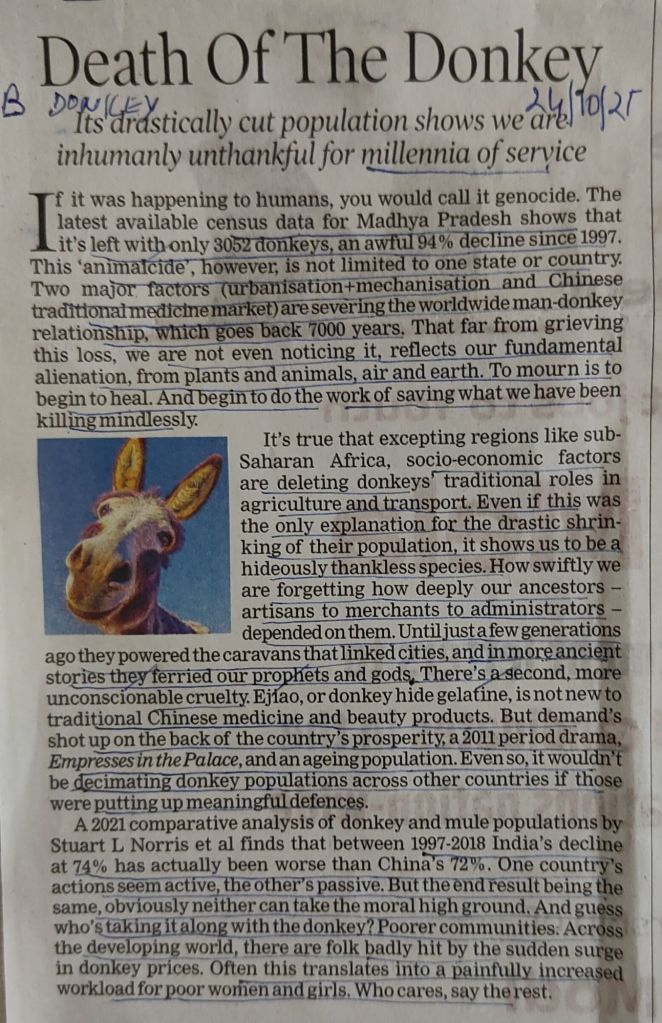
Its drastically cut population shows we are inhumanly unthankful for millennia of service
If it were happening to humans, you would call it genocide. The latest available census data for Madhya Pradesh shows that it’s left with only 3052 donkeys, an awful 94% decline since 1997. This ‘animalcide’, however, is not limited to one state or country. Read the TOI 24/10/25 editorial.
Posted by Kamlesh Tripathi
Author, Poet, & Columnist
*
https://kamleshsujata.wordpress.com
*
Like it and Share it
*
Shravan Charity Mission is an NGO that works for poor children suffering from life-threatening diseases, especially cancer. Our posts are meant for our readers, including children and adults, and have a huge variety of content. We also accept donations for our mission. Should you wish to donate to the cause of cancer? The bank details are given below:
NAME OF ACCOUNT: SHRAVAN CHARITY MISSION
Account no: 680510110004635 (BANK OF INDIA)
IFSC code: BKID0006805
***
Copyright@shravancharitymission
KNOW ETERNAL RUMI
11/10/25 Times of India
The poet suggests that love and compassion should transcend religious boundaries, promoting a vision of inclusiveness that is particularly vital in today’s divided world, writes SUMIT PAUL
Persian mystic and poet Jalaluddin Rumi needs no elaborate introduction as the very name is enough to evoke a deep sense of respect and reverence. He was born in Balkh in Northern Afghanistan and shuffled off this mortal coil in Konya (Turkey). However, his influence extends far beyond geographical boundaries and the realm of poetry. His teachings have had a profound impact on various aspects of contemporary culture, including music, literature, and spirituality. His timeless wisdom continues to resonate with people from all walks of life, crossing religious, cultural, and linguistic boundaries. Rumi’s popularity in the west has surged in recent decades, with his works translated into multiple languages. His profound messages of love, unity, and self-discovery have made him one of the most widely read and revered poets in the world. His writings serve as a bridge between different faiths and cultures, emphasising the universal message of love and the pursuit of enlightenment. Rumi’s words invite readers to embark on a transformative journey, where love and divine union are ultimate destinations. Many of his sublime thoughts transport us to the realms of love, beauty, enlightenment and introspection. For example, The Essential Rumi, chapter 12, includes: “A sufi’s book is not composed of ink and the alphabet. A scholar loves, and lives on, the marks of a pen. A sufi loves footprints!”
Rumi contrasts an intellectual approach to spirituality with an experiential path taken by the Sufis. While scholars rely on written knowledge, Sufis derive wisdom from lived experiences and traces left by those who walked the spiritual path before them. This reflects a belief in the transformative power of direct experience over mere study. This also shows the humility and absence of a burning desire to flaunt one’s name and fame. Rumi didn’t write his poetry while living in an ivory tower. His poetry was poetry of self-experiences. Rumi’s repertoire is based on the philosophy of self-effacement. We all have encumbered the earth, thanks to our wretched existence. In a brief life, man leaves no stone unturned, to leave a mark behind; a legacy for posterity. There’s always a burning desire in every individual to make his presence felt. While the desire to be remembered is innate in every individual, the wish to efface oneself from the big slate of the world is also there, albeit in very few individuals. Only the fully evolved and enlightened human beings don’t wish to be liabilities to earth and others.
Despite differences in beliefs and practices, Rumi sees the underlying essence of spirituality that connects all faiths. He suggests that love and compassion should transcend religious boundaries, promoting a vision of inclusiveness that is particularly vital in today’s divided world. He uses roses as metaphors to explain that the Divine love is just like the sun emitting, light and energy to a branching rosebush that grows elegantly on many levels and within several worlds– all at once. Just as a rosebush branches out, so too knowledge, offering different perspectives and insights. It evokes the idea that spiritual understanding can flourish through embracing diversity and appreciating multiple paths.
We need to imbibe the universal spirit of Rumi and assimilate it into the collective consciousness of humanity. We’ve been sparring over petty things and differences without realising the power of love. Rumi says gamble everything for love, if you’re a true human being. If not, leave this gathering, emphasising the transformative nature of love and necessity of commitment and courage in seeking true connection.
He advocates for risking everything in pursuit of love, suggesting that half-hearted attempts will yield shallow results. It serves as a reminder that authentic love requires boldness and sincerity. We all want this bold and intrepid love to connect with each other and unite in a single thread and a solitary breath, for your task is not to seek love, but merely to seek and find all barriers within yourself that you have built against it. So, let yourself be drawn by the stronger pull of that which you truly love. For Rumi, glue of love is the strongest glue.

Posted by Kamlesh Tripathi
Author, Poet, & Columnist
*
https://kamleshsujata.wordpress.com
*
Like it and Share it
*
Shravan Charity Mission is an NGO that works for poor children suffering from life-threatening diseases, especially cancer. Our posts are meant for our readers, including children and adults, and have a huge variety of content. We also accept donations for our mission. Should you wish to donate to the cause of cancer? The bank details are given below:
NAME OF ACCOUNT: SHRAVAN CHARITY MISSION
Account no: 680510110004635 (BANK OF INDIA)
IFSC code: BKID0006805
***
 Shravan charity mission