26/2/26
ECONOMIC TIMES
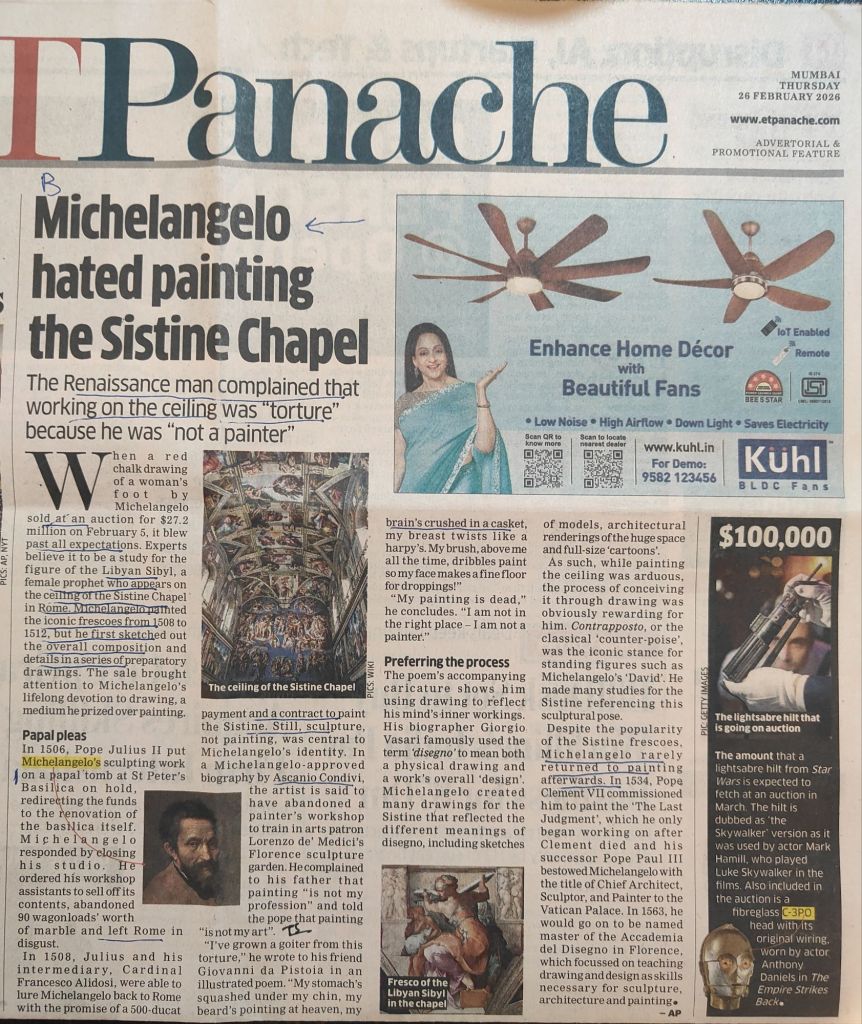
MICHELANGELO HATED PAINTING THE SISTINE CHAPEL
‘The Renaissance man complained that working on the ceiling was “torture” because he was “not a painter”‘
When a red chalk drawing of a woman’s foot by Michelangelo sold at an auction for $27.2 million on February 5, it blew past all expectations. Experts believe it to be a study of the figure of the Libyan Sibyl, a female prophet who appears on the ceiling of the Sistine Chapel in Rome. Michelangelo painted the iconic frescos from 1508 to 1512, but he first sketched out the overall composition and details in a series of preparatory drawings. The sale brought attention to Michelangelo’s lifelong devotion to drawing.
Papal pleas
In 1506, Pope Julius II put Michelangelo’s sculpting work on the papal tomb at St Peter’s Basilica on hold, redirecting the funds to the renovation of the basilica itself. Michelangelo responded by closing his studio. He ordered his workshop assistants to sell off its contents, abandoned 90 wagonloads’ worth of marble and left Rome in disgust.
In 1508, Julius and his intermediary, Cardinal Francesco Alidosi, were able to lure Michelangelo back to Rome with the promise of a 500-ducat payment and a contract to paint the Sistine. Still, sculpture, not painting, was central to Michelangelo’s identity. In a Michelangelo-approved biography by Ascanio Condivi, the artist is said to have abandoned a painter’s workshop to train in the arts patron Lorenzo de’ Medici’s Florence. He complained to his father that painting “is not my profession” and told the pope that painting “is not my art”.
“I’ve grown a goitre from this torture,” he wrote to his friend Giovanni da Pistoia in an illustrated poem. “My stomach’s squashed under my chin, my beard’s pointing at heaven, my brain’s crushed in a casket, my breast twists like a harpy’s. My brush, above me all the time, dribbles paint so my face makes a fine floor for droppings!”
“My painting is dead,” he concludes. “I am not in the right place – I am not a painter.”
Preferring the process
The poem’s accompanying caricature shows him using drawing to reflect his mind’s inner workings. His biographer Giorgio Vasari famously used the term ‘disegno’ to mean both a physical drawing and a work’s overall ‘design’. Michelangelo created many drawings for the Sistine that reflected the different meanings of disegno, including sketches of models, architectural renderings of the huge space and full-size ‘cartoons’.
As such, while painting the ceiling was arduous, the process of conceiving it through drawing was obviously rewarding for him. Contrapposto, or the classical ‘counter-poise’, was the iconic stance for standing figures such as Michelangelo’s ‘David’. He made many studies for the Sistine referencing this sculptural pose.
Despite the popularity of the Sistine frescoes, Michelangelo rarely returned to painting afterwards. In 1534, Pope Clement VII commissioned him to paint ‘The Last Judgment’, which he only began working on after Clement died and his successor, Pope Paul III, bestowed Michelangelo with the title of Chief Architect, Sculptor, and Painter to the Vatican Palace. In 1563, he would go on to be named master of the Accademia del Disegno in Florence, which focused on teaching drawing and design as skills necessary for sculpture, architecture and painting.
Posted by Kamlesh Tripathi
Author, Poet, & Columnist
*
https://kamleshsujata.wordpress.com
*
Like it and Share it
*
Shravan Charity Mission is an NGO that works for poor children suffering from life-threatening diseases, especially cancer. Our posts are meant for our readers, including children and adults, and have a huge variety of content. We also accept donations for our mission. Should you wish to donate to the cause of cancer? The bank details are given below:
NAME OF ACCOUNT: SHRAVAN CHARITY MISSION
Account no: 680510110004635 (BANK OF INDIA)
IFSC code: BKID0006805
***



 Shravan charity mission