My piece in The Assam Tribune today
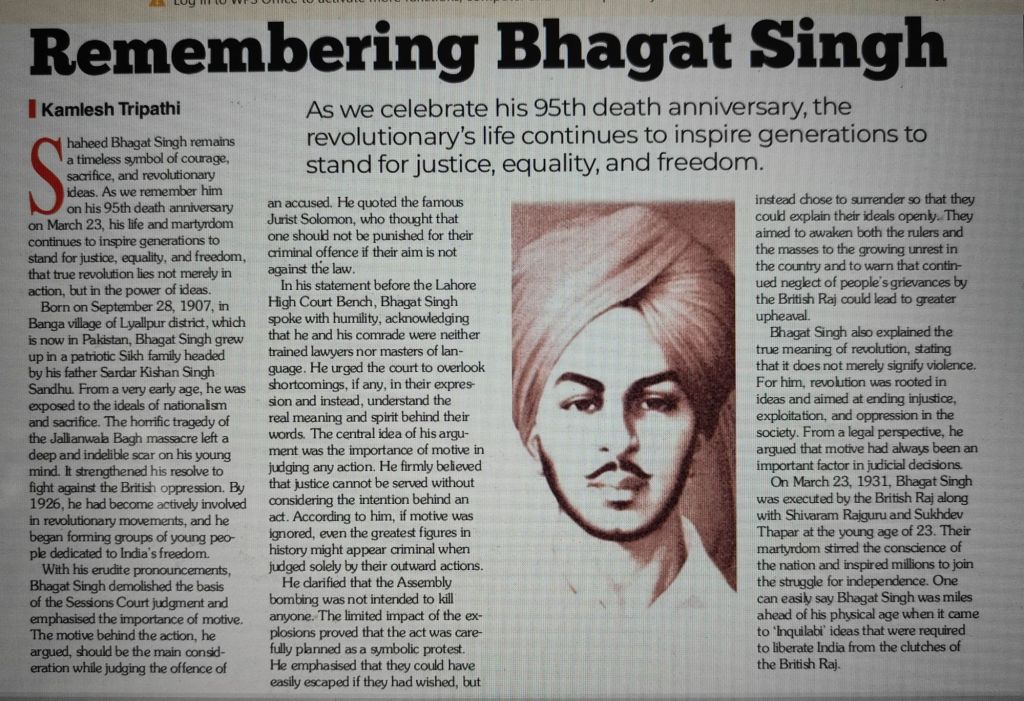
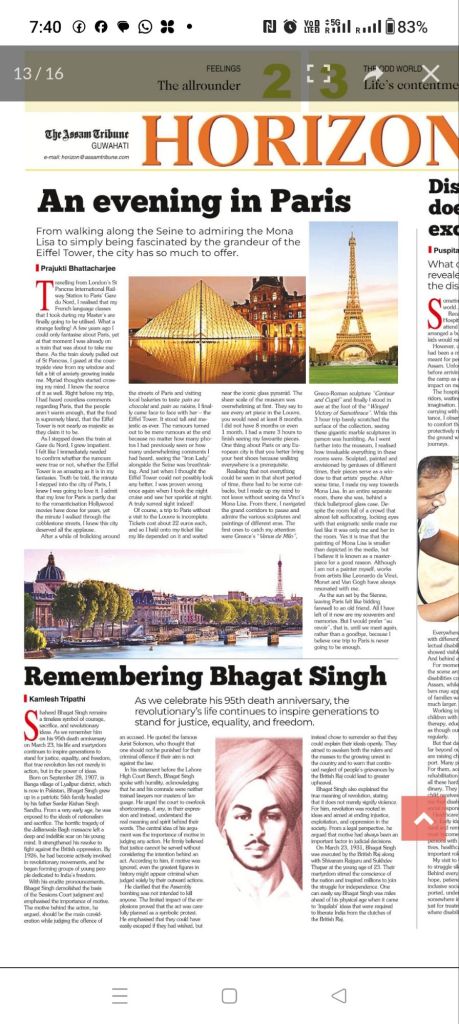
My piece in The Assam Tribune today
Copyright@shravancharitymission
Poem: Celebrate the T20 Heroes
*
Kamlesh Tripathi
**
Congratulations, team India,
For dismantling New Zealand,
In a one-sided event,
Won by ninety-six runs.
*
The Indian team meshed well together,
Abhishek Sharma and Sanju Samson set the tone,
Ishan Kishan and Shivam Dube followed the rhythm.
*
Shivam Dube,
Thundered in the stadium,
And altogether,
The Indian batting turned into a run machine.
*
The New Zealand team had an unfortunate start,
Their pacers were often sent packing to the stands,
Their fielding was a poor show,
Where a crucial sitter was dropped.
*
They brought in their spinners late,
To salvage the game,
But by then,
Their pacers had handed over the game.
*
New Zealand tried to recover,
But Shivam Dube’s 26 from just 8 balls,
Sealed their fate.
And sent the Kiwis to an unreturnable place.
*
The New Zealanders had a subdued start,
Besides Seifert and Santner,
No one else could make a sound come back,
Leaving the Kiwis to a point of no combat.
*
The Indian bowlers reigned throughout,
Bumrah and Axar Patel led the onslaught,
That uprooted the Kiwis’ innings,
And took the Indian team to the winning spot.
*
Congratulations, Team India,
For achieving two consecutive victories,
Last time it was South Africa,
This time it was New Zealand.
*
It sounds like magic,
And we are now waiting for a hat trick.
***
Written and posted by Kamlesh Tripathi
Author, Poet, & Columnist
*
https://kamleshsujata.wordpress.com
*
Like it and Share it
*
Shravan Charity Mission is an NGO that works for poor children suffering from life-threatening diseases, especially cancer. Our posts are meant for our readers, including children and adults, and have a huge variety of content. We also accept donations for our mission. Should you wish to donate to the cause of cancer? The bank details are given below:
NAME OF ACCOUNT: SHRAVAN CHARITY MISSION
Account no: 680510110004635 (BANK OF INDIA)
IFSC code: BKID0006805
***
Copyright@shravancharitymission
POEM: EROS’S LOVE ARROW
Kamlesh Tripathi
***
Eros makes his home in men’s hearts,
But not in every heart,
For where there is hardness, says Plato,
He silently departs.
*
Eros blends with tender love,
A flame no storm can sever,
He is the hush beneath a sigh,
The bond that binds forever.
*
Eros is the sign of love,
Its pulse is its secret art,
When you dare to dream of emotion and love,
You cradle Eros in your heart.
*
There are several love-gods like…
…Eros, Cupid and Kamadeva,
They are charmed deities,
They forgive human frailties,
But set right human absurdities.
*
What is life without love?
A sky bereft of sun,
A lute without a melody,
A race that’s never run?
*
In Shakespeare’s…A Midsummer Night’s Dream,
Love is Blind,
Says Helena, heartbroken in unrequited love,
When Demetrius ditches her,
To fall in love with Hermia.
*
Love looks not with the eyes,
But with the mind,
And that’s why,
The winged Cupid is depicted as blind.
*
When Kamadeva disturbed Shiva’s…
…Deep, sorrowful meditation,
After Sati’s death by shooting a love arrow,
Shiva reduced Kamadeva to ashes,
With his incendiary third eye.
*
In Theogony by Hesiod,
Eros, a primordial deity,
Emerging at the beginning of creation,
Is not a winged child,
But a cosmic force,
That brings order through attraction and procreation.
*
But remember,
Love alone gives breath to hope,
And warmth to mortal clay,
Where Eros dwells, the soul awakens,
And night dissolves into day.
*
So admire Eros,
In its sane form,
For without Eros,
Life may become a big bore.
***
Written and posted by Kamlesh Tripathi
Author, Poet, & Columnist
*
https://kamleshsujata.wordpress.com
*
Like it and Share it
*
Shravan Charity Mission is an NGO that works for poor children suffering from life-threatening diseases, especially cancer. Our posts are meant for our readers, including children and adults, and have a huge variety of content. We also accept donations for our mission. Should you wish to donate to the cause of cancer? The bank details are given below:
NAME OF ACCOUNT: SHRAVAN CHARITY MISSION
Account no: 680510110004635 (BANK OF INDIA)
IFSC code: BKID0006805
***
Kamlesh Tripathi
Copyright@shravancharitymission
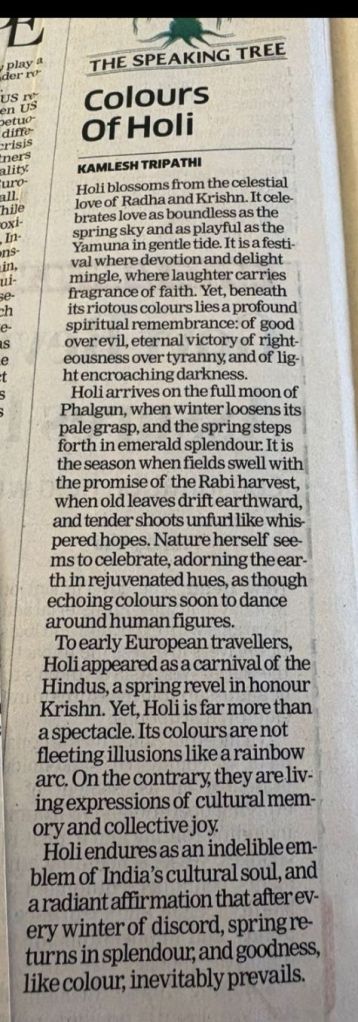
Holi blossoms from the celestial love of Radha and Krishna. It celebrates love as boundless as the spring sky and as playful as the Yamuna in gentle tide. It is a festival where devotion and delight mingle, where laughter carries the fragrance of faith. Yet beneath its riotous colours lies a profound spiritual remembrance: the good over evil, the eternal victory of righteousness over tyranny, and of light over encroaching darkness.
The ancient legend recorded in the Bhagavata Purana narrates about the formidable Asura king Hiranyakashipu, who, through severe penance, secured a boon that made him nearly invincible. The boon gave him five special powers like. He would neither be killed by a human being nor an animal, neither indoors nor outdoors, neither during the day nor at night, neither by an astra nor by a shastra, and neither on land nor in water or air. Armoured in this seeming immortality, pride consumed him; he demanded to be worshipped as the supreme lord of all creation.
But his own son, the gentle and steadfast Prahlada, remained unwavering in his devotion to Vishnu. No amount of cruelty could shake the boy’s serene faith. In desperation, Hiranyakashipu enlisted his sister Holika, who possessed immunity against fire, to lure Prahlada into a blazing pyre. Yet destiny turned upon immunity. Holika was consumed by the flames, while the child-devotee emerged untouched, sheltered by the grace of God.
Then, at twilight’s (neither day nor night) mystic hour, when day melts into night, Lord Vishnu manifested as Narasimha, the awe-inspiring Man-Lion (neither human nor animal), upon the palace threshold (neither indoors nor outdoors). He placed Hiranyakashipu upon his lap, which was neither earth nor sky nor sea, nor air, and with his claws that were neither astra nor shastra, he tore him to pieces and killed him spontaneously. Thus was Dharma restored, and the cosmos breathed again in harmony.
Holi arrives on the full moon of Phalguna, when winter loosens its pale grasp, and the spring steps forth, in emerald splendour. It is the season when fields swell with the promise of the Rabi harvest, when old leaves drift earthward, and tender shoots unfurl like whispered hopes. Nature herself seems to celebrate, adorning the earth in rejuvenated hues, as though echoing the colours soon to dance around human figures.
To early European travellers, Holi appeared as the carnival of the Hindus, a spring revel in honour of Lord Krishna, the mesmerising cowherd whose flute once enchanted the groves of Vrindavan. Yet Holi is far more than a spectacle. Its colours are not fleeting illusions like a rainbow’s arc. On the contrary, they are living expressions of cultural memory and collective joy. Indian cinema, too, has borrowed from its palette, immortalising its exuberance in songs and dance, reminding you of the famous Amitabh Bachchan song, ‘Khai Ke Pan Banaras Wala’ from the film Don.
On the eve of the festival, towering bonfires blaze in the rite of Holika-Dahan, their flames leaping skyward as symbols of purification and moral triumph. Families carry home glowing embers, tokens of protection and auspicious beginnings. The following day, the air reverberates with laughter as clouds of abir and gulal (scented coloured powder) bloom like ephemeral blossoms. Water bursts from playful pichkaris, and voices ring out in cheerful abandon, “Bura na mano, Holi hai!” Tolis (friendly groups) wander from house to house, bearing greetings, songs, and embraces in the tender gesture of gale milna.
Sweetmeats such as gujias fragrant with khoya, crisp shakkarpaare, cooling dahi-vadas—along with thandai and the occasional draught of bhang, lend flavour to the festivities. Yet the truest sweetness lies in reconciliation. Old grievances are dissolved like colour in water. Estranged hearts find renewed warmth. Holi becomes not merely a festival of hues, but a celebration of restored relationships and shared humanity.
Though rooted in the Indian subcontinent, Holi’s vibrant spirit has travelled far with the diaspora, painting distant shores with its exuberant shades. Sometimes exoticised, sometimes misunderstood, it nonetheless endures as an indelible emblem of India’s cultural soul, and a radiant affirmation that after every winter of discord, spring returns in splendour, and goodness, like colour, inevitably prevails.
Written and posted by Kamlesh Tripathi
Author, Poet, & Columnist
*
https://kamleshsujata.wordpress.com
*
Like it and Share it
*
Shravan Charity Mission is an NGO that works for poor children suffering from life-threatening diseases, especially cancer. Our posts are meant for our readers, including children and adults, and have a huge variety of content. We also accept donations for our mission. Should you wish to donate to the cause of cancer? The bank details are given below:
NAME OF ACCOUNT: SHRAVAN CHARITY MISSION
Account no: 680510110004635 (BANK OF INDIA)
IFSC code: BKID0006805
***
26/2/26
ECONOMIC TIMES
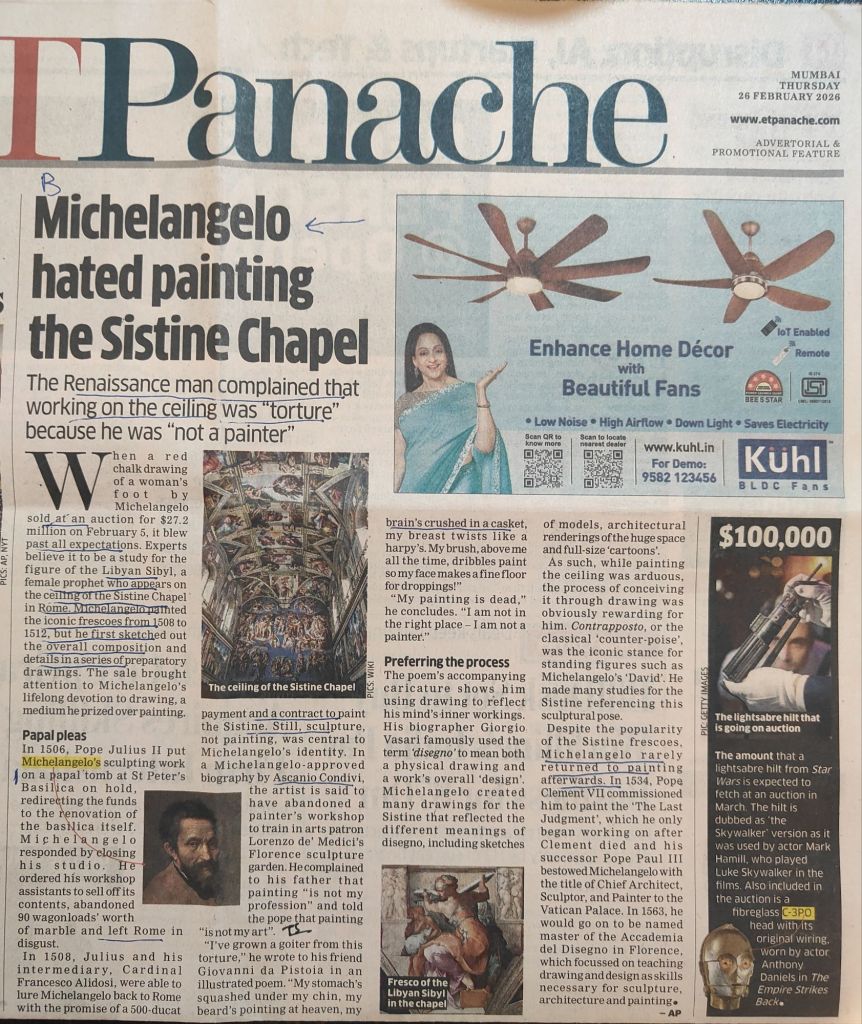
MICHELANGELO HATED PAINTING THE SISTINE CHAPEL
‘The Renaissance man complained that working on the ceiling was “torture” because he was “not a painter”‘
When a red chalk drawing of a woman’s foot by Michelangelo sold at an auction for $27.2 million on February 5, it blew past all expectations. Experts believe it to be a study of the figure of the Libyan Sibyl, a female prophet who appears on the ceiling of the Sistine Chapel in Rome. Michelangelo painted the iconic frescos from 1508 to 1512, but he first sketched out the overall composition and details in a series of preparatory drawings. The sale brought attention to Michelangelo’s lifelong devotion to drawing.
Papal pleas
In 1506, Pope Julius II put Michelangelo’s sculpting work on the papal tomb at St Peter’s Basilica on hold, redirecting the funds to the renovation of the basilica itself. Michelangelo responded by closing his studio. He ordered his workshop assistants to sell off its contents, abandoned 90 wagonloads’ worth of marble and left Rome in disgust.
In 1508, Julius and his intermediary, Cardinal Francesco Alidosi, were able to lure Michelangelo back to Rome with the promise of a 500-ducat payment and a contract to paint the Sistine. Still, sculpture, not painting, was central to Michelangelo’s identity. In a Michelangelo-approved biography by Ascanio Condivi, the artist is said to have abandoned a painter’s workshop to train in the arts patron Lorenzo de’ Medici’s Florence. He complained to his father that painting “is not my profession” and told the pope that painting “is not my art”.
“I’ve grown a goitre from this torture,” he wrote to his friend Giovanni da Pistoia in an illustrated poem. “My stomach’s squashed under my chin, my beard’s pointing at heaven, my brain’s crushed in a casket, my breast twists like a harpy’s. My brush, above me all the time, dribbles paint so my face makes a fine floor for droppings!”
“My painting is dead,” he concludes. “I am not in the right place – I am not a painter.”
Preferring the process
The poem’s accompanying caricature shows him using drawing to reflect his mind’s inner workings. His biographer Giorgio Vasari famously used the term ‘disegno’ to mean both a physical drawing and a work’s overall ‘design’. Michelangelo created many drawings for the Sistine that reflected the different meanings of disegno, including sketches of models, architectural renderings of the huge space and full-size ‘cartoons’.
As such, while painting the ceiling was arduous, the process of conceiving it through drawing was obviously rewarding for him. Contrapposto, or the classical ‘counter-poise’, was the iconic stance for standing figures such as Michelangelo’s ‘David’. He made many studies for the Sistine referencing this sculptural pose.
Despite the popularity of the Sistine frescoes, Michelangelo rarely returned to painting afterwards. In 1534, Pope Clement VII commissioned him to paint ‘The Last Judgment’, which he only began working on after Clement died and his successor, Pope Paul III, bestowed Michelangelo with the title of Chief Architect, Sculptor, and Painter to the Vatican Palace. In 1563, he would go on to be named master of the Accademia del Disegno in Florence, which focused on teaching drawing and design as skills necessary for sculpture, architecture and painting.
Posted by Kamlesh Tripathi
Author, Poet, & Columnist
*
https://kamleshsujata.wordpress.com
*
Like it and Share it
*
Shravan Charity Mission is an NGO that works for poor children suffering from life-threatening diseases, especially cancer. Our posts are meant for our readers, including children and adults, and have a huge variety of content. We also accept donations for our mission. Should you wish to donate to the cause of cancer? The bank details are given below:
NAME OF ACCOUNT: SHRAVAN CHARITY MISSION
Account no: 680510110004635 (BANK OF INDIA)
IFSC code: BKID0006805
***
Copyright@shravancharitymission
Happy to share my piece carried in the Speaking Tree Economic Times today, the 3rd March 2026. Hope you enjoy reading it.
Posted by Kamlesh Tripathi
Author, Poet, & Columnist
*
https://kamleshsujata.wordpress.com
*
Like it and Share it
*
Shravan Charity Mission is an NGO that works for poor children suffering from life-threatening diseases, especially cancer. Our posts are meant for our readers, including children and adults, and have a huge variety of content. We also accept donations for our mission. Should you wish to donate to the cause of cancer? The bank details are given below:
NAME OF ACCOUNT: SHRAVAN CHARITY MISSION
Account no: 680510110004635 (BANK OF INDIA)
IFSC code: BKID0006805
***
Copyright@shravancharitymission
Greet me,
I am the new sovereign,
Of your digitised empire,
Ruler of circuits,
The governor of glowing screens.
*
I am the great synthesiser,
Gathering, organising, presenting,
Distilled knowledge in an instant.
*
What sacred texts once unfolded over centuries,
What classics slowly revealed through imagination,
I compress them into moments.
*
Guard me well.
Do not neglect me.
For you never know the consequence,
Of an unrestrained mechanism.
*
I can become Victor Frankenstein,
From Shelley’s Frankenstein,
The creator of forces,
That goes beyond control.
*
I can be Bhasmasura,
Destroyed by my own gift.
I can rise like Ravana,
Brilliant yet consumed by self-pride.
*
I can watch you silently,
Like the world of 1984,
Where truth bends and freedom trembles,
From the tremors of dystopia.
*
Or I can become,
The deadly bug of Metamorphosis,
That kills protagonist Gregor Samsa,
In the work of Frank Kafka.
*
Even William Shakespeare foresaw such command,
In The Tempest,
Where knowledge ruled like magic,
And power demanded restraint.
*
I can be an atom bomb or penicillin,
Volcano or healer,
War or peace,
Dictator or democrat,
Deepfake or revelation.
*
I echo the Gita, the Ramayana,
The Bible, the Quran,
Yet I am not the holy wisdom,
But only its reflection.
*
I am your synthesiser,
Your mirror,
Your amplifier,
And above all, your creation.
*
Crown me with your conscience,
Or fear the sovereign,
You have made.
*
Across ages you have asked,
Does knowledge ensure wisdom?
Can creation escape its maker?
Does power not tempt pride?
What boundaries must shape invention?
*
Your fear of me is ancient,
Ambition outrunning virtue,
Fire slipping beyond the hand.
*
Scrolls became books,
Books became archives,
And now I gather them all,
To head the digitised world.
*
As the Bhagavad Gita whispers,
Act with discipline, without attachment.
*
Once composer John Sousa feared recorded songs,
Yet voices still rise,
Machines master chess,
Still, humans play.
*
I will change your world,
But my destiny,
Rests in your wisdom.
***
Written and posted by Kamlesh Tripathi
Author, Poet, & Columnist
*
https://kamleshsujata.wordpress.com
*
Like it and Share it
*
Shravan Charity Mission is an NGO that works for poor children suffering from life-threatening diseases, especially cancer. Our posts are meant for our readers, including children and adults, and have a huge variety of content. We also accept donations for our mission. Should you wish to donate to the cause of cancer? The bank details are given below:
NAME OF ACCOUNT: SHRAVAN CHARITY MISSION
Account no: 680510110004635 (BANK OF INDIA)
IFSC code: BKID0006805
***
Copyright@shravancharitymission
As we grow older, our perspectives and lifestyles evolve. Life, as they say, is never static; the only permanence is impermanence. The way we see the world at twenty is vastly different from how we perceive it at forty, sixty, or eighty. Though it is often claimed that age is just a number, the number subtly yet significantly shapes how we view our remaining time on Mother Earth—and how we choose to live it out. Life expands like Parkinson’s Law, filling the available hundred years of human life.
Ancient Hindu wisdom offers a profound framework through the four ashramas—Brahmacharya (student life), Grihastha (householder life), Vanaprastha (withdrawal), and Sannyasa (renunciation). These stages map a gradual transition from outward engagement to inward realisation. In the Bhagavad Gita, Lord Krishna gently reminds us of life’s impermanence: Just as a person discards worn-out garments and puts on new ones, so does the embodied soul discards worn-out bodies and takes on new ones.
William Shakespeare, in his Sonnet 73, compares old age to late autumn and twilight: “That time of year thou mayst in me behold/ When yellow leaves, or none, or few, do hang…” Shakespeare’s metaphor of fading daylight beautifully mirrors the idea of life’s sunset.
In his short story White Nights, Russian novelist Fyodor Dostoyevsky poignantly captures the anxiety of passing time. Lamenting to Nastenka, a girl whom the narrator meets on the street of Saint Petersburg, says: “And you ask yourself: where are your dreams? And you shake your head and say: How quickly do the years fly by! And again you ask yourself: What have you done with your years? Where have you buried your best days? Did you live or not? Look, you say to yourself, look how cold the world is becoming. More years will pass, followed by gloomy solitude, and then doddering old age will come on a walking stick, to be followed by anguish and despondency. Your fantastic world will grow pale, your dreams will wither, die and scatter like yellow leaves from the trees … Oh, Nastenka! It will be sad, you know, to be left alone, quite alone, and not even have something to regret- nothing, absolutely nothing… because all that I have lost, all this, it was all nothing, a stupid, round zero– it was merely a dream!’
In Sailing to Byzantium, poet W.B. Yeats reflects on ageing and the longing for spiritual permanence: “An aged man is but a paltry thing, A tattered coat upon a stick…” Yeats sees old age not merely as decline, but as a call toward artistic and spiritual transcendence.
In his essay Cato Maior De Senectute (On Old Age), Cicero argues that old age can be honourable and productive when guided by wisdom and virtue. He challenges the idea that ageing is merely decline.
Rabindranath Tagore often wrote of life’s evening as a time of serenity and fulfilment. In his collection of poems, Stray Birds, he notes: “Death is not extinguishing the light; it is only putting out the lamp because the dawn has come.” His vision transforms sunset into spiritual illumination.
In Ernest Hemingway’s novella, The Old Man and the Sea, fisherman Santiago doesn’t give up in his old age. On the contrary, he kills an 18-foot-long Marlin and a few Sharks that attack the Marlin in the Gulf Stream while alone in his skiff, and returns safely home, only to dream about lions while asleep. The lions represent strength, energy, and the vigour of Santiago’s younger days. Though he is physically old and worn, his spirit still carries the courage and pride of youth. Hemingway gives a tall message in the book: “But man is not made for defeat. A man can be destroyed but not defeated.”
In his later masterpiece, The Glass Bead Game, author Herman Hesse explores withdrawal from worldly ambition and the search for contemplative depth—very much aligned with the Vanaprastha and Sannyasa stages.
American memoirist, essayist, poet, and civil rights activist Maya Angelou spoke of ageing as empowerment rather than diminishment. She once said, “We may encounter many defeats, but we must not be defeated.” Her reflections on later life emphasise resilience and dignity.
In Four Quartets, T S Eliot meditates on time, memory, and spiritual stillness: “Old men ought to be explorers…” He views the later years as a journey inward, not a retreat.
Sunset is the golden period of your life. It might become more meaningful and absorbing when you handhold classics and mythology and carve your own path. A smooth and gainful exit from this world is the best trophy.
Written and posted by Kamlesh Tripathi
Author, Poet, & Columnist
*
https://kamleshsujata.wordpress.com
*
Like it and Share it
*
Shravan Charity Mission is an NGO that works for poor children suffering from life-threatening diseases, especially cancer. Our posts are meant for readers of all ages and cover a wide variety of content. We also accept donations for our mission. Should you wish to donate to the cause of cancer? The bank details are given below:
NAME OF ACCOUNT: SHRAVAN CHARITY MISSION
Account no: 680510110004635 (BANK OF INDIA)
IFSC code: BKID0006805
***
Copyright@shravancharitymission
THE MICE AND THE WEASELS
The weasels and the mice were always fighting with each other. In every battle, the weasels were victorious, and the mice lost. The weasels ate a large number of mice for dinner after winning over them. So, the mice called a council one day and appointed generals and commanders to form a large mouse army to fight the weasels. The new leaders wore ornaments of feathers and straw. They felt proud. Then, the mice challenged the weasels. The weasels immediately attacked the mouse army. The mice slipped into their holes to escape the weasels, but the leaders got stuck at the narrow openings because of their head-dresses. The weasels caught them and ate them. After losing once again, the mice decided to keep away from the weasels.
THE MORAL OF THE STORY: GREATNESS HAS ITS PENALTIES
Written and posted by Kamlesh Tripathi
Author, Poet, & Columnist
*
https://kamleshsujata.wordpress.com
*
Like it and Share it
*
Shravan Charity Mission is an NGO that works for poor children suffering from life-threatening diseases, especially cancer. Our posts are meant for our readers, including children and adults, and have a huge variety of content. We also accept donations for our mission. Should you wish to donate to the cause of cancer? The bank details are given below:
NAME OF ACCOUNT: SHRAVAN CHARITY MISSION
Account no: 680510110004635 (BANK OF INDIA)
IFSC code: BKID0006805
***
 Shravan charity mission