Shravan Charity Mission is an NGO that works for poor children suffering from life-threatening diseases, especially cancer. Our posts are meant for our readers, including children and adults, and have a huge variety of content. We also accept donations for our mission. Should you wish to donate to the cause of cancer? The bank details are given below:
We departed from the hotel at 8:00 am after a sumptuous continental breakfast. Soon, our coach was navigating the wide and shimmering roads of France. Today, we were to travel from Paris to Brussels, the capital of Belgium and also the capital of the European Union. From there, we were to proceed to the Netherlands. We realised Europe was so unique. We had breakfast in France, lunch was in Belgium, and dinner was in the Netherlands. It took us three and a half hours from Paris to Brussels. The drive was picturesque, with the ever-changing green landscape and flowing rivers. Notably, there was no honking. The drivers in Europe were disciplined and maintained their lanes, a truly commendable trait.
Our coach driver, Michele, hailed from Italy. As we drove along, we passed both small and large villages, each neatly maintained and typically featuring a church tower. The verdant surroundings and the occasional river added charm to the journey. Before Belgium, we stopped to enjoy a hearty lunch at the Wonders Restaurant.
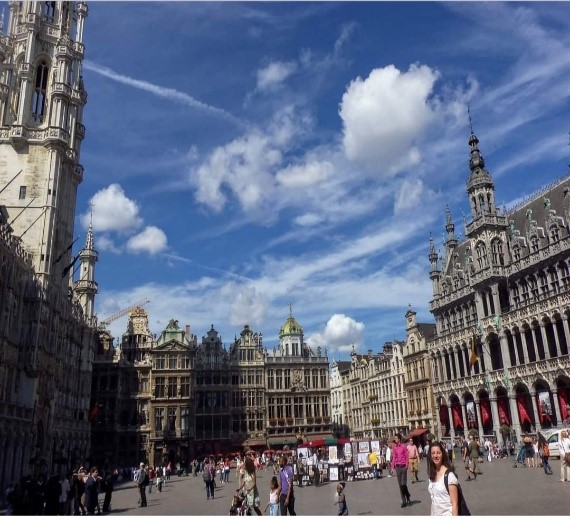
After lunch, we visited the city centre of Brussels, known as the Grand Place. It is a beautiful square that houses the Town Hall, several Gilded Age buildings, and a circular monument. A popular landmark here is the Manneken Pis Statue, also known as the ‘Peeing Boy Statue’, located right in the heart of the square. According to an old folktale, it holds historical significance and continues to attract visitors from all over. The square was bustling with shoppers and tourists. We made the most of the vibrant atmosphere, capturing several photographs and enjoying delicious ice cream.
By 4:00 pm, we departed for our next attraction, the Atomium. It took about an hour to get there. The Atomium is a striking historical monument, built in 1957, featuring nine massive spheres connected by 21 tubes. It represents an iron crystal magnified 165 billion times and is considered a national icon of Belgium. It was another excellent photo opportunity, steeped in architectural and scientific heritage.
After visiting the Atomium, we resumed our journey to Amsterdam, in the Netherlands. From Brussels we crossed over to Valenciennes, a border town in France and then circled back to Antwerp, a town in Belgium, well-known for its diamond market. In and around Antwerp, we saw many windmills, canals, lakes, and quaint village houses. My spouse and I were thrilled to witness this exquisite blend of nature and culture. Finally, we entered the Netherlands via the Hazeldonk, on the Belgium-Netherlands border and then reached the town of Breda and then Amsterdam. Our dinner was at an Indian restaurant called ‘Bollywood’, located in Amsterdam. After enjoying a good meal, we checked into the Amedia Hotel, Amsterdam by 9:00 pm, ready to rest for the night. After a refreshing night, local sightseeing was to follow in Amsterdam during the day. Later, our group was scheduled to travel to Germany the same day. But first, at 9:00 am, we set out to visit Madurodam, a miniature park in Amsterdam, often called ‘Mini Amsterdam.’
Madurodam Park offers a fantastic overview of Dutch architecture and culture, all recreated in miniature. Amsterdam is known as the city of bicycles, canals, and rivers. It draws parallels to Venice in some ways, and gets its water from the North Sea. We entered the park at 9:45 am and were to stay there until noon.
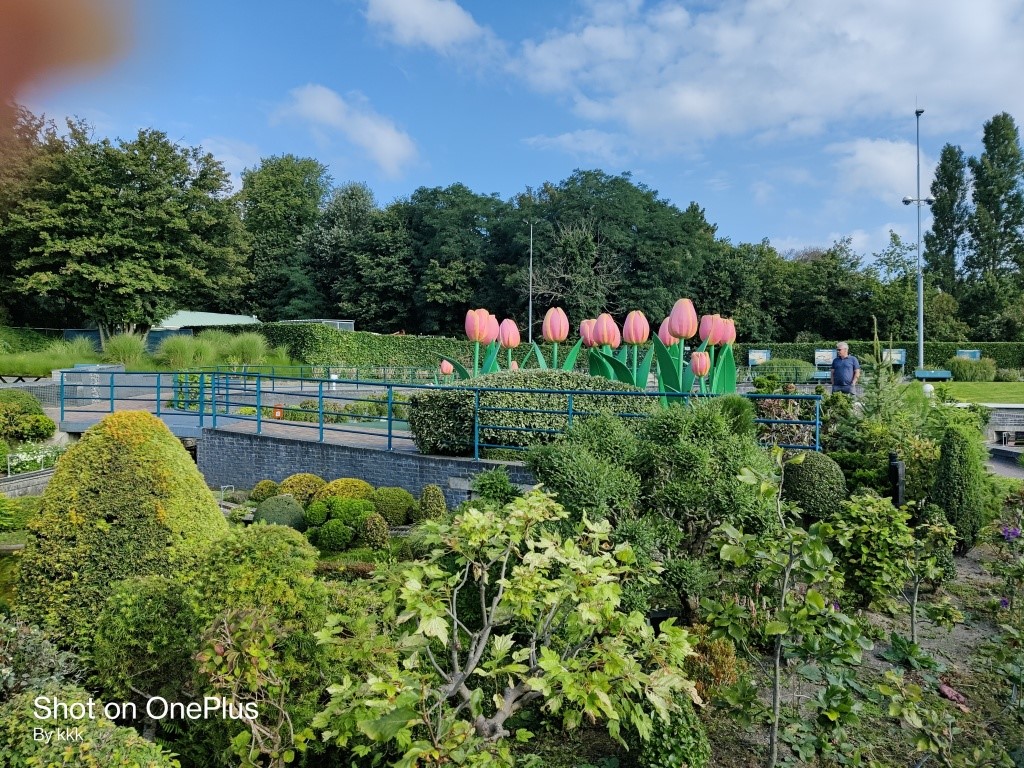
There was so much to see in the park. The landscaping was phenomenal, and the level of detailing in the miniature replicas was truly mind-blowing. Whoever designed the park must have been a genius. Among the many attractions, there was a fascinating 3D flight simulation inside a stationary Dakota aeroplane, complete with realistic sound effects.
There was so much to photograph there, like the verdant garden with miniature canals, boats, luxury liners and the drawbridges that lifted when the toy ships passed through. It was a real delight not only for children but even adults. The landscaping was just awesome with miniature hills, forests, rural homes, and the modelling of canals, windmills, and rural houses was amazing. The souvenir shops within the park were so well laid out and with so much merchandise that it could have tempted anyone to buy in droves. As noon approached, we were supposed to leave the park for lunch, but on that day, our appointed Guru Restaurant caught fire, and we were accommodated in Rangoli Restaurant instead. It’s so nice to see Indian cuisine reaching the nooks and corners of Europe, but you need to book it in advance because the capacities are still low. The change of venue turned out to be a blessing in disguise. The Rangoli Restaurant was just a five-minute walk from the Lovers Canal Cruise Station, so we were able to meet our schedule. We reached the Restaurant at 1:00 pm. After a quick bite, we were on the Lovers Canal Cruise for a boat ride at 1.45 pm. The canals reminded me of the last scene (a motorboat chase) of Alistair Maclean’s famous movie ‘The Puppet on a Chain.’ It was truly the best of both worlds, a satisfying Indian lunch and a relaxing canal cruise through one of Europe’s most beautiful cities.
Shravan Charity Mission is an NGO that works for poor children suffering from life-threatening diseases, especially cancer. Our posts are meant for our readers, including children and adults, and have a huge variety of content. We also accept donations for our mission. Should you wish to donate to the cause of cancer? The bank details are given below:
INTERESTING FACTS: STOLEN IDOLS ARE SACRED OBJECTS. WE NEED TOUGHER LAWS TO CATCH TEMPLE RAIDERS. (THE TIMES OF INDIA 6/10/24)
The US recently handed over 297 stolen antiquities to India. But getting them back was not an easy task. S Vijay Kumar’s love for Indian art and antiquities prompted him to set up the India Pride Project in 2014. It now has volunteers across the globe who help track down pieces of our looted heritage. A veritable Sherlock Holmes of art crimes, Kumar speaks to Sneha Bhura about what’s needed to stop the plunder. Q. You and your team spend hours looking at brochures, identifying marks on artefacts, and working with law enforcement. Tell us what an idol chase involves. A. It takes years of effort. Leads usually come from friends and volunteers. One of our important victories, for instance, was the return of an 8th-century bronze Buddha idol stolen from the Nalanda Museum in 1961. It ended up at the Los Angeles County Museum of Art (LACMA), and though India had been seeking its return since the ’70s itself, the museum denied the request for lack of proof. We worked with the ASI and Economic Advisory Council (EAC) member Sanjeev Sanyal, who helped gather evidence and the Buddha idol was finally handed over in 2023. Many museums don’t reveal provenance (proof of origin), making it harder to trace missing artefacts. Q. Why does it take so long for countries to give them back to India? A. No country willingly returns stolen artefacts as they are often acquired for millions of dollars. India neglected restitution efforts for decades, recovering only 19 objects between 1970 and 2000—and none between 2000 and 2012—owing to the lack of a national art squad or theft registry despite being a signatory to the 1970 UNESCO convention against illicit cultural property trafficking. From 2012 on, the country has secured over 2,000 restitutions. Including the current haul, the US has returned 578. It may seem like a significant number, but they stem from that one big arrest of notorious art smuggler Subhash Kapoor in 2011. When his storage was raided in New York, 2622 objects were seized, 1600 of which belonged to India. Tracking sales of Kapoor’s stolen items to various international museums has also helped India recover many of these artefacts. As for delays from the US, it’s partly because of the Archaeological Survey of India (ASI) insisting on physically inspecting and certifying each object in storage locations—a costly and unnecessary step. There have been several improper identifications as well, causing more delays. Q. What happens if an artefact is with a private collector rather than a public museum? A. Recovery from private collectors is particularly difficult since naming and shaming tactics don’t work. Collectors often hide the objects for years until public memory fades, only for the items to reappear in private estates, like swimming pools or gardens. Q. Subhash Kapoor’s arrest shook the international art world as it exposed a wide network of smugglers, restorers and suppliers who looted temples and low-security sites, selling artefacts to collectors and prestigious museums including New York’s The Metropolitan Museum of Art. But has the arrest stopped the smuggling of antiquities abroad? Are we doing enough to protect our own heritage? A. Not really. We are losing thousands of art objects every decade. Sadly, even Kapoor has been charged with only four cases pertaining to Tamil Nadu thefts. India doesn’t have a specific law under the IPC for temple or heritage theft. So, these crimes were often tried under IPC Section 380 (housebreaking theft) or the Customs Act, with minimal sentences. Tamil Nadu amended Section 380 in 1992 to impose stricter penalties for temple thefts, but a drafting error set the maximum penalty at just three years. This resulted in a 12-year sentence for Kapoor, which he has already served. Also, the broader smuggling cartel remains active, with key figures like antique dealers Vallabh Prakash and his son Aditya still absconding. In 2022, EAC submitted a report to the PMO recommending a national art squad and a finder’s fee for recovering missing objects. But except for the signing of the Cultural Property Agreement with the US this year, little has changed. Idols are still leaving the country. Countries like Italy engage law firms in America to take auction houses and museums there to court. But India lacks the capacity to handle international art crimes. These responsibilities shouldn’t fall on ASI alone. Q. Many Western museums and collectors argue they are “taking care” of these ancient treasures and should be allowed to keep them without acknowledging the colonial loot. Your take? A. This argument is unfair and was never valid. History belongs to its geography, and these artefacts were illegally removed, often by colonial powers. British and Dutch rulers took priceless idols in exchange for trivial items like sacks of rice or spectacles. These objects were not created as art but as sacred objects to worship, intended to reside in temples. Today, India can care for them. Moreover, most stolen artefacts end up in private collections, often tied to money laundering and tax evasion, making this a large issue of organised crime. My work is to ensure that Indian art is not seen as fair game in the international art market. If we don’t stop the open auction of stolen Indian antiquities, thieves will continue to rob and plunder. Q. What happens to the artefacts once they return to India? A. We advocate for returning artefacts to their temples or sites, which has happened in Odisha and Tamil Nadu. When idols were restored, entire villages celebrated. It was like the homecoming of the gods. Rather than quietly ending up in a Delhi museum, artefacts from archaeological sites should be returned to their respective states, for they are the real custodians. (TIMES OF INDIA, OCTOBER 6, 2024).
Shravan Charity Mission is an NGO that works for poor children suffering from life-threatening diseases, especially cancer. Our posts are meant for our readers, including children and adults, and have a huge variety of content. We also accept donations for our mission. Should you wish to donate to the cause of cancer? The bank details are given below:
Don’t miss reading this intriguing title, Áwadh Assam and Dalai Lama … the Kalachakra. The title is available on all online book stores, including Google.
Shravan Charity Mission is an NGO that works for poor children suffering from life-threatening diseases, especially cancer. Our posts are meant for our readers, including children and adults, and have a huge variety of content. We also accept donations for our mission. Should you wish to donate to the cause of cancer? The bank details are given below:
World Music Day is also known as Fête de la Musique. It is celebrated annually on June 21. It originated in France, where citizens were encouraged to play music in their homes and neighbourhoods. The English word ‘music’ originates from the Arabic word ‘Mausiki.’
The world has never been bereft of music. The veena of Goddess Saraswati symbolises the harmony of the universe. It is the melodic balance of speech, sound, and silence. Meera Bai’s bhajans captivate listeners with love and devotion. She sang for Lord Krishna. “Mere to Giridhar Gopal, doosro na koi” (I belong only to Giridhar Gopal, no one else.) In her Vakhs, Lal Ded, the 14th-century Kashmiri mystic poet, speaks of an inner sound or vibration that leads to spiritual awakening. The idea supports the Indian philosophical concept of Nada Brahma—the belief that the universe itself is the divine sound.
“Mujh se pehli si mohabbat meri mehboob na maang, Mausiki mein bhi ab woh halaat nahin rahe.” (Do not ask me for the love I once gave you. Music no longer holds the same sweetness.) In this line, Urdu poet Faiz Ahmed Faiz intertwines lost love with the fading joy in music, linking emotion with melody.
Tansen believed music was the path to the divine. His practice was deeply spiritual, and he often sang in praise of Lord Krishna. According to legends, Tansen could light lamps with Raga Deepak, bring rain with Raga Megh Malhar, and calm wild animals with appropriate ragas. Though these tales may be exaggerated, they reflect the belief that music is a natural force, not merely an art form, but a form of sadhana (spiritual discipline). Tansen said, “Raag aur taal ke bina sangeet adhoora hai. Sangeet vo hai jo man ko shaant kare aur bhagwan se milaye.” (“Music without raga and rhythm is incomplete. True music is that which calms the mind and brings one closer to God.”)
Mystic poet Kabir did not regard music merely as an art but as a sacred practice and a direct path to the divine. His verses (dohas) often express the idea that true music arises from within, when the soul becomes attuned to the divine presence.
Greek composer Vangelis, whose iconic theme ‘Çhariots of Fire’ (fit to be the Olympic hymn) won him an Academy Award in 1981, conveys his underlying craving for music. He believed that music shaped the universe and that he understood the world through music. Vangelis believed in ‘Sadhana’.
André Rieu, the famous Dutch violinist and conductor, emphasises the emotional and universal nature of music: “I make music to touch the souls of people as it’s a language we all can speak.” German philosopher Friedrich Nietzsche famously stated, “Without music, life would be a mistake.” Persian Poet Rumi believed passionately in the use of music, poetry, and dance as a path for reaching God. For Rumi, music helped devotees concentrate their whole being on the divine. Rumi encouraged Sama to listen to music and engage in the sacred dance. Rumi’s favourite musical instrument was the reed flute … ‘Listen to the reed and the tale it tells’.
“The music is not in the notes, but in the silence between,” was Mozart’s take, and “Music should strike fire from the heart of man and bring tears from the eyes of woman,” proclaimed Beethoven. “If music be the food of love, play on,” wrote Shakespeare, in Twelfth Night.
And finally, life is best described in the musical song ‘Que Sera Sera. Whatever will be will be,’ written by Jay Livingston and Ray Evans. Let music be your companion in joy, in sorrow, and in silence. Happy World Music Day.
Shravan Charity Mission is an NGO that works for poor children suffering from life-threatening diseases, especially cancer. Our posts are meant for our readers, including children and adults, and have a huge variety of content. We also accept donations for our mission. Should you wish to donate to the cause of cancer? The bank details are given below:
60 YEARS AGO, SHINKANSEN BLAZED A TRAIL. INDIA SHOULD BE A BULLET TRAIN NATION TOO. BY INVITATION: KYLE CHAN
Sixty years ago, on October 1, 1964, the Shinkansen set off from Tokyo to Osaka, marking a new era of rail travel. It’s hard to believe that when the project was proposed, there were protests over land acquisition, concern over cost and whether it was really needed in an era in which air travel was being democratised. Similar debates are now happening in India around its 508-km Mumbai-Ahmedabad high speed rail corridor. But there are many arguments to be made in favour of a bullet train nation. Decades of rapid economic growth have strained India’s venerable railway system. Highways and roads seem to be filled with traffic congestion no matter how many new lanes are added. A rising middle class has propelled India’s aviation market to third in the world by passenger volume, projected to reach 500m per year by 2030. There is clearly demand for fast, long-distance travel. And there are millions of Indians willing and able to pay for it. A nationwide network connecting India’s largest cities at speeds of 300 km/h or more would transform the country. One could zip from Delhi to Mumbai in under five hours or from Bengaluru to Hyderabad in just over two. In China, bullet trains have been so successful that airlines have stopped flying between some cities, such as Zhengzhou and Xi’an. Even for longer distances where flying might be slightly faster, bullet trains are often preferred for their punctuality, comfort, and reduced hassle at the station. Bullet trains, though more energy-intensive than conventional trains, are a much more energy-efficient and environmentally sustainable way for the most populous nation on earth to travel than airplanes and cars. The benefits of a single high-speed rail line to individual passengers are obvious: faster connections, convenience, and reliability. But the benefits to the entire nation of a whole network of high-speed rail lines, though harder to quantify, can be far more profound. Existing research suggests China’s nationwide bullet train network improves innovation and work collaboration through greater face-to-face interactions. Regional clusters of cities and their surrounding areas can be turned into a single commuting zone, improving job opportunities for workers. Imagine a Hyderabad-Bengaluru-Chennai high-tech cluster connected by bullet trains. And high-speed rail, like conventional railways, benefits from network effects where each additional line improves the value of other existing lines. But what about the cost? The Mumbai-Ahmedabad bullet train’s revised cost is Rs 1.65 lakh crore, which equates to roughly Rs 325 crore per km. While this may seem like a hefty sum, there are some things to keep in mind. One is that the entire railway network needs a massive expansion anyway. Bullet trains can help free up existing track, particularly for freight trains, which was a key motivation behind China’s bullet train program. (FAST TRACK: HIGH SPEED RAIL DOESN’T JUST BENEFIT PASSENGERS, IT IMPROVES JOB OPPORTUNITIES BY CONNECTING CLUSTERS) Another is that the railways are competing with air and road transportation. While improving existing rail infrastructure might seem like a more cost-effective option, there are limits to how far the present system can be pushed. Conventional track can only support trains operating up to certain speeds due to technical limitations. And running both slow and fast trains on the same tracks severely limits the speed of the fastest trains and causes delays. A slightly faster but still frequently delayed train journey will not be enough to win over passengers from aviation and road transport. A true bullet train service will. There are some ways to deal with the cost. One is through standardisation and scale. China created a set of technical and procedural standards that helped lower the cost of each new high-speed rail project. It also deliberately used the scale of its program to incentivise investment in production capacity by suppliers and construction firms. Another way to address costs is, paradoxically, to make use of elevated tracks, bridges and tunnels. This is a strategy that Japan and China both used. While direct construction costs are higher; it reduces problems with land acquisition, which is a prime cause of delays and cost escalations. This approach also helps with safety by keeping track separate from the surrounding environment. Can a national bullet train network even be built in India? Absolutely. Indian Railways has made tremendous progress in electrification, gauge conversion, and line doubling. The Vande Bharat semi-high-speed trains are a triumph of Indian engineering and manufacturing. The massive Dedicated Freight Corridor, which consists of 2,843-km of new freight rail lines, is nearly complete. The Mumbai-Ahmedabad bullet train, for all its delays and problems, has now finished land acquisition. And don’t forget about the many metros popping up across the country. Finally, are bullet trains just a luxury for the rich? It depends on how the fares are set. In China, many migrant workers can afford to take bullet trains between their work and their hometowns. Even if fares are set too low to return a profit, as is the case for many lines in China, this is more than acceptable. A national bullet train network is an investment in India’s economic and environmental future.
(Chan is a postdoctoral researcher at Princeton University) The Times of India 6/10/24
Shravan Charity Mission is an NGO that works for poor children suffering from life-threatening diseases, especially cancer. Our posts are meant for our readers, including children and adults, and have a huge variety of content. We also accept donations for our mission. Should you wish to donate to the cause of cancer? The bank details are given below: