Copyright@shravancharitymission
Published in The Sentinel Guwahati Assam on 21/6/26


Copyright@shravancharitymission
Published in The Sentinel Guwahati Assam on 21/6/26
copyright@shravancharitymission
AESOP’S FABLES
The Monkey and the Cat
A cat and a monkey were great friends and lived as pets in a house. One day, they were sitting by the fire, watching chestnuts roasting and enjoying the warmth. “I would get them,” said the cunning monkey, “but you are much more skillful than I am, cat. Pull the chestnuts out and I’ll divide them between us.” The cat was happy to be praised; she stretched out her paw and tried several times, each time singed her paw severely. When she pulled the chestnuts out of the fire, the monkey ate them up quickly. Soon, their master came in. The cat and the monkey scampered away. The cat had a burnt paw without any chestnuts. From that day, she only ate mice and gave up the monkey’s friendship.
MORAL OF THE STORY: THE FLATTERER SEEKS BENEFIT AT YOUR EXPENSE.
Copyright@shravancharitymission
SHORT STORY: RETURN OF SANGEETA
Kamlesh Tripathi
The final thumak of Sangeeta’s thumri faded into silence. The auditorium erupted in applause. The audience rose from their seats in a standing ovation as the curtains descended. It was Sangeeta’s maiden performance in Lucknow after a decade. The next day, she was flying back to Mumbai. As she stood backstage, she drifted into a reverie.
Lucknow was her hometown. It was here that she had received her classical training in the Lucknow Gharana and later graduated from the Bhatkhande Sangeet Vidyapeeth. Some of her fondest childhood memories were woven around the serene banks of the River Gomti. Her father was a modest trader, and among her many school friends, three shared her passion for classical music—Amrit, Shalini, and Firdaus.
Of the four, Sangeeta was the most gifted, with Shalini closely behind. Her ghazals and thumris won admiration wherever she performed. After graduating, life took the friends in different directions. Amrit and Firdaus married and settled into family life. Shalini married into an influential family in Lucknow but continued to pursue music.
Sangeeta, too, flourished. As her popularity grew, she gradually emerged as a rival to Shalini. Soon, both singers were receiving invitations to perform at classical concerts. Since Lucknow was still a relatively small city, news of their achievements spread rapidly through its cultural circles.
Shalini was unhappy with this development. She didn’t want Sangeeta to rise alongside her. Jealousy had taken root in her heart.
One day, Sangeeta received invitations to perform for All India Radio and later for Doordarshan. She was thrilled, and her parents were immensely proud. But her success did not sit well with Shalini. Using her influence, she managed to have Sangeeta removed from both opportunities and secured her own place instead.
The incident tarnished Sangeeta’s reputation in Lucknow. She felt humiliated and isolated. Though Shalini denied any involvement, rumours spread through the city, and the two singers stopped speaking to each other. The melody queens of Lucknow had drifted apart.
Over time, Shalini’s influence in the city’s music circles grew stronger. Organisers hesitated to invite Sangeeta to their programmes. With only limited opportunities available, Shalini received most of the invitations while Sangeeta was ignored.
Desperate to restore peace, Sangeeta tried to meet Shalini. She was even willing to apologise for any unintended offence and play second fiddle if necessary. But Shalini refused to even meet her.
The doors of the music world had effectively closed on Sangeeta in Lucknow. People whispered that her only fault was being more talented than Shalini. Gradually, friends advised her to seek opportunities elsewhere. Finally, she made the difficult decision to leave Lucknow and boarded a train to Mumbai.
The sprawling metropolis was an ocean of talent where she would encounter many Shalinis. Yet there was one crucial difference: nobody there bore personal ill will toward her. She was an unknown face, judged not by local politics but by her ability. Mumbai offered a more professional environment where talent mattered more than personal influence.
Through perseverance, hard work, and talent, Sangeeta eventually received her first break. After years of struggle, she finally found her place.
Today, she had returned to Lucknow as a celebrated singing sensation.
As she emerged from the theatre after her performance, she was greeted by a sea of admirers. Amid the crowd stood Shalini, withdrawn and remorseful.
Though the crowd pulled her in another direction, Sangeeta gently broke away and walked towards her former friend. Without hesitation, she embraced Shalini.
Overcome with emotion, Shalini apologised for her past actions. As an act of repentance, she confessed that she had stopped performing altogether.
Soon, Amrit and Firdaus also appeared. For Sangeeta, it was a moment of profound joy. She was witnessing the kinder and more compassionate face of her hometown. The next day, she returned to Mumbai.
About a week later, there was a knock on Shalini’s door. An elderly gentleman stood outside.
“My name is Raunaq,” he said politely. “May I speak with you for a while?”
“Certainly,” replied Shalini. “What is it about?”
“We are organising a musical concert, Sangeet Sandhya, next month in Lucknow. Madam Sangeeta has agreed to grace the occasion, but only on one condition, that you sing a duet with her. The concert is being held for the welfare of underprivileged children.”
“Me?” Shalini exclaimed. “But I no longer perform on stage.” Raunaq handed her a sealed note. It read:
“Dear Shalini,
By the time you receive this note, I shall be touring Europe for performances. I will return a week before the programme. I would be delighted if you could sing a duet with me. That is my only condition for participating in Sangeet Sandhya.
Please do not refuse. As a true friend, I feel it is my responsibility to bring you back to the stage. Let us leave the past behind. I am aware of your financial difficulties, and returning to music will help you regain both confidence and stability. Raunaq will explain the rest.
With affection,
Sangeeta.”
In the weeks that followed, banners announcing Sangeet Sandhya appeared across the city, carrying photographs of both Sangeeta and Shalini. The concert was a grand success.
For the audience, it was a memorable musical evening. For Sangeeta and Shalini, it was the beginning of a renewed friendship.
After Sangeeta returned to Mumbai, Shalini slowly found her way back to music. It was Sangeeta who had rekindled her lost passion. Two months later, while watching the evening news, Shalini froze at the headline: “Celebrated singer Sangeeta passed away in Mumbai after battling a terminal illness.” The dinner plate slipped from her hands.
In an instant, everything made sense. Sangeeta’s insistence on the duet, her warmth, her forgiveness, and her silence after returning to Mumbai. With tears in her eyes, Shalini realised that even while facing death, Sangeeta had chosen to heal a broken friendship and restore another singer’s life.
Six months later, Lucknow organised “Sangeet Bhari Shaam” to honour its beloved daughter. As the driving force behind the event, Shalini stood before Sangeeta’s garlanded portrait and whispered,
“You never really left us, Sangeeta. You returned through your music, your kindness, and your forgiveness.”
And as the hall echoed with her melodies, it seemed that Sangeeta had come home once again.
Posted by Kamlesh Tripathi
Author, Poet, & Columnist
*
https://kamleshsujata.wordpress.com
*
Like it and Share it
*
Shravan Charity Mission is an NGO that works for poor children suffering from life-threatening diseases, especially cancer. Our posts are meant for our readers, including children and adults, and have a huge variety of content. We also accept donations for our mission. Should you wish to donate to the cause of cancer? The bank details are given below:
NAME OF ACCOUNT: SHRAVAN CHARITY MISSION
Account no: 680510110004635 (BANK OF INDIA)
IFSC code: BKID0006805
***
Copyright@shravancharitymission
Poem: The Comeback Trail
Kamlesh Tripathi
*
I’ve walked across cities
that didn’t remember my name.
I stood beneath the skies
that looked the same.
*
I’ve loved the light,
I’ve cursed the rain.
I’ve welcomed joy,
I’ve carried pain.
*
I’ve met the kind,
I’ve met the cruel.
Life teaches softly,
Then breaks its own rule.
*
Some mornings bloom
like fields in spring.
Some nights arrive
without a thing.
*
Life has its swagger,
Even in disguise.
It stumbles, it dances,
It falls, it flies.
*
The roads keep bending,
The seasons depart.
Time redraws maps
Inside the heart.
*
What glittered like gold
turned into dust.
What shattered my faith
Rebuilt my trust.
*
I’ve watched endings
wear victory’s face.
I’ve seen silence
outlast the race.
*
Yet through every chapter,
One truth stays unsaid.
Not every story
Is ever truly dead.
*
Because somewhere beyond
the ache and the fall,
a soul finds its footing,
and answers the call.
*
The rarest miracle
Isn’t fortune or fame.
It’s watching hope return…
And hearing life whisper,
“Welcome back to the game.”
**
Written and posted by Kamlesh Tripathi
Author, Poet, & Columnist
*
https://kamleshsujata.wordpress.com
*
Like it and Share it
*
Shravan Charity Mission is an NGO that works for poor children suffering from life-threatening diseases, especially cancer. Our posts are meant for our readers, including children and adults, and have a huge variety of content. We also accept donations for our mission. Should you wish to donate to the cause of cancer? The bank details are given below:
NAME OF ACCOUNT: SHRAVAN CHARITY MISSION
Account no: 680510110004635 (BANK OF INDIA)
IFSC code: BKID0006805
***

TOI 23/6/26
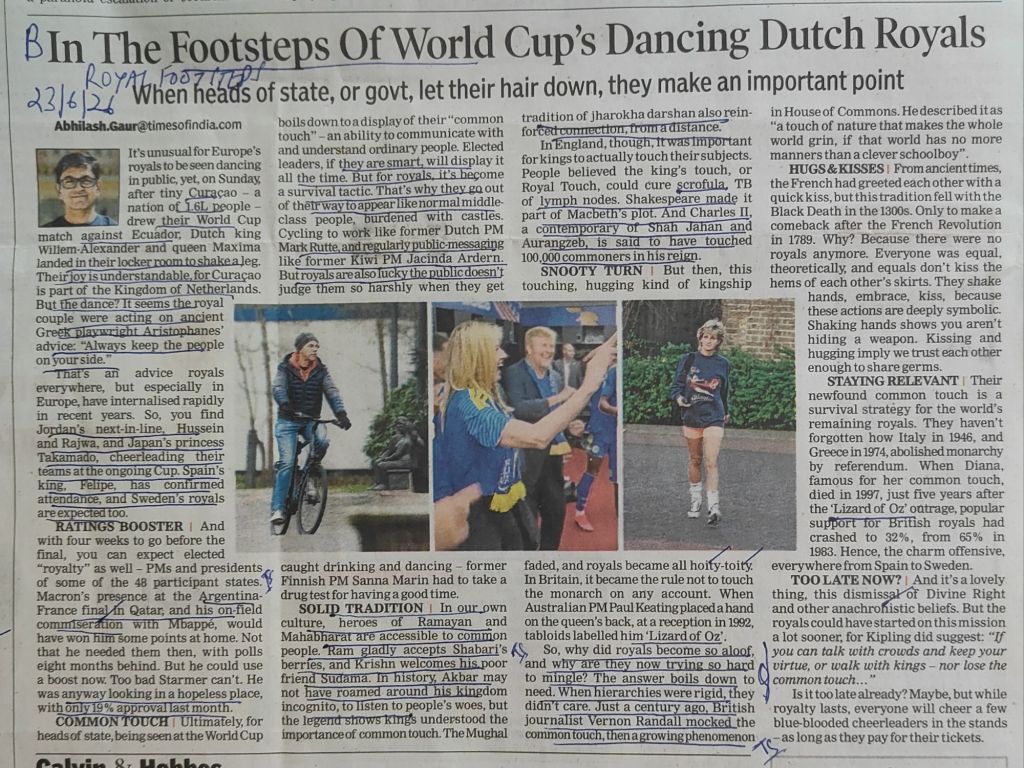
IN THE FOOTSTEPS OF WORLD CUP’S DANCING DUTCH ROYALS
“When heads of state, or govt, let their hair down, they make an important point”
Abhilash.Gaur@timesofindia.com
It’s unusual for Europe’s royals to be seen dancing in public, yet, on Sunday, after tiny Curacao – a nation of 1.6L people – drew their World Cup match against Ecuador, Dutch king Willem-Alexander and queen Maxima landed in their locker room to shake a leg. Their joy is understandable, for Curacao is part of the Kingdom of Netherlands. But the dance? It seems the royal couple were acting on ancient Greek playwright Aristophanes’ advice: “Always keep the people on your side.”
That’s an advice royals everywhere, but especially in Europe, have internalised rapidly in recent years. So, you find Jordan’s next-in-line, Hussein and Rajwa, and Japan’s princess Takamado, cheerleading their teams at the ongoing Cup. Spain’s king, Felipe, has confirmed attendance, and Sweden’s royals are expected too.
RATINGS BOOSTER: And with four weeks to go before the final, you can expect elected “royalty” as well – PMs and presidents of some of the 48 participant states. Macron’s presence at the Argentina-France final in Qatar, and his on-field commiseration with Mbappe, would have won him some points at home. Not that he needed them then, with polls eight months behind. But he could use a boost now. Too bad Starmer can’t. He was anyway looking in a hopeless place, with only 19% approval last month.
COMMON TOUCH: Ultimately, for heads of state, being seen at the World Cup boils down to a display of their “common touch” – an ability to communicate with and understand ordinary people. Elected leaders, if they are smart, will display it all the time. But for royals, it’s become a survival tactic. That’s why they go out of their way to appear like normal middle class people, burdened with castles. Cycling to work like former Dutch PM Mark Rutte, and regular public-messaging like former Kiwi PM Jacinda Ardern. But royals are also lucky the public doesn’t judge them so harshly when they get caught drinking and dancing – former Finnish PM Sanna Marin had to take a drug test for having a good time.
SOLID TRADITION: In our own culture, heroes of Ramayana and Mahabharat are accessible to common people. Ram gladly accepts Shabari’s berries, and Krishn welcomes his poor friend Sudama. In history, Akbar may not have roamed around his kingdom incognito, to listen to people’s woes, but the legend shows kings understood the importance of common touch. The Mughal tradition of Jharokha darshan also reinforced connection, from a distance.
In England, though, it was important for kings to actually touch their subjects. People believed the king’s touch, or Royal Touch, could cure scrofula, TB of lymph nodes. Shakespeare made it part of Macbeth’s plot. And Charles II, a contemporary of Shah Jahan and Aurangzeb, is said to have touched 100,000 commoners in his reign.
SNOOTY TURN: But then, this touching, hugging kind of kingship faded, and royals became all hoity-toity. In Britain, it became it became the rule not to touch the monarch on any account. When Australian PM Paul Keating placed a hand on the queen’s back, at a reception in 1992, tabloids labelled him ‘Lizard of Oz’.
So, why did royals become so aloof, and why are they now trying so hard to mingle? The answer boils down to need. When hierarchies were rigid, they didn’t care. Just a century ago, British journalist Vernon Randall mocked the common touch, then a growing phenomenon in House of Commons. He described it as “a touch of nature that makes the whole world grin, if that world has no more manners than a clever schoolboy”.
HUGS & KISSES: From ancient times, the French had greeted each other with a quick kiss, but this tradition fell with the Black Death in the 1300s. Only to make a comeback after the French Revolution in 1789. Why? Because there were no royals anymore. Everyone was equal, theoretically, and equals don’t kiss the hems of each other’s skirts. That shake hands, embrace, kiss, because these actions are deeply symbolic. Shaking hands shows you aren’t hiding a weapon. Kissing and hugging imply we trust each other enough to share germs.
STAYING RELEVANT: Their newfound common touch is a survival strategy for the world’s remaining royals. They haven’t forgotten how Italy in 1946, and Greece in 1974, abolished monarchy by referendum. When Diana, famous for her common touch, died in 1997, just five years after the ‘Lizard of Oz’ outrage, popular support for British royals had crashed to 32% from 65% in 1983. Hence, the charm offensive, everywhere from Spain to Sweden.
TOI LATE NOW? And it’s a lovely thing, this dismissal of Divine Right and other anachronistic beliefs. But the royals could have started on this mission a lot sooner, for Kipling did suggest: “If you can talk with crowds and keep your virtue, or walk with kings– nor lose the common touch…”
Is it too late already? Maybe, but while royalty lasts, everyone will cheer a few blue-blooded cheerleaders in the stands as long as they pay for their tickets.
Copyright@shravancharitymission
THE PLACES OF KRISHNA’S PASTIMES SURROUNDING GOVARDHAN
Kamlesh Tripathi
Krishna had performed his pastimes in many places surrounding Govardhan Parvat (Hill). Noted personage Sri Raghava took Srinivasa and Narottama (icons of the Gaudiya Vaishnava tradition) to see places near Govardhan where young Krishna performed his pastimes, and he described it to them one by one. It commences with Kusum-Sarovar, a famous pastime spot of Radha & Krishna. Followed by Narad-Kund, where Narad Muni fulfilled his desires by performing tapasya.
At Ratna-simhasana, Radha is depicted sitting on a throne. Even the incident behind Krishna’s killing of the demon Sankhachuda took place here.
Pali is a beautiful garden in which Palita-Yuthesvari (Queen Gopi) used to stay. Sri Krishna enjoyed himself with his friends in the holy place called Ata-grama. In a place called Indra-dhvaja-bedi, Nandaraja used to worship Indra. It was here that Sri Krishna would tend his cows and call each one by the melody of his flute.
Papamochan, also known as Sankarsana-kund, is famous for its sanctity. By bathing here, a person will be freed from all vices.
In the Parasauli-gram, Radha & Krishna enacted their Rasa-Yatra in the Vasant season. At Chandra-Sarovar, Lord Krishna took rest in his rasa-dress. In the beautiful Gandharva-kund, the Gandharvas were overwhelmed by Krishna’s beautiful songs.
The devotional hymn from Stavavali and Goverdhan-asraya-dasaka describes how Radha danced with Krishna in the Rasa-sthali.
In the village of Paitha, when Krishna once hid from the gopis, they all began looking for him. Soon, Krishna appeared before the gopis in his Chaturbhuja (four hands) form. But when Radha arrived, his two hands merged back into his body, signifying that Radha and Krishna were one.
Pleasant pastimes also happened in Gauri-tirtha. The place within Gauri-tirtha is called Nipa-kund, because it is surrounded by beautiful nipa, or kadamb, trees.
The next village, Aniyora, is situated on the Govardhan Hill (Giriraj). It is famously known as the site of the original Annakuta festival, where Lord Krishna lifted the Govardhan hill to protect the villagers and ate their offerings, demanding more by saying “Aniyora!”
The sacred place called Govinda-kund has many milestones to it. It is located near Aniyora village, and it was only here that God Indra bathed Lord Krishna with Ganges water and milk to seek Krishna’s forgiveness.
Vraja-Vilasa-stava (A collection of prayers) says, Indra took hold of the lotus feet of Lord Krishna, in the company of a surabhi cow, and performed his coronation by bathing him with the waters of the Ganges River.
The sacred lake Dana-Nivartana-kund is also located here on the right side of the Govardhana Hill parikrama path. Dana-nivartana-kunda is named after the dana-keli playful pastime, which Krishna enjoyed. It relates to the collection of taxes from Gopis. Vaishnava ascetic Madhavendra Puri stayed here under a tree, and Gopala gave darshan to him on the pretext of bringing him milk. At the end of Govardhan is the Apsara-kund. People who take a bath here are considered very lucky. There are the old palasa trees here. This secluded place is called Syama-dhaka.
The footprint of the divine white elephant Airavata, belonging to Lord Indra, can be seen on the sacred rocks of Govardhan Parvat. After his defeat, Indra described the glories of Lord Krishna’s mercy from here.
The Surabhi Kund is a highly revered, ancient sacred water tank and pilgrimage site situated on the Govardhan Parikrama Marg. Established by Maharaja Vajranabh (Lord Krishna’s great-grandson), it is the spot where the Surabhi cow (Kamadhenu) fed Krishna milk to appease his anger.
Rudra-kund is another beautiful and secluded forest where Mahadeva sat in meditation. Legend has it that it was formed by the tears of Lord Shiva, who was so overwhelmed while meditating on Lord Krishna’s pastimes that he wept profusely.
Kadam-Khandi is a sacred, secluded forest grove located in Kamyavan, Rajasthan, in the Braj region. It is a revered place for meditation and is closely associated with the pastimes of Lord Krishna and Radha. In Dana-ghati, Lord Krishna took a share of the milk products from Radha while his friends blocked her way.
Brahma-kund is also situated in Govardhan. It is described in the Mathura-khand. After bathing here, Brahma satisfied Lord Hari. Indra and the other planetary rulers created other lakes nearby.
On the eastern side is Indra-tirtha, on the south is Yama-tirtha, on the west is Varuna-tirtha, and on the north is Kuvera-tirtha. Krishna enjoyed his pastimes in these locations.
In Manasa-ganga, Krishna enjoyed his ecstatic boat pastimes. Vraja-Vilasa-stava gives a pristine description of Manasa-ganga, which lies on the side of the Govardhan Parvat. The waves of the river splash against the splendid rocks, lining its shores.
Situated 26 kilometres west of Mathura. The mere sight of Govardhan Hill and its circumambulation rids one of his material miseries. Govardhan Hill gives unlimited pleasure to Lord Krishna, who lifted the hill with his left hand to curb the pride of Indra and protect the Braj-vasis.
The Adi-varaha Purana says, ‘Two yojanas (sixteen miles) west of Mathura is the rare teertha named Govardhan. A person who circumambulates this place, named Annakuta-tirtha, does not return to this world. After bathing in Manasa-ganga and seeking darshan of the Deity of Harideva on the Govardhan Hill, and circumambulating Annakuta-tirtha, no heart can remain unhappy. To protect the cows distressed by Indra’s torrential rains, I lifted the Govardhana Hill.’
The Skanda Purana, Mathura-khand, says that Govardhana Hill is an incarnation of the Supreme God. When the Lord lifted the hill, all the people of Braj were saved from Indra’s torrential rains. Lord Vishnu stays eternally on Govardhan. Brahma, Siva, and Laksmi also reside there. There is no doubt about this.
Written and posted by Kamlesh Tripathi
Author, Poet, & Columnist
*
https://kamleshsujata.wordpress.com
*
Like it and Share it
*
Shravan Charity Mission is an NGO that works for poor children suffering from life-threatening diseases, especially cancer. Our posts are meant for our readers, including children and adults, and have a huge variety of content. We also accept donations for our mission. Should you wish to donate to the cause of cancer? The bank details are given below:
NAME OF ACCOUNT: SHRAVAN CHARITY MISSION
Account no: 680510110004635 (BANK OF INDIA)
IFSC code: BKID0006805
***
Copyright@shravancharitymission
Happy reading

Copyright@shravancharitymission
IN THE NATURE’S LAP
*
Kamlesh Tripathi
*
At the open deck,
Of the nature’s Club,
Under the bright sun,
The slanting sunshine,
And the passing clouds.
*
One gets to hear,
The tuneful chirping of birds,
The swishing of the roaming breeze,
The distant horn of a passing car,
Down below in the foot hills.
*
Nature is still predominant here,
Unlike the giant megapolis,
Where nature has drowned in despair,
And life has worn a new avatar.
*
The big banyan tree,
In the open deck,
Stands firm in silence,
While the hilly roads,
Wind through the mountainside.
*
Nature speaks softly,
In her timeless language,
Of patience, balance,
And quiet perseverance.
*
Yet man keeps adding,
His marks and signatures,
Trying to improve,
What was already complete.
*
The birds know no boundaries,
The clouds carry no pride,
The breeze asks for nothing,
And the hills quietly abide.
*
They teach a simple lesson:
To live and let live,
To take only what is needed,
And always learn to give.
*
As the sun slowly descends,
Behind the distant peaks,
The evening whispers a truth,
That every seeker seeks.
*
Amid the noise of ambition,
And the race for worldly gain,
Nature remains the greatest teacher,
Healing every joy and pain.
*
Be with nature my friend,
For nature will never offend,
Life may have many views,
But nature’s view is the ultimate.
***
Copyright@shravancharitymission
GENERAL KNOWLEDGE 6
OCEANIA
The Pacific Islands were unsettled by any of the early hominid species, but with assistance from ice-age land bridges, modern humans settled the Philippines, Australasia and elsewhere by no later than 40,000 years ago (long after the earliest known boats). Eastern Polynesia may have been settled by South American sailors following the Humboldt Current. Sophisticated agriculture developed to supplement fishing.
The thousands of islands and huge ocean gulfs between them meant that settlement was uneven; some – such as Hawaii and Eastern Island – remained unsettled until well into the first millennium AD. Isolation helped create significant linguistic diversity; there are not only hundreds of different languages, but several different language families (in civilizations without writing, oral histories were greatly developed). Philologists can chart the linguistic changes, dating the settlement of each island and tracking the rise and fall of loose-knit empires, with religiously potent chieftains and various class systems
***

