Tag Archives: story

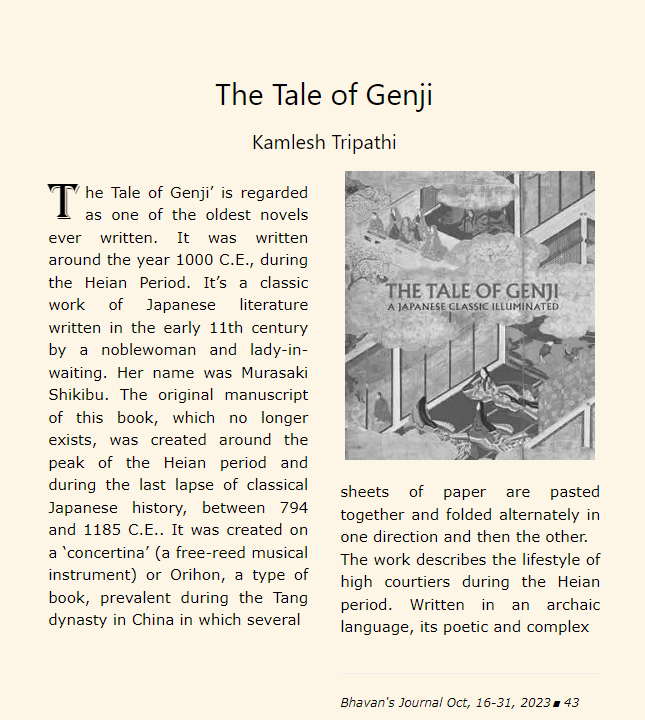
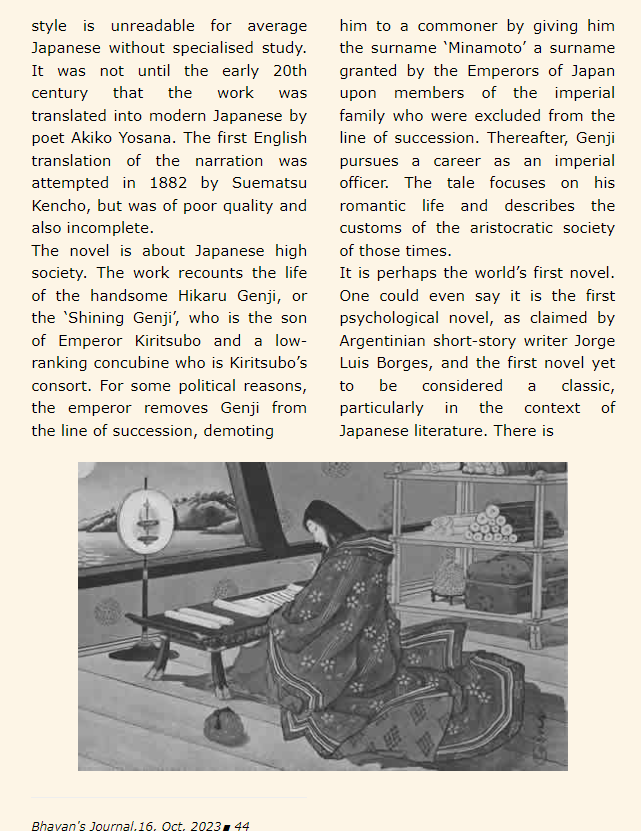
THE TALE OF GENJI published in Bhavans Journal on 15.10.23

SHORT STORY: THE BULL FROG

Copyright@shravancharitymission

    In Japanese folklore, there is a story of a brave and visionary frog. Once upon a time, there lived a bullfrog in a lake. He had umpteen friends there and they all lived happily. One day, the bullfrog told his friends that he had decided to try his luck in the bigger lake across the road. All his friends tried to dissuade him from doing so. They began to scare him. They said that if he went there, he would get lost as it is a huge lake. The bullfrog heard them all but was determined to leave the small lake for a more inspiring life in a bigger lake.

    He crossed over to the other lake and soon found that the new lake had a bonanza of more insects and sweeter water. Soon, he called all his friends from the old and smaller lake. They joined him soon and were happy as they had sufficient sources of food and in addition, the new place was also bigger.

    The moral of the story: A great deal of talent is lost in the world for the want of a little courage. There is little to be gained by being a ‘koopmandook’ –a frog in the well. Of course, it is not easy to leave your comfort zone, and there will always be people who will discourage you from doing so. But when we do break free and come out of our shell, life has a lot more to offer. Until we use our brains and acumen, we will never achieve what we are capable of achieving.

    A person with petty ambitions leads a petty life, as the Hindi saying goes, ‘Chhote vichar, chhota vyakti’ – small thoughts, small man. While it is good to have very few desires, it is bad to have low or no ambition. In a way, life is all about setting a goal for yourself and striving to accomplish it.

By Kamlesh Tripathi

*

https://kamleshsujata.wordpress.com

*

Share it please

*

Shravan Charity Mission is an NGO that works for poor children suffering from life threatening diseases especially cancer. Our posts are meant for our readers that includes both children and adults and it has a huge variety in terms of content. We also accept donations for our mission. Should you wish to donate for the cause. The bank details are given below:

NAME OF ACCOUNT: SHRAVAN CHARITY MISSION

Account no: 680510110004635 (BANK OF INDIA)

IFSC code: BKID0006805

*

Our Publications

GLOOM BEHIND THE SMILE

(The book is about a young cancer patient. Now archived in 8 prestigious libraries of the US that includes Harvard College Library; Harvard University Library; Library of Congress; University of Washington, Seattle; University of Minnesota, Minneapolis; Yale University, New Haven; University of Chicago; University of North Carolina, at Chapel Hill University Libraries. It can also be accessed in MIT through Worldcat.org. Besides, it is also available for reading in libraries and archives of Canada, Cancer Aid and Research Foundation Mumbai; Jaipuria Institute of Management, Noida; India. Shoolini University, Yogananda Knowledge Center, Himachal Pradesh and Azim Premzi University, Bangalore).  

ONE TO TANGO … RIA’S ODYSSEY

(Is a book on ‘singlehood’ about a Delhi girl now archived in Connemara Library, Chennai and Delhi Public Library, GOI, Ministry of Culture, Delhi; Available for reading in Indian National Bibliography, March 2016, in the literature section, in Central Reference Library, Ministry of Culture, India, Belvedere, Kolkata-700022)

AADAB LUCKNOW … FOND MEMORIES

(Is a fiction written around the great city of Nawabs—Lucknow. It describes Lucknow in great detail and also talks about its Hindu-Muslim amity. That happens to be the undying characteristic of Lucknow. The book was launched in the Lucknow International Literary Festival of 2014. It is included for reading in Askews and Holts Library Services, Lancashire, U.K; Herrick District Library, Holland and Charlotte-Mecklenburg Library, Mecklenburg County in North Carolina, USA; Black Gold Cooperative Library Administration, Arroyo Grande, California).

REFRACTIONS … FROM THE PRISM OF GOD

(Co-published by Cankids–Kidscan, a pan India NGO and Shravan Charity Mission, that works for Child cancer in India. The book is endorsed by Ms Preetha Reddy, MD Apollo Hospitals Group. It was launched at Lucknow International Literary Festival in 2016)

TYPICAL TALE OF AN INDIAN SALESMAN

(Is a story of an Indian salesman who is, humbly qualified. Yet he fights his way through unceasing uncertainties to reach the top. A good read not only for salesmen. The book was launched on 10th February 2018 at Gorakhpur Lit-Fest. Now available on Amazon, Flipkart and Onlinegatha)

RHYTHM … in poems

(Published in January 2019. The book contains 50 poems. The poems describe our day-to-day life. A few poems from the book have been published in Shillong Times, Bandra Times and Bhavan’s Journal. The book is available on Amazon, Flipkart and Onlinegatha)

MIRAGE

(Published in February 2020. The book is a collection of eight short stories available in Amazon, Flipkart and Notion Press)

AWADH ASSAM AND DALAI LAMA … The Kalachakra

(The story of the man who received His Holiness The Dalai Lama and his retinue in 1959 as a GOI representative when he fled Tibet in 1959. The book was launched on 21st November 2022 by His Holiness The Dalai Lama at Dharmshala. The title is archived in the library of the Department of Information and International Relations (DIIR) Government of Tibet, Tibet Policy Institute (TPI) and the personal library of His Holiness. The title is also archived in The Ohio Digital Library, USA).

BHAVANS JOURNAL

Short stories, Book reviews and Articles published in Bhavan’s Journal: 1. Reality and Perception, 15.10.19; 2. Sending the Wrong Message, 31.5.20; 3. Eagle versus Scholars June, 15 & 20 2020; 4. Indica, 15.8.20; 5. The Story of King Chitraketu, August 31 2020; 6. Breaking Through the Chakravyuh, September 30 2020. 7. The Questioning Spouse, October 31, 2020; 8. Happy Days, November 15, 2020; 9. The Karma Cycle of Paddy and Wheat, December 15, 2020; 10. Power Vs Influence, January 31, 2021; 11. Three Refugees, March 15, 2021; 12. Rise and Fall of Ajatashatru, March 31, 2021; 13. Reformed Ruler, May 15, 2021; 14. A Lasting Name, May 31, 2021; 15. Are Animals Better Teachers? June 16, 2021; 16. Book Review: The Gram Swaraj, 1.7.21; 17. Right Age for Achievements, 15.7.21; 18. Big Things Have Small Beginnings, 15.8.21; 19. Where is Gangaridai?, 15.9.21; 20. Confront the Donkey Within You 30.9.21; 21. Know Your Strengths 15.10.21; 22. Poverty 15.11.21; 23. Top View 30.11.21; 24. The Bansuriwala 15.1.22; 25. Sale of Alaska 15.2.22; 26. The Dimasa Kingdom 28.2.22; 27. Buried Treasure 15.4.22; 28. The Kingdom of Pragjyotisha 30.4.22; 29. Who is more useful? 15.5.22; 30. The White Swan from Lake Mansarovar 30.6.22; 31. Bhool Bhulayya 15.9.22; 32. Good Karma 30.9.22; 33. Good Name vs Bad Name 15.10.22; 34. Uttarapath—The Grand Trunk Road 1.12.22; 35. When Gods Get Angry 1.1.23; 36. Holinshed’s Chronicles 15.1.23; 37. Theogony 15.2.23; 38. Poem: Mother 14.5.23; 39. THE NAG MANDIR;

SUNDAY SHILLONG TIMES

ARTICLES & POEMS: 1. POEM: HAPPY NEW YEAR 8.1.23; 2. POEM: SPRING 12.3.23; 3. POEM: RIGHT AND WRONG 20.3.23; 4. THE GUSH OF EMOTION—WRITING, 26.3.23; 5. THE NAG MANDIR, 7.5.23; 6. POEM: MOTHER 7.5.23; 7. POEM: RAIN RAIN 9.7.23;

BANDRA TIMES, MUMBAI

ARTICLES & POEMS: 1. POEM SPRING, 1.4.23; POEM MOTHER, 1.6.23;

(ALL THE ABOVE BOOK TITLES ARE AVAILABLE FOR SALE ON AMAZON, FLIPKART AND OTHER ONLINE STORES OR YOU COULD EVEN WRITE TO US FOR A COPY)

*****

SHORT STORY: MITHOO AND THE SKYSCRAPER

Copyright@shravancharitymission

    Once an aged bird named Mithoo returned to his village after a long time. There he was warmly greeted by his family and friends. But then he was appearing quite tired and worn out. So, a friend of his asked him, ‘What’s the matter dear friend you’re looking quite drained out? Is everything fine with you?’

    Mithoo smirked but remained quiet. Meanwhile, some other prominent members of the bird community came and perched near Mithoo on the branches of the adjacent tree rooted on the banks of the flowing river. They were all too happy to see Mithoo. Mithoo too was equally delighted to meet them.

    Soon the bright sun dropped below the horizon and it started getting dark. After a fruity meal, the village birds retired for the day. Mithoo too, after merrily splashing in the river and nibbling some fruits and grains retired for the night. The village birds were rather dejected at the physical and mental condition of Mithoo who was once a very chirpy and lively character.

    In the morning Mithoo was up at the crack of dawn. He flew over the village a couple of times and was happy to see children playing, women getting busy with their daily chores and men heading to their farms. He then went to the river and had a dip there. He was feeling revived now. Thrilled, he again flew over the village, celebrating his independence. He soared to the sky and came down and went up again.

    Meanwhile, the birds were a little surprised at the sudden surge of energy in Mithoo as compared to the previous evening. They were unable to reconcile to the fact as to how he was soaring to such great heights when only yesterday he was looking chronically ill and fatigued.

    Mithoo, in the meanwhile was feeling blessed for a change. He went and perched on the tree, next to the temple. There he could recognise a few human faces. They were the same faces whom he used to notice almost every day before he left for the city but the faces had matured by now. He knew they won’t recognise him because he is a bird. He also recognised the cows in the barn and the mongrels in the narrow lanes of the village. They too had grown old just like him. Mithoo happily continued with his merry routine for a couple of days more.

    Meanwhile, the birds in the village were flabbergasted at the jolly behaviour of Mithoo. A friend, one day, hesitatingly asked Mithoo, ‘When are you going back to the city?’

    Mithoo’s expression suddenly changed. His complexion paled and he turned gloomy. The friend suddenly realised he had touched Mithoo’s raw nerve. He quickly queried. ‘Did I ask anything that I shouldn’t have asked my dear Mithoo?’

    Mithoo appeared lifeless. He said to his friend, I’m not going back to the city anymore.’

    ‘But I hear the city is full of beautiful things. All the rich and mighty only stay there. There are tall buildings, metros, flyovers, cars, trams, buses and whatnot.’ Said the friend.

    That is exactly the reason why I’m not returning to the city anymore because I’m unable to fly in a straight line there, on account of the tall buildings. They obstruct my flight. They are so tall that I neither can fly over them nor can I fly straight because of them so I have to fly in a zig-zag manner between them and that has given me a backache resulting in ill-health. There is a nagging pain in my back because of this zig-zag flying and I’m ageing too. On the contrary, I feel so free here. See, how well, I’ve been flying here in a straight line … and up and down without any obstruction and my pain has also reduced.

    The moral of the story: Towering constructions and skyscrapers obstruct the flight of birds. The birds can neither fly over them each time nor can they fly in a straight line because of them so they have to fly around them. It won’t be possible for human beings to do away with such monolithic construction but the narration only highlights how tall buildings obstruct the flight of birds and how conveniently we human beings have encroached on the aerial space of birds without an iota of guilt.

***

Story by Kamlesh Tripathi

*

https://kamleshsujata.wordpress.com

*

Share it please

*

Shravan Charity Mission is an NGO that works for poor children suffering from life threatening diseases especially cancer. Our posts are meant for our readers that includes both children and adults and it has a huge variety in terms of content. We also accept donations for our mission. Should you wish to donate for the cause. The bank details are given below:

NAME OF ACCOUNT: SHRAVAN CHARITY MISSION

Account no: 680510110004635 (BANK OF INDIA)

IFSC code: BKID0006805

*

Our Publications

GLOOM BEHIND THE SMILE

(The book is about a young cancer patient. Now archived in 8 prestigious libraries of the US that includes Harvard College Library; Harvard University Library; Library of Congress; University of Washington, Seattle; University of Minnesota, Minneapolis; Yale University, New Haven; University of Chicago; University of North Carolina, at Chapel Hill University Libraries. It can also be accessed in MIT through Worldcat.org. Besides, it is also available for reading in libraries and archives of Canada, Cancer Aid and Research Foundation Mumbai; Jaipuria Institute of Management, Noida; India. Shoolini University, Yogananda Knowledge Center, Himachal Pradesh and Azim Premzi University, Bangalore).  

ONE TO TANGO … RIA’S ODYSSEY

(Is a book on ‘singlehood’ about a Delhi girl now archived in Connemara Library, Chennai and Delhi Public Library, GOI, Ministry of Culture, Delhi; Available for reading in Indian National Bibliography, March 2016, in the literature section, in Central Reference Library, Ministry of Culture, India, Belvedere, Kolkata-700022)

AADAB LUCKNOW … FOND MEMORIES

(Is a fiction written around the great city of Nawabs—Lucknow. It describes Lucknow in great detail and also talks about its Hindu-Muslim amity. That happens to be the undying characteristic of Lucknow. The book was launched in the Lucknow International Literary Festival of 2014. It is included for reading in Askews and Holts Library Services, Lancashire, U.K; Herrick District Library, Holland and Charlotte-Mecklenburg Library, Mecklenburg County in North Carolina, USA; Black Gold Cooperative Library Administration, Arroyo Grande, California).

REFRACTIONS … FROM THE PRISM OF GOD

(Co-published by Cankids–Kidscan, a pan India NGO and Shravan Charity Mission, that works for Child cancer in India. The book is endorsed by Ms Preetha Reddy, MD Apollo Hospitals Group. It was launched at Lucknow International Literary Festival in 2016)

TYPICAL TALE OF AN INDIAN SALESMAN

(Is a story of an Indian salesman who is, humbly qualified. Yet he fights his way through unceasing uncertainties to reach the top. A good read not only for salesmen. The book was launched on 10th February 2018 at Gorakhpur Lit-Fest. Now available on Amazon, Flipkart and Onlinegatha)

RHYTHM … in poems

(Published in January 2019. The book contains 50 poems. The poems describe our day-to-day life. A few poems from the book have been published in Shillong Times, Bandra Times and Bhavan’s Journal. The book is available on Amazon, Flipkart and Onlinegatha)

MIRAGE

(Published in February 2020. The book is a collection of eight short stories available in Amazon, Flipkart and Notion Press)

AWADH ASSAM AND DALAI LAMA … The Kalachakra

(The story of the man who received His Holiness The Dalai Lama and his retinue in 1959 as a GOI representative when he fled Tibet in 1959. The book was launched on 21st November 2022 by His Holiness The Dalai Lama at Dharmshala. The title is archived in the library of the Department of Information and International Relations (DIIR) Government of Tibet, Tibet Policy Institute (TPI) and the personal library of His Holiness. The title is also archived in The Ohio Digital Library, USA).

BHAVANS JOURNAL

Short stories, Book reviews and Articles published in Bhavan’s Journal: 1. Reality and Perception, 15.10.19; 2. Sending the Wrong Message, 31.5.20; 3. Eagle versus Scholars June, 15 & 20 2020; 4. Indica, 15.8.20; 5. The Story of King Chitraketu, August 31 2020; 6. Breaking Through the Chakravyuh, September 30 2020. 7. The Questioning Spouse, October 31, 2020; 8. Happy Days, November 15, 2020; 9. The Karma Cycle of Paddy and Wheat, December 15, 2020; 10. Power Vs Influence, January 31, 2021; 11. Three Refugees, March 15, 2021; 12. Rise and Fall of Ajatashatru, March 31, 2021; 13. Reformed Ruler, May 15, 2021; 14. A Lasting Name, May 31, 2021; 15. Are Animals Better Teachers? June 16, 2021; 16. Book Review: The Gram Swaraj, 1.7.21; 17. Right Age for Achievements, 15.7.21; 18. Big Things Have Small Beginnings, 15.8.21; 19. Where is Gangaridai?, 15.9.21; 20. Confront the Donkey Within You 30.9.21; 21. Know Your Strengths 15.10.21; 22. Poverty 15.11.21; 23. Top View 30.11.21; 24. The Bansuriwala 15.1.22; 25. Sale of Alaska 15.2.22; 26. The Dimasa Kingdom 28.2.22; 27. Buried Treasure 15.4.22; 28. The Kingdom of Pragjyotisha 30.4.22; 29. Who is more useful? 15.5.22; 30. The White Swan from Lake Mansarovar 30.6.22; 31. Bhool Bhulayya 15.9.22; 32. Good Karma 30.9.22; 33. Good Name vs Bad Name 15.10.22; 34. Uttarapath—The Grand Trunk Road 1.12.22; 35. When Gods Get Angry 1.1.23; 36. Holinshed’s Chronicles 15.1.23; 37. Theogony 15.2.23; 38. Poem: Mother 14.5.23; 39. THE NAG MANDIR;

SUNDAY SHILLONG TIMES

ARTICLES & POEMS: 1. POEM: HAPPY NEW YEAR 8.1.23; 2. POEM: SPRING 12.3.23; 3. POEM: RIGHT AND WRONG 20.3.23; 4. THE GUSH OF EMOTION—WRITING, 26.3.23; 5. THE NAG MANDIR, 7.5.23; 6. POEM: MOTHER 7.5.23; 7. POEM: RAIN RAIN;

BANDRA TIMES, MUMBAI

ARTICLES & POEMS: 1. POEM SPRING, 1.4.23; POEM MOTHER, 1.6.23;

(ALL THE ABOVE BOOK TITLES ARE AVAILABLE FOR SALE ON AMAZON, FLIPKART AND OTHER ONLINE STORES OR YOU COULD EVEN WRITE TO US FOR A COPY)

*****
MARITIME SCIENCE AND CAPTAIN JAMES COOK

Copyright@shravancharitymission

    Marine navigation is the art and science of steering a ship from a starting point and sailing it to a destination, efficiently and responsibly. It is an art because of the skill that the navigator must have to avoid the dangers of navigation, and it is a science because it is based on physical, mathematical, oceanographic, cartographic, astronomical, and other kinds of knowledge.   

    Captain James Cook was a British explorer of seas. He was also a cartographer and naval officer for his three voyages between 1768 and 1779 in the Pacific Ocean, particularly to New Zealand and Australia.

    He made comprehensive maps of Newfoundland prior to embarking on his three voyages. Cook has a significant role in bringing about science and equipment into the field of navigation. His eleven years of sailing around the Pacific Ocean contributed significantly to the learning curve of the Europeans.

    Cook’s mapping of large areas of the Pacific was his major achievement. This gave navigational accuracy on account of which the Europeans were able to sail to several sets of islands, which also included the Hawaiian group of islands.

    Please note for accurate maps you need to determine accurate latitude and longitude. Between latitude and longitude, longitude was always more difficult to measure correctly. Navigators were able to work out latitude accurately for centuries by measuring the angle of the sun or a star above the horizon with an instrument such as a backstaff or a quadrant– A navigational instrument that was used to measure the altitude of a celestial body, particularly the Sun or the Moon.

    But longitude was always more difficult to measure accurately because it required the exact knowledge of the time difference between points on the surface of the earth. The Earth turns a full 360 degrees in relation to the sun each day. Thus longitude corresponds to time which is 15 degrees every hour, or 1 degree every 4 minutes. In all three voyages of Captain Cook, he gathered detailed information that helped him in his navigation. During his first voyage, he gathered accurate longitude measurements with his navigational skills and with the help of British astronomer Charles Green who helped him gather all the information. They also used newly published Nautical Almanac tables which were part of the official British Alamanac using the lunar distance method – measuring the angular distance from the moon to either the sun during the daytime or one of the eight bright stars during the nighttime to determine the time at the Royal Observatory, Greenwich, and comparing that to his local time determined via the altitude of the sun, moon, or stars.

    Many faces were behind Captain Cook in making his voyages successful, especially, watchmakers who had a great sense of purpose vis-a-vis sailors. On his second voyage, Cook used the K1 chronometer developed by Larcum Kendall, a British watchmaker, which was in the shape of a large pocket watch, 5 inches (13 cm) in diameter. It was a copy of the H4 clock made by John Harrison, a self-educated English carpenter and clockmaker who proved to be the first to keep accurate time at sea when used on Deptford’s journey to Jamaica in 1761-62.

    Cook was a man with a treasure of common sense. He was successful in circumnavigating the world on his first voyage without losing a single sailor to scurvy (a disease resulting from lack of vitamin C), which was an unusual achievement of those times. He tested several preventive measures, the most important one being frequent replenishment of fresh food. He later on presented a paper on this perspective of the voyage to the Royal Society for which he was awarded the Copley Medal, a prestigious award of the Royal Society in 1776. Cook became the first European to develop extensive contacts with various communities in the Pacific. He correctly postulated a language link among all the people of the Pacific despite their being separated by great ocean stretches (see Malayo- Polynesian languages a subgroup of the Austronesian languages, spoken by approximately 385.5 million people). Cook theorised that Polynesians originated from Asia, which scientist Bryan Sykes a British geneticist later verified. In New Zealand, the coming of Cook is often used to signify the onset of the colonization which officially started more than 70 years after his crew became the second group of Europeans to visit that archipelago.

    Without scientists, there are no discoveries. Cook carried several scientists on his voyages. They made significant observations and discoveries. Two botanists, Joseph Banks and the Swede Daniel Solander, sailed on the first voyage. The two collected over 3,000 plant species. Joseph Banks subsequently promoted the British settlement of Australia, establishing New South Wales as a penal settlement in 1788. Artists too sailed on Cook’s first voyage. Sydney Parkinson, a Scottish botanical illustrator was heavily involved in documenting the botanists’ findings, completing 264 drawings before his death near the end of the voyage. They were of immense scientific value to British botanists. Cook’s second expedition included William Hodges, who produced notable landscape paintings of Tahiti, Easter Island, and other locations. Several officers who served under Cook went on to distinctive accomplishments. William Bligh, a British officer in the Royal Navy who was Cook’s sailing master. He was given command of HMS Bounty in 1787 to sail to Tahiti and return with breadfruit. William Bligh became known for the mutiny of his crew, which resulted in his being set adrift in 1789. He later became Governor of New South Wales, where he was the subject of another mutiny – the 1808 Rum Rebellion. George Vancouver, one of Cook’s midshipmen, (officer of a low rank) led a voyage of exploration to the Pacific Coast of North America (a four-and-a-half-year voyage of exploration and diplomacy, commanded by Captain George Vancouver of the Royal Navy) from 1791 to 1794. In honour of Vancouver’s former commander, his ship was named Discovery. George Dixon, who sailed under Cook on his third expedition, later commanded his own ship. Henry Roberts, a lieutenant under Cook, spent many years after that voyage preparing the detailed charts that went into Cook’s posthumous atlas, published around 1784.

    Cook’s contributions to knowledge gained international recognition during his lifetime. In 1779, while the American colonies were fighting Britain for their independence, Benjamin Franklin, an American polymath wrote to captains of colonial warships at sea, recommending that if they came into contact with Cook’s vessel, they were to “not consider her an enemy, nor suffer any plunder to be made of the effects contained in her, nor obstruct her immediate return to England by detaining her or sending her into any other part of Europe or to America; but that you treat the said Captain Cook and his people with all civility and kindness … as common friends to mankind.

***

By Kamlesh Tripathi

*

https://kamleshsujata.wordpress.com

*

Share it please

*

Shravan Charity Mission is an NGO that works for poor children suffering from life threatening diseases especially cancer. Our posts are meant for our readers that includes both children and adults and it has a huge variety in terms of content. We also accept donations for our mission. Should you wish to donate for the cause. The bank details are given below:

NAME OF ACCOUNT: SHRAVAN CHARITY MISSION

Account no: 680510110004635 (BANK OF INDIA)

IFSC code: BKID0006805

*

Our Publications

GLOOM BEHIND THE SMILE

(The book is about a young cancer patient. Now archived in 8 prestigious libraries of the US that includes Harvard College Library; Harvard University Library; Library of Congress; University of Washington, Seattle; University of Minnesota, Minneapolis; Yale University, New Haven; University of Chicago; University of North Carolina, at Chapel Hill University Libraries. It can also be accessed in MIT through Worldcat.org. Besides, it is also available for reading in libraries and archives of Canada, Cancer Aid and Research Foundation Mumbai; Jaipuria Institute of Management, Noida; India. Shoolini University, Yogananda Knowledge Center, Himachal Pradesh and Azim Premzi University, Bangalore).  

ONE TO TANGO … RIA’S ODYSSEY

(Is a book on ‘singlehood’ about a Delhi girl now archived in Connemara Library, Chennai and Delhi Public Library, GOI, Ministry of Culture, Delhi; Available for reading in Indian National Bibliography, March 2016, in the literature section, in Central Reference Library, Ministry of Culture, India, Belvedere, Kolkata-700022)

AADAB LUCKNOW … FOND MEMORIES

(Is a fiction written around the great city of Nawabs—Lucknow. It describes Lucknow in great detail and also talks about its Hindu-Muslim amity. That happens to be the undying characteristic of Lucknow. The book was launched in the Lucknow International Literary Festival of 2014. It is included for reading in Askews and Holts Library Services, Lancashire, U.K; Herrick District Library, Holland and Charlotte-Mecklenburg Library, Mecklenburg County in North Carolina, USA; Black Gold Cooperative Library Administration, Arroyo Grande, California).

REFRACTIONS … FROM THE PRISM OF GOD

(Co-published by Cankids–Kidscan, a pan India NGO and Shravan Charity Mission, that works for Child cancer in India. The book is endorsed by Ms Preetha Reddy, MD Apollo Hospitals Group. It was launched at Lucknow International Literary Festival in 2016)

TYPICAL TALE OF AN INDIAN SALESMAN

(Is a story of an Indian salesman who is, humbly qualified. Yet he fights his way through unceasing uncertainties to reach the top. A good read not only for salesmen. The book was launched on 10th February 2018 at Gorakhpur Lit-Fest. Now available on Amazon, Flipkart and Onlinegatha)

RHYTHM … in poems

(Published in January 2019. The book contains 50 poems. The poems describe our day-to-day life. A few poems from the book have been published in Shillong Times, Bandra Times and Bhavan’s Journal. The book is available on Amazon, Flipkart and Onlinegatha)

MIRAGE

(Published in February 2020. The book is a collection of eight short stories available in Amazon, Flipkart and Notion Press)

AWADH ASSAM AND DALAI LAMA … The Kalachakra

(The story of the man who received His Holiness The Dalai Lama and his retinue in 1959 as a GOI representative when he fled Tibet in 1959. The book was launched on 21st November 2022 by His Holiness The Dalai Lama at Dharmshala. The title is archived in the library of the Department of Information and International Relations (DIIR) Government of Tibet, Tibet Policy Institute (TPI) and the personal library of His Holiness. The title is also archived in The Ohio Digital Library, USA).

BHAVANS JOURNAL

Short stories, Book reviews and Articles published in Bhavan’s Journal: 1. Reality and Perception, 15.10.19; 2. Sending the Wrong Message, 31.5.20; 3. Eagle versus Scholars June, 15 & 20 2020; 4. Indica, 15.8.20; 5. The Story of King Chitraketu, August 31 2020; 6. Breaking Through the Chakravyuh, September 30 2020. 7. The Questioning Spouse, October 31, 2020; 8. Happy Days, November 15, 2020; 9. The Karma Cycle of Paddy and Wheat, December 15, 2020; 10. Power Vs Influence, January 31, 2021; 11. Three Refugees, March 15, 2021; 12. Rise and Fall of Ajatashatru, March 31, 2021; 13. Reformed Ruler, May 15, 2021; 14. A Lasting Name, May 31, 2021; 15. Are Animals Better Teachers? June 16, 2021; 16. Book Review: The Gram Swaraj, 1.7.21; 17. Right Age for Achievements, 15.7.21; 18. Big Things Have Small Beginnings, 15.8.21; 19. Where is Gangaridai?, 15.9.21; 20. Confront the Donkey Within You 30.9.21; 21. Know Your Strengths 15.10.21; 22. Poverty 15.11.21; 23. Top View 30.11.21; 24. The Bansuriwala 15.1.22; 25. Sale of Alaska 15.2.22; 26. The Dimasa Kingdom 28.2.22; 27. Buried Treasure 15.4.22; 28. The Kingdom of Pragjyotisha 30.4.22; 29. Who is more useful? 15.5.22; 30. The White Swan from Lake Mansarovar 30.6.22; 31. Bhool Bhulayya 15.9.22; 32. Good Karma 30.9.22; 33. Good Name vs Bad Name 15.10.22; 34. Uttarapath—The Grand Trunk Road 1.12.22; 35. When Gods Get Angry 1.1.23; 36. Holinshed’s Chronicles 15.1.23; 37. Theogony 15.2.23; 38. Poem: Mother 14.5.23

SUNDAY SHILLONG TIMES

ARTICLES & POEMS: 1. POEM: HAPPY NEW YEAR 8.1.23; 2. POEM: SPRING 12.3.23; 3. POEM: RIGHT AND WRONG 20.3.23, 4. THE GUSH OF EMOTION—WRITING, 26.3.23; 5. THE NAG MANDIR 7.5.23; 6. POEM: MOTHER 7.5.23;

BANDRA TIMES, MUMBAI

ARTICLES & POEMS: 1. POEM SPRING, 1.4.23; POEM MOTHER, 1.6.23;

(ALL THE ABOVE BOOK TITLES ARE AVAILABLE FOR SALE ON AMAZON, FLIPKART AND OTHER ONLINE STORES OR YOU COULD EVEN WRITE TO US FOR A COPY)

*****
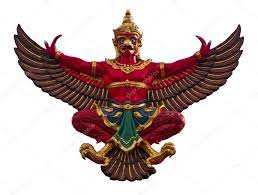
THE STORY OF GARUDA

Copyright@shravancharitymission

    The tale of Garuda starts with the story of Rishi Kashyapa. The ancient Puranas mention Rishi Kashyapa and his genealogy, numerous times. In the Vishnu Purana, Rishi Kashyapa marries thirteen daughters of Daksha Prajapati. Scholar Vettam Mani concludes in his research that Kashyapa may have married more women, thirteen of whom were daughters of Daksha. The story of Garuda originates from the two wives of Rishi Kashyap named Kadru and Vinata, who were daughters of Daksha Prajapati.

    Both the sisters were very fond of Rishi Kashyapa. One day they expressed their desire to marry him and the devout rishi agreed. Thereafter, they both served the rishi with piety and devotion.

    After years of blissful matrimony, one day the Rishi called his wives and expressed his desire to offer them a boon each. Kadru immediately entreated Rishi Kashyap to bless her with a thousand children, each strong and potent. She desired that they should be fearsome, lustrous, and powerful creatures, and as her children, they should be capable of, vanquishing their foes and striking terror in the hearts of their enemies.

    ‘So be it!’ Replied Rishi Kashyapa and granted her the wish immediately. Soon a thousand eggs appeared from Kadru’s womb. She cared for them along with her maids and incubated them in a warm and cosy place. And she eagerly awaited the birth of her many children.

    On the other hand, a meek Vinata bade her time with equanimity. She carried on with her daily duties, prayers, and rituals and continued to seek the blessings of Rishi Kashyapa but did not ask for anything special. The only thing she wished was that her children, balance the effects, brought about, by Kadru’s children. They should give strength, remove fear, and brighten the world.

    Rishi Kashyapa thought long and hard about Vinata’s unborn children. He was reminded of the blessings of the thumb-sized Valakhilya sages. He told Vinata that she would bear two children, who are destined to be the lords of the winged creatures. The Rishi also said they would achieve greatness and be worshipped in all three Lokas. Soon, two eggs sprang forth from the womb of Vinata. She cared for her eggs and showered all her affection and attention on them. Time flew and soon five hundred years passed in no time.

    In the meantime, the eggs of Kadru began to hatch. Snakes and serpents of all sizes, forms, and colours began to emerge from these eggs. They hissed and spewed venom around. The attendants of Kadru got terrified and started running helter-skelter.

    Meanwhile, Vinata kept eagerly thinking about her eggs. She too was anxiously waiting for her children to be born soon. She was overwhelmed with the feeling of fear, impatience and jealousy. One day when she couldn’t hold herself, she picked up an egg and cracked it open. And from the egg, emerged, a bird-like child. It was not fully developed. But it had a brilliant radiance and shined like God Surya himself. The newborn was not pleased with his mother’s behaviour. So he foretold that an unfortunate circumstance awaited her. He said, ‘Dear Mother! As a result of your impatience, you will suffer as a slave.’ In his later days, the newborn Aruna was appointed as the charioteer of Surya, the Sun God.

    One day, Ucchaisravas, the seven-headed celestial stallion, while galloping across the planets reached where Kadru and Vinata lived. Playfully, Kadru asked Vinata if the horse’s tail was black or white. And they argued with each other and finally placed a bet.

    ‘I say the tail is black. If what I say is true, you have to be my slave forever.’ Said Kadru. ‘No, the tail is white. And if I win the bet, you shall remain my slave forever.’ Added Vinata.

    The two sisters then agreed to check the horse’s tail the following day. Meanwhile, Kadru summoned her children and ordered them to do something deceitful. She directed that the snakes coil themselves around the tail of Ucchaisravas, the celestial steed, to make it appear black in colour. The snakes hesitated, making Kadru angry. She cursed them for disobeying their mother’s command and conveyed that they all shall be consumed by fire in a yagna.

    Fearing the wrath of their mother, the snakes agreed to accede to her command and the following day, they coiled themselves around the tail of Ucchaisravas, making the tail appear black.

    ‘Look the tail is black. I’ve won the bet.’ Shrilled Kadru. Having lost the bet Vinata agreed to become the slave of Kadru.

    One fine day, the second egg of Vinata began to hatch. A mighty bird emerged from it. His lustre was bright, and he engulfed everything around him in flames. His eyes were like lightning. He grew in size very quickly and covered everything, even the skies. All those around him cowered in fear and ran for help. Agni and the Devas, and the learned Rishis assembled around the divine bird and praised him. They asked him to contain his divine form to which Pakshiraja, the king of birds agreed.

     He then took the form of a Kinnara—half-bird and half-man and took to the skies in search of his mother Vinata and flew right into her arms where he found her living with Kadru and his serpentine cousins. Vinata was both happy and sad to see her son. Happy to see him alive and well. Sorry that they were bound by an old bet because of which they had to serve the snakes.

    One day, Kadru ordered that she and her children be carried to the island of Ramaniyaka. Vinata lifted Kadru on her shoulders, while the snakes climbed onto Pakshiraja’s back. They were then flown across the seas to the enchanting island. The Pakshiraja flew too close to the sun so the snakes got scorched. They fainted and began to fall down. Kadru prayed to Indra, who provided showers that gave the snakes some respite. Soon they all reached the island of Ramaniyaka safely.

    On the island, the snakes kept ordering the mighty bird to do many tasks. This confused Vinata’s son. He asked his mother why these snakes were ordering him around. Vinata narrated to her son, the story of how she was enslaved by the bet she made in haste. Vinata’s son then requested the snakes to liberate his mother and him. The snakes in return demanded that he bring the pot of nectar held by the Devas in exchange for their freedom. A determined Vainatheya (Vinata’s son Garuda) then took his mother’s blessings and set out for the tough task.

    As he flew past many lands, his eyes fell on Rishi Kashyapa, his father. The majestic bird landed in front of the Rishi to pay his respects. He informed him of his quest to bring back the pot of Amrita (nectar). Rishi Kashyapa blessed him and wished him success in the onerous mission. Pakshiraj then asked his father.

    ‘Where can I find some food to eat? Rishi Kashyapa replied, ‘Near the lake, you’ll find an elephant and a tortoise perpetually quarrelling with each other. Go eat them up. They were sages Vibhavasu and Supratika in their previous birth. By eating them up you will liberate them from their respective curse. The mighty bird took flight and promised to do his father’s bidding. He soared towards the lake and spotted his prey. In one fell swoop, he grabbed the elephant and tortoise – one in each claw. The mighty bird then went in search of a solitary spot to devour his catch. He chanced upon a big banyan tree on which he landed.

    The weight of Pakshiraj along with the elephant and the tortoise broke the branch. Pakshiraj realised that the branch had thousands of little sages on it. They were known as Valakhilyas. They were engaged in deep penance while hanging upside down. To avoid injury to them, the emperor of birds caught the branch with his beak and flew further. The sages opened their eyes and saw this feat of strength.

    They named the mighty son of Vinata, “Garuda”, one who is able to bear heavy weights. Garuda brought the sages down safely and they blessed him with success in his mission to obtain the pot of nectar. Garuda then proceeded to the peaks of the Gandhamadana hills. There he disposed of the remains of the elephant and tortoise and freed them from their curse. Thereafter, he began his journey towards heaven in pursuit of the pot of nectar.

    As Garuda approached the kingdom of Indra, many ill omens began to appear in front of the Devas. Meteors began to fall. Thunderstorms appeared out of nowhere. The weapons held by the Devas began to throb. Filled with anxiety about the well-being of the world, Indra asked his guru Brihaspati, what is happening. And upon hearing the response from his guru, Indra was grief-stricken. He asked his learned guru.

    ‘What do these ill omens foretell? The guru replied.

    ‘That it’s time for you to pay for those ignoble acts that you committed many years ago.’ And he reminded. ‘A long time ago, you … mighty Indra, while you were once assisting Rishi Kashyapa in a yagna where, apart from you, many other learned rishis such as Gandharvas, Devas and others were also present to assist him. Among them, there were the Valakhilyas also. They were large in number but were only as big as a thumb. With all your might, you carried a massive pile of Samith (wood for the fire in the yagna) from the forest, but the Valakhilyas collapsed from the burden of only a single Palasha Danda (peepal tree twig) that they were carrying for the yagna. You laughed at the poor plight of those little sages … “Ha-Ha-Ha. Look at you, struggling with a twig!”

    This offended the Valakhilyas very much. So they vowed to perform a separate yagna to create another Indra. And they cursed you, wishing that your slayer would be born as Rishi Kashyapa’s son. When you heard about their vows you were terrified. So you ran to Rishi Kashyapa to explain what had happened. Kashyapa lent a patient ear but warned that he would not be able to stop the powerful Valakhilyas from doing so. But he gave an assurance to you that he would work out a compromise. When Rishi Kashyap met Valakhilyas he requested them to drop the yagna for creating a new Indra. But he assured them that whomsoever they create will be the Indra of the birds. Valakhilyas agreed to the new plan. After the yagna, Valakhilyas prasad (offering) was offered to Vinata, one of the two wives of Kashyapa. After eating the same she gave birth to two children. They are Aruna and the most powerful golden-hued eagle, Garuda. The same son of Vinata, the Lord of birds, the mighty Garuda is now approaching our realm to take away the pot of nectar.’

    Upon hearing the story, Indra was terrified. He feared losing his position as the sovereign king of the Devas. Indra ordered his entire army to be in a state of readiness and to guard the Amrita at all costs.

    Several armies responded to the clarion call of Indra. Soon, the path to the ‘Amrita Kalasa’ was guarded by armies of Celestial beings such as Devas, Yakshas, Maruts, Rudras, Vasus, Adityas, Gandharvas, Sadhyas, and the Aswini twins. But the determined Garuda fought with each army and routed them in no time.

    Garuda’s form instilled terror in those who opposed him. He blinded them with the dust raised by his wings, tore them with his talons, broke them with his beak, and cleaved them with his claws. Finally, when Garuda reached the place where the pot of nectar was kept, he found, it was guarded by a giant wheel containing many sharp spikes. Garuda transformed himself into a tiny form and slipped between the spokes, unnoticed.

    Beneath the contraption were two snakes each guarding the pot from the opposite direction. Garuda fought them bravely and finally annihilated them. He shattered the wheel above the pot and took off from the heavens along with the pot of nectar. The victorious Garuda then began his journey back to where his mother was enslaved.

    Impressed by his selflessness, determination and strength, Lord Vishnu appeared before the mighty bird. He looked at Garuda fondly. The king of birds paid his respect to the king of all beings. Lord Vishnu asked Garuda to be of service as a Vaishnava.

    Garuda agreed but placed a request that he shall serve Lord Vishnu from both beneath and above. Happily, Lord Vishnu agreed. Thereafter, as one can see that all flags belonging to Lord Vishnu bear the insignia of Garuda. Garuda was also appointed as the sacred mount of the Lord. So, Garuda got his boons, and Lord Vishnu a devoted attendant.

    Indra, who was watching all this, could not believe his eyes. He gathered all his energy and hurled his Vajrayudha (Thunderbolt) at Garuda. But Indra’s weapon did no harm to Garuda.

    The mighty bird stopped in his tracks to address Indra, respectfully. He then shed a feather out of courtesy at the weapon and resumed his journey. Indra implored him to return the pot of nectar. Garuda explained his mother’s predicament. The two then decided to fulfil each other’s wishes.

    Garuda carried the pot of nectar to the lair of his snake brothers. Eager to drink the nectar and attain a limitless life, the snakes came rushing to Garuda. But he stopped them and requested that first his mother be liberated.

    The snakes and Kadru agreed. Vinata was free once again. Garuda then placed the pot on a bed of Kusha Grass. He then told the snakes that the proper way was to first cleanse themselves and then drink the nectar. The snakes acceded to the wisdom and went to the nearby water bodies to bathe. In the meantime, Indra’s son Jayanta descended from heaven and stealthily made away with the pot of nectar and placed it back safely in the realms of heaven. Upon the return of the snakes after their cleansing, they were devoured by Garuda. In this manner, both Indra and Garuda were happy. Since then, Garuda and snakes have been sworn enemies of each other. Garuda, who is eternal, spends his life in the service of Lord Maha Vishnu.

    Garuda wears various nagas (serpent-Gods) as ornaments. They are:

Ananta on the crown, Vasuki as sacred thread, Takshaka around the waist, Karkota as a necklace, Padma and Mahapadma as earrings and Shankapala and Gulika on his thighs. Other nagas serve him as his servant.

    Garuda is known by many names. They are: Vainateya, Kashyapanandana, Pakshiraja, Tarkshya, Garuthman, Vedatma, Vihageshwara, Vedaswarupi, Suparna and Khagaraja.

      The Ramayana and the Mahabharata have a lot of references to the Valakhilya Rishis. They may be considered the forerunners of English folklore ‘Tom Thumb’ and the Lilliputians of the famous satirical novel ‘Gulliver’s Travels’ by Jonathan Swift.

***

By Kamlesh Tripathi

*

https://kamleshsujata.wordpress.com

*

Share it please

*

Shravan Charity Mission is an NGO that works for poor children suffering from life threatening diseases especially cancer. Our posts are meant for our readers that includes both children and adults and it has a huge variety in terms of content. We also accept donations for our mission. Should you wish to donate for the cause. The bank details are given below:

NAME OF ACCOUNT: SHRAVAN CHARITY MISSION

Account no: 680510110004635 (BANK OF INDIA)

IFSC code: BKID0006805

*

Our Publications

GLOOM BEHIND THE SMILE

(The book is about a young cancer patient. Now archived in 8 prestigious libraries of the US that includes Harvard College Library; Harvard University Library; Library of Congress; University of Washington, Seattle; University of Minnesota, Minneapolis; Yale University, New Haven; University of Chicago; University of North Carolina, at Chapel Hill University Libraries. It can also be accessed in MIT through Worldcat.org. Besides, it is also available for reading in libraries and archives of Canada, Cancer Aid and Research Foundation Mumbai; Jaipuria Institute of Management, Noida; India. Shoolini University, Yogananda Knowledge Center, Himachal Pradesh and Azim Premzi University, Bangalore).  

ONE TO TANGO … RIA’S ODYSSEY

(Is a book on ‘singlehood’ about a Delhi girl now archived in Connemara Library, Chennai and Delhi Public Library, GOI, Ministry of Culture, Delhi; Available for reading in Indian National Bibliography, March 2016, in the literature section, in Central Reference Library, Ministry of Culture, India, Belvedere, Kolkata-700022)

AADAB LUCKNOW … FOND MEMORIES

(Is a fiction written around the great city of Nawabs—Lucknow. It describes Lucknow in great detail and also talks about its Hindu-Muslim amity. That happens to be the undying characteristics of Lucknow. The book was launched in Lucknow International Literary Festival of 2014. It is included for reading in Askews and Holts Library Services, Lancashire, U.K; Herrick District Library, Holland and Charlotte-Mecklenburg Library, Mecklenburg County in North Carolina, USA; Black Gold Cooperative Library Administration, Arroyo Grande, California).

REFRACTIONS … FROM THE PRISM OF GOD

(Co-published by Cankids–Kidscan, a pan India NGO and Shravan Charity Mission, that works for Child cancer in India. The book is endorsed by Ms Preetha Reddy, MD Apollo Hospitals Group. It was launched in Lucknow International Literary Festival 2016)

TYPICAL TALE OF AN INDIAN SALESMAN

(Is a story of an Indian salesman who is, humbly qualified. Yet he fights his way through unceasing uncertainties to reach the top. A good read not only for salesmen. The book was launched on 10th February 2018 in Gorakhpur Lit-Fest. Now available on Amazon, Flipkart and Onlinegatha)

RHYTHM … in poems

(Published in January 2019. The book contains 50 poems. The poems describe our day-to-day life. The book is available on Amazon, Flipkart and Onlinegatha)

MIRAGE

(Published in February 2020. The book is a collection of eight short stories available in Amazon, Flipkart and Notion Press)

AWADH ASSAM AND DALAI LAMA … The Kalachakra

(The story of the man who received His Holiness The Dalai Lama and his retinue in 1959 as a GOI representative when he fled Tibet in 1959. The book was launched on 21st November 2022 by His Holiness The Dalai Lama).

BHAVANS JOURNAL

Short stories, Book reviews and Articles published in Bhavan’s Journal: 1. Reality and Perception, 15.10.19; 2. Sending the Wrong Message, 31.5.20; 3. Eagle versus Scholars June, 15 & 20 2020; 4. Indica, 15.8.20; 5. The Story of King Chitraketu, August 31 2020; 6. Breaking Through the Chakravyuh, September 30 2020. 7. The Questioning Spouse, October 31, 2020; 8. Happy Days, November 15, 2020; 9. The Karma Cycle of Paddy and Wheat, December 15, 2020; 10. Power Vs Influence, January 31, 2021; 11. Three Refugees, March 15, 2021; 12. Rise and Fall of Ajatashatru, March 31, 2021; 13. Reformed Ruler, May 15, 2021; 14. A Lasting Name, May 31, 2021; 15. Are Animals Better Teachers?, June 16, 2021; 16. Book Review: The Gram Swaraj, 1.7.21; 17. Right Age for Achievements, 15.7.21; 18. Big Things Have Small Beginnings, 15.8.21; 19. Where is Gangaridai?, 15.9.21; 20. Confront the Donkey Within You 30.9.21; 21. Know Your Strengths 15.10.21; 22. Poverty 15.11.21; 23. Top View 30.11.21; 24. The Bansuriwala 15.1.22; 25. Sale of Alaska 15.2.22; 26. The Dimasa Kingdom 28.2.22; 27. Buried Treasure 15.4.22; 28. The Kingdom of Pragjyotisha 30.4.22; 29. Who is more useful? 15.5.22; 30. The White Swan from Lake Mansarovar 30.6.22; 31. Bhool Bhulayya 15.9.22; 32. Good Karma 30.9.22; 33. Good name vs Bad Name 15.10.22; 34. Uttarapath—The Grand Trunk Road 1.12.22; 35. When Gods Get Angry 1.1.23; 36. Holinshed’s Chronicles 15.1.23; 37. Theogony 15.2.23

SUNDAY SHILLONG TIMES

POEM HAPPY NEW YEAR 8.1.23;

(ALL THE ABOVE BOOK TITLES ARE AVAILABLE FOR SALE ON AMAZON, FLIPKART AND OTHER ONLINE STORES OR YOU COULD EVEN WRITE TO US FOR A COPY)

*****

SHORT STORY: YOU ARE WHAT YOU BELIEVE IN

Copyright@shravancharitymission

    While walking through an elephant camp, a man observes that the pachyderms there are neither kept in cages nor they are held by the use of chains. All that is holding them back from straying away from the camp is a small length of rope tied to one of their legs. As the man gaped at these elephants, he was completely confused as to why these mammoth creatures didn’t use their gargantuan strength to break free. Curious he asked the trainer nearby, why don’t these elephants ever try to escape from here? The trainer replied, ‘When they were very young and much smaller, we used, the same rope to tie them. And at that age, it was enough to hold them. So when they grew up, they were conditioned to believe they cannot break away from this rope. They still believe that the rope can hold them, so they never attempt to break free.’

    Moral of the story: The real strength of a person lies in what he believes in. One should always attempt to use his current strength and not merely live in the past, thinking about his cradle strength.

    American novelist Alice Walker says: The most common way for people to give up their power is by thinking they don’t have any.” No matter how much the world tries to hold you back, your real strength is what you believe in. So condition your mind for high goals in life.

By Kamlesh Tripathi

*

https://kamleshsujata.wordpress.com

*

Share it if you like it

*

Shravan Charity Mission is an NGO that works for poor children suffering from life threatening diseases especially cancer. Our posts are meant for our readers that includes both children and adults and it has a huge variety in terms of content. We also accept donations for our mission. Should you wish to donate for the cause. The bank details are given below:

NAME OF ACCOUNT: SHRAVAN CHARITY MISSION

Account no: 680510110004635 (BANK OF INDIA)

IFSC code: BKID0006805

*

Our Publications

GLOOM BEHIND THE SMILE

(The book is about a young cancer patient. Now archived in 8 prestigious libraries of the US that includes Harvard College Library; Harvard University Library; Library of Congress; University of Washington, Seattle; University of Minnesota, Minneapolis; Yale University, New Haven; University of Chicago; University of North Carolina, at Chapel Hill University Libraries. It can also be accessed in MIT through Worldcat.org. Besides, it is also available for reading in libraries and archives of Canada, Cancer Aid and Research Foundation Mumbai; Jaipuria Institute of Management, Noida; India. Shoolini University, Yogananda Knowledge Center, Himachal Pradesh and Azim Premzi University, Bangalore).  

ONE TO TANGO … RIA’S ODYSSEY

(Is a book on ‘singlehood’ about a Delhi girl now archived in Connemara Library, Chennai and Delhi Public Library, GOI, Ministry of Culture, Delhi; Available for reading in Indian National Bibliography, March 2016, in the literature section, in Central Reference Library, Ministry of Culture, India, Belvedere, Kolkata-700022)

AADAB LUCKNOW … FOND MEMORIES

(Is a fiction written around the great city of Nawabs—Lucknow. It describes Lucknow in great detail and also talks about its Hindu-Muslim amity. That happens to be the undying characteristics of Lucknow. The book was launched in Lucknow International Literary Festival of 2014. It is included for reading in Askews and Holts Library Services, Lancashire, U.K; Herrick District Library, Holland and Charlotte-Mecklenburg Library, Mecklenburg County in North Carolina, USA; Black Gold Cooperative Library Administration, Arroyo Grande, California).

REFRACTIONS … FROM THE PRISM OF GOD

(Co-published by Cankids–Kidscan, a pan India NGO and Shravan Charity Mission, that works for Child cancer in India. The book is endorsed by Ms Preetha Reddy, MD Apollo Hospitals Group. It was launched in Lucknow International Literary Festival 2016)

TYPICAL TALE OF AN INDIAN SALESMAN

(Is a story of an Indian salesman who is, humbly qualified. Yet he fights his way through unceasing uncertainties to reach the top. A good read not only for salesmen. The book was launched on 10th February 2018 in Gorakhpur Lit-Fest. Now available on Amazon, Flipkart and Onlinegatha)

RHYTHM … in poems

(Published in January 2019. The book contains 50 poems. The poems describe our day-to-day life. The book is available on Amazon, Flipkart and Onlinegatha)

MIRAGE

(Published in February 2020. The book is a collection of eight short stories available in Amazon, Flipkart and Notion Press)

AWADH ASSAM AND DALAI LAMA … The Kalachakra

(The story of the man who received His Holiness The Dalai Lama and his retinue in 1959 as a GOI representative when he fled Tibet in 1959. The book was launched on 21st November 2022 by His Holiness The Dalai Lama).

BHAVANS JOURNAL

Short stories, Book reviews and Articles published in Bhavan’s Journal: 1. Reality and Perception, 15.10.19; 2. Sending the Wrong Message, 31.5.20; 3. Eagle versus Scholars June, 15 & 20 2020; 4. Indica, 15.8.20; 5. The Story of King Chitraketu, August 31 2020; 6. Breaking Through the Chakravyuh, September 30 2020. 7. The Questioning Spouse, October 31, 2020; 8. Happy Days, November 15, 2020; 9. The Karma Cycle of Paddy and Wheat, December 15, 2020; 10. Power Vs Influence, January 31, 2021; 11. Three Refugees, March 15, 2021; 12. Rise and Fall of Ajatashatru, March 31, 2021; 13. Reformed Ruler, May 15, 2021; 14. A Lasting Name, May 31, 2021; 15. Are Animals Better Teachers?, June 16, 2021; 16. Book Review: The Gram Swaraj, 1.7.21; 17. Right Age for Achievements, 15.7.21; 18. Big Things Have Small Beginnings, 15.8.21; 19. Where is Gangaridai?, 15.9.21; 20. Confront the Donkey Within You 30.9.21; 21. Know Your Strengths 15.10.21; 22. Poverty 15.11.21; 23. Top View 30.11.21; 24. The Bansuriwala 15.1.22; 25. Sale of Alaska 15.2.22; 26. The Dimasa Kingdom 28.2.22; 27. Buried Treasure 15.4.22; 28. The Kingdom of Pragjyotisha 30.4.22; 29. Who is more useful? 15.5.22; 30. The White Swan from Lake Mansarovar 30.6.22; 31. Bhool Bhulayya 15.9.22; 32. Good Karma 30.9.22; 33. Good name vs Bad Name 15.10.22; 34. Uttarapath—The Grand Trunk Road 1.12.22; 35. When Gods Get Angry 1.1.23; 36. Holinshed’s Chronicles 15.1.23

SUNDAY SHILLONG TIMES

POEM HAPPY NEW YEAR 8.1.23;

(ALL THE ABOVE BOOK TITLES ARE AVAILABLE FOR SALE ON AMAZON, FLIPKART AND OTHER ONLINE STORES OR YOU COULD EVEN WRITE TO US FOR A COPY)

*****

SHORT STORY: THE SAMURAI AND THE MONK

Copyright@shravancharitymission

    There was once a samurai. After winning a war, he was returning home with his army. On the way he passed through a forest. In the forest there was a monk was deep into meditation. The samurai bowed and asked him humbly, “Respected Monk! Please tell me, which is the way to heaven, and which is the way to hell?”

    The monk did not respond. The samurai repeated his question a little more loudly. The monk still did not respond. The third time, the samurai shouted the question so loudly at the Monk that it shook the very tree under which he was meditating. The monk opened his eyes and said sternly, “You stupid fellow! Why did you disturb my meditation?”

    Now the samurai was really furious. He immediately pulled out his sword and raised it to kill the monk. The monk smiled and said, “This is the way to hell.”

    The samurai immediately realised his folly and his anger abated. “The monk called me stupid not to chide me but to teach me the truth.’ He gently placed his sword in the sheath. And the monk said, “This is the way to heaven.”

***

By Kamlesh Tripathi

*

https://kamleshsujata.wordpress.com

*

Share it if you like it

*

Shravan Charity Mission is an NGO that works for poor children suffering from life threatening diseases especially cancer. Our posts are meant for our readers that includes both children and adults and it has a huge variety in terms of content. We also accept donations for our mission. Should you wish to donate for the cause. The bank details are given below:

NAME OF ACCOUNT: SHRAVAN CHARITY MISSION

Account no: 680510110004635 (BANK OF INDIA)

IFSC code: BKID0006805

*

Our Publications

GLOOM BEHIND THE SMILE

(The book is about a young cancer patient. Now archived in 8 prestigious libraries of the US that includes Harvard College Library; Harvard University Library; Library of Congress; University of Washington, Seattle; University of Minnesota, Minneapolis; Yale University, New Haven; University of Chicago; University of North Carolina, at Chapel Hill University Libraries. It can also be accessed in MIT through Worldcat.org. Besides, it is also available for reading in libraries and archives of Canada, Cancer Aid and Research Foundation Mumbai; Jaipuria Institute of Management, Noida; India. Shoolini University, Yogananda Knowledge Center, Himachal Pradesh and Azim Premzi University, Bangalore).  

ONE TO TANGO … RIA’S ODYSSEY

(Is a book on ‘singlehood’ about a Delhi girl now archived in Connemara Library, Chennai and Delhi Public Library, GOI, Ministry of Culture, Delhi; Available for reading in Indian National Bibliography, March 2016, in the literature section, in Central Reference Library, Ministry of Culture, India, Belvedere, Kolkata-700022)

AADAB LUCKNOW … FOND MEMORIES

(Is a fiction written around the great city of Nawabs—Lucknow. It describes Lucknow in great detail and also talks about its Hindu-Muslim amity. That happens to be the undying characteristics of Lucknow. The book was launched in Lucknow International Literary Festival of 2014. It is included for reading in Askews and Holts Library Services, Lancashire, U.K; Herrick District Library, Holland and Charlotte-Mecklenburg Library, Mecklenburg County in North Carolina, USA).

REFRACTIONS … FROM THE PRISM OF GOD

(Co-published by Cankids–Kidscan, a pan India NGO and Shravan Charity Mission, that works for Child cancer in India. The book is endorsed by Ms Preetha Reddy, MD Apollo Hospitals Group. It was launched in Lucknow International Literary Festival 2016)

TYPICAL TALE OF AN INDIAN SALESMAN

(Is a story of an Indian salesman who is, humbly qualified. Yet he fights his ways through unceasing uncertainties to reach the top. A good read not only for salesmen. The book was launched on 10th February, 2018 in Gorakhpur Lit-Fest. Now available in Amazon, Flipkart and Onlinegatha)

RHYTHM … in poems

(Published in January 2019. The book contains 50 poems. The poems describe our day to day life. The book is available in Amazon, Flipkart and Onlinegatha)

MIRAGE

(Published in February 2020. The book is a collection of eight short stories available in Amazon, Flipkart and Notion Press)

Short stories, Book reviews and Articles published in Bhavan’s Journal: Reality and Perception, 15.10.19; Sending the Wrong Message, 31.5.20; Eagle versus Scholars June, 15 & 20 2020; Indica, 15.8.20; The Story of King Chitraketu, August 31 2020; Breaking Through the Chakravyuh, September 30 2020. The Questioning Spouse, October 31, 2020; Happy Days, November 15, 2020; The Karma Cycle of Paddy and Wheat, December 15,2020; Power Vs Influence, January 31, 2021; Three Refugees, March 15, 2021; Rise and Fall of Ajatashatru, March 31, 2021; Reformed Ruler, May 15, 2021; A Lasting Name, May 31, 2021; Are Animals Better Teachers?, June 16, 2021; Book Review: The Gram Swaraj, 1.7.21; Right Age for Achievements, 15.7.21; Big Things Have Small Beginnings, 15.8.21; Where is Gangaridai?, 15.9.21; Confront the Donkey Within You 30.9.21; Know Your Strengths 15.10.21; Poverty 15.11.21; Top View 30.11.21; The Bansuriwala 15.1.22;  

(ALL THE ABOVE BOOK TITLES ARE AVAILABLE FOR SALE IN AMAZON, FLIPKART AND OTHER ONLINE STORES OR YOU COULD EVEN WRITE TO US FOR A COPY)

*****
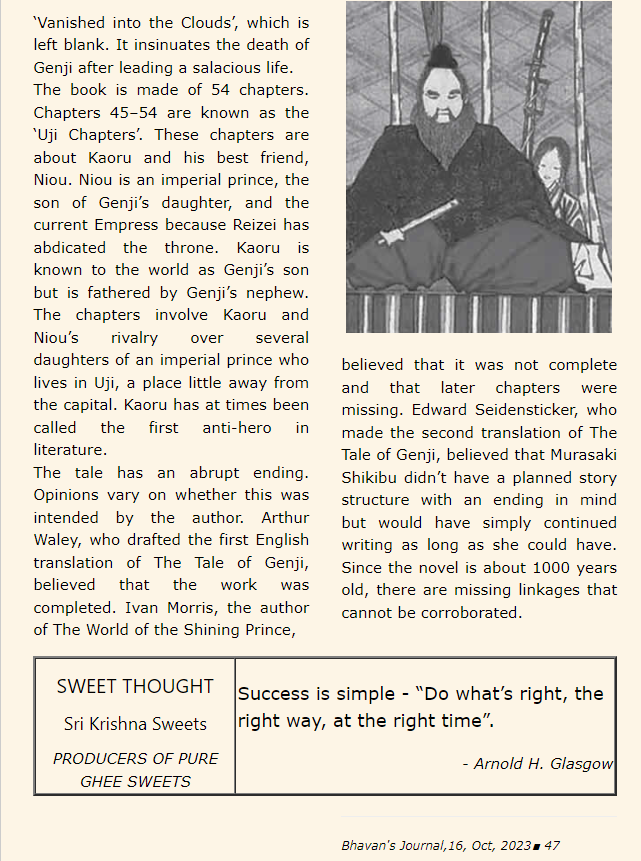
SHORT STORY: CHEATING IN THE GUISE OF A BEGGAR

Copyright@shravancharitymission

Beggary is the ultimate nadir in anyone’s life. When you can’t do anything worthwhile in your life you beg and that could be for any reason. But there is a greater low than the reality of a beggar and that is when you cheat someone by acting as a beggar or in the robe of a beggar. Though, there is a huge difference between a beggar and a cheat there is a greater difference between a cheat and the cheat who cheats in the guise of a beggar. This may sound a little confusing as to how one can cheat someone by camouflaging himself as a beggar.

    In this context let me narrate to you and old episode. This was when I was posted in Chennai working for a company many years ago. I was once on a day train from Chennai to Madurai with two of my colleagues. It was a non-ac compartment where we were having a heated debate on some business issues. This was when an elderly looking blind beggar walked in. He was wearing goggles. We all felt very sympathetic towards him. He was being led by a young lad who was holding his hands and it appeared as if the lad was his progeny. Soon the blind beggar started imploring for alms in Tamil and refused to budge from the compartment without it.

    With his unwanted presence there, I felt our important discussion was getting derailed so I quickly searched my wallet in which the lowest denomination that I could find was a hundred rupee note which in those times was a decent amount that I pulled out and gave it to him in a jiffy. My junior colleagues looked at me somewhat wonderstruck at this liberal gesture of mine, but in reality I didn’t have change so I gave a hundred rupee note, because I quickly wanted him out of my compartment to stay on course with our discussion. And, almost immediately, with lightning speed the boy and the beggar moved out of the cabin, perhaps, they were fearing I may have a change of heart and may call for the note back.

    After that, things settled, and our meeting continued. Thereafter, an hour or so must have passed, and we were all taking some well-deserved rest after the heated discussion was over when a colleague of mine went out of the compartment, I guess to the loo. After a little while he returned, but by then the train had started slowing down, as we were at the outskirts of Madurai Station. He requested me to come out of the compartment immediately to see something. I asked what? He didn’t reply on the contrary he started walking through the corridor towards the other end of the bogie. I followed him life a kid. To my surprise he quickly crossed the vestibule between the two bogies and entered the other bogie and just stood there as if he was lifeless, and I was right behind him when I couldn’t believe my eyes.

    The beggar had taken off his goggles. He was not blind and was counting all the money in the form of notes and change that he had fraudulently collected from me and the others in the bogie, and the baby faced young boy who was hand-holding him earlier was sitting next to him, and was sipping some hot coffee.

    We had little choice, but to laugh, realizing, even beggary didn’t have ethics. But no, I was wrong, as beggars do have ethics as most beggars, get into beggary only when they are left choice less in life. But in this case the person was not a beggar but he was a cheat of the lowest variety in the camouflage of a beggar who didn’t even spare the sombre identity of a blind man.

    Moral of the story: There are two sections of the society. One that doesn’t support beggary and the other that supports beggary. Even if you’re a supporter of beggary give your alms always to a genuine beggar and not to a cheat veiled as a beggar and of course never cheat a blind man.

By Kamlesh Tripathi

*

https://kamleshsujata.wordpress.com

*

Share it if you like it

*

Shravan Charity Mission is an NGO that works for poor children suffering from life threatening diseases especially cancer. Our posts are meant for our readers that includes both children and adults and it has a huge variety in terms of content. We also accept donations for our mission. Should you wish to donate for the cause. The bank details are given below:

NAME OF ACCOUNT: SHRAVAN CHARITY MISSION

Account no: 680510110004635 (BANK OF INDIA)

IFSC code: BKID0006805

*

Our Publications

GLOOM BEHIND THE SMILE

(The book is about a young cancer patient. Now archived in 8 prestigious libraries of the US that includes Harvard College Library; Harvard University Library; Library of Congress; University of Washington, Seattle; University of Minnesota, Minneapolis; Yale University, New Haven; University of Chicago; University of North Carolina, at Chapel Hill University Libraries. It can also be accessed in MIT through Worldcat.org. Besides, it is also available for reading in libraries and archives of Canada, Cancer Aid and Research Foundation Mumbai; Jaipuria Institute of Management, Noida; India. Shoolini University, Yogananda Knowledge Center, Himachal Pradesh and Azim Premzi University, Bangalore).  

ONE TO TANGO … RIA’S ODYSSEY

(Is a book on ‘singlehood’ about a Delhi girl now archived in Connemara Library, Chennai and Delhi Public Library, GOI, Ministry of Culture, Delhi; Available for reading in Indian National Bibliography, March 2016, in the literature section, in Central Reference Library, Ministry of Culture, India, Belvedere, Kolkata-700022)

AADAB LUCKNOW … FOND MEMORIES

(Is a fiction written around the great city of Nawabs—Lucknow. It describes Lucknow in great detail and also talks about its Hindu-Muslim amity. That happens to be the undying characteristics of Lucknow. The book was launched in Lucknow International Literary Festival of 2014. It is included for reading in Askews and Holts Library Services, Lancashire, U.K; Herrick District Library, Holland and Charlotte-Mecklenburg Library, Mecklenburg County in North Carolina, USA).

REFRACTIONS … FROM THE PRISM OF GOD

(Co-published by Cankids–Kidscan, a pan India NGO and Shravan Charity Mission, that works for Child cancer in India. The book is endorsed by Ms Preetha Reddy, MD Apollo Hospitals Group. It was launched in Lucknow International Literary Festival 2016)

TYPICAL TALE OF AN INDIAN SALESMAN

(Is a story of an Indian salesman who is, humbly qualified. Yet he fights his ways through unceasing uncertainties to reach the top. A good read not only for salesmen. The book was launched on 10th February, 2018 in Gorakhpur Lit-Fest. Now available in Amazon, Flipkart and Onlinegatha)

RHYTHM … in poems

(Published in January 2019. The book contains 50 poems. The poems describe our day to day life. The book is available in Amazon, Flipkart and Onlinegatha)

MIRAGE

(Published in February 2020. The book is a collection of eight short stories available in Amazon, Flipkart and Notion Press)

Short stories, Book reviews and Articles published in Bhavan’s Journal: Reality and Perception, 15.10.19; Sending the Wrong Message, 31.5.20; Eagle versus Scholars June, 15 & 20 2020; Indica, 15.8.20; The Story of King Chitraketu, August 31 2020; Breaking Through the Chakravyuh, September 30 2020. The Questioning Spouse, October 31, 2020; Happy Days, November 15, 2020; The Karma Cycle of Paddy and Wheat, December 15,2020; Power Vs Influence, January 31, 2021; Three Refugees, March 15, 2021; Rise and Fall of Ajatashatru, March 31, 2021; Reformed Ruler, May 15, 2021; A Lasting Name, May 31, 2021; Are Animals Better Teachers?, June 16, 2021; Book Review: The Gram Swaraj, 1.7.21; Right Age for Achievements, 15.7.21; Big Things Have Small Beginnings, 15.8.21; Where is Gangaridai?, 15.9.21; Confront the Donkey Within You 30.9.21; Know Your Strengths 15.10.21; Poverty 15.11.21; Top View 30.11.21; The Bansuriwala 15.1.22;  

(ALL THE ABOVE BOOK TITLES ARE AVAILABLE FOR SALE IN AMAZON, FLIPKART AND OTHER ONLINE STORES OR YOU COULD EVEN WRITE TO US FOR A COPY)

*****

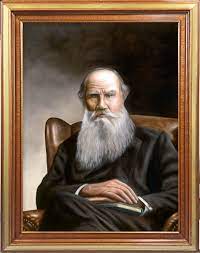
LEO TOLSTOY-Among the World’s Greatest Writers … by Janina Gomes

Copyright@shravancharitymission

Leo Tolstoy

It is difficult to write about one of the greatest writers that ever existed and to trace the influence of his life experiences on his writings, but we can only try to do justice to him and his seminal novels ‘War and Peace’ and ‘Anna Karenina’ by a short biography of his life.

Count Lev Nikolayevich Tolstoy referred to in English as Leo Tolstoy (1828-1910) was born to an aristocratic Russian family. His mother died when he was two years old and his father when he was nine years old.  He and his siblings were raised by his relatives.  His studies at Kazan University, where he was studying law and oriental languages, which he left in the middle, seemed to invite the disdain of his teachers who described him as both unable and unwilling to learn.

He returned to his family estate at Yasnaya Polyana, and spent his life visiting Moscow, Tula and St. Petersburg leading a lax and luxurious life. After incurring heavy gambling debts, he went with his older brother and joined the Russian Army in 1851. He served as a young artillery officer during the Crimean War and was in Sevastopol during the 11 month long siege of Sevastopol in 1854-55. During the war he was recognized for his courage and promoted to Lieutenant. But he was appalled by the number of deaths there were in warfare and after the Crimean War, he left the Army. His experience in the Army and two tours to Europe in 1857 and 1860-61 changed him from a dissolute and privileged society author to a non-violent and spiritual anarchist. During his 1857 visit to Paris, he witnessed a public execution, a trauma that marked him for life.

Two great French writers and intellectuals who influenced him and his work were Victor Hugo and Joseph Proudhon. With the latter his discussions also focused on education. These interactions so fired him with enthusiasm that he returned to his family estate to set up 13 schools for the children of Russian peasants who had just been emancipated from serfdom in 1861.

Tolstoy’s major novels’ War and Peace’ and ‘Anna Karenina’ and his novellas such as ‘Hadji Murad’ and the ‘Death of ‘Ivan Ilyich’ all consistently attempted to convey realistically the Russian society in which he lived. ‘The Cossacks’ (1863) describes the Cossack life and people. ‘Anna Karenina’( 1877) tells parallel stories of an adulterous woman trapped in the conventions  and falsities of society and a  philosophical landowner( much like Tolstoy) who worked alongside the peasants in the fields and sought to reform their lives. Tolstoy not only drew on his life experiences but also created characters in his own image such as, Pierre Bezukhov and Prince Andrei in ‘War and Peace’ and Levin in ‘Anna Karenina’.

‘War and Peace’ is remarkable for its dramatic breadth and unity, which includes 580 characters, many of them historical figures and some fictional ones. The story encompasses a vast canvas and moves from family life to the headquarters of Napolean, and from the court of Alexander I of Russia to the battlefields of Austerlitz and Borodino. Its grandeur and scope make it one of the greatest novels ever written.

  In the 1870’s Tolstoy experienced a profound moral crisis and a profound spiritual awakening as outlined in his non-fictional work ‘The Confession’ (1882). His literal interpretation of the ethical teachings of Jesus centering on his Sermon on the Mount’ caused him to become a fervent Christian anarchist and pacifist. His ideas on non-violent resistance expressed in such works as ‘The Kingdom of God is Within You’ had a pivotal influence on two great leaders of the 20th century- Mahatma Gandhi and Martin Luther King .Jr.

His contemporaries, among whom we can count, Fyodor Dostoyevsky, Gustav Flaubert and Anton Chekov paid him lofty tributes. And in the words of British poet and critic, Mathew Arnold: “A novel by Tolstoy is not a work of art but a piece of life”.

Janina Gomes 

*

https://kamleshsujata.wordpress.com

*

Share it if you like it

*

Shravan Charity Mission is an NGO that works for poor children suffering from life threatening diseases especially cancer. Our posts are meant for our readers that includes both children and adults and it has a huge variety in terms of content. We also accept donations for our mission. Should you wish to donate for the cause. The bank details are given below:

NAME OF ACCOUNT: SHRAVAN CHARITY MISSION

Account no: 680510110004635 (BANK OF INDIA)

IFSC code: BKID0006805

*

Our Publications

GLOOM BEHIND THE SMILE

(The book is about a young cancer patient. Now archived in 8 prestigious libraries of the US that includes Harvard College Library; Harvard University Library; Library of Congress; University of Washington, Seattle; University of Minnesota, Minneapolis; Yale University, New Haven; University of Chicago; University of North Carolina, at Chapel Hill University Libraries. It can also be accessed in MIT through Worldcat.org. Besides, it is also available for reading in libraries and archives of Canada, Cancer Aid and Research Foundation Mumbai; Jaipuria Institute of Management, Noida; India. Shoolini University, Yogananda Knowledge Center, Himachal Pradesh and Azim Premzi University, Bangalore).  

ONE TO TANGO … RIA’S ODYSSEY

(Is a book on ‘singlehood’ about a Delhi girl now archived in Connemara Library, Chennai and Delhi Public Library, GOI, Ministry of Culture, Delhi; Available for reading in Indian National Bibliography, March 2016, in the literature section, in Central Reference Library, Ministry of Culture, India, Belvedere, Kolkata-700022)

AADAB LUCKNOW … FOND MEMORIES

(Is a fiction written around the great city of Nawabs—Lucknow. It describes Lucknow in great detail and also talks about its Hindu-Muslim amity. That happens to be the undying characteristics of Lucknow. The book was launched in Lucknow International Literary Festival of 2014. It is included for reading in Askews and Holts Library Services, Lancashire, U.K; Herrick District Library, Holland and Charlotte-Mecklenburg Library, Mecklenburg County in North Carolina, USA).

REFRACTIONS … FROM THE PRISM OF GOD

(Co-published by Cankids–Kidscan, a pan India NGO and Shravan Charity Mission, that works for Child cancer in India. The book is endorsed by Ms Preetha Reddy, MD Apollo Hospitals Group. It was launched in Lucknow International Literary Festival 2016)

TYPICAL TALE OF AN INDIAN SALESMAN

(Is a story of an Indian salesman who is, humbly qualified. Yet he fights his ways through unceasing uncertainties to reach the top. A good read not only for salesmen. The book was launched on 10th February, 2018 in Gorakhpur Lit-Fest. Now available in Amazon, Flipkart and Onlinegatha)

RHYTHM … in poems

(Published in January 2019. The book contains 50 poems. The poems describe our day to day life. The book is available in Amazon, Flipkart and Onlinegatha)

MIRAGE

(Published in February 2020. The book is a collection of eight short stories available in Amazon, Flipkart and Notion Press)

(ALL THE ABOVE BOOK TITLES ARE AVAILABLE FOR SALE IN AMAZON, FLIPKART AND OTHER ONLINE STORES OR YOU COULD EVEN WRITE TO US FOR A COPY)

*****
SHORT STORY: THE CHAKRAVYUH OF THE CRIME WORLD

Copyright@shravancharitymission

    There was once a young thief who stole some mango seeds of a good variety and sowed it in his backyard and started nourishing them with water and manure. Thereafter, he started making plans, that after some years, when the trees grow up, he’ll sell the mangoes every season, and stop his deceitful business of thievery, and along with that he will also do something respectable. But in the meantime he thought, he’ll continue with his thievery as he had no other option for the present.

    Happy with his plans, every now and then when he came home at odd hours he made it a point to measure the height of the plants in the backyard by standing next to them. The increase in the height of the plants gave him joy. He felt days are not far, when he’ll be out of this treacherous and risky business of thievery. One day when he returned home after a long gap he figured out that the plants had turned into mini trees and had attained his height. He was exuberant at this feeling and the breath taking sight of his mango trees equalling his height.

    Time flew as it would. The thief was now making a lot of money. He soon developed contacts with many politicians and government officials.  He became rich and powerful by committing crimes for them, who in turn, protected him, from getting caught. During this period, the mango trees, had also grown and the backyard had turned into, a small mango orchard. One day when the trees delivered their first crop it reminded the thief of his promise that the time had come to give up thievery but the thief felt it was now impossible for him to return to an honest life.

    With the passage of time the thief only grew taller and taller in the world of crime, and didn’t remain a mere thief.  He had by now become an extortionist, and even a murderer. He now had the political patronage of many politicians and government officers. But then, there remained that strong sense of guilt in him, whenever, he saw the mango orchard—that kept reminding him of his crimes, as he had promised the trees, that he’ll give up thievery as and when the first mango fruit, sprouted out of them. The trees on the other hand were happy, that the time had come, to return favours, to their master. Once or twice, the thief, did have the mangoes from his trees but then he was always loaded with a sense of guilt, that he had not kept up to his promise of leaving thievery. The thief on the contrary, now had, no intention of leaving his dirty business for he was now rolling in power and pelf.

    There came a time when the powerful thief no more enjoyed the sight of the mango trees. They reminded him of his broken promise. They started irritating him. Guiltily, one day he called a wood cutter, and got, all the trees cut, so that they don’t remind him of his guilt anymore, and he dumped the wood in the same backyard that had turned into an orchard.

    Though, the thief had cut the trees and dumped the wood in the backyard he could never forget the sweet mangoes. They kept returning to him in his dreams like a child, reminding him yet about his unfulfilled promise, but unfortunately, the thief by now, was riding a tiger. Finally, one day when the thief had all the money and power to himself he decided to leave the world of crime in the endeavour, to fulfil his promise, but by then, the world of crime was not prepared to leave him and the same politicians and officials who were earlier his friends got him eliminated so that he doesn’t let out, the dark secrets, of the crime world, and the discarded wood of the mango trees lying in his backyard alone, cremated his, crime laden mortal remains.

    Moral of the story: It is very easy to enter the chakravyuh, of the world of crime but extremely difficult to come out of it safe and sound. Nature keeps reminding us of our deeds and misdeeds in the form of ‘mangoes’ and the ‘wood’ in very subtle manners but we only need to catch the subtle signals.

Written by Kamlesh Tripathi

*

https://kamleshsujata.wordpress.com

*

Share it if you like it

*

Shravan Charity Mission is an NGO that works for poor children suffering from life threatening diseases especially cancer. Our posts are meant for our readers that includes both children and adults and it has a huge variety in terms of content. We also accept donations for our mission. Should you wish to donate for the cause. The bank details are given below:

NAME OF ACCOUNT: SHRAVAN CHARITY MISSION

Account no: 680510110004635 (BANK OF INDIA)

IFSC code: BKID0006805

*

Our publications

GLOOM BEHIND THE SMILE

(The book is about a young cancer patient. Now archived in 7 prestigious libraries of the US, including, Harvard University and Library of Congress. It can also be accessed in MIT through Worldcat.org. Besides, it is also available for reading in Libraries and archives of Canada and Cancer Aid and Research Foundation Mumbai)  

ONE TO TANGO … RIA’S ODYSSEY

(Is a book on ‘singlehood’ about a Delhi girl now archived in Connemara Library, Chennai and Delhi Public Library, GOI, Ministry of Culture, Delhi)

AADAB LUCKNOW … FOND MEMORIES

(Is a fiction written around the great city of Nawabs—Lucknow. It describes Lucknow in great detail and also talks about its Hindu-Muslim amity. That happens to be the undying characteristics of Lucknow. The book was launched in Lucknow International Literary Festival of 2014. It is included for reading in Askews and Holts Library Services, Lancashire, U.K.)

REFRACTIONS … FROM THE PRISM OF GOD

(Co-published by Cankids–Kidscan, a pan India NGO and Shravan Charity Mission, that works for Child cancer in India. The book is endorsed by Ms Preetha Reddy, MD Apollo Hospitals Group. It was launched in Lucknow International Literary Festival 2016)

TYPICAL TALE OF AN INDIAN SALESMAN

(Is a story of an Indian Salesman who is, humbly qualified. Yet he fights his ways through unceasing uncertainties to reach the top. A good read not only for salesmen. The book was launched on 10th February, 2018 in Gorakhpur Lit-Fest. Now available in Amazon, Flipkart and Onlinegatha)

RHYTHM … in poems

(Published in January 2019. The book contains 50 poems. The poems describe our day to day life. The book is available in Amazon, Flipkart and Onlinegatha)

MIRAGE

(Published in February 2020. The book is a collection of eight short stories. It is available in Amazon, Flipkart and Notion Press)

(ALL THE ABOVE TITLES ARE AVAILABLE FOR SALE IN AMAZON, FLIPKART AND OTHER ONLINE STORES OR YOU COULD EVEN WRITE TO US FOR A COPY)

*****