Satrajit, a Yadava king, was a great devotee of the Sun-God Surya. He had ten wives and three daughters named Satyabhama, Bratini and Prasvapini. Sun-God Surya, greatly pleased, offered him the dazzling Syamantaka jewel as a present, which had the power of conferring great wealth upon its owner. When Satrajit wore the jewel, its brilliance was such that he was mistaken for the sun god himself.
During a meeting, Krishna asked Satrajit to let King Ugrasena have the jewel, so that it could be used for the good of all. Proud of his possession, Satrajit refused to part with the Syamantaka.Top of Form
One day, Satrajit’s brother, Prasena, borrowed the jewel from Satrajit and went into a forest to hunt. There, a lion killed him, took the jewel, and went inside a cave. The cave was of Jambavan, the immortal king of the bears. Jambavan killed the lion and took the jewel, and offered it to his son as a toy. When Satrajit did not hear from his brother, he suspected that his brother must have been killed for the jewel, and suspected Krishna of committing the deed. The rumour spread, and Krishna set out to recover the jewel himself in vindication.
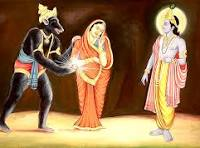
Learning that Prasena had been slain by a lion, which had in turn been killed by a bear on the side of a mountain, Krishna entered the bear’s den. He discovered that the jewel was being used as a toy by a child. Hearing the child’s nurse scream at the sight of the intruder, an enraged Jambavan attacked Krishna. They fought for 28 days and nights before Jambavan finally realised that Krishna was Rama’s reincarnation. Awestruck, Jambavan glorified Krishna and offered the Syamantaka, as well as his daughter, Jambavati, in marriage to the deity. Krishna accepted both of them and provided moksha to the bear king. He then summoned Satrajit to a royal assembly and narrated the tale of the recovery of the Syamantaka. He restored the jewel into the hands of the Yadav king Satrajit. Deeply ashamed of his accusation, Satrajit decided to offer Krishna the hand of his daughter, Satyabhama, regarded as a ‘jewel among women’, as well as the Syamantaka. Krishna married Satyabhama, but declined to receive the jewel, regarding it to be the property of Satrajit, as its donor had been Surya.
Shravan Charity Mission is an NGO that works for poor children suffering from life-threatening diseases, especially cancer. Our posts are meant for our readers, including children and adults, and have a huge variety of content. We also accept donations for our mission. Should you wish to donate to the cause of cancer? The bank details are given below:
Once, in the city of Kanyakubja (present-day Kannauj), there lived a Brahmin named Ajamila.He had studied all the Vedic scriptures from a very young age. He was noble in character and conduct. Well-mannered, free from false pride, he was upright and kind to all living beings.
One day, when Ajamila was gathering flowers in the forest for his daily puja, he saw a beautiful enchantress. Her beauty captivated him, and immediately he fell under her wicked spell.
Soon, Ajamila drove out his faithful wife and elderly parents from his home. He married the enchantress and had many children with her. Ajamila, who had once led a chaste life, now spent his days trying to please his immoral wife. He indulged in many sinful activities that he would have never done before.
Despite being born a Brahmin, Ajamila started killing innocent animals to feed his large family. He began stealing and cheating others, and even encouraged his sons to follow a similar sinful path.
Among all his children, Ajamila was especially fond of his youngest son. His name was Narayana. The child’s innocent behaviour and playful ways had won over Ajamila’s heart. He spent most of his time with Narayana.
Years passed, one day, when Ajamila was old and on his deathbed, he saw three Yamadutas, the terrifying servants of Yamaraja, the god of death, coming towards him. They had come to take Ajamila’s soul and punish him for all the sins that he had committed in his life.
Gripped by intense fear, Ajamila began to weep. In panic, he started calling out the name “Narayana,” which was his beloved son’s name.And, he kept calling ‘Narayana’ on and on, without realising that he was actually chanting the holy name of Lord Narayana.
The Vishnudutas, who weremessengers of Lord Vishnu, heard the holy name of their Lord being chanted by Ajamila on his deathbed, and immediately, they rushed to the scene.
Just as the Yamadutas were about to pull Ajamila’s soul out of his body, the Vishnudutas arrived there and tried to stop them. But the Yamadutas refused to listen. They insisted that Ajamila should be punished for his sins. The Vishnudutas then explained, “Ajamila has already atoned for his sins. Not only those sins committed in this life, but also for those committed over millions of lifetimes, simply by chanting the holy name of Narayana in his helpless state. The name of the Lord is divine. Even though Ajamila was unaware, each time he called his son by his name Narayana, he was actually chanting the Lord’s name and cleansing himself of his sins. Lord Narayana protects those who chant His Holy Name.”
The Yamadutas were thus silenced by the profound wisdom of the Vishnudutas. Defeated, they returned to Yamaraja, their master, and recounted all that had happened. Yamaraja concurred with what they had been told. He said, “What you have heard is true. Although I’m your master, Lord Narayana is the Supreme Lord of the entire universe, and we are all His servants.” He added, “Just as a king has ministers to carry out his commands, I and other demigods work under the direction of the Supreme Lord.”
Yamaraja then explained the rewards of chanting the holy name of Lord Narayana:
“Even the most sinful person is taken to the Supreme Lord’s abode, and he is freed from all punishment if he chants the holy name of Lord Narayana at the time of his death. Lord Narayana will always protect those who chant His holy name.”
He then advised his servants never to bring a person who chants the Holy Name or engages in the devotional service to Lord Narayana. Instead, they should bring only those who do not chant or fail to remember the lotus feet of the Supreme Lord.
Ajamila sincerely bowed to the Vishnudutas when he realised he had been saved from the Yamadutas. He expressed gratitude for rescuing him from going to Naraka. Reflecting on his past sins, Ajamila was filled with remorse for having abandoned his first wife and parents. He now clearly saw the wrongs he had committed.
Ajamila now understood the immense power in chanting the holy name of Lord Narayana. He deeply regretted wasting his life in sinful acts and resolved that, if given a second chance, he would dedicate himself to the service of the Lord.
By the mercy of the Lord Narayana, Ajamila was granted a second chance to live. He seized the opportunity and went to Haridwar, where he spent the rest of his life chanting and serving Lord Vishnu, also known as Lord Narayana.
One day, when Ajamila was meditating, he saw a golden aircraft descending from the sky. Inside it were the same Vishnudutas who had saved him earlier. They had now come to take him to his eternal home,the abode of Lord Narayana.
Ajamila peacefully left his body on the banks of the sacred Ganga River in Haridwar and joined the Vishnudutas to serve his Supreme Lord forever.
Shravan Charity Mission is an NGO that works for poor children suffering from life-threatening diseases, especially cancer. Our posts are meant for our readers, including children and adults, and have a huge variety of content. We also accept donations for our mission. Should you wish to donate to the cause of cancer? The bank details are given below:
The human lifespan, though finite, is a precious gift that we spend on various pursuits—some meaningful, others fleeting. The longest human lifespan recorded is just over 120 years, or about 43,800 days. However, the global average life expectancy, according to a 2022 data, is around 72 years (26,280 days). As we traverse through life, we inevitably pass through different stages, each with its own set of milestones. But just as life brings moments of joy and accomplishment, it also serves as a reminder that time is always moving forward, unstoppable and indifferent. This brings to mind the famous song from the 1966 Raj Kapoor film Teesri Kasam – “Sajan Re Jhoot Mat Bolo, Khuda ke pas jaana hai, na hathi hai na ghoda hai wahan paidal hi jaana hai” (Don’t tell lies, for when you stand before God, there are no horses or elephants, only your own feet to carry you). Time waits for no one, and it eventually strips away the superficiality of life, leaving behind only what truly matters.
In Hindu philosophy, this journey of life is divided into four Ashramas—stages that represent the different phases of human existence: Brahmacharya (Student Stage), Grihastha (Householder Stage), Vanaprastha (Hermit Stage), and Sannyasa (Wandering Ascetic Stage). Each stage has a unique essence, from learning and acquiring knowledge to fulfilling familial responsibilities and eventually renouncing worldly attachments. However, as we near the end of our lives, the burden of materialism fades, and the wisdom of introspection takes center stage.
As we navigate through life, we are given the freedom by the Supreme God to perform our actions—our karmas. In this game of life, one might succeed in areas like politics, career, or accumulating wealth, but these achievements often come at the cost of neglecting spirituality. The Srimad Bhagwatam reminds us that even when we live in a community, our karma is personal and individual. This is why it’s crucial to continuously audit our actions and the time we spend on Mother Earth. We cannot afford to wait until the end of our lives to reflect on the sum total of our experiences. Now is the time to evaluate how we’ve affected others—how many smiles we’ve shared, and how many we’ve taken away.
A poignant story captures this lesson: A notorious man meets a Sadhu, who informs him that he will die in a month. Upon hearing this, the man undergoes a dramatic transformation. He begins apologizing for his past wrongs, seeking forgiveness from those he hurt. On the 30th day, he approaches the Sadhu again, sharing how he has completely changed. The Sadhu reveals that he was never going to die, but he merely frightened him into reforming his ways. This story illustrates the deep impact time, or the awareness of its passage, can have on our actions and behavior.
Karma is deeply intertwined with time. Our actions in the past shape the present, and our present actions will determine our future. Yet, the key to karma lies in intention. The intention behind our actions is what truly matters. When we act out of pure desire for the fruits of our labor, anxiety and misery follow, as we become fixated on outcomes. But when we perform our duties with the right intention, seeking neither reward nor recognition, we align ourselves with the true purpose of life.
Ultimately, the message is clear: auditing our days on Earth isn’t just about assessing what we’ve achieved in the material world, but about evaluating the kindness we’ve extended and the harm we’ve caused. By striving for spiritual growth alongside our worldly pursuits, we can lead a more fulfilling and purposeful life. Time, after all, is the one thing we cannot control, so we must use it wisely.
Shravan Charity Mission is an NGO that works for poor children suffering from life-threatening diseases, especially cancer. Our posts are meant for our readers, including children and adults, and have a huge variety of content. We also accept donations for our mission. Should you wish to donate to the cause of cancer? The bank details are given below:
NAME OF ACCOUNT: SHRAVAN CHARITY MISSION
Account no: 680510110004635 (BANK OF INDIA)
IFSC code: BKID0006805
*
Publications of Kamlesh Tripathi
BOOK TITLE: GLOOM BEHIND THE SMILE
(The book is about a young cancer patient. Now archived in eight prestigious libraries of the US which include Harvard College Library; Harvard University Library; Library of Congress; University of Washington, Seattle; University of Minnesota, Minneapolis; Yale University, New Haven; University of Chicago; University of North Carolina, at Chapel Hill University Libraries. It can also be accessed at MIT through Worldcat.org. Besides, it is also available for reading in the libraries and archives of Canada; the Open Library; Cancer Aid and Research Foundation Mumbai; Jaipuria Institute of Management, Noida, India; Shoolini University, Yogananda Knowledge Center, Himachal Pradesh and Azim Premzi University, Bangalore and the Library of Cancer Aid and Research Foundation, Mumbai. The title also finds a mention in a book titled ‘Enduring Cancer: Life, Death and Diagnosis in Delhi’ by Dwaipayan Banerjee published by the Duke University Press).
BOOK TITLE: ONE TO TANGO … RIA’S ODYSSEY
(It is a book on ‘singlehood’ about a Delhi girl now archived in Connemara Library, Chennai and Delhi Public Library, GOI, Ministry of Culture, Delhi; It is also available for reading in the Indian National Bibliography, March 2016, in the literature section, in Central Reference Library, Ministry of Culture, India, Belvedere, Kolkata-700022)
BOOK TITLE: AADAB LUCKNOW … FOND MEMORIES
(This is a fiction written around the great city of Nawabs—Lucknow. It describes Lucknow in great detail and also talks about its Hindu-Muslim amity, which is the undying characteristic of Lucknow. The book was launched at the Lucknow International Literary Festival in 2014. It is catalogued and included for reading in Askews and Holts Library Services, Lancashire, U.K; Herrick District Library, Holland; Charlotte-Mecklenburg Library, Mecklenburg County, North Carolina, USA; Black Gold Cooperative Library Administration, Arroyo Grande, California; Berkeley Library, University of California; The Peshastin Public Library and The George Public Library near Washington, a Northern Central Washington Libraries branch; the Flagstaff City-Coconino County Public Library in Arizona in the US and the Salina Public Library, Kansas, USA.
BOOK TITLE: REFRACTIONS … FROM THE PRISM OF GOD
(Co-published by Cankids–Kidscan, a pan India NGO and Shravan Charity Mission, that works for child cancer in India. The book is endorsed by Ms Preetha Reddy, MD Apollo Hospitals Group. It was launched at the Lucknow International Literary Festival in 2016).
BOOK TITLE: TYPICAL TALE OF AN INDIAN SALESMAN
(Is a story of an Indian salesman who is, humbly qualified. Yet he fights his way through unceasing uncertainties to reach the top. A good read not only for salesmen but for any reader. The book was launched on 10th February 2018 at Gorakhpur Lit-Fest. Now available on Amazon, Flipkart and Onlinegatha)
BOOK TITLE: RHYTHM … IN POEMS
(Published in January 2019. The book contains 50 poems. The poems are about our day-to-day life. Poems from this book have been published in Shillong Times, Bandra Times, Bhavan’s Journal and Arunachal Times and Goan net. The book is available on Amazon, Flipkart and Onlinegatha)
BOOK TITLE: MIRAGE
(Published in February 2020. The book is a collection of eight short stories available on Amazon, Flipkart and Notion Press)
BOOK TITLE: AWADH ASSAM AND DALAI LAMA … The Kalachakra
(It is the story of the man who received His Holiness The Dalai Lama and his retinue in 1959 as a GOI representative when he fled Tibet in 1959. The book was launched on 21st November 2022 by His Holiness The Dalai Lama at Dharmshala. The title is archived in the library of the Department of Information and International Relations (DIIR) Government of Tibet, Tibet Policy Institute (TPI) and the personal library of His Holiness The Dalai Lama. The title is also archived in The Ohio Digital Library, USA. It was recently included in the digital library of the world-renowned company APPLE. Included in the Library of Friends of Tibet and Maharashtra Mitra Mandal Library in Bandra, Mumbai.
(POEMS, SHORT STORIES AND ARTICLES OF KAMLESH TRIPATHI PUBLISHED IN NEWSPAPERS, JOURNALS AND MAGAZINES)
TIMES OF INDIA
Speaking Tree: Basant Celebrates Ma Saraswati, Shiv, And Spring 1.2.25;
BHAVANS JOURNAL
Short stories, Book reviews and Articles published in Bhavan’s Journal: 1. Reality and Perception, 15.10.19; 2. Sending the Wrong Message, 31.5.20; 3. Eagle versus Scholars, June, 15 & 20, 2020; 4. Indica, 15.8.20; 5. The Story of King Chitraketu, August 31 2020; 6. Breaking Through the Chakravyuh, September 30 2020. 7. The Questioning Spouse, October 31, 2020; 8. Happy Days, November 15, 2020; 9. The Karma Cycle of Paddy and Wheat, December 15, 2020; 10. Power Vs Influence, January 31, 2021; 11. Three Refugees, March 15, 2021; 12. Rise and Fall of Ajatashatru, March 31, 2021; 13. Reformed Ruler, May 15, 2021; 14. A Lasting Name, May 31, 2021; 15. Are Animals Better Teachers? June 16, 2021; 16. Book Review: The Gram Swaraj, 1.7.21; 17. Right Age for Achievements, 15.7.21; 18. Big Things Have Small Beginnings, 15.8.21; 19. Where is Gangaridai?, 15.9.21; 20. Confront the Donkey Within You 30.9.21; 21. Know Your Strengths 15.10.21; 22. Poverty 15.11.21; 23. Top View 30.11.21; 24. The Bansuriwala 15.1.22; 25. Sale of Alaska 15.2.22; 26. The Dimasa Kingdom 28.2.22;27. Buried Treasure 15.4.22; 28. The Kingdom of Pragjyotisha 30.4.22; 29. Who is more useful? 15.5.22; 30. The White Swan from Lake Mansarovar 30.6.22; 31. Bhool Bhulayya 15.9.22; 32. Good Karma 30.9.22; 33. Good Name vs Bad Name 15.10.22; 34. Uttarapath—The Grand Trunk Road 1.12.22; 35. When Gods Get Angry 1.1.23; 36. Holinshed’s Chronicles 15.1.23; 37. Theogony 15.2.23; 38. Poem: Mother 14.5.23; 39. The Nag Mandir 30.6.23; 40. The Story of Garuda 30.7.23; 41. Janmabhoomi vs Karmabhoomi 31.8.23; 42. The Ghost Town of Kuldhara 15.9.23; 43. The Tale of Genji 15.10.23; 44. The Soul Connection 1.12.23; 45.Book review: Jungle Nama … a story of the Sundarban 16.3.24; 46. Book review: A Forgotten Chapter 16.5.24; 47. Exploring Ancient Egypt, 1.8.24; 48. The Story of Dhruva, 16.8.24; 49. Two Hundred Years of Tea in Assam 16.9.24; 50. The Cosmic Messenger 16.10.24; 51. Biblioburro: The Four-Legged Library 16.11.24; 52. The Cologne Cathedral 1.1.25; 53. Gandhi to Mahatma 16.1.25;
THE SHILLONG TIMES
Articles & Poems: 1. Poem: Happy New Year 8.1.23; 2.Poem: Spring 12.3.23; 3.Poem: Right and Wrong 20.3.23; 4.The Gush of Emotion—Writing, 26.3.23; 5. The Nag Mandir, 7.5.23; 6. Poem: Mother 7.5.23; 7. Poem: Rain Rain 9.7.23; 8. Poem:You Come Alone You Go Alone 6.8.23; 9. Poem: Rain Rain (Second Time) 10.8.23; 10. Poem: Guru Teacher 1.10.23; 11. Poem: Autumn … The Interim Heaven 15.10.23; 12. Poem: Happy Diwali 12.11.23; 13. Overcoming Blindness: Learn it the John Milton Way 10.12.23; 14. The Happy Prince and The Happy Man’s Shirt 31.12.23; 15. Annus Mirabilis -2024 7.1.24; 16. Gandhi to Mahatma Gandhi- Incidents that Shaped Gandhi in South Africa 28.1.24; 17. Poem: Together But Not Made For Each Other, 11.2.24; 18. The Birds Bees and The Spiders of Nicholas Guildford and Jonathan Swift 25.2.24; 19. The Overcoats of Nikolai Gogol and Ruskin Bond 10.3.24; 20. The Ethnic Colours of Holi 24.3.24; 21. A Lesson from Dalai Lama, 21.4.24; 22. Poem: Morning Walk 28.4.24; 23. Trip to Rhine Falls, Switzerland, 19.5.24; 24. Poem: Hurt 2.6.24; 25. Poem: Your Conscience Was My Sign On 16.6.24; 26.Poem: The Eerie Ways of Time 7.7.24; 27.Poem: Celebrating the T20 World Champions 14.7.24;28. Read to Rise above mediocrity, 4.8.24; 29. Poem: Desire vs Reality 11.8.24; 30. Jack Ma’s Pristine Advice to Employers, Employees and the Youth 22.9.24; 31. Tagore and Kipling 3.11.24; 32. Poem: Merry Christmas 22.12.24; 33. Poem: The Sunset Point, 5.1.25; 34. Cancer Warning Labels on Alcoholic Beverages, 12.1.25; 35. Poem: Hope … In the Arc of Twilight, 19.1.25; 36. Basant Panchami celebrates the Arrival of Spring 2.2.25; 37. Poem: The Falling World Order, 9.2.25;
THE ASSAM TRIBUNE
Article: 1. The Magic of Reading 11.12.23; 2. Gandhi to Mahatma 29.1.24; 3. Geography of Solitude 8.4.24; 4. A Lesson From Dalai Lama, 22.4.24; 5. A Source of Inspiration, 29.4.24; 6. The Four-LeggedLibrary, 12.5.24; 7. Age and Achievement, 10.6.24; 8. Read … To Rise Above Mediocrity, 1.7.24; 9. Crusade for a College, 25.8.24; 10. Hemingway’s Iceberg Theory (Panorama) 27.9.24; 11. Short story: Love in the Air, 20.10.24; 12. Short story: The Prick of Conscience, 5.1.25; 13. Lost in translation, 6.1.25; 14. Travellers’ tales 20.1.2025;
THE ARUNACHAL TIMES
Poem: 1. Hope—In The Arc of Twilight, 13.8.23; 2.Poem: Spring 3.3.24; 3.Poem: The Morning Walk 10.3.24;
BANDRA TIMES, MUMBAI
Articles & Poems: 1. Poem: SPRING, 1.4.23; 2. Poem: Mother, 1.6.23; 3. Poem: Rain Rain, 1.8.23; 4. A Lesson From Dalai Lama, 1.6.24; 5. Read to rise above Mediocrity 1.8.24
THE GOAN NET
Poem: 1. Autumn – The Interim Heaven, 6.10.24; 2. Reader’s Rewind 17.11.84; 3. Reader’s Rewind: The Irony of Tash Moustache or Mooch 5.12.24; 4. The Sunset Point 22.12.24; 5. Reader’s Rewind: The Joy of a Morning Walk, 3.1.25; 6. Harmony in creation 26.1.25; 7. Poem: What is truly Good for me? 2.1.25; 8. Poem: We both were left behind, 9.2.25;
ARTICLES IN THE DIGITAL MAGAZINE ESAMSKRITI
Aritcles: 29.12.2020: Indica by Megasthenes; 14.3.22: About The Dimasa Kingdom Assam; 10.12.22: Grand Trunk Road–Uttarapath; 5.10.23: The Ghost Town of Kuldhara Near Jaisalmer;
(ALL THE ABOVE BOOK TITLES ARE AVAILABLE FOR SALE ON AMAZON, FLIPKART AND OTHER ONLINE STORES OR YOU COULD EVEN WRITE TO US FOR A COPY)


 Shravan charity mission