Copyright@shravancharitymission
Just as it is believed that Gods and Asuras (demons) claimed ‘Amrit’ by churning the ocean, in the great mythological event of Samundra Manthan, which happens to be the genesis of the world-famous ‘Kumbh Mela’, now considered the biggest spiritual congregation on earth. It is also believed that either Lord Krishna or Arjuna brought the Parijaat Tree from heaven.
Parijaat is considered a sacred Baobab tree. Modern science traces its origin to Sub-Saharan Africa. The tree may have been planted in India by someone who travelled between India and Africa. By the order of the local district magistrate, any form of damage to the tree is strictly prohibited. The tree stands in the village of Kintoor, in the district of Barabanki, in Uttar Pradesh. In botanical terms, Parijaat is known as Adansonia Digitata. The Government website places it in a special category because it does not bear either fruits or seeds, and neither can its branch-cuttings be planted to reproduce a second Parijaat tree. It is also known as “the tree from paradise”. Its age is difficult to determine. Botanists describe it as a unisex tree. It is unique and has not been found anywhere else. The leaves at the lower part of the tree have five tips like the fingers of a hand, while those at the upper part have seven tips.
Parijaat bears beautiful flowers with snow-white petals, five in number, with a red stalk. After drying up, the flowers take on a golden hue. They bloom only at night and shed before sunrise. They also possess medicinal value. The tree blossoms occasionally, with very few flowers, but after ‘Ganga Dussehra’, a Hindu festival that commemorates the day the holy Goddess Ganga descended from heaven to Earth to purify the souls of King Bhagiratha’s ancestors. Its fragrance spreads far and wide. The tree’s age is estimated between 1000 and 5000 years, with a trunk perimeter of around 50 feet, and a height of around 45 feet.
Village Kintoor is named after Kunti, the mother of the Pandavas. It is about 38 km east of the district headquarters, Barbanki. Several ancient temples and ruins are also found in the area. Near the temple established by Kunti in the village of Kintoor stands the Parijaat Tree, which, according to a legend, grew out of Kunti’s ashes.
Many other legends about this tree find popular acceptance. One being, Arjuna, brought it from heaven, and Kunti offered its flowers to Lord Shiva.
There is also a sad myth according to which Princess Parijataka was in love with the Sun God, but her love was never reciprocated. Heartbroken, she committed suicide and from her ashes rose the Parijaat Tree. Unable to bear the sight of her love during the day, she blooms only at night and sheds her flowers as tears, before sunrise.
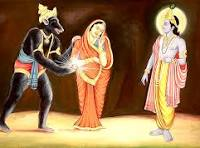
Another story is that Lord Krishna brought this tree for his queen, Satyabhama or Rukmini. According to Harivansh Puraan, the Parijaat Tree is a Kalpavriksha or wish-fulfilling divine tree, otherwise found only in heaven. Newlyweds visit the tree for blessings, and every Tuesday, a fair is held where local people worship the tree.
Some myths suggest that the tree sheds its tears at the touch of the first rays of the sun. Its flowers spread their fragrance in the entire area during the day. According to another myth, the Parijaat tree was planted in Indralok, which was one of the gifts received from the Samudra Manthan. It was thus a celestial plant, not available on earth. To sow seeds of discord, sage Narada brought some flowers from Indralok and gave them to Lord Krishna. He then waited to see to which of his wives Krishna would present them. Finally, Krishna gave the flowers to Rukmini. On seeing this, Narada went to Satyabhama, Krishna’s other wife and told her about it.
On hearing this, Satyabhama felt very jealous. Narada then gave her a solution. He suggested that she should insist on Krishna getting the plant itself from Indralok and plant it at her home, instead of a few flowers. Satyabhama decided to do that, and when Krishna came to her quarters, she expressed her anger and disappointment over the entire incident and insisted that he retrieve the whole plant from Indralok.
In the meantime, Narada went and warned Indra that some earthlings were out to steal the celestial plant from his Indralok. Meanwhile, when Krishna and Satyabhama were about to leave Indralok, after obtaining the celestial Parijaat tree, they were accosted by Indra. Soon, a battle broke out between them in which Indra lost.
But Indra would not let it go so easily. He cursed that the plant would never bear fruit again, though it might bear flowers, and since then, the Parijaat tree does not bear any fruit.
Having brought the tree to Dwarka, Rukmini also took a fancy to the tree because of its flowers. Krishna planted the tree in such a manner that, though the tree was planted in Satyabhama’s house, when it bore flowers, they would fall in Rukmini’s home. Satyabhama had asked for the tree, and she got it. Rukmini wanted the flowers, and she too got it.
It is believed that the Parijaat Tree in village Kintoor, in district Barabanki, in Uttar Pradesh, dates back to the Mahabharat era. It is mentioned in the Mahabharat that Sri Krishna uprooted the Parijaat Tree from the kingdom of Indira, the King of the Devas.
Another legend in the Puranas suggests that Arjuna of the Mahabharata brought the Parijaat Tree for his mother Kunti, who offered it to Shiva.
Written and posted by Kamlesh Tripathi
Author, Poet, & Columnist
*
https://kamleshsujata.wordpress.com
*
Like it and Share it
*
Shravan Charity Mission is an NGO that works for poor children suffering from life-threatening diseases, especially cancer. Our posts are meant for our readers, including children and adults, and have a huge variety of content. We also accept donations for our mission. Should you wish to donate to the cause of cancer? The bank details are given below:
NAME OF ACCOUNT: SHRAVAN CHARITY MISSION
Account no: 680510110004635 (BANK OF INDIA)
IFSC code: BKID0006805
***
 Shravan charity mission