Copyright@shravancharitymission
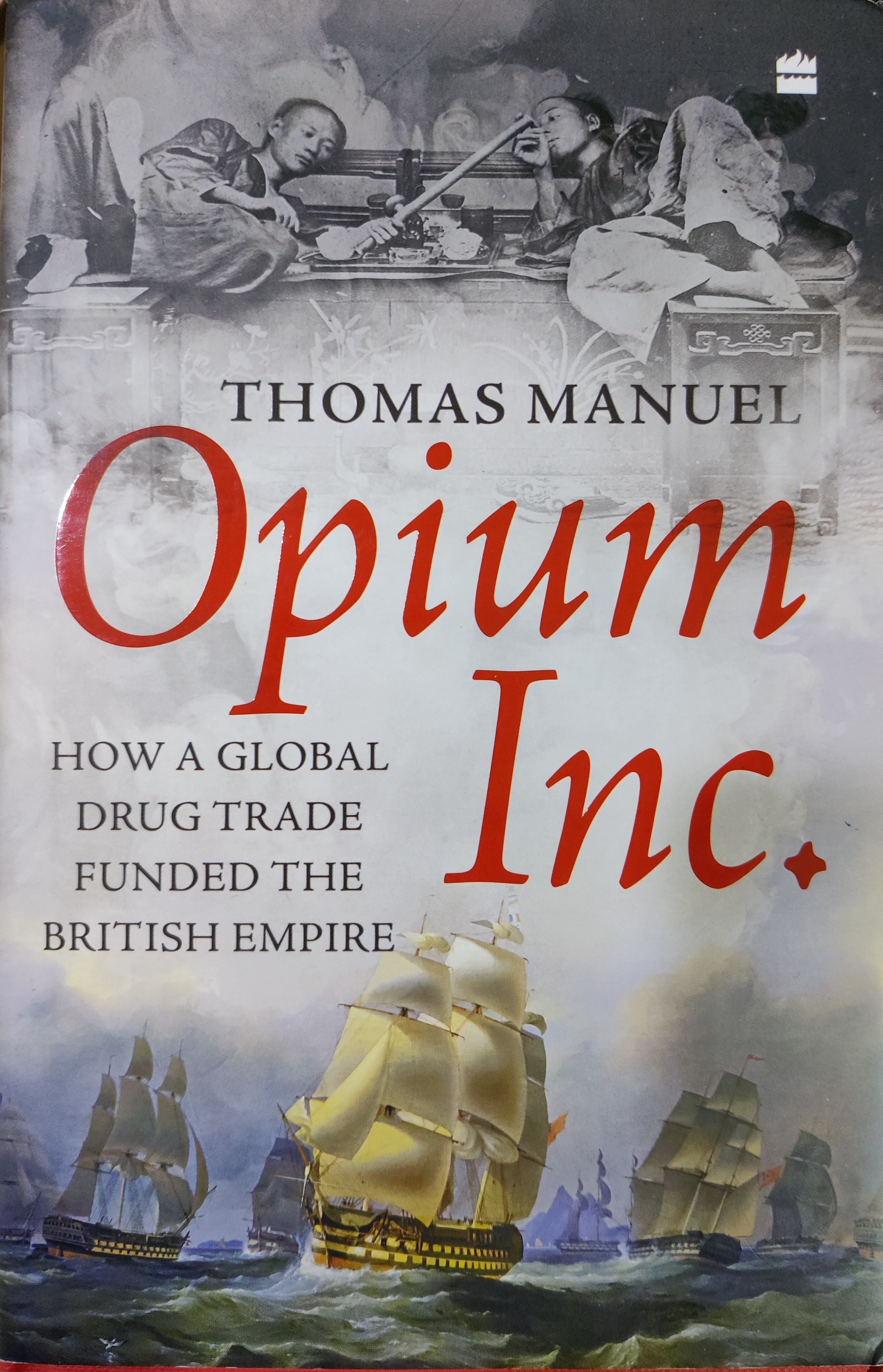
Book Review: ‘OPIUM INC. … How a Global Drug Trade Funded the British Empire’ by Thomas Manuel.
The subject book brings to us the story of the world’s biggest drug deal ever, first published in India in 2021 by Harper Collins. It wouldn’t be out of context to mention at the very outset that the author must have researched to the hilt, digging deep into various historical texts, available, on the global opium supply chain and opium trade, before he penned the book.
Author Thomas Manuel is a journalist. He is also an award-winning playwright whose work revolves around history, science, education, or the intersection of all three. His words can be found in Lapham’s Quarterly, Nib, Wire and The Hindu, among other publications. In 2016, he won The Hindu Playwright Award for his play Hamlet and Angad. He currently works at India Ink, a public history project where he makes videos about how the past continues to affect the world today.
Contents: It starts with the Prologue: The Great Opium Triangle. The book is divided into eleven chapters. I would briefly take you through all of them without being a spoiler. It starts with the ‘Poppy Pioneers’ and then talks of how the opium trade flourished and travelled ‘From Calcutta to Canton’ in China. Canton is also known as Guanzhou. It was captured by the British during the first Opium War. This is followed by the ‘Smugglers of Malwa.’ Then there is also ‘The Bombay Boom’ that comes with the opium money. One of the book’s most interesting sections is ‘The Opium Wars’ which gave rise to ‘Anti-Opium Crusaders.’ The narration also takes you through ‘Opium and Independence’, its ‘Endings and Legacies’. One of the prominent chapters of the book is about the spread of ‘Opium, Cotton, Sugar and slavery’, followed by ‘Opium Smoke and Mirrors’ and it ends with ‘Opium Today’. This is followed by the Index and then a half-page on the author. The language of the author is plain English which is easy to comprehend but is garnished with a plethora of quotes from various texts that make up for a large part of the plot.
What the book offers: This is the story of the world’s biggest drug dealers. In the 19th century, the British East India Company operated a triangle of trade that straddled the globe, running from India to China to Britain. From India to China they took opium. From China to Britain they took tea. From Britain to India, they brought the British Empire. To paraphrase the historian Tan Chung: The Chinese got opium, the British got tea, and the Indians got colonialism. It was a machination that belied what was really going on: The British were enabling the longest-running drug deal ever in the history of the world. It was a devious plan that worked with cheap Indian land and labour and spun money for them. This is the story about the banality of evil, the birth of mega-corporations and the world’s first narco-state. The British had two problems, though. They were importing enormous amounts of tea from China, but the Celestial Empire (China) looked down on British goods and only wanted silver in return. Simultaneously, the expanding colony in India was proving far too expensive to maintain. The British solved both problems with opium, which became the source of income on which they built their empire. For more than a century, the British knew that the drug was dangerous but continued to trade in it anyway and today they talk of morality. They put their colony to work to produce something that the Chinese would buy even if they didn’t want it and that was opium. Over the 18th and 19th centuries, the British transformed the entire farming economies in Bengal and Bihar into opium-producing zones. And their agents smuggled the drug illegally into China, exchanging it for tea. Suddenly, the balance of trade leaned the other way. Silver started flowing back, out of China and into the British hands. Slowly this new equation solidified into a stable mechanism: The Great Opium Triangle. The story of the opium trade is not just about the narcotics that were stored in chests and packed in ships. It was also about how that trade shaped the world we live in today. It left an undying legacy in India, whether it was Bihar’s poverty or the affluence of Bombay, the story of opium is one of immense pain for many and huge privileges for a few.
My take on the book: If you haven’t read about opium you wouldn’t know what havoc it created and continues to create in the world. Opium Inc. sensitises you towards that. While reading the book one gets a feeling as if the author has collated the data from various texts and churned it into a book. In a span of 252 pages, he has plugged around 350 notations from various documents of various authors that go to show the extent of his extensive fact-finding. Every chapter is summarised in the preface itself in a few sentences which creates that initial enamour to run through the book. It has plenty of inside stories and anecdotes some hitherto unheard of. The detailing of how opium was processed in those times is enumerated quite well. From the opium seed to the market, the narration is comprehensive. How the opium markets in China operated is explained substantially well that many would not know. The description of Hong Merchant Pan Zhencheng in the chapter from Calcutta to Canton is engrossing. The book gets interestingly descriptive in the middle. The chapter ‘Smugglers from Malwa’ is elaborate on opium farming, its production and its trading. This is a book with a lot of yarn which otherwise for an average reader would be difficult to ferret out.
The author must have spent an aeon reading and collecting relevant data for the title. Information such as the first clipper in India was built in the 19th century in Howrah was a treat to read, even when, it was an opium clipper. The history of Bombay (Mumbai) is well carved out with its opium past and so are the daring stories of Jamsetjee Jejeebhoy and Sasson who flourished there.
We all talk of contract farming today. The cultivation of opium under ‘contract farming’ started way before it came to other crops in the opium-growing areas. The author has also covered the story of Lin Zexu a high Chinese official best known for his role in the ‘First Opium War’ in whose honour a statue has been erected in Chatham Square in China Town, New York. The book proclaims that the opium wars were akin to the lethal world wars. After page 136 the pace of narration slows down a bit as it is loaded with minute details and names which are difficult to remember. There is one story after another and episode after episode. The narration covers the long history of sugar, opium, tea and cotton in a triangular context—India, China and Great Britain in elaborate detail. It gives a scheming view of the cross-ocean business mercantile.
What the book delivers: The real success of any book is how it impacts you after you’ve read it, and more so, do you feel knowledge-rich after reading it? Well, on those accounts the book is sterling. It tells you how the British demolished Asia. The narration transcends from opium to sugar to cotton under the umbrella of The East India Company. It touches upon most writers who consumed opium or have written on opium and it also includes all those languishing documents on opium. There are some rare pictures too in the book on the manufacturing of opium such as—The Mixing Room, The stacking room, The Examining Hall at the Opium Factory, Patna, 1850; and the Opium Fleet on the Ganges, 1850.
It breezes past romantic poets who were opium users and quotes the lines of a few. The book spans from the historical past of opium to the present. A line from the poem ‘Kubla Khan’ by the English Romantic poet Samuel Taylor Coleridge sums up all too well. It goes as follows:
Beware! Beware!
His flashing eyes, his floating hair!
Weave a circle round him thrice,
And close your eyes with holy dread,
For he on honey-dew hath fed,
And drunk the milk of Paradise.
But whether the ‘milk of Paradise’ that climaxes the lines of Coleridge is opium isn’t clear. But it’s true that Coleridge consumed opium regularly. I would give the book a high rating. It definitely enhances your knowledge base when it comes to opium, tea, cotton and the triangle connecting India, China and the British Crown through The East India Company.
***

By Kamlesh Tripathi
*
https://kamleshsujata.wordpress.com
*
Share it if you like it
*
Shravan Charity Mission is an NGO that works for poor children suffering from life threatening diseases especially cancer. Our posts are meant for our readers that includes both children and adults and it has a huge variety in terms of content. We also accept donations for our mission. Should you wish to donate for the cause. The bank details are given below:
NAME OF ACCOUNT: SHRAVAN CHARITY MISSION
Account no: 680510110004635 (BANK OF INDIA)
IFSC code: BKID0006805
*
Our Publications
GLOOM BEHIND THE SMILE
(The book is about a young cancer patient. Now archived in 8 prestigious libraries of the US that includes Harvard College Library; Harvard University Library; Library of Congress; University of Washington, Seattle; University of Minnesota, Minneapolis; Yale University, New Haven; University of Chicago; University of North Carolina, at Chapel Hill University Libraries. It can also be accessed in MIT through Worldcat.org. Besides, it is also available for reading in libraries and archives of Canada, Cancer Aid and Research Foundation Mumbai; Jaipuria Institute of Management, Noida; India. Shoolini University, Yogananda Knowledge Center, Himachal Pradesh and Azim Premzi University, Bangalore).
ONE TO TANGO … RIA’S ODYSSEY
(Is a book on ‘singlehood’ about a Delhi girl now archived in Connemara Library, Chennai and Delhi Public Library, GOI, Ministry of Culture, Delhi; Available for reading in Indian National Bibliography, March 2016, in the literature section, in Central Reference Library, Ministry of Culture, India, Belvedere, Kolkata-700022)
AADAB LUCKNOW … FOND MEMORIES
(Is a fiction written around the great city of Nawabs—Lucknow. It describes Lucknow in great detail and also talks about its Hindu-Muslim amity. That happens to be the undying characteristics of Lucknow. The book was launched in Lucknow International Literary Festival of 2014. It is included for reading in Askews and Holts Library Services, Lancashire, U.K; Herrick District Library, Holland and Charlotte-Mecklenburg Library, Mecklenburg County in North Carolina, USA; Black Gold Cooperative Library Administration, Arroyo Grande, California).
REFRACTIONS … FROM THE PRISM OF GOD
(Co-published by Cankids–Kidscan, a pan India NGO and Shravan Charity Mission, that works for Child cancer in India. The book is endorsed by Ms Preetha Reddy, MD Apollo Hospitals Group. It was launched in Lucknow International Literary Festival 2016)
TYPICAL TALE OF AN INDIAN SALESMAN
(Is a story of an Indian salesman who is, humbly qualified. Yet he fights his way through unceasing uncertainties to reach the top. A good read not only for salesmen. The book was launched on 10th February 2018 in Gorakhpur Lit-Fest. Now available on Amazon, Flipkart and Onlinegatha)
RHYTHM … in poems
(Published in January 2019. The book contains 50 poems. The poems describe our day-to-day life. The book is available on Amazon, Flipkart and Onlinegatha)
MIRAGE
(Published in February 2020. The book is a collection of eight short stories available in Amazon, Flipkart and Notion Press)
AWADH ASSAM AND DALAI LAMA … The Kalachakra
(The story of the man who received His Holiness The Dalai Lama and his retinue in 1959 as a GOI representative when he fled Tibet in 1959. The book was recently launched on 21st November 2022 by His Holiness The Dalai Lama and is archived in his library).
BHAVANS JOURNAL
Short stories, Book reviews and Articles published in Bhavan’s Journal: 1. Reality and Perception, 15.10.19; 2. Sending the Wrong Message, 31.5.20; 3. Eagle versus Scholars June, 15 & 20 2020; 4. Indica, 15.8.20; 5. The Story of King Chitraketu, August 31 2020; 6. Breaking Through the Chakravyuh, September 30 2020. 7. The Questioning Spouse, October 31, 2020; 8. Happy Days, November 15, 2020; 9. The Karma Cycle of Paddy and Wheat, December 15, 2020; 10. Power Vs Influence, January 31, 2021; 11. Three Refugees, March 15, 2021; 12. Rise and Fall of Ajatashatru, March 31, 2021; 13. Reformed Ruler, May 15, 2021; 14. A Lasting Name, May 31, 2021; 15. Are Animals Better Teachers?, June 16, 2021; 16. Book Review: The Gram Swaraj, 1.7.21; 17. Right Age for Achievements, 15.7.21; 18. Big Things Have Small Beginnings, 15.8.21; 19. Where is Gangaridai?, 15.9.21; 20. Confront the Donkey Within You 30.9.21; 21. Know Your Strengths 15.10.21; 22. Poverty 15.11.21; 23. Top View 30.11.21; 24. The Bansuriwala 15.1.22; 25. Sale of Alaska 15.2.22; 26. The Dimasa Kingdom 28.2.22; 27. Buried Treasure 15.4.22; 28. The Kingdom of Pragjyotisha 30.4.22; 29. Who is more useful? 15.5.22; 30. The White Swan from Lake Mansarovar 30.6.22; 31. Bhool Bhulayya 15.9.22; 32. Good Karma 30.9.22; 33. Good name vs Bad Name 15.10.22; 34. Uttarapath—The Grand Trunk Road 1.12.22; 35. When Gods Get Angry 1.1.23; 36. Holinshed’s Chronicles 15.1.23
SUNDAY SHILLONG TIMES
POEM HAPPY NEW YEAR 8.1.23;
(ALL THE ABOVE BOOK TITLES ARE AVAILABLE FOR SALE ON AMAZON, FLIPKART AND OTHER ONLINE STORES OR YOU COULD EVEN WRITE TO US FOR A COPY)
*****


 Shravan charity mission