Ex- Senior corporate- writer, author and social activist currently working for poor children suffering from life threatening diseases.
View all posts by shravancharitymission →
The Longest Journey is E. M. Forster’s second novel, published in 1907. It follows Rickie Elliot, a sensitive and imaginative young man, as he struggles between his idealistic view of life and the restrictive conventions of English society.
Rickie is a Cambridge student who loves literature and philosophy. He marries Agnes Pembroke, a conventional and practical woman, partly because he believes marriage will give him stability. However, their relationship is unhappy because Rickie’s emotional and intellectual nature conflicts with Agnes’s conventional outlook.
Rickie later discovers that Stephen Wonham, a young man living a rough rural life, is actually his half-brother. Stephen represents everything Rickie lacks—physical vitality, spontaneity, honesty, and a close connection with nature. Rickie becomes deeply attached to him, but Agnes and her family regard Stephen as socially inferior and try to keep the brothers apart.
Rickie’s relationship with Stephen gradually exposes the emptiness of the respectable social world in which he has been living. His friendship with Stephen and his encounters with people such as Mr. Ansell force him to question conventional ideas about marriage, morality, education, and social class.
The tragedy of the novel is that Rickie fails to completely break away from these conventions. His attempts to reconcile his intellectual life with his natural and emotional instincts ultimately lead to suffering and loss. Stephen survives, but Rickie dies, making the title The Longest Journey symbolic of Rickie’s difficult journey toward self-knowledge and authenticity.
Major themes
Conflict between nature and society
Individuality versus social convention
The limitations of marriage
The importance of friendship and brotherhood
Intellectual life versus instinct and emotion
Class and social prejudice
The search for truth and self-realization
In essence:The Longest Journey is the story of a sensitive young man who struggles to live authentically in a society that values respectability and conformity. Forster contrasts the artificiality of conventional society with the vitality and freedom represented by Stephen and nature.
Jeffrey Archer has passed away aged 86, bringing to an end one of the most colourful, controversial and extraordinary lives in modern British public life. The bestselling novelist, former Conservative politician and peer experienced spectacular success, devastating scandal, enormous wealth and even imprisonment during a career that often appeared more dramatic than the plots of his books. Archer was a man who repeatedly reached the top, suffered extraordinary falls from grace and somehow managed to rebuild his life. Born Jeffrey Howard Archer in north London on 15 April 1940, he grew up in Weston-super-Mare, Somerset. His mother, Lola, worked as a journalist, while the story Archer later presented about his father, William, was considerably grander than the reality. Archer claimed his father had been a decorated First World War hero, but accounts later revealed a troubled past that included a conviction for fraud. Archer was not an outstanding academic, leaving school with three O-levels, but athletics became one of his strengths. After several early jobs, including a brief period with the Metropolitan Police and work as a physical training instructor, he eventually studied at Oxford, where he won a Blue for athletics. Oxford also introduced him to people who would later occupy influential positions in politics, finance and the media. It was during this period that he met chemistry student Mary Weeden, whom he married. “It was love at first sight for me,” Archer later recalled, “but I don’t think it was for her.” His ability to make connections was already becoming apparent. Archer persuaded The Beatles to support a major fundraising campaign for Oxfam before pursuing his growing political ambitions. After serving as a Conservative councillor in London, he entered Parliament as MP for Louth following a by-election victory in 1969. His first parliamentary career lasted only five years. A disastrous investment in a Canadian company left Archer facing financial ruin. Having borrowed heavily to finance the investment, he resigned his parliamentary seat in 1974 while threatened with bankruptcy. That crisis unexpectedly provided the foundations for another career. Archer began writing and published his first novel, Not a Penny More, Not a Penny Less, in 1976. It was followed by Kane and Abel and First Among Equals. Literary critics were not always impressed, but readers certainly were. His fast-moving stories of ambition, wealth, rivalry and dramatic reversals of fortune became hugely successful, turning Archer into one of Britain’s best-known commercial novelists. Yet politics continued to draw him back. Margaret Thatcher appointed Archer Deputy Chairman of the Conservative Party in 1985, but the position lasted only around a year. Following newspaper allegations involving sex worker Monica Coghlan, Archer resigned and subsequently sued the Daily Star for libel. He won the case in 1987 and received £500,000 in damages. The proceedings also produced an infamous remark from trial judge Mr Justice Caulfield. Referring to Archer’s wife Mary, he questioned whether Archer would have sought “cold, unloving, rubber-insulated sex” in “a seedy hotel round about quarter to one on a Tuesday morning after an evening at the Caprice?” For a while, Archer appeared to have survived another potentially career-ending scandal. He returned to public life and was awarded a peerage by Conservative Prime Minister John Major in 1992. By the end of the decade, he was preparing for another major political comeback after being selected as the Conservative candidate for Mayor of London. Then everything unravelled again. A former friend alleged that Archer had lied under oath during his successful 1987 libel action. Archer withdrew from the mayoral race and Conservative leader William Hague publicly declared: “This is the end of politics for Jeffrey Archer. I will not tolerate such behaviour in my party.” This time, the consequences went far beyond losing a political career. Archer was charged with perjury and perverting the course of justice. In 2001, he was convicted and sentenced to four years in prison. Yet even a prison sentence became material for another chapter of his writing career. After spending time in Belmarsh and Weyland prisons, Archer documented his experiences in the three-volume My Prison Diary. He was eventually released after serving half his sentence. “I learned a lot from it,” Archer later said. “The British people are very forgiving.” His political ambitions were effectively finished, but his extraordinary productivity as an author continued. Archer published books well into his eighties, including volumes of The Clifton Chronicles and seven novels following fictional Metropolitan Police officer William Warwick. He also retained his place in the House of Lords for many years after his conviction, eventually formally retiring in 2024. In January 2026, aged 85, Archer announced that his forthcoming novel, Adam and Eve, would be his last. Even as his career approached its conclusion, the competitive spirit of the athlete he had once been remained evident. “Everyone would like to run their last 100m at the Olympics and win the gold medal,” Archer told BBC Breakfast in September 2026. Now Jeffrey Archer has died aged 86, leaving behind a legacy that is exceptionally difficult to separate from the controversies that accompanied him. His supporters will remember a phenomenally successful storyteller whose novels kept generations of readers turning the pages. His critics will remember the exaggerations, scandals and lies that repeatedly damaged his reputation. Few public figures experienced so many dramatic reversals. Financial disaster helped create a bestselling novelist. Political disgrace was followed by a peerage. A celebrated victory in a libel trial ultimately became part of the story that sent him to prison. Even incarceration was transformed into another series of books. Jeffrey Archer spent decades writing about ambition, fortunes won and lost, betrayal, power and extraordinary comebacks. In the end, his own life contained all of them.
Summary of Where Angels Fear to Tread by E. M. Forster
Where Angels Fear to Tread (1905) is a novel by E. M. Forster about the conflict between English social conventions and the freer, more passionate way of life found in Italy.
The story begins when Lilia Herriton, a young English widow, travels to Italy. Her relatives, especially her sister-in-law Caroline Abbott and brother-in-law Philip Herriton, worry that Lilia will behave irresponsibly. In Italy, however, Lilia falls in love with Gino Carella, a much younger Italian man, and marries him.
After Lilia dies while giving birth to a son, her English relatives become concerned about the child’s future. They believe that the boy should be brought to England and raised according to their family’s values. Philip travels to Italy with Caroline to take the child away from Gino.
Their attempt creates a tragic conflict. The English characters see themselves as acting for the child’s benefit, but they fail to understand Gino’s feelings as a father and the importance of his relationship with his son. The situation eventually leads to the accidental death of the child, leaving the characters devastated.
The novel ends with Philip and Caroline confronting the consequences of their actions and recognizing the limitations of their rigid English attitudes.
Major themes
English society vs. Italian culture: Forster contrasts English restraint and social convention with Italian spontaneity and emotional freedom.
Love and family: The novel questions who has the right to decide what is best for a child.
Class and social prejudice: The Herritons judge Gino partly because he is Italian and socially different from them.
Hypocrisy and convention: Forster criticizes people who follow social rules without considering their human consequences.
Life and spontaneity: Italy represents a more passionate and instinctive approach to life, challenging the controlled world of the English characters.
In essence: the novel shows how attempts to impose rigid social values on human relationships can produce unintended and tragic consequences.
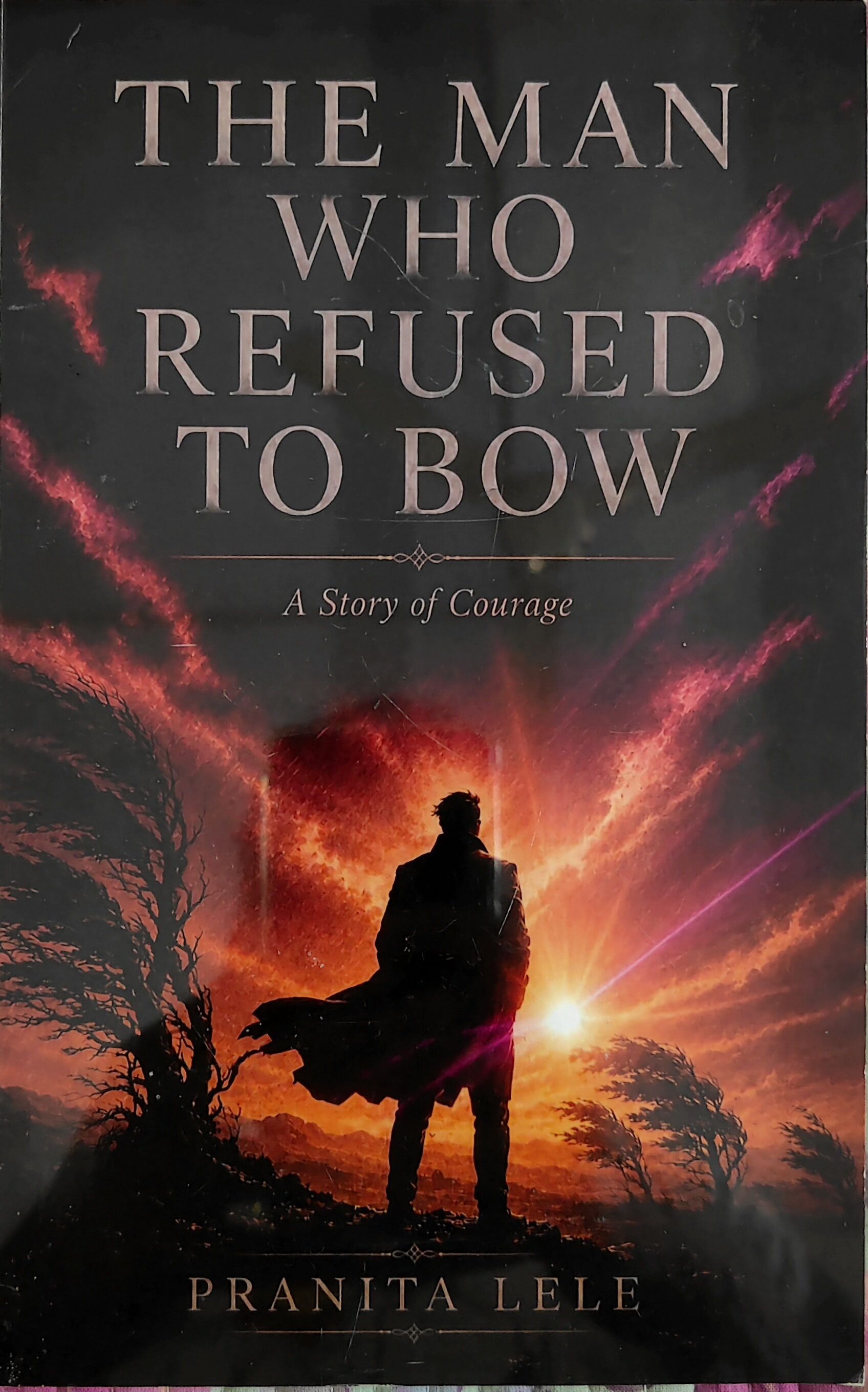
The Man Who Refused to Bow… A Story of Courage … by Pranita Lele
Reviewed by: Kamlesh Tripathi
The book is a personal account of author Pranita Lele, who is combating horrific situations that life has offered her. Her husband is suffering from Cancer. Cancer, as one can say, is the reverse of the Midas touch. Just as the Midas touch converts everything into gold, cancer can transform life into a gruelling journey. Cancer can walk into anyone’s life surreptitiously, and as an uninvited guest, without any warning, just as it walked into Vikram Lele’s life, the author’s husband. You need a Satyavati to retrieve her husband from the menace of cancer. I’m reminded of the famous story of Satyavati, Satyavan and Yama. The analogy may sound similar. Pranita and Vikram’s story evokes the celebrated episode of Savitri and Satyavan in the Mahabharata. When Satyavan suddenly fell ill while working in the forest, Savitri cradled his head in her lap. When Yama, the god of death, arrived to claim her husband’s life, she refused to abandon him and followed Yama, ultimately persuading him to restore Satyavan’s life. Truly, a kindred metaphor.
Another glimpse that one gets is of the 1963 Bollywood hit … Dil Ek Mandir, starring Meena Kumari, Rajendra Kumar and Raj Kumar. For a closer fit, consider Elizabeth Barrett Browning and Robert Browning, whose relationship involved emotional support during difficult periods, though it is not principally a story of a wife nursing a seriously ill husband.
I’m reminded of the first stanza of one of my poems titled, ‘I’m Life,’ where life says: You think you know me/Well, everyone thinks that way/But believe me/ I’m very sneaky/I’m very tricky/And I rarely play by the rules you make for me.
Spread across 40 chapters and around 170 pages, the book presents its central message in a precise, concise and accessible manner. Normally, such books are unplanned because tragedies strike without notice, and the author has to play it by ear. The narration is in easy English, in short sentences with a pleasant trickle and flow like a flowing river.
The book intertwines life’s onerous circumstances with biological calamities. Aged parents above 90. Vikram, after recovering from brain haemorrhage, falls prey to oesophageal cancer. And in this global world, one cannot expect children to be by your side always. And in these frightful circumstances, one finds author Pranita walking through a dark isthmus all by herself.
But to every downside there is an upside. The world survives because of the balance. The plane has wings. It will glide through high turbulence, provided the pilot is competent and the support system is good. This is where the Oncology Department of Max Hospital Lucknow comes into play. Its team of doctors and support staff extended extensive support to Vikram and Pranita throughout the treatment. The subject book is definitely to honour the entire team of Max Hospital.
The author has painstakingly acknowledged friends and relatives, contacts, including overseas contacts and hospital staff, for what they did for Vikram.
The book doesn’t bear a sombre and morose tone. It is filled with lively episodes that take you away from the pain of the patient and the family.
The author has used the correct terminology in terms of describing each stage of illness. The narrative helps in building the doctor-patient relationship. The narration has a separate chapter for each doctor and support staff. It describes Chemotherapy, Radiation, immunotherapy, and targeted therapy in simple language.
Pranita Lele’s steadfast companionship also recalls the enduring ideal of marital devotion found in English literature. In John Milton’s Paradise Lost (there is a thematic echo), Adam and Eve’s relationship, despite its trials and consequences, explores the profound bond between husband and wife. While the circumstances differ considerably from Vikram and Pranita’s struggle with cancer, the work invites reflection on companionship when life becomes difficult. Pranita’s story brings this ideal into the everyday world of medical appointments, uncertainty and caregiving, showing how commitment is expressed not merely through words but through continued presence and practical acts of love…. A real page-turner.
Written and posted by Kamlesh Tripathi
Author, Poet, & Columnist
Appreciation received from a reader.
Wow .I read the article .So well written .His writing proves that he is an highly intellectual person .So much depth and meaning in his writing . Great work Pranita .I am sure and confident with all your support ,prayers and positivity Vikram will be fine .Our prayers and best wishes are always with you both .God bless .👍❤️❤️❤️
Shravan Charity Mission is an NGO that works for poor children suffering from life-threatening diseases, especially cancer. Our posts are meant for our readers, including children and adults, and have a huge variety of content. We also accept donations for our mission. Should you wish to donate to the cause of cancer? The bank details are given below:
QUOTES 1/10/26 * An unjust law is itself a species of violence. Arrest for its breach is more so… MAHATMA GANDHI * Let us cherish and love old age; for it is full of pleasure if one knows how to use it. Fruits are most welcome when almost over; youth is more charming at its close…Each pleasure reserves to the end the greatest delights which it contains…SENECA, Letters from a Stoic * ‘I have always been wandering/seeking my inner self/ As I am myself the voyager/ and the destination.’ …Poet Iqbal * The Warren Buffet family motto might have been “spend less than you make,” with the corollary “don’t go into debt”. * Don’t ask the barber whether you need a haircut * Praise by name, criticise by category * ‘Law and order represent the largest circle within which is the next circle representing ‘public order’ and the smallest circle represents ‘Security of state’s … JUSTICE HIDAYATULLAH * The man who exceeds in fearlessness has no name…but he who exceeds in confidence is rash…and he who exceeds in fearing and is deficient in confidence is a coward… ARISTOTLE * While there may be an immigration problem, it isn’t really a serious problem. The really serious problem is assimilation… SAMUEL P HUNTINGTON * Generations to come will scarcely believe that such a man ever walked the earth…said ALBERT EINSTEIN on Mahatma Gandhi. * Spinning to me is the means to establish communion with God, and khadi is the symbol of unity of Indian humanity… MAHATMA GANDHI * Those who ‘abjure’ violence and do so only because others are committing violence on their behalf… GEORGE ORWELL * Blessed is the servant who loves his brother as much when he is sick and useless as when he is well and an be of service to him. And blessed is he who loves his brother as well when he is far off as when he is by his side… ST FRANCIS OF ASSISI